Author:Ryan Fraser
Universityof Guyana:Facultyof Technology
GeologyDepartment
DATE: 16TH
APRIL,2016
Near-term Future of Oil & Gas Exploration in Guyana
Research Paper
GEM3201 GEOLOGY OF GUIANA SHIELD
1
Table of Contents
Oil & Gas Background..........................................................................................................3
Geological setting of the Guyana-Suriname Basin: .............................................................5
History of Oil & Gas Exploration: .........................................................................................9
Key Oil & Gas Exploration Companies Players in Guyana Offshore Basin:.....................15
Basin Potential According to the United States Geological Survey (USGS)....................16
Offshore and Onshore Block Licence Map:..................................................................17
Petroleum Exploration & Production Licence, Block Reference Map of Onshore and
Offshore Concessions........................................................................................................18
Guyana’s Attractiveness for Petroleum Ventures:..........................................................19
The Significant Guyana Oil Discovery:..............................................................................20
Roughly Quantified Financial Impact to Exxon Mobil:...................................................20
This Oil Is a "Game Changer" for Guyana: .....................................................................21
The Venezuelan Curveball: ............................................................................................21
Bottom Line:...................................................................................................................23
ExxonMobil’s Looming Downgrade..................................................................................24
ExxonMobil Pre-Feed bids for Liza-1 Well Guyana..........................................................25
Near-term Future of Oil & Gas Exploration in Guyana....................................................26
Crude Oil Price Forecast: Long Term 2016 to 2025 | Data and Charts..........................26
Petroleum Politics: OPEC - Organization of Petroleum Exporting Countries ................33
Availability of Infrastructure:............................................................................................34
Infrastructure and Construction Needs: Current Construction Sector and Capacity....34
Infrastructure Constraints and Needs ...........................................................................34
Port facilities ..................................................................................................................34
Other Direct Infrastructure............................................................................................35
Utilities and Transport ...................................................................................................36
Public Services and Facilities..............................................................................................37
Private Sector Facilities..................................................................................................37
Social-Economic Impacts: ..............................................................................................38
Role of local Banks ............................................................................................................39
2
Oil & gas Industry funding challenge.............................................................................39
Banking sector appetite for oil and gas investments ....................................................40
Equity Financing:............................................................................................................40
Debt Financing: ..............................................................................................................41
Potential Benefits to Businesses:...................................................................................42
Recent exploration drilling activities in Guyana-Suriname Basin......................................43
Previous Exploration Program (2010-2012): .....................................................................43
Current Exploration Program (2015-2016): Source CGX May 2015 Presentation ............44
Liza-1 Discovery by ExxonMobil Corp., Stabroek Block Area March 20th, 2015................45
Future of other drilling activity in Guyana-Suriname basin:..............................................46
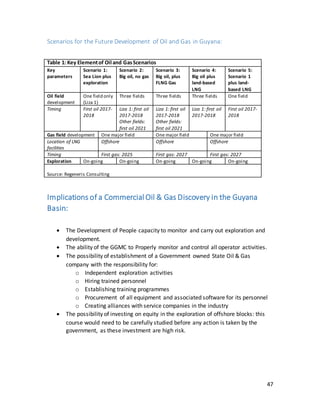
Scenarios for the Future Development of Oil and Gas in Guyana:................................47
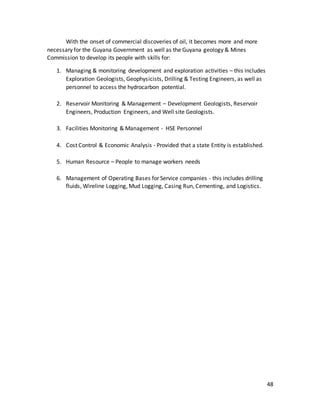
Implications of a Commercial Oil & Gas Discovery in the Guyana Basin:.......................47
Discussion ..........................................................................................................................49
Conclusion..........................................................................................................................51
References.........................................................................................................................52
3
Oil & GasBackground
Guyana is divided into two Petroleum Basins named Guyana and Takutu,
respectively. The Guyana Basin is further divided into two basins, Onshore and
Offshore. Herein is a synopsis of the Basins.
Onshore Guyana Basin
The deepest part of the southern “boundary” is some 150 miles from the
Guyanese Coastline. NABI Oil And Gas, Inc. and ON ENERGY Inc. companies have
concessions within this part of the Basin.
Within the Onshore Guyana Basin, there was a chance of these blocks being
subjected to competitive bidding, however this does not take away any one’s
prerogative to apply for concessions within this area. There were 13 wells drilled within
this part of the Basin from 1916 to present day. Only Rose Hall-1 drilled in 1941 and
Drill-1 in 1967 had oil shows. The eastern part of the Onshore Guyana Basin has the
largest thickness of sediments reaching some 2,500 m. It should also be noted that the
gas found on the coast is nearly all biogenic, with a very small area yielding thermogenic
gas.
Offshore Guyana Basin
REPSOL, ANADARKO, ESSO/HESS/NEXEN, Mid-Atlantic Oil and Gas, Inc., RATIO
Energy/Guyana Ltd and CGX Resources Inc. have petroleum concessions in this part of
the basin. Presently, a number of companies are negotiating for concessions in the
offshore Guyana Area.
On the aspect of Offshore Guyana Basin, from the nearshore to around 80 miles
to the north, the seabed is generally on the continental shelf then it moves to the slope
and as one gets further it reaches the deep-water area. From the northwest (where the
Anadarko concession is) to the Northeastern area depths can be from 1,000 feet to
more than 10,000 feet. This area is known as the “ultra-deep waters”. In May 2015,
ESSO made a significant discovery of petroleum while drilling in its Stabroek Block.
Guyana has never had a commercial petroleum discovery, although there are a
number of wells that had oil and gas shows both onshore and offshore. Prior to the
ESSO discovery, our “best” well has been Karanambo-1 well drilled by Home Oil in the
Takutu Basin in 1982.
Takutu Basin
Located in the southwestern area of Guyana lies the Karanambo-1 well, which
was drilled in 1982 by Home Oil Company. This was the best prospect drilled within this
Basin. Located in southwestern Guyana a small amount of light crude was
4
accrued. Tests conducted on samples from Karanambo-1 found that the oil is of good
quality (420API) and is of a “sweet” variety, that is, it contains less than 0.5% hydrogen
sulphide. However, its geological characteristics are mainly naturally fractured
reservoirs, thus proving more difficult to find commercial petroleum than regular
reservoirs. The other wells drilled in the Takutu are Lethem-1 (1980), Turantsink-1
(1992) and Apoteri K2 well (2011).
5
Geological setting of the Guyana-Suriname Basin:
Brief Overview
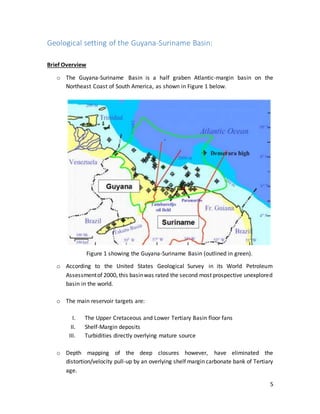
o The Guyana-Suriname Basin is a half graben Atlantic-margin basin on the
Northeast Coast of South America, as shown in Figure 1 below.
Figure 1 showing the Guyana-Suriname Basin (outlined in green).
o According to the United States Geological Survey in its World Petroleum
Assessmentof 2000, this basinwas rated the second most prospective unexplored
basin in the world.
o The main reservoir targets are:
I. The Upper Cretaceous and Lower Tertiary Basin floor fans
II. Shelf-Margin deposits
III. Turbidities directly overlying mature source
o Depth mapping of the deep closures however, have eliminated the
distortion/velocity pull-up by an overlying shelf margin carbonate bank of Tertiary
age.
6
History of the Basin
o The Guyana-Suriname Basin evolved from a failed rift arm which extends to the
Takatu Basin in an easterly trend straddling the borders of Guyana and Brazil.
o It is bounded to the South and North by the Demerara Plateau high and the
Pomeroon Arch respectively and is described as a trap door structure plunging
from the Pomeroon Arch and impinging against the Demerara Plateau.
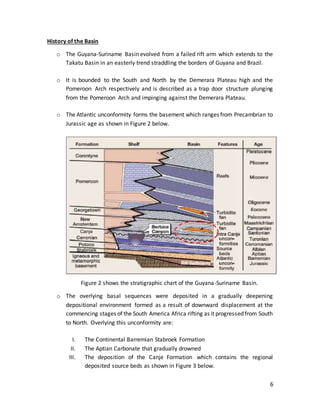
o The Atlantic unconformity forms the basement which ranges from Precambrian to
Jurassic age as shown in Figure 2 below.
Figure 2 shows the stratigraphic chart of the Guyana-Suriname Basin.
o The overlying basal sequences were deposited in a gradually deepening
depositional environment formed as a result of downward displacement at the
commencing stages of the South America Africa rifting as it progressed from South
to North. Overlying this unconformity are:
I. The Continental Barremian Stabroek Formation
II. The Aptian Carbonate that gradually drowned
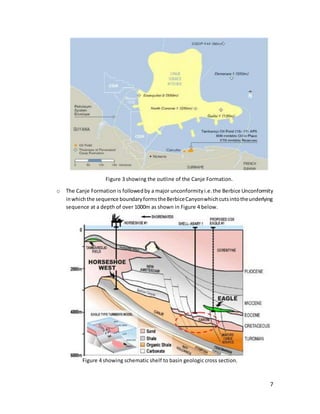
III. The deposition of the Canje Formation which contains the regional
deposited source beds as shown in Figure 3 below.
7
Figure 3 showing the outline of the Canje Formation.
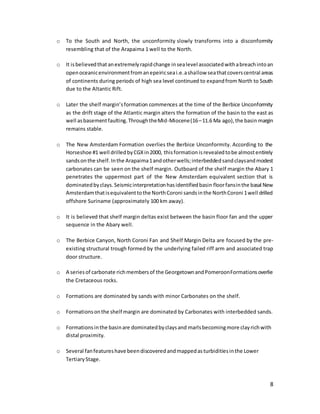
o The Canje Formation is followedby a major unconformityi.e.the Berbice Unconformity
inwhichthe sequence boundaryformstheBerbiceCanyonwhichcutsintotheunderlying
sequence at a depth of over 1000m as shown in Figure 4 below.
Figure 4 showing schematic shelf to basin geologic cross section.
8
o To the South and North, the unconformity slowly transforms into a disconformity
resembling that of the Arapaima 1 well to the North.
o It isbelievedthatanextremelyrapidchange insealevel associatedwithabreachintoan
openoceanicenvironmentfromanepeiricseai.e.ashallow seathatcoverscentral areas
of continents during periods of high sea level continued to expandfrom North to South
due to the Altantic Rift.
o Later the shelf margin’sformation commences at the time of the Berbice Unconformity
as the drift stage of the Atlantic margin alters the formation of the basin to the east as
well asbasementfaulting.ThroughtheMid-Miocene(16–11.6 Ma ago),the basin margin
remains stable.
o The New Amsterdam Formation overlies the Berbice Unconformity. According to the
Horseshoe #1 well drilledbyCGXin2000, thisformationisrevealedtobe almostentirely
sandsonthe shelf.Inthe Arapaima1andotherwells;interbeddedsandclaysandmodest
carbonates can be seen on the shelf margin. Outboard of the shelf margin the Abary 1
penetrates the uppermost part of the New Amsterdam equivalent section that is
dominatedbyclays.Seismicinterpretationhasidentifiedbasin floorfansinthe basal New
Amsterdamthatisequivalenttothe NorthCoroni sandsinthe NorthCoroni 1well drilled
offshore Suriname (approximately 100 km away).
o It is believed that shelf margin deltas exist between the basin floor fan and the upper
sequence in the Abary well.
o The Berbice Canyon, North Coroni Fan and Shelf Margin Delta are focused by the pre-
existing structural trough formed by the underlying failed riff arm and associated trap
door structure.
o A seriesof carbonate richmembersof the GeorgetownandPomeroonFormationsoverlie
the Cretaceous rocks.
o Formations are dominated by sands with minor Carbonates on the shelf.
o Formationsonthe shelf margin are dominated by Carbonates with interbedded sands.
o Formationsinthe basinare dominatedbyclaysand marlsbecomingmore clayrichwith
distal proximity.
o Several fanfeatureshave beendiscoveredandmappedasturbiditiesinthe Lower
TertiaryStage.
9
o The depositionof the CorentyneFormationcommencinginthe Mid-Miocene oversteps
the shelf edge asthe clasticdominatedsurge fromthe Andeanupliftisdepositedby
continuesintothe presentday.
History of Oil & Gas Exploration:
Oil and gas exploration and evaluation refer not only to the evaluation of proven
resource and the scope for exploiting it economically, it also includes the techniques used
to identify areas with resource potential and to determine development prospects.
There are three distinct phases to the process of evaluation:
 Evaluating the resource potential of an area in the prospecting phase so as, for
example, to help in coming to a decision about the acquisition of development
rights;
 Evaluating development prospects as part of their exploration phase, so as, for
example to decide whether a structure merits exploratory drilling;
 Evaluating the economic value of an oil or gas find.
These three phases in the search for and development of oil and natural gas may be
further divided into a number of different sub-stages.Atthe conclusion of eachevaluation
phase it is possible to make an assessment of the available reserves, but the degree of
accuracy willreflect the levelof detailin the preliminary surveys. In areas which have only
been identified as possibly having hydrocarbon potential, speculative guesses are all that
are possible where there is to be exploratory drilling of an actual structure, it is possible
to make estimates of the available reserves; when dealing with a confirmed deposit, then
precise calculations of the actual reserves may be made. (Kehrer, 1983).
Earliest Observations, exploration borehole at Waini estuary, near Punta Playa
The first oil exploration in British Guiana was based on reports of oil and gas seeps
dating back to the eighteenth century, when Dutch explorers noted the occurrence of
flotsam pitch near Krukenkal Point, nine mile south-east of Punta Playa, and recorded
hydrocarbon indications. When investigated in the mid-1850s these seeps proved to be
insignificant. The first oil exploration borehole, sunk to investigate these seeps,
encountered droplets of tarry oil.
10
Coastal Artesian Water Wells strike Methane Gas
In the early 1900s several coastal artesian wells intersected small quantities of
methane gas.Onesignificant occurrence was from awell drilled in 1926 at Plantation Bath
on the west coast of Berbice, which supplied enough gas for use on the local sugar estate.
The gas was marsh gas which is not associated with petroleum.
First Prospecting Licence granted on 1938; Onshore Investigations by Trinidad
Leaseholds
The first prospecting licence was granted to Trinidad Leaseholds Company Ltd. In
1938. With partners Central Mining AND Investments Corporation, they conducted
seismic refraction and reflection surveys to determine the location of structures. This led
to the sinking of a well, Rose Hall,near Barama landing on Canje Creek in the deepest part
of the on-shore extension of the Guyana Basin. The well ended 6,465ft in the basement.
A few oil droplets were noted at 6079 feet. Trinidad Leaseholds relinquished their licence
in 1942 and no further exploration was undertaken for more than a decade.
1950s- Regional Survey by Standard Oil
In 1958, Standard Oil of California, United States, acquired exploration rights to
most of the continental shelf. They carried out a regional survey but no wells were sunk.
1960s- On and Off-shore surveys by Geological Survey, SHELL, CONOCO: More than
eight well sunk- two off shore
The water stratigraphic boreholes, sponsored by the GeologicalSurvey, were sunk
in 1961. These two holes encountered heavy oil droplets just above basement, but no
commercial potential was indicated. The Geological Surveys also drilled several shallow
stratigraphic boreholes in the Takatu Basin.
In 1965 Licences were granted to SHELL for on and off-shore exploration and to
CONOCO for off-shore exploration. CONOCO then assigned 50% of its rights to TENECO.
SHELL conducted seismic surveys in 1965-66, and started a drilling campaign in 1966. In
1966-67, they sank six wells to obtain stratigraphic information and to test for heavy oil
along the fringe of the Guyana Basin. Reportedly only Drill 1 well near Mahaicony
encountered indications of hydrocarbons.
The CONOCO/TENECO partnership sank two off-shore wells in 1967, the Guyana
Off-shore 1 and Off-shore 2, 100km to the east. Guyana Off-shore 1 was terminated at
11
8930 feet, encountering gas shows between 2275 and 6200 feet. Guyana Off-shore 2
proved to be a dry well with minor gas shows at 7284 and 7626 feet.
In the latter part of the 196-s SHELL conducted off-shore seismic surveys, with no drilling.
1970s- Focus on Off-shore Basin, On-shore Takatu Basin: Seven wells sunk by SHELL,
OXCO, CONOCO,DEMINEX
In 1971-1972, Terra Surveys of Canada completed an aeromagnetic survey which
served to create interest in the Takatu Basin. As a result COMORO and the Geological
Survey jointly surveyed the Takatu basin.
In 1971 SHELL, OXCO and CONOCO undertook off-shore seismic surveys and
formed a consortium to sink the Berbice 1 test well. Oil indications were intersected at
7124 feet, before drilling and structural problems forced the abandonment of the well at
7380 feet. The Berbice 1 well was then diverted from 5090 feet to a final depth of 12500
feet, ending in upper Eocene sediments. Although many gas shows were indicated
throughout the section the well was deemed dry and abandoned.
Five holes were drilled in 1974, four by SHELL, and one by DEMINEX. Shell drilled
Mahaica 1 which terminated at 8014 feet in Paleocene sediments. Although reservoir
quality was found to be adequate, no oil shows were seen. SHELL folled-up the dry but
promising Berbice 1 well drilled in 1971 with the Berbice 2 which terminated at 10,049
feet in Upper Oligocene sediments. A production test did not find oil, even though gas
was very evident during drilling and oil-stained siltstones were found. SHELL’s third well
at Abary 1 sunk in the deepest part of the offshore basin close to a targeted seismic
horizon, encountered heavy gases and oil. The well was abandoned without being tested,
because the operators could not control it. Their fourth wellMahaica 2 was located closer
to the shore than Mahaica 1. It gave indications of good reservoir characteristics, but no
hydrocarbon shows were found and the well was terminated at 7500 feet in Paleocene
sediments.
DEMINEX drilled Essequibo 1, which the abandoned at 11,199 feet in lower
Miocene sediments. Several oil shows were noted from 7,000 feet to the bottom of the
well. DEMINEX went on to drill Essequibo 2 in 1976-77 to test a structure in the
Cretaceous section, and was discouraged to find only three minor methane gas shows.
Considering the project as unsuccessful, DEMINEX relinquished it licence in 1977.
In 1979 Home Oil of Canada obtained permission to explore the Takutu Basin, and
they conducted a seismic survey in the western half of the concession.
12
1980s – Drilling at Takutu: Discovery Well by Home Oil at Karanambo 1…
A Denison/Seagull partnership understood off-shore seismic surveys in 1980, with
follow-up surveys 1982. There was no drilling.
By far the most successful oil exploration to date was Home Oil’s programme of
1981 and 1982, when they sank the Lethem 1 and Karanambo 1 wells in the Takutu Basin,
striving oilflowing at 400 barrels aday inKaranambo 1, in the northwest of the concession
struck oil from fractured Apoteri volcanics of Jurassic age. It is thought that the source of
the oil may have been the Manari Shales the strategically underlie the Apoteri volcanics.
Home Oil could not find partners to continue their drilling programme and no additional
work was done.
The Petroleum Exploration Promotion Project
In, 1984 the World Bank provided financial and technical support for a project to
synthesize petroleum all exploration data in Guyana, to formulate and enact legislation
for petroleum and gas exploration and production, and to actively promote Guyana’s
petroleum exploration potential. Promotional Seminars were held in London and
Houston, Texas. The success of this project was demonstrated by the grant of two off-
shore exploration licences to LASMO/BHP and PETREL/Guyana Exploration Limited (GEL)
in 1988. LASMO/BHP completed additional off-shore seismic surveys in 1989.
1990s – Turantsink 2 sunk at Takutu; Arapaimal sunk Off-shore to test Carbonate
Formations
Ten years after Home Oil’s discovery of oil in Karanambo 1 well in fractured
Apoteri volcanics of the Takutu Basin, Guyana Hunt Oil drilled Turantsink 1 well 25 miles
south of Karanambo 1 at the northern edge of the Takutu basin in December 1992, to
investigate the possibility of the presence of a lacustrine fandeltaic systemwith pervasive
sandstone units and to test for the closure of the oil bearing structure.
The fan delta theory was not confirmed but the faulted structural closure was
located. Instead of a deltaic sand sequence, more than 2,000 feet of evaporate consist of
halite (NaCl) with subordinate slyvite (KCL) was intersected. Oil shows were found in
several sections. The well was abandoned in 1993 at a depth of 11,600 feet, in Apoteri
volcanics. Hunt Oil relinquished their Takutu concession at the end of 1993.
TOTAL joined with PETREL/gel in 1989, and the group sank the Arapaima 1 off-
shore well in 1991-92 to test the upper and lower Cretaceous calcareous shale reef
formations along the edge of the Guyana off-shore basin. Reasonably good reservoir
13
quality was found in sandstone but the calcareous formations had low porosities. Gas
shows were found in certain horizons. The well abandoned at 11,090 feet.
Proposal for Off-shore wells frustrated by Companies (LASMO/BHP; PETREL/GEL;
MOBIL) Inability to Raise Funds
In 1991 MOBIL acquired rights for off-shore exploration and commenced a
geophysical and geochemical exploration programme. LASMO/BHP failed to raise funds
for their proposed drill programme which was based on the results of their off-shore
seismic survey completed in 1989. They withdrew in 1991. Likewise, the PETREL/GEL
partnership could not attract funding for additional exploration and they withdrew in
1992. MOBIL also could not attract partners to jointly drill a well and they withdrew in
1994.
South America Mapping Project (SAMMP)
The Geology and Mines Commission participated as an associate member in the
South American Mapping Project (SAMMP) undertaken between October 1992 and
October 1995. SAMMP was sponsored by six major oil and mining companies (AMOCO,
BHP, CONOCO, EXXON, JNOC and UNOCAL), to gather the maximum available
aeromagnetic and marine magnetic data on the south American continent and its off-
shore continental margin, to compile, catalogue =, display and prepare a digital dataset
of such data and produce a comprehensive report.
Free of any cost, GGMC will benefit through the project by the acquisition of a
decamped, gridded magnetic dataset for Guyana which GGMC can use and distribute
after paying a royalty charge to PGW- Paterson, Grant and Watson.
New Round of Petroleum Exploration Promotion by PETREL
Oil exploration ground to a halt in 1994, ostensibly for lack of funding for drilling
programme. In an effort to revive exploration the government of Guyana in October 1995
entered into an initial six months promotional agreement with PETREL who undertook to
bring companies to Guyana to carry out exploration in the Georgetown off-shore
Exploration Block. The initial contract is renewable for a further three months period.
This agreement gives PETREL exclusive rights to promote the Georgetown off-
shore Block.
14
Shell's Abary-1 well, drilled in 1975 in what is now Repsol YPF’s Georgetown
license, found oil and gas shows, and flowed 37° API light oil.
Through the latter part of the 1980s and into the 1990s, Mobil, Total, Guyana
Exploration and BHP continued the exploration effort.
The most recent offshore activity occurred in mid-2000, when CGX Energy
attempted to spud a well on its Eagle prospect. However, the rig was run off its location
by Surinamese gunboats, which claimed that it was in Surinamese waters. This was part
of a long-running dispute between the two countries over the maritime border.
CGX was forced to move the rig and went on to drill its Horseshoe West prospect
in the Corentyne block. The well failed to encounter commercial quantities of oil or gas
due mainly to the absence of a shale seal. The company also drilled three onshore wells
during 2005 on its Berbice Block, through its operating stake in the ON Energy JV, but all
three were also dry holes.
No further drilling has taken place offshore Guyana since. In September 2007, the
century old border dispute between Guyana and Suriname was finally settled by the
United Nations International Tribunal of the Law of the Sea (ITLOS).
Guyana was awarded 33,000 square kilometers, the majority of the acreage under
dispute, with Suriname awarded the remaining 17,800 square kilometers.
This allowed Repsol YPF to drill a well offshore Suriname earlier that year in Block
30. Unfortunately, its WestTapir prospect came in dry, yet another disappointing offshore
result in the basin. However, the Guyana Basinremains hugely under-explored and hopes
for exploration success remain high.
15
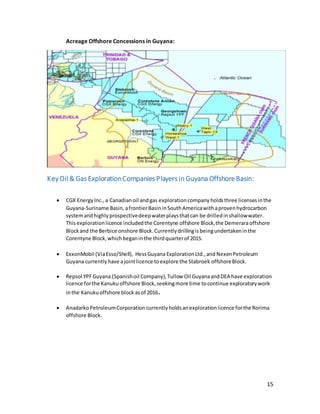
Acreage Offshore Concessions in Guyana:
KeyOil& Gas ExplorationCompanies Playersin Guyana OffshoreBasin:
 CGX EnergyInc.,a Canadianoil andgas explorationcompany holdsthree licensesinthe
Guyana-Suriname Basin,afrontierBasininSouthAmericawithaprovenhydrocarbon
systemandhighlyprospectivedeepwaterplaysthatcan be drilledinshallowwater.
Thisexplorationlicence includedthe Corentyne offshore Block,the Demeraraoffshore
Blockand the Berbice onshore Block.Currentlydrillingisbeingundertakeninthe
Corentyne Block,whichbeganinthe thirdquarterof 2015.
 ExxonMobil (ViaEsso/Shell), HessGuyana ExplorationLtd.,and NexenPetroleum
Guyana currentlyhave ajointlicence toexplore the Stabroek offshoreBlock.
 Repsol YPFGuyana (Spanishoil Company), Tullow Oil GuyanaandDEA have exploration
licence forthe Kanuku offshore Block,seekingmore time tocontinue exploratorywork
inthe Kanukuoffshore block asof 2016.
 AnadarkoPetroleumCorporation currentlyholdsanexplorationlicence forthe Rorima
offshore Block.
16
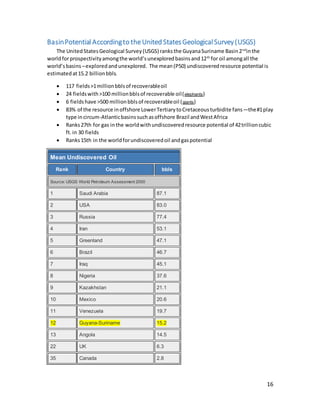
BasinPotential Accordingto theUnited StatesGeologicalSurvey(USGS)
The UnitedStatesGeological Survey(USGS) ranksthe GuyanaSuriname Basin2nd
inthe
worldforprospectivityamongthe world’sunexploredbasinsand12th
for oil amongall the
world’sbasins –exploredandunexplored. The mean(P50) undiscoveredresource potential is
estimatedat15.2 billionbbls.
 117 fields>1millionbblsof recoverableoil
 24 fieldswith>100 millionbblsof recoverable oil(elephants)
 6 fieldshave >500 millionbblsof recoverableoil (giants)
 83% of the resource inoffshore LowerTertiarytoCretaceousturbidite fans—the#1play
type incircum-Atlanticbasinssuchasoffshore Brazil andWestAfrica
 Ranks27th for gas inthe worldwithundiscoveredresource potential of 42trillioncubic
ft. in 30 fields
 Ranks15th in the worldforundiscoveredoil andgaspotential
Mean Undiscovered Oil
Rank Country bbls
Source: USGS World Petroleum Assessment 2000
1 Saudi Arabia 87.1
2 USA 83.0
3 Russia 77.4
4 Iran 53.1
5 Greenland 47.1
6 Brazil 46.7
7 Iraq 45.1
8 Nigeria 37.6
9 Kazakhstan 21.1
10 Mexico 20.6
11 Venezuela 19.7
12 Guyana-Suriname 15.2
13 Angola 14.5
22 UK 6.3
35 Canada 2.8
17
Offshore andOnshore Block Licence Map:
18
Petroleum Exploration & Production Licence, Block Reference Map
of Onshore and Offshore Concessions.
19
Guyana’s Attractiveness for Petroleum Ventures:
What is so attractive about Guyana for Petroleum Ventures?
Accordingto a WorldPetroleumAssessmentin 2000, the UnitedStatesGeological Survey
(USGS) identifiedthe Guyana-Suriname Basinashavingthe secondhighestresource potential
amongunexploredoil basinsinthe worldandcurrentlyestimatesmeanrecoverableoil reserves
of over15.2 billionbbls andgasreservesof 32 trillioncubicft.
Moreover, giventhisreportbythe USGS, the prospectsof Oil & Gas findsinGuyana
have great potential. The estimate forthe entire GuyanaBasin standscurrentlyat 2.2 billion
barrelsand6 trillioncuft.or 28.3 billioncubicmetresof gas, if full exploitationof these
resourcesare encouraged.
Likewise,otherkeyfactorsof Guyana’sattractivenessinclude:
 Political stability –A stable conducive atmosphere,encouragespetroleumcompaniesto
do businessinGuyana.
 Geographiclocation – Coastal/Offshore areathuseasiershipping,rigmovements(as
againstthe Takutu Basin)
 Culture - Guyanese have strongworkethic;are easilytrainedinskills.
 Legal,RegulatoryandContractual framework –CurrentPetroleumlegislationis Not
cumbersome andtechnicallysound
 Service Industryveryclose inTrinidad,Venezuela,Suriname,eventhe Gulf of Mexico.
20
The Significant Guyana Oil Discovery:
On May 20th, 2015, ExxonMobil announcedanoil discoveryinthe NorthAtlanticOcean
off the coast of the SouthAmericancountry,Guyana.
In the pressrelease bythe company,the discoverywasdescribedas"significant."Itwas
the resultof drillingwhichhadbegunonMarch 5th, 2015.
Detailsincluded:
 Oil foundinthe StabroekBlock
 Well withlarge productionpotential
 ProjectedmajoreconomicimpactonGuyana'seconomy
 Improvedfuture prospectsforExxonMobil
 Rise of territorydispute betweenVenezuelaandGuyana
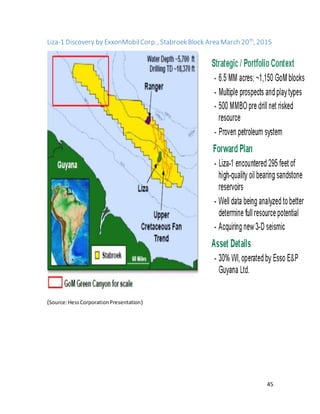
The discovery of Oil wasmade in the StabroekBlock,whichislocated120 miles(193
kilometers) off the shore of Guyanaandspreadsoveran area of 6.6 millionacres(26,800 square
kilometers) inthe AtlanticOcean. The well calledLiza-1,drilledby ExxonMobil affiliate,Esso
ExplorationandProductionGuyanaLtd., is5,719 feet(1,743 meters) below sealevel.Itwas
drilledto17,825 feet(5,433 meters).The drilling of thiswell resultedinthe discoveryof a
sandstone columnsoakedwithgasandoil.The reservoirhasa depthof 295 feet(90 meters) and
contains oil thatof ishighquality accordingto ExxonMobil.
However,thisOil findinthe StabroekBlockdoesnot belongsoleytoExxonMobil,butit is
rather dividedupamongthree stakeholders.Viaitsaffiliate,EssoExplorationandProduction
Guyana Ltd.,ExxonMobil holdsa share of 45 percentinthe venture.HessGuyanaExploration
Limited,whichispartof the NY-basedHessCorporation(NYSE:HES),hasa stake of 30 percent.
The smallestshare of 25 percentbelongstothe Chinese CNOOCNexenPetroleumGuyana
Limited.
Roughly Quantified Financial Impact to Exxon Mobil:
The productionpotential of the newlydrilledLiza-1wellisprojectedtobe more than
700 millionbarrelsof oil.ThisestimatewassharedbyGuyana'sministerof governance,Raphael
Trotman,who saidthat itcame from"expertsoutside of Exxon."Interestingly,inthe official
statementannouncingthe discovery,Exxongave noofficial estimateof the well'sproduction
potential.
The presidentof ExxonMobil ExplorationCompany,StephenM.Greenlee,sharedthat
the value andcommercial viabilityof the foundresource wouldbe determined"overthe coming
months."The companyhas notmade an official commentonthe estimate presentedby
Trotman.
21
If it is correct,thiswouldmake the well worth$ 22 billion atthe currentcrude oil price
inthe internationalmarket(ataround$31.5 per barrel).Anotherestimate made bythe minister
of governance isthatthe Liza-1 well willstartproducingcrude oil infive years'time orseven
years'time at the most.
Therefore,toquicklysummarize,if the $22billionisaccurate,ExxonMobil'sshare is
about$9.9billionat the $31.5 perbarrel estimate,andthatwill be meaningful inabout5-7
years.And for evenmore perspective,thisdiscoveryisabout3.3% of ExxonMobil's$300B
currentmarketcap.
This Oil Is a "Game Changer" for Guyana:
It's worthnotingthat if the estimatesare correct,the oil productionfromthiswell can
bringa dramatic change to the economyof Guyana verysoon.At present,the countrydoesnot
produce any oil andreliesprimarilyonlow tomediumscale miningof lumber, diamondsand
gold,withthe exceptionof afewlarge scale goldoperationsbyTroyResourcesLtd.,and
Goldfieldsatmediumcapacityoperation.
In 2014, Guyana had GDP of $3.228 billion,accordingtodata fromthe World Bank.In
the Bank's GDP countryranking,it held163th positionwhichisthe lowestinthe groupof South
American countries.Withitsvalue of $22 billionatcurrentcrude oil prices,the Liza-1well
exceedsGuyana'sGDP6.815 times.Thiscouldgive the largelyundevelopedcountryamajor
economicboost,whichwouldhave apositive impactinimportantfieldssuchasinfrastructure
and social policy.
However,the keypointof thisdiscoveryisthatExxonMobil,andothershareholders,will
be able to prettyeasilydictate termsandgethighlyfavorable treatmentfromthe Guyana
Government.
The Venezuelan Curveball:
The oil discoveryinGuyanacomesat a difficulttime forExxonMobil.Itcanbe seen asa
brightspotin a dark time.The companymarkeditsworstfinancial performance inroughlya
decade.XOMannouncedearningsof $4.2 billionmarkingadecrease of 52 percentcomparedto
Q2 of 2014.
ExxonMobil alsofellshortof the expectationsforearningsof $1.11 per share hitting$1
instead.EventhoughExxon'soil andgasproductionoutputgrew by3.4 percentto 4 million
barrelsoil equivalentperday,plungingoil priceshave hadamajordownwardimpacton
earnings.
22
Therefore,withthe developmentof the Liza-1well inGuyana,the company'sassetsand
profitcouldgrowsignificantlywithanalystsclaimingthatthiscouldevenbe the startof a revival
for the Texas-basedCorporation.
Moreover, ExxonMobil isnotthe onlycompanyinGuyana’soffshore waters,thereare
othercompaniesparticipatinginthisspace too.The listincludescompanieslikeTullowOil
(OTCPK:TUWLF) andAnadarko(NYSE:APC).TwoCanadiancompanies,PacificRubialesandCGX
Energy(OTCPK:CGXEF),are toexplore ablockinclose proximitytothe Liza-1well.
Howevertodate,the onlymajorchallenge infrontof the productionof oil inthe
StabroekBlockisthe dispute betweenVenezuelaandGuyana overthe regionwhichitis in.This
dispute hasa longhistoryanddatesback to the 19th century.In 1899, an international tribunal
ruledthatthe territorycalled “Essequibo”alongwithitscoastal watersbelongedtoGuyana,but
Venezuela,Guyana’sWestern neighborrefusedtoacceptthe ruling.
Notably,this dispute hadsubsidedduringthe presidencyof HugoChavez,butwas
sparkedagainby hissuccessorNicolasMadurojustone weekafterthe announcementof the oil
discovery.Thisrenewedsparksawthe Presidentof Venezuelaissuingadecree whichclaimed
sovereigntyof the disputedregion.The foreignministerof the country inpressstatements
referredtothe oil explorationmade byExxonaspolitical provocation.
Guyanese officialsadmitthatinvestorshave beenintimidatedbythe recent
developments,butare alsomakingeveryefforttoencourage the continuationof the
explorationactivity.The country'spresident,DavidGranger,beganacampaignfor gaining
international supportatthe CaribbeanCommunity(CARICOM) summitinBarbadosinJuly
continuingatthe UnitedNationsGeneral AssemblyinSeptember.PresidentMadurohasalso
beenmakingeffortstofindmembersof the international communitythatwill backhimup.
International Political Analystsandpredictthathisactions are gearedtowardsreducingpolitical
tensioninhisowncountryand that he would nottake militaryaction.The changingof the
establishedborderbetweenGuyanaandVenezuela atthisseemshighlyunlikely.
ExxonMobil hasmade nocommentonthe recentdevelopmentsinthe relations
betweenthe twocountries,eventhoughPresidentMaduromade indirectaccusationagainst
the company.He advisedGuyananotto take "bad advice"fromExxonMobil orfromofficials
"bribed"byit.
Venezuelaandthe largestoil producer(ExxonMobil) inthe worldhave notbeenon
goodterms since 2007 whenthe local governmentnationalizedthe company'sassetsinthe
country.In 2014, an international tribunalof the WorldBankruledthat Venezuelamustpay
Exxon$1.6 billioninthe formof compensation,butnoactionhas beentakensofar.
The historyof the Venezuelanoilindustry isverycolorful.Likewise,the U.S.appearsto
be backingExxonMobil.All inall,Venezuelamaynotbe seen asa majorthreatto thisdiscovery
althoughitcouldslowthingsdown,consideringthat itwill take yearsforthisdiscoveryto pay
off for Guyanaand ExxonMobil.
23
Bottom Line:
The discoveryinGuyanaappearsto be significant.Inlightof ExxonMobil’s recentbad
newsdue to the energycrash,this ispositive andencouragingabout ExxonMobil'sfuture.
However,there are twothingstokeepinmind.Firstly,the impactisperhaps3-4% of XOM's
marketcap. Witha $300B marketcap, thisisimportantdiscovery,assize matters.Secondly,the
timingis well intothe future,perhapssixtoseven yearsoutif Venezuelagetsinthe way,and
perhapsthree tofive yearsif not.Thisis veryfar frominstantcash forExxonMobil,giventhe
crude marketcrisis.
24
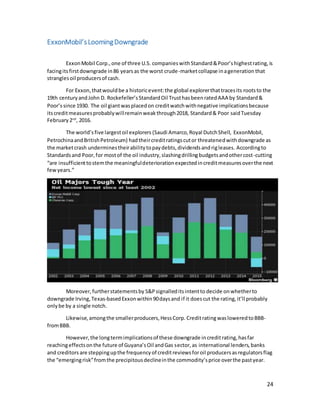
ExxonMobil’sLoomingDowngrade
ExxonMobil Corp.,one of three U.S. companieswithStandard&Poor’shighestrating,is
facingitsfirstdowngrade in86 yearsas the worst crude-marketcollapse inageneration that
stranglesoil producersof cash.
For Exxon,thatwouldbe a historicevent:the global explorerthattracesits rootsto the
19th centuryandJohn D. Rockefeller’sStandardOil TrusthasbeenratedAAA by Standard&
Poor’s since 1930. The oil giantwasplacedon creditwatchwithnegative implicationsbecause
itscreditmeasuresprobablywillremainweakthrough2018, Standard& Poor saidTuesday
February2nd
, 2016.
The world’sfive largestoil explorers (Saudi Amarco,Royal DutchShell, ExxonMobil,
PetrochinaandBritishPetroleum) hadtheircreditratingscutor threatenedwithdowngrade as
the marketcrash underminestheirabilitytopaydebts,dividendsandrigleases. Accordingto
Standardsand Poor,for mostof the oil industry,slashingdrillingbudgetsandothercost-cutting
“are insufficienttostemthe meaningfuldeteriorationexpectedincreditmeasuresoverthe next
fewyears.”
Moreover,furtherstatementsby S&Psignalleditsintentto decide onwhetherto
downgrade Irving,Texas-basedExxonwithin90daysand if it doescut the rating,it’ll probably
only be by a single notch.
Likewise,amongthe smallerproducers,HessCorp. CreditratingwasloweredtoBBB-
fromBBB.
However,the longtermimplicationsof these downgrade increditrating,hasfar
reachingeffectsonthe future of Guyana’sOil andGas sector,as international lenders,banks
and creditors are steppingupthe frequencyof creditreviewsforoil producersasregulatorsflag
the “emergingrisk”fromthe precipitousdeclineinthe commodity’sprice overthe pastyear.
25
Furthermore,these ratingcutscausedbyplummetingcrude oil prices,are starving
companiesof cashneededtofunddrilling,paydividendsandservice theirdebts. Theserating
cuts accordingto SeniorFinancial executivesformChevron,one of the bigoil companies,donot
materiallyimpactingtheircostof fundsormateriallyimpactingtheir abilitytosecure financing.
ExxonMobil Pre-Feed bids for Liza-1 Well Guyana
Accordingto the International Oil &GasNewspaper, ExxonMobil ispouringover
engineeringanddesignbidsfromfloatercontractorsaimingtosupplythe USoil companywitha
floatingproduction,storage andoffloadingvessel forthe fast-trackdevelopmentof its ground-
breaking,deep-waterLizaprojectoff Guyana.
Moreover,itisstatedthat there are at leastfive players inthe FloaterIndustrythat are
battlingtolanda contract to lease a“vessel of opportunity”thatwill able tohandle 60,000
barrelsperday of crude inadditionto significantquantitiesof gas. AccordingtoExxonMobil,it
expectsthe firstoil beingtargetedassoonas2018.
Additionally, ExxonMobil intendstodrill atleastfourmore wellsonits6.6-millionacre
Stabroekblock.
26
Near-termFutureof Oil& GasExplorationin Guyana
The developmentof the Oil &Gas IndustryinGuyana will be dependentonseveral
aspects,includingWorldMarketEconomics,PetroleumPolitics,Socioeconomics andPolitical
Structure of Guyana, DirectEconomicImpact as well asthe Availabilityof Infrastructure(Current
& Future).
Crude Oil Price Forecast: Long Term 2016 to 2025 | Data and Charts
Fluctuationsin global crude oil priceshave alwaysbeeninthe focusof economicand
financial news.The highercrude oil pricesrise,the more positive isthe economicoutlookfor
petroleumexporters.Incontrast,those countriesdependentonpetroleumimportssufferto
varyingdegreesfrom those same higherpricesasimportbillsincrease.Estimatesforthe price
perbarrel for crude oil from leadingfinancial andmultilateral institutionsare thusclosely
monitoredbygovernments,investors,andconsumersalike.Belowis asummaryof some recent
crude oil price forecasts:
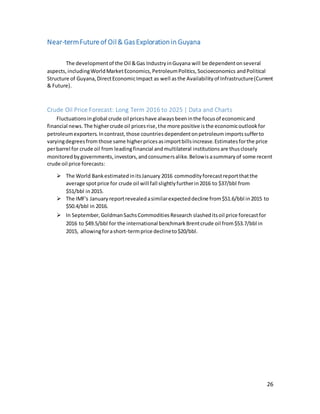
 The World BankestimatedinitsJanuary 2016 commodityforecastreportthatthe
average spotprice for crude oil will fall slightlyfurtherin2016 to $37/bbl from
$51/bbl in2015.
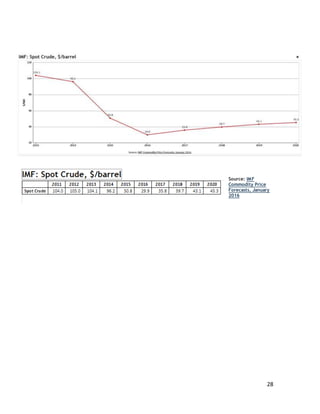
 The IMF's January reportrevealedasimilarexpecteddecline from$51.6/bbl in2015 to
$50.4/bbl in 2016.
 In September, GoldmanSachsCommoditiesResearch slasheditsoil price forecastfor
2016 to $49.5/bbl for the international benchmarkBrentcrude oil from$53.7/bbl in
2015, allowingforashort-termprice declineto$20/bbl.
27
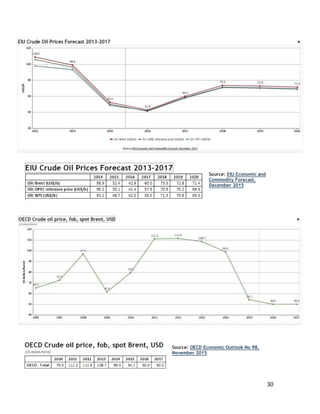
 Global crude oil price forecastsfromthe EconomistIntelligence Unitandthe
OrganisationforEconomicCooperationandDevelopment(OECD) are alsoprovidedin
the visualizations below.
Source: World Bank
Commodity
Forecast Price Data,
January 2016
28
Source: IMF
Commodity Price
Forecasts, January
2016
29
Crude Oil, $/Barrel, 1960-2015
Source: IMF
Commodity Price
Forecasts,
January 2016
30
Source: EIU Economic and
Commodity Forecast,
December 2015
Source: OECD Economic Outlook No 98,
November 2015
31
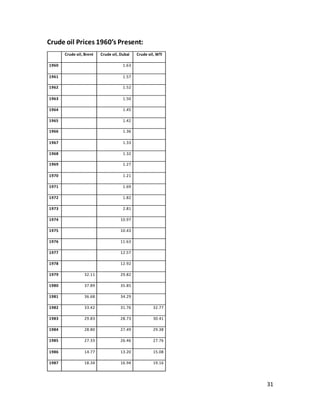
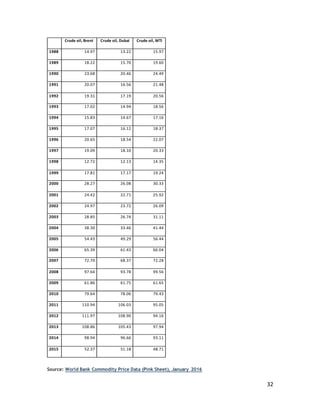
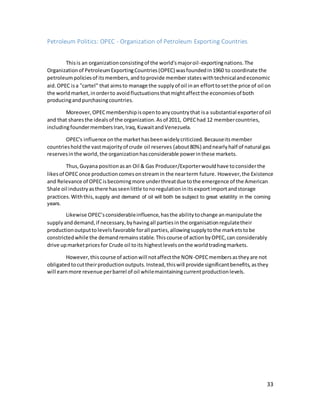
Crude oil Prices 1960’s Present:
Crude oil, Brent Crude oil, Dubai Crude oil, WTI
1960 1.63
1961 1.57
1962 1.52
1963 1.50
1964 1.45
1965 1.42
1966 1.36
1967 1.33
1968 1.32
1969 1.27
1970 1.21
1971 1.69
1972 1.82
1973 2.81
1974 10.97
1975 10.43
1976 11.63
1977 12.57
1978 12.92
1979 32.11 29.82
1980 37.89 35.85
1981 36.68 34.29
1982 33.42 31.76 32.77
1983 29.83 28.73 30.41
1984 28.80 27.49 29.38
1985 27.33 26.46 27.76
1986 14.77 13.20 15.08
1987 18.34 16.94 19.16
32
Crude oil, Brent Crude oil, Dubai Crude oil, WTI
1988 14.97 13.22 15.97
1989 18.22 15.70 19.60
1990 23.68 20.46 24.49
1991 20.07 16.56 21.48
1992 19.31 17.19 20.56
1993 17.02 14.94 18.56
1994 15.83 14.67 17.16
1995 17.07 16.12 18.37
1996 20.65 18.54 22.07
1997 19.09 18.10 20.33
1998 12.72 12.13 14.35
1999 17.81 17.17 19.24
2000 28.27 26.08 30.33
2001 24.42 22.71 25.92
2002 24.97 23.72 26.09
2003 28.85 26.74 31.11
2004 38.30 33.46 41.44
2005 54.43 49.29 56.44
2006 65.39 61.43 66.04
2007 72.70 68.37 72.28
2008 97.64 93.78 99.56
2009 61.86 61.75 61.65
2010 79.64 78.06 79.43
2011 110.94 106.03 95.05
2012 111.97 108.90 94.16
2013 108.86 105.43 97.94
2014 98.94 96.66 93.11
2015 52.37 51.18 48.71
Source: World Bank Commodity Price Data (Pink Sheet), January 2016
33
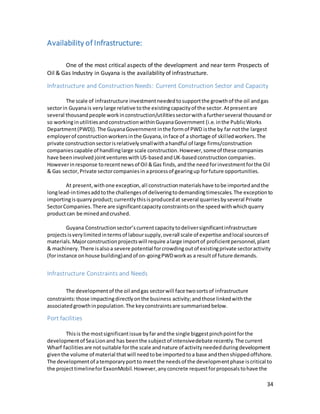
Petroleum Politics: OPEC - Organization of Petroleum Exporting Countries
Thisis an organizationconsistingof the world'smajoroil-exportingnations.The
Organizationof PetroleumExportingCountries(OPEC) wasfoundedin1960 to coordinate the
petroleumpoliciesof itsmembers,andtoprovide member stateswithtechnicalandeconomic
aid.OPEC isa “cartel” that aimsto manage the supplyof oil inan efforttosetthe price of oil on
the worldmarket,inorderto avoidfluctuationsthatmightaffectthe economiesof both
producingandpurchasingcountries.
Moreover, OPECmembershipisopentoanycountrythat isa substantial exporterof oil
and that sharesthe idealsof the organization.Asof 2011, OPEChad 12 membercountries,
includingfoundermembersIran,Iraq,KuwaitandVenezuela.
OPEC's influence onthe markethasbeenwidelycriticized.Becauseitsmember
countriesholdthe vastmajorityof crude oil reserves (about80%) andnearlyhalf of natural gas
reservesinthe world,the organizationhasconsiderable powerinthese markets.
Thus,Guyana positionasan Oil & Gas Producer/Exporterwouldhave toconsiderthe
likesof OPEConce productioncomesonstreamin the nearterm future. However,the Existence
and Relevance of OPECisbecomingmore underthreatdue tothe emergence of the American
Shale oil industryasthere hasseenlittle tonoregulationinitsexportimportandstorage
practices.Withthis, supply and demand of oil will both be subject to great volatility in the coming
years.
Likewise OPEC’sconsiderableinfluence,hasthe abilitytochange anmanipulate the
supplyanddemand,if necessary,byhavingall partiesinthe organisationregulatetheir
productionoutputtolevelsfavorable forall parties,allowingsupplytothe marketstobe
constrictedwhile the demandremainsstable.Thiscourse of actionbyOPEC,can considerably
drive upmarketpricesfor Crude oil toits highestlevelsonthe worldtradingmarkets.
However,thiscourse of actionwill notaffectthe NON-OPECmembersastheyare not
obligatedtocuttheirproductionoutputs.Instead,thiswill provide significantbenefits,asthey
will earnmore revenue perbarrel of oil whilemaintainingcurrentproductionlevels.
34
Availability of Infrastructure:
One of the most critical aspects of the development and near term Prospects of
Oil & Gas Industry in Guyana is the availability of infrastructure.
Infrastructure and Construction Needs: Current Construction Sector and Capacity
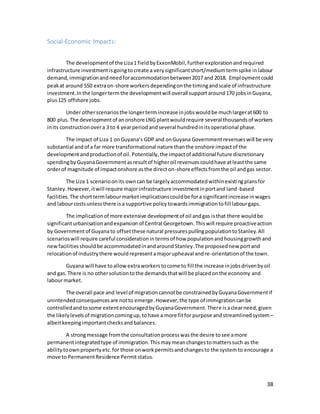
The scale of infrastructure investmentneededtosupportthe growthof the oil andgas
sectorin Guyanais verylarge relative tothe existingcapacityof the sector.Atpresentare
several thousand people workinconstruction/utilitiessectorwithafurtherseveral thousand or
so workinginutilitiesandconstructionwithinGuyanaGovernment (i.e.inthe PublicWorks
Department(PWD)).The GuyanaGovernment inthe formof PWD isthe by far notthe largest
employerof constructionworkersinthe Guyana,inface of a shortage of skilledworkers.The
private constructionsectorisrelativelysmallwithahandful of large firms/construction
companiescapable of handlinglarge scale construction.However,someof these companies
have beeninvolved jointventureswith US-basedand UK-basedconstructioncompanies.
Howeverinresponse torecentnewsof Oil &Gas finds, andthe need forinvestmentforthe Oil
& Gas sector,Private sectorcompaniesin aprocessof gearingup forfuture opportunities.
At present,withone exception,all constructionmaterialshave tobe importedandthe
longlead-intimesaddtothe challengesof deliveringtodemandingtimescales.The exceptionto
importingisquarryproduct;currentlythisisproducedat several quarriesbyseveral Private
SectorCompanies.There are significantcapacityconstraintsonthe speedwithwhichquarry
productcan be minedandcrushed.
Guyana Constructionsector’scurrentcapacitytodeliversignificantinfrastructure
projectsisverylimitedintermsof laboursupply,overall scale of expertise andlocal sourcesof
materials.Majorconstructionprojectswill require alarge importof proficientpersonnel,plant
& machinery.There isalsoa severe potential forcrowdingoutof existingprivate sectoractivity
(forinstance onhouse building)andof on-goingPWDworkas a resultof future demands.
Infrastructure Constraints and Needs
The developmentof the oil andgas sectorwill face twosortsof infrastructure
constraints:those impactingdirectlyonthe business activity;andthose linkedwiththe
associatedgrowthinpopulation.The keyconstraintsare summarisedbelow.
Port facilities
Thisis the mostsignificantissue byfarandthe single biggestpinchpointforthe
developmentof SeaLionand has beenthe subjectof intensivedebate recently.The current
Wharf facilitiesare notsuitable forthe scale andnature of activityneededduringdevelopment
giventhe volume of material thatwill needtobe importedtoa base andthenshippedoffshore.
The developmentof atemporaryportto meetthe needsof the developmentphase iscritical to
the projecttimelineforExxonMobil.However,anyconcrete requestforproposalstohave the
35
temporaryharbourfacility(withadesignlifeof around30 years) builtto facilitate the needs of
the developmentinOil &Gas Sectorhas yetto be made.If anysuch proposal ismade,itwill
representaverydemandingtimescale andwouldinvolve substantialdredgingworks,landbased
civil engineeringandpilingworktosecure atemporary facility.The facilitywouldneedtobe
usedduringthe developmentphase atleastuntil 2018.
The developmentof improvedportfacilitieshasbeenacontroversialtopicandthe likely
solutionshave changedduring the course of thisstudy.The GuyanaGovernments current
preferredlong-termsolutionis todevelopanew port to cater for the needsof the Oil & Gas
sectorin the longtermand to improve facilitiesforthe fisheriesfleetandthe cruise shipsector
(offeringadeep-waterberthtoallow transfersonshore whenweatherconditionsmilitate
againstthe use of tenders).However,thissolutionwilltake time todevelopandmost
importantlyfinance.
It isassumed that forthe purposesof development workthatmainconstructionwill not
start until afterfirstoil andassociated revenuesarrive (i.e.after2018, ExxonMobil projection).
Thiswill be a majorprojectinvolvinganew road,dredging,piling,andconsiderable amountof
earthworks.The GuyanaGovernmentiscurrentlyinsistingthatany proposednew facilitybuilt
on Guyanasoil as a temporaryfacilitythatisnot usedonce the new port facilityiscreatedand
that all oil and gas activitywill needtomigrate tothe new port.
Other Direct Infrastructure
Lay down and storage base - ExxonMobil isnot currently seekingproposalsforafacility
comprisingalay down& storage base areas forstorage and warehousing,anareaforspool
fabrication&storage,and areasfor drillingandothersupplycompanies.The base wouldbe a
controlledsite andrunto O&G healthandsafetystandards;it wouldneedtobe close to the
temporaryportstructure.Thisbase couldbe developedinstagesand furtherexpandedto
facilitate workspace,storage andcapacityneeds.
Bundledor reeledflowlinesassemblybase - Thiswouldbe a base where the flowlines
whichconnectthe FloatingProductionStorage andOffloading (FPSO) towellheadsandare
several kilometreslongare assembled.Dependingonthe technologyusedajetty,laydownarea
and some buildingsforstaff wouldbe required.The facilitywould therefore needtobe located
somewhere inCamp/stagingareaasitrequiresalarge areaonshore. Itwouldbe a temporary
facilitythatcouldbe removed,althoughitcould potentially,be re-usedbyfuture oil
developments.
Staff HoldingArea - PotentiallyO&Gfirmsmayseektoinvestina new facilitytoprovide
temporaryaccommodationforoffshore O&Gworkersintransitiontoact as a back-upshould
transportbe delayed(forinstancedue tothe weather).
36
Utilities and Transport
Water - inthe immediate termthe supplyof waterisasignificantpinchpointand
concernfor the O&G sector whichuseslarge quantitiesof waterinthe developmentof mudsfor
use indrilling.More generally,watersupplyin Georgetown hasreachedacritical situationat
timesinrecentyearswhenthere have beenespeciallydryspellsdue toEl Ninoweather
patterns.The upgrade to supplyisneededirrespective of Oil andGasand is due to be carried
out inthe near future.The locationof where waterissupplied todependsonwhere the main
lay-downareasare likelytobe.Additional supplyislikelytobe neededbothtothe existingport
and to anynewport.
Electricity:The generatorsinStanleyare reachingthe endof theirdesignlifeandthere
isa needto increase overall generationcapacitybyaround2 megawattsandprovide an
alternative generationfacility(potentiallyretainingthe currentone asback-up).The future
upgrade neededisbeingacceleratedbythe likelydemandsfromthe Oil andGassector.
Roads: The qualityof roadsis a seriousconcernof all Oil and Gas firmsdue toconcerns
overhealthandsafety.However,itisnota bindingpinchpoint forthe developmentof Liza1 or
otherfields.Neverthelessthe greaterthe volumesof trafficusingitasthe economygrowsthe
greaterwill be the case and needfora substantial investmentinitsupgrade.We have assumed
that an upgrade wouldbecome sopressingunderScenario2that it wouldhave tohappenthen,
but FIG couldchoose toinvestearlierunderScenario1(probablyonce othermajor
infrastructure activityiscompleted).
Airport: the facilitiesatthe Cheddi JaganInternational andthe Ogle International
Airportwouldneedupgradingtoprovide additional helicopterstorage andtodevelopitmore
fullyasa commercial oil industryheliport. Currently,there isanongoing feasibilitystudyforthe
extensionof the Cheddi JaganInternational Airportwhichwouldseesignificantimprovements
to passengerterminals(andassociatedservices) andupgrades tothe arrivalsanddeparture
facilities. However,althoughnotessential atthe momentforthe Oil andGas sector,it would
benefitthe economy if undertaken.Inthe longertermunderthe highergrowthscenariosas
trafficlevels rise the case forinvestinginmodernpassengeradministration facilitiesbecomes
more relevant.
Waste:waste facilitiesare fairlybasicinGuyanawithnorecyclingfacilities.The Oil and
Gas sector doesproduce highvolumesof waste thatneedtreatmentanddisposal.Asthe sector
growsthe businesscase foradedicatedwaste recoveryfacilitywouldgrow aswell andGuyana
Governmentwouldneedtoconsiderthis,inkeeping withEnvironmental Regulationsand Acts.
Telecommunications:InGuyanathere isalreadya significant telecommunications base
withcurrentservices inthe Guyanabeingadequate,althoughinvestmenttoupgrade current
infrastructure inparallel withthe development of the Oil andGas sectorwill become necessary.
The growth ineconomyandpopulationarisingfromoil andgaswouldnotrequire significant
capital investmentbutwouldhelpspreadusersacrossafixedcapital investmenthelpingreduce
usercharges – somethingthatwouldbe verywelcome byresidentsandbusinessesalike.
37
Public Services and Facilities
The growth inthe populationandthe economywill lead toextrademandsonexisting
governmentfacilitiesandthe needforfuture investment.
Education: the current capacityof the educationsystemisable cope withthe current
capacity,althoughinthe case of populationincrease,new school facilitiesmayneedtobed
introducedtocope withincrease.
Health: the currenthospital islarge enoughtocope withmost foreseeablepopulation
growthso longas Government isable tocontinue toimprove the facility,withthe introduction
of more specialiseddepartmentsmannedwithwell certifieddoctorsandcontinuedintroduction
of modern equipmentand treatmentfacilities. The emergence of the Oil &gas sectors will
require some enhancedmedical facilities,butthisisessentiallytoensure there are suitable
evacuationfacilitiesformedical emergencies,which wouldnotrequire any large capital
investmentinnewfacilities.
Other facilities:office accommodationforGuyanaGovernment departmentsisalready
quite squeezedandmanyof the buildingswere notdesignedwithmodernoffice use inmind.As
the requirementsforpolice,immigration,oil regulationandotherpublicservicesrise there will
be a needtoinvestin newoffice accommodationforGovernment employees.
Private Sector Facilities
The extra demandsforaccommodationandhotels/restaurantare likelytoencourage
investmentbythe private sector.Some investmentisalreadyplanned. Proposalscanbe made
to developlarge residentialwithmultiple blockunits aimedatprovidingself-contained,self-
cateringaccommodationintwobedapartments(largelyforO&Gworkers).Beyond thisthe
hotel and restaurantfacilitiesinGuyanacan adequatelycope withpotentialpopulationand
businessexpansion.
38
Social-Economic Impacts:
The developmentof the Liza1 fieldbyExxonMobil,furtherexplorationandrequired
infrastructure investmentisgoingtocreate a verysignificantshort/mediumtermspike inlabour
demand,immigrationandneedforaccommodationbetween2017 and 2018. Employmentcould
peakat around 550 extraon-shore workersdependingonthe timingandscale of infrastructure
investment.Inthe longertermthe developmentwill overall supportaround170 jobsinGuyana,
plus125 offshore jobs.
Under otherscenariosthe longertermincrease injobswouldbe muchlargerat600 to
800 plus.The developmentof anonshore LNG plantwouldrequire several thousandsof workers
inits constructionovera 3 to 4 yearperiodandseveral hundredinitsoperational phase.
The impact of Liza 1 onGuyana’s GDP and onGuyana Governmentrevenueswill be very
substantial andof a far more transformational nature thanthe onshore impactof the
developmentandproductionof oil.Potentially,the impactof additional future discretionary
spendingbyGuyanaGovernmentasresultof higheroil revenuescouldhave atleastthe same
orderof magnitude of impactonshore asthe directon-shore effectsfromthe oil andgas sector.
The Liza 1 scenarioonits owncan be largelyaccommodatedwithinexistingplansfor
Stanley.However,itwill require majorinfrastructure investmentinportand land-based
facilities.The shorttermlabourmarketimplicationscouldbe fora significantincrease inwages
and labourcostsunlessthere isa supportive policytowardsimmigrationtofill labourgaps.
The implicationof more extensive developmentof oil andgas isthat there wouldbe
significanturbanisationandexpansion of Central Georgetown.Thiswill require proactiveaction
by Governmentof Guyanato offsetthese natural pressurespullingpopulationtoStanley.All
scenarioswill require careful considerationintermsof how populationandhousinggrowthand
newfacilitiesshouldbe accommodatedinandaroundStanley.The proposednew portand
relocationof industrythere wouldrepresentamajorupheaval andre-orientationof the town.
Guyana will have toallowextraworkerstocome to fill the increase injobsdrivenbyoil
and gas.There is no othersolutiontothe demandsthatwill be placedonthe economy and
labourmarket.
The overall pace and level of migrationcannotbe constrainedbyGuyanaGovernmentif
unintendedconsequencesare notto emerge.However,the type of immigrationcanbe
controlledandtosome extentencouragedbyGuyanaGovernment.There isaclearneed,given
the likelylevelsof migrationcomingup,tohave a more fitfor purpose andstreamlinedsystem –
albeitkeepingimportantchecksandbalances.
A strongmessage fromthe consultationprocesswasthe desire tosee amore
permanentintegratedtype of immigration.Thismaymeanchangestomatterssuch as the
abilitytoownpropertyetc.for those onworkpermitsandchangesto the systemto encourage a
move to PermanentResidence Permitstatus.
39
Roleof local Banks
Businessformationandgrowthisconstrainedbythe relativelylimitedpool of local
entrepreneurs;asresultof the size of the economythere islimitedcompetitionormonopolyin
mostbusinessservices(includingfinancial services,accountancy,legal,ITetc.).Businesssupport
includingadvice andloansisavailableto Guyana’sbusinessesthroughanumberof well-
establishedbankssuchas,Guyana Bankof Industry& trade,DemeraraBank,RepublicBank,
ScotiaBank and Citizensbank.
Additionally,these local bankscanalsohave the chance to facilitate paymentsandwire
transactionsforboth foreignandlocal employeesattachedtothe offshore drillingand
explorationrigs.Thesetransactions,willgeneraterevenuesforthese banks,whichinturn
translatesintothe tax systemof Guyana.
Oil & gas Industry funding challenge
The oil and gas industryhasbeenexperiencingaperiodof majorinvestment,with
upstreamspendingtopping$700 billionin2013. Thisrecordlevel of investmentissetagainst a
backdropof overthe next20 yearsto finance itscontributiontothe world’sfuture energy
needs.Despitethe industry’simmense appetite forcapital,comparedtoothercapital intensive
industries,ithasbeenrelativelyconservative whenitcomesto financial structuring.
40
Banking sector appetite for oil and gas investments
The last fewyearscan be broadlycharacterizedbya scarcityof publicequityfinancing,
combinedwith corporate creditconditions thatwere initiallytightbutare now accommodative.
Bankswere forcedto introduce tighterlendingcontrolsinresponse tonew legislation.Inmany
jurisdictions, the processof rebuildingtheir balance sheetsislargelycomplete.However,
cautionaroundrisk managementandthe pressure todeliveranappropriate return hasled
banksto tightenlendingstandards,particularlyforsmall-to-medium-sizedborrowers.In
response,companieshave started toaccessalternative sourcesof finance,suchasthe bond
market, projectpartners,private equityandexportcreditagencies.There isnow bothmore
competitionforfundingandalsoa widerrange of debtand equityprovidersservingthe market.
Equity Financing:
Equityfinancingisthe processof raisingcapital throughthe sale of sharesinan
enterprise. Equity financingessentiallyreferstothe sale of anownershipinteresttoraise funds
for capital investment purposes.Equityfinancingspansawide range of activitiesinscale and
scope,froma fewthousanddollarsraisedbyan entrepreneur,togiant initialpublic
offerings (IPOs) runningintothe billions of dollars.While the termisgenerallyassociatedwith
financingsby publiccompanies listedonanexchange,itincludesfinancingsby private
companies aswell.Equityfinancingisdistinctfrom debtfinancing,whichrefers to
funds borrowedbya Company.
A breakdownof 'EquityFinancing':
Equityfinancinginvolvesnotjustthe sale of commonequity,butalsothe sale of
otherequity orquasi-equityinstrumentssuchaspreferredstock, convertible preferred
stock andequityunitsthatinclude commonsharesandwarrants.
In the Oil & Gas Business, initial public offerings (IPOs) aswellas the involvementof private
companiesare common sources of capital investment.These entities,can purchase sharesin
the company,each of which represents a proportional claimof ownership of company.
However,IPOsare heavilydependent onOil &Gas prices as well as onthe economic
and financial marketconditions, thusmaybe accompaniedbysignificantriskwhenundertaken.
On the otherhand,Private equity,isalsodependentonOil &Gas prices,butservesasa
robustand majorsource of fundingformanysmall upstreamactivitiesthatexhibittechnological
advantages.Owningtothe deepwaternature of Guyana’s offshore basin, the needforthrough
exploration of the basinis highlyimportantasthe capital costsassociatedwiththese
41
explorationprogrammesisatall-time high.Thus,thisreaffirmsthe needtoconformthe nature
of the Oil & Gas deposit,utilisingthe mostadvance technologies available toexplore the basin.
Debt Financing:
Debtfinancingiswhenafirmraisesmoneyfor workingcapital orcapital
expenditures bysellingbonds,bills,ornotestoindividual and/or institutional investors.In
returnfor lendingthe money,the individualsorinstitutionsbecome creditorsandreceive a
promise thatthe principal andinterestonthe debtwill be repaid.
A breakdown of 'Debt Financing':
Withrespectto debtfinancing, these transactionswill be facilitatedmajorlendingbanks
withwhichthe firm/companyisassociatedwith.These institutions/banks will conducta
thoroughanalysisof the firms/company’s’ financialcredentials,inadditiontothe viabilityof the
projectbeingundertaken, beforeissuingacreditline tothe companyto finance theircapital
expenses. These creditlineswillbe grantedunderspecificregulationsandrepaymentschemes
withattachedinterestratesoverthe grantedperiodof time.
Moreover, thistype of financingwill notaffectthe nature of explorationactivities
currentlybeingconductedinthe offshorebasinasthe firm/company,will have significant
capital reservestoconducttasksassociatedwithexplorationactivities.Also,the companycan
seekPrivate investors,tofinance theseoperations,if capital reservesare notavailable atthe
giventime.
However,the relevance of debtfinancingbecomesmore importantasthe “exploitation
phase”beginsbecause,the costof exploitationof the resource issignificantly higherthanthe
costs of exploration.Hence the needtochoose betweenequityanddebtfinancinggivenlong
termmarketforecastsfor the pricesof the commodity.
42
Potential Benefits to Businesses:
The oil and gas developmentswillprovidea range of potential opportunitiesfor
businessinGuyana.Basedonthe experience elsewhere,inprinciple,theseopportunitiescould
include:
 There will be directcontract opportunities inthe oil andgas supplychain.Examples
couldinclude:supplyboats,crew logistics,suppliesandequipmentlogistics(including
stevedoringandwharf services),securityservicesandotherbusinessservicesincluding
IT support,accountancy,trainingservicesandtelecommunications.Insome cases,local
firmsare able to provide supportforthese servicesdirectly.
 There may be furtherdirectcontract opportunitiesthatcouldbe deliveredlocallyby
existingfirms,throughfirmsentering jointventureswithoverseascompanies,or
throughin-migrantsseekingtosetupnew businessesin Guyana.Thiscouldinclude
specialisedmaintenanceservices,environmental consultancy,smallonshore
manufacturingandengineeringservicesandotherspecialisedservicese.g.around
safety.
 Indirectimpactsof the developmentof the oil andgassectorwill include additional
flightscomingintoGuyana offeringnewvisitortravel options (includingmakingmore
routesand servicesviable)and newfreighttransport opportunities,aswell asgreater
demandacrossall consumer facing businessesfromthe increase inpopulation.
 The local constructionsectorcouldbenefitsubstantiallyfromthe constructionboom
that the oil and gas sectorand populationgrowthwillgenerate.If carefullyplannedto
evenoutconstructionactivitieswhere possible,there islikelytobe opportunityfora
sustainedincrease in the local construction sector overthe nextdecade.
43
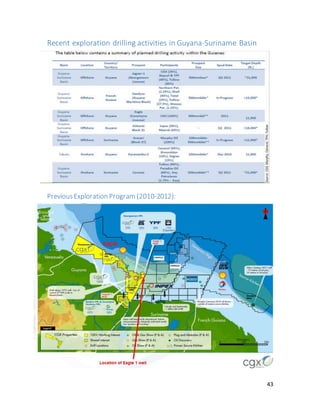
Recent exploration drilling activities in Guyana-Suriname Basin
PreviousExploration Program (2010-2012):
44
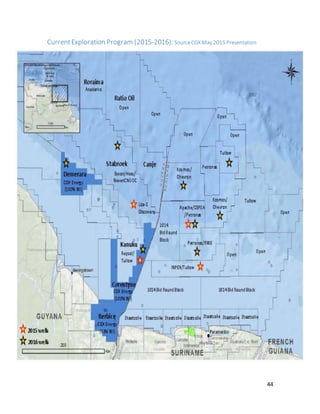
CurrentExploration Program (2015-2016): SourceCGX May 2015 Presentation
45
Liza-1 Discovery by ExxonMobilCorp., StabroekBlock Area March 20th
, 2015
(Source:HessCorporationPresentation)
46
Futureof other drilling activity in Guyana-Surinamebasin:
Guyana’s first commercial Oil Discovery has set the stage for future activity,
herein allowing for continued exploration in the offshore basin of Guyana.
However, given the current economics of oil prices on the world markets, the
current and future exploration activities will not be adversely affected although
investors will remain cautious on investments of capital into drilling programmes for
their associated exploration companies.
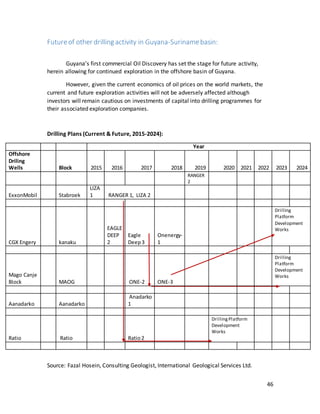
Drilling Plans (Current & Future, 2015-2024):
Year
Offshore
Driling
Wells Block 2015 2016 2017 2018 2019 2020 2021 2022 2023 2024
RANGER
2
ExxonMobil Stabroek
LIZA
1 RANGER 1, LIZA 2
CGX Engery kanaku
EAGLE
DEEP
2
Eagle
Deep3
Onenergy-
1
Drilling
Platform
Development
Works
Mago Canje
Block MAOG ONE-2 ONE-3
Drilling
Platform
Development
Works
Aanadarko Aanadarko
Anadarko
1
Ratio Ratio Ratio2
DrillingPlatform
Development
Works
Source: Fazal Hosein, Consulting Geologist, International Geological Services Ltd.
47
Scenarios for the Future Development of Oil and Gas in Guyana:
Table 1: Key Elementof Oil and GasScenarios
Key
parameters
Scenario 1:
Sea Lion plus
exploration
Scenario 2:
Big oil, no gas
Scenario 3:
Big oil, plus
FLNG Gas
Scenario 4:
Big oil plus
land-based
LNG
Scenario 5:
Scenario 1
plus land-
based LNG
Oil field
development
One field only
(Liza 1)
Three fields Three fields Three fields One field
Timing First oil 2017-
2018
Liza 1: first oil
2017-2018
Other fields:
first oil 2021
Liza 1: first oil
2017-2018
Other fields:
first oil 2021
Liza 1: first oil
2017-2018
First oil 2017-
2018
Gas field development One major field One major field One major field
Location of LNG
facilities
Offshore Offshore Offshore
Timing First gas: 2025 First gas: 2027 First gas: 2027
Exploration On-going On-going On-going On-going On-going
Source: Regeneris Consulting
Implications of a Commercial Oil & Gas Discovery in the Guyana
Basin:
 The Development of People capacity to monitor and carry out exploration and
development.
 The ability of the GGMC to Properly monitor and control all operator activities.
 The possibility of establishment of a Government owned State Oil & Gas
company with the responsibility for:
o Independent exploration activities
o Hiring trained personnel
o Establishing training programmes
o Procurement of all equipment and associated software for its personnel
o Creating alliances with service companies in the industry
 The possibility of investing on equity in the exploration of offshore blocks: this
course would need to be carefully studied before any action is taken by the
government, as these investment are high risk.
48
With the onset of commercial discoveries of oil, it becomes more and more
necessary for the Guyana Government as well as the Guyana geology & Mines
Commission to develop its people with skills for:
1. Managing & monitoring development and exploration activities – this includes
Exploration Geologists, Geophysicists, Drilling & Testing Engineers, as well as
personnel to access the hydrocarbon potential.
2. Reservoir Monitoring & Management – Development Geologists, Reservoir
Engineers, Production Engineers, and Well site Geologists.
3. Facilities Monitoring & Management - HSE Personnel
4. Cost Control & Economic Analysis - Provided that a state Entity is established.
5. Human Resource – People to manage workers needs
6. Management of Operating Bases for Service companies - this includes drilling
fluids, Wireline Logging, Mud Logging, Casing Run, Cementing, and Logistics.
49
Discussion
The near term future of Guyana Oil and Gas Sector has great potential given the
favourable exploration programmes as well as the attractiveness of Guyana to investors to
develop its resources.
With respect to the ongoing Crude oil price turmoil on the worldtrading marketswhich
has seen the cost per barrel of oil fall to an average of USD$32, has had a significant impact on
major oil producers around the world. But this has not stopped these companies from seeking
exploration of potentially unexplored basins that have large scale Oil and Gas potential.
Guyana, holds a favourable position on the potential of its offshore basin, which is
currently undergoing rigorous exploration regimes, by several renowned Exploration and oil
producing companies including ExxonMobil, and CGX Energy. There are also other Low key
companiesundertakingexplorationinGuyana’soffshore basin. Itisworthnotingthat the capital
fundingneededforExplorationactivatesdiffersvastlyfromactual Exploitationactivatescostwise.
Moreover,the Explorationof Guyana’sbasinwill notbe affectedbythe current Oil price
turmoil, as funding for these exploration activities are primarily sourced through the company’s
own resources or through private equity investment.
The real challengearisesthroughthe ExploitationPhaseof theoffshoreOilandGasFields,
providedthatthe findisapprisedand quantified.Herein,the costsof exploitationservices,drilling
and extractionrigs,as well as onshore servicessignificantincreasesoperational costsacross the
exploitationphase. Thusasoil pricescontinuetobe significantlylow onthe International trading
markers, no Company will want to risk investment into such an exploration venture when the
marketsprocessare not favourable forbusiness.However,suchcompaniescanbeginto pre-bid
the construction for future exploitation, as it do not incur any cost at present when seeking the
services of the Industry contractors.
Moreover, expertsinthe Oil and Gas industryare forecasting thatcheap petrol couldbe
quite a fewyearsoff perhapsevenasmanyas tenyearsbefore the Republiccanturn ‘ared cent’
from oil. Hence, it will be PETROCARIBE for some time yet.
The Canadianshave alreadywarnedGuyana thatoilcanhave abittersweettaste.Itseems
as though poor countries like Guyana that find oil have a habit, thereafter, of ‘playing God,’
drawingdownhumongousloansfromcommercial lendingagencies,turningtheirbacksonthings
like agricultureandbuildingskyscraperswhichare quitecommonplaceinoil-producingcountries,
It wouldseemasthoughwhatthe Canadianshave alsodiscoveredisthatoil hasa wayof
fuelling corruption. That having been said the Canadians have warned Guyana of the need to
manage ouroil moneywisely. If suchacase arises,it mightbe besttoconsiderhiringahighpriced
metropolitan firm of accountants to control the oil money.
The Canadians want Guyana to pass tomes of legislation to deal with things like the
environment protection, the transparency of contracts, management et al.
50
As much as it is said that oil is a valuable natural resource the thinghas a way of getting
messysometimes. Oil spillsare mostalwaysverydisastrousinnature,where they can devastate
ecosystems,kill marine life anddo untold damage to countries both economically and socially.
Is there oil in our future?
The unpredictability about oil’s future might also be spurring the haste for there is no
bigger uncertainty right now than the future of fossil fuels.
World leaders have met in Paris and painted a doomsday picture for the future of our
planet unless there is an agreed cap on the emission of greenhouse gases.US President Barack
Obama said a turning point may have been reached.
“What shouldgive ushope,”he said,“isthe factthatournationsshare asense of urgency
about thischallenge anda growingrealisationthatitis withinour powerto do somethingabout
it.” Doing something about it means using less oil and more green technology.
The negotiationshave alwaysbeenstymiedbythe needtofindthe moneytohelpnations
shift to more environmentally friendly energy sources. India and France announced plans to
mobilise $1 trillion for solar power for some of the world’s poorest people and Bill Gates of
Microsoftsaidhe intendstoputbillionsof dollars into new energy research and development.
The pointisthat oil is not goingto be the energysource of the future world.Guyanahas
beenparty to the worldwide greenmovementinrecentyearsand while we can surelycounton
some oil revenuesforfuture development,fallingoil pricesandthe renewedmomentumof the
green movement might well translate into lesser earnings than were expected.
51
Conclusion
Witha total of only22 explorationwells,17 of whichwere sunkbetween1965 and
1977, the searchfor oil inGuyana to date can be regardedasmodest.Resultshave beenmodest
but promising,withone discoverywell,widespreadoil andgasindicationsandgoodreservoir
potential occurringlocally.Lackof fundingreportedlydoggedthe promiseof additional
explorationwellsinthe 1990s, after an intense promotioneffortbythe governmentof Guyana
inthe 1980s fundedbythe World Bankhad successfullybroughtinthree groupsof Companies.
A recentlyinitiatedsecondphase of PetroleumExplorationPromotionbyareturningCompany,
PETREL, is expectedtostimulate interestandfunding.Itisanticipatedthatthe resultsof the
SouthAmericanMappingProject,recentlyconcludedbymajorOil Companies:AMOCO,BHP,
CONOCO,EXXON andUNOCALwill alsoenhance interestinPetroleum.
Also,withrespecttofurtherexplorationactivities,Guyana’soffshore Basinwill continue
to be exploredandmapped,regardlessof the price of oil onthe International TradingMarkets.
However,the challengeariseswhenthe significantdiscoveryisquantifiedandtherefore ready
transitionto the exploitationphase.Here again,asa rule of the thumb,nocompanywill risk
startingexploitationof promisingwellsgiventhe Worldmarketeconomicsatpresent.However,
as the marketsituationimprovesandthe price of oil ralliestofavorablelevels,toturna profitas
well asfinance capital costs,onlythenwill the explorationphase begin.
52
References
 Exxon Mobil, Guyana And Keeping Your Dividend Safe, John Rhodes, Sep. 14,
2015, Available online at: http://seekingalpha.com/article/3507816-exxon-
mobil-guyana-keeping-dividend-safe?page=2#
 Guyana Geology and Mines Commission, PETROLEUM Available online at :
http://www.ggmc.gov.gy/main/?q=divisions/petroleum
 ExxonMobil eyes pre-FEED bids for Liza , By Kathrine Schmidt, Iain Esau, Luke
Johnson & Noah Brenner, Houston & London, 16 October 2015, Available online
at:http://www.upstreamonline.com/live/1414259/exxonmobil-eyes-pre-feed-
bids-for-liza
 Socio-Economic Study of Oil and Gas Development in the Falkland, May 2013,
Regeneris Consulting Ltd Avaioable online at: www.regeneris.co.uk
http://www.falklands.gov.fk/assets/Falklands-Oil-and-Gas-Socio-Economic-
Study-Final-Report.pdf
 ExxonMobil Downgrade, Joe Carroll , 2nd February, 2016, Available online at:
http://www.bloomberg.com/news/articles/2016-02-02/chevron-hess-join-ranks-
of-downgraded-crude-oil-explorers
 Opec Disagreement Dollar Cash Available online at:
http://sputniknews.com/world/20160220/1035106025/opec-disagreement-
dollar-crash.html#ixzz410UMqsoJ
 Upstream Insight, November 2008, Guyana: On the Brink of Exploration Success
http://cgxenergy.ca/cmsAssets/docs/analysts/Wood%20Mackenzie/WoodMacK
enzie-Nov08.pdf
53
 Implications of a commercial Oil Discovery in the Guyana Basin, Guyana Geology
& Mines Commission 11th National Mining & Quarrying Conference & Exhibition,
August 23rd-25th, 2015.
 Equity Financing Available online at:
http://www.investopedia.com/terms/e/equityfinancing.asp#ixzz423N6mbwK
 Debt Financing Definition Investopedia Available online at:
http://www.investopedia.com/terms/d/debtfinancing.asp#ixzz423ObVamU
 Plan for the Petroleum Sector by the Petroleum Unit, GGMC, SAMMP Project
Document, GGMC; Evaluation of hydrocarbons by Peter Kehrer, Natural
Resources and Development, vol.17, 1983, Institute for Scientific Co-operation
Tubingen, Federal Republic of Germany.
 Upstream Insight, November 2008, Guyana: On the Brink of Exploration Success
http://cgxenergy.ca/cmsAssets/docs/analysts/Wood%20Mackenzie/WoodMacK
enzie-Nov08.pdf
 Birnie, D.J. & Workman, W., 2007. The Guyana-Suriname Basin: An Evolving
Exploration Opportunity. GEOSEIS Inc., Calgary, AB, Canada and CGX Energy Inc.,
Calgary, AB, Canada
 Crude Oil Price Forecast: Long Term Outlook 2016-2025, Available online at:
http://knoema.com/yxptpab/crude-oil-price-forecast-long-term-2016-to-2025-
data-and-charts
 Implications of a Commercial Oil Discovery in the Guyana Basin, Guyana geology
and Mines Commission, 11th National Mining and Quarrying Conference and
Exhibition, 23rd to 25th August, 2015 by Dr Fazal Hosein (Consulting Geologist).
Contributors:
 KenishaWilson

Oil Prospects 2015-2020

  • 1.
    Author:Ryan Fraser Universityof Guyana:FacultyofTechnology GeologyDepartment DATE: 16TH APRIL,2016 Near-term Future of Oil & Gas Exploration in Guyana Research Paper GEM3201 GEOLOGY OF GUIANA SHIELD
  • 2.
    1 Table of Contents Oil& Gas Background..........................................................................................................3 Geological setting of the Guyana-Suriname Basin: .............................................................5 History of Oil & Gas Exploration: .........................................................................................9 Key Oil & Gas Exploration Companies Players in Guyana Offshore Basin:.....................15 Basin Potential According to the United States Geological Survey (USGS)....................16 Offshore and Onshore Block Licence Map:..................................................................17 Petroleum Exploration & Production Licence, Block Reference Map of Onshore and Offshore Concessions........................................................................................................18 Guyana’s Attractiveness for Petroleum Ventures:..........................................................19 The Significant Guyana Oil Discovery:..............................................................................20 Roughly Quantified Financial Impact to Exxon Mobil:...................................................20 This Oil Is a "Game Changer" for Guyana: .....................................................................21 The Venezuelan Curveball: ............................................................................................21 Bottom Line:...................................................................................................................23 ExxonMobil’s Looming Downgrade..................................................................................24 ExxonMobil Pre-Feed bids for Liza-1 Well Guyana..........................................................25 Near-term Future of Oil & Gas Exploration in Guyana....................................................26 Crude Oil Price Forecast: Long Term 2016 to 2025 | Data and Charts..........................26 Petroleum Politics: OPEC - Organization of Petroleum Exporting Countries ................33 Availability of Infrastructure:............................................................................................34 Infrastructure and Construction Needs: Current Construction Sector and Capacity....34 Infrastructure Constraints and Needs ...........................................................................34 Port facilities ..................................................................................................................34 Other Direct Infrastructure............................................................................................35 Utilities and Transport ...................................................................................................36 Public Services and Facilities..............................................................................................37 Private Sector Facilities..................................................................................................37 Social-Economic Impacts: ..............................................................................................38 Role of local Banks ............................................................................................................39
  • 3.
    2 Oil & gasIndustry funding challenge.............................................................................39 Banking sector appetite for oil and gas investments ....................................................40 Equity Financing:............................................................................................................40 Debt Financing: ..............................................................................................................41 Potential Benefits to Businesses:...................................................................................42 Recent exploration drilling activities in Guyana-Suriname Basin......................................43 Previous Exploration Program (2010-2012): .....................................................................43 Current Exploration Program (2015-2016): Source CGX May 2015 Presentation ............44 Liza-1 Discovery by ExxonMobil Corp., Stabroek Block Area March 20th, 2015................45 Future of other drilling activity in Guyana-Suriname basin:..............................................46 Scenarios for the Future Development of Oil and Gas in Guyana:................................47 Implications of a Commercial Oil & Gas Discovery in the Guyana Basin:.......................47 Discussion ..........................................................................................................................49 Conclusion..........................................................................................................................51 References.........................................................................................................................52
  • 4.
    3 Oil & GasBackground Guyanais divided into two Petroleum Basins named Guyana and Takutu, respectively. The Guyana Basin is further divided into two basins, Onshore and Offshore. Herein is a synopsis of the Basins. Onshore Guyana Basin The deepest part of the southern “boundary” is some 150 miles from the Guyanese Coastline. NABI Oil And Gas, Inc. and ON ENERGY Inc. companies have concessions within this part of the Basin. Within the Onshore Guyana Basin, there was a chance of these blocks being subjected to competitive bidding, however this does not take away any one’s prerogative to apply for concessions within this area. There were 13 wells drilled within this part of the Basin from 1916 to present day. Only Rose Hall-1 drilled in 1941 and Drill-1 in 1967 had oil shows. The eastern part of the Onshore Guyana Basin has the largest thickness of sediments reaching some 2,500 m. It should also be noted that the gas found on the coast is nearly all biogenic, with a very small area yielding thermogenic gas. Offshore Guyana Basin REPSOL, ANADARKO, ESSO/HESS/NEXEN, Mid-Atlantic Oil and Gas, Inc., RATIO Energy/Guyana Ltd and CGX Resources Inc. have petroleum concessions in this part of the basin. Presently, a number of companies are negotiating for concessions in the offshore Guyana Area. On the aspect of Offshore Guyana Basin, from the nearshore to around 80 miles to the north, the seabed is generally on the continental shelf then it moves to the slope and as one gets further it reaches the deep-water area. From the northwest (where the Anadarko concession is) to the Northeastern area depths can be from 1,000 feet to more than 10,000 feet. This area is known as the “ultra-deep waters”. In May 2015, ESSO made a significant discovery of petroleum while drilling in its Stabroek Block. Guyana has never had a commercial petroleum discovery, although there are a number of wells that had oil and gas shows both onshore and offshore. Prior to the ESSO discovery, our “best” well has been Karanambo-1 well drilled by Home Oil in the Takutu Basin in 1982. Takutu Basin Located in the southwestern area of Guyana lies the Karanambo-1 well, which was drilled in 1982 by Home Oil Company. This was the best prospect drilled within this Basin. Located in southwestern Guyana a small amount of light crude was
  • 5.
    4 accrued. Tests conductedon samples from Karanambo-1 found that the oil is of good quality (420API) and is of a “sweet” variety, that is, it contains less than 0.5% hydrogen sulphide. However, its geological characteristics are mainly naturally fractured reservoirs, thus proving more difficult to find commercial petroleum than regular reservoirs. The other wells drilled in the Takutu are Lethem-1 (1980), Turantsink-1 (1992) and Apoteri K2 well (2011).
  • 6.
    5 Geological setting ofthe Guyana-Suriname Basin: Brief Overview o The Guyana-Suriname Basin is a half graben Atlantic-margin basin on the Northeast Coast of South America, as shown in Figure 1 below. Figure 1 showing the Guyana-Suriname Basin (outlined in green). o According to the United States Geological Survey in its World Petroleum Assessmentof 2000, this basinwas rated the second most prospective unexplored basin in the world. o The main reservoir targets are: I. The Upper Cretaceous and Lower Tertiary Basin floor fans II. Shelf-Margin deposits III. Turbidities directly overlying mature source o Depth mapping of the deep closures however, have eliminated the distortion/velocity pull-up by an overlying shelf margin carbonate bank of Tertiary age.
  • 7.
    6 History of theBasin o The Guyana-Suriname Basin evolved from a failed rift arm which extends to the Takatu Basin in an easterly trend straddling the borders of Guyana and Brazil. o It is bounded to the South and North by the Demerara Plateau high and the Pomeroon Arch respectively and is described as a trap door structure plunging from the Pomeroon Arch and impinging against the Demerara Plateau. o The Atlantic unconformity forms the basement which ranges from Precambrian to Jurassic age as shown in Figure 2 below. Figure 2 shows the stratigraphic chart of the Guyana-Suriname Basin. o The overlying basal sequences were deposited in a gradually deepening depositional environment formed as a result of downward displacement at the commencing stages of the South America Africa rifting as it progressed from South to North. Overlying this unconformity are: I. The Continental Barremian Stabroek Formation II. The Aptian Carbonate that gradually drowned III. The deposition of the Canje Formation which contains the regional deposited source beds as shown in Figure 3 below.
  • 8.
    7 Figure 3 showingthe outline of the Canje Formation. o The Canje Formation is followedby a major unconformityi.e.the Berbice Unconformity inwhichthe sequence boundaryformstheBerbiceCanyonwhichcutsintotheunderlying sequence at a depth of over 1000m as shown in Figure 4 below. Figure 4 showing schematic shelf to basin geologic cross section.
  • 9.
    8 o To theSouth and North, the unconformity slowly transforms into a disconformity resembling that of the Arapaima 1 well to the North. o It isbelievedthatanextremelyrapidchange insealevel associatedwithabreachintoan openoceanicenvironmentfromanepeiricseai.e.ashallow seathatcoverscentral areas of continents during periods of high sea level continued to expandfrom North to South due to the Altantic Rift. o Later the shelf margin’sformation commences at the time of the Berbice Unconformity as the drift stage of the Atlantic margin alters the formation of the basin to the east as well asbasementfaulting.ThroughtheMid-Miocene(16–11.6 Ma ago),the basin margin remains stable. o The New Amsterdam Formation overlies the Berbice Unconformity. According to the Horseshoe #1 well drilledbyCGXin2000, thisformationisrevealedtobe almostentirely sandsonthe shelf.Inthe Arapaima1andotherwells;interbeddedsandclaysandmodest carbonates can be seen on the shelf margin. Outboard of the shelf margin the Abary 1 penetrates the uppermost part of the New Amsterdam equivalent section that is dominatedbyclays.Seismicinterpretationhasidentifiedbasin floorfansinthe basal New Amsterdamthatisequivalenttothe NorthCoroni sandsinthe NorthCoroni 1well drilled offshore Suriname (approximately 100 km away). o It is believed that shelf margin deltas exist between the basin floor fan and the upper sequence in the Abary well. o The Berbice Canyon, North Coroni Fan and Shelf Margin Delta are focused by the pre- existing structural trough formed by the underlying failed riff arm and associated trap door structure. o A seriesof carbonate richmembersof the GeorgetownandPomeroonFormationsoverlie the Cretaceous rocks. o Formations are dominated by sands with minor Carbonates on the shelf. o Formationsonthe shelf margin are dominated by Carbonates with interbedded sands. o Formationsinthe basinare dominatedbyclaysand marlsbecomingmore clayrichwith distal proximity. o Several fanfeatureshave beendiscoveredandmappedasturbiditiesinthe Lower TertiaryStage.
  • 10.
    9 o The depositionofthe CorentyneFormationcommencinginthe Mid-Miocene oversteps the shelf edge asthe clasticdominatedsurge fromthe Andeanupliftisdepositedby continuesintothe presentday. History of Oil & Gas Exploration: Oil and gas exploration and evaluation refer not only to the evaluation of proven resource and the scope for exploiting it economically, it also includes the techniques used to identify areas with resource potential and to determine development prospects. There are three distinct phases to the process of evaluation:  Evaluating the resource potential of an area in the prospecting phase so as, for example, to help in coming to a decision about the acquisition of development rights;  Evaluating development prospects as part of their exploration phase, so as, for example to decide whether a structure merits exploratory drilling;  Evaluating the economic value of an oil or gas find. These three phases in the search for and development of oil and natural gas may be further divided into a number of different sub-stages.Atthe conclusion of eachevaluation phase it is possible to make an assessment of the available reserves, but the degree of accuracy willreflect the levelof detailin the preliminary surveys. In areas which have only been identified as possibly having hydrocarbon potential, speculative guesses are all that are possible where there is to be exploratory drilling of an actual structure, it is possible to make estimates of the available reserves; when dealing with a confirmed deposit, then precise calculations of the actual reserves may be made. (Kehrer, 1983). Earliest Observations, exploration borehole at Waini estuary, near Punta Playa The first oil exploration in British Guiana was based on reports of oil and gas seeps dating back to the eighteenth century, when Dutch explorers noted the occurrence of flotsam pitch near Krukenkal Point, nine mile south-east of Punta Playa, and recorded hydrocarbon indications. When investigated in the mid-1850s these seeps proved to be insignificant. The first oil exploration borehole, sunk to investigate these seeps, encountered droplets of tarry oil.
  • 11.
    10 Coastal Artesian WaterWells strike Methane Gas In the early 1900s several coastal artesian wells intersected small quantities of methane gas.Onesignificant occurrence was from awell drilled in 1926 at Plantation Bath on the west coast of Berbice, which supplied enough gas for use on the local sugar estate. The gas was marsh gas which is not associated with petroleum. First Prospecting Licence granted on 1938; Onshore Investigations by Trinidad Leaseholds The first prospecting licence was granted to Trinidad Leaseholds Company Ltd. In 1938. With partners Central Mining AND Investments Corporation, they conducted seismic refraction and reflection surveys to determine the location of structures. This led to the sinking of a well, Rose Hall,near Barama landing on Canje Creek in the deepest part of the on-shore extension of the Guyana Basin. The well ended 6,465ft in the basement. A few oil droplets were noted at 6079 feet. Trinidad Leaseholds relinquished their licence in 1942 and no further exploration was undertaken for more than a decade. 1950s- Regional Survey by Standard Oil In 1958, Standard Oil of California, United States, acquired exploration rights to most of the continental shelf. They carried out a regional survey but no wells were sunk. 1960s- On and Off-shore surveys by Geological Survey, SHELL, CONOCO: More than eight well sunk- two off shore The water stratigraphic boreholes, sponsored by the GeologicalSurvey, were sunk in 1961. These two holes encountered heavy oil droplets just above basement, but no commercial potential was indicated. The Geological Surveys also drilled several shallow stratigraphic boreholes in the Takatu Basin. In 1965 Licences were granted to SHELL for on and off-shore exploration and to CONOCO for off-shore exploration. CONOCO then assigned 50% of its rights to TENECO. SHELL conducted seismic surveys in 1965-66, and started a drilling campaign in 1966. In 1966-67, they sank six wells to obtain stratigraphic information and to test for heavy oil along the fringe of the Guyana Basin. Reportedly only Drill 1 well near Mahaicony encountered indications of hydrocarbons. The CONOCO/TENECO partnership sank two off-shore wells in 1967, the Guyana Off-shore 1 and Off-shore 2, 100km to the east. Guyana Off-shore 1 was terminated at
  • 12.
    11 8930 feet, encounteringgas shows between 2275 and 6200 feet. Guyana Off-shore 2 proved to be a dry well with minor gas shows at 7284 and 7626 feet. In the latter part of the 196-s SHELL conducted off-shore seismic surveys, with no drilling. 1970s- Focus on Off-shore Basin, On-shore Takatu Basin: Seven wells sunk by SHELL, OXCO, CONOCO,DEMINEX In 1971-1972, Terra Surveys of Canada completed an aeromagnetic survey which served to create interest in the Takatu Basin. As a result COMORO and the Geological Survey jointly surveyed the Takatu basin. In 1971 SHELL, OXCO and CONOCO undertook off-shore seismic surveys and formed a consortium to sink the Berbice 1 test well. Oil indications were intersected at 7124 feet, before drilling and structural problems forced the abandonment of the well at 7380 feet. The Berbice 1 well was then diverted from 5090 feet to a final depth of 12500 feet, ending in upper Eocene sediments. Although many gas shows were indicated throughout the section the well was deemed dry and abandoned. Five holes were drilled in 1974, four by SHELL, and one by DEMINEX. Shell drilled Mahaica 1 which terminated at 8014 feet in Paleocene sediments. Although reservoir quality was found to be adequate, no oil shows were seen. SHELL folled-up the dry but promising Berbice 1 well drilled in 1971 with the Berbice 2 which terminated at 10,049 feet in Upper Oligocene sediments. A production test did not find oil, even though gas was very evident during drilling and oil-stained siltstones were found. SHELL’s third well at Abary 1 sunk in the deepest part of the offshore basin close to a targeted seismic horizon, encountered heavy gases and oil. The well was abandoned without being tested, because the operators could not control it. Their fourth wellMahaica 2 was located closer to the shore than Mahaica 1. It gave indications of good reservoir characteristics, but no hydrocarbon shows were found and the well was terminated at 7500 feet in Paleocene sediments. DEMINEX drilled Essequibo 1, which the abandoned at 11,199 feet in lower Miocene sediments. Several oil shows were noted from 7,000 feet to the bottom of the well. DEMINEX went on to drill Essequibo 2 in 1976-77 to test a structure in the Cretaceous section, and was discouraged to find only three minor methane gas shows. Considering the project as unsuccessful, DEMINEX relinquished it licence in 1977. In 1979 Home Oil of Canada obtained permission to explore the Takutu Basin, and they conducted a seismic survey in the western half of the concession.
  • 13.
    12 1980s – Drillingat Takutu: Discovery Well by Home Oil at Karanambo 1… A Denison/Seagull partnership understood off-shore seismic surveys in 1980, with follow-up surveys 1982. There was no drilling. By far the most successful oil exploration to date was Home Oil’s programme of 1981 and 1982, when they sank the Lethem 1 and Karanambo 1 wells in the Takutu Basin, striving oilflowing at 400 barrels aday inKaranambo 1, in the northwest of the concession struck oil from fractured Apoteri volcanics of Jurassic age. It is thought that the source of the oil may have been the Manari Shales the strategically underlie the Apoteri volcanics. Home Oil could not find partners to continue their drilling programme and no additional work was done. The Petroleum Exploration Promotion Project In, 1984 the World Bank provided financial and technical support for a project to synthesize petroleum all exploration data in Guyana, to formulate and enact legislation for petroleum and gas exploration and production, and to actively promote Guyana’s petroleum exploration potential. Promotional Seminars were held in London and Houston, Texas. The success of this project was demonstrated by the grant of two off- shore exploration licences to LASMO/BHP and PETREL/Guyana Exploration Limited (GEL) in 1988. LASMO/BHP completed additional off-shore seismic surveys in 1989. 1990s – Turantsink 2 sunk at Takutu; Arapaimal sunk Off-shore to test Carbonate Formations Ten years after Home Oil’s discovery of oil in Karanambo 1 well in fractured Apoteri volcanics of the Takutu Basin, Guyana Hunt Oil drilled Turantsink 1 well 25 miles south of Karanambo 1 at the northern edge of the Takutu basin in December 1992, to investigate the possibility of the presence of a lacustrine fandeltaic systemwith pervasive sandstone units and to test for the closure of the oil bearing structure. The fan delta theory was not confirmed but the faulted structural closure was located. Instead of a deltaic sand sequence, more than 2,000 feet of evaporate consist of halite (NaCl) with subordinate slyvite (KCL) was intersected. Oil shows were found in several sections. The well was abandoned in 1993 at a depth of 11,600 feet, in Apoteri volcanics. Hunt Oil relinquished their Takutu concession at the end of 1993. TOTAL joined with PETREL/gel in 1989, and the group sank the Arapaima 1 off- shore well in 1991-92 to test the upper and lower Cretaceous calcareous shale reef formations along the edge of the Guyana off-shore basin. Reasonably good reservoir
  • 14.
    13 quality was foundin sandstone but the calcareous formations had low porosities. Gas shows were found in certain horizons. The well abandoned at 11,090 feet. Proposal for Off-shore wells frustrated by Companies (LASMO/BHP; PETREL/GEL; MOBIL) Inability to Raise Funds In 1991 MOBIL acquired rights for off-shore exploration and commenced a geophysical and geochemical exploration programme. LASMO/BHP failed to raise funds for their proposed drill programme which was based on the results of their off-shore seismic survey completed in 1989. They withdrew in 1991. Likewise, the PETREL/GEL partnership could not attract funding for additional exploration and they withdrew in 1992. MOBIL also could not attract partners to jointly drill a well and they withdrew in 1994. South America Mapping Project (SAMMP) The Geology and Mines Commission participated as an associate member in the South American Mapping Project (SAMMP) undertaken between October 1992 and October 1995. SAMMP was sponsored by six major oil and mining companies (AMOCO, BHP, CONOCO, EXXON, JNOC and UNOCAL), to gather the maximum available aeromagnetic and marine magnetic data on the south American continent and its off- shore continental margin, to compile, catalogue =, display and prepare a digital dataset of such data and produce a comprehensive report. Free of any cost, GGMC will benefit through the project by the acquisition of a decamped, gridded magnetic dataset for Guyana which GGMC can use and distribute after paying a royalty charge to PGW- Paterson, Grant and Watson. New Round of Petroleum Exploration Promotion by PETREL Oil exploration ground to a halt in 1994, ostensibly for lack of funding for drilling programme. In an effort to revive exploration the government of Guyana in October 1995 entered into an initial six months promotional agreement with PETREL who undertook to bring companies to Guyana to carry out exploration in the Georgetown off-shore Exploration Block. The initial contract is renewable for a further three months period. This agreement gives PETREL exclusive rights to promote the Georgetown off- shore Block.
  • 15.
    14 Shell's Abary-1 well,drilled in 1975 in what is now Repsol YPF’s Georgetown license, found oil and gas shows, and flowed 37° API light oil. Through the latter part of the 1980s and into the 1990s, Mobil, Total, Guyana Exploration and BHP continued the exploration effort. The most recent offshore activity occurred in mid-2000, when CGX Energy attempted to spud a well on its Eagle prospect. However, the rig was run off its location by Surinamese gunboats, which claimed that it was in Surinamese waters. This was part of a long-running dispute between the two countries over the maritime border. CGX was forced to move the rig and went on to drill its Horseshoe West prospect in the Corentyne block. The well failed to encounter commercial quantities of oil or gas due mainly to the absence of a shale seal. The company also drilled three onshore wells during 2005 on its Berbice Block, through its operating stake in the ON Energy JV, but all three were also dry holes. No further drilling has taken place offshore Guyana since. In September 2007, the century old border dispute between Guyana and Suriname was finally settled by the United Nations International Tribunal of the Law of the Sea (ITLOS). Guyana was awarded 33,000 square kilometers, the majority of the acreage under dispute, with Suriname awarded the remaining 17,800 square kilometers. This allowed Repsol YPF to drill a well offshore Suriname earlier that year in Block 30. Unfortunately, its WestTapir prospect came in dry, yet another disappointing offshore result in the basin. However, the Guyana Basinremains hugely under-explored and hopes for exploration success remain high.
  • 16.
    15 Acreage Offshore Concessionsin Guyana: KeyOil& Gas ExplorationCompanies Playersin Guyana OffshoreBasin:  CGX EnergyInc.,a Canadianoil andgas explorationcompany holdsthree licensesinthe Guyana-Suriname Basin,afrontierBasininSouthAmericawithaprovenhydrocarbon systemandhighlyprospectivedeepwaterplaysthatcan be drilledinshallowwater. Thisexplorationlicence includedthe Corentyne offshore Block,the Demeraraoffshore Blockand the Berbice onshore Block.Currentlydrillingisbeingundertakeninthe Corentyne Block,whichbeganinthe thirdquarterof 2015.  ExxonMobil (ViaEsso/Shell), HessGuyana ExplorationLtd.,and NexenPetroleum Guyana currentlyhave ajointlicence toexplore the Stabroek offshoreBlock.  Repsol YPFGuyana (Spanishoil Company), Tullow Oil GuyanaandDEA have exploration licence forthe Kanuku offshore Block,seekingmore time tocontinue exploratorywork inthe Kanukuoffshore block asof 2016.  AnadarkoPetroleumCorporation currentlyholdsanexplorationlicence forthe Rorima offshore Block.
  • 17.
    16 BasinPotential Accordingto theUnitedStatesGeologicalSurvey(USGS) The UnitedStatesGeological Survey(USGS) ranksthe GuyanaSuriname Basin2nd inthe worldforprospectivityamongthe world’sunexploredbasinsand12th for oil amongall the world’sbasins –exploredandunexplored. The mean(P50) undiscoveredresource potential is estimatedat15.2 billionbbls.  117 fields>1millionbblsof recoverableoil  24 fieldswith>100 millionbblsof recoverable oil(elephants)  6 fieldshave >500 millionbblsof recoverableoil (giants)  83% of the resource inoffshore LowerTertiarytoCretaceousturbidite fans—the#1play type incircum-Atlanticbasinssuchasoffshore Brazil andWestAfrica  Ranks27th for gas inthe worldwithundiscoveredresource potential of 42trillioncubic ft. in 30 fields  Ranks15th in the worldforundiscoveredoil andgaspotential Mean Undiscovered Oil Rank Country bbls Source: USGS World Petroleum Assessment 2000 1 Saudi Arabia 87.1 2 USA 83.0 3 Russia 77.4 4 Iran 53.1 5 Greenland 47.1 6 Brazil 46.7 7 Iraq 45.1 8 Nigeria 37.6 9 Kazakhstan 21.1 10 Mexico 20.6 11 Venezuela 19.7 12 Guyana-Suriname 15.2 13 Angola 14.5 22 UK 6.3 35 Canada 2.8
  • 18.
  • 19.
    18 Petroleum Exploration &Production Licence, Block Reference Map of Onshore and Offshore Concessions.
  • 20.
    19 Guyana’s Attractiveness forPetroleum Ventures: What is so attractive about Guyana for Petroleum Ventures? Accordingto a WorldPetroleumAssessmentin 2000, the UnitedStatesGeological Survey (USGS) identifiedthe Guyana-Suriname Basinashavingthe secondhighestresource potential amongunexploredoil basinsinthe worldandcurrentlyestimatesmeanrecoverableoil reserves of over15.2 billionbbls andgasreservesof 32 trillioncubicft. Moreover, giventhisreportbythe USGS, the prospectsof Oil & Gas findsinGuyana have great potential. The estimate forthe entire GuyanaBasin standscurrentlyat 2.2 billion barrelsand6 trillioncuft.or 28.3 billioncubicmetresof gas, if full exploitationof these resourcesare encouraged. Likewise,otherkeyfactorsof Guyana’sattractivenessinclude:  Political stability –A stable conducive atmosphere,encouragespetroleumcompaniesto do businessinGuyana.  Geographiclocation – Coastal/Offshore areathuseasiershipping,rigmovements(as againstthe Takutu Basin)  Culture - Guyanese have strongworkethic;are easilytrainedinskills.  Legal,RegulatoryandContractual framework –CurrentPetroleumlegislationis Not cumbersome andtechnicallysound  Service Industryveryclose inTrinidad,Venezuela,Suriname,eventhe Gulf of Mexico.
  • 21.
    20 The Significant GuyanaOil Discovery: On May 20th, 2015, ExxonMobil announcedanoil discoveryinthe NorthAtlanticOcean off the coast of the SouthAmericancountry,Guyana. In the pressrelease bythe company,the discoverywasdescribedas"significant."Itwas the resultof drillingwhichhadbegunonMarch 5th, 2015. Detailsincluded:  Oil foundinthe StabroekBlock  Well withlarge productionpotential  ProjectedmajoreconomicimpactonGuyana'seconomy  Improvedfuture prospectsforExxonMobil  Rise of territorydispute betweenVenezuelaandGuyana The discovery of Oil wasmade in the StabroekBlock,whichislocated120 miles(193 kilometers) off the shore of Guyanaandspreadsoveran area of 6.6 millionacres(26,800 square kilometers) inthe AtlanticOcean. The well calledLiza-1,drilledby ExxonMobil affiliate,Esso ExplorationandProductionGuyanaLtd., is5,719 feet(1,743 meters) below sealevel.Itwas drilledto17,825 feet(5,433 meters).The drilling of thiswell resultedinthe discoveryof a sandstone columnsoakedwithgasandoil.The reservoirhasa depthof 295 feet(90 meters) and contains oil thatof ishighquality accordingto ExxonMobil. However,thisOil findinthe StabroekBlockdoesnot belongsoleytoExxonMobil,butit is rather dividedupamongthree stakeholders.Viaitsaffiliate,EssoExplorationandProduction Guyana Ltd.,ExxonMobil holdsa share of 45 percentinthe venture.HessGuyanaExploration Limited,whichispartof the NY-basedHessCorporation(NYSE:HES),hasa stake of 30 percent. The smallestshare of 25 percentbelongstothe Chinese CNOOCNexenPetroleumGuyana Limited. Roughly Quantified Financial Impact to Exxon Mobil: The productionpotential of the newlydrilledLiza-1wellisprojectedtobe more than 700 millionbarrelsof oil.ThisestimatewassharedbyGuyana'sministerof governance,Raphael Trotman,who saidthat itcame from"expertsoutside of Exxon."Interestingly,inthe official statementannouncingthe discovery,Exxongave noofficial estimateof the well'sproduction potential. The presidentof ExxonMobil ExplorationCompany,StephenM.Greenlee,sharedthat the value andcommercial viabilityof the foundresource wouldbe determined"overthe coming months."The companyhas notmade an official commentonthe estimate presentedby Trotman.
  • 22.
    21 If it iscorrect,thiswouldmake the well worth$ 22 billion atthe currentcrude oil price inthe internationalmarket(ataround$31.5 per barrel).Anotherestimate made bythe minister of governance isthatthe Liza-1 well willstartproducingcrude oil infive years'time orseven years'time at the most. Therefore,toquicklysummarize,if the $22billionisaccurate,ExxonMobil'sshare is about$9.9billionat the $31.5 perbarrel estimate,andthatwill be meaningful inabout5-7 years.And for evenmore perspective,thisdiscoveryisabout3.3% of ExxonMobil's$300B currentmarketcap. This Oil Is a "Game Changer" for Guyana: It's worthnotingthat if the estimatesare correct,the oil productionfromthiswell can bringa dramatic change to the economyof Guyana verysoon.At present,the countrydoesnot produce any oil andreliesprimarilyonlow tomediumscale miningof lumber, diamondsand gold,withthe exceptionof afewlarge scale goldoperationsbyTroyResourcesLtd.,and Goldfieldsatmediumcapacityoperation. In 2014, Guyana had GDP of $3.228 billion,accordingtodata fromthe World Bank.In the Bank's GDP countryranking,it held163th positionwhichisthe lowestinthe groupof South American countries.Withitsvalue of $22 billionatcurrentcrude oil prices,the Liza-1well exceedsGuyana'sGDP6.815 times.Thiscouldgive the largelyundevelopedcountryamajor economicboost,whichwouldhave apositive impactinimportantfieldssuchasinfrastructure and social policy. However,the keypointof thisdiscoveryisthatExxonMobil,andothershareholders,will be able to prettyeasilydictate termsandgethighlyfavorable treatmentfromthe Guyana Government. The Venezuelan Curveball: The oil discoveryinGuyanacomesat a difficulttime forExxonMobil.Itcanbe seen asa brightspotin a dark time.The companymarkeditsworstfinancial performance inroughlya decade.XOMannouncedearningsof $4.2 billionmarkingadecrease of 52 percentcomparedto Q2 of 2014. ExxonMobil alsofellshortof the expectationsforearningsof $1.11 per share hitting$1 instead.EventhoughExxon'soil andgasproductionoutputgrew by3.4 percentto 4 million barrelsoil equivalentperday,plungingoil priceshave hadamajordownwardimpacton earnings.
  • 23.
    22 Therefore,withthe developmentof theLiza-1well inGuyana,the company'sassetsand profitcouldgrowsignificantlywithanalystsclaimingthatthiscouldevenbe the startof a revival for the Texas-basedCorporation. Moreover, ExxonMobil isnotthe onlycompanyinGuyana’soffshore waters,thereare othercompaniesparticipatinginthisspace too.The listincludescompanieslikeTullowOil (OTCPK:TUWLF) andAnadarko(NYSE:APC).TwoCanadiancompanies,PacificRubialesandCGX Energy(OTCPK:CGXEF),are toexplore ablockinclose proximitytothe Liza-1well. Howevertodate,the onlymajorchallenge infrontof the productionof oil inthe StabroekBlockisthe dispute betweenVenezuelaandGuyana overthe regionwhichitis in.This dispute hasa longhistoryanddatesback to the 19th century.In 1899, an international tribunal ruledthatthe territorycalled “Essequibo”alongwithitscoastal watersbelongedtoGuyana,but Venezuela,Guyana’sWestern neighborrefusedtoacceptthe ruling. Notably,this dispute hadsubsidedduringthe presidencyof HugoChavez,butwas sparkedagainby hissuccessorNicolasMadurojustone weekafterthe announcementof the oil discovery.Thisrenewedsparksawthe Presidentof Venezuelaissuingadecree whichclaimed sovereigntyof the disputedregion.The foreignministerof the country inpressstatements referredtothe oil explorationmade byExxonaspolitical provocation. Guyanese officialsadmitthatinvestorshave beenintimidatedbythe recent developments,butare alsomakingeveryefforttoencourage the continuationof the explorationactivity.The country'spresident,DavidGranger,beganacampaignfor gaining international supportatthe CaribbeanCommunity(CARICOM) summitinBarbadosinJuly continuingatthe UnitedNationsGeneral AssemblyinSeptember.PresidentMadurohasalso beenmakingeffortstofindmembersof the international communitythatwill backhimup. International Political Analystsandpredictthathisactions are gearedtowardsreducingpolitical tensioninhisowncountryand that he would nottake militaryaction.The changingof the establishedborderbetweenGuyanaandVenezuela atthisseemshighlyunlikely. ExxonMobil hasmade nocommentonthe recentdevelopmentsinthe relations betweenthe twocountries,eventhoughPresidentMaduromade indirectaccusationagainst the company.He advisedGuyananotto take "bad advice"fromExxonMobil orfromofficials "bribed"byit. Venezuelaandthe largestoil producer(ExxonMobil) inthe worldhave notbeenon goodterms since 2007 whenthe local governmentnationalizedthe company'sassetsinthe country.In 2014, an international tribunalof the WorldBankruledthat Venezuelamustpay Exxon$1.6 billioninthe formof compensation,butnoactionhas beentakensofar. The historyof the Venezuelanoilindustry isverycolorful.Likewise,the U.S.appearsto be backingExxonMobil.All inall,Venezuelamaynotbe seen asa majorthreatto thisdiscovery althoughitcouldslowthingsdown,consideringthat itwill take yearsforthisdiscoveryto pay off for Guyanaand ExxonMobil.
  • 24.
    23 Bottom Line: The discoveryinGuyanaappearstobe significant.Inlightof ExxonMobil’s recentbad newsdue to the energycrash,this ispositive andencouragingabout ExxonMobil'sfuture. However,there are twothingstokeepinmind.Firstly,the impactisperhaps3-4% of XOM's marketcap. Witha $300B marketcap, thisisimportantdiscovery,assize matters.Secondly,the timingis well intothe future,perhapssixtoseven yearsoutif Venezuelagetsinthe way,and perhapsthree tofive yearsif not.Thisis veryfar frominstantcash forExxonMobil,giventhe crude marketcrisis.
  • 25.
    24 ExxonMobil’sLoomingDowngrade ExxonMobil Corp.,one ofthree U.S. companieswithStandard&Poor’shighestrating,is facingitsfirstdowngrade in86 yearsas the worst crude-marketcollapse inageneration that stranglesoil producersof cash. For Exxon,thatwouldbe a historicevent:the global explorerthattracesits rootsto the 19th centuryandJohn D. Rockefeller’sStandardOil TrusthasbeenratedAAA by Standard& Poor’s since 1930. The oil giantwasplacedon creditwatchwithnegative implicationsbecause itscreditmeasuresprobablywillremainweakthrough2018, Standard& Poor saidTuesday February2nd , 2016. The world’sfive largestoil explorers (Saudi Amarco,Royal DutchShell, ExxonMobil, PetrochinaandBritishPetroleum) hadtheircreditratingscutor threatenedwithdowngrade as the marketcrash underminestheirabilitytopaydebts,dividendsandrigleases. Accordingto Standardsand Poor,for mostof the oil industry,slashingdrillingbudgetsandothercost-cutting “are insufficienttostemthe meaningfuldeteriorationexpectedincreditmeasuresoverthe next fewyears.” Moreover,furtherstatementsby S&Psignalleditsintentto decide onwhetherto downgrade Irving,Texas-basedExxonwithin90daysand if it doescut the rating,it’ll probably only be by a single notch. Likewise,amongthe smallerproducers,HessCorp. CreditratingwasloweredtoBBB- fromBBB. However,the longtermimplicationsof these downgrade increditrating,hasfar reachingeffectsonthe future of Guyana’sOil andGas sector,as international lenders,banks and creditors are steppingupthe frequencyof creditreviewsforoil producersasregulatorsflag the “emergingrisk”fromthe precipitousdeclineinthe commodity’sprice overthe pastyear.
  • 26.
    25 Furthermore,these ratingcutscausedbyplummetingcrude oilprices,are starving companiesof cashneededtofunddrilling,paydividendsandservice theirdebts. Theserating cuts accordingto SeniorFinancial executivesformChevron,one of the bigoil companies,donot materiallyimpactingtheircostof fundsormateriallyimpactingtheir abilitytosecure financing. ExxonMobil Pre-Feed bids for Liza-1 Well Guyana Accordingto the International Oil &GasNewspaper, ExxonMobil ispouringover engineeringanddesignbidsfromfloatercontractorsaimingtosupplythe USoil companywitha floatingproduction,storage andoffloadingvessel forthe fast-trackdevelopmentof its ground- breaking,deep-waterLizaprojectoff Guyana. Moreover,itisstatedthat there are at leastfive players inthe FloaterIndustrythat are battlingtolanda contract to lease a“vessel of opportunity”thatwill able tohandle 60,000 barrelsperday of crude inadditionto significantquantitiesof gas. AccordingtoExxonMobil,it expectsthe firstoil beingtargetedassoonas2018. Additionally, ExxonMobil intendstodrill atleastfourmore wellsonits6.6-millionacre Stabroekblock.
  • 27.
    26 Near-termFutureof Oil& GasExplorationinGuyana The developmentof the Oil &Gas IndustryinGuyana will be dependentonseveral aspects,includingWorldMarketEconomics,PetroleumPolitics,Socioeconomics andPolitical Structure of Guyana, DirectEconomicImpact as well asthe Availabilityof Infrastructure(Current & Future). Crude Oil Price Forecast: Long Term 2016 to 2025 | Data and Charts Fluctuationsin global crude oil priceshave alwaysbeeninthe focusof economicand financial news.The highercrude oil pricesrise,the more positive isthe economicoutlookfor petroleumexporters.Incontrast,those countriesdependentonpetroleumimportssufferto varyingdegreesfrom those same higherpricesasimportbillsincrease.Estimatesforthe price perbarrel for crude oil from leadingfinancial andmultilateral institutionsare thusclosely monitoredbygovernments,investors,andconsumersalike.Belowis asummaryof some recent crude oil price forecasts:  The World BankestimatedinitsJanuary 2016 commodityforecastreportthatthe average spotprice for crude oil will fall slightlyfurtherin2016 to $37/bbl from $51/bbl in2015.  The IMF's January reportrevealedasimilarexpecteddecline from$51.6/bbl in2015 to $50.4/bbl in 2016.  In September, GoldmanSachsCommoditiesResearch slasheditsoil price forecastfor 2016 to $49.5/bbl for the international benchmarkBrentcrude oil from$53.7/bbl in 2015, allowingforashort-termprice declineto$20/bbl.
  • 28.
    27  Global crudeoil price forecastsfromthe EconomistIntelligence Unitandthe OrganisationforEconomicCooperationandDevelopment(OECD) are alsoprovidedin the visualizations below. Source: World Bank Commodity Forecast Price Data, January 2016
  • 29.
  • 30.
    29 Crude Oil, $/Barrel,1960-2015 Source: IMF Commodity Price Forecasts, January 2016
  • 31.
    30 Source: EIU Economicand Commodity Forecast, December 2015 Source: OECD Economic Outlook No 98, November 2015
  • 32.
    31 Crude oil Prices1960’s Present: Crude oil, Brent Crude oil, Dubai Crude oil, WTI 1960 1.63 1961 1.57 1962 1.52 1963 1.50 1964 1.45 1965 1.42 1966 1.36 1967 1.33 1968 1.32 1969 1.27 1970 1.21 1971 1.69 1972 1.82 1973 2.81 1974 10.97 1975 10.43 1976 11.63 1977 12.57 1978 12.92 1979 32.11 29.82 1980 37.89 35.85 1981 36.68 34.29 1982 33.42 31.76 32.77 1983 29.83 28.73 30.41 1984 28.80 27.49 29.38 1985 27.33 26.46 27.76 1986 14.77 13.20 15.08 1987 18.34 16.94 19.16
  • 33.
    32 Crude oil, BrentCrude oil, Dubai Crude oil, WTI 1988 14.97 13.22 15.97 1989 18.22 15.70 19.60 1990 23.68 20.46 24.49 1991 20.07 16.56 21.48 1992 19.31 17.19 20.56 1993 17.02 14.94 18.56 1994 15.83 14.67 17.16 1995 17.07 16.12 18.37 1996 20.65 18.54 22.07 1997 19.09 18.10 20.33 1998 12.72 12.13 14.35 1999 17.81 17.17 19.24 2000 28.27 26.08 30.33 2001 24.42 22.71 25.92 2002 24.97 23.72 26.09 2003 28.85 26.74 31.11 2004 38.30 33.46 41.44 2005 54.43 49.29 56.44 2006 65.39 61.43 66.04 2007 72.70 68.37 72.28 2008 97.64 93.78 99.56 2009 61.86 61.75 61.65 2010 79.64 78.06 79.43 2011 110.94 106.03 95.05 2012 111.97 108.90 94.16 2013 108.86 105.43 97.94 2014 98.94 96.66 93.11 2015 52.37 51.18 48.71 Source: World Bank Commodity Price Data (Pink Sheet), January 2016
  • 34.
    33 Petroleum Politics: OPEC- Organization of Petroleum Exporting Countries Thisis an organizationconsistingof the world'smajoroil-exportingnations.The Organizationof PetroleumExportingCountries(OPEC) wasfoundedin1960 to coordinate the petroleumpoliciesof itsmembers,andtoprovide member stateswithtechnicalandeconomic aid.OPEC isa “cartel” that aimsto manage the supplyof oil inan efforttosetthe price of oil on the worldmarket,inorderto avoidfluctuationsthatmightaffectthe economiesof both producingandpurchasingcountries. Moreover, OPECmembershipisopentoanycountrythat isa substantial exporterof oil and that sharesthe idealsof the organization.Asof 2011, OPEChad 12 membercountries, includingfoundermembersIran,Iraq,KuwaitandVenezuela. OPEC's influence onthe markethasbeenwidelycriticized.Becauseitsmember countriesholdthe vastmajorityof crude oil reserves (about80%) andnearlyhalf of natural gas reservesinthe world,the organizationhasconsiderable powerinthese markets. Thus,Guyana positionasan Oil & Gas Producer/Exporterwouldhave toconsiderthe likesof OPEConce productioncomesonstreamin the nearterm future. However,the Existence and Relevance of OPECisbecomingmore underthreatdue tothe emergence of the American Shale oil industryasthere hasseenlittle tonoregulationinitsexportimportandstorage practices.Withthis, supply and demand of oil will both be subject to great volatility in the coming years. Likewise OPEC’sconsiderableinfluence,hasthe abilitytochange anmanipulate the supplyanddemand,if necessary,byhavingall partiesinthe organisationregulatetheir productionoutputtolevelsfavorable forall parties,allowingsupplytothe marketstobe constrictedwhile the demandremainsstable.Thiscourse of actionbyOPEC,can considerably drive upmarketpricesfor Crude oil toits highestlevelsonthe worldtradingmarkets. However,thiscourse of actionwill notaffectthe NON-OPECmembersastheyare not obligatedtocuttheirproductionoutputs.Instead,thiswill provide significantbenefits,asthey will earnmore revenue perbarrel of oil whilemaintainingcurrentproductionlevels.
  • 35.
    34 Availability of Infrastructure: Oneof the most critical aspects of the development and near term Prospects of Oil & Gas Industry in Guyana is the availability of infrastructure. Infrastructure and Construction Needs: Current Construction Sector and Capacity The scale of infrastructure investmentneededtosupportthe growthof the oil andgas sectorin Guyanais verylarge relative tothe existingcapacityof the sector.Atpresentare several thousand people workinconstruction/utilitiessectorwithafurtherseveral thousand or so workinginutilitiesandconstructionwithinGuyanaGovernment (i.e.inthe PublicWorks Department(PWD)).The GuyanaGovernment inthe formof PWD isthe by far notthe largest employerof constructionworkersinthe Guyana,inface of a shortage of skilledworkers.The private constructionsectorisrelativelysmallwithahandful of large firms/construction companiescapable of handlinglarge scale construction.However,someof these companies have beeninvolved jointventureswith US-basedand UK-basedconstructioncompanies. Howeverinresponse torecentnewsof Oil &Gas finds, andthe need forinvestmentforthe Oil & Gas sector,Private sectorcompaniesin aprocessof gearingup forfuture opportunities. At present,withone exception,all constructionmaterialshave tobe importedandthe longlead-intimesaddtothe challengesof deliveringtodemandingtimescales.The exceptionto importingisquarryproduct;currentlythisisproducedat several quarriesbyseveral Private SectorCompanies.There are significantcapacityconstraintsonthe speedwithwhichquarry productcan be minedandcrushed. Guyana Constructionsector’scurrentcapacitytodeliversignificantinfrastructure projectsisverylimitedintermsof laboursupply,overall scale of expertise andlocal sourcesof materials.Majorconstructionprojectswill require alarge importof proficientpersonnel,plant & machinery.There isalsoa severe potential forcrowdingoutof existingprivate sectoractivity (forinstance onhouse building)andof on-goingPWDworkas a resultof future demands. Infrastructure Constraints and Needs The developmentof the oil andgas sectorwill face twosortsof infrastructure constraints:those impactingdirectlyonthe business activity;andthose linkedwiththe associatedgrowthinpopulation.The keyconstraintsare summarisedbelow. Port facilities Thisis the mostsignificantissue byfarandthe single biggestpinchpointforthe developmentof SeaLionand has beenthe subjectof intensivedebate recently.The current Wharf facilitiesare notsuitable forthe scale andnature of activityneededduringdevelopment giventhe volume of material thatwill needtobe importedtoa base andthenshippedoffshore. The developmentof atemporaryportto meetthe needsof the developmentphase iscritical to the projecttimelineforExxonMobil.However,anyconcrete requestforproposalstohave the
  • 36.
    35 temporaryharbourfacility(withadesignlifeof around30 years)builtto facilitate the needs of the developmentinOil &Gas Sectorhas yetto be made.If anysuch proposal ismade,itwill representaverydemandingtimescale andwouldinvolve substantialdredgingworks,landbased civil engineeringandpilingworktosecure atemporary facility.The facilitywouldneedtobe usedduringthe developmentphase atleastuntil 2018. The developmentof improvedportfacilitieshasbeenacontroversialtopicandthe likely solutionshave changedduring the course of thisstudy.The GuyanaGovernments current preferredlong-termsolutionis todevelopanew port to cater for the needsof the Oil & Gas sectorin the longtermand to improve facilitiesforthe fisheriesfleetandthe cruise shipsector (offeringadeep-waterberthtoallow transfersonshore whenweatherconditionsmilitate againstthe use of tenders).However,thissolutionwilltake time todevelopandmost importantlyfinance. It isassumed that forthe purposesof development workthatmainconstructionwill not start until afterfirstoil andassociated revenuesarrive (i.e.after2018, ExxonMobil projection). Thiswill be a majorprojectinvolvinganew road,dredging,piling,andconsiderable amountof earthworks.The GuyanaGovernmentiscurrentlyinsistingthatany proposednew facilitybuilt on Guyanasoil as a temporaryfacilitythatisnot usedonce the new port facilityiscreatedand that all oil and gas activitywill needtomigrate tothe new port. Other Direct Infrastructure Lay down and storage base - ExxonMobil isnot currently seekingproposalsforafacility comprisingalay down& storage base areas forstorage and warehousing,anareaforspool fabrication&storage,and areasfor drillingandothersupplycompanies.The base wouldbe a controlledsite andrunto O&G healthandsafetystandards;it wouldneedtobe close to the temporaryportstructure.Thisbase couldbe developedinstagesand furtherexpandedto facilitate workspace,storage andcapacityneeds. Bundledor reeledflowlinesassemblybase - Thiswouldbe a base where the flowlines whichconnectthe FloatingProductionStorage andOffloading (FPSO) towellheadsandare several kilometreslongare assembled.Dependingonthe technologyusedajetty,laydownarea and some buildingsforstaff wouldbe required.The facilitywould therefore needtobe located somewhere inCamp/stagingareaasitrequiresalarge areaonshore. Itwouldbe a temporary facilitythatcouldbe removed,althoughitcould potentially,be re-usedbyfuture oil developments. Staff HoldingArea - PotentiallyO&Gfirmsmayseektoinvestina new facilitytoprovide temporaryaccommodationforoffshore O&Gworkersintransitiontoact as a back-upshould transportbe delayed(forinstancedue tothe weather).
  • 37.
    36 Utilities and Transport Water- inthe immediate termthe supplyof waterisasignificantpinchpointand concernfor the O&G sector whichuseslarge quantitiesof waterinthe developmentof mudsfor use indrilling.More generally,watersupplyin Georgetown hasreachedacritical situationat timesinrecentyearswhenthere have beenespeciallydryspellsdue toEl Ninoweather patterns.The upgrade to supplyisneededirrespective of Oil andGasand is due to be carried out inthe near future.The locationof where waterissupplied todependsonwhere the main lay-downareasare likelytobe.Additional supplyislikelytobe neededbothtothe existingport and to anynewport. Electricity:The generatorsinStanleyare reachingthe endof theirdesignlifeandthere isa needto increase overall generationcapacitybyaround2 megawattsandprovide an alternative generationfacility(potentiallyretainingthe currentone asback-up).The future upgrade neededisbeingacceleratedbythe likelydemandsfromthe Oil andGassector. Roads: The qualityof roadsis a seriousconcernof all Oil and Gas firmsdue toconcerns overhealthandsafety.However,itisnota bindingpinchpoint forthe developmentof Liza1 or otherfields.Neverthelessthe greaterthe volumesof trafficusingitasthe economygrowsthe greaterwill be the case and needfora substantial investmentinitsupgrade.We have assumed that an upgrade wouldbecome sopressingunderScenario2that it wouldhave tohappenthen, but FIG couldchoose toinvestearlierunderScenario1(probablyonce othermajor infrastructure activityiscompleted). Airport: the facilitiesatthe Cheddi JaganInternational andthe Ogle International Airportwouldneedupgradingtoprovide additional helicopterstorage andtodevelopitmore fullyasa commercial oil industryheliport. Currently,there isanongoing feasibilitystudyforthe extensionof the Cheddi JaganInternational Airportwhichwouldseesignificantimprovements to passengerterminals(andassociatedservices) andupgrades tothe arrivalsanddeparture facilities. However,althoughnotessential atthe momentforthe Oil andGas sector,it would benefitthe economy if undertaken.Inthe longertermunderthe highergrowthscenariosas trafficlevels rise the case forinvestinginmodernpassengeradministration facilitiesbecomes more relevant. Waste:waste facilitiesare fairlybasicinGuyanawithnorecyclingfacilities.The Oil and Gas sector doesproduce highvolumesof waste thatneedtreatmentanddisposal.Asthe sector growsthe businesscase foradedicatedwaste recoveryfacilitywouldgrow aswell andGuyana Governmentwouldneedtoconsiderthis,inkeeping withEnvironmental Regulationsand Acts. Telecommunications:InGuyanathere isalreadya significant telecommunications base withcurrentservices inthe Guyanabeingadequate,althoughinvestmenttoupgrade current infrastructure inparallel withthe development of the Oil andGas sectorwill become necessary. The growth ineconomyandpopulationarisingfromoil andgaswouldnotrequire significant capital investmentbutwouldhelpspreadusersacrossafixedcapital investmenthelpingreduce usercharges – somethingthatwouldbe verywelcome byresidentsandbusinessesalike.
  • 38.
    37 Public Services andFacilities The growth inthe populationandthe economywill lead toextrademandsonexisting governmentfacilitiesandthe needforfuture investment. Education: the current capacityof the educationsystemisable cope withthe current capacity,althoughinthe case of populationincrease,new school facilitiesmayneedtobed introducedtocope withincrease. Health: the currenthospital islarge enoughtocope withmost foreseeablepopulation growthso longas Government isable tocontinue toimprove the facility,withthe introduction of more specialiseddepartmentsmannedwithwell certifieddoctorsandcontinuedintroduction of modern equipmentand treatmentfacilities. The emergence of the Oil &gas sectors will require some enhancedmedical facilities,butthisisessentiallytoensure there are suitable evacuationfacilitiesformedical emergencies,which wouldnotrequire any large capital investmentinnewfacilities. Other facilities:office accommodationforGuyanaGovernment departmentsisalready quite squeezedandmanyof the buildingswere notdesignedwithmodernoffice use inmind.As the requirementsforpolice,immigration,oil regulationandotherpublicservicesrise there will be a needtoinvestin newoffice accommodationforGovernment employees. Private Sector Facilities The extra demandsforaccommodationandhotels/restaurantare likelytoencourage investmentbythe private sector.Some investmentisalreadyplanned. Proposalscanbe made to developlarge residentialwithmultiple blockunits aimedatprovidingself-contained,self- cateringaccommodationintwobedapartments(largelyforO&Gworkers).Beyond thisthe hotel and restaurantfacilitiesinGuyanacan adequatelycope withpotentialpopulationand businessexpansion.
  • 39.
    38 Social-Economic Impacts: The developmentofthe Liza1 fieldbyExxonMobil,furtherexplorationandrequired infrastructure investmentisgoingtocreate a verysignificantshort/mediumtermspike inlabour demand,immigrationandneedforaccommodationbetween2017 and 2018. Employmentcould peakat around 550 extraon-shore workersdependingonthe timingandscale of infrastructure investment.Inthe longertermthe developmentwill overall supportaround170 jobsinGuyana, plus125 offshore jobs. Under otherscenariosthe longertermincrease injobswouldbe muchlargerat600 to 800 plus.The developmentof anonshore LNG plantwouldrequire several thousandsof workers inits constructionovera 3 to 4 yearperiodandseveral hundredinitsoperational phase. The impact of Liza 1 onGuyana’s GDP and onGuyana Governmentrevenueswill be very substantial andof a far more transformational nature thanthe onshore impactof the developmentandproductionof oil.Potentially,the impactof additional future discretionary spendingbyGuyanaGovernmentasresultof higheroil revenuescouldhave atleastthe same orderof magnitude of impactonshore asthe directon-shore effectsfromthe oil andgas sector. The Liza 1 scenarioonits owncan be largelyaccommodatedwithinexistingplansfor Stanley.However,itwill require majorinfrastructure investmentinportand land-based facilities.The shorttermlabourmarketimplicationscouldbe fora significantincrease inwages and labourcostsunlessthere isa supportive policytowardsimmigrationtofill labourgaps. The implicationof more extensive developmentof oil andgas isthat there wouldbe significanturbanisationandexpansion of Central Georgetown.Thiswill require proactiveaction by Governmentof Guyanato offsetthese natural pressurespullingpopulationtoStanley.All scenarioswill require careful considerationintermsof how populationandhousinggrowthand newfacilitiesshouldbe accommodatedinandaroundStanley.The proposednew portand relocationof industrythere wouldrepresentamajorupheaval andre-orientationof the town. Guyana will have toallowextraworkerstocome to fill the increase injobsdrivenbyoil and gas.There is no othersolutiontothe demandsthatwill be placedonthe economy and labourmarket. The overall pace and level of migrationcannotbe constrainedbyGuyanaGovernmentif unintendedconsequencesare notto emerge.However,the type of immigrationcanbe controlledandtosome extentencouragedbyGuyanaGovernment.There isaclearneed,given the likelylevelsof migrationcomingup,tohave a more fitfor purpose andstreamlinedsystem – albeitkeepingimportantchecksandbalances. A strongmessage fromthe consultationprocesswasthe desire tosee amore permanentintegratedtype of immigration.Thismaymeanchangestomatterssuch as the abilitytoownpropertyetc.for those onworkpermitsandchangesto the systemto encourage a move to PermanentResidence Permitstatus.
  • 40.
    39 Roleof local Banks Businessformationandgrowthisconstrainedbytherelativelylimitedpool of local entrepreneurs;asresultof the size of the economythere islimitedcompetitionormonopolyin mostbusinessservices(includingfinancial services,accountancy,legal,ITetc.).Businesssupport includingadvice andloansisavailableto Guyana’sbusinessesthroughanumberof well- establishedbankssuchas,Guyana Bankof Industry& trade,DemeraraBank,RepublicBank, ScotiaBank and Citizensbank. Additionally,these local bankscanalsohave the chance to facilitate paymentsandwire transactionsforboth foreignandlocal employeesattachedtothe offshore drillingand explorationrigs.Thesetransactions,willgeneraterevenuesforthese banks,whichinturn translatesintothe tax systemof Guyana. Oil & gas Industry funding challenge The oil and gas industryhasbeenexperiencingaperiodof majorinvestment,with upstreamspendingtopping$700 billionin2013. Thisrecordlevel of investmentissetagainst a backdropof overthe next20 yearsto finance itscontributiontothe world’sfuture energy needs.Despitethe industry’simmense appetite forcapital,comparedtoothercapital intensive industries,ithasbeenrelativelyconservative whenitcomesto financial structuring.
  • 41.
    40 Banking sector appetitefor oil and gas investments The last fewyearscan be broadlycharacterizedbya scarcityof publicequityfinancing, combinedwith corporate creditconditions thatwere initiallytightbutare now accommodative. Bankswere forcedto introduce tighterlendingcontrolsinresponse tonew legislation.Inmany jurisdictions, the processof rebuildingtheir balance sheetsislargelycomplete.However, cautionaroundrisk managementandthe pressure todeliveranappropriate return hasled banksto tightenlendingstandards,particularlyforsmall-to-medium-sizedborrowers.In response,companieshave started toaccessalternative sourcesof finance,suchasthe bond market, projectpartners,private equityandexportcreditagencies.There isnow bothmore competitionforfundingandalsoa widerrange of debtand equityprovidersservingthe market. Equity Financing: Equityfinancingisthe processof raisingcapital throughthe sale of sharesinan enterprise. Equity financingessentiallyreferstothe sale of anownershipinteresttoraise funds for capital investment purposes.Equityfinancingspansawide range of activitiesinscale and scope,froma fewthousanddollarsraisedbyan entrepreneur,togiant initialpublic offerings (IPOs) runningintothe billions of dollars.While the termisgenerallyassociatedwith financingsby publiccompanies listedonanexchange,itincludesfinancingsby private companies aswell.Equityfinancingisdistinctfrom debtfinancing,whichrefers to funds borrowedbya Company. A breakdownof 'EquityFinancing': Equityfinancinginvolvesnotjustthe sale of commonequity,butalsothe sale of otherequity orquasi-equityinstrumentssuchaspreferredstock, convertible preferred stock andequityunitsthatinclude commonsharesandwarrants. In the Oil & Gas Business, initial public offerings (IPOs) aswellas the involvementof private companiesare common sources of capital investment.These entities,can purchase sharesin the company,each of which represents a proportional claimof ownership of company. However,IPOsare heavilydependent onOil &Gas prices as well as onthe economic and financial marketconditions, thusmaybe accompaniedbysignificantriskwhenundertaken. On the otherhand,Private equity,isalsodependentonOil &Gas prices,butservesasa robustand majorsource of fundingformanysmall upstreamactivitiesthatexhibittechnological advantages.Owningtothe deepwaternature of Guyana’s offshore basin, the needforthrough exploration of the basinis highlyimportantasthe capital costsassociatedwiththese
  • 42.
    41 explorationprogrammesisatall-time high.Thus,thisreaffirmsthe needtoconformthenature of the Oil & Gas deposit,utilisingthe mostadvance technologies available toexplore the basin. Debt Financing: Debtfinancingiswhenafirmraisesmoneyfor workingcapital orcapital expenditures bysellingbonds,bills,ornotestoindividual and/or institutional investors.In returnfor lendingthe money,the individualsorinstitutionsbecome creditorsandreceive a promise thatthe principal andinterestonthe debtwill be repaid. A breakdown of 'Debt Financing': Withrespectto debtfinancing, these transactionswill be facilitatedmajorlendingbanks withwhichthe firm/companyisassociatedwith.These institutions/banks will conducta thoroughanalysisof the firms/company’s’ financialcredentials,inadditiontothe viabilityof the projectbeingundertaken, beforeissuingacreditline tothe companyto finance theircapital expenses. These creditlineswillbe grantedunderspecificregulationsandrepaymentschemes withattachedinterestratesoverthe grantedperiodof time. Moreover, thistype of financingwill notaffectthe nature of explorationactivities currentlybeingconductedinthe offshorebasinasthe firm/company,will have significant capital reservestoconducttasksassociatedwithexplorationactivities.Also,the companycan seekPrivate investors,tofinance theseoperations,if capital reservesare notavailable atthe giventime. However,the relevance of debtfinancingbecomesmore importantasthe “exploitation phase”beginsbecause,the costof exploitationof the resource issignificantly higherthanthe costs of exploration.Hence the needtochoose betweenequityanddebtfinancinggivenlong termmarketforecastsfor the pricesof the commodity.
  • 43.
    42 Potential Benefits toBusinesses: The oil and gas developmentswillprovidea range of potential opportunitiesfor businessinGuyana.Basedonthe experience elsewhere,inprinciple,theseopportunitiescould include:  There will be directcontract opportunities inthe oil andgas supplychain.Examples couldinclude:supplyboats,crew logistics,suppliesandequipmentlogistics(including stevedoringandwharf services),securityservicesandotherbusinessservicesincluding IT support,accountancy,trainingservicesandtelecommunications.Insome cases,local firmsare able to provide supportforthese servicesdirectly.  There may be furtherdirectcontract opportunitiesthatcouldbe deliveredlocallyby existingfirms,throughfirmsentering jointventureswithoverseascompanies,or throughin-migrantsseekingtosetupnew businessesin Guyana.Thiscouldinclude specialisedmaintenanceservices,environmental consultancy,smallonshore manufacturingandengineeringservicesandotherspecialisedservicese.g.around safety.  Indirectimpactsof the developmentof the oil andgassectorwill include additional flightscomingintoGuyana offeringnewvisitortravel options (includingmakingmore routesand servicesviable)and newfreighttransport opportunities,aswell asgreater demandacrossall consumer facing businessesfromthe increase inpopulation.  The local constructionsectorcouldbenefitsubstantiallyfromthe constructionboom that the oil and gas sectorand populationgrowthwillgenerate.If carefullyplannedto evenoutconstructionactivitieswhere possible,there islikelytobe opportunityfora sustainedincrease in the local construction sector overthe nextdecade.
  • 44.
    43 Recent exploration drillingactivities in Guyana-Suriname Basin PreviousExploration Program (2010-2012):
  • 45.
    44 CurrentExploration Program (2015-2016):SourceCGX May 2015 Presentation
  • 46.
    45 Liza-1 Discovery byExxonMobilCorp., StabroekBlock Area March 20th , 2015 (Source:HessCorporationPresentation)
  • 47.
    46 Futureof other drillingactivity in Guyana-Surinamebasin: Guyana’s first commercial Oil Discovery has set the stage for future activity, herein allowing for continued exploration in the offshore basin of Guyana. However, given the current economics of oil prices on the world markets, the current and future exploration activities will not be adversely affected although investors will remain cautious on investments of capital into drilling programmes for their associated exploration companies. Drilling Plans (Current & Future, 2015-2024): Year Offshore Driling Wells Block 2015 2016 2017 2018 2019 2020 2021 2022 2023 2024 RANGER 2 ExxonMobil Stabroek LIZA 1 RANGER 1, LIZA 2 CGX Engery kanaku EAGLE DEEP 2 Eagle Deep3 Onenergy- 1 Drilling Platform Development Works Mago Canje Block MAOG ONE-2 ONE-3 Drilling Platform Development Works Aanadarko Aanadarko Anadarko 1 Ratio Ratio Ratio2 DrillingPlatform Development Works Source: Fazal Hosein, Consulting Geologist, International Geological Services Ltd.
  • 48.
    47 Scenarios for theFuture Development of Oil and Gas in Guyana: Table 1: Key Elementof Oil and GasScenarios Key parameters Scenario 1: Sea Lion plus exploration Scenario 2: Big oil, no gas Scenario 3: Big oil, plus FLNG Gas Scenario 4: Big oil plus land-based LNG Scenario 5: Scenario 1 plus land- based LNG Oil field development One field only (Liza 1) Three fields Three fields Three fields One field Timing First oil 2017- 2018 Liza 1: first oil 2017-2018 Other fields: first oil 2021 Liza 1: first oil 2017-2018 Other fields: first oil 2021 Liza 1: first oil 2017-2018 First oil 2017- 2018 Gas field development One major field One major field One major field Location of LNG facilities Offshore Offshore Offshore Timing First gas: 2025 First gas: 2027 First gas: 2027 Exploration On-going On-going On-going On-going On-going Source: Regeneris Consulting Implications of a Commercial Oil & Gas Discovery in the Guyana Basin:  The Development of People capacity to monitor and carry out exploration and development.  The ability of the GGMC to Properly monitor and control all operator activities.  The possibility of establishment of a Government owned State Oil & Gas company with the responsibility for: o Independent exploration activities o Hiring trained personnel o Establishing training programmes o Procurement of all equipment and associated software for its personnel o Creating alliances with service companies in the industry  The possibility of investing on equity in the exploration of offshore blocks: this course would need to be carefully studied before any action is taken by the government, as these investment are high risk.
  • 49.
    48 With the onsetof commercial discoveries of oil, it becomes more and more necessary for the Guyana Government as well as the Guyana geology & Mines Commission to develop its people with skills for: 1. Managing & monitoring development and exploration activities – this includes Exploration Geologists, Geophysicists, Drilling & Testing Engineers, as well as personnel to access the hydrocarbon potential. 2. Reservoir Monitoring & Management – Development Geologists, Reservoir Engineers, Production Engineers, and Well site Geologists. 3. Facilities Monitoring & Management - HSE Personnel 4. Cost Control & Economic Analysis - Provided that a state Entity is established. 5. Human Resource – People to manage workers needs 6. Management of Operating Bases for Service companies - this includes drilling fluids, Wireline Logging, Mud Logging, Casing Run, Cementing, and Logistics.
  • 50.
    49 Discussion The near termfuture of Guyana Oil and Gas Sector has great potential given the favourable exploration programmes as well as the attractiveness of Guyana to investors to develop its resources. With respect to the ongoing Crude oil price turmoil on the worldtrading marketswhich has seen the cost per barrel of oil fall to an average of USD$32, has had a significant impact on major oil producers around the world. But this has not stopped these companies from seeking exploration of potentially unexplored basins that have large scale Oil and Gas potential. Guyana, holds a favourable position on the potential of its offshore basin, which is currently undergoing rigorous exploration regimes, by several renowned Exploration and oil producing companies including ExxonMobil, and CGX Energy. There are also other Low key companiesundertakingexplorationinGuyana’soffshore basin. Itisworthnotingthat the capital fundingneededforExplorationactivatesdiffersvastlyfromactual Exploitationactivatescostwise. Moreover,the Explorationof Guyana’sbasinwill notbe affectedbythe current Oil price turmoil, as funding for these exploration activities are primarily sourced through the company’s own resources or through private equity investment. The real challengearisesthroughthe ExploitationPhaseof theoffshoreOilandGasFields, providedthatthe findisapprisedand quantified.Herein,the costsof exploitationservices,drilling and extractionrigs,as well as onshore servicessignificantincreasesoperational costsacross the exploitationphase. Thusasoil pricescontinuetobe significantlylow onthe International trading markers, no Company will want to risk investment into such an exploration venture when the marketsprocessare not favourable forbusiness.However,suchcompaniescanbeginto pre-bid the construction for future exploitation, as it do not incur any cost at present when seeking the services of the Industry contractors. Moreover, expertsinthe Oil and Gas industryare forecasting thatcheap petrol couldbe quite a fewyearsoff perhapsevenasmanyas tenyearsbefore the Republiccanturn ‘ared cent’ from oil. Hence, it will be PETROCARIBE for some time yet. The Canadianshave alreadywarnedGuyana thatoilcanhave abittersweettaste.Itseems as though poor countries like Guyana that find oil have a habit, thereafter, of ‘playing God,’ drawingdownhumongousloansfromcommercial lendingagencies,turningtheirbacksonthings like agricultureandbuildingskyscraperswhichare quitecommonplaceinoil-producingcountries, It wouldseemasthoughwhatthe Canadianshave alsodiscoveredisthatoil hasa wayof fuelling corruption. That having been said the Canadians have warned Guyana of the need to manage ouroil moneywisely. If suchacase arises,it mightbe besttoconsiderhiringahighpriced metropolitan firm of accountants to control the oil money. The Canadians want Guyana to pass tomes of legislation to deal with things like the environment protection, the transparency of contracts, management et al.
  • 51.
    50 As much asit is said that oil is a valuable natural resource the thinghas a way of getting messysometimes. Oil spillsare mostalwaysverydisastrousinnature,where they can devastate ecosystems,kill marine life anddo untold damage to countries both economically and socially. Is there oil in our future? The unpredictability about oil’s future might also be spurring the haste for there is no bigger uncertainty right now than the future of fossil fuels. World leaders have met in Paris and painted a doomsday picture for the future of our planet unless there is an agreed cap on the emission of greenhouse gases.US President Barack Obama said a turning point may have been reached. “What shouldgive ushope,”he said,“isthe factthatournationsshare asense of urgency about thischallenge anda growingrealisationthatitis withinour powerto do somethingabout it.” Doing something about it means using less oil and more green technology. The negotiationshave alwaysbeenstymiedbythe needtofindthe moneytohelpnations shift to more environmentally friendly energy sources. India and France announced plans to mobilise $1 trillion for solar power for some of the world’s poorest people and Bill Gates of Microsoftsaidhe intendstoputbillionsof dollars into new energy research and development. The pointisthat oil is not goingto be the energysource of the future world.Guyanahas beenparty to the worldwide greenmovementinrecentyearsand while we can surelycounton some oil revenuesforfuture development,fallingoil pricesandthe renewedmomentumof the green movement might well translate into lesser earnings than were expected.
  • 52.
    51 Conclusion Witha total ofonly22 explorationwells,17 of whichwere sunkbetween1965 and 1977, the searchfor oil inGuyana to date can be regardedasmodest.Resultshave beenmodest but promising,withone discoverywell,widespreadoil andgasindicationsandgoodreservoir potential occurringlocally.Lackof fundingreportedlydoggedthe promiseof additional explorationwellsinthe 1990s, after an intense promotioneffortbythe governmentof Guyana inthe 1980s fundedbythe World Bankhad successfullybroughtinthree groupsof Companies. A recentlyinitiatedsecondphase of PetroleumExplorationPromotionbyareturningCompany, PETREL, is expectedtostimulate interestandfunding.Itisanticipatedthatthe resultsof the SouthAmericanMappingProject,recentlyconcludedbymajorOil Companies:AMOCO,BHP, CONOCO,EXXON andUNOCALwill alsoenhance interestinPetroleum. Also,withrespecttofurtherexplorationactivities,Guyana’soffshore Basinwill continue to be exploredandmapped,regardlessof the price of oil onthe International TradingMarkets. However,the challengeariseswhenthe significantdiscoveryisquantifiedandtherefore ready transitionto the exploitationphase.Here again,asa rule of the thumb,nocompanywill risk startingexploitationof promisingwellsgiventhe Worldmarketeconomicsatpresent.However, as the marketsituationimprovesandthe price of oil ralliestofavorablelevels,toturna profitas well asfinance capital costs,onlythenwill the explorationphase begin.
  • 53.
    52 References  Exxon Mobil,Guyana And Keeping Your Dividend Safe, John Rhodes, Sep. 14, 2015, Available online at: http://seekingalpha.com/article/3507816-exxon- mobil-guyana-keeping-dividend-safe?page=2#  Guyana Geology and Mines Commission, PETROLEUM Available online at : http://www.ggmc.gov.gy/main/?q=divisions/petroleum  ExxonMobil eyes pre-FEED bids for Liza , By Kathrine Schmidt, Iain Esau, Luke Johnson & Noah Brenner, Houston & London, 16 October 2015, Available online at:http://www.upstreamonline.com/live/1414259/exxonmobil-eyes-pre-feed- bids-for-liza  Socio-Economic Study of Oil and Gas Development in the Falkland, May 2013, Regeneris Consulting Ltd Avaioable online at: www.regeneris.co.uk http://www.falklands.gov.fk/assets/Falklands-Oil-and-Gas-Socio-Economic- Study-Final-Report.pdf  ExxonMobil Downgrade, Joe Carroll , 2nd February, 2016, Available online at: http://www.bloomberg.com/news/articles/2016-02-02/chevron-hess-join-ranks- of-downgraded-crude-oil-explorers  Opec Disagreement Dollar Cash Available online at: http://sputniknews.com/world/20160220/1035106025/opec-disagreement- dollar-crash.html#ixzz410UMqsoJ  Upstream Insight, November 2008, Guyana: On the Brink of Exploration Success http://cgxenergy.ca/cmsAssets/docs/analysts/Wood%20Mackenzie/WoodMacK enzie-Nov08.pdf
  • 54.
    53  Implications ofa commercial Oil Discovery in the Guyana Basin, Guyana Geology & Mines Commission 11th National Mining & Quarrying Conference & Exhibition, August 23rd-25th, 2015.  Equity Financing Available online at: http://www.investopedia.com/terms/e/equityfinancing.asp#ixzz423N6mbwK  Debt Financing Definition Investopedia Available online at: http://www.investopedia.com/terms/d/debtfinancing.asp#ixzz423ObVamU  Plan for the Petroleum Sector by the Petroleum Unit, GGMC, SAMMP Project Document, GGMC; Evaluation of hydrocarbons by Peter Kehrer, Natural Resources and Development, vol.17, 1983, Institute for Scientific Co-operation Tubingen, Federal Republic of Germany.  Upstream Insight, November 2008, Guyana: On the Brink of Exploration Success http://cgxenergy.ca/cmsAssets/docs/analysts/Wood%20Mackenzie/WoodMacK enzie-Nov08.pdf  Birnie, D.J. & Workman, W., 2007. The Guyana-Suriname Basin: An Evolving Exploration Opportunity. GEOSEIS Inc., Calgary, AB, Canada and CGX Energy Inc., Calgary, AB, Canada  Crude Oil Price Forecast: Long Term Outlook 2016-2025, Available online at: http://knoema.com/yxptpab/crude-oil-price-forecast-long-term-2016-to-2025- data-and-charts  Implications of a Commercial Oil Discovery in the Guyana Basin, Guyana geology and Mines Commission, 11th National Mining and Quarrying Conference and Exhibition, 23rd to 25th August, 2015 by Dr Fazal Hosein (Consulting Geologist). Contributors:  KenishaWilson