Group 4
Bijoyini Ganguly [B13143]
Roopan Roy [B13168]
Saiyam Sanghvi [B13169]
Santanu Mallick [B13170]
Suhas Kini [B13175]
GENERAL ELECTRIC
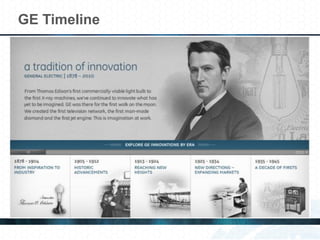
GE Timeline
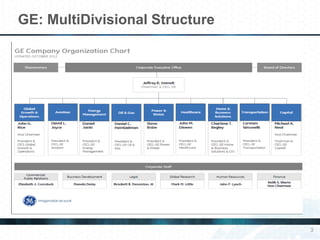
GE: MultiDivisional Structure
3
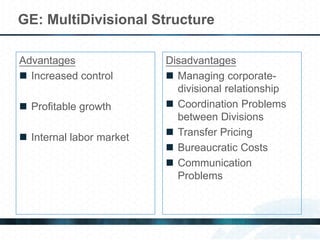
Advantages
 Increased control
 Profitable growth
 Internal labor market
GE: MultiDivisional Structure
Disadvantages
 Managing corporate-
divisional relationship
 Coordination Problems
between Divisions
 Transfer Pricing
 Bureaucratic Costs
 Communication
Problems
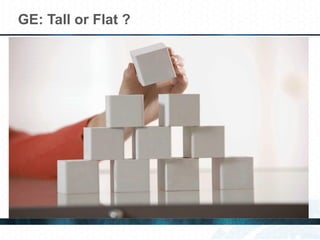
GE: Tall or Flat ?
GE Values
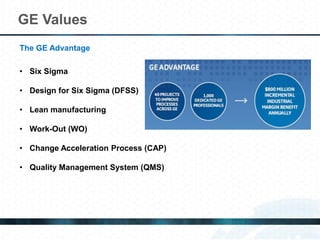
• Six Sigma
• Design for Six Sigma (DFSS)
• Lean manufacturing
• Work-Out (WO)
• Change Acceleration Process (CAP)
• Quality Management System (QMS)
The GE Advantage
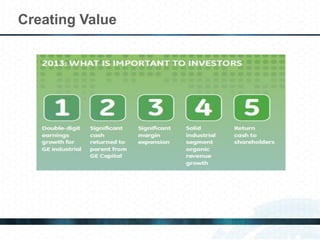
Creating Value
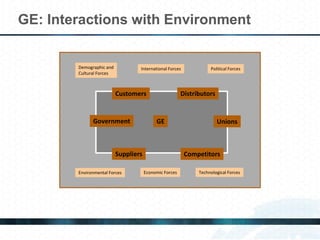
GE
Customers Distributors
UnionsGovernment
Suppliers Competitors
Demographic and
Cultural Forces
International Forces Political Forces
Environmental Forces Economic Forces Technological Forces
GE: Interactions with Environment
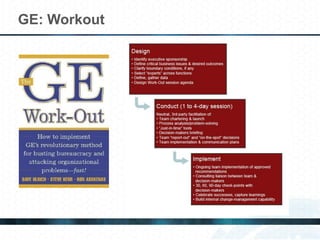
GE: Workout
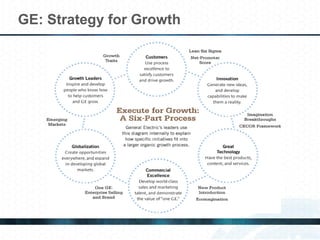
GE: Strategy for Growth
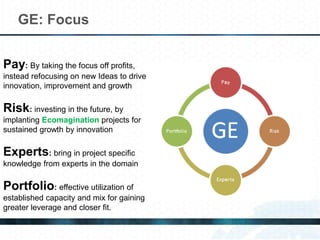
GE: Focus
Pay: By taking the focus off profits,
instead refocusing on new Ideas to drive
innovation, improvement and growth
Risk: investing in the future, by
implanting Ecomagination projects for
sustained growth by innovation
Experts: bring in project specific
knowledge from experts in the domain
Portfolio: effective utilization of
established capacity and mix for gaining
greater leverage and closer fit.
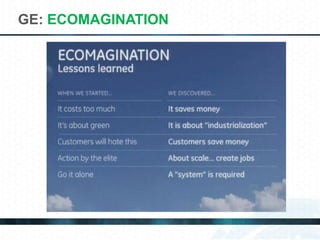
GE: ECOMAGINATION
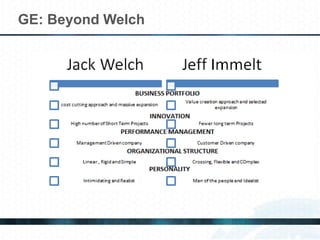
GE: Beyond Welch
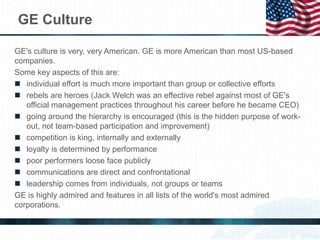
GE Culture
GE's culture is very, very American. GE is more American than most US-based
companies.
Some key aspects of this are:
 individual effort is much more important than group or collective efforts
 rebels are heroes (Jack Welch was an effective rebel against most of GE's
official management practices throughout his career before he became CEO)
 going around the hierarchy is encouraged (this is the hidden purpose of work-
out, not team-based participation and improvement)
 competition is king, internally and externally
 loyalty is determined by performance
 poor performers loose face publicly
 communications are direct and confrontational
 leadership comes from individuals, not groups or teams
GE is highly admired and features in all lists of the world's most admired
corporations.
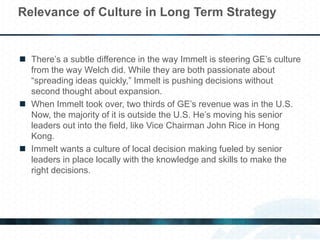
 There’s a subtle difference in the way Immelt is steering GE’s culture
from the way Welch did. While they are both passionate about
“spreading ideas quickly,” Immelt is pushing decisions without
second thought about expansion.
 When Immelt took over, two thirds of GE’s revenue was in the U.S.
Now, the majority of it is outside the U.S. He’s moving his senior
leaders out into the field, like Vice Chairman John Rice in Hong
Kong.
 Immelt wants a culture of local decision making fueled by senior
leaders in place locally with the knowledge and skills to make the
right decisions.
Relevance of Culture in Long Term Strategy
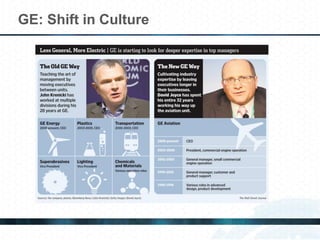
GE: Shift in Culture
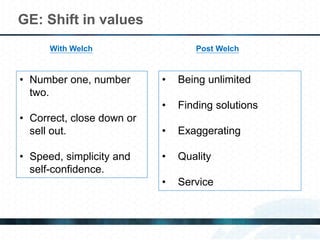
GE: Shift in values
• Number one, number
two.
• Correct, close down or
sell out.
• Speed, simplicity and
self-confidence.
• Being unlimited
• Finding solutions
• Exaggerating
• Quality
• Service
With Welch Post Welch
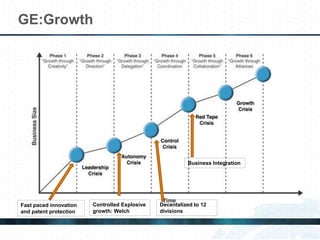
GE:Growth
Fast paced innovation
and patent protection
Controlled Explosive
growth: Welch
Decentalized to 12
divisions
Business Integration
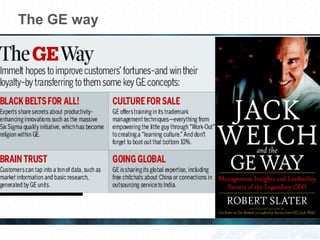
The GE way
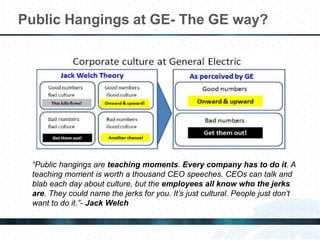
Public Hangings at GE- The GE way?
“Public hangings are teaching moments. Every company has to do it. A
teaching moment is worth a thousand CEO speeches. CEOs can talk and
blab each day about culture, but the employees all know who the jerks
are. They could name the jerks for you. It’s just cultural. People just don’t
want to do it.”- Jack Welch
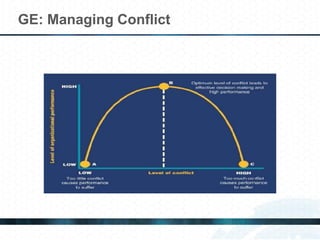
GE: Managing Conflict
General electric:The GE culture

General electric:The GE culture

  • 1.
    Group 4 Bijoyini Ganguly[B13143] Roopan Roy [B13168] Saiyam Sanghvi [B13169] Santanu Mallick [B13170] Suhas Kini [B13175] GENERAL ELECTRIC
  • 2.
  • 3.
  • 4.
    Advantages  Increased control Profitable growth  Internal labor market GE: MultiDivisional Structure Disadvantages  Managing corporate- divisional relationship  Coordination Problems between Divisions  Transfer Pricing  Bureaucratic Costs  Communication Problems
  • 5.
  • 6.
    GE Values • SixSigma • Design for Six Sigma (DFSS) • Lean manufacturing • Work-Out (WO) • Change Acceleration Process (CAP) • Quality Management System (QMS) The GE Advantage
  • 7.
  • 8.
    GE Customers Distributors UnionsGovernment Suppliers Competitors Demographicand Cultural Forces International Forces Political Forces Environmental Forces Economic Forces Technological Forces GE: Interactions with Environment
  • 9.
  • 10.
  • 11.
    GE: Focus Pay: Bytaking the focus off profits, instead refocusing on new Ideas to drive innovation, improvement and growth Risk: investing in the future, by implanting Ecomagination projects for sustained growth by innovation Experts: bring in project specific knowledge from experts in the domain Portfolio: effective utilization of established capacity and mix for gaining greater leverage and closer fit.
  • 12.
  • 13.
  • 14.
    GE Culture GE's cultureis very, very American. GE is more American than most US-based companies. Some key aspects of this are:  individual effort is much more important than group or collective efforts  rebels are heroes (Jack Welch was an effective rebel against most of GE's official management practices throughout his career before he became CEO)  going around the hierarchy is encouraged (this is the hidden purpose of work- out, not team-based participation and improvement)  competition is king, internally and externally  loyalty is determined by performance  poor performers loose face publicly  communications are direct and confrontational  leadership comes from individuals, not groups or teams GE is highly admired and features in all lists of the world's most admired corporations.
  • 15.
     There’s asubtle difference in the way Immelt is steering GE’s culture from the way Welch did. While they are both passionate about “spreading ideas quickly,” Immelt is pushing decisions without second thought about expansion.  When Immelt took over, two thirds of GE’s revenue was in the U.S. Now, the majority of it is outside the U.S. He’s moving his senior leaders out into the field, like Vice Chairman John Rice in Hong Kong.  Immelt wants a culture of local decision making fueled by senior leaders in place locally with the knowledge and skills to make the right decisions. Relevance of Culture in Long Term Strategy
  • 16.
    GE: Shift inCulture
  • 17.
    GE: Shift invalues • Number one, number two. • Correct, close down or sell out. • Speed, simplicity and self-confidence. • Being unlimited • Finding solutions • Exaggerating • Quality • Service With Welch Post Welch
  • 18.
    GE:Growth Fast paced innovation andpatent protection Controlled Explosive growth: Welch Decentalized to 12 divisions Business Integration
  • 19.
  • 20.
    Public Hangings atGE- The GE way? “Public hangings are teaching moments. Every company has to do it. A teaching moment is worth a thousand CEO speeches. CEOs can talk and blab each day about culture, but the employees all know who the jerks are. They could name the jerks for you. It’s just cultural. People just don’t want to do it.”- Jack Welch
  • 21.