
Patrick Heller
Notes for meeting with CSOs
Jakarta, October 2015
Outline
A. Oil sector institutional structure – key
questions
B. Contract structure and incentives
A. Oil-sector institutional structure – Key questions
1. What are the appropriate roles for Pertamina,
SKK Migas, Ministries and other institutions?
2. Who shall be responsible for overseeing
compliance by oil companies (including
Pertamina) with rules and regulations?
3. What mechanisms are in place to ensure public
accountability of all of these institutions?
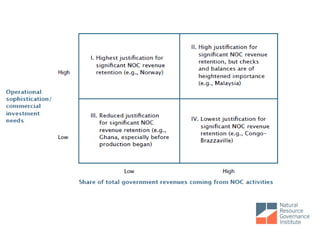
Investing in empowering SOE can confer real
advantages
• Development of national
skills
• Long-term economic control
and financial returns
• More effective state control
over the pace and
development of the
industry
• Stimulator of local content
and positive economic
spillovers
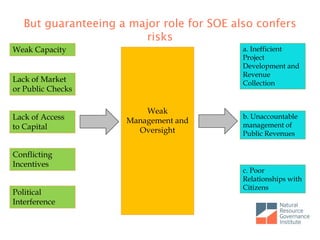
But guaranteeing a major role for SOE also confers
risks
Weak Capacity
Lack of Market
or Public Checks
Lack of Access
to Capital
Conflicting
Incentives
Political
Interference
Weak
Management and
Oversight
a. Inefficient
Project
Development and
Revenue
Collection
b. Unaccountable
management of
Public Revenues
c. Poor
Relationships with
Citizens
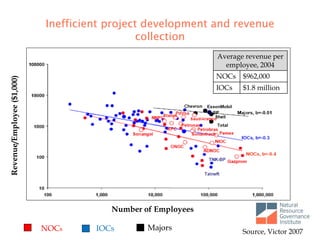
Inefficient project development and revenue
collection
NOCs IOCs Majors
Average revenue per
employee, 2004
NOCs $962,000
IOCs $1.8 million
Source, Victor 2007
Number of Employees
Revenue/Employee($1,000)
Core Principles: The Chatham House Principles
1 Clarity of goals, roles and responsibilities
2 Sustainable development for the benefit of future generations
3 Enablement to carry out the role assigned
4 Accountability of decision-making and performance
5 Transparency and accuracy of information
Source: Chatham House, 2005
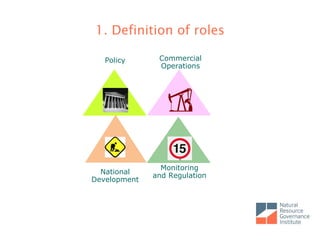
1. Definition of roles
Policy
Monitoring
and Regulation
Commercial
Operations
National
Development
Archetype 1: Norway
Policy
Monitoring
and Regulation
Commercial
Operations
National
Development
Archetype 2: Malaysia
Policy
Commercial
Operations
Monitoring
and Regulation
National
Development
A New Hybrid: Brazil
Traditional zones (post 1997)
Policy
Monitoring
and Regulation
Commercial
Operations (Petrobras and
other companies compete)
National
Development
(Petrobras retains
some)
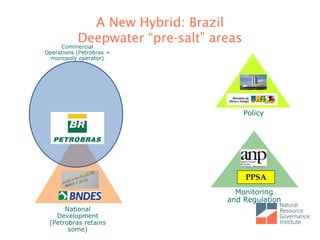
A New Hybrid: Brazil
Deepwater ―pre-salt‖ areas
Policy
Monitoring
and Regulation
Commercial
Operations (Petrobras =
monopoly operator)
National
Development
(Petrobras retains
some)
PPSA
Brazil’s PPSA: a new non-operating NOC
• Created by 2010 legislation
• Purpose: to manage PSCs and petroleum
commercialization contracts in off-shore ―pre-
salt‖
– Representing the state in contractor groups—
chairs the operating committees
– Evaluating E&P plans and enforcing contracts
– Monitoring/auditing costs
– Sells state share of oil and gas from PSCs
• Under tutelage of Ministry of Mines and
Energy
―Exporting the Norwegian Model‖
Low Political Competition High Political Competition
High Institutional
Capacity
Quadrant I
-Consolidate functions
initially
-Consider separating functions
as becomes more pluralistic
Example: MALAYSIA
Quadrant II
-Separate functions
Examples: NORWAY,
BRAZIL
Low Institutional
Capacity
Quadrant III
-Consolidate functions
Example: ANGOLA
Quadrant IV
-Develop technical and
institutional capacity
Example: NIGERIA
Different mandates for NOC
Commercial
Regulatory
Quasi-Fiscal
Pro's

Extensive mandate for SOC
Cons

• More influence on decisions
• Greater access to information
(?)
• Skills development
• Technology transfer
• Greater revenues(?)
• Less dependence on int’l co’s
• Other sources of revenue likely
smaller
• Potential liabilities
• Significant risk
• High financial risk
• Less efficient than private sector
• Neglect of other potentially
higher-benefit sectors
• Concentration of expertise
• More capacity than government
agencies
• Conflict of interest
• More capacity to deliver than
the government
• Employment and skills
• Gains popular support
• “State within a state” –
infrastructure and other
activities
• No focus
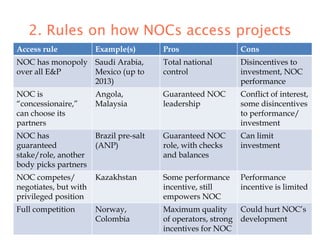
2. Rules on how NOCs access projects
Access rule Example(s) Pros Cons
NOC has monopoly
over all E&P
Saudi Arabia,
Mexico (up to
2013)
Total national
control
Disincentives to
investment, NOC
performance
NOC is
“concessionaire,”
can choose its
partners
Angola,
Malaysia
Guaranteed NOC
leadership
Conflict of interest,
some disincentives
to performance/
investment
NOC has
guaranteed
stake/role, another
body picks partners
Brazil pre-salt
(ANP)
Guaranteed NOC
role, with checks
and balances
Can limit
investment
NOC competes/
negotiates, but with
privileged position
Kazakhstan Some performance
incentive, still
empowers NOC
Performance
incentive is limited
Full competition Norway,
Colombia
Maximum quality
of operators, strong
incentives for NOC
Could hurt NOC’s
development
Institutional reform in Mexico
2,000
2,500
3,000
3,500
4,000
2003
2004
2005
2006
2007
2008
2009
2010
2011
2012
2013
Thousandbarrelsperday
Mexico Oil Production
8.0
9.0
10.0
11.0
12.0
13.0
14.0
15.0
16.0
17.0
2003
2004
2005
2006
2007
2008
2009
2010
2011
2012
2013
Billionbarrels
Mexico Proved Oil Reserves
Source: BP Statistical Review
Institutional reform in Mexico
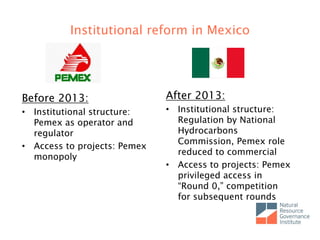
Before 2013:
• Institutional structure:
Pemex as operator and
regulator
• Access to projects: Pemex
monopoly
After 2013:
• Institutional structure:
Regulation by National
Hydrocarbons
Commission, Pemex role
reduced to commercial
• Access to projects: Pemex
privileged access in
―Round 0,‖ competition
for subsequent rounds
3. Fiscal relations between SOE and the State
All revenues to consolidated
fund/special funds, NOC to
receive allocation from
parliament
NOC can retain a predefined
part of revenues from the
petroleum sector
NOC retains all revenues from
production share/equity and
pays taxes and dividends to
the state
Explanation
Degree of State
control
1
2
3
High
Low
• All revenues will be transferred to the
consolidated fund
• NOC present her budget and get budget
approval before receiving funding
• Part of petroleum revenues that can be
retained are set by law
• All revenues in excess are transferred to the
consolidated fund
• NOC operated as a 'normal' commercial
entity with the state as majority (or sole)
shareholder
• NOC pays royalties, taxes and dividends to
the state
4. No matter the institutional model, checks and
balances on regulatory agencies and NOCs are critical
• Anti-corruption rules for
leadership and staff
• Strong performance
benchmarks
• Consistent public reporting
• Technocratic and independent
boards
• Thorough audits by
independent auditors
• Rigorous oversight by a well-
informed parliament
B. Contract structure and incentives
“As far as possible, terms
should be written into
legislation that can be more
clearly scrutinized; any
remaining concessions which
depart from standard
legislated terms should be
submitted to and approved
by the legislature. “
Types of Petroleum and Mineral
Agreements
Agreement Type Key Features Examples
Concession
(Royalty/Tax)
Company owns 100%
of the produced
resource
UK, US, Colombia,
Brazil
Production Sharing Produced resource is
split among
government and
company, company
gets entitlement to
recover costs plus
some share of profit
Indonesia, Azerbaijan,
Angola
Service Contract Government retains
ownership, companies
are paid a fee
Iran, Iraq, Mexico,
Bolivia
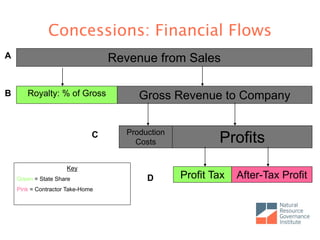
Revenue from Sales
Royalty: % of Gross Gross Revenue to Company
Production
Costs Profits
Profit Tax After-Tax Profit
Key
Green = State Share
Pink = Contractor Take-Home
A
B
C
D
Concessions: Financial Flows
Concessions: Key Issues
Subject Concession Features
Direction of Payments Contractor pays government
Distinguishing Government Revenue
Streams
Royalties and Income Taxes
Other Possible Revenue Streams Bonus, Dividends from State Equity,
Dividend Withholding Tax, Windfall
Profits Tax, Fees
Key Issues in System Design • Setting appropriate royalty
• Tax rates and rules on deductions
• Providing some measure of
progressivity
Advantages Simplicity
Disadvantages No built-in progressivity, alignment
of incentives
Total Oil Produced
Royalty: 10 to
20%
After-Royalty Net : 50%
Cost Oil Profit Oil
Sales by
Sonangol*
Sales by Contractor
Group
Profit
Tax 50%
After-Tax
Profit
Key
Green = State/Sonangol Share
Pink = Contractor Take-Home
* Profit Oil Split between Sonangol and
Contractor varies by contract. Sonangol
retains 10% of its revenues, reverts rest to
Treasury.
A
B
C
D
E
PSA Financial Flows: Angola
PSA Examples: Profit-oil split
Cumulative Production Profit-oil split
< 350 mb 20% state / 80% contractor
351 – 750 mb 35% state / 65% contractor
751 – 1000 mb 45% state / 55% contractor
1001 – 1500 mb 50% state / 50% contractor
1501 – 2000 mb 60% state / 40% contractor
Production-based: Nigeria (Bonga deepwater)
Internal Rate of Return Profit-oil split
RROR < 16.75% 30% state / 70% contractor
16.75% < RROR < 22.75% 55% state / 45% contractor
RROR > 22.75% 80% state / 20% contractor
IRR-based: Azerbaijan (ACG)
PSAs: Key Issues
Subject PSA Features
Direction of Payments Contractor pays government taxes and
(sometimes) royalties;
Government sells share of petroleum
Distinguishing Government Revenue
Streams
Production share
Other Possible Revenue Streams Royalties, Income Tax, Bonus,
Dividends from State Equity, Dividend
Withholding Tax, Windfall Profits Tax,
Fees
Key Issues in System Design • Cost Recovery Rules
• System for Production Split
• Oversight of National Oil
Company
Advantages Direct government role in oil sales,
alignment of incentives, easy to build in
progressivity
Disadvantages Increased potential for conflict of
interest
Contract allocation: Competitive bidding
success factors
• Well-tailored legal framework / institutional
structure
• Transparent process; implemented as
designed
• Objective qualification and assessment criteria
• Competitive but realistic fiscal conditions
• Disclosure of company ownership and of
agents helping win contract
• Conflict of interest regulations
• Independent authority in charge of allocations
Stabilization clauses
Public
Law
Private
Law
“The Government guarantees to the
Contractor, for the entire duration of
this Contract, that it will maintain
the stability of the legal, fiscal and
economic conditions of this contract,
as they result from this contract, the
law and regulations in force on the
effective date. ”
In most OECD countries, no stabilization
clauses
1997: Basic oil sands
royalty regulations
established
2007: Government raises
royalty rates by executive
action, to apply to all
projects
2010: Government
launches “Royalty
Competitiveness
Review,” changes royalty
system to give incentives
to businesses
“Oil Sands” royalties in Alberta, Canada
http://www.energy.alberta.ca/About_Us/1133.asp
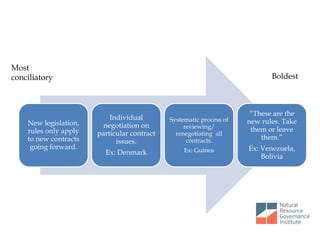
New legislation,
rules only apply
to new contracts
going forward.
Individual
negotiation on
particular contract
issues.
Ex: Denmark
Systematic process of
reviewing/
renegotiating all
contracts.
Ex: Guinea
“These are the
new rules. Take
them or leave
them.”
Ex: Venezuela,
Bolivia
Most
conciliatory Boldest
Citizen understanding and engagement with
contracts
http://www.revenuewatch.org/publications/contracts-confidential-ending-secret-deals-
extractive-industries
EITI and Contract Disclosure
• The EITI Report should provide an
, and include a reference
or link to the location where these are published. (§3.12(b))
• The EITI Report must document the
related to both exploration
and exploitation, including relevant legal provisions, actual
disclosure practices and any reforms that are planned or underway.
(§3.12(b))
• EITI implementing countries are encouraged to
that provide the terms attached to the
exploitation of oil, gas and minerals. (§3.12(a))
Tool for analysis and comparison:
www.resourcecontracts.org
Citizen awareness of contracts—
examples
citizen guides
CSO-
parliament collaboration
financial
modeling and web-based
collaboration
citizen
scrutiny of legal
compliance

Institutional Frameworks and Contract Structure

  • 1.
    Patrick Heller Notes formeeting with CSOs Jakarta, October 2015
  • 2.
    Outline A. Oil sectorinstitutional structure – key questions B. Contract structure and incentives
  • 3.
    A. Oil-sector institutionalstructure – Key questions 1. What are the appropriate roles for Pertamina, SKK Migas, Ministries and other institutions? 2. Who shall be responsible for overseeing compliance by oil companies (including Pertamina) with rules and regulations? 3. What mechanisms are in place to ensure public accountability of all of these institutions?
  • 4.
    Investing in empoweringSOE can confer real advantages • Development of national skills • Long-term economic control and financial returns • More effective state control over the pace and development of the industry • Stimulator of local content and positive economic spillovers
  • 5.
    But guaranteeing amajor role for SOE also confers risks Weak Capacity Lack of Market or Public Checks Lack of Access to Capital Conflicting Incentives Political Interference Weak Management and Oversight a. Inefficient Project Development and Revenue Collection b. Unaccountable management of Public Revenues c. Poor Relationships with Citizens
  • 6.
    Inefficient project developmentand revenue collection NOCs IOCs Majors Average revenue per employee, 2004 NOCs $962,000 IOCs $1.8 million Source, Victor 2007 Number of Employees Revenue/Employee($1,000)
  • 7.
    Core Principles: TheChatham House Principles 1 Clarity of goals, roles and responsibilities 2 Sustainable development for the benefit of future generations 3 Enablement to carry out the role assigned 4 Accountability of decision-making and performance 5 Transparency and accuracy of information Source: Chatham House, 2005
  • 8.
    1. Definition ofroles Policy Monitoring and Regulation Commercial Operations National Development
  • 9.
    Archetype 1: Norway Policy Monitoring andRegulation Commercial Operations National Development
  • 10.
  • 11.
    A New Hybrid:Brazil Traditional zones (post 1997) Policy Monitoring and Regulation Commercial Operations (Petrobras and other companies compete) National Development (Petrobras retains some)
  • 12.
    A New Hybrid:Brazil Deepwater ―pre-salt‖ areas Policy Monitoring and Regulation Commercial Operations (Petrobras = monopoly operator) National Development (Petrobras retains some) PPSA
  • 13.
    Brazil’s PPSA: anew non-operating NOC • Created by 2010 legislation • Purpose: to manage PSCs and petroleum commercialization contracts in off-shore ―pre- salt‖ – Representing the state in contractor groups— chairs the operating committees – Evaluating E&P plans and enforcing contracts – Monitoring/auditing costs – Sells state share of oil and gas from PSCs • Under tutelage of Ministry of Mines and Energy
  • 14.
    ―Exporting the NorwegianModel‖ Low Political Competition High Political Competition High Institutional Capacity Quadrant I -Consolidate functions initially -Consider separating functions as becomes more pluralistic Example: MALAYSIA Quadrant II -Separate functions Examples: NORWAY, BRAZIL Low Institutional Capacity Quadrant III -Consolidate functions Example: ANGOLA Quadrant IV -Develop technical and institutional capacity Example: NIGERIA
  • 15.
    Different mandates forNOC Commercial Regulatory Quasi-Fiscal Pro's  Extensive mandate for SOC Cons  • More influence on decisions • Greater access to information (?) • Skills development • Technology transfer • Greater revenues(?) • Less dependence on int’l co’s • Other sources of revenue likely smaller • Potential liabilities • Significant risk • High financial risk • Less efficient than private sector • Neglect of other potentially higher-benefit sectors • Concentration of expertise • More capacity than government agencies • Conflict of interest • More capacity to deliver than the government • Employment and skills • Gains popular support • “State within a state” – infrastructure and other activities • No focus
  • 16.
    2. Rules onhow NOCs access projects Access rule Example(s) Pros Cons NOC has monopoly over all E&P Saudi Arabia, Mexico (up to 2013) Total national control Disincentives to investment, NOC performance NOC is “concessionaire,” can choose its partners Angola, Malaysia Guaranteed NOC leadership Conflict of interest, some disincentives to performance/ investment NOC has guaranteed stake/role, another body picks partners Brazil pre-salt (ANP) Guaranteed NOC role, with checks and balances Can limit investment NOC competes/ negotiates, but with privileged position Kazakhstan Some performance incentive, still empowers NOC Performance incentive is limited Full competition Norway, Colombia Maximum quality of operators, strong incentives for NOC Could hurt NOC’s development
  • 17.
    Institutional reform inMexico 2,000 2,500 3,000 3,500 4,000 2003 2004 2005 2006 2007 2008 2009 2010 2011 2012 2013 Thousandbarrelsperday Mexico Oil Production 8.0 9.0 10.0 11.0 12.0 13.0 14.0 15.0 16.0 17.0 2003 2004 2005 2006 2007 2008 2009 2010 2011 2012 2013 Billionbarrels Mexico Proved Oil Reserves Source: BP Statistical Review
  • 18.
    Institutional reform inMexico Before 2013: • Institutional structure: Pemex as operator and regulator • Access to projects: Pemex monopoly After 2013: • Institutional structure: Regulation by National Hydrocarbons Commission, Pemex role reduced to commercial • Access to projects: Pemex privileged access in ―Round 0,‖ competition for subsequent rounds
  • 19.
    3. Fiscal relationsbetween SOE and the State All revenues to consolidated fund/special funds, NOC to receive allocation from parliament NOC can retain a predefined part of revenues from the petroleum sector NOC retains all revenues from production share/equity and pays taxes and dividends to the state Explanation Degree of State control 1 2 3 High Low • All revenues will be transferred to the consolidated fund • NOC present her budget and get budget approval before receiving funding • Part of petroleum revenues that can be retained are set by law • All revenues in excess are transferred to the consolidated fund • NOC operated as a 'normal' commercial entity with the state as majority (or sole) shareholder • NOC pays royalties, taxes and dividends to the state
  • 21.
    4. No matterthe institutional model, checks and balances on regulatory agencies and NOCs are critical • Anti-corruption rules for leadership and staff • Strong performance benchmarks • Consistent public reporting • Technocratic and independent boards • Thorough audits by independent auditors • Rigorous oversight by a well- informed parliament
  • 22.
    B. Contract structureand incentives “As far as possible, terms should be written into legislation that can be more clearly scrutinized; any remaining concessions which depart from standard legislated terms should be submitted to and approved by the legislature. “
  • 23.
    Types of Petroleumand Mineral Agreements Agreement Type Key Features Examples Concession (Royalty/Tax) Company owns 100% of the produced resource UK, US, Colombia, Brazil Production Sharing Produced resource is split among government and company, company gets entitlement to recover costs plus some share of profit Indonesia, Azerbaijan, Angola Service Contract Government retains ownership, companies are paid a fee Iran, Iraq, Mexico, Bolivia
  • 24.
    Revenue from Sales Royalty:% of Gross Gross Revenue to Company Production Costs Profits Profit Tax After-Tax Profit Key Green = State Share Pink = Contractor Take-Home A B C D Concessions: Financial Flows
  • 25.
    Concessions: Key Issues SubjectConcession Features Direction of Payments Contractor pays government Distinguishing Government Revenue Streams Royalties and Income Taxes Other Possible Revenue Streams Bonus, Dividends from State Equity, Dividend Withholding Tax, Windfall Profits Tax, Fees Key Issues in System Design • Setting appropriate royalty • Tax rates and rules on deductions • Providing some measure of progressivity Advantages Simplicity Disadvantages No built-in progressivity, alignment of incentives
  • 26.
    Total Oil Produced Royalty:10 to 20% After-Royalty Net : 50% Cost Oil Profit Oil Sales by Sonangol* Sales by Contractor Group Profit Tax 50% After-Tax Profit Key Green = State/Sonangol Share Pink = Contractor Take-Home * Profit Oil Split between Sonangol and Contractor varies by contract. Sonangol retains 10% of its revenues, reverts rest to Treasury. A B C D E PSA Financial Flows: Angola
  • 27.
    PSA Examples: Profit-oilsplit Cumulative Production Profit-oil split < 350 mb 20% state / 80% contractor 351 – 750 mb 35% state / 65% contractor 751 – 1000 mb 45% state / 55% contractor 1001 – 1500 mb 50% state / 50% contractor 1501 – 2000 mb 60% state / 40% contractor Production-based: Nigeria (Bonga deepwater) Internal Rate of Return Profit-oil split RROR < 16.75% 30% state / 70% contractor 16.75% < RROR < 22.75% 55% state / 45% contractor RROR > 22.75% 80% state / 20% contractor IRR-based: Azerbaijan (ACG)
  • 28.
    PSAs: Key Issues SubjectPSA Features Direction of Payments Contractor pays government taxes and (sometimes) royalties; Government sells share of petroleum Distinguishing Government Revenue Streams Production share Other Possible Revenue Streams Royalties, Income Tax, Bonus, Dividends from State Equity, Dividend Withholding Tax, Windfall Profits Tax, Fees Key Issues in System Design • Cost Recovery Rules • System for Production Split • Oversight of National Oil Company Advantages Direct government role in oil sales, alignment of incentives, easy to build in progressivity Disadvantages Increased potential for conflict of interest
  • 29.
    Contract allocation: Competitivebidding success factors • Well-tailored legal framework / institutional structure • Transparent process; implemented as designed • Objective qualification and assessment criteria • Competitive but realistic fiscal conditions • Disclosure of company ownership and of agents helping win contract • Conflict of interest regulations • Independent authority in charge of allocations
  • 30.
    Stabilization clauses Public Law Private Law “The Governmentguarantees to the Contractor, for the entire duration of this Contract, that it will maintain the stability of the legal, fiscal and economic conditions of this contract, as they result from this contract, the law and regulations in force on the effective date. ”
  • 31.
    In most OECDcountries, no stabilization clauses 1997: Basic oil sands royalty regulations established 2007: Government raises royalty rates by executive action, to apply to all projects 2010: Government launches “Royalty Competitiveness Review,” changes royalty system to give incentives to businesses “Oil Sands” royalties in Alberta, Canada http://www.energy.alberta.ca/About_Us/1133.asp
  • 32.
    New legislation, rules onlyapply to new contracts going forward. Individual negotiation on particular contract issues. Ex: Denmark Systematic process of reviewing/ renegotiating all contracts. Ex: Guinea “These are the new rules. Take them or leave them.” Ex: Venezuela, Bolivia Most conciliatory Boldest
  • 33.
    Citizen understanding andengagement with contracts http://www.revenuewatch.org/publications/contracts-confidential-ending-secret-deals- extractive-industries
  • 34.
    EITI and ContractDisclosure • The EITI Report should provide an , and include a reference or link to the location where these are published. (§3.12(b)) • The EITI Report must document the related to both exploration and exploitation, including relevant legal provisions, actual disclosure practices and any reforms that are planned or underway. (§3.12(b)) • EITI implementing countries are encouraged to that provide the terms attached to the exploitation of oil, gas and minerals. (§3.12(a))
  • 35.
    Tool for analysisand comparison: www.resourcecontracts.org
  • 36.
    Citizen awareness ofcontracts— examples citizen guides CSO- parliament collaboration financial modeling and web-based collaboration citizen scrutiny of legal compliance