Search Engines Shamprasad Pujar IGIDR, Mumbai [email_address]
Agenda Basics of Internet Basics of Search engine What is a search engine? Functioning of a search engine Methods of indexing or searching Types of Search engines? Advantages of Search engines? Disadvantages of Search engines? Search engines v/s Directories v/s portals Limitations of search engines Q & A
Basics of Internet Anybody can publish anything on the net Content and features of sites change very fast No bibliographic control on published information Internet is a self publishing tool-Evaluate Try out multiple sites, while looking for information Subject Directories and Search Engines vary in their    contents Subject Directories/Search engines are highly    volatile Good source to locate scholarly literature
Basics of Search Engines Store millions of pages in their databases Sites are included automatically based on a set    criteria. No human interference Search features/scope vary greatly from one to    another Good for beginners and experts Good for searching on a narrow topic Search for particular types of documents, file    types, etc is possible  Search for any kind of information is possible Different search facility is available for sites,    images, news, audio/video files, maps etc
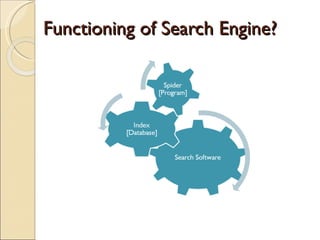
What is a Search Engine? Search engine is a tool, which helps in retrieving  information from the Internet It indexes the web and accordingly builds its databases Each search engine has its own set rules to index  websites When the query or keyword is entered in the search  box it checks its ‘index’ with the query Relevant matches are retrieved and returned as 'hits' or  'search results‘
Functioning of Search Engine?
Methods of Indexing and Searching Keywords from meta tags or web pages Boolean (and, or, not) Mathematical symbols (+, * -) Concept /Computational  Natural language searching
Types of Search Engines General  Example: Bing, Google, Gigablast, etc Meta Search Engines Example: Dogpile, etc Subject Specific search engine Example: Scirus, Intute, Entrez, GoPubMed Intelligent/Specialized Search Engines Example: Kosmix, WolframAlpha  Deep Web/Invisible web Example: Library catalogues, Databases Scholarly literature Example: Google Scholar, Base, OAISTER, etc
Types of Search Engines General Search Engines : Have own database/index Index sites using their software robot/crawler Index sites on their policy Rank web pages based on their policy Meta Search Engines   Search different general search engines Components Dispatch mechanism   Interface Agents    Display
Types of Search Engines Subject Specific Search Engines: Index sites on particular subject or material Intelligent/Specialized Search Engines: Concept based searching Allow natural language searching Use thesaurus  Personalized Services Deepweb or Inivisible Web: Search content stored in searchable databases Scholarly Literature Search Engines Search content from scholarly journals publishers  websites/grey literature published from institutes  and repositories
Advantages of Search Engines Enable to quick search to vast amount of information from one search box Search on a specific type or piece of  information is possible Different types of search engines enable  to look for specific types of documents
Disadvantages of Search Engines Creates information overload Semantic search is not possible Privacy and security is of concern Makes everyone to dependent
Search Engines v/s Directories v/s Portals SEARCH ENGINES Crawl Web for information Automatic Indexing Change in webpage automatically gets updated  DIRECTORIES Human editing Change in webpage will not automatically updated PORTALS Information put by individuals or organizations
Limitations of Search Engines Can not index the entire web.  Most of the search engines can index only between 40% and 60% of the web Can not index sites governed by passwords and developed using frames
 
Q & A Questions and Answers ??

Search Engines

  • 1.
    Search Engines ShamprasadPujar IGIDR, Mumbai [email_address]
  • 2.
    Agenda Basics ofInternet Basics of Search engine What is a search engine? Functioning of a search engine Methods of indexing or searching Types of Search engines? Advantages of Search engines? Disadvantages of Search engines? Search engines v/s Directories v/s portals Limitations of search engines Q & A
  • 3.
    Basics of InternetAnybody can publish anything on the net Content and features of sites change very fast No bibliographic control on published information Internet is a self publishing tool-Evaluate Try out multiple sites, while looking for information Subject Directories and Search Engines vary in their contents Subject Directories/Search engines are highly volatile Good source to locate scholarly literature
  • 4.
    Basics of SearchEngines Store millions of pages in their databases Sites are included automatically based on a set criteria. No human interference Search features/scope vary greatly from one to another Good for beginners and experts Good for searching on a narrow topic Search for particular types of documents, file types, etc is possible Search for any kind of information is possible Different search facility is available for sites, images, news, audio/video files, maps etc
  • 5.
    What is aSearch Engine? Search engine is a tool, which helps in retrieving information from the Internet It indexes the web and accordingly builds its databases Each search engine has its own set rules to index websites When the query or keyword is entered in the search box it checks its ‘index’ with the query Relevant matches are retrieved and returned as 'hits' or 'search results‘
  • 6.
  • 7.
    Methods of Indexingand Searching Keywords from meta tags or web pages Boolean (and, or, not) Mathematical symbols (+, * -) Concept /Computational Natural language searching
  • 8.
    Types of SearchEngines General Example: Bing, Google, Gigablast, etc Meta Search Engines Example: Dogpile, etc Subject Specific search engine Example: Scirus, Intute, Entrez, GoPubMed Intelligent/Specialized Search Engines Example: Kosmix, WolframAlpha Deep Web/Invisible web Example: Library catalogues, Databases Scholarly literature Example: Google Scholar, Base, OAISTER, etc
  • 9.
    Types of SearchEngines General Search Engines : Have own database/index Index sites using their software robot/crawler Index sites on their policy Rank web pages based on their policy Meta Search Engines Search different general search engines Components Dispatch mechanism  Interface Agents  Display
  • 10.
    Types of SearchEngines Subject Specific Search Engines: Index sites on particular subject or material Intelligent/Specialized Search Engines: Concept based searching Allow natural language searching Use thesaurus Personalized Services Deepweb or Inivisible Web: Search content stored in searchable databases Scholarly Literature Search Engines Search content from scholarly journals publishers websites/grey literature published from institutes and repositories
  • 11.
    Advantages of SearchEngines Enable to quick search to vast amount of information from one search box Search on a specific type or piece of information is possible Different types of search engines enable to look for specific types of documents
  • 12.
    Disadvantages of SearchEngines Creates information overload Semantic search is not possible Privacy and security is of concern Makes everyone to dependent
  • 13.
    Search Engines v/sDirectories v/s Portals SEARCH ENGINES Crawl Web for information Automatic Indexing Change in webpage automatically gets updated DIRECTORIES Human editing Change in webpage will not automatically updated PORTALS Information put by individuals or organizations
  • 14.
    Limitations of SearchEngines Can not index the entire web. Most of the search engines can index only between 40% and 60% of the web Can not index sites governed by passwords and developed using frames
  • 15.
  • 16.
    Q & AQuestions and Answers ??

Editor's Notes

  • #16 Tip: Add your own speaker notes here.
  • #17 Tip: Add your own speaker notes here.