Java 8
What could possibly go wrong?
Grzegorz Rozniecki (@xaerxess)
October 11, 2016
About me
@xaerxess
Important: Images used in this presentation (and the presentation itself) are free to use under Creative Commons Attribution
License.
Code (reviews) addict Open Source advocate
I’m a software engineer who enjoys learning and likes sharing his knowledge. Big GNU/Linux fan and Open
Source Software advocate. I’ve developed software in various languages, including Perl, JavaScript, Java, Python,
PHP and Lisp (and experimented with few others).
● Being a programmer is mostly reading
code, not writing
● You are not your code!
● Freedom is important
● You can read how libraries, languages,
even operating systems are built - and
learn!
● Contribute, it’s easy!
Who?
Why?
What?
Where?
What now?
WHO uses Java 8
Quick journey from 1995 to 2016
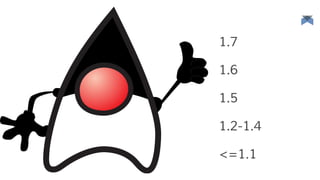
1.7
1.6
1.5
1.2-1.4
<=1.1
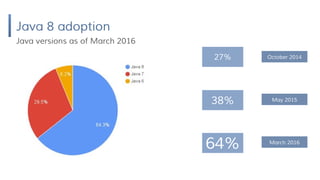
Java 8 adoption
Java versions as of March 2016
October 201427%
38%
64%
May 2015
March 2016
WHY Java 8
(rhetorical)
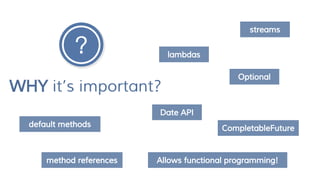
lambdas
streams
Date API
Optional
CompletableFuture
Allows functional programming!method references
WHY it’s important?
default methods
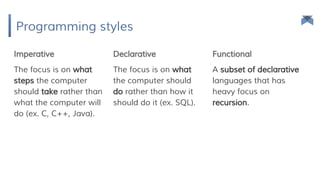
Programming styles
...?
Why he’s talking about…
Programming styles
Imperative Declarative Functional
The focus is on what
steps the computer
should take rather than
what the computer will
do (ex. C, C++, Java).
The focus is on what
the computer should
do rather than how it
should do it (ex. SQL).
A subset of declarative
languages that has
heavy focus on
recursion.
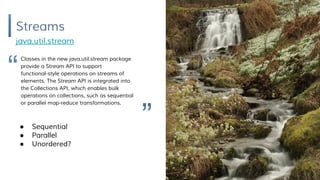
Streams
java.util.stream
Classes in the new java.util.stream package
provide a Stream API to support
functional-style operations on streams of
elements. The Stream API is integrated into
the Collections API, which enables bulk
operations on collections, such as sequential
or parallel map-reduce transformations.
● Sequential
● Parallel
● Unordered?
“
”
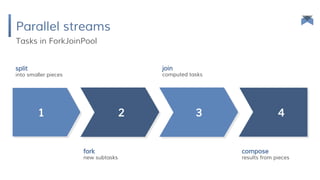
Parallel streams
Tasks in ForkJoinPool
into smaller pieces
split
new subtasks
fork
computed tasks
join
1 2 3 4
results from pieces
compose
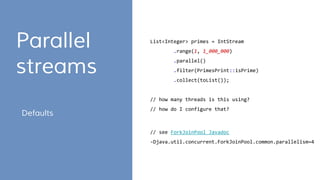
Parallel
streams
List<Integer> primes = IntStream
.range(1, 1_000_000)
.parallel()
.filter(PrimesPrint::isPrime)
.collect(toList());
// how many threads is this using?
// how do I configure that?
Defaults
// see ForkJoinPool Javadoc
-Djava.util.concurrent.ForkJoinPool.common.parallelism=4
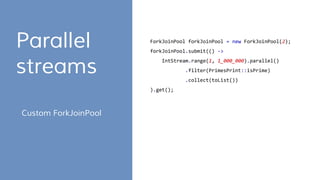
Parallel
streams
ForkJoinPool forkJoinPool = new ForkJoinPool(2);
forkJoinPool.submit(() ->
IntStream.range(1, 1_000_000).parallel()
.filter(PrimesPrint::isPrime)
.collect(toList())
).get();
Custom ForkJoinPool
WHAT should I
use?
Effective Java, Item 47: Know and use
your libraries
Libraries
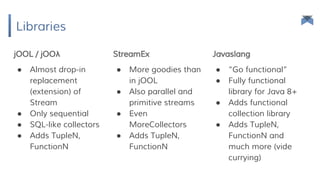
jOOL / jOOλ StreamEx Javaslang
● Almost drop-in
replacement
(extension) of
Stream
● Only sequential
● SQL-like collectors
● Adds TupleN,
FunctionN
● More goodies than
in jOOL
● Also parallel and
primitive streams
● Even
MoreCollectors
● Adds TupleN,
FunctionN
● “Go functional”
● Fully functional
library for Java 8+
● Adds functional
collection library
● Adds TupleN,
FunctionN and
much more (vide
currying)
Problem
static final ImmutableList<String> DATA = ImmutableList.of("foo", "bar", "baz", "bazinga");
static final String[] ARRAY_DATA = DATA.stream().toArray(String[]::new);
static final Iterable<String> ITERABLE_DATA = DATA;
static final Iterator<String> ITERATOR_DATA = DATA.iterator(); // don't do this at home or work!
How create Stream?
DATA.stream();
Arrays.stream(ARRAY_DATA);
StreamSupport.stream(ITERABLE_DATA.spliterator(), false);
StreamSupport.stream(
Spliterators.spliteratorUnknownSize(ITERATOR_DATA, Spliterator.ORDERED),
false);
Solution - jOOL
static final ImmutableList<String> DATA = ImmutableList.of("foo", "bar", "baz", "bazinga");
static final String[] ARRAY_DATA = DATA.stream().toArray(String[]::new);
static final Iterable<String> ITERABLE_DATA = DATA;
static final Iterator<String> ITERATOR_DATA = DATA.iterator(); // don't do this at home or work!
How create Stream?
Seq.seq(DATA);
Seq.seq(ARRAY_DATA);
Seq.seq(ITERABLE_DATA);
Seq.seq(DATA);
Solution - jOOL (fixed)
static final ImmutableList<String> DATA = ImmutableList.of("foo", "bar", "baz", "bazinga");
static final String[] ARRAY_DATA = DATA.stream().toArray(String[]::new);
static final Iterable<String> ITERABLE_DATA = DATA;
static final Iterator<String> ITERATOR_DATA = DATA.iterator(); // don't do this at home or work!
How create Stream?
Seq.seq(DATA);
Seq.of(ARRAY_DATA);
Seq.seq(ITERABLE_DATA);
Seq.seq(DATA);
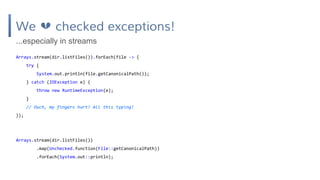
We checked exceptions!
Arrays.stream(dir.listFiles()).forEach(file -> {
try {
System.out.println(file.getCanonicalPath());
} catch (IOException e) {
throw new RuntimeException(e);
}
// Ouch, my fingers hurt! All this typing!
});
...especially in streams
Arrays.stream(dir.listFiles())
.map(Unchecked.function(File::getCanonicalPath))
.forEach(System.out::println);
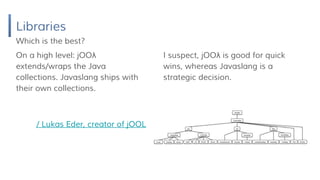
Libraries
On a high level: jOOλ
extends/wraps the Java
collections. Javaslang ships with
their own collections.
/ Lukas Eder, creator of jOOL
Which is the best?
I suspect, jOOλ is good for quick
wins, whereas Javaslang is a
strategic decision.
CompletableFuture
and CompletionStage
● ~50 methods
● Concept from JS promises
● What could go wrong?
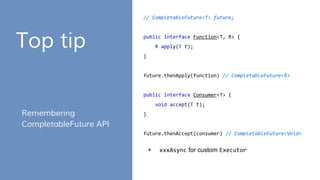
Top tip
Remembering
CompletableFuture API
// CompletableFuture<T> future;
public interface Function<T, R> {
R apply(T t);
}
future.thenApply(function) // CompletableFuture<R>
public interface Consumer<T> {
void accept(T t);
}
future.thenAccept(consumer) // CompletableFuture<Void>
+ xxxAsync for custom Executor
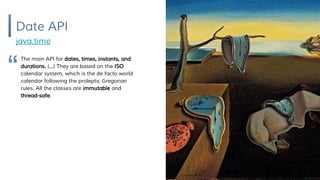
Date API
java.time
The main API for dates, times, instants, and
durations. (...) They are based on the ISO
calendar system, which is the de facto world
calendar following the proleptic Gregorian
rules. All the classes are immutable and
thread-safe.
“
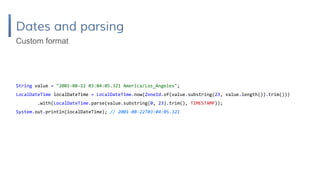
Dates and parsing
String value = "2001-08-22 03:04:05.321 America/Los_Angeles";
LocalDateTime localDateTime = LocalDateTime.now(ZoneId.of(value.substring(23, value.length()).trim()))
.with(LocalDateTime.parse(value.substring(0, 23).trim(), TIMESTAMP));
System.out.println(localDateTime); // 2001-08-22T03:04:05.321
Custom format
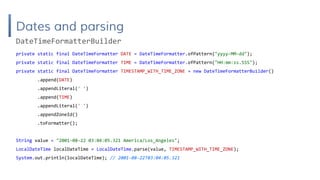
Dates and parsing
private static final DateTimeFormatter DATE = DateTimeFormatter.ofPattern("yyyy-MM-dd");
private static final DateTimeFormatter TIME = DateTimeFormatter.ofPattern("HH:mm:ss.SSS");
private static final DateTimeFormatter TIMESTAMP_WITH_TIME_ZONE = new DateTimeFormatterBuilder()
.append(DATE)
.appendLiteral(' ')
.append(TIME)
.appendLiteral(' ')
.appendZoneId()
.toFormatter();
String value = "2001-08-22 03:04:05.321 America/Los_Angeles";
LocalDateTime localDateTime = LocalDateTime.parse(value, TIMESTAMP_WITH_TIME_ZONE);
System.out.println(localDateTime); // 2001-08-22T03:04:05.321
DateTimeFormatterBuilder
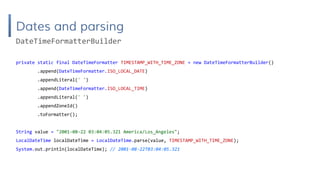
Dates and parsing
private static final DateTimeFormatter TIMESTAMP_WITH_TIME_ZONE = new DateTimeFormatterBuilder()
.append(DateTimeFormatter.ISO_LOCAL_DATE)
.appendLiteral(' ')
.append(DateTimeFormatter.ISO_LOCAL_TIME)
.appendLiteral(' ')
.appendZoneId()
.toFormatter();
String value = "2001-08-22 03:04:05.321 America/Los_Angeles";
LocalDateTime localDateTime = LocalDateTime.parse(value, TIMESTAMP_WITH_TIME_ZONE);
System.out.println(localDateTime); // 2001-08-22T03:04:05.321
DateTimeFormatterBuilder
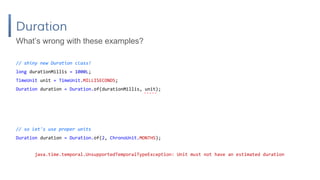
Duration
// shiny new Duration class!
long durationMillis = 1000L;
TimeUnit unit = TimeUnit.MILLISECONDS;
Duration duration = Duration.of(durationMillis, unit);
What’s wrong with these examples?
// so let's use proper units
Duration duration = Duration.of(2, ChronoUnit.MONTHS);
java.time.temporal.UnsupportedTemporalTypeException: Unit must not have an estimated duration
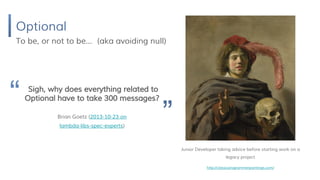
Optional
To be, or not to be… (aka avoiding null)
Sigh, why does everything related to
Optional have to take 300 messages?
”Brian Goetz (2013-10-23 on
lambda-libs-spec-experts)
“
Junior Developer taking advice before starting work on a
legacy project
http://classicprogrammerpaintings.com/
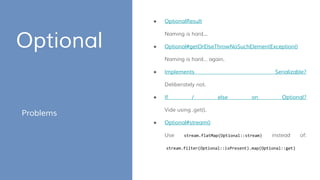
Optional
Problems
● OptionalResult
Naming is hard...
● Optional#getOrElseThrowNoSuchElementException()
Naming is hard… again.
● Implements Serializable?
Deliberately not.
● If / else on Optional?
Vide using .get().
● Optional#stream()
Use stream.flatMap(Optional::stream) instead of:
stream.filter(Optional::isPresent).map(Optional::get)
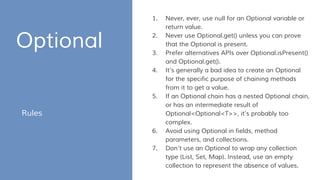
Optional
Rules
1. Never, ever, use null for an Optional variable or
return value.
2. Never use Optional.get() unless you can prove
that the Optional is present.
3. Prefer alternatives APIs over Optional.isPresent()
and Optional.get().
4. It’s generally a bad idea to create an Optional
for the specific purpose of chaining methods
from it to get a value.
5. If an Optional chain has a nested Optional chain,
or has an intermediate result of
Optional<Optional<T>>, it’s probably too
complex.
6. Avoid using Optional in fields, method
parameters, and collections.
7. Don’t use an Optional to wrap any collection
type (List, Set, Map). Instead, use an empty
collection to represent the absence of values.
WHERE should I
find answers?
Contribute!
That’s all
(questions?)
Thank you for your
participation!

JDD 2016 - Grzegorz Rozniecki - Java 8 What Could Possibly Go Wrong

  • 1.
    Java 8 What couldpossibly go wrong? Grzegorz Rozniecki (@xaerxess) October 11, 2016
  • 2.
    About me @xaerxess Important: Imagesused in this presentation (and the presentation itself) are free to use under Creative Commons Attribution License. Code (reviews) addict Open Source advocate I’m a software engineer who enjoys learning and likes sharing his knowledge. Big GNU/Linux fan and Open Source Software advocate. I’ve developed software in various languages, including Perl, JavaScript, Java, Python, PHP and Lisp (and experimented with few others). ● Being a programmer is mostly reading code, not writing ● You are not your code! ● Freedom is important ● You can read how libraries, languages, even operating systems are built - and learn! ● Contribute, it’s easy!
  • 3.
  • 4.
    WHO uses Java8 Quick journey from 1995 to 2016
  • 5.
  • 6.
    Java 8 adoption Javaversions as of March 2016 October 201427% 38% 64% May 2015 March 2016
  • 7.
  • 8.
    lambdas streams Date API Optional CompletableFuture Allows functionalprogramming!method references WHY it’s important? default methods
  • 9.
  • 10.
    Programming styles Imperative DeclarativeFunctional The focus is on what steps the computer should take rather than what the computer will do (ex. C, C++, Java). The focus is on what the computer should do rather than how it should do it (ex. SQL). A subset of declarative languages that has heavy focus on recursion.
  • 11.
    Streams java.util.stream Classes in thenew java.util.stream package provide a Stream API to support functional-style operations on streams of elements. The Stream API is integrated into the Collections API, which enables bulk operations on collections, such as sequential or parallel map-reduce transformations. ● Sequential ● Parallel ● Unordered? “ ”
  • 12.
    Parallel streams Tasks inForkJoinPool into smaller pieces split new subtasks fork computed tasks join 1 2 3 4 results from pieces compose
  • 13.
    Parallel streams List<Integer> primes =IntStream .range(1, 1_000_000) .parallel() .filter(PrimesPrint::isPrime) .collect(toList()); // how many threads is this using? // how do I configure that? Defaults // see ForkJoinPool Javadoc -Djava.util.concurrent.ForkJoinPool.common.parallelism=4
  • 14.
    Parallel streams ForkJoinPool forkJoinPool =new ForkJoinPool(2); forkJoinPool.submit(() -> IntStream.range(1, 1_000_000).parallel() .filter(PrimesPrint::isPrime) .collect(toList()) ).get(); Custom ForkJoinPool
  • 15.
    WHAT should I use? EffectiveJava, Item 47: Know and use your libraries
  • 16.
    Libraries jOOL / jOOλStreamEx Javaslang ● Almost drop-in replacement (extension) of Stream ● Only sequential ● SQL-like collectors ● Adds TupleN, FunctionN ● More goodies than in jOOL ● Also parallel and primitive streams ● Even MoreCollectors ● Adds TupleN, FunctionN ● “Go functional” ● Fully functional library for Java 8+ ● Adds functional collection library ● Adds TupleN, FunctionN and much more (vide currying)
  • 17.
    Problem static final ImmutableList<String>DATA = ImmutableList.of("foo", "bar", "baz", "bazinga"); static final String[] ARRAY_DATA = DATA.stream().toArray(String[]::new); static final Iterable<String> ITERABLE_DATA = DATA; static final Iterator<String> ITERATOR_DATA = DATA.iterator(); // don't do this at home or work! How create Stream? DATA.stream(); Arrays.stream(ARRAY_DATA); StreamSupport.stream(ITERABLE_DATA.spliterator(), false); StreamSupport.stream( Spliterators.spliteratorUnknownSize(ITERATOR_DATA, Spliterator.ORDERED), false);
  • 18.
    Solution - jOOL staticfinal ImmutableList<String> DATA = ImmutableList.of("foo", "bar", "baz", "bazinga"); static final String[] ARRAY_DATA = DATA.stream().toArray(String[]::new); static final Iterable<String> ITERABLE_DATA = DATA; static final Iterator<String> ITERATOR_DATA = DATA.iterator(); // don't do this at home or work! How create Stream? Seq.seq(DATA); Seq.seq(ARRAY_DATA); Seq.seq(ITERABLE_DATA); Seq.seq(DATA);
  • 19.
    Solution - jOOL(fixed) static final ImmutableList<String> DATA = ImmutableList.of("foo", "bar", "baz", "bazinga"); static final String[] ARRAY_DATA = DATA.stream().toArray(String[]::new); static final Iterable<String> ITERABLE_DATA = DATA; static final Iterator<String> ITERATOR_DATA = DATA.iterator(); // don't do this at home or work! How create Stream? Seq.seq(DATA); Seq.of(ARRAY_DATA); Seq.seq(ITERABLE_DATA); Seq.seq(DATA);
  • 20.
    We checked exceptions! Arrays.stream(dir.listFiles()).forEach(file-> { try { System.out.println(file.getCanonicalPath()); } catch (IOException e) { throw new RuntimeException(e); } // Ouch, my fingers hurt! All this typing! }); ...especially in streams Arrays.stream(dir.listFiles()) .map(Unchecked.function(File::getCanonicalPath)) .forEach(System.out::println);
  • 21.
    Libraries On a highlevel: jOOλ extends/wraps the Java collections. Javaslang ships with their own collections. / Lukas Eder, creator of jOOL Which is the best? I suspect, jOOλ is good for quick wins, whereas Javaslang is a strategic decision.
  • 22.
    CompletableFuture and CompletionStage ● ~50methods ● Concept from JS promises ● What could go wrong?
  • 23.
    Top tip Remembering CompletableFuture API //CompletableFuture<T> future; public interface Function<T, R> { R apply(T t); } future.thenApply(function) // CompletableFuture<R> public interface Consumer<T> { void accept(T t); } future.thenAccept(consumer) // CompletableFuture<Void> + xxxAsync for custom Executor
  • 24.
    Date API java.time The mainAPI for dates, times, instants, and durations. (...) They are based on the ISO calendar system, which is the de facto world calendar following the proleptic Gregorian rules. All the classes are immutable and thread-safe. “
  • 25.
    Dates and parsing Stringvalue = "2001-08-22 03:04:05.321 America/Los_Angeles"; LocalDateTime localDateTime = LocalDateTime.now(ZoneId.of(value.substring(23, value.length()).trim())) .with(LocalDateTime.parse(value.substring(0, 23).trim(), TIMESTAMP)); System.out.println(localDateTime); // 2001-08-22T03:04:05.321 Custom format
  • 26.
    Dates and parsing privatestatic final DateTimeFormatter DATE = DateTimeFormatter.ofPattern("yyyy-MM-dd"); private static final DateTimeFormatter TIME = DateTimeFormatter.ofPattern("HH:mm:ss.SSS"); private static final DateTimeFormatter TIMESTAMP_WITH_TIME_ZONE = new DateTimeFormatterBuilder() .append(DATE) .appendLiteral(' ') .append(TIME) .appendLiteral(' ') .appendZoneId() .toFormatter(); String value = "2001-08-22 03:04:05.321 America/Los_Angeles"; LocalDateTime localDateTime = LocalDateTime.parse(value, TIMESTAMP_WITH_TIME_ZONE); System.out.println(localDateTime); // 2001-08-22T03:04:05.321 DateTimeFormatterBuilder
  • 27.
    Dates and parsing privatestatic final DateTimeFormatter TIMESTAMP_WITH_TIME_ZONE = new DateTimeFormatterBuilder() .append(DateTimeFormatter.ISO_LOCAL_DATE) .appendLiteral(' ') .append(DateTimeFormatter.ISO_LOCAL_TIME) .appendLiteral(' ') .appendZoneId() .toFormatter(); String value = "2001-08-22 03:04:05.321 America/Los_Angeles"; LocalDateTime localDateTime = LocalDateTime.parse(value, TIMESTAMP_WITH_TIME_ZONE); System.out.println(localDateTime); // 2001-08-22T03:04:05.321 DateTimeFormatterBuilder
  • 28.
    Duration // shiny newDuration class! long durationMillis = 1000L; TimeUnit unit = TimeUnit.MILLISECONDS; Duration duration = Duration.of(durationMillis, unit); What’s wrong with these examples? // so let's use proper units Duration duration = Duration.of(2, ChronoUnit.MONTHS); java.time.temporal.UnsupportedTemporalTypeException: Unit must not have an estimated duration
  • 29.
    Optional To be, ornot to be… (aka avoiding null) Sigh, why does everything related to Optional have to take 300 messages? ”Brian Goetz (2013-10-23 on lambda-libs-spec-experts) “ Junior Developer taking advice before starting work on a legacy project http://classicprogrammerpaintings.com/
  • 30.
    Optional Problems ● OptionalResult Naming ishard... ● Optional#getOrElseThrowNoSuchElementException() Naming is hard… again. ● Implements Serializable? Deliberately not. ● If / else on Optional? Vide using .get(). ● Optional#stream() Use stream.flatMap(Optional::stream) instead of: stream.filter(Optional::isPresent).map(Optional::get)
  • 31.
    Optional Rules 1. Never, ever,use null for an Optional variable or return value. 2. Never use Optional.get() unless you can prove that the Optional is present. 3. Prefer alternatives APIs over Optional.isPresent() and Optional.get(). 4. It’s generally a bad idea to create an Optional for the specific purpose of chaining methods from it to get a value. 5. If an Optional chain has a nested Optional chain, or has an intermediate result of Optional<Optional<T>>, it’s probably too complex. 6. Avoid using Optional in fields, method parameters, and collections. 7. Don’t use an Optional to wrap any collection type (List, Set, Map). Instead, use an empty collection to represent the absence of values.
  • 32.
    WHERE should I findanswers? Contribute!
  • 33.
    That’s all (questions?) Thank youfor your participation!