Code Transformation with
Spoon
Gérard Paligot
Code transformation
• Read, generate, analyse or transform.
Code transformation
• Read, generate, analyse or transform.
• Used more and more by libraries.
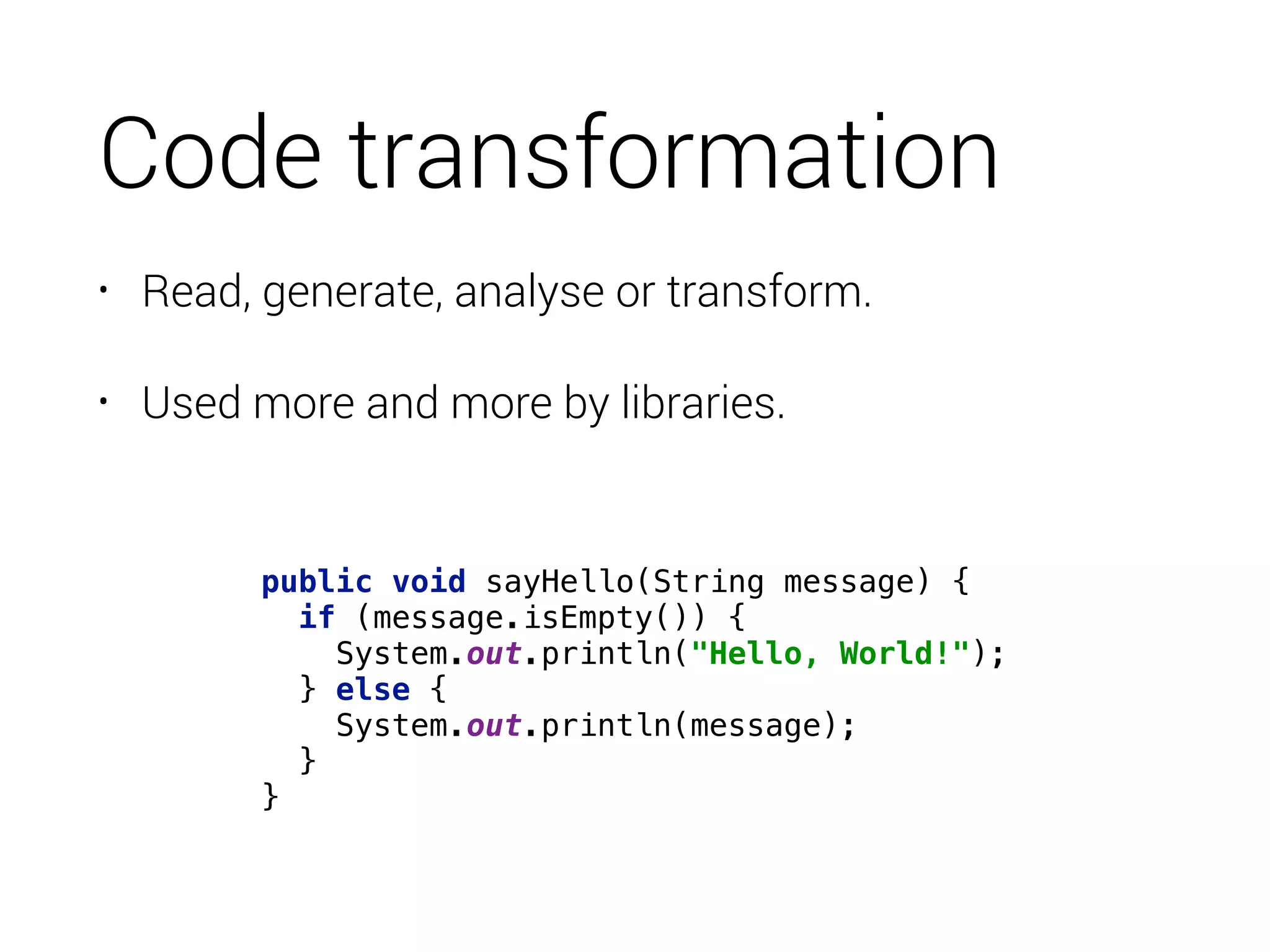
Code transformation
• Read, generate, analyse or transform.
• Used more and more by libraries.
public void sayHello(String message) {

if (message.isEmpty()) {

System.out.println("Hello, World!");

} else {

System.out.println(message);

}

}
Code transformation
• Read, generate, analyse or transform.
• Used more and more by libraries.
@Log
public void sayHello(String message) {

if (message.isEmpty()) {

System.out.println("Hello, World!");

} else {

System.out.println(message);

}

}
Code transformation
• Read, generate, analyse or transform.
• Used more and more by libraries.
public void sayHello(@Log String message) {

if (message.isEmpty()) {

System.out.println("Hello, World!");

} else {

System.out.println(message);

}

}
Code transformation
• Read, generate, analyse or transform.
• Used more and more by libraries.
public void sayHello(@NotNull String message) {

if (message.isEmpty()) {

System.out.println("Hello, World!");

} else {

System.out.println(message);

}

}
Library rescue
• APT
• JDT
• JavaParser
• JTransformer
• ASM
• pfff
• Others…
JDT
• Developed at Eclipse.
JDT
• Developed at Eclipse.
• Used in the project Eclipse.
JDT
• Developed at Eclipse.
• Used in the project Eclipse.
• Easy to create a Eclipse plugin with JDT.
JDT
• Developed at Eclipse.
• Used in the project Eclipse.
• Easy to create a Eclipse plugin with JDT.
• Read, generate, analyse and transform source code.
JDT
• Developed at Eclipse.
• Used in the project Eclipse.
• Easy to create a Eclipse plugin with JDT.
• Read, generate, analyse and transform source code.
• API and meta model hard to use and to understand.
APT
• Developed at SUN, later by Oracle.
APT
• Developed at SUN, later by Oracle.
• Adopted by a lot of open-source librairies.
APT
• Developed at SUN, later by Oracle.
• Adopted by a lot of open-source librairies.
• Accessible by the package javax.lang.model.* and
javax.annotation.processing.
APT
• Developed at SUN, later by Oracle.
• Adopted by a lot of open-source librairies.
• Accessible by the package javax.lang.model.* and
javax.annotation.processing.
• Well integrated in modernes build-management.
APT
• Developed at SUN, later by Oracle.
• Adopted by a lot of open-source librairies.
• Accessible by the package javax.lang.model.* and
javax.annotation.processing.
• Well integrated in modernes build-management.
• Meta model limited and transformation not allowed.
@SupportedAnnotationTypes("fr.inria.NotNull")

public class TypeProcessor extends AbstractProcessor {

@Override

public boolean process(Set<? extends TypeElement> annotations, RoundEnvironment roundEnv) {

roundEnv.getElementsAnnotatedWith(NotNull.class).stream() //

.map(e -> "annotation found on " + e.getSimpleName()) //

.forEach(System.out::println);


for (Element element : roundEnv.getElementsAnnotatedWith(NotNull.class)) {

// Editing not possible!

}

return true;

}

}
@SupportedAnnotationTypes("fr.inria.NotNull")

public class TypeProcessor extends AbstractProcessor {

@Override

public boolean process(Set<? extends TypeElement> annotations, RoundEnvironment roundEnv) {

roundEnv.getElementsAnnotatedWith(NotNull.class).stream() //

.map(e -> "annotation found on " + e.getSimpleName()) //

.forEach(System.out::println);


for (Element element : roundEnv.getElementsAnnotatedWith(NotNull.class)) {

// Editing not possible!

}

return true;

}

}
@SupportedAnnotationTypes("fr.inria.NotNull")

public class TypeProcessor extends AbstractProcessor {

@Override

public boolean process(Set<? extends TypeElement> annotations, RoundEnvironment roundEnv) {

roundEnv.getElementsAnnotatedWith(NotNull.class).stream() //

.map(e -> "annotation found on " + e.getSimpleName()) //

.forEach(System.out::println);


for (Element element : roundEnv.getElementsAnnotatedWith(NotNull.class)) {

// Editing not possible!

}

return true;

}

}
@SupportedAnnotationTypes("fr.inria.NotNull")

public class TypeProcessor extends AbstractProcessor {

@Override

public boolean process(Set<? extends TypeElement> annotations, RoundEnvironment roundEnv) {

roundEnv.getElementsAnnotatedWith(NotNull.class).stream() //

.map(e -> "annotation found on " + e.getSimpleName()) //

.forEach(System.out::println);


for (Element element : roundEnv.getElementsAnnotatedWith(NotNull.class)) {

// Editing not possible!

}

return true;

}

}
@SupportedAnnotationTypes("fr.inria.NotNull")

public class TypeProcessor extends AbstractProcessor {

@Override

public boolean process(Set<? extends TypeElement> annotations, RoundEnvironment roundEnv) {

roundEnv.getElementsAnnotatedWith(NotNull.class).stream() //

.map(e -> "annotation found on " + e.getSimpleName()) //

.forEach(System.out::println);


for (Element element : roundEnv.getElementsAnnotatedWith(NotNull.class)) {

// Editing not possible!

}

return true;

}

}
@SupportedAnnotationTypes("fr.inria.NotNull")

public class TypeProcessor extends AbstractProcessor {

@Override

public boolean process(Set<? extends TypeElement> annotations, RoundEnvironment roundEnv) {

roundEnv.getElementsAnnotatedWith(NotNull.class).stream() //

.map(e -> "annotation found on " + e.getSimpleName()) //

.forEach(System.out::println);


for (Element element : roundEnv.getElementsAnnotatedWith(NotNull.class)) {

// Editing not possible!

}

return true;

}

}
<plugin>

<groupId>org.apache.maven.plugins</groupId>

<artifactId>maven-compiler-plugin</artifactId>

<executions>

<execution>

<id>default-compile</id>

<goals>

<goal>compile</goal>

</goals>

<configuration>

<compilerArgument>-proc:none</compilerArgument>

</configuration>

</execution>

</executions>

</plugin>
<plugin>

<groupId>org.apache.maven.plugins</groupId>

<artifactId>maven-compiler-plugin</artifactId>

<executions>

<execution>

<id>default-compile</id>

<goals>

<goal>compile</goal>

</goals>

<configuration>

<compilerArgument>-proc:none</compilerArgument>

</configuration>

</execution>

</executions>

</plugin>
<dependency>

<groupId>fr.inria</groupId>

<artifactId>apt</artifactId>

<version>${project.parent.version}</version>

<optional>true</optional>

</dependency>
Spoon
• Developed at INRIA by Renauld Pawlak, Nicolas
Petitprez and Carlos Noguera.
Spoon
• Developed at INRIA by Renauld Pawlak, Nicolas
Petitprez and Carlos Noguera.
• Used by Spirals team at INRIA Lille, by Diversify at
INRIA Rennes and by the world!
Spoon
• Developed at INRIA by Renauld Pawlak, Nicolas
Petitprez and Carlos Noguera.
• Used by Spirals team at INRIA Lille, by Diversify at
INRIA Rennes and by the world!
• Designed for developers to be use easily.
Spoon
• Developed at INRIA by Renauld Pawlak, Nicolas
Petitprez and Carlos Noguera.
• Used by Spirals team at INRIA Lille, by Diversify at
INRIA Rennes and by the world!
• Designed for developers to be use easily.
• Source to source code transformation.
Spoon
• Developed at INRIA by Renauld Pawlak, Nicolas
Petitprez and Carlos Noguera.
• Used by Spirals team at INRIA Lille, by Diversify at
INRIA Rennes and by the world!
• Designed for developers to be use easily.
• Source to source code transformation.
• Complete and fine-grained Java meta model.
APT
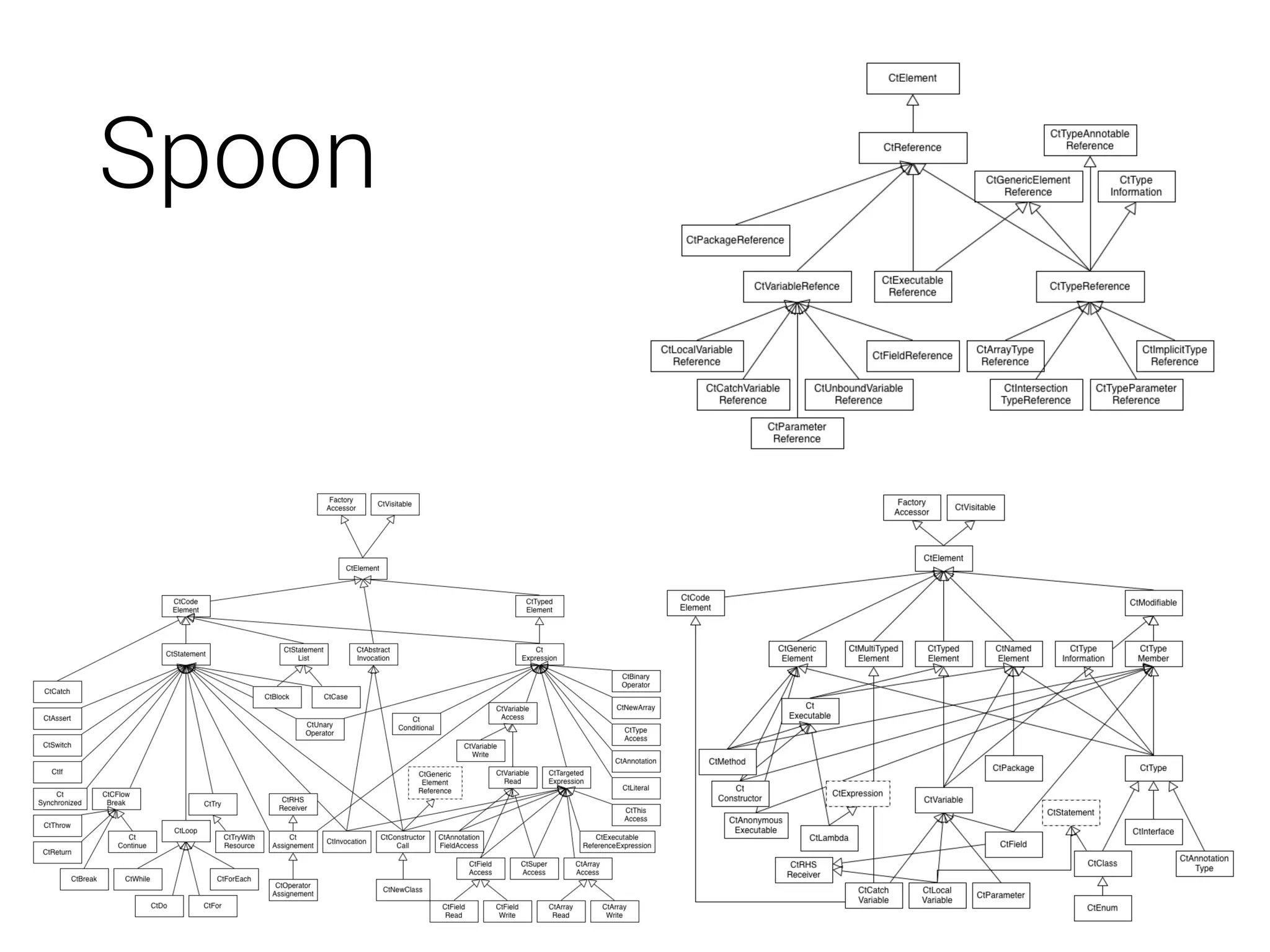
Spoon
http://spoon.gforge.inria.fr/structural_elements.html
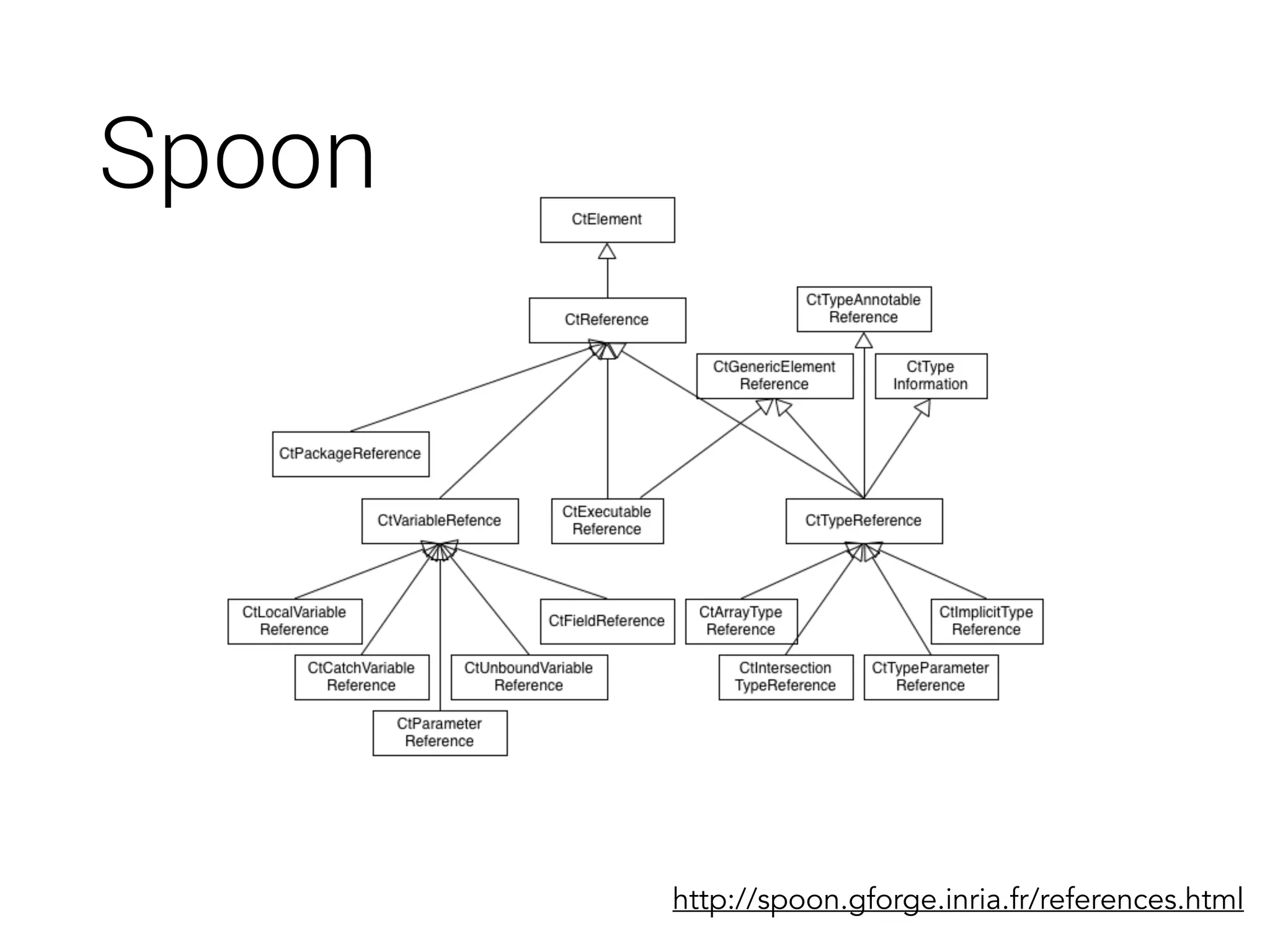
Spoon
http://spoon.gforge.inria.fr/references.html
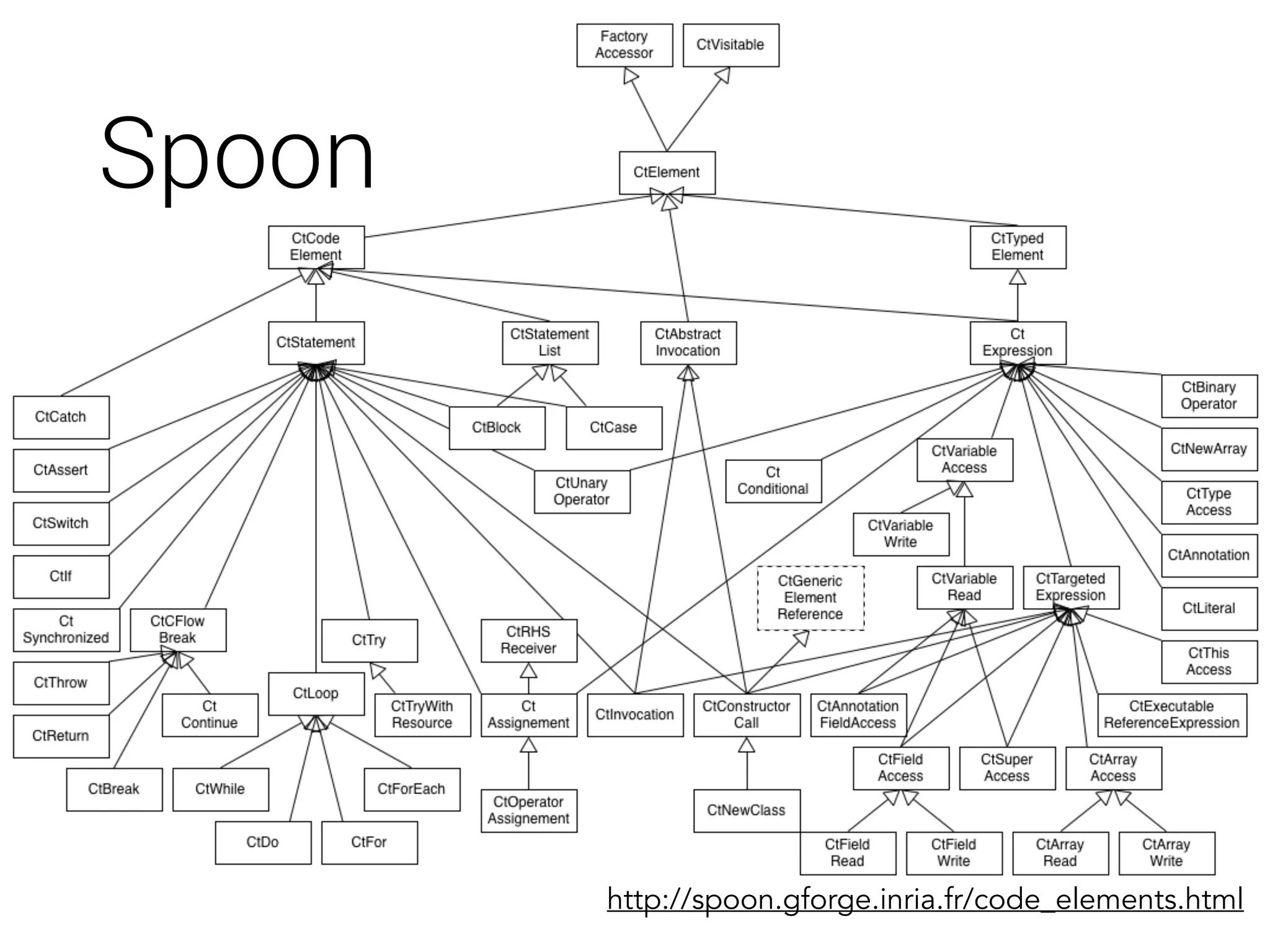
Spoon
http://spoon.gforge.inria.fr/code_elements.html
Spoon
How it works?
Input
AST
Processing
Output
Features
• Factory
• Query
• Processor
• Template
Processor
A program analysis is a combination of query and
analysis code. In Spoon, this conceptual pair is reified
in a processor. A processor is a class that focuses on
the analysis of one kind of program elements.
http://spoon.gforge.inria.fr/processor.html
Processor
A program analysis is a combination of query and
analysis code. In Spoon, this conceptual pair is reified
in a processor. A processor is a class that focuses on
the analysis of one kind of program elements.
public class TypeSpoonProcessor extends AbstractAnnotationProcessor<NotNull, CtParameter<?>> {

@Override public void process(NotNull annotation, CtParameter<?> element) {


}

}
http://spoon.gforge.inria.fr/processor.html
Processor
A program analysis is a combination of query and
analysis code. In Spoon, this conceptual pair is reified
in a processor. A processor is a class that focuses on
the analysis of one kind of program elements.
public class TypeSpoonProcessor extends AbstractAnnotationProcessor<NotNull, CtParameter<?>> {

@Override public void process(NotNull annotation, CtParameter<?> element) {


}

}
http://spoon.gforge.inria.fr/processor.html
Processor
A program analysis is a combination of query and
analysis code. In Spoon, this conceptual pair is reified
in a processor. A processor is a class that focuses on
the analysis of one kind of program elements.
public class TypeSpoonProcessor extends AbstractAnnotationProcessor<NotNull, CtParameter<?>> {

@Override public void process(NotNull annotation, CtParameter<?> element) {


}

}
http://spoon.gforge.inria.fr/processor.html
Processor
A program analysis is a combination of query and
analysis code. In Spoon, this conceptual pair is reified
in a processor. A processor is a class that focuses on
the analysis of one kind of program elements.
public class TypeSpoonProcessor extends AbstractAnnotationProcessor<NotNull, CtParameter<?>> {

@Override public void process(NotNull annotation, CtParameter<?> element) {
System.out.println("annotation found on " + element.getSimpleName());

}

}
http://spoon.gforge.inria.fr/processor.html
Processor
A program analysis is a combination of query and
analysis code. In Spoon, this conceptual pair is reified
in a processor. A processor is a class that focuses on
the analysis of one kind of program elements.
public class TypeSpoonProcessor extends AbstractAnnotationProcessor<NotNull, CtParameter<?>> {

@Override public void process(NotNull annotation, CtParameter<?> element) {
System.out.println("annotation found on " + element.getSimpleName());

}

}
http://spoon.gforge.inria.fr/processor.html
Factory
Create new elements, fill their data and add them in an
existing AST. The factory is the entry point to do that
and each factory has them own responsibility. i.e.,
CoreFactory creates empty nodes and CodeFactory
creates a node ready to be printed.
http://spoon.gforge.inria.fr/factories.html
Factory
Create new elements, fill their data and add them in an
existing AST. The factory is the entry point to do that
and each factory has them own responsibility. i.e.,
CoreFactory creates empty nodes and CodeFactory
creates a node ready to be printed.
http://spoon.gforge.inria.fr/factories.html
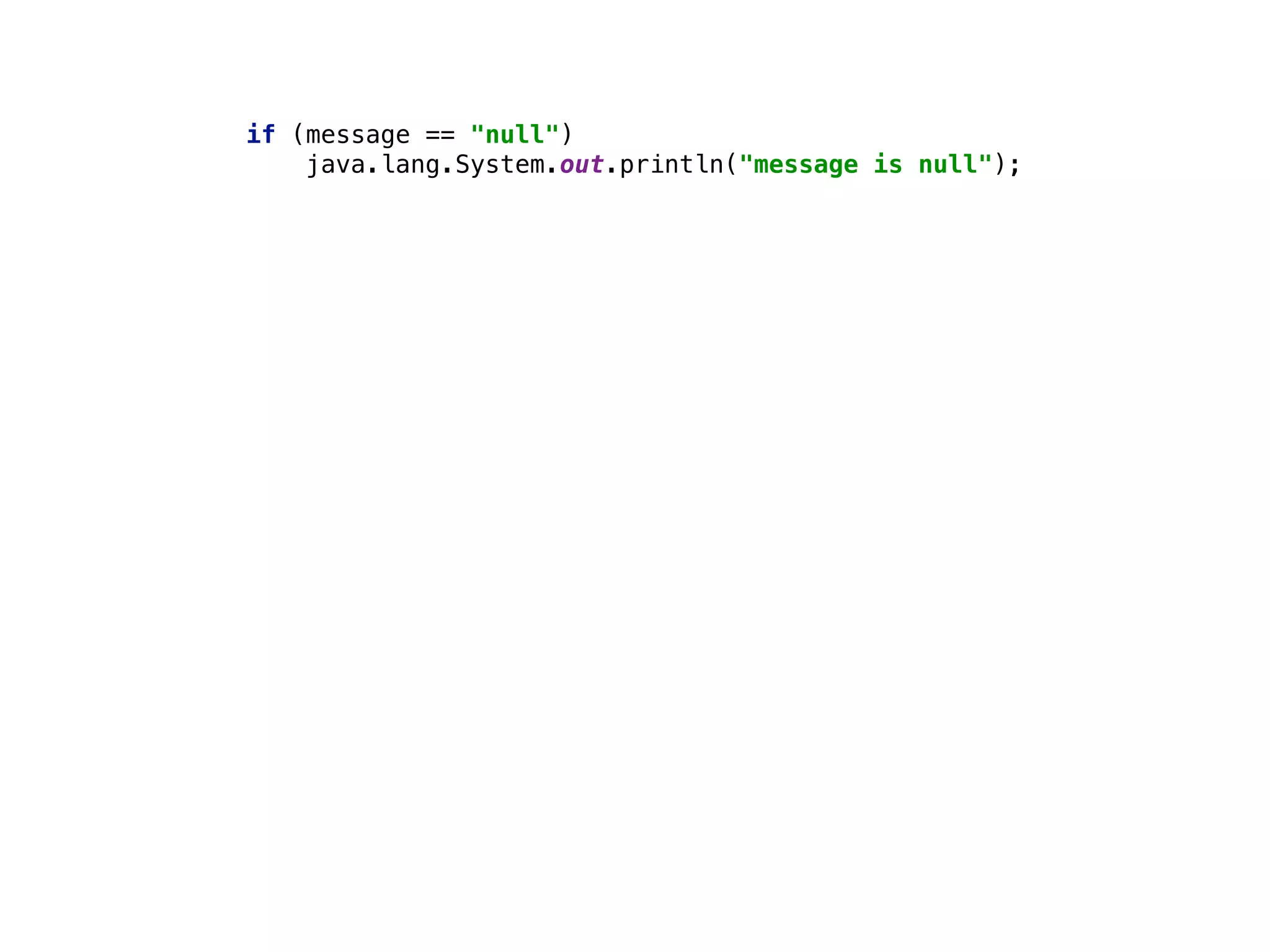
if (message == "null")

java.lang.System.out.println("message is null");
if (message == "null")

java.lang.System.out.println("message is null");
if (message == "null")

java.lang.System.out.println("message is null");
if (message == "null")

java.lang.System.out.println("message is null");
if (message == "null")

java.lang.System.out.println("message is null");
if (message == "null")

java.lang.System.out.println("message is null");
if (message == "null")

java.lang.System.out.println("message is null");
if (message == "null")

java.lang.System.out.println("message is null");
if (message == "null")

java.lang.System.out.println("message is null");
if (message == "null")

java.lang.System.out.println("message is null");
if (message == "null")

java.lang.System.out.println("message is null");
if (message == "null")

java.lang.System.out.println("message is null");
@Override public void process(NotNull annotation, CtParameter<?> element) {

System.out.println("annotation found on " + element.getSimpleName());


final CtVariableAccess<?> parameter = //

getFactory().Code().createVariableRead(element.getReference(), false);

final CtLiteral<?> nullAccess = getFactory().Code().createLiteral("null");

final CtBinaryOperator<Boolean> binaryOperator = //

getFactory().Code().createBinaryOperator(parameter, nullAccess, BinaryOperatorKind.EQ);


final CtCodeSnippetStatement snippet = getFactory().Code().createCodeSnippetStatement(

"System.out.println("" + element.getSimpleName() + " is null")");


// Creates condition.

final CtIf anIf = getFactory().Core().createIf();

anIf.setCondition(binaryOperator);

anIf.setThenStatement(snippet.compile());


// Factory

final CtExecutable ctExecutable = element.getParent(CtExecutable.class);

ctExecutable.getBody().insertBegin(anIf);

}
@Override public void process(NotNull annotation, CtParameter<?> element) {

System.out.println("annotation found on " + element.getSimpleName());


final CtVariableAccess<?> parameter = //

getFactory().Code().createVariableRead(element.getReference(), false);

final CtLiteral<?> nullAccess = getFactory().Code().createLiteral("null");

final CtBinaryOperator<Boolean> binaryOperator = //

getFactory().Code().createBinaryOperator(parameter, nullAccess, BinaryOperatorKind.EQ);


final CtCodeSnippetStatement snippet = getFactory().Code().createCodeSnippetStatement(

"System.out.println("" + element.getSimpleName() + " is null")");


// Creates condition.

final CtIf anIf = getFactory().Core().createIf();

anIf.setCondition(binaryOperator);

anIf.setThenStatement(snippet.compile());


// Factory

final CtExecutable ctExecutable = element.getParent(CtExecutable.class);

ctExecutable.getBody().insertBegin(anIf);

}
@Override public void process(NotNull annotation, CtParameter<?> element) {

System.out.println("annotation found on " + element.getSimpleName());


final CtVariableAccess<?> parameter = //

getFactory().Code().createVariableRead(element.getReference(), false);

final CtLiteral<?> nullAccess = getFactory().Code().createLiteral("null");

final CtBinaryOperator<Boolean> binaryOperator = //

getFactory().Code().createBinaryOperator(parameter, nullAccess, BinaryOperatorKind.EQ);


final CtCodeSnippetStatement snippet = getFactory().Code().createCodeSnippetStatement(

"System.out.println("" + element.getSimpleName() + " is null")");


// Creates condition.

final CtIf anIf = getFactory().Core().createIf();

anIf.setCondition(binaryOperator);

anIf.setThenStatement(snippet.compile());


// Factory

final CtExecutable ctExecutable = element.getParent(CtExecutable.class);

ctExecutable.getBody().insertBegin(anIf);

}
@Override public void process(NotNull annotation, CtParameter<?> element) {

System.out.println("annotation found on " + element.getSimpleName());


final CtVariableAccess<?> parameter = //

getFactory().Code().createVariableRead(element.getReference(), false);

final CtLiteral<?> nullAccess = getFactory().Code().createLiteral("null");

final CtBinaryOperator<Boolean> binaryOperator = //

getFactory().Code().createBinaryOperator(parameter, nullAccess, BinaryOperatorKind.EQ);


final CtCodeSnippetStatement snippet = getFactory().Code().createCodeSnippetStatement(

"System.out.println("" + element.getSimpleName() + " is null")");


// Creates condition.

final CtIf anIf = getFactory().Core().createIf();

anIf.setCondition(binaryOperator);

anIf.setThenStatement(snippet.compile());


// Factory

final CtExecutable ctExecutable = element.getParent(CtExecutable.class);

ctExecutable.getBody().insertBegin(anIf);

}
@Override public void process(NotNull annotation, CtParameter<?> element) {

System.out.println("annotation found on " + element.getSimpleName());


final CtVariableAccess<?> parameter = //

getFactory().Code().createVariableRead(element.getReference(), false);

final CtLiteral<?> nullAccess = getFactory().Code().createLiteral("null");

final CtBinaryOperator<Boolean> binaryOperator = //

getFactory().Code().createBinaryOperator(parameter, nullAccess, BinaryOperatorKind.EQ);


final CtCodeSnippetStatement snippet = getFactory().Code().createCodeSnippetStatement(

"System.out.println("" + element.getSimpleName() + " is null")");


// Creates condition.

final CtIf anIf = getFactory().Core().createIf();

anIf.setCondition(binaryOperator);

anIf.setThenStatement(snippet.compile());


// Factory

final CtExecutable ctExecutable = element.getParent(CtExecutable.class);

ctExecutable.getBody().insertBegin(anIf);

}
@Override public void process(NotNull annotation, CtParameter<?> element) {

System.out.println("annotation found on " + element.getSimpleName());


final CtVariableAccess<?> parameter = //

getFactory().Code().createVariableRead(element.getReference(), false);

final CtLiteral<?> nullAccess = getFactory().Code().createLiteral("null");

final CtBinaryOperator<Boolean> binaryOperator = //

getFactory().Code().createBinaryOperator(parameter, nullAccess, BinaryOperatorKind.EQ);


final CtCodeSnippetStatement snippet = getFactory().Code().createCodeSnippetStatement(

"System.out.println("" + element.getSimpleName() + " is null")");


// Creates condition.

final CtIf anIf = getFactory().Core().createIf();

anIf.setCondition(binaryOperator);

anIf.setThenStatement(snippet.compile());


// Factory

final CtExecutable ctExecutable = element.getParent(CtExecutable.class);

ctExecutable.getBody().insertBegin(anIf);

}
@Override public void process(NotNull annotation, CtParameter<?> element) {

System.out.println("annotation found on " + element.getSimpleName());


final CtVariableAccess<?> parameter = //

getFactory().Code().createVariableRead(element.getReference(), false);

final CtLiteral<?> nullAccess = getFactory().Code().createLiteral("null");

final CtBinaryOperator<Boolean> binaryOperator = //

getFactory().Code().createBinaryOperator(parameter, nullAccess, BinaryOperatorKind.EQ);


final CtCodeSnippetStatement snippet = getFactory().Code().createCodeSnippetStatement(

"System.out.println("" + element.getSimpleName() + " is null")");


// Creates condition.

final CtIf anIf = getFactory().Core().createIf();

anIf.setCondition(binaryOperator);

anIf.setThenStatement(snippet.compile());


// Factory

final CtExecutable ctExecutable = element.getParent(CtExecutable.class);

ctExecutable.getBody().insertBegin(anIf);

}
Template
Spoon provides developers a way of writing code
transformations: code templates. Those templates are
statically type-checked, in order to ensure statically
that the generated code will be correct.
http://spoon.gforge.inria.fr/template_definition.html
public class NotNullTemplate extends StatementTemplate {

@Parameter CtVariableAccess<?> _access_;


public NotNullTemplate(CtVariableAccess<?> _access_) {

this._access_ = _access_;

}


@Override public void statement() throws Throwable {

if (_access_.S() == null) {

System.out.println("Parameter is null");

}

}

}
public class NotNullTemplate extends StatementTemplate {

@Parameter CtVariableAccess<?> _access_;


public NotNullTemplate(CtVariableAccess<?> _access_) {

this._access_ = _access_;

}


@Override public void statement() throws Throwable {

if (_access_.S() == null) {

System.out.println("Parameter is null");

}

}

}
public class NotNullTemplate extends StatementTemplate {

@Parameter CtVariableAccess<?> _access_;


public NotNullTemplate(CtVariableAccess<?> _access_) {

this._access_ = _access_;

}


@Override public void statement() throws Throwable {

if (_access_.S() == null) {

System.out.println("Parameter is null");

}

}

}
public class NotNullTemplate extends StatementTemplate {

@Parameter CtVariableAccess<?> _access_;


public NotNullTemplate(CtVariableAccess<?> _access_) {

this._access_ = _access_;

}


@Override public void statement() throws Throwable {

if (_access_.S() == null) {

System.out.println("Parameter is null");

}

}

}
public class NotNullTemplate extends StatementTemplate {

@Parameter CtVariableAccess<?> _access_;


public NotNullTemplate(CtVariableAccess<?> _access_) {

this._access_ = _access_;

}


@Override public void statement() throws Throwable {

if (_access_.S() == null) {

System.out.println("Parameter is null");

}

}

}
@Override public void process(NotNull annotation, CtParameter<?> element) {

System.out.println("annotation found on " + element.getSimpleName());


final CtVariableAccess<?> parameter = //

getFactory().Code().createVariableRead(element.getReference(), false);

final CtLiteral<?> nullAccess = getFactory().Code().createLiteral("null");

final CtBinaryOperator<Boolean> binaryOperator = //

getFactory().Code().createBinaryOperator(parameter, nullAccess, BinaryOperatorKind.EQ);


final CtCodeSnippetStatement snippet = getFactory().Code().createCodeSnippetStatement(

"System.out.println("" + element.getSimpleName() + " is null")");


// Creates condition.

final CtIf anIf = getFactory().Core().createIf();

anIf.setCondition(binaryOperator);

anIf.setThenStatement(snippet.compile());


// Factory

final CtExecutable ctExecutable = element.getParent(CtExecutable.class);

ctExecutable.getBody().insertBegin(anIf);

}
@Override public void process(NotNull annotation, CtParameter<?> element) {

System.out.println("annotation found on " + element.getSimpleName());


new NotNullTemplate(parameter).apply(element.getParent(CtType.class));


}
Query
Make a complexe query on a given AST, based on
the notion of filter, done in plain Java, in the spirit of
an embedded DSL and in one single line of code in
the normal cases. i.e., TypeFilter is used to return all
elements of a certain type.
Query.getElements(factory, new TypeFilter<>(CtParameter.class));
Query.getElements(element, new TypeFilter<>(CtParameter.class));
element.getElements(new TypeFilter<>(CtParameter.class));
http://spoon.gforge.inria.fr/filter.html
Usage
<dependency>

<groupId>fr.inria.gforge.spoon</groupId>

<artifactId>spoon-core</artifactId>

<version>5.1.1</version>

</dependency>
final SpoonAPI spoon = new Launcher();

spoon.addInputResource("/src/main/java/");

spoon.setSourceOutputDirectory("/target/");

spoon.addProcessor(new AwesomeProcessor());

spoon.run();


// Here, make complex query from the
factory.
Dependency
API
Usage
<plugin>

<groupId>fr.inria.gforge.spoon</groupId>

<artifactId>
spoon-maven-plugin
</artifactId>

<version>2.2</version>

<executions>

<execution>

<phase>generate-sources</phase>

<goals>

<goal>generate</goal>

</goals>

</execution>

</executions>

<configuration>

<processors>

<processor>
fr.inria.AwesomeProcessor
</processor>

</processors>

</configuration>

</plugin>
Maven Plugin
Usage
buildscript {

repositories {

mavenCentral()
mavenLocal()

}

dependencies {

classpath ‘fr.inria.gforge.spoon:spoon—gradle-plugin:
1.0-SNAPSHOT’

}

}
!
apply plugin: "java"
apply plugin: "spoon"
!
spoon {

processors = [‘fr.inria.AwesomeProcessor’]

}
Gradle Plugin
Thank you!
Gérard Paligot
Practical work
#1
For each interface, count how many classes
implement it.
public interface Delicious {

void prepare(Prepare prepare, int time);


void make(Cook cook, int time);

}
#2
Inserts a probe in all entry methods to display its
name and its declaring type.
@Override

public void prepare() {


}
Before
After
@Override

public void prepare() {

System.out.println("enter: Tacos - prepare");

}
#2 expert
Inserts a probe in all exit methods to display its name
and its declaring type.
#3
Adds a probe (with the invocation of a method
named isNotNull) to check all parameters not
primitives of a method.
@Override

public void prepare(Prepare prepare) {


}
Before
After
@Override

public void prepare(Prepare prepare) {

fr.inria.tp3.Check.isNotNull(
prepare, "Parameter %s can't be null.", "prepare");

}
#3 expert
Uses an annotation, named @NotNull, to check the
parameter annotated.
@Override

public void prepare(@NotNull Prepare prepare) {


}
Before
After
@Override

public void prepare(Prepare prepare) {

fr.inria.tp3.Check.isNotNull(
prepare, "Parameter %s can't be null.", "prepare");

}
#4
Create the annotation @Bound to check the minimum
and maximum of a method parameter.
@Override

public void prepare(@Bound(min = 0, max = 10) int time) {


}
Before
After
@Override

public void prepare(int time) {

if (time > 10.0)

throw new RuntimeException(
"out of max bound (" + time + " > 10.0");


if (time < 0.0)

throw new RuntimeException(
"out of min bound (" + time + " < 0.0");

}
#5
Create the annotation @RetryOnFailure to relaunch
execution of a method if an exception is thrown.
Think to use templates. ;)
@java.lang.Override

public void prepare() {

int attempt = 0;

java.lang.Throwable lastTh = null;

while ((attempt++) < 3) {

try {
// Body of the original code here.

} catch (java.lang.Throwable ex) {

lastTh = ex;

if (false) {

ex.printStackTrace();

} 

try {

java.lang.Thread.sleep(50L);

} catch (java.lang.InterruptedException ignored) {

}

}

}

if (lastTh != null) {

throw new java.lang.RuntimeException(lastTh);

} 

}
• TP 1: For each interface, count how many classes implement it.
• TP 2: Inserts a probe in all entry methods to display its name and its
declaring type.
• TP 2 (expert): Handles exit of methods.
• TP 3: Adds a probe (with the invocation of a method named checkNotNull)
to check all parameters not primitives of a method.
• TP 3 (expert): Handles it with an annotation named @NotNull.
• TP 4: Create the annotation @Bound to check the minimum and maximum
of a method parameter.
• TP 5 (expert): Create the annotation @RetryOnFailure to relaunch
execution of a method if an exception is thrown.

Code transformation With Spoon

  • 1.
  • 2.
    Code transformation • Read,generate, analyse or transform.
  • 3.
    Code transformation • Read,generate, analyse or transform. • Used more and more by libraries.
  • 4.
    Code transformation • Read,generate, analyse or transform. • Used more and more by libraries. public void sayHello(String message) {
 if (message.isEmpty()) {
 System.out.println("Hello, World!");
 } else {
 System.out.println(message);
 }
 }
  • 5.
    Code transformation • Read,generate, analyse or transform. • Used more and more by libraries. @Log public void sayHello(String message) {
 if (message.isEmpty()) {
 System.out.println("Hello, World!");
 } else {
 System.out.println(message);
 }
 }
  • 6.
    Code transformation • Read,generate, analyse or transform. • Used more and more by libraries. public void sayHello(@Log String message) {
 if (message.isEmpty()) {
 System.out.println("Hello, World!");
 } else {
 System.out.println(message);
 }
 }
  • 7.
    Code transformation • Read,generate, analyse or transform. • Used more and more by libraries. public void sayHello(@NotNull String message) {
 if (message.isEmpty()) {
 System.out.println("Hello, World!");
 } else {
 System.out.println(message);
 }
 }
  • 8.
    Library rescue • APT •JDT • JavaParser • JTransformer • ASM • pfff • Others…
  • 9.
  • 10.
    JDT • Developed atEclipse. • Used in the project Eclipse.
  • 11.
    JDT • Developed atEclipse. • Used in the project Eclipse. • Easy to create a Eclipse plugin with JDT.
  • 12.
    JDT • Developed atEclipse. • Used in the project Eclipse. • Easy to create a Eclipse plugin with JDT. • Read, generate, analyse and transform source code.
  • 13.
    JDT • Developed atEclipse. • Used in the project Eclipse. • Easy to create a Eclipse plugin with JDT. • Read, generate, analyse and transform source code. • API and meta model hard to use and to understand.
  • 14.
    APT • Developed atSUN, later by Oracle.
  • 15.
    APT • Developed atSUN, later by Oracle. • Adopted by a lot of open-source librairies.
  • 16.
    APT • Developed atSUN, later by Oracle. • Adopted by a lot of open-source librairies. • Accessible by the package javax.lang.model.* and javax.annotation.processing.
  • 17.
    APT • Developed atSUN, later by Oracle. • Adopted by a lot of open-source librairies. • Accessible by the package javax.lang.model.* and javax.annotation.processing. • Well integrated in modernes build-management.
  • 18.
    APT • Developed atSUN, later by Oracle. • Adopted by a lot of open-source librairies. • Accessible by the package javax.lang.model.* and javax.annotation.processing. • Well integrated in modernes build-management. • Meta model limited and transformation not allowed.
  • 19.
    @SupportedAnnotationTypes("fr.inria.NotNull")
 public class TypeProcessorextends AbstractProcessor {
 @Override
 public boolean process(Set<? extends TypeElement> annotations, RoundEnvironment roundEnv) {
 roundEnv.getElementsAnnotatedWith(NotNull.class).stream() //
 .map(e -> "annotation found on " + e.getSimpleName()) //
 .forEach(System.out::println);
 
 for (Element element : roundEnv.getElementsAnnotatedWith(NotNull.class)) {
 // Editing not possible!
 }
 return true;
 }
 }
  • 20.
    @SupportedAnnotationTypes("fr.inria.NotNull")
 public class TypeProcessorextends AbstractProcessor {
 @Override
 public boolean process(Set<? extends TypeElement> annotations, RoundEnvironment roundEnv) {
 roundEnv.getElementsAnnotatedWith(NotNull.class).stream() //
 .map(e -> "annotation found on " + e.getSimpleName()) //
 .forEach(System.out::println);
 
 for (Element element : roundEnv.getElementsAnnotatedWith(NotNull.class)) {
 // Editing not possible!
 }
 return true;
 }
 }
  • 21.
    @SupportedAnnotationTypes("fr.inria.NotNull")
 public class TypeProcessorextends AbstractProcessor {
 @Override
 public boolean process(Set<? extends TypeElement> annotations, RoundEnvironment roundEnv) {
 roundEnv.getElementsAnnotatedWith(NotNull.class).stream() //
 .map(e -> "annotation found on " + e.getSimpleName()) //
 .forEach(System.out::println);
 
 for (Element element : roundEnv.getElementsAnnotatedWith(NotNull.class)) {
 // Editing not possible!
 }
 return true;
 }
 }
  • 22.
    @SupportedAnnotationTypes("fr.inria.NotNull")
 public class TypeProcessorextends AbstractProcessor {
 @Override
 public boolean process(Set<? extends TypeElement> annotations, RoundEnvironment roundEnv) {
 roundEnv.getElementsAnnotatedWith(NotNull.class).stream() //
 .map(e -> "annotation found on " + e.getSimpleName()) //
 .forEach(System.out::println);
 
 for (Element element : roundEnv.getElementsAnnotatedWith(NotNull.class)) {
 // Editing not possible!
 }
 return true;
 }
 }
  • 23.
    @SupportedAnnotationTypes("fr.inria.NotNull")
 public class TypeProcessorextends AbstractProcessor {
 @Override
 public boolean process(Set<? extends TypeElement> annotations, RoundEnvironment roundEnv) {
 roundEnv.getElementsAnnotatedWith(NotNull.class).stream() //
 .map(e -> "annotation found on " + e.getSimpleName()) //
 .forEach(System.out::println);
 
 for (Element element : roundEnv.getElementsAnnotatedWith(NotNull.class)) {
 // Editing not possible!
 }
 return true;
 }
 }
  • 24.
    @SupportedAnnotationTypes("fr.inria.NotNull")
 public class TypeProcessorextends AbstractProcessor {
 @Override
 public boolean process(Set<? extends TypeElement> annotations, RoundEnvironment roundEnv) {
 roundEnv.getElementsAnnotatedWith(NotNull.class).stream() //
 .map(e -> "annotation found on " + e.getSimpleName()) //
 .forEach(System.out::println);
 
 for (Element element : roundEnv.getElementsAnnotatedWith(NotNull.class)) {
 // Editing not possible!
 }
 return true;
 }
 }
  • 25.
  • 26.
  • 27.
  • 28.
    Spoon • Developed atINRIA by Renauld Pawlak, Nicolas Petitprez and Carlos Noguera.
  • 29.
    Spoon • Developed atINRIA by Renauld Pawlak, Nicolas Petitprez and Carlos Noguera. • Used by Spirals team at INRIA Lille, by Diversify at INRIA Rennes and by the world!
  • 30.
    Spoon • Developed atINRIA by Renauld Pawlak, Nicolas Petitprez and Carlos Noguera. • Used by Spirals team at INRIA Lille, by Diversify at INRIA Rennes and by the world! • Designed for developers to be use easily.
  • 31.
    Spoon • Developed atINRIA by Renauld Pawlak, Nicolas Petitprez and Carlos Noguera. • Used by Spirals team at INRIA Lille, by Diversify at INRIA Rennes and by the world! • Designed for developers to be use easily. • Source to source code transformation.
  • 32.
    Spoon • Developed atINRIA by Renauld Pawlak, Nicolas Petitprez and Carlos Noguera. • Used by Spirals team at INRIA Lille, by Diversify at INRIA Rennes and by the world! • Designed for developers to be use easily. • Source to source code transformation. • Complete and fine-grained Java meta model.
  • 33.
  • 34.
  • 35.
  • 36.
  • 37.
  • 38.
  • 39.
    Features • Factory • Query •Processor • Template
  • 40.
    Processor A program analysisis a combination of query and analysis code. In Spoon, this conceptual pair is reified in a processor. A processor is a class that focuses on the analysis of one kind of program elements. http://spoon.gforge.inria.fr/processor.html
  • 41.
    Processor A program analysisis a combination of query and analysis code. In Spoon, this conceptual pair is reified in a processor. A processor is a class that focuses on the analysis of one kind of program elements. public class TypeSpoonProcessor extends AbstractAnnotationProcessor<NotNull, CtParameter<?>> {
 @Override public void process(NotNull annotation, CtParameter<?> element) { 
 }
 } http://spoon.gforge.inria.fr/processor.html
  • 42.
    Processor A program analysisis a combination of query and analysis code. In Spoon, this conceptual pair is reified in a processor. A processor is a class that focuses on the analysis of one kind of program elements. public class TypeSpoonProcessor extends AbstractAnnotationProcessor<NotNull, CtParameter<?>> {
 @Override public void process(NotNull annotation, CtParameter<?> element) { 
 }
 } http://spoon.gforge.inria.fr/processor.html
  • 43.
    Processor A program analysisis a combination of query and analysis code. In Spoon, this conceptual pair is reified in a processor. A processor is a class that focuses on the analysis of one kind of program elements. public class TypeSpoonProcessor extends AbstractAnnotationProcessor<NotNull, CtParameter<?>> {
 @Override public void process(NotNull annotation, CtParameter<?> element) { 
 }
 } http://spoon.gforge.inria.fr/processor.html
  • 44.
    Processor A program analysisis a combination of query and analysis code. In Spoon, this conceptual pair is reified in a processor. A processor is a class that focuses on the analysis of one kind of program elements. public class TypeSpoonProcessor extends AbstractAnnotationProcessor<NotNull, CtParameter<?>> {
 @Override public void process(NotNull annotation, CtParameter<?> element) { System.out.println("annotation found on " + element.getSimpleName());
 }
 } http://spoon.gforge.inria.fr/processor.html
  • 45.
    Processor A program analysisis a combination of query and analysis code. In Spoon, this conceptual pair is reified in a processor. A processor is a class that focuses on the analysis of one kind of program elements. public class TypeSpoonProcessor extends AbstractAnnotationProcessor<NotNull, CtParameter<?>> {
 @Override public void process(NotNull annotation, CtParameter<?> element) { System.out.println("annotation found on " + element.getSimpleName());
 }
 } http://spoon.gforge.inria.fr/processor.html
  • 46.
    Factory Create new elements,fill their data and add them in an existing AST. The factory is the entry point to do that and each factory has them own responsibility. i.e., CoreFactory creates empty nodes and CodeFactory creates a node ready to be printed. http://spoon.gforge.inria.fr/factories.html
  • 47.
    Factory Create new elements,fill their data and add them in an existing AST. The factory is the entry point to do that and each factory has them own responsibility. i.e., CoreFactory creates empty nodes and CodeFactory creates a node ready to be printed. http://spoon.gforge.inria.fr/factories.html if (message == "null")
 java.lang.System.out.println("message is null");
  • 48.
    if (message =="null")
 java.lang.System.out.println("message is null");
  • 49.
    if (message =="null")
 java.lang.System.out.println("message is null");
  • 50.
    if (message =="null")
 java.lang.System.out.println("message is null");
  • 51.
    if (message =="null")
 java.lang.System.out.println("message is null");
  • 52.
    if (message =="null")
 java.lang.System.out.println("message is null");
  • 53.
    if (message =="null")
 java.lang.System.out.println("message is null");
  • 54.
    if (message =="null")
 java.lang.System.out.println("message is null");
  • 55.
    if (message =="null")
 java.lang.System.out.println("message is null");
  • 56.
    if (message =="null")
 java.lang.System.out.println("message is null");
  • 57.
    if (message =="null")
 java.lang.System.out.println("message is null");
  • 58.
    if (message =="null")
 java.lang.System.out.println("message is null");
  • 59.
    @Override public voidprocess(NotNull annotation, CtParameter<?> element) {
 System.out.println("annotation found on " + element.getSimpleName());
 
 final CtVariableAccess<?> parameter = //
 getFactory().Code().createVariableRead(element.getReference(), false);
 final CtLiteral<?> nullAccess = getFactory().Code().createLiteral("null");
 final CtBinaryOperator<Boolean> binaryOperator = //
 getFactory().Code().createBinaryOperator(parameter, nullAccess, BinaryOperatorKind.EQ);
 
 final CtCodeSnippetStatement snippet = getFactory().Code().createCodeSnippetStatement(
 "System.out.println("" + element.getSimpleName() + " is null")");
 
 // Creates condition.
 final CtIf anIf = getFactory().Core().createIf();
 anIf.setCondition(binaryOperator);
 anIf.setThenStatement(snippet.compile());
 
 // Factory
 final CtExecutable ctExecutable = element.getParent(CtExecutable.class);
 ctExecutable.getBody().insertBegin(anIf);
 }
  • 60.
    @Override public voidprocess(NotNull annotation, CtParameter<?> element) {
 System.out.println("annotation found on " + element.getSimpleName());
 
 final CtVariableAccess<?> parameter = //
 getFactory().Code().createVariableRead(element.getReference(), false);
 final CtLiteral<?> nullAccess = getFactory().Code().createLiteral("null");
 final CtBinaryOperator<Boolean> binaryOperator = //
 getFactory().Code().createBinaryOperator(parameter, nullAccess, BinaryOperatorKind.EQ);
 
 final CtCodeSnippetStatement snippet = getFactory().Code().createCodeSnippetStatement(
 "System.out.println("" + element.getSimpleName() + " is null")");
 
 // Creates condition.
 final CtIf anIf = getFactory().Core().createIf();
 anIf.setCondition(binaryOperator);
 anIf.setThenStatement(snippet.compile());
 
 // Factory
 final CtExecutable ctExecutable = element.getParent(CtExecutable.class);
 ctExecutable.getBody().insertBegin(anIf);
 }
  • 61.
    @Override public voidprocess(NotNull annotation, CtParameter<?> element) {
 System.out.println("annotation found on " + element.getSimpleName());
 
 final CtVariableAccess<?> parameter = //
 getFactory().Code().createVariableRead(element.getReference(), false);
 final CtLiteral<?> nullAccess = getFactory().Code().createLiteral("null");
 final CtBinaryOperator<Boolean> binaryOperator = //
 getFactory().Code().createBinaryOperator(parameter, nullAccess, BinaryOperatorKind.EQ);
 
 final CtCodeSnippetStatement snippet = getFactory().Code().createCodeSnippetStatement(
 "System.out.println("" + element.getSimpleName() + " is null")");
 
 // Creates condition.
 final CtIf anIf = getFactory().Core().createIf();
 anIf.setCondition(binaryOperator);
 anIf.setThenStatement(snippet.compile());
 
 // Factory
 final CtExecutable ctExecutable = element.getParent(CtExecutable.class);
 ctExecutable.getBody().insertBegin(anIf);
 }
  • 62.
    @Override public voidprocess(NotNull annotation, CtParameter<?> element) {
 System.out.println("annotation found on " + element.getSimpleName());
 
 final CtVariableAccess<?> parameter = //
 getFactory().Code().createVariableRead(element.getReference(), false);
 final CtLiteral<?> nullAccess = getFactory().Code().createLiteral("null");
 final CtBinaryOperator<Boolean> binaryOperator = //
 getFactory().Code().createBinaryOperator(parameter, nullAccess, BinaryOperatorKind.EQ);
 
 final CtCodeSnippetStatement snippet = getFactory().Code().createCodeSnippetStatement(
 "System.out.println("" + element.getSimpleName() + " is null")");
 
 // Creates condition.
 final CtIf anIf = getFactory().Core().createIf();
 anIf.setCondition(binaryOperator);
 anIf.setThenStatement(snippet.compile());
 
 // Factory
 final CtExecutable ctExecutable = element.getParent(CtExecutable.class);
 ctExecutable.getBody().insertBegin(anIf);
 }
  • 63.
    @Override public voidprocess(NotNull annotation, CtParameter<?> element) {
 System.out.println("annotation found on " + element.getSimpleName());
 
 final CtVariableAccess<?> parameter = //
 getFactory().Code().createVariableRead(element.getReference(), false);
 final CtLiteral<?> nullAccess = getFactory().Code().createLiteral("null");
 final CtBinaryOperator<Boolean> binaryOperator = //
 getFactory().Code().createBinaryOperator(parameter, nullAccess, BinaryOperatorKind.EQ);
 
 final CtCodeSnippetStatement snippet = getFactory().Code().createCodeSnippetStatement(
 "System.out.println("" + element.getSimpleName() + " is null")");
 
 // Creates condition.
 final CtIf anIf = getFactory().Core().createIf();
 anIf.setCondition(binaryOperator);
 anIf.setThenStatement(snippet.compile());
 
 // Factory
 final CtExecutable ctExecutable = element.getParent(CtExecutable.class);
 ctExecutable.getBody().insertBegin(anIf);
 }
  • 64.
    @Override public voidprocess(NotNull annotation, CtParameter<?> element) {
 System.out.println("annotation found on " + element.getSimpleName());
 
 final CtVariableAccess<?> parameter = //
 getFactory().Code().createVariableRead(element.getReference(), false);
 final CtLiteral<?> nullAccess = getFactory().Code().createLiteral("null");
 final CtBinaryOperator<Boolean> binaryOperator = //
 getFactory().Code().createBinaryOperator(parameter, nullAccess, BinaryOperatorKind.EQ);
 
 final CtCodeSnippetStatement snippet = getFactory().Code().createCodeSnippetStatement(
 "System.out.println("" + element.getSimpleName() + " is null")");
 
 // Creates condition.
 final CtIf anIf = getFactory().Core().createIf();
 anIf.setCondition(binaryOperator);
 anIf.setThenStatement(snippet.compile());
 
 // Factory
 final CtExecutable ctExecutable = element.getParent(CtExecutable.class);
 ctExecutable.getBody().insertBegin(anIf);
 }
  • 65.
    @Override public voidprocess(NotNull annotation, CtParameter<?> element) {
 System.out.println("annotation found on " + element.getSimpleName());
 
 final CtVariableAccess<?> parameter = //
 getFactory().Code().createVariableRead(element.getReference(), false);
 final CtLiteral<?> nullAccess = getFactory().Code().createLiteral("null");
 final CtBinaryOperator<Boolean> binaryOperator = //
 getFactory().Code().createBinaryOperator(parameter, nullAccess, BinaryOperatorKind.EQ);
 
 final CtCodeSnippetStatement snippet = getFactory().Code().createCodeSnippetStatement(
 "System.out.println("" + element.getSimpleName() + " is null")");
 
 // Creates condition.
 final CtIf anIf = getFactory().Core().createIf();
 anIf.setCondition(binaryOperator);
 anIf.setThenStatement(snippet.compile());
 
 // Factory
 final CtExecutable ctExecutable = element.getParent(CtExecutable.class);
 ctExecutable.getBody().insertBegin(anIf);
 }
  • 66.
    Template Spoon provides developersa way of writing code transformations: code templates. Those templates are statically type-checked, in order to ensure statically that the generated code will be correct. http://spoon.gforge.inria.fr/template_definition.html
  • 67.
    public class NotNullTemplateextends StatementTemplate {
 @Parameter CtVariableAccess<?> _access_;
 
 public NotNullTemplate(CtVariableAccess<?> _access_) {
 this._access_ = _access_;
 }
 
 @Override public void statement() throws Throwable {
 if (_access_.S() == null) {
 System.out.println("Parameter is null");
 }
 }
 }
  • 68.
    public class NotNullTemplateextends StatementTemplate {
 @Parameter CtVariableAccess<?> _access_;
 
 public NotNullTemplate(CtVariableAccess<?> _access_) {
 this._access_ = _access_;
 }
 
 @Override public void statement() throws Throwable {
 if (_access_.S() == null) {
 System.out.println("Parameter is null");
 }
 }
 }
  • 69.
    public class NotNullTemplateextends StatementTemplate {
 @Parameter CtVariableAccess<?> _access_;
 
 public NotNullTemplate(CtVariableAccess<?> _access_) {
 this._access_ = _access_;
 }
 
 @Override public void statement() throws Throwable {
 if (_access_.S() == null) {
 System.out.println("Parameter is null");
 }
 }
 }
  • 70.
    public class NotNullTemplateextends StatementTemplate {
 @Parameter CtVariableAccess<?> _access_;
 
 public NotNullTemplate(CtVariableAccess<?> _access_) {
 this._access_ = _access_;
 }
 
 @Override public void statement() throws Throwable {
 if (_access_.S() == null) {
 System.out.println("Parameter is null");
 }
 }
 }
  • 71.
    public class NotNullTemplateextends StatementTemplate {
 @Parameter CtVariableAccess<?> _access_;
 
 public NotNullTemplate(CtVariableAccess<?> _access_) {
 this._access_ = _access_;
 }
 
 @Override public void statement() throws Throwable {
 if (_access_.S() == null) {
 System.out.println("Parameter is null");
 }
 }
 }
  • 72.
    @Override public voidprocess(NotNull annotation, CtParameter<?> element) {
 System.out.println("annotation found on " + element.getSimpleName());
 
 final CtVariableAccess<?> parameter = //
 getFactory().Code().createVariableRead(element.getReference(), false);
 final CtLiteral<?> nullAccess = getFactory().Code().createLiteral("null");
 final CtBinaryOperator<Boolean> binaryOperator = //
 getFactory().Code().createBinaryOperator(parameter, nullAccess, BinaryOperatorKind.EQ);
 
 final CtCodeSnippetStatement snippet = getFactory().Code().createCodeSnippetStatement(
 "System.out.println("" + element.getSimpleName() + " is null")");
 
 // Creates condition.
 final CtIf anIf = getFactory().Core().createIf();
 anIf.setCondition(binaryOperator);
 anIf.setThenStatement(snippet.compile());
 
 // Factory
 final CtExecutable ctExecutable = element.getParent(CtExecutable.class);
 ctExecutable.getBody().insertBegin(anIf);
 }
  • 73.
    @Override public voidprocess(NotNull annotation, CtParameter<?> element) {
 System.out.println("annotation found on " + element.getSimpleName());
 
 new NotNullTemplate(parameter).apply(element.getParent(CtType.class)); 
 }
  • 74.
    Query Make a complexequery on a given AST, based on the notion of filter, done in plain Java, in the spirit of an embedded DSL and in one single line of code in the normal cases. i.e., TypeFilter is used to return all elements of a certain type. Query.getElements(factory, new TypeFilter<>(CtParameter.class)); Query.getElements(element, new TypeFilter<>(CtParameter.class)); element.getElements(new TypeFilter<>(CtParameter.class)); http://spoon.gforge.inria.fr/filter.html
  • 75.
    Usage <dependency>
 <groupId>fr.inria.gforge.spoon</groupId>
 <artifactId>spoon-core</artifactId>
 <version>5.1.1</version>
 </dependency> final SpoonAPI spoon= new Launcher();
 spoon.addInputResource("/src/main/java/");
 spoon.setSourceOutputDirectory("/target/");
 spoon.addProcessor(new AwesomeProcessor());
 spoon.run();
 
 // Here, make complex query from the factory. Dependency API
  • 76.
  • 77.
    Usage buildscript {
 repositories {
 mavenCentral() mavenLocal()
 }
 dependencies{
 classpath ‘fr.inria.gforge.spoon:spoon—gradle-plugin: 1.0-SNAPSHOT’
 }
 } ! apply plugin: "java" apply plugin: "spoon" ! spoon {
 processors = [‘fr.inria.AwesomeProcessor’]
 } Gradle Plugin
  • 78.
  • 79.
  • 80.
    #1 For each interface,count how many classes implement it. public interface Delicious {
 void prepare(Prepare prepare, int time);
 
 void make(Cook cook, int time);
 }
  • 81.
    #2 Inserts a probein all entry methods to display its name and its declaring type.
  • 82.
    @Override
 public void prepare(){
 
 } Before After @Override
 public void prepare() {
 System.out.println("enter: Tacos - prepare");
 }
  • 83.
    #2 expert Inserts aprobe in all exit methods to display its name and its declaring type.
  • 84.
    #3 Adds a probe(with the invocation of a method named isNotNull) to check all parameters not primitives of a method.
  • 85.
    @Override
 public void prepare(Prepareprepare) {
 
 } Before After @Override
 public void prepare(Prepare prepare) {
 fr.inria.tp3.Check.isNotNull( prepare, "Parameter %s can't be null.", "prepare");
 }
  • 86.
    #3 expert Uses anannotation, named @NotNull, to check the parameter annotated.
  • 87.
    @Override
 public void prepare(@NotNullPrepare prepare) {
 
 } Before After @Override
 public void prepare(Prepare prepare) {
 fr.inria.tp3.Check.isNotNull( prepare, "Parameter %s can't be null.", "prepare");
 }
  • 88.
    #4 Create the annotation@Bound to check the minimum and maximum of a method parameter.
  • 89.
    @Override
 public void prepare(@Bound(min= 0, max = 10) int time) {
 
 } Before After @Override
 public void prepare(int time) {
 if (time > 10.0)
 throw new RuntimeException( "out of max bound (" + time + " > 10.0");
 
 if (time < 0.0)
 throw new RuntimeException( "out of min bound (" + time + " < 0.0");
 }
  • 90.
    #5 Create the annotation@RetryOnFailure to relaunch execution of a method if an exception is thrown. Think to use templates. ;)
  • 91.
    @java.lang.Override
 public void prepare(){
 int attempt = 0;
 java.lang.Throwable lastTh = null;
 while ((attempt++) < 3) {
 try { // Body of the original code here.
 } catch (java.lang.Throwable ex) {
 lastTh = ex;
 if (false) {
 ex.printStackTrace();
 } 
 try {
 java.lang.Thread.sleep(50L);
 } catch (java.lang.InterruptedException ignored) {
 }
 }
 }
 if (lastTh != null) {
 throw new java.lang.RuntimeException(lastTh);
 } 
 }
  • 92.
    • TP 1:For each interface, count how many classes implement it. • TP 2: Inserts a probe in all entry methods to display its name and its declaring type. • TP 2 (expert): Handles exit of methods. • TP 3: Adds a probe (with the invocation of a method named checkNotNull) to check all parameters not primitives of a method. • TP 3 (expert): Handles it with an annotation named @NotNull. • TP 4: Create the annotation @Bound to check the minimum and maximum of a method parameter. • TP 5 (expert): Create the annotation @RetryOnFailure to relaunch execution of a method if an exception is thrown.