Java 8
Interesting parts

Vaidas Pilkauskas, Kasparas Rudokas
Vilnius JUG
Agenda
●   Lambda
●   Date & Time
●   PermGen
●   Annotations
Lambda
JSR 335
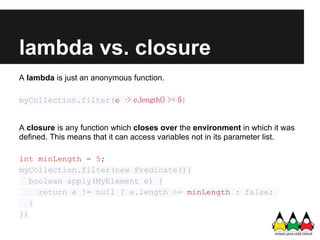
lambda vs. closure
A lambda is just an anonymous function.

myCollection.filter(e ‑> e.length() >= 5)


A closure is any function which closes over the environment in which it was
defined. This means that it can access variables not in its parameter list.

int minLength = 5;
myCollection.filter(new Predicate(){
   boolean apply(MyElement e) {
     return e != null ? e.length >= minLength : false;
   }
})
Project Lambda (JSR 335)
● Language changes
  ○ Lambda Expression
  ○ Virtual Extension Method
● Library changes
  ○ Functional API
  ○ Parallel collections
  ○ Bulk Operations
Problem
String[] names = {"Alice", "Bob", "Charlie", Dave"};
Arrays.sort(names, new Comparator<String>() {
  @Override
  public int compare(String o1, String o2) {
    return o1.compareToIgnoreCase(o2);
  }
});
"tiny" anonymous inner
class
String[] names = {"Alice", "Bob", "Charlie", Dave"};
Arrays.sort(names, new Comparator<String>() {
  @Override
  public int compare(String o1, String o2) {
    return o1.compareToIgnoreCase(o2);
  }
});
"tiny" and useful
●   callbacks
●   runnables
●   event handlers
●   comparators
●   ...and many other cases
All we need!
String[] names = {"Alice", "Bob", "Charlie", Dave"};
Arrays.sort(names, new Comparator<String>() {
  @Override
  public int compare(String o1, String o2) {
    return o1.compareToIgnoreCase(o2);
  }
});
Solution - closure
String[] names = {"Alice", "Bob", "Charlie", Dave"};
Arrays.sort(names, (o1, o2) -> o1.compareToIgnoreCase(o2));
What do we mean by
 closures?
● a unit of deferred execution
● code that can be passed as a value
● can be used in an assignment
  statement
● capture of a surrounding environment
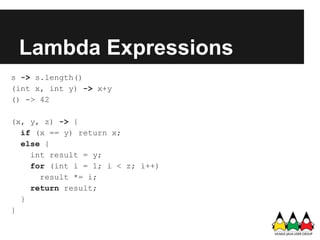
Lambda Expressions
s -> s.length()
(int x, int y) -> x+y
() -> 42

(x, y, z) -> {
  if (x == y) return x;
  else {
    int result = y;
    for (int i = 1; i < z; i++)
      result *= i;
    return result;
  }
}
Lambda Syntax
principally because something similar
has been generally well-received in
other Java-like languages (C# and
Scala), and a clearly "better" alternative
did not present itself
Lambda
● Effectively final variables
Lambda
● Effectively final variables
● Shadowing
Lambda
● Effectively final variables
● Shadowing
● break, continue must be local
Lambda
●   Effectively final variables
●   Shadowing
●   break, continue must be local
●   this - lambda is not an instance
    method. (this == surrounding context
    object)
Lambda
● Effectively final variables
● Shadowing
● break, continue must be local
● this - lambda is not an instance
  method. (this == surrounding context
  object)
● throw completes method abruptly
Functional Interfaces
A functional interface is an interface
that has just one abstract method, and
thus represents a single function
contract.
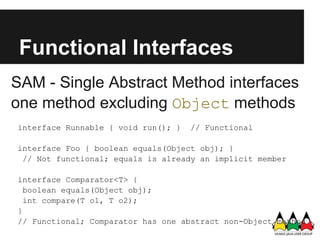
Functional Interfaces
SAM - Single Abstract Method interfaces
one method excluding Object methods
interface Runnable { void run(); }   // Functional

interface Foo { boolean equals(Object obj); }
 // Not functional; equals is already an implicit member

interface Comparator<T> {
  boolean equals(Object obj);
  int compare(T o1, T o2);
}
// Functional; Comparator has one abstract non-Object method
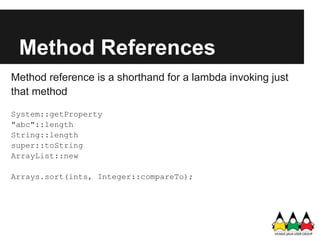
Method References
Method reference is a shorthand for a lambda invoking just
that method

System::getProperty
"abc"::length
String::length
super::toString
ArrayList::new

Arrays.sort(ints, Integer::compareTo);
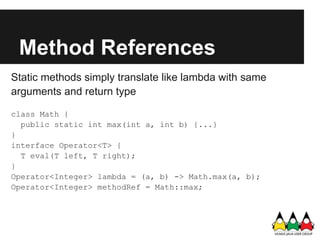
Method References
Static methods simply translate like lambda with same
arguments and return type

class Math {
  public static int max(int a, int b) {...}
}
interface Operator<T> {
  T eval(T left, T right);
}
Operator<Integer> lambda = (a, b) -> Math.max(a, b);
Operator<Integer> methodRef = Math::max;
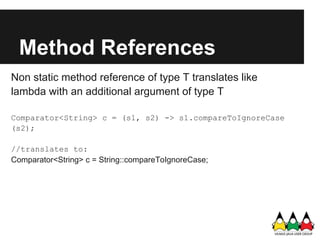
Method References
Non static method reference of type T translates like
lambda with an additional argument of type T

Comparator<String> c = (s1, s2) -> s1.compareToIgnoreCase
(s2);

//translates to:
Comparator<String> c = String::compareToIgnoreCase;
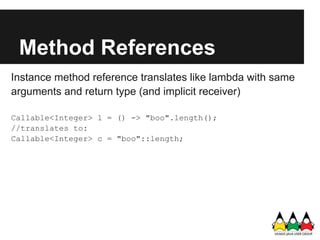
Method References
Instance method reference translates like lambda with same
arguments and return type (and implicit receiver)

Callable<Integer> l = () -> "boo".length();
//translates to:
Callable<Integer> c = "boo"::length;
Method References
String[] names = {"Alice", "Bob", "Charlie", Dave"};
Arrays.sort(names,
            (o1, o2) -> o1.compareToIgnoreCase(o2));

//translates to

String[] names = {"Alice", "Bob", "Charlie", Dave"};
Arrays.sort(names, String::compareToIgnoreCase);
Compatibility
           Cannot add new interface methods
(without forcing current interface users to implement them)

      But we need new lambda enabled methods
               (on Java core libraries!)
Default methods
 (also known as)
● virtual extension methods
● defender methods
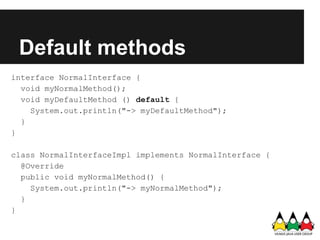
Default methods
interface NormalInterface {
  void myNormalMethod();
  void myDefaultMethod () default {
    System.out.println("-> myDefaultMethod");
  }
}

class NormalInterfaceImpl implements NormalInterface {
  @Override
  public void myNormalMethod() {
    System.out.println("-> myNormalMethod");
  }
}
Functional Collections
Major changes in collection API:
● Internal iteration support with Iterable/Stream interfaces
   (forEach, filter, map, etc)
Functional Collections
Major changes in collection API:
● Internal iteration support with Iterable/Stream interfaces
   (forEach, filter, map, etc)
● Explicit parallel APIs for greater parallelism support.
   These can be combined with Fork/Join to divide the
   tasks
Functional Collections
Major changes in collection API:
● Internal iteration support with Iterable/Stream interfaces
   (forEach, filter, map, etc)
● Explicit parallel APIs for greater parallelism support.
   These can be combined with Fork/Join to divide the
   tasks
● Greater stress on immutability and avoiding in-place
   mutation which was done in the conventional for-each
   loops
Example
String[] names = {"Alice", "Bob", "Charlie", "Dave"};

List<String> filteredNames = Streams.stream(names)
                .filter(e -> e.length() >= 4)
                .into(new ArrayList<>());

filteredNames.stream().forEach(System.out::println);
Streams
● No storage - nothing is stored in stream
Streams
● No storage - nothing is stored in stream
● Functional in nature - new values are produced
Streams
● No storage - nothing is stored in stream
● Functional in nature - new values are produced
● Laziness-seeking. Many operations can be
   implemented lazily
Streams
● No storage - nothing is stored in stream
● Functional in nature - new values are produced
● Laziness-seeking. Many operations can be
    implemented lazily
●   Bounds optional. Think of infinite stream
Functional interfaces
java.util.functions
● Predicate - a property of the object passed as
   argument
● Block - an action to be performed with the object
   passed as argument
● Mapper - transform a T to a U
● ...
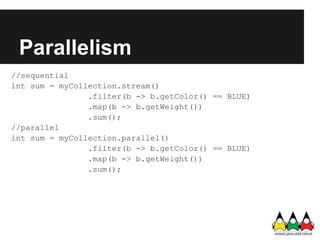
Parallelism
//sequential
int sum = myCollection.stream()
                .filter(b -> b.getColor() == BLUE)
                .map(b -> b.getWeight())
                .sum();
//parallel
int sum = myCollection.parallel()
                .filter(b -> b.getColor() == BLUE)
                .map(b -> b.getWeight())
                .sum();
Advantages
● Elements may be computed lazily. If we apply a Mapper
  to a collection of a thousand elements but only iterate
  over the first three, the remaining elements will never be
  mapped.
Advantages
● Elements may be computed lazily. If we apply a Mapper
  to a collection of a thousand elements but only iterate
  over the first three, the remaining elements will never be
  mapped.
● Method chaining is encouraged. Hence there's no need
  to store intermediate results in their own collections.
Advantages
● Elements may be computed lazily. If we apply a Mapper
  to a collection of a thousand elements but only iterate
  over the first three, the remaining elements will never be
  mapped.
● Method chaining is encouraged. Hence there's no need
  to store intermediate results in their own collections.
● Internal iteration hides implementation decisions. For
  example, we could parallelize a map() operation just by
  writing myCollection.parallel().map(e ‑> e.length()).
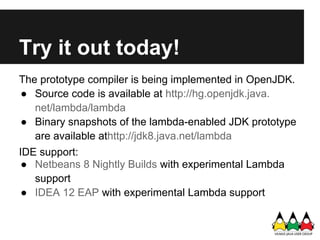
Try it out today!
The prototype compiler is being implemented in OpenJDK.
● Source code is available at http://hg.openjdk.java.
   net/lambda/lambda
● Binary snapshots of the lambda-enabled JDK prototype
   are available athttp://jdk8.java.net/lambda
IDE support:
 ● Netbeans 8 Nightly Builds with experimental Lambda
   support
 ● IDEA 12 EAP with experimental Lambda support
Date & Time API
JSR 310
Oldies: Date
● Mutable
Oldies: Date
● Mutable
● Years being indexed from 1900
Oldies: Date
● Mutable
● Years being indexed from 1900
● Months being indexed from 0
Oldies: Date
● Mutable
● Years being indexed from 1900
● Months being indexed from 0

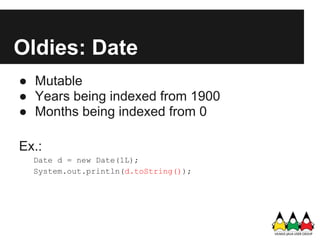
Ex.:
  Date d = new Date(1L);
  System.out.println(d.toString());
Oldies: Date
● Mutable
● Years being indexed from 1900
● Months being indexed from 0

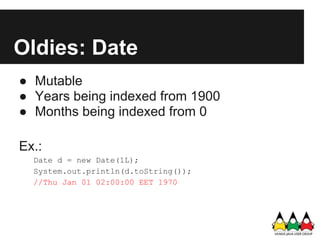
Ex.:
  Date d = new Date(1L);
  System.out.println(d.toString());
  //Thu Jan 01 02:00:00 EET 1970
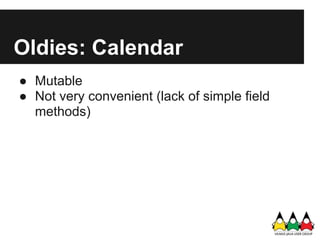
Oldies: Calendar
● Mutable
Oldies: Calendar
● Mutable
● Not very convenient (lack of simple field
  methods)
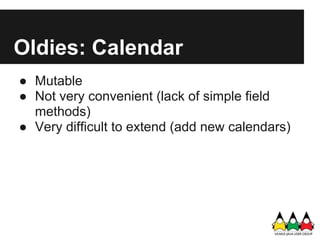
Oldies: Calendar
● Mutable
● Not very convenient (lack of simple field
  methods)
● Very difficult to extend (add new calendars)
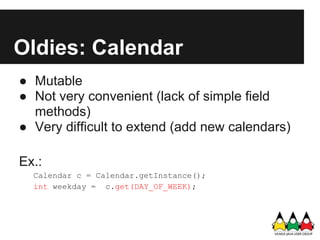
Oldies: Calendar
● Mutable
● Not very convenient (lack of simple field
  methods)
● Very difficult to extend (add new calendars)

Ex.:
  Calendar c = Calendar.getInstance();
  int weekday = c.get(DAY_OF_WEEK);
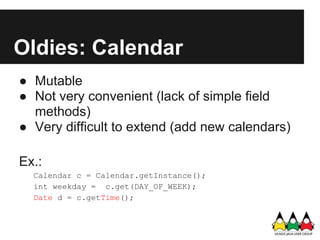
Oldies: Calendar
● Mutable
● Not very convenient (lack of simple field
  methods)
● Very difficult to extend (add new calendars)

Ex.:
  Calendar c = Calendar.getInstance();
  int weekday = c.get(DAY_OF_WEEK);
  Date d = c.getTime();
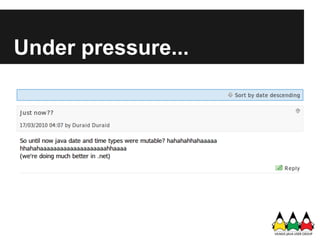
Under pressure...
JSR 310
● Immutable
JSR 310
● Immutable
● Defines consistent language for domain
  ○ Offset from UTC vs TimeZone
  ○ Machine vs Human
  ○ ISO 8601
JSR 310
● Immutable
● Defines consistent language for domain
  ○ Offset from UTC vs TimeZone
  ○ Machine vs Human
  ○ ISO 8601
● No old Date/Calendar usage (clean)
JSR 310
● Immutable
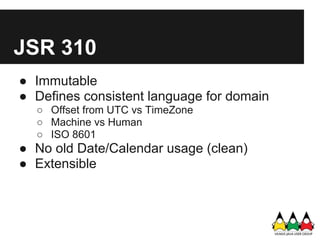
● Defines consistent language for domain
  ○ Offset from UTC vs TimeZone
  ○ Machine vs Human
  ○ ISO 8601
● No old Date/Calendar usage (clean)
● Extensible
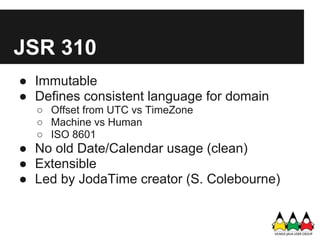
JSR 310
● Immutable
● Defines consistent language for domain
  ○ Offset from UTC vs TimeZone
  ○ Machine vs Human
  ○ ISO 8601
● No old Date/Calendar usage (clean)
● Extensible
● Led by JodaTime creator (S. Colebourne)
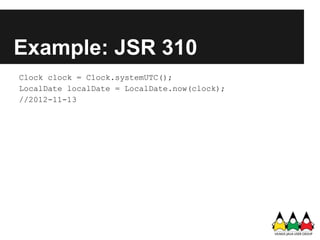
Example: JSR 310
Clock clock = Clock.systemUTC();
LocalDate localDate = LocalDate.now(clock);
//2012-11-13
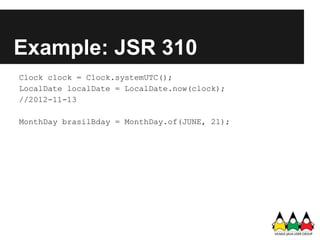
Example: JSR 310
Clock clock = Clock.systemUTC();
LocalDate localDate = LocalDate.now(clock);
//2012-11-13

MonthDay brasilBday = MonthDay.of(JUNE, 21);
Example: JSR 310
Clock clock = Clock.systemUTC();
LocalDate localDate = LocalDate.now(clock);
//2012-11-13

MonthDay brasilBday = MonthDay.of(JUNE, 21);

ZoneId zoneId = ZoneId.of("America/New_York");
Clock clock = Clock.system(zoneId);
ZonedDateTime zonedDateTimeUS = ZonedDateTime.now(clock);
//2012-11-11T04:17:58.693-05:00[America/New_York]
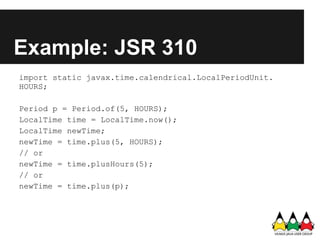
Example: JSR 310
import static javax.time.calendrical.LocalPeriodUnit.
HOURS;

Period p = Period.of(5, HOURS);
LocalTime time = LocalTime.now();
LocalTime newTime;
newTime = time.plus(5, HOURS);
// or
newTime = time.plusHours(5);
// or
newTime = time.plus(p);
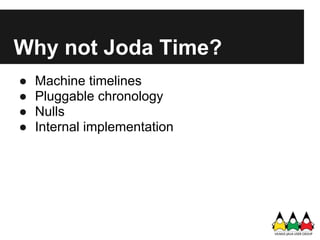
Why not Joda Time?
●   Machine timelines
●   Pluggable chronology
●   Nulls
●   Internal implementation
VM/GC
JEP 122 & JEP 156
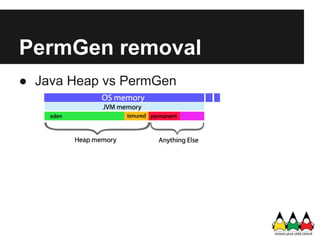
PermGen removal
● Java Heap vs PermGen
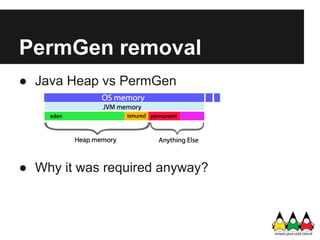
PermGen removal
● Java Heap vs PermGen
PermGen removal
● Java Heap vs PermGen


● Why it was required anyway?
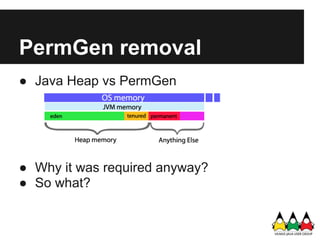
PermGen removal
● Java Heap vs PermGen


● Why it was required anyway?
● So what?
Annotations
JSR 308 & JEP 120
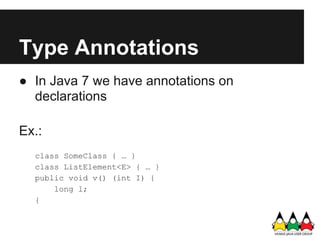
Type Annotations
● In Java 7 we have annotations on
  declarations

Ex.:
  class SomeClass { … }
  class ListElement<E> { … }
  public void v() (int I) {
      long l;
  {
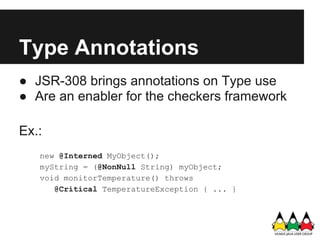
Type Annotations
● JSR-308 brings annotations on Type use
● Are an enabler for the checkers framework

Ex.:
   new @Interned MyObject();
   myString = (@NonNull String) myObject;
   void monitorTemperature() throws
      @Critical TemperatureException { ... }
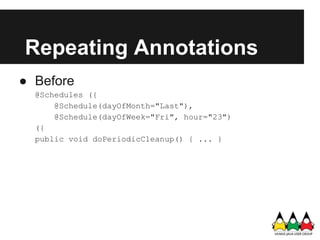
Repeating Annotations
● Before
  @Schedules ({
      @Schedule(dayOfMonth="Last"),
      @Schedule(dayOfWeek="Fri", hour="23")
  ({
  public void doPeriodicCleanup() { ... }
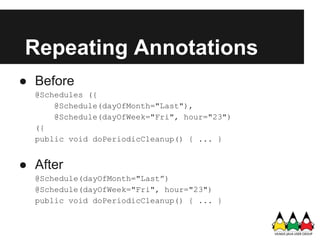
Repeating Annotations
● Before
  @Schedules ({
      @Schedule(dayOfMonth="Last"),
      @Schedule(dayOfWeek="Fri", hour="23")
  ({
  public void doPeriodicCleanup() { ... }


● After
  @Schedule(dayOfMonth="Last”)
  @Schedule(dayOfWeek="Fri", hour="23")
  public void doPeriodicCleanup() { ... }
Q&A
References
* Lambda
http://stackoverflow.com/questions/220658/what-is-the-difference-between-a-closure-and-a-lambda
http://openjdk.java.net/projects/lambda/
http://jcp.org/aboutJava/communityprocess/edr/jsr335/index2.html
http://vimeo.com/48577033 (slides: http://www.slideshare.net/tkowalcz/java-gets-a-closure)
http://datumedge.blogspot.co.uk/2012/06/java-8-lambdas.html
http://www.theserverside.com/news/thread.tss?thread_id=68718
http://medianetwork.oracle.com/video/player/1785479333001
https://oracleus.activeevents.com/connect/sessionDetail.ww?SESSION_ID=6080
https://oracleus.activeevents.com/connect/sessionDetail.ww?SESSION_ID=5089
http://www.lektorium.tv/lecture/?id=14048
http://www.lektorium.tv/lecture/?id=14049
http://blog.xebia.com/2012/11/05/report-will-java-8s-lambda-change-the-face-of-the-world/
http://www.slideshare.net/fsarradin/java-8-lambda
http://programmers.stackexchange.com/questions/173441/what-triggered-the-popularity-of-lambda-functions-in-modern-mainstream-programmi?newsletter=1&nlcode=29983%
7c903a
http://www.slideshare.net/bje/java-closures
* Collections
http://www.javabeat.net/2012/05/enhanced-collections-api-in-java-8-supports-lambda-expressions/
http://cr.openjdk.java.net/~briangoetz/lambda/collections-overview.html
http://architects.dzone.com/articles/java-collections-api
References
* Remove the Permanent Generation
http://www.cubrid.org/blog/dev-platform/understanding-jvm-internals/
http://javaeesupportpatterns.blogspot.com/2011/10/java-7-features-permgen-removal.html
http://java.dzone.com/articles/busting-permgen-myths
https://oracleus.activeevents.com/connect/sessionDetail.ww?SESSION_ID=5135
* JSR 310: Date and Time API
http://java.dzone.com/articles/introducing-new-date-and-time
http://sourceforge.net/apps/mediawiki/threeten/index.php?title=ThreeTen
http://www.infoq.com/news/2010/03/jsr-310
https://docs.google.com/document/pub?id=1rd8yplQZIRz3LxMzpVLuskr1b0HwBmK9PXpdgBYojSw
http://sourceforge.net/apps/mediawiki/threeten/index.php?title=User_Guide
https://oracleus.activeevents.com/connect/sessionDetail.ww?SESSION_ID=4350
* General Java8
http://openjdk.java.net/projects/jdk8/features
http://www.pcadvisor.co.uk/news/software/3401314/oracle-java-upgrades-still-worthwhile-despite-postponed-features/
http://dhruba.name/2011/07/06/oracle-discusses-java-7-8-new-features-on-video/
http://channel9.msdn.com/Events/Lang-NEXT/Lang-NEXT-2012/Java-8
http://www.parleys.com/#st=5&id=2850&sl=1
http://www.parleys.com/#st=5&id=2847
https://oracleus.activeevents.com/connect/sessionDetail.ww?SESSION_ID=2872
https://oracleus.activeevents.com/connect/sessionDetail.ww?SESSION_ID=10458
References
*Annotations
https://oracleus.activeevents.com/connect/sessionDetail.ww?SESSION_ID=4469
https://blogs.oracle.com/abuckley/entry/jsr_308_moves_forward
http://jcp.org/en/jsr/detail?id=308
http://openjdk.java.net/jeps/120
http://types.cs.washington.edu/checker-framework/

Java 8

  • 1.
    Java 8 Interesting parts VaidasPilkauskas, Kasparas Rudokas Vilnius JUG
  • 2.
    Agenda ● Lambda ● Date & Time ● PermGen ● Annotations
  • 3.
  • 4.
    lambda vs. closure Alambda is just an anonymous function. myCollection.filter(e ‑> e.length() >= 5) A closure is any function which closes over the environment in which it was defined. This means that it can access variables not in its parameter list. int minLength = 5; myCollection.filter(new Predicate(){ boolean apply(MyElement e) { return e != null ? e.length >= minLength : false; } })
  • 5.
    Project Lambda (JSR335) ● Language changes ○ Lambda Expression ○ Virtual Extension Method ● Library changes ○ Functional API ○ Parallel collections ○ Bulk Operations
  • 6.
    Problem String[] names ={"Alice", "Bob", "Charlie", Dave"}; Arrays.sort(names, new Comparator<String>() { @Override public int compare(String o1, String o2) { return o1.compareToIgnoreCase(o2); } });
  • 7.
    "tiny" anonymous inner class String[]names = {"Alice", "Bob", "Charlie", Dave"}; Arrays.sort(names, new Comparator<String>() { @Override public int compare(String o1, String o2) { return o1.compareToIgnoreCase(o2); } });
  • 8.
    "tiny" and useful ● callbacks ● runnables ● event handlers ● comparators ● ...and many other cases
  • 9.
    All we need! String[]names = {"Alice", "Bob", "Charlie", Dave"}; Arrays.sort(names, new Comparator<String>() { @Override public int compare(String o1, String o2) { return o1.compareToIgnoreCase(o2); } });
  • 10.
    Solution - closure String[]names = {"Alice", "Bob", "Charlie", Dave"}; Arrays.sort(names, (o1, o2) -> o1.compareToIgnoreCase(o2));
  • 11.
    What do wemean by closures? ● a unit of deferred execution ● code that can be passed as a value ● can be used in an assignment statement ● capture of a surrounding environment
  • 12.
    Lambda Expressions s ->s.length() (int x, int y) -> x+y () -> 42 (x, y, z) -> { if (x == y) return x; else { int result = y; for (int i = 1; i < z; i++) result *= i; return result; } }
  • 13.
    Lambda Syntax principally becausesomething similar has been generally well-received in other Java-like languages (C# and Scala), and a clearly "better" alternative did not present itself
  • 14.
  • 15.
    Lambda ● Effectively finalvariables ● Shadowing
  • 16.
    Lambda ● Effectively finalvariables ● Shadowing ● break, continue must be local
  • 17.
    Lambda ● Effectively final variables ● Shadowing ● break, continue must be local ● this - lambda is not an instance method. (this == surrounding context object)
  • 18.
    Lambda ● Effectively finalvariables ● Shadowing ● break, continue must be local ● this - lambda is not an instance method. (this == surrounding context object) ● throw completes method abruptly
  • 19.
    Functional Interfaces A functionalinterface is an interface that has just one abstract method, and thus represents a single function contract.
  • 20.
    Functional Interfaces SAM -Single Abstract Method interfaces one method excluding Object methods interface Runnable { void run(); } // Functional interface Foo { boolean equals(Object obj); } // Not functional; equals is already an implicit member interface Comparator<T> { boolean equals(Object obj); int compare(T o1, T o2); } // Functional; Comparator has one abstract non-Object method
  • 21.
    Method References Method referenceis a shorthand for a lambda invoking just that method System::getProperty "abc"::length String::length super::toString ArrayList::new Arrays.sort(ints, Integer::compareTo);
  • 22.
    Method References Static methodssimply translate like lambda with same arguments and return type class Math { public static int max(int a, int b) {...} } interface Operator<T> { T eval(T left, T right); } Operator<Integer> lambda = (a, b) -> Math.max(a, b); Operator<Integer> methodRef = Math::max;
  • 23.
    Method References Non staticmethod reference of type T translates like lambda with an additional argument of type T Comparator<String> c = (s1, s2) -> s1.compareToIgnoreCase (s2); //translates to: Comparator<String> c = String::compareToIgnoreCase;
  • 24.
    Method References Instance methodreference translates like lambda with same arguments and return type (and implicit receiver) Callable<Integer> l = () -> "boo".length(); //translates to: Callable<Integer> c = "boo"::length;
  • 25.
    Method References String[] names= {"Alice", "Bob", "Charlie", Dave"}; Arrays.sort(names, (o1, o2) -> o1.compareToIgnoreCase(o2)); //translates to String[] names = {"Alice", "Bob", "Charlie", Dave"}; Arrays.sort(names, String::compareToIgnoreCase);
  • 26.
    Compatibility Cannot add new interface methods (without forcing current interface users to implement them) But we need new lambda enabled methods (on Java core libraries!)
  • 27.
    Default methods (alsoknown as) ● virtual extension methods ● defender methods
  • 28.
    Default methods interface NormalInterface{ void myNormalMethod(); void myDefaultMethod () default { System.out.println("-> myDefaultMethod"); } } class NormalInterfaceImpl implements NormalInterface { @Override public void myNormalMethod() { System.out.println("-> myNormalMethod"); } }
  • 29.
    Functional Collections Major changesin collection API: ● Internal iteration support with Iterable/Stream interfaces (forEach, filter, map, etc)
  • 30.
    Functional Collections Major changesin collection API: ● Internal iteration support with Iterable/Stream interfaces (forEach, filter, map, etc) ● Explicit parallel APIs for greater parallelism support. These can be combined with Fork/Join to divide the tasks
  • 31.
    Functional Collections Major changesin collection API: ● Internal iteration support with Iterable/Stream interfaces (forEach, filter, map, etc) ● Explicit parallel APIs for greater parallelism support. These can be combined with Fork/Join to divide the tasks ● Greater stress on immutability and avoiding in-place mutation which was done in the conventional for-each loops
  • 32.
    Example String[] names ={"Alice", "Bob", "Charlie", "Dave"}; List<String> filteredNames = Streams.stream(names) .filter(e -> e.length() >= 4) .into(new ArrayList<>()); filteredNames.stream().forEach(System.out::println);
  • 33.
    Streams ● No storage- nothing is stored in stream
  • 34.
    Streams ● No storage- nothing is stored in stream ● Functional in nature - new values are produced
  • 35.
    Streams ● No storage- nothing is stored in stream ● Functional in nature - new values are produced ● Laziness-seeking. Many operations can be implemented lazily
  • 36.
    Streams ● No storage- nothing is stored in stream ● Functional in nature - new values are produced ● Laziness-seeking. Many operations can be implemented lazily ● Bounds optional. Think of infinite stream
  • 37.
    Functional interfaces java.util.functions ● Predicate- a property of the object passed as argument ● Block - an action to be performed with the object passed as argument ● Mapper - transform a T to a U ● ...
  • 38.
    Parallelism //sequential int sum =myCollection.stream() .filter(b -> b.getColor() == BLUE) .map(b -> b.getWeight()) .sum(); //parallel int sum = myCollection.parallel() .filter(b -> b.getColor() == BLUE) .map(b -> b.getWeight()) .sum();
  • 39.
    Advantages ● Elements maybe computed lazily. If we apply a Mapper to a collection of a thousand elements but only iterate over the first three, the remaining elements will never be mapped.
  • 40.
    Advantages ● Elements maybe computed lazily. If we apply a Mapper to a collection of a thousand elements but only iterate over the first three, the remaining elements will never be mapped. ● Method chaining is encouraged. Hence there's no need to store intermediate results in their own collections.
  • 41.
    Advantages ● Elements maybe computed lazily. If we apply a Mapper to a collection of a thousand elements but only iterate over the first three, the remaining elements will never be mapped. ● Method chaining is encouraged. Hence there's no need to store intermediate results in their own collections. ● Internal iteration hides implementation decisions. For example, we could parallelize a map() operation just by writing myCollection.parallel().map(e ‑> e.length()).
  • 42.
    Try it outtoday! The prototype compiler is being implemented in OpenJDK. ● Source code is available at http://hg.openjdk.java. net/lambda/lambda ● Binary snapshots of the lambda-enabled JDK prototype are available athttp://jdk8.java.net/lambda IDE support: ● Netbeans 8 Nightly Builds with experimental Lambda support ● IDEA 12 EAP with experimental Lambda support
  • 43.
    Date & TimeAPI JSR 310
  • 44.
  • 45.
    Oldies: Date ● Mutable ●Years being indexed from 1900
  • 46.
    Oldies: Date ● Mutable ●Years being indexed from 1900 ● Months being indexed from 0
  • 47.
    Oldies: Date ● Mutable ●Years being indexed from 1900 ● Months being indexed from 0 Ex.: Date d = new Date(1L); System.out.println(d.toString());
  • 48.
    Oldies: Date ● Mutable ●Years being indexed from 1900 ● Months being indexed from 0 Ex.: Date d = new Date(1L); System.out.println(d.toString()); //Thu Jan 01 02:00:00 EET 1970
  • 49.
  • 50.
    Oldies: Calendar ● Mutable ●Not very convenient (lack of simple field methods)
  • 51.
    Oldies: Calendar ● Mutable ●Not very convenient (lack of simple field methods) ● Very difficult to extend (add new calendars)
  • 52.
    Oldies: Calendar ● Mutable ●Not very convenient (lack of simple field methods) ● Very difficult to extend (add new calendars) Ex.: Calendar c = Calendar.getInstance(); int weekday = c.get(DAY_OF_WEEK);
  • 53.
    Oldies: Calendar ● Mutable ●Not very convenient (lack of simple field methods) ● Very difficult to extend (add new calendars) Ex.: Calendar c = Calendar.getInstance(); int weekday = c.get(DAY_OF_WEEK); Date d = c.getTime();
  • 54.
  • 55.
  • 56.
    JSR 310 ● Immutable ●Defines consistent language for domain ○ Offset from UTC vs TimeZone ○ Machine vs Human ○ ISO 8601
  • 57.
    JSR 310 ● Immutable ●Defines consistent language for domain ○ Offset from UTC vs TimeZone ○ Machine vs Human ○ ISO 8601 ● No old Date/Calendar usage (clean)
  • 58.
    JSR 310 ● Immutable ●Defines consistent language for domain ○ Offset from UTC vs TimeZone ○ Machine vs Human ○ ISO 8601 ● No old Date/Calendar usage (clean) ● Extensible
  • 59.
    JSR 310 ● Immutable ●Defines consistent language for domain ○ Offset from UTC vs TimeZone ○ Machine vs Human ○ ISO 8601 ● No old Date/Calendar usage (clean) ● Extensible ● Led by JodaTime creator (S. Colebourne)
  • 60.
    Example: JSR 310 Clockclock = Clock.systemUTC(); LocalDate localDate = LocalDate.now(clock); //2012-11-13
  • 61.
    Example: JSR 310 Clockclock = Clock.systemUTC(); LocalDate localDate = LocalDate.now(clock); //2012-11-13 MonthDay brasilBday = MonthDay.of(JUNE, 21);
  • 62.
    Example: JSR 310 Clockclock = Clock.systemUTC(); LocalDate localDate = LocalDate.now(clock); //2012-11-13 MonthDay brasilBday = MonthDay.of(JUNE, 21); ZoneId zoneId = ZoneId.of("America/New_York"); Clock clock = Clock.system(zoneId); ZonedDateTime zonedDateTimeUS = ZonedDateTime.now(clock); //2012-11-11T04:17:58.693-05:00[America/New_York]
  • 63.
    Example: JSR 310 importstatic javax.time.calendrical.LocalPeriodUnit. HOURS; Period p = Period.of(5, HOURS); LocalTime time = LocalTime.now(); LocalTime newTime; newTime = time.plus(5, HOURS); // or newTime = time.plusHours(5); // or newTime = time.plus(p);
  • 64.
    Why not JodaTime? ● Machine timelines ● Pluggable chronology ● Nulls ● Internal implementation
  • 65.
  • 66.
    PermGen removal ● JavaHeap vs PermGen
  • 67.
    PermGen removal ● JavaHeap vs PermGen
  • 68.
    PermGen removal ● JavaHeap vs PermGen ● Why it was required anyway?
  • 69.
    PermGen removal ● JavaHeap vs PermGen ● Why it was required anyway? ● So what?
  • 70.
  • 71.
    Type Annotations ● InJava 7 we have annotations on declarations Ex.: class SomeClass { … } class ListElement<E> { … } public void v() (int I) { long l; {
  • 72.
    Type Annotations ● JSR-308brings annotations on Type use ● Are an enabler for the checkers framework Ex.: new @Interned MyObject(); myString = (@NonNull String) myObject; void monitorTemperature() throws @Critical TemperatureException { ... }
  • 73.
    Repeating Annotations ● Before @Schedules ({ @Schedule(dayOfMonth="Last"), @Schedule(dayOfWeek="Fri", hour="23") ({ public void doPeriodicCleanup() { ... }
  • 74.
    Repeating Annotations ● Before @Schedules ({ @Schedule(dayOfMonth="Last"), @Schedule(dayOfWeek="Fri", hour="23") ({ public void doPeriodicCleanup() { ... } ● After @Schedule(dayOfMonth="Last”) @Schedule(dayOfWeek="Fri", hour="23") public void doPeriodicCleanup() { ... }
  • 75.
  • 76.
    References * Lambda http://stackoverflow.com/questions/220658/what-is-the-difference-between-a-closure-and-a-lambda http://openjdk.java.net/projects/lambda/ http://jcp.org/aboutJava/communityprocess/edr/jsr335/index2.html http://vimeo.com/48577033 (slides:http://www.slideshare.net/tkowalcz/java-gets-a-closure) http://datumedge.blogspot.co.uk/2012/06/java-8-lambdas.html http://www.theserverside.com/news/thread.tss?thread_id=68718 http://medianetwork.oracle.com/video/player/1785479333001 https://oracleus.activeevents.com/connect/sessionDetail.ww?SESSION_ID=6080 https://oracleus.activeevents.com/connect/sessionDetail.ww?SESSION_ID=5089 http://www.lektorium.tv/lecture/?id=14048 http://www.lektorium.tv/lecture/?id=14049 http://blog.xebia.com/2012/11/05/report-will-java-8s-lambda-change-the-face-of-the-world/ http://www.slideshare.net/fsarradin/java-8-lambda http://programmers.stackexchange.com/questions/173441/what-triggered-the-popularity-of-lambda-functions-in-modern-mainstream-programmi?newsletter=1&nlcode=29983% 7c903a http://www.slideshare.net/bje/java-closures * Collections http://www.javabeat.net/2012/05/enhanced-collections-api-in-java-8-supports-lambda-expressions/ http://cr.openjdk.java.net/~briangoetz/lambda/collections-overview.html http://architects.dzone.com/articles/java-collections-api
  • 77.
    References * Remove thePermanent Generation http://www.cubrid.org/blog/dev-platform/understanding-jvm-internals/ http://javaeesupportpatterns.blogspot.com/2011/10/java-7-features-permgen-removal.html http://java.dzone.com/articles/busting-permgen-myths https://oracleus.activeevents.com/connect/sessionDetail.ww?SESSION_ID=5135 * JSR 310: Date and Time API http://java.dzone.com/articles/introducing-new-date-and-time http://sourceforge.net/apps/mediawiki/threeten/index.php?title=ThreeTen http://www.infoq.com/news/2010/03/jsr-310 https://docs.google.com/document/pub?id=1rd8yplQZIRz3LxMzpVLuskr1b0HwBmK9PXpdgBYojSw http://sourceforge.net/apps/mediawiki/threeten/index.php?title=User_Guide https://oracleus.activeevents.com/connect/sessionDetail.ww?SESSION_ID=4350 * General Java8 http://openjdk.java.net/projects/jdk8/features http://www.pcadvisor.co.uk/news/software/3401314/oracle-java-upgrades-still-worthwhile-despite-postponed-features/ http://dhruba.name/2011/07/06/oracle-discusses-java-7-8-new-features-on-video/ http://channel9.msdn.com/Events/Lang-NEXT/Lang-NEXT-2012/Java-8 http://www.parleys.com/#st=5&id=2850&sl=1 http://www.parleys.com/#st=5&id=2847 https://oracleus.activeevents.com/connect/sessionDetail.ww?SESSION_ID=2872 https://oracleus.activeevents.com/connect/sessionDetail.ww?SESSION_ID=10458
  • 78.