Daniel Coll and Diego Moliner Productions
STONEHENGE
Time
Stonehenge was built around the year 3600 B.C. It
was finished in the year 2000 B.C. by the British
indigenous people.
Location
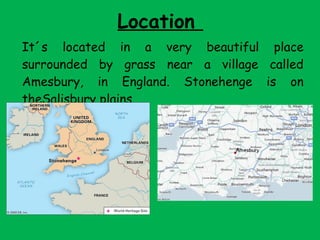
It“s located in a very beautiful place
surrounded by grass near a village called
Amesbury, in England. Stonehenge is on
theSalisbury plains.
Materials
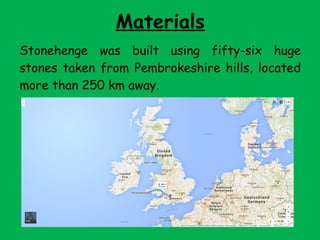
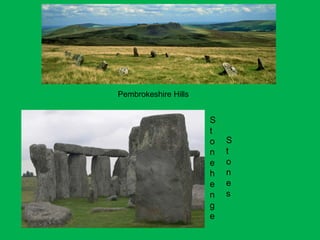
Stonehenge was built using fifty-six huge
stones taken from Pembrokeshire hills, located
more than 250 km away.
Pembrokeshire Hills
S
t
o
n
e
h
e
n
g
e
S
t
o
n
e
s
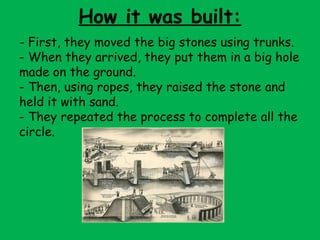
How it was built:
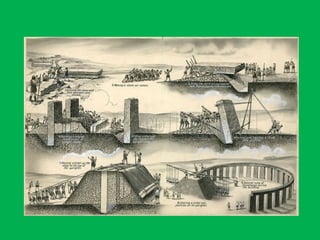
- First, they moved the big stones using trunks.
- When they arrived, they put them in a big hole
made on the ground.
- Then, using ropes, they raised the stone and
held it with sand.
- They repeated the process to complete all the
circle.
Organization
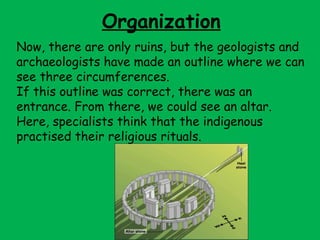
Now, there are only ruins, but the geologists and
archaeologists have made an outline where we can
see three circumferences.
If this outline was correct, there was an
entrance. From there, we could see an altar.
Here, specialists think that the indigenous
practised their religious rituals.
Uses and explanations
There are lots of theories about the uses and
origin of this monument. The most important
are:
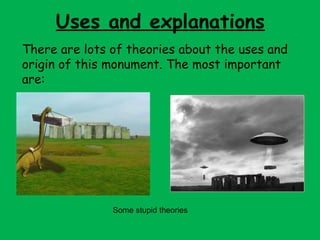
Some stupid theories
Sanatorium
They went there to cure their strange diseases.
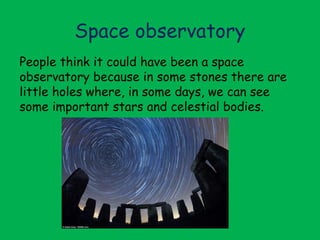
Space observatory
People think it could have been a space
observatory because in some stones there are
little holes where, in some days, we can see
some important stars and celestial bodies.
Unification place
Some think that it was also used as a
meeting point.
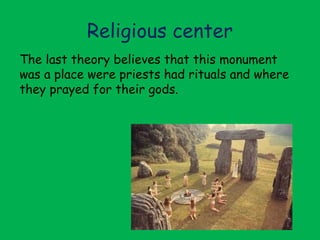
Religious center
The last theory believes that this monument
was a place were priests had rituals and where
they prayed for their gods.
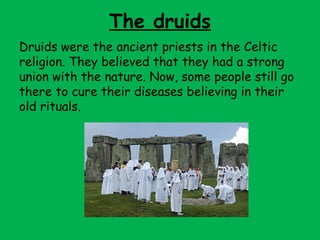
The druids
Druids were the ancient priests in the Celtic
religion. They believed that they had a strong
union with the nature. Now, some people still go
there to cure their diseases believing in their
old rituals.
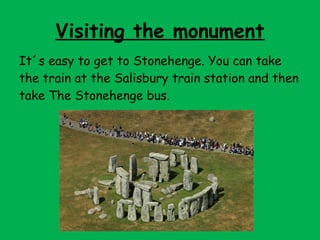
Visiting the monument
It“s easy to get to Stonehenge. You can take
the train at the Salisbury train station and then
take The Stonehenge bus.
THE END

Stonehenge

  • 1.
    Daniel Coll andDiego Moliner Productions STONEHENGE
  • 2.
    Time Stonehenge was builtaround the year 3600 B.C. It was finished in the year 2000 B.C. by the British indigenous people.
  • 3.
    Location It“s located ina very beautiful place surrounded by grass near a village called Amesbury, in England. Stonehenge is on theSalisbury plains.
  • 4.
    Materials Stonehenge was builtusing fifty-six huge stones taken from Pembrokeshire hills, located more than 250 km away.
  • 5.
  • 6.
    How it wasbuilt: - First, they moved the big stones using trunks. - When they arrived, they put them in a big hole made on the ground. - Then, using ropes, they raised the stone and held it with sand. - They repeated the process to complete all the circle.
  • 8.
    Organization Now, there areonly ruins, but the geologists and archaeologists have made an outline where we can see three circumferences. If this outline was correct, there was an entrance. From there, we could see an altar. Here, specialists think that the indigenous practised their religious rituals.
  • 9.
    Uses and explanations Thereare lots of theories about the uses and origin of this monument. The most important are: Some stupid theories
  • 10.
    Sanatorium They went thereto cure their strange diseases.
  • 11.
    Space observatory People thinkit could have been a space observatory because in some stones there are little holes where, in some days, we can see some important stars and celestial bodies.
  • 12.
    Unification place Some thinkthat it was also used as a meeting point.
  • 13.
    Religious center The lasttheory believes that this monument was a place were priests had rituals and where they prayed for their gods.
  • 14.
    The druids Druids werethe ancient priests in the Celtic religion. They believed that they had a strong union with the nature. Now, some people still go there to cure their diseases believing in their old rituals.
  • 15.
    Visiting the monument It“seasy to get to Stonehenge. You can take the train at the Salisbury train station and then take The Stonehenge bus.
  • 16.