







Hi,
This is Adrian
I am here because I love to build games and also
to give presentations. Today’s is about...
Pathfinding
in games
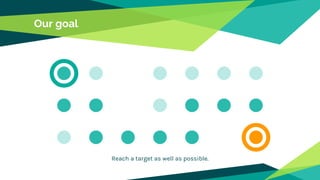
Our goal
Reach a target as well as possible.
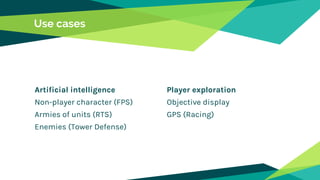
Artificial intelligence
Non-player character (FPS)
Armies of units (RTS)
Enemies (Tower Defense)
Use cases
Player exploration
Objective display
GPS (Racing)
RTS Starcraft 2
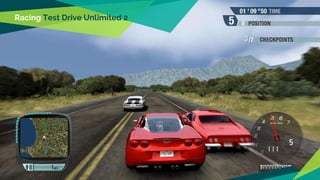
Racing Test Drive Unlimited 2
RPG Mass Effect 2
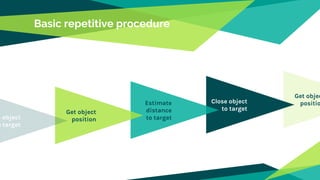
Get objec
positio
Basic repetitive procedure
Close object
to target
Estimate
distance
to target
Get object
positione object
o target
1.
Space representation
Data structures
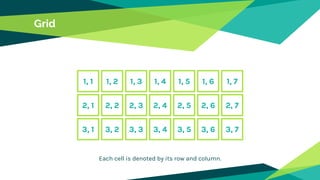
Grid
Each cell is denoted by its row and column.
1, 1 1, 2 1, 3 1, 4 1, 5 1, 6 1, 7
2, 1 2, 2 2, 3 2, 4 2, 5 2, 6 2, 7
3, 1 3, 2 3, 3 3, 4 3, 5 3, 6 3, 7
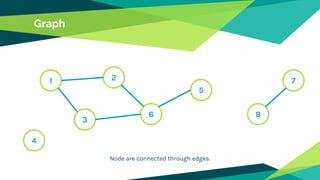
Graph
Node are connected through edges.
1
3
2
6
5
8
4
7
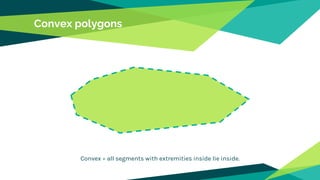
Convex polygons
Convex = all segments with extremities inside lie inside.
2.
Space manipulation
Algorithms
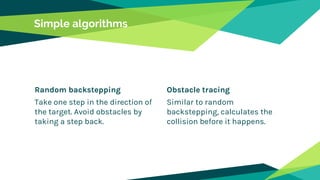
Random backstepping
Take one step in the direction of
the target. Avoid obstacles by
taking a step back.
Simple algorithms
Obstacle tracing
Similar to random
backstepping, calculates the
collision before it happens.
Advanced algorithms
◆ Breadth-first search (BFS)
◆ Depth-first search (DFS)
◆ Best-first search
◆ Dijkstra’s algorithm
◆ A* algorithm
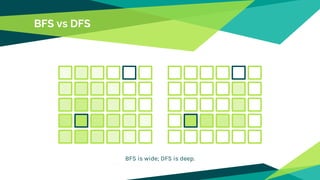
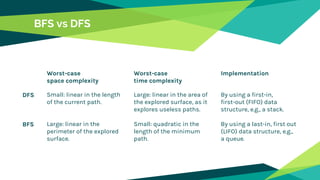
BFS vs DFS
BFS is wide; DFS is deep.
Worst-case
space complexity
Worst-case
time complexity
Implementation
BFS vs DFS
Small: linear in the length
of the current path.
Large: linear in the area of
the explored surface, as it
explores useless paths.
By using a first-in,
first-out (FIFO) data
structure, e.g., a stack.
DFS
Large: linear in the
perimeter of the explored
surface.
Small: quadratic in the
length of the minimum
path.
By using a last-in, first out
(LIFO) data structure, e.g.,
a queue.
BFS
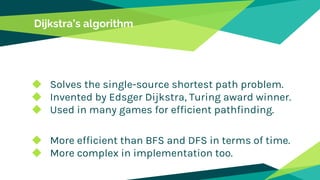
Dijkstra’s algorithm
◆ Solves the single-source shortest path problem.
◆ Invented by Edsger Dijkstra, Turing award winner.
◆ Used in many games for efficient pathfinding.
◆ More efficient than BFS and DFS in terms of time.
◆ More complex in implementation too.
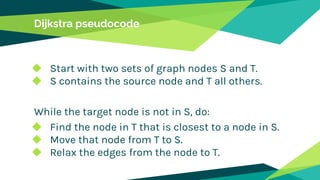
Dijkstra pseudocode
◆ Start with two sets of graph nodes S and T.
◆ S contains the source node and T all others.
While the target node is not in S, do:
◆ Find the node in T that is closest to a node in S.
◆ Move that node from T to S.
◆ Relax the edges from the node to T.
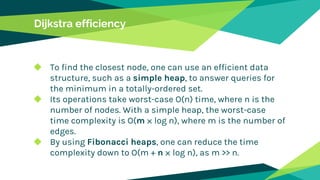
Dijkstra efficiency
◆ To find the closest node, one can use an efficient data
structure, such as a simple heap, to answer queries for
the minimum in a totally-ordered set.
◆ Its operations take worst-case O(n) time, where n is the
number of nodes. With a simple heap, the worst-case
time complexity is O(m ⨉ log n), where m is the number of
edges.
◆ By using Fibonacci heaps, one can reduce the time
complexity down to O(m + n ⨉ log n), as m >> n.
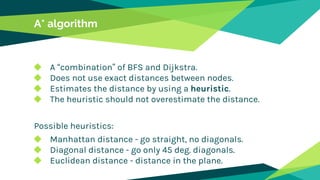
A* algorithm
◆ A “combination” of BFS and Dijkstra.
◆ Does not use exact distances between nodes.
◆ Estimates the distance by using a heuristic.
◆ The heuristic should not overestimate the distance.
Possible heuristics:
◆ Manhattan distance - go straight, no diagonals.
◆ Diagonal distance - go only 45 deg. diagonals.
◆ Euclidean distance - distance in the plane.
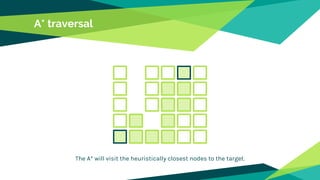
A* traversal
The A* will visit the heuristically closest nodes to the target.
3.
Dynamic changes
What about updates on the world?
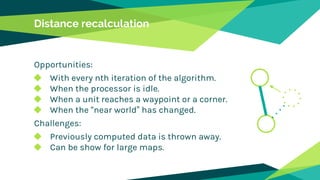
Distance recalculation
Opportunities:
◆ With every nth iteration of the algorithm.
◆ When the processor is idle.
◆ When a unit reaches a waypoint or a corner.
◆ When the “near world” has changed.
Challenges:
◆ Previously computed data is thrown away.
◆ Can be show for large maps.
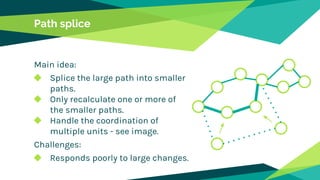
Path splice
Main idea:
◆ Splice the large path into smaller
paths.
◆ Only recalculate one or more of
the smaller paths.
◆ Handle the coordination of
multiple units - see image.
Challenges:
◆ Responds poorly to large changes.
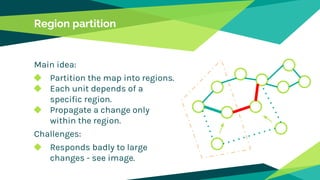
Region partition
Main idea:
◆ Partition the map into regions.
◆ Each unit depends of a
specific region.
◆ Propagate a change only
within the region.
Challenges:
◆ Responds badly to large
changes - see image.
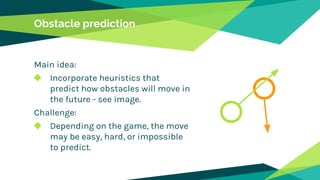
Obstacle prediction
Main idea:
◆ Incorporate heuristics that
predict how obstacles will move in
the future - see image.
Challenge:
◆ Depending on the game, the move
may be easy, hard, or impossible
to predict.
4.
Multiple units
How can we coordinate them?
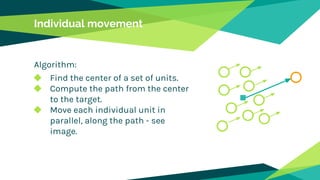
Individual movement
Algorithm:
◆ Find the center of a set of units.
◆ Compute the path from the center
to the target.
◆ Move each individual unit in
parallel, along the path - see
image.
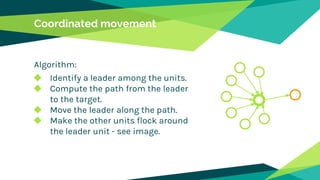
Coordinated movement
Algorithm:
◆ Identify a leader among the units.
◆ Compute the path from the leader
to the target.
◆ Move the leader along the path.
◆ Make the other units flock around
the leader unit - see image.
Thank you.
Any questions?
You can find me at @dumitrix

Pathfinding in games

  • 2.
    Hi, This is Adrian Iam here because I love to build games and also to give presentations. Today’s is about...
  • 3.
  • 4.
    Our goal Reach atarget as well as possible.
  • 5.
    Artificial intelligence Non-player character(FPS) Armies of units (RTS) Enemies (Tower Defense) Use cases Player exploration Objective display GPS (Racing)
  • 6.
  • 7.
    Racing Test DriveUnlimited 2
  • 8.
  • 9.
    Get objec positio Basic repetitiveprocedure Close object to target Estimate distance to target Get object positione object o target
  • 10.
  • 11.
    Grid Each cell isdenoted by its row and column. 1, 1 1, 2 1, 3 1, 4 1, 5 1, 6 1, 7 2, 1 2, 2 2, 3 2, 4 2, 5 2, 6 2, 7 3, 1 3, 2 3, 3 3, 4 3, 5 3, 6 3, 7
  • 12.
    Graph Node are connectedthrough edges. 1 3 2 6 5 8 4 7
  • 13.
    Convex polygons Convex =all segments with extremities inside lie inside.
  • 14.
  • 15.
    Random backstepping Take onestep in the direction of the target. Avoid obstacles by taking a step back. Simple algorithms Obstacle tracing Similar to random backstepping, calculates the collision before it happens.
  • 16.
    Advanced algorithms ◆ Breadth-firstsearch (BFS) ◆ Depth-first search (DFS) ◆ Best-first search ◆ Dijkstra’s algorithm ◆ A* algorithm
  • 17.
    BFS vs DFS BFSis wide; DFS is deep.
  • 18.
    Worst-case space complexity Worst-case time complexity Implementation BFSvs DFS Small: linear in the length of the current path. Large: linear in the area of the explored surface, as it explores useless paths. By using a first-in, first-out (FIFO) data structure, e.g., a stack. DFS Large: linear in the perimeter of the explored surface. Small: quadratic in the length of the minimum path. By using a last-in, first out (LIFO) data structure, e.g., a queue. BFS
  • 19.
    Dijkstra’s algorithm ◆ Solvesthe single-source shortest path problem. ◆ Invented by Edsger Dijkstra, Turing award winner. ◆ Used in many games for efficient pathfinding. ◆ More efficient than BFS and DFS in terms of time. ◆ More complex in implementation too.
  • 20.
    Dijkstra pseudocode ◆ Startwith two sets of graph nodes S and T. ◆ S contains the source node and T all others. While the target node is not in S, do: ◆ Find the node in T that is closest to a node in S. ◆ Move that node from T to S. ◆ Relax the edges from the node to T.
  • 21.
    Dijkstra efficiency ◆ Tofind the closest node, one can use an efficient data structure, such as a simple heap, to answer queries for the minimum in a totally-ordered set. ◆ Its operations take worst-case O(n) time, where n is the number of nodes. With a simple heap, the worst-case time complexity is O(m ⨉ log n), where m is the number of edges. ◆ By using Fibonacci heaps, one can reduce the time complexity down to O(m + n ⨉ log n), as m >> n.
  • 22.
    A* algorithm ◆ A“combination” of BFS and Dijkstra. ◆ Does not use exact distances between nodes. ◆ Estimates the distance by using a heuristic. ◆ The heuristic should not overestimate the distance. Possible heuristics: ◆ Manhattan distance - go straight, no diagonals. ◆ Diagonal distance - go only 45 deg. diagonals. ◆ Euclidean distance - distance in the plane.
  • 23.
    A* traversal The A*will visit the heuristically closest nodes to the target.
  • 24.
    3. Dynamic changes What aboutupdates on the world?
  • 25.
    Distance recalculation Opportunities: ◆ Withevery nth iteration of the algorithm. ◆ When the processor is idle. ◆ When a unit reaches a waypoint or a corner. ◆ When the “near world” has changed. Challenges: ◆ Previously computed data is thrown away. ◆ Can be show for large maps.
  • 26.
    Path splice Main idea: ◆Splice the large path into smaller paths. ◆ Only recalculate one or more of the smaller paths. ◆ Handle the coordination of multiple units - see image. Challenges: ◆ Responds poorly to large changes.
  • 27.
    Region partition Main idea: ◆Partition the map into regions. ◆ Each unit depends of a specific region. ◆ Propagate a change only within the region. Challenges: ◆ Responds badly to large changes - see image.
  • 28.
    Obstacle prediction Main idea: ◆Incorporate heuristics that predict how obstacles will move in the future - see image. Challenge: ◆ Depending on the game, the move may be easy, hard, or impossible to predict.
  • 29.
    4. Multiple units How canwe coordinate them?
  • 30.
    Individual movement Algorithm: ◆ Findthe center of a set of units. ◆ Compute the path from the center to the target. ◆ Move each individual unit in parallel, along the path - see image.
  • 31.
    Coordinated movement Algorithm: ◆ Identifya leader among the units. ◆ Compute the path from the leader to the target. ◆ Move the leader along the path. ◆ Make the other units flock around the leader unit - see image.
  • 32.
    Thank you. Any questions? Youcan find me at @dumitrix