Intellectual PropertyIntellectual Property
RightsRights
Chapter – 5Chapter – 5
B.Tech , Mech. 3/1B.Tech , Mech. 3/1
Professor & Lawyer Puttu. Guru Prasad
M.B.A., M.Com., M.Phil., PGDFTM., APSET., PhD at JNTUK
Professor & Lawyer Puttu. Guru Prasad
M.B.A., M.Com., M.Phil., PGDFTM., APSET., PhD at JNTUK
Trade secretesTrade secretes
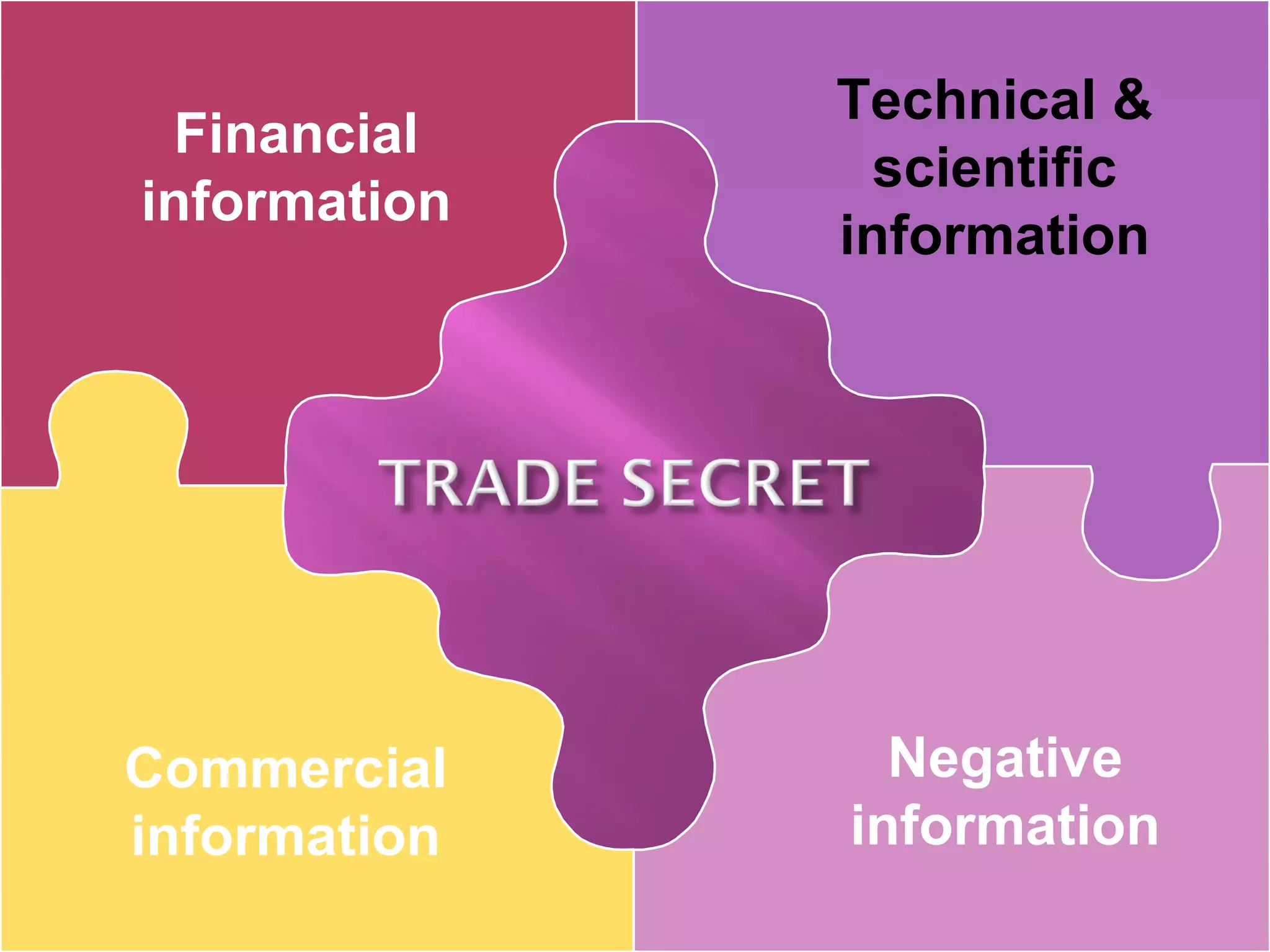
Financial
information
Technical &
scientific
information
Commercial
information
Negative
information
A trade secret is a formula, pattern,
physical device, idea, process, or
compilation of information which is
not generally known or reasonably
ascertainable, by which a business
can obtain an economic advantage
over competitors or customers.
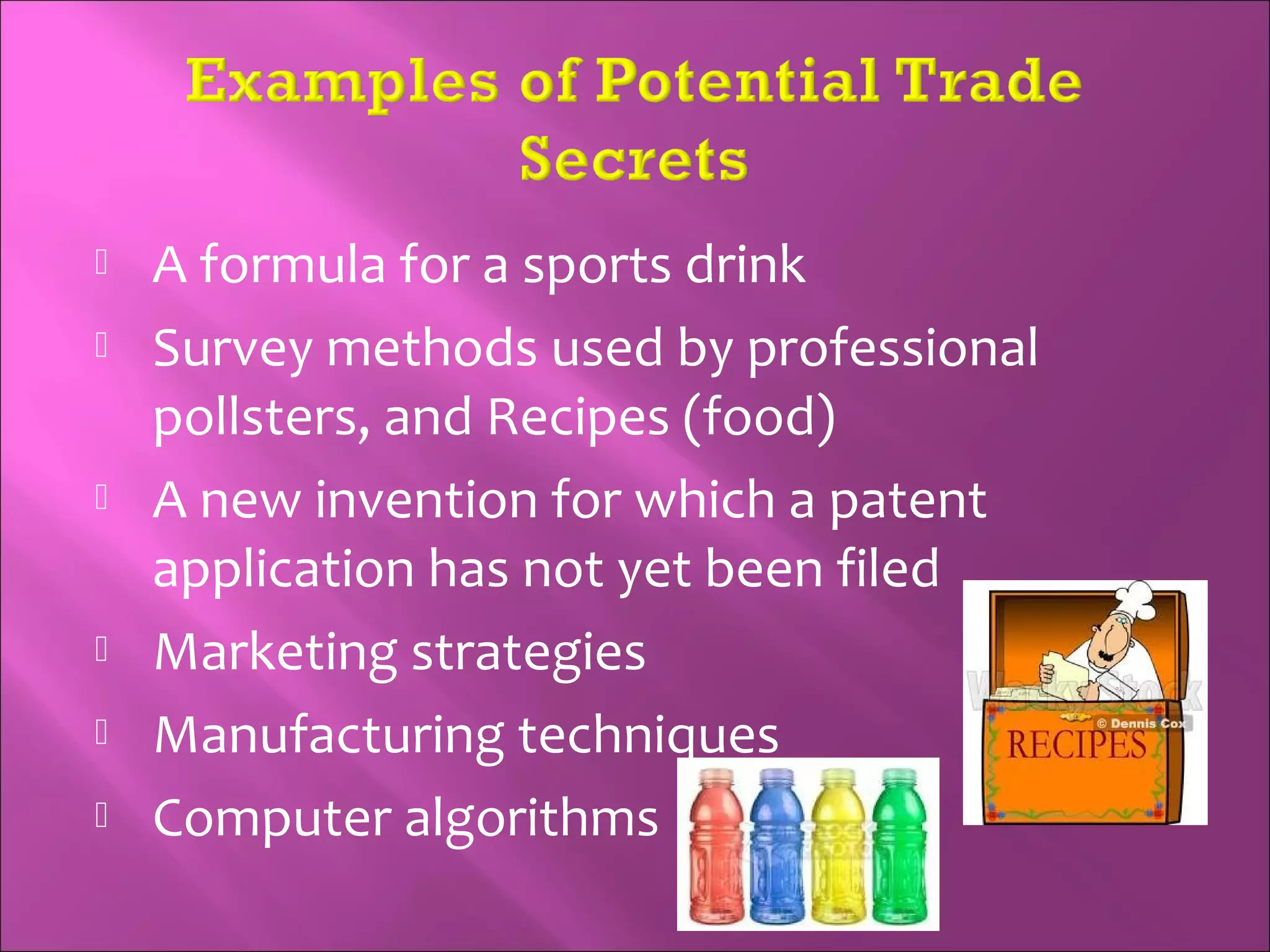
 A formula for a sports drink
 Survey methods used by professional
pollsters, and Recipes (food)
 A new invention for which a patent
application has not yet been filed
 Marketing strategies
 Manufacturing techniques
 Computer algorithms
Secrecy
 Restrict access to the information (lock it away in
a secure place, such as a bank vault)
 Limit the number of people who know the
information
 Have the people who know the trade secret
agree in writing not to disclose the information
(sign non-disclosure agreements)
 Have anyone that comes in contact with the trade
secret, directly or indirectly, sign non-disclosure
agreements
 Mark any written material pertaining to the trade
secret as proprietary
 Unlimited duration -trade secrets could
potentially last longer than patents (20 years)
and copyrights
 Your protection is theoretically worldwide
 No application required
 No registration costs
 No public disclosure or registration with
government agency
 Effective immediately
Formula for Coca-Cola
The Big Mac Special Sauce
KFC Chicken Recipe
WD-40 Formula
Secret Recipes
Kentucky fried chicken
The secret recipe of “11 herbs and spices” lies in a bank
vault. Few people know it, and they are contractually
obligated to secrecy.
The ingredients are mixed by two different companies in
two different locations and then combined elsewhere in a
third, separate location.
To mix the final formula, a computer processing system is
used to blend the mixtures together and ensure that no
one outside KFC has the complete recipe
Secret !
Initially Later stage
Not patentable patentable
patent
TS
Strategic
business
decision
TS
•Part of the idea
TS
© ID
n o re g is tra tio n
- le s s c o s ts (b u t: c o s ts to k e e p s e c re t)
- im m e d ia te ly a v a ila b le
c a n la s t lo n g e r
- b u t: lim ite d to e c o n o m ic life
- u n c e rta in life s p a n : le a k o u t is irre m e d ia b le
n o p u b lic d is c lo s u re
- b u t: p ra c tic a l n e e d to d is c lo s e
- if le a k o u t: T S lo s t
T ra d e S e c re ts
re g is tra tio n
- fe e s (re g is tra tio n + m a in te n a n c e )
- ta k e s tim e to g e t p a te n t
lim ite d in tim e
- g e n e ra lly: m a x 2 0 y
- b u t: c a n b e in v a lid e d
p u b lic d is c lo s u re
- p u b lic a tio n 1 8 m a fte r filin g
- if P n o t a llo w e d : n o T S
P a te n ts
What is difference between TS and Patent
1 Court Order to stop the misuse
2. Monetary damages
•Actual damages caused as a result of the misuse (lost
profits)
•Amount by which defendant unjustly benefited from
the misappropriation (unjust enrichment)
3. Seizure order
•Can be obtained in civil actions to search the
defendant's premises in order to obtain the evidence
to establish the theft of TS at trial
4. Precautionary impoundment
•Of the articles that include misused TS, or the products
that resulted of misusing
Remedies to Misappropriation
 1. Independent Creation- similar formula created
with his own knowledge.
 2.Unclean hands – The owners behavior is
morally wrong.
 3.Laches- unreasonable delay in asserting a
claim, which may result in its dismissal.
 4.Absence of secrecy protection measures- failed
in protecting its trade secret, sharing it through
publication.
 5.Privileges- sharing the information before
media at court trail.
1. Contract law
• When there is an agreement to protect the TS
NDA/CA
anti-reverse engineering clause
• Where a confidential relationship exists
attorney, employee, independent contractors
2. Principle of tort / unfair competition
• Misappropriation by competitors who have no
contractual relationship
theft, espionage, subversion of employees
TS protection may be based on...
3. Criminal laws
• e.g. for an employee to steal trade secrets from a
company
• e.g. unauthorized access to computers
• theft, electronic espionage, invasion of privacy, etc.
• circumvention of technical protection systems
4. Specific trade secret laws
• US: Uniform Trade Secrets Act; Economic
Espionage Act
TS protection may be based on...
 Trade secret litigation comprises of two
aspects.
 1. violation of trade secret law takes
place, when the confidential information
is obtained through misappropriation.
 2. violation of nondisclosure agreement
takes place when a party in the contract
breached the agreement.
 The law of unfair competition is to safeguard the
interest of the customers from unfair or
misleading trade practices.
 Types of Unfair Competition:
 Passing off
 Misappropriation
 Right of Publicity
 False Advertising
 Product Disparagement
 Dilution
 Infringement of Trade Dress
 Infringement of Trade Dress:- the unique and
distinctive feature of a product , service, or
business which differentiates it from others is
known as “Trade Dress”.
 Trade Dress protection is needed to restrict
others from duplicating a product.
 Dilution: Basically , Tarnishment and Blurring
are the two important aspects which are
responsible for dilution of a product.
 The unauthorized use of a mark on a dissimilar
product which damages the distinctiveness of
the that mark is known as ‘Blurring’.
 ‘Tarnishment’ refers to the unauthorized use of
mark for a poor quality product which effects
the products of mark owner.
 Product Disparagement: when a false statement
is made with an intention to harm a company or
its products or its services, then it is known as
“product disparagement”.
 It is also known as ‘Trade Libel’ or “Commercial
Disparagement”.
 Right of Publicity: Allows individuals to protect
their identities from being used for commercial
purpose by other parties. Many companies
misuse the celebrities name in fake to sell their
products
 Passing off occurs when one party sells his
goods and services by affixing another
company’s trade mark on them.
 Passing off is confined to registered and
unregistered trademarks , symbols , signs and
devices etc.,
 Passing off is an offence which is done by
misrepresenting the goods and services for
creating confusion in customers mind which
effects the image or good will of the original
manufacturer.
 Misappropriation exists when one party uses
the property of other party without informing
them.
 Misappropriation means unauthorized use of
person's name or likeness for advertising
purpose, which effects the image of other
persons.
 The plaintiff does not possess any copy right
for it and he cannot claim any damages; ex-
stock market rumors , new paper report etc.,
 The Clean Room:- The clean room refers to a
room in which a team of engineers, designers,
researchers or scientists work together for a
specific purpose. Each and every activity is
documented .
 The clean room act as an evidence to prove that
the information which is identical to some other’s
trade secret has derived through team efforts.
 It also ensures that the information was not
copied , theft or gained through any other
improper means
 Reverse Engineering: Any information which
is obtained through reverse engineering of a
product, will also be unprotectable under TS.
 Ex:- A Gel Pen company has a secret formula
for making Gel used in pens. If a person
purchases the pen and analyze the Gel
chemically and come to knew about the secret
formula, then it is called “Reverse
Engineering”
HOW ARE TRADE SECRETS LOST
OR STOLEN ?
– departing or disgruntled employees
– intentional (malicious)
– inevitable (knowledge acquired)
– by ignorance
80% of trade secret loss
< employees, contractors, trusted insiders!
A Growing Problem.A Growing Problem.
Why Does It Occur?Why Does It Occur?
A Growing ProblemA Growing Problem..
Why Does It Occur?Why Does It Occur?
– The Way we do business today (increased use of
contractors, temporary workers, out-sourcing)
– Declining employee loyalty: more job changes
– Organized crime : discovered the money to be
made in stealing high tech IP
– Storage facilities (DVD, external memories,
keys)
– Expanding use of wireless technology
Trade secrets may be legally discovered by the
following proper means:
 Independent invention
 Reverse engineering:-
that is, starting with the known product and working
backward to find the method by which it was developed
(assuming the reverse engineering is not prohibited by
contract)
 Observing the item in public use or on public display
 Obtaining the trade secret from published
literature
29
What is lawful?
→ Discovery of the secret by fair and
honest means
1. Independent creation
– without using illegal means or violating agreements
or law
≠ patent
TS protection
provides
no exclusivity !
What is lawful?
2. Reverse engineering
– Common practice among software
companies: studying competitors'
products
•to make software that can interoperate with
the software being studied
•to make a product that will compete with it
– E.g. decompile object code to reveal its structure
and figure out the interface specifications for
interoperability purposes
– E.g. look at a program's input and outputs
2. Confidentiality agreement or NDA
 e.g., employees, suppliers, consultants,
financial advisors
What is typically considered
wrongful?
1. Duty of trust
– implied or imposed by law
– e.g., employees, directors, lawyers
3. Industrial espionage, theft, bribery, hacking
 A partial list of improper means
includes theft, bribery,
misrepresentation, breach, or
inducement of a breach of a duty to
maintain secrecy or espionage
through electronic or other means
33
A springboard injunction is a type of injunction designed
to remove or limit the advantage or head-start that an
employee has gained through unlawful activities,
typically through the misuse of the employer’s
confidential information.
The individual is placed “under a special disability” by
the injunction in order to “ensure that he does not get an
unfair start”
A springboard injunction is unlike any other kind of
injunction, because it is not targeted at preventing future
unlawful activity but rather its purpose is to restore a
level playing field between the parties.
 Mr Ellis, Bullivant’s Managing Director, left to set up a competing
business, taking confidential information with him including a card
index with the contact details of Bullivant’s contacts, which he used
to contact those clients in direct competition.
 The High Court granted an injunction prohibiting Ellis from entering
into or fulfilling any contract made with or through any of the
contacts in the card index until judgment or further order.
 Ellis appealed to the Court of Appeal, arguing that the injunction
should not apply to any customers that he was able to make contact
with without using the card index.
 His appeal failed on this point, the court concluding that “having
made deliberate and unlawful use of Bullivant’s property, he cannot
complain if he finds that the eye of the law is unable to distinguish
between those whom, had he so chosen, he could have contacted
lawfully and those whom he could not”.
 CDA= Confidentiality Agreement
 NDA= Non Disclosure Agreement
 The important elements included in the
written agreement of CDA & NDA are:
 1. Ownership of Inventions
 2. Non Disclosure Provisions
 3. Non Solicitation Provisions
 4. Non Competition Provisions
 Complaint is a first document which is
brought into the notice of the court by the
plaintiff and asks for the corrective measures.
 The defendant is required to give response to
such complaint after receiving the summons
from the court with in stipulated time period
mentioned by the relevant court .
 All the case data will be kept in Civil Cover
Sheet.
 The trail note book has to be maintained
by paralegal for future assistance.
 The trail note book is a binder used to
index and provide reference to the
necessary information required to handle
the case.
 It contains all the relevant and important
and legal information regarding the
lawsuit.
 Breach of contract takes place when a party
fails to fulfill the promise made in an
agreement.
 For example the employee fails to fulfill the
promise and discloses the trade secret to other
parties, then it is known as breach of contract.
 This is also treated as Breach of Fiduciary duty
that employee is failed in maintaining the
secrecy
 Contract is nothing but An Agreement
Enforceable by Law.
 The Ten Essential Conditions for a Contract:
 1. Offer, 2. Acceptance, 3.Concensus-Ad-Idam,
4. Lawful Consideration, 5. Capacity to
Contract, 6. Free consent, 7.Legal object,
8. Possibility of Performance, 9. Intention to
create a legal relation ship 10. Writing and
Registration.
 In India , violation of trade secrets will be covered under
Sec 27 of the Indian Contract act. It restricts parties in
contract from Disclosing any kind of Information.
 The Special Contract Acts like , Agency law
clearly defines the Duties and Responsibilities of
the Employer and Employee.
 And it provides the eligible Remedies for the
possible Damages occurred to the Owner from
the agent .
 The Agent is Liable to the Owner for the loss
occurred due to him.
 Always read an NDA before signing. Some
agreements are titled Nondisclosure or
Confidentiality agreements, yet their terms
have the opposite effect.
 People who sign nondisclosure agreements
promising not to disclose trade secrets without
authorization from the owner.
 All the employees are bound under an Implied
duty not to disclose sensitive information and
should be kept it confidential from Stake
Holders.
 The Diljeet Titus case,1997.
 The conflict: Illegal and unauthorized copying
of material and information belong to Titus and
company by it’s four employees.
 Advocate: Arun Jaitly
 Page number – 195,
 Annexure 1– Model Non disclosure or
Confidentiality Agreement – 203 page.
 Annexure 2-Trade Secret Bond – 210 page.
For further Questions or Doubts- Call me or Mail
Prof. Puttu Guru Prasad , VVIT.Prof. Puttu Guru Prasad , VVIT.
Cell : 93 94 96 98 98. 767 40 60 336, 90 59 457 336
Mail: puttuvvit@gamil.com.
Reference :
BS Publication ; Fundamentals of Intellectual
Property for Engineers.
Cengage Learning: Intellectual Property by
Deborah.

Trade secrets

  • 1.
    Intellectual PropertyIntellectual Property RightsRights Chapter– 5Chapter – 5 B.Tech , Mech. 3/1B.Tech , Mech. 3/1 Professor & Lawyer Puttu. Guru Prasad M.B.A., M.Com., M.Phil., PGDFTM., APSET., PhD at JNTUK
  • 2.
    Professor & LawyerPuttu. Guru Prasad M.B.A., M.Com., M.Phil., PGDFTM., APSET., PhD at JNTUK Trade secretesTrade secretes
  • 3.
  • 4.
    A trade secretis a formula, pattern, physical device, idea, process, or compilation of information which is not generally known or reasonably ascertainable, by which a business can obtain an economic advantage over competitors or customers.
  • 5.
     A formulafor a sports drink  Survey methods used by professional pollsters, and Recipes (food)  A new invention for which a patent application has not yet been filed  Marketing strategies  Manufacturing techniques  Computer algorithms
  • 6.
  • 7.
     Restrict accessto the information (lock it away in a secure place, such as a bank vault)  Limit the number of people who know the information  Have the people who know the trade secret agree in writing not to disclose the information (sign non-disclosure agreements)  Have anyone that comes in contact with the trade secret, directly or indirectly, sign non-disclosure agreements  Mark any written material pertaining to the trade secret as proprietary
  • 8.
     Unlimited duration-trade secrets could potentially last longer than patents (20 years) and copyrights  Your protection is theoretically worldwide  No application required  No registration costs  No public disclosure or registration with government agency  Effective immediately
  • 9.
    Formula for Coca-Cola TheBig Mac Special Sauce KFC Chicken Recipe WD-40 Formula
  • 10.
    Secret Recipes Kentucky friedchicken The secret recipe of “11 herbs and spices” lies in a bank vault. Few people know it, and they are contractually obligated to secrecy. The ingredients are mixed by two different companies in two different locations and then combined elsewhere in a third, separate location. To mix the final formula, a computer processing system is used to blend the mixtures together and ensure that no one outside KFC has the complete recipe
  • 11.
    Secret ! Initially Laterstage Not patentable patentable patent TS Strategic business decision TS •Part of the idea TS © ID
  • 12.
    n o reg is tra tio n - le s s c o s ts (b u t: c o s ts to k e e p s e c re t) - im m e d ia te ly a v a ila b le c a n la s t lo n g e r - b u t: lim ite d to e c o n o m ic life - u n c e rta in life s p a n : le a k o u t is irre m e d ia b le n o p u b lic d is c lo s u re - b u t: p ra c tic a l n e e d to d is c lo s e - if le a k o u t: T S lo s t T ra d e S e c re ts re g is tra tio n - fe e s (re g is tra tio n + m a in te n a n c e ) - ta k e s tim e to g e t p a te n t lim ite d in tim e - g e n e ra lly: m a x 2 0 y - b u t: c a n b e in v a lid e d p u b lic d is c lo s u re - p u b lic a tio n 1 8 m a fte r filin g - if P n o t a llo w e d : n o T S P a te n ts What is difference between TS and Patent
  • 13.
    1 Court Orderto stop the misuse 2. Monetary damages •Actual damages caused as a result of the misuse (lost profits) •Amount by which defendant unjustly benefited from the misappropriation (unjust enrichment) 3. Seizure order •Can be obtained in civil actions to search the defendant's premises in order to obtain the evidence to establish the theft of TS at trial 4. Precautionary impoundment •Of the articles that include misused TS, or the products that resulted of misusing Remedies to Misappropriation
  • 14.
     1. IndependentCreation- similar formula created with his own knowledge.  2.Unclean hands – The owners behavior is morally wrong.  3.Laches- unreasonable delay in asserting a claim, which may result in its dismissal.  4.Absence of secrecy protection measures- failed in protecting its trade secret, sharing it through publication.  5.Privileges- sharing the information before media at court trail.
  • 15.
    1. Contract law •When there is an agreement to protect the TS NDA/CA anti-reverse engineering clause • Where a confidential relationship exists attorney, employee, independent contractors 2. Principle of tort / unfair competition • Misappropriation by competitors who have no contractual relationship theft, espionage, subversion of employees TS protection may be based on...
  • 16.
    3. Criminal laws •e.g. for an employee to steal trade secrets from a company • e.g. unauthorized access to computers • theft, electronic espionage, invasion of privacy, etc. • circumvention of technical protection systems 4. Specific trade secret laws • US: Uniform Trade Secrets Act; Economic Espionage Act TS protection may be based on...
  • 17.
     Trade secretlitigation comprises of two aspects.  1. violation of trade secret law takes place, when the confidential information is obtained through misappropriation.  2. violation of nondisclosure agreement takes place when a party in the contract breached the agreement.
  • 18.
     The lawof unfair competition is to safeguard the interest of the customers from unfair or misleading trade practices.  Types of Unfair Competition:  Passing off  Misappropriation  Right of Publicity  False Advertising  Product Disparagement  Dilution  Infringement of Trade Dress
  • 19.
     Infringement ofTrade Dress:- the unique and distinctive feature of a product , service, or business which differentiates it from others is known as “Trade Dress”.  Trade Dress protection is needed to restrict others from duplicating a product.
  • 20.
     Dilution: Basically, Tarnishment and Blurring are the two important aspects which are responsible for dilution of a product.  The unauthorized use of a mark on a dissimilar product which damages the distinctiveness of the that mark is known as ‘Blurring’.  ‘Tarnishment’ refers to the unauthorized use of mark for a poor quality product which effects the products of mark owner.
  • 21.
     Product Disparagement:when a false statement is made with an intention to harm a company or its products or its services, then it is known as “product disparagement”.  It is also known as ‘Trade Libel’ or “Commercial Disparagement”.  Right of Publicity: Allows individuals to protect their identities from being used for commercial purpose by other parties. Many companies misuse the celebrities name in fake to sell their products
  • 22.
     Passing offoccurs when one party sells his goods and services by affixing another company’s trade mark on them.  Passing off is confined to registered and unregistered trademarks , symbols , signs and devices etc.,  Passing off is an offence which is done by misrepresenting the goods and services for creating confusion in customers mind which effects the image or good will of the original manufacturer.
  • 23.
     Misappropriation existswhen one party uses the property of other party without informing them.  Misappropriation means unauthorized use of person's name or likeness for advertising purpose, which effects the image of other persons.  The plaintiff does not possess any copy right for it and he cannot claim any damages; ex- stock market rumors , new paper report etc.,
  • 24.
     The CleanRoom:- The clean room refers to a room in which a team of engineers, designers, researchers or scientists work together for a specific purpose. Each and every activity is documented .  The clean room act as an evidence to prove that the information which is identical to some other’s trade secret has derived through team efforts.  It also ensures that the information was not copied , theft or gained through any other improper means
  • 25.
     Reverse Engineering:Any information which is obtained through reverse engineering of a product, will also be unprotectable under TS.  Ex:- A Gel Pen company has a secret formula for making Gel used in pens. If a person purchases the pen and analyze the Gel chemically and come to knew about the secret formula, then it is called “Reverse Engineering”
  • 26.
    HOW ARE TRADESECRETS LOST OR STOLEN ?
  • 27.
    – departing ordisgruntled employees – intentional (malicious) – inevitable (knowledge acquired) – by ignorance 80% of trade secret loss < employees, contractors, trusted insiders! A Growing Problem.A Growing Problem. Why Does It Occur?Why Does It Occur?
  • 28.
    A Growing ProblemAGrowing Problem.. Why Does It Occur?Why Does It Occur? – The Way we do business today (increased use of contractors, temporary workers, out-sourcing) – Declining employee loyalty: more job changes – Organized crime : discovered the money to be made in stealing high tech IP – Storage facilities (DVD, external memories, keys) – Expanding use of wireless technology
  • 29.
    Trade secrets maybe legally discovered by the following proper means:  Independent invention  Reverse engineering:- that is, starting with the known product and working backward to find the method by which it was developed (assuming the reverse engineering is not prohibited by contract)  Observing the item in public use or on public display  Obtaining the trade secret from published literature 29
  • 30.
    What is lawful? →Discovery of the secret by fair and honest means 1. Independent creation – without using illegal means or violating agreements or law ≠ patent TS protection provides no exclusivity !
  • 31.
    What is lawful? 2.Reverse engineering – Common practice among software companies: studying competitors' products •to make software that can interoperate with the software being studied •to make a product that will compete with it – E.g. decompile object code to reveal its structure and figure out the interface specifications for interoperability purposes – E.g. look at a program's input and outputs
  • 32.
    2. Confidentiality agreementor NDA  e.g., employees, suppliers, consultants, financial advisors What is typically considered wrongful? 1. Duty of trust – implied or imposed by law – e.g., employees, directors, lawyers 3. Industrial espionage, theft, bribery, hacking
  • 33.
     A partiallist of improper means includes theft, bribery, misrepresentation, breach, or inducement of a breach of a duty to maintain secrecy or espionage through electronic or other means 33
  • 34.
    A springboard injunctionis a type of injunction designed to remove or limit the advantage or head-start that an employee has gained through unlawful activities, typically through the misuse of the employer’s confidential information. The individual is placed “under a special disability” by the injunction in order to “ensure that he does not get an unfair start” A springboard injunction is unlike any other kind of injunction, because it is not targeted at preventing future unlawful activity but rather its purpose is to restore a level playing field between the parties.
  • 35.
     Mr Ellis,Bullivant’s Managing Director, left to set up a competing business, taking confidential information with him including a card index with the contact details of Bullivant’s contacts, which he used to contact those clients in direct competition.  The High Court granted an injunction prohibiting Ellis from entering into or fulfilling any contract made with or through any of the contacts in the card index until judgment or further order.  Ellis appealed to the Court of Appeal, arguing that the injunction should not apply to any customers that he was able to make contact with without using the card index.  His appeal failed on this point, the court concluding that “having made deliberate and unlawful use of Bullivant’s property, he cannot complain if he finds that the eye of the law is unable to distinguish between those whom, had he so chosen, he could have contacted lawfully and those whom he could not”.
  • 36.
     CDA= ConfidentialityAgreement  NDA= Non Disclosure Agreement  The important elements included in the written agreement of CDA & NDA are:  1. Ownership of Inventions  2. Non Disclosure Provisions  3. Non Solicitation Provisions  4. Non Competition Provisions
  • 37.
     Complaint isa first document which is brought into the notice of the court by the plaintiff and asks for the corrective measures.  The defendant is required to give response to such complaint after receiving the summons from the court with in stipulated time period mentioned by the relevant court .  All the case data will be kept in Civil Cover Sheet.
  • 38.
     The trailnote book has to be maintained by paralegal for future assistance.  The trail note book is a binder used to index and provide reference to the necessary information required to handle the case.  It contains all the relevant and important and legal information regarding the lawsuit.
  • 39.
     Breach ofcontract takes place when a party fails to fulfill the promise made in an agreement.  For example the employee fails to fulfill the promise and discloses the trade secret to other parties, then it is known as breach of contract.  This is also treated as Breach of Fiduciary duty that employee is failed in maintaining the secrecy
  • 40.
     Contract isnothing but An Agreement Enforceable by Law.  The Ten Essential Conditions for a Contract:  1. Offer, 2. Acceptance, 3.Concensus-Ad-Idam, 4. Lawful Consideration, 5. Capacity to Contract, 6. Free consent, 7.Legal object, 8. Possibility of Performance, 9. Intention to create a legal relation ship 10. Writing and Registration.
  • 41.
     In India, violation of trade secrets will be covered under Sec 27 of the Indian Contract act. It restricts parties in contract from Disclosing any kind of Information.  The Special Contract Acts like , Agency law clearly defines the Duties and Responsibilities of the Employer and Employee.  And it provides the eligible Remedies for the possible Damages occurred to the Owner from the agent .  The Agent is Liable to the Owner for the loss occurred due to him.
  • 42.
     Always readan NDA before signing. Some agreements are titled Nondisclosure or Confidentiality agreements, yet their terms have the opposite effect.  People who sign nondisclosure agreements promising not to disclose trade secrets without authorization from the owner.  All the employees are bound under an Implied duty not to disclose sensitive information and should be kept it confidential from Stake Holders.
  • 43.
     The DiljeetTitus case,1997.  The conflict: Illegal and unauthorized copying of material and information belong to Titus and company by it’s four employees.  Advocate: Arun Jaitly  Page number – 195,  Annexure 1– Model Non disclosure or Confidentiality Agreement – 203 page.  Annexure 2-Trade Secret Bond – 210 page.
  • 44.
    For further Questionsor Doubts- Call me or Mail Prof. Puttu Guru Prasad , VVIT.Prof. Puttu Guru Prasad , VVIT. Cell : 93 94 96 98 98. 767 40 60 336, 90 59 457 336 Mail: puttuvvit@gamil.com. Reference : BS Publication ; Fundamentals of Intellectual Property for Engineers. Cengage Learning: Intellectual Property by Deborah.

Editor's Notes

  • #3 Optional Props: Coca-Cola can WD-40 can
  • #5 Do any of you know what a trade secret is? (call on a couple of students) Read definition from slide.
  • #6 Can you think of some examples of formulas, patterns, physical devices, ideas, processes, or compilations of information that you may want to keep as a trade secret? (call on a couple of students)
  • #7 What is required to maintain a trade secret? Hint: Hit enter (picture will appear). (Hit enter) Secrecy. Trade secrets must be secret. Anything that is public knowledge or general knowledge in an industry cannot be claimed as a trade secret. Anything that is completely disclosed by the marketed goods cannot be a trade secret, for example, the ingredients are listed so how could the recipe be a trade secret.
  • #8 What are some ways you can protect your trade secrets? (call on a couple of students)
  • #9 There are a number of advantages to seeking trade secret protection. Read from slide.
  • #10 These are some famous trade secrets. Other examples include Twinkies and Krispy Kreme. Show props if you have them. Here are some interesting tidbits about each of these trade secrets: Formula for Coca-Cola: According to many, the formula for Coke is the most famous trade secret. When Coke, at the end of the 19th century, decided not to patent its formula, it did so for one reason: to keep it secret, forever. In May 2006, a Coke employee and two others were charged with stealing and trying to sell guarded Coke secrets to Pepsi. Pepsi notified Coke of the breach and the FBI was called in. The Big Mac Special Sauce: In 2004 McDonald&amp;apos;s acknowledged that they had lost the recipe for the Big Mac special sauce. As it turns out, McDonald&amp;apos;s changed the original special sauce recipe to cut costs and lost the original. When a returning exec wanted to return to the original special sauce, no one could find the recipe. The exec remembered the name of the California company that supplied the sauce 36 years ago. They still had the sauce in their record books, and McDonald&amp;apos;s was able to recover the recipe. KFC Chicken Recipe: Only two KFC executives know the finger-lickin&amp;apos; recipe of 11 herbs and spices. A third executive knows the combination to the safe where the handwritten recipe resides. Less than a handful of KFC employees know the identities of the three executives, who are not allowed to travel together on the same plane or in the same car for security reasons. After being locked in a safe for 68 years, Colonel Harland Sanders&amp;apos; handwritten recipe was temporarily relocated to a secret-secure location as KFC modernizes its safekeeping. It was transported in an armored car and high-security motorcade. WD-40 Formula: The formula for WD-40 is locked in a bank vault and has only ever been taken out of the vault twice -- once when they changed banks and once on the CEOs 50th birthday. The CEO rode into Times Square on the back of a horse in a suit of armor with the formula. The company mixes WD-40 in a concentrated form in three locations -- San Diego, Sydney and London -- and then sends it to aerosol manufacturing partners. (Tidbits from http://iamsamuel.org/2008/10/24/closely-guarded-secrets/)