52
compiled and edited by geoff crane
TIPS
TO BREAK INTO PROJECT MANAGEMENT
The first of anything is always
special—the first drink, the first
date, the first dance. No matter
what comes in later years, you
always remember the first.
So it is with my first class.
I still recall those twenty-seven
faces turned towards me on my
first day and the moment of anxiety
that said I'd made a terrible,
horrible mistake. I felt sure I was
going to let them all down.
Now, as they get set to graduate, I
couldn't be more proud. We all
worked very hard together and I
know they're ready to take on
whatever comes their way. They're
going to be amazing.
If you're one of my former students,
then I and all of this book's
contributors wish you genuine,
heartfelt congratulations on your
accomplishments so far.
If we've never met, that's okay. This
book is for you, too.
What follows are suggestions from
my friends—project management
practitioners from around the
world—who represent a slew of
different industries. All of them have
made the difficult transition into
their chosen careers and have
become leaders in their field.
Read their stories, heed their
advice and subscribe to their blogs.
If you're feeling particularly bold,
reach out to them on Twitter and
introduce yourself. You'll find
everyone here to be professional
and very friendly.
Above all, be excited. If you're
about to break into project
management, you're headed for
the ride of your life!
—Geoff.
clobtloa
FIFTY-TWO TIPS TO BREAK INTO PROJECT MANAGEMENT 1
Find Your Job............................................................... 3
Find Your Project........................................................ 1 8
Find Your Skills........................................................... 32
Find Yourself............................................................... 44
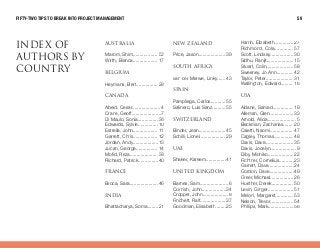
Index of Authors by Country.....................................................................59
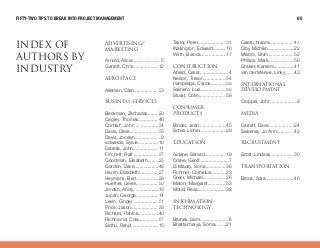
Index of Authors by Industry.....................................................................60
Other Books From Our Authors................................................................61
q^_ib lc
`lkqbkqp
FIFTY-TWO TIPS TO BREAK INTO PROJECT MANAGEMENT 2
cfka vlrogl_
Getoutthere andgetworking!
k loaboto help you break
through into the project
management industry, I’d like
to share with you an acronym.
It’s really easy to remember: GET
HIRED.
“Let’s break it down!
“1 . Get Your Credentials: Getting a
certification or a diploma, even if
you have little experience,
demonstrates that you are serious
about your career. If you are
starting out, I recommend you
look into the CAPM certification by
the PMI.
“2. Earn Trust: Be trustworthy in all
that you do, both at school,
among friends, and especially at
work.
“3. Three to Tango: It takes three
to find a job in any field: you, the
employer, and a ‘connector’.
Many people find jobs because of
a friend of a friend. Expand your
network so you can have a large
pool of these loose connections
who know of you.
“4. Help People: Project managers
have a unique skill set that allows
them to get things done. This
puts you in a position where you
can help people with their
projects. Offer your help, either
with projects within your company,
or formally as a volunteer in an
organization.
“5. Innovate and Impress: Here is
some good news—you’re special
and unique. Here is the bad
news—so is everybody else. In
today’s world of conformity, it pays
off to innovate to impress, since
you are competing with other
candidates that are just as
qualified and competent as you
are.
“What can you do to set yourself
apart? Can you blog about your
experience as you start your
career? Can you work your loose
connections to get a local project
featured in the press? Can you try
and speak at your local project
management networking event?
“Be daring. Be weird. Innovate.
“6. Research Companies: Instead
of applying for jobs randomly, do
this instead:
“Find a few companies in your
area that you would like to work
for and focus on getting in their
door, regardless of position. What
do you think would impress a
hiring manager more? An
applicant that just wants a job, or
one that is eager to work in their
company because of their values
and excellence?
“7. Exemplify: When applying for
work and presenting yourself to an
employer, focus on concrete
examples of what you have done
instead of abstracts ideas of what
you know.
“For example, instead of telling
them you have training in risk
management, tell them about that
one time when you had to use it
and the results that followed. This
creates a concrete image in the
hiring manager’s mind of you being
awesome.
“Starting your career is a project.
Treat it as such!
“8. Decompose...this project into
smaller, actionable items, so you
will know what to do during the
whole process.
“And regardless of what you want
to do in life, remember that life is a
project, and you are the manager.”
dbq ql hklt `bp^o
@pm4tm
http://pmforthemasses.com
`bp^o^_bfaI mjm
molgb`q j^k^dboI objlkqb`e
^ka mj cloqeb j^ppbp
Cesar Abeid, PMP, is a project manager, podcaster, and public speaker. As the
Project Manager for Remontech since 2004, Cesar managed and executed
projects in Canada, the US, Brazil, and Peru. He is the host and producer of the
popular Project Management for the Masses Podcast, and the multiple award-
winning Construction Industry Podcast. Cesar speaks and writes on the topics
of project management, personal productivity, and simplifying project
management so all - project managers or not - can learn how to get things done.
f
FIND YOUR JOB 4
^kafkd vlro
first full-time gig might be
one of the most challenging
steps you'll make in your
career. With the ebb and
flow of the job market, it's
not as easy as sending
out your resume and
waiting for a response.
Your best bet is to meet
people and expand your
network. There are a
number of ways to go
about this task—you
can either review job
postings and find
people you know who
can refer you to the
hiring company, or you
can look for the
hidden jobs.
“For my first job in
marketing, I looked for
the hidden jobs. My
thinking was that there
would be hundreds of
candidates for the posted jobs, but
with the hidden job market, I might
be able to get into a conversation
before the job was posted. It took
dozens upon dozens of tries before I
landed a role. Some of the strategies
I tried were:
• Making it a point to meet one new
person a day;
• Going to industry events;
• Talking to my friends' parents
about roles in their companies;
• Perusing the marketing section of
the bookstore and talking to
people who knew more about the
field than I did;
• Interning at multiple marketing
organizations;
• Participating in all the
conversations I could—in person,
on the phone, through e-mail,
through social media, etc.;
• Asking anyone who was willing to
help for a referral to someone in
the industry;
• Making a list of target
companies/people.
“I also became an avid consumer of
media. I researched, read, watched
and otherwise consumed all I could
about the marketing industry. In
doing so, I paid particular attention
to what was happening locally. On
one particular day (as I was
becoming completely overwhelmed
by looming student loans), I read
about two marketing companies that
were growing by leaps and bounds. I
wrote a letter to each CEO and
asked for an informational interview.
To my surprise, both CEO's
responded and invited me to join
them for a conversation. In the end,
the CEO of the second company
offered me a job.”
“Look forthe
hidden jobs.”
^if`f^ ^okliapsmI ^``lrkq afob`qloI efii eliifa^v
By day, I am an award-winning, digital marketer and use my passion for creativity and innovation to train teams on creativity
techniques, develop breakthrough digital experiences and facilitate Creative Problem Solving (CPS) workshops. I am also an author, a
mom of two wonderful boys and someone who loves ideas, learning and collaborating with curious, thought provoking people. I hold
a Master of Science in Creative Studies from the International Center for Studies in Creativity at Buffalo State College and an M.B.A.
in Marketing from Bentley University.
i
dbq ql hklt ^if`f^
@aliciarnold
http://alicia.arnold.com
FIND YOUR JOB 5
k jv sbovfirst day of
university one of the lecturers
explained to the students that
over the next three years we would
gain foundational knowledge in many
areas, enough to get an idea of which
areas we could specialize in but not
enough to be an expert in any on
completion of the course. She was
right, but naturally, over the three years
I completely forgot that.
“Thus when I graduated I assumed I
would walk into a job—but that’s not
what happened. What transpired was
around sixty job applications and only
a handful of interviews. I was aiming
too high.
“I expected to get a job as a project
manager. Instead, I slowly realized this
was unlikely to happen with zero
commercial experience. So, instead, I
took a job in a digital agency in a
content entry role—the lowest of the
low. But by this point I’d realized that
sometimes this was how it has to be
done and that ‘getting your foot in the
door’ is the very first critical step when
fresh out of school.
“Once in a professional environment I
quickly realized, despite my recent
graduation and good grades, just how
out of my depth I was and how little I
actually knew. So I sat, worked hard
and professionally, but most
importantly of all, I watched and
listened to absolutely everything the
experienced people said and did.
“I sat and watched until, slowly but
surely, I began to feel part of the team
and able to make suggestions on
certain processes. Over time I was
able to implement some small tweaks
to processes that had positive results.
This earned me a small amount of
trust. With that trust I found
that I had a little bit more
freedom and confidence to
get involved in other areas
of the business, helping
out anyone I could where
possible and always trying
to improve things. I saw
even more trust come my
way, along with a little bit
of respect.
“From that point on, I found
a snowball effect.
“Be humble, be honest, work
hard and you’ll get the trust,
respect and confidence to
step up a level. No matter
how high you climb in an
organization, always
follow this cycle and you
you'll do just fine.”
p^j _^okbpabsbilmjbkq qb^j j^k^dboI @dil_^iabs
dbq ql hklt p^j
@thesambarnes
http://www.thesambarnes.com
Sam Barnes is the Development Team Manager at globaldev. After receiving his BA in Web and eBusiness
Computing, Sam spent two years as a front-end developer before moving into digital project management at
various agencies. Sam has delivered projects of all sizes for clients including Nokia, Dell, Zebra, BBC and
Oracle before his two years as a Web Project Manager at globaldev. Sam is a Certified Scrum Product Owner,
has written for Smashing Magazine, was published this year in the Gower Handbook of People in Project
Management and speaks at various digital project management events.
““II aassssuummeeddII wwoouullddwwaallkk iinnttoo
aa jjoobb,, bbuutttthhaatt''ss nnoottwwhhaatt
hhaappppeenneedd..””
l
FIND YOUR JOB 6
^kv mblmib will tell
you, ‘looking for work is
a full time job.’ No
offense to these well-wishers, but I
suspect they haven't had to look
for a job in awhile.
“Full time jobs get results. They
may not be fast, but they're results
nonetheless. At the end of a work
week, people who hold full time
jobs know where they stand.
“That's not the case for those
looking for work. Employer
disengagement, applicant tracking
systems and resume-sucking
black holes—these are just some
of the painful realities that today's
job-seeker has to contend with.
It's entirely possible to slog
tirelessly for months with nothing
for your time but the echo of
another hung-up phone.
“So what do you do if you're
looking for your first project
management job and you're just
not getting anywhere?
“Throw conventional advice out
the window and be drastic. We live
in times when only the nimblest
survive and you, my friend, are a
ninja!
“Use the job boards to recognize
where opportunities might lie, but
don't apply for them. Instead, hop
on LinkedIn to find who in that
organization might be the actual
hiring manager. Better yet, find out
who might be the hiring manager's
manager. Reach out to them and
ask for an informational interview.
“Make something cool—a
presentation, an Excel tool,
something your prospects could
appreciate and you know you can
make dazzle—and send it to your
prospects with a personal note.
“Join a professional organization
and volunteer to check people in
at meetings. Pay attention to the
questions they ask of any
speakers. Introduce yourself
during mixers. Introduce other
people you know have something
in common.
“For better or worse, you need to
assume that recruitment's front
door is broken. If you want a job,
you'll have to find your own way in.
Creativity, initiative and tenacity are
your friends here.
“As for your mindset—treat your
job search as just another thing
you do during your day. Don't put
too much pressure on yourself to
get results or you may end up
burning out—that could cause you
to miss opportunity when it comes
knocking.
“And opportunity will come, I
promise you. It just might not take
the form you were expecting.”
“Throwconventional
advice outthe window
andbe drastic.”
dblcc `o^kbmolcbpplo^ka `lkpriq^kq
Geoff is a former senior project portfolio manager who has ties to some of the world's largest
banks and professional services firms.
A staunch believer in the value of soft skills over hard skills, he has returned to university to
pursue a doctorate in clinical psychology. Unable to stay away from the action, though, Geoff
continues to help aspiring executives organize their project work and is a professor of Project
Management at Durham and Fleming Colleges in Ontario, Canada.
j
FIND YOUR JOB 7dbq ql hklt dblcc
@papercutpm
http://papercutpm.com
^qebothan breaking into
PM per se, you need to
break into development.
Good intentions are not enough.
You need to have skills that are
useful. Project management
education counts highly but so
does experience.
“So how do you get experience?
Volunteering is probably the most
common route. Find a placement
that uses your PM skills and spend
a couple of years in a developing
country. This is important as it
shows a recruiting manager that
you are a) committed and b) won't
want to be flown home as soon as
you realize that the nearest flush
toilet is a flight away!
“Learn languages— Spanish,
French, Portuguese—whatever. If
you do get a placement as a local
volunteer, learn the language—
speaking Yoruba or Bahasa
Indonesia looks good on your
CV—but it also shows that you are
interested in the cultures of the
places you work. You can't perform
development with poor
communication.
“Take advantage of any volunteer
placement to find out what
development means to local people
and local organizations. Listen to
them. They know more than you.
You don't do development to
people—it is a process that
happens with people.
“Put together a portfolio of projects
that you have managed. Show the
results—time, scope and
cost—and also impact. What
difference has your project made?
What did you learn from your
projects?
“Learn how to make things work in
your organization—how to get
things done—development
agencies never have enough funds.
The ability to get stuff done is an
important skill.
“Look for opportunities—in general,
the worse the situation, the easier it
is to get jobs. Spend a couple of
years in the Eastern DRC,
Afghanistan—somewhere difficult.
You have to earn your spurs and
show senior NGO staff that you can
work effectively in a difficult
location.
“Above all, keep listening and
learning and maintain a healthy
sense of humour.”
“Findoutwhat‘development’meansto localpeople andorganizations.”
dbq ql hklt glek
@johncropper
http://projectservices.lingos.org
glek `olmmboafob`qloI molgb`q pbosf`bpI ifkdlp J ib^okfkd fk kdlp
John has worked in NGOs for over twenty years—mostly with Oxfam, as Programme Director for Latin America as well
as managing its project management systems and managing a global programme on gender and governance.
He is LINGOs' Director of Project Services and believes that good project management can make a massive
contribution to reducing poverty. John is a Prince2 Practitioner and helped develop PMDPro. He has facilitated courses
in Europe, the US, Africa and Latin America and is Vice Chair of PM4NGOs and the Vice Chair of Anti-Slavery
International.
o
FIND YOUR JOB 8
p vlr fkqbosfbt for
your first real job, think
about this! You are
actually interviewing your
employer as much as they are
interviewing you. Now, don't get
too cocky and think that you
alone are in the driver's seat.
You aren't. The employer has
the job and will make a decision
that suits them to fill the position.
That said, you are interviewing
them, too. It's vitally important to
employers that they hire well-
qualified people with great
potential who fit the position and
the company. This is where you
interviewing them is important to
you and to the hiring company.
“Prepare to interview your
prospective employer. What
personal strengths do you bring
to this future job? What sorts of
tasks and undertakings really
energize you? Are these sorts of
tasks and undertakings available
to you in this position?
“What really matters to you?
What are your personal values in
action? Does this potential
future employer's organizational
culture align with your values?
Be careful if they don't; culture fit
is key to success for you and
your future employer.
“What work/life integration are
you seeking? What level of
workplace flexibility do you want
and need? What trade-offs are
you prepared to make to get
them? When, now? Over time?
“Think back and identify times
when you were happiest and
most fulfilled? What were you
doing? Does this employer and
work opportunity offer this to
you? At least in part?
“What are you able to contribute
to your potential employer's
customers and to society at
large? Can you do this here?
“We all realize that your first job is
a big step, and that the realities
of the marketplace may mean
that you make compromises to
get your first job. Just plan to
make informed choices.
Interview your employer while
they are interviewing you!”
gl`bivk pK a^sfpmobpfabkq ^ka `lJclrkaboI
kbiplk e^oq ii`
Jocelyn is the president of Nelson Hart LLC, a consulting
firm whose tag line says it all: when individuals flourish,
organizations thrive. To help flourishing individuals and
thriving organizations become a reality, she consults with
clients in all sectors and industries; she is an adjunct
professor at the University of Maryland's Center for
Excellence in Project Management delivering two innovative,
positive, psychology-based graduate courses: Managing
Project Teams and Evolving as a PM Leader. Jocelyn has
published chapters about positive workplaces and positive
education in the Oxford Handbook of Positive Psychology
and Work and the Gower Handbook of People in Project
Management.
FIND YOUR JOB 9
“Interview
your
employer
while they
are
interviewing
you!”
^
dbq ql hklt gl`bivk
@grtwork
http://www.nelsonhartllc.com
tfpe I would have had
someone to ask this
question when I started out.
Times are truly different now
and the project management
profession has evolved
immensely from the time that I
started into it (which was
reluctantly at best). The PM
profession never was my
choice, but rather something
that I was and became really
good at.
“I have actually had the chance
to have a conversation with
someone on this exact topic as
I have a mentee under my
wing. He and I have grown
together for almost two years
now and here's what I told him
(and would tell anyone else in
this situation).
“Just get a job in project
management regardless of
longevity at first. Don't look and
wait for the perfect job to come
along—the one you want to
spend the rest of your working
life in. Get a project
management related job on
your resume and stick with it for
more than six months. It might
not be fun, might not be the
best and definitely won't be
your ultimate destination. But
the fact that you can put it on
your resume will help you grow
to the next level. Consider this
your stepping stone. This
simple action will turn your life
around.
“Once you're in that position,
be prepared to work but more
importantly become a sponge.
Take it all in: the processes, the
documents, the insane
requests and the insane hours.
It won't all be bad and there is
a lot of good to come out of it.
This will build your skin's
thickness, a trait that will
become invaluable to you down
the road.
“So many students, who are
more mature coming into this
profession, expect a lot of their
first project management job.
Unfortunately you have to pay
your dues. Consider this time
your entry fee but make the
most of it. Lamenting that this
is not what you want will only
give you a bad reputation. If
you put in that effort right off
the top, you will reap great
rewards.”
“Consider
thistime
‘paying
yourdues’,
butmake
the most
of it.”
dbq ql hklt pvisfb
http://linkedin.com/in/sylvie4sresolutions
pvisfb bat^oapI mjmI pqa`
mofk`fm^i L ltkboI pob plirqflkp
Sylvie has been involved in project management in a multitude of industries for
over twenty-five years. She previously worked for a top five consulting firm,
where she was in charge of projects in the Information Technology, Banking and
Securities sectors as well as a Manager in the Risk Management practice. She
has, since 2002, instituted her own consulting and training practice, SRE
Solutions, where she is able to assist in consulting and training project managers
on a number of topics and proejcts. Sylvie works for a number of training
organizations as well as educational institutions to support the spread of
knowledge to the ever-growing PM community.
She is a member of the Project Management Institute and has received her
PMP® certification. Sylvie was instrumental in the development of the local PMI
Chapter having until recently been on the Board for over ten years during which
time she created and managed the PMP® Overdrive certification program as well
as our popular mentoring program after having had three terms as President.
f
FIND YOUR JOB 10
l _ob^hinto
the project
management
profession, you need
connection, education
and emotion.
“Keep track of all the
people that you meet.
Write down when and
where you met them,
and take note of their
specialty, hobby and
other details. Whenever
possible, get a picture
with them so that you
can send a copy the
next day. You'll
remember their face and
they'll remember yours.
“I remember a picture
with someone that I met
years ago. When he later
got elected to lead an
international organization
with millions of
members, I promptly
congratulated him and
also sent him
a copy of the
picture. I
have done
something
similar to
people who would later
become chairs of their
respective boards.
Currently, I am just
waiting for one person to
be elected as a
president of a country,
soon.
“Deliberately contact
them at least once a
year to stay connected.
If you find an article or
story that they may be
interested in, use that
opportunity to refresh
your connection. Start
this habit
now. In the
past fifteen
years, I
never had to
look for a
job or contract. My
contacts would usually
reach out to me first
whenever they needed
my expertise. I never
had to send my resume,
ever.
“Along with your
connections, you need
to stay on top of your
profession through
continuing education
and/or professional
designations. Without
my PMP credential, I
would not have been
considered for a
contract that ended up
lasting several years.
And yes, I got that
contract because I was
referred by one of my
contacts. When I was
looking for a new
contract recently, I was
able to get it within four
days with the help of my
contacts!
“In addition to
connection and
education, you need to
master your emotions.
For someone with a
technical background, I
used to see everything
as black and white.
However, to be an
effective project
manager, you also need
to appreciate grey—and
more importantly, the
different shades of grey.
In your projects,
emotional intelligence (or
EQ, emotional quotient)
will always trump IQ.”
“Keep track of
allthe people that
you meet.”
dbq ql hklt glek
@johnestrella
http://www.johnestrella.com
glek ^K bpqobii^I meaI `j`I mjm
éêÉëáÇÉåíI ~ÖáäáíÉâ
Dr. John A. Estrella, CMC, PMP, worked on various consulting engagements for some of the
world's most respected organizations in Asia, North America and Europe. In addition to his
management consulting career, he authored six books and several courses for audiences in
Canada, U.S., U.K., France, Sweden, Japan, India and other countries.
John was awarded a scholarship by the Project Management Institute (PMI) Educational
Foundation for his doctoral studies. He is a member of PMI and CMC-Canada. In 201 2, he
received the Queen Elizabeth II Diamond Jubilee Medal.
q
FIND YOUR JOB 11
ebkbsbo
anyone asks
me how to
break into their chosen
career—any career—I
often have to give them
the same depressing
(but true) advice.
“People want to hire
someone who can
demonstrably prove they
can already do the job.
“For anyone fresh out of
school, that feels like a
catch-22. And it can be.
“There is a way around
this chicken-and-egg
situation, though. Get
experience under your
belt doing something
real.
“Computer programmers
can contribute to an
open-source project,
such as WordPress, or
any of the many, many
add-on ‘plugins’ for that
product. As a project
manager, you should find
projects that need
managing. There is a
large overlap between
projects that need
coding and projects that
need managing. A very
few people are naturally
gifted when it comes to
project management and
very often people would
be thrilled to have it
taken off their hands.
“Where do you find
those opportunities? Get
networking. Find local
meetups (business, tech,
social media)—anything
where people have
projects they want to
start. Use your LinkedIn
and Facebook networks.
Follow people on Twitter.
“Get successful on time,
on budget, on scope
projects under your belt
so you can tell an
employer what you
achieved rather than
how much potential you
have.
“Get a reputation for
delivering and you might
have people start
coming to you.”
“People wantto hire
someone who can prove they
can already do the job.”
`eofp d^oobqq`efbc afdfq^i lccf`boI `lmv_ilddbojbaf^
Chief Digital Officer for Copyblogger Media, Project Lead on the
Rainmaker Platform, Co-Author of the Problogger Book with Darren Rowse.
t
FIND YOUR JOB 12dbq ql hklt `eofp
@chrisgarrett
http://www.chrisg.com
can't offer a personal success story because I
fell into project management by accident—the
master plan was to be an investment banker (a
lucky escape)! However, in the many years since, I
have seen a lot of people look to break into project
management, with varying degrees of success.
“One of the most important
things that people need to do
to get a foothold in project
management is to understand
where they would like their
journey to start. For people in the early stages of
their career, this can be scary—it can feel as though
you are making a commitment for the next forty
years of your life, but that's not the case. There will
be plenty of opportunities for your career to branch
in different directions, but when you are starting out
you need to have a solid goal.
“Do you want to get into a large company and grow
through a coordinator/leader/manager role or would
you rather join a smaller company where you can
start off as a project manager on small initiatives
and grow more rapidly (albeit with less room to
grow long-term)? Do you want to specialize in a
particular type of project or would you rather be a
generalist? Any of these options will allow you to be
successful, but not all will appeal to you. So
understand what works most for you and focus
your personal development in
those areas.
“That may be nothing more
than researching companies
that offer what you are looking for, but it may be a
case of taking training, and perhaps even
certifications to strengthen your abilities and make
you stand out as a candidate. Not only will you be
more appealing to employers, you will be better
positioned for success once you are in the job and,
by extension, better able to control your career
growth.
“Good luck and have fun!”
“Understandwhere in your
journey you'dlike to start.”
dbq ql hklt ^kav
@roffensianpm
http://www.roffensian.com
^kav gloa^kmobpfabkqI olccbkpf^k `lkpriqfkd fk`K
Andy is President of Roffensian Consulting Inc., an Ontario, Canada based management consulting firm with a strong
emphasis on organizational transformation, portfolio management and PMOs. Andy has a track record of success,
managing business critical projects, programs and portfolios in many diverse industries.
Andy is an in-demand speaker and moderator who delivers thought-provoking content in an engaging and
entertaining style, and is also an instructor in project management related disciplines. He always strives to provide
thought-provoking presentations that drive his audience to challenge accepted norms while providing actionable
content that can be applied in the real world.
f
FIND YOUR JOB 13
dbq ql hklt dblodb
@gjucan
http://www.jucan.ca
ljb t^p klq built in a
day—it takes patience and
determination to build a
successful career in project
management. Coming out of the
school you have the tools, but
someone with a hammer and nails
may not be ready to start building a
house just yet!
“To learn how to run successful
projects you still need to learn how
to use the tools you have, how to
effectively apply them in real-life to
obtain the desired results. Seek a
mentor, someone with experience
that could guide your first steps and
help you avoid pitfalls. At the end of
the day, one can learn from their own
mistakes but it’s surely less painful to
learn from those of other people!
“Also, get involved with the PMI and
your local Chapter—there is a wealth
of knowledge at your fingertips, and
a large network of people that can
help you to grow as a project
manager. Project managers love to
talk, so ask for advice and you’ll
surely get a downpour of information
about what works and what you
should avoid.
“Lastly, trust your team and work
with them—just because you’re
called a Project Manager does not
mean that you have, or you should
have, all the answers. Projects are
done for people and by people—if
you’re able to connect with your
stakeholders and your team so
everyone works for the project rather
than themselves, then you’ll have
successful projects. And successful
projects make successful project
managers!”
“Project
managers
love to
talk, so
ask for
advice.”
dblodb gr`^kmobpfabkqI lod^kfw^qflk^i
mbocloj^k`b bk^_ibop kbqtloh
George Jucan is an internationally recognized project management expert, currently Chair
of the Canadian Committee at the International Organization of Standardization (ISO) for
the Project, Programme and Portfolio Management set of standards, and International
Convener of ISOTC258WG3, and former Core Team member for PMBOK® Guide—5th
Edition. He is well known as a successful project management consultant, speaker at
public events, trainer and author of high-impact project management articles.
FIND YOUR JOB 14
o
lr e^sb a passion for it,
now get that across to
others.
“It doesn’t matter if you’re not
managing a project right now; the
concepts you’re using for your
own tasks can evidence what you
know. Apply PM stuff to
everything, planning holidays,
student assignments, going to live
and work abroad.
“Your course assignments are
projects, after all. You need to:
• Complete them to a deadline
• Be clear on the objective of the
assignment
• Understand requirements from
yoursponsor(tutor)
• Focus on the critical success
criteria i.e. what are the tutor’s
looking for
• Plan your milestones, working
around holidays and other
commitments
• Check if key resources are
available when you need them
e.g. books from the library
• Understand inter-dependencies
e.g. when working with other
team members on the
assignment – what is their
availability?
• Review constraints e.g. limited
availability of a book or access
to key people
• Assess risks throughout – what
can get in the way of success
and how can you manage that
• Have an issue escalation
process –how do you raise
queries and with whom
• Understand priorities – what
assignments need to be
completed at the same time?
• Manage your stakeholders – this
could be the librarian or an
essential source of information
outside the university. Managing
relationships is vital to achieve
your objective.
• Update your sponsor and other
team members – keep people
supportive
• Be prepared to see things from
the differing perspectives of
other people involved
“It’s easy to focus on the process
side of projects, but people skills
are essential. How you interact
with and get the best from others
is vital. Focus just as much on
developing your people skills and
personal effectiveness as you do
on the process side of project
management, and you’ll have
success in your sights!
“Most of all, become known as
someone who overcomes
obstacles and gets things done.
Always meet your commitments,
and you will get noticed.
“Best of luck in your careers!”
o^kgfq pfaerj^k^dfkd afob`qloI `e^kdbnrbpq iqa
dbq ql hklt o^kgfq
@ranjit_sidhu
http://www.changequest.co.uk
Ranjit is a skilful trainer and an experienced project and change management consultant with over twenty
years’ experience working on a variety of projects spanning Europe, North America and Africa. She set up
ChangeQuest Limited in 2005 to help organisations develop their capability to manage change more
effectively. Ranjit is an accredited trainer in change management, project management, facilitation and NLP.
She is a contributing author for the Gower Handbook of People in Project Management and The Effective
Change Manager (CMBoK) from the Change Management Institute. Her book, Titanic Lessons in Project
Leadership, offers guidelines for effective communication and team building.
“It'seasy to focuson the processside of
projects, butpeople skillsare essential.”
v
FIND YOUR JOB 15
lr kbsbohklt who
you are talking to, so make it
count—think of every
conversation as a mini job
interview and an opportunity. Most
of my PPM roles have come from
talking to someone, as opposed to
endless job applications.
“There are a number of key aspects
to support breaking into project
management, as with any role. I
think the three most important ones
are:
(1 ) Who do you know?
(2) What do you know?
(3) Can you demonstrate your
knowledge?
“Who do you know? Every
connection is a potential route to a
job. A key skill is the ability to
network with peers, colleagues and
customers. Utilize your networking
skills to keep in contact with people,
meet new people (both face to face
at events and meetings, but also
using social media tools such as
LinkedIn, Twitter, blogs,
etc.—get creative!). When
talking to people,
consider the context,
situation, organization,
person, what they are
interested in, what their
values are, why they're
there, etc. Put yourself in
their shoes and tailor your
discussion to the
individual. Put their
concerns first, focus on
the customer and how you can help
them.
“What do you know? You have
undertaken a PPM course.
Great—this is important. Now you
need to demonstrate you know
what you know and can talk
knowledgeably about the subject.
One good approach here is not to
just spout a lot of generic PPM
terminology or approaches, but to
listen to the person you are talking
to, relate to their issues and discuss
how you would have approached it.
For example, your contact
discusses that unexpected issues
kept ‘popping up and biting them’,
you can discuss the importance of
planning and risk management and
how this can be applied in their
situation.
“Can you demonstrate your
knowledge? Many others have the
same background as you. They
have done a PPM course as well.
So what makes you stand out? So
far you have a contact, you know
their issues and you have an
approach that could help. Now
demonstrate your practical
experience and how you achieved
success. You may have undertaken
project work, volunteer work, short
work placements, etc. Use all these
experiences to begin to build your
project portfolio. Volunteering for
projects is a great way to quickly
build expertise and experience.
“Above all else, focus on the
customer. Don't just talk about what
you can/have done. Make sure it is
relevant to the customer and helps
resolve their issues.
“Good luck!”
“Above allelse, focus
on the customer.”
aoK bat^oa t^iifkdqlkmolgb`q j^k^dbjbkq ^asl`^qbI bat^iifkdqlkK`lj
Dr. Edward Wallington is an advocate of professional project management and business analysis in the
geospatial and management information sectors. Ed is a versatile and enthusiastic project manager with a deep
interest and belief in the transfer of project management theory into operational application. Ed is a member of
the Association for Project Management (APM), a committee member of the APM Programme Management
Specialist Interest Group and actively contributes to the PPM community.
dbq ql hklt ba
@edwallington
http://www.edwallington.com
v
FIND YOUR JOB 16
`^jb fkql fKq. in a bit of a
strange way. It was 1 997 and I
had just moved to ‘the big
smoke’ after finishing school. I
wanted to be a tour guide but like
most people I had to get a
job—any job really—to pay rent and
food (mmm yum - grilled potatoes
for dinner seven nights a week!). I
got a job as a receptionist and they
sent me to advanced
Microsoft Excel training.
While I was at this
training, one comment
from the trainer led me
on my career in IT: ‘You
pick this up very fast—have you
ever considered a career in IT?’ I
went home, thought about it,
researched some local college
classes, quit my job and enrolled
full-time in college for six months.
“When I finished I sent out over 1 50
letters to companies I wanted to
work for. When I got no replies I
was really disappointed but I wasn't
giving up. So I tried a different
approach—I applied for jobs in the
paper (no internet jobs then). For
one job out of hundreds of
applicants I finally got an interview.
But then something else
happened—I got a reply to one of
my letters. It was from a company
that I had completed a one-month
receptionist contract for, before my
course began.
“To make a long story
short, I got both job offers
but I took the job at the
company I had worked at
before because their
culture and people were
amazing. From then on, I averaged
a promotion every second year,
working for some amazing
companies over the past fifteen
years such as Microsoft, big banks,
major financial companies, small
not-for-profits and everything in
between.
“So you're probably thinking—what
is all the point of all this rambling?
Well, essentially based on my
‘getting started’ story and my
experience, I got to where I am
based on my personal ‘ten life
guidelines’:
1 . Stand by your principles and
be as honest as you can as
much as you can;
2. Do what you love = you will be
happy = you will be rewarded;
3. Never give up;
4. Don't feel that your whole life
should be consumed by being
a PM or whatever career you
actually end up choosing—live
life today like it is your last
because as far as I know we
only get once chance and it
is all too fleeting—and
much shorter for
some than others;
5. The world is not
against you—only
losers think like
that;
6. Don't take a job
just for the
money;
7. Be yourself;
8. Dump the fakers, the
dishonest, the bitchy and the
negative people;
9. View everyday life through the
glass half full;
1 0. Work hard but when you get
stressed stop and think—will it
kill me if I don't get this done?
99.9% of the time the answer
is a big fat No. Go home, read
a book, play with your kids or
go out and party!“The worldis
notagainst
you.”
Bianca has over fifteen years' experience in the IT industry, starting as a Technical Engineer and
progressing through to roles such as Senior Consultant, Practice Leader and IT Manager. She now
consults to businesses as a independent project manager and business analyst/strategist.
f
_f^k`^ tfoqemolgb`q j^k^dboL _rpfkbpp ^k^ivpq
tfoqe `lkpriqfkd dbq ql hklt _f^k`^
@wirthconsulting
http://www.wirthconsulting.com.au
FIND YOUR JOB 17
cfka vlromolgb`q
Once you're working, you needto finda projectto manage.
fopq, let’s get the
unpleasant truth out of
the way: very few
companies hire entry level or
junior project managers. These
types of positions are given to
internal employees as
promotion to those who are
trusted and only to manage
projects that are neither high
visibility nor high exposure.
“The way to become an entry
level or junior PM is to leverage
the role you are already doing
in your current job. In other
words, you need to become a
PM in your current position,
even if it is not a formal PM role
or a full time PM role.
“Here is what I mean.
“If you look closely at your
current position, you will notice
that you work on a series of
projects or on a long term
project as an ‘individual
contributor’. In most jobs, you
are responsible for managing
yourself. If you think about it,
you can consciously delineate
between the project
management and the
‘individual contributor’ activities
you do in your current position.
“What you need to do is
‘formalize’ your PM activities.
“But how?
“By following a PM
methodology even if nobody
asks you to do so. Make sure
you develop a mini-scope and
a mini-requirements document
for your part of the work.
Develop a schedule for your
tasks. If there is not one, work
with others to develop a plan
for the entire project. Don’t go
overboard. Make it simple and
easy. Use simple Excel
spreadsheets to track your
plans.
“As you perform your tasks,
create statuses every week
and send them to your
manager (even if he/she does
not ask for them). When the
project is completed, do a
mini-formal project closeout.
For example, setup a brief
‘lessons learned’ meeting.
Capture the outcome of the
meeting and send it out.
Archive all the project
documents and send the link
to your manager and the other
people on the project.
“After you do this for few
projects, sit down with your
management and discuss your
performance and career plan
as a professional project
manager. Make the case for
why you should be promoted
to a project manager. If you are
not successful, update your
resume and apply with other
companies.”
dbq ql hklt p^j^a
@samadaidane
http://guerrillaprojectmanagement.com
Samad Aidane is a Project and Change Management Consultant and Coach with over two decades of
experience in technology change initiatives in industries such telecom, finance, and healthcare with companies
such as HP, Cap Gemini, Time Warner Telecom, and Telefonica. Samad holds a Post Graduate Degree in the
Neuroscience of Leadership from Middlesex University, U.K. His research connects the latest findings in brain
science research to leadership development and informs the ways project managers and organizational change
leaders can improve their capacity to make effective decisions, solve complex problems, and facilitate lasting
change. Samad is certified by PMI as a Project Management Professional and a member of the Social &
Affective Neuroscience Society.
c p^j^a ^fa^kbmolgb`q j^k^dboI
kbrolcolkqfboK`lj
FIND YOUR PROJECT 19
“Make yourplans
simple andeasy.”
FIND YOUR PROJECT 20
riqfk^qflk^i
teams present new
challenges for the
International manager. There
are logistics problems: How
do you coordinate teams that
work in different time zones?
What kind of collaboration can
you create in a team that
rarely sees one another?
“As well as the logistic prob-
lems come cultural problems.
For example, successfully
creating a culture of innova-
tion can be a challenge. Hon-
eywell experienced this,
according to a November,
201 3 Time Magazine article,
when Rameshbabu
Songukrishnasamy began
working as general manager
of the company’s R&D centers
in Shanghai and Beijing. He
found his employees were not
innovating. They weren’t
tinkering or inventing on their
own—not a positive sign in an
R&D lab! ‘They were happy
just doing what they were
asked to do,’ Rameshbabu
says. The problem is, R&D is
about doing something new.
“Rameshbabu found that his
Chinese workers had a fear of
failure. They worried that the
company would be upset if
their work did not yield posit-
ive results, so they didn’t ex-
periment. Another problem is
that some Chinese engineers
‘tend to shy away from critical
questioning,’ a process that is
fundamental in R&D. ‘The
reason they are able to make
so much innovation in Silicon
Valley is that people question
the status quo and find altern-
ative ways,’ says Rameshb-
abu. But he found that
Chinese culture and educa-
tion focused on rote learning,
not critical thinking.
“Creating successful Interna-
tional programs requires un-
derstanding and adapting to
different business cultures.
Applying Western manage-
ment practices in Asia will fail,
just as surely as transplanting
Western employees into an
Eastern environment. Imagine
an independent, critical
thinker from Silicon Valley
landing in Foxconn, Shen-
zhen—where challenging the
status quo is forbidden.
“Team dynamics play a huge
factor in management style,
objectives, and capabilities.
Building a culture of innova-
tion is just one example of
where these dynamics be-
come complicated. Power
distance will affect everything
from goal setting to how
problems are socialized.
Communication style can
quickly lead to misunder-
standings. Differences on the
fluidity of time can mean
completely missing the mark
with customer deadlines. And
differences in identity and en-
gagement style can lead to
initial confusion, bad first im-
pressions, or distrust.
“This is why understanding
business cultural practices is
so important. Hyrax Interna-
tional LLC has developed a
program that explores each of
these five preferences. The
company offers many free re-
sources to explain and ex-
plore International project
management.”
w^`e^of^p _b`hj^kmobpfabkq ^ka `blI
evo^u fkqbok^qflk^i ii`
Zacharias Beckman has over 25 years of experience
in technology, healthcare, finance, energy, legal, and
defense work in fortune 500, government and private
sectors. He specializes in advising companies on
global project management, and executing
international strategy with a focus on both operational
success and cultural consciousness.
Mr. Beckman is a frequent keynote speaker on global
business and strategic partnerships and has
published Building Successful Multinational Business
Relationships, the first of a series on this topic.
dbq ql hklt w^`e^of^p
@hyraxllc
http://hyraxllc.com/content
“ApplyingWestern managementpractices
in Asia willfail.”
j
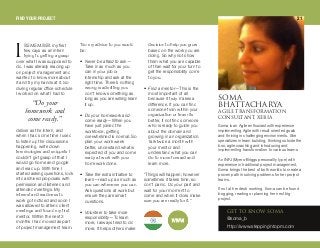
objbj_bomy first
few days as an intern
trying to getting a grasp
over what I was supposed to
do. I was already reading up
on project management and
wanted to know more about
it and try my hands at it. So
during regular office schedule
I worked on what I had to
deliver as the intern, and
when I had some time I used
to listen up the discussions
happening, write down
terminologies and snippets I
couldn’t get grasp of that I
would go home and google
and read up. With time I
started asking questions, look
into archived proposals with
permission and listened and
attended meetings. My
interest and readiness to
work got noticed and soon I
was allowed to attend client
meetings and found my first
mentor. Within the next 3
months I had moved as part
of project management team.
“So my advice to you would
be:
• Never be afraid to ask—
Take in as much as you
can in your job or
internship and ask at the
right time. There’s nothing
wrong is admitting you
don’t know something as
long as you are willing learn
it up.
• Do your homework and
come ready—When you
have just joined the
workforce, getting
overwhelmed is normal. So
plan your work week
better, understand what is
expected of you and come
ready at work with your
homework done.
• Take the extra initiative to
learn—read up as much as
you can whenever you can.
Ask questions at work but
ensure they are smart
questions.
• Volunteer to take more
responsibility—To learn
more, I always tried to do
more. It helps others make
decision to help you grow
based on the work you are
doing. So why not show
them what you are capable
of than wait for your turn to
get the responsibility come
to you.
• Find a mentor—This is the
most important of all
because it truly makes a
difference. If you can find
someone from within your
organization or team its
better, if not find someone
who is ready to guide you
about the domain and
growing in an organization.
Talk twice a month with
your mentor and
understand what you can
do to move forward and
learn more.
“Things will happen; however
sometimes it takes time, so
don’t panic. Do your part and
wait for your moment to
come and when it does make
sure you are ready for it.”
plj^
_e^qq^`e^ov^^dfib qo^kpcloj^qflk
`lkpriq^kqI ub_f^
dbq ql hklt plj^
@soma_b
http://www.steppingintopm.com
Soma is an Agile enthusiast with experience
implementing Agile with result oriented goals
and thriving in challenging environments. She
specializes in team building, thinking outside the
box, agile coaching and introducing and
implementing transformation to various teams.
An INFJ (Myers-Briggs personality type) with
experience in traditional project management,
Soma brings the best of both worlds to create a
proven path in solving problems for her project
teams.
If not at her desk working, Soma can be found
blogging, reading or planning her next big
project.
“Do your
homework and
come ready.”
f
FIND YOUR PROJECT 21
b`bkqiv, I was asked to
lead a major website
rewrite with product
owners in London and Sydney, a
vendor in New York and an
infrastructure and QA team in
Philadelphia. I was in the
Philadelphia office. I was brought in
in November and the goal was to
complete with a new website in
production by the end of June. I
came in not knowing the culture,
the development timelines or the
infra timelines; the team members
didn't know one another, yet we
had a strict mandate around
scope, budget and time that could
not move. The end date, June,
was fixed and the scope was
unknown.
I should have run. Fast.
“Now that we are about to launch
(in June!), what I've learned is this:
follow your PM instincts. If the
scope is too much in too short a
time frame...say so. Don't be
afraid. The only reason we are
making this date is that I kept
sounding alarms. I was
documenting and reporting risks
constantly and escalating
constantly. I didn't have the
institutional acumen or time to get
buy-in to do much else. All I could
really do was tell people, ‘if this is
what you want, you better do this.
And do it now.’
“If your company doesn't keep risk
logs, start one. And make it a part
of every single report that you give
out. If you've got blockers, make it
your priority to unblock, in
whatever way you can. That's a
real way that PMs add value
immediately. You won't make
friends, you may even make a few
enemies, but in the end, your
courage will make the difference in
what gets delivered. And that's
really what being a PM is all about,
isn't it?”
“If the
scope is
too much
in too
shorta
time
frame...
say so.”
dbq ql hklt
jf`efhl
@michikodiby
http://www.kosmothink.com
jf`efhl af_v`blL`lkpriq^kqI
qeb pb^ifdeq `ljm^kv
Michiko is probably the most no-nonsense, get-it-done PM you'll ever come
across. Seasoned and able to lead effectively, she believes in and recognizes
the good in people and the power of a vision. A process guru, Michiko is a
PMP and Design for Six Sigma certified. A leader int he Project Management
community, Michiko is the author of a popular Project Management blog,
Kosmothink. Michiko has been featured in the Project Management Institute's
global magazine, PM Today. She holds a Master's Degree in Conflict Analysis
and Resolution.
o
FIND YOUR PROJECT 22
kv ^ppfdkjbkq that
you are given at work can
be your first project. So
don't ask your boss, ‘Please make
me a project manager of a project’.
Instead, execute all work that you
are given using project
management best practices.
Initiate it, plan it, execute it, control
it, close it (IPECC). You'll want to
use the methodology that makes
most sense for your
assignment—so look into Agile or
Six Sigma (DMAIC) as well. Show
them that you know how projects
are done by tailoring a
methodology and then applying it
to your assignments. And don't
forget to tell them that you are
consistently doing this. In this way,
they can see that you 'have what it
takes' to manage real proejcts and
will assign bigger and more
important tasks and projects to
you over time.”
“Don'task yourboss, ‘Please
make me projectmanager’.”
dbq ql hklt `lokbifrp
@corneliusficht
http://www.pm-prepcast.com
`lokbifrp cf`eqkboI mjmI `pj
mobpfabkqI lpm fkqbok^qflk^i ii`
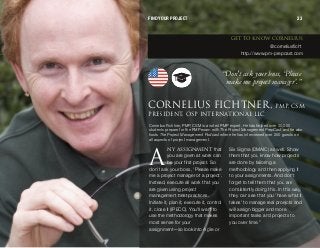
Cornelius Fichtner, PMP, CSM is a noted PMP expert. He has helped over 30,000
students prepare for the PMP exam with The Project Management PrepCast and he also
hosts The Project Management Podcast where he has interviewed over 250 guests on
all aspects of project management.
^
FIND YOUR PROJECT 23
lla Project Management
is not rocket science. It's
not even science. It's really
just common sense, gained mostly
through experience. The books,
processes, the PMBoK—all of it feels
meaningless and rote when you try to
learn the material out of context. The
most important piece of advice I
could offer you is to get out there and
try the approaches you find in the
books that don't put you to sleep and
commit the things that worked to
memory. Understand ‘why’ they
worked, and if some ‘great’ piece of
business advice isn't working for
you—drop it. Different things work on
different projects for different people.
It's all about what works for you.
“...and best of luck making big things
happen. That's your real job as a
PM.”
“If some ‘great’piece of businessadvice
isn'tworkingforyou, drop it!”
a^sb d^oobqq`blI molgb`qj^k^dbjbkqK`lj
Co-Founder and CEO of ProjectManagement.com (formerly gantthead.com), a well-known and
profitable on-line publication since early 2000. ProjectManagement.com is the world's largest
dedicated community of IT Project Managers. For more than a decade, we have grown
profitably through partnerships, acquisitions and natural extensions of our brand. In January
201 4, we joined the Project Management Institute (PMI) family, helping serve the needs of more
than 2.9 million Project Managers worldwide.
d
FIND YOUR PROJECT 24
dbq ql hklt a^sb
@DaveG253
http://www.projectmanagement.com
_pbosb, listen, practise and
learn. Everything we do at work
involves working with other
people and gives us limitless
opportunities to practise and develop our
skills, knowledge, strategies and tools.
“I remember many occasions in my early
days at work sitting around a boardroom
and feeling like I was acting a
part—seeing myself from the outside.
People often talk about the first one
hundred days as a time to make an
impact. That's the time when you are
likely to still have some objectivity about
the organization you find yourself in, and
how that compares to your previous
experiences. Use that time especially to
observe, listen, practise and learn.
“When we start out, people expect us to
be on a steep learning curve, so it's an
especially good time to ask questions
and to try things out. Look for the people
who are especially good project leaders
and managers and seek them out as role
models. Consider what it is that they do
that enables teams to work well together
and achieve exceptional results. How
could you emulate that?
“More experienced colleagues will be
flattered if you seek them out as
mentors, and will be delighted if you
volunteer to take on particular roles /
actions that will help you to try out and
develop your knowledge and skills.
“When you spot examples of teams not
working well, consider why that might be
and what might help them do better. Is
there something you could do that could
support the team leader and enable
them to achieve better results (without
undermining them)?
“There's nothing like observing the
dynamics of a team to really understand
the theories of team development and
how you can bring not only your
technical skills, but also your behavioural
and thinking skills to help the teams you
belong to achieve high performance.
“Use your first one hundred days' relative
objectivity to observe, listen, practise and
learn and then keep doing that. Your
ability to do so will enable you to
enhance your personal effectiveness and
that of the teams that you work in
throughout your working life.”
“Use yourfirst100 daysto observe, listen,
practise andlearn.”
bifp^_bqe dllaj^kltkbo^ka mofk`fm^i `lkpriq^kqI
ofsbooebb `lkpriqfkd
Elisabeth Goodman (BSc Biochemistry, MSc Information
Science) spent over twenty-five years in Pharmaceutical
Research and Development, where she held management roles
in Information and Library Management and internal training and
consultancy roles supporting business teams on a global basis.
She writes, presents, consults and provides training on topics
relating to enhancing team effectiveness including Project
Management. Elisabeth is a certified practitioner in Change
Management, Lean Six Sigma, Myers-Briggs Type Indicator
(MBTI), NLP (Neuro Linguistic Programming) and is a full
member of the APM (Association for Project Management) for
which she is a committee member (East of England Branch and
Enabling Change SIG).
dbq ql hklt Éäáë~ÄÉíÜ
@ecgoodman
http://www.riverrhee.com
l
FIND YOUR PROJECT 25
k efp _llh, The Power of
Intention, Wayne Dyer suggests that
we: ‘Act as if everything you desire is
already here… treat yourself as if you
already are what you’d like to become.’
And in his book, Get Out of Your Own Way,
Robert K. Cooper writes: ‘Brain scans
show that simply imagining a complex and
compelling goal will actually fire the same
neurons that will be required to actually
achieve the goal... In order to sense a new
idea or shape a better future, we must first
create it in the brain as a possibility…’
“Translating these high-sounding
suggestions to our topic of getting a
foothold in PM (and getting a bit more
specific) here is a list of things I’ve
observed that ‘ordinary’ project team
members were doing just before they broke
into their official role of project manager:
• Anticipating problems that the team
might face, then helping to prevent them;
• Going beyond simply enduring or
complaining about obstacles or
roadblocks to taking the actions that
were necessary to help remove them;
• Filling in the gaps by doing the dirty,
thankless jobs when no one else was
available in order to keep the project
moving;
• Stepping up and acting on behalf of (or,
more specifically acting as if they
‘owned’):
• The schedule
• The budget
• The resource work load that may have
needed balancing
• The quality of the finished product
• Advocating on behalf of team members
who wouldn’t (or couldn’t) speak up for
themselves;
• Serving as a bridge between
stakeholders and the professionals on
the project team by helping translate
technical jargon, explain field-specific
best practices or generally selling the
project and its value;
• Leading, in critical moments when there
was no one else around to serve as
leader.
“In short, when a member of the project
team starts doing the kinds of things listed
above, the senior managers and
stakeholders who are orbiting the project
begin to listen more carefully when this
person speaks. And eventually this person
acquires the personal gravitas to be asked
to serve, officially, as a project manager.”
jf`e^bi dobbomolgb`q j^k^dbjbkq ^rqelo
^ka qo^fkbo
dbq ql hklt jf`e^bi
@michael_greer
http://michaelgreer.biz
“Fillin gapsby doingthe
dirty, thanklessjobs.”
Project Management (PM) author and trainer whose mission is
to help new project managers become more effective. Through
books, workshops, and public speaking appearances, seeks
to demystify the field of project management (PM) and make it
accessible to newcomers. Spent many years as an
instructional designer developing custom training and
performance support solutions for all sorts of clients and
content areas (sales, management, technical).
f
FIND YOUR PROJECT 26
bt project managers should
show that they are flexible,
willing to put in the time and
able to listen to their project team
members. As you don't have much
project management experience, look for
other ways to contribute,
such as through facilitating
discussion, being great at
documentation, being
honest and transparent in
communications and asking
the questions that no one
else dares to. I do this a lot
and when you are new to a business or
a job you can get away with it simply
because you are new!
“On one of my first projects, I forgot to
identify a stakeholder group and didn't
talk to them at all. Then, on go-live day, I
had the head of that department on the
phone wondering what had happened
and why her team was swamped with
extra work. Communicate more than you
think you have to—extra stakeholders
will appear where you least expect them.
That doesn't mean blanket e-mails to
the whole company. It means tailored,
relevant communication to specific
stakeholders, but lots and lots of it.
Phone people, stop by their offices,
invite them to lunch or coffee. Especially
on big projects, people do worry about
not knowing what's going on: it's your
job to stop that.
“Another unwritten rule of project
management is that you protect your
project team from politics and grief so
that they can get on and do
their jobs. If it helps, take the
blame for problems yourself.
It's a great way to diffuse
tension and help people
move on to constructive
problem solving. It is very
hard for someone to keep
shouting or ranting at you when you've
apologized.
“Finally, don't forget that you are a
project stakeholder too: you should
always get something out of a project in
terms of career development, even if it is
just spending another six months
working in an area you love.”
“Extra
stakeholderswill
appearwhere you
leastexpect
them.”
bifw^_bqe e^oofkafob`qloI qeb lql_lp dolrm
Elizabeth has a decade of experience in leading IT and process
improvement projects in financial services and healthcare. She
is also experienced in managing business change. She now
works as a project communications consultant, helping others
tell the story of their projects more effectively. Elizabeth is the
author of three books and the award-winning blog,
www.GirlsGuideToPM.com.
dbq ql hklt bifw^_bqe
@pm4girls
http://www.OtobosGroup.com
k
FIND YOUR PROJECT 27
ov íç ïçêâon the hard
projects and ask for help (but
not too much). When I was a
complete junior and a very risky
project needed a project
manager, I raised my
hand and insisted with a
bit of hubris that I was up
for the job. The company
I worked for knew that I
wasn’t experienced and asked a
senior manager to help and keep an
eye on my work. All I had to do was
ask for help when I needed it. In the
end the project failed, the budget got
out of hand, procurement was a mess
and everything got cancelled half-way.
“Because I worked hard, still had a
somewhat happy project team and
because I didn’t make any mistakes
towards the client I actually got
complimented on my work. I couldn’t
have done what I did without help. If I
hadn’t reached out for help it would
have been a total catastrophe. The
experience hardened me, and without
a mentor it would probably have just
broken my spirit.
“The company or client
you’ll work for will take
a risk if they put a junior
on a project. Try to
show with integrity that
you’re ready to invest a lot of yourself
in making up for such a risk. You can
do so for instance by getting certified
in a project management methodology
or by getting experience in project
management by volunteering outside
your job.
“So try to show you’re ready to work
on a project where you deserve to
have a mentor. Take risks and be
humble. You shouldn’t have to venture
into the woods alone for the first time.”
“You shouldn'thave
to venture into the
woodsalone.”
Bert is a senior project manager with a strong background in software development and
architecture. Most of the projects he manages solve complex commercial and digital problems.
In the past he worked for technology companies such as Sony and TomTom as well as for
international advertising agencies such as TBWA and Ogilvy. Bert strongly believes in coaching,
empowerment and facilitation.
dbq ql hklt _boq
@bertheymans
http://journeymanpm.com
q
FIND YOUR PROJECT 28
_boq ebvj^kppbkflomolgb`q j^k^dboI
memolI m^oq lc qeb `olklp dolrm
objbj_bowhen I started as a
project manager, my supervisor said,
‘You need to get hard skills in project
management’ and he subscribed me
directly to a training session on a famous
planning tool.
“One of his first requests was to get a
plan from the team. Therefore, I invested a
lot of myself to get this plan done. It was
quite complex with a lot of uncertainties
due to the nature of the project: product
development. However, I managed to
complete it and started to follow the
progress of teams against it.
“After a few weeks, I realized I was
investing a significant amount of my time
only to update the plan which was not of
high added value. The second issue was
that the teams involved started to become
bored with the meetings I was organizing:
the plan constantly needed to be
adapted and the teams started to feel
micro-managed.
“I realized the plan was too detailed in the
description of the teams’ tasks so I
decided to work at a higher level with
more significant milestones. The teams
quickly felt more empowered, less
updates were needed and I was saving
time to reinvest in other important project
management tasks such as stakeholder
management.
“Interestingly enough, by speaking with
key stakeholders, I understood that the
issue was coming not from the teams’
activities but from the frequent changes in
product requirements. Therefore I
implemented a requirements document
with requirements lock or stage and gate
decisions.
“Isn’t it far from planning?
“The year after I asked for a soft skills
course about negotiation.”
“Iwas
investinga
significant
amountof
time only to
update the
plan.”
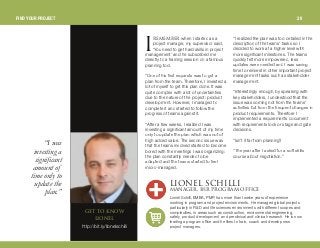
iflkbi p`efiifj^k^dboI _pomoldo^j lccf`b
Lionel Schilli, EMBA, PMP, has more than twelve years of experience
working in program and project environments. He managed global projects
particularly in R&D and life sciences environments with different scopes and
complexities, in areas such as construction, environmental engineering,
safety, product development, and preclinical and clinical research. He is now
leading a program office and he likes to train, coach and develop new
project managers.
f
FIND YOUR PROJECT 29
dbq ql hklt
iflkbi
http://bit.ly/lionelschilli
fhb jlpq mblmib f hklt, I fell into the project
management discipline by accident. My advice to you
is to try and replicate the ‘accident’ in your own career.
“Make sure you do your research and understand which
organizations have projects in the first place. Then look at the
types of roles they have for entry level students. These roles
may not be project-related at first, but they will be business-
related. It's these roles that will start you on the path to
building your workplace skills. These roles could be
discipline-related (for example, IT, Human Resources or
Finance) or they could be of a work discipline (for example,
administration, analysis or support).
“If you start to build up your work skills in an organization that
is very project management centric, i.e., they use projects to
get things done, it really is a matter of proving yourself in your
current role before asking to be more aligned with the
projects.
“The alternative route is to start working in a project support
role—something like project coordinator, planner or PMO.
These roles give you instant exposure to projects with the
luxury of being able to work closely with an experienced
project manager—on the job training!”
“Try andreplicate the ‘accident’in
yourown career.”
dbq ql hklt ifkap^v
@projectmgmt
http://www.arraspeople.co.uk/camel-blog/
ifkap^v p`lqqafob`qloI ^oo^p mblmib
Lindsay has worked in project management recruitment
for about twelve years in the U.K. She not only finds work
for people but also gives practical advice on their careers.
Before that she worked as a Project Office Manager at
Hewlett-Packard.
i
FIND YOUR PROJECT 30
mbqboq^vilo
`efbc i^wv lccf`boI qeb i^wv molgb`q j^k^dboiqa
Peter Taylor is the author of the best-selling book on ‘Productive Laziness’ – The Lazy
Project Manager.
In the last 4 years he has focused on writing and lecturing with over 200 presentations
around the world in over 20 countries and has been described as ‘perhaps the most
entertaining and inspiring speaker in the project management world today’. He also
acts as an independent consultant working with some of the major organizations in the
world coaching executive sponsors, PMO leaders and project managers.
His mission is to teach as many people as possible that it is achievable to ‘work
smarter and not harder’ and to still gain success in the battle of the work/life balance.
FIND YOUR PROJECT 31
ebk jv hfap were young they
loved to play one game at the their
birthday parties. This game involved
‘Beans’ – all of the kids standing ready and waiting
for instructions and then the cry would go up of
‘Beans’ and the game would begin.
‘Runner beans’ would mean that everyone had to
run on the spot. ‘Jumping beans’ meant jumping
up and down, ‘French beans’ meant a chorus of
‘Ooh la la’s’ and ‘Baked beans’ meant ... well you
know kids so I am sure that you can work that one
out for yourself.
“Then at the end a final call would be ‘Human
beans’ and the kids were back to normal human
beings (or back to kids anyway which meant even
more noise and dancing around and general
excitement).
“I hear a lot about ‘Green beans’
and the challenge of inducting and
developing raw talent in to the
project organization.
“Find a safe place to start. Projects
are, by their very nature, tricky
beasts and for a ‘newbie’ to learn the practical
skills of project management they should ensure
that they enter the PM world in a controlled way.
‘Green beans’ should experience project reality by
taking up a small part in another PMs project,
learning and getting involved in a small way.
“In addition, if there are project reviews, health
checks, and retrospectives taking place then this
is another great entry experience.
“Find a friendly place to work. A project practise,
PMO, or community is the right place to nurture
these ‘beans’ and ‘Green beans’ should be active
in these communities asking the questions that
you will need to ask and watching closely the
experienced PMs in action.
We all know that there is a world of
difference between theory and
practice so get the support you will
need to move away from the
theory.
“Find a helping hand. Find a
mentor who will be there to listen from time to time
and gently point you in the right direction when you
need help.
“Look outside your own organization and connect
to some truly wonderful project managers and
experts out there on the www. There is a huge
amount of advice and guidance through local
project management groups, through conferences
and meetings, through the online discussions and
blogs, and lots more.”
“Take up a small
partin another
PM'sproject.”
t
dbq ql hklt mbqbo
@thelazypm
http://www.thelazyprojectmanager.com
cfka vlrophfiip
Knowledge isn'tenough. It'sexperience thatwillmake you strong.
dbq ql hklt dibk
@galleman
http://herdingcats.typepad.com
lr e^sb qefp diploma from a
university or some school that says
‘I know about project management’.
This is necessary but unfortunately not
sufficient. Next, you need to learn the
project management frameworks that
belong to the domain you're interested in.
For Enterprise IT, that’d be ITIL. For
general Software Development, start with
the Software Engineering Institute’s CMMI
process areas—several of these are
related to managing projects. IEEE now
owns the Software Engineering Body of
Knowledge (SWEBOK) which has project
management chapters. If it’s construction
you’re interested in join AACE
(www.aacei.org) and look at the Total
Cost Management framework—there's
lots of PM stuff there. Of course the
federal and state governments also have
guides for managing their projects. You
can’t assume that a PMBoK®-based
education, for example, is sufficient for a
specific domain. It’s a great start, but you
need more.
“Books abound on how to manage
projects and Amazon can provide you
with a list. As a project management
student you may have learned all the
processes, tools, documents, and
artifacts that go along with managing
projects. However, there is one critically
important thing to understand: Risk
Management is how adults manage
projects.
“Your role on any project is to deal with
the risks. There my be a formal ‘risk
manager’, or it may be you. Either way,
look to Tim Lister’s advice that you can
find here:
http://bit.ly/toomuchrisk
“Keep this presentation close at hand.
Then, and this is a little self-promotion,
keep on hand the five immutable
principles, practices and processes
needed to increase the probability of
project success. Refer to them often:
http://bit.ly/perfbasedpm
“The questions asked and the answers
you will recieve in the Principles and
Practices will inform you what to do next
in your new role as a project manager.”
Glen B. Alleman leads the Program Planning and Controls
practice for Niwot Ridge, LLC. In this position Glen brings
his twenty-five years’ experience in program management,
systems engineering, software development, and general
management to bear on problems of performance based
program management.
Glen’s experience is focused on mission critical software
systems in a variety of firms including Logicon, TRW, CH2M
Hill, SM&A, before joining Niwot Ridge, LLC where he
developed the Performance-Based Project Management®
method and applied it in Aerospace, Defense, and
Enterprise IT engagements.
v
FIND YOUR SKILLS 33
“You needto learn
the frameworks
thatbelongto the domain
you're interestedin.”
dibk ^iibj^kmoldo^j mbocloj^k`b ib^a
kftlq ofadbI ii`
kprob b^`e molgb`q
has a Project Definition
Document (PDD) recorded in
writing, approved and dated. Then
all the stakeholders know what the
project is about. You also have a
useful document to use as a
baseline to assess the changes that
are bound to come along.
“The project manager needs to
avoid ‘project drift’. You can avoid
this with a robust change request
process, that lets you assess the
impacts of time, cost and quality.
“The following is my
recommendation essentials for a
good Project Definition Document
(PDD).
“Background: Start with a
description of the background
(context) so that people understand
why you have reached the need for
the project.
“Objective: Clearly state what
needs to be delivered or achieved
and the associated benefits that
those features will bring.
“Scope: State what is ‘in-scope’
and what is ‘out-of-scope’. Out-of-
scope stuff might be phased into
another project or follow-on project.
“Constraints: State all the things
that are known that will restrict the
project, e.g., time, deadlines, costs,
quality, people, resources, etc.
“Assumptions: List all the
assumptions you have made when
developing the plan, e.g. peoples’
availability, cash flows, etc.
“Risks: It’s so important to talk to
stakeholders and listen to the risks
they identify, then list them and
decide how you will manage those
risks.
“Management: State how the
project will be launched, monitored
and controlled. Describe the
frequency of reviews, where they
will take place, the software tools
(e.g. planning / scheduling /
progressing tools and Earned Value
Measurement Tools) you will use
and the channels you will follow for
communications.
“Financials: State the Estimated
Budget To Complete (EBTC),
describe the cash-flows, payment
plan for suppliers. Milestone
Payment Plans, etc.
“Now the above document may be
two or three pages, or perhaps a
multiple-page book. It does not
matter, so long as there is sufficient
information for the next phase of
planning to begin. Make sure the
PDD is approved and dated.
“I hope all the above is helpful. A
career in project management is
one that is truly rewarding, whether
in commerce, industry or a not-for-
profit organisation.”
glek `lokfpeI j_^I c`fjI `e^oqboba j^ohbqbo
afob`qloI jf`ol mi^kkfkd fkqbok^qflk^i iqa ErhF
John has enjoyed an exciting career spanning twenty-five years in project management in a global
electronics company based in Dorset, UK and a second career in product and then strategic marketing.
b
“A careerin projectmanagement
istruly rewarding.”
dbq ql hklt glek
http://linkedin.com/in/cornish
http://www.microplanning.co.uk
FIND YOUR SKILLS 34
kb lc qeb jlpq important
milestones in all Enterprise Application
Integration projects is the handoff from
system testing to user testing. This is when
you string together all your individual
components to create an end-to-end
environment for acceptance of the
implementation.
“I like to refer to this milestone/quality gate in
the project as the project’s Promontory Point:
the final spike before providing end-to-end
testing capability. Until now, you have likely
worked to agreed-upon specifications and
project plans and have defined all the
configuration parameters. However, anything
can happen when you actually make the
connectivity live for the first time. Due to the
criticality of this step and the potential for
finger-pointing, I recommend having a
separate task for this event complete with a
specific test plan and a scheduled play-by-
play call.
“This Promontory Point is a standalone event
and represents a handoff from development to
User Acceptance test. It should be an exit
requirement from one team and an entrance
requirement for the other team, with electronic
sign-offs on both sides.
“Here are some important ground rules to
consider for your Promontory Point task:
1 ) Send out a meeting announcement one week
before the test.
2) Create a baselined test plan that outlines the
creation, modification, close out of the transaction.
3) Create a well-defined test script based on a
requirements use case. that includes a description
of each component in the end-to-end transaction,
the associated input, processing, and output for
each component, as well as a means to validate
success.
4) Create a connectivity diagram that outlines all
the configuration points and their associated
values.
5) Identify all authentications and passwords at
each point (digital certificate IDs, etc.)
6) Set up a dedicated conference bridge for the
call, so end user applications can be shared.
7) Appoint a call leader who will go through the test
process step by step.
8) Appoint a scribe – someone to check off all the
steps of the test case.
9) Establish a defined means of tracking issues
during testing.
1 0) Appoint dedicated resources on the bridge.
Many hours can be lost trying to “track down” a
person that owns a key component.
1 1 ) Prepare a sign-off that the process completed.
1 2) Issue an announcement that the test is
complete, along with the results, and the next
steps.
“Of course this assumes a sunny day
successful test. My experience shows that
there is a better than 30% chance that the first
test will fail. You should also make sure to post
meeting minutes that outline the call, identify
actions to take in case the initial transaction
doesn’t work, and also submit lessons learned
for future connectivity issues.”
a^sb a^sfppbkflomolgb`q j^k^dbo
Dave Davis, PMP and PgMP is a project and
program manager and a recognized professional in
leadership and project management. With over thirty
years' experience as a manager, project manager,
program manager, business analyst and knowledge
manager, Dave understands the challenges of being
a project leader and the associated stakeholder
relationships.
l
FIND YOUR SKILLS 35
dbq ql hklt a^sb
@santadave
molgb`q
manager has a
very special role.
You must organize,
motivate, and achieve
results while leading
yourself and people who
don’t report to you. This
is challenging but can be
very rewarding.
“The one tip that can help
you stay focused and
respected (that helped
me when I started in my
role) is to connect with
people— make a true
connection with another
human being. At the root
of all projects are people
with families, ambitions,
and challenges. Connect
deeply, respect and
appreciate them and they
will follow you and your
project plan!
“Quick Tip: Create
guiding principles as a
team. Instead of fixing
every interaction one at a
time, help your project
team members help
themselves. Invest in a
team meeting to have
them discover their
principles for
communication when
things go right (how will
we celebrate and help
each other shine) and
when things go wrong
(how can we be honest
with each other to make
things better). Engage
them in open dialogue
using their own personal
principles as a starting
point.
“Assess the strength of
your team’s glow and
help discover ways to
help each member
flourish, thrive and grow
individually and together.”
“Atthe rootof allprojects
are people.”
dbq ql hklt plkf^
@readytofeedback
http://harvestperformance.ca
plkf^ af j^rilclrkaboI ib^a cbba_^`h
bkqerpf^pq ^ka
mbocloj^k`b fjmolsbjbkq
molcbppflk^i
e^osbpq mbocloj^k`b
Sonia Di Maulo, MA, CRP, founder of Harvest Performance, is an author, feedback
enthusiast, and performance improvement professional. She helps leaders around the
world emerge and doesn't plan on stopping any time soon.
Sometimes leaders make mistakes that destroy their credibility, keep them invisible, and
limit their growth. Through keynotes, workshops, and leadership coaching, learn how to
cultivate trust and collaboration and develop a plan to emerge and leave a legacy. Have
you read Sonia’s story of Brave Apple endorsed by Ken Blanchard? Find out more here:
http://www.harvestperformance.ca.
^
FIND YOURSELF 36
tbkq fkql Project Management
because I was sick and tired of having a
job that was the same day in and day out!
It was Project Management that took me back
to University, where I studied for my degree in
Project Management (Leeds Met Uni rocks)!
“After three years of studying vast amounts of
project books, methods and approaches, I
graduated full of knowledge, ready to manage
projects—or so I thought!
“Compared to most people after university, I
was the most technically trained Project
Manager out there. However, trying to apply
all the knowledge I had to every project just
‘p*ssed people off’.
“After years of annoying people, I came
through to the other side and realized that
although technical skills are important,
people skills are more important.
“Projects are about people.
“If it weren’t for the customer, there wouldn’t
be a project. By customer, I mean sponsor
and other people who want to use the cool
stuff the project will deliver. People are needed
to deliver the outputs for the project.
“So, how can you help make life easier for the
people involved with projects? I usually coach
Project Managers to start with the fact that
Projects are there to reduce risk; they are
there to increase the certainty of delivering
something for their customer.
“Risk isn’t exciting, but getting answers to
questions like ‘What could go wrong?’, ‘What
is the probability of getting it delivered on
time?’, or ‘What might stop us delivering for
the customer?’, suddenly makes project life a
lot more interesting, and also helps to form a
plan.
“The plan is the most important
communication tool a Project Manager can
use, and this helps reduce uncertainty; it
reduces risks, increasing the likelihood of
success.
“A plan is not just a list of milestones and
tasks; instead it tells everyone involved:
• Why are we doing the project?
• What are we going to deliver?
• How are we going to deliver it?
• Who is responsible for delivering tasks and
stuff?
• When will the stuff be delivered?
“Capture all of this, get it written down, then
define and agree to the time, cost and quality
and you should be off to a great start.
“After all—it’s not rocket science!”
“Projectsare there
to reduce risk.”dbq ql hklt o^ic
@pmoplanet
http://www.pmoplanet.com
o^ic cfk`ebqqI goK
clrkabo^ka afob`qlo
lc mjl mjl mi^kbq iqa
Honours graduate from the Leeds Metropolitan
University Centre for Project Management, a past
chairman of the APM PMO SIG, Ralf has also been a
reviewer on the P3O guide, a committee member on
the PMI’s Portfolio BoK, and the co-founder of PMO
Flashmob. Ralf is one of the most recognized PMO
professionals in the UK, consulting with organizations
on Strategic / Portfolio PMO, but also PMOs on large
and complex programs. Ralf started his career as a
Project and Program Manager then moved into
Strategic and Portfolio PMOs over ten years ago. He
has been involved in over fifteen PMO’s (over one
thousand projects) across varying sectors.
f
FIND YOUR SKILLS 37
dbq ql hklt obw^
@rezamofid
p f illh_^`hat my career, I
see two significant areas for im-
provement which I want to share
with you today. I remember the first time I
was assigned to manage a project; the
most important thing for
me was to make customer
happy. I was prepared to
put myself and my team in
a very tough situation in
order to give my customer
what he wanted, when he wanted. I un-
derestimated the power of ink and the
power of documentation. I accepted an
actual physical object as a refer-
ence—rather than an engineering draw-
ing—to make a few thousand parts as
part of a new product development pro-
ject. I did this because the customer was
in rush and didn’t want to take the time to
develop the drawing. That project ended
up taking much longer and was much
more costly than the customer originally
anticipated and required.
“Always ask for a written
specification. Our language
at work is not just English; it
needs to be a technical lan-
guage spoken through en-
gineering drawings, blueprints or
technical specifications. Even an actual
physical object might not communicate
all of the part’s characteristics and tech-
nical specifications. And more import-
antly, document every single ‘lesson
learned’ because ‘the faintest ink beats
the strongest memory’.”
“Iunderestimatedthe
powerof ink and
documentation.”
obw^ jlcfa`liibdb molcbpploI
aroe^j `liibdb
Reza is a college professor teaching across programs in Operations
Management and Project Management. He worked as the quality
manager with medical equipment and supply manufacturing as well
as a material manager with electromechanical manufacturing. He
has managed and participated in a variety of projects such as new
product development projects mostly in the manufacturing and
operation environments. He is a member of Professional Engineers
Ontario and enjoys reading, watching movies and playing tennis.
^
FIND YOUR SKILLS 38
dbq ql hklt g^plk
@priceperrott
http://www.priceperrott.com
olgb`q management’s a
great career to get into, but
when you’re starting out it’s
really important to make sure you
get the basics well covered.
We’re all keen to progress up the
project ladder and take on more
responsibility, but this enthusiasm
needs to be tempered with the
reality that (despite what you may
think), you don’t actually know it
all yet!
“Time spent understanding the
essentials of the underlying
processes behind effective project
management will pay back huge
dividends later on in your career.
It’s a marathon, not a sprint. For
example, the skills associated
with setting up and managing
risk, issue and decision registers,
writing up effective meeting
minutes and learning to build
relationships with your
stakeholders are all areas you’ll
need to excel in. Spend your early
career understanding how to
make these things work in
practice, as everyday tools you
use to manage project
information—and not as a ‘tick in
the box’ to get you through a
project audit.
“There’s a clear distinction
between the skills of project
management and the
methodologies in which you can
gain accreditation. For example,
PRINCE2 as a methodology tells
you to have a risk log, but doesn’t
teach you why you need risk
management or what it’s about.
“Focusing on understanding how
and why you can make things
work for you and your team
means that when your dream
project management role arrives,
you’re ready for the opportunity.
You can step up to leading a team
and showing true excellence in
delivery, rather than jumping off a
cliff like a lemming full of ideas but
little experience of how to execute
them effectively.
“Projects run without a sound
understanding and basis of
effective project management are
more likely to fall into crisis
management, with a higher risk of
failure. That’s a tough thing to
have on your career track record.
“Set your own standards high,
lead by example and always
respect the support of junior
members in your team. If you
really understand their
contributions, it makes you a
leader, not a manager. That’s a
good thing.”
aoK g^plk mof`bj^k^dfkd afob`qloI mof`b mboolqq ifjfqba
Dr. Jason Price is an independent management consultant specialising in business change, performance improvement
and customer service. He is a qualified management consultant, programme and project manager with fifteen years'
international experience in strategy, delivery and consultancy review of customer service and performance improvement
programmes and projects. Jason’s background includes consultancy and operational line management in public sector,
financial services, insurance and utility industries in the UK and New Zealand.
“Enthusiasm needsto be temperedwith reality.”
m
FIND YOUR SKILLS 39
^v_b qefp will be your
first time in the
workforce, or maybe
Project Management is a career
change for you. One way or the
other, now’s the time to channel
your inner John Wayne or Arnold
Schwarzenegger; whatever comes
your way, show no fear!
“You’ll receive countless pieces of
advice and exhortations to ‘learn
from the mistakes of others’; I
wish it was so easy but the fact is
that we do most of our learning
from our own mistakes.
You learned about concepts like
the scope-time-cost triple
constraint. You know, if you have
enough money and resources, you
can ‘compress’ time. Alternatively,
you can reduce scope. Well,
sometimes the iron triangle
doesn't quite work out.
“Some projects are already at
minimum scope. Throwing money
at a project by increasing the size
of the team actually lowers
productivity by increasing
communication time.
“Deadlines can actually be drop
dead dates. That is the case for
Time to Market (TTM) projects
where if you miss the date, you
lose the opportunity. ROI goes to
zero and the whole budget
become a sunk cost. Case in
point, two of my pharmaceutical
clients were in a race to introduce
a new drug. One got to the FDA a
week before the other. Ten years
of work and about USD 1 .2B were
lost.
“They say a great project manager
delivers his projects ahead of time
and below budget. The client will
still consider you a good project
manager if the project is on time
and on budget. The client may
even swallow a small budgetary
overrun as long as you are
transparent and can forecast by
how much the project will go over
budget.
“Clients rarely enjoy projects that
go beyond their deadlines. A
soon to be ex-project manager
allows his projects to go beyond
the deadlines. That is actually
quite easy to do; most projects
that bust their deadlines do so
very quietly, one day at a time.
“Do everything in your power,
every minute of every day, to move
the project along and to preserve
or increase any schedule buffer
you may have. Do not let anyone
consume that buffer without a
fight.
“Meet or beat your project
deadlines and you’ll go from good
project manager to great project
manager. Bust your project
deadlines and you’re on your way
to being an ex-project manager.
“It's your ball!”
“We do mostof ourlearning
from ourown mistakes.”
Patrick is an ex-soldier (Combat Engineering followed by Artillery), a Chemical Engineer,
currently a Project Manager, and a soon to be businessman. He is an experienced
Project/Program Manager in a wide variety of industries: Process, Pulp and Paper,
Manufacturing, Pharmaceuticals, Biotechnology, Food and Beverages, Point of Sale systems,
and Pharmacy systems. He has extensive experience reporting progress and discussing
challenges with senior management teams (Directors, Vice Presidents, and Presidents) as well
as leading implementation teams in fulfilling the goals of the project and organization.
j
dbq ql hklt m^qof`h
@hardnosed
http://www.thehardnosedpm.com
m^qof`hof`e^oaëÉåáçêéêçàÉÅí L éêçÖê~ã ã~å~ÖÉêI modmmj
FIND YOUR SKILLS 40
olgb`q pr``bpp is not as
easy as it seems. Most of the
projects you will manage
throughout your career will
have at least one hard-to-
satisfy stakeholder and one
critical risk that may put the
project at jeopardy and lead
to failure. Your antidote to most project
hurdles is “COMRIS”, communication
and risk management.
“Communication is one of the top
ranked personal skills across all
industries. The demand for effective
communication among professionals
has become bigger than ever due to
virtual teams, diverse cultures, and
dissimilar expectations just to name a
few. One golden rule to ensure effective
communication and buy-in from your
stakeholders can be summed up in this
Chinese proverb: “Tell me and I’ll forget;
show me and I may remember; involve
me and I’ll understand.”. You can
achieve active involvement with your
stakeholders by articulating the
objectives and strategic benefits your
project brings to the organization. Once
these goals are clear, mutual interest will
boost collaboration between you and
your project team, sponsor, and
stakeholders.
“Build rapports with your important
stakeholders. Get along with them and
refrain from unnecessary formalities, yet
be firm when the need arises to
safeguard your project from scope
creep and inevitable
conflicts among different
people with contradictory
needs.
“Risk Management is the other side of
the coin, and undoubtedly the heart and
soul of project management. Failing to
practice risk management correctly can
have fatal consequences to your
projects. Be creative in carving your
Risk Breakdown Structure (RBS). It is
the first step and an effective stimulus to
perform a fruitful risk identification
activity. Don’t allow yourself to have a
two- or even three-level RBS. Dig as
deep as you can to list down all risk
categories that might hit your project.
Don’t fall into the trap of owning all the
risks yourself; you need to identify risk
owners and clearly communicate their
tasks. When it comes to different risk
perceptions, subjectivity will reach its
peak and may lead to conflicts among
stakeholders. Be smart in tackling this
issue by being objective and expressing
your fact-based viewpoints while being
at the same distance as all conflicting
parties.”
“Yourantidote is
COMRIS.”
Kareem Shaker is a project management professional,
enterprise risk management consultant, and innovation writer.
He has fifteen years of experience leading multi-million dollar
business transformation projects and programs that
empowered a large number of stakeholders with technology
solutions. Kareem has people and C-Level stakeholders’
management skills, the ability to lead, motivate, and influence
diverse large teams towards achieving common business
goals. He is passionate about management and leadership
trends, new technologies, risk management, and innovation.
m
dbq ql hklt h^obbj
@kareemshaker
http://www.kareemshaker.com
h^obbj pe^hbopbkfloj^k^dboI
molgb`q ^ka bkqbomofpb ofph
ar_^f tloia
FIND YOUR SKILLS 41
gl ^kk ptbbkbvclrkaboI ptbbkbv
`ljjrkf`^qflkp iqa
dbq ql hklt gl ^kk
@commsabilities
http://www.commsabilities.com/blog.asp
Jo Ann is a transformation and engagement consultant who assists leaders build trust and rapport with key stakeholders. She is known for persuading stakeholders
to get involved and actively support change as well as for clarifying technical and complex information so stakeholders understand both the detail and relevance.
Programmes span technology rollouts, office relocations, redundancies and redeployment, skills development, new product launches, political lobbying and brand
makeovers. Activities include strategy and action plans, audits and research, channels and campaigns, mentoring, skills training and evaluation.
FIND YOUR SKILL 42
bkfloj^k^dbop play many
parts including sponsors of
projects that may have been
allocated to them by some one
higher up.
“Their support is crucial but their hearts
may be elsewhere. Luckily, with regular
communications that is
tailored to their needs,
they can be won over.
“I saw this in action in
a multinational’s human
resources department.
The managing director, concerned about
a more successful competitor, had asked
HR to develop a programme to up-skill
sales teams.
“Responsibility was delegated down
through the management hierarchy to my
client. The project team spent eighteen
months developing software to identify the
skill levels and training needs of all sales
and marketing people.
“They were proud of their solution and
believed it would put the sales effort back
on a par with the competitor. But they
hadn’t taken into account the impact on
people.
“At roll out the message that came back
was ‘forget it, we’ll pay lip service but
we’re not going to put in the effort you
need to make this a success’.
“When the project team went to the
managing director for help they found her
priorities had moved on. Their challenge
was to win back her
support.
“We began with the
HR director,
reminding him of the
difference the project
would make to the multinational’s
competitiveness. Then we used him to re-
engage the managing director with a hard-
hitting presentation that revealed a
widening gap between sales skills in the
multinational and its arch rival, but also
affirmed the project’s ability to close this
gap without external recruitment.
“Having won the managing director over
we used her to sell the project to the
marketing and sales directors and their
teams. These four executives became
excited by the project’s potential and
expanded the programme beyond its
original remit. A coup for the project
manager who had stepped in to take over
just before things went pear-shaped.”
“Executive supportis
crucialbuttheirheartsmay
be elsewhere.”
p
ebk looking at project
management as a profession,
little used to be known about
what a project manager does and what the
typical workday of a project manager looks
like. Children never used to say: ‘I want to
be a project manager when I grow up.’
“Years ago I started as a
project administrator. Then
I moved into IT support and
was always chosen to
manage all the projects in our
division. This is something I
enjoyed because it was a
natural fit.
“As a project manager, I'm in the fortunate
position to be doing something that suits
my abilities and temperament and which
complements my core talents and skills. I
enjoy the variation provided by being
involved in various different projects and
teams. It brings excitement when starting
something new, as well as satisfaction
when bringing a project to successful
completion and having formed lasting
relationships with the team members.
“Being a strong communicator and a
person who cares about people, project
management has become my destined
career where I feel comfortable and I believe
that I am making a difference.
“Today, project managers are making a
difference in every aspect of society,
whether it's in IT, finance, retail, engineering,
mining or the public sector, and plenty of
other industries. Project management as a
profession has matured.
“You are now looking on
embarking on project
management as a career.
Remember the ten-thousand
hours rule—you are only truly
experienced when you have
reached the ten-year mark.
Give yourself time to become
comfortable with managing
projects and always strive to be
professional. One thing I have learned from
experience in order to do well on projects, is
to:
• Always be planning
• Always be communicating
• Always be building relationships
“To give back to my community, I blog on
Virtual Project Consulting about project
management best practices, processes and
tools. I reach out to existing and aspiring
project managers while offering a hub of
recommended resources. Please visit and
join the community.”
“Give yourself time
to become
comfortable with
managingprojects.”
ifkhv s^k abojbotbI mjm
pbkflomolgb`q j^k^dboI
sfoqr^i molgb`q `lkpriqfkd
Linky vd Merwe is a certified project management
professional (PMP) and Founder of Virtual Project
Consulting. She has been in IT with fourteen years
project management experience of which six years
were at Microsoft Consulting Services South Africa.
She likes to blog about project management and
related topics. Her mission is to provide project
management best practices advice and to recommend
resources for training, software, products and books to
aspiring and existing project managers. She also helps
project managers to become socially switched on to
enhance their own careers.
dbq ql hklt ifkhv
@virtualpm
http://www.virtualprojectconsulting.com
t
FIND YOUR SKILLS 43
cfka vlropbic
Every leaderhasa style. Do you knowyours?
É çéÉåK _É ÑäÉñáÄäÉK _É däçÄ~äK
“Those who want to manage projects in a
globalized world should consider being open to
international opportunities and flexible to work
across company and country cultures.
“When I received a phone call at five in the
morning inviting me to quit a permanent job in
Brazil and move to a three-
month contract in Portugal,
I did not hesitate.
“After twenty-two years of
living abroad, I do not regret having taken the
same open attitude when I had other
opportunities to move across companies and
countries.
“With every move I needed to be flexible and
learn from the new teams, colleagues and
managers about the company and country
cultures. It took time and effort to learn new
languages, understand local accents, and
discover formal and informal rules. Work across
continents also required flexible hours in order
to cope with different time zones and working
days.
“Global project managers must make innovative
uses of communication technologies and
constantly adapt to new methods of
collaboration and learning styles, leadership
techniques, and organizational structures.
Companies increasingly build
on this openness and
flexibility in order to be closer
to local markets, to reduce
group-thinking and increase
innovation, and to access qualified material and
human resources that are spread across
geographies.
“At a personal level, my openness and flexibility
were rewarded with a better understanding of
individual differences, an increased respect of
preferences that I do not share, and the
learning on how to foster diversity in my work
and personal lives.”
“Be open to international
opportunities.”
dbq ql hklt gb^k
http://www.globalprojectmanagement.org
gb^k _fkabo
pbkflooCa molgb`q j^k^dbo
Jean always had a strong passion for project management theory and practice. He spent the last twenty-five
years managing IS, IT, infrastructure and R&D programs and projects. When he is not managing projects, he
is also a lecturer on project management, delivering presentations to global congresses, teaching at the
University of Fribourg (iimt - Switzerland) and giving guest lectures at Norges teknisk-naturvitenskapelige
universitet (NTNU - Norway) and Southampton University.
In his spare time, besides writing his bio in third-person, Jean also writes inspiring academic papers, award-
winning books and incredibly interesting book chapters. Just take a look into Global Project Management
(Gower, 2007) and The Gower Handbook of People in Project Management (Gower, 201 3) and write to him if
you disagree with his humbleness.
_
FIND YOURSELF 45
p^o^ _ol`^molgb`q ^ka nr^ifqv
`lkpriq^kqI nr^prqo^
dbq ql hklt p^o^
@sara_em
Sara is a Project Quality Manager who has worked in
different industries such as railway, aeronautics and
the web. She has a real passion for her job and is
always trying to improve and discover many ways to
do her job better.
'sb ib^okba ^ ilq in my seven
years as a project manager. Never forget
that before taking on a new assignment, you
will be managing people with different
behaviours and expectations, each with
their own unique understanding of your
project. Before starting work, always try to
get to know your team better. It's not a
waste of time. In fact, it will help you during
meetings and will provide you with more
objectives. Your project will go much easier.”
f
FIND YOURSELF 46
k^ljf `^fbqqfI mjm
molgb`qLmoldo^j j^k^dboL`lkpriq^kqIpq^qb lc `^ifclokf^
olgb`q j^k^dbjbkq is not for the faint of
heart. Otherwise, everyone would be doing it. It’s
both and art and science to manage the reality of
projects; people, processes and politics. I believe that by
sharing with my community of project managers, I’ll help to
advance the practice of leadership in project management
one project manager at a time.
“Here are my top three qualities any newbie venturing into
project management should have:
• Self-motivation—Project Managers must have the drive
and passion to multitask in most environments today. You
may be managing multiple projects and need to be good at
time management. You'll have to focus your attention across
a myriad of project activities.
• Adaptability—Embrace ambiguity. Projects can
take on a life of their own and as a project
manager you are responsible to deliver your
projects on time, within budget in a manner
that meets your customer's needs.
• Good communication skills—
Communication is 90% of a project
manager’s job on a daily basis. You
must be able to acquire these core skills
through training and personal
development, working with a mentor or
senior project manager.
Most project managers come up
through the ranks in an organization as
“accidental” project managers.
Certainly this was my story. Education
was always very important to me; my
path began when I attended college
and graduated from California State
University Sacramento with a Bachelor
of Arts degree. I took a job out of
college at an insurance company and
worked in their Information Technology
(IT) Division as a PC coordinator.
Today, I’m very active within the PMI
community as a thought leader,
speaker, published author and blogger.
In my day job I work as a credentialed
Project Manager and Enterprise
Architect working in the field of
Information Technology in the public
sector in California. As an Enterprise
Architect (EA), I help define how
information and technology will support
the business operations and provide
benefits for the business. Over the
years, I've enjoyed consulting with
teams to design, build and implement
technology. IT is an exciting field for
project managers; I'm a geek at heart
and a dreamer on a deadline.
m
dbq ql hklt k^ljf
@theglassbreaker
http://www.theglassbreakers.net
FIND YOURSELF 47
umb`q^qflkp, when positive, can be
an important motivation tool. The
Merriam-Webster Online Dictionary
defines expectation as ‘a belief that something
will happen or is likely to happen’. Expectations
provide the motivation to begin a new project or
to plan for the future. The belief that something
good will happen can provide a significant
amount of energy to propel us toward our
goals.
“Goals, in the long run,
must be based on our
expectations. When
we discover that our
expectations are
impossible, they stop being motivators. An
example of the impact of the mismatch
between goals and expectations can be seen in
poorly set project estimates. Occasionally (I am
being kind), I see PMOs or managers set an
estimate for a project team without input or
participation. Usually the estimate is wrong, and
wrong low. One could suggest that there are
many physiological reasons for setting a low
estimate, ranging from creating an anchor bias
to providing the team a stretch goal. In most
cases no one on the team is fooled (at least
more than once) therefore no one is motivated.
“A second criterion for maximizing the potential
to meet expectations is to voice them.
Expectations that remain
unvoiced and therefore
potentially unmet can cause
anger and resentment. No one
can simply assume that the
picture we have in our head
about the future will just happen. A number of
times over my career as a manager, employees
have come to me to let me know that they had
wanted to be assigned to a specific project
after someone else had volunteered. In most
cases these employees had formed an
expectation about their role on the project but
had never voiced that expectation. Because
the expectation was unvoiced it had far less
chance of being met.
“As you contemplate the future and your career
make sure your expectations of the future are
possible. Goals are important motivators but
only if they fit your expectations and you believe
they will happen. Voicing your expectations is
another important step towards realizing them.
An unvoiced expectation is less apt to evoke
feedback. Unless you find your voice you may
never get the information needed to adjust your
course.
“Set your goals and expectations, share them
with your friends and mentors and then listen to
their opinions. Avoiding impossible and
unvoiced expectations will reduce the potential
for disappointment and resentment as you
begin your career as leaders and managers.”
Mr. Cagley is an authority in guiding
organizations through the process of
continuous process improvement. His
areas of expertise encompass
management experience in a wide
variety of methods and metrics: Lean
software development, Agile software
development, quality integration, quality
assurance and the application of the
Capability Maturity Model® Integration
(CMMI) to achieve process
improvements. Mr. Cagley is an active
member of the International Function
Point Users Group and is a Certified
Function Point Specialist. He is also the
editor of the Software Process and
Measurement Podcast - SPaMCAST
and blogs at tcagley.wordpress.com.
b
dbq ql hklt qelj^p
@tcagley
http://www.spamcast.net
FIND YOURSELF 48
qelj^p j `^dibvI go
sf`b mobpfabkqI `lkpriqfkd
a^sfa `lkpriqfkd dolrm
“An unvoicedexpectation is
lessaptto evoke feedback.”
c you're serious about developing a career
in project management, you need a mental
model of how a project manager adds
value to drive your professional development
plan. While there are a number of dimensions,
consider the continuum between specialist
and generalist.
“The specialist endeavours to become a
master of the vocabulary and processes in her
chosen domain. She knows every variation,
can debate the pros and cons with subject
matter experts, and has passionate opinions
on the efficacy of most of the common
processes. The specialist has great faith in
both theory and practice, and has little
patience with sloppy practitioners. Her
professional development focus is on
continually expanding her knowledge and
experience in her business or technical
specialty. She belongs to every professional
society in her area of expertise and reads
everything they publish. She'll spend much of
her career consulting with a variety of
organizations.
“The generalist has a passing familiarity with
the vocabulary and key techniques of a
number of fields and how they fit together to
produce a result. As a result, the generalist has
a broad view of the level of effort required to
produce a complex product and has little
sympathy for those who ‘discover’
requirements in the middle of execution. His
professional development is about breadth
more than depth. He'll join a professional
organization, but subscribe to The Economist
and tap CSS feeds from sites representing a
dozen different disciplines. He'll spend a
period of years with an organization, managing
a variety of projects for them, before moving
on.
“Once you have your model, devise a career
strategy and an implementation plan. Look at
alternatives and conduct your ROI
calculations. Set specific, measurable,
achievable, realistic, time-specific goals.
Identify the risks, talk to your stakeholders
(manager, significant other), and set a budget,
for both money and time. Then select your
vendors, put together a work breakdown
structure and set up a schedule. After all,
we're project managers and our careers are
just one more project we need to manage.”
“Ourcareersare justone more
projectwe needto manage.”
dbq ql hklt a^sb
@practicingitpm
http://blog.practicingitpm.com
a^sb dloalkerj^k `^mfq^i j^k^dbjbkq qo^kpcloj^qflk molgb`q j^k^dboI
qeb mo^`qf`fkd fq molgb`q j^k^dboI ii`
Dave Gordon is an experienced portfolio, program and project manager. He specializes in
human capital management, payroll and employee benefits administration software
implementations. He has managed software development projects, SaaS, ERP and other
packaged software implementations and business process outsourcing projects in over twenty
states, four Canadian provinces, Spain and the UK.
Dave holds a BS in Business and an MS in Information Technology, specializing in Project
Management. He also holds the Project Management Professional (PMP) credential, the Senior
Professional in Human Resources (SPHR), the Global Professional in Human Resources
(GPHR) credential and the Certified Employee Benefits Specialist (CEBS) credential.
f
FIND YOURSELF 49
1 . Grab the first opportunity that
comes your way. Don’t play
hard to get.
2. Get in there and really hustle.
Work smart and hard.
3. Give all the credit to everyone
else. It’s the experiences
you’re looking for.
4. Pay attention to what others
are doing around you. This
includes people who are not
project managers.
5. Try to learn a little something
from everyone, even those
whom you may not like.
6. Don’t get too upset if things
don’t go as planned. Things
are going to get messy.
7. Focus on what is valuable to
your customer first, to your
boss second, and yourself
last.
8. Share what you learn with
others.
9. Ask a lot of questions (even
dumb ones).
1 0. Be honest.
abobherbqebobkqbomofpb ^dfib `l^`eI
ib^afkd ^dfib
dbq ql hklt abobh
@derekhuether
http://thecriticalpath.info
Derek has 25 years of experience as a U.S. Marine,
consultant, project manager, federal agency PMO
advisor, and enterprise Agile coach. Derek takes the
hand waving and voodoo out of both Project
Management and Agile in the Enterprise.
He is the voice behind The Critical Path blog, and
author of Zombie Project Management (KDP 201 1 ).
Derek is a Certified ScrumMaster and Certified Product
Owner through the Scrum Alliance and both a Certified
Project Management Professional (PMP) and Agile
Certified Practitioner (PMI-ACP) through the Project
Management Institute, with specializations in Agile at
scale, portfolio alignment, PMO activities, Scrum, and
Kanban.
“Give allthe creditto
everyone else.”
FIND YOURSELF 50
dbq ql hklt dfkdbo
http://linkedin.com/in/gingerlevin
kkls^qb, but make
sure you have your
manager’s support and do
not neglect your other work.
When I first began my career
after graduating from under-
graduate school, I worked as a
management auditor for the
U.S. General Accounting
Office, an Agency that does
audits—which are projects as
they are temporary and unique
undertakings—for members of
the U.S. Congress. I had a lot
of energy and enthusiasm but
limited responsibilities as I was
new. I was learning how to file,
prepare work papers, check
findings, make copies, etc. I
was assigned to an audit to
check to see if the freight rates
charged by railroads and
trucking companies to the
government were accurate.
Computers were in their
infancy then, but I had limited
exposure to them in college.
The method used to check the
accuracy of these freight rates
took eight hours with a giant
calculator known as the Friden
calculator. I knew we could
computerize the formula, found
some computer terminals
which used time sharing to a
mainframe located elsewhere
for use, found out how to get
access to them and the cost to
use them. I then asked my
manager if I could try it. He
agreed. It was necessary to
learn a programming language,
set up the program for the
calculation, and then to
actually submit data and do it.
It took time, but it was
successful. It was the first
such use of computers in this
agency, and it is in its archives
in its celebration of its ninetieth
anniversary, www.gao.gov.
Lessons learned: do not be
afraid to speak up and suggest
a better way. But time your
suggestion so it is appropriate,
recognize that change takes
time, apprise your customer or
manager of your progress, and
set up a schedule with some
early wins!”
“Speak up, buttime itso it'sappropriate.”
aoK dfkdboibsfkI mjmI mÖjmI lmjP `ÉêíáÑáÉÇ
fkabmbkabkq `lkpriq^kq
Dr. Ginger Levin, PMP, PgMP, OPM3 Certified, is a Senior Consultant and Educator in portfolio and program
management, the PMO, benefits, metrics, and maturity assessments. She has over 45 years of experience.
Her career includes work in the railroad industry, the U.S. government, as the co-owner of a consulting firm,
and as an independent entrepreneur. Dr. Levin is an editor, author, or co-author of 20 books; an Adjunct
Professor for the University of Wisconsin-Platteville in its MSPM program and SKEMA University’s doctoral
program. She is active volunteer with PMI and holds a doctorate from The George Washington University.
f
FIND YOURSELF 51
olgb`q managers are
usually seen by society,
and unfortunately by
themselves, as being the delivery
arm of an organization. As such,
one might conclude, their role is
not dissimilar to that played
by the hand in the human
body. The head formulates
scope and vision which then
sends these sets of
governing concepts and
rules to the hand to carry
them out. The hand, in this
crude analogy, has no room—nor
any capacity —to play a devil's
advocate and challenge the head
for the validity of its decisions. As
such the hand is expected to
blindly follow its instructions and
carry out the prescribed mission.
“Being a project manager
requires one to deliver to meet
objectives, produce results and
follow the path his stakeholders
chart. An aspiring project
manager might think, not
unexpectedly, that he or she has
no role to play in validating
morality—in the widest possible
sense of this
term—of the
actions he is
asked to lead.
“Regardless of
the domain in
which you will
find yourself, you will always
come across (provided you keep
your eyes open to such)
situations where you will need to
validate your actions against your
moral compass. These might be
internal to your project, for
example, the way you treat your
team, respond to pressure, or
communicate with peers,
subordinates or vendors. You
may feel pressure to turn a blind
eye to your project's impact on
the environment, on people or on
society as a whole.
“Having been in this game for
some time now, I lament the fact
that in my earlier days no one
introduced me to the need to
evaluate my actions—all my
actions—against my value
system. Had I been alerted to
this possibility I might have.
Quitely likely I would have reacted
differently to some earlier
circumstances where I was not
yet fully aware of my options and
assumed, incorrectly, that my job
was to deliver—no matter what.”
“Validate your
actionsagainst
yourmoral
compass.”
dbq ql hklt pefj
@shim_marom
http://www.quantmleap.com
Shim is an accidental project manager, having started his professional life as an economist. After being mesmerized
by the exponential potential he's seen in the field of information technology, he shifted his attention to this field,
where he has walked the walk starting as a software programmer, a systems analyst, a business analyst and now,
for nearly fifteen years, a full-time project manager.
Shim is the proud owner of a project management related blog where he makes an attempt to use behavioural
economics principles to challenge widely accepted wisdom and re-evaluate commonly expressed dogmas and
perceptions.
m
pefj j^oljI molgb`q j^k^dbo^ka ^rqelo
FIND YOURSELF 52
dbq ql hklt j^od^obq
@margaretmeloni
http://www.pmstudent.com
bsborkabobpqfj^qb qeb
power of attitude and aptitude. You are
always a walking billboard for your own
capabilities. Although this will remain true
throughout your career it is even more
important right now.
“You have yet to build your experience. What
you can offer right now is attitude and aptitude.
You can walk and talk and dress as if you are
already a seasoned project manager. You want
your potential employer to look at you and see
a project manager. You want to display
enthusiasm. You want to show that although
you are new you are prepared to take on a
challenge. This can land you the job - even over
more qualified candidates.
“I was hired into my second post-college
position just for this reason. At the time I was a
new computer programmer. As part of the
hiring process I had to take a skills test. I did
poorly on this test. I was hired anyway. The
hiring team saw something in me that they did
not see in my more experienced competition.
Attitude and aptitude.
“You can bet I jumped in and made sure they
never regretted their choice.
“You can do this too. Be confident in yourself. I
do not mean false confidence. Do not make
promises that you cannot keep. Trust in your
ability to draw upon what you have learned and
what you have experienced in order to
successfully manage projects. Be able to
access your training and apply it to real life
scenarios. When you answer interview
questions do not say, ‘I have never done that
before.’ Instead say, ‘Based on the scenario
you are describing to me, here is how I would
handle that situation.’ Just because you have
not done something does not mean you cannot
do it. It just means you are new.
“Be new and bring on the attitude and the
aptitude.”
“Trustin yourability to draw
upon whatyou have learned.”
j^od^obq jbilkfI j_^I mjm
`ljjrkfqv ib^aboI mjpqrabkq
Margaret Meloni, MBA, PMP is the Community Leader at pmStudent, a company devoted
to helping you successfully navigate the art and science of the project world. Her
background in IT Project Management and PMO Leadership enables Margaret to
understand the challenges you face in managing projects. A recipient of the UCLA
Extension Distinguished Instructors award, her wish is to see her students take on tough
projects and emerge as strong and sought after project managers.
k
FIND YOURSELF 53
eb _bpq ^asf`b I ever received as a
PM came (fortunately) early in my career.
As I started digging in to my first
projects, my boss came to me one day and
said, ‘Treat it like it's yours’.
Treat the project as if it were
your company, not just a
small part of a larger pie.
Treat it like it's your
checkbook, your money on
the line, like a delay will
impact your profitability (and subsequently your
livelihood), and like a budget overage will come
out of your pocket. That mindset will help you
stay focused, and stay aware.
“One of the problems with projects in larger
organizations is that there's sometimes a
cushion; if you go over budget the company will
just absorb it. Unfortunately, while this cushion
provides some level of safety, it also leads to
some poor management practices. The belief
that the ‘budget’ isn’t really all there is, or that
there’s always ‘a little more time’, means that
you don’t have to be quite as rigorous in your
management.
“This goes beyond just budgets and schedules.
Treating the project as if it’s your company is
going to affect who you deal with your vendors
and suppliers, your co-workers, your superiors.
You’ll be looking at how your
management affects your
reputation, and that of your
company. This continued
focus will also cause your
skills to develop faster. By
looking at things as if their
yours you’re going to find both your hard and
soft skills improving far faster than those PM’s
who are simply manning to ‘cost, schedule,
scope’.
“Treating every project like it’s your own
business will make sure you pay attention to
what matters.”
“Treatthe projectasif it
were yourcompany.”
dbq ql hklt qobslo
@trevorknelson
http://linkedin.com/in/trevorknelson
qobslohK kbiplkmobpfabkqI kbiplk molgb`q `lkpriqfkd
Mr. Nelson is an accomplished Project and Program Manager, with over twenty-five years
of experience managing multiple projects and programs. His experience includes design,
construction, non-profit, and IT projects. Certified as a PMP by PMI, IPMA-C by asapm
(IPMA-USA), and PMD Pro Level 2 by PM4NGOs, he currently serves as Chair of
PM4NGOs (Project Management for Non-government Organizations) and is a former Vice
President of asapm (IPMA-USA).
q
FIND YOURSELF 54
ljbqfjbp, PMs have to work under pressure in not-
so-motivated environments.
“In a tough situation like this, it´s very difficult to ask these PMs
to have a positive attitude in meetings where they are talking
about stopping projects in kill point time. It´s also difficult to
find professionals who worry about the use of their language,
most often causing complaints which lead to their workmates'
job performance. In this way PMs influence their team
members, programming them for mediocrity and fail.
“Alfonso Bucero, describes this idea in a personal way in his
book Today is a Good Day. He says it´s difficult to find PMs
who confront this unknown situation, finding the courage to
confront their fears and develop their potential as a team
leader. We face a shortage of professionals who can maintain
a positive attitude and have passion, are persistent and patient
so the project turns out well.
“As PMs we cannot avoid the inevitable, or entirely avoid
adverse events in our projects. However, we can change our
position towards reality. In this, each and every one of us as
PMs are responsible for our attitude. Each and every one of us
have daily opportunities to constructively and positively
confront reality.
“I think that the PM's attitude reflects on the entire team. It
determines results. As leaders we should have passion, be
persistent and have enough patience to make it easy for the
team to develop their skills.
“Isn´t being a Project Manager the best job in the world?.
“Today is a good day!”
`^oilp gK
m^jmifbd^^o`efqb`q CmjmI
ë~äáåÉêç é~ãéäáÉÖ~
éêçàÉÅí ã~å~ÖÉãÉåí
dbq ql hklt `^oilp
@cjpampliega
http://www.salineropampliega.com
An Architect and PMP® at his firm
Salinero Pampliega Project
Managment, Carlos´ professional aim is
to optimize his client's assets. His
expertise gained as Architect has
facilitated communication skills,
leadership and team development,
complementing the Project Manager
profile demanded by businesses in the
market.
Carlos is Co-Founder of PMI Castilla y
León Branch of Madrid Spain Chapter.
An Architect and PMP ® at Salinero
Pampliega Project Management, Luis
is results-oriented and adds value to
organizations on each project with
which he is involved.
He is CEO & Co-Founder of PMideas,
an e-Magazine about Project
Management and Co-Founder of PMI
Castilla y León Branch of Madrid Spain
Chapter. Luis responds to the
challenges of development and
business expansion with great
strategic vision.
dbq ql hklt irfp
@salineroluis
http://www.pmideas.es/blogroll
irfp p^kw
p^ifkbol^o`efqb`q CmjmI
ë~äáåÉêç é~ãéäáÉÖ~
éêçàÉÅí ã~å~ÖÉãÉåí
p
FIND YOURSELF 55
b nrfbq ^ka ifpqbkK
“Fresh out of school, you are
storming the gates with a head full
of knowledge and a heart full of
eager. Take a breath. Gather your
confidence. Move forward with the
patience to listen. Nobody is going
to give you a project
based on your
knowledge alone.
Managing projects
takes maturity. More
specifically, it takes
the maturity to listen.
And learn from what you hear.
Demonstrate this maturity and be
confident that the same brains and
spirit that got you to this point can
get you to the next phase of your
life.
“You are coming into a complex
world built by hard work,
happenstance, quick thinking and
forces beyond our control.
“Things may not always be
operating by the book or even close
to any chapter in the book. But they
are operating. And running. And
moving.
“Understand how the machine
works before trying to fix it.
Understand why the machine came
to work the way it did. It may not be
perfect, but it works. People who
are there already or who were there
before you are your best source of
knowledge. They can tell you the
why's and the what's. If you listen
carefully enough, they will tell you
the how's. They know how the
machine works and who to talk to,
what levers to pull,
which people to
speak to, to get
things done.
“The mayor of a
major city came into
office and made it a point to
frequently meet with his
predecessor. For one hour his
predecessor would yell at him at
what a rotten job he was doing. The
next hour his predecessor would
dole out priceless pearls of insight
into running the city. The mayor
eventually left office and his
successor came in. He never met
with the previous mayor. He didn't
want to listen. He got himself
elected but never stood in front of
his predecessor and listened. He is
now in jail. True story.
“Remember, people are the most
important aspect of any project.
People deliver results. Work with
them and you'll be fine. And listen.”
“Understandhowthe
machine worksbefore
tryingto fixit.”
dbq ql hklt j^oh
@markphillipspm
http://www.reinventingcommunication.net
j^ohmefiifmpmobpfabkqI obfksbkqfkd`ljjrkf`^qflkKkbq
Mark Phillips is an accomplished CEO and thought leader with a passion for
project communication. For over seventeen years, he has built a project
management software company, Vertabase, and consultancy servicing
clients including multinational automotives, web start-ups and financial
services. He led product development on a cutting-edge US Army Research
Lab program.
He is the author of Reinventing Communication by Gower Publishing.
Mark is known for finding and delivering innovative solutions in complex
environments. His work has appeared in publications including Project
Manager Today, Measurable News, eWeek and the Small Wars Journal. He
delivers keynotes, seminars and workshops worldwide.
_
FIND YOURSELF 56
dbq ql hklt `li^
@franklypm
http://www.kw-digital.com
k qeb j^glofqv of cases, the project
manager is rarely the line manager of the
project team. As a result, project
management often involves quietly influencing
the actions of others without any direct
authority.
“This is a tip I thankfully learned very early on in
my career. Since then, I’ve watched many a
project manager fall at the first hurdle. The
most common car-crash traits I have seen
include Control Freaks and Ostriches. If you’re
going to succeed in this game, make sure
you’re not one of these. In my line of work they
are the sole cause of developers throwing their
keyboards, designers sobbing onto their
Wacoms, and clients asking for another PM –
or worse, another agency!
“Being competent in project management and
enthusiastic in your job is unfortunately not
enough to ensure successful delivery. Influence
is the magic pixie dust that turns capable
project leadership, into great project leadership.
The ability to gently persuade and influence the
behaviour of others is a very effective form of
power to have, and there are a few ways you
can of harness it.
“1 . Crack the whip: Power can be delegated by
someone senior. It’s not my ideal, but I have
been known to rely on this when I‘m faced with
a particularly unruly team member or a client
who’s not playing ball.
“2. Be likeable: A project manager who is
admired or well-liked will have authority granted
through others who want to be associated with
them. These project managers always direct
their decisions and actions toward the success
of the project and never self-promote. Respect
and understand the abilities of each member of
your team as well as your clients and you are
half-way there.
“3. Be knowledgeable: Francis Bacon once
said that knowledge is power. This is the
reason why I believe the best Digital PMs are
those who have had gained some experience
in other areas of website production before
embarking on their PM career. If this kind of
opportunity doesn’t present itself to you, then
all is not lost. I’ve found that the most influential
PM’s are those who acknowledge that there is
always room to improve.
“4. Make friends in high places: A project
manager can increase his or her influence
through political means, by gaining support and
developing good working relationships with
project sponsors and superiors. Being in this
position also allows you to resolve issues
quicker and tends to help secure project
resources when needed. Get networking!
Without influence, you will be unable to
properly lead and your projects are likely to be
challenged, or possibly fail. Make the pursuit
of informal authority or influence your mission. It
will be your new, secret superpower!”
Cola is a senior consultant and project manager at
digital corporate communications agency KW Digital.
On a day-to-day basis she manages the delivery of
websites, intranets and social media campaigns for
clients across the UK, Europe and Middle East.
Originally a front-end developer, she has 1 6 years’
experience working with some of the UK’s leading
corporate comms agencies. A regular contributor to
global discussion and debate on digital project
delivery, Cola’s long-running “Digital PM Daily News”
on Twitter has quite a following.
f
`li^ of`ejlkapbkflomolgb`q j^k^dboL
afdfq^i `lkpriq^kq
ht afdfq^i
FIND YOURSELF 57
~êéÉ aáÉã (or seize the day as the
Romans say). During your career you
will be given opportunities that seem
daunting, perhaps a senior role on a new
project or a new career opportunity. Take them!
The person offering it to you,
believes you can do it. Prove
them right and reward their
faith in you. As a former team
leader and partner for a major
PM consultancy I had to find
suitable PMs for roles on
projects and often looked to
give the younger graduate PMs an opportunity
to step into a leading role. I found it personally
very satisfying and rewarding to see a graduate
PM stretch themselves and see their
confidence grow as they took on more senior
roles. For me what makes a good PM is not
just the procedural and contractual knowledge
but an innate ability to be rational, considered,
organized, confident and to show leadership
when required. None of these traits are age or
experience dependent.
“As a PM you are not expected to
be an expert in all the fields you
manage. You are managing
specialists who know their fields in
depth. It is very unnerving when
your team first looks to you for
decision making and leadership.
So you must listen before you act, get an
understanding of the options available for a
particular issue, weigh up the pros and cons of
each option and ask for advice from your
specialist team. Do not be afraid to ask
questions if you don’t understand a particular
technical issue or an acronym used—I still do!
Nobody will think less of you if you ask the right
questions and you will find most of the senior
people in your industry will take the opportunity
to help graduates learn the ropes.”
“It'svery unnerving
when yourteam first
looksto you for
leadership.”
dbq ql hklt `lifk
@c_stuart
http://www.bakerstuart.com
`lifk pqr^oqI _KbkdKEelkpFI j^mjI jt`lI j_fcj
j^k^dfkd afob`qloI _^hbopqr^oq
I graduated with a degree in Civil Engineering. I started to get involved in the management of projects in
my role as resident engineer and found that I preferred being in the centre of things. Coordinating and
managing were far more interesting and exciting than being stuck behind a drawing board. Twenty five
years later, I’ve worked on a variety of projects in a number of different countries from water supply, sea
defences, roads, a skyscraper or two and even a role as design manager on the London Eye back in
the late 90’s. For the last 1 0-1 2 years I have specialised commercial offices and office interiors.
`
FIND YOURSELF 58
^rpqo^if^
Marom, Shim.................. 52
Wirth, Bianca.................. 1 7
_bidfrj
Heymans, Bert................ 28
`^k^a^
Abeid, Cesar..................... 4
Crane, Geoff......................7
Di Maulo, Sonia............... 36
Edwards, Sylvie...............1 0
Estrella, John.................. 1 1
Garrett, Chris.................. 1 2
Jordan, Andy...................1 3
Jucan, George................ 1 4
Mofid, Reza.....................38
Richard, Patrick...............40
Ñê~åÅÉ
Broca, Sara.....................46
áåÇá~
Bhattacharya, Soma........21
åÉï òÉ~ä~åÇ
Price, Jason.................... 39
ëçìíÜ ~ÑêáÅ~
van der Merwe, Linky...... 43
ëé~áå
Pampliega, Carlos........... 55
Salinero, Luis Sanz.......... 55
ptfqwboi^ka
Binder, Jean.................... 45
Schilli, Lionel................... 29
ì^b
Shaker, Kareem...............41
ìåáíÉÇ âáåÖÇçã
Barnes, Sam..................... 6
Cornish, John..................34
Cropper, John................... 8
Finchett, Ralf................... 37
Goodman, Elisabeth........25
Harrin, Elizabeth.............. 27
Richmond, Cola.............. 57
Scott, Lindsay................. 30
Sidhu, Ranjit....................1 5
Stuart, Colin.................... 58
Sweeney, Jo Ann............ 42
Taylor, Peter.................... 31
Wallington, Edward......... 1 6
ìë~
Aidane, Samad............... 1 9
Alleman, Glen..................33
Arnold, Alicia..................... 5
Beckman, Zacharias....... 20
Caietti, Naomi................. 47
Cagley, Thomas.............. 48
Davis, Dave..................... 35
Davis, Jocelyn................... 9
Diby, Michiko...................22
Fichtner, Cornelius...........23
Garrett, Dave...................24
Gordon, Dave..................49
Greer, Michael................. 26
Huether, Derek................ 50
Levin, Ginger................... 51
Meloni, Margaret............. 53
Nelson, Trevor................. 54
Phillips, Mark...................56
fkabu lc
^rqelop _v
`lrkqov
FIFTY-TWO TIPS TO BREAK INTO PROJECT MANAGEMENT 59
fkabu lc
^rqelop _v
fkarpqov
^asboqfpfkdL
j^ohbqfkd
Arnold, Alicia..................... 5
Garrett, Chris.................. 1 2
^bolpm^`b
Alleman, Glen..................33
_rpfkbpp pbosf`bp
Beckman, Zacharias....... 20
Cagley, Thomas.............. 48
Cornish, John..................34
Davis, Dave..................... 35
Davis, Jocelyn................... 9
Edwards, Sylvie...............1 0
Estrella, John.................. 1 1
Finchett, Ralf................... 37
Goodman, Elisabeth........25
Gordon, Dave..................49
Harrin, Elizabeth.............. 27
Heymans, Bert................ 28
Huether, Derek................ 50
Jordan, Andy...................1 3
Jucan, George................ 1 4
Levin, Ginger................... 51
Price, Jason.................... 39
Richard, Patrick...............40
Richmond, Cola.............. 57
Sidhu, Ranjit....................1 5
Taylor, Peter.................... 31
Wallington, Edward......... 1 6
Wirth, Bianca.................. 1 7
`lkpqor`qflk
Abeid, Cesar..................... 4
Nelson, Trevor................. 54
Pampliega, Carlos........... 55
Salinero, Luis...................55
Stuart, Colin.................... 58
`lkprjbo
molar`qp
Binder, Jean.................... 45
Schilli, Lionel................... 29
bar`^qflk
Aidane, Samad............... 1 9
Crane, Geoff......................7
Di Maulo, Sonia............... 36
Fichtner, Cornelius...........23
Greer, Michael................. 26
Meloni, Margaret............. 53
Mofid, Reza.....................38
fkcloj^qflk
qb`eklildv
Barnes, Sam..................... 6
Bhattacharya, Soma........21
Caietti, Naomi................. 47
Diby, Michiko...................22
Marom, Shim.................. 52
Phillips, Mark...................56
Shaker, Kareem...............41
van der Merwe, Linky...... 43
fkqbok^qflk^i
absbilmjbkq
Cropper, John................... 8
jbaf^
Garrett, Dave...................24
Sweeney, Jo Ann............ 42
ob`orfqjbkq
Scott, Lindsay................. 30
qo^kpmloq^qflk
Broca, Sara.....................46
FIFTY-TWO TIPS TO BREAK INTO PROJECT MANAGEMENT 60
All text contributions, photos, pull quotes, like-
nesses, Twitter handles, website addresses and
other content contained within this book are subject
to the copyright of their respective owners. All have
kindly granted permission to print their original
material in this publication. Further reproduction is
prohibited without their permission.
lqebo
Äççâë colj
lro^rqelop
Alleman, G.B. (201 4). Performance-based
project management: Increasing the probability
of project success. New York City, NY:
AMACOM.
Arnold, A. (201 1 ). Creatively ever after: A path to
innovation. Hanover, MA: Alder Hill Press.
Beckman, Z.J. (201 4). Building successful
multinational business relationships. Seattle, WA:
Kindle Direct Publishing.
Binder, J. (2007). Global project management
communication, collaboration and management
across borders. Aldershot, England: Gower
Publishing.
Di Maulo, S. & Kalimeris, C. (201 2). The apple in
the orchard: A story about finding the courage to
emerge as a leader. Montreal, PQ: Sonia Di
Maulo.
Estrella, J.A. (201 0). Lessons learned in project
management: 140 tips in 140 words or less.
Seattle, WA: CreateSpace Independent
Publishing Platform.
Garrett, D. (201 2). Project pain reliever: A just-in-
time handbook for anyone managing projects.
Ft. Lauderdale, FL: J. Ross Pub.
Greer, M. (201 1 ). The PM Minimalist mentor:
Scripted coaching tools to guide your project
team. Seattle, WA: CreateSpace Independent
Publishing Platform.
Harrin, E. (201 3). Shortcuts to success: project
management in the real world (2nd ed.).
Swindon: BCS.
Huether, D. & Huether, C.J. (201 1 ). Zombie
project management (Kindle edition). Seattle,
WA: Kindle Direct Publishing.
Jordan, A. (201 3). Risk management for project-
driven organizations: A strategic guide to
portfolio, program and PMO success. Plantation,
FL: J Ross Publishing.
Levin, G. & Green, A.R. (201 4). Implementing
program management templates and forms
aligned with the standard for program
management, and other best practices (3rd ed.).
Boca Raton, FL: CRC Press.
Lock, D., & Scott, L. (201 3). Gower handbook of
people in project management. Aldershot,
England: Gower Publishing.
Meloni, M. (201 4). Project inspiration: Quotes
from the human side of project management
(Kindle edition). Seattle, WA: Kindle Direct
Publishing.
Phillips, M. (201 4). Reinventing communication:
How to design, lead and manage high
performing projects. Aldershot, England: Gower
Publishing.
Rowse, D., & Garrett, C. (201 2). ProBlogger
secrets for blogging your way to a six-figure
Income (3rd ed.). Hoboken, NJ: John Wiley &
Sons.
Sidhu, R. (201 2). Titanic lessons in project
leadership: Effective communication and team
building. Oshawa, ON: Multi-Media Publications
Inc.
Taylor, P. (2009). The lazy project manager: How
to be twice as productive and still leave the office
early. Oxford, England: Infinite Ideas.
FIFTY-TWO TIPS TO BREAK INTO PROJECT MANAGEMENT 61
http://papercutpm.com

52 Tips to Break Into Project Management

  • 1.
    52 compiled and editedby geoff crane TIPS TO BREAK INTO PROJECT MANAGEMENT
  • 2.
    The first ofanything is always special—the first drink, the first date, the first dance. No matter what comes in later years, you always remember the first. So it is with my first class. I still recall those twenty-seven faces turned towards me on my first day and the moment of anxiety that said I'd made a terrible, horrible mistake. I felt sure I was going to let them all down. Now, as they get set to graduate, I couldn't be more proud. We all worked very hard together and I know they're ready to take on whatever comes their way. They're going to be amazing. If you're one of my former students, then I and all of this book's contributors wish you genuine, heartfelt congratulations on your accomplishments so far. If we've never met, that's okay. This book is for you, too. What follows are suggestions from my friends—project management practitioners from around the world—who represent a slew of different industries. All of them have made the difficult transition into their chosen careers and have become leaders in their field. Read their stories, heed their advice and subscribe to their blogs. If you're feeling particularly bold, reach out to them on Twitter and introduce yourself. You'll find everyone here to be professional and very friendly. Above all, be excited. If you're about to break into project management, you're headed for the ride of your life! —Geoff. clobtloa FIFTY-TWO TIPS TO BREAK INTO PROJECT MANAGEMENT 1
  • 3.
    Find Your Job...............................................................3 Find Your Project........................................................ 1 8 Find Your Skills........................................................... 32 Find Yourself............................................................... 44 Index of Authors by Country.....................................................................59 Index of Authors by Industry.....................................................................60 Other Books From Our Authors................................................................61 q^_ib lc `lkqbkqp FIFTY-TWO TIPS TO BREAK INTO PROJECT MANAGEMENT 2
  • 4.
  • 5.
    k loaboto helpyou break through into the project management industry, I’d like to share with you an acronym. It’s really easy to remember: GET HIRED. “Let’s break it down! “1 . Get Your Credentials: Getting a certification or a diploma, even if you have little experience, demonstrates that you are serious about your career. If you are starting out, I recommend you look into the CAPM certification by the PMI. “2. Earn Trust: Be trustworthy in all that you do, both at school, among friends, and especially at work. “3. Three to Tango: It takes three to find a job in any field: you, the employer, and a ‘connector’. Many people find jobs because of a friend of a friend. Expand your network so you can have a large pool of these loose connections who know of you. “4. Help People: Project managers have a unique skill set that allows them to get things done. This puts you in a position where you can help people with their projects. Offer your help, either with projects within your company, or formally as a volunteer in an organization. “5. Innovate and Impress: Here is some good news—you’re special and unique. Here is the bad news—so is everybody else. In today’s world of conformity, it pays off to innovate to impress, since you are competing with other candidates that are just as qualified and competent as you are. “What can you do to set yourself apart? Can you blog about your experience as you start your career? Can you work your loose connections to get a local project featured in the press? Can you try and speak at your local project management networking event? “Be daring. Be weird. Innovate. “6. Research Companies: Instead of applying for jobs randomly, do this instead: “Find a few companies in your area that you would like to work for and focus on getting in their door, regardless of position. What do you think would impress a hiring manager more? An applicant that just wants a job, or one that is eager to work in their company because of their values and excellence? “7. Exemplify: When applying for work and presenting yourself to an employer, focus on concrete examples of what you have done instead of abstracts ideas of what you know. “For example, instead of telling them you have training in risk management, tell them about that one time when you had to use it and the results that followed. This creates a concrete image in the hiring manager’s mind of you being awesome. “Starting your career is a project. Treat it as such! “8. Decompose...this project into smaller, actionable items, so you will know what to do during the whole process. “And regardless of what you want to do in life, remember that life is a project, and you are the manager.” dbq ql hklt `bp^o @pm4tm http://pmforthemasses.com `bp^o^_bfaI mjm molgb`q j^k^dboI objlkqb`e ^ka mj cloqeb j^ppbp Cesar Abeid, PMP, is a project manager, podcaster, and public speaker. As the Project Manager for Remontech since 2004, Cesar managed and executed projects in Canada, the US, Brazil, and Peru. He is the host and producer of the popular Project Management for the Masses Podcast, and the multiple award- winning Construction Industry Podcast. Cesar speaks and writes on the topics of project management, personal productivity, and simplifying project management so all - project managers or not - can learn how to get things done. f FIND YOUR JOB 4
  • 6.
    ^kafkd vlro first full-timegig might be one of the most challenging steps you'll make in your career. With the ebb and flow of the job market, it's not as easy as sending out your resume and waiting for a response. Your best bet is to meet people and expand your network. There are a number of ways to go about this task—you can either review job postings and find people you know who can refer you to the hiring company, or you can look for the hidden jobs. “For my first job in marketing, I looked for the hidden jobs. My thinking was that there would be hundreds of candidates for the posted jobs, but with the hidden job market, I might be able to get into a conversation before the job was posted. It took dozens upon dozens of tries before I landed a role. Some of the strategies I tried were: • Making it a point to meet one new person a day; • Going to industry events; • Talking to my friends' parents about roles in their companies; • Perusing the marketing section of the bookstore and talking to people who knew more about the field than I did; • Interning at multiple marketing organizations; • Participating in all the conversations I could—in person, on the phone, through e-mail, through social media, etc.; • Asking anyone who was willing to help for a referral to someone in the industry; • Making a list of target companies/people. “I also became an avid consumer of media. I researched, read, watched and otherwise consumed all I could about the marketing industry. In doing so, I paid particular attention to what was happening locally. On one particular day (as I was becoming completely overwhelmed by looming student loans), I read about two marketing companies that were growing by leaps and bounds. I wrote a letter to each CEO and asked for an informational interview. To my surprise, both CEO's responded and invited me to join them for a conversation. In the end, the CEO of the second company offered me a job.” “Look forthe hidden jobs.” ^if`f^ ^okliapsmI ^``lrkq afob`qloI efii eliifa^v By day, I am an award-winning, digital marketer and use my passion for creativity and innovation to train teams on creativity techniques, develop breakthrough digital experiences and facilitate Creative Problem Solving (CPS) workshops. I am also an author, a mom of two wonderful boys and someone who loves ideas, learning and collaborating with curious, thought provoking people. I hold a Master of Science in Creative Studies from the International Center for Studies in Creativity at Buffalo State College and an M.B.A. in Marketing from Bentley University. i dbq ql hklt ^if`f^ @aliciarnold http://alicia.arnold.com FIND YOUR JOB 5
  • 7.
    k jv sbovfirstday of university one of the lecturers explained to the students that over the next three years we would gain foundational knowledge in many areas, enough to get an idea of which areas we could specialize in but not enough to be an expert in any on completion of the course. She was right, but naturally, over the three years I completely forgot that. “Thus when I graduated I assumed I would walk into a job—but that’s not what happened. What transpired was around sixty job applications and only a handful of interviews. I was aiming too high. “I expected to get a job as a project manager. Instead, I slowly realized this was unlikely to happen with zero commercial experience. So, instead, I took a job in a digital agency in a content entry role—the lowest of the low. But by this point I’d realized that sometimes this was how it has to be done and that ‘getting your foot in the door’ is the very first critical step when fresh out of school. “Once in a professional environment I quickly realized, despite my recent graduation and good grades, just how out of my depth I was and how little I actually knew. So I sat, worked hard and professionally, but most importantly of all, I watched and listened to absolutely everything the experienced people said and did. “I sat and watched until, slowly but surely, I began to feel part of the team and able to make suggestions on certain processes. Over time I was able to implement some small tweaks to processes that had positive results. This earned me a small amount of trust. With that trust I found that I had a little bit more freedom and confidence to get involved in other areas of the business, helping out anyone I could where possible and always trying to improve things. I saw even more trust come my way, along with a little bit of respect. “From that point on, I found a snowball effect. “Be humble, be honest, work hard and you’ll get the trust, respect and confidence to step up a level. No matter how high you climb in an organization, always follow this cycle and you you'll do just fine.” p^j _^okbpabsbilmjbkq qb^j j^k^dboI @dil_^iabs dbq ql hklt p^j @thesambarnes http://www.thesambarnes.com Sam Barnes is the Development Team Manager at globaldev. After receiving his BA in Web and eBusiness Computing, Sam spent two years as a front-end developer before moving into digital project management at various agencies. Sam has delivered projects of all sizes for clients including Nokia, Dell, Zebra, BBC and Oracle before his two years as a Web Project Manager at globaldev. Sam is a Certified Scrum Product Owner, has written for Smashing Magazine, was published this year in the Gower Handbook of People in Project Management and speaks at various digital project management events. ““II aassssuummeeddII wwoouullddwwaallkk iinnttoo aa jjoobb,, bbuutttthhaatt''ss nnoottwwhhaatt hhaappppeenneedd..”” l FIND YOUR JOB 6
  • 8.
    ^kv mblmib willtell you, ‘looking for work is a full time job.’ No offense to these well-wishers, but I suspect they haven't had to look for a job in awhile. “Full time jobs get results. They may not be fast, but they're results nonetheless. At the end of a work week, people who hold full time jobs know where they stand. “That's not the case for those looking for work. Employer disengagement, applicant tracking systems and resume-sucking black holes—these are just some of the painful realities that today's job-seeker has to contend with. It's entirely possible to slog tirelessly for months with nothing for your time but the echo of another hung-up phone. “So what do you do if you're looking for your first project management job and you're just not getting anywhere? “Throw conventional advice out the window and be drastic. We live in times when only the nimblest survive and you, my friend, are a ninja! “Use the job boards to recognize where opportunities might lie, but don't apply for them. Instead, hop on LinkedIn to find who in that organization might be the actual hiring manager. Better yet, find out who might be the hiring manager's manager. Reach out to them and ask for an informational interview. “Make something cool—a presentation, an Excel tool, something your prospects could appreciate and you know you can make dazzle—and send it to your prospects with a personal note. “Join a professional organization and volunteer to check people in at meetings. Pay attention to the questions they ask of any speakers. Introduce yourself during mixers. Introduce other people you know have something in common. “For better or worse, you need to assume that recruitment's front door is broken. If you want a job, you'll have to find your own way in. Creativity, initiative and tenacity are your friends here. “As for your mindset—treat your job search as just another thing you do during your day. Don't put too much pressure on yourself to get results or you may end up burning out—that could cause you to miss opportunity when it comes knocking. “And opportunity will come, I promise you. It just might not take the form you were expecting.” “Throwconventional advice outthe window andbe drastic.” dblcc `o^kbmolcbpplo^ka `lkpriq^kq Geoff is a former senior project portfolio manager who has ties to some of the world's largest banks and professional services firms. A staunch believer in the value of soft skills over hard skills, he has returned to university to pursue a doctorate in clinical psychology. Unable to stay away from the action, though, Geoff continues to help aspiring executives organize their project work and is a professor of Project Management at Durham and Fleming Colleges in Ontario, Canada. j FIND YOUR JOB 7dbq ql hklt dblcc @papercutpm http://papercutpm.com
  • 9.
    ^qebothan breaking into PMper se, you need to break into development. Good intentions are not enough. You need to have skills that are useful. Project management education counts highly but so does experience. “So how do you get experience? Volunteering is probably the most common route. Find a placement that uses your PM skills and spend a couple of years in a developing country. This is important as it shows a recruiting manager that you are a) committed and b) won't want to be flown home as soon as you realize that the nearest flush toilet is a flight away! “Learn languages— Spanish, French, Portuguese—whatever. If you do get a placement as a local volunteer, learn the language— speaking Yoruba or Bahasa Indonesia looks good on your CV—but it also shows that you are interested in the cultures of the places you work. You can't perform development with poor communication. “Take advantage of any volunteer placement to find out what development means to local people and local organizations. Listen to them. They know more than you. You don't do development to people—it is a process that happens with people. “Put together a portfolio of projects that you have managed. Show the results—time, scope and cost—and also impact. What difference has your project made? What did you learn from your projects? “Learn how to make things work in your organization—how to get things done—development agencies never have enough funds. The ability to get stuff done is an important skill. “Look for opportunities—in general, the worse the situation, the easier it is to get jobs. Spend a couple of years in the Eastern DRC, Afghanistan—somewhere difficult. You have to earn your spurs and show senior NGO staff that you can work effectively in a difficult location. “Above all, keep listening and learning and maintain a healthy sense of humour.” “Findoutwhat‘development’meansto localpeople andorganizations.” dbq ql hklt glek @johncropper http://projectservices.lingos.org glek `olmmboafob`qloI molgb`q pbosf`bpI ifkdlp J ib^okfkd fk kdlp John has worked in NGOs for over twenty years—mostly with Oxfam, as Programme Director for Latin America as well as managing its project management systems and managing a global programme on gender and governance. He is LINGOs' Director of Project Services and believes that good project management can make a massive contribution to reducing poverty. John is a Prince2 Practitioner and helped develop PMDPro. He has facilitated courses in Europe, the US, Africa and Latin America and is Vice Chair of PM4NGOs and the Vice Chair of Anti-Slavery International. o FIND YOUR JOB 8
  • 10.
    p vlr fkqbosfbtfor your first real job, think about this! You are actually interviewing your employer as much as they are interviewing you. Now, don't get too cocky and think that you alone are in the driver's seat. You aren't. The employer has the job and will make a decision that suits them to fill the position. That said, you are interviewing them, too. It's vitally important to employers that they hire well- qualified people with great potential who fit the position and the company. This is where you interviewing them is important to you and to the hiring company. “Prepare to interview your prospective employer. What personal strengths do you bring to this future job? What sorts of tasks and undertakings really energize you? Are these sorts of tasks and undertakings available to you in this position? “What really matters to you? What are your personal values in action? Does this potential future employer's organizational culture align with your values? Be careful if they don't; culture fit is key to success for you and your future employer. “What work/life integration are you seeking? What level of workplace flexibility do you want and need? What trade-offs are you prepared to make to get them? When, now? Over time? “Think back and identify times when you were happiest and most fulfilled? What were you doing? Does this employer and work opportunity offer this to you? At least in part? “What are you able to contribute to your potential employer's customers and to society at large? Can you do this here? “We all realize that your first job is a big step, and that the realities of the marketplace may mean that you make compromises to get your first job. Just plan to make informed choices. Interview your employer while they are interviewing you!” gl`bivk pK a^sfpmobpfabkq ^ka `lJclrkaboI kbiplk e^oq ii` Jocelyn is the president of Nelson Hart LLC, a consulting firm whose tag line says it all: when individuals flourish, organizations thrive. To help flourishing individuals and thriving organizations become a reality, she consults with clients in all sectors and industries; she is an adjunct professor at the University of Maryland's Center for Excellence in Project Management delivering two innovative, positive, psychology-based graduate courses: Managing Project Teams and Evolving as a PM Leader. Jocelyn has published chapters about positive workplaces and positive education in the Oxford Handbook of Positive Psychology and Work and the Gower Handbook of People in Project Management. FIND YOUR JOB 9 “Interview your employer while they are interviewing you!” ^ dbq ql hklt gl`bivk @grtwork http://www.nelsonhartllc.com
  • 11.
    tfpe I wouldhave had someone to ask this question when I started out. Times are truly different now and the project management profession has evolved immensely from the time that I started into it (which was reluctantly at best). The PM profession never was my choice, but rather something that I was and became really good at. “I have actually had the chance to have a conversation with someone on this exact topic as I have a mentee under my wing. He and I have grown together for almost two years now and here's what I told him (and would tell anyone else in this situation). “Just get a job in project management regardless of longevity at first. Don't look and wait for the perfect job to come along—the one you want to spend the rest of your working life in. Get a project management related job on your resume and stick with it for more than six months. It might not be fun, might not be the best and definitely won't be your ultimate destination. But the fact that you can put it on your resume will help you grow to the next level. Consider this your stepping stone. This simple action will turn your life around. “Once you're in that position, be prepared to work but more importantly become a sponge. Take it all in: the processes, the documents, the insane requests and the insane hours. It won't all be bad and there is a lot of good to come out of it. This will build your skin's thickness, a trait that will become invaluable to you down the road. “So many students, who are more mature coming into this profession, expect a lot of their first project management job. Unfortunately you have to pay your dues. Consider this time your entry fee but make the most of it. Lamenting that this is not what you want will only give you a bad reputation. If you put in that effort right off the top, you will reap great rewards.” “Consider thistime ‘paying yourdues’, butmake the most of it.” dbq ql hklt pvisfb http://linkedin.com/in/sylvie4sresolutions pvisfb bat^oapI mjmI pqa` mofk`fm^i L ltkboI pob plirqflkp Sylvie has been involved in project management in a multitude of industries for over twenty-five years. She previously worked for a top five consulting firm, where she was in charge of projects in the Information Technology, Banking and Securities sectors as well as a Manager in the Risk Management practice. She has, since 2002, instituted her own consulting and training practice, SRE Solutions, where she is able to assist in consulting and training project managers on a number of topics and proejcts. Sylvie works for a number of training organizations as well as educational institutions to support the spread of knowledge to the ever-growing PM community. She is a member of the Project Management Institute and has received her PMP® certification. Sylvie was instrumental in the development of the local PMI Chapter having until recently been on the Board for over ten years during which time she created and managed the PMP® Overdrive certification program as well as our popular mentoring program after having had three terms as President. f FIND YOUR JOB 10
  • 12.
    l _ob^hinto the project management profession,you need connection, education and emotion. “Keep track of all the people that you meet. Write down when and where you met them, and take note of their specialty, hobby and other details. Whenever possible, get a picture with them so that you can send a copy the next day. You'll remember their face and they'll remember yours. “I remember a picture with someone that I met years ago. When he later got elected to lead an international organization with millions of members, I promptly congratulated him and also sent him a copy of the picture. I have done something similar to people who would later become chairs of their respective boards. Currently, I am just waiting for one person to be elected as a president of a country, soon. “Deliberately contact them at least once a year to stay connected. If you find an article or story that they may be interested in, use that opportunity to refresh your connection. Start this habit now. In the past fifteen years, I never had to look for a job or contract. My contacts would usually reach out to me first whenever they needed my expertise. I never had to send my resume, ever. “Along with your connections, you need to stay on top of your profession through continuing education and/or professional designations. Without my PMP credential, I would not have been considered for a contract that ended up lasting several years. And yes, I got that contract because I was referred by one of my contacts. When I was looking for a new contract recently, I was able to get it within four days with the help of my contacts! “In addition to connection and education, you need to master your emotions. For someone with a technical background, I used to see everything as black and white. However, to be an effective project manager, you also need to appreciate grey—and more importantly, the different shades of grey. In your projects, emotional intelligence (or EQ, emotional quotient) will always trump IQ.” “Keep track of allthe people that you meet.” dbq ql hklt glek @johnestrella http://www.johnestrella.com glek ^K bpqobii^I meaI `j`I mjm éêÉëáÇÉåíI ~ÖáäáíÉâ Dr. John A. Estrella, CMC, PMP, worked on various consulting engagements for some of the world's most respected organizations in Asia, North America and Europe. In addition to his management consulting career, he authored six books and several courses for audiences in Canada, U.S., U.K., France, Sweden, Japan, India and other countries. John was awarded a scholarship by the Project Management Institute (PMI) Educational Foundation for his doctoral studies. He is a member of PMI and CMC-Canada. In 201 2, he received the Queen Elizabeth II Diamond Jubilee Medal. q FIND YOUR JOB 11
  • 13.
    ebkbsbo anyone asks me howto break into their chosen career—any career—I often have to give them the same depressing (but true) advice. “People want to hire someone who can demonstrably prove they can already do the job. “For anyone fresh out of school, that feels like a catch-22. And it can be. “There is a way around this chicken-and-egg situation, though. Get experience under your belt doing something real. “Computer programmers can contribute to an open-source project, such as WordPress, or any of the many, many add-on ‘plugins’ for that product. As a project manager, you should find projects that need managing. There is a large overlap between projects that need coding and projects that need managing. A very few people are naturally gifted when it comes to project management and very often people would be thrilled to have it taken off their hands. “Where do you find those opportunities? Get networking. Find local meetups (business, tech, social media)—anything where people have projects they want to start. Use your LinkedIn and Facebook networks. Follow people on Twitter. “Get successful on time, on budget, on scope projects under your belt so you can tell an employer what you achieved rather than how much potential you have. “Get a reputation for delivering and you might have people start coming to you.” “People wantto hire someone who can prove they can already do the job.” `eofp d^oobqq`efbc afdfq^i lccf`boI `lmv_ilddbojbaf^ Chief Digital Officer for Copyblogger Media, Project Lead on the Rainmaker Platform, Co-Author of the Problogger Book with Darren Rowse. t FIND YOUR JOB 12dbq ql hklt `eofp @chrisgarrett http://www.chrisg.com
  • 14.
    can't offer apersonal success story because I fell into project management by accident—the master plan was to be an investment banker (a lucky escape)! However, in the many years since, I have seen a lot of people look to break into project management, with varying degrees of success. “One of the most important things that people need to do to get a foothold in project management is to understand where they would like their journey to start. For people in the early stages of their career, this can be scary—it can feel as though you are making a commitment for the next forty years of your life, but that's not the case. There will be plenty of opportunities for your career to branch in different directions, but when you are starting out you need to have a solid goal. “Do you want to get into a large company and grow through a coordinator/leader/manager role or would you rather join a smaller company where you can start off as a project manager on small initiatives and grow more rapidly (albeit with less room to grow long-term)? Do you want to specialize in a particular type of project or would you rather be a generalist? Any of these options will allow you to be successful, but not all will appeal to you. So understand what works most for you and focus your personal development in those areas. “That may be nothing more than researching companies that offer what you are looking for, but it may be a case of taking training, and perhaps even certifications to strengthen your abilities and make you stand out as a candidate. Not only will you be more appealing to employers, you will be better positioned for success once you are in the job and, by extension, better able to control your career growth. “Good luck and have fun!” “Understandwhere in your journey you'dlike to start.” dbq ql hklt ^kav @roffensianpm http://www.roffensian.com ^kav gloa^kmobpfabkqI olccbkpf^k `lkpriqfkd fk`K Andy is President of Roffensian Consulting Inc., an Ontario, Canada based management consulting firm with a strong emphasis on organizational transformation, portfolio management and PMOs. Andy has a track record of success, managing business critical projects, programs and portfolios in many diverse industries. Andy is an in-demand speaker and moderator who delivers thought-provoking content in an engaging and entertaining style, and is also an instructor in project management related disciplines. He always strives to provide thought-provoking presentations that drive his audience to challenge accepted norms while providing actionable content that can be applied in the real world. f FIND YOUR JOB 13
  • 15.
    dbq ql hkltdblodb @gjucan http://www.jucan.ca ljb t^p klq built in a day—it takes patience and determination to build a successful career in project management. Coming out of the school you have the tools, but someone with a hammer and nails may not be ready to start building a house just yet! “To learn how to run successful projects you still need to learn how to use the tools you have, how to effectively apply them in real-life to obtain the desired results. Seek a mentor, someone with experience that could guide your first steps and help you avoid pitfalls. At the end of the day, one can learn from their own mistakes but it’s surely less painful to learn from those of other people! “Also, get involved with the PMI and your local Chapter—there is a wealth of knowledge at your fingertips, and a large network of people that can help you to grow as a project manager. Project managers love to talk, so ask for advice and you’ll surely get a downpour of information about what works and what you should avoid. “Lastly, trust your team and work with them—just because you’re called a Project Manager does not mean that you have, or you should have, all the answers. Projects are done for people and by people—if you’re able to connect with your stakeholders and your team so everyone works for the project rather than themselves, then you’ll have successful projects. And successful projects make successful project managers!” “Project managers love to talk, so ask for advice.” dblodb gr`^kmobpfabkqI lod^kfw^qflk^i mbocloj^k`b bk^_ibop kbqtloh George Jucan is an internationally recognized project management expert, currently Chair of the Canadian Committee at the International Organization of Standardization (ISO) for the Project, Programme and Portfolio Management set of standards, and International Convener of ISOTC258WG3, and former Core Team member for PMBOK® Guide—5th Edition. He is well known as a successful project management consultant, speaker at public events, trainer and author of high-impact project management articles. FIND YOUR JOB 14 o
  • 16.
    lr e^sb apassion for it, now get that across to others. “It doesn’t matter if you’re not managing a project right now; the concepts you’re using for your own tasks can evidence what you know. Apply PM stuff to everything, planning holidays, student assignments, going to live and work abroad. “Your course assignments are projects, after all. You need to: • Complete them to a deadline • Be clear on the objective of the assignment • Understand requirements from yoursponsor(tutor) • Focus on the critical success criteria i.e. what are the tutor’s looking for • Plan your milestones, working around holidays and other commitments • Check if key resources are available when you need them e.g. books from the library • Understand inter-dependencies e.g. when working with other team members on the assignment – what is their availability? • Review constraints e.g. limited availability of a book or access to key people • Assess risks throughout – what can get in the way of success and how can you manage that • Have an issue escalation process –how do you raise queries and with whom • Understand priorities – what assignments need to be completed at the same time? • Manage your stakeholders – this could be the librarian or an essential source of information outside the university. Managing relationships is vital to achieve your objective. • Update your sponsor and other team members – keep people supportive • Be prepared to see things from the differing perspectives of other people involved “It’s easy to focus on the process side of projects, but people skills are essential. How you interact with and get the best from others is vital. Focus just as much on developing your people skills and personal effectiveness as you do on the process side of project management, and you’ll have success in your sights! “Most of all, become known as someone who overcomes obstacles and gets things done. Always meet your commitments, and you will get noticed. “Best of luck in your careers!” o^kgfq pfaerj^k^dfkd afob`qloI `e^kdbnrbpq iqa dbq ql hklt o^kgfq @ranjit_sidhu http://www.changequest.co.uk Ranjit is a skilful trainer and an experienced project and change management consultant with over twenty years’ experience working on a variety of projects spanning Europe, North America and Africa. She set up ChangeQuest Limited in 2005 to help organisations develop their capability to manage change more effectively. Ranjit is an accredited trainer in change management, project management, facilitation and NLP. She is a contributing author for the Gower Handbook of People in Project Management and The Effective Change Manager (CMBoK) from the Change Management Institute. Her book, Titanic Lessons in Project Leadership, offers guidelines for effective communication and team building. “It'seasy to focuson the processside of projects, butpeople skillsare essential.” v FIND YOUR JOB 15
  • 17.
    lr kbsbohklt who youare talking to, so make it count—think of every conversation as a mini job interview and an opportunity. Most of my PPM roles have come from talking to someone, as opposed to endless job applications. “There are a number of key aspects to support breaking into project management, as with any role. I think the three most important ones are: (1 ) Who do you know? (2) What do you know? (3) Can you demonstrate your knowledge? “Who do you know? Every connection is a potential route to a job. A key skill is the ability to network with peers, colleagues and customers. Utilize your networking skills to keep in contact with people, meet new people (both face to face at events and meetings, but also using social media tools such as LinkedIn, Twitter, blogs, etc.—get creative!). When talking to people, consider the context, situation, organization, person, what they are interested in, what their values are, why they're there, etc. Put yourself in their shoes and tailor your discussion to the individual. Put their concerns first, focus on the customer and how you can help them. “What do you know? You have undertaken a PPM course. Great—this is important. Now you need to demonstrate you know what you know and can talk knowledgeably about the subject. One good approach here is not to just spout a lot of generic PPM terminology or approaches, but to listen to the person you are talking to, relate to their issues and discuss how you would have approached it. For example, your contact discusses that unexpected issues kept ‘popping up and biting them’, you can discuss the importance of planning and risk management and how this can be applied in their situation. “Can you demonstrate your knowledge? Many others have the same background as you. They have done a PPM course as well. So what makes you stand out? So far you have a contact, you know their issues and you have an approach that could help. Now demonstrate your practical experience and how you achieved success. You may have undertaken project work, volunteer work, short work placements, etc. Use all these experiences to begin to build your project portfolio. Volunteering for projects is a great way to quickly build expertise and experience. “Above all else, focus on the customer. Don't just talk about what you can/have done. Make sure it is relevant to the customer and helps resolve their issues. “Good luck!” “Above allelse, focus on the customer.” aoK bat^oa t^iifkdqlkmolgb`q j^k^dbjbkq ^asl`^qbI bat^iifkdqlkK`lj Dr. Edward Wallington is an advocate of professional project management and business analysis in the geospatial and management information sectors. Ed is a versatile and enthusiastic project manager with a deep interest and belief in the transfer of project management theory into operational application. Ed is a member of the Association for Project Management (APM), a committee member of the APM Programme Management Specialist Interest Group and actively contributes to the PPM community. dbq ql hklt ba @edwallington http://www.edwallington.com v FIND YOUR JOB 16
  • 18.
    `^jb fkql fKq.in a bit of a strange way. It was 1 997 and I had just moved to ‘the big smoke’ after finishing school. I wanted to be a tour guide but like most people I had to get a job—any job really—to pay rent and food (mmm yum - grilled potatoes for dinner seven nights a week!). I got a job as a receptionist and they sent me to advanced Microsoft Excel training. While I was at this training, one comment from the trainer led me on my career in IT: ‘You pick this up very fast—have you ever considered a career in IT?’ I went home, thought about it, researched some local college classes, quit my job and enrolled full-time in college for six months. “When I finished I sent out over 1 50 letters to companies I wanted to work for. When I got no replies I was really disappointed but I wasn't giving up. So I tried a different approach—I applied for jobs in the paper (no internet jobs then). For one job out of hundreds of applicants I finally got an interview. But then something else happened—I got a reply to one of my letters. It was from a company that I had completed a one-month receptionist contract for, before my course began. “To make a long story short, I got both job offers but I took the job at the company I had worked at before because their culture and people were amazing. From then on, I averaged a promotion every second year, working for some amazing companies over the past fifteen years such as Microsoft, big banks, major financial companies, small not-for-profits and everything in between. “So you're probably thinking—what is all the point of all this rambling? Well, essentially based on my ‘getting started’ story and my experience, I got to where I am based on my personal ‘ten life guidelines’: 1 . Stand by your principles and be as honest as you can as much as you can; 2. Do what you love = you will be happy = you will be rewarded; 3. Never give up; 4. Don't feel that your whole life should be consumed by being a PM or whatever career you actually end up choosing—live life today like it is your last because as far as I know we only get once chance and it is all too fleeting—and much shorter for some than others; 5. The world is not against you—only losers think like that; 6. Don't take a job just for the money; 7. Be yourself; 8. Dump the fakers, the dishonest, the bitchy and the negative people; 9. View everyday life through the glass half full; 1 0. Work hard but when you get stressed stop and think—will it kill me if I don't get this done? 99.9% of the time the answer is a big fat No. Go home, read a book, play with your kids or go out and party!“The worldis notagainst you.” Bianca has over fifteen years' experience in the IT industry, starting as a Technical Engineer and progressing through to roles such as Senior Consultant, Practice Leader and IT Manager. She now consults to businesses as a independent project manager and business analyst/strategist. f _f^k`^ tfoqemolgb`q j^k^dboL _rpfkbpp ^k^ivpq tfoqe `lkpriqfkd dbq ql hklt _f^k`^ @wirthconsulting http://www.wirthconsulting.com.au FIND YOUR JOB 17
  • 19.
    cfka vlromolgb`q Once you'reworking, you needto finda projectto manage.
  • 20.
    fopq, let’s getthe unpleasant truth out of the way: very few companies hire entry level or junior project managers. These types of positions are given to internal employees as promotion to those who are trusted and only to manage projects that are neither high visibility nor high exposure. “The way to become an entry level or junior PM is to leverage the role you are already doing in your current job. In other words, you need to become a PM in your current position, even if it is not a formal PM role or a full time PM role. “Here is what I mean. “If you look closely at your current position, you will notice that you work on a series of projects or on a long term project as an ‘individual contributor’. In most jobs, you are responsible for managing yourself. If you think about it, you can consciously delineate between the project management and the ‘individual contributor’ activities you do in your current position. “What you need to do is ‘formalize’ your PM activities. “But how? “By following a PM methodology even if nobody asks you to do so. Make sure you develop a mini-scope and a mini-requirements document for your part of the work. Develop a schedule for your tasks. If there is not one, work with others to develop a plan for the entire project. Don’t go overboard. Make it simple and easy. Use simple Excel spreadsheets to track your plans. “As you perform your tasks, create statuses every week and send them to your manager (even if he/she does not ask for them). When the project is completed, do a mini-formal project closeout. For example, setup a brief ‘lessons learned’ meeting. Capture the outcome of the meeting and send it out. Archive all the project documents and send the link to your manager and the other people on the project. “After you do this for few projects, sit down with your management and discuss your performance and career plan as a professional project manager. Make the case for why you should be promoted to a project manager. If you are not successful, update your resume and apply with other companies.” dbq ql hklt p^j^a @samadaidane http://guerrillaprojectmanagement.com Samad Aidane is a Project and Change Management Consultant and Coach with over two decades of experience in technology change initiatives in industries such telecom, finance, and healthcare with companies such as HP, Cap Gemini, Time Warner Telecom, and Telefonica. Samad holds a Post Graduate Degree in the Neuroscience of Leadership from Middlesex University, U.K. His research connects the latest findings in brain science research to leadership development and informs the ways project managers and organizational change leaders can improve their capacity to make effective decisions, solve complex problems, and facilitate lasting change. Samad is certified by PMI as a Project Management Professional and a member of the Social & Affective Neuroscience Society. c p^j^a ^fa^kbmolgb`q j^k^dboI kbrolcolkqfboK`lj FIND YOUR PROJECT 19 “Make yourplans simple andeasy.”
  • 21.
    FIND YOUR PROJECT20 riqfk^qflk^i teams present new challenges for the International manager. There are logistics problems: How do you coordinate teams that work in different time zones? What kind of collaboration can you create in a team that rarely sees one another? “As well as the logistic prob- lems come cultural problems. For example, successfully creating a culture of innova- tion can be a challenge. Hon- eywell experienced this, according to a November, 201 3 Time Magazine article, when Rameshbabu Songukrishnasamy began working as general manager of the company’s R&D centers in Shanghai and Beijing. He found his employees were not innovating. They weren’t tinkering or inventing on their own—not a positive sign in an R&D lab! ‘They were happy just doing what they were asked to do,’ Rameshbabu says. The problem is, R&D is about doing something new. “Rameshbabu found that his Chinese workers had a fear of failure. They worried that the company would be upset if their work did not yield posit- ive results, so they didn’t ex- periment. Another problem is that some Chinese engineers ‘tend to shy away from critical questioning,’ a process that is fundamental in R&D. ‘The reason they are able to make so much innovation in Silicon Valley is that people question the status quo and find altern- ative ways,’ says Rameshb- abu. But he found that Chinese culture and educa- tion focused on rote learning, not critical thinking. “Creating successful Interna- tional programs requires un- derstanding and adapting to different business cultures. Applying Western manage- ment practices in Asia will fail, just as surely as transplanting Western employees into an Eastern environment. Imagine an independent, critical thinker from Silicon Valley landing in Foxconn, Shen- zhen—where challenging the status quo is forbidden. “Team dynamics play a huge factor in management style, objectives, and capabilities. Building a culture of innova- tion is just one example of where these dynamics be- come complicated. Power distance will affect everything from goal setting to how problems are socialized. Communication style can quickly lead to misunder- standings. Differences on the fluidity of time can mean completely missing the mark with customer deadlines. And differences in identity and en- gagement style can lead to initial confusion, bad first im- pressions, or distrust. “This is why understanding business cultural practices is so important. Hyrax Interna- tional LLC has developed a program that explores each of these five preferences. The company offers many free re- sources to explain and ex- plore International project management.” w^`e^of^p _b`hj^kmobpfabkq ^ka `blI evo^u fkqbok^qflk^i ii` Zacharias Beckman has over 25 years of experience in technology, healthcare, finance, energy, legal, and defense work in fortune 500, government and private sectors. He specializes in advising companies on global project management, and executing international strategy with a focus on both operational success and cultural consciousness. Mr. Beckman is a frequent keynote speaker on global business and strategic partnerships and has published Building Successful Multinational Business Relationships, the first of a series on this topic. dbq ql hklt w^`e^of^p @hyraxllc http://hyraxllc.com/content “ApplyingWestern managementpractices in Asia willfail.” j
  • 22.
    objbj_bomy first few daysas an intern trying to getting a grasp over what I was supposed to do. I was already reading up on project management and wanted to know more about it and try my hands at it. So during regular office schedule I worked on what I had to deliver as the intern, and when I had some time I used to listen up the discussions happening, write down terminologies and snippets I couldn’t get grasp of that I would go home and google and read up. With time I started asking questions, look into archived proposals with permission and listened and attended meetings. My interest and readiness to work got noticed and soon I was allowed to attend client meetings and found my first mentor. Within the next 3 months I had moved as part of project management team. “So my advice to you would be: • Never be afraid to ask— Take in as much as you can in your job or internship and ask at the right time. There’s nothing wrong is admitting you don’t know something as long as you are willing learn it up. • Do your homework and come ready—When you have just joined the workforce, getting overwhelmed is normal. So plan your work week better, understand what is expected of you and come ready at work with your homework done. • Take the extra initiative to learn—read up as much as you can whenever you can. Ask questions at work but ensure they are smart questions. • Volunteer to take more responsibility—To learn more, I always tried to do more. It helps others make decision to help you grow based on the work you are doing. So why not show them what you are capable of than wait for your turn to get the responsibility come to you. • Find a mentor—This is the most important of all because it truly makes a difference. If you can find someone from within your organization or team its better, if not find someone who is ready to guide you about the domain and growing in an organization. Talk twice a month with your mentor and understand what you can do to move forward and learn more. “Things will happen; however sometimes it takes time, so don’t panic. Do your part and wait for your moment to come and when it does make sure you are ready for it.” plj^ _e^qq^`e^ov^^dfib qo^kpcloj^qflk `lkpriq^kqI ub_f^ dbq ql hklt plj^ @soma_b http://www.steppingintopm.com Soma is an Agile enthusiast with experience implementing Agile with result oriented goals and thriving in challenging environments. She specializes in team building, thinking outside the box, agile coaching and introducing and implementing transformation to various teams. An INFJ (Myers-Briggs personality type) with experience in traditional project management, Soma brings the best of both worlds to create a proven path in solving problems for her project teams. If not at her desk working, Soma can be found blogging, reading or planning her next big project. “Do your homework and come ready.” f FIND YOUR PROJECT 21
  • 23.
    b`bkqiv, I wasasked to lead a major website rewrite with product owners in London and Sydney, a vendor in New York and an infrastructure and QA team in Philadelphia. I was in the Philadelphia office. I was brought in in November and the goal was to complete with a new website in production by the end of June. I came in not knowing the culture, the development timelines or the infra timelines; the team members didn't know one another, yet we had a strict mandate around scope, budget and time that could not move. The end date, June, was fixed and the scope was unknown. I should have run. Fast. “Now that we are about to launch (in June!), what I've learned is this: follow your PM instincts. If the scope is too much in too short a time frame...say so. Don't be afraid. The only reason we are making this date is that I kept sounding alarms. I was documenting and reporting risks constantly and escalating constantly. I didn't have the institutional acumen or time to get buy-in to do much else. All I could really do was tell people, ‘if this is what you want, you better do this. And do it now.’ “If your company doesn't keep risk logs, start one. And make it a part of every single report that you give out. If you've got blockers, make it your priority to unblock, in whatever way you can. That's a real way that PMs add value immediately. You won't make friends, you may even make a few enemies, but in the end, your courage will make the difference in what gets delivered. And that's really what being a PM is all about, isn't it?” “If the scope is too much in too shorta time frame... say so.” dbq ql hklt jf`efhl @michikodiby http://www.kosmothink.com jf`efhl af_v`blL`lkpriq^kqI qeb pb^ifdeq `ljm^kv Michiko is probably the most no-nonsense, get-it-done PM you'll ever come across. Seasoned and able to lead effectively, she believes in and recognizes the good in people and the power of a vision. A process guru, Michiko is a PMP and Design for Six Sigma certified. A leader int he Project Management community, Michiko is the author of a popular Project Management blog, Kosmothink. Michiko has been featured in the Project Management Institute's global magazine, PM Today. She holds a Master's Degree in Conflict Analysis and Resolution. o FIND YOUR PROJECT 22
  • 24.
    kv ^ppfdkjbkq that youare given at work can be your first project. So don't ask your boss, ‘Please make me a project manager of a project’. Instead, execute all work that you are given using project management best practices. Initiate it, plan it, execute it, control it, close it (IPECC). You'll want to use the methodology that makes most sense for your assignment—so look into Agile or Six Sigma (DMAIC) as well. Show them that you know how projects are done by tailoring a methodology and then applying it to your assignments. And don't forget to tell them that you are consistently doing this. In this way, they can see that you 'have what it takes' to manage real proejcts and will assign bigger and more important tasks and projects to you over time.” “Don'task yourboss, ‘Please make me projectmanager’.” dbq ql hklt `lokbifrp @corneliusficht http://www.pm-prepcast.com `lokbifrp cf`eqkboI mjmI `pj mobpfabkqI lpm fkqbok^qflk^i ii` Cornelius Fichtner, PMP, CSM is a noted PMP expert. He has helped over 30,000 students prepare for the PMP exam with The Project Management PrepCast and he also hosts The Project Management Podcast where he has interviewed over 250 guests on all aspects of project management. ^ FIND YOUR PROJECT 23
  • 25.
    lla Project Management isnot rocket science. It's not even science. It's really just common sense, gained mostly through experience. The books, processes, the PMBoK—all of it feels meaningless and rote when you try to learn the material out of context. The most important piece of advice I could offer you is to get out there and try the approaches you find in the books that don't put you to sleep and commit the things that worked to memory. Understand ‘why’ they worked, and if some ‘great’ piece of business advice isn't working for you—drop it. Different things work on different projects for different people. It's all about what works for you. “...and best of luck making big things happen. That's your real job as a PM.” “If some ‘great’piece of businessadvice isn'tworkingforyou, drop it!” a^sb d^oobqq`blI molgb`qj^k^dbjbkqK`lj Co-Founder and CEO of ProjectManagement.com (formerly gantthead.com), a well-known and profitable on-line publication since early 2000. ProjectManagement.com is the world's largest dedicated community of IT Project Managers. For more than a decade, we have grown profitably through partnerships, acquisitions and natural extensions of our brand. In January 201 4, we joined the Project Management Institute (PMI) family, helping serve the needs of more than 2.9 million Project Managers worldwide. d FIND YOUR PROJECT 24 dbq ql hklt a^sb @DaveG253 http://www.projectmanagement.com
  • 26.
    _pbosb, listen, practiseand learn. Everything we do at work involves working with other people and gives us limitless opportunities to practise and develop our skills, knowledge, strategies and tools. “I remember many occasions in my early days at work sitting around a boardroom and feeling like I was acting a part—seeing myself from the outside. People often talk about the first one hundred days as a time to make an impact. That's the time when you are likely to still have some objectivity about the organization you find yourself in, and how that compares to your previous experiences. Use that time especially to observe, listen, practise and learn. “When we start out, people expect us to be on a steep learning curve, so it's an especially good time to ask questions and to try things out. Look for the people who are especially good project leaders and managers and seek them out as role models. Consider what it is that they do that enables teams to work well together and achieve exceptional results. How could you emulate that? “More experienced colleagues will be flattered if you seek them out as mentors, and will be delighted if you volunteer to take on particular roles / actions that will help you to try out and develop your knowledge and skills. “When you spot examples of teams not working well, consider why that might be and what might help them do better. Is there something you could do that could support the team leader and enable them to achieve better results (without undermining them)? “There's nothing like observing the dynamics of a team to really understand the theories of team development and how you can bring not only your technical skills, but also your behavioural and thinking skills to help the teams you belong to achieve high performance. “Use your first one hundred days' relative objectivity to observe, listen, practise and learn and then keep doing that. Your ability to do so will enable you to enhance your personal effectiveness and that of the teams that you work in throughout your working life.” “Use yourfirst100 daysto observe, listen, practise andlearn.” bifp^_bqe dllaj^kltkbo^ka mofk`fm^i `lkpriq^kqI ofsbooebb `lkpriqfkd Elisabeth Goodman (BSc Biochemistry, MSc Information Science) spent over twenty-five years in Pharmaceutical Research and Development, where she held management roles in Information and Library Management and internal training and consultancy roles supporting business teams on a global basis. She writes, presents, consults and provides training on topics relating to enhancing team effectiveness including Project Management. Elisabeth is a certified practitioner in Change Management, Lean Six Sigma, Myers-Briggs Type Indicator (MBTI), NLP (Neuro Linguistic Programming) and is a full member of the APM (Association for Project Management) for which she is a committee member (East of England Branch and Enabling Change SIG). dbq ql hklt Éäáë~ÄÉíÜ @ecgoodman http://www.riverrhee.com l FIND YOUR PROJECT 25
  • 27.
    k efp _llh,The Power of Intention, Wayne Dyer suggests that we: ‘Act as if everything you desire is already here… treat yourself as if you already are what you’d like to become.’ And in his book, Get Out of Your Own Way, Robert K. Cooper writes: ‘Brain scans show that simply imagining a complex and compelling goal will actually fire the same neurons that will be required to actually achieve the goal... In order to sense a new idea or shape a better future, we must first create it in the brain as a possibility…’ “Translating these high-sounding suggestions to our topic of getting a foothold in PM (and getting a bit more specific) here is a list of things I’ve observed that ‘ordinary’ project team members were doing just before they broke into their official role of project manager: • Anticipating problems that the team might face, then helping to prevent them; • Going beyond simply enduring or complaining about obstacles or roadblocks to taking the actions that were necessary to help remove them; • Filling in the gaps by doing the dirty, thankless jobs when no one else was available in order to keep the project moving; • Stepping up and acting on behalf of (or, more specifically acting as if they ‘owned’): • The schedule • The budget • The resource work load that may have needed balancing • The quality of the finished product • Advocating on behalf of team members who wouldn’t (or couldn’t) speak up for themselves; • Serving as a bridge between stakeholders and the professionals on the project team by helping translate technical jargon, explain field-specific best practices or generally selling the project and its value; • Leading, in critical moments when there was no one else around to serve as leader. “In short, when a member of the project team starts doing the kinds of things listed above, the senior managers and stakeholders who are orbiting the project begin to listen more carefully when this person speaks. And eventually this person acquires the personal gravitas to be asked to serve, officially, as a project manager.” jf`e^bi dobbomolgb`q j^k^dbjbkq ^rqelo ^ka qo^fkbo dbq ql hklt jf`e^bi @michael_greer http://michaelgreer.biz “Fillin gapsby doingthe dirty, thanklessjobs.” Project Management (PM) author and trainer whose mission is to help new project managers become more effective. Through books, workshops, and public speaking appearances, seeks to demystify the field of project management (PM) and make it accessible to newcomers. Spent many years as an instructional designer developing custom training and performance support solutions for all sorts of clients and content areas (sales, management, technical). f FIND YOUR PROJECT 26
  • 28.
    bt project managersshould show that they are flexible, willing to put in the time and able to listen to their project team members. As you don't have much project management experience, look for other ways to contribute, such as through facilitating discussion, being great at documentation, being honest and transparent in communications and asking the questions that no one else dares to. I do this a lot and when you are new to a business or a job you can get away with it simply because you are new! “On one of my first projects, I forgot to identify a stakeholder group and didn't talk to them at all. Then, on go-live day, I had the head of that department on the phone wondering what had happened and why her team was swamped with extra work. Communicate more than you think you have to—extra stakeholders will appear where you least expect them. That doesn't mean blanket e-mails to the whole company. It means tailored, relevant communication to specific stakeholders, but lots and lots of it. Phone people, stop by their offices, invite them to lunch or coffee. Especially on big projects, people do worry about not knowing what's going on: it's your job to stop that. “Another unwritten rule of project management is that you protect your project team from politics and grief so that they can get on and do their jobs. If it helps, take the blame for problems yourself. It's a great way to diffuse tension and help people move on to constructive problem solving. It is very hard for someone to keep shouting or ranting at you when you've apologized. “Finally, don't forget that you are a project stakeholder too: you should always get something out of a project in terms of career development, even if it is just spending another six months working in an area you love.” “Extra stakeholderswill appearwhere you leastexpect them.” bifw^_bqe e^oofkafob`qloI qeb lql_lp dolrm Elizabeth has a decade of experience in leading IT and process improvement projects in financial services and healthcare. She is also experienced in managing business change. She now works as a project communications consultant, helping others tell the story of their projects more effectively. Elizabeth is the author of three books and the award-winning blog, www.GirlsGuideToPM.com. dbq ql hklt bifw^_bqe @pm4girls http://www.OtobosGroup.com k FIND YOUR PROJECT 27
  • 29.
    ov íç ïçêâonthe hard projects and ask for help (but not too much). When I was a complete junior and a very risky project needed a project manager, I raised my hand and insisted with a bit of hubris that I was up for the job. The company I worked for knew that I wasn’t experienced and asked a senior manager to help and keep an eye on my work. All I had to do was ask for help when I needed it. In the end the project failed, the budget got out of hand, procurement was a mess and everything got cancelled half-way. “Because I worked hard, still had a somewhat happy project team and because I didn’t make any mistakes towards the client I actually got complimented on my work. I couldn’t have done what I did without help. If I hadn’t reached out for help it would have been a total catastrophe. The experience hardened me, and without a mentor it would probably have just broken my spirit. “The company or client you’ll work for will take a risk if they put a junior on a project. Try to show with integrity that you’re ready to invest a lot of yourself in making up for such a risk. You can do so for instance by getting certified in a project management methodology or by getting experience in project management by volunteering outside your job. “So try to show you’re ready to work on a project where you deserve to have a mentor. Take risks and be humble. You shouldn’t have to venture into the woods alone for the first time.” “You shouldn'thave to venture into the woodsalone.” Bert is a senior project manager with a strong background in software development and architecture. Most of the projects he manages solve complex commercial and digital problems. In the past he worked for technology companies such as Sony and TomTom as well as for international advertising agencies such as TBWA and Ogilvy. Bert strongly believes in coaching, empowerment and facilitation. dbq ql hklt _boq @bertheymans http://journeymanpm.com q FIND YOUR PROJECT 28 _boq ebvj^kppbkflomolgb`q j^k^dboI memolI m^oq lc qeb `olklp dolrm
  • 30.
    objbj_bowhen I startedas a project manager, my supervisor said, ‘You need to get hard skills in project management’ and he subscribed me directly to a training session on a famous planning tool. “One of his first requests was to get a plan from the team. Therefore, I invested a lot of myself to get this plan done. It was quite complex with a lot of uncertainties due to the nature of the project: product development. However, I managed to complete it and started to follow the progress of teams against it. “After a few weeks, I realized I was investing a significant amount of my time only to update the plan which was not of high added value. The second issue was that the teams involved started to become bored with the meetings I was organizing: the plan constantly needed to be adapted and the teams started to feel micro-managed. “I realized the plan was too detailed in the description of the teams’ tasks so I decided to work at a higher level with more significant milestones. The teams quickly felt more empowered, less updates were needed and I was saving time to reinvest in other important project management tasks such as stakeholder management. “Interestingly enough, by speaking with key stakeholders, I understood that the issue was coming not from the teams’ activities but from the frequent changes in product requirements. Therefore I implemented a requirements document with requirements lock or stage and gate decisions. “Isn’t it far from planning? “The year after I asked for a soft skills course about negotiation.” “Iwas investinga significant amountof time only to update the plan.” iflkbi p`efiifj^k^dboI _pomoldo^j lccf`b Lionel Schilli, EMBA, PMP, has more than twelve years of experience working in program and project environments. He managed global projects particularly in R&D and life sciences environments with different scopes and complexities, in areas such as construction, environmental engineering, safety, product development, and preclinical and clinical research. He is now leading a program office and he likes to train, coach and develop new project managers. f FIND YOUR PROJECT 29 dbq ql hklt iflkbi http://bit.ly/lionelschilli
  • 31.
    fhb jlpq mblmibf hklt, I fell into the project management discipline by accident. My advice to you is to try and replicate the ‘accident’ in your own career. “Make sure you do your research and understand which organizations have projects in the first place. Then look at the types of roles they have for entry level students. These roles may not be project-related at first, but they will be business- related. It's these roles that will start you on the path to building your workplace skills. These roles could be discipline-related (for example, IT, Human Resources or Finance) or they could be of a work discipline (for example, administration, analysis or support). “If you start to build up your work skills in an organization that is very project management centric, i.e., they use projects to get things done, it really is a matter of proving yourself in your current role before asking to be more aligned with the projects. “The alternative route is to start working in a project support role—something like project coordinator, planner or PMO. These roles give you instant exposure to projects with the luxury of being able to work closely with an experienced project manager—on the job training!” “Try andreplicate the ‘accident’in yourown career.” dbq ql hklt ifkap^v @projectmgmt http://www.arraspeople.co.uk/camel-blog/ ifkap^v p`lqqafob`qloI ^oo^p mblmib Lindsay has worked in project management recruitment for about twelve years in the U.K. She not only finds work for people but also gives practical advice on their careers. Before that she worked as a Project Office Manager at Hewlett-Packard. i FIND YOUR PROJECT 30
  • 32.
    mbqboq^vilo `efbc i^wv lccf`boIqeb i^wv molgb`q j^k^dboiqa Peter Taylor is the author of the best-selling book on ‘Productive Laziness’ – The Lazy Project Manager. In the last 4 years he has focused on writing and lecturing with over 200 presentations around the world in over 20 countries and has been described as ‘perhaps the most entertaining and inspiring speaker in the project management world today’. He also acts as an independent consultant working with some of the major organizations in the world coaching executive sponsors, PMO leaders and project managers. His mission is to teach as many people as possible that it is achievable to ‘work smarter and not harder’ and to still gain success in the battle of the work/life balance. FIND YOUR PROJECT 31 ebk jv hfap were young they loved to play one game at the their birthday parties. This game involved ‘Beans’ – all of the kids standing ready and waiting for instructions and then the cry would go up of ‘Beans’ and the game would begin. ‘Runner beans’ would mean that everyone had to run on the spot. ‘Jumping beans’ meant jumping up and down, ‘French beans’ meant a chorus of ‘Ooh la la’s’ and ‘Baked beans’ meant ... well you know kids so I am sure that you can work that one out for yourself. “Then at the end a final call would be ‘Human beans’ and the kids were back to normal human beings (or back to kids anyway which meant even more noise and dancing around and general excitement). “I hear a lot about ‘Green beans’ and the challenge of inducting and developing raw talent in to the project organization. “Find a safe place to start. Projects are, by their very nature, tricky beasts and for a ‘newbie’ to learn the practical skills of project management they should ensure that they enter the PM world in a controlled way. ‘Green beans’ should experience project reality by taking up a small part in another PMs project, learning and getting involved in a small way. “In addition, if there are project reviews, health checks, and retrospectives taking place then this is another great entry experience. “Find a friendly place to work. A project practise, PMO, or community is the right place to nurture these ‘beans’ and ‘Green beans’ should be active in these communities asking the questions that you will need to ask and watching closely the experienced PMs in action. We all know that there is a world of difference between theory and practice so get the support you will need to move away from the theory. “Find a helping hand. Find a mentor who will be there to listen from time to time and gently point you in the right direction when you need help. “Look outside your own organization and connect to some truly wonderful project managers and experts out there on the www. There is a huge amount of advice and guidance through local project management groups, through conferences and meetings, through the online discussions and blogs, and lots more.” “Take up a small partin another PM'sproject.” t dbq ql hklt mbqbo @thelazypm http://www.thelazyprojectmanager.com
  • 33.
    cfka vlrophfiip Knowledge isn'tenough.It'sexperience thatwillmake you strong.
  • 34.
    dbq ql hkltdibk @galleman http://herdingcats.typepad.com lr e^sb qefp diploma from a university or some school that says ‘I know about project management’. This is necessary but unfortunately not sufficient. Next, you need to learn the project management frameworks that belong to the domain you're interested in. For Enterprise IT, that’d be ITIL. For general Software Development, start with the Software Engineering Institute’s CMMI process areas—several of these are related to managing projects. IEEE now owns the Software Engineering Body of Knowledge (SWEBOK) which has project management chapters. If it’s construction you’re interested in join AACE (www.aacei.org) and look at the Total Cost Management framework—there's lots of PM stuff there. Of course the federal and state governments also have guides for managing their projects. You can’t assume that a PMBoK®-based education, for example, is sufficient for a specific domain. It’s a great start, but you need more. “Books abound on how to manage projects and Amazon can provide you with a list. As a project management student you may have learned all the processes, tools, documents, and artifacts that go along with managing projects. However, there is one critically important thing to understand: Risk Management is how adults manage projects. “Your role on any project is to deal with the risks. There my be a formal ‘risk manager’, or it may be you. Either way, look to Tim Lister’s advice that you can find here: http://bit.ly/toomuchrisk “Keep this presentation close at hand. Then, and this is a little self-promotion, keep on hand the five immutable principles, practices and processes needed to increase the probability of project success. Refer to them often: http://bit.ly/perfbasedpm “The questions asked and the answers you will recieve in the Principles and Practices will inform you what to do next in your new role as a project manager.” Glen B. Alleman leads the Program Planning and Controls practice for Niwot Ridge, LLC. In this position Glen brings his twenty-five years’ experience in program management, systems engineering, software development, and general management to bear on problems of performance based program management. Glen’s experience is focused on mission critical software systems in a variety of firms including Logicon, TRW, CH2M Hill, SM&A, before joining Niwot Ridge, LLC where he developed the Performance-Based Project Management® method and applied it in Aerospace, Defense, and Enterprise IT engagements. v FIND YOUR SKILLS 33 “You needto learn the frameworks thatbelongto the domain you're interestedin.” dibk ^iibj^kmoldo^j mbocloj^k`b ib^a kftlq ofadbI ii`
  • 35.
    kprob b^`e molgb`q hasa Project Definition Document (PDD) recorded in writing, approved and dated. Then all the stakeholders know what the project is about. You also have a useful document to use as a baseline to assess the changes that are bound to come along. “The project manager needs to avoid ‘project drift’. You can avoid this with a robust change request process, that lets you assess the impacts of time, cost and quality. “The following is my recommendation essentials for a good Project Definition Document (PDD). “Background: Start with a description of the background (context) so that people understand why you have reached the need for the project. “Objective: Clearly state what needs to be delivered or achieved and the associated benefits that those features will bring. “Scope: State what is ‘in-scope’ and what is ‘out-of-scope’. Out-of- scope stuff might be phased into another project or follow-on project. “Constraints: State all the things that are known that will restrict the project, e.g., time, deadlines, costs, quality, people, resources, etc. “Assumptions: List all the assumptions you have made when developing the plan, e.g. peoples’ availability, cash flows, etc. “Risks: It’s so important to talk to stakeholders and listen to the risks they identify, then list them and decide how you will manage those risks. “Management: State how the project will be launched, monitored and controlled. Describe the frequency of reviews, where they will take place, the software tools (e.g. planning / scheduling / progressing tools and Earned Value Measurement Tools) you will use and the channels you will follow for communications. “Financials: State the Estimated Budget To Complete (EBTC), describe the cash-flows, payment plan for suppliers. Milestone Payment Plans, etc. “Now the above document may be two or three pages, or perhaps a multiple-page book. It does not matter, so long as there is sufficient information for the next phase of planning to begin. Make sure the PDD is approved and dated. “I hope all the above is helpful. A career in project management is one that is truly rewarding, whether in commerce, industry or a not-for- profit organisation.” glek `lokfpeI j_^I c`fjI `e^oqboba j^ohbqbo afob`qloI jf`ol mi^kkfkd fkqbok^qflk^i iqa ErhF John has enjoyed an exciting career spanning twenty-five years in project management in a global electronics company based in Dorset, UK and a second career in product and then strategic marketing. b “A careerin projectmanagement istruly rewarding.” dbq ql hklt glek http://linkedin.com/in/cornish http://www.microplanning.co.uk FIND YOUR SKILLS 34
  • 36.
    kb lc qebjlpq important milestones in all Enterprise Application Integration projects is the handoff from system testing to user testing. This is when you string together all your individual components to create an end-to-end environment for acceptance of the implementation. “I like to refer to this milestone/quality gate in the project as the project’s Promontory Point: the final spike before providing end-to-end testing capability. Until now, you have likely worked to agreed-upon specifications and project plans and have defined all the configuration parameters. However, anything can happen when you actually make the connectivity live for the first time. Due to the criticality of this step and the potential for finger-pointing, I recommend having a separate task for this event complete with a specific test plan and a scheduled play-by- play call. “This Promontory Point is a standalone event and represents a handoff from development to User Acceptance test. It should be an exit requirement from one team and an entrance requirement for the other team, with electronic sign-offs on both sides. “Here are some important ground rules to consider for your Promontory Point task: 1 ) Send out a meeting announcement one week before the test. 2) Create a baselined test plan that outlines the creation, modification, close out of the transaction. 3) Create a well-defined test script based on a requirements use case. that includes a description of each component in the end-to-end transaction, the associated input, processing, and output for each component, as well as a means to validate success. 4) Create a connectivity diagram that outlines all the configuration points and their associated values. 5) Identify all authentications and passwords at each point (digital certificate IDs, etc.) 6) Set up a dedicated conference bridge for the call, so end user applications can be shared. 7) Appoint a call leader who will go through the test process step by step. 8) Appoint a scribe – someone to check off all the steps of the test case. 9) Establish a defined means of tracking issues during testing. 1 0) Appoint dedicated resources on the bridge. Many hours can be lost trying to “track down” a person that owns a key component. 1 1 ) Prepare a sign-off that the process completed. 1 2) Issue an announcement that the test is complete, along with the results, and the next steps. “Of course this assumes a sunny day successful test. My experience shows that there is a better than 30% chance that the first test will fail. You should also make sure to post meeting minutes that outline the call, identify actions to take in case the initial transaction doesn’t work, and also submit lessons learned for future connectivity issues.” a^sb a^sfppbkflomolgb`q j^k^dbo Dave Davis, PMP and PgMP is a project and program manager and a recognized professional in leadership and project management. With over thirty years' experience as a manager, project manager, program manager, business analyst and knowledge manager, Dave understands the challenges of being a project leader and the associated stakeholder relationships. l FIND YOUR SKILLS 35 dbq ql hklt a^sb @santadave
  • 37.
    molgb`q manager has a veryspecial role. You must organize, motivate, and achieve results while leading yourself and people who don’t report to you. This is challenging but can be very rewarding. “The one tip that can help you stay focused and respected (that helped me when I started in my role) is to connect with people— make a true connection with another human being. At the root of all projects are people with families, ambitions, and challenges. Connect deeply, respect and appreciate them and they will follow you and your project plan! “Quick Tip: Create guiding principles as a team. Instead of fixing every interaction one at a time, help your project team members help themselves. Invest in a team meeting to have them discover their principles for communication when things go right (how will we celebrate and help each other shine) and when things go wrong (how can we be honest with each other to make things better). Engage them in open dialogue using their own personal principles as a starting point. “Assess the strength of your team’s glow and help discover ways to help each member flourish, thrive and grow individually and together.” “Atthe rootof allprojects are people.” dbq ql hklt plkf^ @readytofeedback http://harvestperformance.ca plkf^ af j^rilclrkaboI ib^a cbba_^`h bkqerpf^pq ^ka mbocloj^k`b fjmolsbjbkq molcbppflk^i e^osbpq mbocloj^k`b Sonia Di Maulo, MA, CRP, founder of Harvest Performance, is an author, feedback enthusiast, and performance improvement professional. She helps leaders around the world emerge and doesn't plan on stopping any time soon. Sometimes leaders make mistakes that destroy their credibility, keep them invisible, and limit their growth. Through keynotes, workshops, and leadership coaching, learn how to cultivate trust and collaboration and develop a plan to emerge and leave a legacy. Have you read Sonia’s story of Brave Apple endorsed by Ken Blanchard? Find out more here: http://www.harvestperformance.ca. ^ FIND YOURSELF 36
  • 38.
    tbkq fkql ProjectManagement because I was sick and tired of having a job that was the same day in and day out! It was Project Management that took me back to University, where I studied for my degree in Project Management (Leeds Met Uni rocks)! “After three years of studying vast amounts of project books, methods and approaches, I graduated full of knowledge, ready to manage projects—or so I thought! “Compared to most people after university, I was the most technically trained Project Manager out there. However, trying to apply all the knowledge I had to every project just ‘p*ssed people off’. “After years of annoying people, I came through to the other side and realized that although technical skills are important, people skills are more important. “Projects are about people. “If it weren’t for the customer, there wouldn’t be a project. By customer, I mean sponsor and other people who want to use the cool stuff the project will deliver. People are needed to deliver the outputs for the project. “So, how can you help make life easier for the people involved with projects? I usually coach Project Managers to start with the fact that Projects are there to reduce risk; they are there to increase the certainty of delivering something for their customer. “Risk isn’t exciting, but getting answers to questions like ‘What could go wrong?’, ‘What is the probability of getting it delivered on time?’, or ‘What might stop us delivering for the customer?’, suddenly makes project life a lot more interesting, and also helps to form a plan. “The plan is the most important communication tool a Project Manager can use, and this helps reduce uncertainty; it reduces risks, increasing the likelihood of success. “A plan is not just a list of milestones and tasks; instead it tells everyone involved: • Why are we doing the project? • What are we going to deliver? • How are we going to deliver it? • Who is responsible for delivering tasks and stuff? • When will the stuff be delivered? “Capture all of this, get it written down, then define and agree to the time, cost and quality and you should be off to a great start. “After all—it’s not rocket science!” “Projectsare there to reduce risk.”dbq ql hklt o^ic @pmoplanet http://www.pmoplanet.com o^ic cfk`ebqqI goK clrkabo^ka afob`qlo lc mjl mjl mi^kbq iqa Honours graduate from the Leeds Metropolitan University Centre for Project Management, a past chairman of the APM PMO SIG, Ralf has also been a reviewer on the P3O guide, a committee member on the PMI’s Portfolio BoK, and the co-founder of PMO Flashmob. Ralf is one of the most recognized PMO professionals in the UK, consulting with organizations on Strategic / Portfolio PMO, but also PMOs on large and complex programs. Ralf started his career as a Project and Program Manager then moved into Strategic and Portfolio PMOs over ten years ago. He has been involved in over fifteen PMO’s (over one thousand projects) across varying sectors. f FIND YOUR SKILLS 37
  • 39.
    dbq ql hkltobw^ @rezamofid p f illh_^`hat my career, I see two significant areas for im- provement which I want to share with you today. I remember the first time I was assigned to manage a project; the most important thing for me was to make customer happy. I was prepared to put myself and my team in a very tough situation in order to give my customer what he wanted, when he wanted. I un- derestimated the power of ink and the power of documentation. I accepted an actual physical object as a refer- ence—rather than an engineering draw- ing—to make a few thousand parts as part of a new product development pro- ject. I did this because the customer was in rush and didn’t want to take the time to develop the drawing. That project ended up taking much longer and was much more costly than the customer originally anticipated and required. “Always ask for a written specification. Our language at work is not just English; it needs to be a technical lan- guage spoken through en- gineering drawings, blueprints or technical specifications. Even an actual physical object might not communicate all of the part’s characteristics and tech- nical specifications. And more import- antly, document every single ‘lesson learned’ because ‘the faintest ink beats the strongest memory’.” “Iunderestimatedthe powerof ink and documentation.” obw^ jlcfa`liibdb molcbpploI aroe^j `liibdb Reza is a college professor teaching across programs in Operations Management and Project Management. He worked as the quality manager with medical equipment and supply manufacturing as well as a material manager with electromechanical manufacturing. He has managed and participated in a variety of projects such as new product development projects mostly in the manufacturing and operation environments. He is a member of Professional Engineers Ontario and enjoys reading, watching movies and playing tennis. ^ FIND YOUR SKILLS 38
  • 40.
    dbq ql hkltg^plk @priceperrott http://www.priceperrott.com olgb`q management’s a great career to get into, but when you’re starting out it’s really important to make sure you get the basics well covered. We’re all keen to progress up the project ladder and take on more responsibility, but this enthusiasm needs to be tempered with the reality that (despite what you may think), you don’t actually know it all yet! “Time spent understanding the essentials of the underlying processes behind effective project management will pay back huge dividends later on in your career. It’s a marathon, not a sprint. For example, the skills associated with setting up and managing risk, issue and decision registers, writing up effective meeting minutes and learning to build relationships with your stakeholders are all areas you’ll need to excel in. Spend your early career understanding how to make these things work in practice, as everyday tools you use to manage project information—and not as a ‘tick in the box’ to get you through a project audit. “There’s a clear distinction between the skills of project management and the methodologies in which you can gain accreditation. For example, PRINCE2 as a methodology tells you to have a risk log, but doesn’t teach you why you need risk management or what it’s about. “Focusing on understanding how and why you can make things work for you and your team means that when your dream project management role arrives, you’re ready for the opportunity. You can step up to leading a team and showing true excellence in delivery, rather than jumping off a cliff like a lemming full of ideas but little experience of how to execute them effectively. “Projects run without a sound understanding and basis of effective project management are more likely to fall into crisis management, with a higher risk of failure. That’s a tough thing to have on your career track record. “Set your own standards high, lead by example and always respect the support of junior members in your team. If you really understand their contributions, it makes you a leader, not a manager. That’s a good thing.” aoK g^plk mof`bj^k^dfkd afob`qloI mof`b mboolqq ifjfqba Dr. Jason Price is an independent management consultant specialising in business change, performance improvement and customer service. He is a qualified management consultant, programme and project manager with fifteen years' international experience in strategy, delivery and consultancy review of customer service and performance improvement programmes and projects. Jason’s background includes consultancy and operational line management in public sector, financial services, insurance and utility industries in the UK and New Zealand. “Enthusiasm needsto be temperedwith reality.” m FIND YOUR SKILLS 39
  • 41.
    ^v_b qefp willbe your first time in the workforce, or maybe Project Management is a career change for you. One way or the other, now’s the time to channel your inner John Wayne or Arnold Schwarzenegger; whatever comes your way, show no fear! “You’ll receive countless pieces of advice and exhortations to ‘learn from the mistakes of others’; I wish it was so easy but the fact is that we do most of our learning from our own mistakes. You learned about concepts like the scope-time-cost triple constraint. You know, if you have enough money and resources, you can ‘compress’ time. Alternatively, you can reduce scope. Well, sometimes the iron triangle doesn't quite work out. “Some projects are already at minimum scope. Throwing money at a project by increasing the size of the team actually lowers productivity by increasing communication time. “Deadlines can actually be drop dead dates. That is the case for Time to Market (TTM) projects where if you miss the date, you lose the opportunity. ROI goes to zero and the whole budget become a sunk cost. Case in point, two of my pharmaceutical clients were in a race to introduce a new drug. One got to the FDA a week before the other. Ten years of work and about USD 1 .2B were lost. “They say a great project manager delivers his projects ahead of time and below budget. The client will still consider you a good project manager if the project is on time and on budget. The client may even swallow a small budgetary overrun as long as you are transparent and can forecast by how much the project will go over budget. “Clients rarely enjoy projects that go beyond their deadlines. A soon to be ex-project manager allows his projects to go beyond the deadlines. That is actually quite easy to do; most projects that bust their deadlines do so very quietly, one day at a time. “Do everything in your power, every minute of every day, to move the project along and to preserve or increase any schedule buffer you may have. Do not let anyone consume that buffer without a fight. “Meet or beat your project deadlines and you’ll go from good project manager to great project manager. Bust your project deadlines and you’re on your way to being an ex-project manager. “It's your ball!” “We do mostof ourlearning from ourown mistakes.” Patrick is an ex-soldier (Combat Engineering followed by Artillery), a Chemical Engineer, currently a Project Manager, and a soon to be businessman. He is an experienced Project/Program Manager in a wide variety of industries: Process, Pulp and Paper, Manufacturing, Pharmaceuticals, Biotechnology, Food and Beverages, Point of Sale systems, and Pharmacy systems. He has extensive experience reporting progress and discussing challenges with senior management teams (Directors, Vice Presidents, and Presidents) as well as leading implementation teams in fulfilling the goals of the project and organization. j dbq ql hklt m^qof`h @hardnosed http://www.thehardnosedpm.com m^qof`hof`e^oaëÉåáçêéêçàÉÅí L éêçÖê~ã ã~å~ÖÉêI modmmj FIND YOUR SKILLS 40
  • 42.
    olgb`q pr``bpp isnot as easy as it seems. Most of the projects you will manage throughout your career will have at least one hard-to- satisfy stakeholder and one critical risk that may put the project at jeopardy and lead to failure. Your antidote to most project hurdles is “COMRIS”, communication and risk management. “Communication is one of the top ranked personal skills across all industries. The demand for effective communication among professionals has become bigger than ever due to virtual teams, diverse cultures, and dissimilar expectations just to name a few. One golden rule to ensure effective communication and buy-in from your stakeholders can be summed up in this Chinese proverb: “Tell me and I’ll forget; show me and I may remember; involve me and I’ll understand.”. You can achieve active involvement with your stakeholders by articulating the objectives and strategic benefits your project brings to the organization. Once these goals are clear, mutual interest will boost collaboration between you and your project team, sponsor, and stakeholders. “Build rapports with your important stakeholders. Get along with them and refrain from unnecessary formalities, yet be firm when the need arises to safeguard your project from scope creep and inevitable conflicts among different people with contradictory needs. “Risk Management is the other side of the coin, and undoubtedly the heart and soul of project management. Failing to practice risk management correctly can have fatal consequences to your projects. Be creative in carving your Risk Breakdown Structure (RBS). It is the first step and an effective stimulus to perform a fruitful risk identification activity. Don’t allow yourself to have a two- or even three-level RBS. Dig as deep as you can to list down all risk categories that might hit your project. Don’t fall into the trap of owning all the risks yourself; you need to identify risk owners and clearly communicate their tasks. When it comes to different risk perceptions, subjectivity will reach its peak and may lead to conflicts among stakeholders. Be smart in tackling this issue by being objective and expressing your fact-based viewpoints while being at the same distance as all conflicting parties.” “Yourantidote is COMRIS.” Kareem Shaker is a project management professional, enterprise risk management consultant, and innovation writer. He has fifteen years of experience leading multi-million dollar business transformation projects and programs that empowered a large number of stakeholders with technology solutions. Kareem has people and C-Level stakeholders’ management skills, the ability to lead, motivate, and influence diverse large teams towards achieving common business goals. He is passionate about management and leadership trends, new technologies, risk management, and innovation. m dbq ql hklt h^obbj @kareemshaker http://www.kareemshaker.com h^obbj pe^hbopbkfloj^k^dboI molgb`q ^ka bkqbomofpb ofph ar_^f tloia FIND YOUR SKILLS 41
  • 43.
    gl ^kk ptbbkbvclrkaboIptbbkbv `ljjrkf`^qflkp iqa dbq ql hklt gl ^kk @commsabilities http://www.commsabilities.com/blog.asp Jo Ann is a transformation and engagement consultant who assists leaders build trust and rapport with key stakeholders. She is known for persuading stakeholders to get involved and actively support change as well as for clarifying technical and complex information so stakeholders understand both the detail and relevance. Programmes span technology rollouts, office relocations, redundancies and redeployment, skills development, new product launches, political lobbying and brand makeovers. Activities include strategy and action plans, audits and research, channels and campaigns, mentoring, skills training and evaluation. FIND YOUR SKILL 42 bkfloj^k^dbop play many parts including sponsors of projects that may have been allocated to them by some one higher up. “Their support is crucial but their hearts may be elsewhere. Luckily, with regular communications that is tailored to their needs, they can be won over. “I saw this in action in a multinational’s human resources department. The managing director, concerned about a more successful competitor, had asked HR to develop a programme to up-skill sales teams. “Responsibility was delegated down through the management hierarchy to my client. The project team spent eighteen months developing software to identify the skill levels and training needs of all sales and marketing people. “They were proud of their solution and believed it would put the sales effort back on a par with the competitor. But they hadn’t taken into account the impact on people. “At roll out the message that came back was ‘forget it, we’ll pay lip service but we’re not going to put in the effort you need to make this a success’. “When the project team went to the managing director for help they found her priorities had moved on. Their challenge was to win back her support. “We began with the HR director, reminding him of the difference the project would make to the multinational’s competitiveness. Then we used him to re- engage the managing director with a hard- hitting presentation that revealed a widening gap between sales skills in the multinational and its arch rival, but also affirmed the project’s ability to close this gap without external recruitment. “Having won the managing director over we used her to sell the project to the marketing and sales directors and their teams. These four executives became excited by the project’s potential and expanded the programme beyond its original remit. A coup for the project manager who had stepped in to take over just before things went pear-shaped.” “Executive supportis crucialbuttheirheartsmay be elsewhere.” p
  • 44.
    ebk looking atproject management as a profession, little used to be known about what a project manager does and what the typical workday of a project manager looks like. Children never used to say: ‘I want to be a project manager when I grow up.’ “Years ago I started as a project administrator. Then I moved into IT support and was always chosen to manage all the projects in our division. This is something I enjoyed because it was a natural fit. “As a project manager, I'm in the fortunate position to be doing something that suits my abilities and temperament and which complements my core talents and skills. I enjoy the variation provided by being involved in various different projects and teams. It brings excitement when starting something new, as well as satisfaction when bringing a project to successful completion and having formed lasting relationships with the team members. “Being a strong communicator and a person who cares about people, project management has become my destined career where I feel comfortable and I believe that I am making a difference. “Today, project managers are making a difference in every aspect of society, whether it's in IT, finance, retail, engineering, mining or the public sector, and plenty of other industries. Project management as a profession has matured. “You are now looking on embarking on project management as a career. Remember the ten-thousand hours rule—you are only truly experienced when you have reached the ten-year mark. Give yourself time to become comfortable with managing projects and always strive to be professional. One thing I have learned from experience in order to do well on projects, is to: • Always be planning • Always be communicating • Always be building relationships “To give back to my community, I blog on Virtual Project Consulting about project management best practices, processes and tools. I reach out to existing and aspiring project managers while offering a hub of recommended resources. Please visit and join the community.” “Give yourself time to become comfortable with managingprojects.” ifkhv s^k abojbotbI mjm pbkflomolgb`q j^k^dboI sfoqr^i molgb`q `lkpriqfkd Linky vd Merwe is a certified project management professional (PMP) and Founder of Virtual Project Consulting. She has been in IT with fourteen years project management experience of which six years were at Microsoft Consulting Services South Africa. She likes to blog about project management and related topics. Her mission is to provide project management best practices advice and to recommend resources for training, software, products and books to aspiring and existing project managers. She also helps project managers to become socially switched on to enhance their own careers. dbq ql hklt ifkhv @virtualpm http://www.virtualprojectconsulting.com t FIND YOUR SKILLS 43
  • 45.
    cfka vlropbic Every leaderhasastyle. Do you knowyours?
  • 46.
    É çéÉåK _ÉÑäÉñáÄäÉK _É däçÄ~äK “Those who want to manage projects in a globalized world should consider being open to international opportunities and flexible to work across company and country cultures. “When I received a phone call at five in the morning inviting me to quit a permanent job in Brazil and move to a three- month contract in Portugal, I did not hesitate. “After twenty-two years of living abroad, I do not regret having taken the same open attitude when I had other opportunities to move across companies and countries. “With every move I needed to be flexible and learn from the new teams, colleagues and managers about the company and country cultures. It took time and effort to learn new languages, understand local accents, and discover formal and informal rules. Work across continents also required flexible hours in order to cope with different time zones and working days. “Global project managers must make innovative uses of communication technologies and constantly adapt to new methods of collaboration and learning styles, leadership techniques, and organizational structures. Companies increasingly build on this openness and flexibility in order to be closer to local markets, to reduce group-thinking and increase innovation, and to access qualified material and human resources that are spread across geographies. “At a personal level, my openness and flexibility were rewarded with a better understanding of individual differences, an increased respect of preferences that I do not share, and the learning on how to foster diversity in my work and personal lives.” “Be open to international opportunities.” dbq ql hklt gb^k http://www.globalprojectmanagement.org gb^k _fkabo pbkflooCa molgb`q j^k^dbo Jean always had a strong passion for project management theory and practice. He spent the last twenty-five years managing IS, IT, infrastructure and R&D programs and projects. When he is not managing projects, he is also a lecturer on project management, delivering presentations to global congresses, teaching at the University of Fribourg (iimt - Switzerland) and giving guest lectures at Norges teknisk-naturvitenskapelige universitet (NTNU - Norway) and Southampton University. In his spare time, besides writing his bio in third-person, Jean also writes inspiring academic papers, award- winning books and incredibly interesting book chapters. Just take a look into Global Project Management (Gower, 2007) and The Gower Handbook of People in Project Management (Gower, 201 3) and write to him if you disagree with his humbleness. _ FIND YOURSELF 45
  • 47.
    p^o^ _ol`^molgb`q ^kanr^ifqv `lkpriq^kqI nr^prqo^ dbq ql hklt p^o^ @sara_em Sara is a Project Quality Manager who has worked in different industries such as railway, aeronautics and the web. She has a real passion for her job and is always trying to improve and discover many ways to do her job better. 'sb ib^okba ^ ilq in my seven years as a project manager. Never forget that before taking on a new assignment, you will be managing people with different behaviours and expectations, each with their own unique understanding of your project. Before starting work, always try to get to know your team better. It's not a waste of time. In fact, it will help you during meetings and will provide you with more objectives. Your project will go much easier.” f FIND YOURSELF 46
  • 48.
    k^ljf `^fbqqfI mjm molgb`qLmoldo^jj^k^dboL`lkpriq^kqIpq^qb lc `^ifclokf^ olgb`q j^k^dbjbkq is not for the faint of heart. Otherwise, everyone would be doing it. It’s both and art and science to manage the reality of projects; people, processes and politics. I believe that by sharing with my community of project managers, I’ll help to advance the practice of leadership in project management one project manager at a time. “Here are my top three qualities any newbie venturing into project management should have: • Self-motivation—Project Managers must have the drive and passion to multitask in most environments today. You may be managing multiple projects and need to be good at time management. You'll have to focus your attention across a myriad of project activities. • Adaptability—Embrace ambiguity. Projects can take on a life of their own and as a project manager you are responsible to deliver your projects on time, within budget in a manner that meets your customer's needs. • Good communication skills— Communication is 90% of a project manager’s job on a daily basis. You must be able to acquire these core skills through training and personal development, working with a mentor or senior project manager. Most project managers come up through the ranks in an organization as “accidental” project managers. Certainly this was my story. Education was always very important to me; my path began when I attended college and graduated from California State University Sacramento with a Bachelor of Arts degree. I took a job out of college at an insurance company and worked in their Information Technology (IT) Division as a PC coordinator. Today, I’m very active within the PMI community as a thought leader, speaker, published author and blogger. In my day job I work as a credentialed Project Manager and Enterprise Architect working in the field of Information Technology in the public sector in California. As an Enterprise Architect (EA), I help define how information and technology will support the business operations and provide benefits for the business. Over the years, I've enjoyed consulting with teams to design, build and implement technology. IT is an exciting field for project managers; I'm a geek at heart and a dreamer on a deadline. m dbq ql hklt k^ljf @theglassbreaker http://www.theglassbreakers.net FIND YOURSELF 47
  • 49.
    umb`q^qflkp, when positive,can be an important motivation tool. The Merriam-Webster Online Dictionary defines expectation as ‘a belief that something will happen or is likely to happen’. Expectations provide the motivation to begin a new project or to plan for the future. The belief that something good will happen can provide a significant amount of energy to propel us toward our goals. “Goals, in the long run, must be based on our expectations. When we discover that our expectations are impossible, they stop being motivators. An example of the impact of the mismatch between goals and expectations can be seen in poorly set project estimates. Occasionally (I am being kind), I see PMOs or managers set an estimate for a project team without input or participation. Usually the estimate is wrong, and wrong low. One could suggest that there are many physiological reasons for setting a low estimate, ranging from creating an anchor bias to providing the team a stretch goal. In most cases no one on the team is fooled (at least more than once) therefore no one is motivated. “A second criterion for maximizing the potential to meet expectations is to voice them. Expectations that remain unvoiced and therefore potentially unmet can cause anger and resentment. No one can simply assume that the picture we have in our head about the future will just happen. A number of times over my career as a manager, employees have come to me to let me know that they had wanted to be assigned to a specific project after someone else had volunteered. In most cases these employees had formed an expectation about their role on the project but had never voiced that expectation. Because the expectation was unvoiced it had far less chance of being met. “As you contemplate the future and your career make sure your expectations of the future are possible. Goals are important motivators but only if they fit your expectations and you believe they will happen. Voicing your expectations is another important step towards realizing them. An unvoiced expectation is less apt to evoke feedback. Unless you find your voice you may never get the information needed to adjust your course. “Set your goals and expectations, share them with your friends and mentors and then listen to their opinions. Avoiding impossible and unvoiced expectations will reduce the potential for disappointment and resentment as you begin your career as leaders and managers.” Mr. Cagley is an authority in guiding organizations through the process of continuous process improvement. His areas of expertise encompass management experience in a wide variety of methods and metrics: Lean software development, Agile software development, quality integration, quality assurance and the application of the Capability Maturity Model® Integration (CMMI) to achieve process improvements. Mr. Cagley is an active member of the International Function Point Users Group and is a Certified Function Point Specialist. He is also the editor of the Software Process and Measurement Podcast - SPaMCAST and blogs at tcagley.wordpress.com. b dbq ql hklt qelj^p @tcagley http://www.spamcast.net FIND YOURSELF 48 qelj^p j `^dibvI go sf`b mobpfabkqI `lkpriqfkd a^sfa `lkpriqfkd dolrm “An unvoicedexpectation is lessaptto evoke feedback.”
  • 50.
    c you're seriousabout developing a career in project management, you need a mental model of how a project manager adds value to drive your professional development plan. While there are a number of dimensions, consider the continuum between specialist and generalist. “The specialist endeavours to become a master of the vocabulary and processes in her chosen domain. She knows every variation, can debate the pros and cons with subject matter experts, and has passionate opinions on the efficacy of most of the common processes. The specialist has great faith in both theory and practice, and has little patience with sloppy practitioners. Her professional development focus is on continually expanding her knowledge and experience in her business or technical specialty. She belongs to every professional society in her area of expertise and reads everything they publish. She'll spend much of her career consulting with a variety of organizations. “The generalist has a passing familiarity with the vocabulary and key techniques of a number of fields and how they fit together to produce a result. As a result, the generalist has a broad view of the level of effort required to produce a complex product and has little sympathy for those who ‘discover’ requirements in the middle of execution. His professional development is about breadth more than depth. He'll join a professional organization, but subscribe to The Economist and tap CSS feeds from sites representing a dozen different disciplines. He'll spend a period of years with an organization, managing a variety of projects for them, before moving on. “Once you have your model, devise a career strategy and an implementation plan. Look at alternatives and conduct your ROI calculations. Set specific, measurable, achievable, realistic, time-specific goals. Identify the risks, talk to your stakeholders (manager, significant other), and set a budget, for both money and time. Then select your vendors, put together a work breakdown structure and set up a schedule. After all, we're project managers and our careers are just one more project we need to manage.” “Ourcareersare justone more projectwe needto manage.” dbq ql hklt a^sb @practicingitpm http://blog.practicingitpm.com a^sb dloalkerj^k `^mfq^i j^k^dbjbkq qo^kpcloj^qflk molgb`q j^k^dboI qeb mo^`qf`fkd fq molgb`q j^k^dboI ii` Dave Gordon is an experienced portfolio, program and project manager. He specializes in human capital management, payroll and employee benefits administration software implementations. He has managed software development projects, SaaS, ERP and other packaged software implementations and business process outsourcing projects in over twenty states, four Canadian provinces, Spain and the UK. Dave holds a BS in Business and an MS in Information Technology, specializing in Project Management. He also holds the Project Management Professional (PMP) credential, the Senior Professional in Human Resources (SPHR), the Global Professional in Human Resources (GPHR) credential and the Certified Employee Benefits Specialist (CEBS) credential. f FIND YOURSELF 49
  • 51.
    1 . Grabthe first opportunity that comes your way. Don’t play hard to get. 2. Get in there and really hustle. Work smart and hard. 3. Give all the credit to everyone else. It’s the experiences you’re looking for. 4. Pay attention to what others are doing around you. This includes people who are not project managers. 5. Try to learn a little something from everyone, even those whom you may not like. 6. Don’t get too upset if things don’t go as planned. Things are going to get messy. 7. Focus on what is valuable to your customer first, to your boss second, and yourself last. 8. Share what you learn with others. 9. Ask a lot of questions (even dumb ones). 1 0. Be honest. abobherbqebobkqbomofpb ^dfib `l^`eI ib^afkd ^dfib dbq ql hklt abobh @derekhuether http://thecriticalpath.info Derek has 25 years of experience as a U.S. Marine, consultant, project manager, federal agency PMO advisor, and enterprise Agile coach. Derek takes the hand waving and voodoo out of both Project Management and Agile in the Enterprise. He is the voice behind The Critical Path blog, and author of Zombie Project Management (KDP 201 1 ). Derek is a Certified ScrumMaster and Certified Product Owner through the Scrum Alliance and both a Certified Project Management Professional (PMP) and Agile Certified Practitioner (PMI-ACP) through the Project Management Institute, with specializations in Agile at scale, portfolio alignment, PMO activities, Scrum, and Kanban. “Give allthe creditto everyone else.” FIND YOURSELF 50
  • 52.
    dbq ql hkltdfkdbo http://linkedin.com/in/gingerlevin kkls^qb, but make sure you have your manager’s support and do not neglect your other work. When I first began my career after graduating from under- graduate school, I worked as a management auditor for the U.S. General Accounting Office, an Agency that does audits—which are projects as they are temporary and unique undertakings—for members of the U.S. Congress. I had a lot of energy and enthusiasm but limited responsibilities as I was new. I was learning how to file, prepare work papers, check findings, make copies, etc. I was assigned to an audit to check to see if the freight rates charged by railroads and trucking companies to the government were accurate. Computers were in their infancy then, but I had limited exposure to them in college. The method used to check the accuracy of these freight rates took eight hours with a giant calculator known as the Friden calculator. I knew we could computerize the formula, found some computer terminals which used time sharing to a mainframe located elsewhere for use, found out how to get access to them and the cost to use them. I then asked my manager if I could try it. He agreed. It was necessary to learn a programming language, set up the program for the calculation, and then to actually submit data and do it. It took time, but it was successful. It was the first such use of computers in this agency, and it is in its archives in its celebration of its ninetieth anniversary, www.gao.gov. Lessons learned: do not be afraid to speak up and suggest a better way. But time your suggestion so it is appropriate, recognize that change takes time, apprise your customer or manager of your progress, and set up a schedule with some early wins!” “Speak up, buttime itso it'sappropriate.” aoK dfkdboibsfkI mjmI mÖjmI lmjP `ÉêíáÑáÉÇ fkabmbkabkq `lkpriq^kq Dr. Ginger Levin, PMP, PgMP, OPM3 Certified, is a Senior Consultant and Educator in portfolio and program management, the PMO, benefits, metrics, and maturity assessments. She has over 45 years of experience. Her career includes work in the railroad industry, the U.S. government, as the co-owner of a consulting firm, and as an independent entrepreneur. Dr. Levin is an editor, author, or co-author of 20 books; an Adjunct Professor for the University of Wisconsin-Platteville in its MSPM program and SKEMA University’s doctoral program. She is active volunteer with PMI and holds a doctorate from The George Washington University. f FIND YOURSELF 51
  • 53.
    olgb`q managers are usuallyseen by society, and unfortunately by themselves, as being the delivery arm of an organization. As such, one might conclude, their role is not dissimilar to that played by the hand in the human body. The head formulates scope and vision which then sends these sets of governing concepts and rules to the hand to carry them out. The hand, in this crude analogy, has no room—nor any capacity —to play a devil's advocate and challenge the head for the validity of its decisions. As such the hand is expected to blindly follow its instructions and carry out the prescribed mission. “Being a project manager requires one to deliver to meet objectives, produce results and follow the path his stakeholders chart. An aspiring project manager might think, not unexpectedly, that he or she has no role to play in validating morality—in the widest possible sense of this term—of the actions he is asked to lead. “Regardless of the domain in which you will find yourself, you will always come across (provided you keep your eyes open to such) situations where you will need to validate your actions against your moral compass. These might be internal to your project, for example, the way you treat your team, respond to pressure, or communicate with peers, subordinates or vendors. You may feel pressure to turn a blind eye to your project's impact on the environment, on people or on society as a whole. “Having been in this game for some time now, I lament the fact that in my earlier days no one introduced me to the need to evaluate my actions—all my actions—against my value system. Had I been alerted to this possibility I might have. Quitely likely I would have reacted differently to some earlier circumstances where I was not yet fully aware of my options and assumed, incorrectly, that my job was to deliver—no matter what.” “Validate your actionsagainst yourmoral compass.” dbq ql hklt pefj @shim_marom http://www.quantmleap.com Shim is an accidental project manager, having started his professional life as an economist. After being mesmerized by the exponential potential he's seen in the field of information technology, he shifted his attention to this field, where he has walked the walk starting as a software programmer, a systems analyst, a business analyst and now, for nearly fifteen years, a full-time project manager. Shim is the proud owner of a project management related blog where he makes an attempt to use behavioural economics principles to challenge widely accepted wisdom and re-evaluate commonly expressed dogmas and perceptions. m pefj j^oljI molgb`q j^k^dbo^ka ^rqelo FIND YOURSELF 52
  • 54.
    dbq ql hkltj^od^obq @margaretmeloni http://www.pmstudent.com bsborkabobpqfj^qb qeb power of attitude and aptitude. You are always a walking billboard for your own capabilities. Although this will remain true throughout your career it is even more important right now. “You have yet to build your experience. What you can offer right now is attitude and aptitude. You can walk and talk and dress as if you are already a seasoned project manager. You want your potential employer to look at you and see a project manager. You want to display enthusiasm. You want to show that although you are new you are prepared to take on a challenge. This can land you the job - even over more qualified candidates. “I was hired into my second post-college position just for this reason. At the time I was a new computer programmer. As part of the hiring process I had to take a skills test. I did poorly on this test. I was hired anyway. The hiring team saw something in me that they did not see in my more experienced competition. Attitude and aptitude. “You can bet I jumped in and made sure they never regretted their choice. “You can do this too. Be confident in yourself. I do not mean false confidence. Do not make promises that you cannot keep. Trust in your ability to draw upon what you have learned and what you have experienced in order to successfully manage projects. Be able to access your training and apply it to real life scenarios. When you answer interview questions do not say, ‘I have never done that before.’ Instead say, ‘Based on the scenario you are describing to me, here is how I would handle that situation.’ Just because you have not done something does not mean you cannot do it. It just means you are new. “Be new and bring on the attitude and the aptitude.” “Trustin yourability to draw upon whatyou have learned.” j^od^obq jbilkfI j_^I mjm `ljjrkfqv ib^aboI mjpqrabkq Margaret Meloni, MBA, PMP is the Community Leader at pmStudent, a company devoted to helping you successfully navigate the art and science of the project world. Her background in IT Project Management and PMO Leadership enables Margaret to understand the challenges you face in managing projects. A recipient of the UCLA Extension Distinguished Instructors award, her wish is to see her students take on tough projects and emerge as strong and sought after project managers. k FIND YOURSELF 53
  • 55.
    eb _bpq ^asf`bI ever received as a PM came (fortunately) early in my career. As I started digging in to my first projects, my boss came to me one day and said, ‘Treat it like it's yours’. Treat the project as if it were your company, not just a small part of a larger pie. Treat it like it's your checkbook, your money on the line, like a delay will impact your profitability (and subsequently your livelihood), and like a budget overage will come out of your pocket. That mindset will help you stay focused, and stay aware. “One of the problems with projects in larger organizations is that there's sometimes a cushion; if you go over budget the company will just absorb it. Unfortunately, while this cushion provides some level of safety, it also leads to some poor management practices. The belief that the ‘budget’ isn’t really all there is, or that there’s always ‘a little more time’, means that you don’t have to be quite as rigorous in your management. “This goes beyond just budgets and schedules. Treating the project as if it’s your company is going to affect who you deal with your vendors and suppliers, your co-workers, your superiors. You’ll be looking at how your management affects your reputation, and that of your company. This continued focus will also cause your skills to develop faster. By looking at things as if their yours you’re going to find both your hard and soft skills improving far faster than those PM’s who are simply manning to ‘cost, schedule, scope’. “Treating every project like it’s your own business will make sure you pay attention to what matters.” “Treatthe projectasif it were yourcompany.” dbq ql hklt qobslo @trevorknelson http://linkedin.com/in/trevorknelson qobslohK kbiplkmobpfabkqI kbiplk molgb`q `lkpriqfkd Mr. Nelson is an accomplished Project and Program Manager, with over twenty-five years of experience managing multiple projects and programs. His experience includes design, construction, non-profit, and IT projects. Certified as a PMP by PMI, IPMA-C by asapm (IPMA-USA), and PMD Pro Level 2 by PM4NGOs, he currently serves as Chair of PM4NGOs (Project Management for Non-government Organizations) and is a former Vice President of asapm (IPMA-USA). q FIND YOURSELF 54
  • 56.
    ljbqfjbp, PMs haveto work under pressure in not- so-motivated environments. “In a tough situation like this, it´s very difficult to ask these PMs to have a positive attitude in meetings where they are talking about stopping projects in kill point time. It´s also difficult to find professionals who worry about the use of their language, most often causing complaints which lead to their workmates' job performance. In this way PMs influence their team members, programming them for mediocrity and fail. “Alfonso Bucero, describes this idea in a personal way in his book Today is a Good Day. He says it´s difficult to find PMs who confront this unknown situation, finding the courage to confront their fears and develop their potential as a team leader. We face a shortage of professionals who can maintain a positive attitude and have passion, are persistent and patient so the project turns out well. “As PMs we cannot avoid the inevitable, or entirely avoid adverse events in our projects. However, we can change our position towards reality. In this, each and every one of us as PMs are responsible for our attitude. Each and every one of us have daily opportunities to constructively and positively confront reality. “I think that the PM's attitude reflects on the entire team. It determines results. As leaders we should have passion, be persistent and have enough patience to make it easy for the team to develop their skills. “Isn´t being a Project Manager the best job in the world?. “Today is a good day!” `^oilp gK m^jmifbd^^o`efqb`q CmjmI ë~äáåÉêç é~ãéäáÉÖ~ éêçàÉÅí ã~å~ÖÉãÉåí dbq ql hklt `^oilp @cjpampliega http://www.salineropampliega.com An Architect and PMP® at his firm Salinero Pampliega Project Managment, Carlos´ professional aim is to optimize his client's assets. His expertise gained as Architect has facilitated communication skills, leadership and team development, complementing the Project Manager profile demanded by businesses in the market. Carlos is Co-Founder of PMI Castilla y León Branch of Madrid Spain Chapter. An Architect and PMP ® at Salinero Pampliega Project Management, Luis is results-oriented and adds value to organizations on each project with which he is involved. He is CEO & Co-Founder of PMideas, an e-Magazine about Project Management and Co-Founder of PMI Castilla y León Branch of Madrid Spain Chapter. Luis responds to the challenges of development and business expansion with great strategic vision. dbq ql hklt irfp @salineroluis http://www.pmideas.es/blogroll irfp p^kw p^ifkbol^o`efqb`q CmjmI ë~äáåÉêç é~ãéäáÉÖ~ éêçàÉÅí ã~å~ÖÉãÉåí p FIND YOURSELF 55
  • 57.
    b nrfbq ^kaifpqbkK “Fresh out of school, you are storming the gates with a head full of knowledge and a heart full of eager. Take a breath. Gather your confidence. Move forward with the patience to listen. Nobody is going to give you a project based on your knowledge alone. Managing projects takes maturity. More specifically, it takes the maturity to listen. And learn from what you hear. Demonstrate this maturity and be confident that the same brains and spirit that got you to this point can get you to the next phase of your life. “You are coming into a complex world built by hard work, happenstance, quick thinking and forces beyond our control. “Things may not always be operating by the book or even close to any chapter in the book. But they are operating. And running. And moving. “Understand how the machine works before trying to fix it. Understand why the machine came to work the way it did. It may not be perfect, but it works. People who are there already or who were there before you are your best source of knowledge. They can tell you the why's and the what's. If you listen carefully enough, they will tell you the how's. They know how the machine works and who to talk to, what levers to pull, which people to speak to, to get things done. “The mayor of a major city came into office and made it a point to frequently meet with his predecessor. For one hour his predecessor would yell at him at what a rotten job he was doing. The next hour his predecessor would dole out priceless pearls of insight into running the city. The mayor eventually left office and his successor came in. He never met with the previous mayor. He didn't want to listen. He got himself elected but never stood in front of his predecessor and listened. He is now in jail. True story. “Remember, people are the most important aspect of any project. People deliver results. Work with them and you'll be fine. And listen.” “Understandhowthe machine worksbefore tryingto fixit.” dbq ql hklt j^oh @markphillipspm http://www.reinventingcommunication.net j^ohmefiifmpmobpfabkqI obfksbkqfkd`ljjrkf`^qflkKkbq Mark Phillips is an accomplished CEO and thought leader with a passion for project communication. For over seventeen years, he has built a project management software company, Vertabase, and consultancy servicing clients including multinational automotives, web start-ups and financial services. He led product development on a cutting-edge US Army Research Lab program. He is the author of Reinventing Communication by Gower Publishing. Mark is known for finding and delivering innovative solutions in complex environments. His work has appeared in publications including Project Manager Today, Measurable News, eWeek and the Small Wars Journal. He delivers keynotes, seminars and workshops worldwide. _ FIND YOURSELF 56
  • 58.
    dbq ql hklt`li^ @franklypm http://www.kw-digital.com k qeb j^glofqv of cases, the project manager is rarely the line manager of the project team. As a result, project management often involves quietly influencing the actions of others without any direct authority. “This is a tip I thankfully learned very early on in my career. Since then, I’ve watched many a project manager fall at the first hurdle. The most common car-crash traits I have seen include Control Freaks and Ostriches. If you’re going to succeed in this game, make sure you’re not one of these. In my line of work they are the sole cause of developers throwing their keyboards, designers sobbing onto their Wacoms, and clients asking for another PM – or worse, another agency! “Being competent in project management and enthusiastic in your job is unfortunately not enough to ensure successful delivery. Influence is the magic pixie dust that turns capable project leadership, into great project leadership. The ability to gently persuade and influence the behaviour of others is a very effective form of power to have, and there are a few ways you can of harness it. “1 . Crack the whip: Power can be delegated by someone senior. It’s not my ideal, but I have been known to rely on this when I‘m faced with a particularly unruly team member or a client who’s not playing ball. “2. Be likeable: A project manager who is admired or well-liked will have authority granted through others who want to be associated with them. These project managers always direct their decisions and actions toward the success of the project and never self-promote. Respect and understand the abilities of each member of your team as well as your clients and you are half-way there. “3. Be knowledgeable: Francis Bacon once said that knowledge is power. This is the reason why I believe the best Digital PMs are those who have had gained some experience in other areas of website production before embarking on their PM career. If this kind of opportunity doesn’t present itself to you, then all is not lost. I’ve found that the most influential PM’s are those who acknowledge that there is always room to improve. “4. Make friends in high places: A project manager can increase his or her influence through political means, by gaining support and developing good working relationships with project sponsors and superiors. Being in this position also allows you to resolve issues quicker and tends to help secure project resources when needed. Get networking! Without influence, you will be unable to properly lead and your projects are likely to be challenged, or possibly fail. Make the pursuit of informal authority or influence your mission. It will be your new, secret superpower!” Cola is a senior consultant and project manager at digital corporate communications agency KW Digital. On a day-to-day basis she manages the delivery of websites, intranets and social media campaigns for clients across the UK, Europe and Middle East. Originally a front-end developer, she has 1 6 years’ experience working with some of the UK’s leading corporate comms agencies. A regular contributor to global discussion and debate on digital project delivery, Cola’s long-running “Digital PM Daily News” on Twitter has quite a following. f `li^ of`ejlkapbkflomolgb`q j^k^dboL afdfq^i `lkpriq^kq ht afdfq^i FIND YOURSELF 57
  • 59.
    ~êéÉ aáÉã (orseize the day as the Romans say). During your career you will be given opportunities that seem daunting, perhaps a senior role on a new project or a new career opportunity. Take them! The person offering it to you, believes you can do it. Prove them right and reward their faith in you. As a former team leader and partner for a major PM consultancy I had to find suitable PMs for roles on projects and often looked to give the younger graduate PMs an opportunity to step into a leading role. I found it personally very satisfying and rewarding to see a graduate PM stretch themselves and see their confidence grow as they took on more senior roles. For me what makes a good PM is not just the procedural and contractual knowledge but an innate ability to be rational, considered, organized, confident and to show leadership when required. None of these traits are age or experience dependent. “As a PM you are not expected to be an expert in all the fields you manage. You are managing specialists who know their fields in depth. It is very unnerving when your team first looks to you for decision making and leadership. So you must listen before you act, get an understanding of the options available for a particular issue, weigh up the pros and cons of each option and ask for advice from your specialist team. Do not be afraid to ask questions if you don’t understand a particular technical issue or an acronym used—I still do! Nobody will think less of you if you ask the right questions and you will find most of the senior people in your industry will take the opportunity to help graduates learn the ropes.” “It'svery unnerving when yourteam first looksto you for leadership.” dbq ql hklt `lifk @c_stuart http://www.bakerstuart.com `lifk pqr^oqI _KbkdKEelkpFI j^mjI jt`lI j_fcj j^k^dfkd afob`qloI _^hbopqr^oq I graduated with a degree in Civil Engineering. I started to get involved in the management of projects in my role as resident engineer and found that I preferred being in the centre of things. Coordinating and managing were far more interesting and exciting than being stuck behind a drawing board. Twenty five years later, I’ve worked on a variety of projects in a number of different countries from water supply, sea defences, roads, a skyscraper or two and even a role as design manager on the London Eye back in the late 90’s. For the last 1 0-1 2 years I have specialised commercial offices and office interiors. ` FIND YOURSELF 58
  • 60.
    ^rpqo^if^ Marom, Shim.................. 52 Wirth,Bianca.................. 1 7 _bidfrj Heymans, Bert................ 28 `^k^a^ Abeid, Cesar..................... 4 Crane, Geoff......................7 Di Maulo, Sonia............... 36 Edwards, Sylvie...............1 0 Estrella, John.................. 1 1 Garrett, Chris.................. 1 2 Jordan, Andy...................1 3 Jucan, George................ 1 4 Mofid, Reza.....................38 Richard, Patrick...............40 Ñê~åÅÉ Broca, Sara.....................46 áåÇá~ Bhattacharya, Soma........21 åÉï òÉ~ä~åÇ Price, Jason.................... 39 ëçìíÜ ~ÑêáÅ~ van der Merwe, Linky...... 43 ëé~áå Pampliega, Carlos........... 55 Salinero, Luis Sanz.......... 55 ptfqwboi^ka Binder, Jean.................... 45 Schilli, Lionel................... 29 ì^b Shaker, Kareem...............41 ìåáíÉÇ âáåÖÇçã Barnes, Sam..................... 6 Cornish, John..................34 Cropper, John................... 8 Finchett, Ralf................... 37 Goodman, Elisabeth........25 Harrin, Elizabeth.............. 27 Richmond, Cola.............. 57 Scott, Lindsay................. 30 Sidhu, Ranjit....................1 5 Stuart, Colin.................... 58 Sweeney, Jo Ann............ 42 Taylor, Peter.................... 31 Wallington, Edward......... 1 6 ìë~ Aidane, Samad............... 1 9 Alleman, Glen..................33 Arnold, Alicia..................... 5 Beckman, Zacharias....... 20 Caietti, Naomi................. 47 Cagley, Thomas.............. 48 Davis, Dave..................... 35 Davis, Jocelyn................... 9 Diby, Michiko...................22 Fichtner, Cornelius...........23 Garrett, Dave...................24 Gordon, Dave..................49 Greer, Michael................. 26 Huether, Derek................ 50 Levin, Ginger................... 51 Meloni, Margaret............. 53 Nelson, Trevor................. 54 Phillips, Mark...................56 fkabu lc ^rqelop _v `lrkqov FIFTY-TWO TIPS TO BREAK INTO PROJECT MANAGEMENT 59
  • 61.
    fkabu lc ^rqelop _v fkarpqov ^asboqfpfkdL j^ohbqfkd Arnold,Alicia..................... 5 Garrett, Chris.................. 1 2 ^bolpm^`b Alleman, Glen..................33 _rpfkbpp pbosf`bp Beckman, Zacharias....... 20 Cagley, Thomas.............. 48 Cornish, John..................34 Davis, Dave..................... 35 Davis, Jocelyn................... 9 Edwards, Sylvie...............1 0 Estrella, John.................. 1 1 Finchett, Ralf................... 37 Goodman, Elisabeth........25 Gordon, Dave..................49 Harrin, Elizabeth.............. 27 Heymans, Bert................ 28 Huether, Derek................ 50 Jordan, Andy...................1 3 Jucan, George................ 1 4 Levin, Ginger................... 51 Price, Jason.................... 39 Richard, Patrick...............40 Richmond, Cola.............. 57 Sidhu, Ranjit....................1 5 Taylor, Peter.................... 31 Wallington, Edward......... 1 6 Wirth, Bianca.................. 1 7 `lkpqor`qflk Abeid, Cesar..................... 4 Nelson, Trevor................. 54 Pampliega, Carlos........... 55 Salinero, Luis...................55 Stuart, Colin.................... 58 `lkprjbo molar`qp Binder, Jean.................... 45 Schilli, Lionel................... 29 bar`^qflk Aidane, Samad............... 1 9 Crane, Geoff......................7 Di Maulo, Sonia............... 36 Fichtner, Cornelius...........23 Greer, Michael................. 26 Meloni, Margaret............. 53 Mofid, Reza.....................38 fkcloj^qflk qb`eklildv Barnes, Sam..................... 6 Bhattacharya, Soma........21 Caietti, Naomi................. 47 Diby, Michiko...................22 Marom, Shim.................. 52 Phillips, Mark...................56 Shaker, Kareem...............41 van der Merwe, Linky...... 43 fkqbok^qflk^i absbilmjbkq Cropper, John................... 8 jbaf^ Garrett, Dave...................24 Sweeney, Jo Ann............ 42 ob`orfqjbkq Scott, Lindsay................. 30 qo^kpmloq^qflk Broca, Sara.....................46 FIFTY-TWO TIPS TO BREAK INTO PROJECT MANAGEMENT 60
  • 62.
    All text contributions,photos, pull quotes, like- nesses, Twitter handles, website addresses and other content contained within this book are subject to the copyright of their respective owners. All have kindly granted permission to print their original material in this publication. Further reproduction is prohibited without their permission. lqebo Äççâë colj lro^rqelop Alleman, G.B. (201 4). Performance-based project management: Increasing the probability of project success. New York City, NY: AMACOM. Arnold, A. (201 1 ). Creatively ever after: A path to innovation. Hanover, MA: Alder Hill Press. Beckman, Z.J. (201 4). Building successful multinational business relationships. Seattle, WA: Kindle Direct Publishing. Binder, J. (2007). Global project management communication, collaboration and management across borders. Aldershot, England: Gower Publishing. Di Maulo, S. & Kalimeris, C. (201 2). The apple in the orchard: A story about finding the courage to emerge as a leader. Montreal, PQ: Sonia Di Maulo. Estrella, J.A. (201 0). Lessons learned in project management: 140 tips in 140 words or less. Seattle, WA: CreateSpace Independent Publishing Platform. Garrett, D. (201 2). Project pain reliever: A just-in- time handbook for anyone managing projects. Ft. Lauderdale, FL: J. Ross Pub. Greer, M. (201 1 ). The PM Minimalist mentor: Scripted coaching tools to guide your project team. Seattle, WA: CreateSpace Independent Publishing Platform. Harrin, E. (201 3). Shortcuts to success: project management in the real world (2nd ed.). Swindon: BCS. Huether, D. & Huether, C.J. (201 1 ). Zombie project management (Kindle edition). Seattle, WA: Kindle Direct Publishing. Jordan, A. (201 3). Risk management for project- driven organizations: A strategic guide to portfolio, program and PMO success. Plantation, FL: J Ross Publishing. Levin, G. & Green, A.R. (201 4). Implementing program management templates and forms aligned with the standard for program management, and other best practices (3rd ed.). Boca Raton, FL: CRC Press. Lock, D., & Scott, L. (201 3). Gower handbook of people in project management. Aldershot, England: Gower Publishing. Meloni, M. (201 4). Project inspiration: Quotes from the human side of project management (Kindle edition). Seattle, WA: Kindle Direct Publishing. Phillips, M. (201 4). Reinventing communication: How to design, lead and manage high performing projects. Aldershot, England: Gower Publishing. Rowse, D., & Garrett, C. (201 2). ProBlogger secrets for blogging your way to a six-figure Income (3rd ed.). Hoboken, NJ: John Wiley & Sons. Sidhu, R. (201 2). Titanic lessons in project leadership: Effective communication and team building. Oshawa, ON: Multi-Media Publications Inc. Taylor, P. (2009). The lazy project manager: How to be twice as productive and still leave the office early. Oxford, England: Infinite Ideas. FIFTY-TWO TIPS TO BREAK INTO PROJECT MANAGEMENT 61
  • 63.