Offner relay design variations
David Shafer
David Shafer Optical Design
Fairfield, CT 06824
#203-259-1431
shaferlens@sbcglobal.net
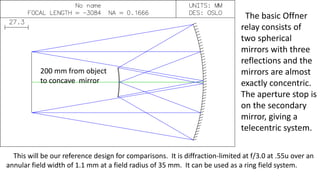
The basic Offner
relay consists of
two spherical
mirrors with three
reflections and the
mirrors are almost
exactly concentric.
The aperture stop is
on the secondary
mirror, giving a
telecentric system.
This will be our reference design for comparisons. It is diffraction-limited at f/3.0 at .55u over an
annular field width of 1.1 mm at a field radius of 35 mm. It can be used as a ring field system.
200 mm from object
to concave mirror
The basic Offner
design is limited by
higher-order
astigmatism and
Petzval and they can
be shown to be
related to spherical
aberration of the
chief ray. That can
be corrected with a
meniscus shell,
giving a greatly
enlarged field size.
This is diffraction limited at f/3 at .55u over an annular 12 mm field size in the plane of the
page or a much larger field out of the plane, such as a 60 x 1.0 mm linear strip field.
The excellent high-
order aberration
correction provided
by the meniscus
lens can be used for
a large diffraction-
limited field size, like
the 12 mm for f/3.0
or used for a faster
speed design, like
this f/2.0 with a 5.0
mm field size.
There is some color and chromatic variation of astigmatism and Petzval in these designs, which
can be minimized by having the meniscus lens not be exactly concentric (like a Maksutov shell).
The highest performance
happens when the
meniscus lens is between
the mirrors and is not in
contact with the convex
mirror. The extra passes
through the lens greatly
improve aberration
correction. Then the 5 mm
field size at f/2.0 from the
previous slide is becomes
10 mm with diffraction-
limited correction. This
design could also be
changed to a smaller field
size and a faster speed, like
f/1.5 shown here with a 4
mm field.
The stronger lens power in this double pass design makes color
more of a problem and this only works well with a fairly narrow
spectral bandwidth.
U.S. 4,331,390
By going to a more
complicated design, using a
single glass type, it is
possible to correct for an
extremely broad spectrum
over a narrow annular field
width.
All of these designs can be
used as ring field systems,
with an arc shaped field that
is large in one direction, or a
narrow linear field that is
perpendicular to the plane of
the page, or a smaller still
square field.
U.S. 4,711,535
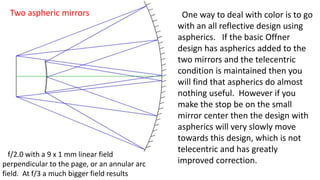
One way to deal with color is to go
with an all reflective design using
aspherics. If the basic Offner
design has aspherics added to the
two mirrors and the telecentric
condition is maintained then you
will find that aspherics do almost
nothing useful. However if you
make the stop be on the small
mirror center then the design with
aspherics will very slowly move
towards this design, which is not
telecentric and has greatly
improved correction.
f/2.0 with a 9 x 1 mm linear field
perpendicular to the page, or an annular arc
field. At f/3 a much bigger field results
Two aspheric mirrors
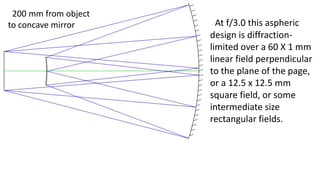
At f/3.0 this aspheric
design is diffraction-
limited over a 60 X 1 mm
linear field perpendicular
to the plane of the page,
or a 12.5 x 12.5 mm
square field, or some
intermediate size
rectangular fields.
200 mm from object
to concave mirror
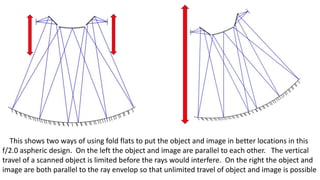
This shows two ways of using fold flats to put the object and image in better locations in this
f/2.0 aspheric design. On the left the object and image are parallel to each other. The vertical
travel of a scanned object is limited before the rays would interfere. On the right the object and
image are both parallel to the ray envelop so that unlimited travel of object and image is possible
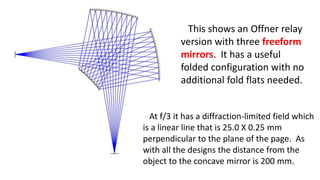
This shows an Offner relay
version with three freeform
mirrors. It has a useful
folded configuration with no
additional fold flats needed.
At f/3 it has a diffraction-limited field which
is a linear line that is 25.0 X 0.25 mm
perpendicular to the plane of the page. As
with all the designs the distance from the
object to the concave mirror is 200 mm.

Offner relay design variants

  • 1.
    Offner relay designvariations David Shafer David Shafer Optical Design Fairfield, CT 06824 #203-259-1431 shaferlens@sbcglobal.net
  • 2.
    The basic Offner relayconsists of two spherical mirrors with three reflections and the mirrors are almost exactly concentric. The aperture stop is on the secondary mirror, giving a telecentric system. This will be our reference design for comparisons. It is diffraction-limited at f/3.0 at .55u over an annular field width of 1.1 mm at a field radius of 35 mm. It can be used as a ring field system. 200 mm from object to concave mirror
  • 3.
    The basic Offner designis limited by higher-order astigmatism and Petzval and they can be shown to be related to spherical aberration of the chief ray. That can be corrected with a meniscus shell, giving a greatly enlarged field size. This is diffraction limited at f/3 at .55u over an annular 12 mm field size in the plane of the page or a much larger field out of the plane, such as a 60 x 1.0 mm linear strip field.
  • 4.
    The excellent high- orderaberration correction provided by the meniscus lens can be used for a large diffraction- limited field size, like the 12 mm for f/3.0 or used for a faster speed design, like this f/2.0 with a 5.0 mm field size. There is some color and chromatic variation of astigmatism and Petzval in these designs, which can be minimized by having the meniscus lens not be exactly concentric (like a Maksutov shell).
  • 5.
    The highest performance happenswhen the meniscus lens is between the mirrors and is not in contact with the convex mirror. The extra passes through the lens greatly improve aberration correction. Then the 5 mm field size at f/2.0 from the previous slide is becomes 10 mm with diffraction- limited correction. This design could also be changed to a smaller field size and a faster speed, like f/1.5 shown here with a 4 mm field. The stronger lens power in this double pass design makes color more of a problem and this only works well with a fairly narrow spectral bandwidth. U.S. 4,331,390
  • 6.
    By going toa more complicated design, using a single glass type, it is possible to correct for an extremely broad spectrum over a narrow annular field width. All of these designs can be used as ring field systems, with an arc shaped field that is large in one direction, or a narrow linear field that is perpendicular to the plane of the page, or a smaller still square field. U.S. 4,711,535
  • 7.
    One way todeal with color is to go with an all reflective design using aspherics. If the basic Offner design has aspherics added to the two mirrors and the telecentric condition is maintained then you will find that aspherics do almost nothing useful. However if you make the stop be on the small mirror center then the design with aspherics will very slowly move towards this design, which is not telecentric and has greatly improved correction. f/2.0 with a 9 x 1 mm linear field perpendicular to the page, or an annular arc field. At f/3 a much bigger field results Two aspheric mirrors
  • 8.
    At f/3.0 thisaspheric design is diffraction- limited over a 60 X 1 mm linear field perpendicular to the plane of the page, or a 12.5 x 12.5 mm square field, or some intermediate size rectangular fields. 200 mm from object to concave mirror
  • 9.
    This shows twoways of using fold flats to put the object and image in better locations in this f/2.0 aspheric design. On the left the object and image are parallel to each other. The vertical travel of a scanned object is limited before the rays would interfere. On the right the object and image are both parallel to the ray envelop so that unlimited travel of object and image is possible
  • 10.
    This shows anOffner relay version with three freeform mirrors. It has a useful folded configuration with no additional fold flats needed. At f/3 it has a diffraction-limited field which is a linear line that is 25.0 X 0.25 mm perpendicular to the plane of the page. As with all the designs the distance from the object to the concave mirror is 200 mm.