Luther Gulick and Lyndall
Urwick
Submitted by: Mohammad Omid Jami
15/10/2018
Content
Introduction
Life and times
Contributions
Criticism
Conclusion
4/27/2019 2
Introduction
Classical Thinkers
Closeness of contributions
Joint works
Same personal experience
Both had been influenced by military discipline and services
Bod had been influenced by Taylor an Fayol’s ideas
They developed the administrative to management theory together
4/27/2019 3
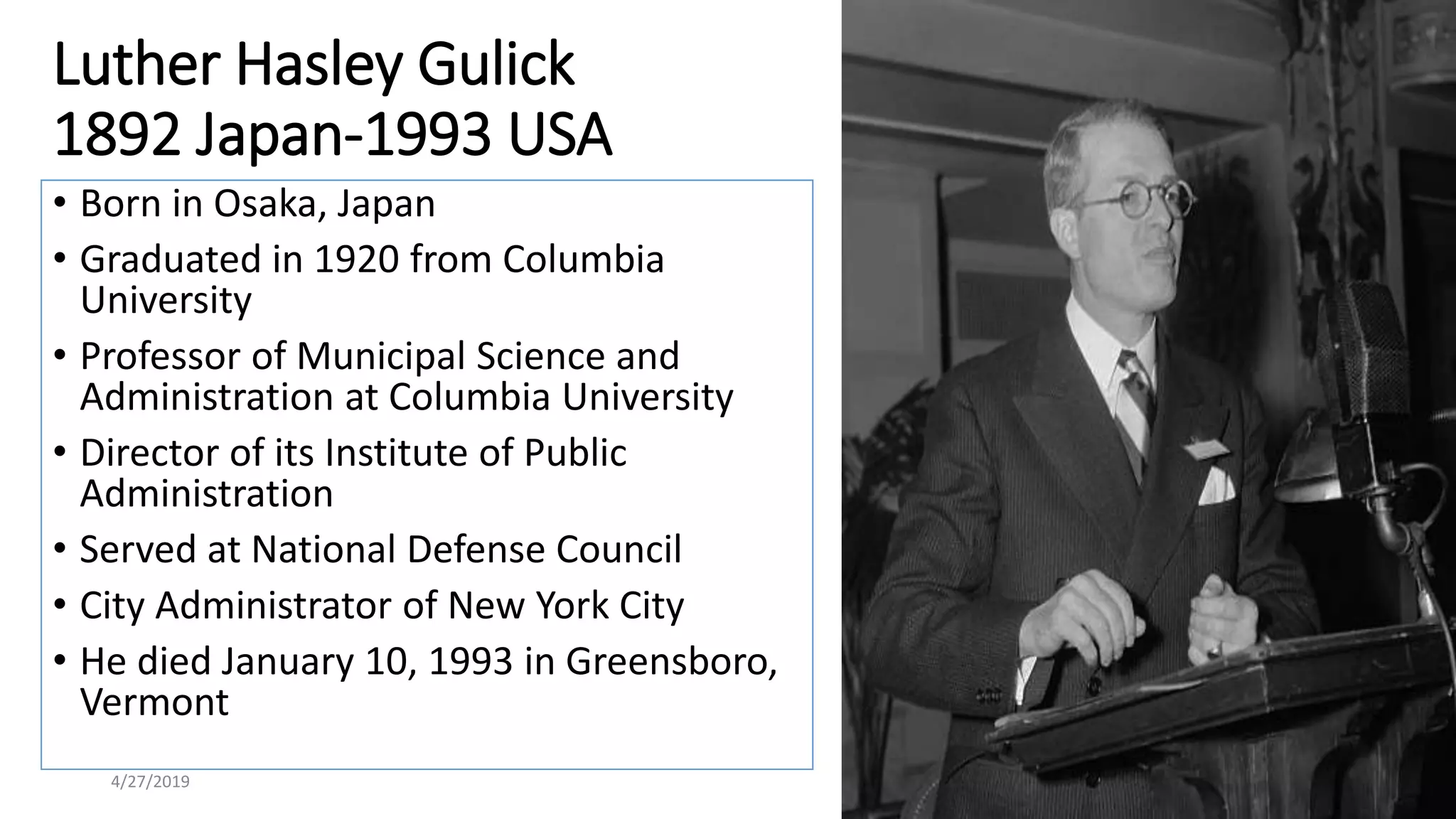
Luther Hasley Gulick
1892 Japan-1993 USA
• Born in Osaka, Japan
• Graduated in 1920 from Columbia
University
• Professor of Municipal Science and
Administration at Columbia University
• Director of its Institute of Public
Administration
• Served at National Defense Council
• City Administrator of New York City
• He died January 10, 1993 in Greensboro,
Vermont
4/27/2019 4
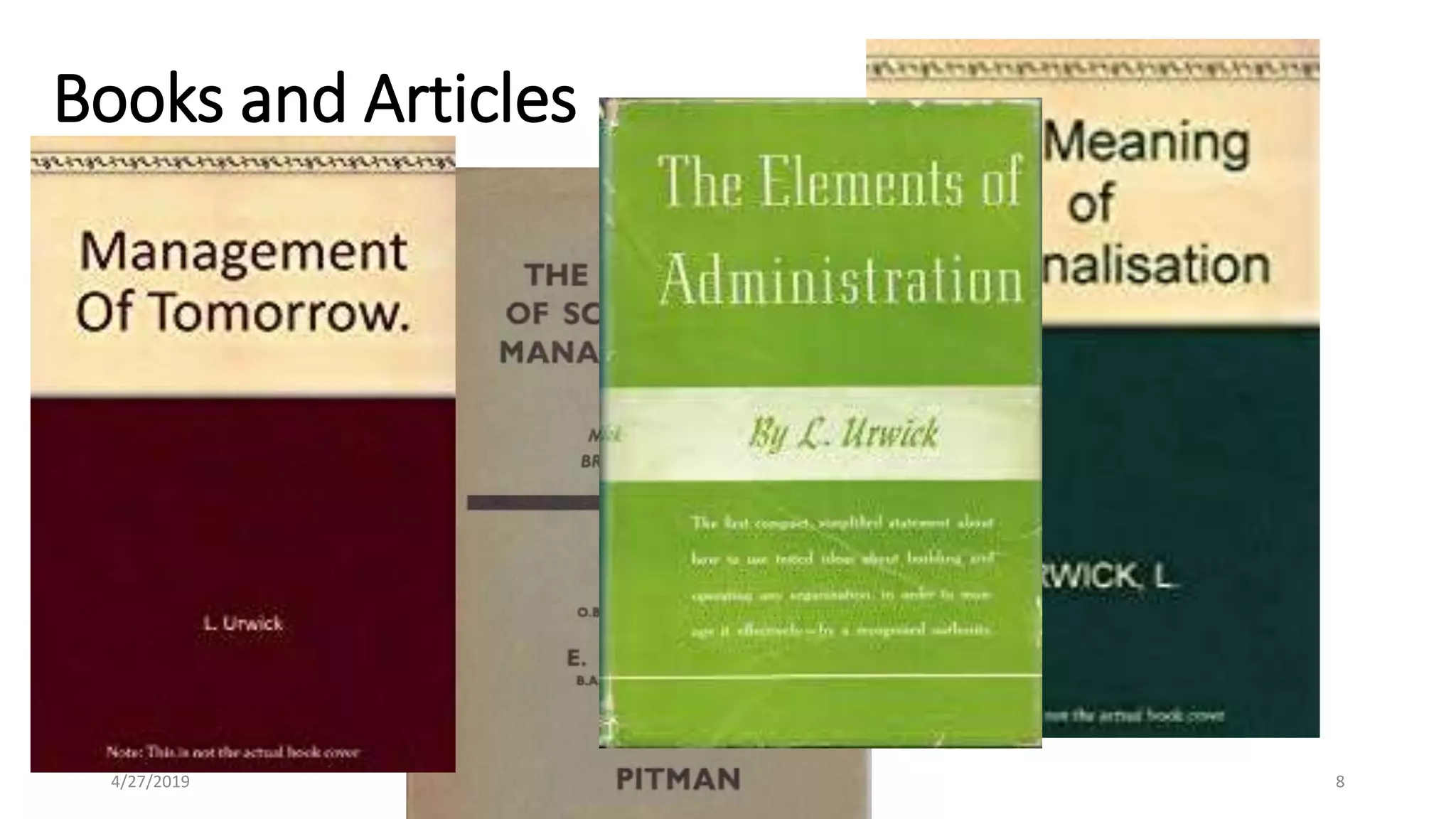
Books and Articles
4/27/2019 5
4/27/2019 6
Lyndall Fownes Urwick
1891 -1983 UK
Born in Malvern, Worcestershire
Graduated from Oxford University
Worked as business man
Worked in army during WW1
Director of the International Management
Institute in Geneva 1928-33
Urwick, Orr & Partners (UOP) Ltd a
consultancy Company 1934-1961
During the WWII worked as Advisor to the
Treasury
Several international Awards and Gold medals
4/27/2019 7
Books and Articles
4/27/2019 8
Papers on Science of
Administration
Dynamic Administration
Freedom and Coordination
4/27/2019 9
Books and Articles
Urwick and Gulick
Administrative to Management theory
• Related to top management
• Influenced by Tylor and Fayol
• To reach 3Es there are certain principles of administration which should be
understood and followed
• Classical theory reached its zenith
• They both also emphasized on importance of structure and formal organization
• Administration should be considered as a science
4/27/2019 10
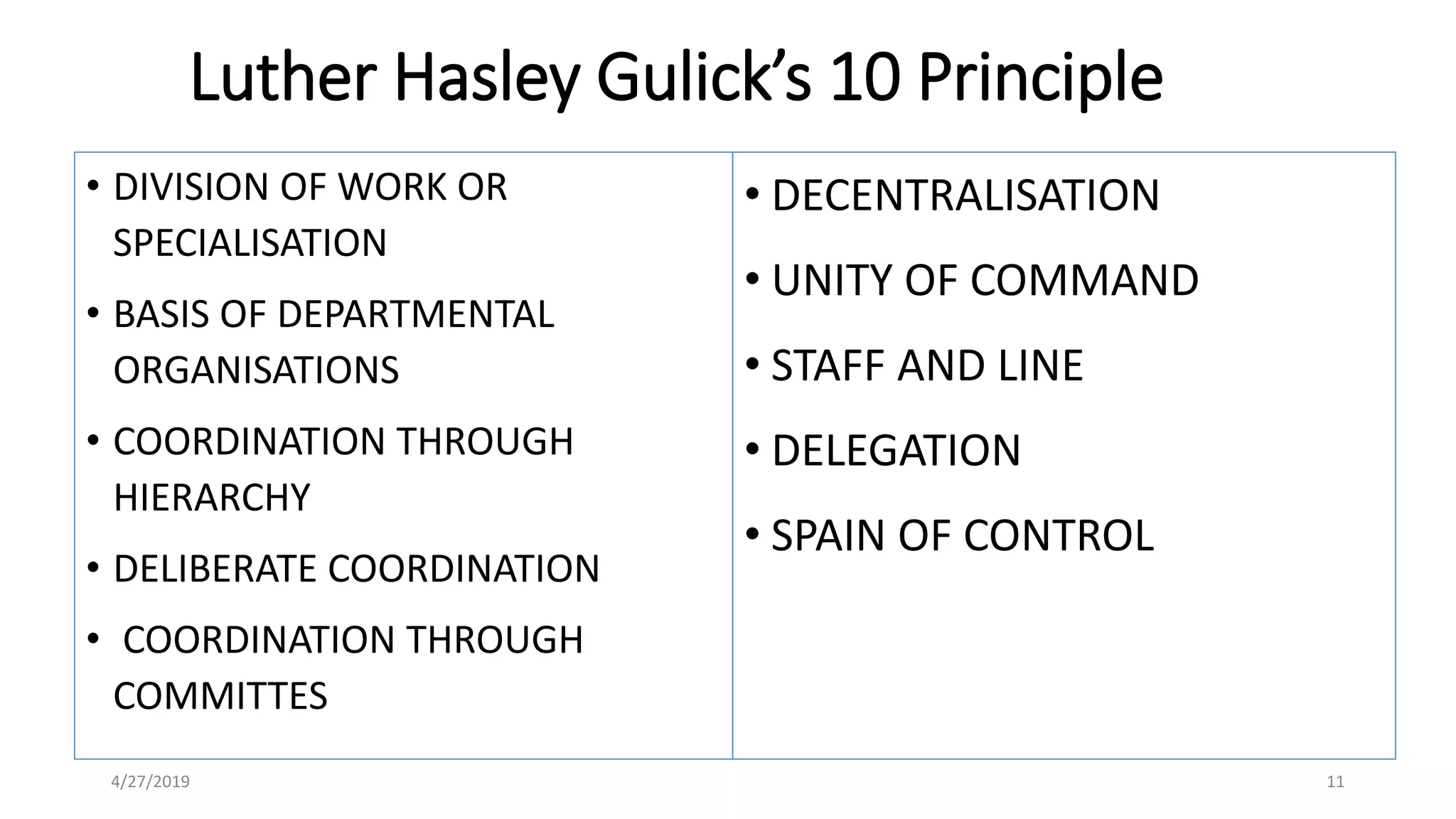
Luther Hasley Gulick’s 10 Principle
• DIVISION OF WORK OR
SPECIALISATION
• BASIS OF DEPARTMENTAL
ORGANISATIONS
• COORDINATION THROUGH
HIERARCHY
• DELIBERATE COORDINATION
• COORDINATION THROUGH
COMMITTES
4/27/2019 11
• DECENTRALISATION
• UNITY OF COMMAND
• STAFF AND LINE
• DELEGATION
• SPAIN OF CONTROL
Lyndall Fownes Urwick’s principles
1. Objectiveness
2. Corresspondence
3. Responsibility
4. Scalar
5. Span of Control
6. Specialisation
7. Cordination
8. Definition
4/27/2019 12
29 principles
Integrated Fayol’s fourteen
principles, Mooney and Reiley’s
principles of process and effect,
Taylor’s principles of
management and the ideas of
Follett and Graicunas
Critics
Herbert Simon
No evidence for principles
Lots of weaknesses on their theory
There is to much duplications on Urwicks 29 principles
“it is a fatal defect of the current principle of administration that, like
proverbs, they occur in pairs”
4/27/2019 13
Conclusion
4/27/2019 14
‫تان‬ ‫توجه‬ ‫از‬ ‫سپاس‬
Thank you for your attention
‫مننه‬ ‫ډیره‬
DHANYAWAD
4/27/2019 15

Luther Gulick and Lyndall Urwick

  • 1.
    Luther Gulick andLyndall Urwick Submitted by: Mohammad Omid Jami 15/10/2018
  • 2.
  • 3.
    Introduction Classical Thinkers Closeness ofcontributions Joint works Same personal experience Both had been influenced by military discipline and services Bod had been influenced by Taylor an Fayol’s ideas They developed the administrative to management theory together 4/27/2019 3
  • 4.
    Luther Hasley Gulick 1892Japan-1993 USA • Born in Osaka, Japan • Graduated in 1920 from Columbia University • Professor of Municipal Science and Administration at Columbia University • Director of its Institute of Public Administration • Served at National Defense Council • City Administrator of New York City • He died January 10, 1993 in Greensboro, Vermont 4/27/2019 4
  • 5.
  • 6.
  • 7.
    Lyndall Fownes Urwick 1891-1983 UK Born in Malvern, Worcestershire Graduated from Oxford University Worked as business man Worked in army during WW1 Director of the International Management Institute in Geneva 1928-33 Urwick, Orr & Partners (UOP) Ltd a consultancy Company 1934-1961 During the WWII worked as Advisor to the Treasury Several international Awards and Gold medals 4/27/2019 7
  • 8.
  • 9.
    Papers on Scienceof Administration Dynamic Administration Freedom and Coordination 4/27/2019 9 Books and Articles Urwick and Gulick
  • 10.
    Administrative to Managementtheory • Related to top management • Influenced by Tylor and Fayol • To reach 3Es there are certain principles of administration which should be understood and followed • Classical theory reached its zenith • They both also emphasized on importance of structure and formal organization • Administration should be considered as a science 4/27/2019 10
  • 11.
    Luther Hasley Gulick’s10 Principle • DIVISION OF WORK OR SPECIALISATION • BASIS OF DEPARTMENTAL ORGANISATIONS • COORDINATION THROUGH HIERARCHY • DELIBERATE COORDINATION • COORDINATION THROUGH COMMITTES 4/27/2019 11 • DECENTRALISATION • UNITY OF COMMAND • STAFF AND LINE • DELEGATION • SPAIN OF CONTROL
  • 12.
    Lyndall Fownes Urwick’sprinciples 1. Objectiveness 2. Corresspondence 3. Responsibility 4. Scalar 5. Span of Control 6. Specialisation 7. Cordination 8. Definition 4/27/2019 12 29 principles Integrated Fayol’s fourteen principles, Mooney and Reiley’s principles of process and effect, Taylor’s principles of management and the ideas of Follett and Graicunas
  • 13.
    Critics Herbert Simon No evidencefor principles Lots of weaknesses on their theory There is to much duplications on Urwicks 29 principles “it is a fatal defect of the current principle of administration that, like proverbs, they occur in pairs” 4/27/2019 13
  • 14.
  • 15.
    ‫تان‬ ‫توجه‬ ‫از‬‫سپاس‬ Thank you for your attention ‫مننه‬ ‫ډیره‬ DHANYAWAD 4/27/2019 15

Editor's Notes

  • #3 More exastive of principle of administration They focused on efficiency and effectiveness on their writings It is beacause of this, that one finds continued references to discipline and efficiency in their writings Importance to the structure of org Urwik remarks It is impossible for humanity to advance its knowledge of organization unless the factor on structure is isolated from the considerations, however artificial such an isolation may appear.
  • #4 Importance to the structure of org Urwik remarks It is impossible for humanity to advance its knowledge of organization unless the factor on structure is isolated from the considerations, however artificial such an isolation may appear. Closeness of conterbutions And joint works Both had same personal experience in (military and civil services) And had influence by military discipline and services And infesized in discipline Both are influenced by taylor ideas in sintific management And fayol ideas on classical theory of public administration They developed the administrative to management theory togather This theory is related to top management They both believed that there are certain principles of administration They should be understood and followed to reach the efficiency and effectiveness The both believed that administration should be considered as a science which the mentioned that…. They both emphasized on importance of structure and formal organization Urwik” organization is … a proper design to run the administration properly” Lack of design ….
  • #5 In a time where the prevalent theme was the separation of politics and administration, Gulick advocated that it was impossible to separate the two.
  • #6  Evolution of the Budget in Massachusetts. Macmillan, 1920.  Administrative Reflections from World War II. University of Alabama Press, 1948.  American Forest Policy. Duell, Sloan & Pearce, 1951.  The Metropolitan Problems and American Ideas. Knopf, 1966. Notes on the Theory of organizations 1937 Papers on the Science of Administration
  • #8  Taylor Key Gantt Memorial Medal Follow of international Academy of Management
  • #10 Wrote or edited 1937 Found together “Administrative science quarterly” an academic journal
  • #11 They both emphasized on importance of structure and formal organization Urwik” organization is … a proper design to run the administration properly” Lack of design ….
  • #12 4 bases to work be divided in an org and department are created Purpose(function) Process(skill) Persons(clientele) Place(territory)
  • #13 Lots of duplications 1943 the elements of administration His most famous book
  • #14 More exastive of principle of administration They focused on efficiency and effectiveness on their writings It is beacause of this, that one finds continued references to discipline and efficiency in their writings Importance to the structure of org Urwik remarks It is impossible for humanity to advance its knowledge of organization unless the factor on structure is isolated from the considerations, however artificial such an isolation may appear. He conceived organization mainly as a designing process, and felt that “lack of design is illogical, cruel, wasteful and inefficient”
  • #15 Theory of Administrative to management theory Their theory means that there are principles for making efficiency and effectiveness in organizations