CONTENTS
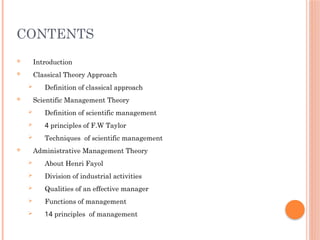
Introduction
ClassicalTheory Approach
Definition of classical approach
Scientific Management Theory
Definition of scientific management
4 principles of F.W Taylor
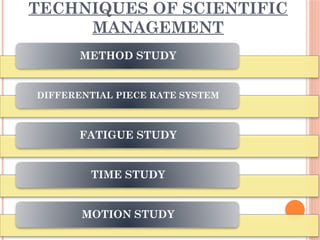
Techniques of scientific management
Administrative Management Theory
About Henri Fayol
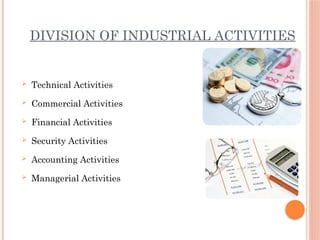
Division of industrial activities
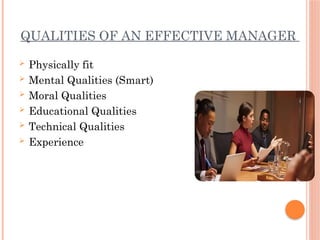
Qualities of an effective manager
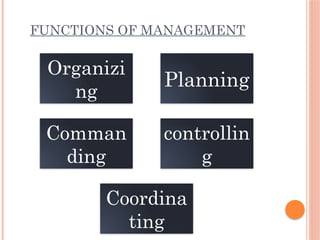
Functions of management
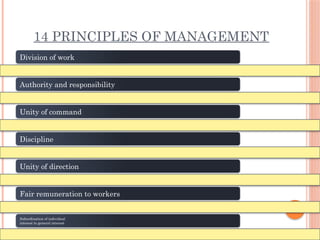
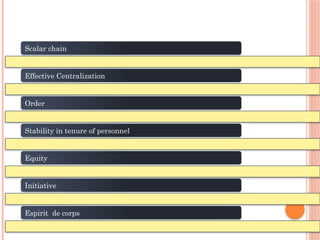
14 principles of management
3.
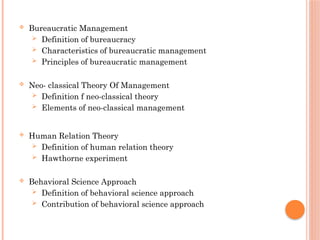
Bureaucratic Management
Definition of bureaucracy
Characteristics of bureaucratic management
Principles of bureaucratic management
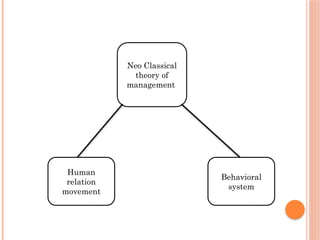
Neo- classical Theory Of Management
Definition f neo-classical theory
Elements of neo-classical management
Human Relation Theory
Definition of human relation theory
Hawthorne experiment
Behavioral Science Approach
Definition of behavioral science approach
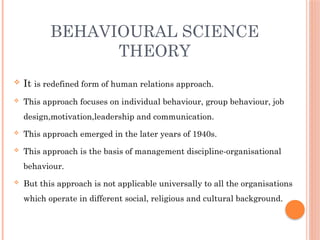
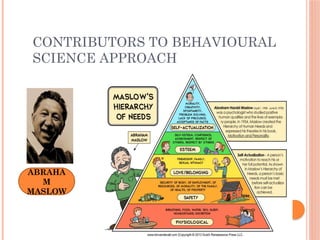
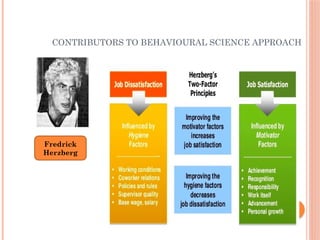
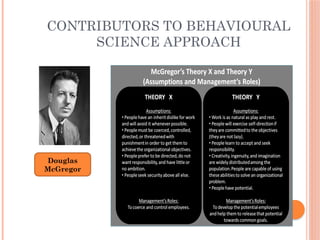
Contribution of behavioral science approach
4.
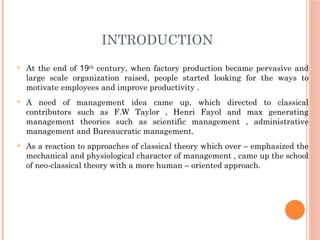
INTRODUCTION
At theend of 19th
century, when factory production became pervasive and
large scale organization raised, people started looking for the ways to
motivate employees and improve productivity .
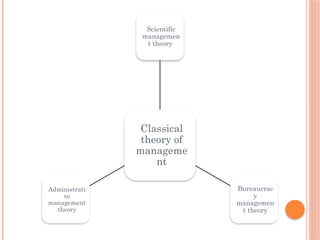
A need of management idea came up, which directed to classical
contributors such as F.W Taylor , Henri Fayol and max generating
management theories such as scientific management , administrative
management and Bureaucratic management.
As a reaction to approaches of classical theory which over – emphasized the
mechanical and physiological character of management , came up the school
of neo-classical theory with a more human – oriented approach.
DEFINITION OF CLASSICALAPPROACH
Classical approach is the oldest formal
school of thought which began around
1900 and continued into the 1920’s.
Its mainly concerned with the increasing
the efficiency of workers and organization
based on management practices, which
were an outcome of careful observation.
Classical approach mainly looks for the
universal principles of operation in the
striving for economic efficiency.
SCIENTIFIC MANAGEMENT THEORY
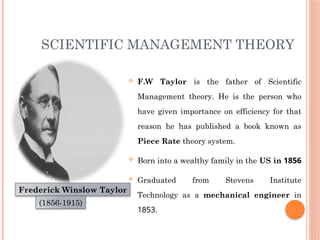
F.W Taylor is the father of Scientific
Management theory. He is the person who
have given importance on efficiency for that
reason he has published a book known as
Piece Rate theory system.
Born into a wealthy family in the US in 1856
Graduated from Stevens Institute
Technology as a mechanical engineer in
1853.
Frederick Winslow Taylor
(1856-1915)
9.
DEFINITION OF SCIENTIFIC
MANAGEMENT
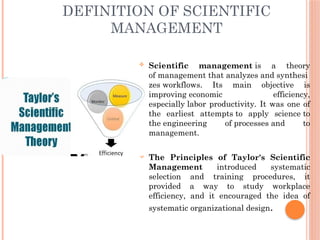
Scientific management is a theory
of management that analyzes and synthesi
zes workflows. Its main objective is
improving economic efficiency,
especially labor productivity. It was one of
the earliest attempts to apply science to
the engineering of processes and to
management.
The Principles of Taylor's Scientific
Management introduced systematic
selection and training procedures, it
provided a way to study workplace
efficiency, and it encouraged the idea of
systematic organizational design.
10.
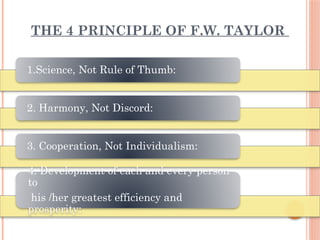
THE 4 PRINCIPLEOF F.W. TAYLOR
1.Science, Not Rule of Thumb:
2. Harmony, Not Discord:
3. Cooperation, Not Individualism:
4. Development of each and every person
to
his /her greatest efficiency and
prosperity:
ADMINISTRATIVE MANAGEMENT
Administrativemanagement attempts to find a rational way to design an
organization as a whole.
The theory generally calls for a formalize administrative structure , a clear
division of labor , and delegation of power and authority to administrators
relevant to their area of responsibility.
According to this theory, you should design an organization using a very
formalized structure with clear lines of authority from the top to down.
This is hierarchical structure
13.
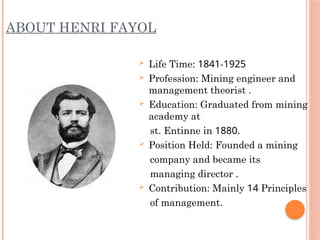
ABOUT HENRI FAYOL
Life Time: 1841-1925
Profession: Mining engineer and
management theorist .
Education: Graduated from mining
academy at
st. Entinne in 1880.
Position Held: Founded a mining
company and became its
managing director .
Contribution: Mainly 14 Principles
of management.
14.
FAYOL’S CONTRIBUTION TO
MANAGEMENT
AREDIVIDED IN FOUR SECTION:
Division of Industrial Activities
Quality of an effective manager
Functions of management
Principles of management
14 PRINCIPLES OFMANAGEMENT
Division of work
Authority and responsibility
Unity of command
Discipline
Unity of direction
Fair remuneration to workers
Subordination of individual
interest to general interest
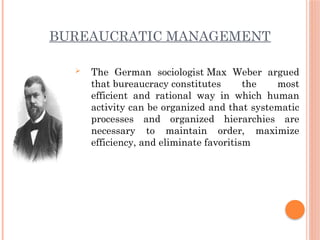
BUREAUCRATIC MANAGEMENT
TheGerman sociologist Max Weber argued
that bureaucracy constitutes the most
efficient and rational way in which human
activity can be organized and that systematic
processes and organized hierarchies are
necessary to maintain order, maximize
efficiency, and eliminate favoritism
21.
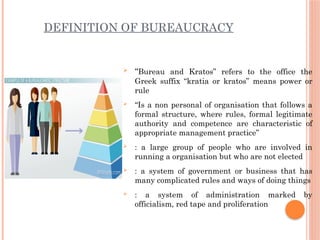
DEFINITION OF BUREAUCRACY
“Bureau and Kratos” refers to the office the
Greek suffix “kratia or kratos” means power or
rule
“Is a non personal of organisation that follows a
formal structure, where rules, formal legitimate
authority and competence are characteristic of
appropriate management practice”
: a large group of people who are involved in
running a organisation but who are not elected
: a system of government or business that has
many complicated rules and ways of doing things
: a system of administration marked by
officialism, red tape and proliferation
22.
CHARACTERISTIC OF BUREAUCRATIC
MANAGEMENT
Specialization of labor
A formal set of rules and regulations
Well-defined hierarchy within the organization
Impersonality in the application of rules
23.
A formalhierarchical structure – In a bureaucratic organization, each level controls
the level below it. Also, the level above it controls it. A formal hierarchy is the basis of
central planning and centralized decision-making.
Rules-based Management – The organization uses rules to exert control. Therefore,
the lower levels seamlessly execute the decisions made at higher levels.
Functional Specialty organization – Specialists do the work. Also, the organization
divides employees into units based on the type of work they do or the skills they possess.
Up-focused or In-focused Mission – If the mission of the organization is to serve the
stockholders, board, or any other agency that empowered it, then it is up-focused. On
the other hand, if the mission is to serve the organization itself and those within it (like
generating profits, etc.), then it is in-focused.
INTRODUCTION
The termclassical refers to work done by a group of economists
in18th
and 19th
centuries.
The word neo means “New”.
Much of these work was developing theories about the way
markets and markets economists and the are generally termed
“Neo-classical economists”.
The neo classical approach was set out by Alfred Marshall in his
principles of economics, published in 1890.
26.
• It maybe noted here that the theories stated by Taylor and
Fayol are called by writers as classical theories
• while the theories stated by writers as classical theories the
human relations movement and the behavioural science
movement are called new-classical theories.
27.
ELEMENTS OF NEO-CLASSICAL
THEORIES
1.Individual
2. Work Group
3.Participative management
4.Oreintation
5. Motivation
6. Leadership
7. Employee Development
28.
INDIVIDUAL
Neo-classical theoryrecognized the individual
differences which were ignored by the classical theory.
Every individual has emotions, feelings, attitudes,
hopes, aspirations, and expectations.
The new-classical theory advocated a package deal of
motivation, including financial and non financial
incentives, to make the workers feel at ease at work
and increase their productivity.
29.
WORK GROUP
• Anindividual in a group develops Social wants.
• As he is a social being, he develops a desire to belong
& to be accepted by his work group.
Participative Management
• Neo-classical theory suggested workers
participation in management for improving
their productivity.
30.
ORIENTATION
Classical theorywas job oriented while neo-classical
theory is employee oriented.
There is a shift in managerial style from product
oriented approach to employee and group centred
approach.
classical theory was concerned with the basic needs of
organization and society whereas neo-classical
approach tried to satisfy the personal security and
social needs of workers.
31.
MOTIVATION
• No-classical writersconsidered business
organization as a social system,
• The employees could be motivated by social and
psychological wants and not solely by economic
incentives.
LEADERSHIP
• Democratic style of leadership is essential to
develop co-operative attitude of employee
towards management.
32.
EMPLOYEE DEVELOPMENT
Asthere is a close connection between moral and
production, neo-classical writers emphasized that
management that must take greater interest in
employee development workers satisfaction.
HUMAN RELATION THEORYOF
MANAGEMENT
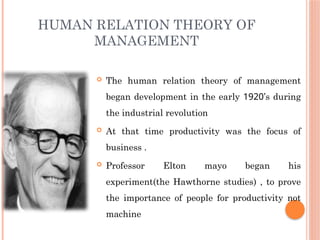
The human relation theory of management
began development in the early 1920’s during
the industrial revolution
At that time productivity was the focus of
business .
Professor Elton mayo began his
experiment(the Hawthorne studies) , to prove
the importance of people for productivity not
machine
35.
HUMAN RELATION THEORYOF
MANAGEMENT
The human relations management theory is a
researched belief that people desire to be part of a
supportive team that facilitates development and
growth .
Therefore , if employees receive special attention and
are encouraged to participate , they perceive their
work has significance , and they are motivated to be
more productive , resulting in high quality
36.
HAWTHORNE EXPERIMENT
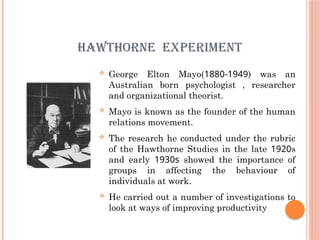
GeorgeElton Mayo(1880-1949) was an
Australian born psychologist , researcher
and organizational theorist.
Mayo is known as the founder of the human
relations movement.
The research he conducted under the rubric
of the Hawthorne Studies in the late 1920s
and early 1930s showed the importance of
groups in affecting the behaviour of
individuals at work.
He carried out a number of investigations to
look at ways of improving productivity
37.
HAWTHORNE EFFECT
TheHawthorne effect is the idea that “behaviour during
the course of an experiment can be altered by a subject’s
awareness of participating in an experiment”.
The initial Hawthorne effect took place in the
Hawthorne plant of western electric company in the
1920’s and 1930’s.
The studies were composed of many long “investigations
into the importance for work behaviour and attitudes of
a variety of physical , economic and social variables”.
38.
HAWTHORNE EXPERIMENT
TheHawthorne experiment were first conducted in November , 1924 at
western electric company’s Hawthorne plant in Chicago.
The initial tests were sponsored by the National research council (NRC) of
the national academy of sciences.
In 1927 , a research team from Harvard business school was invented to
join the studies after the illumination test drew unanticipated results.
A team of researchers led by George Elton Mayo from the Harvard
business school carried out the studies.
(General Electric originally contributed funding , but they withdrew after
the first trial was completed).
39.
FOUR PARTS OFHAWTHORNE
EXPERIMENT
I. Part 1-Illumination Experiments (1924-27).
II. Part 2-Relay Assembly Test Room Study (1927-
1929).
III. Part 3-Mass Interviewing Programme (1928-1930).
IV. Part 4-Bank Wiring Observation Room Experiment
(1932)
40.
PART 1 –ILLUMINATION
EXPERIMENTS (1924-1927)
These experiments were performed to find out the effect of
different levels of illumination (lighting) on productivity.
The brightness of the light was increased and decreased to find
out the effect on the productivity of the test group. Surprisingly,
the productivity increased even when the level of illumination
was decreased.
It was concluded that factors other than light were also
important.
41.
PART 2 –RELAY ASSEMBLY TEST
ROOM STUDY ( 1927-1929)
Under these test two small groups of six female telephone relay
assemblers were selected. Each group was kept in a separate rooms.
From time to time, changes were made in working hours , rest
periods, lunch breaks, etc. They were allowed to choose their own
rest periods and to give suggestions. Output increased in both the
control rooms. It was concluded that social relationship among
workers, participation in decision-making, etc. had a greater effect
on productivity than working conditions.
42.
PART 3 –MASS INTERVIEWING
PROGRAMME (1928-1930)
21,000 employees were interviewed over a period
of three years to find out reasons for increased
productivity. It was concluded that productivity
can be increased if workers are allowed to talk
freely about matters that are important to them.
43.
PART 4 –BANK WIRING OBSERVATION
ROOM EXPERIMENT (1932)
A group of 14 male workers in the bank wiring room were placed
under observation for six months. A workers' pay depended on
the performance of the group as a whole . The researchers
thought that the efficient workers would put pressure on the less
efficient workers to complete the work. However, it was found
that the group established its own standards of output, and social
pressure was used to achieve the standards of output.
BEHAVIOURAL SCIENCE
THEORY
Itis redefined form of human relations approach.
This approach focuses on individual behaviour, group behaviour, job
design,motivation,leadership and communication.
This approach emerged in the later years of 1940s.
This approach is the basis of management discipline-organisational
behaviour.
But this approach is not applicable universally to all the organisations
which operate in different social, religious and cultural background.
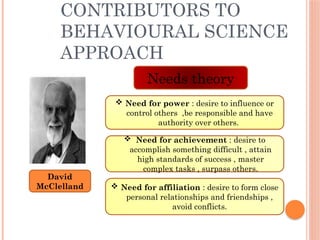
CONTRIBUTORS TO
BEHAVIOURAL SCIENCE
APPROACH
David
McClelland
Needstheory
Need for power : desire to influence or
control others ,be responsible and have
authority over others.
Need for achievement : desire to
accomplish something difficult , attain
high standards of success , master
complex tasks , surpass others.
Need for affiliation : desire to form close
personal relationships and friendships ,
avoid conflicts.
50.
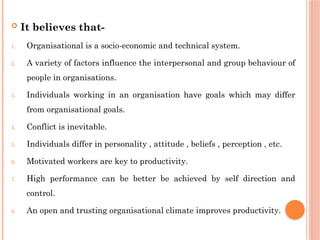
It believesthat-
1. Organisational is a socio-economic and technical system.
2. A variety of factors influence the interpersonal and group behaviour of
people in organisations.
3. Individuals working in an organisation have goals which may differ
from organisational goals.
4. Conflict is inevitable.
5. Individuals differ in personality , attitude , beliefs , perception , etc.
6. Motivated workers are key to productivity.
7. High performance can be better be achieved by self direction and
control.
8. An open and trusting organisational climate improves productivity.
51.
CONCLUSION
Classical andneoclassical approaches made a crucial role in the
advancement of management theories and practices
Though classical theory is now outdated, it is still important as it
introduced the concept of management as a subject for intellectual
analysis . Neoclassical approach put overemphasis on human variable
and symbolic reward .
So it is clear that the field of management has some remarkable
theories which are underpinned by pragmatic study evidence . The
development holds a rather brighter future for the study , research and
practice of management .