NJ Futures Forum 2012
March 2012
Evolving strategies for land assemblage, urban redevelopment
without eminent domain.
The Evolving Jersey City Experience.
2
3
4
5
6
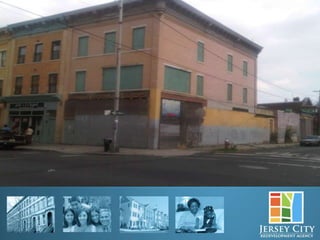
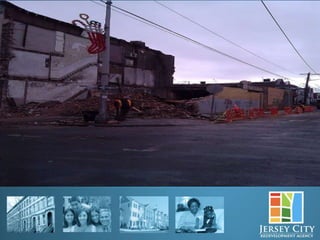
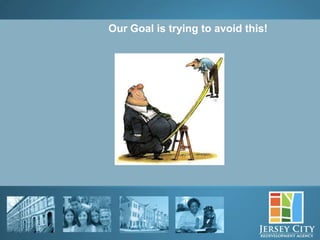
Our Goal is trying to avoid this!


7
Moving toward “Voluntary” land assemblage.
The “goal” is real market based incentives to land assembly.


         8
The “greed and avarice” scenario.

 The difficulty of assembling sites large enough to redevelop at higher
  density can and has hindered renewal in city centers and accelerate
  suburban sprawl onto large sites already in single ownership. A number
  of cities are looking at new redevelopment strategies encouraging
  voluntary land assembly. Graduated Density is one strategy now being

  used in California and Jersey City. Others are Land Assembly Districts
  “with the power, by a majority vote, to approve or disapprove the sale of
  the neighborhood to a developer or municipality seeking to consolidate
  the land in a single parcel”. Land Pooling and Land Adjustments are
  other scenarios being looked at in the United States and other countries.
  Canal Crossing is evolving to include a little of everything.


               9
Graduated Density can create a new fear of being left out.

 Graduated density zoning which allows higher density on larger sites. This
  strategy can increase the incentive for owners to cooperate in voluntary
  land assemblage that can create higher land values. Graduated density
  zoning will not eliminate the incentive to hold out, but it can create a new
  fear of being left out.
 Holdouts who are left with sites that cannot be combined with enough
  contiguous properties to trigger higher density lose a valuable economic
  opportunity.
 Jersey City is presently using this strategy in Journal Square and McGinley
  Square Redevelopment Areas.


               10
Journal Square Redevelopment Plan

 The original Journal Square Plan called for the an increase beyond the
  underlying zoning districts’ maximum FAR would be permitted through a
  District Improvement Bonuses (DIBs) and the Inclusionary Housing Bonus.
  Both of these tools were meant to provide more development options in the
  Square without overly enriching the existing property owner.
 The central purpose DIB was to “even the playing field” between the
  property owner and the developer, while providing much needed funds for
  infrastructure improvements.

 Journal Square is the ultimate “fragmented ownership” scenario.


              11
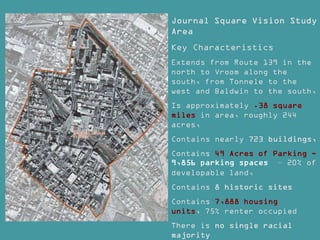
The Study Area
Redevelop Journal
     Square         12
Journal
     Square
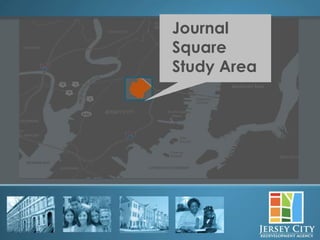
     Study Area


13
–
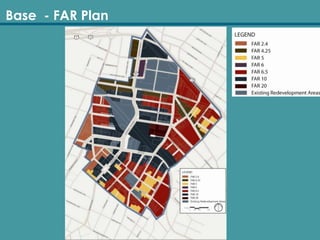
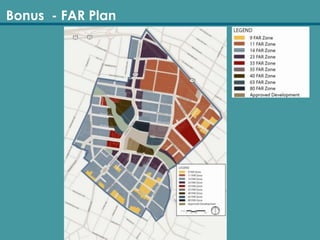
Journal Square Density
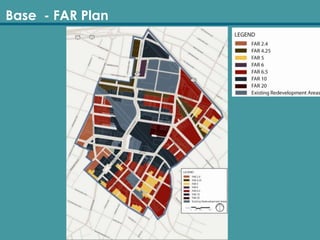
Base - FAR Plan
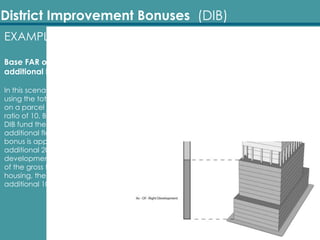
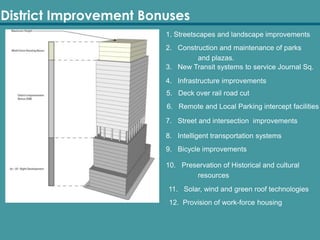
District Improvement Bonuses (DIB)
EXAMPLE

Base FAR of 10, eligible for an
additional bonus FAR of 20

In this scenario, a 36 story building
using the total site area is proposed
on a parcel with a base floor area
ratio of 10. By contributing to the
DIB fund they were awarded
additional floor area of 20. This
bonus is applied by adding an
additional 20 stories to the
development. By setting aside 10%
of the gross floor area to workforce
housing, the developer earned an
additional 10% to the building area.
District Improvement Bonuses
                        1. Streetscapes and landscape improvements
                        2. Construction and maintenance of parks
                                 and plazas.
                        3. New Transit systems to service Journal Sq.
                        4. Infrastructure improvements
                        5. Deck over rail road cut
                        6. Remote and Local Parking intercept facilities

                        7. Street and intersection improvements

                        8. Intelligent transportation systems
                        9. Bicycle improvements

                        10. Preservation of Historical and cultural
                                resources
                        11. Solar, wind and green roof technologies
                         12. Provision of work-force housing
Base - FAR Plan
Bonus - FAR Plan
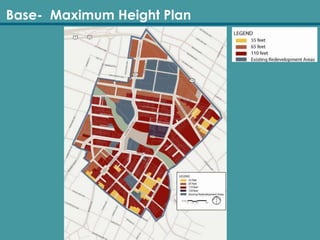
Base- Maximum Height Plan
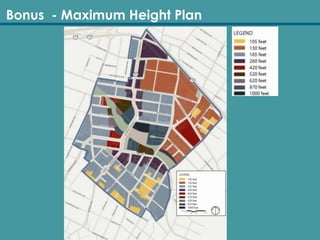
Bonus - Maximum Height Plan
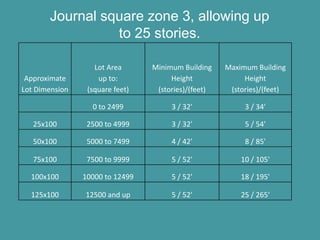
Journal square zone 3, allowing up
                 to 25 stories.

                   Lot Area      Minimum Building    Maximum Building
 Approximate        up to:            Height              Height
Lot Dimension    (square feet)    (stories)/(feet)    (stories)/(feet)

                  0 to 2499           3 / 32'             3 / 34'

   25x100        2500 to 4999         3 / 32'             5 / 54'

   50x100        5000 to 7499         4 / 42'             8 / 85'

   75x100        7500 to 9999         5 / 52'            10 / 105'

  100x100       10000 to 12499        5 / 52'            18 / 195'

  125x100       12500 and up          5 / 52'            25 / 265'
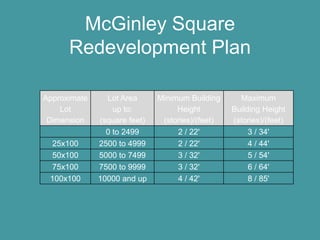
McGinley Square
      Redevelopment Plan

Approximate     Lot Area      Minimum Building      Maximum
    Lot           up to:           Height         Building Height
 Dimension    (square feet)    (stories)/(feet)   (stories)/(feet)
                0 to 2499          2 / 22'             3 / 34'
 25x100       2500 to 4999         2 / 22'             4 / 44'
 50x100       5000 to 7499         3 / 32'             5 / 54'
 75x100       7500 to 9999         3 / 32'             6 / 64'
 100x100      10000 and up         4 / 42'             8 / 85'
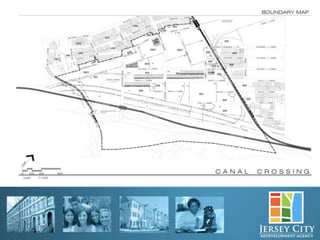
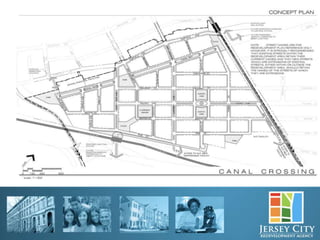
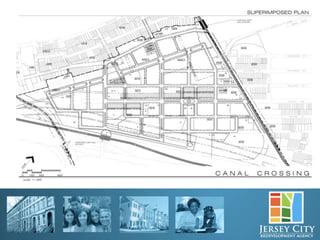
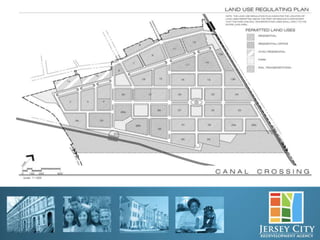
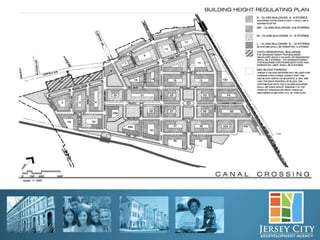
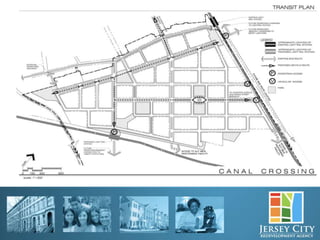
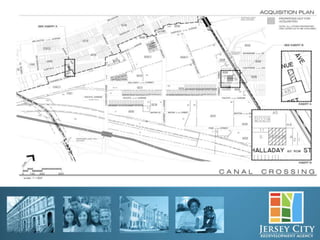
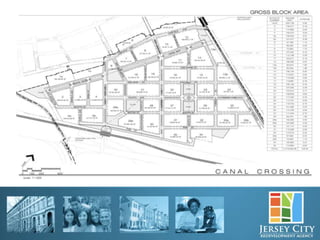
Canal Crossing Redevelopment Area
Finding a “new” model for large scale urban
              redevelopment.


      25
In October 2010, the Agency received a $2.3
million Tiger Planning Grant ( DOT/HUD) for
development studies to work out the details
and cost associated with the redevelopment of
Canal Crossing, this work includes a funding
and equity mechanism.


      26
Revitalization of this area has been hampered by
outdated infrastructure, large tracts of contaminated
former industrial lands, and a road system that fails to
sufficiently link up with the local regional rail network.
The project focus will be to create a residential, mixed-
use, transit-oriented development with access to open
space amenities in a community with a significant low-
income population. The process will also develop a
formal legal framework to ensure that redevelopment is
equitable


           27
28
29
30
31
32
33
34
35
RELOCATION

• As outlined, the Canal Crossing Redevelopment Plan converts
  former old industrial sites into new blocks for mixed use residential
  development. Wherever practical, it is the preference of the
  Jersey City Redevelopment Agency for existing property
  owners to participate in such manner that development of the
  proposed blocks can occur in accordance with this Plan. To
  that extent, this Plan and the Agency encourage the
  cooperation among the existing property owners in order for
  any block to realize its full development potential. Under this
  scenario, the relocation of persons or businesses should be
  significantly reduced. In terms of relocation, the vast majority of
  relocations will only affect businesses, since only one residentially
  occupied property is currently listed for acquisition.
The Challenge is!

This doesn’t get us where we need to go
as a community of property owners and as
a city. It doesn’t address the brown field
issue/chromium clean up. It doesn’t
address the flooding and other serious
infrastructure issues, not to mention
planning issues of new grid and transit.
Rincon Redevelopment Plan,
    San Francisco, Ca.
B. Owner Participation

•   To the extent compatible with the purposes of the Plan and
    appropriate redevelopment of the Project, owners of real property in the
    Project may, subject to rules and regulations including standards for
    rehabilitation promulgated by the Redevelopment Agency, be accorded the
    opportunity to participate in the redevelopment of the Project. Such
    participation shall be contingent upon execution by such owner of a binding
    agreement (hereinafter called “owner participation agreement”) by which the
    property retained or acquired will be developed, maintained, or rehabilitated
    for use in conformity with the Plan, the Declaration of Restrictions, and the
    Owner Participation Rules promulgated by the Agency.
•   Owner participation necessarily will be subject to and limited by such factors
    as the nature, condition, and use of the existing improvements; the
    reduction of the total number of individual parcels in the Project; the
    elimination of certain land uses; the realignment of streets; the construction
    of new public facilities and improvement in accordance with the Plan, the
    declaration of restrictions and in accordance with such controls as may be
    found necessary to ensure that redevelopment is carried out pursuant to
    this Plan.
D. Acquisition of Real Property

•   Any real property located within the Project Area may be acquired by the
    Agency by purchase, gift, devise, exchange, condemnation, lease, or any
    other lawful method, including utilization of the power of eminent domain, if
    one or more of the following conditions are met.
•   The building is substandard to a degree requiring clearance as
    demonstrated by a structural inspection of the property.
•   The property must be acquired in order to eliminate an environment
    deficiency, including but not limited to: incompatible land uses, small and
    irregular lot subdivision, or overcrowding of the land.
•   The property must be acquired in order to eliminate impediments to land
    development through assembly of land into parcels of reasonable size and
    shape, served by an improved street system and public utilities.
D. Acquisition of Real Property

• The building must be removed in order to effect a
  change in land use as provided in this Plan.
• Without the consent of an owner, the Agency shall not
  acquire any real property on which an existing building is
  to be continued on its present site and in its present form
  and use unless such building requires structural
  alteration, improvement, modernization or
  rehabilitation, or the site or lot on which the building is
  situated requires modification in size, shape or use or it
  is necessary to impose upon such property any of the
  standards, restriction and controls of the Plan and the
  owner fails or refuses to agree to participate in the
  Redevelopment Plan.
Anaheim Platinum Triangle.
• The City Council identified a few criteria for the plan:
• First, private property owners should drive development within the
  Platinum Triangle.
• There would be no subsidies or other public incentives to achieve
  development goals.
• Second, new mixed-use developments could not turn existing
  properties into nonconforming uses or buildings. Property owners
  would still retain the rights to develop and use property pursuant to
  existing zoning.
• Third, recognizing that the area was composed of dozens of
  individually owned parcels, the private sector would have to
  assemble parcels if larger sites were to be developed. The city
  would not use eminent domain to acquire property.
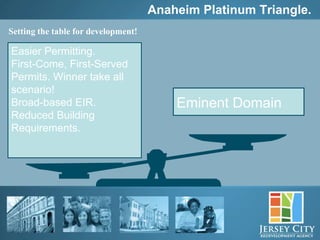
Anaheim Platinum Triangle.
Setting the table for development!

Easier Permitting.
First-Come, First-Served
Permits. Winner take all
scenario!
Broad-based EIR.                         Eminent Domain
Reduced Building
Requirements.


              44
Curt Pringle
     Mayor of the City of Anaheim

   While many owners decided to
redevelop or sell their properties, other
small businesses have decided to stay
where they are, which is exactly what our
plan allows them to do—keep their
businesses with out the threat of eminent
domain.
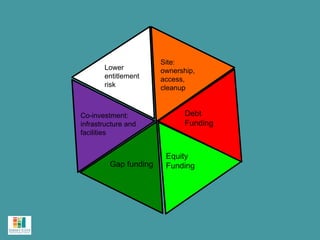
Six areas where public private partnerships
 create value in contemporary real estate
               development.
Site:
       Lower           ownership,
       entitlement     access,
       risk            cleanup


Co-investment:                Debt
infrastructure and            Funding
facilities


                        Equity
         Gap funding    Funding
Thank You

NJ Future Forum 2012 Dealing With Reality Antonicello

  • 1.
    NJ Futures Forum2012 March 2012 Evolving strategies for land assemblage, urban redevelopment without eminent domain. The Evolving Jersey City Experience.
  • 2.
  • 3.
  • 4.
  • 5.
  • 6.
  • 7.
    Our Goal istrying to avoid this! 7
  • 8.
    Moving toward “Voluntary”land assemblage. The “goal” is real market based incentives to land assembly. 8
  • 9.
    The “greed andavarice” scenario.  The difficulty of assembling sites large enough to redevelop at higher density can and has hindered renewal in city centers and accelerate suburban sprawl onto large sites already in single ownership. A number of cities are looking at new redevelopment strategies encouraging voluntary land assembly. Graduated Density is one strategy now being used in California and Jersey City. Others are Land Assembly Districts “with the power, by a majority vote, to approve or disapprove the sale of the neighborhood to a developer or municipality seeking to consolidate the land in a single parcel”. Land Pooling and Land Adjustments are other scenarios being looked at in the United States and other countries. Canal Crossing is evolving to include a little of everything. 9
  • 10.
    Graduated Density cancreate a new fear of being left out.  Graduated density zoning which allows higher density on larger sites. This strategy can increase the incentive for owners to cooperate in voluntary land assemblage that can create higher land values. Graduated density zoning will not eliminate the incentive to hold out, but it can create a new fear of being left out.  Holdouts who are left with sites that cannot be combined with enough contiguous properties to trigger higher density lose a valuable economic opportunity.  Jersey City is presently using this strategy in Journal Square and McGinley Square Redevelopment Areas. 10
  • 11.
    Journal Square RedevelopmentPlan  The original Journal Square Plan called for the an increase beyond the underlying zoning districts’ maximum FAR would be permitted through a District Improvement Bonuses (DIBs) and the Inclusionary Housing Bonus. Both of these tools were meant to provide more development options in the Square without overly enriching the existing property owner.  The central purpose DIB was to “even the playing field” between the property owner and the developer, while providing much needed funds for infrastructure improvements.  Journal Square is the ultimate “fragmented ownership” scenario. 11
  • 12.
    The Study Area RedevelopJournal Square 12
  • 13.
    Journal Square Study Area 13
  • 14.
  • 15.
  • 16.
  • 17.
    District Improvement Bonuses(DIB) EXAMPLE Base FAR of 10, eligible for an additional bonus FAR of 20 In this scenario, a 36 story building using the total site area is proposed on a parcel with a base floor area ratio of 10. By contributing to the DIB fund they were awarded additional floor area of 20. This bonus is applied by adding an additional 20 stories to the development. By setting aside 10% of the gross floor area to workforce housing, the developer earned an additional 10% to the building area.
  • 18.
    District Improvement Bonuses 1. Streetscapes and landscape improvements 2. Construction and maintenance of parks and plazas. 3. New Transit systems to service Journal Sq. 4. Infrastructure improvements 5. Deck over rail road cut 6. Remote and Local Parking intercept facilities 7. Street and intersection improvements 8. Intelligent transportation systems 9. Bicycle improvements 10. Preservation of Historical and cultural resources 11. Solar, wind and green roof technologies 12. Provision of work-force housing
  • 19.
  • 20.
  • 21.
  • 22.
    Bonus - MaximumHeight Plan
  • 23.
    Journal square zone3, allowing up to 25 stories. Lot Area Minimum Building Maximum Building Approximate up to: Height Height Lot Dimension (square feet) (stories)/(feet) (stories)/(feet) 0 to 2499 3 / 32' 3 / 34' 25x100 2500 to 4999 3 / 32' 5 / 54' 50x100 5000 to 7499 4 / 42' 8 / 85' 75x100 7500 to 9999 5 / 52' 10 / 105' 100x100 10000 to 12499 5 / 52' 18 / 195' 125x100 12500 and up 5 / 52' 25 / 265'
  • 24.
    McGinley Square Redevelopment Plan Approximate Lot Area Minimum Building Maximum Lot up to: Height Building Height Dimension (square feet) (stories)/(feet) (stories)/(feet) 0 to 2499 2 / 22' 3 / 34' 25x100 2500 to 4999 2 / 22' 4 / 44' 50x100 5000 to 7499 3 / 32' 5 / 54' 75x100 7500 to 9999 3 / 32' 6 / 64' 100x100 10000 and up 4 / 42' 8 / 85'
  • 25.
    Canal Crossing RedevelopmentArea Finding a “new” model for large scale urban redevelopment. 25
  • 26.
    In October 2010,the Agency received a $2.3 million Tiger Planning Grant ( DOT/HUD) for development studies to work out the details and cost associated with the redevelopment of Canal Crossing, this work includes a funding and equity mechanism. 26
  • 27.
    Revitalization of thisarea has been hampered by outdated infrastructure, large tracts of contaminated former industrial lands, and a road system that fails to sufficiently link up with the local regional rail network. The project focus will be to create a residential, mixed- use, transit-oriented development with access to open space amenities in a community with a significant low- income population. The process will also develop a formal legal framework to ensure that redevelopment is equitable 27
  • 28.
  • 29.
  • 30.
  • 31.
  • 32.
  • 33.
  • 34.
  • 35.
  • 36.
    RELOCATION • As outlined,the Canal Crossing Redevelopment Plan converts former old industrial sites into new blocks for mixed use residential development. Wherever practical, it is the preference of the Jersey City Redevelopment Agency for existing property owners to participate in such manner that development of the proposed blocks can occur in accordance with this Plan. To that extent, this Plan and the Agency encourage the cooperation among the existing property owners in order for any block to realize its full development potential. Under this scenario, the relocation of persons or businesses should be significantly reduced. In terms of relocation, the vast majority of relocations will only affect businesses, since only one residentially occupied property is currently listed for acquisition.
  • 37.
    The Challenge is! Thisdoesn’t get us where we need to go as a community of property owners and as a city. It doesn’t address the brown field issue/chromium clean up. It doesn’t address the flooding and other serious infrastructure issues, not to mention planning issues of new grid and transit.
  • 38.
    Rincon Redevelopment Plan, San Francisco, Ca.
  • 39.
    B. Owner Participation • To the extent compatible with the purposes of the Plan and appropriate redevelopment of the Project, owners of real property in the Project may, subject to rules and regulations including standards for rehabilitation promulgated by the Redevelopment Agency, be accorded the opportunity to participate in the redevelopment of the Project. Such participation shall be contingent upon execution by such owner of a binding agreement (hereinafter called “owner participation agreement”) by which the property retained or acquired will be developed, maintained, or rehabilitated for use in conformity with the Plan, the Declaration of Restrictions, and the Owner Participation Rules promulgated by the Agency. • Owner participation necessarily will be subject to and limited by such factors as the nature, condition, and use of the existing improvements; the reduction of the total number of individual parcels in the Project; the elimination of certain land uses; the realignment of streets; the construction of new public facilities and improvement in accordance with the Plan, the declaration of restrictions and in accordance with such controls as may be found necessary to ensure that redevelopment is carried out pursuant to this Plan.
  • 40.
    D. Acquisition ofReal Property • Any real property located within the Project Area may be acquired by the Agency by purchase, gift, devise, exchange, condemnation, lease, or any other lawful method, including utilization of the power of eminent domain, if one or more of the following conditions are met. • The building is substandard to a degree requiring clearance as demonstrated by a structural inspection of the property. • The property must be acquired in order to eliminate an environment deficiency, including but not limited to: incompatible land uses, small and irregular lot subdivision, or overcrowding of the land. • The property must be acquired in order to eliminate impediments to land development through assembly of land into parcels of reasonable size and shape, served by an improved street system and public utilities.
  • 41.
    D. Acquisition ofReal Property • The building must be removed in order to effect a change in land use as provided in this Plan. • Without the consent of an owner, the Agency shall not acquire any real property on which an existing building is to be continued on its present site and in its present form and use unless such building requires structural alteration, improvement, modernization or rehabilitation, or the site or lot on which the building is situated requires modification in size, shape or use or it is necessary to impose upon such property any of the standards, restriction and controls of the Plan and the owner fails or refuses to agree to participate in the Redevelopment Plan.
  • 42.
    Anaheim Platinum Triangle. •The City Council identified a few criteria for the plan: • First, private property owners should drive development within the Platinum Triangle. • There would be no subsidies or other public incentives to achieve development goals. • Second, new mixed-use developments could not turn existing properties into nonconforming uses or buildings. Property owners would still retain the rights to develop and use property pursuant to existing zoning. • Third, recognizing that the area was composed of dozens of individually owned parcels, the private sector would have to assemble parcels if larger sites were to be developed. The city would not use eminent domain to acquire property.
  • 44.
    Anaheim Platinum Triangle. Settingthe table for development! Easier Permitting. First-Come, First-Served Permits. Winner take all scenario! Broad-based EIR. Eminent Domain Reduced Building Requirements. 44
  • 45.
    Curt Pringle Mayor of the City of Anaheim While many owners decided to redevelop or sell their properties, other small businesses have decided to stay where they are, which is exactly what our plan allows them to do—keep their businesses with out the threat of eminent domain.
  • 46.
    Six areas wherepublic private partnerships create value in contemporary real estate development.
  • 47.
    Site: Lower ownership, entitlement access, risk cleanup Co-investment: Debt infrastructure and Funding facilities Equity Gap funding Funding
  • 48.