PHOTOGRAPHY,
CAMERA,
LENSES
AR-807
ELECTIVE-I
SUBMITTED TO:-
MR.VIJENDER SAGAR
SUBMITTED BY:-
NITIN SHIVHARE
B.ARCH 8TH
SEM
SEC-B
PHOTOGRAPHY
• Photography is the science, art and practice of
creating durable images by recording light or other
electromagnetic radiation, either electronically by
means of an image sensor, or chemically by means
of a light-sensitive material such as photographic
film.
PHOTOGRAPHY
• Comes from the Greek word “phōtos” which
means light and “graphé” which means
“drawing”.
• Together they mean drawing with light
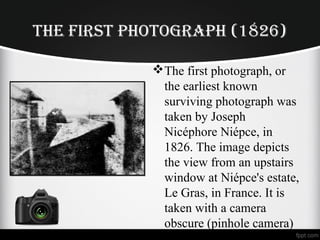
THE FIRST PHOTOGRAPH (1826)
The first photograph, or
the earliest known
surviving photograph was
taken by Joseph
Nicéphore Niépce, in
1826. The image depicts
the view from an upstairs
window at Niépce's estate,
Le Gras, in France. It is
taken with a camera
obscure (pinhole camera)
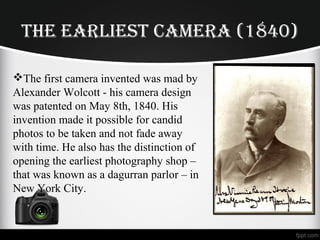
THE EARLIEST CAMERA (1840)
The first camera invented was mad by
Alexander Wolcott - his camera design
was patented on May 8th, 1840. His
invention made it possible for candid
photos to be taken and not fade away
with time. He also has the distinction of
opening the earliest photography shop –
that was known as a dagurran parlor – in
New York City.
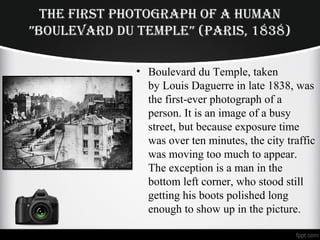
THE FIRST PHOTOGRAPH OF A HuMAn
”BOuLEvARd du TEMPLE” (PARIS, 1838)
• Boulevard du Temple, taken
by Louis Daguerre in late 1838, was
the first-ever photograph of a
person. It is an image of a busy
street, but because exposure time
was over ten minutes, the city traffic
was moving too much to appear.
The exception is a man in the
bottom left corner, who stood still
getting his boots polished long
enough to show up in the picture.
THE FIRST LIGHT PICTuRE And HuMAn
POTRAIT EvER TAkEn [OCT,nOv 1839]
Robert Cornelius, self-portrait,
Oct. or Nov. 1839, approximate
quarter plate daguerreotype
which is a procedure invented in
1839 using silver on a copper
plate. The back reads, “The first
light picture ever taken.”
This self-portrait is the first
photographic portrait image of a
human ever produced.
First Color PhotograPh [1861]
Although color photography was
explored throughout the 19th
century, initial experiments in color
resulted in projected temporary
images, rather than permanent color
images. Moreover until the 1870s
the emulsions available were not
sensitive to red or green light.The
first color photo, an additive
projected image of a tartan ribbon,
was taken in 1861 by the Scottish
physicist James Clerk Maxwell.
First high sPeed PhotograPh
[1878]
• In 1887, using a series of trip wires,
Eadweard Muybridge created the first
high speed photo series which can be
run together to give the effect of
motion pictures. High speed
photography is the science of taking
pictures of very fast phenomena. In
1948, the Society of Motion Picture
and Television Engineers (SMPTE)
defined high-speed photography as
any set of photographs captured by a
camera capable of 128 frames per
second or greater, and of at least
three consecutive frames.
iNtrodUCtioN
A CAMERA is a device that records images, either as a
still photograph or as moving images known as videos
or movies.
A device for taking photographs by letting light from an
image fall briefly onto sensitized film, usually by means
of a lens-and-shutter mechanism.
 The term camera comes from the word camera obscura
(Latin for "dark chamber")
 An early mechanism of projecting images where an
entire room functioned as a real-time imaging system
 The modern camera evolved from the camera
obscura.
historY
Alhazen (Ibn Al-Haytham) invented the Camera
Obscura in AD 1021 and explained why the images
were upside down.
The first camera that was small and portable enough
for practical use was built by Johann Zahn in 1685.
The first permanent photograph was made in 1826
by Joseph Nicéphore Niépce.
The first colour photograph was made by Scottish
physicist James Clerk Maxwell.
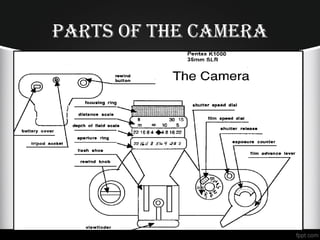
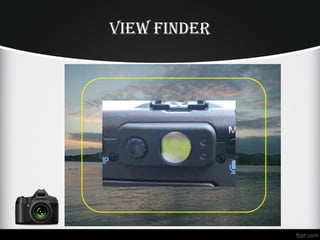
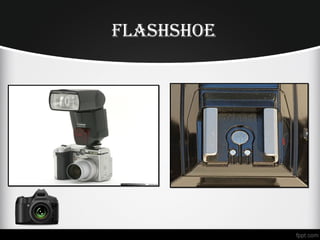
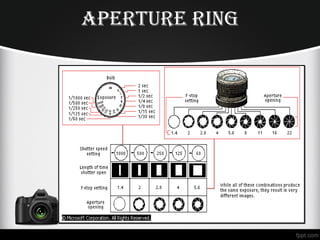
Parts oF the CaMera
View FiNder
Rewind Knob
FLASHSHoe
ApeRtuRe Ring
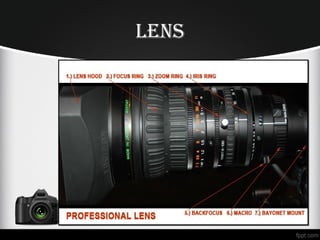
LenS
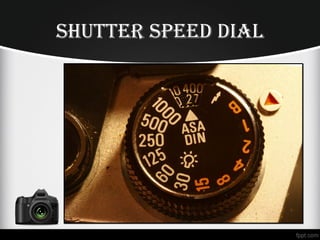
SHutteR Speed diAL
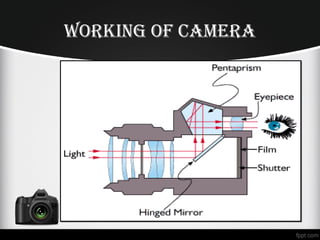
woRKing oF CAMeRA
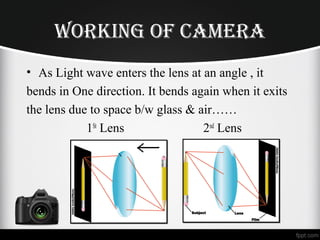
• As Light wave enters the lens at an angle , it
bends in One direction. It bends again when it exits
the lens due to space b/w glass & air……
1St
Lens 2nd
Lens
woRKing oF CAMeRA
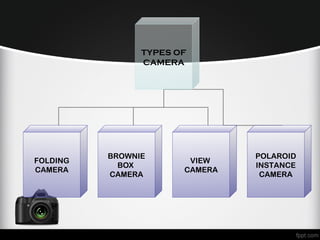
TYPES OF
CAMERA
FOLDING
CAMERA
BROWNIE
BOX
CAMERA
VIEW
CAMERA
POLAROID
INSTANCE
CAMERA
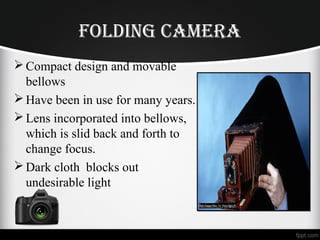
Folding Camera
Compact design and movable
bellows
Have been in use for many years.
Lens incorporated into bellows,
which is slid back and forth to
change focus.
Dark cloth blocks out
undesirable light
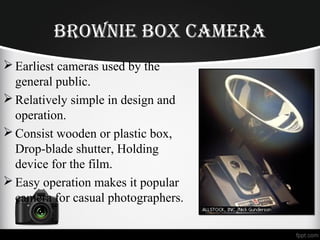
BroWnie BoX Camera
Earliest cameras used by the
general public.
Relatively simple in design and
operation.
Consist wooden or plastic box,
Drop-blade shutter, Holding
device for the film.
Easy operation makes it popular
camera for casual photographers.
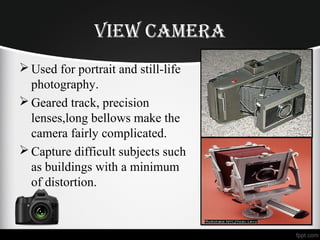
VieW Camera
Used for portrait and still-life
photography.
Geared track, precision
lenses,long bellows make the
camera fairly complicated.
Capture difficult subjects such
as buildings with a minimum
of distortion.
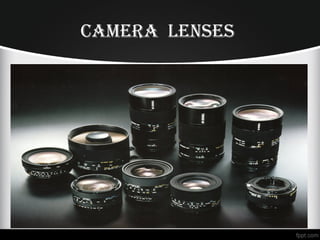
Camera lenSeS
Camera lenSeS
The camera lens owes to the human eye.
The lens focuses a parallel light beam to form an
inverted image.
Lenses helps to avoid blurredness and far-off
photographs can be easily taken.
Focal length of lens affects the field of view,
magnification, and depth of field of a lens.
Light in weight and compact.
 Available in the best brands.
TYPeS oF lenSeS
Range (in mm) Known as Properties
20 to 35 Wide-angle lenses Provide greater depth of
field and include larger
angle of view but provide
relatively low magnification.
45 to 55 Normal lenses Produce an image that can
be clearly seen by human
eye.
Approx. 85 Telephoto lenses Constrict the field of view
and decrease the depth of
field.
More than 85 Zoom lens Can be adjusted
continuously between two
fixed limits.

PHOTOGRAPHY PPT

  • 1.
  • 2.
    PHOTOGRAPHY • Photography isthe science, art and practice of creating durable images by recording light or other electromagnetic radiation, either electronically by means of an image sensor, or chemically by means of a light-sensitive material such as photographic film.
  • 3.
    PHOTOGRAPHY • Comes fromthe Greek word “phōtos” which means light and “graphé” which means “drawing”. • Together they mean drawing with light
  • 4.
    THE FIRST PHOTOGRAPH(1826) The first photograph, or the earliest known surviving photograph was taken by Joseph Nicéphore Niépce, in 1826. The image depicts the view from an upstairs window at Niépce's estate, Le Gras, in France. It is taken with a camera obscure (pinhole camera)
  • 5.
    THE EARLIEST CAMERA(1840) The first camera invented was mad by Alexander Wolcott - his camera design was patented on May 8th, 1840. His invention made it possible for candid photos to be taken and not fade away with time. He also has the distinction of opening the earliest photography shop – that was known as a dagurran parlor – in New York City.
  • 6.
    THE FIRST PHOTOGRAPHOF A HuMAn ”BOuLEvARd du TEMPLE” (PARIS, 1838) • Boulevard du Temple, taken by Louis Daguerre in late 1838, was the first-ever photograph of a person. It is an image of a busy street, but because exposure time was over ten minutes, the city traffic was moving too much to appear. The exception is a man in the bottom left corner, who stood still getting his boots polished long enough to show up in the picture.
  • 7.
    THE FIRST LIGHTPICTuRE And HuMAn POTRAIT EvER TAkEn [OCT,nOv 1839] Robert Cornelius, self-portrait, Oct. or Nov. 1839, approximate quarter plate daguerreotype which is a procedure invented in 1839 using silver on a copper plate. The back reads, “The first light picture ever taken.” This self-portrait is the first photographic portrait image of a human ever produced.
  • 8.
    First Color PhotograPh[1861] Although color photography was explored throughout the 19th century, initial experiments in color resulted in projected temporary images, rather than permanent color images. Moreover until the 1870s the emulsions available were not sensitive to red or green light.The first color photo, an additive projected image of a tartan ribbon, was taken in 1861 by the Scottish physicist James Clerk Maxwell.
  • 9.
    First high sPeedPhotograPh [1878] • In 1887, using a series of trip wires, Eadweard Muybridge created the first high speed photo series which can be run together to give the effect of motion pictures. High speed photography is the science of taking pictures of very fast phenomena. In 1948, the Society of Motion Picture and Television Engineers (SMPTE) defined high-speed photography as any set of photographs captured by a camera capable of 128 frames per second or greater, and of at least three consecutive frames.
  • 11.
    iNtrodUCtioN A CAMERA isa device that records images, either as a still photograph or as moving images known as videos or movies. A device for taking photographs by letting light from an image fall briefly onto sensitized film, usually by means of a lens-and-shutter mechanism.  The term camera comes from the word camera obscura (Latin for "dark chamber")  An early mechanism of projecting images where an entire room functioned as a real-time imaging system  The modern camera evolved from the camera obscura.
  • 12.
    historY Alhazen (Ibn Al-Haytham)invented the Camera Obscura in AD 1021 and explained why the images were upside down. The first camera that was small and portable enough for practical use was built by Johann Zahn in 1685. The first permanent photograph was made in 1826 by Joseph Nicéphore Niépce. The first colour photograph was made by Scottish physicist James Clerk Maxwell.
  • 13.
  • 14.
  • 15.
  • 16.
  • 17.
  • 18.
  • 19.
  • 20.
    woRKing oF CAMeRA •As Light wave enters the lens at an angle , it bends in One direction. It bends again when it exits the lens due to space b/w glass & air…… 1St Lens 2nd Lens
  • 21.
  • 22.
  • 23.
    Folding Camera Compact designand movable bellows Have been in use for many years. Lens incorporated into bellows, which is slid back and forth to change focus. Dark cloth blocks out undesirable light
  • 24.
    BroWnie BoX Camera Earliestcameras used by the general public. Relatively simple in design and operation. Consist wooden or plastic box, Drop-blade shutter, Holding device for the film. Easy operation makes it popular camera for casual photographers.
  • 25.
    VieW Camera Used forportrait and still-life photography. Geared track, precision lenses,long bellows make the camera fairly complicated. Capture difficult subjects such as buildings with a minimum of distortion.
  • 26.
  • 27.
    Camera lenSeS The cameralens owes to the human eye. The lens focuses a parallel light beam to form an inverted image. Lenses helps to avoid blurredness and far-off photographs can be easily taken. Focal length of lens affects the field of view, magnification, and depth of field of a lens. Light in weight and compact.  Available in the best brands.
  • 28.
    TYPeS oF lenSeS Range(in mm) Known as Properties 20 to 35 Wide-angle lenses Provide greater depth of field and include larger angle of view but provide relatively low magnification. 45 to 55 Normal lenses Produce an image that can be clearly seen by human eye. Approx. 85 Telephoto lenses Constrict the field of view and decrease the depth of field. More than 85 Zoom lens Can be adjusted continuously between two fixed limits.