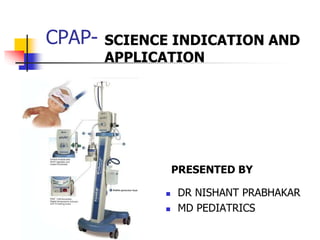
CPAP- SCIENCE INDICATION AND
APPLICATION
PRESENTED BY
 DR NISHANT PRABHAKAR
 MD PEDIATRICS
DEFINITION
 Also called continuous distending pressure (CDP)
 Maintenance of an increased (positive)
transpulmonary pressure during the inspiratory &
expiratory phase of respiration in a spontaniously
breathing baby.
 By which alveoli are kept open which increase
the functional residual capacity(FRC) of the lungs
resulting in better gas exchange.
HISTORY
 Harrison 1968: described grunting in neonates as
naturally producing end expiratory pressure
 Gregory et al, 1971: introduced the clinical use of
distending pressure in neonates.(via endotrachial
tube or a head box)
 Kattwinkel reported successful use of nasal prongs in
neonates with RDS.
 Reports of significant lower incidence of chronic lung
disease from columbia university that used more
CPAP as compared to north american centre have led
to resurgence of interest in CPAP over the last 15
years.
PHYSIOLOGY OF CPAP
 Increases FRC
 Decreases V/Q mismatch
 Splints upper airway - airway resistance
 Increase tidal volume
 Decrease work of breathing
 Conserves surfectant
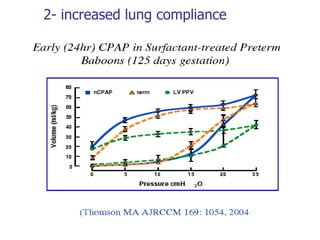
 Increase lung compliance
DISADVANTAGES OF
CONVENTIONAL VENTILATION
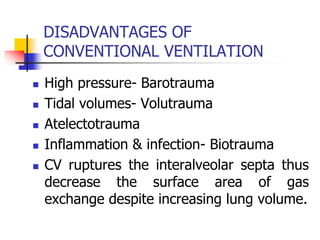
 High pressure- Barotrauma
 Tidal volumes- Volutrauma
 Atelectotrauma
 Inflammation & infection- Biotrauma
 CV ruptures the interalveolar septa thus
decrease the surface area of gas
exchange despite increasing lung volume.
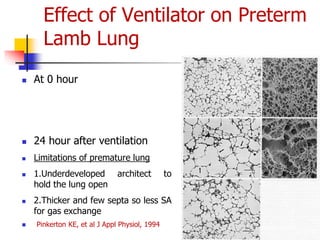
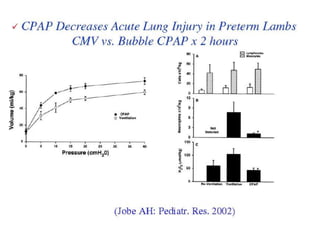
Effect of Ventilator on Preterm
Lamb Lung
 At 0 hour
 24 hour after ventilation
 Limitations of premature lung
 1.Underdeveloped architect to
hold the lung open
 2.Thicker and few septa so less SA
for gas exchange
 Pinkerton KE, et al J Appl Physiol, 1994
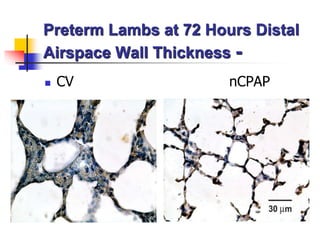
Preterm Lambs at 72 Hours Distal
Airspace Wall Thickness -
 CV nCPAP
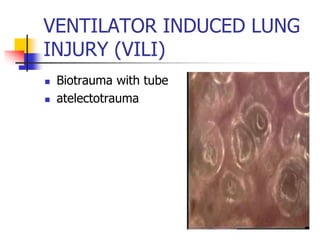
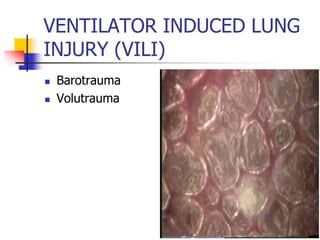
VENTILATOR INDUCED LUNG
INJURY (VILI)
 Biotrauma with tube
 atelectotrauma
VENTILATOR INDUCED LUNG
INJURY (VILI)
 Barotrauma
 Volutrauma
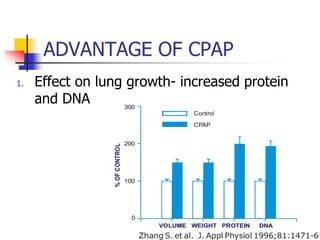
ADVANTAGE OF CPAP
1. Effect on lung growth- increased protein
and DNA
2- increased lung compliance
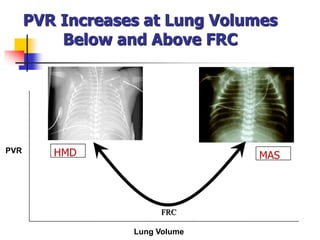
PVR Increases at Lung Volumes
Below and Above FRC
PVR
Lung Volume
FRC
HMD MAS
CPAP MAGIC
 Opens lung at FRC
 Keeps it open at minimum constant
pressure least atelecto & barotrauma
 Pulmonary arterial pressure are least
hence less V/Q mismatch less pressure
required.
 No ET tube- no biotrauma
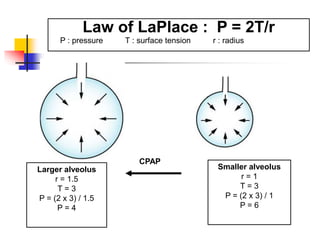
Larger alveolus
r = 1.5
T = 3
P = (2 x 3) / 1.5
P = 4
Smaller alveolus
r = 1
T = 3
P = (2 x 3) / 1
P = 6
CPAP
Law of LaPlace : P = 2T/r
P : pressure T : surface tension r : radius
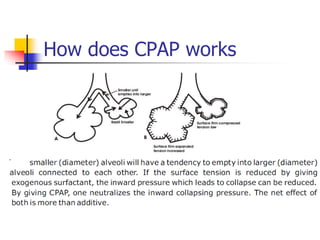
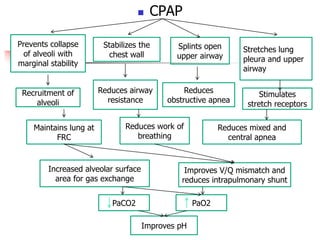
How does CPAP works
Stretches lung
pleura and upper
airway
 CPAP
Prevents collapse
of alveoli with
marginal stability
Stabilizes the
chest wall
Splints open
upper airway
Improves pH
Reduces airway
resistance
Recruitment of
alveoli
PaO2PaCO2
Improves V/Q mismatch and
reduces intrapulmonary shunt
Increased alveolar surface
area for gas exchange
Maintains lung at
FRC
Reduces work of
breathing
Reduces mixed and
central apnea
Reduces
obstructive apnea
Stimulates
stretch receptors
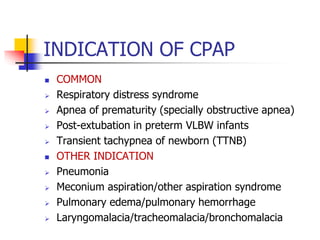
INDICATION OF CPAP
 COMMON
 Respiratory distress syndrome
 Apnea of prematurity (specially obstructive apnea)
 Post-extubation in preterm VLBW infants
 Transient tachypnea of newborn (TTNB)
 OTHER INDICATION
 Pneumonia
 Meconium aspiration/other aspiration syndrome
 Pulmonary edema/pulmonary hemorrhage
 Laryngomalacia/tracheomalacia/bronchomalacia
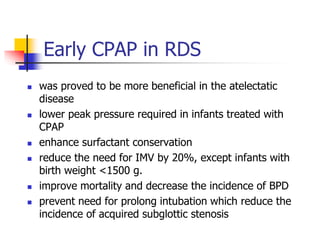
Early CPAP in RDS
 was proved to be more beneficial in the atelectatic
disease
 lower peak pressure required in infants treated with
CPAP
 enhance surfactant conservation
 reduce the need for IMV by 20%, except infants with
birth weight <1500 g.
 improve mortality and decrease the incidence of BPD
 prevent need for prolong intubation which reduce the
incidence of acquired subglottic stenosis
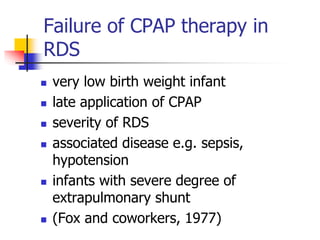
Failure of CPAP therapy in
RDS
 very low birth weight infant
 late application of CPAP
 severity of RDS
 associated disease e.g. sepsis,
hypotension
 infants with severe degree of
extrapulmonary shunt
 (Fox and coworkers, 1977)
CPAP in apnea of prematurity
 the application of low-level CPAP decrease the incidence
of apnea of prematurity (compared to other forms of
stimulation)
 improve oxygenation
 stimulation or inhibition of pulmonary reflexes
 alveolar stabilization
 mechanical splinting of airway; reduce supraglottic
resistance in both inspiration and expiration
 some investigators recommended the early use of CPAP
as a preventive measure of apnea of prematurity
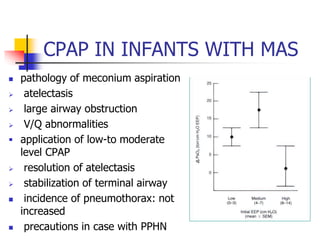
CPAP IN INFANTS WITH MAS
 pathology of meconium aspiration
 atelectasis
 large airway obstruction
 V/Q abnormalities
 application of low-to moderate
level CPAP
 resolution of atelectasis
 stabilization of terminal airway
 incidence of pneumothorax: not
increased
 precautions in case with PPHN
C0NTRAINDICATION OF CPAP
 Progressive respiratory failure with PaCO2 levels >60
mmhg and/or inability to maintain oxygenation
(PaCO2 <50 mmHg)
 Certain congenital malformation of the airway
(choanal atresia, cleft palate, tracheoesophageal
fistula, congenital diaphragmatic hernia,etc)
 Severe cardiovascular instability (hypotension)
 Poor respiratory drive (frequent apnea and
bradycardia) that is not improved by CPAP.
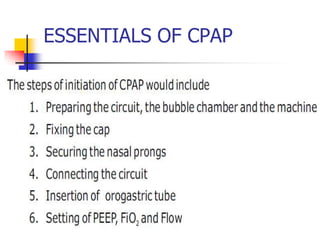
ESSENTIALS OF CPAP
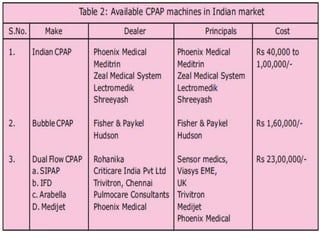
CPAP MACHINES
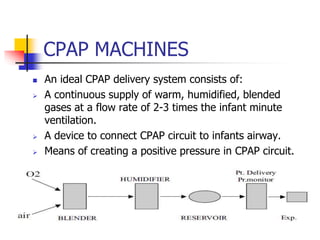
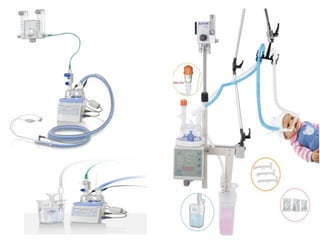
 An ideal CPAP delivery system consists of:
 A continuous supply of warm, humidified, blended
gases at a flow rate of 2-3 times the infant minute
ventilation.
 A device to connect CPAP circuit to infants airway.
 Means of creating a positive pressure in CPAP circuit.
CPAP DELIVERY SYSTEM
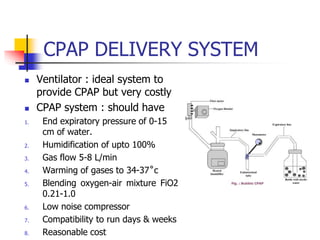
 Ventilator : ideal system to
provide CPAP but very costly
 CPAP system : should have
1. End expiratory pressure of 0-15
cm of water.
2. Humidification of upto 100%
3. Gas flow 5-8 L/min
4. Warming of gases to 34-37˚c
5. Blending oxygen-air mixture FiO2
0.21-1.0
6. Low noise compressor
7. Compatibility to run days & weeks
8. Reasonable cost
PATIENT INTERFACE FOR
PROVIDING CPAP
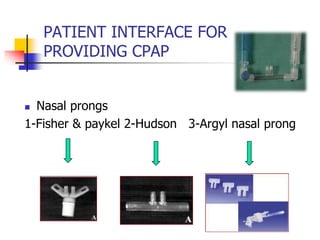
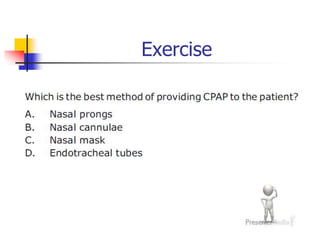
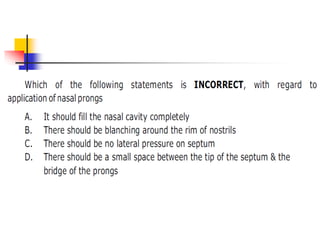
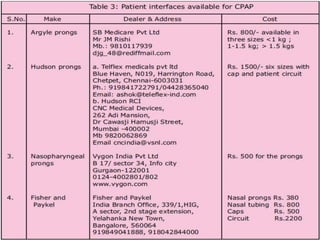
 Nasal prongs
1-Fisher & paykel 2-Hudson 3-Argyl nasal prong
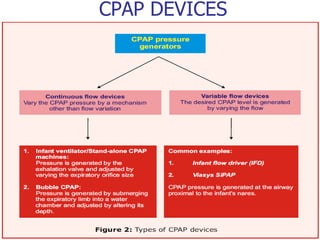
CPAP DEVICES
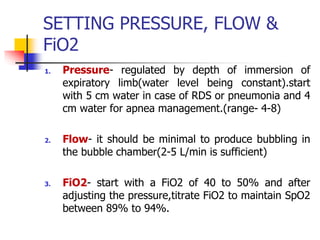
SETTING PRESSURE, FLOW &
FiO2
1. Pressure- regulated by depth of immersion of
expiratory limb(water level being constant).start
with 5 cm water in case of RDS or pneumonia and 4
cm water for apnea management.(range- 4-8)
2. Flow- it should be minimal to produce bubbling in
the bubble chamber(2-5 L/min is sufficient)
3. FiO2- start with a FiO2 of 40 to 50% and after
adjusting the pressure,titrate FiO2 to maintain SpO2
between 89% to 94%.
MONITORING ADEQUACY AND
COMPLICATION OF CPAP
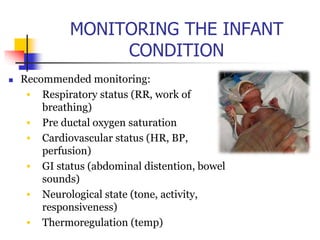
MONITORING THE INFANT
CONDITION
 Recommended monitoring:
• Respiratory status (RR, work of
breathing)
• Pre ductal oxygen saturation
• Cardiovascular status (HR, BP,
perfusion)
• GI status (abdominal distention, bowel
sounds)
• Neurological state (tone, activity,
responsiveness)
• Thermoregulation (temp)
WEANING FROM CPAP
 It is considered when clinical condition
for which CPAP was indicated is
passive.
 e.g. in case of RDS we have to see for
improvement in Silverman Anderson
score i.e. if score is less than 4 we can
try weaning
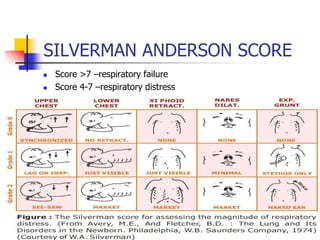
SILVERMAN ANDERSON SCORE
 Score >7 –respiratory failure
 Score 4-7 –respiratory distress
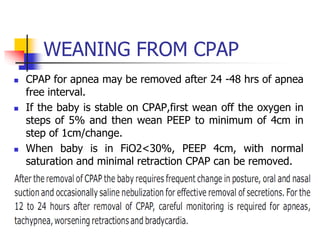
WEANING FROM CPAP
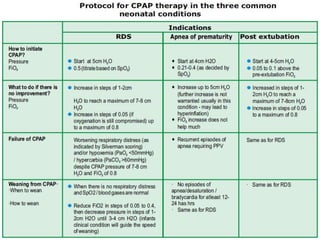
 CPAP for apnea may be removed after 24 -48 hrs of apnea
free interval.
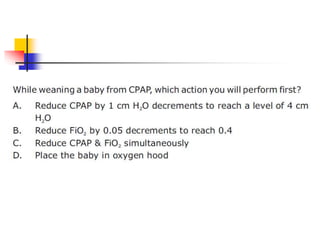
 If the baby is stable on CPAP,first wean off the oxygen in
steps of 5% and then wean PEEP to minimum of 4cm in
step of 1cm/change.
 When baby is in FiO2<30%, PEEP 4cm, with normal
saturation and minimal retraction CPAP can be removed.
CPAP FAILURE
 CPAP failure is considered if FiO2 required is
>60% and PEEP required is > 7cm of water.
 If baby is continuing to have retraction,
grunting and apnea is considered fo
mechanical ventilation.
 If PaO2<50%, SpO2<85%, and PaCO2>60%
on CPAP with FiO2>60% and PEEP >7cm of
water is also considered for mechanical
ventilation.
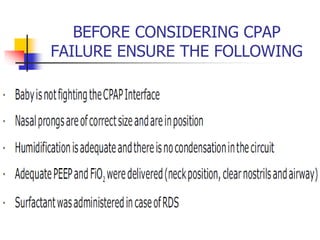
BEFORE CONSIDERING CPAP
FAILURE ENSURE THE FOLLOWING
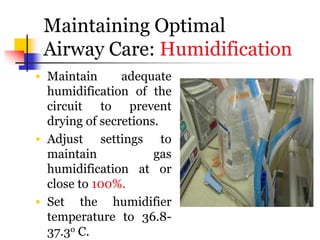
Maintaining Optimal
Airway Care: Humidification
• Maintain adequate
humidification of the
circuit to prevent
drying of secretions.
• Adjust settings to
maintain gas
humidification at or
close to 100%.
• Set the humidifier
temperature to 36.8-
37.3o C.
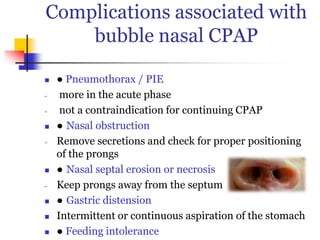
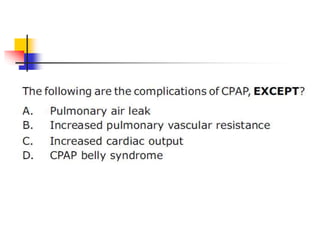
Complications associated with
bubble nasal CPAP
 ● Pneumothorax / PIE
- more in the acute phase
- not a contraindication for continuing CPAP
 ● Nasal obstruction
- Remove secretions and check for proper positioning
of the prongs
 ● Nasal septal erosion or necrosis
- Keep prongs away from the septum
 ● Gastric distension
 Intermittent or continuous aspiration of the stomach
 ● Feeding intolerance
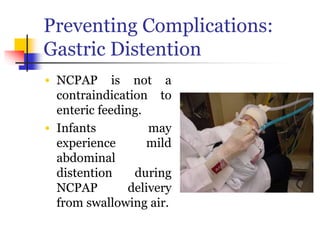
Preventing Complications:
Gastric Distention
• NCPAP is not a
contraindication to
enteric feeding.
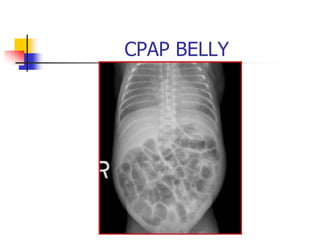
• Infants may
experience mild
abdominal
distention during
NCPAP delivery
from swallowing air.
CPAP BELLY
Preventing Complications:
Gastric Distention
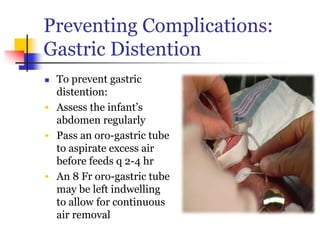
 To prevent gastric
distention:
• Assess the infant’s
abdomen regularly
• Pass an oro-gastric tube
to aspirate excess air
before feeds q 2-4 hr
• An 8 Fr oro-gastric tube
may be left indwelling
to allow for continuous
air removal
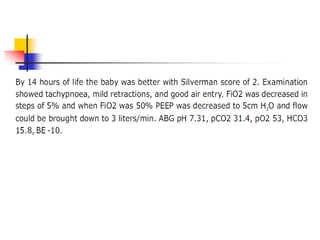
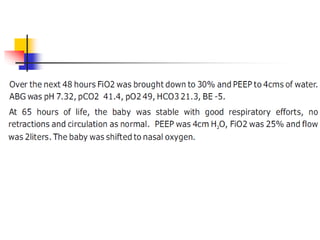
CASE STUDY
 Antenatal steroid
 Arrangement before birth
Exercise
Cpap
Cpap
Cpap
Cpap
Cpap
Cpap

Cpap

  • 1.
    CPAP- SCIENCE INDICATIONAND APPLICATION PRESENTED BY  DR NISHANT PRABHAKAR  MD PEDIATRICS
  • 2.
    DEFINITION  Also calledcontinuous distending pressure (CDP)  Maintenance of an increased (positive) transpulmonary pressure during the inspiratory & expiratory phase of respiration in a spontaniously breathing baby.  By which alveoli are kept open which increase the functional residual capacity(FRC) of the lungs resulting in better gas exchange.
  • 3.
    HISTORY  Harrison 1968:described grunting in neonates as naturally producing end expiratory pressure  Gregory et al, 1971: introduced the clinical use of distending pressure in neonates.(via endotrachial tube or a head box)  Kattwinkel reported successful use of nasal prongs in neonates with RDS.  Reports of significant lower incidence of chronic lung disease from columbia university that used more CPAP as compared to north american centre have led to resurgence of interest in CPAP over the last 15 years.
  • 4.
    PHYSIOLOGY OF CPAP Increases FRC  Decreases V/Q mismatch  Splints upper airway - airway resistance  Increase tidal volume  Decrease work of breathing  Conserves surfectant  Increase lung compliance
  • 5.
    DISADVANTAGES OF CONVENTIONAL VENTILATION High pressure- Barotrauma  Tidal volumes- Volutrauma  Atelectotrauma  Inflammation & infection- Biotrauma  CV ruptures the interalveolar septa thus decrease the surface area of gas exchange despite increasing lung volume.
  • 6.
    Effect of Ventilatoron Preterm Lamb Lung  At 0 hour  24 hour after ventilation  Limitations of premature lung  1.Underdeveloped architect to hold the lung open  2.Thicker and few septa so less SA for gas exchange  Pinkerton KE, et al J Appl Physiol, 1994
  • 7.
    Preterm Lambs at72 Hours Distal Airspace Wall Thickness -  CV nCPAP
  • 8.
    VENTILATOR INDUCED LUNG INJURY(VILI)  Biotrauma with tube  atelectotrauma
  • 9.
    VENTILATOR INDUCED LUNG INJURY(VILI)  Barotrauma  Volutrauma
  • 11.
    ADVANTAGE OF CPAP 1.Effect on lung growth- increased protein and DNA
  • 12.
  • 13.
    PVR Increases atLung Volumes Below and Above FRC PVR Lung Volume FRC HMD MAS
  • 14.
    CPAP MAGIC  Openslung at FRC  Keeps it open at minimum constant pressure least atelecto & barotrauma  Pulmonary arterial pressure are least hence less V/Q mismatch less pressure required.  No ET tube- no biotrauma
  • 15.
    Larger alveolus r =1.5 T = 3 P = (2 x 3) / 1.5 P = 4 Smaller alveolus r = 1 T = 3 P = (2 x 3) / 1 P = 6 CPAP Law of LaPlace : P = 2T/r P : pressure T : surface tension r : radius
  • 16.
  • 17.
    Stretches lung pleura andupper airway  CPAP Prevents collapse of alveoli with marginal stability Stabilizes the chest wall Splints open upper airway Improves pH Reduces airway resistance Recruitment of alveoli PaO2PaCO2 Improves V/Q mismatch and reduces intrapulmonary shunt Increased alveolar surface area for gas exchange Maintains lung at FRC Reduces work of breathing Reduces mixed and central apnea Reduces obstructive apnea Stimulates stretch receptors
  • 18.
    INDICATION OF CPAP COMMON  Respiratory distress syndrome  Apnea of prematurity (specially obstructive apnea)  Post-extubation in preterm VLBW infants  Transient tachypnea of newborn (TTNB)  OTHER INDICATION  Pneumonia  Meconium aspiration/other aspiration syndrome  Pulmonary edema/pulmonary hemorrhage  Laryngomalacia/tracheomalacia/bronchomalacia
  • 19.
    Early CPAP inRDS  was proved to be more beneficial in the atelectatic disease  lower peak pressure required in infants treated with CPAP  enhance surfactant conservation  reduce the need for IMV by 20%, except infants with birth weight <1500 g.  improve mortality and decrease the incidence of BPD  prevent need for prolong intubation which reduce the incidence of acquired subglottic stenosis
  • 20.
    Failure of CPAPtherapy in RDS  very low birth weight infant  late application of CPAP  severity of RDS  associated disease e.g. sepsis, hypotension  infants with severe degree of extrapulmonary shunt  (Fox and coworkers, 1977)
  • 21.
    CPAP in apneaof prematurity  the application of low-level CPAP decrease the incidence of apnea of prematurity (compared to other forms of stimulation)  improve oxygenation  stimulation or inhibition of pulmonary reflexes  alveolar stabilization  mechanical splinting of airway; reduce supraglottic resistance in both inspiration and expiration  some investigators recommended the early use of CPAP as a preventive measure of apnea of prematurity
  • 22.
    CPAP IN INFANTSWITH MAS  pathology of meconium aspiration  atelectasis  large airway obstruction  V/Q abnormalities  application of low-to moderate level CPAP  resolution of atelectasis  stabilization of terminal airway  incidence of pneumothorax: not increased  precautions in case with PPHN
  • 23.
    C0NTRAINDICATION OF CPAP Progressive respiratory failure with PaCO2 levels >60 mmhg and/or inability to maintain oxygenation (PaCO2 <50 mmHg)  Certain congenital malformation of the airway (choanal atresia, cleft palate, tracheoesophageal fistula, congenital diaphragmatic hernia,etc)  Severe cardiovascular instability (hypotension)  Poor respiratory drive (frequent apnea and bradycardia) that is not improved by CPAP.
  • 24.
  • 25.
    CPAP MACHINES  Anideal CPAP delivery system consists of:  A continuous supply of warm, humidified, blended gases at a flow rate of 2-3 times the infant minute ventilation.  A device to connect CPAP circuit to infants airway.  Means of creating a positive pressure in CPAP circuit.
  • 27.
    CPAP DELIVERY SYSTEM Ventilator : ideal system to provide CPAP but very costly  CPAP system : should have 1. End expiratory pressure of 0-15 cm of water. 2. Humidification of upto 100% 3. Gas flow 5-8 L/min 4. Warming of gases to 34-37˚c 5. Blending oxygen-air mixture FiO2 0.21-1.0 6. Low noise compressor 7. Compatibility to run days & weeks 8. Reasonable cost
  • 28.
    PATIENT INTERFACE FOR PROVIDINGCPAP  Nasal prongs 1-Fisher & paykel 2-Hudson 3-Argyl nasal prong
  • 29.
  • 30.
    SETTING PRESSURE, FLOW& FiO2 1. Pressure- regulated by depth of immersion of expiratory limb(water level being constant).start with 5 cm water in case of RDS or pneumonia and 4 cm water for apnea management.(range- 4-8) 2. Flow- it should be minimal to produce bubbling in the bubble chamber(2-5 L/min is sufficient) 3. FiO2- start with a FiO2 of 40 to 50% and after adjusting the pressure,titrate FiO2 to maintain SpO2 between 89% to 94%.
  • 32.
  • 33.
    MONITORING THE INFANT CONDITION Recommended monitoring: • Respiratory status (RR, work of breathing) • Pre ductal oxygen saturation • Cardiovascular status (HR, BP, perfusion) • GI status (abdominal distention, bowel sounds) • Neurological state (tone, activity, responsiveness) • Thermoregulation (temp)
  • 34.
    WEANING FROM CPAP It is considered when clinical condition for which CPAP was indicated is passive.  e.g. in case of RDS we have to see for improvement in Silverman Anderson score i.e. if score is less than 4 we can try weaning
  • 35.
    SILVERMAN ANDERSON SCORE Score >7 –respiratory failure  Score 4-7 –respiratory distress
  • 36.
    WEANING FROM CPAP CPAP for apnea may be removed after 24 -48 hrs of apnea free interval.  If the baby is stable on CPAP,first wean off the oxygen in steps of 5% and then wean PEEP to minimum of 4cm in step of 1cm/change.  When baby is in FiO2<30%, PEEP 4cm, with normal saturation and minimal retraction CPAP can be removed.
  • 37.
    CPAP FAILURE  CPAPfailure is considered if FiO2 required is >60% and PEEP required is > 7cm of water.  If baby is continuing to have retraction, grunting and apnea is considered fo mechanical ventilation.  If PaO2<50%, SpO2<85%, and PaCO2>60% on CPAP with FiO2>60% and PEEP >7cm of water is also considered for mechanical ventilation.
  • 38.
    BEFORE CONSIDERING CPAP FAILUREENSURE THE FOLLOWING
  • 39.
    Maintaining Optimal Airway Care:Humidification • Maintain adequate humidification of the circuit to prevent drying of secretions. • Adjust settings to maintain gas humidification at or close to 100%. • Set the humidifier temperature to 36.8- 37.3o C.
  • 40.
    Complications associated with bubblenasal CPAP  ● Pneumothorax / PIE - more in the acute phase - not a contraindication for continuing CPAP  ● Nasal obstruction - Remove secretions and check for proper positioning of the prongs  ● Nasal septal erosion or necrosis - Keep prongs away from the septum  ● Gastric distension  Intermittent or continuous aspiration of the stomach  ● Feeding intolerance
  • 41.
    Preventing Complications: Gastric Distention •NCPAP is not a contraindication to enteric feeding. • Infants may experience mild abdominal distention during NCPAP delivery from swallowing air.
  • 42.
  • 43.
    Preventing Complications: Gastric Distention To prevent gastric distention: • Assess the infant’s abdomen regularly • Pass an oro-gastric tube to aspirate excess air before feeds q 2-4 hr • An 8 Fr oro-gastric tube may be left indwelling to allow for continuous air removal
  • 44.
    CASE STUDY  Antenatalsteroid  Arrangement before birth
  • 49.

Editor's Notes

  • #14 Let us understand the relationship between Lung volume – X axis with Pulmonary vascular resistance – y Axis . PVR is least once the lung is open at the FRC , at this blood flow is maximum with Best ventilation perfusion matching and gas exchange. You can see on Right- baby with MAS has higher lung volume while on left HMD has lower lung volume both RESULT in high PVR . In clinical practice , for a baby on CPAP with higher pressure the lung will over distend while low CPAP will cause reduced FRC – in both PVR will increase causing Rt to left shunt impairing pulmonary blood flow .Thus we must ensure lung is opened at FRC for best blood flow and better gas exchange .
  • #16 Imagine two alveoli are connected to same terminal airway – the smaller alveoli will have tendency to collapse and empty into larger due to higher collapsing pressure Notice Rt smaller alveoli has pressure 6 cm while left bigger one 4 cm as the radius small r is 1 and 1.5 respectively .