

Structure Analysis I
Chapter 8
Structure Analysis I
Chapter 8
Deflections
Structural Analysis (I)Dr. Mohammed Arafa
Introduction
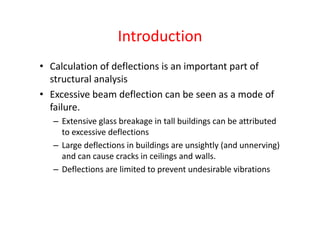
• Calculation of deflections is an important part of 
structural analysis
• Excessive beam deflection can be seen as a mode of 
failure.
– Extensive glass breakage in tall buildings can be attributed 
to excessive deflections
– Large deflections in buildings are unsightly (and unnerving) 
and can cause cracks in ceilings and walls.
– Deflections are limited to prevent undesirable vibrations
Beam Deflection
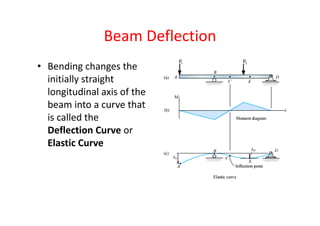
• Bending changes the 
initially straight 
longitudinal axis of the 
beam into a curve that 
is called the 
Deflection Curve or 
Elastic Curve
Beam Deflection
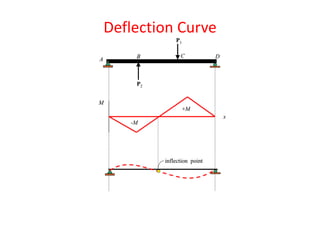
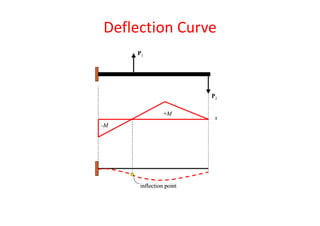
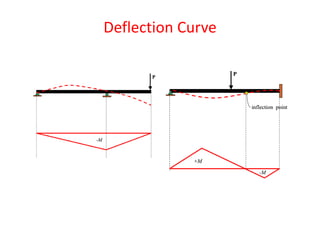
• To determine the deflection curve:
– Draw shear and moment diagram for the beam
– Directly under the moment diagram draw a line for the 
beam and label all supports
– At the supports displacement is zero
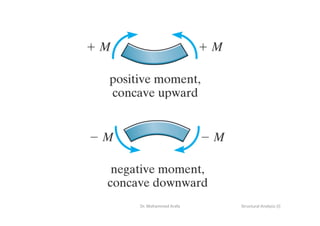
– Where the moment is negative, the deflection curve is 
concave downward.
– Where the moment is positive the deflection curve is 
concave upward
– Where the two curve meet is the Inflection Point
Structural Analysis (I)Dr. Mohammed Arafa
Deflection Curve
Deflection Curve
Deflection Curve
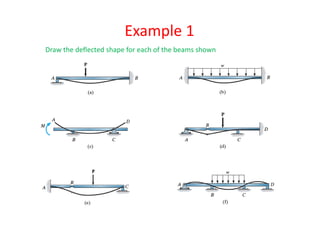
Example 1
Draw the deflected shape for each of the beams shown
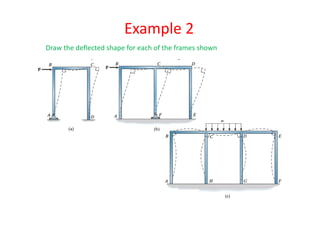
Example 2
Draw the deflected shape for each of the frames shown
Double Integration Method
Structural Analysis (I)Dr. Mohammed Arafa
Elastic‐Beam Theory
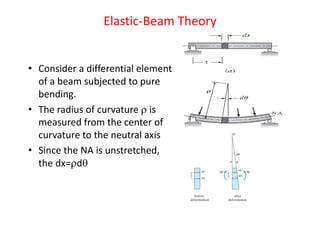
• Consider a differential element 
of a beam subjected to pure 
bending.
• The radius of curvature  is 
measured from the center of 
curvature to the neutral axis
• Since the NA is unstretched, 
the dx=d
Elastic‐Beam Theory
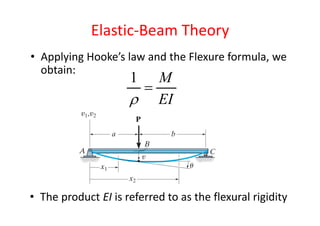
• Applying Hooke’s law and the Flexure formula, we 
obtain:
EI
M


1
• The product EI is referred to as the flexural rigidity
Elastic‐Beam Theory
Since:
1
then:
( )
dx d
d dx
M
d dx Slope
EI
 






  
  
EI
M
dx
vd
solutionexact
dxdv
dxvd
EI
M
dxdv
dxvd





2
2
2
3
2
22
2
3
2
22
)(
/1
/
/1
/1

 From calculus books: 
The Double Integration Method
Relate Moments to Deflections
EI
M
dx
vd
2
2
 
 dx
xEI
xM
dx
dv
x
)(
)(
 
 2
)(
)( dx
xEI
xM
xv
Use Boundary Conditions to 
Evaluate Integration 
Constants
Structural Analysis (I)Dr. Mohammed Arafa
Assumptions and Limitations
• Deflections caused by shearing action negligibly 
small compared to bending
• Deflections are small compared to the cross‐
sectional dimensions of the beam
• All portions of the beam are acting in the elastic 
range
• Beam is straight prior to the application of loads
Example 1
PL
L
x
x
y
P
P
2
2
d v
EI M
dx
M PL Px

  
   
 
   
 
2
2
2
1
2
1 1
2 3
2
3
2
2 2
2 3
max
2
max
Integrating once:
2
0
@ 0, 0 0 0 0
2
Integrating twice:
2 6
0
@ 0, 0 0 0 0
2 6
@
2 6
2
d v
EI PL Px
dx
dv x
EI PLx P c
dx
dv
x EI PL P c c
dx
PLx x
EIv P c
PL
x v EI P c c
PLx x
EIv P x L v v
PL L
EIv
  
   
        
   
        
     
  
3 3 3
max
6 3 3
L PL PL
P v
EI
    
y
 2
2
xL
W
M 
2
2
d v
EI M
dx

@ x
 
2
2
2
2
d v W
EI L x
dx
  
Integrating once
 
3
1
2 3
L xdv W
EI c
dx

 
@ x = 0  
 
3 3
1 1
0
0 0
2 3 6
Ldv W WL
EI c c
dx

      
L
x
x
WL
W
2
2
WL
 
3
3
6 6
dv W WL
EI L x
dx
   
Example 2
 
3 4
4
24 6 24
W WL WL
EIv L x x    
Max. occurs @ x = L  
4 4 4 4
max max
6 24 8 8
W L WL WL WL
EIv v
EI
       
EI
WL
8
4
max 
Integrating twice
 
4 3
2
6 4 6
L xW WL
EIv x c

   
@ x = 0      
24
0
64
0
6
00
4
22
34
WL
cc
WLLW
EIv 


L
x
y x
2
WL
2
WL
22
x
Wxx
WL
M 
2 2
2
2 2
d v WL x
EI x W
dx
 
Integrating
2 3
1
2 2 2 3
dv WL x W x
EI c
dx
  
Since the beam is symmetric 0
2
@ 
dx
dvL
x
  













 1
32
3
2
22
2
2
0
2
@ c
L
W
L
WL
EI
L
x
24
3
1
WL
c 
3
2 3
4 6 24
dv WL W WL
EI x x
dx
   
Example 3
Integrating
3 4 3
2
4 3 6 4 24
WL x W x WL
EIv x c   
@ x = 0 v = 0         2
343
0
244
0
63
0
4
0 c
WLWWL
EI  02  c
3
3 4
12 24 24
WL W WL
EIv x x x   
2 Max. occurs @ x = L /
4
max
5
384
WL
EIv  
4
max
5
384
WL
EI
D =
Structural Analysis (I)Dr. Mohammed Arafa
y
2
2
for 0
2 2
d v P L
EI x x
dx
  
Integrating
2
1
2 2
dv P x
EI c
dx
 
Since the beam is symmetric 0
2
@ 
dx
dvL
x
  






 1
2
2
2
2
0
2
@ c
L
P
EI
L
x
16
2
1
PL
c 
2
2
4 16
dv P PL
EI x
dx
  
x
P
M
L
x
22
0for 
L/2
x
x
2
P
2
P
P
L/2
Example 4
Integrating
3 2
2
4 3 16
P x PL
EIv x c  
@ x = 0 v = 0       2
23
0
163
0
4
0 c
PLP
EI  02  c
2
3
12 16
P PL
EIv x x  
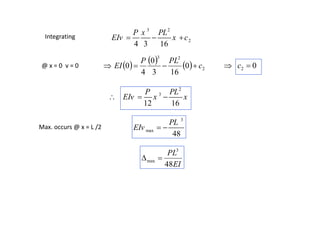
2 Max. occurs @ x = L /
3
max
48
PL
EIv  
EI
PL
48
3
max 
Example
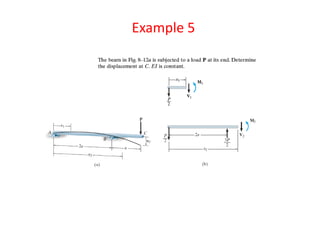
Example 5
Moment‐Area Theorems
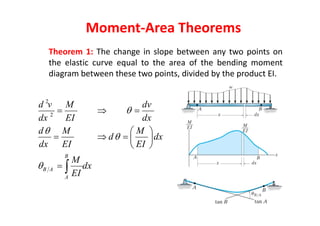
Theorem 1: The change in slope between any two points on
the elastic curve equal to the area of the bending moment
diagram between these two points, divided by the product EI.
Moment‐Area Theorems
2
2
B
B A
A
d v M dv
dx EI dx
d M M
d dx
dx EI EI
M
dx
EI




  
 
    
 
 
/A
B B
A A
B
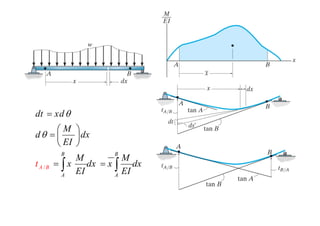
dt xd
M
d dx
EI
M M
x dx x dx
EI EI
t



 
  
 
  
Theorem 2: The vertical distance of point A on a elastic
curve from the tangent drawn to the curve at B is equal to
the moment of the area under the M/EI diagram between
two points (A and B) about point A .
Moment‐Area Theorems
B
A B
A
B
A B
A
M
t x dx
EI
M
t x dx
EI




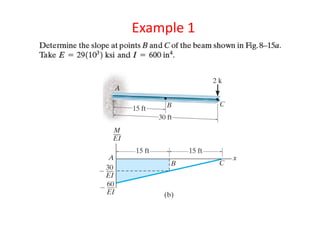
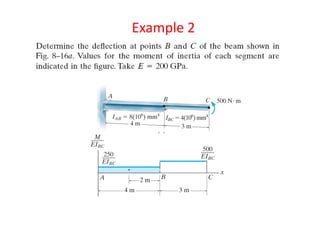
Example 1
Example 2
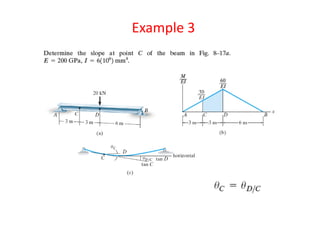
Example 3
Example 4
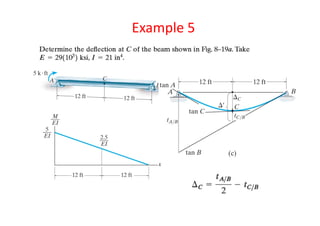
Example 5
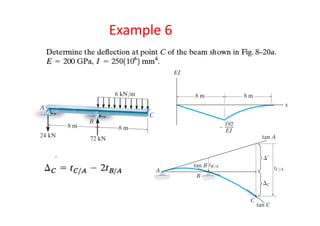
Example 6
Geometric Properties of Area
Text Book Cover Page
Example 7
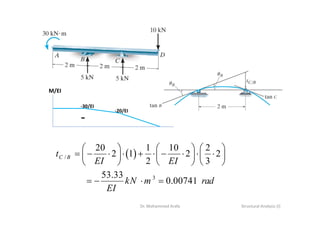
‐30/EI
‐20/EI
M/EI
‐
 /
3
20 1 10 2
2 1 2 2
2 3
53.33
0.00741
C Bt
EI EI
kN m rad
EI
     
              
     
   
‐30/EI
‐20/EI
M/EI
‐
Structural Analysis (I)Dr. Mohammed Arafa
Conjugate-Beam Method
2
2
2
2
dV d M
w w
dx dx
d M d v M
dx EI dx EI





 
V wdx M wdx dx
M M
dx v dx dx
EI EI

  
 
    
     
    
  
  
Integrating
Conjugate-Beam Method
Theorem 1: The slope at a point in the real beam is
numerically equal the shear at the corresponding point in
the conjugate beam.
Theorem 2: The displacement of a point in the real beam is
numerically equal the moment at the corresponding point
in the conjugate beam.
Conjugate-Beam Method
Structural Analysis (I)Dr. Mohammed Arafa
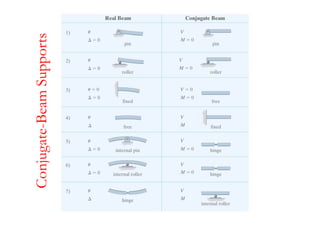
Conjugate-BeamSupports
Example 1
Find the Max. deflection Take E=200Gpa, I=60(106)
EIEI
M
EI
V
BB
BB
5.14062
)25(
5.562
5.562
'
'



Notes
+ve shear means slope is counterclockwise
+ve moment means displacement upward
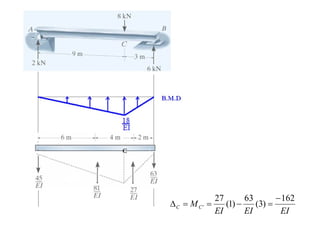
Example 2
Find the deflection at Point C
C
EIEIEI
MCC
162
)3(
63
)1(
27
'


Example 3
Find the deflection at Point D
EI
360
EI
720 EI
MDD
3600
' 
Example 4
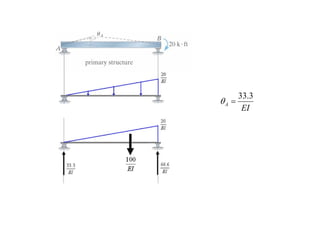
Find the Rotation at A
10 ft
EI
A
3.33

Example 5
Copyright © 2009 Pearson Prentice Hall Inc.
Example 6
٢k
6k
48k.ft
SFD
6
2
151212
2
_
+
48
30
BMD
24
151248
_ _
+
‐48/EI
‐30/EI
M/EI
24/EI
151248
Solution 1
٢k
6k
48k.ft
‐48/EI
‐30/EI
Conjugate Beam
24/EI
151248
228.6/EI
3.6/EI
225/EI
144/EI48/EI
192/EI
0
225 2 3.6
15 15
3
2304
B B
B
B
B B
M
M
M
EI EI
M
EI




 

 
     
 
   

   
 
   
   
225 3.6
0
228.6
225 3.6 228.6
0
B BR R
B R
B BR R
B BL L
V
V
EI EI
V
EI
V
EI EI EI








  
 
    
٢k
6k
48k.ft
Solution 2: BMD using Method of Superposition
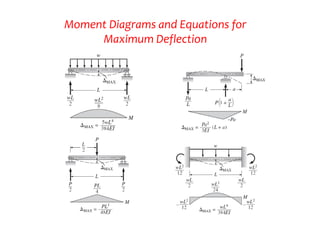
Moment Diagrams and Equations for 
Maximum Deflection
Chapter 8-deflections

Chapter 8-deflections