Learning Dynamical Systems
from Demonstrations
0
Organizers/Speakers: Nadia Figueroa, Sina Mirrazavi, Lukas Huber,
Aude Billard
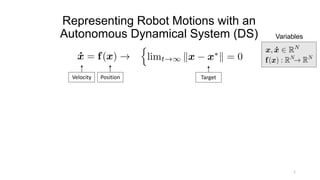
Representing Robot Motions with an
Autonomous Dynamical System (DS)
Velocity Position Target
Variables
1
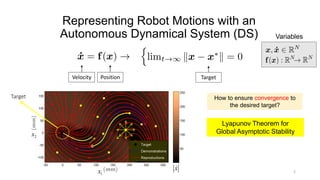
Representing Robot Motions with an
Autonomous Dynamical System (DS)
Velocity Position Target
Variables
Target
1x
2x
x
Lyapunov Theorem for
Global Asymptotic Stability
How to ensure convergence to
the desired target?
2
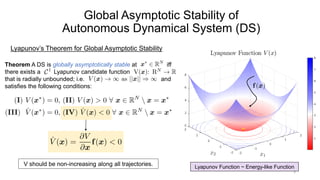
Global Asymptotic Stability of
Autonomous Dynamical System (DS)
Lyapunov Function ~ Energy-like Function
Theorem A DS is globally asymptotically stable at iff
there exists a Lyapunov candidate function
that is radially unbounded; i.e. and
satisfies the following conditions:
V should be non-increasing along all trajectories.
Lyapunov’s Theorem for Global Asymptotic Stability
3
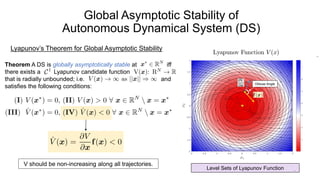
Lyapunov’s Theorem for Global Asymptotic Stability
Level Sets of Lyapunov Function
Theorem A DS is globally asymptotically stable at iff
there exists a Lyapunov candidate function
that is radially unbounded; i.e. and
satisfies the following conditions:
V should be non-increasing along all trajectories.
Global Asymptotic Stability of
Autonomous Dynamical System (DS)
4
Obtuse Angle
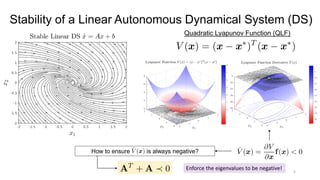
Stability of a Linear Autonomous Dynamical System (DS)
Quadratic Lyapunov Function (QLF)
How to ensure is always negative?
Enforce the eigenvalues to be negative! 5
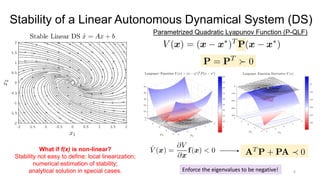
Stability of a Linear Autonomous Dynamical System (DS)
Parametrized Quadratic Lyapunov Function (P-QLF)
Enforce the eigenvalues to be negative!
What if f(x) is non-linear?
Stability not easy to define: local linearization;
numerical estimation of stability;
analytical solution in special cases. 6
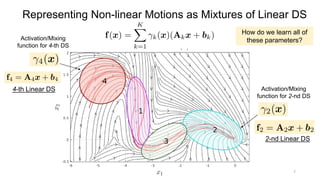
Representing Non-linear Motions as Mixtures of Linear DS
7
2-nd Linear DS
4-th Linear DS Activation/Mixing
function for 2-nd DS
Activation/Mixing
function for 4-th DS
How do we learn all of
these parameters?
8
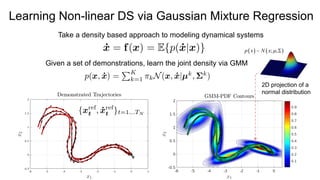
Learning Non-linear DS via Gaussian Mixture Regression
Take a density based approach to modeling dynamical systems
Given a set of demonstrations, learn the joint density via GMM
2D projection of a
normal distribution
   ~ ; ,p x N x  
9
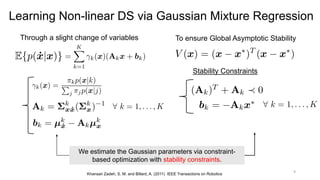
Learning Non-linear DS via Gaussian Mixture Regression
Through a slight change of variables To ensure Global Asymptotic Stability
Khansari Zadeh, S. M. and Billard, A. (2011) IEEE Transactions on Robotics
We estimate the Gaussian parameters via constraint-
based optimization with stability constraints.
Stability Constraints
10
Learning Non-linear DS via Gaussian Mixture Regression
[1] Khansari Zadeh, S. M. and Billard, A. (2011) IEEE Transactions on Robotics
Stable Estimator of Dynamical Systems (SEDS) Approach [1]
Demonstrations
Reproductions
11
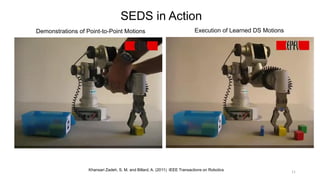
SEDS in Action
Khansari Zadeh, S. M. and Billard, A. (2011) IEEE Transactions on Robotics
Demonstrations of Point-to-Point Motions Execution of Learned DS Motions
12
SEDS in Action
[2] Figueroa, Pais and Billard. (2016) ACM/IEEE HRI Conference
Demonstrations of Sequence of Point-to-Point Motions Execution of Sequence of Learned DS Motions
Learn a point-to-point SEDS for each Phase + impedance/force profiles [2]
13
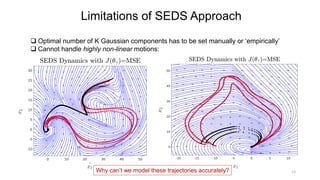
Limitations of SEDS Approach
 Optimal number of K Gaussian components has to be set manually or ‘empirically’
 Cannot handle highly non-linear motions:
Why can’t we model these trajectories accurately?
14
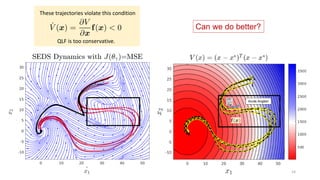
These trajectories violate this condition
QLF is too conservative.
Acute Angles!
Can we do better?
16
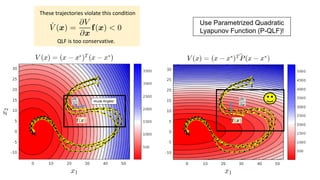
Acute Angles!
Use Parametrized Quadratic
Lyapunov Function (P-QLF)!
These trajectories violate this condition
QLF is too conservative.
Acute Angles!
17
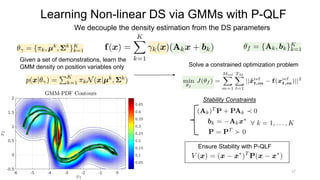
Learning Non-linear DS via GMMs with P-QLF
We decouple the density estimation from the DS parameters
Given a set of demonstrations, learn the
GMM density on position variables only Solve a constrained optimization problem
Stability Constraints
Ensure Stability with P-QLF
18
Learning Non-linear DS via GMMs with P-QLF
[3] Mirrazavi, BIllard. (2018) EPFL PhD Thesis.
Linear Parameter Varying (LPV) Dynamical Systems (DS) Approach [2]
19
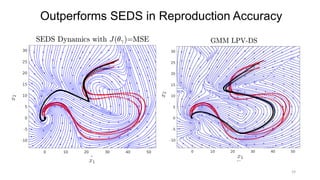
Outperforms SEDS in Reproduction Accuracy
20
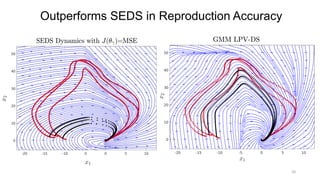
Outperforms SEDS in Reproduction Accuracy
21
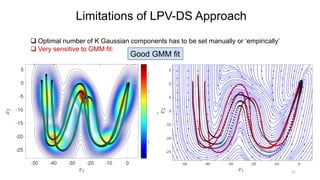
Limitations of LPV-DS Approach
 Optimal number of K Gaussian components has to be set manually or ‘empirically’
 Very sensitive to GMM fit:
Good GMM fit
22
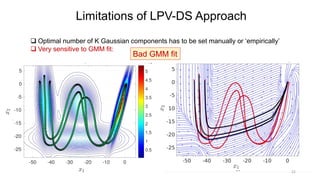
Limitations of LPV-DS Approach
 Optimal number of K Gaussian components has to be set manually or ‘empirically’
 Very sensitive to GMM fit:
Bad GMM fit
Other SEDS-based Extensions – beyond QLF
Tau-SEDS Approach [4]:
Based on Diffeomorphic Transformations
And Complex Lyapunov Functions
23[4] Neumann, Steil (2015) Robotics and Autonomous Systems
Step 1: Construct a Lyapunov Candidate
Function Consistent with the Demonstrations
Weighted Sum of Asymmetric
Quadratic Functions (WSAQF) [5]
[5] Khansari, Billard (2015) Robotics and Autonomous Systems
Other SEDS-based Extensions – beyond QLF
Tau-SEDS Approach [4]:
Based on Diffeomorphic Transformations
And Complex Lyapunov Functions
24
Step 2: Define a diffeomorphism where
takes the form of a QLF
Step 3: Transform the demonstrations via
Step 4: Learn SEDS on transformed data.
Step 1: Construct a Lyapunov Candidate
Function Consistent with the Demonstrations
[4] Neumann, Steil (2015) Robotics and Autonomous Systems [5] Khansari, Billard (2015) Robotics and Autonomous Systems
Other SEDS-based Extensions – beyond QLF
Tau-SEDS Approach [4]:
Based on Diffeomorphic Transformations
And Complex Lyapunov Functions
25
Step 2: Define a diffeomorphism where
takes the form of a QLF
Step 3: Transform the demonstrations via
Step 4: Learn SEDS on transformed data.
Step 5: Back-transform learn SEDS via
Step 1: Construct a Lyapunov Candidate
Function Consistent with the Demonstrations
[4] Neumann, Steil (2015) Robotics and Autonomous Systems [5] Khansari, Billard (2015) Robotics and Autonomous Systems
Other SEDS-based Extensions – beyond QLF
26
Contracting Dynamical Systems Primitives [5]
[6] Ravichandar, Salehi, Dani (2017) CoRL
Stability Constraints via
Partial Contraction Theory
Full List of Publications Mentioned in Lecture
27
[1] Khansari Zadeh, S. M. and Billard, A. (2011) Learning Stable Non-Linear Dynamical Systems with Gaussian
Mixture Models. IEEE Transaction on Robotics, vol. 27, num 5, p. 943-957.
[2] Figueroa, N., Pais, A. L. and Billard, A. (2016) Learning Complex Sequential Tasks from Demonstration: A
Pizza Dough Rolling Case Study. In Proc. of the 2016 ACM/IEEE International Conference on Human-Robot
Interaction. HRI Pioneers Workshop.
[3] Mirrazavi Salehian, S. S. (2018) Compliant control of Uni/ Multi- robotic arms with dynamical systems.
PhD Thesis.
[4] K. Neumann and J. J. Steil. (2015) Learning robot motions with stable dynamical systems under
diffeomorphic transformations. Robotics and Autonomous Systems, 70 (Supplement C):1 – 15
[5] Khansari Zadeh, S. M. and Billard, A. (2014) Learning Control Lyapunov Function to Ensure Stability of
Dynamical System-based Robot Reaching Motions. Robotics and Autonomous Systems
[6] H. Ravichandar, I. Salehi, and A. Dani. (2017) Learning partially contracting dynamical systems from
demonstrations. In Proceedings of the 1st Annual Conference on Robot Learning, vol. 78 of Proceedings of
Machine Learning Research, pp 369–378
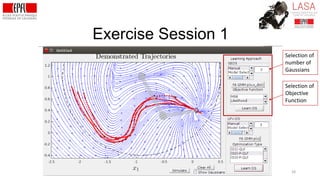
Exercise Session 1
28
Selection of
number of
Gaussians
Selection of
Objective
Function
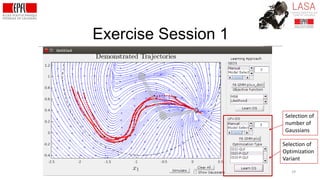
Exercise Session 1
29
Selection of
number of
Gaussians
Selection of
Optimization
Variant
Exercise Session 1
30
Selection of
Optimization
Variant
P is unknown, is estimated jointly with A’s.
P is known, it is estimated a priori via [5]
[5] Khansari, Billard (2015) Robotics and Autonomous Systems

Lecture 1 - Learning Dynamical Systems from Demonstrations

  • 1.
    Learning Dynamical Systems fromDemonstrations 0 Organizers/Speakers: Nadia Figueroa, Sina Mirrazavi, Lukas Huber, Aude Billard
  • 2.
    Representing Robot Motionswith an Autonomous Dynamical System (DS) Velocity Position Target Variables 1
  • 3.
    Representing Robot Motionswith an Autonomous Dynamical System (DS) Velocity Position Target Variables Target 1x 2x x Lyapunov Theorem for Global Asymptotic Stability How to ensure convergence to the desired target? 2
  • 4.
    Global Asymptotic Stabilityof Autonomous Dynamical System (DS) Lyapunov Function ~ Energy-like Function Theorem A DS is globally asymptotically stable at iff there exists a Lyapunov candidate function that is radially unbounded; i.e. and satisfies the following conditions: V should be non-increasing along all trajectories. Lyapunov’s Theorem for Global Asymptotic Stability 3
  • 5.
    Lyapunov’s Theorem forGlobal Asymptotic Stability Level Sets of Lyapunov Function Theorem A DS is globally asymptotically stable at iff there exists a Lyapunov candidate function that is radially unbounded; i.e. and satisfies the following conditions: V should be non-increasing along all trajectories. Global Asymptotic Stability of Autonomous Dynamical System (DS) 4 Obtuse Angle
  • 6.
    Stability of aLinear Autonomous Dynamical System (DS) Quadratic Lyapunov Function (QLF) How to ensure is always negative? Enforce the eigenvalues to be negative! 5
  • 7.
    Stability of aLinear Autonomous Dynamical System (DS) Parametrized Quadratic Lyapunov Function (P-QLF) Enforce the eigenvalues to be negative! What if f(x) is non-linear? Stability not easy to define: local linearization; numerical estimation of stability; analytical solution in special cases. 6
  • 8.
    Representing Non-linear Motionsas Mixtures of Linear DS 7 2-nd Linear DS 4-th Linear DS Activation/Mixing function for 2-nd DS Activation/Mixing function for 4-th DS How do we learn all of these parameters?
  • 9.
    8 Learning Non-linear DSvia Gaussian Mixture Regression Take a density based approach to modeling dynamical systems Given a set of demonstrations, learn the joint density via GMM 2D projection of a normal distribution    ~ ; ,p x N x  
  • 10.
    9 Learning Non-linear DSvia Gaussian Mixture Regression Through a slight change of variables To ensure Global Asymptotic Stability Khansari Zadeh, S. M. and Billard, A. (2011) IEEE Transactions on Robotics We estimate the Gaussian parameters via constraint- based optimization with stability constraints. Stability Constraints
  • 11.
    10 Learning Non-linear DSvia Gaussian Mixture Regression [1] Khansari Zadeh, S. M. and Billard, A. (2011) IEEE Transactions on Robotics Stable Estimator of Dynamical Systems (SEDS) Approach [1] Demonstrations Reproductions
  • 12.
    11 SEDS in Action KhansariZadeh, S. M. and Billard, A. (2011) IEEE Transactions on Robotics Demonstrations of Point-to-Point Motions Execution of Learned DS Motions
  • 13.
    12 SEDS in Action [2]Figueroa, Pais and Billard. (2016) ACM/IEEE HRI Conference Demonstrations of Sequence of Point-to-Point Motions Execution of Sequence of Learned DS Motions Learn a point-to-point SEDS for each Phase + impedance/force profiles [2]
  • 14.
    13 Limitations of SEDSApproach  Optimal number of K Gaussian components has to be set manually or ‘empirically’  Cannot handle highly non-linear motions: Why can’t we model these trajectories accurately?
  • 15.
    14 These trajectories violatethis condition QLF is too conservative. Acute Angles! Can we do better?
  • 16.
    16 Acute Angles! Use ParametrizedQuadratic Lyapunov Function (P-QLF)! These trajectories violate this condition QLF is too conservative. Acute Angles!
  • 17.
    17 Learning Non-linear DSvia GMMs with P-QLF We decouple the density estimation from the DS parameters Given a set of demonstrations, learn the GMM density on position variables only Solve a constrained optimization problem Stability Constraints Ensure Stability with P-QLF
  • 18.
    18 Learning Non-linear DSvia GMMs with P-QLF [3] Mirrazavi, BIllard. (2018) EPFL PhD Thesis. Linear Parameter Varying (LPV) Dynamical Systems (DS) Approach [2]
  • 19.
    19 Outperforms SEDS inReproduction Accuracy
  • 20.
    20 Outperforms SEDS inReproduction Accuracy
  • 21.
    21 Limitations of LPV-DSApproach  Optimal number of K Gaussian components has to be set manually or ‘empirically’  Very sensitive to GMM fit: Good GMM fit
  • 22.
    22 Limitations of LPV-DSApproach  Optimal number of K Gaussian components has to be set manually or ‘empirically’  Very sensitive to GMM fit: Bad GMM fit
  • 23.
    Other SEDS-based Extensions– beyond QLF Tau-SEDS Approach [4]: Based on Diffeomorphic Transformations And Complex Lyapunov Functions 23[4] Neumann, Steil (2015) Robotics and Autonomous Systems Step 1: Construct a Lyapunov Candidate Function Consistent with the Demonstrations Weighted Sum of Asymmetric Quadratic Functions (WSAQF) [5] [5] Khansari, Billard (2015) Robotics and Autonomous Systems
  • 24.
    Other SEDS-based Extensions– beyond QLF Tau-SEDS Approach [4]: Based on Diffeomorphic Transformations And Complex Lyapunov Functions 24 Step 2: Define a diffeomorphism where takes the form of a QLF Step 3: Transform the demonstrations via Step 4: Learn SEDS on transformed data. Step 1: Construct a Lyapunov Candidate Function Consistent with the Demonstrations [4] Neumann, Steil (2015) Robotics and Autonomous Systems [5] Khansari, Billard (2015) Robotics and Autonomous Systems
  • 25.
    Other SEDS-based Extensions– beyond QLF Tau-SEDS Approach [4]: Based on Diffeomorphic Transformations And Complex Lyapunov Functions 25 Step 2: Define a diffeomorphism where takes the form of a QLF Step 3: Transform the demonstrations via Step 4: Learn SEDS on transformed data. Step 5: Back-transform learn SEDS via Step 1: Construct a Lyapunov Candidate Function Consistent with the Demonstrations [4] Neumann, Steil (2015) Robotics and Autonomous Systems [5] Khansari, Billard (2015) Robotics and Autonomous Systems
  • 26.
    Other SEDS-based Extensions– beyond QLF 26 Contracting Dynamical Systems Primitives [5] [6] Ravichandar, Salehi, Dani (2017) CoRL Stability Constraints via Partial Contraction Theory
  • 27.
    Full List ofPublications Mentioned in Lecture 27 [1] Khansari Zadeh, S. M. and Billard, A. (2011) Learning Stable Non-Linear Dynamical Systems with Gaussian Mixture Models. IEEE Transaction on Robotics, vol. 27, num 5, p. 943-957. [2] Figueroa, N., Pais, A. L. and Billard, A. (2016) Learning Complex Sequential Tasks from Demonstration: A Pizza Dough Rolling Case Study. In Proc. of the 2016 ACM/IEEE International Conference on Human-Robot Interaction. HRI Pioneers Workshop. [3] Mirrazavi Salehian, S. S. (2018) Compliant control of Uni/ Multi- robotic arms with dynamical systems. PhD Thesis. [4] K. Neumann and J. J. Steil. (2015) Learning robot motions with stable dynamical systems under diffeomorphic transformations. Robotics and Autonomous Systems, 70 (Supplement C):1 – 15 [5] Khansari Zadeh, S. M. and Billard, A. (2014) Learning Control Lyapunov Function to Ensure Stability of Dynamical System-based Robot Reaching Motions. Robotics and Autonomous Systems [6] H. Ravichandar, I. Salehi, and A. Dani. (2017) Learning partially contracting dynamical systems from demonstrations. In Proceedings of the 1st Annual Conference on Robot Learning, vol. 78 of Proceedings of Machine Learning Research, pp 369–378
  • 28.
    Exercise Session 1 28 Selectionof number of Gaussians Selection of Objective Function
  • 29.
    Exercise Session 1 29 Selectionof number of Gaussians Selection of Optimization Variant
  • 30.
    Exercise Session 1 30 Selectionof Optimization Variant P is unknown, is estimated jointly with A’s. P is known, it is estimated a priori via [5] [5] Khansari, Billard (2015) Robotics and Autonomous Systems