React Native Munich Meetup
May 2017
REDUX SAGA
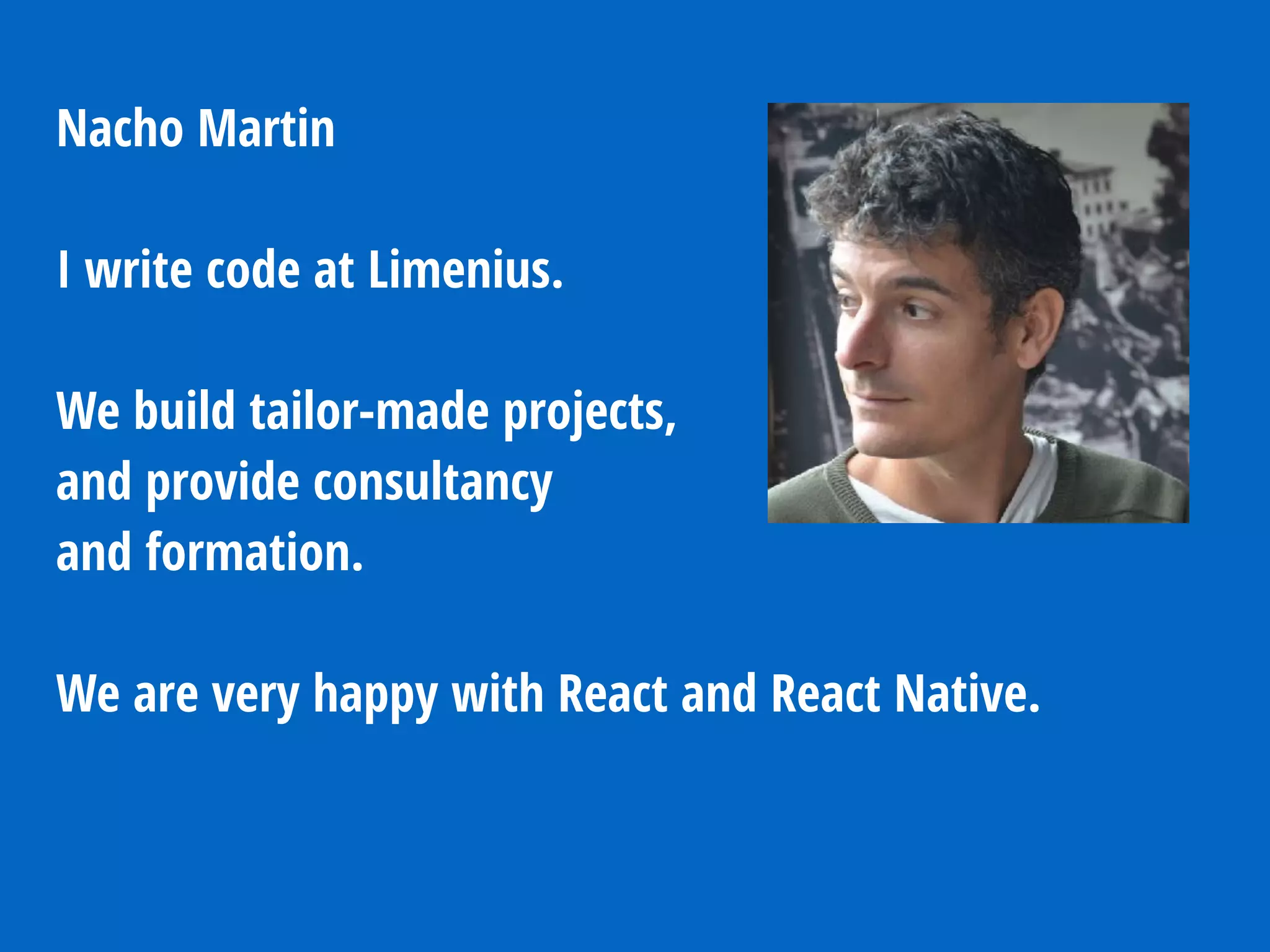
Nacho Martín
@nacmartin
Nacho Martin
I write code at Limenius.
We build tailor-made projects,
and provide consultancy
and formation.
We are very happy with React and React Native.
Roadmap:
• Are Sagas indispensable?
• Do they have a strong theoretical background?
• ES6 Generators
• Sagas
Maybe you don’t need redux-saga
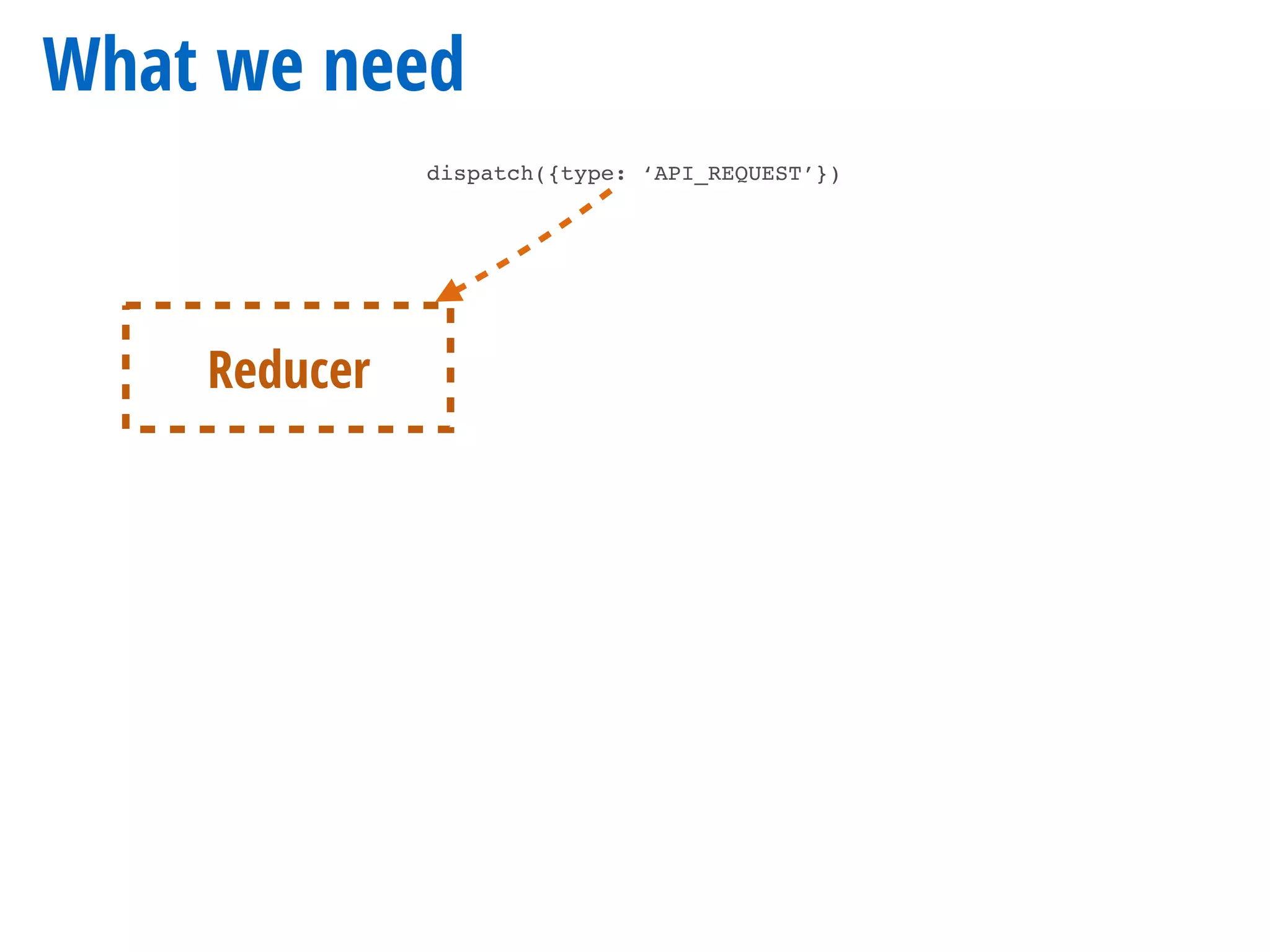
What we need
dispatch({type: ‘API_REQUEST’})
Reducer
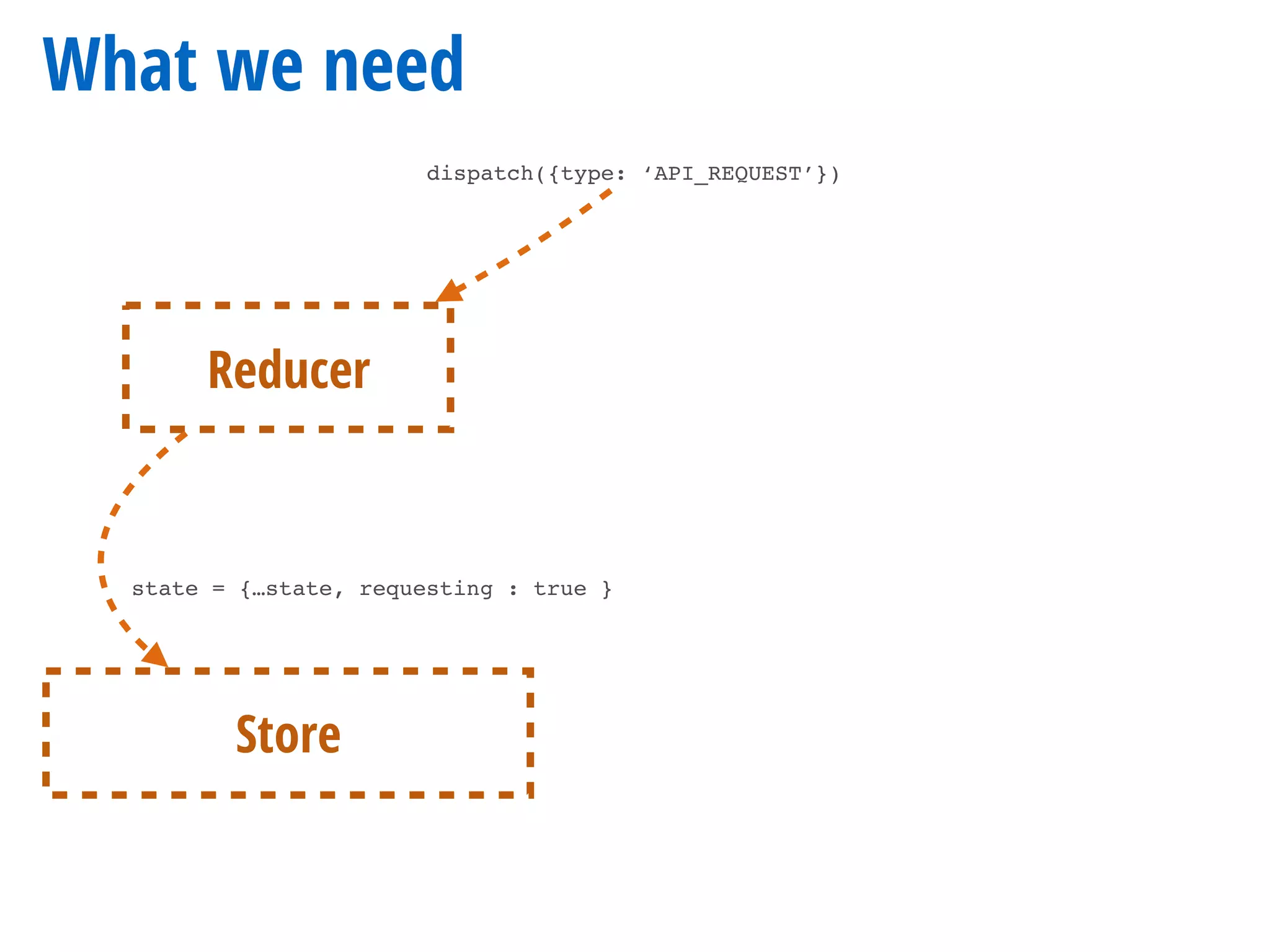
What we need
dispatch({type: ‘API_REQUEST’})
Reducer
state = {…state, requesting : true }
Store
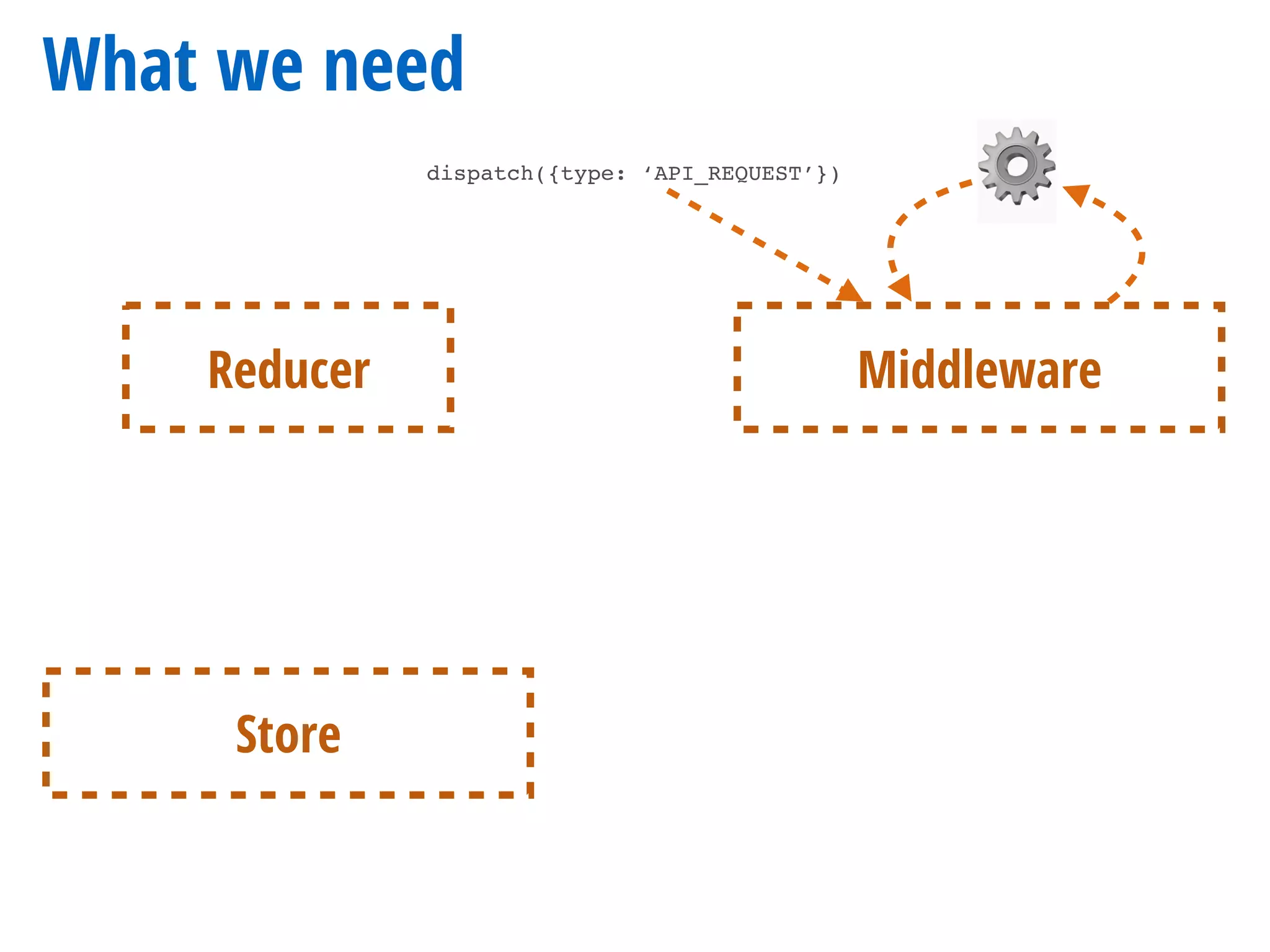
What we need
dispatch({type: ‘API_REQUEST’})
Reducer
Store
Middleware
⚙
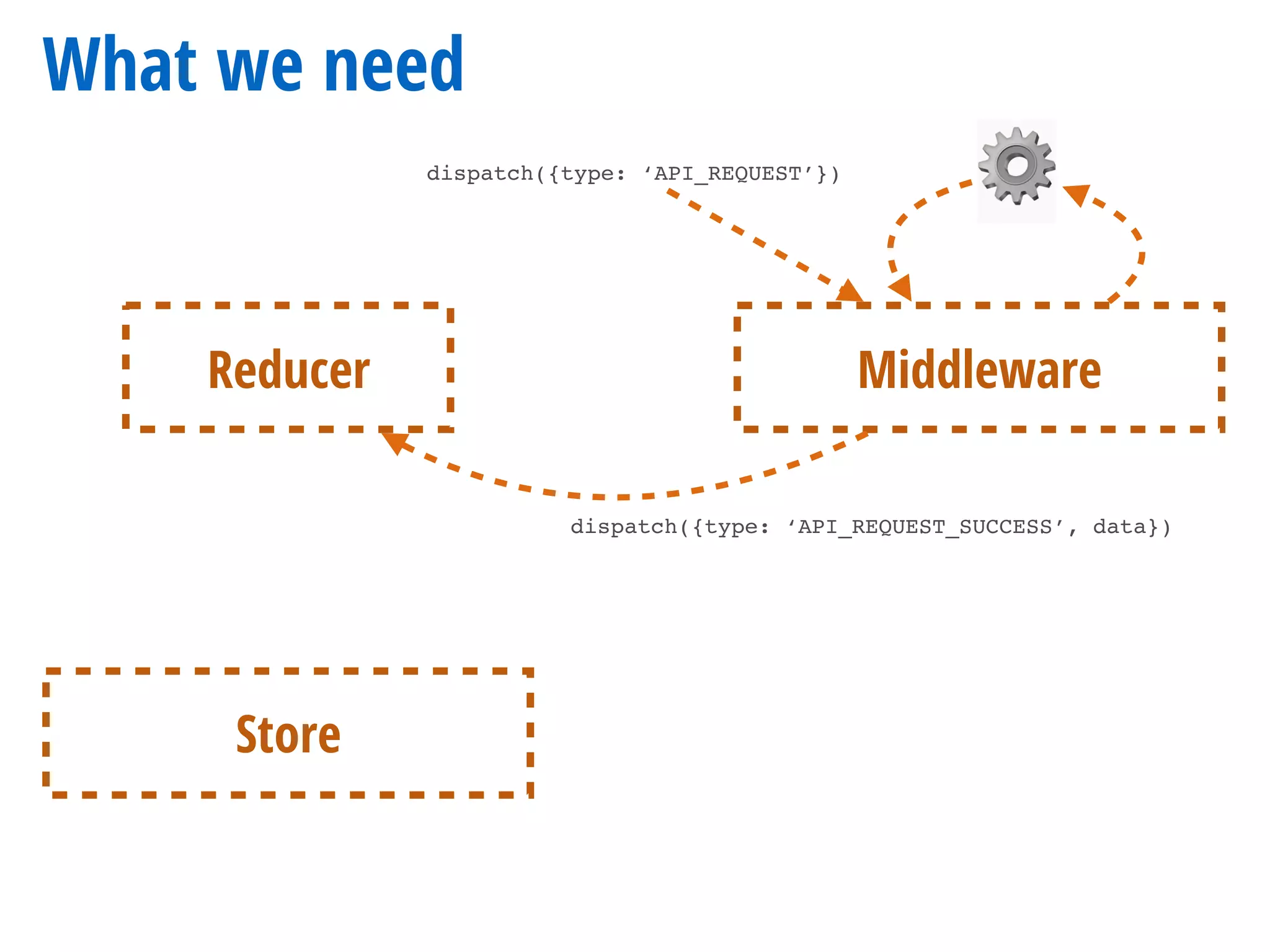
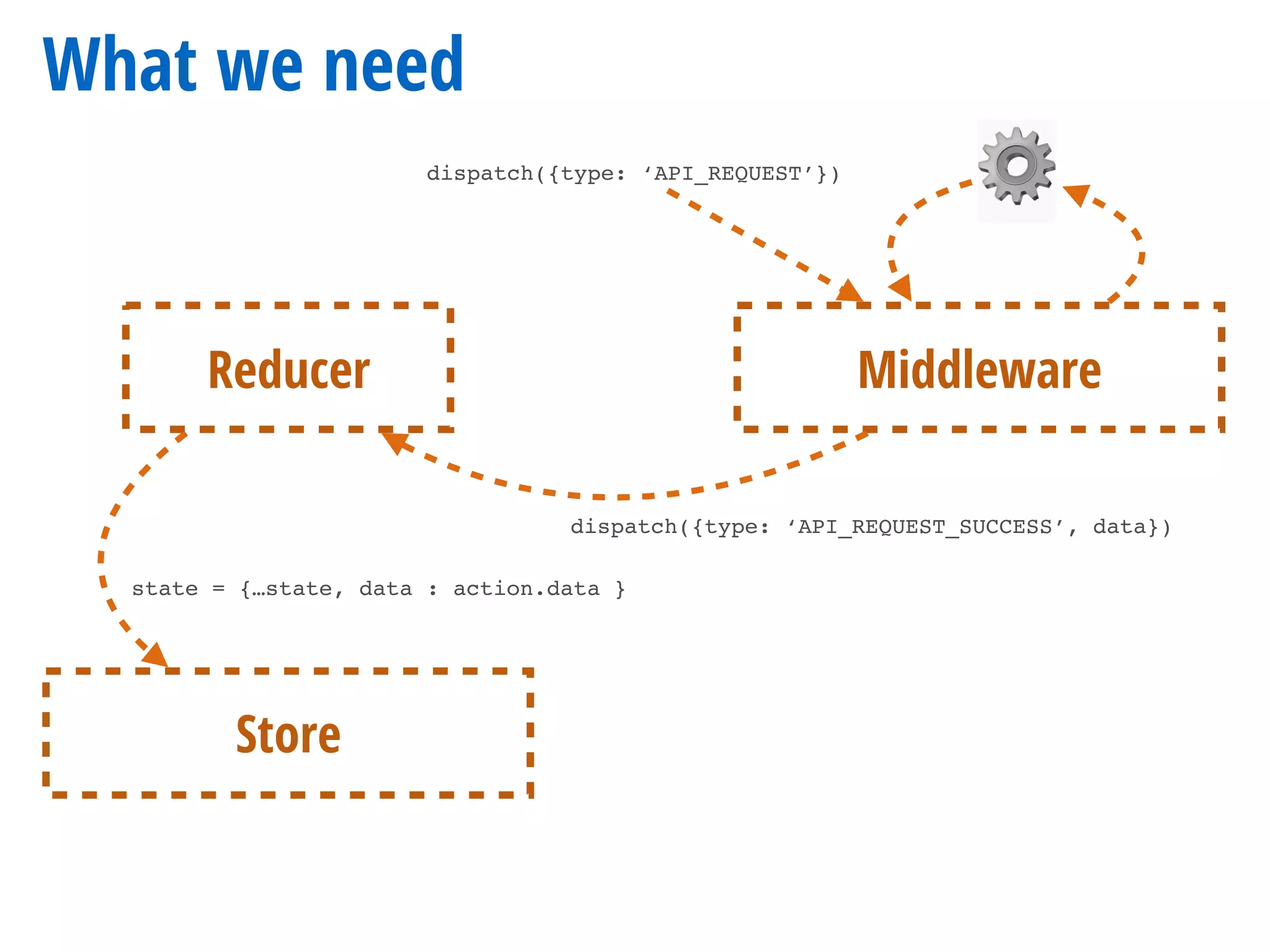
What we need
dispatch({type: ‘API_REQUEST’})
Reducer
Store
Middleware
dispatch({type: ‘API_REQUEST_SUCCESS’, data})
⚙
What we need
dispatch({type: ‘API_REQUEST’})
Reducer
state = {…state, data : action.data }
Store
Middleware
dispatch({type: ‘API_REQUEST_SUCCESS’, data})
⚙
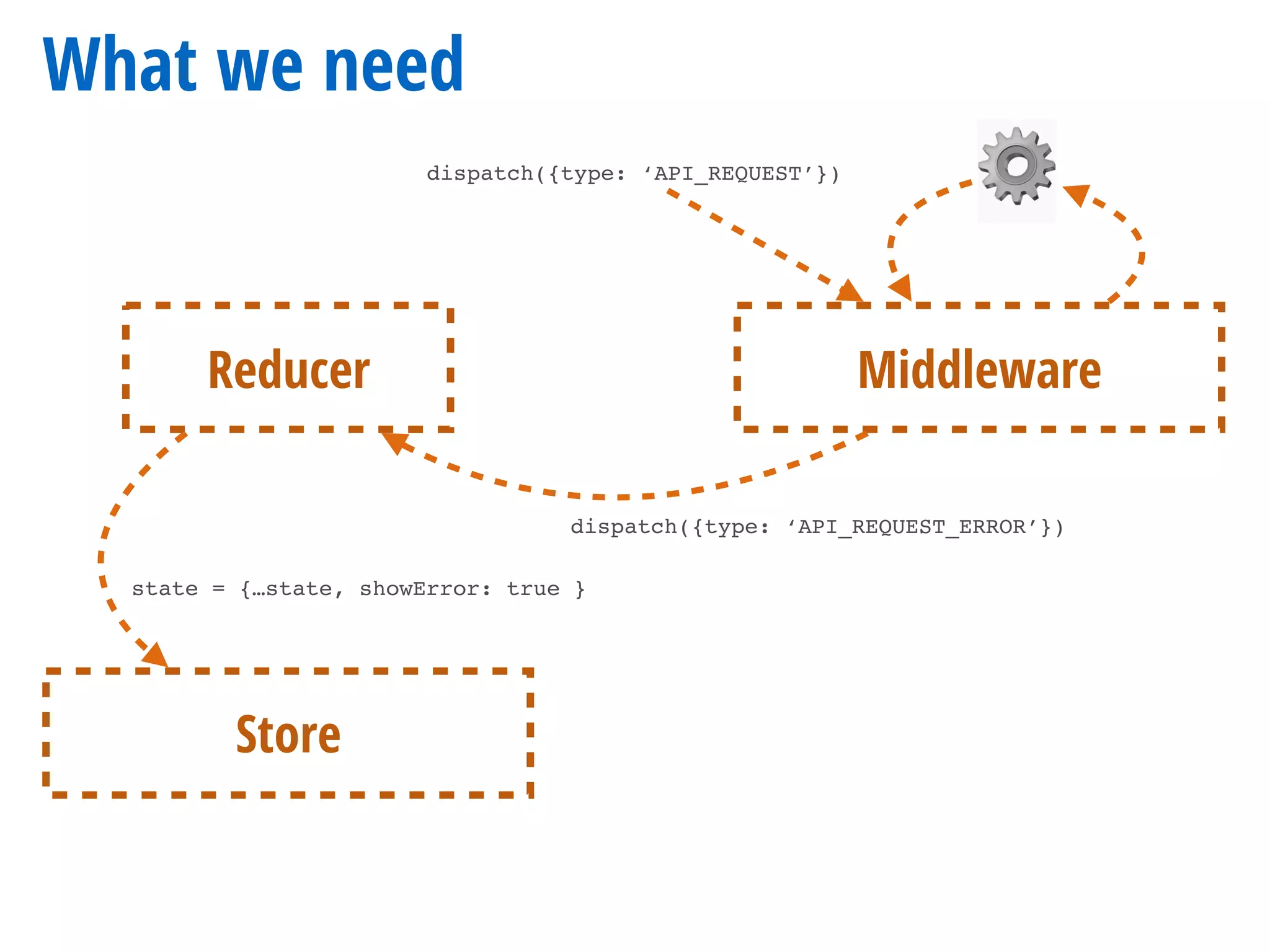
What we need
dispatch({type: ‘API_REQUEST’})
Reducer
state = {…state, showError: true }
Store
Middleware
dispatch({type: ‘API_REQUEST_ERROR’})
⚙
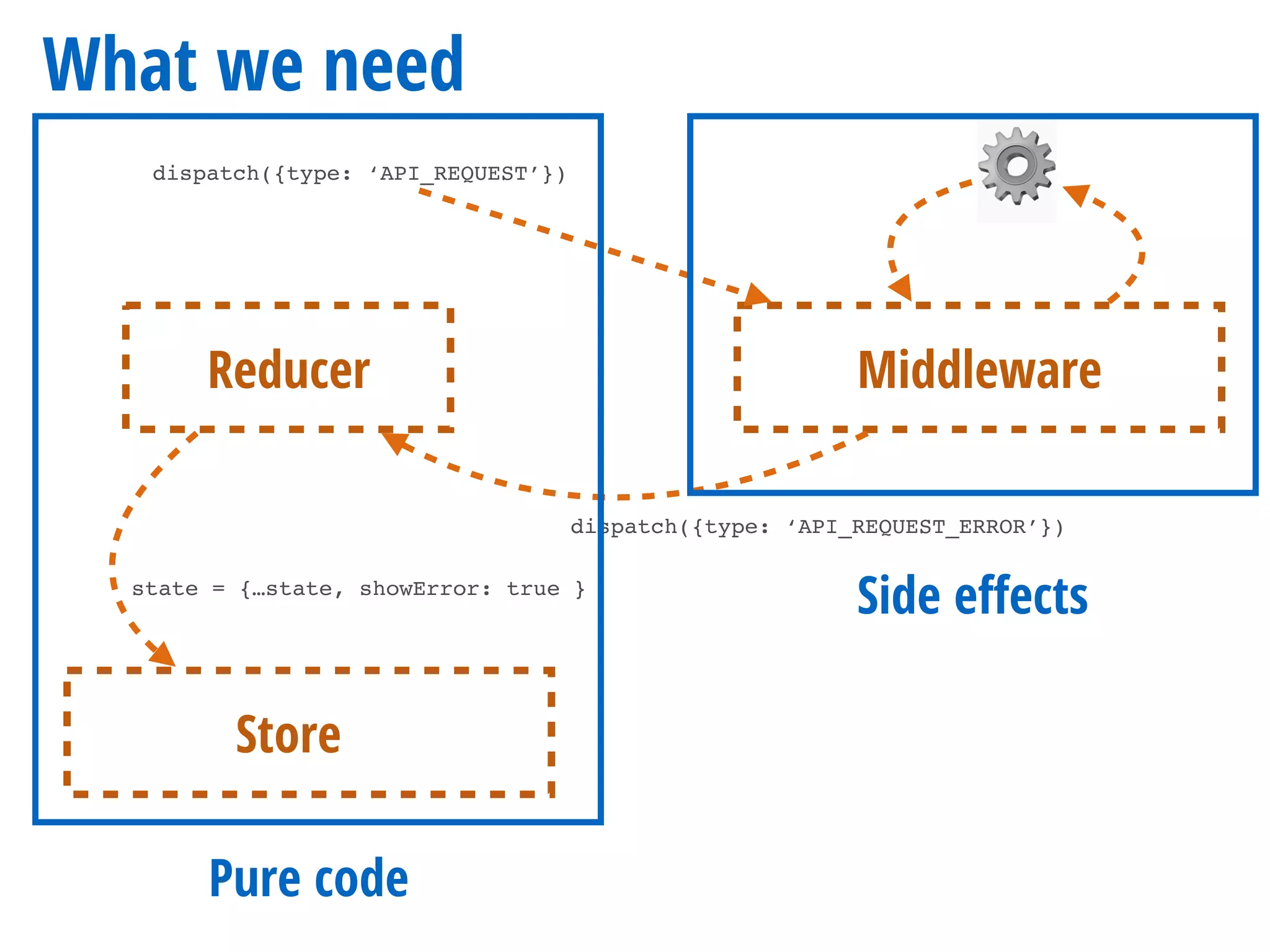
What we need
dispatch({type: ‘API_REQUEST’})
Reducer
state = {…state, showError: true }
Store
Middleware
dispatch({type: ‘API_REQUEST_ERROR’})
⚙
Side effects
Pure code
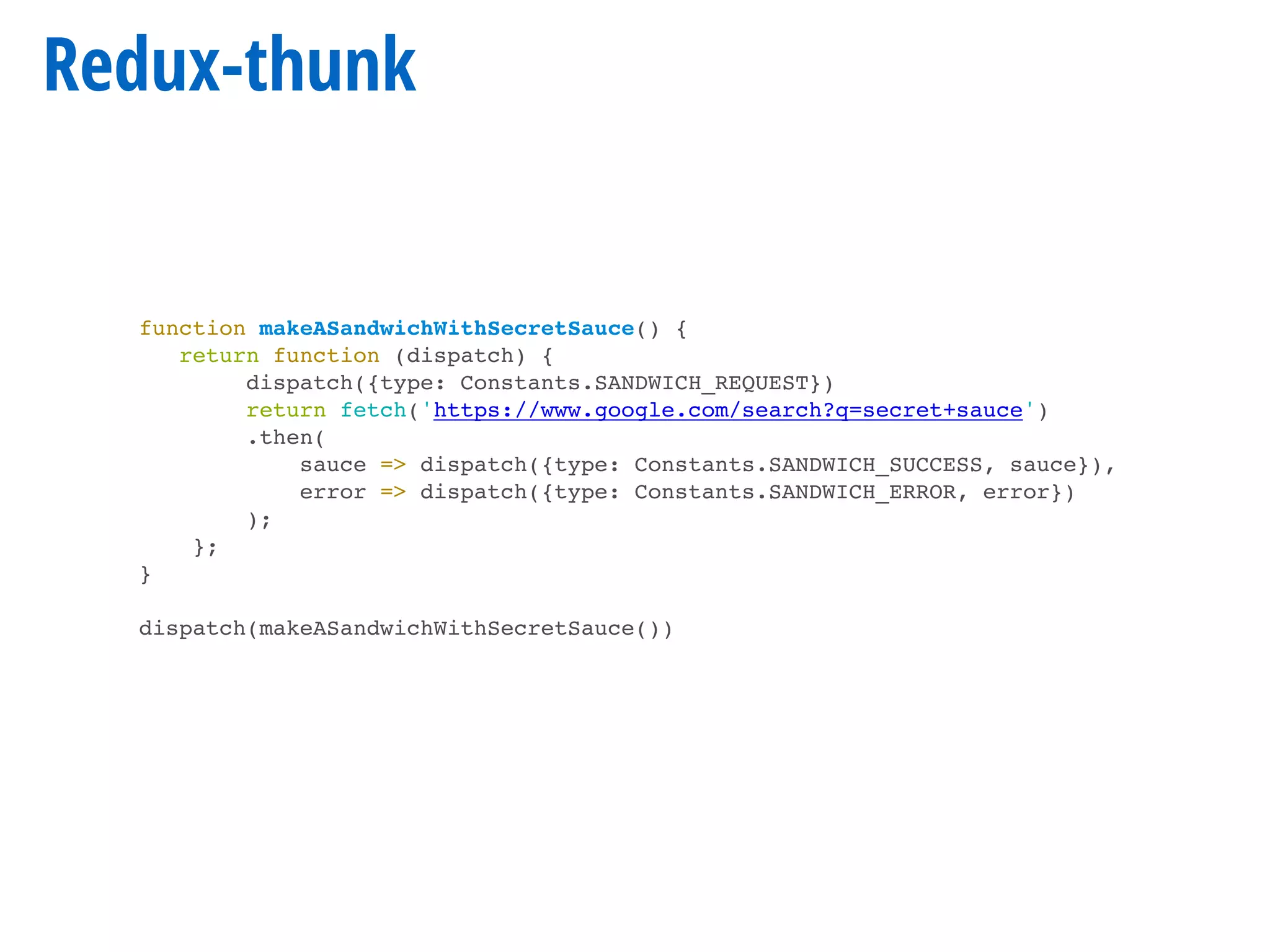
Redux-thunk
function makeASandwichWithSecretSauce() {
return function (dispatch) {
dispatch({type: Constants.SANDWICH_REQUEST})
return fetch('https://www.google.com/search?q=secret+sauce')
.then(
sauce => dispatch({type: Constants.SANDWICH_SUCCESS, sauce}),
error => dispatch({type: Constants.SANDWICH_ERROR, error})
);
};
}
dispatch(makeASandwichWithSecretSauce())
Redux-thunk
The lib has only 14 lines of code
If you don’t need more, stick with it
But what if you do?
If you need more
•Redux-saga
•Redux-observable
•…
•Maybe your own in the future?
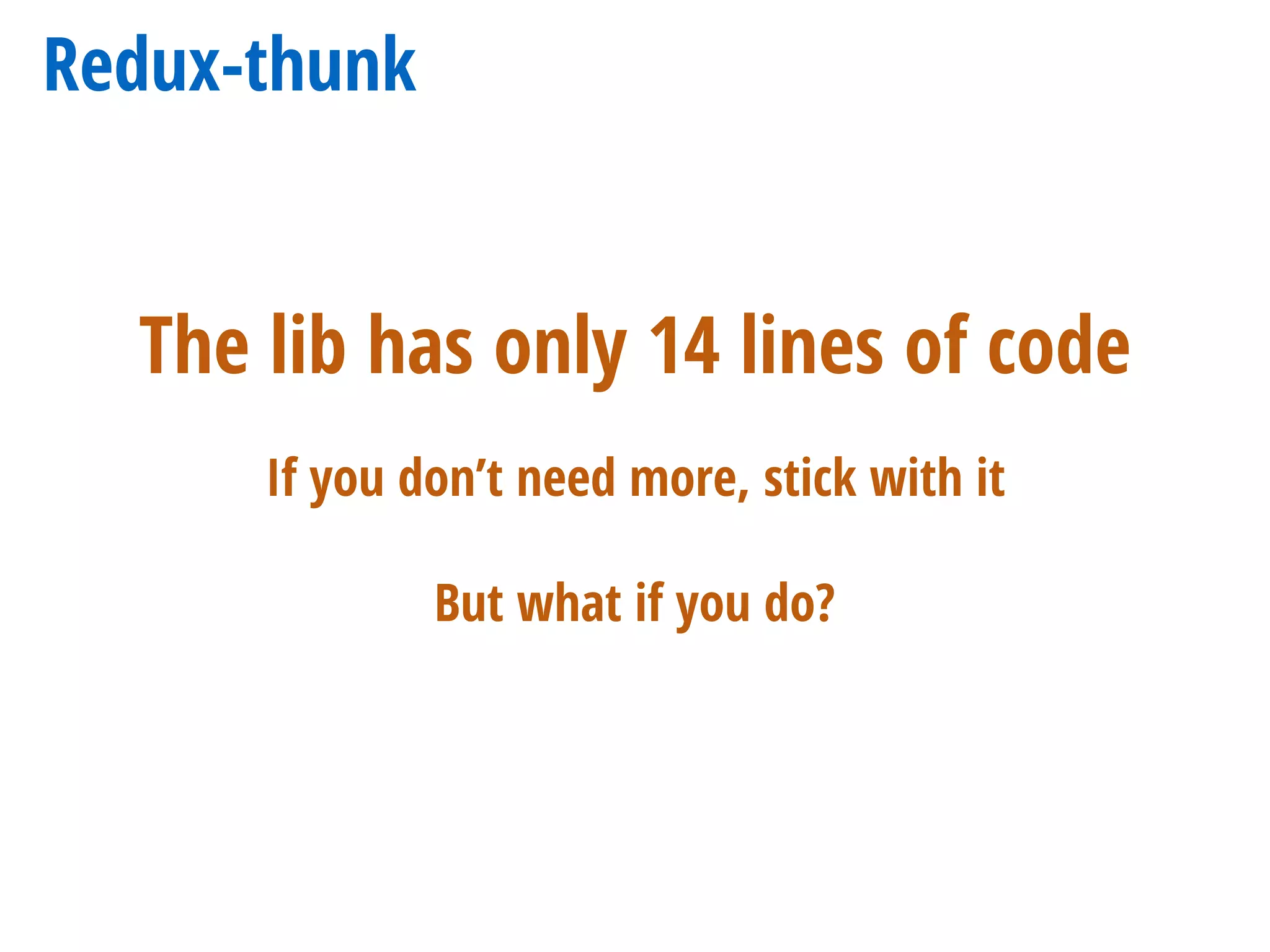
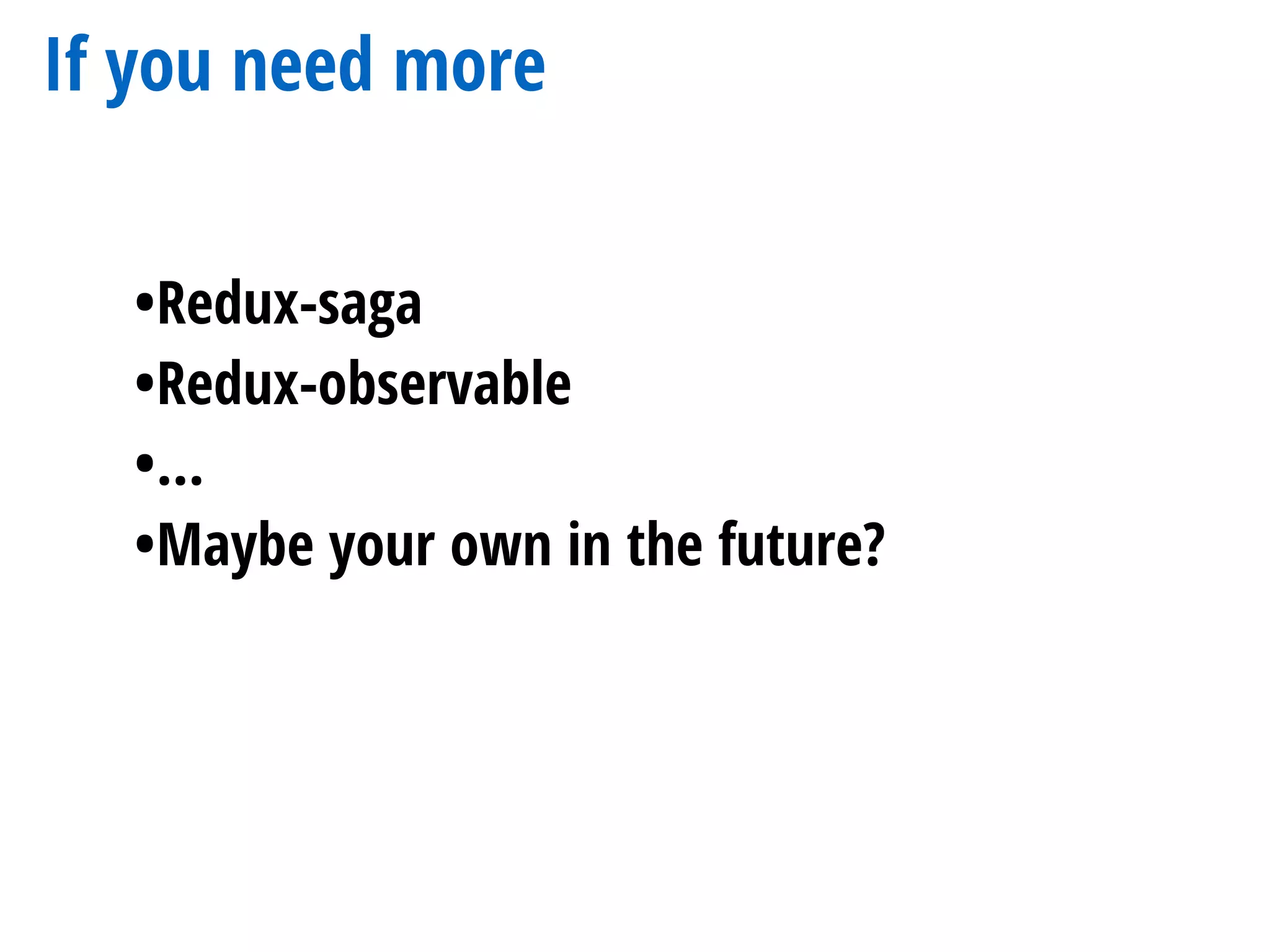
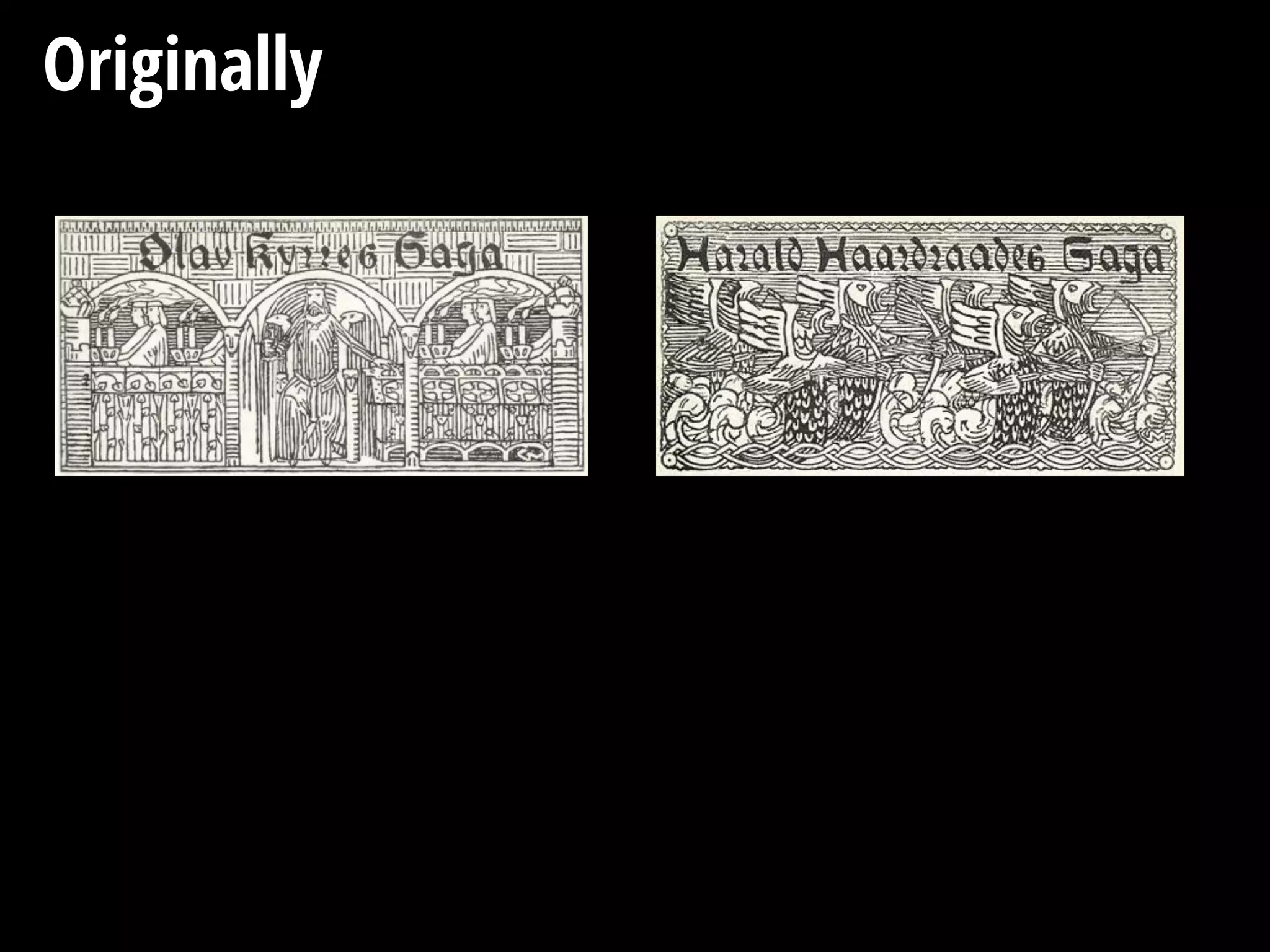
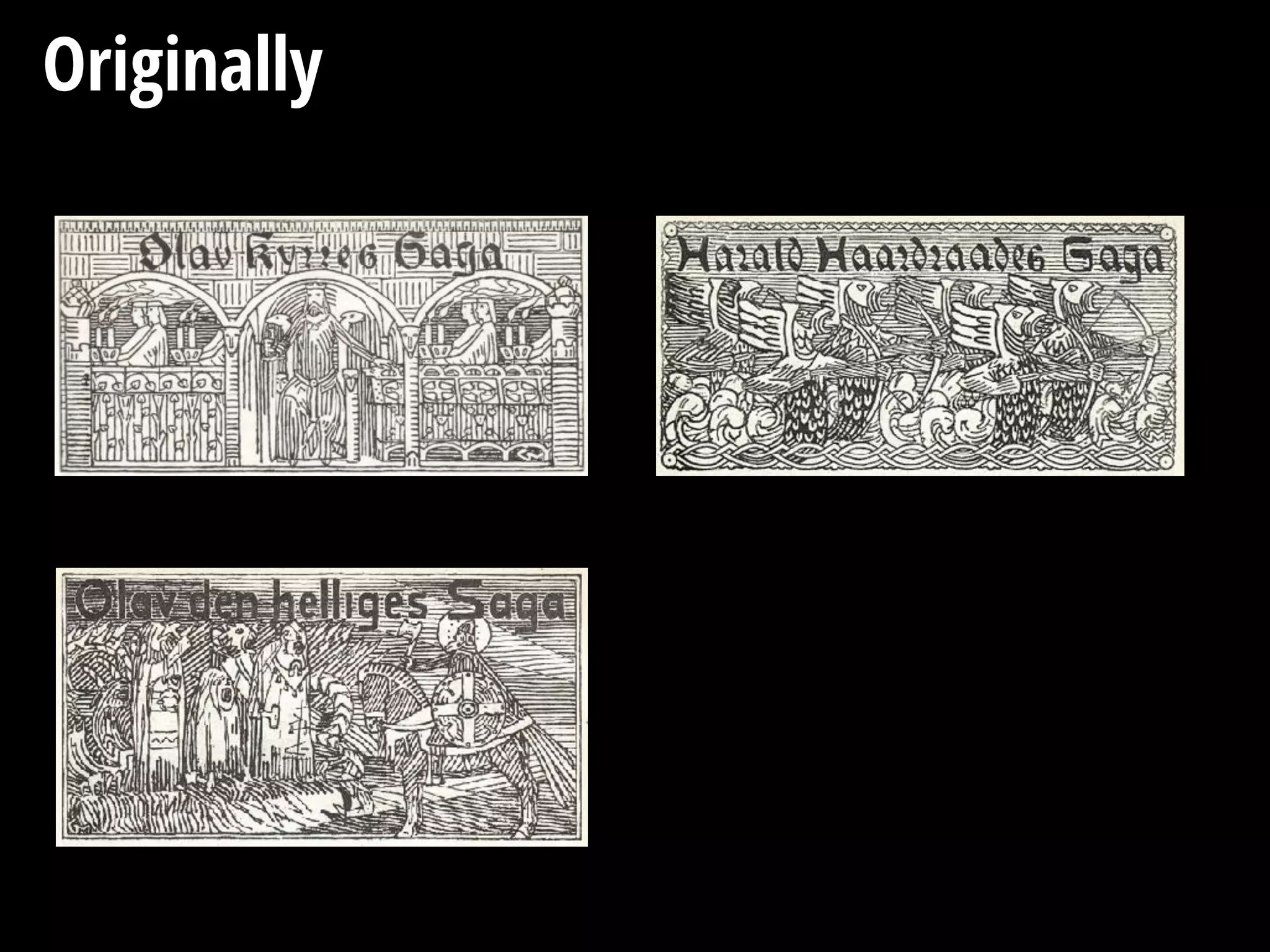
Sagas: an abused word
Originally
Originally
Originally
Originally
But nowadays
A long and complicated story with many details
e.g. “my neighbor told me the saga of his divorce again”
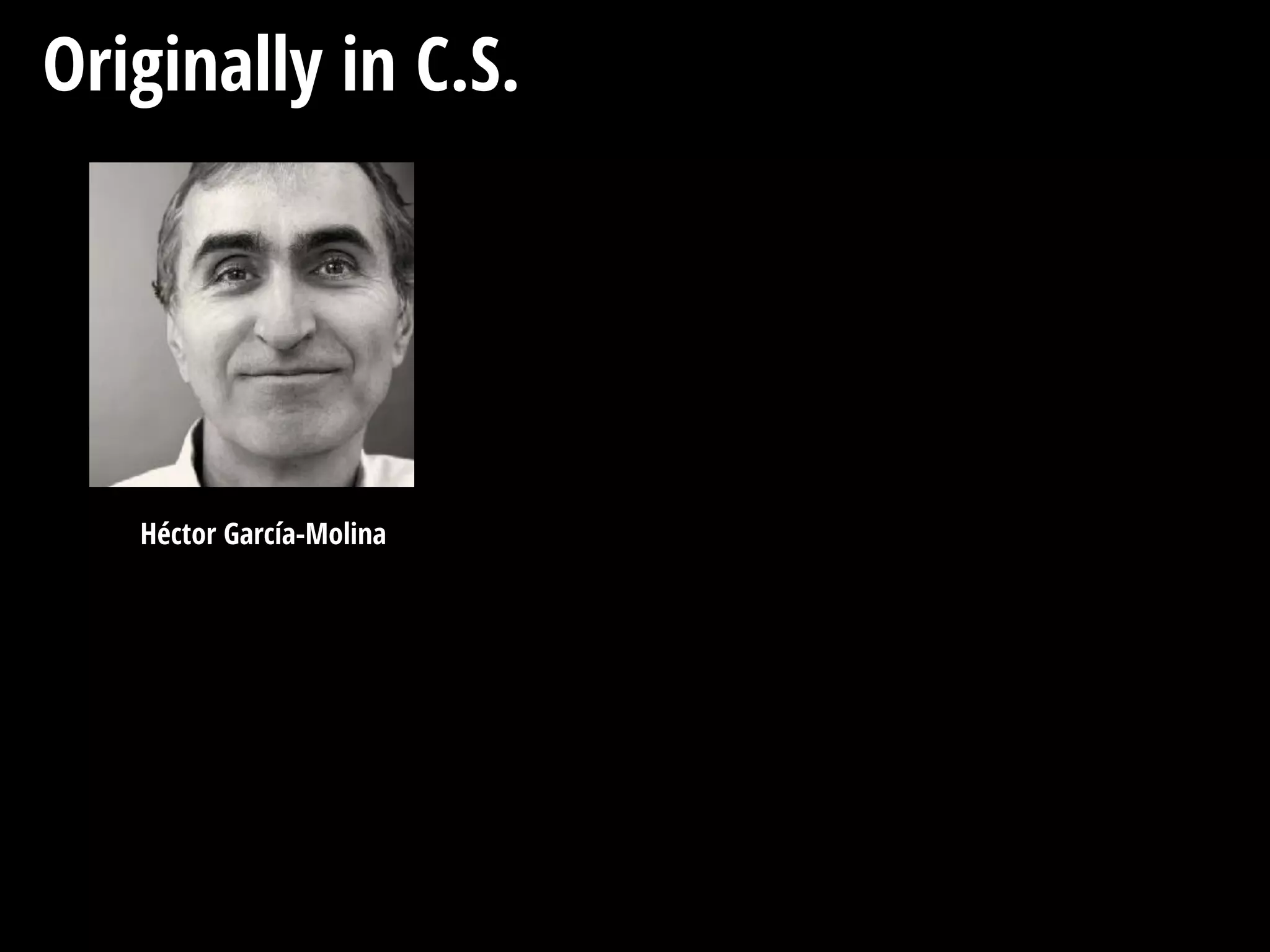
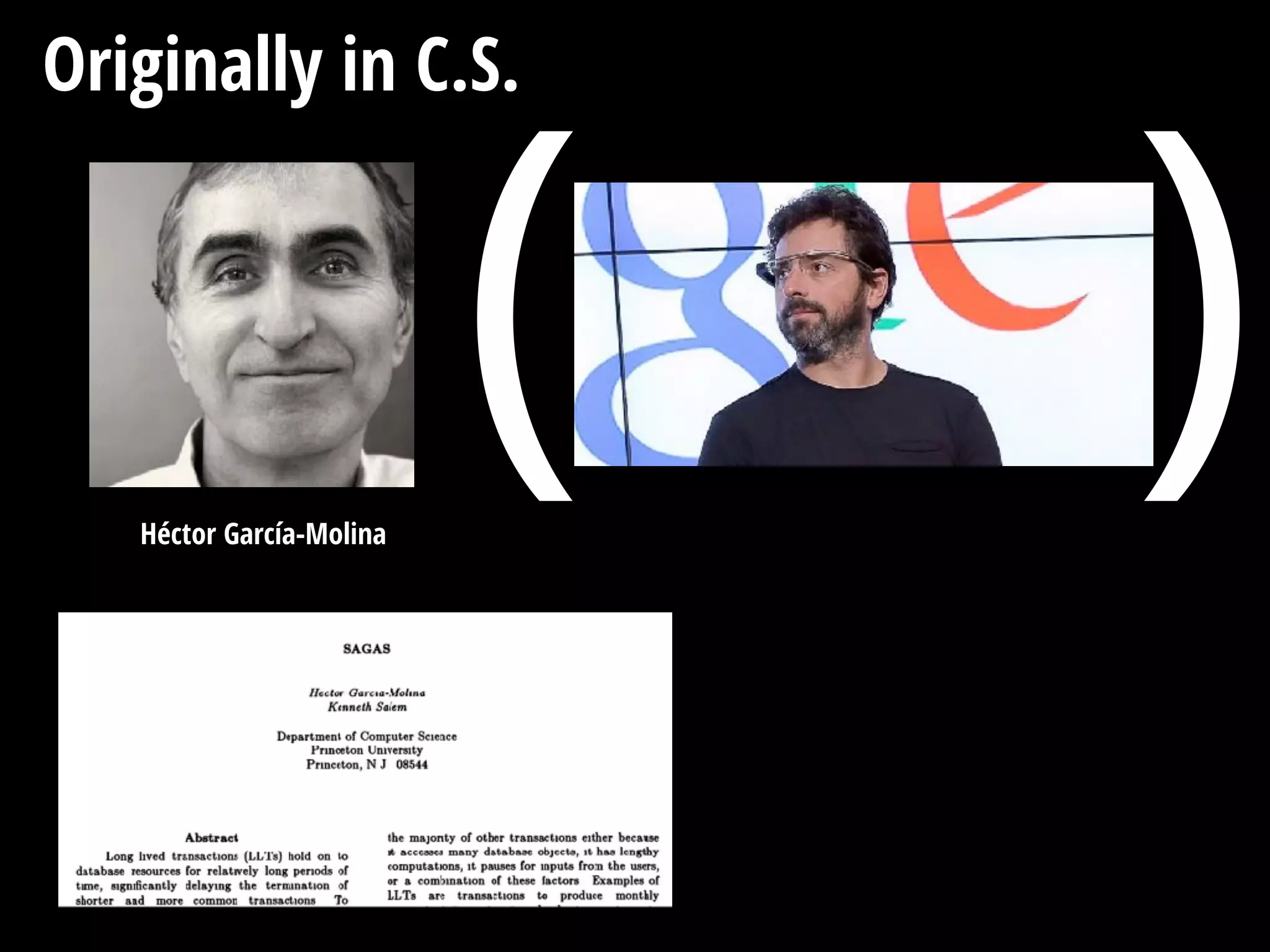
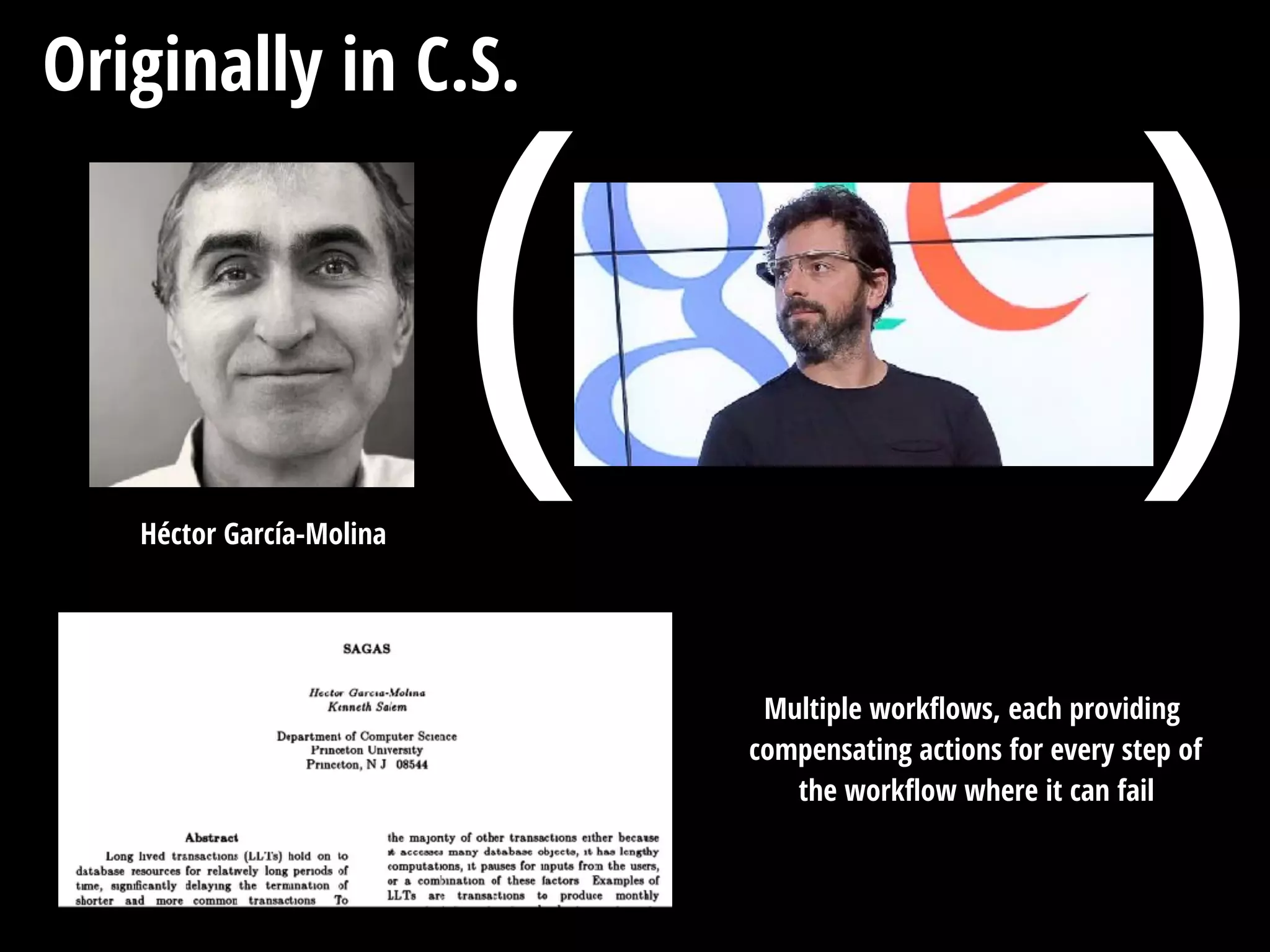
Originally in C.S.
Héctor García-Molina
Originally in C.S.
Héctor García-Molina
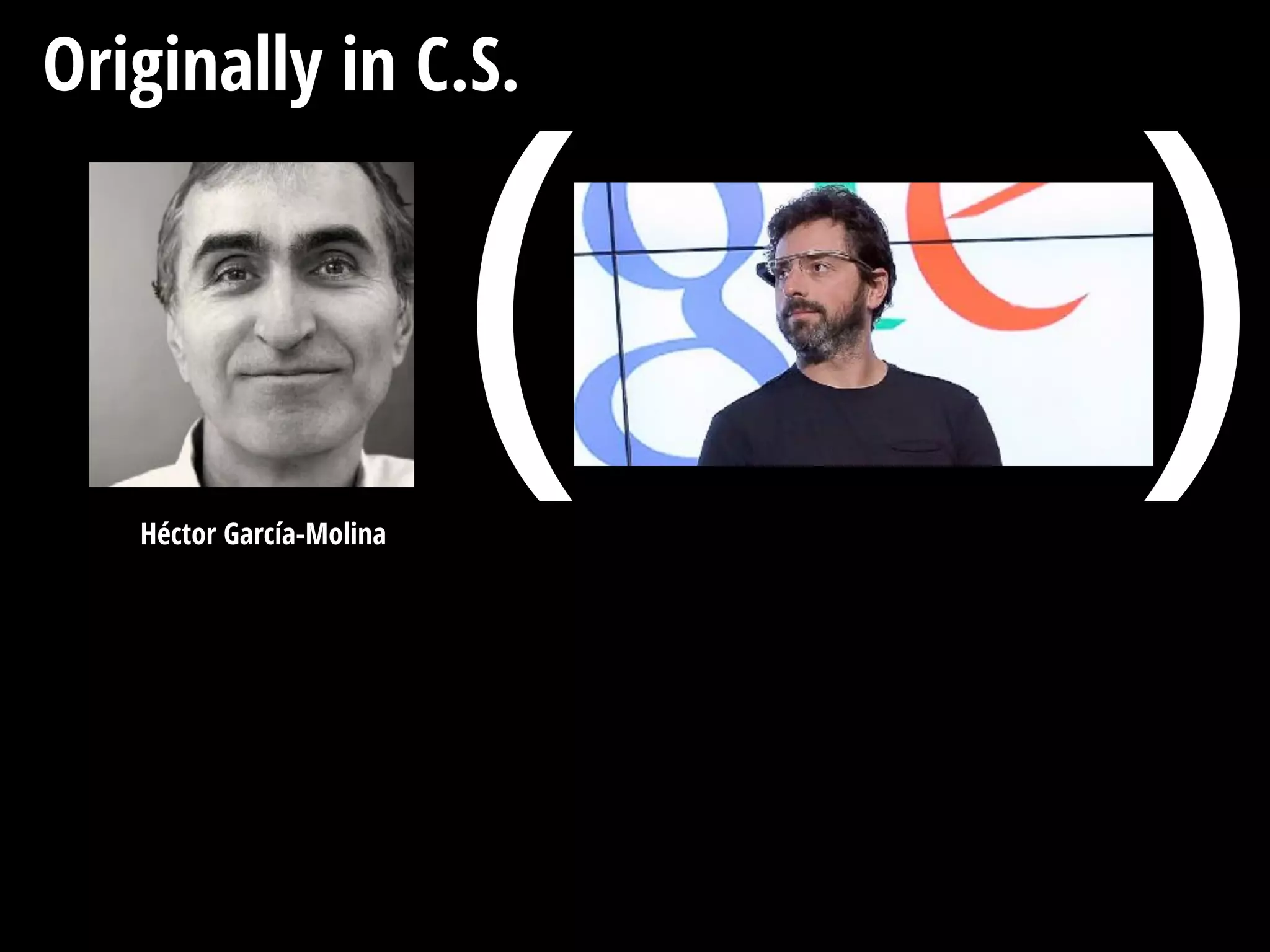
( )
Originally in C.S.
Héctor García-Molina
( )
Originally in C.S.
Héctor García-Molina
( )
Multiple workflows, each providing
compensating actions for every step of
the workflow where it can fail
But nowadays
A process manager used to
orchestrate complex operations.
But nowadays
A process manager used to
orchestrate complex operations.
A library to manage side-effects.
And in redux-saga:
Generators
function*
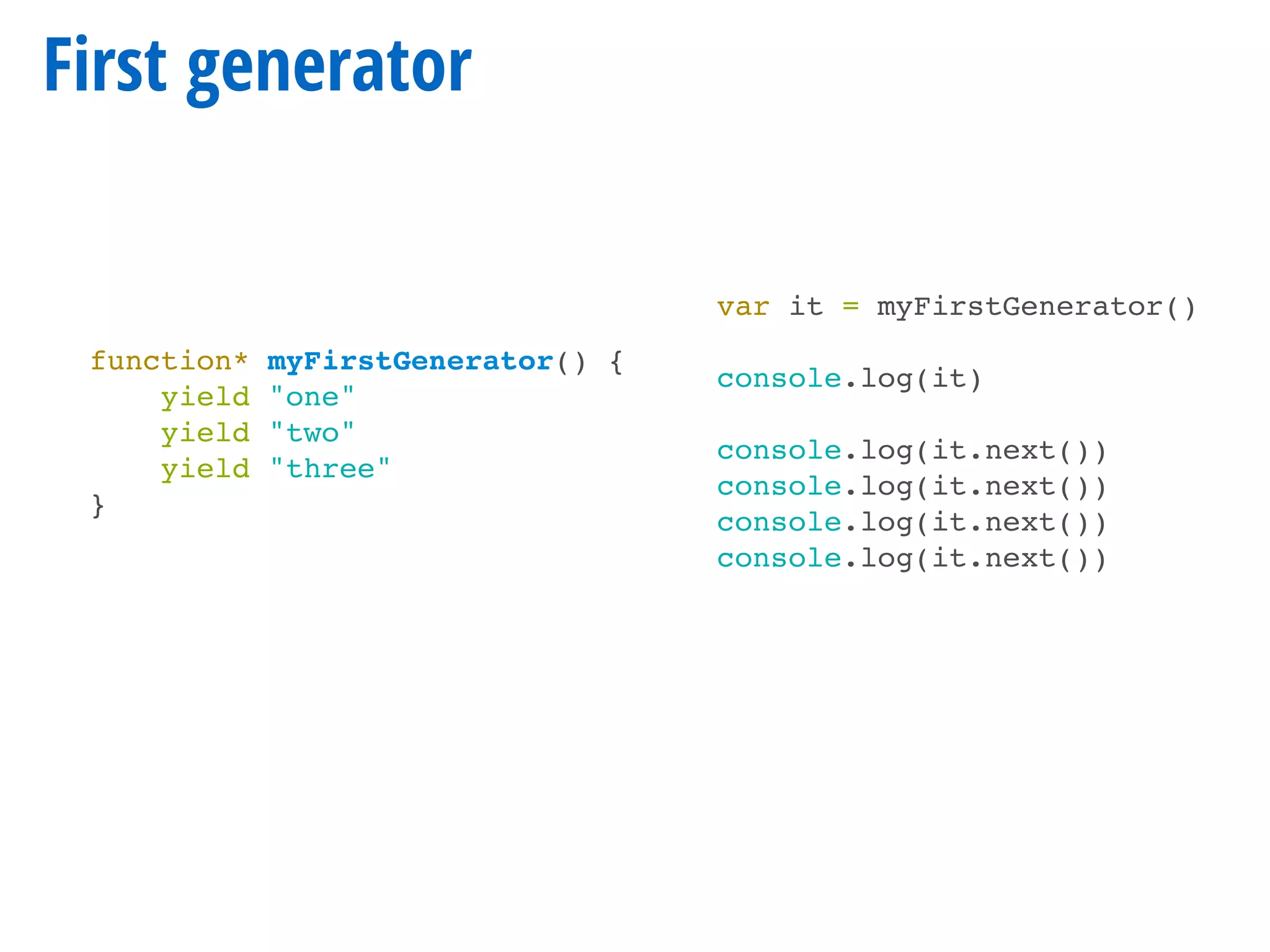
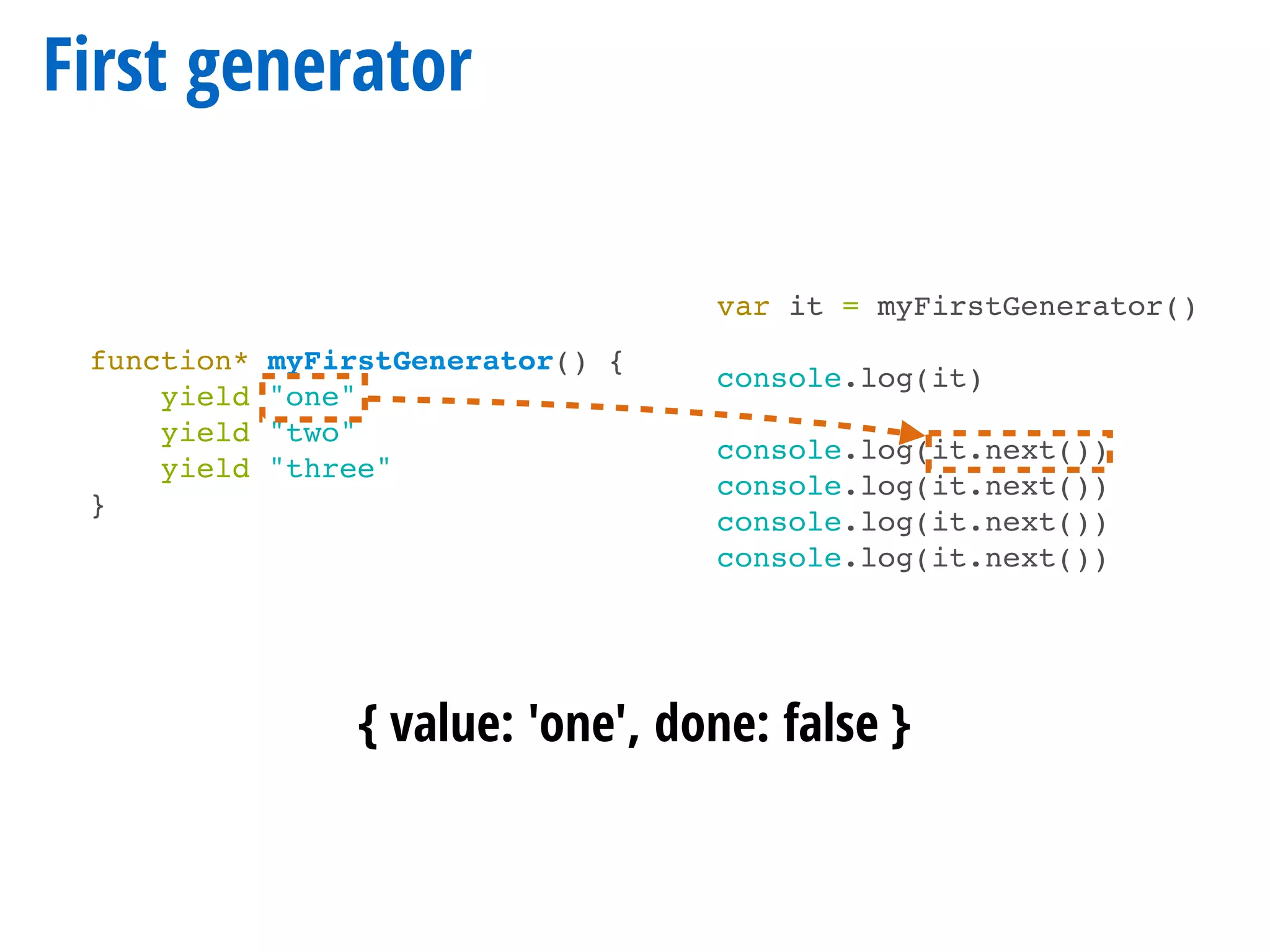
First generator
function* myFirstGenerator() {
yield "one"
yield "two"
yield "three"
}
var it = myFirstGenerator()
console.log(it)
console.log(it.next())
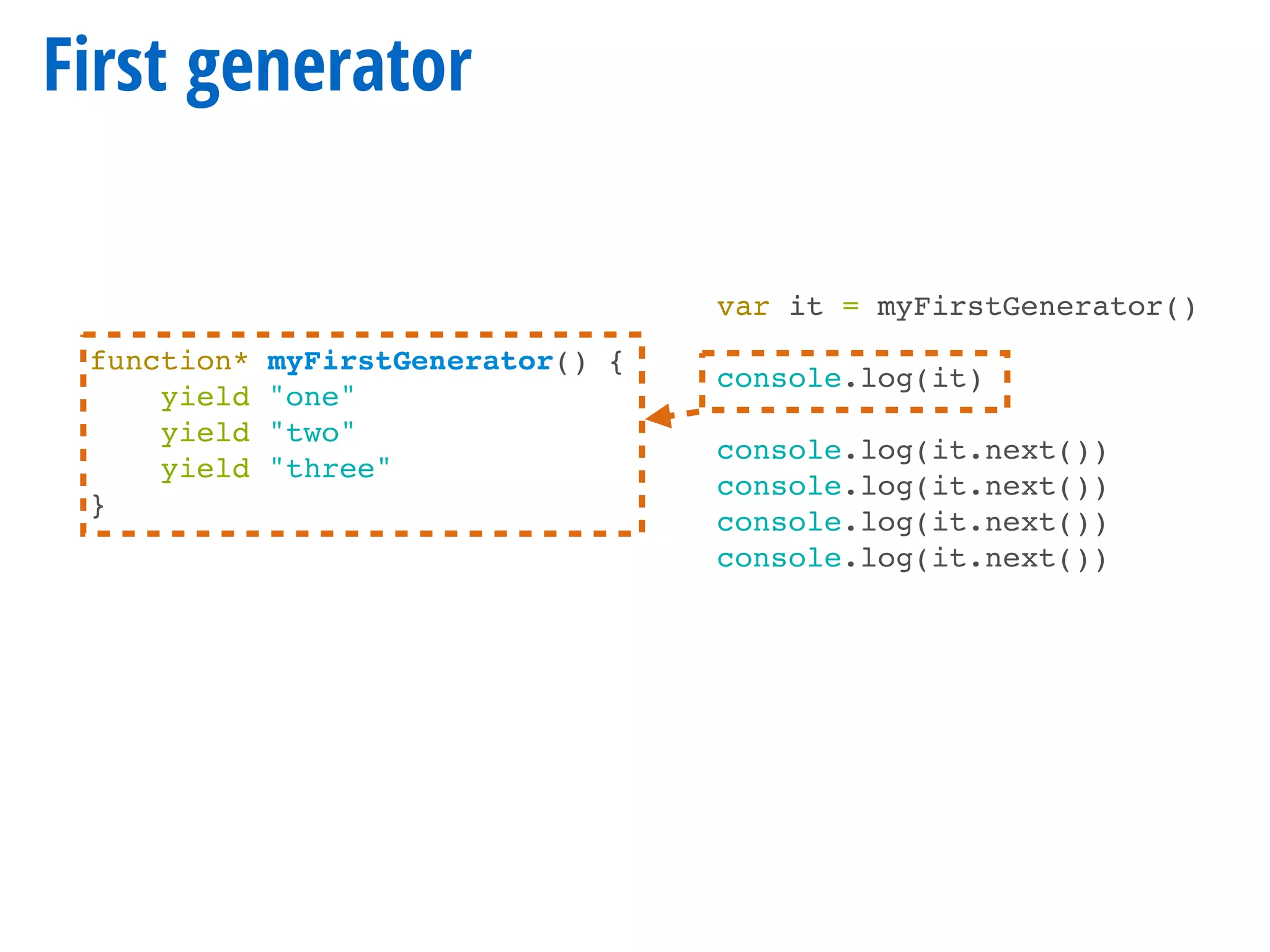
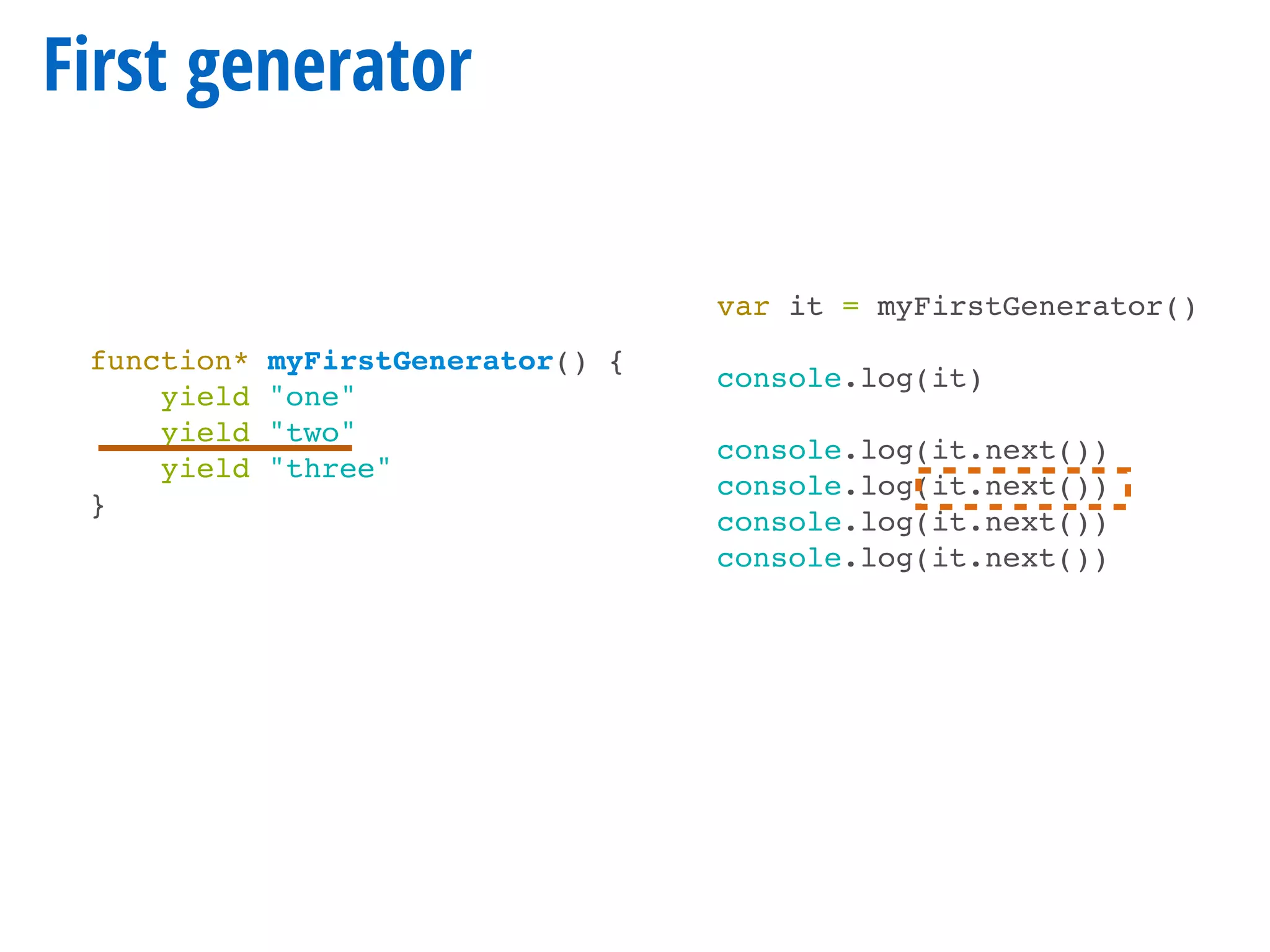
First generator
function* myFirstGenerator() {
yield "one"
yield "two"
yield "three"
}
var it = myFirstGenerator()
console.log(it)
console.log(it.next())
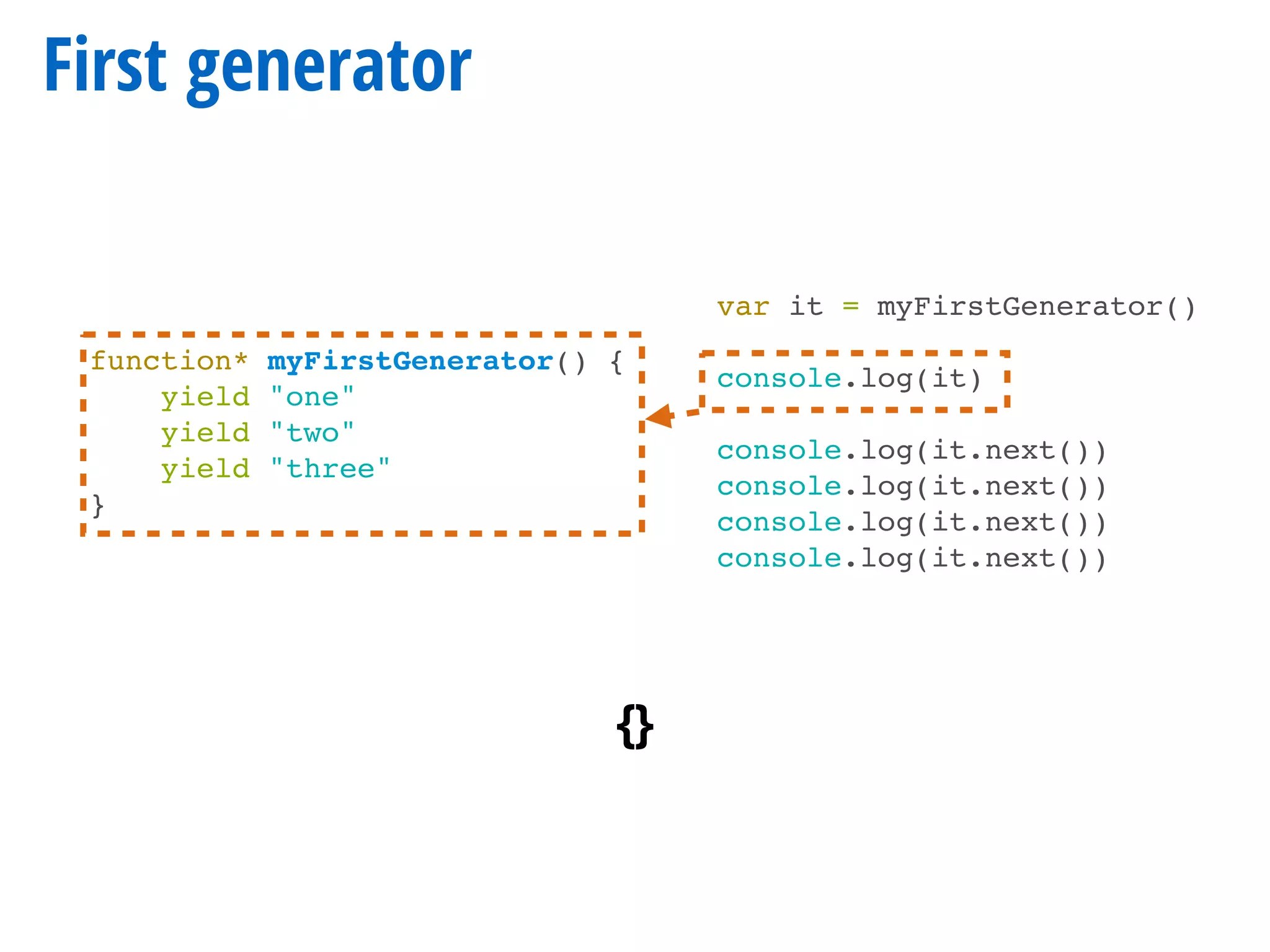
First generator
function* myFirstGenerator() {
yield "one"
yield "two"
yield "three"
}
var it = myFirstGenerator()
console.log(it)
console.log(it.next())
{}
First generator
function* myFirstGenerator() {
yield "one"
yield "two"
yield "three"
}
var it = myFirstGenerator()
console.log(it)
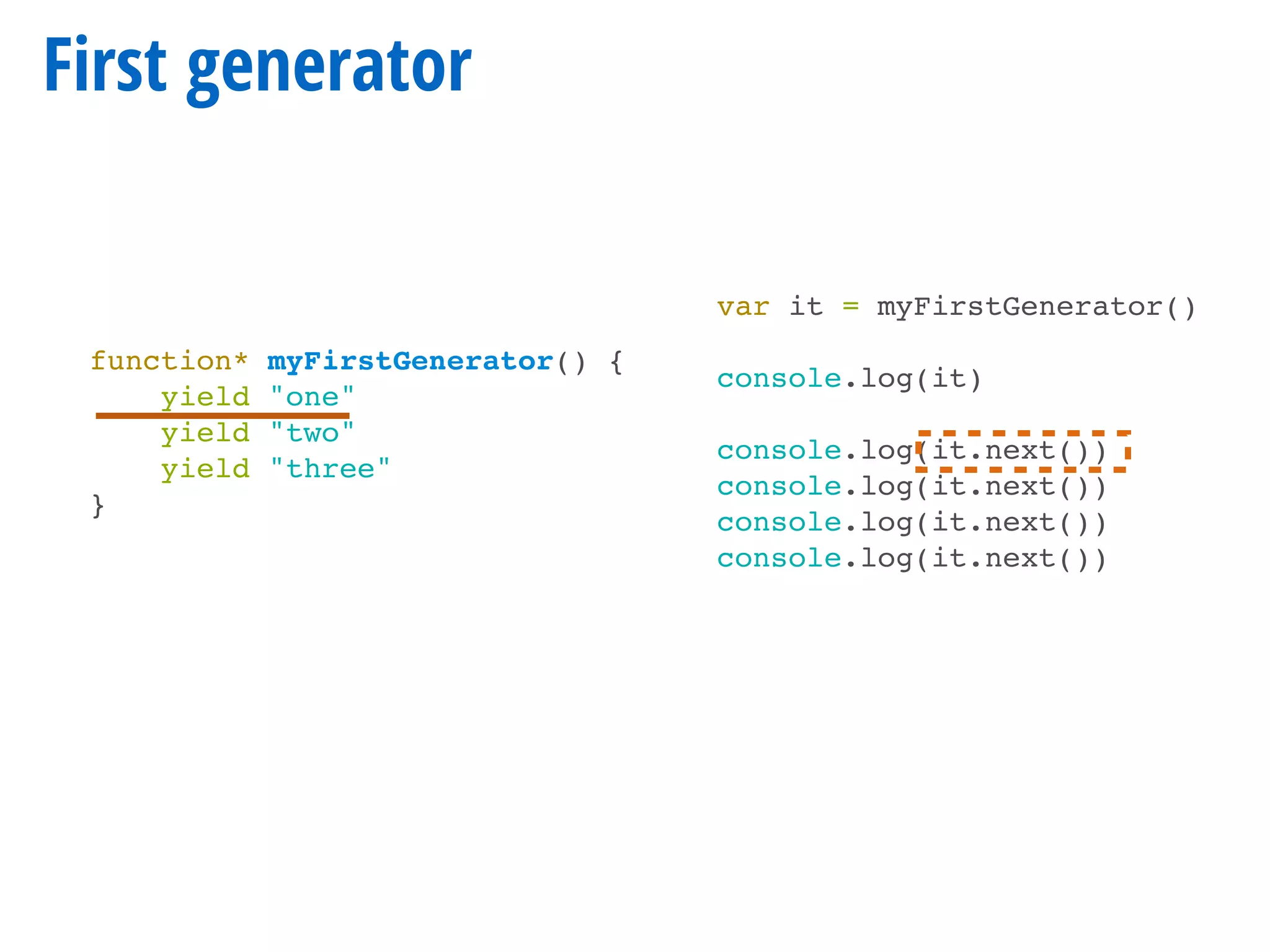
console.log(it.next())
First generator
function* myFirstGenerator() {
yield "one"
yield "two"
yield "three"
}
var it = myFirstGenerator()
console.log(it)
console.log(it.next())
{ value: 'one', done: false }
First generator
function* myFirstGenerator() {
yield "one"
yield "two"
yield "three"
}
var it = myFirstGenerator()
console.log(it)
console.log(it.next())
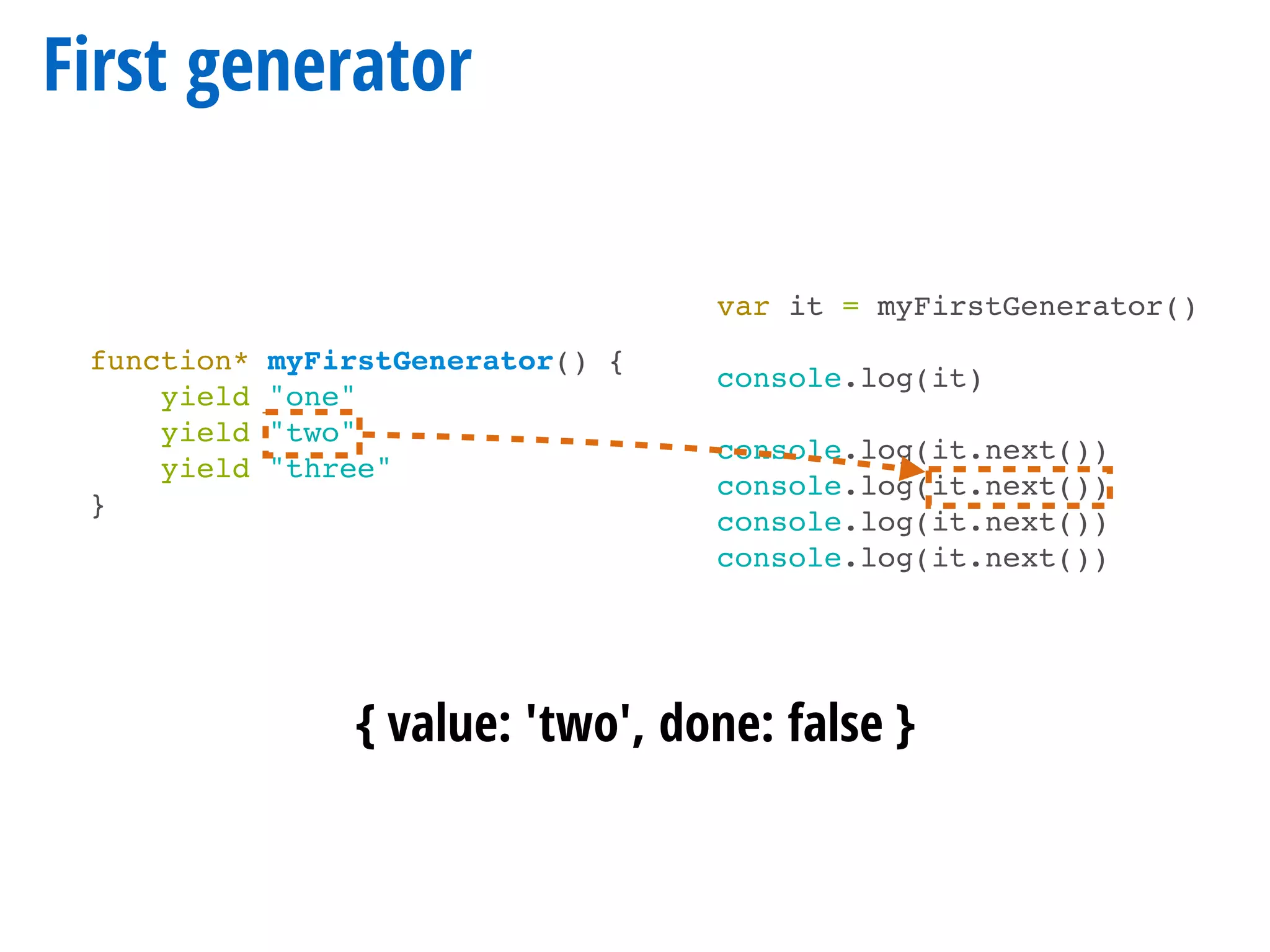
First generator
function* myFirstGenerator() {
yield "one"
yield "two"
yield "three"
}
var it = myFirstGenerator()
console.log(it)
console.log(it.next())
{ value: 'two', done: false }
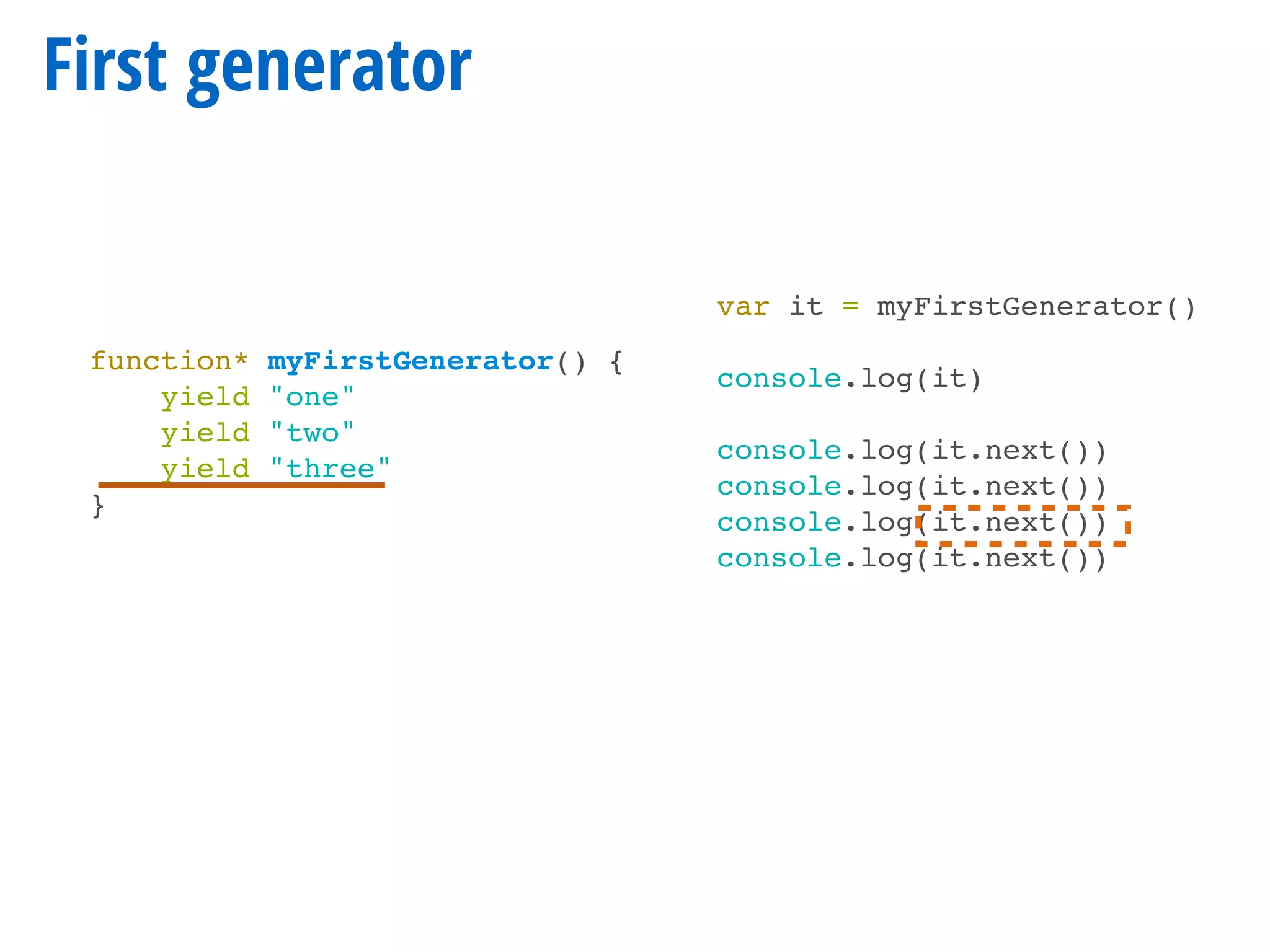
First generator
function* myFirstGenerator() {
yield "one"
yield "two"
yield "three"
}
var it = myFirstGenerator()
console.log(it)
console.log(it.next())
First generator
function* myFirstGenerator() {
yield "one"
yield "two"
yield "three"
}
var it = myFirstGenerator()
console.log(it)
console.log(it.next())
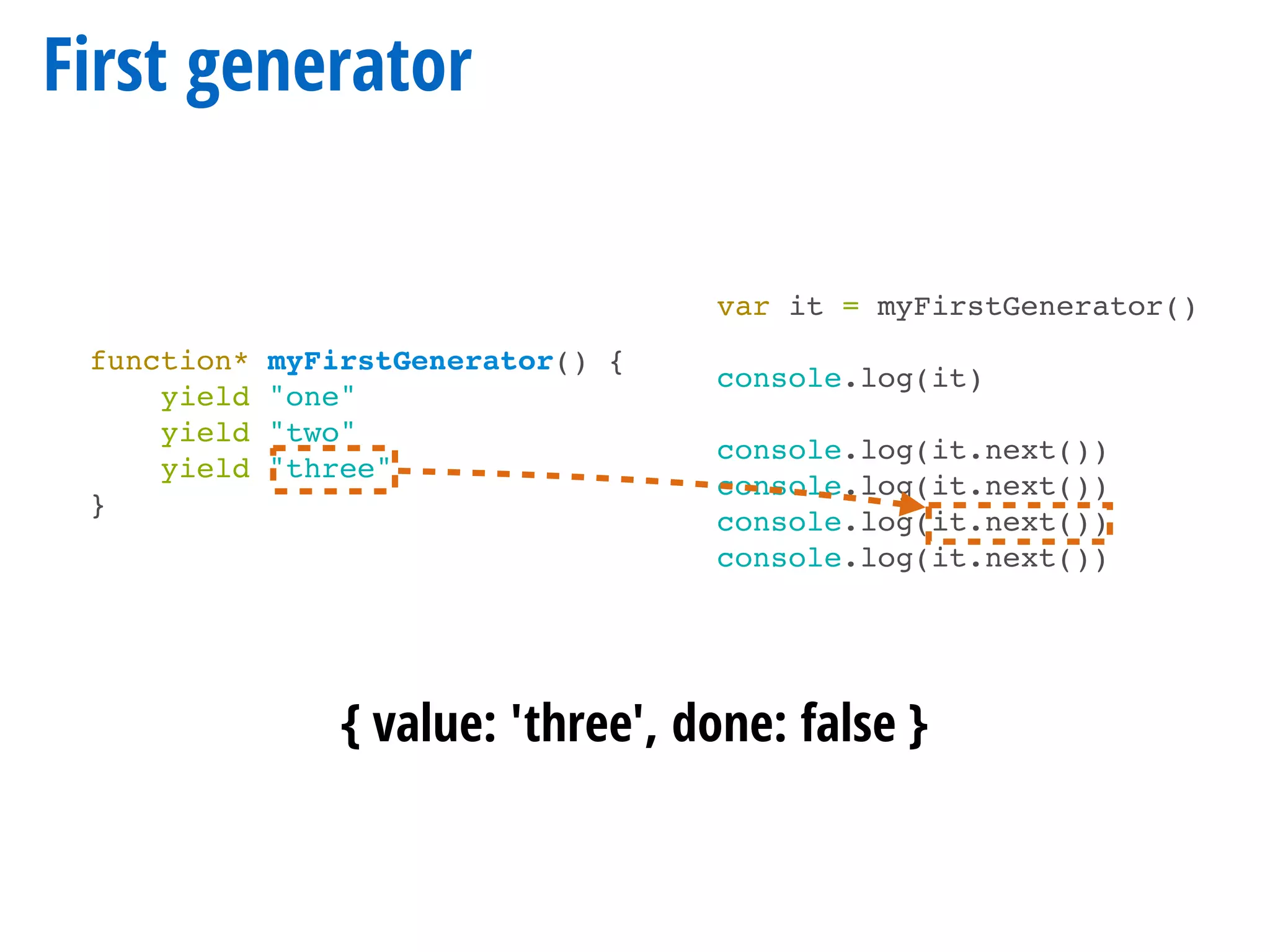
{ value: 'three', done: false }
First generator
function* myFirstGenerator() {
yield "one"
yield "two"
yield "three"
}
var it = myFirstGenerator()
console.log(it)
console.log(it.next())
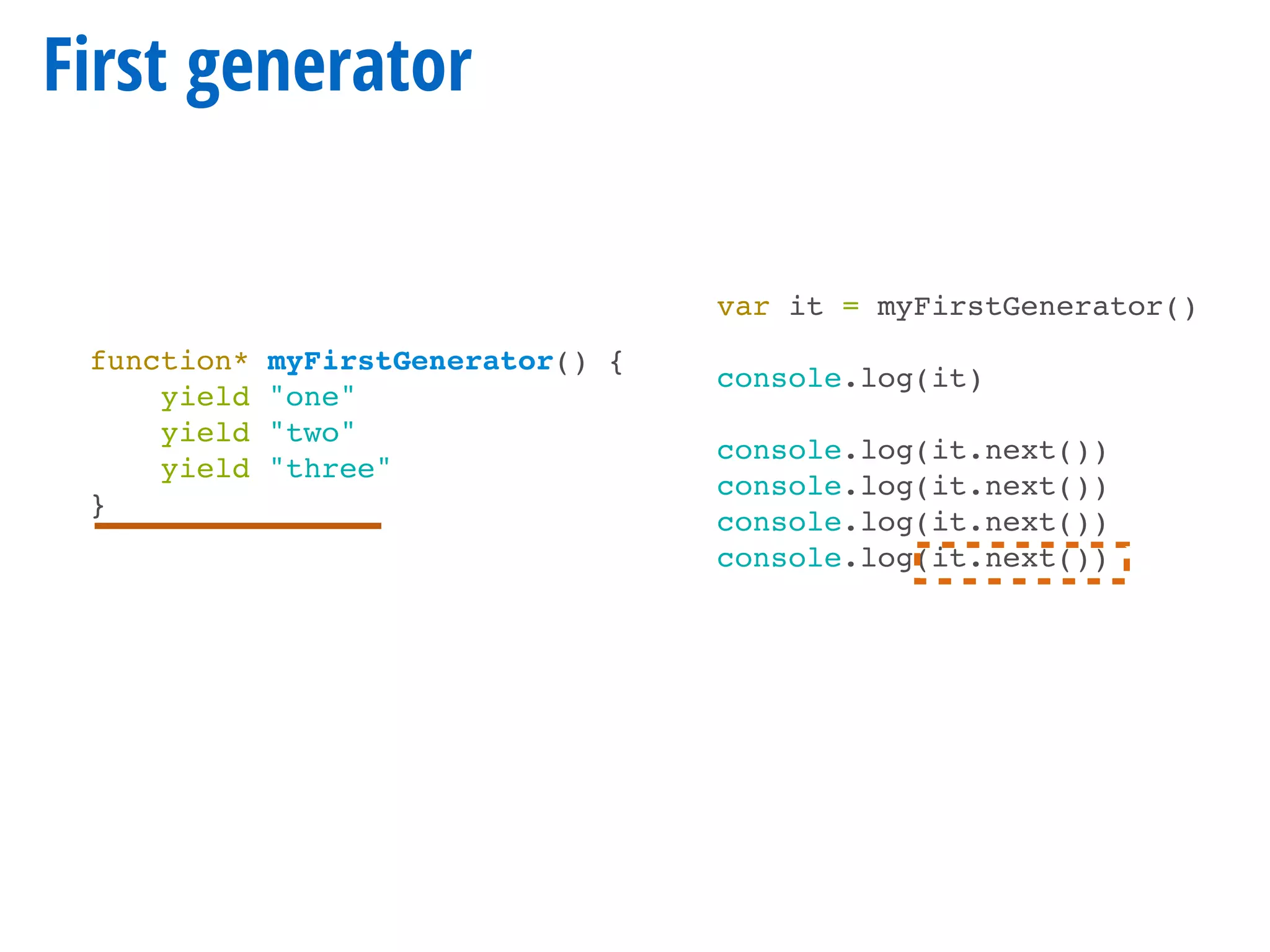
First generator
function* myFirstGenerator() {
yield "one"
yield "two"
yield "three"
}
var it = myFirstGenerator()
console.log(it)
console.log(it.next())
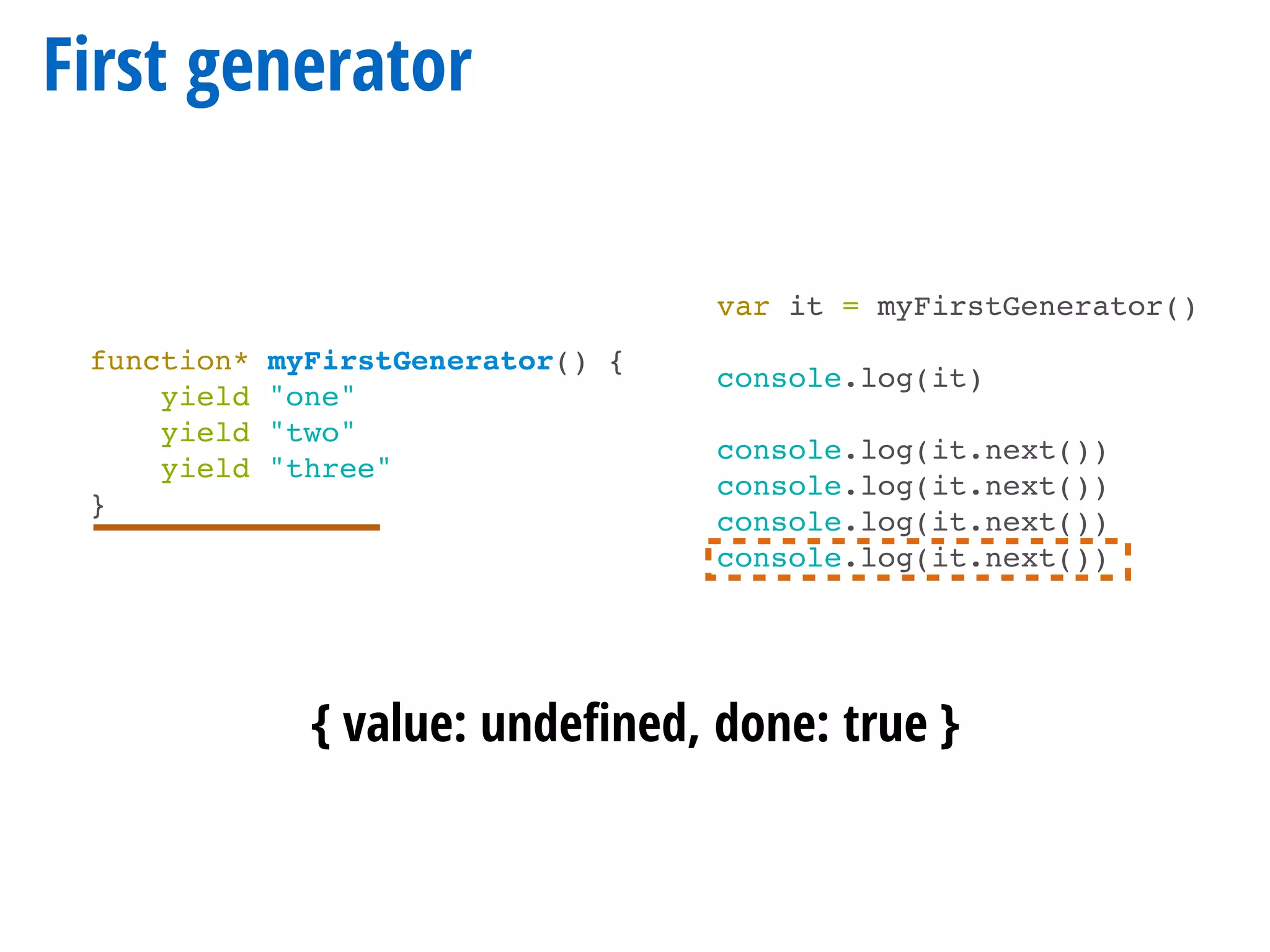
{ value: undefined, done: true }
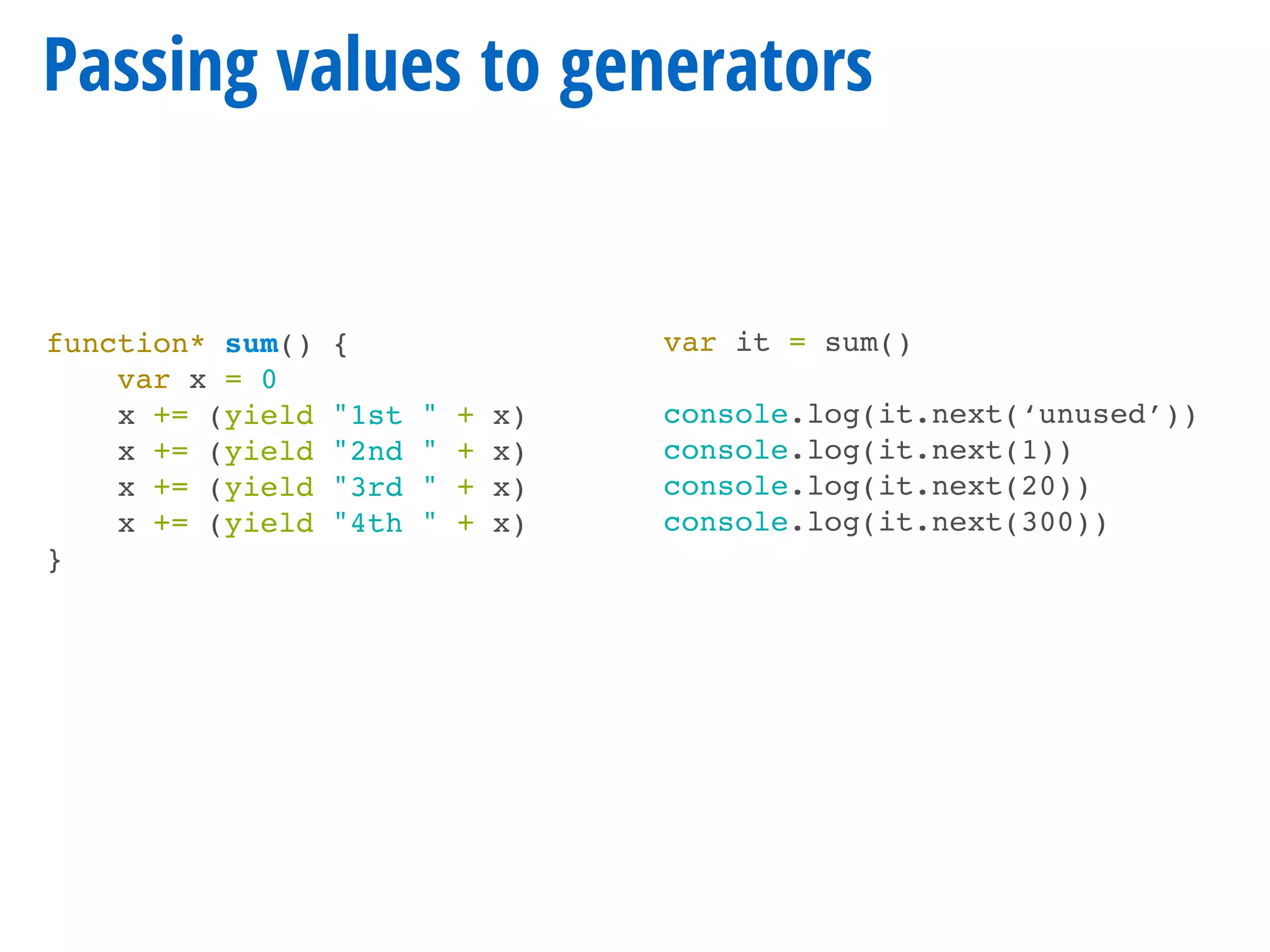
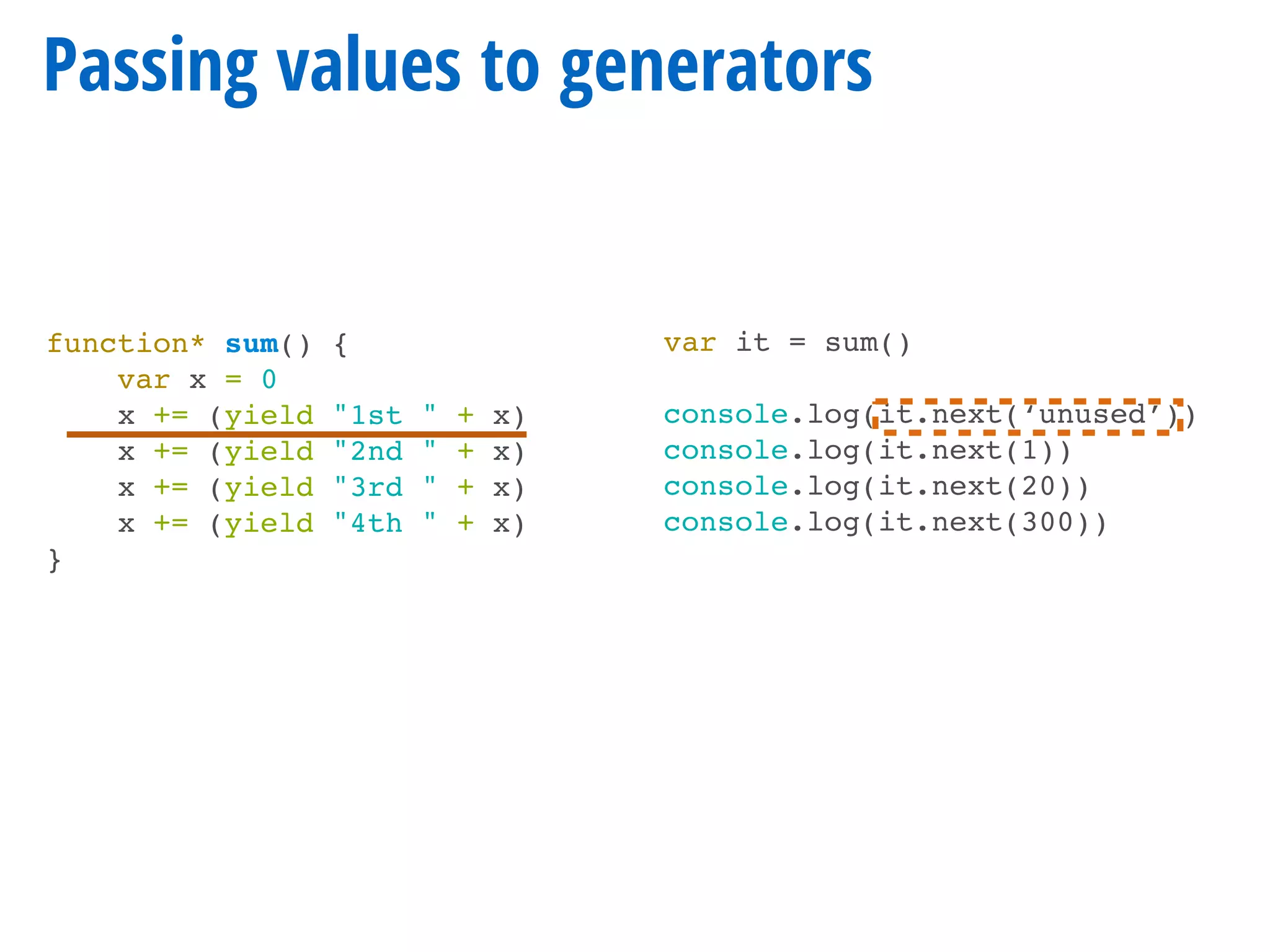
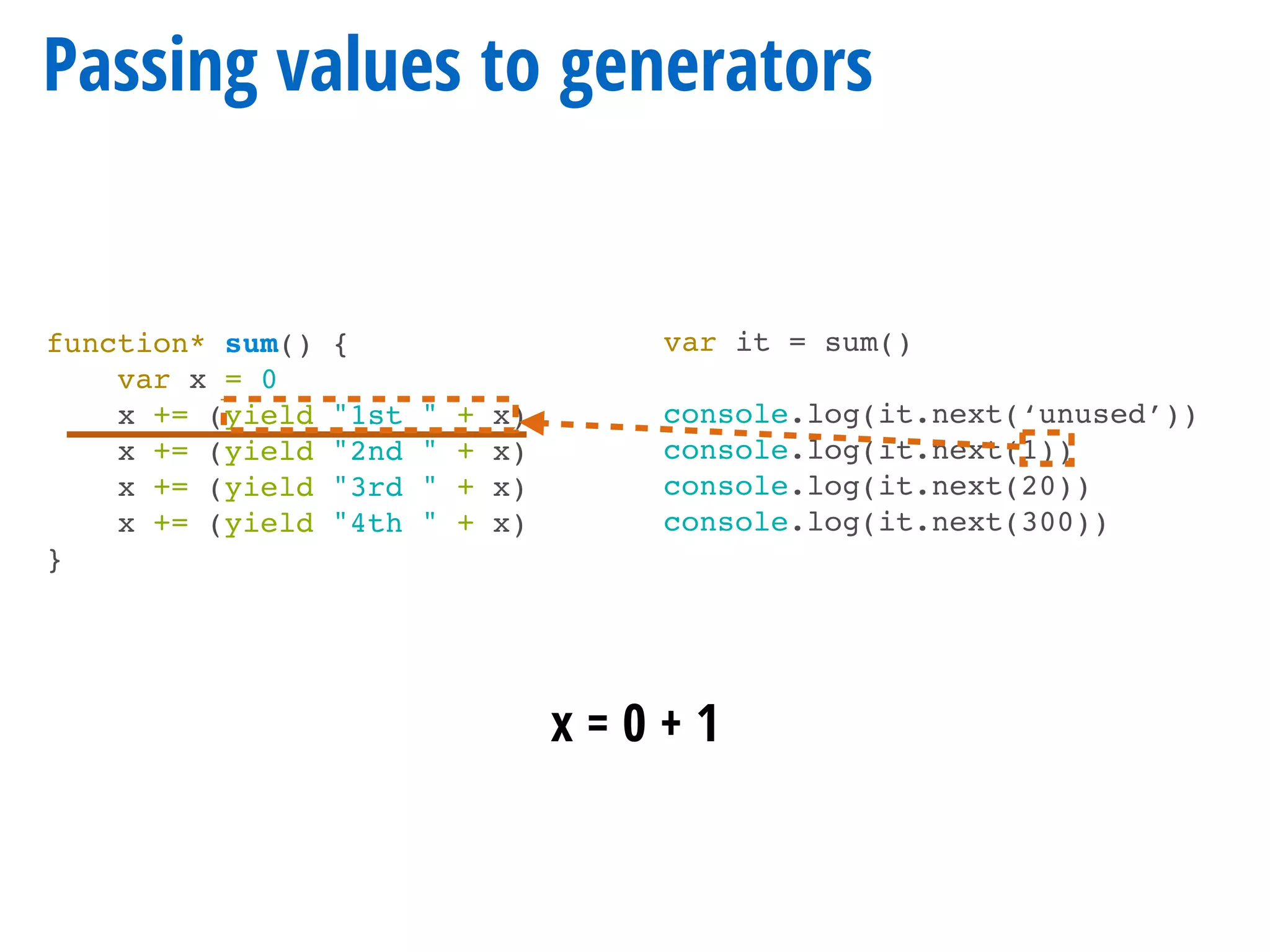
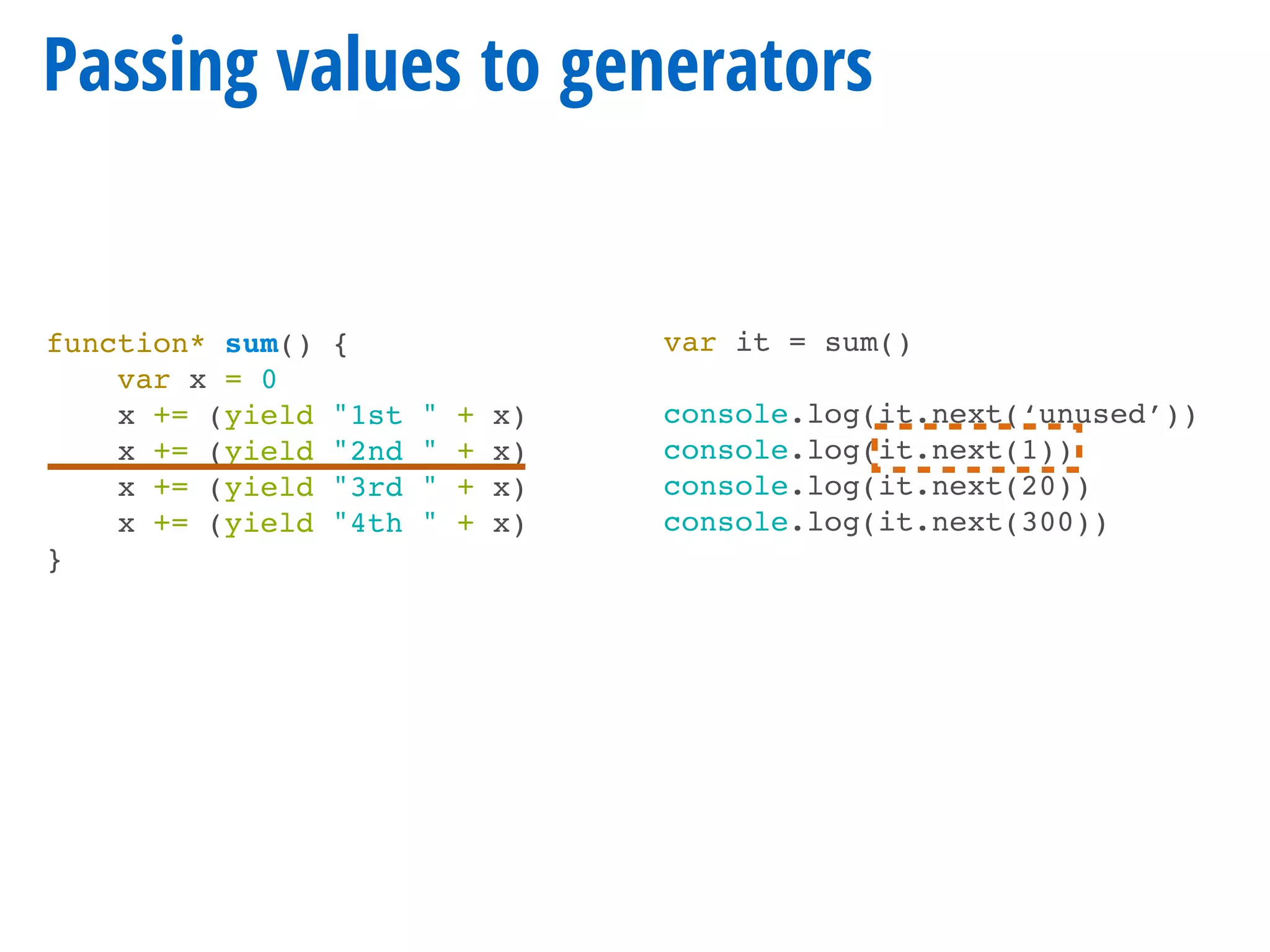
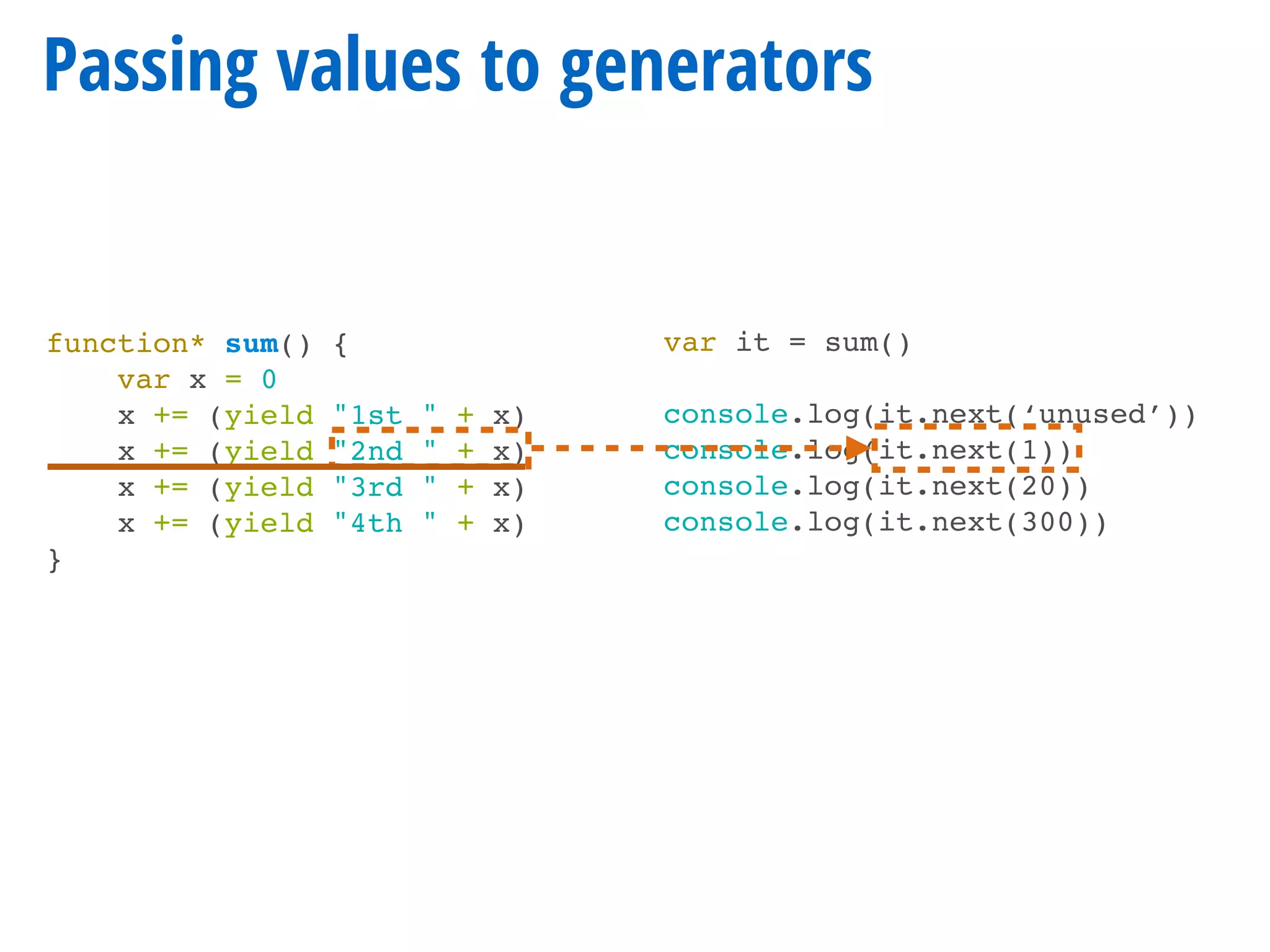
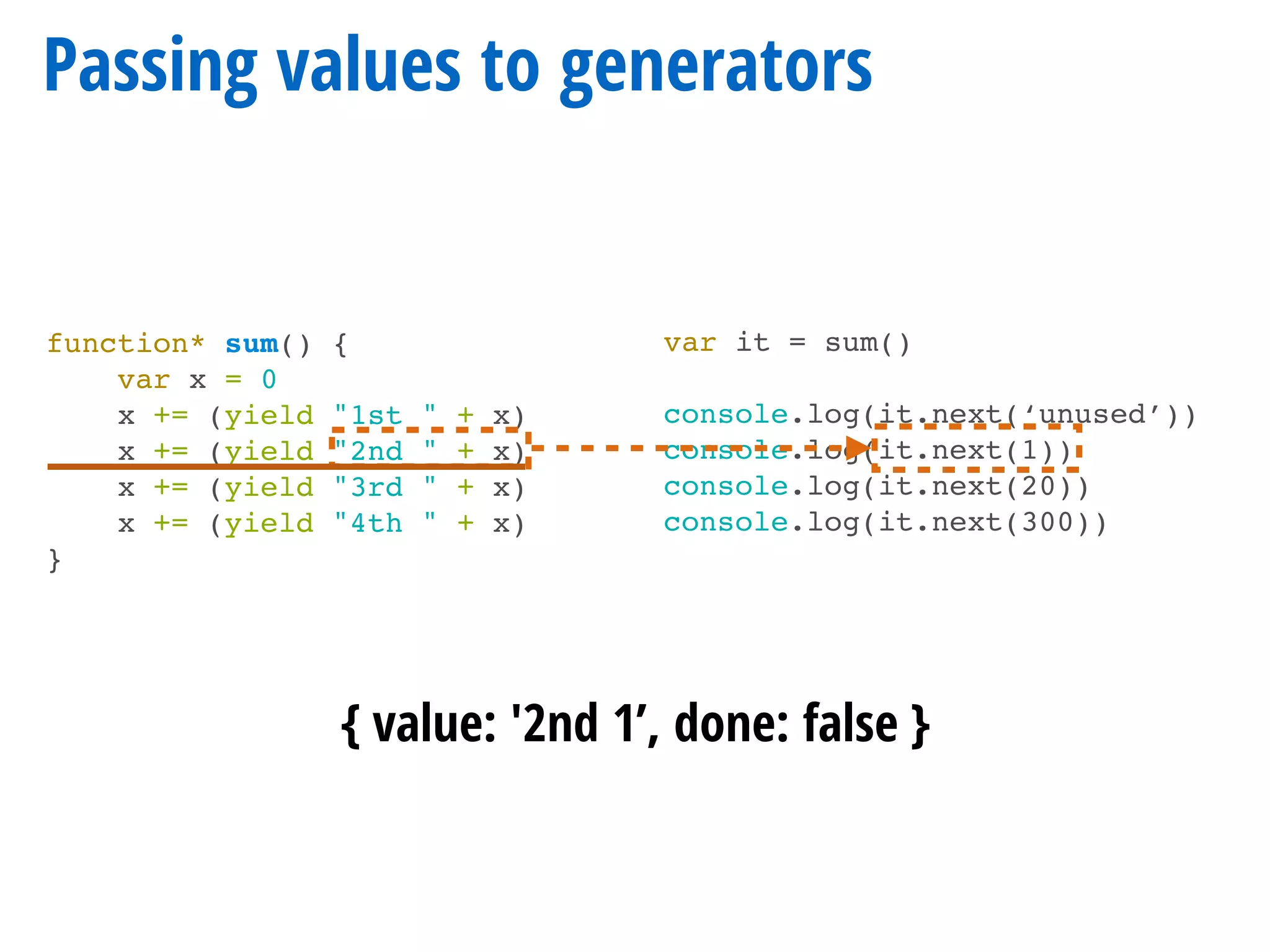
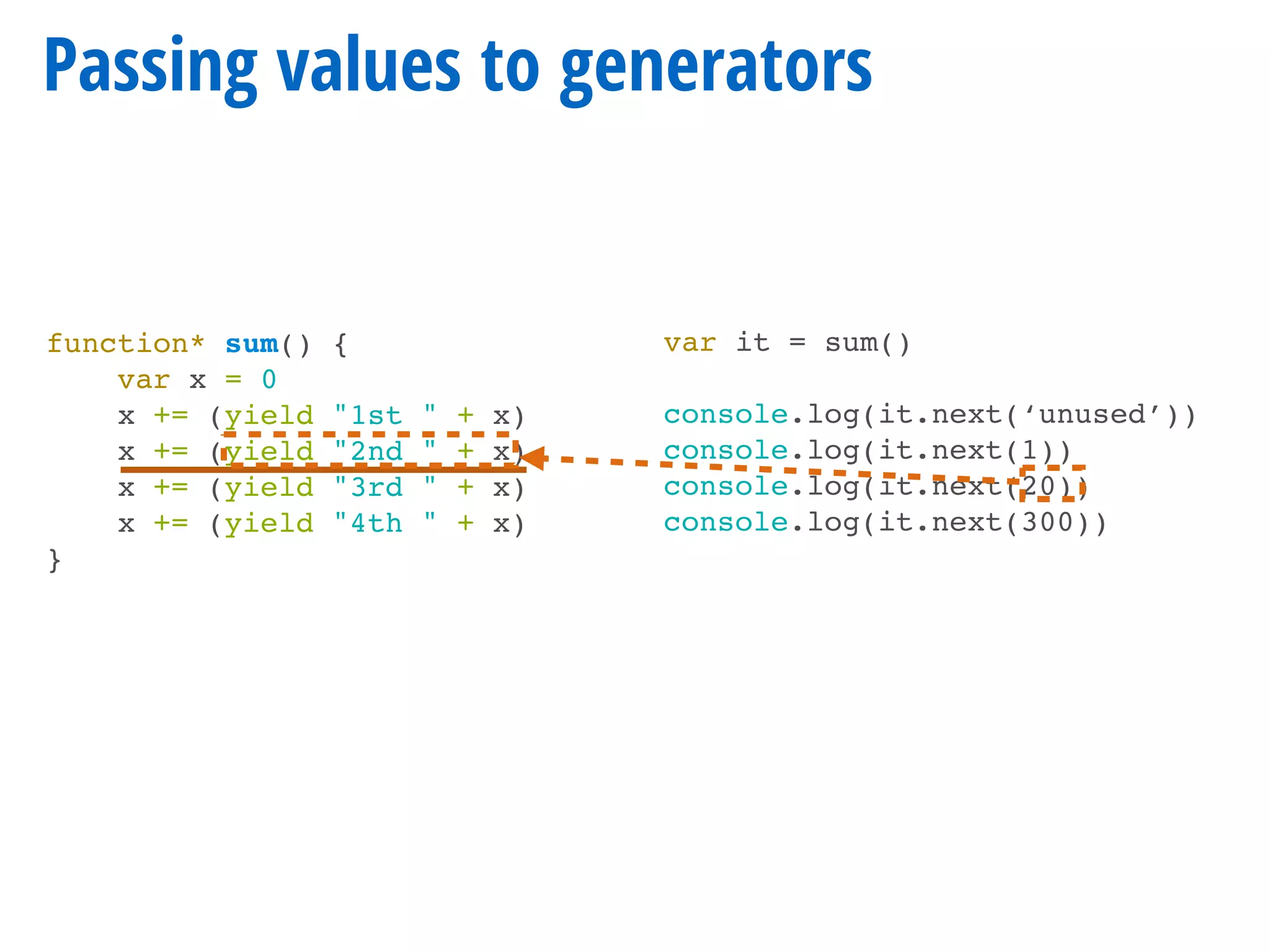
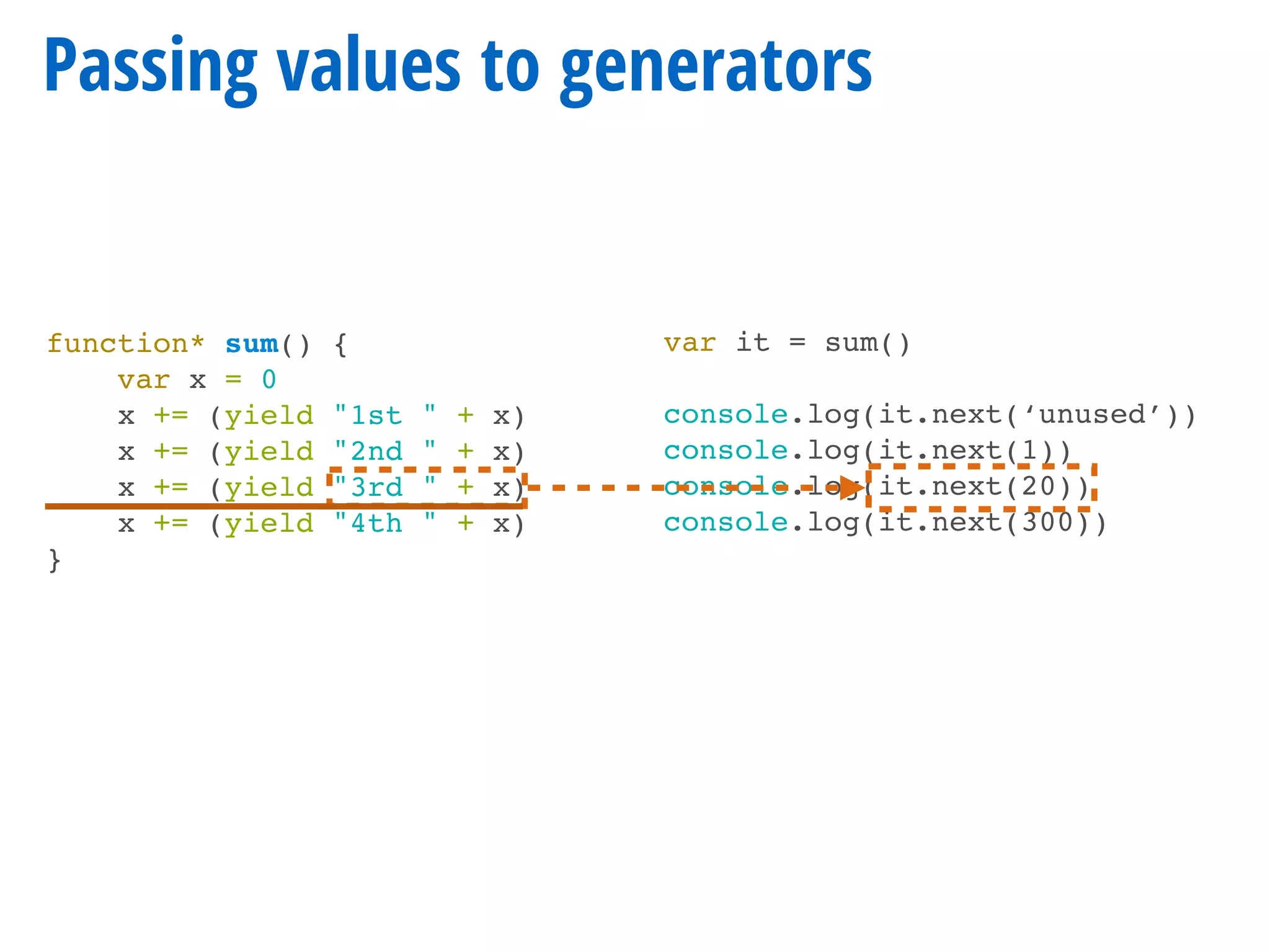
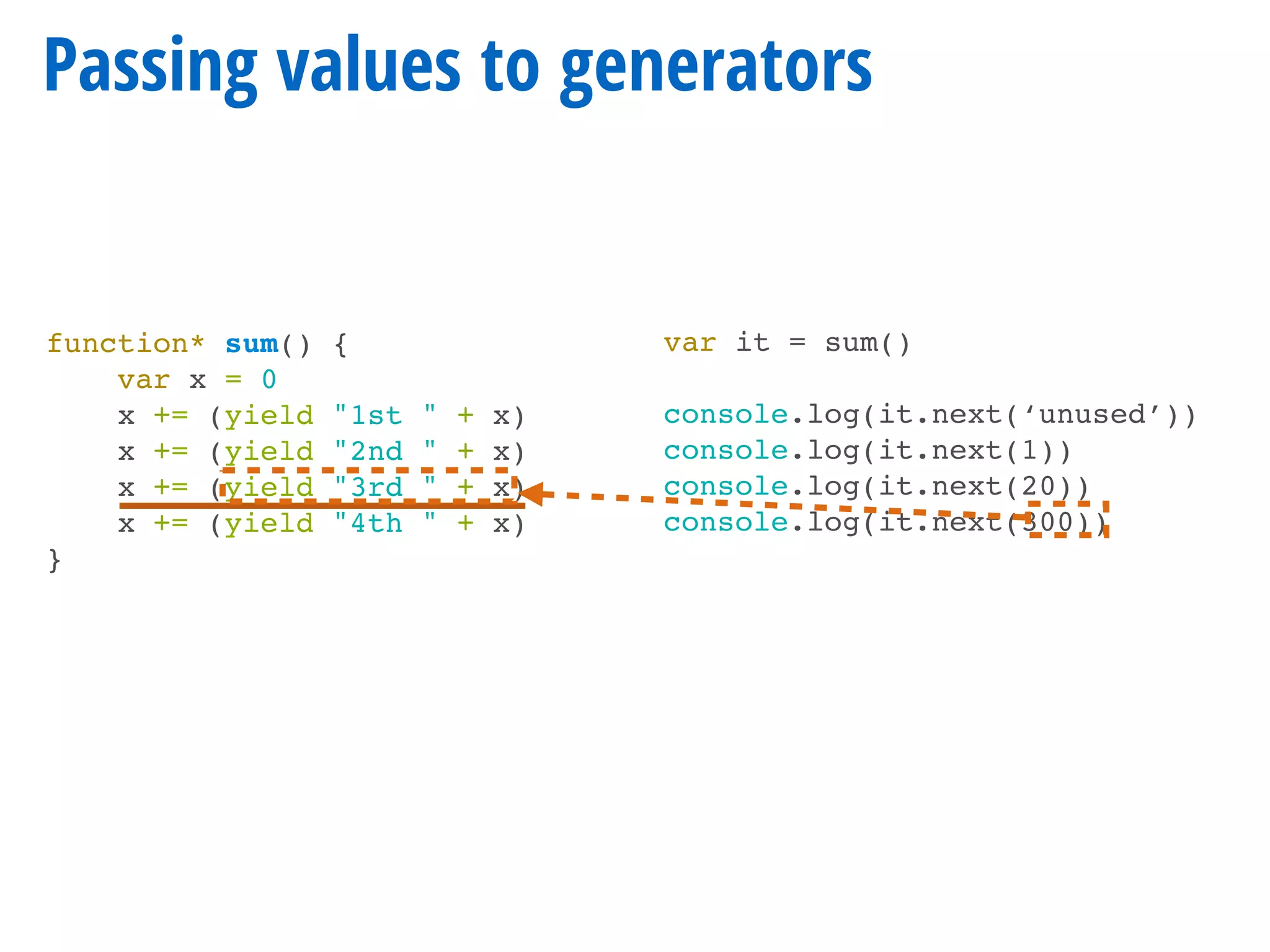
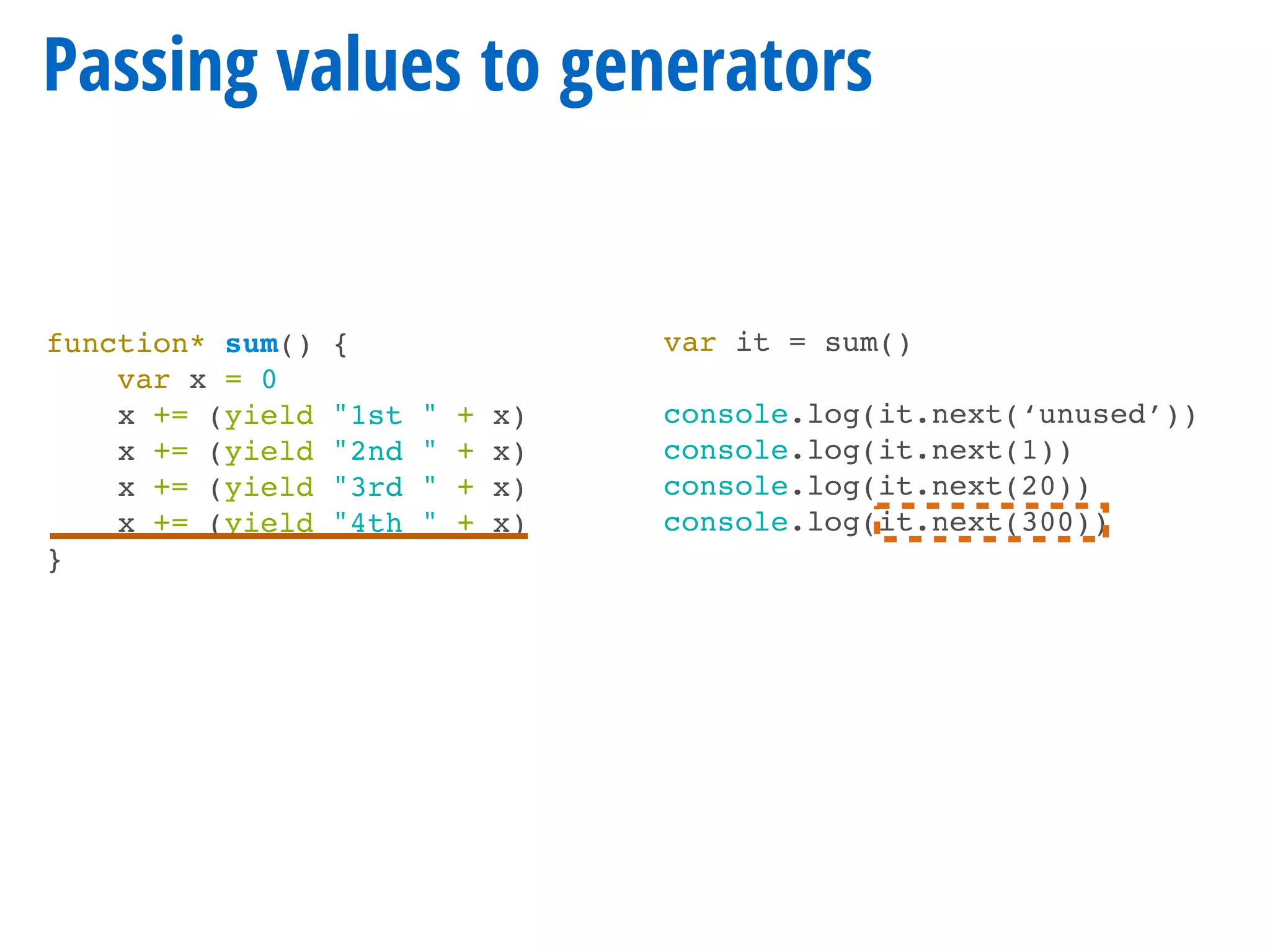
function* sum() {
var x = 0
x += (yield "1st " + x)
x += (yield "2nd " + x)
x += (yield "3rd " + x)
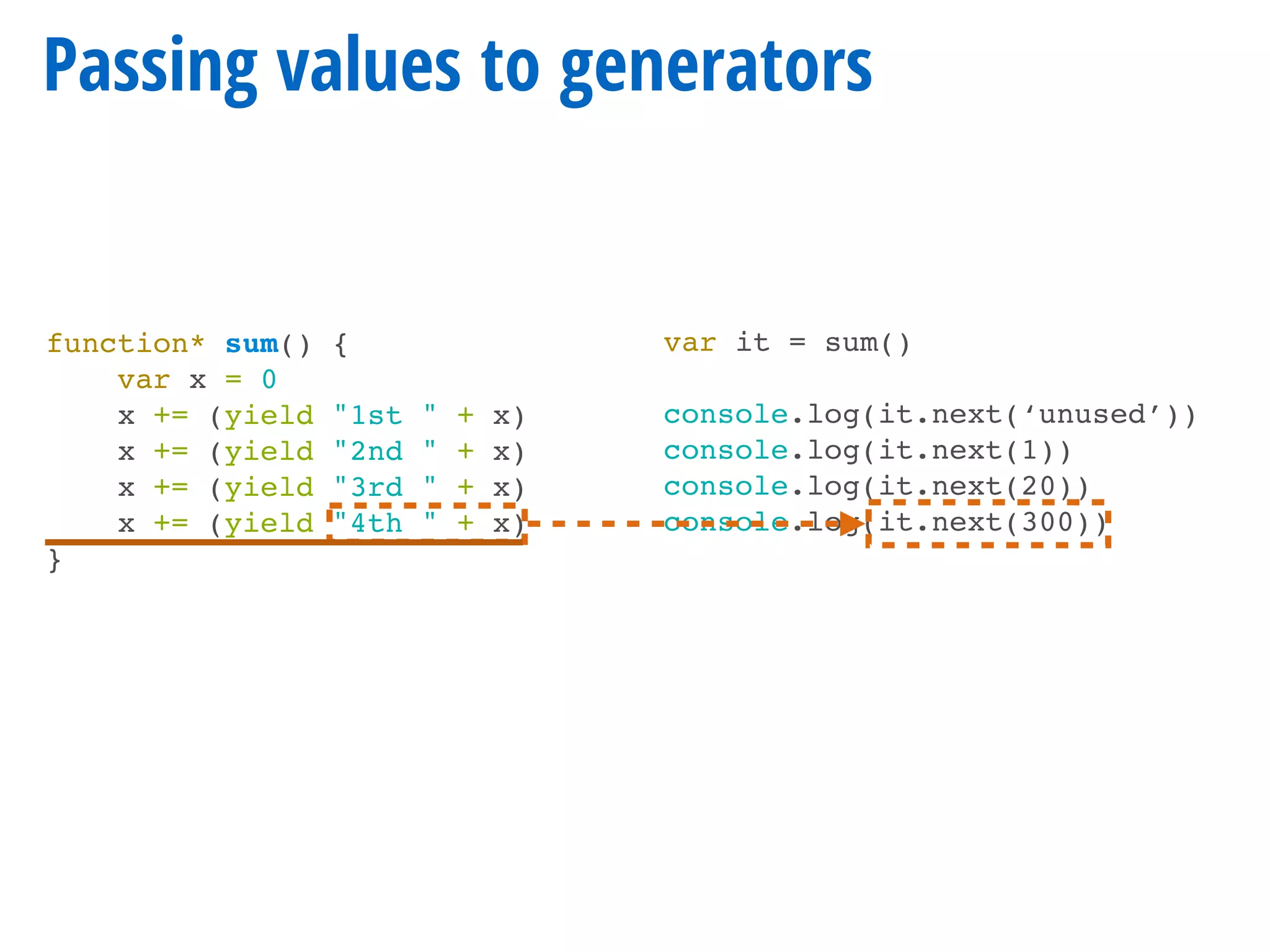
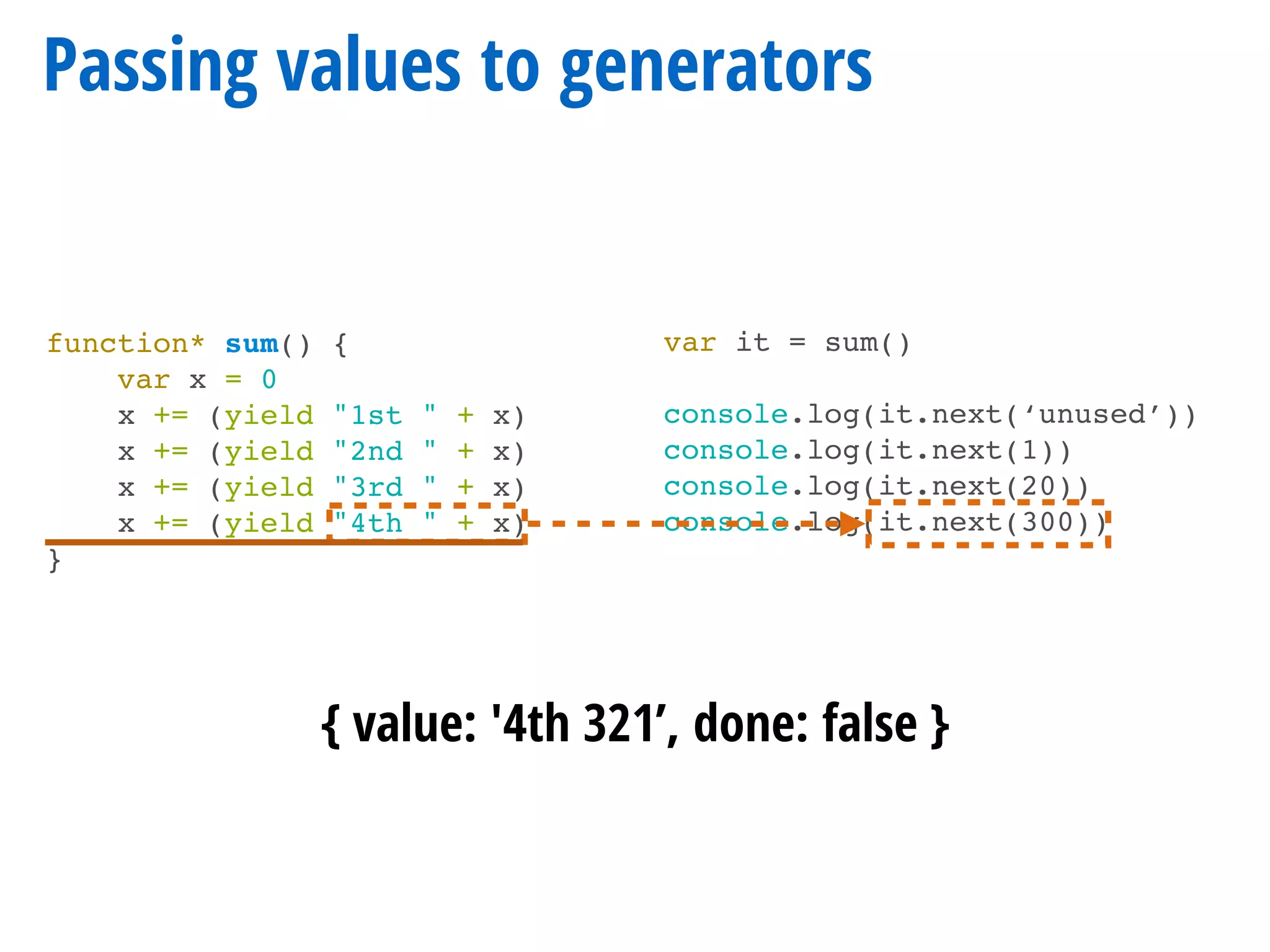
x += (yield "4th " + x)
}
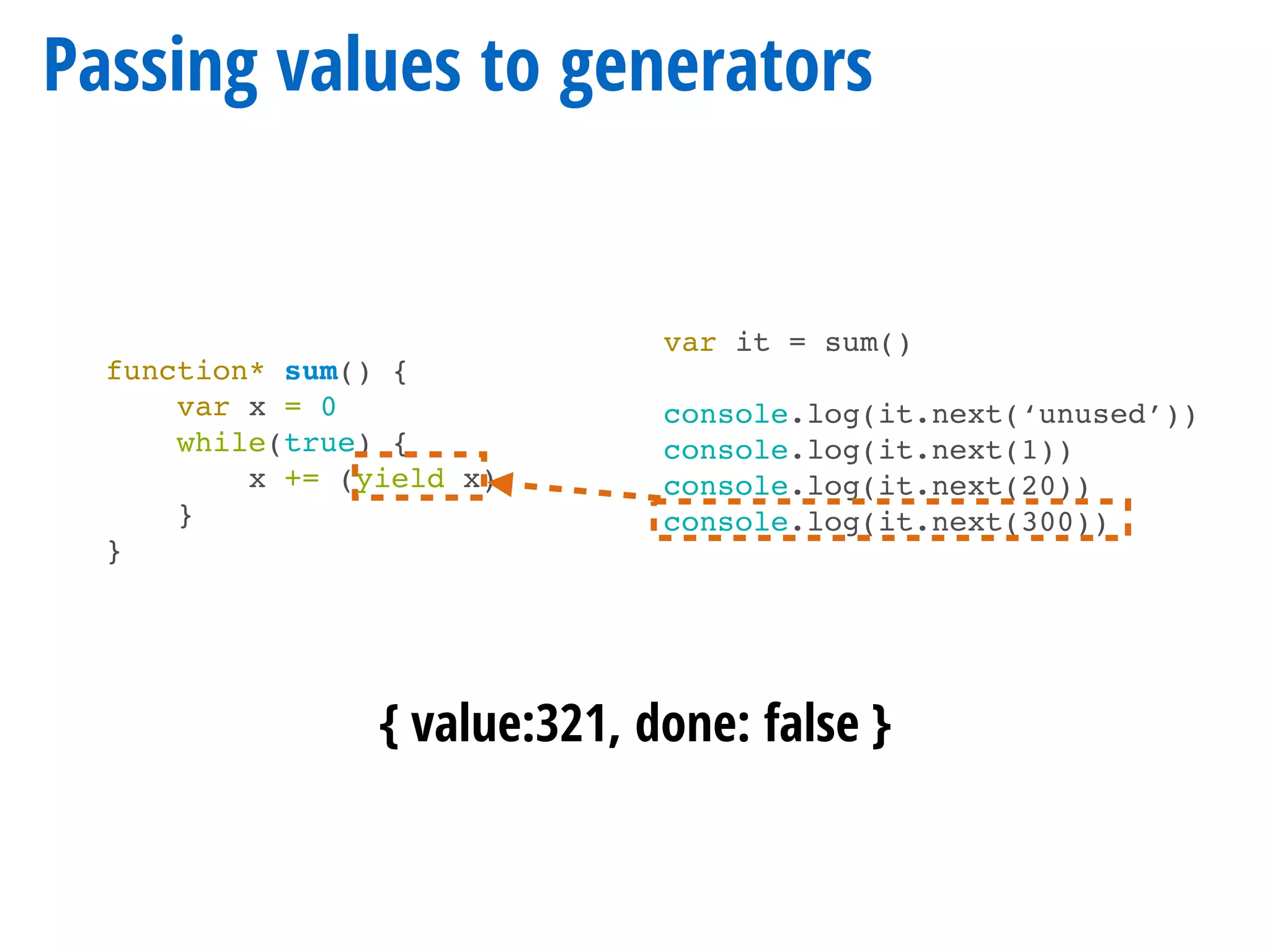
Passing values to generators
var it = sum()
console.log(it.next(‘unused’))
console.log(it.next(1))
console.log(it.next(20))
console.log(it.next(300))
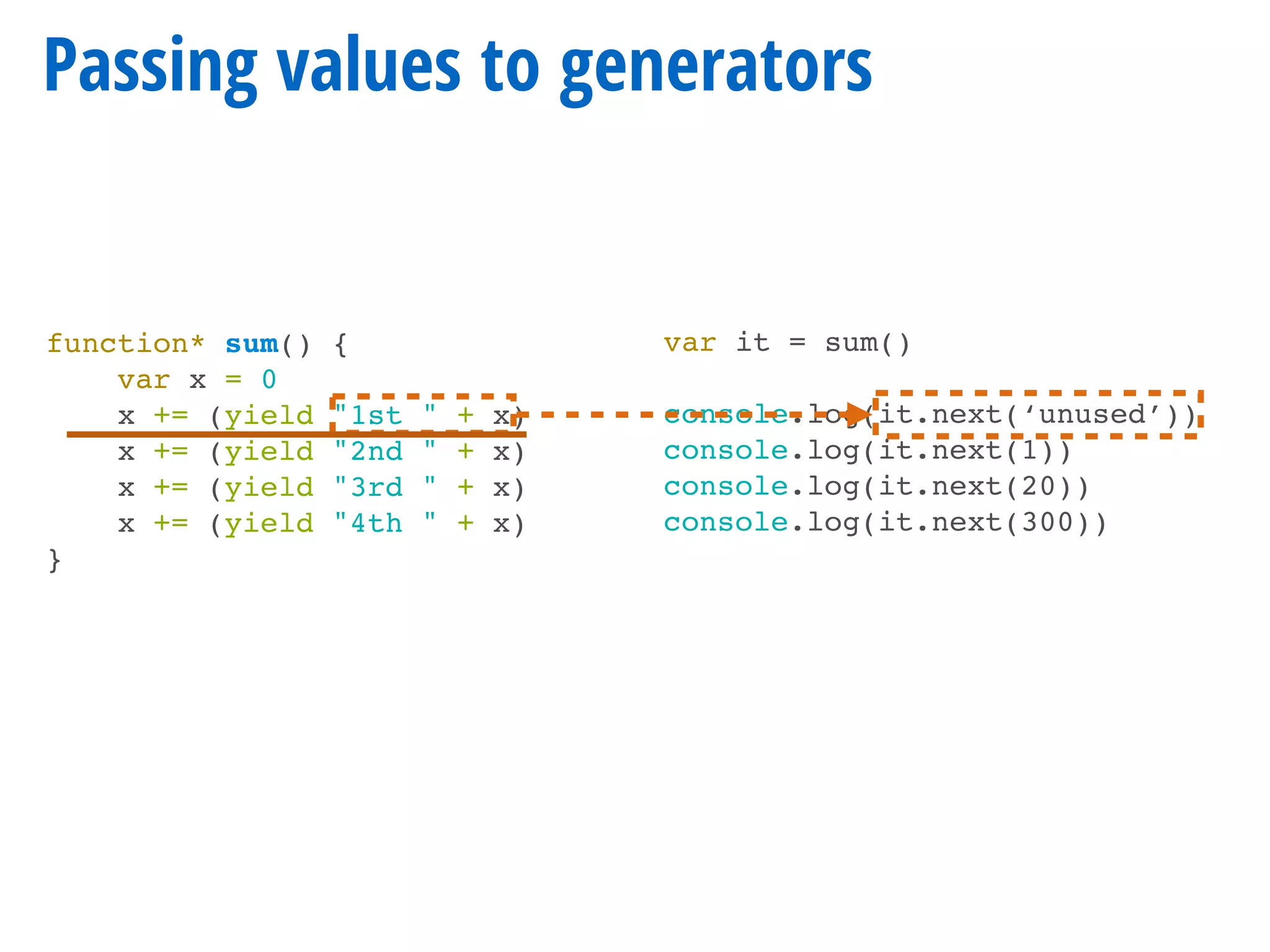
function* sum() {
var x = 0
x += (yield "1st " + x)
x += (yield "2nd " + x)
x += (yield "3rd " + x)
x += (yield "4th " + x)
}
Passing values to generators
var it = sum()
console.log(it.next(‘unused’))
console.log(it.next(1))
console.log(it.next(20))
console.log(it.next(300))
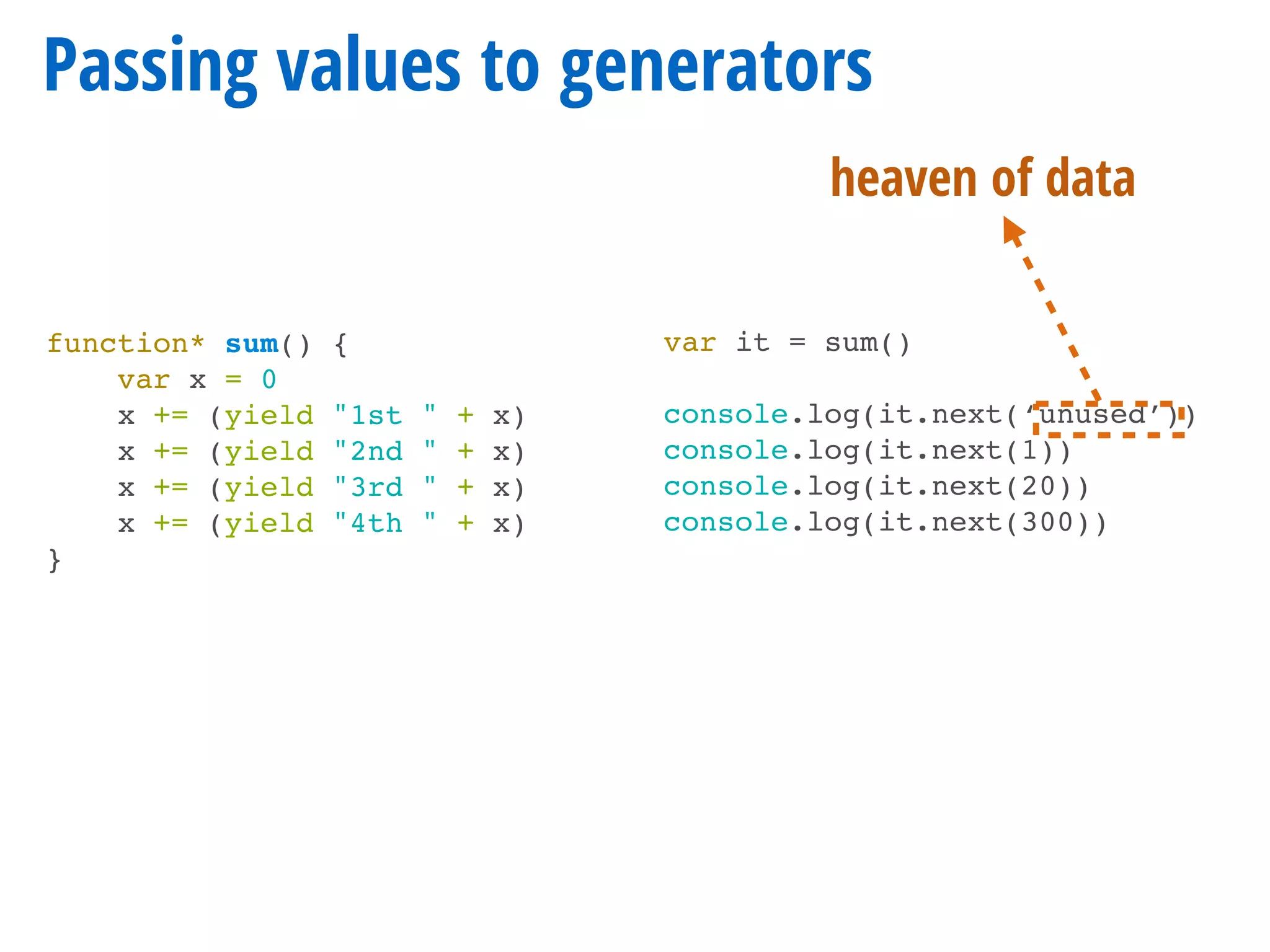
heaven of data
function* sum() {
var x = 0
x += (yield "1st " + x)
x += (yield "2nd " + x)
x += (yield "3rd " + x)
x += (yield "4th " + x)
}
Passing values to generators
var it = sum()
console.log(it.next(‘unused’))
console.log(it.next(1))
console.log(it.next(20))
console.log(it.next(300))
function* sum() {
var x = 0
x += (yield "1st " + x)
x += (yield "2nd " + x)
x += (yield "3rd " + x)
x += (yield "4th " + x)
}
Passing values to generators
var it = sum()
console.log(it.next(‘unused’))
console.log(it.next(1))
console.log(it.next(20))
console.log(it.next(300))
function* sum() {
var x = 0
x += (yield "1st " + x)
x += (yield "2nd " + x)
x += (yield "3rd " + x)
x += (yield "4th " + x)
}
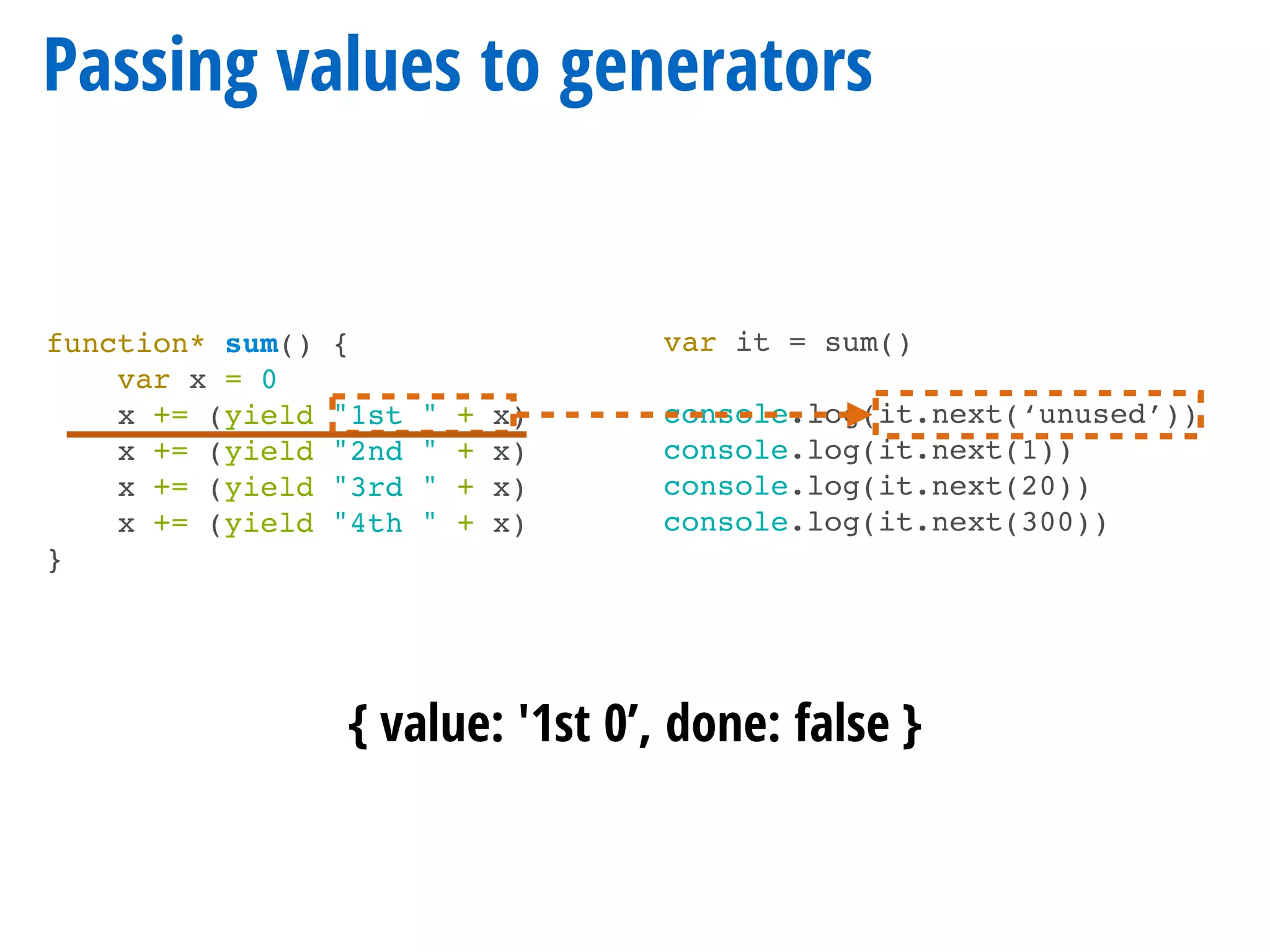
Passing values to generators
var it = sum()
console.log(it.next(‘unused’))
console.log(it.next(1))
console.log(it.next(20))
console.log(it.next(300))
{ value: '1st 0’, done: false }
function* sum() {
var x = 0
x += (yield "1st " + x)
x += (yield "2nd " + x)
x += (yield "3rd " + x)
x += (yield "4th " + x)
}
Passing values to generators
var it = sum()
console.log(it.next(‘unused’))
console.log(it.next(1))
console.log(it.next(20))
console.log(it.next(300))
function* sum() {
var x = 0
x += (yield "1st " + x)
x += (yield "2nd " + x)
x += (yield "3rd " + x)
x += (yield "4th " + x)
}
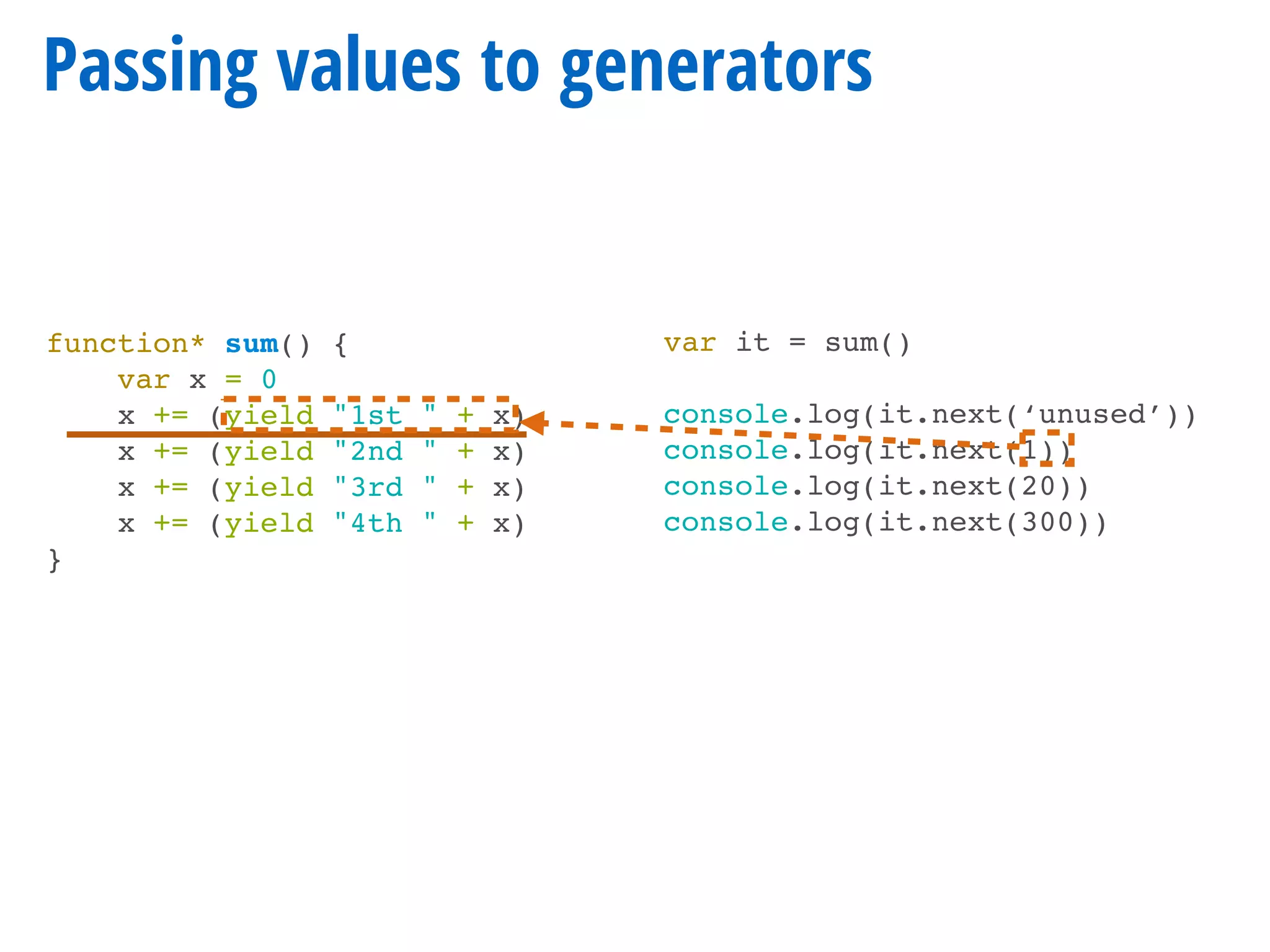
Passing values to generators
var it = sum()
console.log(it.next(‘unused’))
console.log(it.next(1))
console.log(it.next(20))
console.log(it.next(300))
x = 0 + 1
function* sum() {
var x = 0
x += (yield "1st " + x)
x += (yield "2nd " + x)
x += (yield "3rd " + x)
x += (yield "4th " + x)
}
Passing values to generators
var it = sum()
console.log(it.next(‘unused’))
console.log(it.next(1))
console.log(it.next(20))
console.log(it.next(300))
function* sum() {
var x = 0
x += (yield "1st " + x)
x += (yield "2nd " + x)
x += (yield "3rd " + x)
x += (yield "4th " + x)
}
Passing values to generators
var it = sum()
console.log(it.next(‘unused’))
console.log(it.next(1))
console.log(it.next(20))
console.log(it.next(300))
function* sum() {
var x = 0
x += (yield "1st " + x)
x += (yield "2nd " + x)
x += (yield "3rd " + x)
x += (yield "4th " + x)
}
Passing values to generators
var it = sum()
console.log(it.next(‘unused’))
console.log(it.next(1))
console.log(it.next(20))
console.log(it.next(300))
{ value: '2nd 1’, done: false }
function* sum() {
var x = 0
x += (yield "1st " + x)
x += (yield "2nd " + x)
x += (yield "3rd " + x)
x += (yield "4th " + x)
}
Passing values to generators
var it = sum()
console.log(it.next(‘unused’))
console.log(it.next(1))
console.log(it.next(20))
console.log(it.next(300))
function* sum() {
var x = 0
x += (yield "1st " + x)
x += (yield "2nd " + x)
x += (yield "3rd " + x)
x += (yield "4th " + x)
}
Passing values to generators
var it = sum()
console.log(it.next(‘unused’))
console.log(it.next(1))
console.log(it.next(20))
console.log(it.next(300))
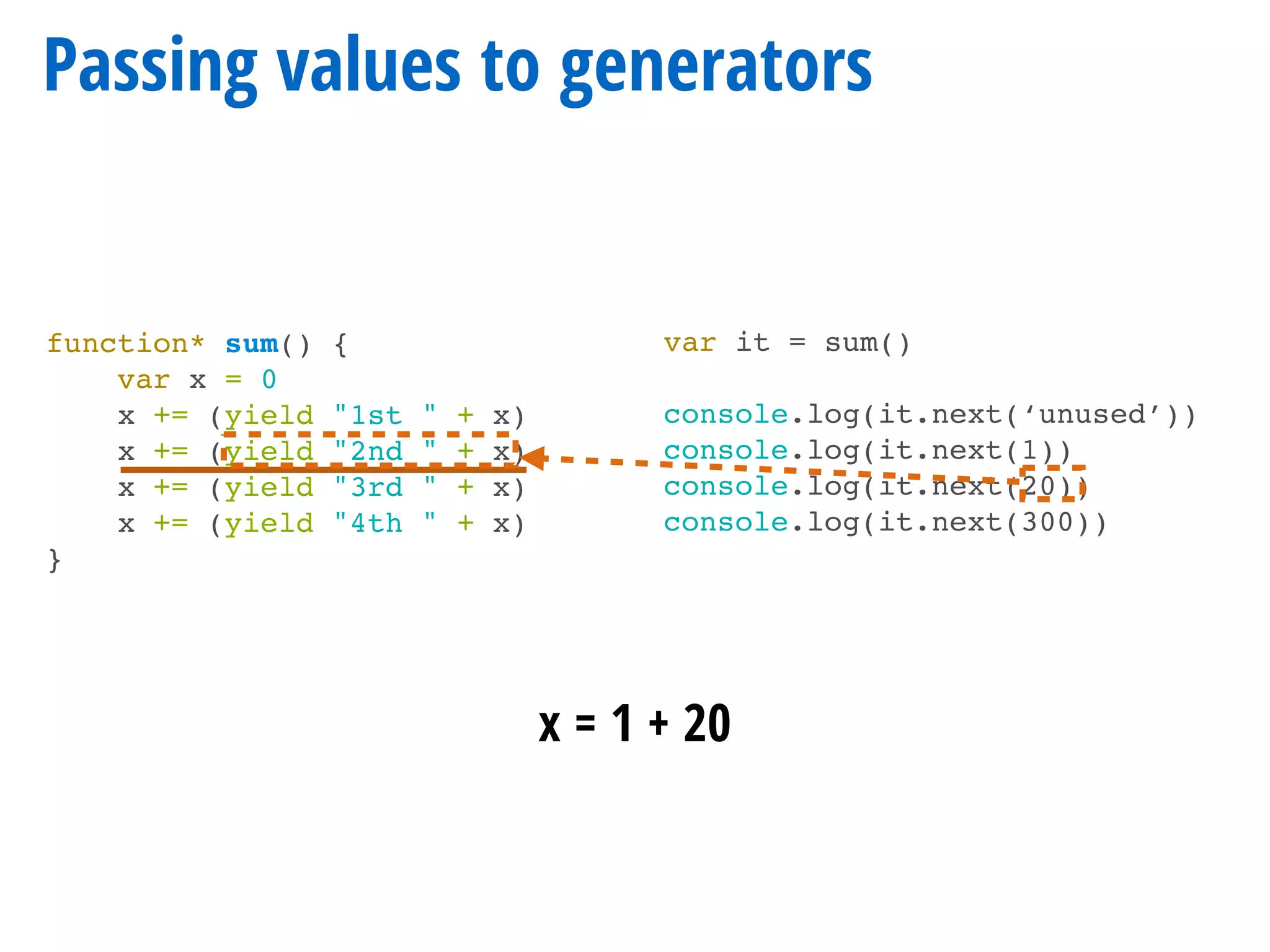
x = 1 + 20
function* sum() {
var x = 0
x += (yield "1st " + x)
x += (yield "2nd " + x)
x += (yield "3rd " + x)
x += (yield "4th " + x)
}
Passing values to generators
var it = sum()
console.log(it.next(‘unused’))
console.log(it.next(1))
console.log(it.next(20))
console.log(it.next(300))
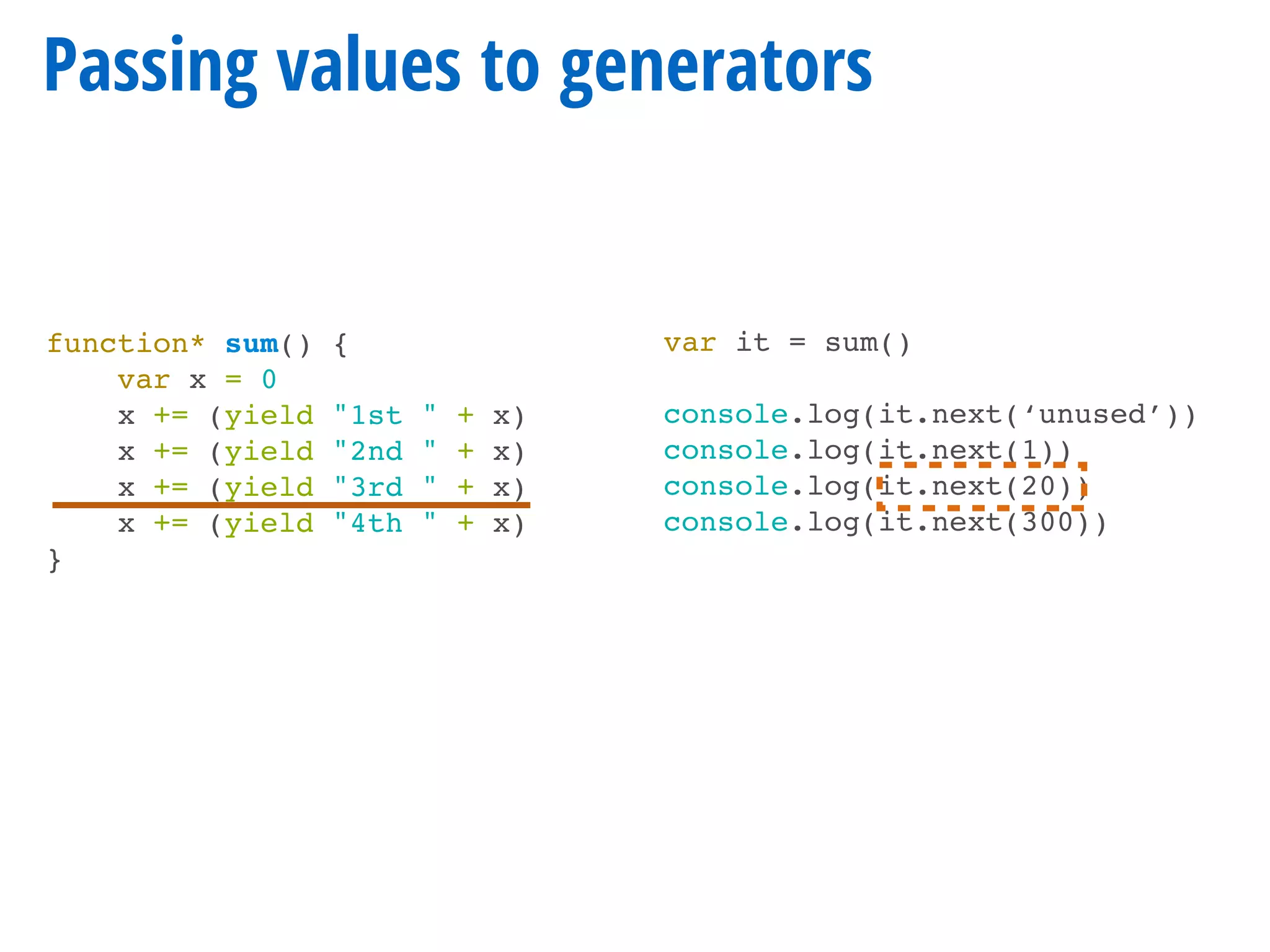
function* sum() {
var x = 0
x += (yield "1st " + x)
x += (yield "2nd " + x)
x += (yield "3rd " + x)
x += (yield "4th " + x)
}
Passing values to generators
var it = sum()
console.log(it.next(‘unused’))
console.log(it.next(1))
console.log(it.next(20))
console.log(it.next(300))
function* sum() {
var x = 0
x += (yield "1st " + x)
x += (yield "2nd " + x)
x += (yield "3rd " + x)
x += (yield "4th " + x)
}
Passing values to generators
var it = sum()
console.log(it.next(‘unused’))
console.log(it.next(1))
console.log(it.next(20))
console.log(it.next(300))
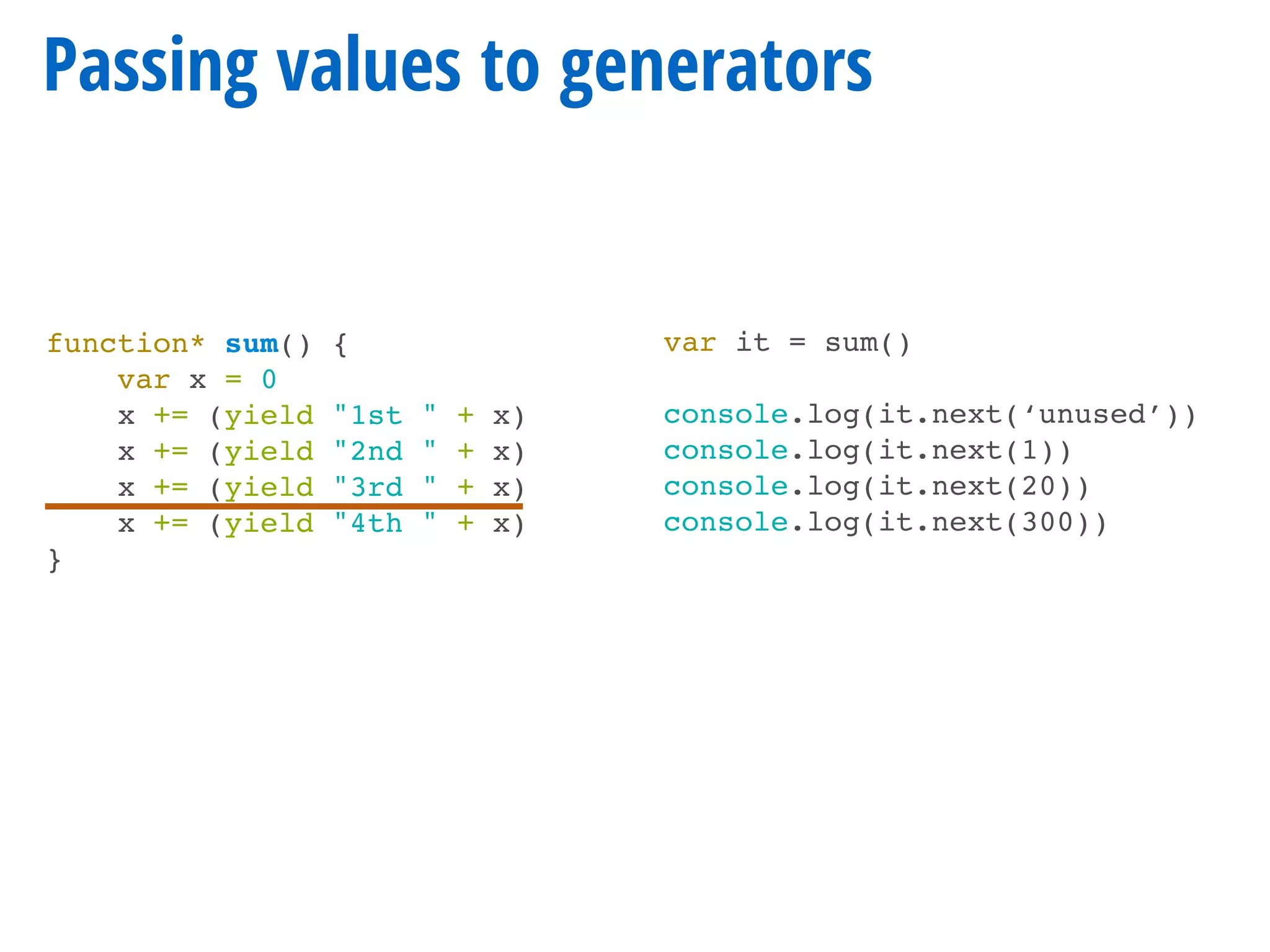
function* sum() {
var x = 0
x += (yield "1st " + x)
x += (yield "2nd " + x)
x += (yield "3rd " + x)
x += (yield "4th " + x)
}
Passing values to generators
var it = sum()
console.log(it.next(‘unused’))
console.log(it.next(1))
console.log(it.next(20))
console.log(it.next(300))
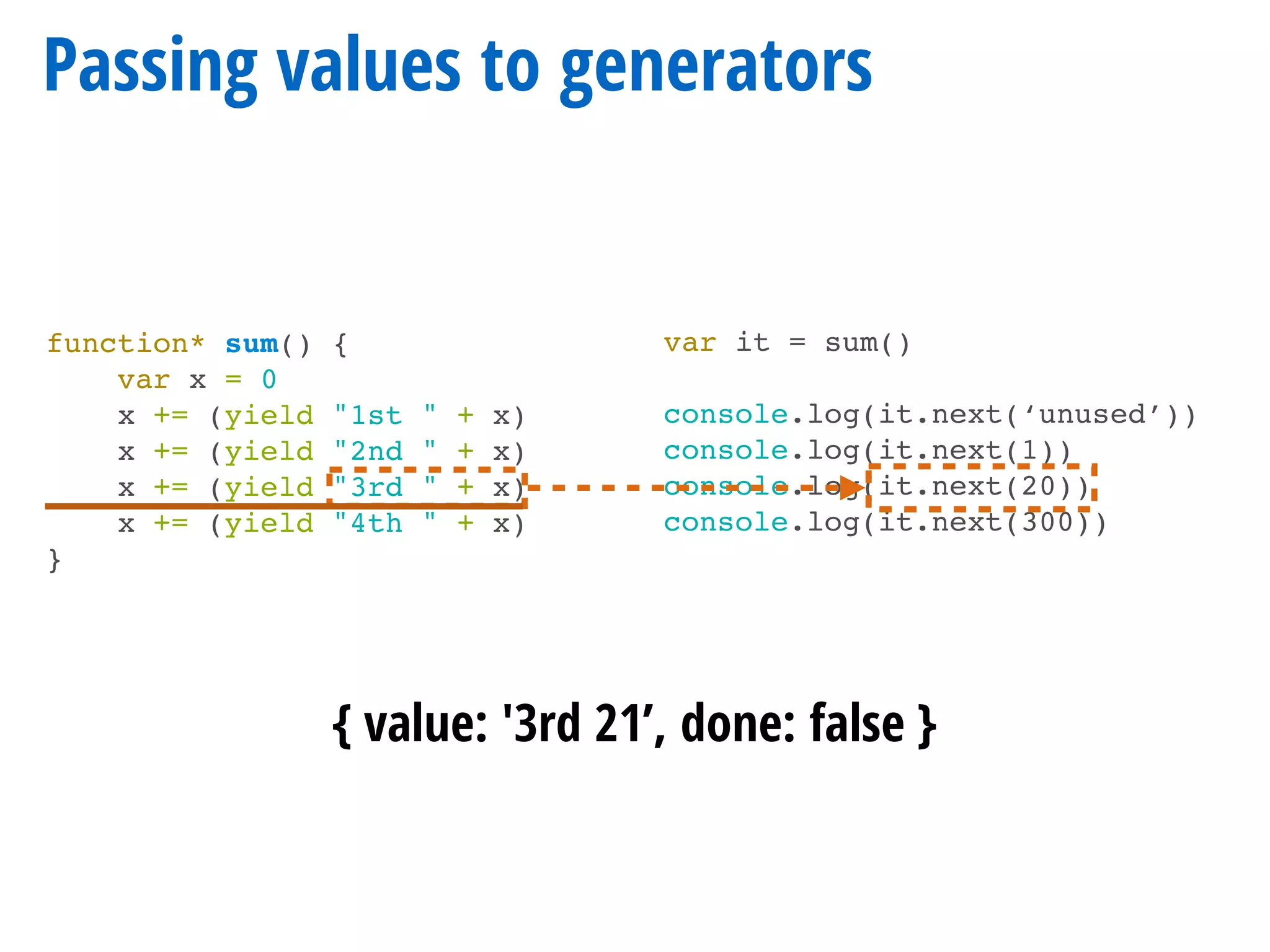
{ value: '3rd 21’, done: false }
function* sum() {
var x = 0
x += (yield "1st " + x)
x += (yield "2nd " + x)
x += (yield "3rd " + x)
x += (yield "4th " + x)
}
Passing values to generators
var it = sum()
console.log(it.next(‘unused’))
console.log(it.next(1))
console.log(it.next(20))
console.log(it.next(300))
function* sum() {
var x = 0
x += (yield "1st " + x)
x += (yield "2nd " + x)
x += (yield "3rd " + x)
x += (yield "4th " + x)
}
Passing values to generators
var it = sum()
console.log(it.next(‘unused’))
console.log(it.next(1))
console.log(it.next(20))
console.log(it.next(300))
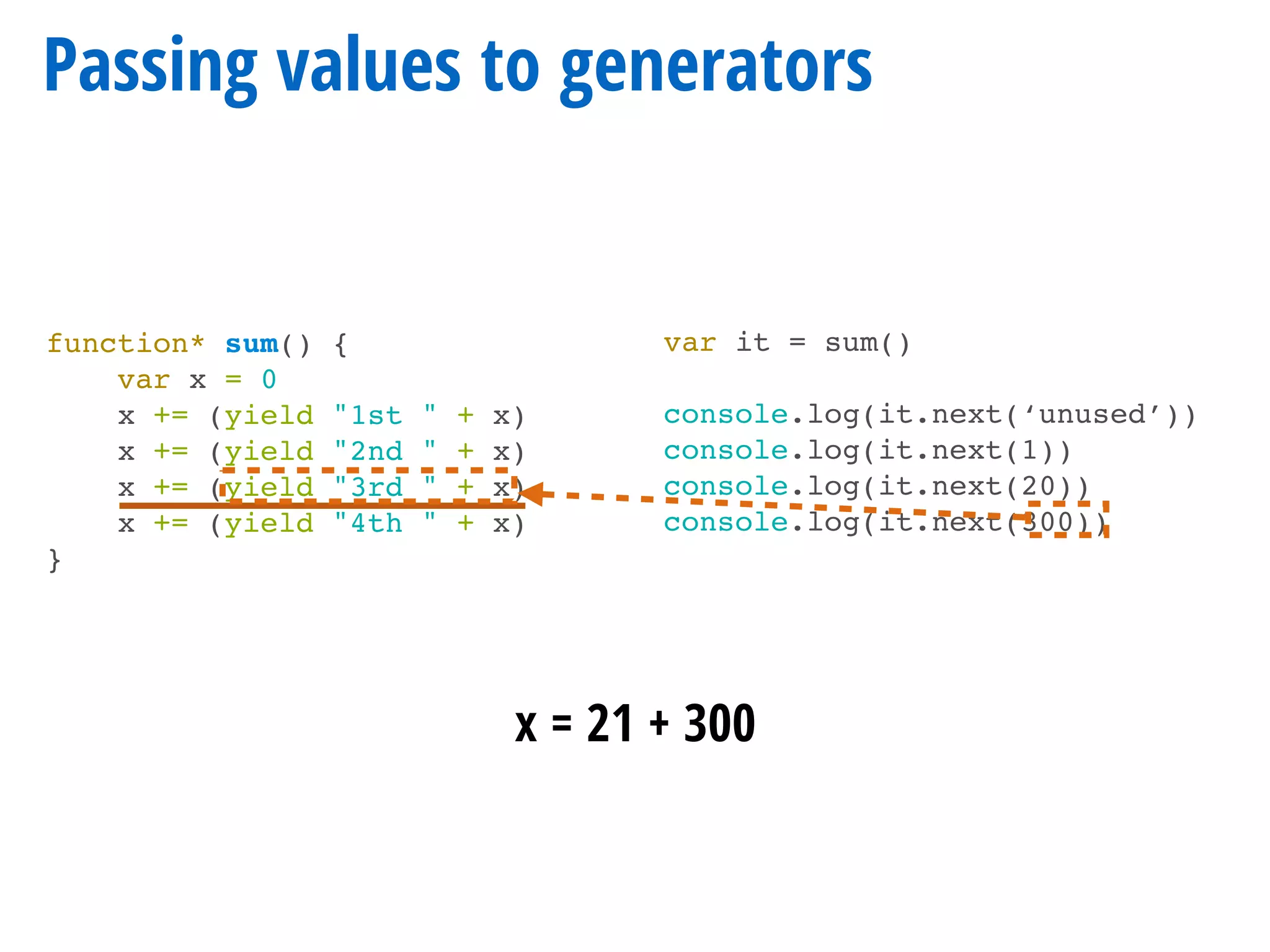
x = 21 + 300
function* sum() {
var x = 0
x += (yield "1st " + x)
x += (yield "2nd " + x)
x += (yield "3rd " + x)
x += (yield "4th " + x)
}
Passing values to generators
var it = sum()
console.log(it.next(‘unused’))
console.log(it.next(1))
console.log(it.next(20))
console.log(it.next(300))
function* sum() {
var x = 0
x += (yield "1st " + x)
x += (yield "2nd " + x)
x += (yield "3rd " + x)
x += (yield "4th " + x)
}
Passing values to generators
var it = sum()
console.log(it.next(‘unused’))
console.log(it.next(1))
console.log(it.next(20))
console.log(it.next(300))
function* sum() {
var x = 0
x += (yield "1st " + x)
x += (yield "2nd " + x)
x += (yield "3rd " + x)
x += (yield "4th " + x)
}
Passing values to generators
var it = sum()
console.log(it.next(‘unused’))
console.log(it.next(1))
console.log(it.next(20))
console.log(it.next(300))
{ value: '4th 321’, done: false }
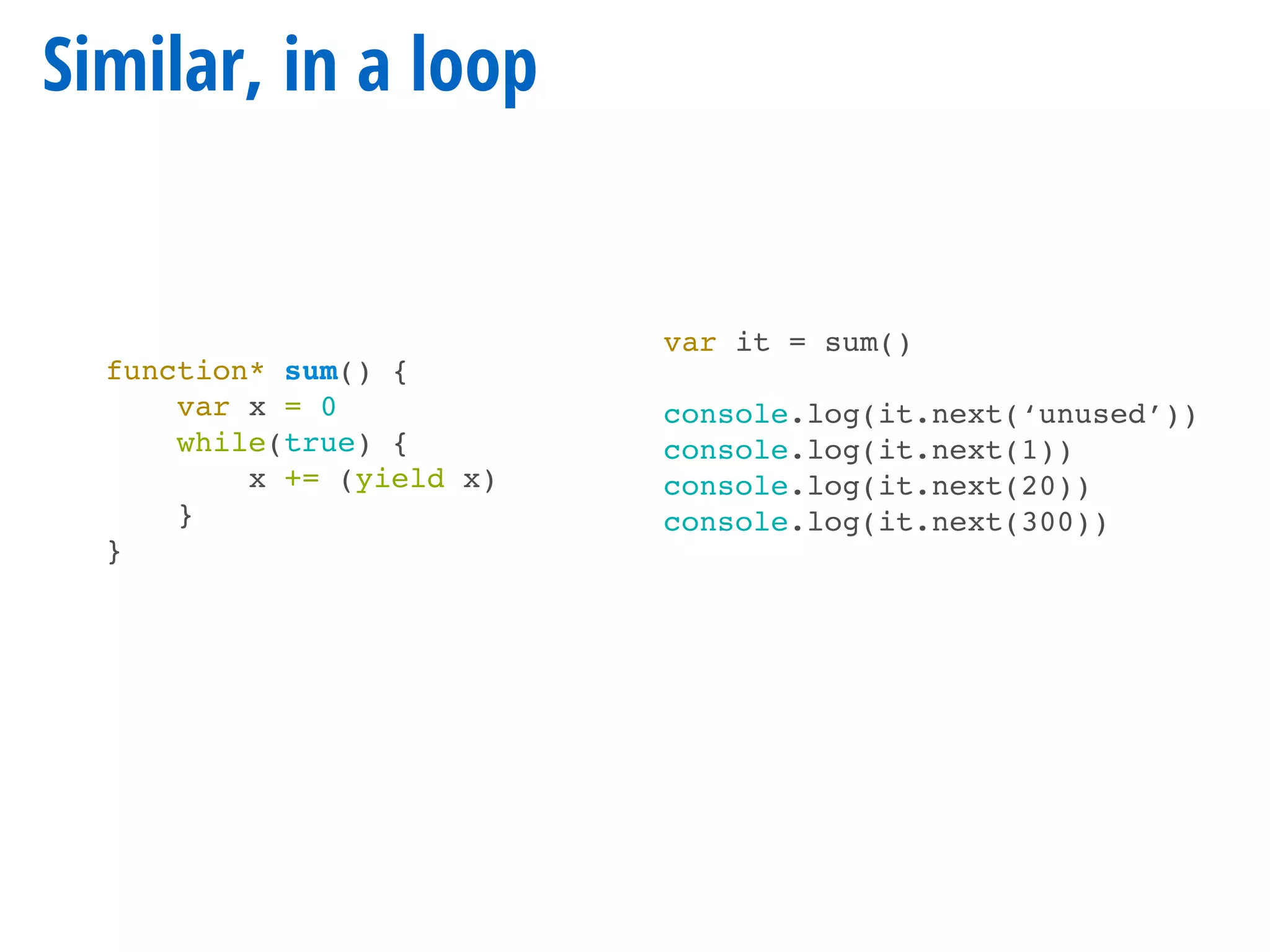
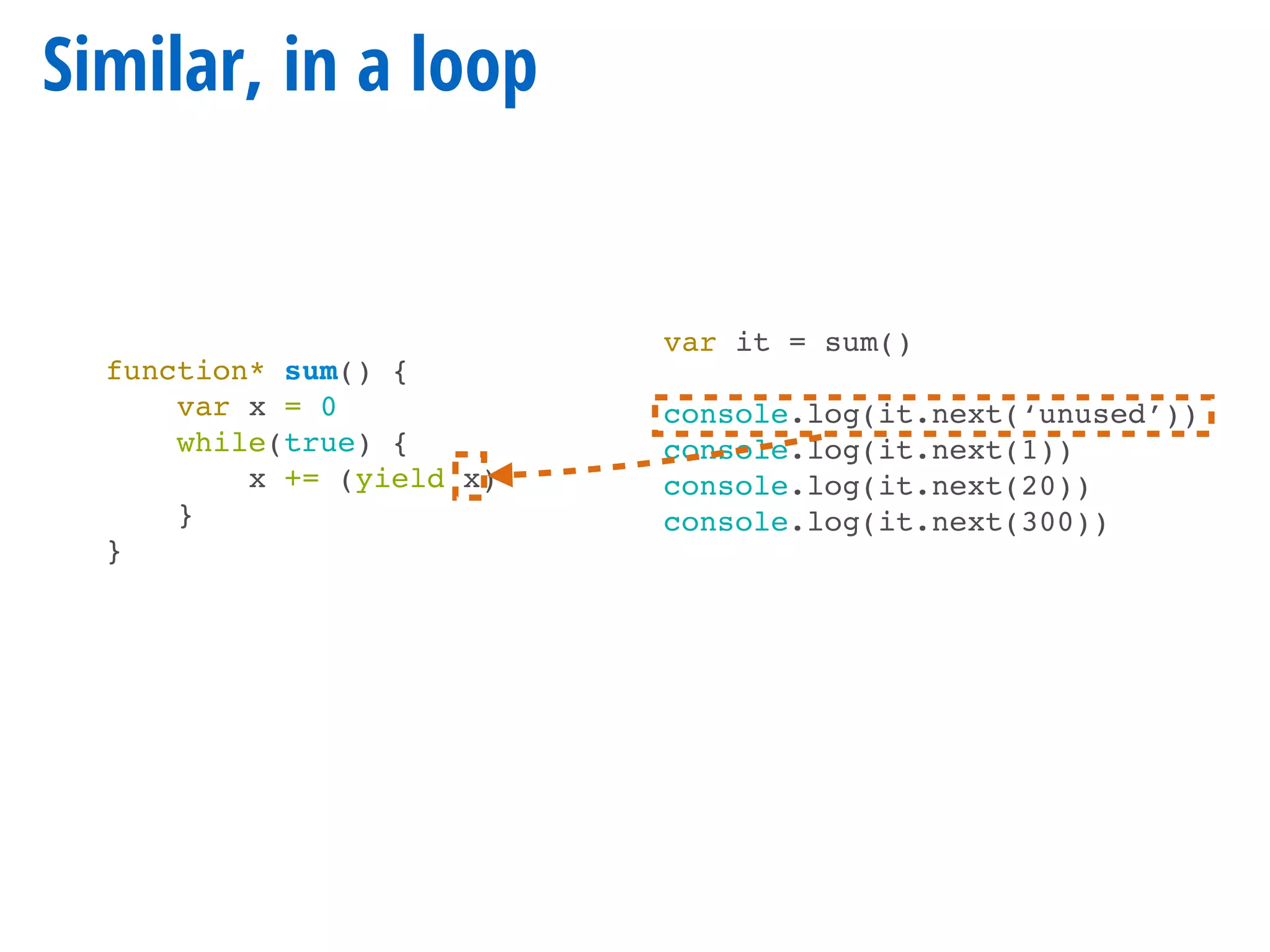
function* sum() {
var x = 0
while(true) {
x += (yield x)
}
}
Similar, in a loop
var it = sum()
console.log(it.next(‘unused’))
console.log(it.next(1))
console.log(it.next(20))
console.log(it.next(300))
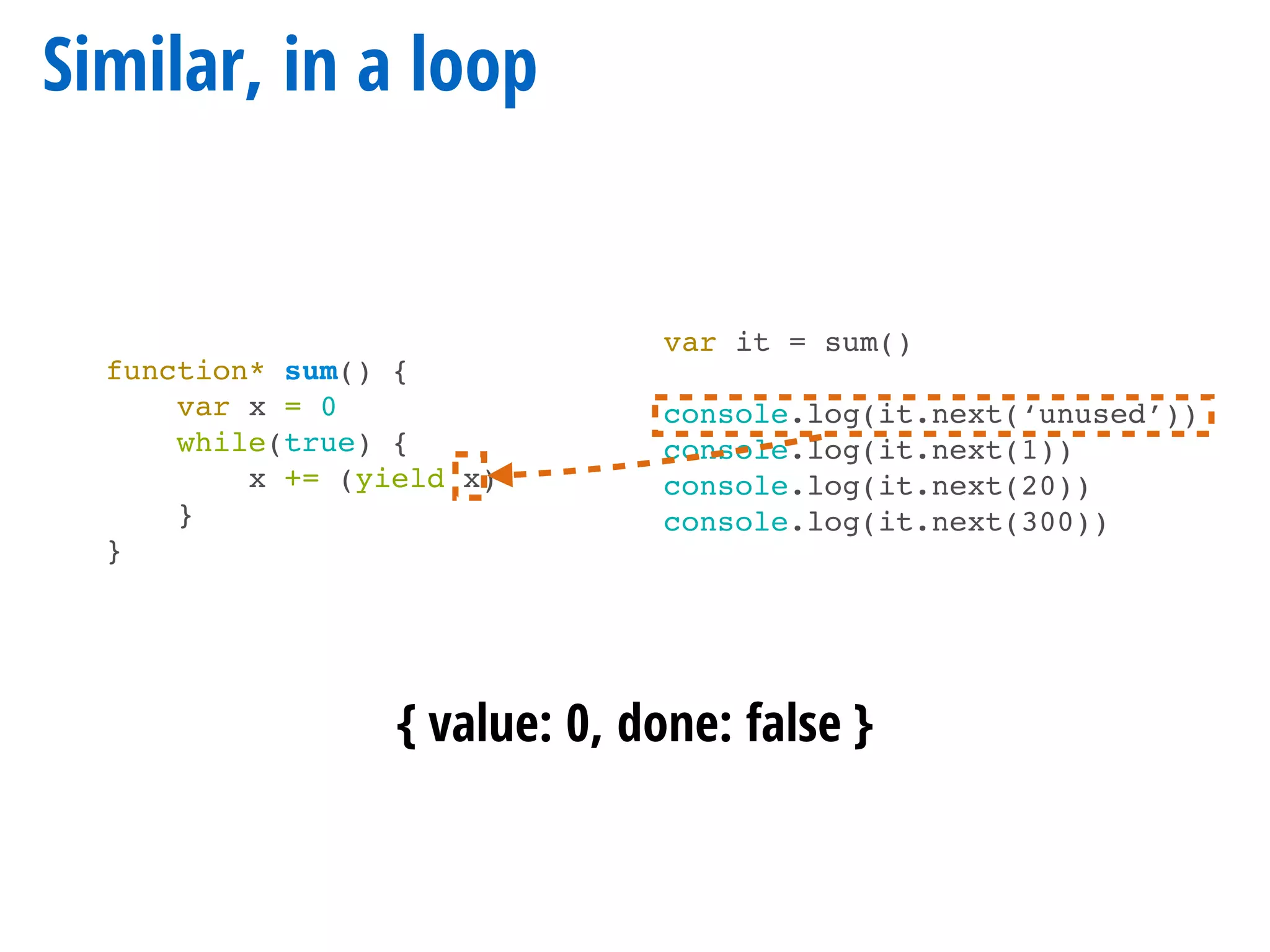
function* sum() {
var x = 0
while(true) {
x += (yield x)
}
}
Similar, in a loop
var it = sum()
console.log(it.next(‘unused’))
console.log(it.next(1))
console.log(it.next(20))
console.log(it.next(300))
function* sum() {
var x = 0
while(true) {
x += (yield x)
}
}
Similar, in a loop
var it = sum()
console.log(it.next(‘unused’))
console.log(it.next(1))
console.log(it.next(20))
console.log(it.next(300))
{ value: 0, done: false }
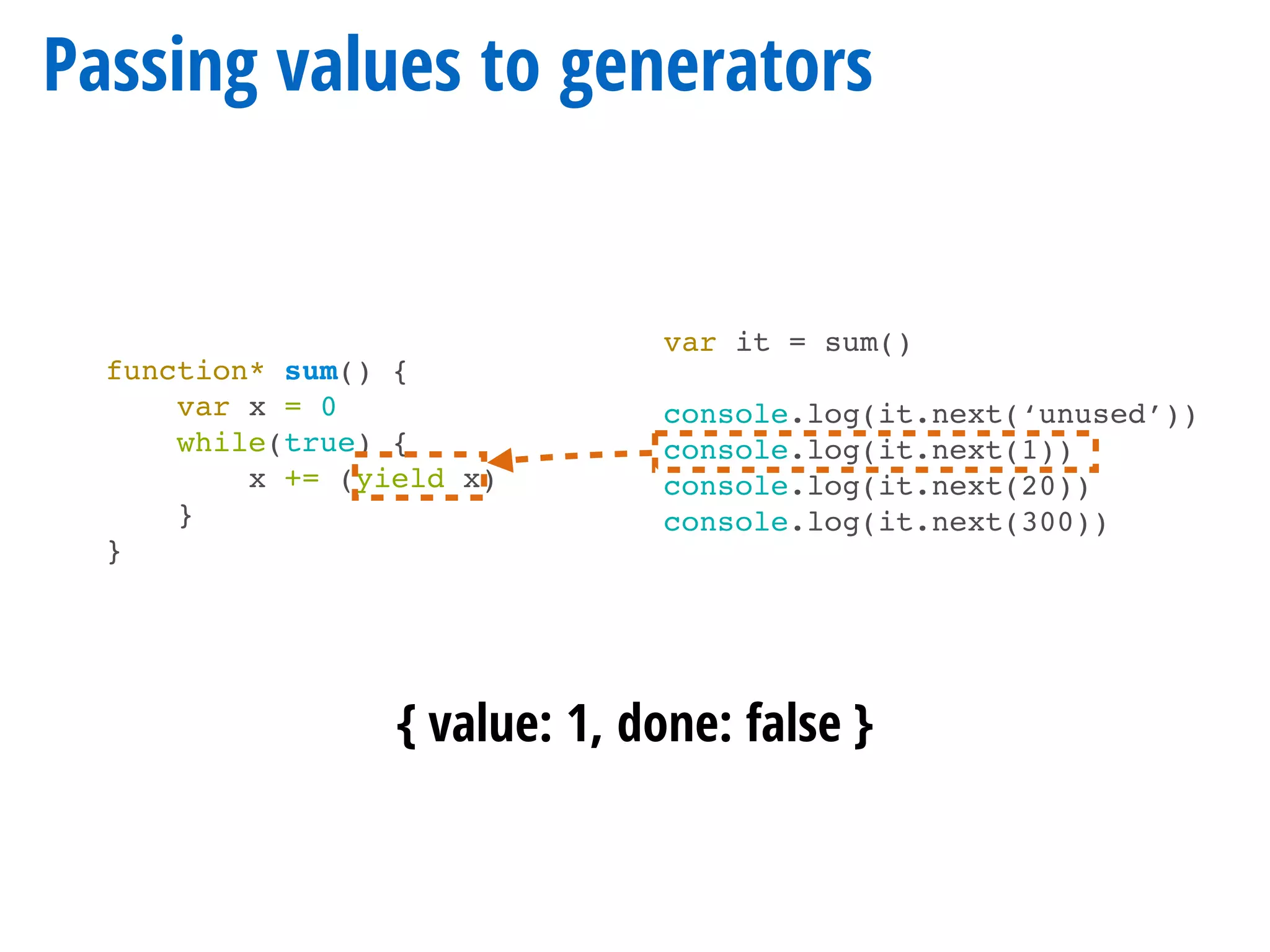
function* sum() {
var x = 0
while(true) {
x += (yield x)
}
}
Passing values to generators
var it = sum()
console.log(it.next(‘unused’))
console.log(it.next(1))
console.log(it.next(20))
console.log(it.next(300))
{ value: 1, done: false }
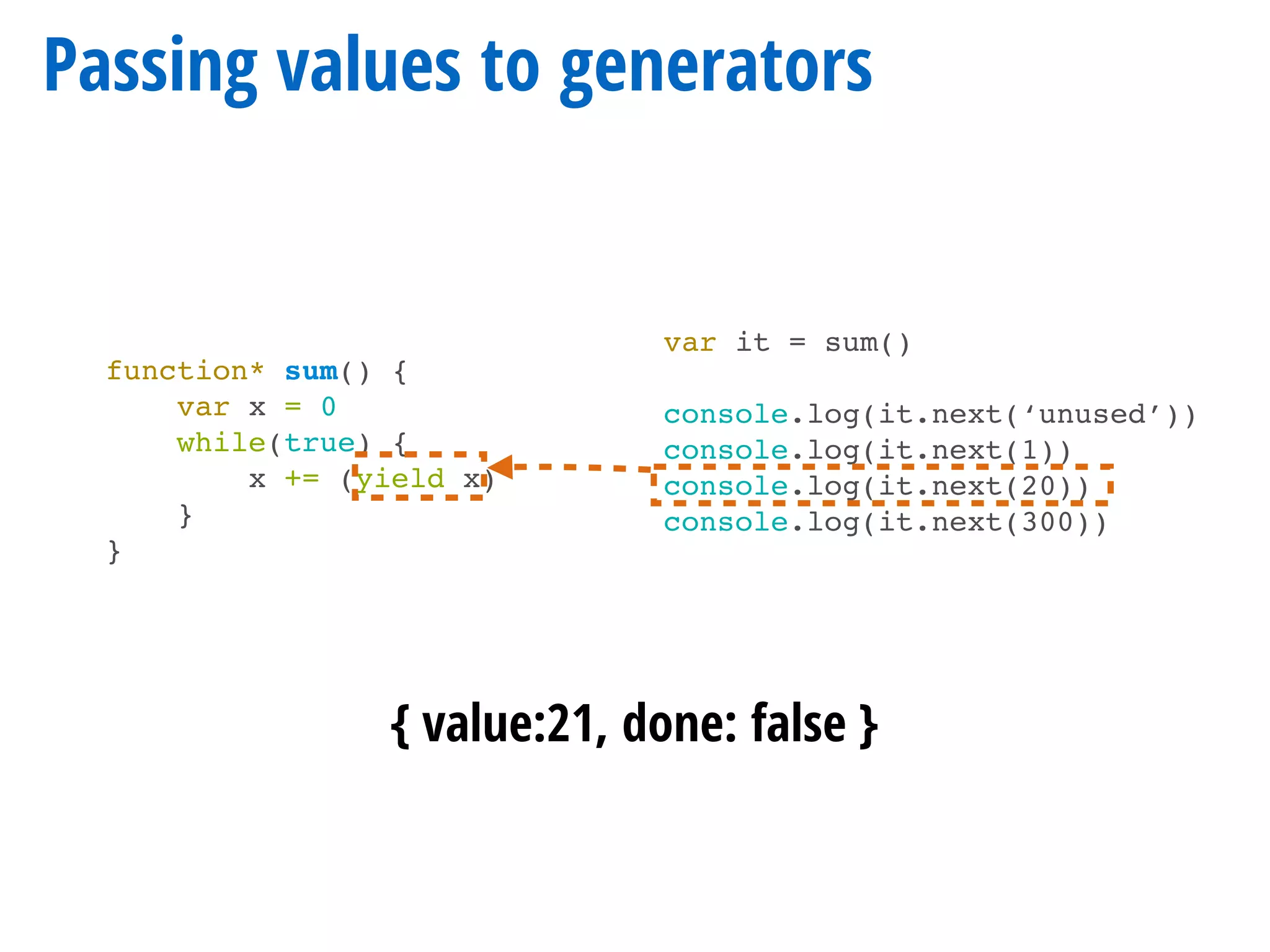
function* sum() {
var x = 0
while(true) {
x += (yield x)
}
}
Passing values to generators
var it = sum()
console.log(it.next(‘unused’))
console.log(it.next(1))
console.log(it.next(20))
console.log(it.next(300))
{ value:21, done: false }
function* sum() {
var x = 0
while(true) {
x += (yield x)
}
}
Passing values to generators
var it = sum()
console.log(it.next(‘unused’))
console.log(it.next(1))
console.log(it.next(20))
console.log(it.next(300))
{ value:321, done: false }
Making a iterable
for (let value of myIterable) {
console.log(value); // [1, 2, 3]
}
[...myIterable]; // [1, 2, 3]
var myIterable = {};
myIterable[Symbol.iterator] = function* () {
yield 1;
yield 2;
yield 3;
};
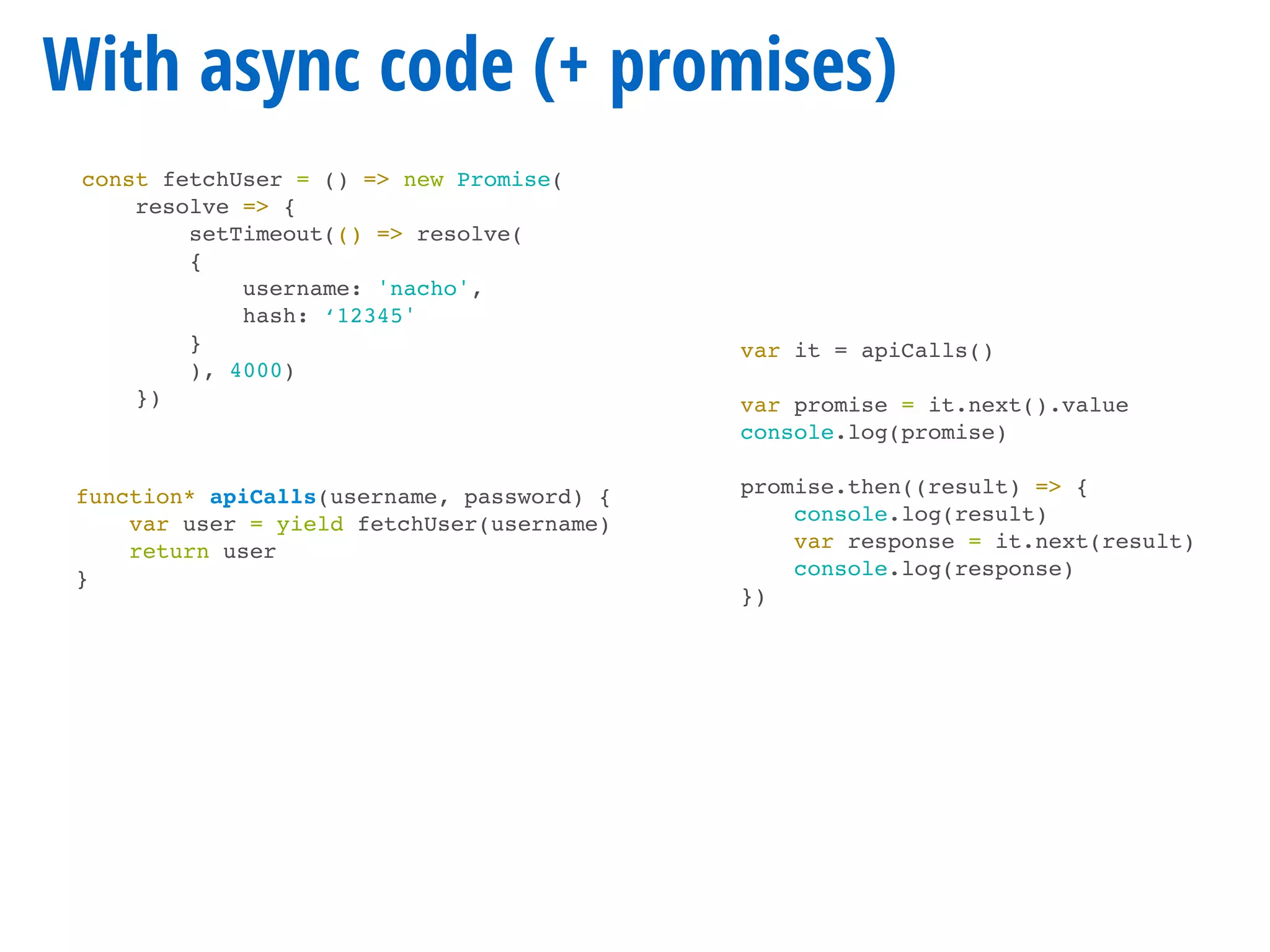
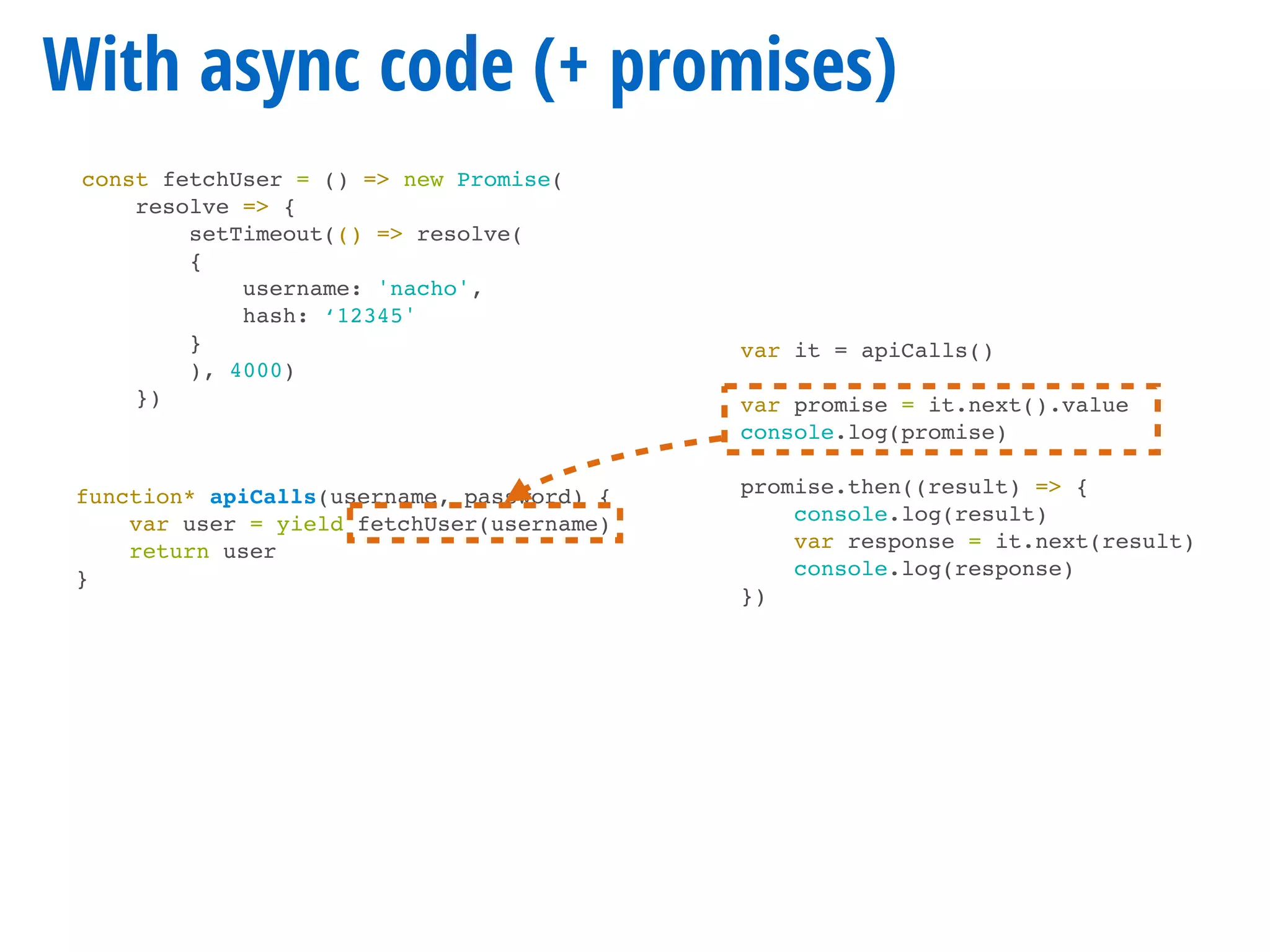
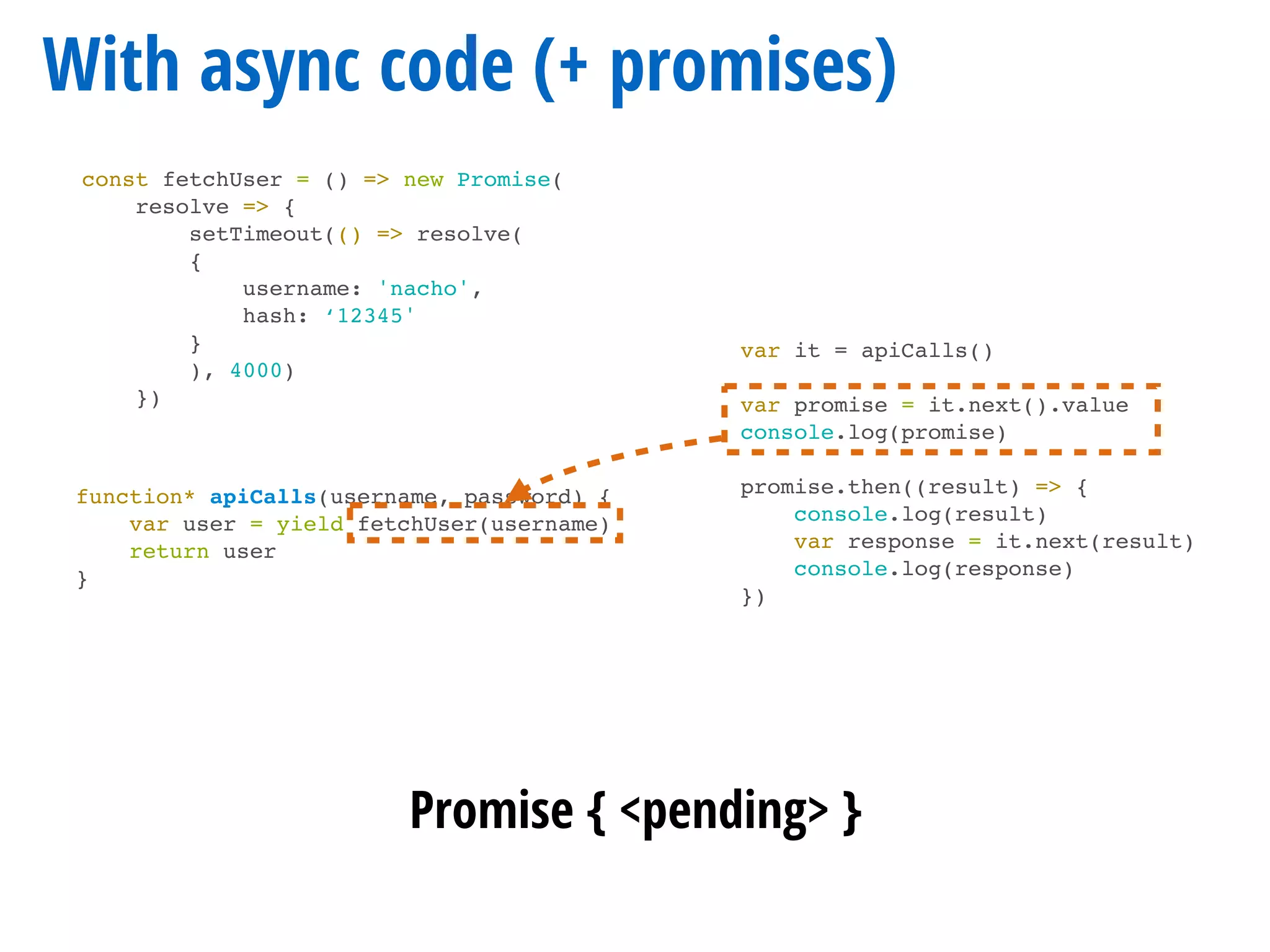
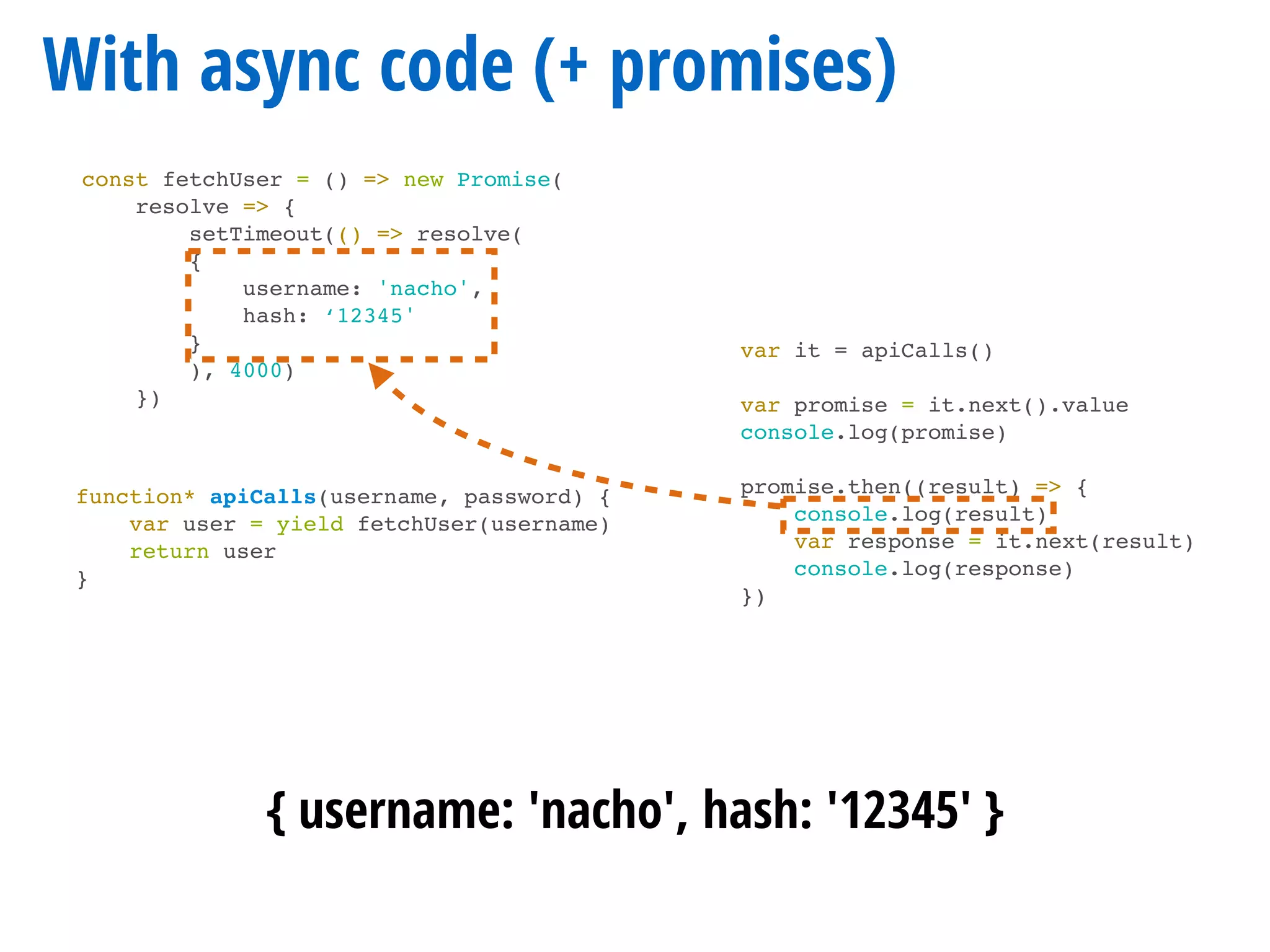
const fetchUser = () => new Promise(
resolve => {
setTimeout(() => resolve(
{
username: 'nacho',
hash: ‘12345'
}
), 4000)
})
With async code (+ promises)
function* apiCalls(username, password) {
var user = yield fetchUser(username)
return user
}
var it = apiCalls()
var promise = it.next().value
console.log(promise)
promise.then((result) => {
console.log(result)
var response = it.next(result)
console.log(response)
})
const fetchUser = () => new Promise(
resolve => {
setTimeout(() => resolve(
{
username: 'nacho',
hash: ‘12345'
}
), 4000)
})
With async code (+ promises)
function* apiCalls(username, password) {
var user = yield fetchUser(username)
return user
}
var it = apiCalls()
var promise = it.next().value
console.log(promise)
promise.then((result) => {
console.log(result)
var response = it.next(result)
console.log(response)
})
const fetchUser = () => new Promise(
resolve => {
setTimeout(() => resolve(
{
username: 'nacho',
hash: ‘12345'
}
), 4000)
})
With async code (+ promises)
function* apiCalls(username, password) {
var user = yield fetchUser(username)
return user
}
var it = apiCalls()
var promise = it.next().value
console.log(promise)
promise.then((result) => {
console.log(result)
var response = it.next(result)
console.log(response)
})
Promise { <pending> }
With async code (+ promises)
const fetchUser = () => new Promise(
resolve => {
setTimeout(() => resolve(
{
username: 'nacho',
hash: ‘12345'
}
), 4000)
})
function* apiCalls(username, password) {
var user = yield fetchUser(username)
return user
}
var it = apiCalls()
var promise = it.next().value
console.log(promise)
promise.then((result) => {
console.log(result)
var response = it.next(result)
console.log(response)
})
{ username: 'nacho', hash: '12345' }
With async code (+ promises)
const fetchUser = () => new Promise(
resolve => {
setTimeout(() => resolve(
{
username: 'nacho',
hash: ‘12345'
}
), 4000)
})
function* apiCalls(username, password) {
var user = yield fetchUser(username)
return user
}
var it = apiCalls()
var promise = it.next().value
console.log(promise)
promise.then((result) => {
console.log(result)
var response = it.next(result)
console.log(response)
})
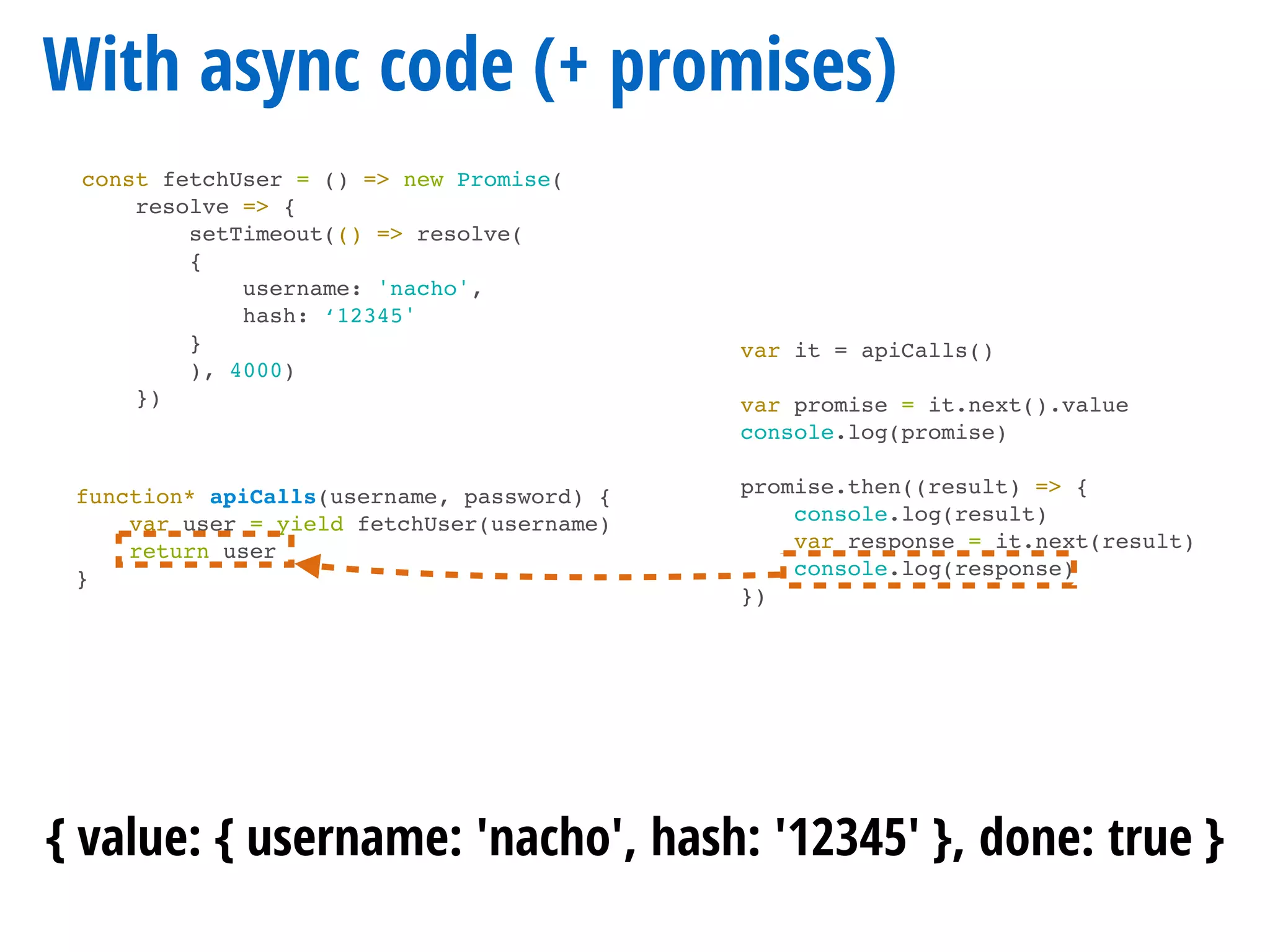
{ value: { username: 'nacho', hash: '12345' }, done: true }
With async code (+ promises)
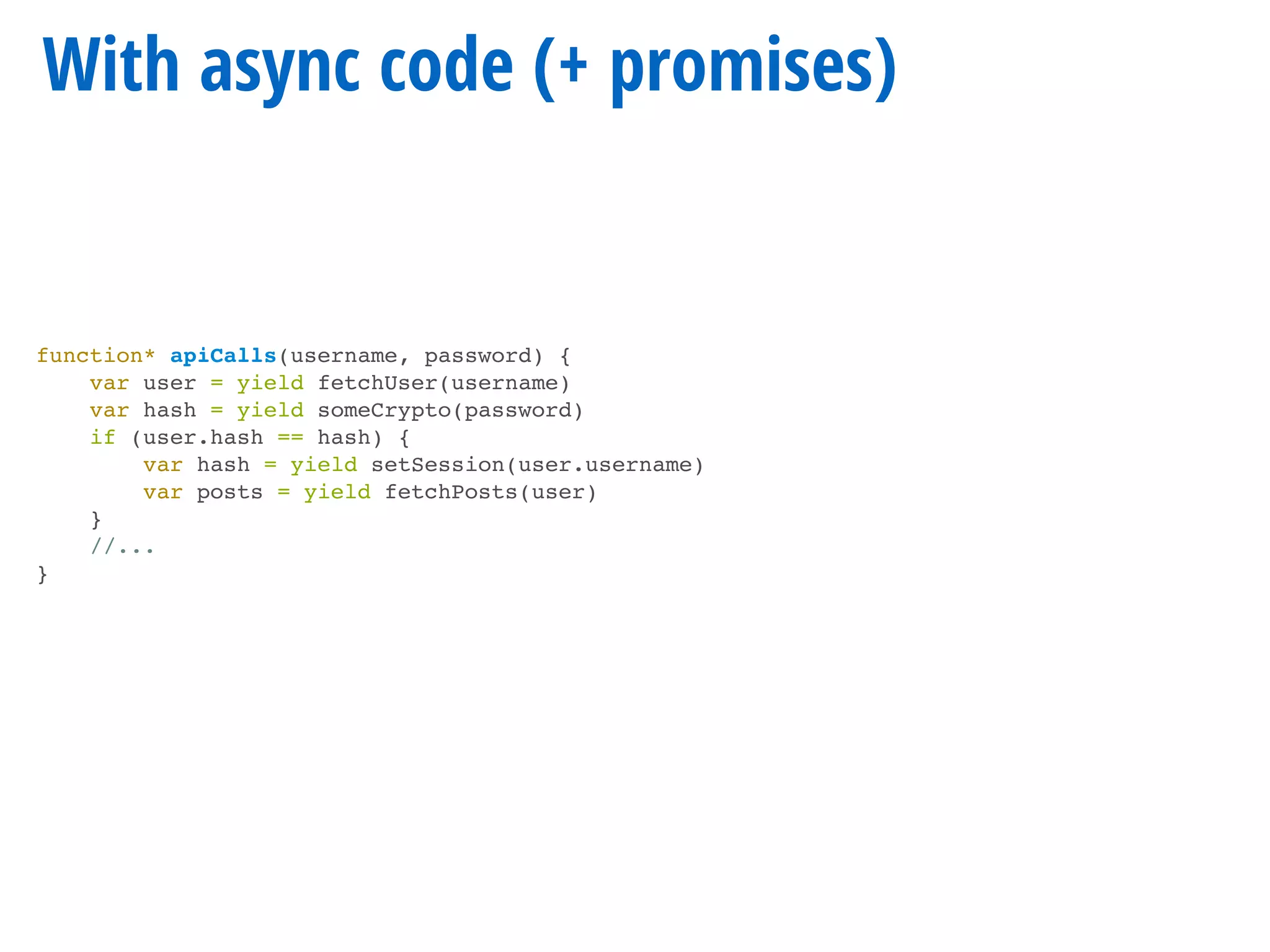
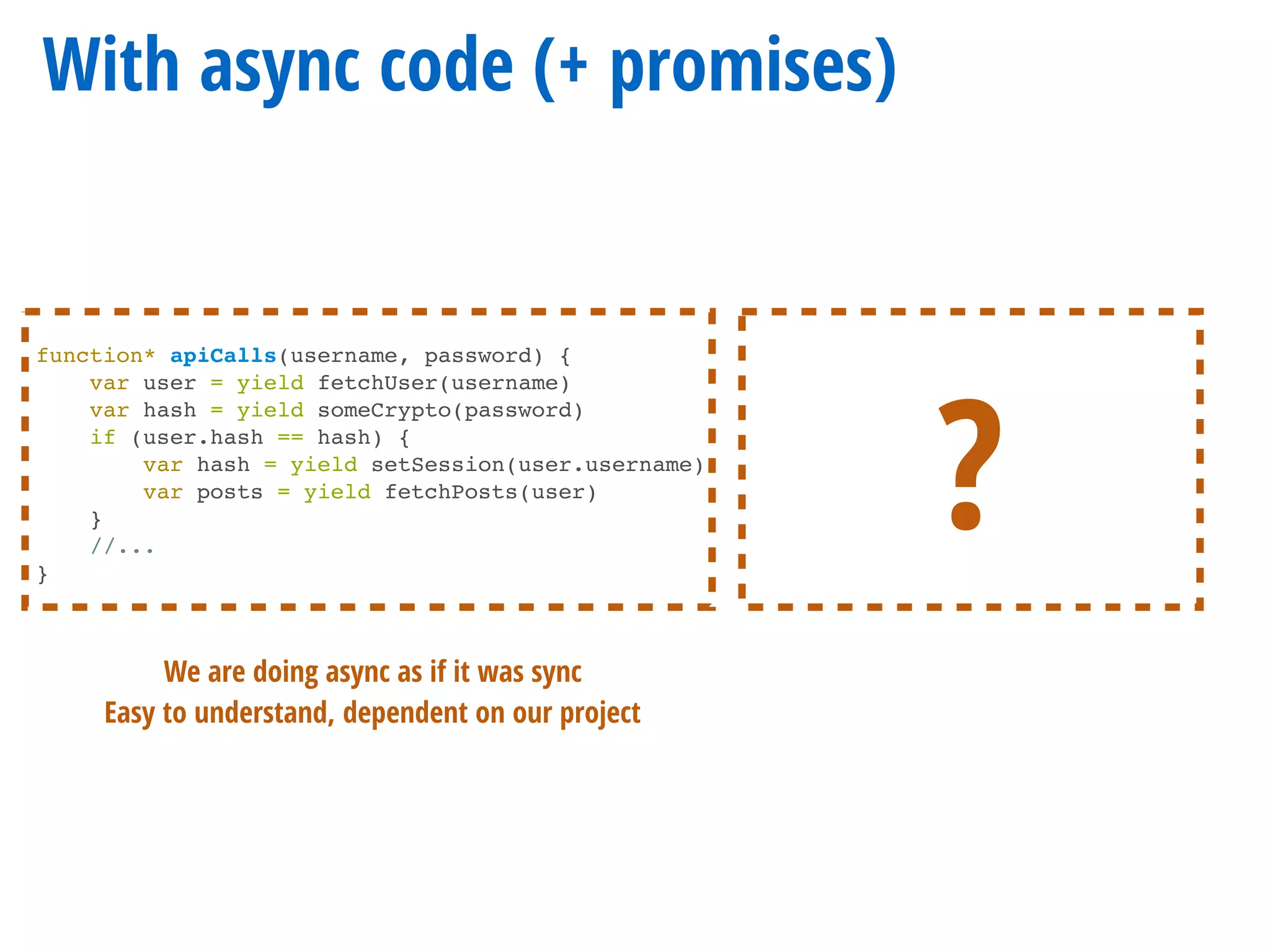
function* apiCalls(username, password) {
var user = yield fetchUser(username)
var hash = yield someCrypto(password)
if (user.hash == hash) {
var hash = yield setSession(user.username)
var posts = yield fetchPosts(user)
}
//...
}
With async code (+ promises)
function* apiCalls(username, password) {
var user = yield fetchUser(username)
var hash = yield someCrypto(password)
if (user.hash == hash) {
var hash = yield setSession(user.username)
var posts = yield fetchPosts(user)
}
//...
}
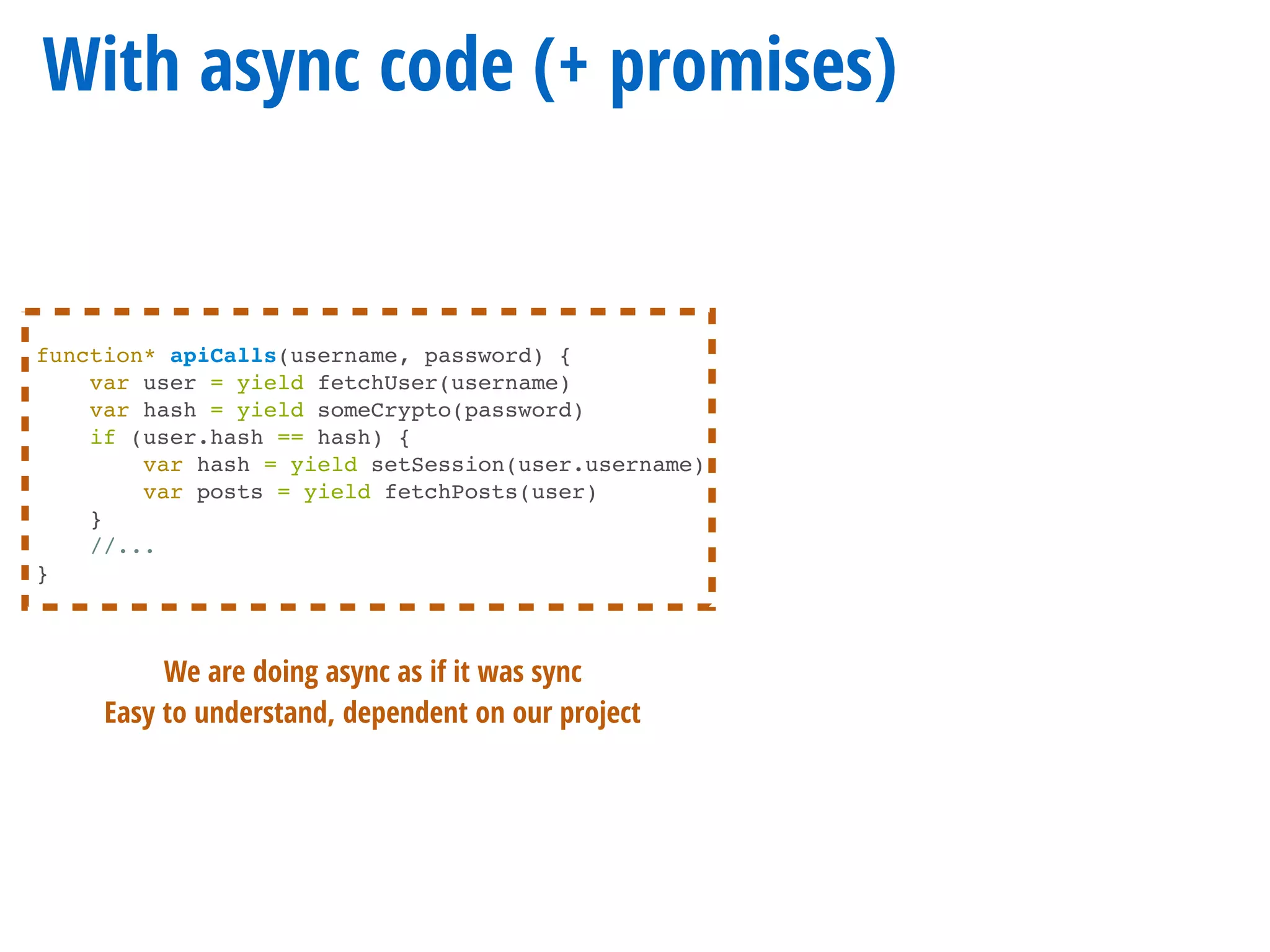
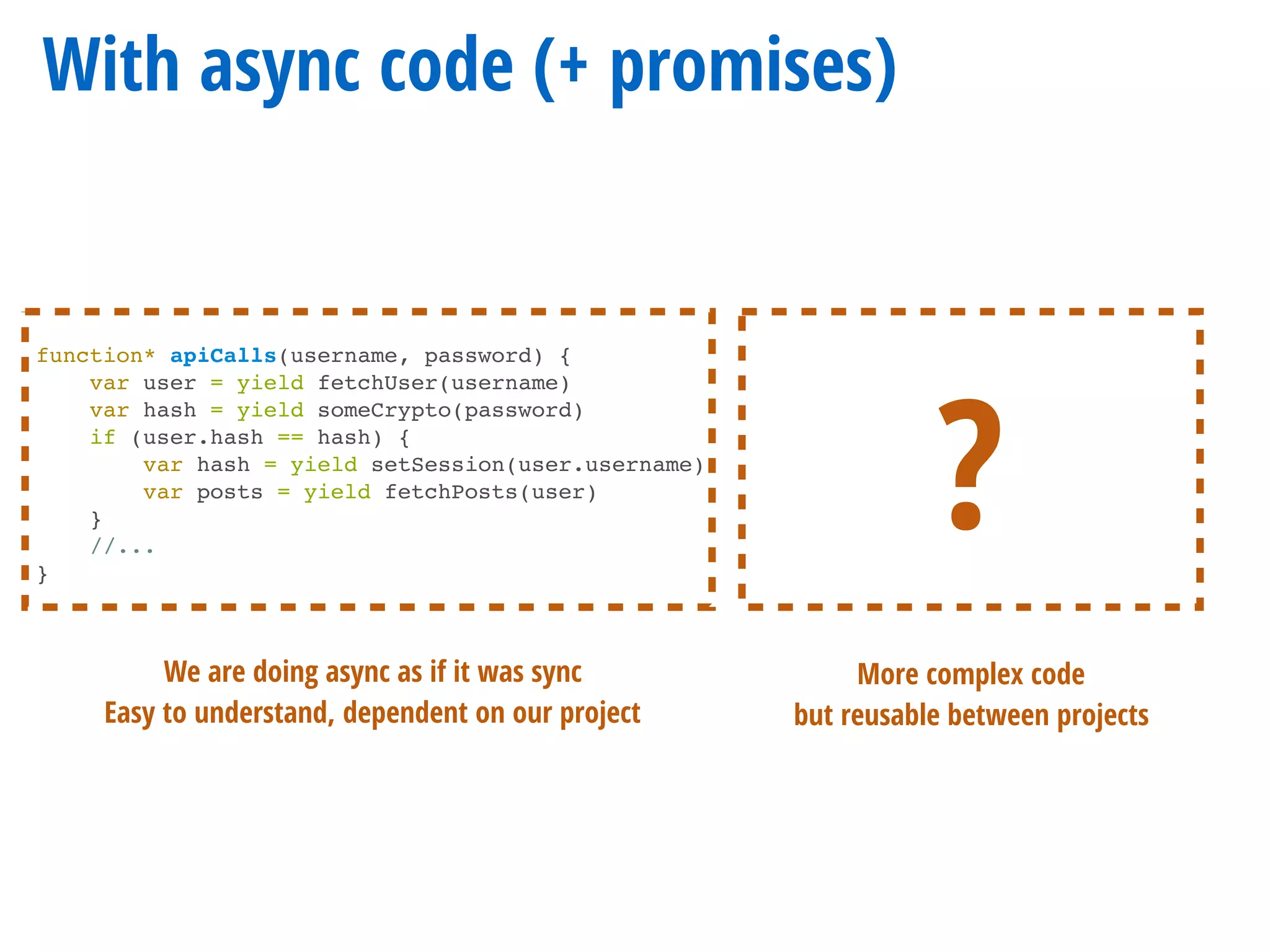
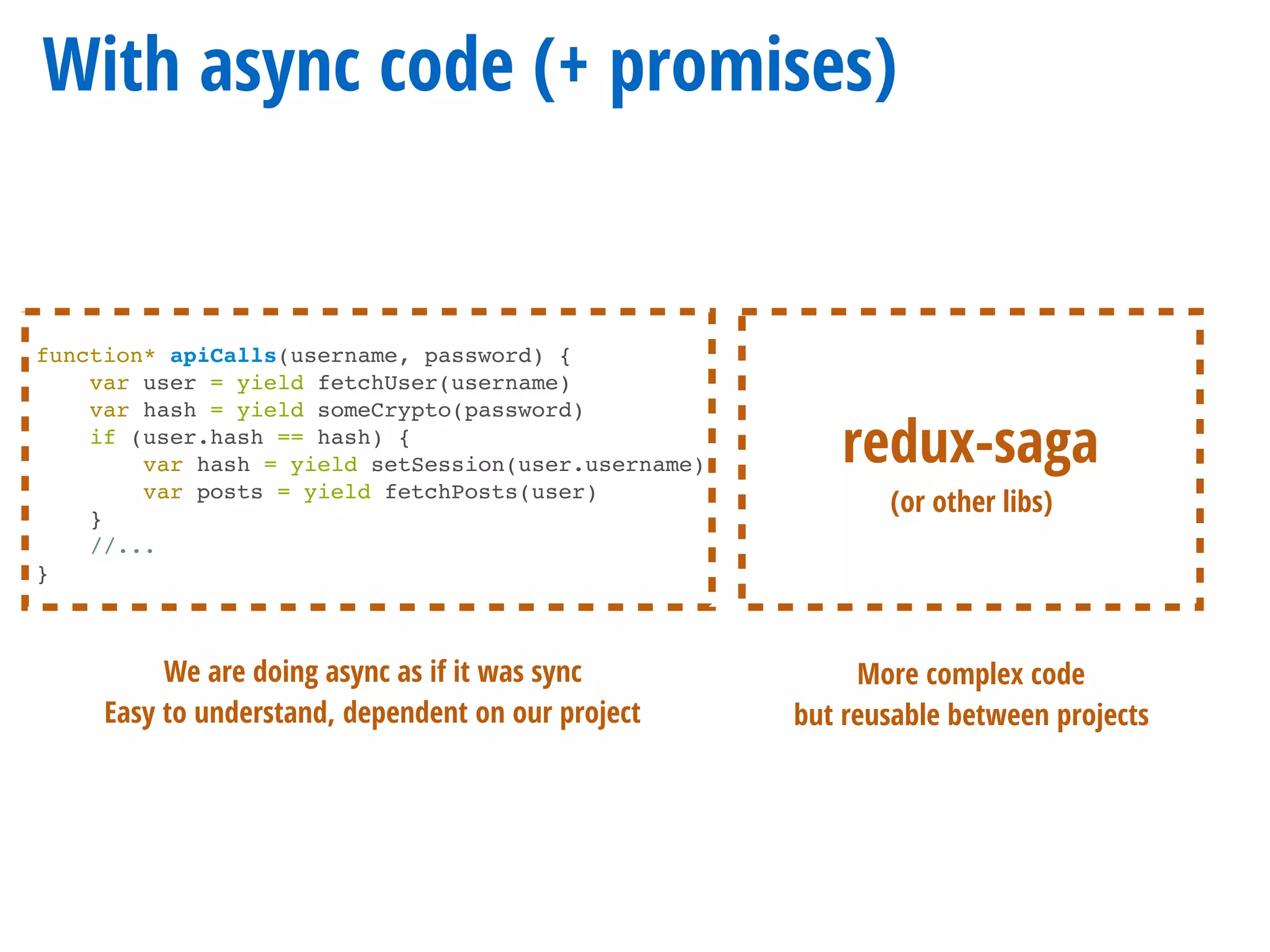
We are doing async as if it was sync
Easy to understand, dependent on our project
With async code (+ promises)
function* apiCalls(username, password) {
var user = yield fetchUser(username)
var hash = yield someCrypto(password)
if (user.hash == hash) {
var hash = yield setSession(user.username)
var posts = yield fetchPosts(user)
}
//...
}
We are doing async as if it was sync
Easy to understand, dependent on our project
?
With async code (+ promises)
function* apiCalls(username, password) {
var user = yield fetchUser(username)
var hash = yield someCrypto(password)
if (user.hash == hash) {
var hash = yield setSession(user.username)
var posts = yield fetchPosts(user)
}
//...
}
We are doing async as if it was sync
Easy to understand, dependent on our project
?
More complex code
but reusable between projects
With async code (+ promises)
function* apiCalls(username, password) {
var user = yield fetchUser(username)
var hash = yield someCrypto(password)
if (user.hash == hash) {
var hash = yield setSession(user.username)
var posts = yield fetchPosts(user)
}
//...
}
We are doing async as if it was sync
Easy to understand, dependent on our project
More complex code
but reusable between projects
redux-saga
(or other libs)
Sagas
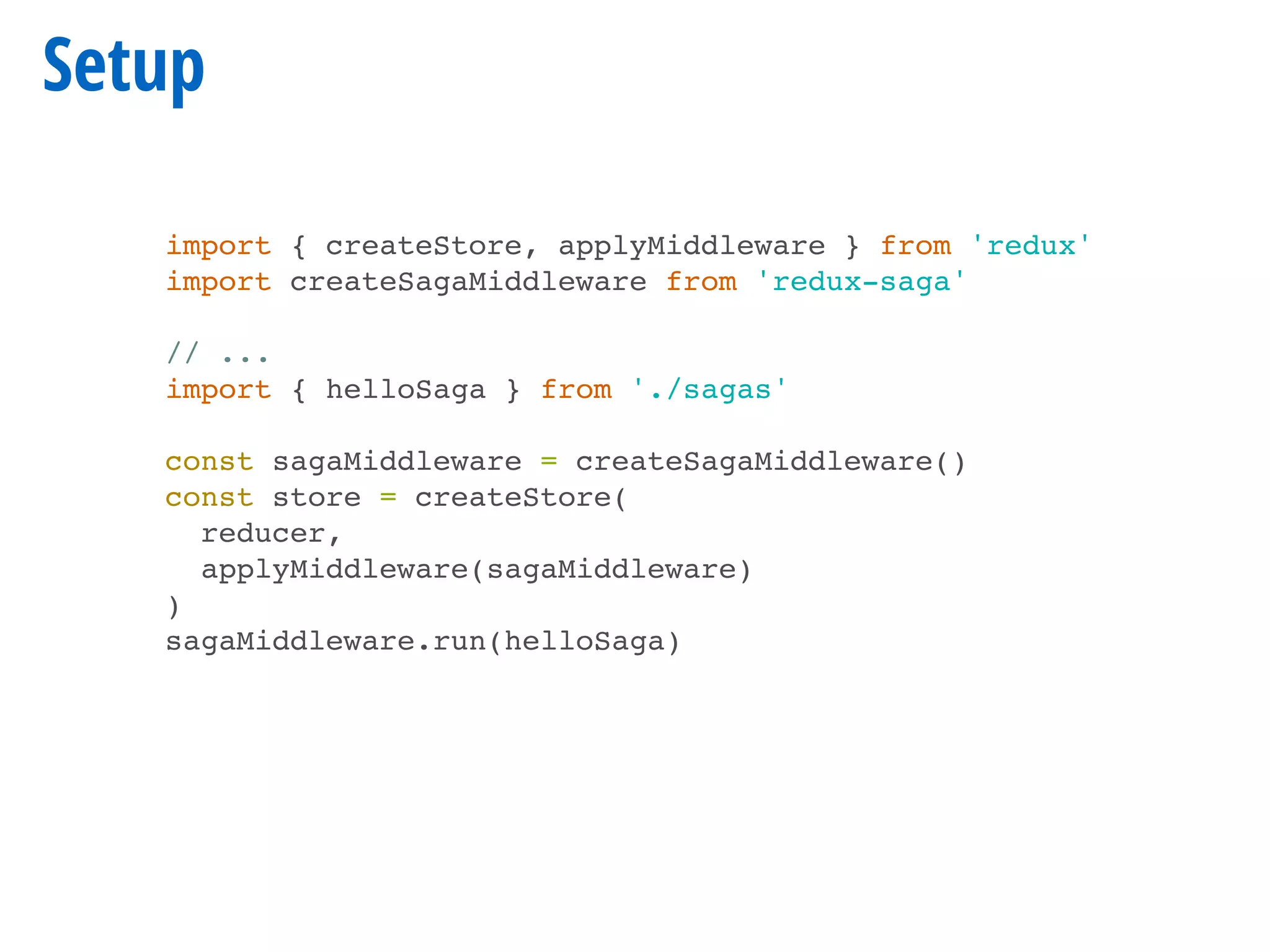
Setup
import { createStore, applyMiddleware } from 'redux'
import createSagaMiddleware from 'redux-saga'
// ...
import { helloSaga } from './sagas'
const sagaMiddleware = createSagaMiddleware()
const store = createStore(
reducer,
applyMiddleware(sagaMiddleware)
)
sagaMiddleware.run(helloSaga)
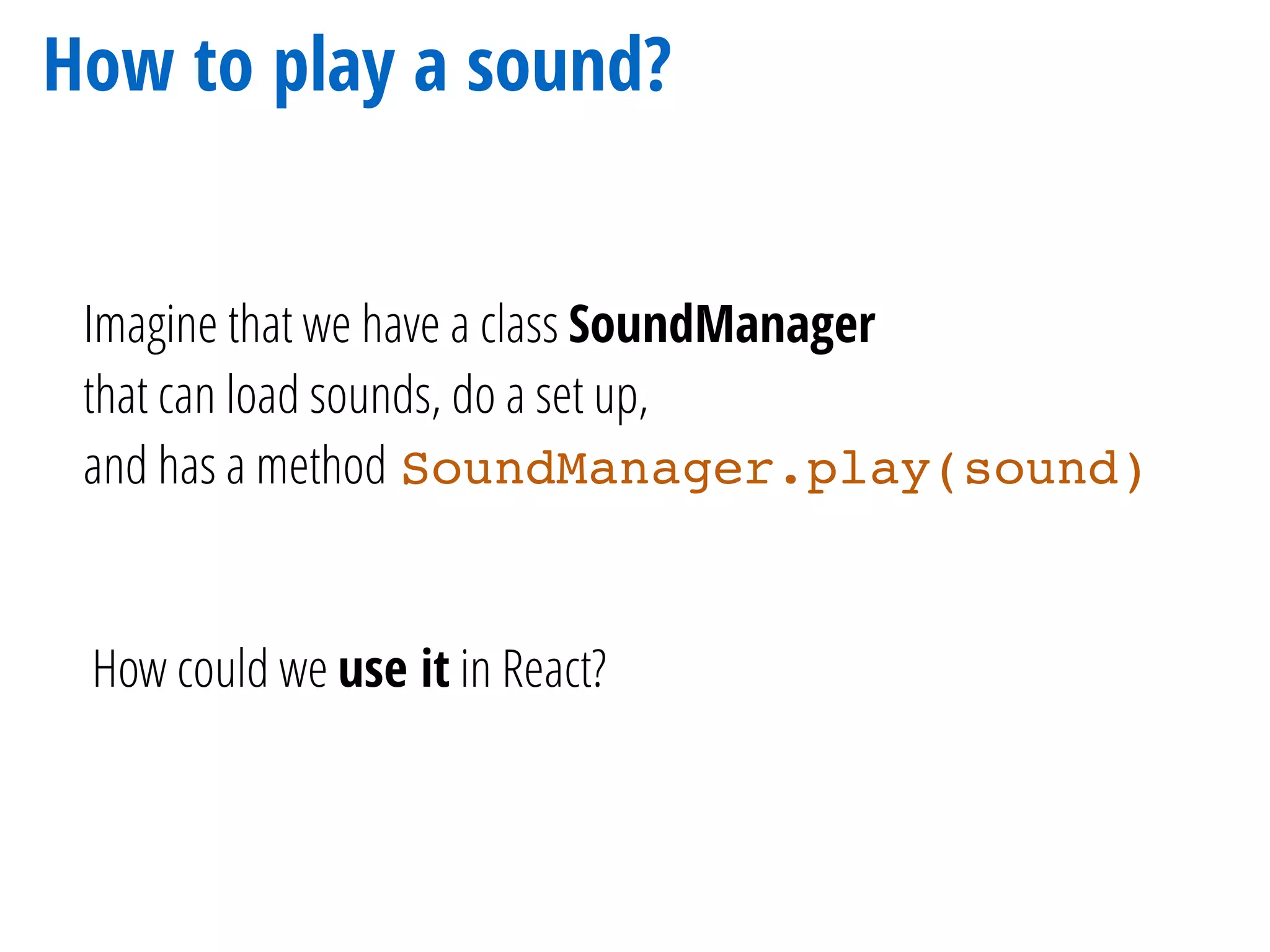
How to play a sound?
Imagine that we have a class SoundManager
that can load sounds, do a set up,
and has a method SoundManager.play(sound)
How could we use it in React?
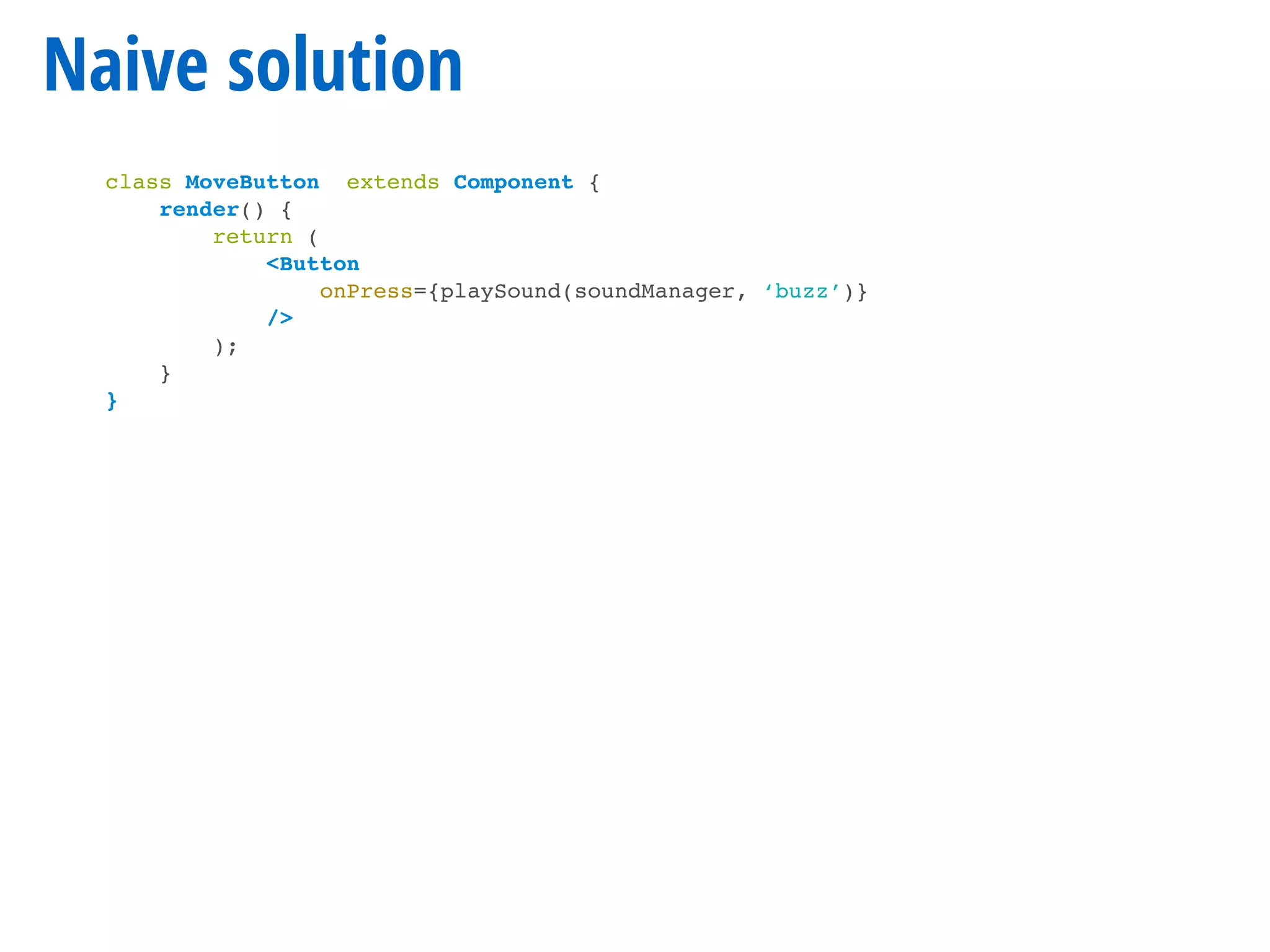
Naive solution
class MoveButton extends Component {
render() {
return (
<Button
onPress={playSound(soundManager, ‘buzz’)}
/>
);
}
}
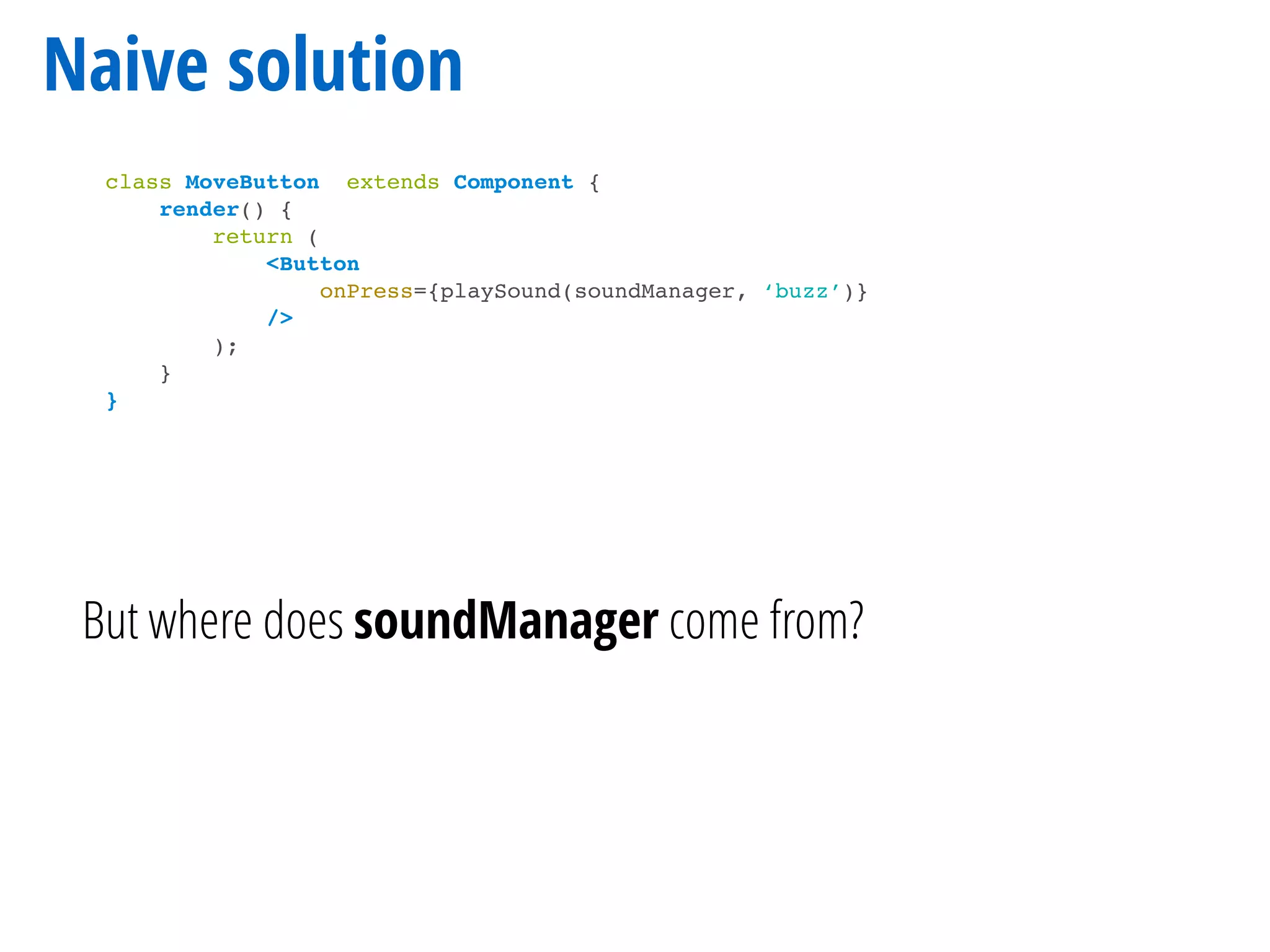
Naive solution
class MoveButton extends Component {
render() {
return (
<Button
onPress={playSound(soundManager, ‘buzz’)}
/>
);
}
}
But where does soundManager come from?
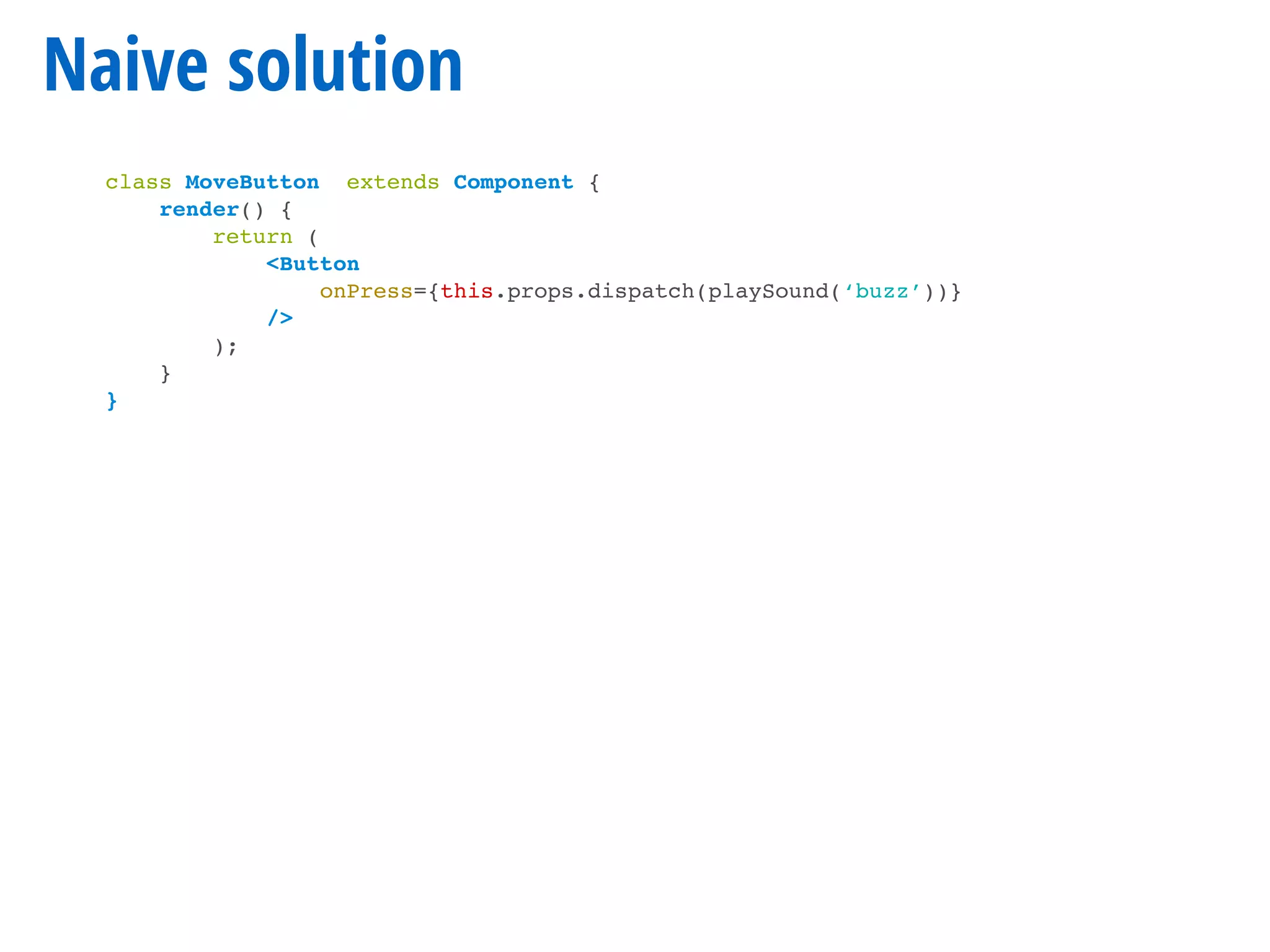
Naive solution
class MoveButton extends Component {
render() {
return (
<Button
onPress={this.props.dispatch(playSound(‘buzz’))}
/>
);
}
}
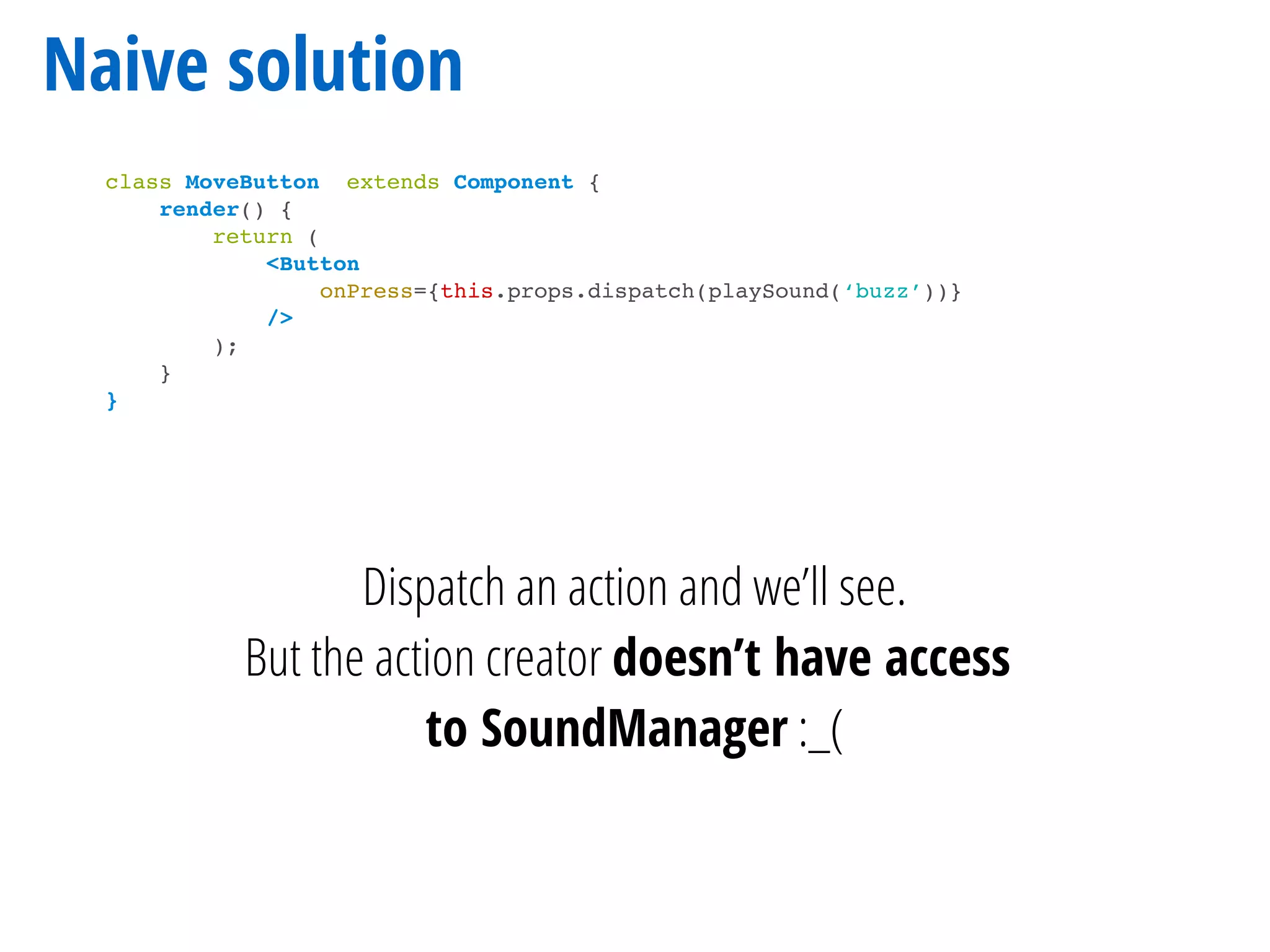
Naive solution
class MoveButton extends Component {
render() {
return (
<Button
onPress={this.props.dispatch(playSound(‘buzz’))}
/>
);
}
}
Dispatch an action and we’ll see.
But the action creator doesn’t have access
to SoundManager :_(
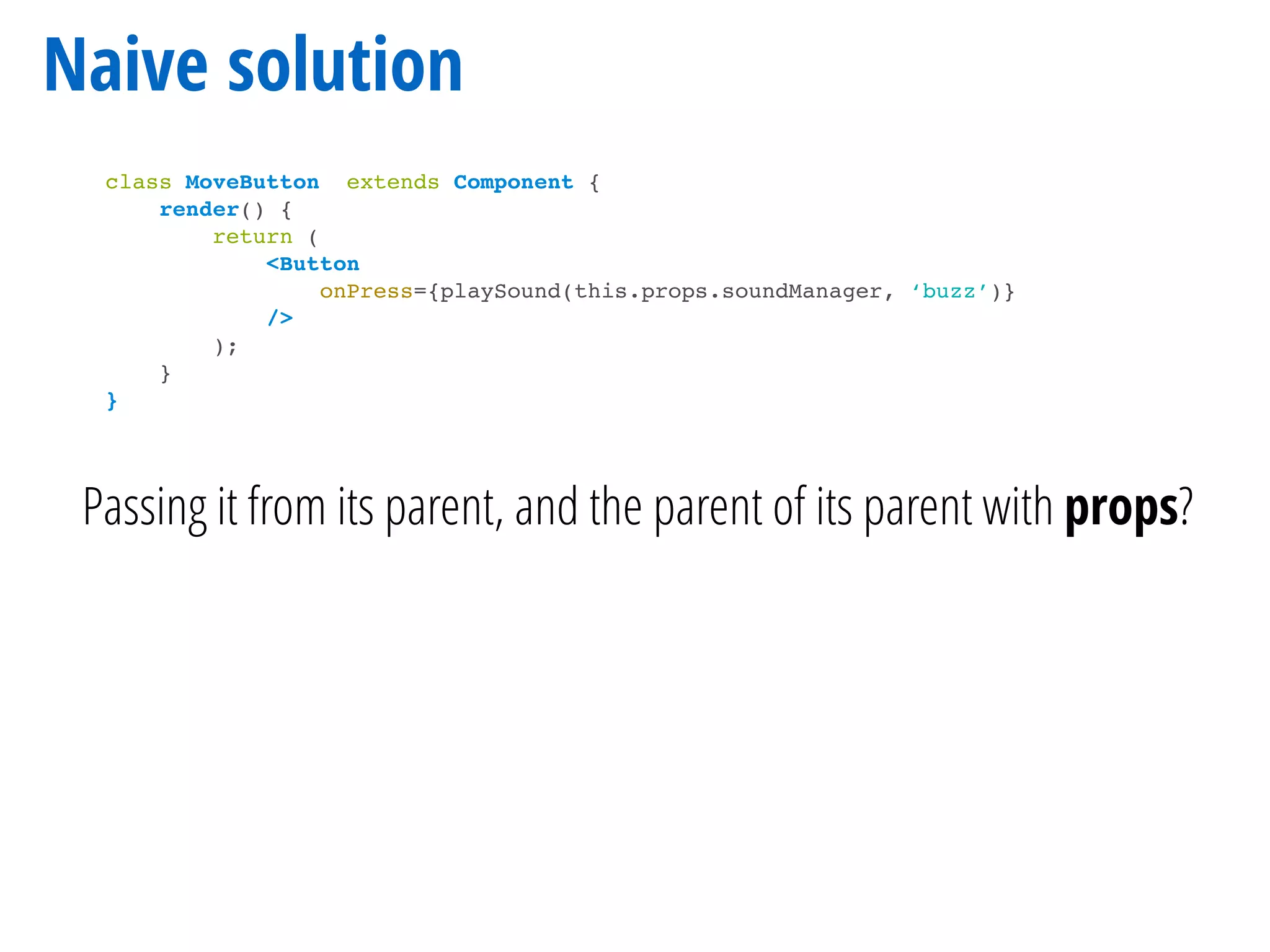
Naive solution
class MoveButton extends Component {
render() {
return (
<Button
onPress={playSound(this.props.soundManager, ‘buzz’)}
/>
);
}
}
Passing it from its parent, and the parent of its parent with props?
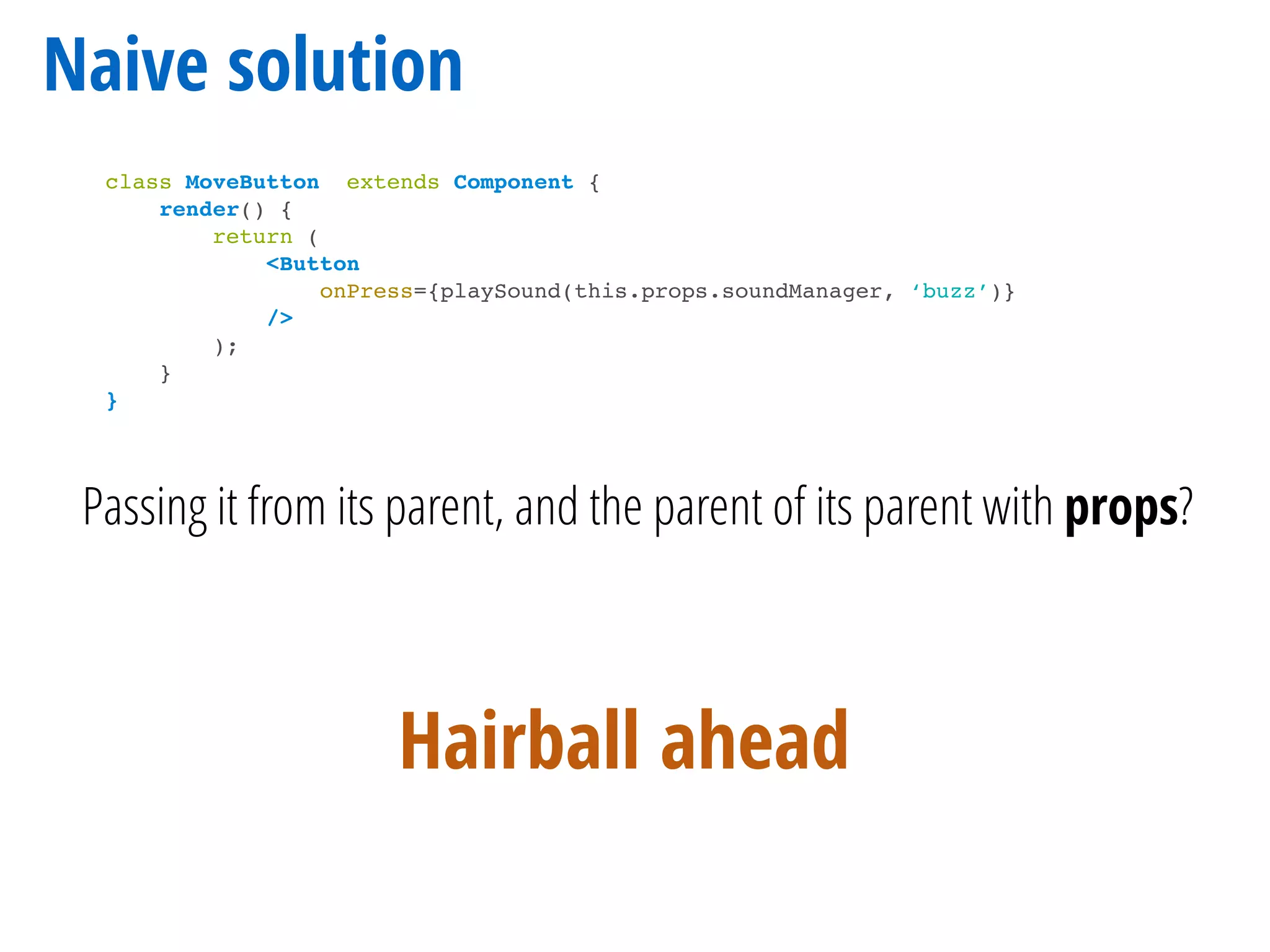
Naive solution
class MoveButton extends Component {
render() {
return (
<Button
onPress={playSound(this.props.soundManager, ‘buzz’)}
/>
);
}
}
Passing it from its parent, and the parent of its parent with props?
Hairball ahead
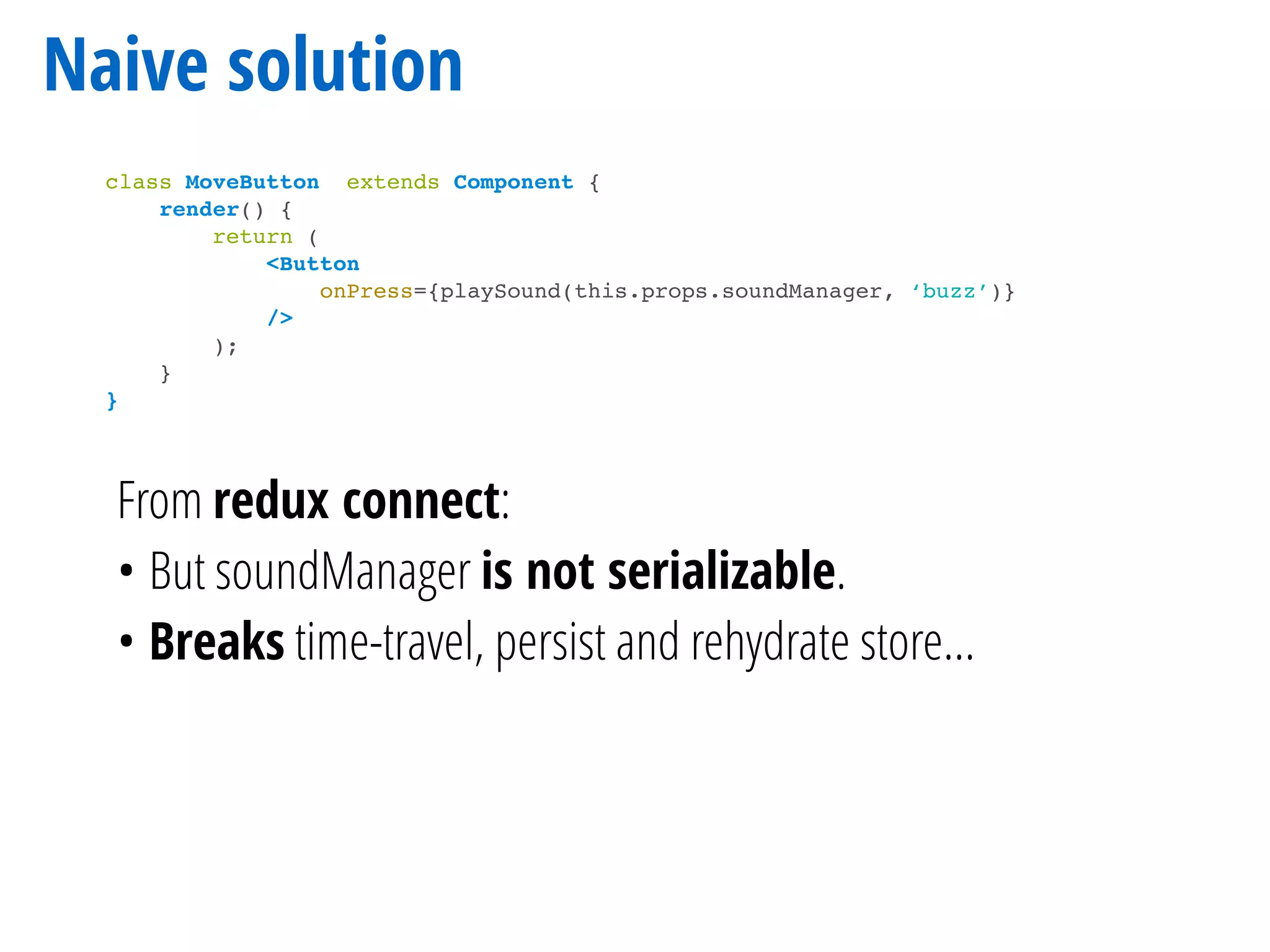
Naive solution
class MoveButton extends Component {
render() {
return (
<Button
onPress={playSound(this.props.soundManager, ‘buzz’)}
/>
);
}
}
From redux connect:
• But soundManager is not serializable.
• Breaks time-travel, persist and rehydrate store…
Naive solution
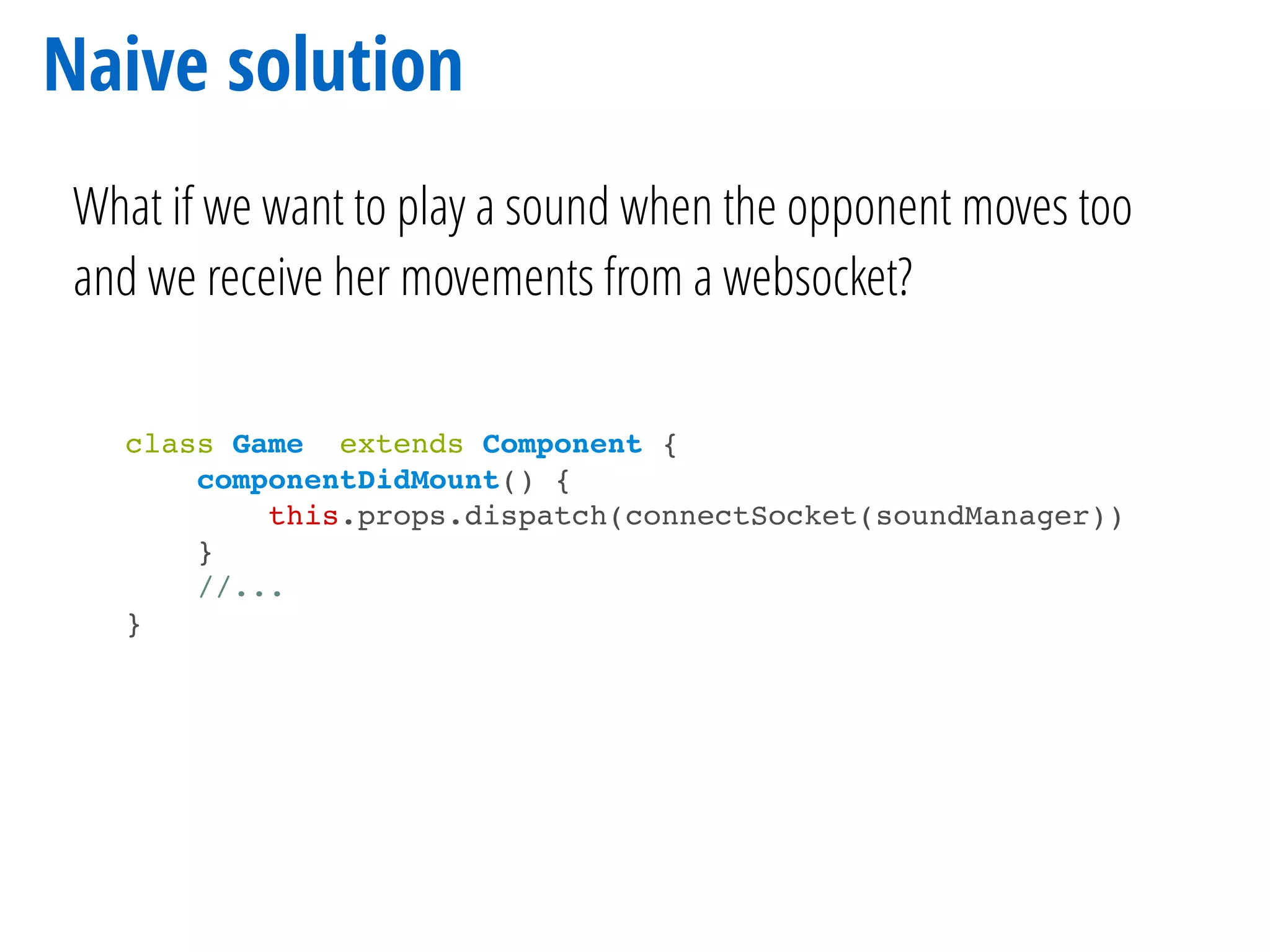
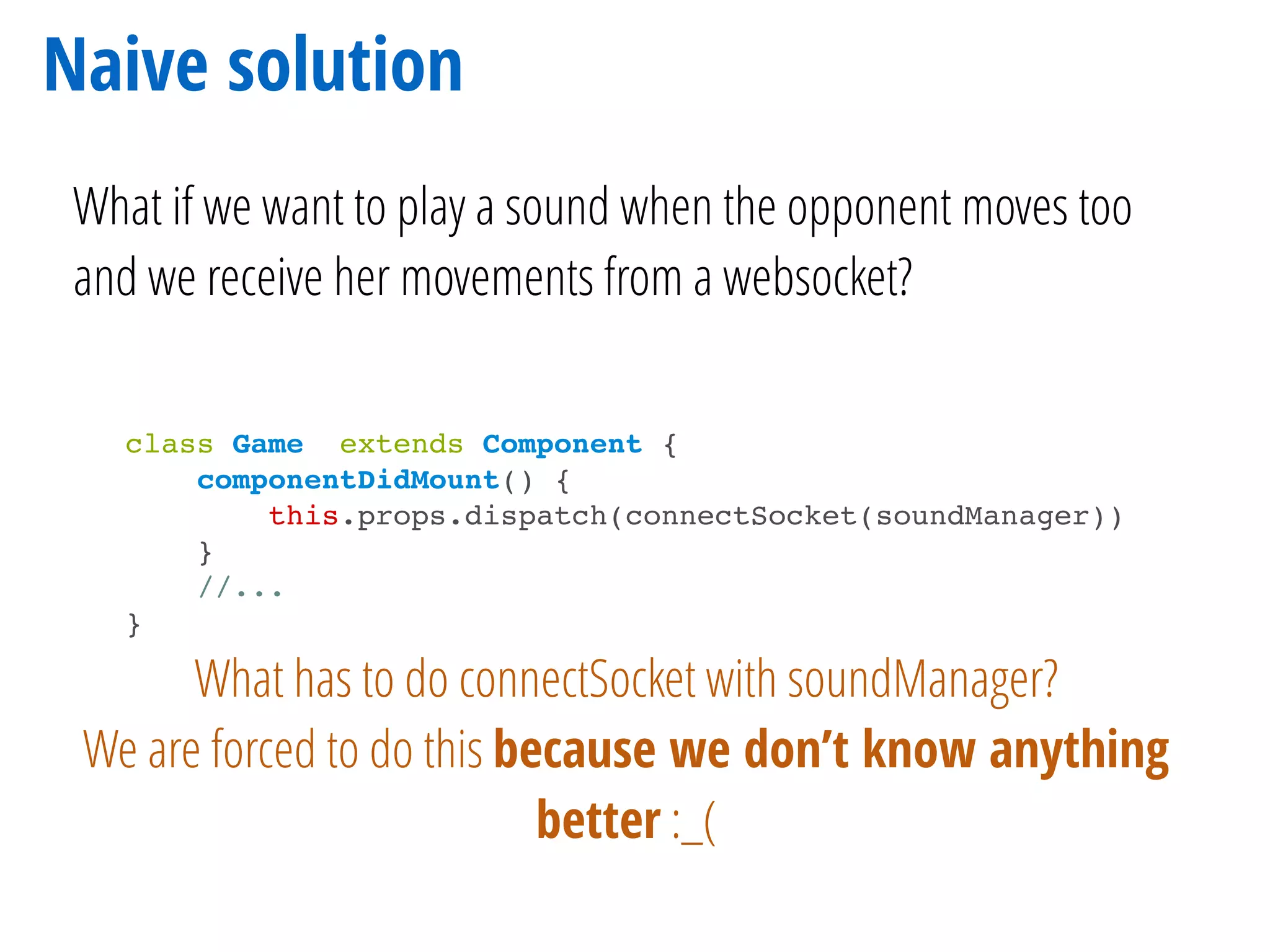
What if we want to play a sound when the opponent moves too
and we receive her movements from a websocket?
Naive solution
What if we want to play a sound when the opponent moves too
and we receive her movements from a websocket?
class Game extends Component {
componentDidMount() {
this.props.dispatch(connectSocket(soundManager))
}
//...
}
Naive solution
What if we want to play a sound when the opponent moves too
and we receive her movements from a websocket?
class Game extends Component {
componentDidMount() {
this.props.dispatch(connectSocket(soundManager))
}
//...
}
What has to do connectSocket with soundManager?
We are forced to do this because we don’t know anything
better :_(
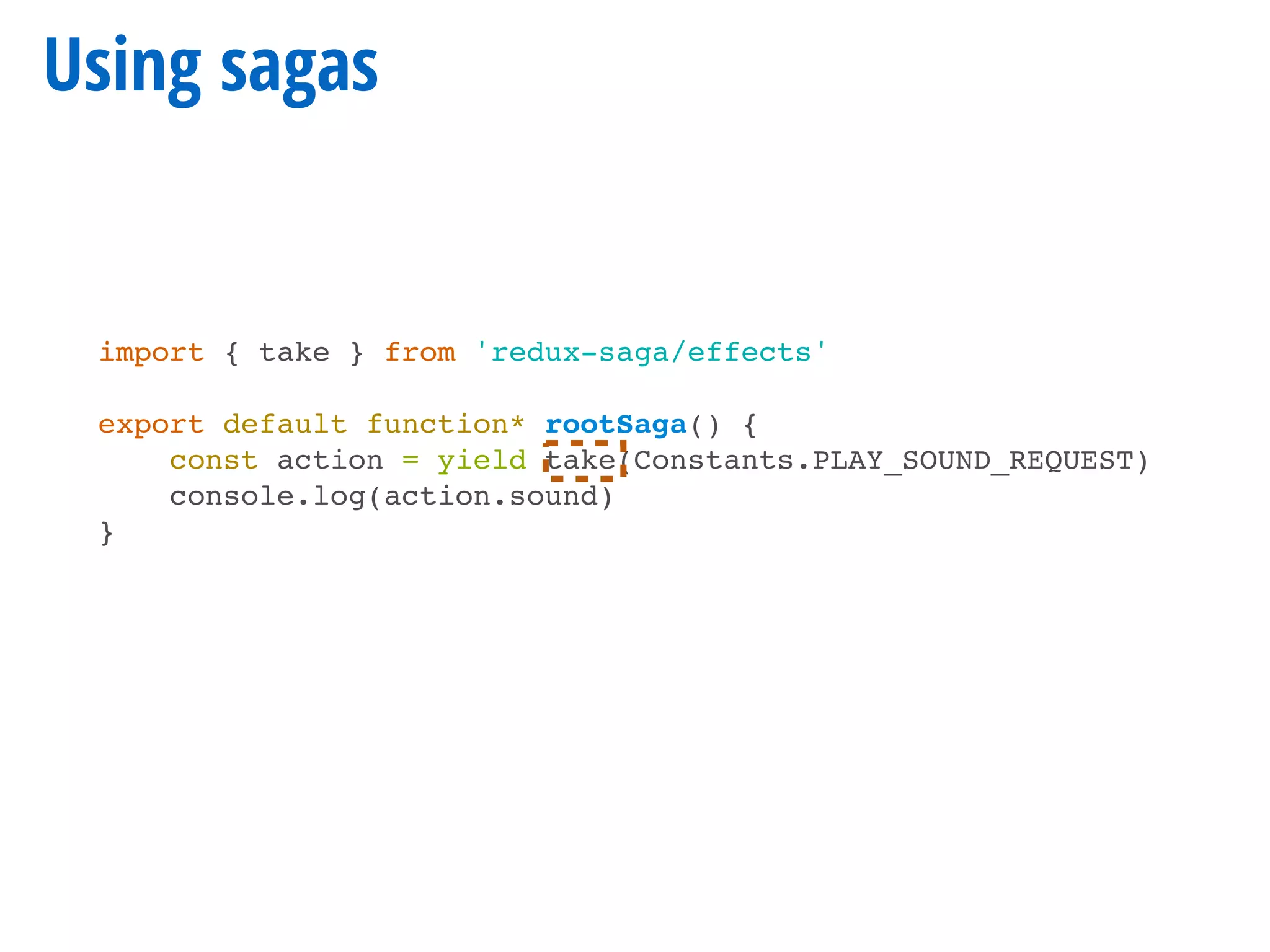
Using sagas
import { take } from 'redux-saga/effects'
export default function* rootSaga() {
const action = yield take(Constants.PLAY_SOUND_REQUEST)
console.log(action.sound)
}
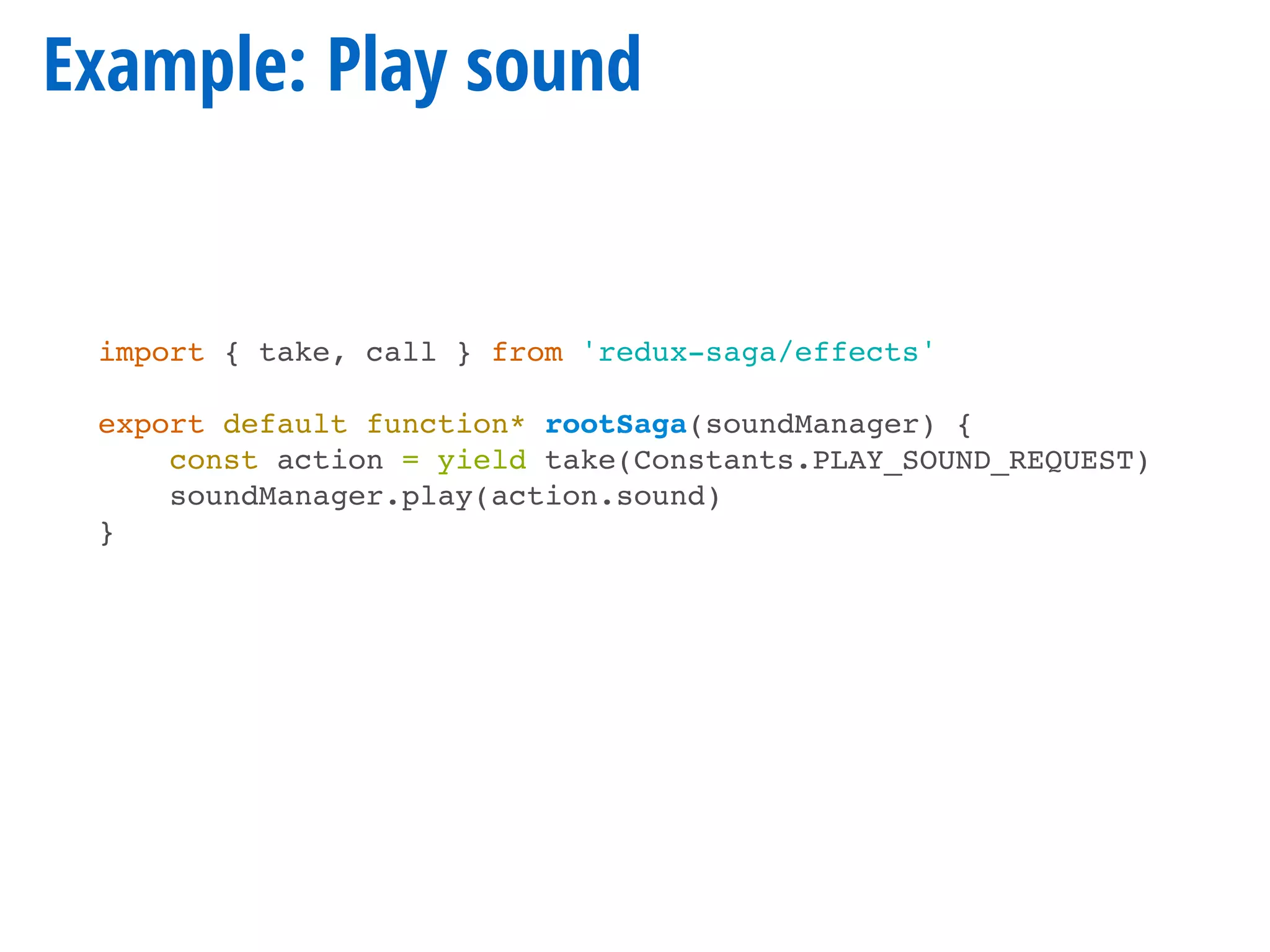
Example: Play sound
import { take, call } from 'redux-saga/effects'
export default function* rootSaga(soundManager) {
const action = yield take(Constants.PLAY_SOUND_REQUEST)
soundManager.play(action.sound)
}
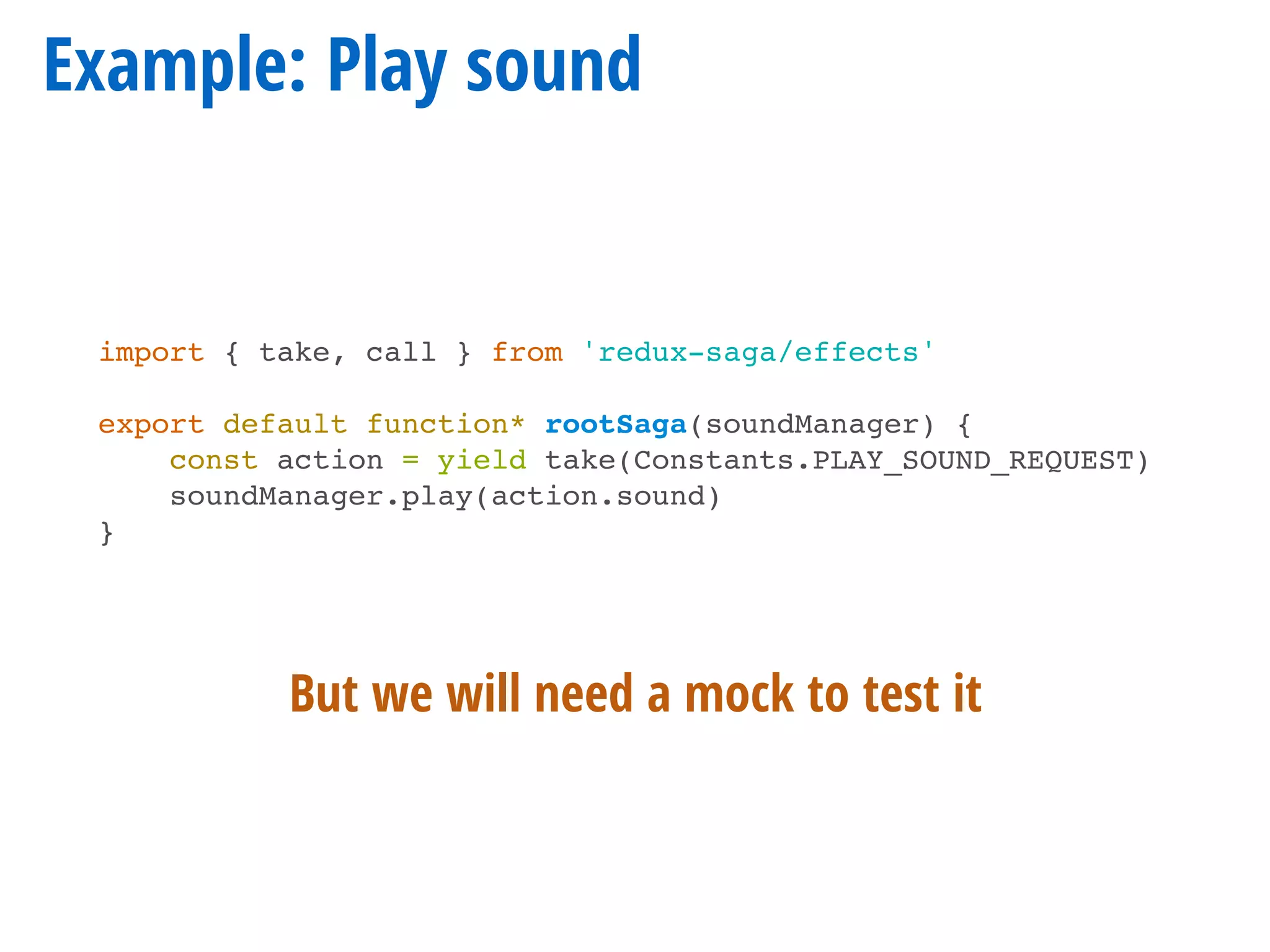
Example: Play sound
import { take, call } from 'redux-saga/effects'
export default function* rootSaga(soundManager) {
const action = yield take(Constants.PLAY_SOUND_REQUEST)
soundManager.play(action.sound)
}
But we will need a mock to test it
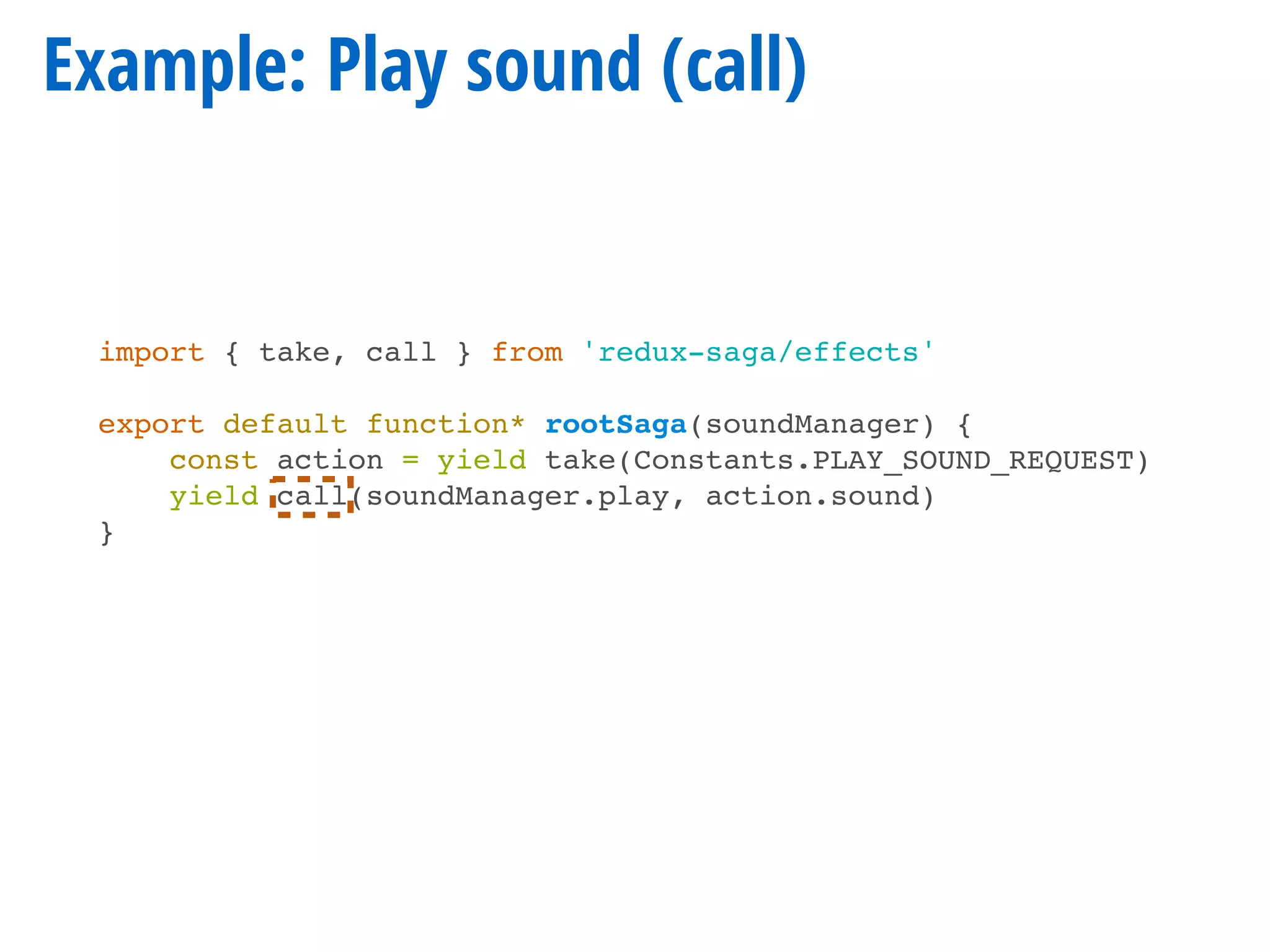
Example: Play sound (call)
import { take, call } from 'redux-saga/effects'
export default function* rootSaga(soundManager) {
const action = yield take(Constants.PLAY_SOUND_REQUEST)
yield call(soundManager.play, action.sound)
}
Example: Play sound (call)
import { take, call } from 'redux-saga/effects'
export default function* rootSaga(soundManager) {
const action = yield take(Constants.PLAY_SOUND_REQUEST)
yield call(soundManager.play, action.sound)
}
{
CALL: {
fn: soundManager.play,
args: ['buzz']
}
}
Call returns an object
Declarative effects
Effects are declarative, so they are easier to test
export function* delayAndDo() {
yield call(delay, 1000)
yield call(doSomething)
}
test('delayAndDo Saga test', (assert) => {
const it = delayAndDo()
assert.deepEqual(
it.next().value,
call(delay, 1000),
'delayAndDo Saga must call delay(1000)'
)
assert.deepEqual(
it.next().value,
call(doSomething),
'delayAndDo Saga must call doSomething'
)
{ CALL: {fn: delay, args: [1000]}}
{ CALL: {fn: doSomething, args: []}}
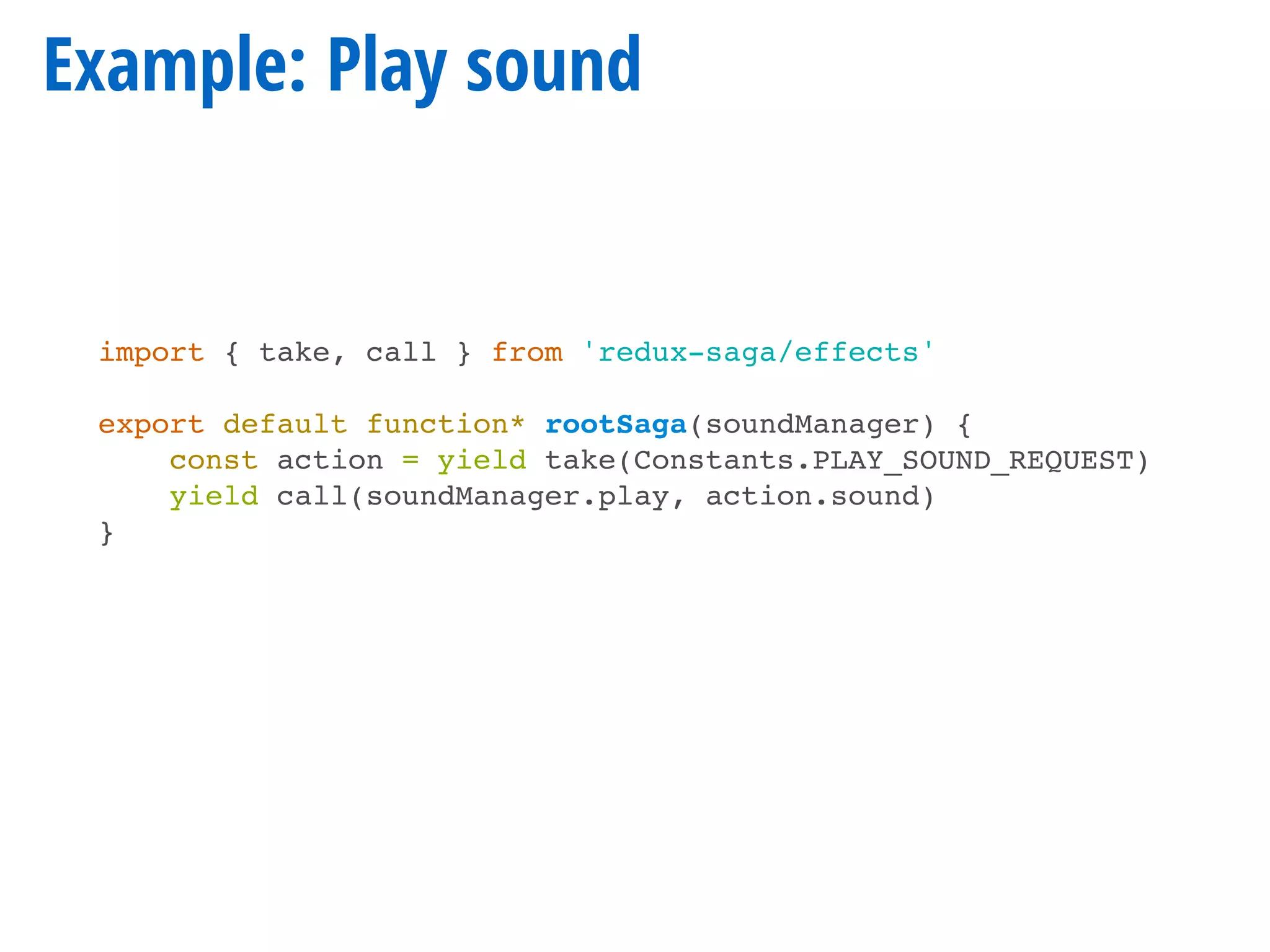
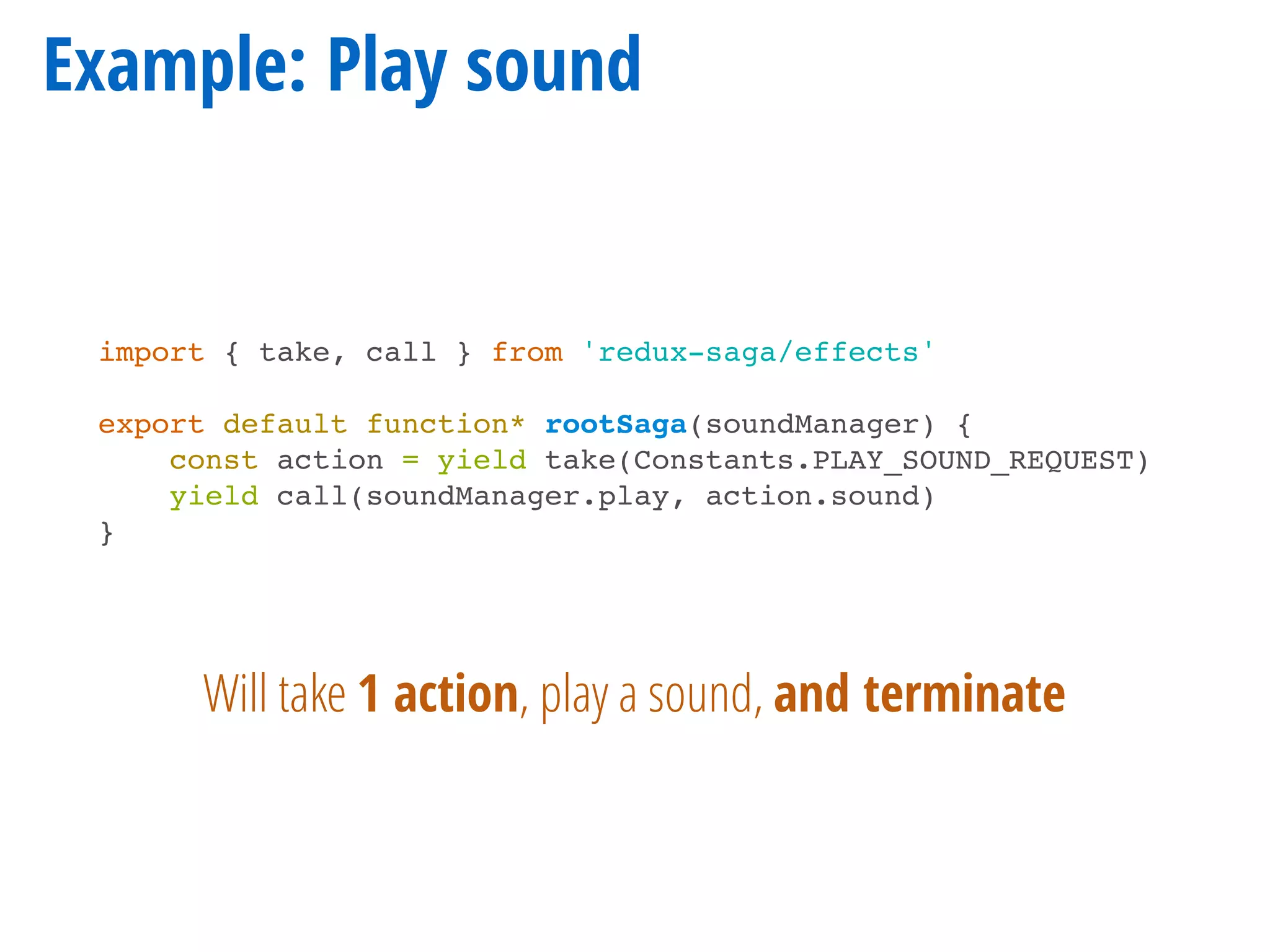
Example: Play sound
import { take, call } from 'redux-saga/effects'
export default function* rootSaga(soundManager) {
const action = yield take(Constants.PLAY_SOUND_REQUEST)
yield call(soundManager.play, action.sound)
}
Example: Play sound
import { take, call } from 'redux-saga/effects'
export default function* rootSaga(soundManager) {
const action = yield take(Constants.PLAY_SOUND_REQUEST)
yield call(soundManager.play, action.sound)
}
Will take 1 action, play a sound, and terminate
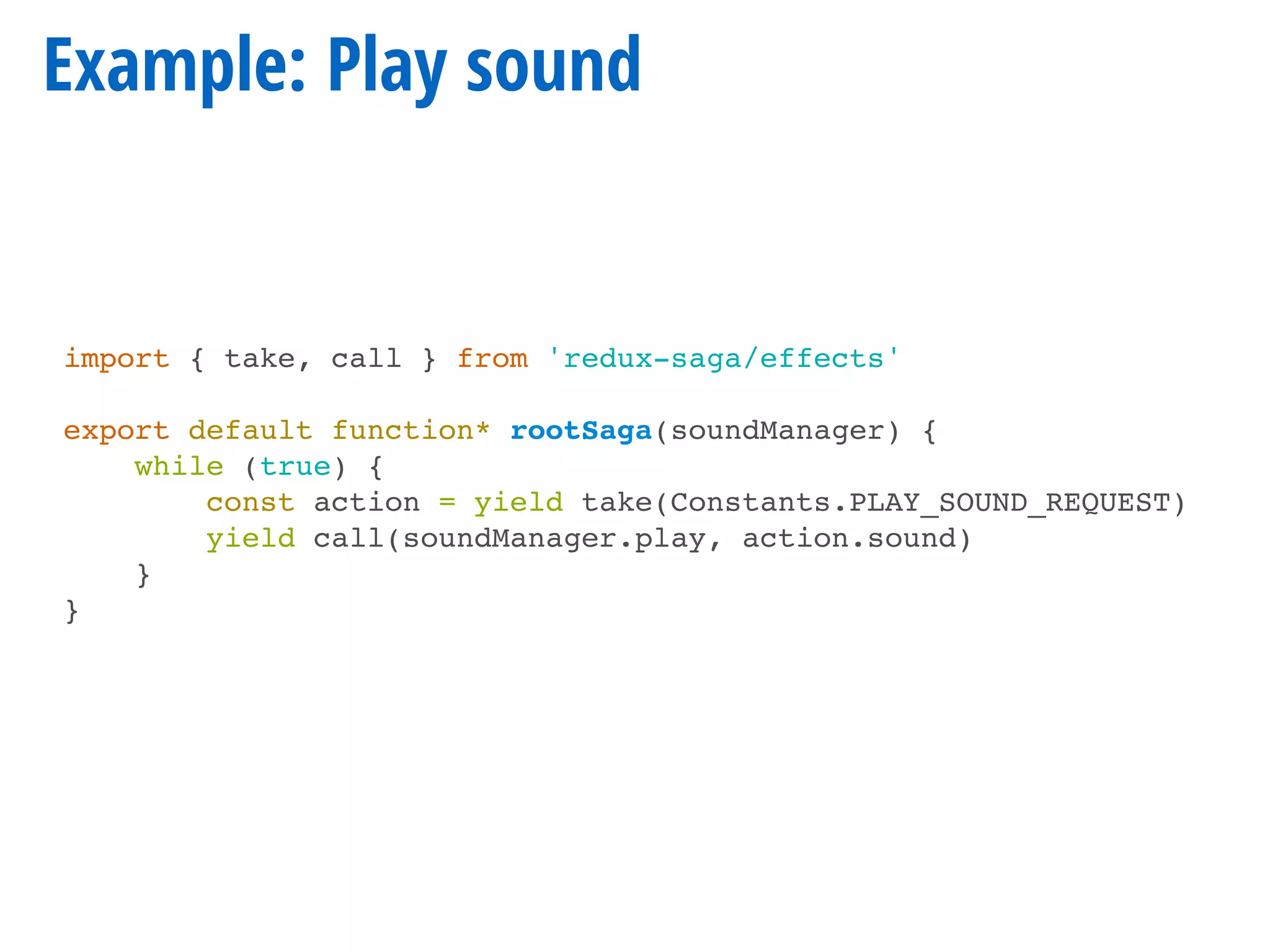
Example: Play sound
import { take, call } from 'redux-saga/effects'
export default function* rootSaga(soundManager) {
while (true) {
const action = yield take(Constants.PLAY_SOUND_REQUEST)
yield call(soundManager.play, action.sound)
}
}
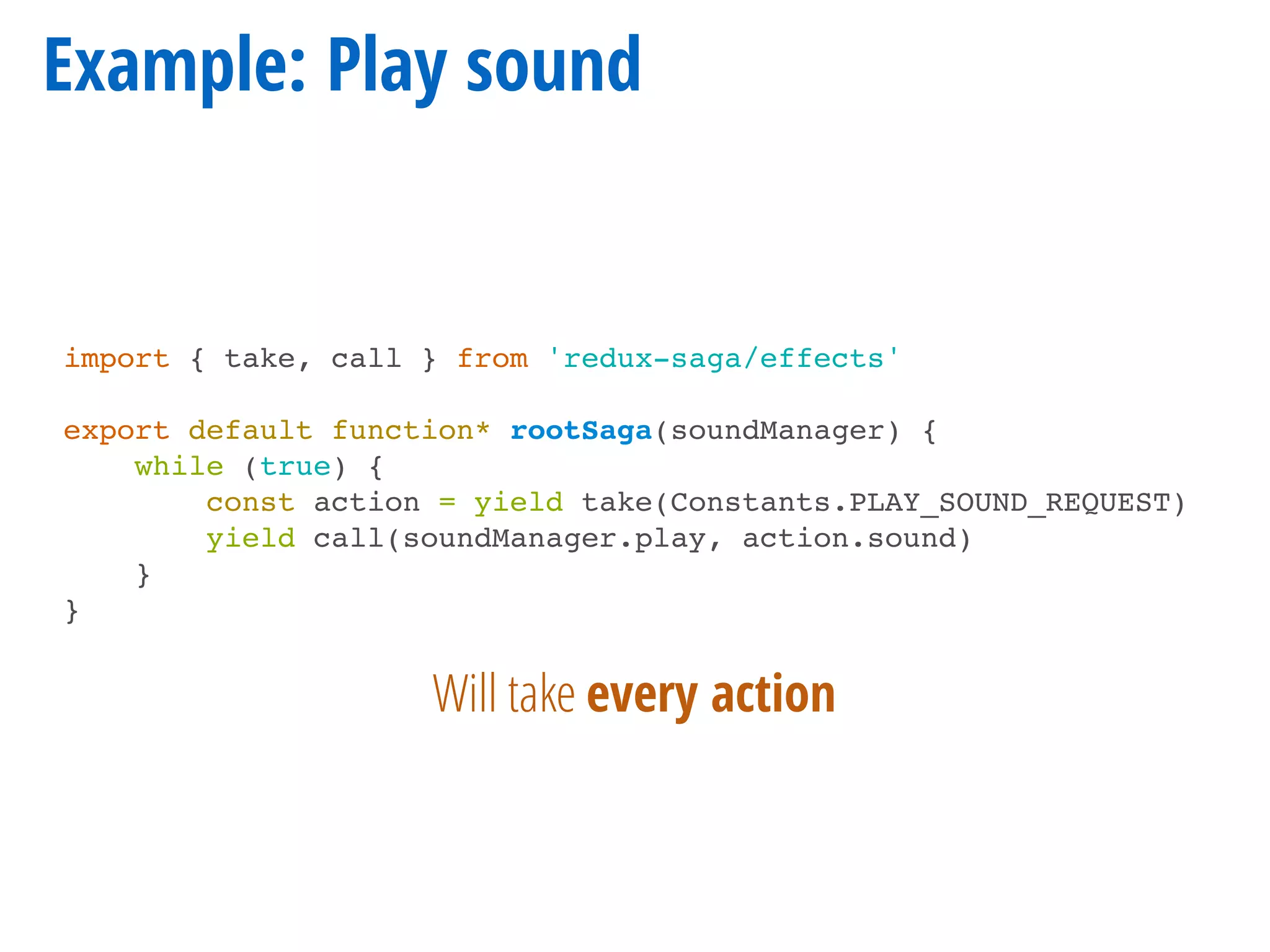
Example: Play sound
import { take, call } from 'redux-saga/effects'
export default function* rootSaga(soundManager) {
while (true) {
const action = yield take(Constants.PLAY_SOUND_REQUEST)
yield call(soundManager.play, action.sound)
}
}
Will take every action
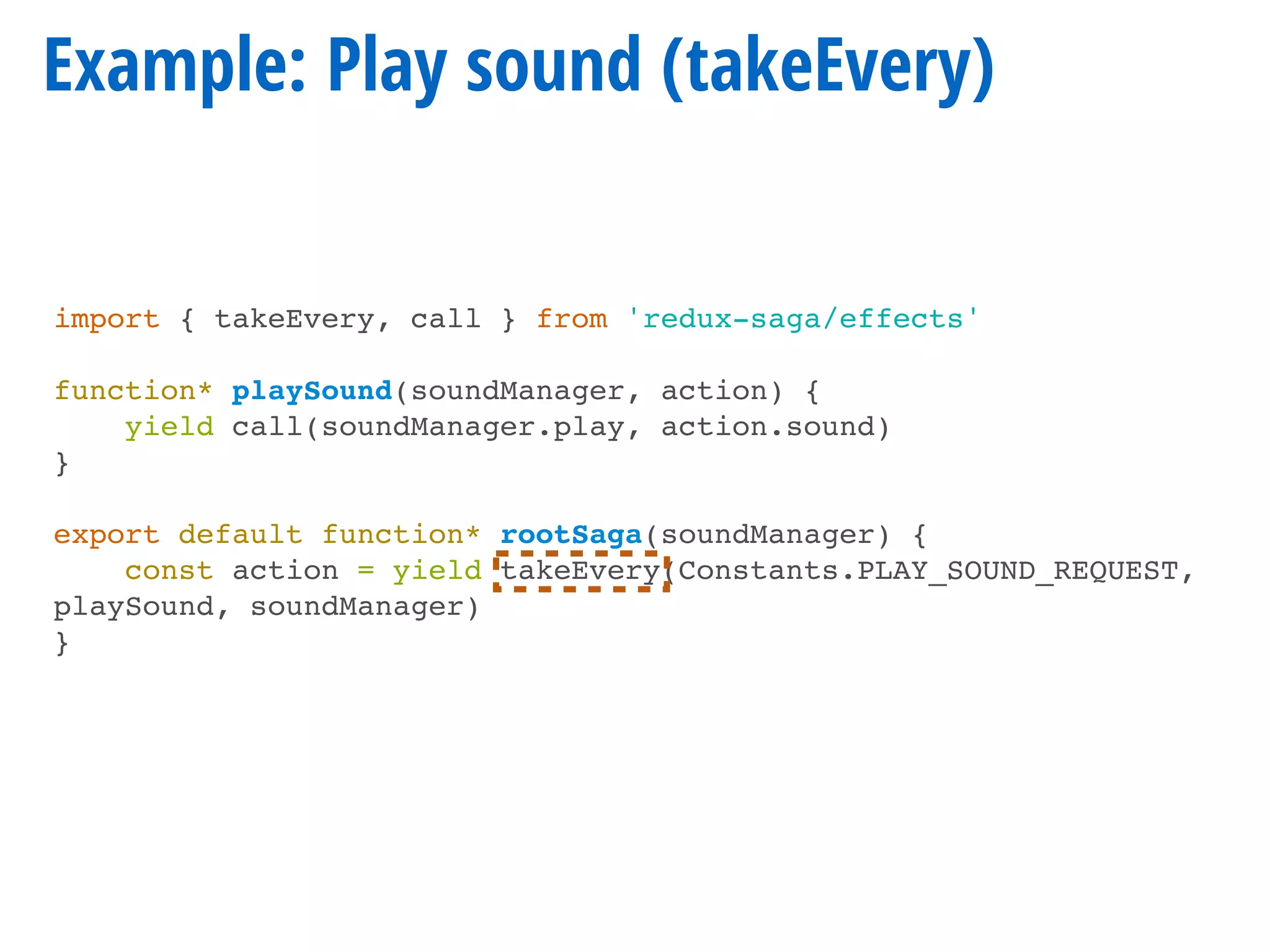
Example: Play sound (takeEvery)
import { takeEvery, call } from 'redux-saga/effects'
function* playSound(soundManager, action) {
yield call(soundManager.play, action.sound)
}
export default function* rootSaga(soundManager) {
const action = yield takeEvery(Constants.PLAY_SOUND_REQUEST,
playSound, soundManager)
}
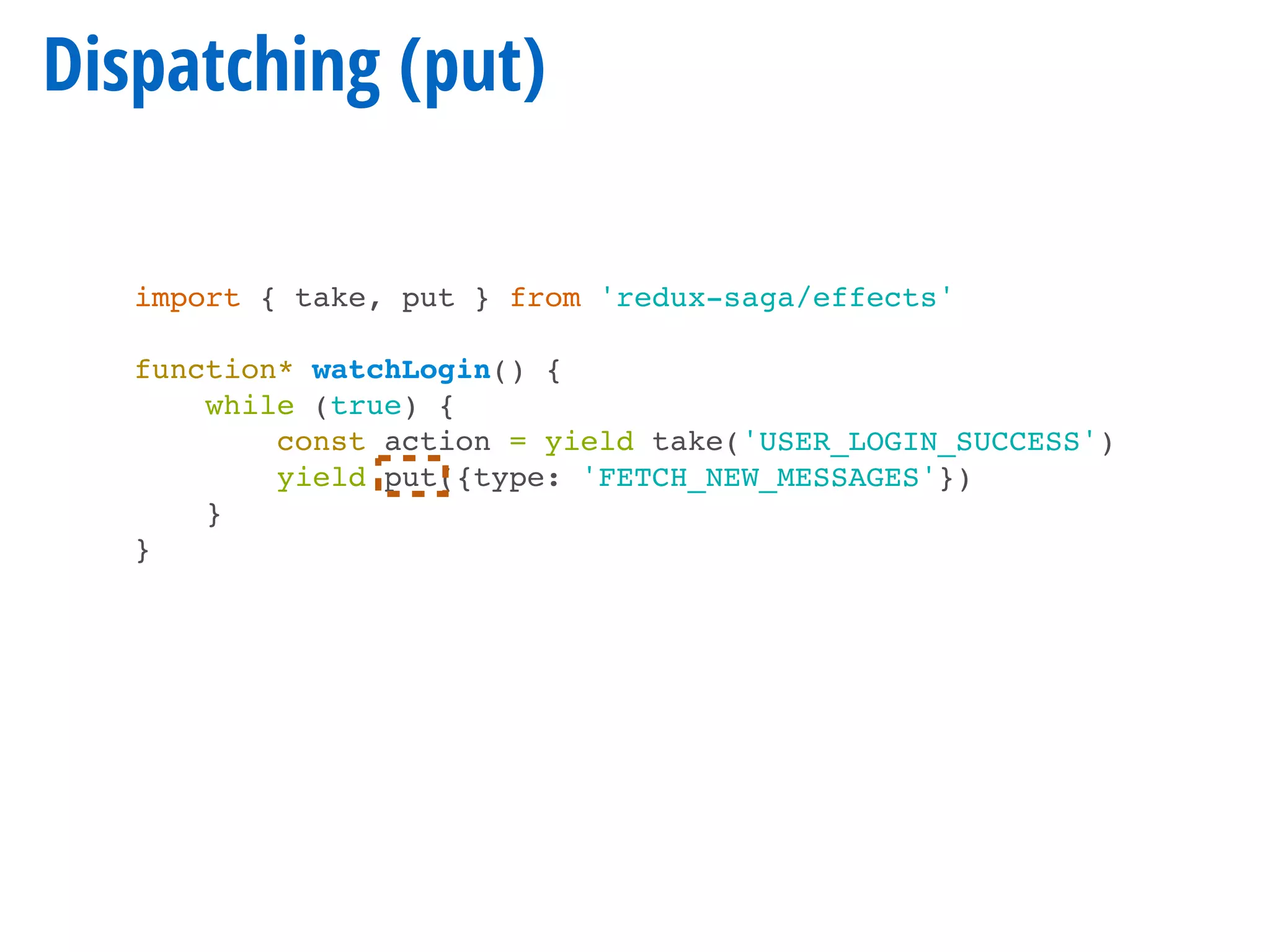
Dispatching (put)
import { take, put } from 'redux-saga/effects'
function* watchLogin() {
while (true) {
const action = yield take('USER_LOGIN_SUCCESS')
yield put({type: 'FETCH_NEW_MESSAGES'})
}
}
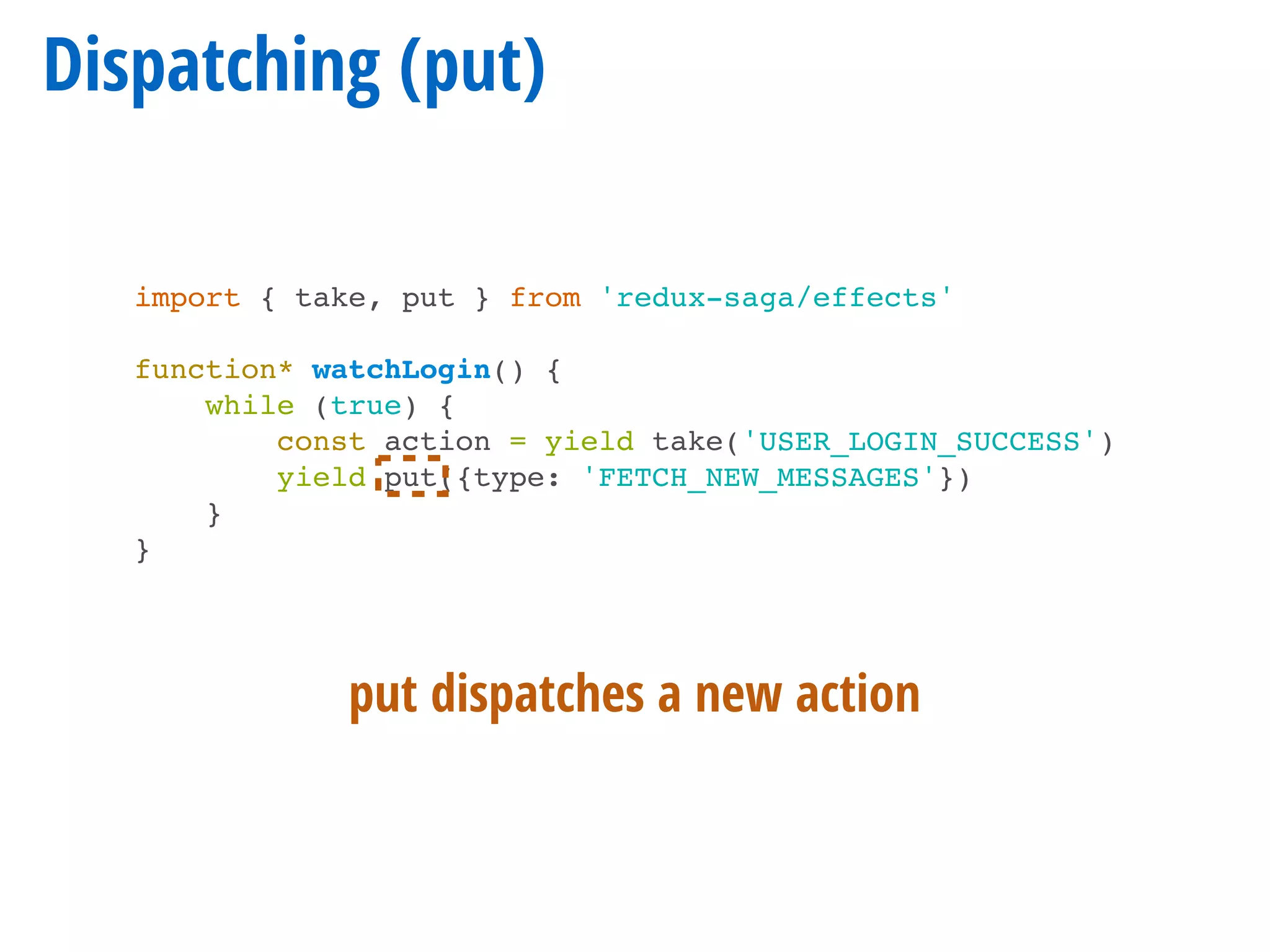
Dispatching (put)
import { take, put } from 'redux-saga/effects'
function* watchLogin() {
while (true) {
const action = yield take('USER_LOGIN_SUCCESS')
yield put({type: 'FETCH_NEW_MESSAGES'})
}
}
put dispatches a new action
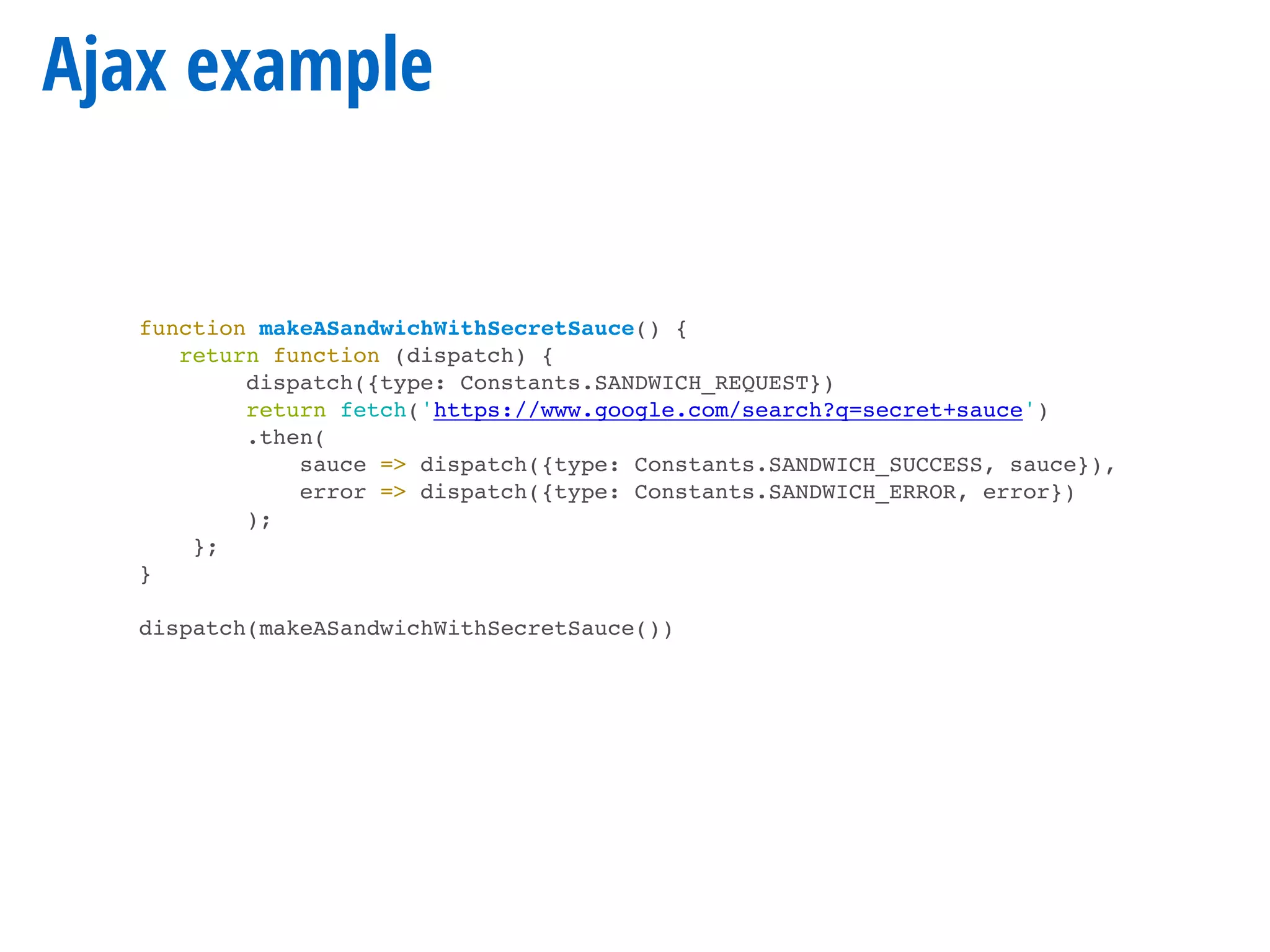
Ajax example
function makeASandwichWithSecretSauce() {
return function (dispatch) {
dispatch({type: Constants.SANDWICH_REQUEST})
return fetch('https://www.google.com/search?q=secret+sauce')
.then(
sauce => dispatch({type: Constants.SANDWICH_SUCCESS, sauce}),
error => dispatch({type: Constants.SANDWICH_ERROR, error})
);
};
}
dispatch(makeASandwichWithSecretSauce())
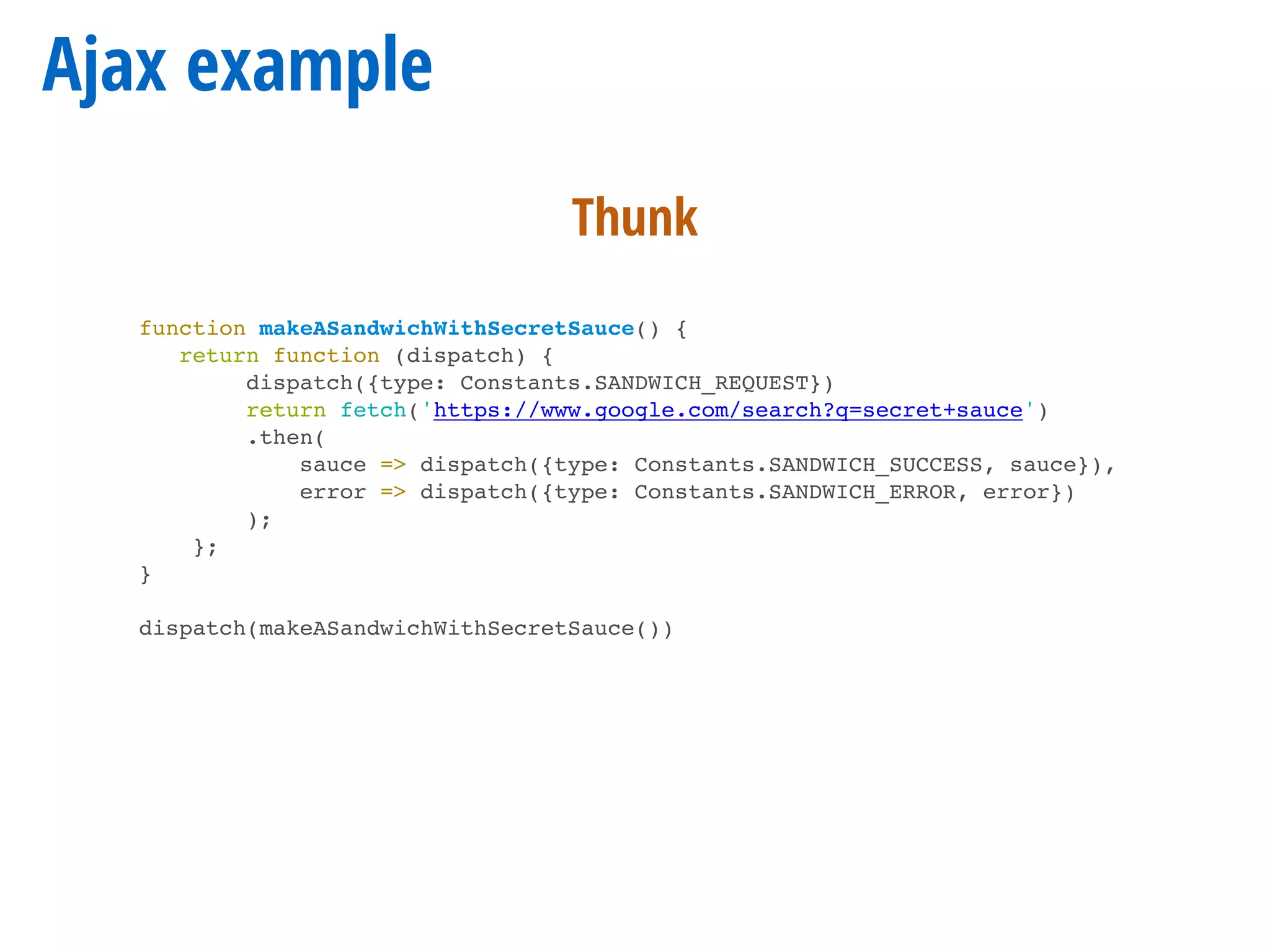
Ajax example
function makeASandwichWithSecretSauce() {
return function (dispatch) {
dispatch({type: Constants.SANDWICH_REQUEST})
return fetch('https://www.google.com/search?q=secret+sauce')
.then(
sauce => dispatch({type: Constants.SANDWICH_SUCCESS, sauce}),
error => dispatch({type: Constants.SANDWICH_ERROR, error})
);
};
}
dispatch(makeASandwichWithSecretSauce())
Thunk
Ajax example
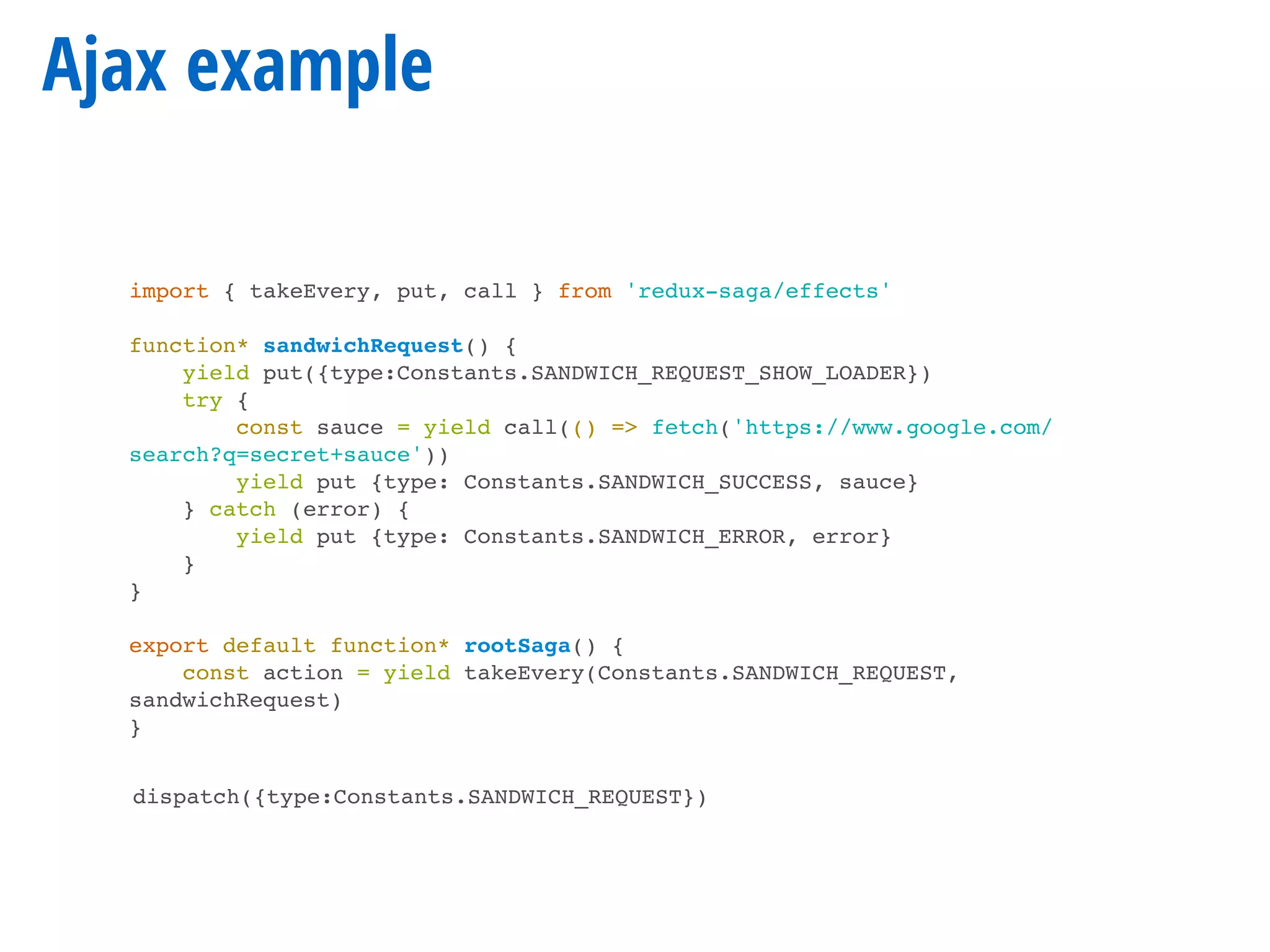
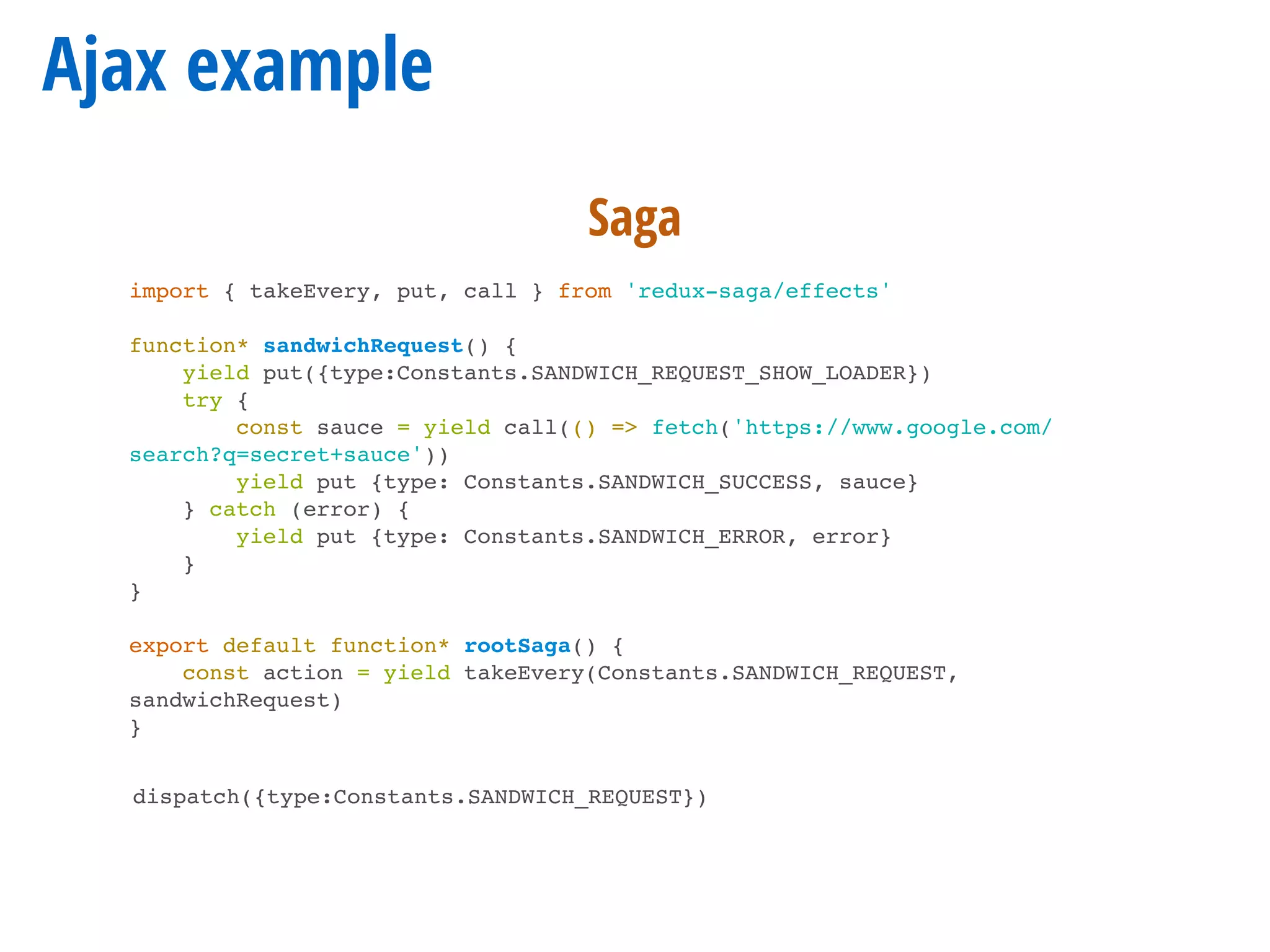
import { takeEvery, put, call } from 'redux-saga/effects'
function* sandwichRequest() {
yield put({type:Constants.SANDWICH_REQUEST_SHOW_LOADER})
try {
const sauce = yield call(() => fetch('https://www.google.com/
search?q=secret+sauce'))
yield put {type: Constants.SANDWICH_SUCCESS, sauce}
} catch (error) {
yield put {type: Constants.SANDWICH_ERROR, error}
}
}
export default function* rootSaga() {
const action = yield takeEvery(Constants.SANDWICH_REQUEST,
sandwichRequest)
}
dispatch({type:Constants.SANDWICH_REQUEST})
Ajax example
import { takeEvery, put, call } from 'redux-saga/effects'
function* sandwichRequest() {
yield put({type:Constants.SANDWICH_REQUEST_SHOW_LOADER})
try {
const sauce = yield call(() => fetch('https://www.google.com/
search?q=secret+sauce'))
yield put {type: Constants.SANDWICH_SUCCESS, sauce}
} catch (error) {
yield put {type: Constants.SANDWICH_ERROR, error}
}
}
export default function* rootSaga() {
const action = yield takeEvery(Constants.SANDWICH_REQUEST,
sandwichRequest)
}
dispatch({type:Constants.SANDWICH_REQUEST})
Saga
takeLatest
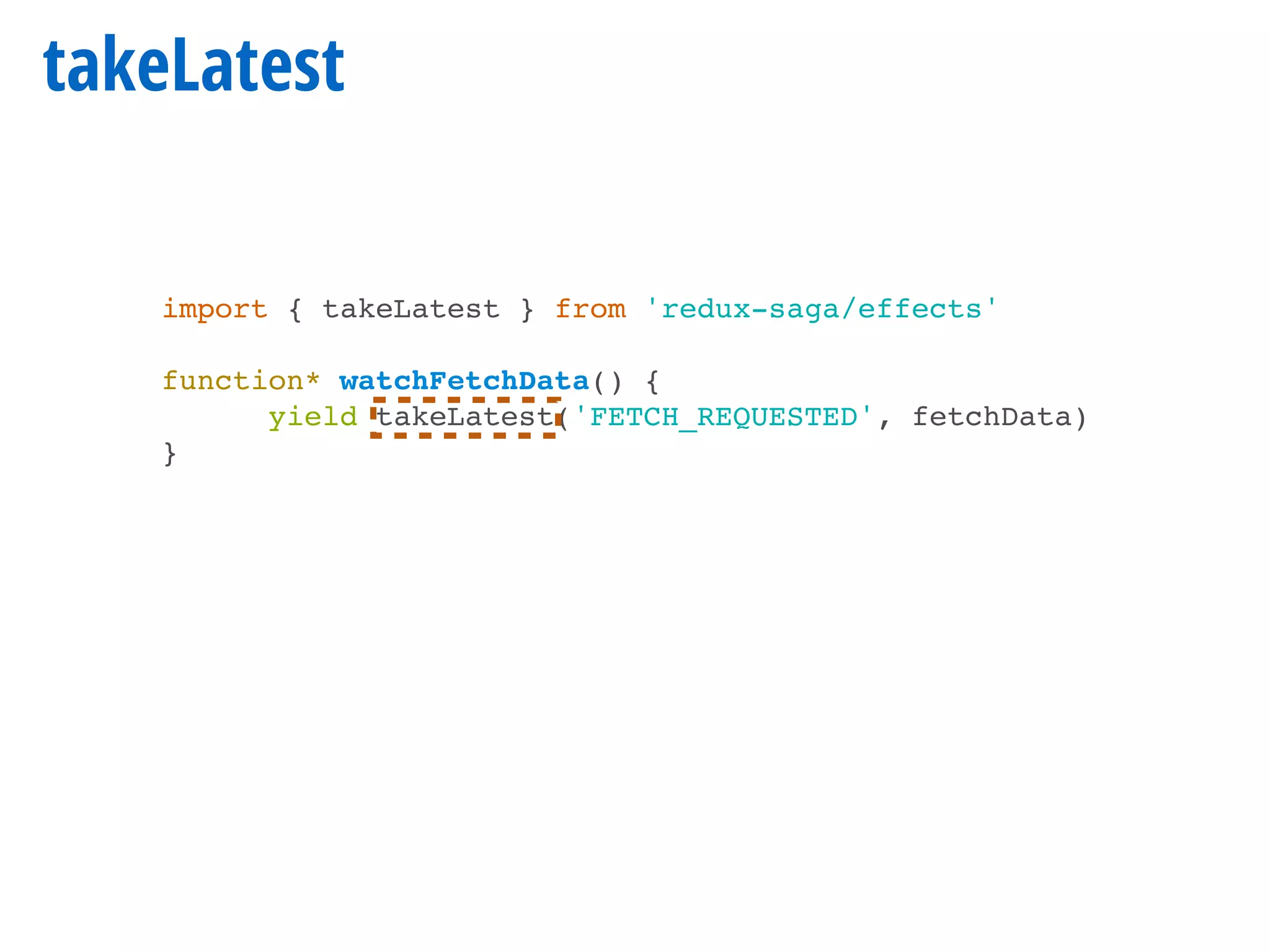
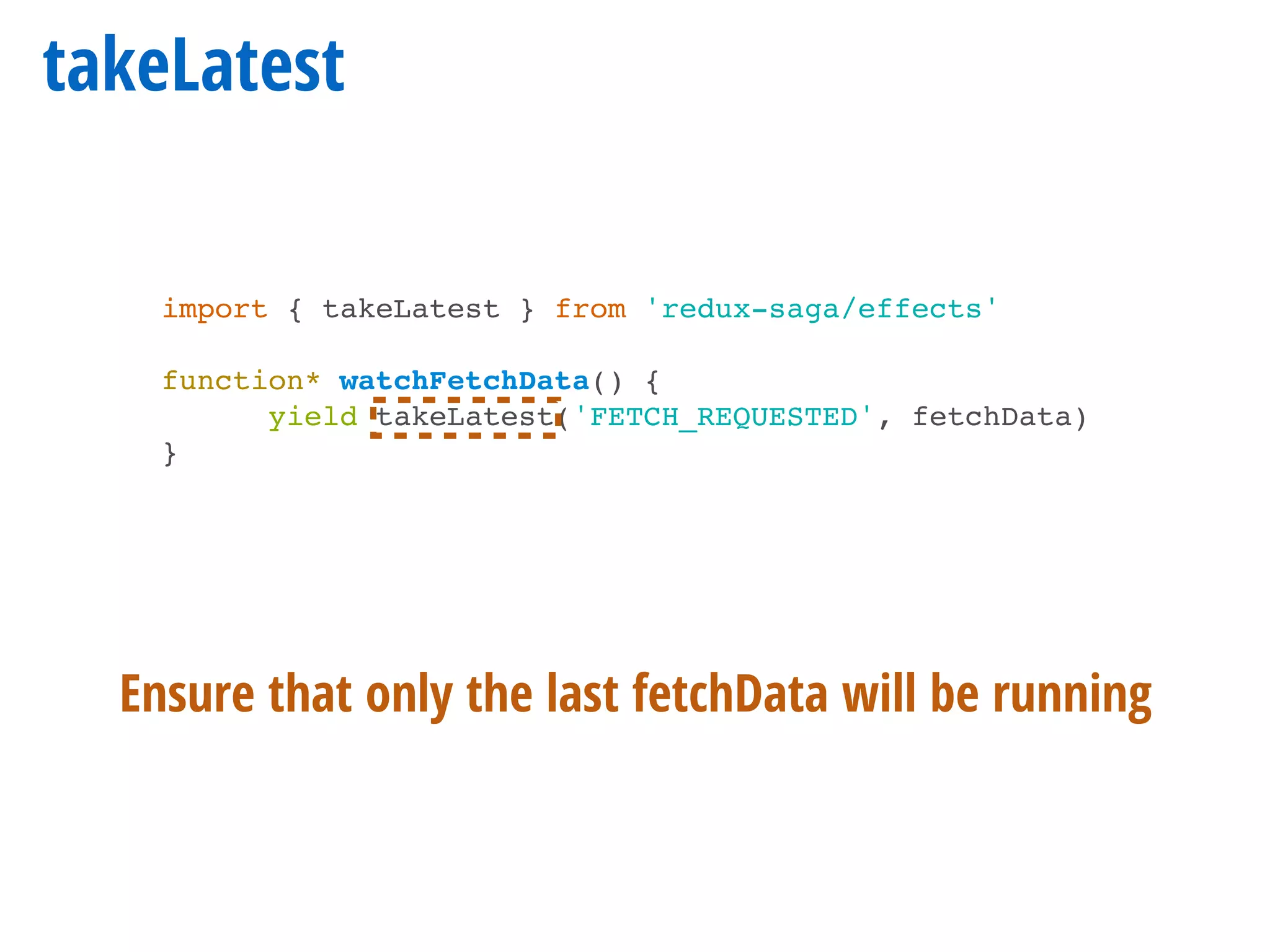
import { takeLatest } from 'redux-saga/effects'
function* watchFetchData() {
yield takeLatest('FETCH_REQUESTED', fetchData)
}
takeLatest
import { takeLatest } from 'redux-saga/effects'
function* watchFetchData() {
yield takeLatest('FETCH_REQUESTED', fetchData)
}
Ensure that only the last fetchData will be running
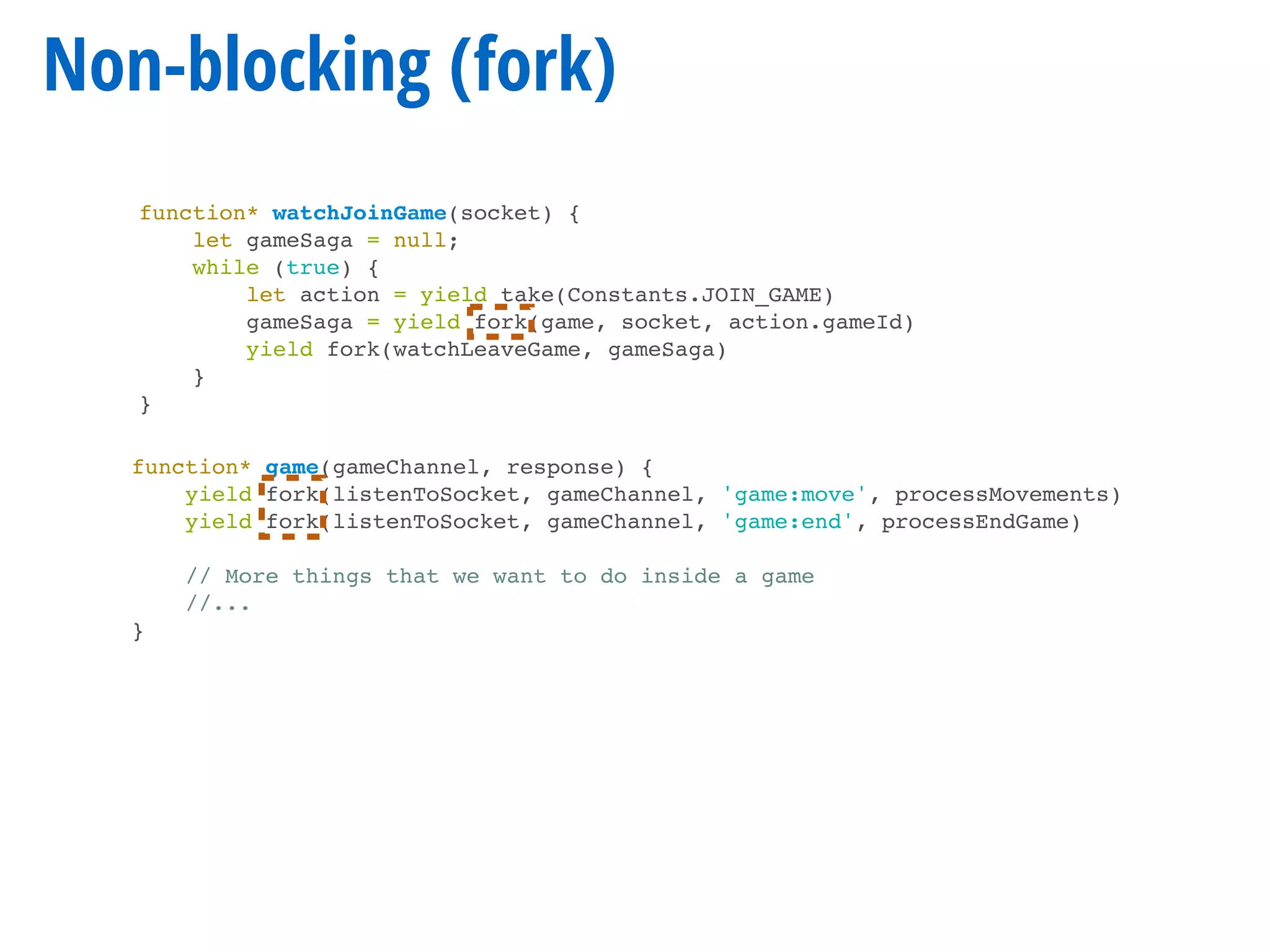
Non-blocking (fork)
function* watchJoinGame(socket) {
let gameSaga = null;
while (true) {
let action = yield take(Constants.JOIN_GAME)
gameSaga = yield fork(game, socket, action.gameId)
yield fork(watchLeaveGame, gameSaga)
}
}
function* game(gameChannel, response) {
yield fork(listenToSocket, gameChannel, 'game:move', processMovements)
yield fork(listenToSocket, gameChannel, 'game:end', processEndGame)
// More things that we want to do inside a game
//...
}
Non-blocking (fork)
function* watchJoinGame(socket) {
let gameSaga = null;
while (true) {
let action = yield take(Constants.JOIN_GAME)
gameSaga = yield fork(game, socket, action.gameId)
yield fork(watchLeaveGame, gameSaga)
}
}
function* game(gameChannel, response) {
yield fork(listenToSocket, gameChannel, 'game:move', processMovements)
yield fork(listenToSocket, gameChannel, 'game:end', processEndGame)
// More things that we want to do inside a game
//...
}
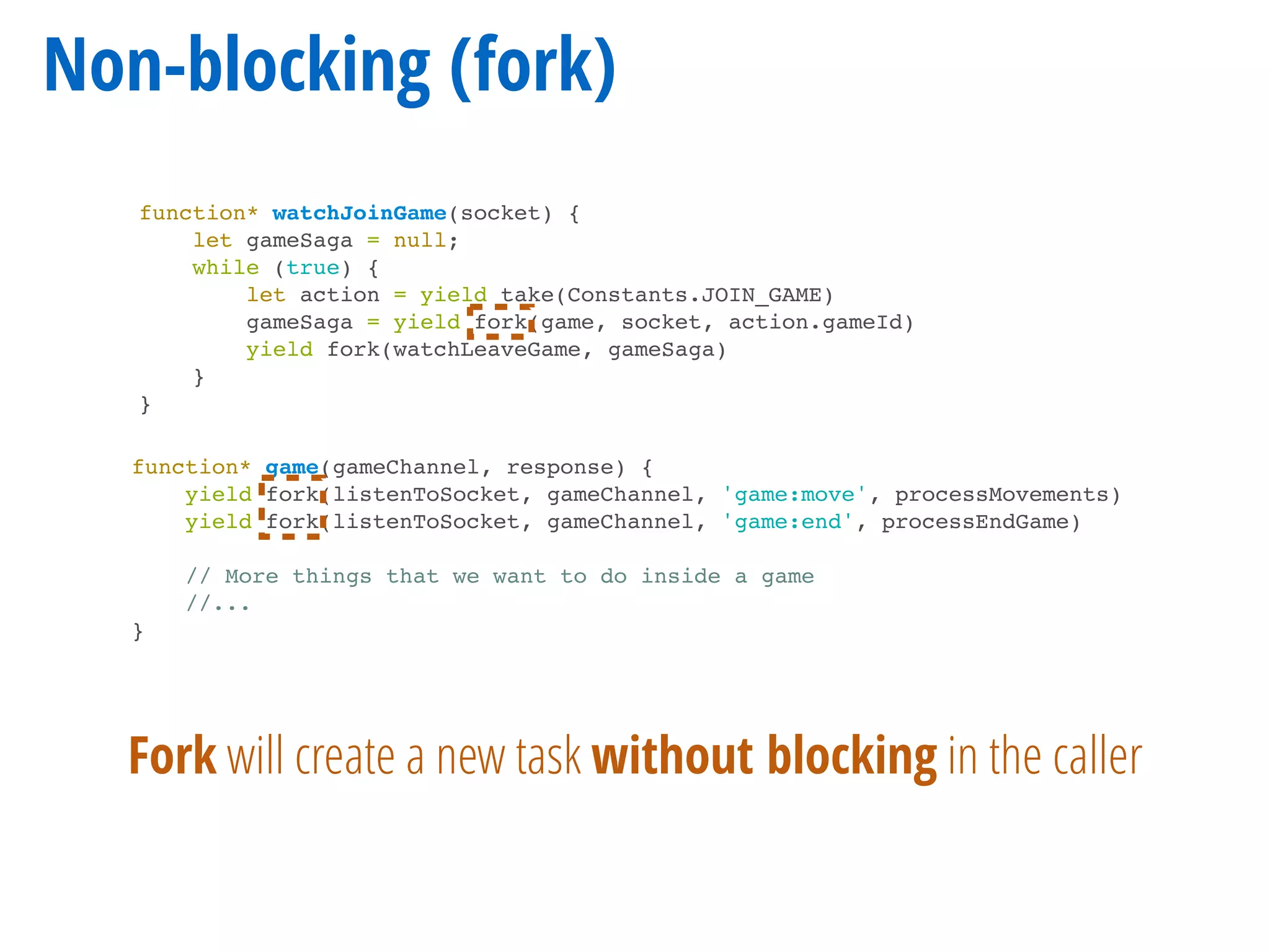
Fork will create a new task without blocking in the caller
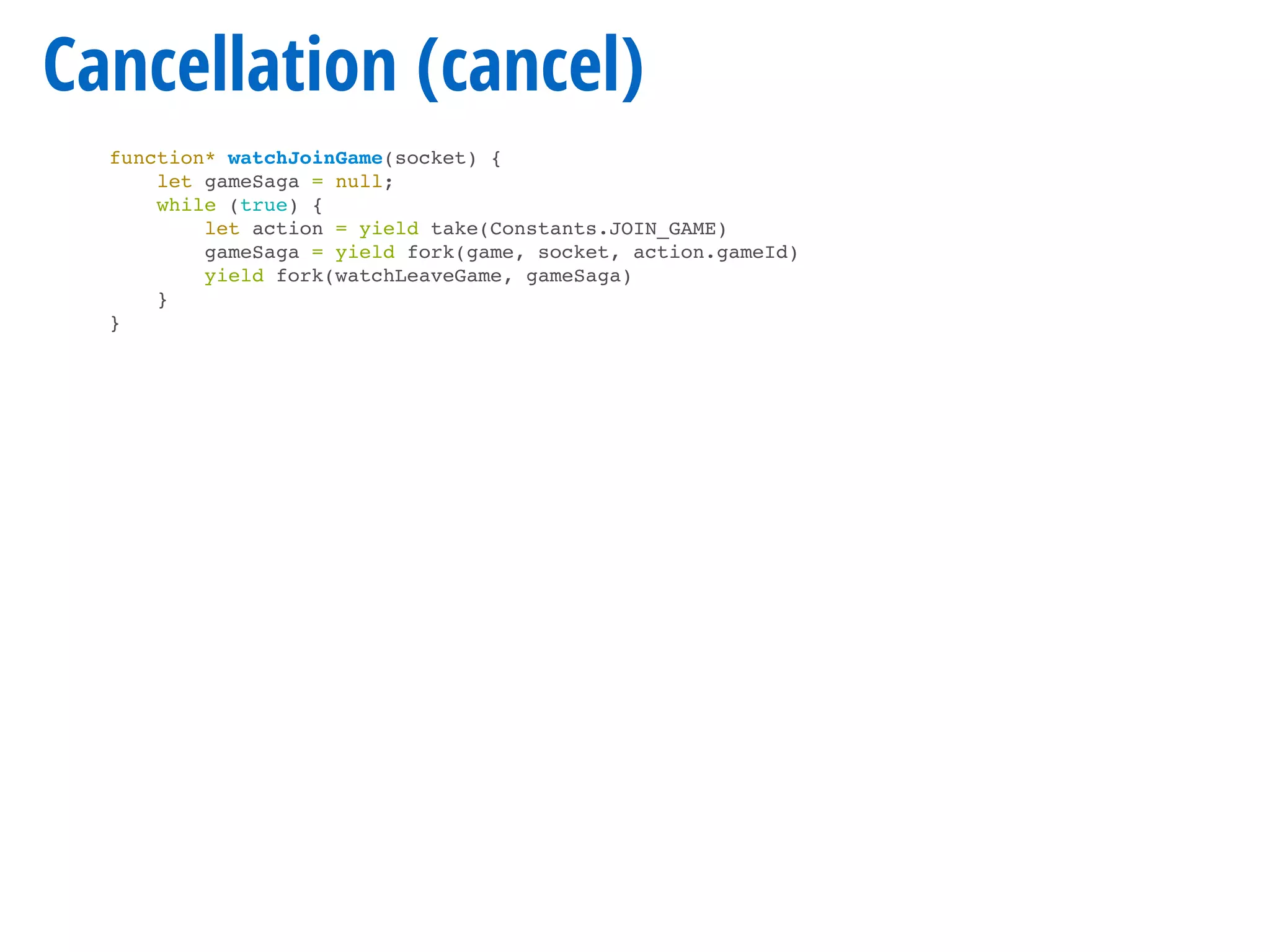
Cancellation (cancel)
function* watchJoinGame(socket) {
let gameSaga = null;
while (true) {
let action = yield take(Constants.JOIN_GAME)
gameSaga = yield fork(game, socket, action.gameId)
yield fork(watchLeaveGame, gameSaga)
}
}
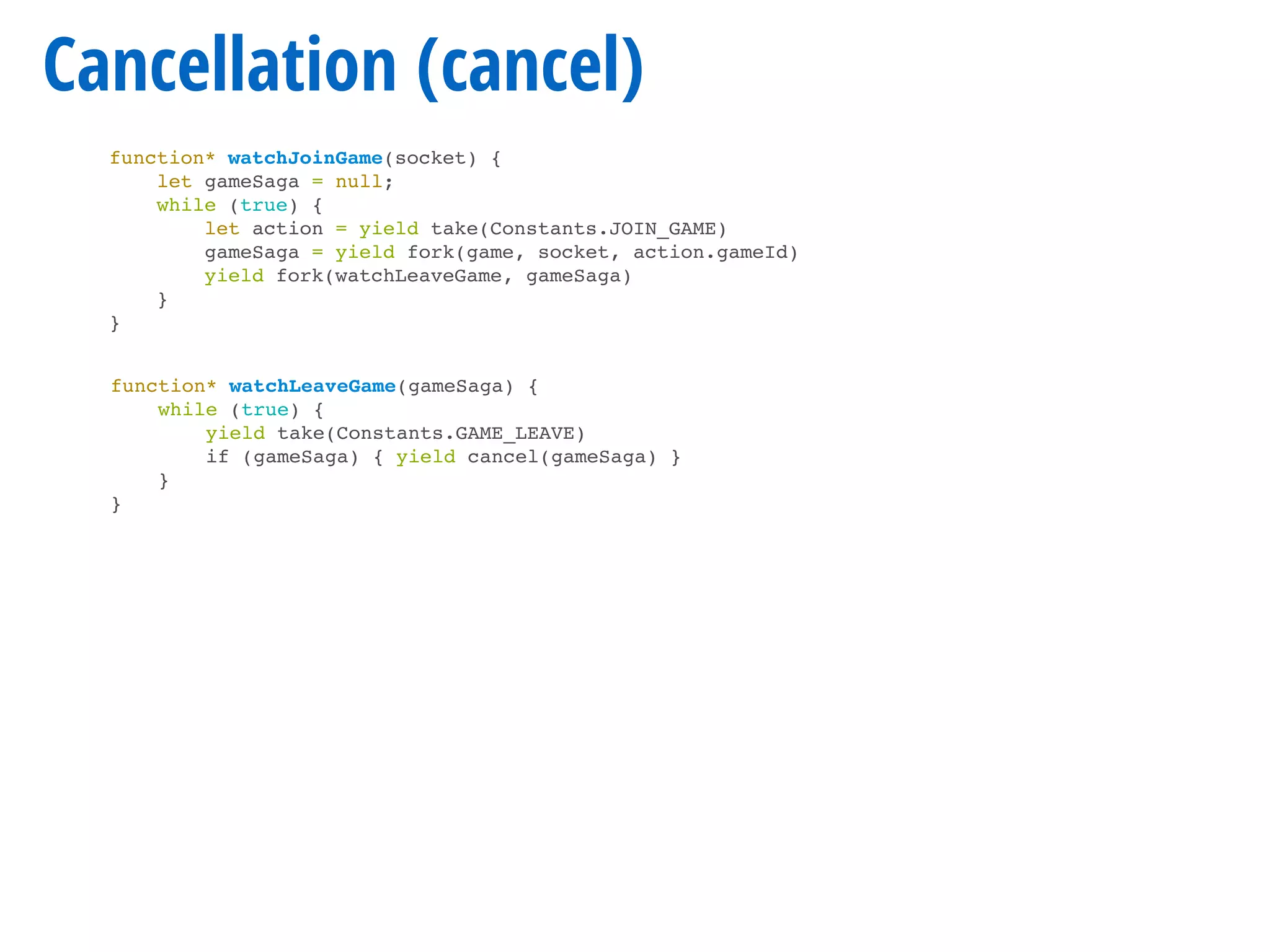
Cancellation (cancel)
function* watchJoinGame(socket) {
let gameSaga = null;
while (true) {
let action = yield take(Constants.JOIN_GAME)
gameSaga = yield fork(game, socket, action.gameId)
yield fork(watchLeaveGame, gameSaga)
}
}
function* watchLeaveGame(gameSaga) {
while (true) {
yield take(Constants.GAME_LEAVE)
if (gameSaga) { yield cancel(gameSaga) }
}
}
Cancellation (cancel)
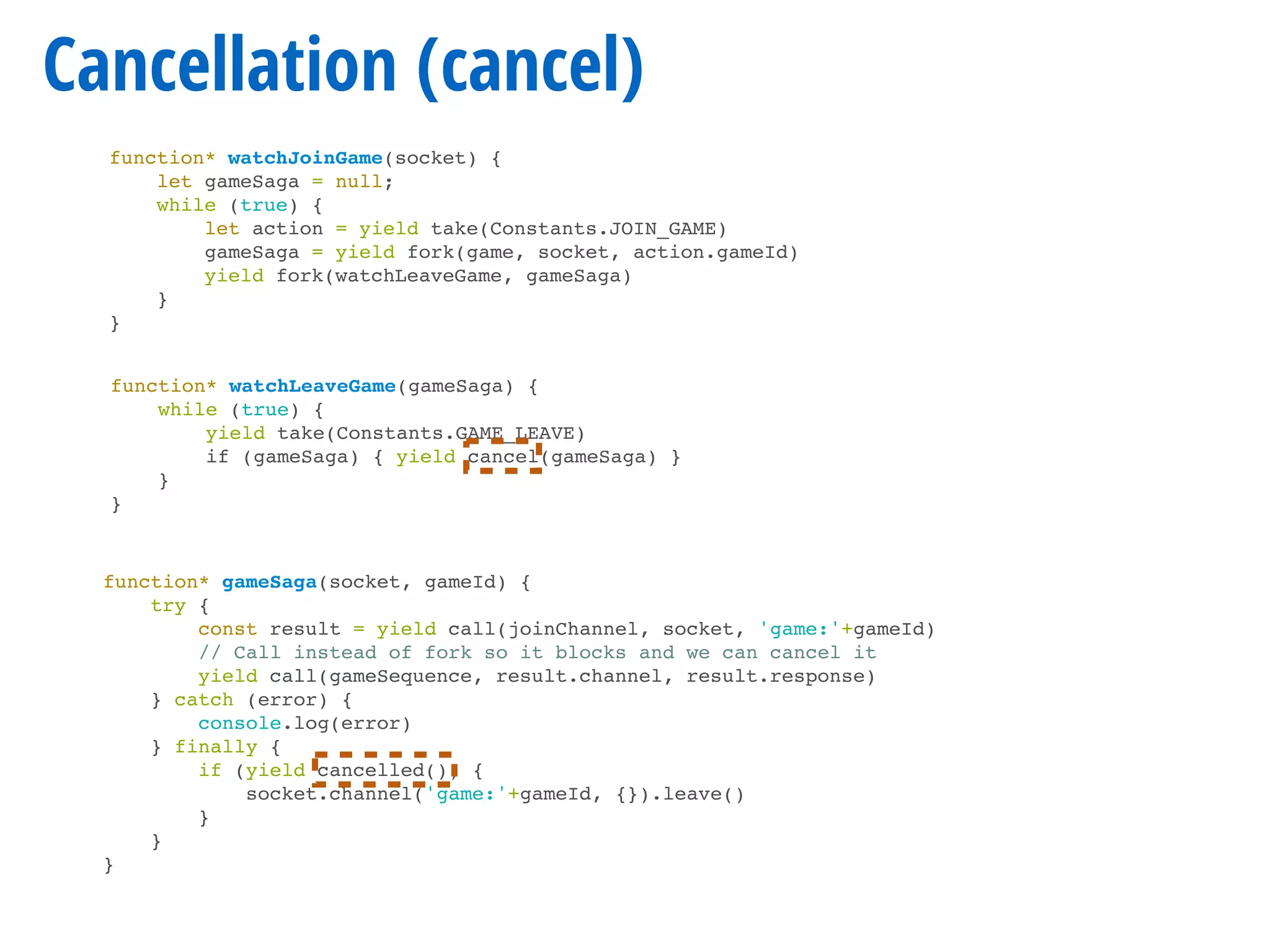
function* gameSaga(socket, gameId) {
try {
const result = yield call(joinChannel, socket, 'game:'+gameId)
// Call instead of fork so it blocks and we can cancel it
yield call(gameSequence, result.channel, result.response)
} catch (error) {
console.log(error)
} finally {
if (yield cancelled()) {
socket.channel('game:'+gameId, {}).leave()
}
}
}
function* watchJoinGame(socket) {
let gameSaga = null;
while (true) {
let action = yield take(Constants.JOIN_GAME)
gameSaga = yield fork(game, socket, action.gameId)
yield fork(watchLeaveGame, gameSaga)
}
}
function* watchLeaveGame(gameSaga) {
while (true) {
yield take(Constants.GAME_LEAVE)
if (gameSaga) { yield cancel(gameSaga) }
}
}
Cancellation (cancel)
function* gameSaga(socket, gameId) {
try {
const result = yield call(joinChannel, socket, 'game:'+gameId)
// Call instead of fork so it blocks and we can cancel it
yield call(gameSequence, result.channel, result.response)
} catch (error) {
console.log(error)
} finally {
if (yield cancelled()) {
socket.channel('game:'+gameId, {}).leave()
}
}
}
function* watchJoinGame(socket) {
let gameSaga = null;
while (true) {
let action = yield take(Constants.JOIN_GAME)
gameSaga = yield fork(game, socket, action.gameId)
yield fork(watchLeaveGame, gameSaga)
}
}
function* watchLeaveGame(gameSaga) {
while (true) {
yield take(Constants.GAME_LEAVE)
if (gameSaga) { yield cancel(gameSaga) }
}
}
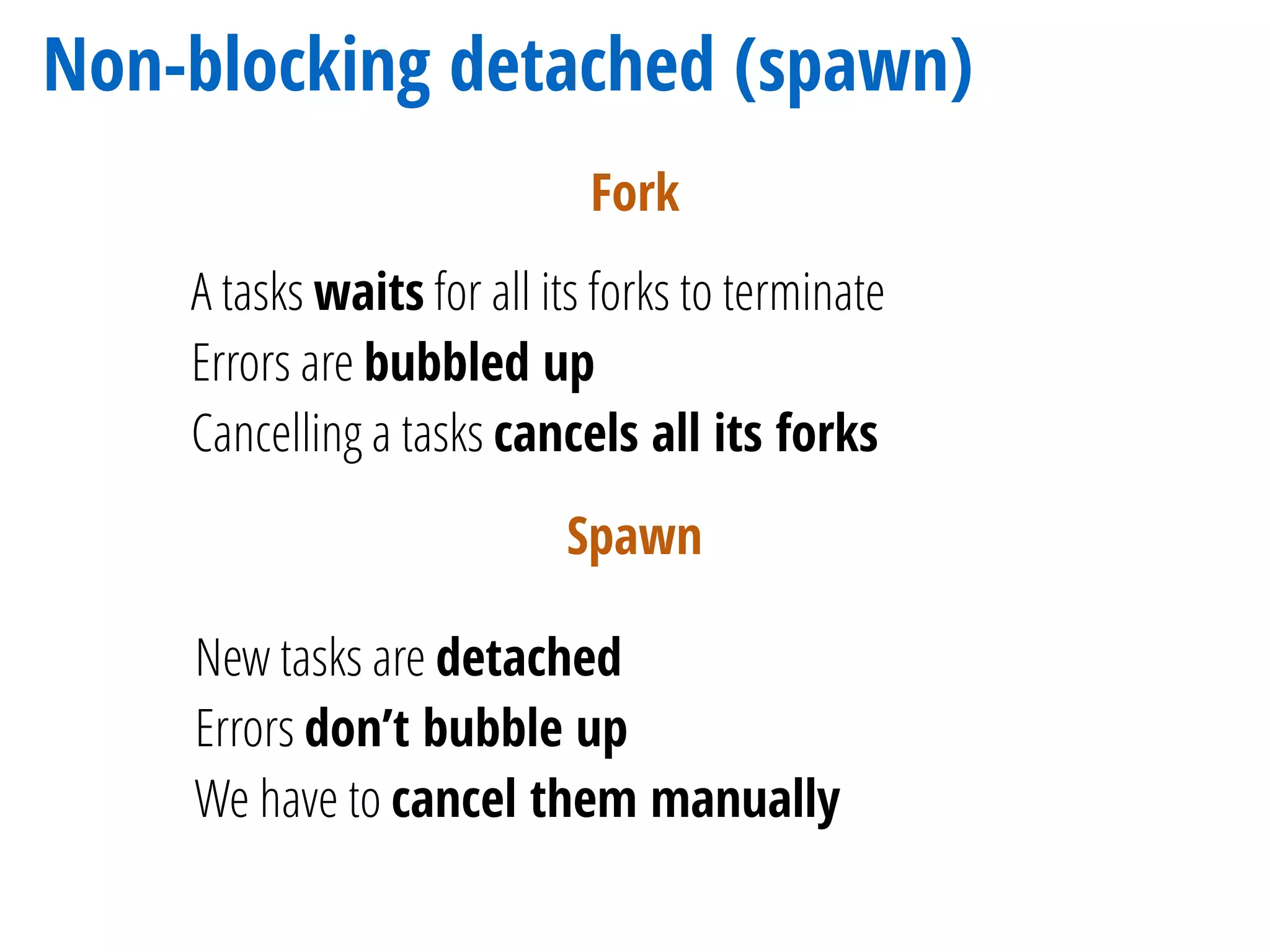
Non-blocking detached (spawn)
A tasks waits for all its forks to terminate
Errors are bubbled up
Cancelling a tasks cancels all its forks
Fork
Spawn
New tasks are detached
Errors don’t bubble up
We have to cancel them manually
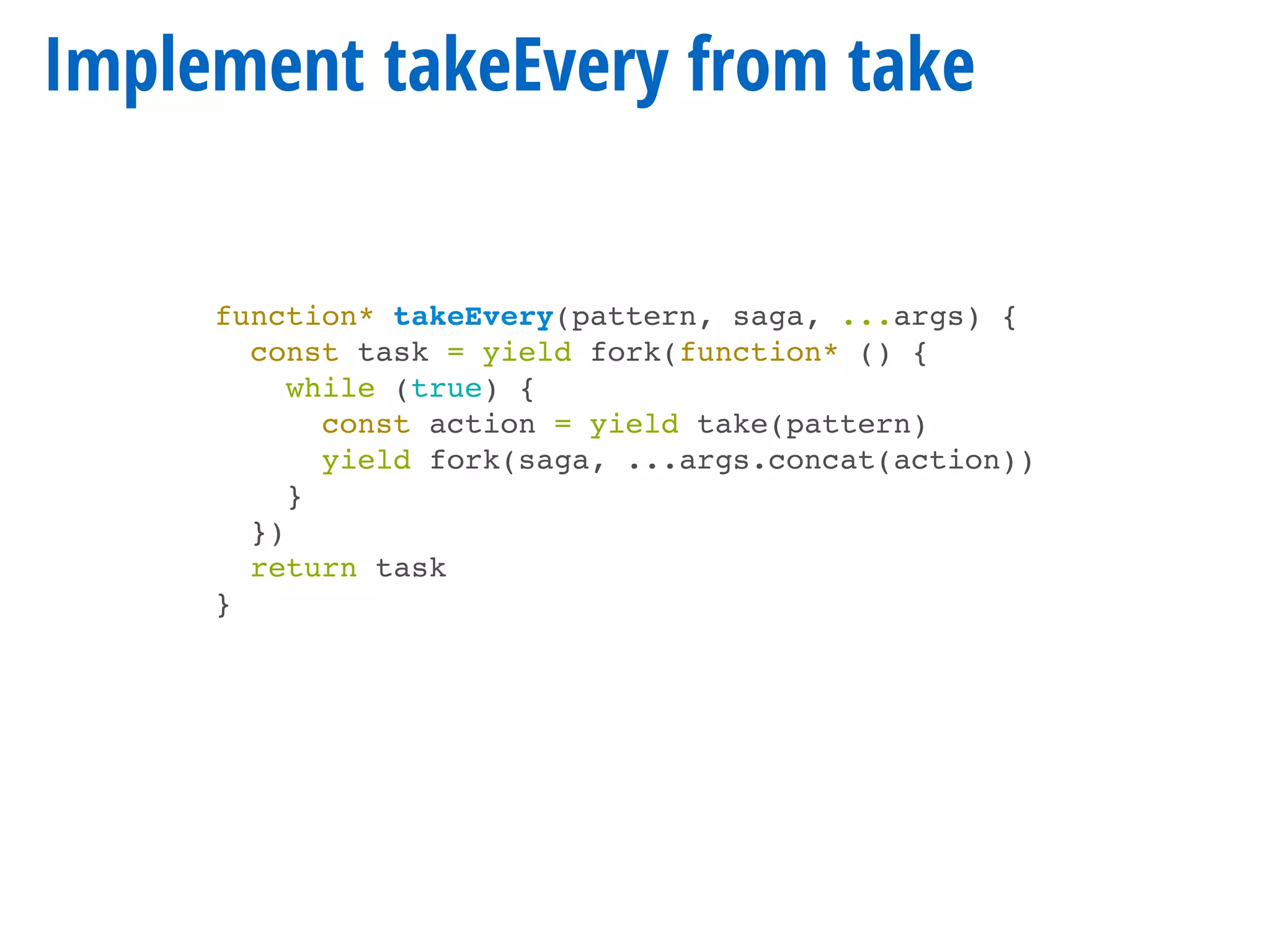
Implement takeEvery from take
function* takeEvery(pattern, saga, ...args) {
const task = yield fork(function* () {
while (true) {
const action = yield take(pattern)
yield fork(saga, ...args.concat(action))
}
})
return task
}
Parallel (all)
export default function* rootSaga() {
yield all([
playSounds(),
watchJoinGame(),
//…
])
}
Will block until all terminate
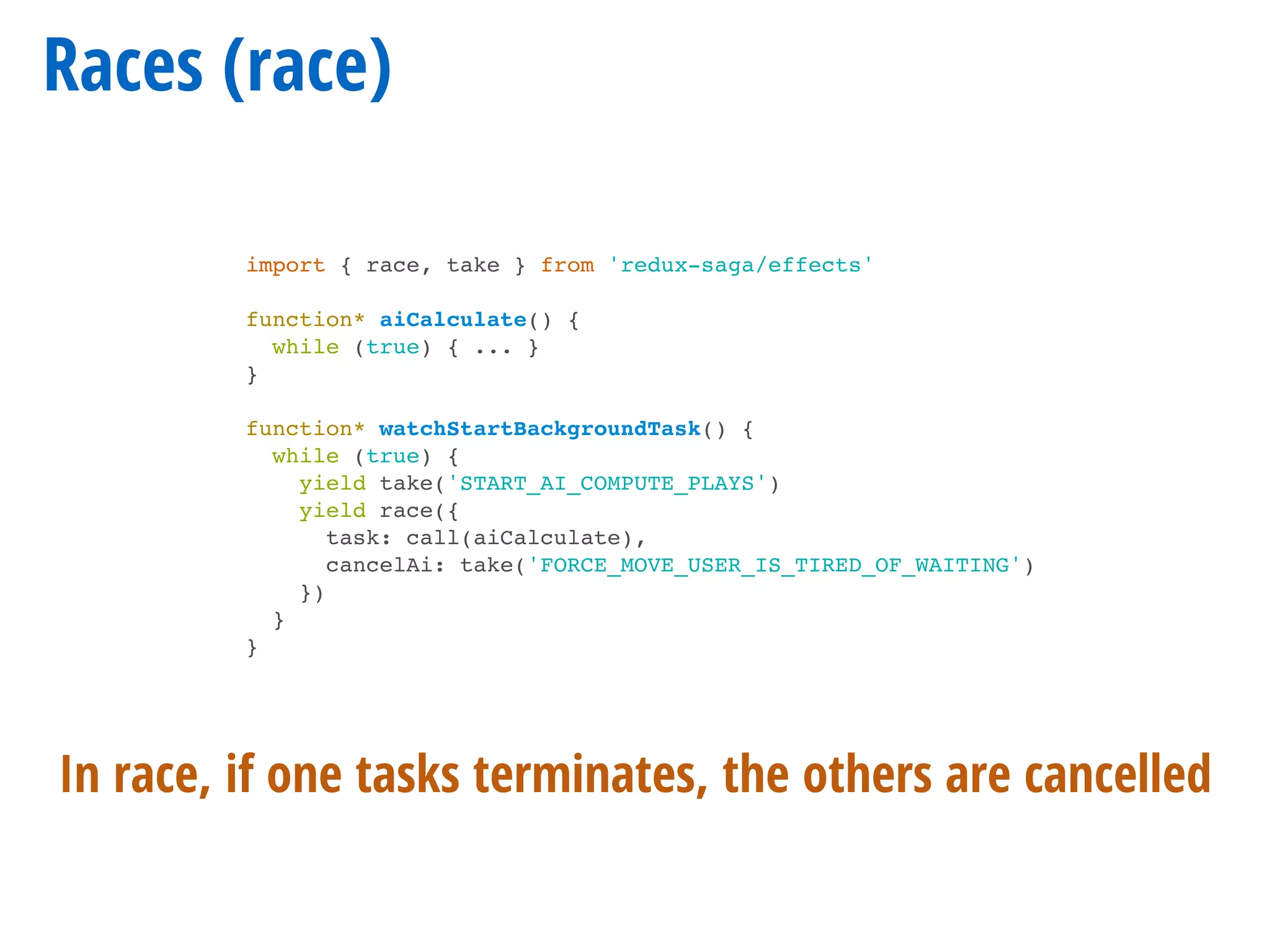
Races (race)
import { race, take } from 'redux-saga/effects'
function* aiCalculate() {
while (true) { ... }
}
function* watchStartBackgroundTask() {
while (true) {
yield take('START_AI_COMPUTE_PLAYS')
yield race({
task: call(aiCalculate),
cancelAi: take('FORCE_MOVE_USER_IS_TIRED_OF_WAITING')
})
}
}
In race, if one tasks terminates, the others are cancelled
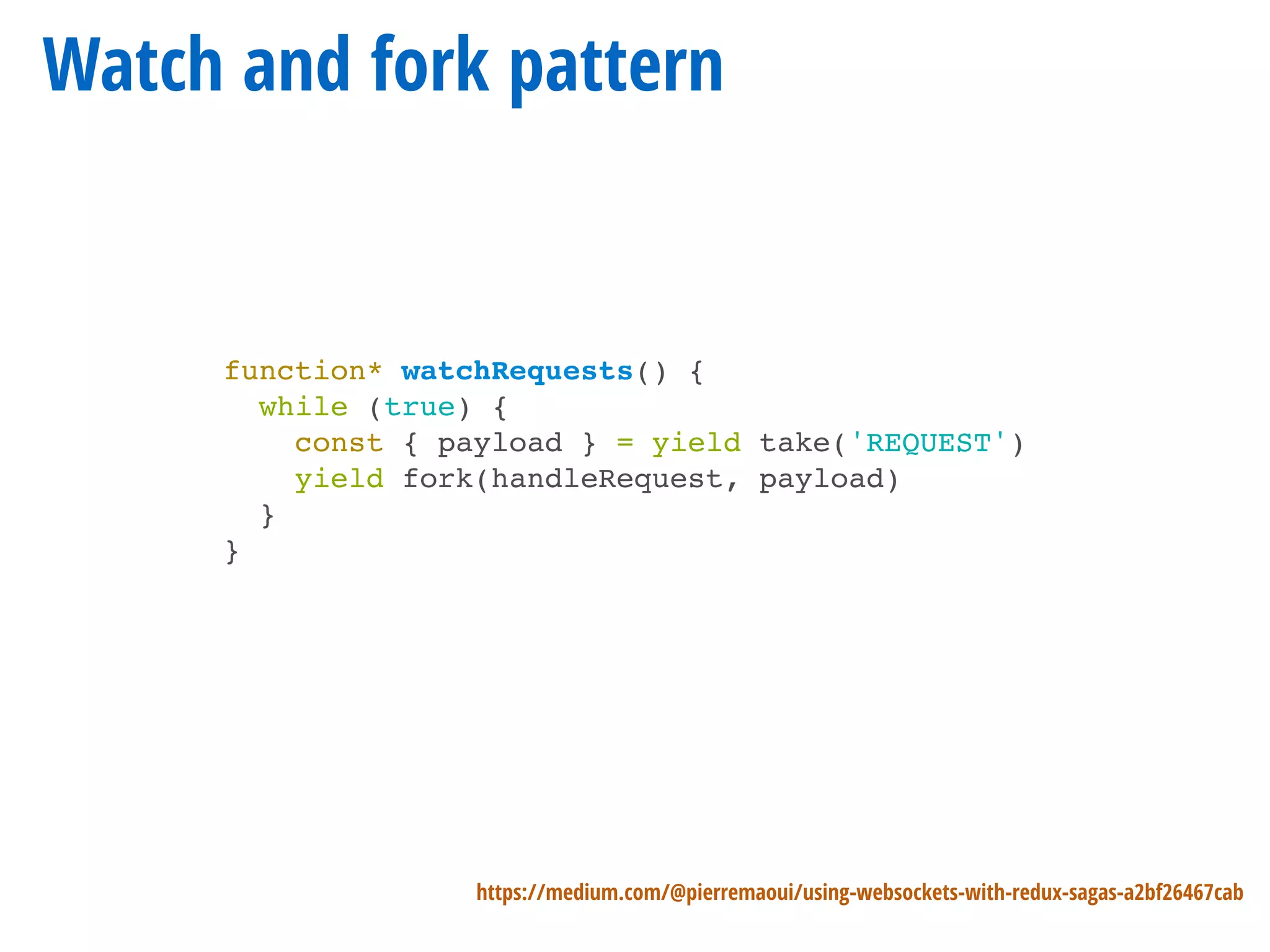
Watch and fork pattern
https://medium.com/@pierremaoui/using-websockets-with-redux-sagas-a2bf26467cab
function* watchRequests() {
while (true) {
const { payload } = yield take('REQUEST')
yield fork(handleRequest, payload)
}
}
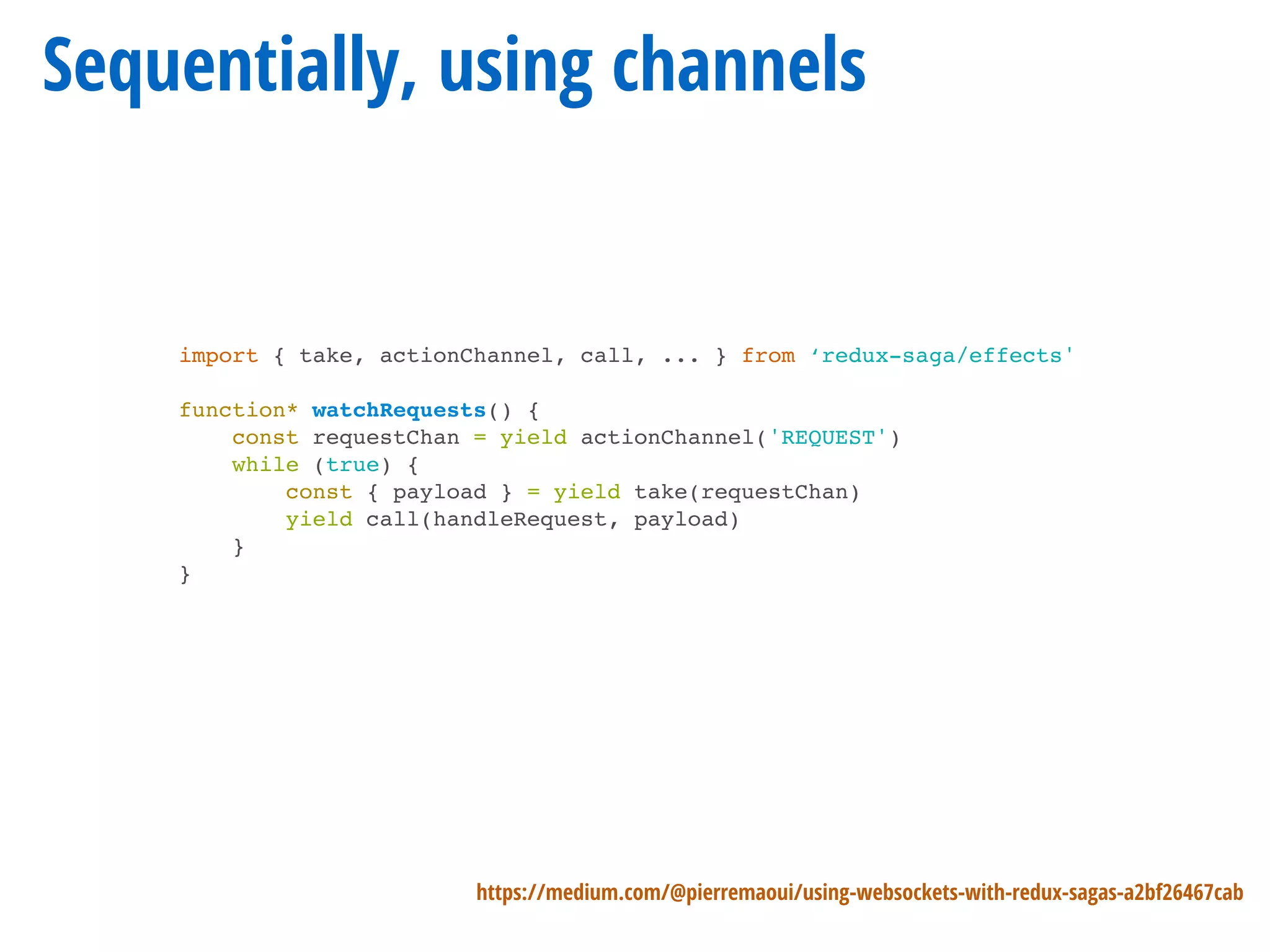
Sequentially, using channels
https://medium.com/@pierremaoui/using-websockets-with-redux-sagas-a2bf26467cab
import { take, actionChannel, call, ... } from ‘redux-saga/effects'
function* watchRequests() {
const requestChan = yield actionChannel('REQUEST')
while (true) {
const { payload } = yield take(requestChan)
yield call(handleRequest, payload)
}
}
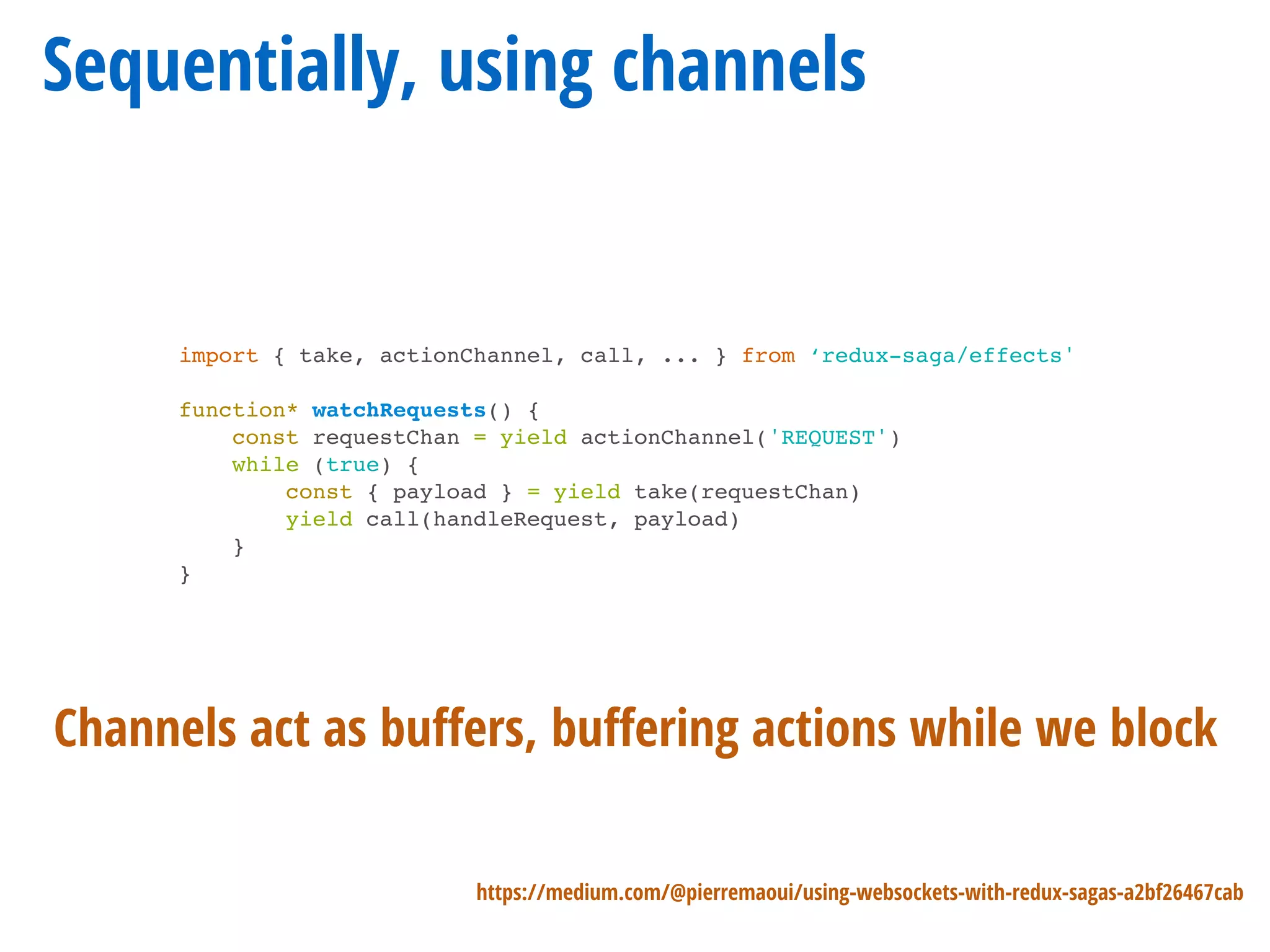
Sequentially, using channels
https://medium.com/@pierremaoui/using-websockets-with-redux-sagas-a2bf26467cab
import { take, actionChannel, call, ... } from ‘redux-saga/effects'
function* watchRequests() {
const requestChan = yield actionChannel('REQUEST')
while (true) {
const { payload } = yield take(requestChan)
yield call(handleRequest, payload)
}
}
Channels act as buffers, buffering actions while we block
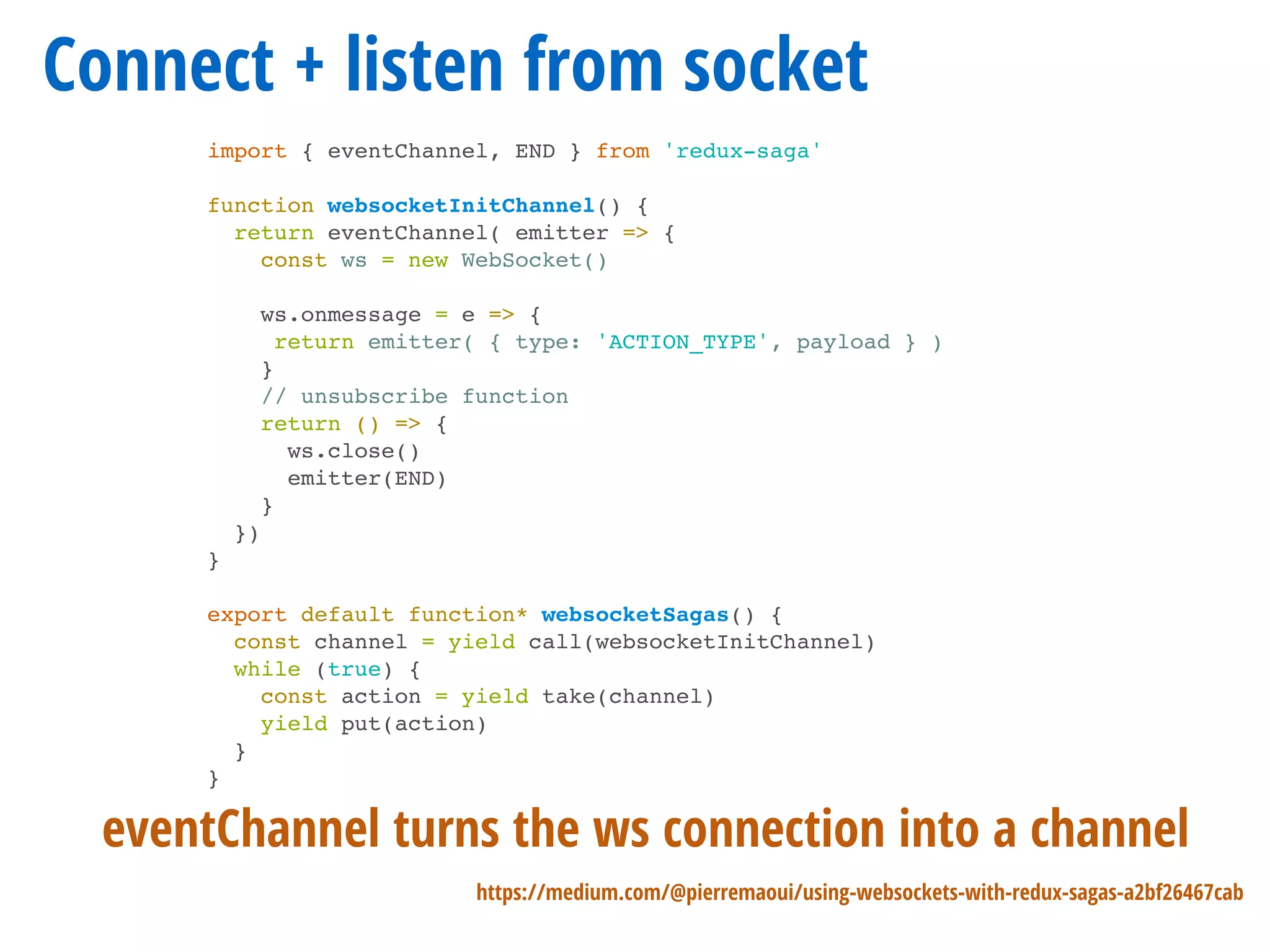
Connect + listen from socket
import { eventChannel, END } from 'redux-saga'
function websocketInitChannel() {
return eventChannel( emitter => {
const ws = new WebSocket()
ws.onmessage = e => {
return emitter( { type: 'ACTION_TYPE', payload } )
}
// unsubscribe function
return () => {
ws.close()
emitter(END)
}
})
}
export default function* websocketSagas() {
const channel = yield call(websocketInitChannel)
while (true) {
const action = yield take(channel)
yield put(action)
}
}
https://medium.com/@pierremaoui/using-websockets-with-redux-sagas-a2bf26467cab
eventChannel turns the ws connection into a channel
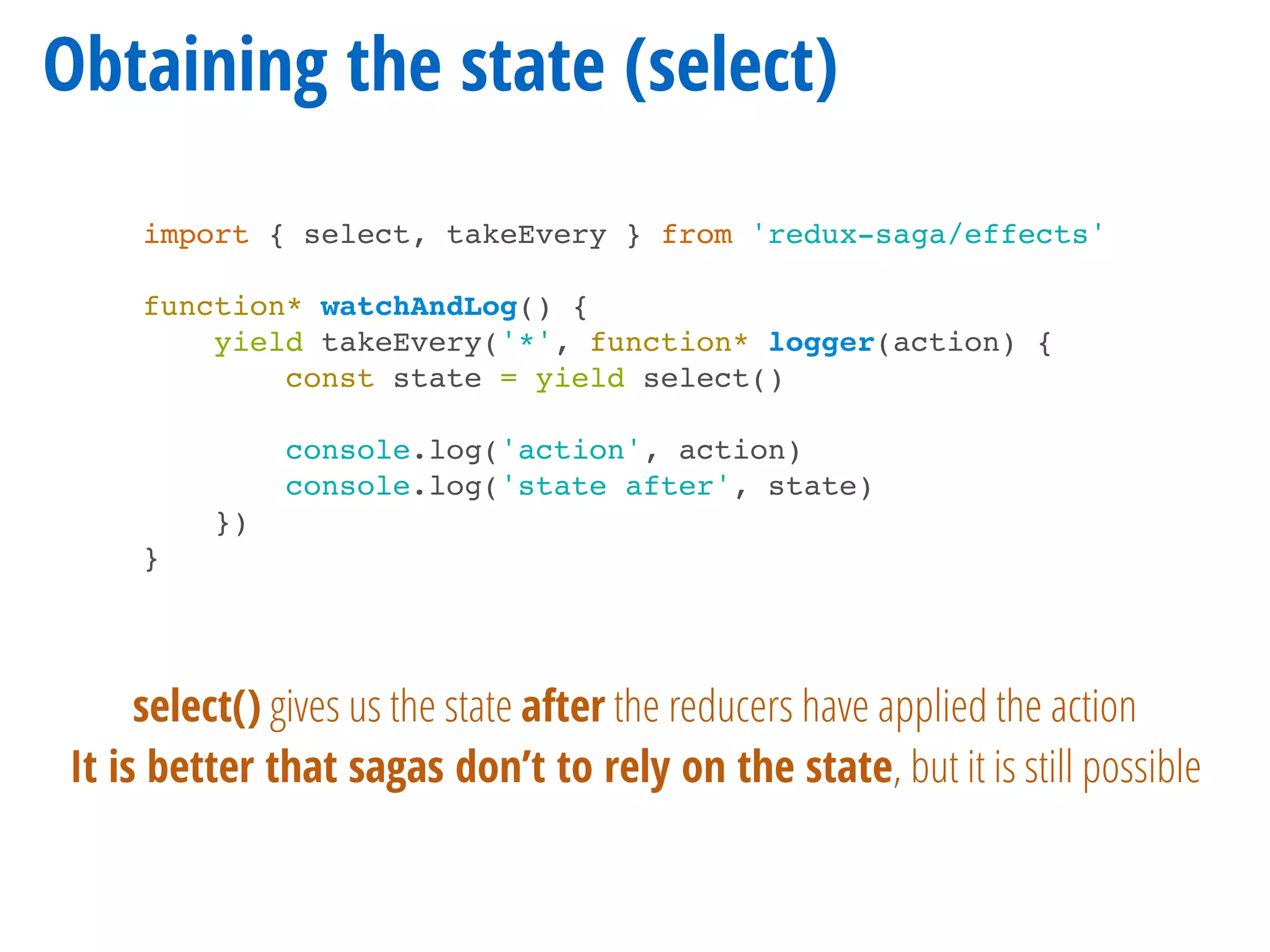
Obtaining the state (select)
import { select, takeEvery } from 'redux-saga/effects'
function* watchAndLog() {
yield takeEvery('*', function* logger(action) {
const state = yield select()
console.log('action', action)
console.log('state after', state)
})
}
select() gives us the state after the reducers have applied the action
It is better that sagas don’t to rely on the state, but it is still possible
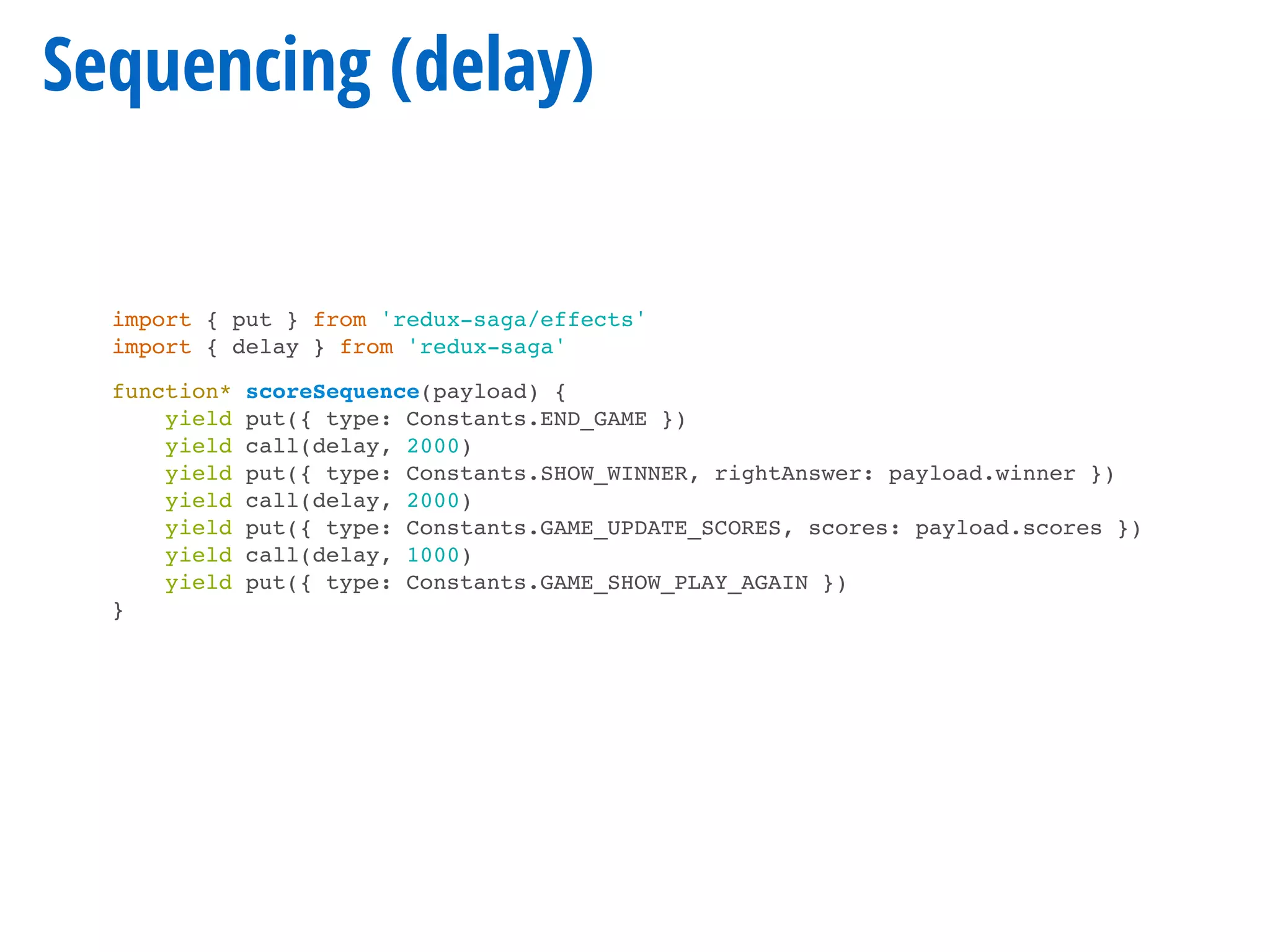
Sequencing (delay)
import { put } from 'redux-saga/effects'
import { delay } from 'redux-saga'
function* scoreSequence(payload) {
yield put({ type: Constants.END_GAME })
yield call(delay, 2000)
yield put({ type: Constants.SHOW_WINNER, rightAnswer: payload.winner })
yield call(delay, 2000)
yield put({ type: Constants.GAME_UPDATE_SCORES, scores: payload.scores })
yield call(delay, 1000)
yield put({ type: Constants.GAME_SHOW_PLAY_AGAIN })
}
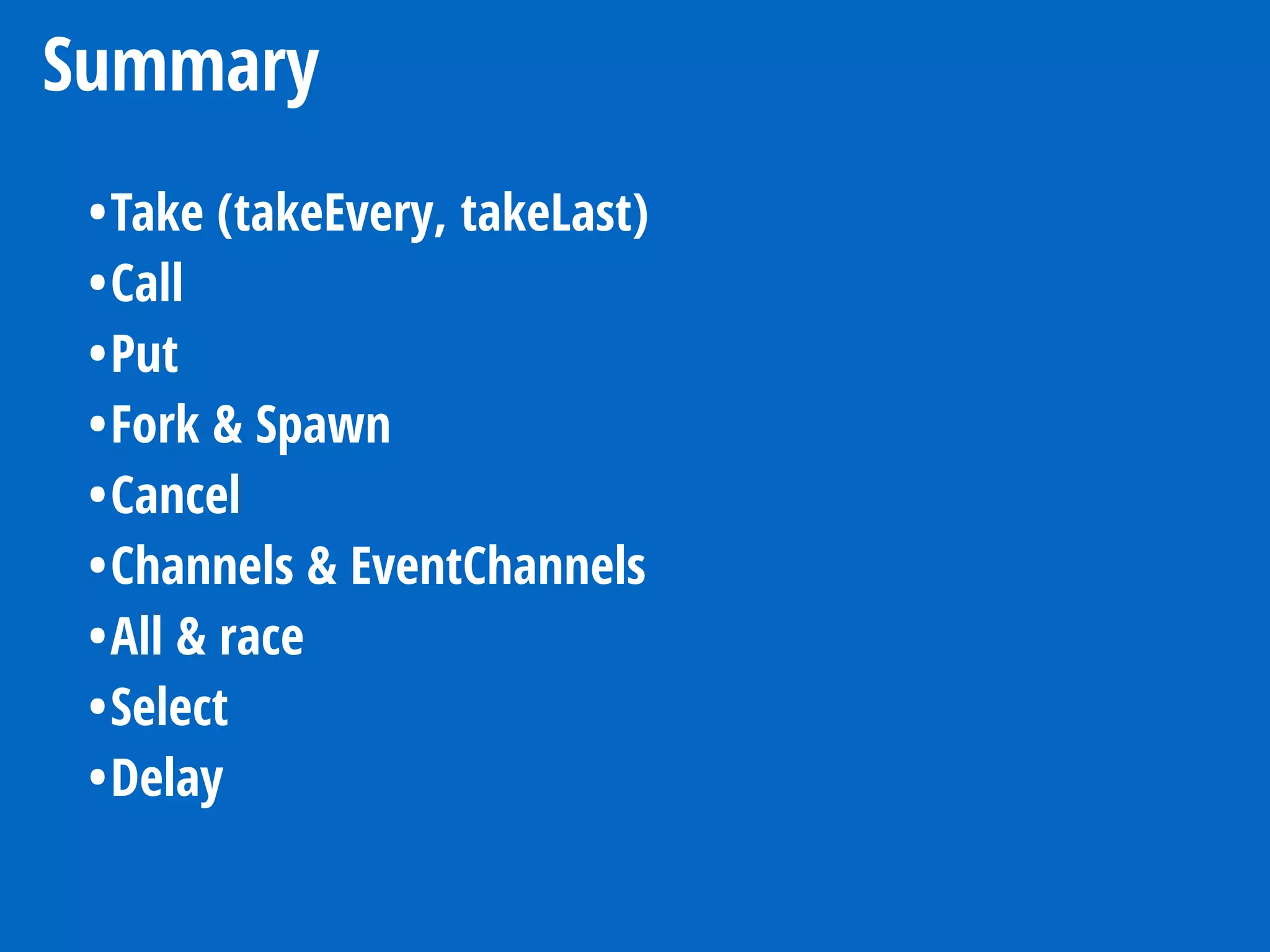
Summary
•Take (takeEvery, takeLast)
•Call
•Put
•Fork & Spawn
•Cancel
•Channels & EventChannels
•All & race
•Select
•Delay
Thanks! @nacmartin
nacho@limenius.com
http://limenius.com

Redux saga: managing your side effects. Also: generators in es6

  • 1.
    React Native MunichMeetup May 2017 REDUX SAGA Nacho Martín @nacmartin
  • 2.
    Nacho Martin I writecode at Limenius. We build tailor-made projects, and provide consultancy and formation. We are very happy with React and React Native.
  • 3.
    Roadmap: • Are Sagasindispensable? • Do they have a strong theoretical background? • ES6 Generators • Sagas
  • 4.
    Maybe you don’tneed redux-saga
  • 7.
    What we need dispatch({type:‘API_REQUEST’}) Reducer
  • 8.
    What we need dispatch({type:‘API_REQUEST’}) Reducer state = {…state, requesting : true } Store
  • 9.
    What we need dispatch({type:‘API_REQUEST’}) Reducer Store Middleware ⚙
  • 10.
    What we need dispatch({type:‘API_REQUEST’}) Reducer Store Middleware dispatch({type: ‘API_REQUEST_SUCCESS’, data}) ⚙
  • 11.
    What we need dispatch({type:‘API_REQUEST’}) Reducer state = {…state, data : action.data } Store Middleware dispatch({type: ‘API_REQUEST_SUCCESS’, data}) ⚙
  • 12.
    What we need dispatch({type:‘API_REQUEST’}) Reducer state = {…state, showError: true } Store Middleware dispatch({type: ‘API_REQUEST_ERROR’}) ⚙
  • 13.
    What we need dispatch({type:‘API_REQUEST’}) Reducer state = {…state, showError: true } Store Middleware dispatch({type: ‘API_REQUEST_ERROR’}) ⚙ Side effects Pure code
  • 14.
    Redux-thunk function makeASandwichWithSecretSauce() { returnfunction (dispatch) { dispatch({type: Constants.SANDWICH_REQUEST}) return fetch('https://www.google.com/search?q=secret+sauce') .then( sauce => dispatch({type: Constants.SANDWICH_SUCCESS, sauce}), error => dispatch({type: Constants.SANDWICH_ERROR, error}) ); }; } dispatch(makeASandwichWithSecretSauce())
  • 15.
    Redux-thunk The lib hasonly 14 lines of code If you don’t need more, stick with it But what if you do?
  • 16.
    If you needmore •Redux-saga •Redux-observable •… •Maybe your own in the future?
  • 17.
  • 18.
  • 19.
  • 20.
  • 21.
  • 22.
    But nowadays A longand complicated story with many details e.g. “my neighbor told me the saga of his divorce again”
  • 23.
  • 24.
    Originally in C.S. HéctorGarcía-Molina ( )
  • 25.
    Originally in C.S. HéctorGarcía-Molina ( )
  • 26.
    Originally in C.S. HéctorGarcía-Molina ( ) Multiple workflows, each providing compensating actions for every step of the workflow where it can fail
  • 27.
    But nowadays A processmanager used to orchestrate complex operations.
  • 28.
    But nowadays A processmanager used to orchestrate complex operations. A library to manage side-effects. And in redux-saga:
  • 29.
  • 30.
    First generator function* myFirstGenerator(){ yield "one" yield "two" yield "three" } var it = myFirstGenerator() console.log(it) console.log(it.next()) console.log(it.next()) console.log(it.next()) console.log(it.next())
  • 31.
    First generator function* myFirstGenerator(){ yield "one" yield "two" yield "three" } var it = myFirstGenerator() console.log(it) console.log(it.next()) console.log(it.next()) console.log(it.next()) console.log(it.next())
  • 32.
    First generator function* myFirstGenerator(){ yield "one" yield "two" yield "three" } var it = myFirstGenerator() console.log(it) console.log(it.next()) console.log(it.next()) console.log(it.next()) console.log(it.next()) {}
  • 33.
    First generator function* myFirstGenerator(){ yield "one" yield "two" yield "three" } var it = myFirstGenerator() console.log(it) console.log(it.next()) console.log(it.next()) console.log(it.next()) console.log(it.next())
  • 34.
    First generator function* myFirstGenerator(){ yield "one" yield "two" yield "three" } var it = myFirstGenerator() console.log(it) console.log(it.next()) console.log(it.next()) console.log(it.next()) console.log(it.next()) { value: 'one', done: false }
  • 35.
    First generator function* myFirstGenerator(){ yield "one" yield "two" yield "three" } var it = myFirstGenerator() console.log(it) console.log(it.next()) console.log(it.next()) console.log(it.next()) console.log(it.next())
  • 36.
    First generator function* myFirstGenerator(){ yield "one" yield "two" yield "three" } var it = myFirstGenerator() console.log(it) console.log(it.next()) console.log(it.next()) console.log(it.next()) console.log(it.next()) { value: 'two', done: false }
  • 37.
    First generator function* myFirstGenerator(){ yield "one" yield "two" yield "three" } var it = myFirstGenerator() console.log(it) console.log(it.next()) console.log(it.next()) console.log(it.next()) console.log(it.next())
  • 38.
    First generator function* myFirstGenerator(){ yield "one" yield "two" yield "three" } var it = myFirstGenerator() console.log(it) console.log(it.next()) console.log(it.next()) console.log(it.next()) console.log(it.next()) { value: 'three', done: false }
  • 39.
    First generator function* myFirstGenerator(){ yield "one" yield "two" yield "three" } var it = myFirstGenerator() console.log(it) console.log(it.next()) console.log(it.next()) console.log(it.next()) console.log(it.next())
  • 40.
    First generator function* myFirstGenerator(){ yield "one" yield "two" yield "three" } var it = myFirstGenerator() console.log(it) console.log(it.next()) console.log(it.next()) console.log(it.next()) console.log(it.next()) { value: undefined, done: true }
  • 41.
    function* sum() { varx = 0 x += (yield "1st " + x) x += (yield "2nd " + x) x += (yield "3rd " + x) x += (yield "4th " + x) } Passing values to generators var it = sum() console.log(it.next(‘unused’)) console.log(it.next(1)) console.log(it.next(20)) console.log(it.next(300))
  • 42.
    function* sum() { varx = 0 x += (yield "1st " + x) x += (yield "2nd " + x) x += (yield "3rd " + x) x += (yield "4th " + x) } Passing values to generators var it = sum() console.log(it.next(‘unused’)) console.log(it.next(1)) console.log(it.next(20)) console.log(it.next(300)) heaven of data
  • 43.
    function* sum() { varx = 0 x += (yield "1st " + x) x += (yield "2nd " + x) x += (yield "3rd " + x) x += (yield "4th " + x) } Passing values to generators var it = sum() console.log(it.next(‘unused’)) console.log(it.next(1)) console.log(it.next(20)) console.log(it.next(300))
  • 44.
    function* sum() { varx = 0 x += (yield "1st " + x) x += (yield "2nd " + x) x += (yield "3rd " + x) x += (yield "4th " + x) } Passing values to generators var it = sum() console.log(it.next(‘unused’)) console.log(it.next(1)) console.log(it.next(20)) console.log(it.next(300))
  • 45.
    function* sum() { varx = 0 x += (yield "1st " + x) x += (yield "2nd " + x) x += (yield "3rd " + x) x += (yield "4th " + x) } Passing values to generators var it = sum() console.log(it.next(‘unused’)) console.log(it.next(1)) console.log(it.next(20)) console.log(it.next(300)) { value: '1st 0’, done: false }
  • 46.
    function* sum() { varx = 0 x += (yield "1st " + x) x += (yield "2nd " + x) x += (yield "3rd " + x) x += (yield "4th " + x) } Passing values to generators var it = sum() console.log(it.next(‘unused’)) console.log(it.next(1)) console.log(it.next(20)) console.log(it.next(300))
  • 47.
    function* sum() { varx = 0 x += (yield "1st " + x) x += (yield "2nd " + x) x += (yield "3rd " + x) x += (yield "4th " + x) } Passing values to generators var it = sum() console.log(it.next(‘unused’)) console.log(it.next(1)) console.log(it.next(20)) console.log(it.next(300)) x = 0 + 1
  • 48.
    function* sum() { varx = 0 x += (yield "1st " + x) x += (yield "2nd " + x) x += (yield "3rd " + x) x += (yield "4th " + x) } Passing values to generators var it = sum() console.log(it.next(‘unused’)) console.log(it.next(1)) console.log(it.next(20)) console.log(it.next(300))
  • 49.
    function* sum() { varx = 0 x += (yield "1st " + x) x += (yield "2nd " + x) x += (yield "3rd " + x) x += (yield "4th " + x) } Passing values to generators var it = sum() console.log(it.next(‘unused’)) console.log(it.next(1)) console.log(it.next(20)) console.log(it.next(300))
  • 50.
    function* sum() { varx = 0 x += (yield "1st " + x) x += (yield "2nd " + x) x += (yield "3rd " + x) x += (yield "4th " + x) } Passing values to generators var it = sum() console.log(it.next(‘unused’)) console.log(it.next(1)) console.log(it.next(20)) console.log(it.next(300)) { value: '2nd 1’, done: false }
  • 51.
    function* sum() { varx = 0 x += (yield "1st " + x) x += (yield "2nd " + x) x += (yield "3rd " + x) x += (yield "4th " + x) } Passing values to generators var it = sum() console.log(it.next(‘unused’)) console.log(it.next(1)) console.log(it.next(20)) console.log(it.next(300))
  • 52.
    function* sum() { varx = 0 x += (yield "1st " + x) x += (yield "2nd " + x) x += (yield "3rd " + x) x += (yield "4th " + x) } Passing values to generators var it = sum() console.log(it.next(‘unused’)) console.log(it.next(1)) console.log(it.next(20)) console.log(it.next(300)) x = 1 + 20
  • 53.
    function* sum() { varx = 0 x += (yield "1st " + x) x += (yield "2nd " + x) x += (yield "3rd " + x) x += (yield "4th " + x) } Passing values to generators var it = sum() console.log(it.next(‘unused’)) console.log(it.next(1)) console.log(it.next(20)) console.log(it.next(300))
  • 54.
    function* sum() { varx = 0 x += (yield "1st " + x) x += (yield "2nd " + x) x += (yield "3rd " + x) x += (yield "4th " + x) } Passing values to generators var it = sum() console.log(it.next(‘unused’)) console.log(it.next(1)) console.log(it.next(20)) console.log(it.next(300))
  • 55.
    function* sum() { varx = 0 x += (yield "1st " + x) x += (yield "2nd " + x) x += (yield "3rd " + x) x += (yield "4th " + x) } Passing values to generators var it = sum() console.log(it.next(‘unused’)) console.log(it.next(1)) console.log(it.next(20)) console.log(it.next(300))
  • 56.
    function* sum() { varx = 0 x += (yield "1st " + x) x += (yield "2nd " + x) x += (yield "3rd " + x) x += (yield "4th " + x) } Passing values to generators var it = sum() console.log(it.next(‘unused’)) console.log(it.next(1)) console.log(it.next(20)) console.log(it.next(300)) { value: '3rd 21’, done: false }
  • 57.
    function* sum() { varx = 0 x += (yield "1st " + x) x += (yield "2nd " + x) x += (yield "3rd " + x) x += (yield "4th " + x) } Passing values to generators var it = sum() console.log(it.next(‘unused’)) console.log(it.next(1)) console.log(it.next(20)) console.log(it.next(300))
  • 58.
    function* sum() { varx = 0 x += (yield "1st " + x) x += (yield "2nd " + x) x += (yield "3rd " + x) x += (yield "4th " + x) } Passing values to generators var it = sum() console.log(it.next(‘unused’)) console.log(it.next(1)) console.log(it.next(20)) console.log(it.next(300)) x = 21 + 300
  • 59.
    function* sum() { varx = 0 x += (yield "1st " + x) x += (yield "2nd " + x) x += (yield "3rd " + x) x += (yield "4th " + x) } Passing values to generators var it = sum() console.log(it.next(‘unused’)) console.log(it.next(1)) console.log(it.next(20)) console.log(it.next(300))
  • 60.
    function* sum() { varx = 0 x += (yield "1st " + x) x += (yield "2nd " + x) x += (yield "3rd " + x) x += (yield "4th " + x) } Passing values to generators var it = sum() console.log(it.next(‘unused’)) console.log(it.next(1)) console.log(it.next(20)) console.log(it.next(300))
  • 61.
    function* sum() { varx = 0 x += (yield "1st " + x) x += (yield "2nd " + x) x += (yield "3rd " + x) x += (yield "4th " + x) } Passing values to generators var it = sum() console.log(it.next(‘unused’)) console.log(it.next(1)) console.log(it.next(20)) console.log(it.next(300)) { value: '4th 321’, done: false }
  • 62.
    function* sum() { varx = 0 while(true) { x += (yield x) } } Similar, in a loop var it = sum() console.log(it.next(‘unused’)) console.log(it.next(1)) console.log(it.next(20)) console.log(it.next(300))
  • 63.
    function* sum() { varx = 0 while(true) { x += (yield x) } } Similar, in a loop var it = sum() console.log(it.next(‘unused’)) console.log(it.next(1)) console.log(it.next(20)) console.log(it.next(300))
  • 64.
    function* sum() { varx = 0 while(true) { x += (yield x) } } Similar, in a loop var it = sum() console.log(it.next(‘unused’)) console.log(it.next(1)) console.log(it.next(20)) console.log(it.next(300)) { value: 0, done: false }
  • 65.
    function* sum() { varx = 0 while(true) { x += (yield x) } } Passing values to generators var it = sum() console.log(it.next(‘unused’)) console.log(it.next(1)) console.log(it.next(20)) console.log(it.next(300)) { value: 1, done: false }
  • 66.
    function* sum() { varx = 0 while(true) { x += (yield x) } } Passing values to generators var it = sum() console.log(it.next(‘unused’)) console.log(it.next(1)) console.log(it.next(20)) console.log(it.next(300)) { value:21, done: false }
  • 67.
    function* sum() { varx = 0 while(true) { x += (yield x) } } Passing values to generators var it = sum() console.log(it.next(‘unused’)) console.log(it.next(1)) console.log(it.next(20)) console.log(it.next(300)) { value:321, done: false }
  • 68.
    Making a iterable for(let value of myIterable) { console.log(value); // [1, 2, 3] } [...myIterable]; // [1, 2, 3] var myIterable = {}; myIterable[Symbol.iterator] = function* () { yield 1; yield 2; yield 3; };
  • 69.
    const fetchUser =() => new Promise( resolve => { setTimeout(() => resolve( { username: 'nacho', hash: ‘12345' } ), 4000) }) With async code (+ promises) function* apiCalls(username, password) { var user = yield fetchUser(username) return user } var it = apiCalls() var promise = it.next().value console.log(promise) promise.then((result) => { console.log(result) var response = it.next(result) console.log(response) })
  • 70.
    const fetchUser =() => new Promise( resolve => { setTimeout(() => resolve( { username: 'nacho', hash: ‘12345' } ), 4000) }) With async code (+ promises) function* apiCalls(username, password) { var user = yield fetchUser(username) return user } var it = apiCalls() var promise = it.next().value console.log(promise) promise.then((result) => { console.log(result) var response = it.next(result) console.log(response) })
  • 71.
    const fetchUser =() => new Promise( resolve => { setTimeout(() => resolve( { username: 'nacho', hash: ‘12345' } ), 4000) }) With async code (+ promises) function* apiCalls(username, password) { var user = yield fetchUser(username) return user } var it = apiCalls() var promise = it.next().value console.log(promise) promise.then((result) => { console.log(result) var response = it.next(result) console.log(response) }) Promise { <pending> }
  • 72.
    With async code(+ promises) const fetchUser = () => new Promise( resolve => { setTimeout(() => resolve( { username: 'nacho', hash: ‘12345' } ), 4000) }) function* apiCalls(username, password) { var user = yield fetchUser(username) return user } var it = apiCalls() var promise = it.next().value console.log(promise) promise.then((result) => { console.log(result) var response = it.next(result) console.log(response) }) { username: 'nacho', hash: '12345' }
  • 73.
    With async code(+ promises) const fetchUser = () => new Promise( resolve => { setTimeout(() => resolve( { username: 'nacho', hash: ‘12345' } ), 4000) }) function* apiCalls(username, password) { var user = yield fetchUser(username) return user } var it = apiCalls() var promise = it.next().value console.log(promise) promise.then((result) => { console.log(result) var response = it.next(result) console.log(response) }) { value: { username: 'nacho', hash: '12345' }, done: true }
  • 74.
    With async code(+ promises) function* apiCalls(username, password) { var user = yield fetchUser(username) var hash = yield someCrypto(password) if (user.hash == hash) { var hash = yield setSession(user.username) var posts = yield fetchPosts(user) } //... }
  • 75.
    With async code(+ promises) function* apiCalls(username, password) { var user = yield fetchUser(username) var hash = yield someCrypto(password) if (user.hash == hash) { var hash = yield setSession(user.username) var posts = yield fetchPosts(user) } //... } We are doing async as if it was sync Easy to understand, dependent on our project
  • 76.
    With async code(+ promises) function* apiCalls(username, password) { var user = yield fetchUser(username) var hash = yield someCrypto(password) if (user.hash == hash) { var hash = yield setSession(user.username) var posts = yield fetchPosts(user) } //... } We are doing async as if it was sync Easy to understand, dependent on our project ?
  • 77.
    With async code(+ promises) function* apiCalls(username, password) { var user = yield fetchUser(username) var hash = yield someCrypto(password) if (user.hash == hash) { var hash = yield setSession(user.username) var posts = yield fetchPosts(user) } //... } We are doing async as if it was sync Easy to understand, dependent on our project ? More complex code but reusable between projects
  • 78.
    With async code(+ promises) function* apiCalls(username, password) { var user = yield fetchUser(username) var hash = yield someCrypto(password) if (user.hash == hash) { var hash = yield setSession(user.username) var posts = yield fetchPosts(user) } //... } We are doing async as if it was sync Easy to understand, dependent on our project More complex code but reusable between projects redux-saga (or other libs)
  • 79.
  • 80.
    Setup import { createStore,applyMiddleware } from 'redux' import createSagaMiddleware from 'redux-saga' // ... import { helloSaga } from './sagas' const sagaMiddleware = createSagaMiddleware() const store = createStore( reducer, applyMiddleware(sagaMiddleware) ) sagaMiddleware.run(helloSaga)
  • 81.
    How to playa sound? Imagine that we have a class SoundManager that can load sounds, do a set up, and has a method SoundManager.play(sound) How could we use it in React?
  • 82.
    Naive solution class MoveButtonextends Component { render() { return ( <Button onPress={playSound(soundManager, ‘buzz’)} /> ); } }
  • 83.
    Naive solution class MoveButtonextends Component { render() { return ( <Button onPress={playSound(soundManager, ‘buzz’)} /> ); } } But where does soundManager come from?
  • 84.
    Naive solution class MoveButtonextends Component { render() { return ( <Button onPress={this.props.dispatch(playSound(‘buzz’))} /> ); } }
  • 85.
    Naive solution class MoveButtonextends Component { render() { return ( <Button onPress={this.props.dispatch(playSound(‘buzz’))} /> ); } } Dispatch an action and we’ll see. But the action creator doesn’t have access to SoundManager :_(
  • 86.
    Naive solution class MoveButtonextends Component { render() { return ( <Button onPress={playSound(this.props.soundManager, ‘buzz’)} /> ); } } Passing it from its parent, and the parent of its parent with props?
  • 87.
    Naive solution class MoveButtonextends Component { render() { return ( <Button onPress={playSound(this.props.soundManager, ‘buzz’)} /> ); } } Passing it from its parent, and the parent of its parent with props? Hairball ahead
  • 88.
    Naive solution class MoveButtonextends Component { render() { return ( <Button onPress={playSound(this.props.soundManager, ‘buzz’)} /> ); } } From redux connect: • But soundManager is not serializable. • Breaks time-travel, persist and rehydrate store…
  • 89.
    Naive solution What ifwe want to play a sound when the opponent moves too and we receive her movements from a websocket?
  • 90.
    Naive solution What ifwe want to play a sound when the opponent moves too and we receive her movements from a websocket? class Game extends Component { componentDidMount() { this.props.dispatch(connectSocket(soundManager)) } //... }
  • 91.
    Naive solution What ifwe want to play a sound when the opponent moves too and we receive her movements from a websocket? class Game extends Component { componentDidMount() { this.props.dispatch(connectSocket(soundManager)) } //... } What has to do connectSocket with soundManager? We are forced to do this because we don’t know anything better :_(
  • 92.
    Using sagas import {take } from 'redux-saga/effects' export default function* rootSaga() { const action = yield take(Constants.PLAY_SOUND_REQUEST) console.log(action.sound) }
  • 93.
    Example: Play sound import{ take, call } from 'redux-saga/effects' export default function* rootSaga(soundManager) { const action = yield take(Constants.PLAY_SOUND_REQUEST) soundManager.play(action.sound) }
  • 94.
    Example: Play sound import{ take, call } from 'redux-saga/effects' export default function* rootSaga(soundManager) { const action = yield take(Constants.PLAY_SOUND_REQUEST) soundManager.play(action.sound) } But we will need a mock to test it
  • 95.
    Example: Play sound(call) import { take, call } from 'redux-saga/effects' export default function* rootSaga(soundManager) { const action = yield take(Constants.PLAY_SOUND_REQUEST) yield call(soundManager.play, action.sound) }
  • 96.
    Example: Play sound(call) import { take, call } from 'redux-saga/effects' export default function* rootSaga(soundManager) { const action = yield take(Constants.PLAY_SOUND_REQUEST) yield call(soundManager.play, action.sound) } { CALL: { fn: soundManager.play, args: ['buzz'] } } Call returns an object
  • 97.
    Declarative effects Effects aredeclarative, so they are easier to test export function* delayAndDo() { yield call(delay, 1000) yield call(doSomething) } test('delayAndDo Saga test', (assert) => { const it = delayAndDo() assert.deepEqual( it.next().value, call(delay, 1000), 'delayAndDo Saga must call delay(1000)' ) assert.deepEqual( it.next().value, call(doSomething), 'delayAndDo Saga must call doSomething' ) { CALL: {fn: delay, args: [1000]}} { CALL: {fn: doSomething, args: []}}
  • 98.
    Example: Play sound import{ take, call } from 'redux-saga/effects' export default function* rootSaga(soundManager) { const action = yield take(Constants.PLAY_SOUND_REQUEST) yield call(soundManager.play, action.sound) }
  • 99.
    Example: Play sound import{ take, call } from 'redux-saga/effects' export default function* rootSaga(soundManager) { const action = yield take(Constants.PLAY_SOUND_REQUEST) yield call(soundManager.play, action.sound) } Will take 1 action, play a sound, and terminate
  • 100.
    Example: Play sound import{ take, call } from 'redux-saga/effects' export default function* rootSaga(soundManager) { while (true) { const action = yield take(Constants.PLAY_SOUND_REQUEST) yield call(soundManager.play, action.sound) } }
  • 101.
    Example: Play sound import{ take, call } from 'redux-saga/effects' export default function* rootSaga(soundManager) { while (true) { const action = yield take(Constants.PLAY_SOUND_REQUEST) yield call(soundManager.play, action.sound) } } Will take every action
  • 102.
    Example: Play sound(takeEvery) import { takeEvery, call } from 'redux-saga/effects' function* playSound(soundManager, action) { yield call(soundManager.play, action.sound) } export default function* rootSaga(soundManager) { const action = yield takeEvery(Constants.PLAY_SOUND_REQUEST, playSound, soundManager) }
  • 103.
    Dispatching (put) import {take, put } from 'redux-saga/effects' function* watchLogin() { while (true) { const action = yield take('USER_LOGIN_SUCCESS') yield put({type: 'FETCH_NEW_MESSAGES'}) } }
  • 104.
    Dispatching (put) import {take, put } from 'redux-saga/effects' function* watchLogin() { while (true) { const action = yield take('USER_LOGIN_SUCCESS') yield put({type: 'FETCH_NEW_MESSAGES'}) } } put dispatches a new action
  • 105.
    Ajax example function makeASandwichWithSecretSauce(){ return function (dispatch) { dispatch({type: Constants.SANDWICH_REQUEST}) return fetch('https://www.google.com/search?q=secret+sauce') .then( sauce => dispatch({type: Constants.SANDWICH_SUCCESS, sauce}), error => dispatch({type: Constants.SANDWICH_ERROR, error}) ); }; } dispatch(makeASandwichWithSecretSauce())
  • 106.
    Ajax example function makeASandwichWithSecretSauce(){ return function (dispatch) { dispatch({type: Constants.SANDWICH_REQUEST}) return fetch('https://www.google.com/search?q=secret+sauce') .then( sauce => dispatch({type: Constants.SANDWICH_SUCCESS, sauce}), error => dispatch({type: Constants.SANDWICH_ERROR, error}) ); }; } dispatch(makeASandwichWithSecretSauce()) Thunk
  • 107.
    Ajax example import {takeEvery, put, call } from 'redux-saga/effects' function* sandwichRequest() { yield put({type:Constants.SANDWICH_REQUEST_SHOW_LOADER}) try { const sauce = yield call(() => fetch('https://www.google.com/ search?q=secret+sauce')) yield put {type: Constants.SANDWICH_SUCCESS, sauce} } catch (error) { yield put {type: Constants.SANDWICH_ERROR, error} } } export default function* rootSaga() { const action = yield takeEvery(Constants.SANDWICH_REQUEST, sandwichRequest) } dispatch({type:Constants.SANDWICH_REQUEST})
  • 108.
    Ajax example import {takeEvery, put, call } from 'redux-saga/effects' function* sandwichRequest() { yield put({type:Constants.SANDWICH_REQUEST_SHOW_LOADER}) try { const sauce = yield call(() => fetch('https://www.google.com/ search?q=secret+sauce')) yield put {type: Constants.SANDWICH_SUCCESS, sauce} } catch (error) { yield put {type: Constants.SANDWICH_ERROR, error} } } export default function* rootSaga() { const action = yield takeEvery(Constants.SANDWICH_REQUEST, sandwichRequest) } dispatch({type:Constants.SANDWICH_REQUEST}) Saga
  • 109.
    takeLatest import { takeLatest} from 'redux-saga/effects' function* watchFetchData() { yield takeLatest('FETCH_REQUESTED', fetchData) }
  • 110.
    takeLatest import { takeLatest} from 'redux-saga/effects' function* watchFetchData() { yield takeLatest('FETCH_REQUESTED', fetchData) } Ensure that only the last fetchData will be running
  • 111.
    Non-blocking (fork) function* watchJoinGame(socket){ let gameSaga = null; while (true) { let action = yield take(Constants.JOIN_GAME) gameSaga = yield fork(game, socket, action.gameId) yield fork(watchLeaveGame, gameSaga) } } function* game(gameChannel, response) { yield fork(listenToSocket, gameChannel, 'game:move', processMovements) yield fork(listenToSocket, gameChannel, 'game:end', processEndGame) // More things that we want to do inside a game //... }
  • 112.
    Non-blocking (fork) function* watchJoinGame(socket){ let gameSaga = null; while (true) { let action = yield take(Constants.JOIN_GAME) gameSaga = yield fork(game, socket, action.gameId) yield fork(watchLeaveGame, gameSaga) } } function* game(gameChannel, response) { yield fork(listenToSocket, gameChannel, 'game:move', processMovements) yield fork(listenToSocket, gameChannel, 'game:end', processEndGame) // More things that we want to do inside a game //... } Fork will create a new task without blocking in the caller
  • 113.
    Cancellation (cancel) function* watchJoinGame(socket){ let gameSaga = null; while (true) { let action = yield take(Constants.JOIN_GAME) gameSaga = yield fork(game, socket, action.gameId) yield fork(watchLeaveGame, gameSaga) } }
  • 114.
    Cancellation (cancel) function* watchJoinGame(socket){ let gameSaga = null; while (true) { let action = yield take(Constants.JOIN_GAME) gameSaga = yield fork(game, socket, action.gameId) yield fork(watchLeaveGame, gameSaga) } } function* watchLeaveGame(gameSaga) { while (true) { yield take(Constants.GAME_LEAVE) if (gameSaga) { yield cancel(gameSaga) } } }
  • 115.
    Cancellation (cancel) function* gameSaga(socket,gameId) { try { const result = yield call(joinChannel, socket, 'game:'+gameId) // Call instead of fork so it blocks and we can cancel it yield call(gameSequence, result.channel, result.response) } catch (error) { console.log(error) } finally { if (yield cancelled()) { socket.channel('game:'+gameId, {}).leave() } } } function* watchJoinGame(socket) { let gameSaga = null; while (true) { let action = yield take(Constants.JOIN_GAME) gameSaga = yield fork(game, socket, action.gameId) yield fork(watchLeaveGame, gameSaga) } } function* watchLeaveGame(gameSaga) { while (true) { yield take(Constants.GAME_LEAVE) if (gameSaga) { yield cancel(gameSaga) } } }
  • 116.
    Cancellation (cancel) function* gameSaga(socket,gameId) { try { const result = yield call(joinChannel, socket, 'game:'+gameId) // Call instead of fork so it blocks and we can cancel it yield call(gameSequence, result.channel, result.response) } catch (error) { console.log(error) } finally { if (yield cancelled()) { socket.channel('game:'+gameId, {}).leave() } } } function* watchJoinGame(socket) { let gameSaga = null; while (true) { let action = yield take(Constants.JOIN_GAME) gameSaga = yield fork(game, socket, action.gameId) yield fork(watchLeaveGame, gameSaga) } } function* watchLeaveGame(gameSaga) { while (true) { yield take(Constants.GAME_LEAVE) if (gameSaga) { yield cancel(gameSaga) } } }
  • 117.
    Non-blocking detached (spawn) Atasks waits for all its forks to terminate Errors are bubbled up Cancelling a tasks cancels all its forks Fork Spawn New tasks are detached Errors don’t bubble up We have to cancel them manually
  • 118.
    Implement takeEvery fromtake function* takeEvery(pattern, saga, ...args) { const task = yield fork(function* () { while (true) { const action = yield take(pattern) yield fork(saga, ...args.concat(action)) } }) return task }
  • 119.
    Parallel (all) export defaultfunction* rootSaga() { yield all([ playSounds(), watchJoinGame(), //… ]) } Will block until all terminate
  • 120.
    Races (race) import {race, take } from 'redux-saga/effects' function* aiCalculate() { while (true) { ... } } function* watchStartBackgroundTask() { while (true) { yield take('START_AI_COMPUTE_PLAYS') yield race({ task: call(aiCalculate), cancelAi: take('FORCE_MOVE_USER_IS_TIRED_OF_WAITING') }) } } In race, if one tasks terminates, the others are cancelled
  • 121.
    Watch and forkpattern https://medium.com/@pierremaoui/using-websockets-with-redux-sagas-a2bf26467cab function* watchRequests() { while (true) { const { payload } = yield take('REQUEST') yield fork(handleRequest, payload) } }
  • 122.
    Sequentially, using channels https://medium.com/@pierremaoui/using-websockets-with-redux-sagas-a2bf26467cab import{ take, actionChannel, call, ... } from ‘redux-saga/effects' function* watchRequests() { const requestChan = yield actionChannel('REQUEST') while (true) { const { payload } = yield take(requestChan) yield call(handleRequest, payload) } }
  • 123.
    Sequentially, using channels https://medium.com/@pierremaoui/using-websockets-with-redux-sagas-a2bf26467cab import{ take, actionChannel, call, ... } from ‘redux-saga/effects' function* watchRequests() { const requestChan = yield actionChannel('REQUEST') while (true) { const { payload } = yield take(requestChan) yield call(handleRequest, payload) } } Channels act as buffers, buffering actions while we block
  • 124.
    Connect + listenfrom socket import { eventChannel, END } from 'redux-saga' function websocketInitChannel() { return eventChannel( emitter => { const ws = new WebSocket() ws.onmessage = e => { return emitter( { type: 'ACTION_TYPE', payload } ) } // unsubscribe function return () => { ws.close() emitter(END) } }) } export default function* websocketSagas() { const channel = yield call(websocketInitChannel) while (true) { const action = yield take(channel) yield put(action) } } https://medium.com/@pierremaoui/using-websockets-with-redux-sagas-a2bf26467cab eventChannel turns the ws connection into a channel
  • 125.
    Obtaining the state(select) import { select, takeEvery } from 'redux-saga/effects' function* watchAndLog() { yield takeEvery('*', function* logger(action) { const state = yield select() console.log('action', action) console.log('state after', state) }) } select() gives us the state after the reducers have applied the action It is better that sagas don’t to rely on the state, but it is still possible
  • 126.
    Sequencing (delay) import {put } from 'redux-saga/effects' import { delay } from 'redux-saga' function* scoreSequence(payload) { yield put({ type: Constants.END_GAME }) yield call(delay, 2000) yield put({ type: Constants.SHOW_WINNER, rightAnswer: payload.winner }) yield call(delay, 2000) yield put({ type: Constants.GAME_UPDATE_SCORES, scores: payload.scores }) yield call(delay, 1000) yield put({ type: Constants.GAME_SHOW_PLAY_AGAIN }) }
  • 127.
    Summary •Take (takeEvery, takeLast) •Call •Put •Fork& Spawn •Cancel •Channels & EventChannels •All & race •Select •Delay
  • 128.