DIGITAL
WATERMARKING.
~By Vidhi Patel
INTRODUCTION
Information
Hiding
Steganography Cryptography Watermarking
WHAT IS A WATERMARK?
 A watermark is a form, image or text that is
impressed onto paper, which provides
evidence of its authenticity.
 A distinguishing mark impressed on paper
during manufacture ; visible when paper is
held up to the light (e.g. $ Bill)
WHAT IS DIGITAL
WATERMARKING?
 Digital watermarking is an extension of
watermarking concept in the digital world.
 A digital watermark is a pattern of bits inserted
into a digital image , audio or video file that
identified the file’s copyright information
(author , right , etc.)
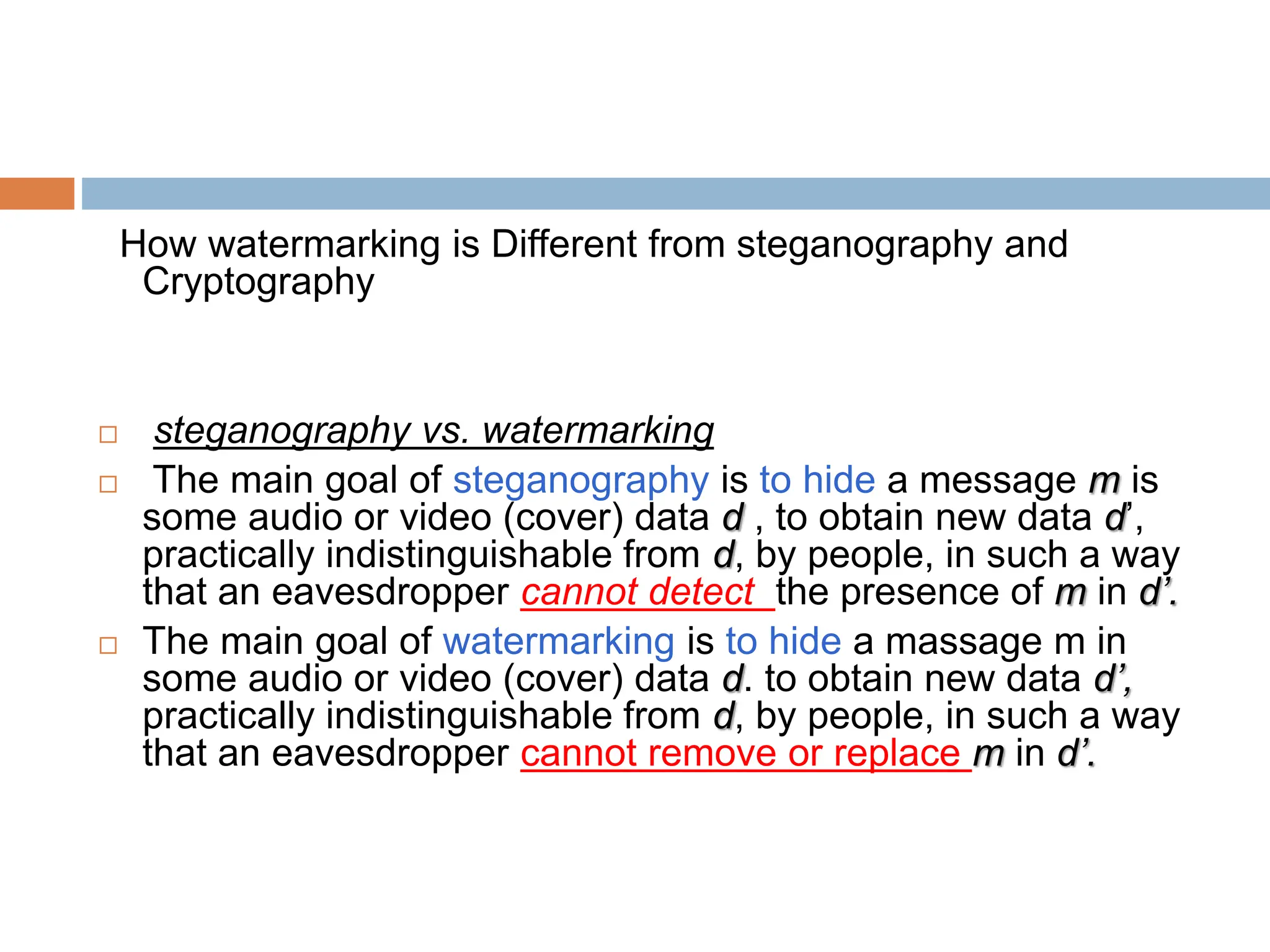
How watermarking is Different from steganography and
Cryptography
 steganography vs. watermarking
 The main goal of steganography is to hide a message m is
some audio or video (cover) data d , to obtain new data d’,
practically indistinguishable from d, by people, in such a way
that an eavesdropper cannot detect the presence of m in d’.
 The main goal of watermarking is to hide a massage m in
some audio or video (cover) data d. to obtain new data d’,
practically indistinguishable from d, by people, in such a way
that an eavesdropper cannot remove or replace m in d’.
Cryptography vs. watermarking
 Cryptography is the most common method of
protecting digital content and is one of the best
developed science
 However, encryption cannot help the seller
monitor how a legitimate customer handles the
content after decryption.
 Digital watermarking can protect content even
after it is decrypted.
Importance of Digital Watermarking
 Alice creates an original image and watermarks it
before passing it to Bob. If bob claims the image
and shells copies to other people Alice can extract
her watermark from the image proving her
copyright to it.
 The caveat here is that Alice will only be able to
prove her copyright of the image if Bob hasn’t
managed to modify the image such that the
watermark is damage enough to be undetectable
or added his own watermark such that it is
impossible to discover which watermark was
embedded first.
WATERMARKING
CLASSIFICATION
Visible & Invisible Watermarking
Robust & Fragile Watermarking
Asymmetric & Symmetric watermarking
Public & Private watermarking
Steganographic & Non-steganographic Watermarking
Visible Watermarking
 Visible watermarking is a translucent overlaid
into an image and is visible to the viewer.
Visible watermarking is used to indicate
ownership and for copyright protection.
Invisible Watermarking
 Invisible watermark is embedded into the data
in such a way that the changes mad to the
pixel values are perceptually not noticed.
Invisible watermark is used as evidence of
ownership and to detect misappropriated
images.
Dual Watermarking
 Dual watermark is the combination of visible
and invisible watermark. An invisible
watermark is used as backup for the visible
watermark.

Digital Watermarking.pptx

  • 1.
  • 2.
  • 3.
    WHAT IS AWATERMARK?  A watermark is a form, image or text that is impressed onto paper, which provides evidence of its authenticity.  A distinguishing mark impressed on paper during manufacture ; visible when paper is held up to the light (e.g. $ Bill)
  • 4.
    WHAT IS DIGITAL WATERMARKING? Digital watermarking is an extension of watermarking concept in the digital world.  A digital watermark is a pattern of bits inserted into a digital image , audio or video file that identified the file’s copyright information (author , right , etc.)
  • 5.
    How watermarking isDifferent from steganography and Cryptography  steganography vs. watermarking  The main goal of steganography is to hide a message m is some audio or video (cover) data d , to obtain new data d’, practically indistinguishable from d, by people, in such a way that an eavesdropper cannot detect the presence of m in d’.  The main goal of watermarking is to hide a massage m in some audio or video (cover) data d. to obtain new data d’, practically indistinguishable from d, by people, in such a way that an eavesdropper cannot remove or replace m in d’.
  • 6.
    Cryptography vs. watermarking Cryptography is the most common method of protecting digital content and is one of the best developed science  However, encryption cannot help the seller monitor how a legitimate customer handles the content after decryption.  Digital watermarking can protect content even after it is decrypted.
  • 7.
    Importance of DigitalWatermarking  Alice creates an original image and watermarks it before passing it to Bob. If bob claims the image and shells copies to other people Alice can extract her watermark from the image proving her copyright to it.  The caveat here is that Alice will only be able to prove her copyright of the image if Bob hasn’t managed to modify the image such that the watermark is damage enough to be undetectable or added his own watermark such that it is impossible to discover which watermark was embedded first.
  • 8.
    WATERMARKING CLASSIFICATION Visible & InvisibleWatermarking Robust & Fragile Watermarking Asymmetric & Symmetric watermarking Public & Private watermarking Steganographic & Non-steganographic Watermarking
  • 9.
    Visible Watermarking  Visiblewatermarking is a translucent overlaid into an image and is visible to the viewer. Visible watermarking is used to indicate ownership and for copyright protection.
  • 10.
    Invisible Watermarking  Invisiblewatermark is embedded into the data in such a way that the changes mad to the pixel values are perceptually not noticed. Invisible watermark is used as evidence of ownership and to detect misappropriated images. Dual Watermarking  Dual watermark is the combination of visible and invisible watermark. An invisible watermark is used as backup for the visible watermark.