Small Scale Research Project
The 8 Critical Approaches
Possible Questions
1
The 8 Critical ApproachesThe 8 Critical Approaches
• Star / Performer
• Genre
• Auteur
• Social and political contexts
• Gender issues
• Ethnicity
• Institution
• Technology
Star / Performer
• You can research an individual or group of
individuals, which could lead to something
such as a ‘star-study’, historical
developments in star status, cultural
relationships the notion of star / performer,
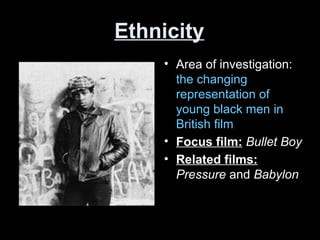
fandom, issues of performance.
Star / Performer
• Area of investigation:
The characteristics of
Rhys Ifans’
performance across
different directors and
production contexts
• Focus film: Enduring
Love
• Related films: Twin
Town and Notting Hill
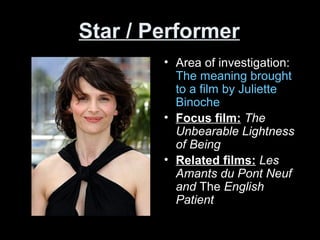
Star / Performer
• Area of investigation:
The meaning brought
to a film by Juliette
Binoche
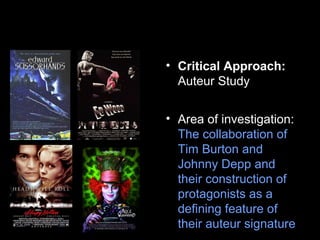
• Focus film: The
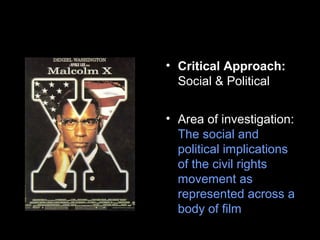
Unbearable Lightness
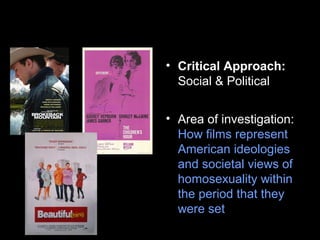
of Being
• Related films: Les
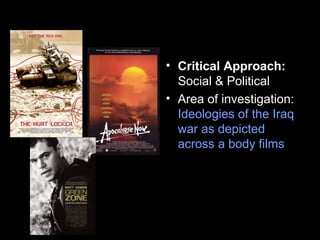
Amants du Pont Neuf
and The English
Patient
Genre
• You could focus your research on a single
genre or a range of genres. This area is
designed for you to develop investigations
that consider film as a structured product
that is designed to relate to other similar
films. You might investigate the evolution
of a genre, consider the idea of national
cinema or look at genre as a cultural
product.
Genre
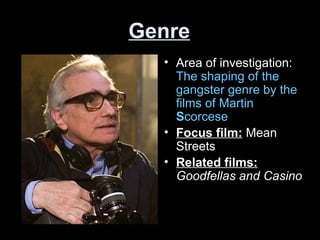
• Area of investigation:
The shaping of the
gangster genre by the
films of Martin
Scorcese
• Focus film: Mean
Streets
• Related films:
Goodfellas and Casino
Genre
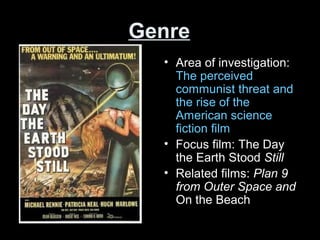
• Area of investigation:
The perceived
communist threat and
the rise of the
American science
fiction film
• Focus film: The Day
the Earth Stood Still
• Related films: Plan 9
from Outer Space and
On the Beach
The Auteur
• allows a film or body of films to be seen in the context of
an authorial voice. It is intended that this context be as
broadly interpreted as possible, and so the traditional
view of an auteur as a single person (usually the
director) is extended to include any individual who
leaves a 'signature' of control (over the production
and/or over meaning) on a film, be they the screenwriter,
the cinematographer, the composer, or even an actor.
Indeed, this is taken further still by considering the
collaborative auteur (two or more individuals who when
they come together on a project leave an unmistakable
signature - Scorsese and DeNiro, for example), and the
institutional auteur (where an institution, be it a studio, a
government agency or a collective, leaves a signature
on a film irrespective of who actually worked on it - the
comedies produced at Ealing demonstrate this well).
The Auteur
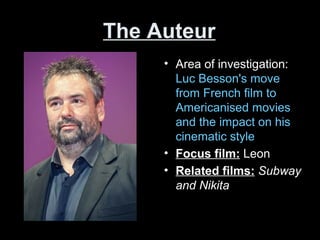
• Area of investigation:
Luc Besson's move
from French film to
Americanised movies
and the impact on his
cinematic style
• Focus film: Leon
• Related films: Subway
and Nikita
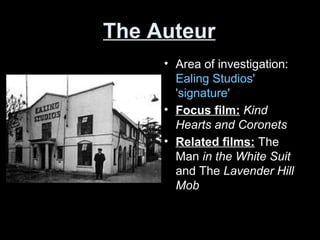
The Auteur
• Area of investigation:
Ealing Studios'
'signature'
• Focus film: Kind
Hearts and Coronets
• Related films: The
Man in the White Suit
and The Lavender Hill
Mob
Social and political contexts
• This could focus on the contexts of the
production of the film, or on the
commentary offered by films on a
particular social or political context (E.G
Iraq War – Farenheit 9-11)
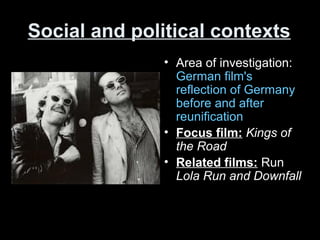
Social and political contexts
• Area of investigation:
German film's
reflection of Germany
before and after
reunification
• Focus film: Kings of
the Road
• Related films: Run
Lola Run and Downfall
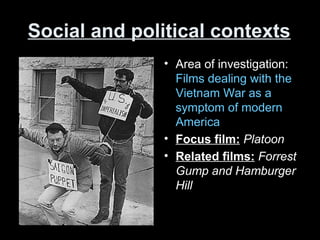
Social and political contexts
• Area of investigation:
Films dealing with the
Vietnam War as a
symptom of modern
America
• Focus film: Platoon
• Related films: Forrest
Gump and Hamburger
Hill
Gender
• encourages an approach that allows the
study of gendered films or gendered
filmmaking, but also one that allows the
study of gendered spectatorship. Issues of
sexuality, of gender, of representation,
and of other related contexts can be
explored either singly or through a
comparative approach (such as
comparing male and female directorial
approaches to the crime movie genre).
Gender
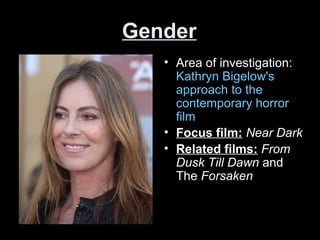
• Area of investigation:
Kathryn Bigelow's
approach to the
contemporary horror
film
• Focus film: Near Dark
• Related films: From
Dusk Till Dawn and
The Forsaken
Ethnicity
• may be explored through diverse
approaches including analysing the
representations within a film, and issues
around those making a film. It should be
viewed as a broad approach that can
include more traditional topics (such as
Sexploitation movies, or the
representation of the American Indian in
the Western genre),
Ethnicity
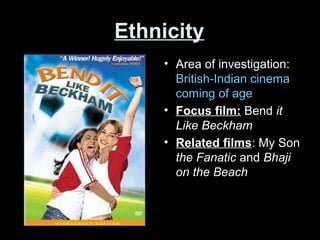
• Area of investigation:
British-Indian cinema
coming of age
• Focus film: Bend it
Like Beckham
• Related films: My Son
the Fanatic and Bhaji
on the Beach
Ethnicity
• Area of investigation:
the changing
representation of
young black men in
British film
• Focus film: Bullet Boy
• Related films:
Pressure and Babylon
Institution
• engages with issues of industry that may have
been stimulated from concepts engaged with in
FM2 British and American film. Most obvious will
be the industrialised production contexts for film
production (the studios ,the production
companies, and even the established methods
of production), but issues around film finance,
producing, law, regulation, distribution,
exhibition and governmental influence over
filmmaking are all valuable areas through which
to contextualise a research project.
Institution
• Area of investigation:
the impact of the Hays
Code
• Focus film: Ecstasy
• Related films: Tarzan
and His Mate and The
Outlaw
Institution
• Area of investigation:
American Cinema -
independence and
success
• Focus film:
Apocalypse Now
• Related films: The
Good Shepherd and
Sleepy Hollow
Technology
• this context is one that encompasses all the
constructional devices in cinema, from
production through to distribution and exhibition
methods. A wide range of investigations can be
contextualised by technology from an historic
approach dealing with a production
development such as the introduction of
surround sound, through to the impact of video
on the industry, or the implication of digital
exhibition (most importantly with the broader
areas of investigation is the need to anchor
them to a particular focus film).
Technology
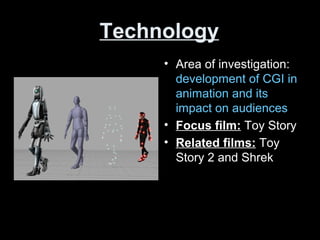
• Area of investigation:
development of CGI in
animation and its
impact on audiences
• Focus film: Toy Story
• Related films: Toy
Story 2 and Shrek
Technology
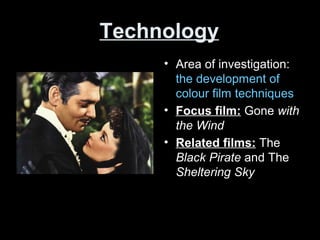
• Area of investigation:
the development of
colour film techniques
• Focus film: Gone with
the Wind
• Related films: The
Black Pirate and The
Sheltering Sky
Other Examples
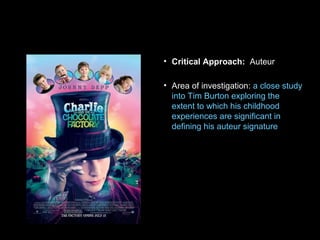
• Critical Approach: Auteur
• Area of investigation: a close study
into Tim Burton exploring the
extent to which his childhood
experiences are significant in
defining his auteur signature
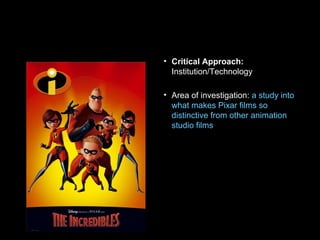
• Critical Approach:
Institution/Technology
• Area of investigation: a study into
what makes Pixar films so
distinctive from other animation
studio films
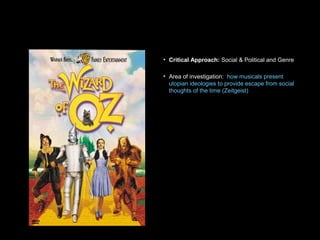
• Critical Approach: Social & Political and Genre
• Area of investigation: how musicals present
utopian ideologies to provide escape from social
thoughts of the time (Zeitgeist)
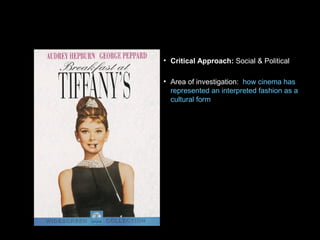
• Critical Approach: Social & Political
• Area of investigation: how cinema has
represented an interpreted fashion as a
cultural form
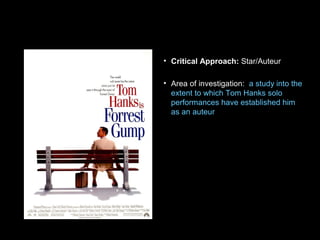
• Critical Approach: Star/Auteur
• Area of investigation: a study into the
extent to which Tom Hanks solo
performances have established him
as an auteur
• Critical Approach:
Social & Political
• Area of investigation:
Representations of
corruption in Africa
and its social and
political effects on
Western perceptions
of Africa
• Critical Approach:
Institution/
Technology
• Area of investigation:
The impact of Pixar
on the development
and reception of
contemporary
animation feature
films
• Critical Approach:
Social & Political
• Area of investigation:
A comparison of
American mainstream
and independent
films and the social
and political
commentary these
films make pertaining
to adolescence
• Critical Approach:
Social & Political
• Area of investigation:
How 1970’s musicals
rebelled against the
societal norms on
gender and sexuality
• Critical Approach:
Auteur Study
• Area of investigation:
The collaboration of
Tim Burton and
Johnny Depp and
their construction of
protagonists as a
defining feature of
their auteur signature
• Critical Approach:
Social & Political
• Area of investigation:
The social and
political implications
of the civil rights
movement as
represented across a
body of film
• Critical Approach:
Social & Political
• Area of investigation:
How films represent
American ideologies
and societal views of
homosexuality within
the period that they
were set
• Critical Approach:
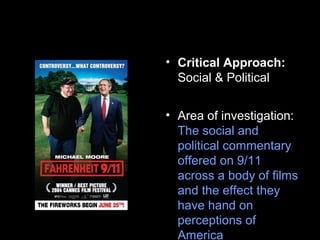
Social & Political
• Area of investigation:
The social and
political commentary
offered on 9/11
across a body of films
and the effect they
have hand on
perceptions of
America
• Critical Approach:
Social & Political
• Area of investigation:
Ideologies of the Iraq
war as depicted
across a body films

The Critical Approaches

  • 1.
    Small Scale ResearchProject The 8 Critical Approaches Possible Questions 1
  • 2.
    The 8 CriticalApproachesThe 8 Critical Approaches • Star / Performer • Genre • Auteur • Social and political contexts • Gender issues • Ethnicity • Institution • Technology
  • 3.
    Star / Performer •You can research an individual or group of individuals, which could lead to something such as a ‘star-study’, historical developments in star status, cultural relationships the notion of star / performer, fandom, issues of performance.
  • 4.
    Star / Performer •Area of investigation: The characteristics of Rhys Ifans’ performance across different directors and production contexts • Focus film: Enduring Love • Related films: Twin Town and Notting Hill
  • 5.
    Star / Performer •Area of investigation: The meaning brought to a film by Juliette Binoche • Focus film: The Unbearable Lightness of Being • Related films: Les Amants du Pont Neuf and The English Patient
  • 6.
    Genre • You couldfocus your research on a single genre or a range of genres. This area is designed for you to develop investigations that consider film as a structured product that is designed to relate to other similar films. You might investigate the evolution of a genre, consider the idea of national cinema or look at genre as a cultural product.
  • 7.
    Genre • Area ofinvestigation: The shaping of the gangster genre by the films of Martin Scorcese • Focus film: Mean Streets • Related films: Goodfellas and Casino
  • 8.
    Genre • Area ofinvestigation: The perceived communist threat and the rise of the American science fiction film • Focus film: The Day the Earth Stood Still • Related films: Plan 9 from Outer Space and On the Beach
  • 9.
    The Auteur • allowsa film or body of films to be seen in the context of an authorial voice. It is intended that this context be as broadly interpreted as possible, and so the traditional view of an auteur as a single person (usually the director) is extended to include any individual who leaves a 'signature' of control (over the production and/or over meaning) on a film, be they the screenwriter, the cinematographer, the composer, or even an actor. Indeed, this is taken further still by considering the collaborative auteur (two or more individuals who when they come together on a project leave an unmistakable signature - Scorsese and DeNiro, for example), and the institutional auteur (where an institution, be it a studio, a government agency or a collective, leaves a signature on a film irrespective of who actually worked on it - the comedies produced at Ealing demonstrate this well).
  • 10.
    The Auteur • Areaof investigation: Luc Besson's move from French film to Americanised movies and the impact on his cinematic style • Focus film: Leon • Related films: Subway and Nikita
  • 11.
    The Auteur • Areaof investigation: Ealing Studios' 'signature' • Focus film: Kind Hearts and Coronets • Related films: The Man in the White Suit and The Lavender Hill Mob
  • 12.
    Social and politicalcontexts • This could focus on the contexts of the production of the film, or on the commentary offered by films on a particular social or political context (E.G Iraq War – Farenheit 9-11)
  • 13.
    Social and politicalcontexts • Area of investigation: German film's reflection of Germany before and after reunification • Focus film: Kings of the Road • Related films: Run Lola Run and Downfall
  • 14.
    Social and politicalcontexts • Area of investigation: Films dealing with the Vietnam War as a symptom of modern America • Focus film: Platoon • Related films: Forrest Gump and Hamburger Hill
  • 15.
    Gender • encourages anapproach that allows the study of gendered films or gendered filmmaking, but also one that allows the study of gendered spectatorship. Issues of sexuality, of gender, of representation, and of other related contexts can be explored either singly or through a comparative approach (such as comparing male and female directorial approaches to the crime movie genre).
  • 16.
    Gender • Area ofinvestigation: Kathryn Bigelow's approach to the contemporary horror film • Focus film: Near Dark • Related films: From Dusk Till Dawn and The Forsaken
  • 17.
    Ethnicity • may beexplored through diverse approaches including analysing the representations within a film, and issues around those making a film. It should be viewed as a broad approach that can include more traditional topics (such as Sexploitation movies, or the representation of the American Indian in the Western genre),
  • 18.
    Ethnicity • Area ofinvestigation: British-Indian cinema coming of age • Focus film: Bend it Like Beckham • Related films: My Son the Fanatic and Bhaji on the Beach
  • 19.
    Ethnicity • Area ofinvestigation: the changing representation of young black men in British film • Focus film: Bullet Boy • Related films: Pressure and Babylon
  • 20.
    Institution • engages withissues of industry that may have been stimulated from concepts engaged with in FM2 British and American film. Most obvious will be the industrialised production contexts for film production (the studios ,the production companies, and even the established methods of production), but issues around film finance, producing, law, regulation, distribution, exhibition and governmental influence over filmmaking are all valuable areas through which to contextualise a research project.
  • 21.
    Institution • Area ofinvestigation: the impact of the Hays Code • Focus film: Ecstasy • Related films: Tarzan and His Mate and The Outlaw
  • 22.
    Institution • Area ofinvestigation: American Cinema - independence and success • Focus film: Apocalypse Now • Related films: The Good Shepherd and Sleepy Hollow
  • 23.
    Technology • this contextis one that encompasses all the constructional devices in cinema, from production through to distribution and exhibition methods. A wide range of investigations can be contextualised by technology from an historic approach dealing with a production development such as the introduction of surround sound, through to the impact of video on the industry, or the implication of digital exhibition (most importantly with the broader areas of investigation is the need to anchor them to a particular focus film).
  • 24.
    Technology • Area ofinvestigation: development of CGI in animation and its impact on audiences • Focus film: Toy Story • Related films: Toy Story 2 and Shrek
  • 25.
    Technology • Area ofinvestigation: the development of colour film techniques • Focus film: Gone with the Wind • Related films: The Black Pirate and The Sheltering Sky
  • 26.
  • 27.
    • Critical Approach:Auteur • Area of investigation: a close study into Tim Burton exploring the extent to which his childhood experiences are significant in defining his auteur signature
  • 28.
    • Critical Approach: Institution/Technology •Area of investigation: a study into what makes Pixar films so distinctive from other animation studio films
  • 29.
    • Critical Approach:Social & Political and Genre • Area of investigation: how musicals present utopian ideologies to provide escape from social thoughts of the time (Zeitgeist)
  • 30.
    • Critical Approach:Social & Political • Area of investigation: how cinema has represented an interpreted fashion as a cultural form
  • 31.
    • Critical Approach:Star/Auteur • Area of investigation: a study into the extent to which Tom Hanks solo performances have established him as an auteur
  • 32.
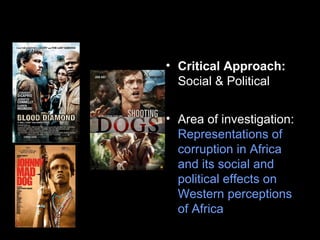
    • Critical Approach: Social& Political • Area of investigation: Representations of corruption in Africa and its social and political effects on Western perceptions of Africa
  • 33.
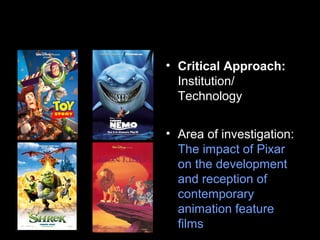
    • Critical Approach: Institution/ Technology •Area of investigation: The impact of Pixar on the development and reception of contemporary animation feature films
  • 34.
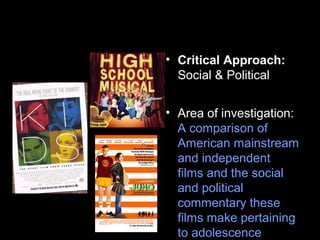
    • Critical Approach: Social& Political • Area of investigation: A comparison of American mainstream and independent films and the social and political commentary these films make pertaining to adolescence
  • 35.
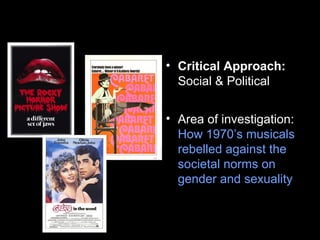
    • Critical Approach: Social& Political • Area of investigation: How 1970’s musicals rebelled against the societal norms on gender and sexuality
  • 36.
    • Critical Approach: AuteurStudy • Area of investigation: The collaboration of Tim Burton and Johnny Depp and their construction of protagonists as a defining feature of their auteur signature
  • 37.
    • Critical Approach: Social& Political • Area of investigation: The social and political implications of the civil rights movement as represented across a body of film
  • 38.
    • Critical Approach: Social& Political • Area of investigation: How films represent American ideologies and societal views of homosexuality within the period that they were set
  • 39.
    • Critical Approach: Social& Political • Area of investigation: The social and political commentary offered on 9/11 across a body of films and the effect they have hand on perceptions of America
  • 40.
    • Critical Approach: Social& Political • Area of investigation: Ideologies of the Iraq war as depicted across a body films