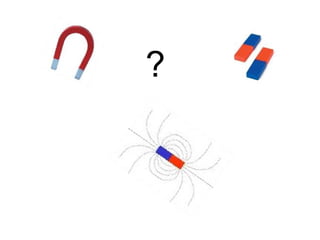
?
7 questions – to get you thinking
1) How many poles does a magnet have?
2) What are the magnetic metals?
3) Why does the Earth have a magnetic field and what is
it useful for?
4) What is the shape of a magnetic field? (iron filings
experiment)
5) What is the advantage of an electromagnet over a
permanent magnet?
6) What does a magnetic field around a wire look like?
7) What is the difference between static, magnetism
What we are going to be covering
today
1)Reminder of the basic properties of
magnets.
2) Important terminology:
Magnetic flux density, B-field and definition
of the Tesla.
3) Force on a current-carrying wire in a
magnetic field. (F = B I L) when field is
perpendicular to current .
4) Fleming’s left hand rule.
111
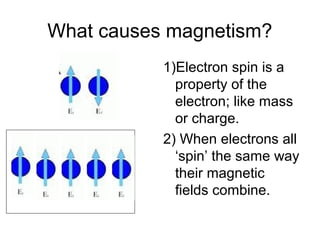
What causes magnetism?
1)Electron spin is a
property of the
electron; like mass
or charge.
2) When electrons all
‘spin’ the same way
their magnetic
fields combine.
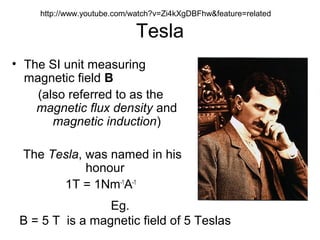
Tesla
• The SI unit measuring
magnetic field B
(also referred to as the
magnetic flux density and
magnetic induction)
The Tesla, was named in his
honour
1T = 1Nm-1
A-1
Eg.
B = 5 T is a magnetic field of 5 Teslas
http://www.youtube.com/watch?v=Zi4kXgDBFhw&feature=related
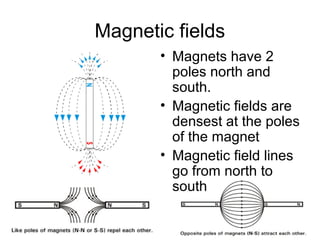
Magnetic fields
• Magnets have 2
poles north and
south.
• Magnetic fields are
densest at the poles
of the magnet
• Magnetic field lines
go from north to
south
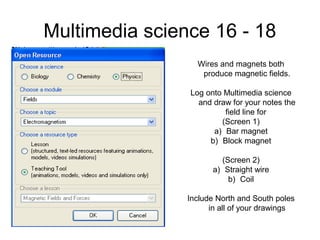
Multimedia science 16 - 18
Wires and magnets both
produce magnetic fields.
Log onto Multimedia science
and draw for your notes the
field line for
(Screen 1)
a) Bar magnet
b) Block magnet
(Screen 2)
a) Straight wire
b) Coil
Include North and South poles
in all of your drawings
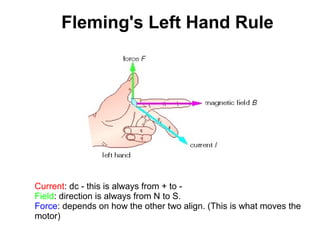
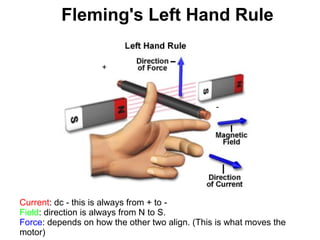
Fleming's Left Hand Rule
Current: dc - this is always from + to -
Field: direction is always from N to S.
Force: depends on how the other two align. (This is what moves the
motor)
Fleming's Left Hand Rule
+
-
Current: dc - this is always from + to -
Field: direction is always from N to S.
Force: depends on how the other two align. (This is what moves the
motor)
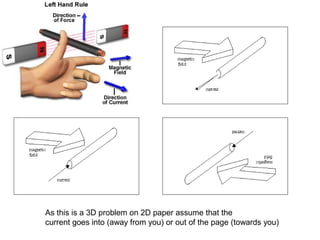
As this is a 3D problem on 2D paper assume that the
current goes into (away from you) or out of the page (towards you)
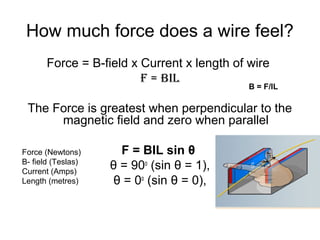
How much force does a wire feel?
Force = B-field x Current x length of wire
F = BIl
The Force is greatest when perpendicular to the
magnetic field and zero when parallel
F = BIL sin θ
θ = 90o
(sin θ = 1),
θ = 0o
(sin θ = 0),
B = F/IL
Force (Newtons)
B- field (Teslas)
Current (Amps)
Length (metres)
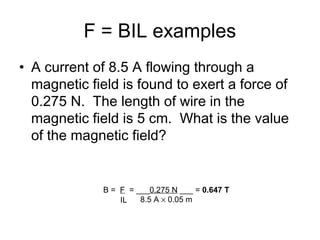
F = BIL examples
• A current of 8.5 A flowing through a
magnetic field is found to exert a force of
0.275 N. The length of wire in the
magnetic field is 5 cm. What is the value
of the magnetic field?
B = F = ___0.275 N ___ = 0.647 T
8.5 A × 0.05 mIL
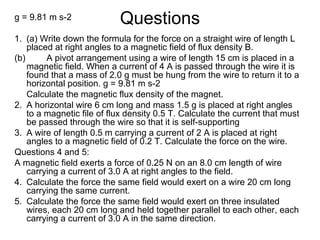
Questionsg = 9.81 m s-2
1. (a) Write down the formula for the force on a straight wire of length L
placed at right angles to a magnetic field of flux density B.
(b) A pivot arrangement using a wire of length 15 cm is placed in a
magnetic field. When a current of 4 A is passed through the wire it is
found that a mass of 2.0 g must be hung from the wire to return it to a
horizontal position. g = 9.81 m s-2
Calculate the magnetic flux density of the magnet.
2. A horizontal wire 6 cm long and mass 1.5 g is placed at right angles
to a magnetic file of flux density 0.5 T. Calculate the current that must
be passed through the wire so that it is self-supporting
3. A wire of length 0.5 m carrying a current of 2 A is placed at right
angles to a magnetic field of 0.2 T. Calculate the force on the wire.
Questions 4 and 5:
A magnetic field exerts a force of 0.25 N on an 8.0 cm length of wire
carrying a current of 3.0 A at right angles to the field.
4. Calculate the force the same field would exert on a wire 20 cm long
carrying the same current.
5. Calculate the force the same field would exert on three insulated
wires, each 20 cm long and held together parallel to each other, each
carrying a current of 3.0 A in the same direction.
Answers and worked solutions
1(a) F = BIL
(b) B=F/IL
B = [2.0 x 10-3 x 9.81]/ [4 x 0.15] = 0.0327 T
(Remember to change grams to kg and centimetres to metres)
2 Weight of mass required = BIL
Therefore: 1.5 x 10-3 x 9.81 = 0.5 x I x 0.06 giving I = 0.49 A
3 F = BIL = 0.2 x 2 x 0.5 = 0.2 N
4 For 20 cm length
5. If each wire carries 3.0 A this is the same as effective current of 9.0 A,
so force F = 3 ´ 0.625 = 1.9 N.
N.625.0
cm8
cm20
N25.0 =×=F
Making motors
Multimedia 11-16 motors and Flemming’s
left hand rule
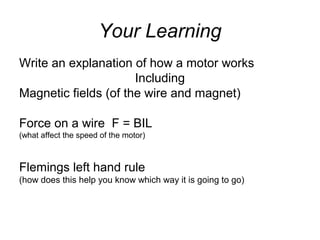
Your Learning
Write an explanation of how a motor works
Including
Magnetic fields (of the wire and magnet)
Force on a wire F = BIL
(what affect the speed of the motor)
Flemings left hand rule
(how does this help you know which way it is going to go)

Magnets1

  • 1.
  • 2.
    7 questions –to get you thinking 1) How many poles does a magnet have? 2) What are the magnetic metals? 3) Why does the Earth have a magnetic field and what is it useful for? 4) What is the shape of a magnetic field? (iron filings experiment) 5) What is the advantage of an electromagnet over a permanent magnet? 6) What does a magnetic field around a wire look like? 7) What is the difference between static, magnetism
  • 3.
    What we aregoing to be covering today 1)Reminder of the basic properties of magnets. 2) Important terminology: Magnetic flux density, B-field and definition of the Tesla. 3) Force on a current-carrying wire in a magnetic field. (F = B I L) when field is perpendicular to current . 4) Fleming’s left hand rule.
  • 4.
    111 What causes magnetism? 1)Electronspin is a property of the electron; like mass or charge. 2) When electrons all ‘spin’ the same way their magnetic fields combine.
  • 5.
    Tesla • The SIunit measuring magnetic field B (also referred to as the magnetic flux density and magnetic induction) The Tesla, was named in his honour 1T = 1Nm-1 A-1 Eg. B = 5 T is a magnetic field of 5 Teslas http://www.youtube.com/watch?v=Zi4kXgDBFhw&feature=related
  • 6.
    Magnetic fields • Magnetshave 2 poles north and south. • Magnetic fields are densest at the poles of the magnet • Magnetic field lines go from north to south
  • 7.
    Multimedia science 16- 18 Wires and magnets both produce magnetic fields. Log onto Multimedia science and draw for your notes the field line for (Screen 1) a) Bar magnet b) Block magnet (Screen 2) a) Straight wire b) Coil Include North and South poles in all of your drawings
  • 8.
    Fleming's Left HandRule Current: dc - this is always from + to - Field: direction is always from N to S. Force: depends on how the other two align. (This is what moves the motor)
  • 9.
    Fleming's Left HandRule + - Current: dc - this is always from + to - Field: direction is always from N to S. Force: depends on how the other two align. (This is what moves the motor)
  • 10.
    As this isa 3D problem on 2D paper assume that the current goes into (away from you) or out of the page (towards you)
  • 11.
    How much forcedoes a wire feel? Force = B-field x Current x length of wire F = BIl The Force is greatest when perpendicular to the magnetic field and zero when parallel F = BIL sin θ θ = 90o (sin θ = 1), θ = 0o (sin θ = 0), B = F/IL Force (Newtons) B- field (Teslas) Current (Amps) Length (metres)
  • 12.
    F = BILexamples • A current of 8.5 A flowing through a magnetic field is found to exert a force of 0.275 N. The length of wire in the magnetic field is 5 cm. What is the value of the magnetic field? B = F = ___0.275 N ___ = 0.647 T 8.5 A × 0.05 mIL
  • 13.
    Questionsg = 9.81m s-2 1. (a) Write down the formula for the force on a straight wire of length L placed at right angles to a magnetic field of flux density B. (b) A pivot arrangement using a wire of length 15 cm is placed in a magnetic field. When a current of 4 A is passed through the wire it is found that a mass of 2.0 g must be hung from the wire to return it to a horizontal position. g = 9.81 m s-2 Calculate the magnetic flux density of the magnet. 2. A horizontal wire 6 cm long and mass 1.5 g is placed at right angles to a magnetic file of flux density 0.5 T. Calculate the current that must be passed through the wire so that it is self-supporting 3. A wire of length 0.5 m carrying a current of 2 A is placed at right angles to a magnetic field of 0.2 T. Calculate the force on the wire. Questions 4 and 5: A magnetic field exerts a force of 0.25 N on an 8.0 cm length of wire carrying a current of 3.0 A at right angles to the field. 4. Calculate the force the same field would exert on a wire 20 cm long carrying the same current. 5. Calculate the force the same field would exert on three insulated wires, each 20 cm long and held together parallel to each other, each carrying a current of 3.0 A in the same direction.
  • 14.
    Answers and workedsolutions 1(a) F = BIL (b) B=F/IL B = [2.0 x 10-3 x 9.81]/ [4 x 0.15] = 0.0327 T (Remember to change grams to kg and centimetres to metres) 2 Weight of mass required = BIL Therefore: 1.5 x 10-3 x 9.81 = 0.5 x I x 0.06 giving I = 0.49 A 3 F = BIL = 0.2 x 2 x 0.5 = 0.2 N 4 For 20 cm length 5. If each wire carries 3.0 A this is the same as effective current of 9.0 A, so force F = 3 ´ 0.625 = 1.9 N. N.625.0 cm8 cm20 N25.0 =×=F
  • 15.
    Making motors Multimedia 11-16motors and Flemming’s left hand rule
  • 16.
    Your Learning Write anexplanation of how a motor works Including Magnetic fields (of the wire and magnet) Force on a wire F = BIL (what affect the speed of the motor) Flemings left hand rule (how does this help you know which way it is going to go)