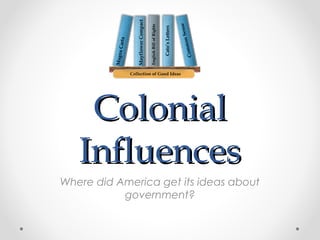
Sense
on
Comm

Cato’s Letters

English Bill of Rights

Mayflower Compact

Magna
Carta

Collection of Good Ideas

Colonial
Influences
Where did America get its ideas about
government?
What’s the big idea?
• Rule of Law
o All people must follow the laws, and the laws should be enforced
fairly.

• Self Government
o People can make decisions on how their government should work.

• Due Process
o People have the right to fair and reasonable laws. Officials have to
follow rules when enforcing laws and need to treat all people in the
same way.

• Limited Government
o A government that has been limited in power by a constitution, or
written agreement.

• Rights
o A set of things that people believe they should be free to do without
restrictions.
Cut-and-Fold Instructions
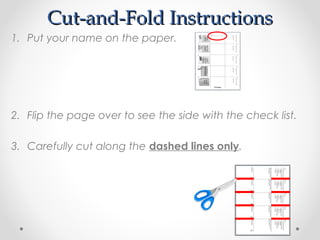
1. Put your name on the paper.

2. Flip the page over to see the side with the check list.
3. Carefully cut along the dashed lines only.
Cut-and-Fold Instructions

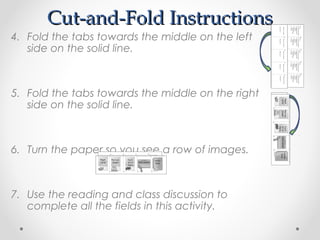
4. Fold the tabs towards the middle on the left
side on the solid line.

5. Fold the tabs towards the middle on the right
side on the solid line.

6. Turn the paper so you see a row of images.

7. Use the reading and class discussion to
complete all the fields in this activity.
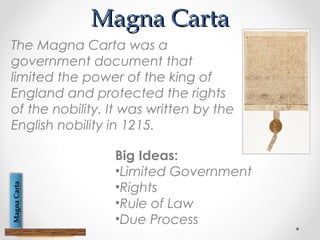
Magna Carta

Magna Carta

The Magna Carta was a
government document that
limited the power of the king of
England and protected the rights
of the nobility. It was written by the
English nobility in 1215.
Big Ideas:
•Limited Government
•Rights
•Rule of Law
•Due Process
Mayflower Compact

Mayflower Compact

Magna Carta

The Mayflower Compact was an
agreement among individuals that created
a government that would provide order
and protect the rights of the colonists. It was
written by a group of English Pilgrims as they
traveled to Massachusetts in 1620.
Big Ideas:
•Self Government
•Rule of Law
English Bill of Rights

English Bill of Rights

Mayflower Compact

Magna Carta

The English Bill of Rights was a government
document that expanded the powers of
the English Parliament and expanded the
rights of the people, as well as further limited
the rights of the king. It was written by the
members of the English Parliament in 1689.
Big Ideas:
•Limited Government
•Rights
•Due Process
•Rule of Law
Cato’s Letters

Cato’s Letters

English Bill of Rights

Mayflower Compact

Magna Carta

Cato’s Letters were made up of a collection
of newspaper articles published to convince
people to support the freedom of
expression and to fight against the heavy
handed rule of the British government. They
were written by two anonymous English
journalists in the 1720’s.
Big Ideas:
•Rights
•Rule of Law
Common Sense

Common Sense

Cato’s Letters

English Bill of Rights

Mayflower Compact

Magna Carta

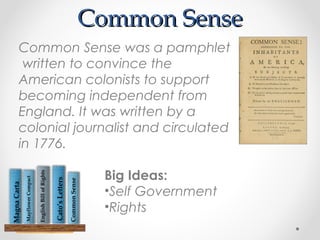
Common Sense was a pamphlet
written to convince the
American colonists to support
becoming independent from
England. It was written by a
colonial journalist and circulated
in 1776.
Big Ideas:
•Self Government
•Rights
From Big Ideas to the
Constitution
The movers and shakers in the colonial
period spent a lot of time thinking about
these big ideas, and how to put them into
practice.
Give it a try yourself by matching each
aspect of the U.S. Constitution to the big
ideas that you just learned about.
From Big Ideas to the
Constitution
A

“This Constitution and the laws of the United States ... shall be the supreme law of the
land.” All government officials “shall be bound by an oath to support this constitution.”
U.S. Constitution, Article VI

Self– Government:
popular or representative
system where the people
create and run their own
government

Rule of Law: the idea that
all people must follow the
laws, and that the laws are
enforced fairly
Due Process: People have the
right to fair and reasonable laws.
Officials have to follow rules
when enforcing the laws and treat
all people in the same way.

Rights: A set of things that
people believe they should
be free to do without
restrictions

A

Limited Government:
the power of government is
limited by the Constitution,
and each branch is limited
in what it can do
B

From Big Ideas to the
Constitution

The first ten amendments in the Bill of Rights guarantee certain rights and freedoms that
include:
•Freedom of speech, the press, and religion
•Right to petition the government and to bear arms
•Prohibition of excessive bail or fines, or cruel and unusual punishments for crimes
Self– Government:
popular or representative
system where the people
create and run their own
government

Rule of Law: the idea that
all people must follow the
laws, and that the laws are
enforced fairly
Due Process: People have the
right to fair and reasonable laws.
Officials have to follow rules
when enforcing the laws and treat
all people in the same way.

Rights: A set of things that
people believe they should
be free to do without
restrictions

B

Limited Government:
the power of government is
limited by the Constitution,
and each branch is limited
in what it can do
C

From Big Ideas to the
Constitution

The U.S. Constitution created three branches of government. Each branch is given the
power to check, or limit the power of the other two. The system of checks and balances
keeps any one branch from getting too powerful.

Self– Government:
popular or representative
system where the people
create and run their own
government

Rule of Law: the idea that
all people must follow the
laws, and that the laws are
enforced fairly
Due Process: People have the
right to fair and reasonable laws.
Officials have to follow rules
when enforcing the laws and treat
all people in the same way.

Rights: A set of things that
people believe they should
be free to do without
restrictions

Limited Government:
the power of government is
limited by the Constitution,
and each branch is limited
in what it can do

C
D

From Big Ideas to the
Constitution

“ No person shall...be deprived of life, liberty, or property, without due process of law”
U.S. Constitution, 5th Amendment

Self– Government:
popular or representative
system where the people
create and run their own
government

Rule of Law: the idea that
all people must follow the
laws, and that the laws are
enforced fairly
Due Process: People have the
right to fair and reasonable laws.
Officials have to follow rules
when enforcing the laws and treat
all people in the same way.

Rights: A set of things that
people believe they should
be free to do without
restrictions

D

Limited Government:
the power of government is
limited by the Constitution,
and each branch is limited
in what it can do
E

From Big Ideas to the
Constitution

“WE THE PEOPLE of the United States...do ordain and establish this Constitution for the
United States of America.”
Preamble to the Constitution, 1787

Self– Government:
popular or representative
system where the people
create and run their own
government

E

Rule of Law: the idea that
all people must follow the
laws, and that the laws are
enforced fairly
Due Process: People have the
right to fair and reasonable laws.
Officials have to follow rules
when enforcing the laws and treat
all people in the same way.

Rights: A set of things that
people believe they should
be free to do without
restrictions

Limited Government:
the power of government is
limited by the Constitution,
and each branch is limited
in what it can do

Colonial influences ppt

  • 1.
    Sense on Comm Cato’s Letters English Billof Rights Mayflower Compact Magna Carta Collection of Good Ideas Colonial Influences Where did America get its ideas about government?
  • 2.
    What’s the bigidea? • Rule of Law o All people must follow the laws, and the laws should be enforced fairly. • Self Government o People can make decisions on how their government should work. • Due Process o People have the right to fair and reasonable laws. Officials have to follow rules when enforcing laws and need to treat all people in the same way. • Limited Government o A government that has been limited in power by a constitution, or written agreement. • Rights o A set of things that people believe they should be free to do without restrictions.
  • 3.
    Cut-and-Fold Instructions 1. Putyour name on the paper. 2. Flip the page over to see the side with the check list. 3. Carefully cut along the dashed lines only.
  • 4.
    Cut-and-Fold Instructions 4. Foldthe tabs towards the middle on the left side on the solid line. 5. Fold the tabs towards the middle on the right side on the solid line. 6. Turn the paper so you see a row of images. 7. Use the reading and class discussion to complete all the fields in this activity.
  • 5.
    Magna Carta Magna Carta TheMagna Carta was a government document that limited the power of the king of England and protected the rights of the nobility. It was written by the English nobility in 1215. Big Ideas: •Limited Government •Rights •Rule of Law •Due Process
  • 6.
    Mayflower Compact Mayflower Compact MagnaCarta The Mayflower Compact was an agreement among individuals that created a government that would provide order and protect the rights of the colonists. It was written by a group of English Pilgrims as they traveled to Massachusetts in 1620. Big Ideas: •Self Government •Rule of Law
  • 7.
    English Bill ofRights English Bill of Rights Mayflower Compact Magna Carta The English Bill of Rights was a government document that expanded the powers of the English Parliament and expanded the rights of the people, as well as further limited the rights of the king. It was written by the members of the English Parliament in 1689. Big Ideas: •Limited Government •Rights •Due Process •Rule of Law
  • 8.
    Cato’s Letters Cato’s Letters EnglishBill of Rights Mayflower Compact Magna Carta Cato’s Letters were made up of a collection of newspaper articles published to convince people to support the freedom of expression and to fight against the heavy handed rule of the British government. They were written by two anonymous English journalists in the 1720’s. Big Ideas: •Rights •Rule of Law
  • 9.
    Common Sense Common Sense Cato’sLetters English Bill of Rights Mayflower Compact Magna Carta Common Sense was a pamphlet written to convince the American colonists to support becoming independent from England. It was written by a colonial journalist and circulated in 1776. Big Ideas: •Self Government •Rights
  • 10.
    From Big Ideasto the Constitution The movers and shakers in the colonial period spent a lot of time thinking about these big ideas, and how to put them into practice. Give it a try yourself by matching each aspect of the U.S. Constitution to the big ideas that you just learned about.
  • 11.
    From Big Ideasto the Constitution A “This Constitution and the laws of the United States ... shall be the supreme law of the land.” All government officials “shall be bound by an oath to support this constitution.” U.S. Constitution, Article VI Self– Government: popular or representative system where the people create and run their own government Rule of Law: the idea that all people must follow the laws, and that the laws are enforced fairly Due Process: People have the right to fair and reasonable laws. Officials have to follow rules when enforcing the laws and treat all people in the same way. Rights: A set of things that people believe they should be free to do without restrictions A Limited Government: the power of government is limited by the Constitution, and each branch is limited in what it can do
  • 12.
    B From Big Ideasto the Constitution The first ten amendments in the Bill of Rights guarantee certain rights and freedoms that include: •Freedom of speech, the press, and religion •Right to petition the government and to bear arms •Prohibition of excessive bail or fines, or cruel and unusual punishments for crimes Self– Government: popular or representative system where the people create and run their own government Rule of Law: the idea that all people must follow the laws, and that the laws are enforced fairly Due Process: People have the right to fair and reasonable laws. Officials have to follow rules when enforcing the laws and treat all people in the same way. Rights: A set of things that people believe they should be free to do without restrictions B Limited Government: the power of government is limited by the Constitution, and each branch is limited in what it can do
  • 13.
    C From Big Ideasto the Constitution The U.S. Constitution created three branches of government. Each branch is given the power to check, or limit the power of the other two. The system of checks and balances keeps any one branch from getting too powerful. Self– Government: popular or representative system where the people create and run their own government Rule of Law: the idea that all people must follow the laws, and that the laws are enforced fairly Due Process: People have the right to fair and reasonable laws. Officials have to follow rules when enforcing the laws and treat all people in the same way. Rights: A set of things that people believe they should be free to do without restrictions Limited Government: the power of government is limited by the Constitution, and each branch is limited in what it can do C
  • 14.
    D From Big Ideasto the Constitution “ No person shall...be deprived of life, liberty, or property, without due process of law” U.S. Constitution, 5th Amendment Self– Government: popular or representative system where the people create and run their own government Rule of Law: the idea that all people must follow the laws, and that the laws are enforced fairly Due Process: People have the right to fair and reasonable laws. Officials have to follow rules when enforcing the laws and treat all people in the same way. Rights: A set of things that people believe they should be free to do without restrictions D Limited Government: the power of government is limited by the Constitution, and each branch is limited in what it can do
  • 15.
    E From Big Ideasto the Constitution “WE THE PEOPLE of the United States...do ordain and establish this Constitution for the United States of America.” Preamble to the Constitution, 1787 Self– Government: popular or representative system where the people create and run their own government E Rule of Law: the idea that all people must follow the laws, and that the laws are enforced fairly Due Process: People have the right to fair and reasonable laws. Officials have to follow rules when enforcing the laws and treat all people in the same way. Rights: A set of things that people believe they should be free to do without restrictions Limited Government: the power of government is limited by the Constitution, and each branch is limited in what it can do