ISA-95 Overview
• ISA-95, also known as ANSI/ISA-95 or ISA-95 Enterprise-
Control System Integration, is a set of standards developed by
the International Society of Automation (ISA) for integrating
enterprise and control systems.
• It provides a framework for defining the interface between
business systems (such as ERP) and manufacturing systems
(such as PLCs and SCADA systems), allowing them to
communicate and exchange data seamlessly.
• ISA-95 defines standard models for information exchange
between different systems and provides a common terminology
for discussing manufacturing operations.
Limitations of ISA-95 in Modern Networks
• ISA-95 was developed in the 1990s, before the widespread adoption
of modern technologies such as cloud computing, the internet of
things (IoT), and artificial intelligence (AI).
• As a result, it may not be sufficient for addressing the complex
challenges of modern networks, where there is a need for greater
flexibility, agility, and scalability.
• For example, modern networks require real-time data processing
and analysis, which ISA-95 was not designed to handle.
• Additionally, modern networks often involve multiple layers of
abstraction, which can make it difficult to map onto the ISA-95
model.
Impact of IoT on ISA-95 Model
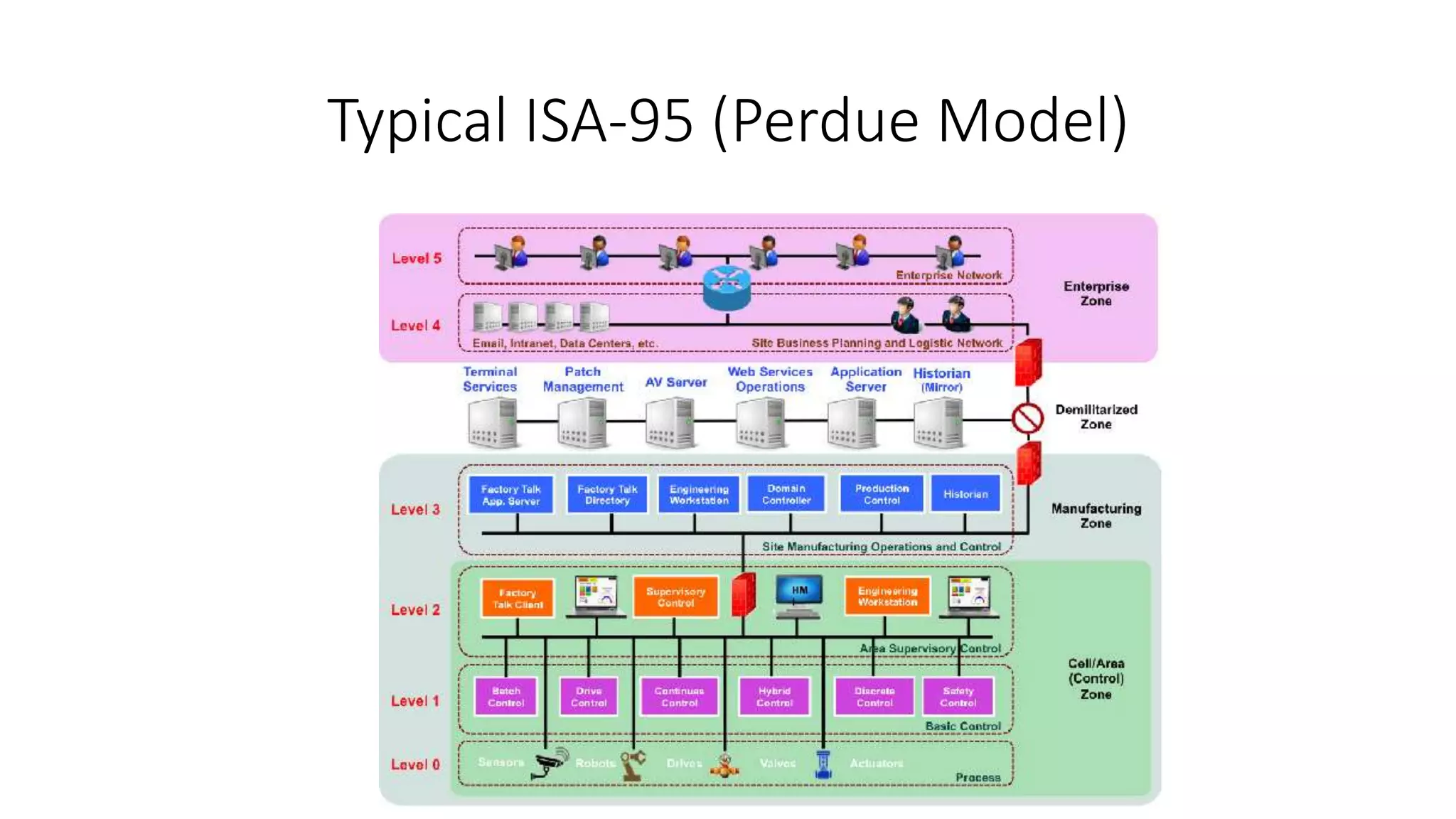
• In the IoT era, the flow of data is no longer strictly hierarchical
as prescribed in the ISA-95 model.
• As intelligence is added to sensors and actuators (Level 0) and
controllers (Level 1), new potentials for control system exposure
are occurring much further down the pyramid than the Model
ever considered.
• This means that the traditional ISA-95 model may not be
sufficient to address the challenges of modern networks, which
require new standards and approaches that can accommodate
the complex and dynamic nature of IoT systems.
Conclusion
• ISA-95 has been an important standard for integrating enterprise and
control systems, providing a common framework and terminology for
manufacturing operations.
• However, it was developed before the widespread adoption of
modern technologies such as cloud computing, IoT, and AI, and may
not be sufficient to address the challenges of modern networks.
• In particular, the hierarchical nature of the ISA-95 model may not be
suitable for the complex and dynamic nature of IoT systems.
• As a result, new standards and approaches are needed to address
the challenges of modern networks and ensure the safe and
effective integration of enterprise and control systems.
ISA-95 Controls
Typical ISA-95 (Perdue Model)
Accounting for modern flows
ISA-95 Architecture Diagram
Firewall
Firewall
Corporate
Network
L5
Corporate
Logistics
L4
Industrial
DMZ
Manufacturing
Operations
L3
Local HMI
L2
Controller
L1
Field Devices
L0
Admin Building
Site 2 Site 3
Remote Access
Domain
Controllers
App
Server
Switch Stack
ISP 1 ISP2
Main Floor Site 2
Main Floor Site 3
Site 2
Site 3
Corporate
Workstations
Firewall
SCCM Remote Access Application
AV
Engineering
Workstations
Engineering
Workstations
Engineering
Workstations
Cameras Cameras Cameras
Door Access
HVAC
Cloud
Services
(M365,
AWS, Private
Cloud, SSO
Providers)
SCADA Server
App Server
Robotics
Field Controller
Field Controller Field Controller
Field Controller
App Server App Server
Database
Actuator
Actuator Actuator
Actuator
Actuator
Actuator
Domain
Controllers
Historian Historian
Modern ISA-95 DataFlow Diagram

ISA-95.pptx

  • 2.
    ISA-95 Overview • ISA-95,also known as ANSI/ISA-95 or ISA-95 Enterprise- Control System Integration, is a set of standards developed by the International Society of Automation (ISA) for integrating enterprise and control systems. • It provides a framework for defining the interface between business systems (such as ERP) and manufacturing systems (such as PLCs and SCADA systems), allowing them to communicate and exchange data seamlessly. • ISA-95 defines standard models for information exchange between different systems and provides a common terminology for discussing manufacturing operations.
  • 3.
    Limitations of ISA-95in Modern Networks • ISA-95 was developed in the 1990s, before the widespread adoption of modern technologies such as cloud computing, the internet of things (IoT), and artificial intelligence (AI). • As a result, it may not be sufficient for addressing the complex challenges of modern networks, where there is a need for greater flexibility, agility, and scalability. • For example, modern networks require real-time data processing and analysis, which ISA-95 was not designed to handle. • Additionally, modern networks often involve multiple layers of abstraction, which can make it difficult to map onto the ISA-95 model.
  • 4.
    Impact of IoTon ISA-95 Model • In the IoT era, the flow of data is no longer strictly hierarchical as prescribed in the ISA-95 model. • As intelligence is added to sensors and actuators (Level 0) and controllers (Level 1), new potentials for control system exposure are occurring much further down the pyramid than the Model ever considered. • This means that the traditional ISA-95 model may not be sufficient to address the challenges of modern networks, which require new standards and approaches that can accommodate the complex and dynamic nature of IoT systems.
  • 5.
    Conclusion • ISA-95 hasbeen an important standard for integrating enterprise and control systems, providing a common framework and terminology for manufacturing operations. • However, it was developed before the widespread adoption of modern technologies such as cloud computing, IoT, and AI, and may not be sufficient to address the challenges of modern networks. • In particular, the hierarchical nature of the ISA-95 model may not be suitable for the complex and dynamic nature of IoT systems. • As a result, new standards and approaches are needed to address the challenges of modern networks and ensure the safe and effective integration of enterprise and control systems.
  • 6.
  • 7.
  • 8.
  • 9.
    ISA-95 Architecture Diagram Firewall Firewall Corporate Network L5 Corporate Logistics L4 Industrial DMZ Manufacturing Operations L3 LocalHMI L2 Controller L1 Field Devices L0 Admin Building Site 2 Site 3 Remote Access Domain Controllers App Server Switch Stack ISP 1 ISP2 Main Floor Site 2 Main Floor Site 3 Site 2 Site 3 Corporate Workstations Firewall SCCM Remote Access Application AV Engineering Workstations Engineering Workstations Engineering Workstations Cameras Cameras Cameras Door Access HVAC Cloud Services (M365, AWS, Private Cloud, SSO Providers) SCADA Server App Server Robotics Field Controller Field Controller Field Controller Field Controller Field Controller Field Controller App Server App Server Database Actuator Actuator Actuator Actuator Actuator Actuator Domain Controllers Historian Historian
  • 10.