4
CLASSROOM STRUCTURES WHICH ENCOURAGE STUDENT PARTICIPATION
METHOD DEFINITION WHEN USED PREPARATION/PROCEDURE LIMITATION
Group
Discussion.
Prepare one or two questions on
the subject to give each group.
Divide the members into small
clusters of four to six. A leader is
chosen to record and report
pertinent ideas discussed.
Thought must be given as to the
purpose and organization of groups.
Panel Discussion. As a technique to stimulate
interest and thinking, and to
provoke better discussion.
Members are often not objective
towards the subject.
Opportunity for pooling of
ideas, experience, and
knowledge.
For majority of meetings because
of adaptability to greater group
participation.
Preplanning to develop discussion
outline. Leader encourages every
member to participate by guiding
the discussion.
Practical with not more than twenty
persons. Becomes disorganized without
careful planning of material to be
covered.
Buzz Groups. Allows for total participation by
group members through small
clusters of participants, followed
by discussion of the entire group.
As a technique to get participa-
tion from every individual in the
group. Highly adaptable to other
group methods.
A discussion in a conversational
form among a selected group of
persons with a leader, in front of
an audience that joins in later.
The leader plans with the four to
eight members of the panel. The
panel discusses informally
without any set speeches. The
leader then opens the discussion
to the entire group and summa-
rizes.
Can get off beam; personality of
speakers may overshadow content;
vocal speaker can monopolize program
Symposium
Discussion.
A discussion in which the topic is
broken into its various phases;
each part is presented by an
expert or person well informed
on that particular phase, in a
brief, concise speech.
When specific information is
desired.
Leader meets with the three or
four members of the symposium
and plans outline. Participants are
introduced and reports are given,
group directs questions to proper
symposium members, leader
summarizes.
Can get off beam; personality of
speakers may overshadow content.
vocal speaker can monopolize program.
Debate
Discussion.
A pro and con discussion of a
controversial issue. Objective is
to convince the audience rather
than display skill in attacking the
opponent.
In discussing a controversial
issue on which there are fairly
definite opinions in the group on
both sides to bring these differ-
ences out into the open in a
friendly manner.
Divide the group into sides of pro
and con. Each speaker should be
limited to a predetermined time
followed by rebuttal if desired.
https://www.cte.cornell.edu/documents/Classroom%20Structures.pdf
retrieved at:
5
METHOD DEFINITION WHEN USED PREPARATION/PROCEDURE LIMITATION
Experience
Discussion.
A small or large group discus-
sion following a report on the
main point of a book, article,
movie, or life experience.
To present a new point of view or
to present issues that will
stimulate thought and discussion.
Plan with others participating on
how review is to be presented.
Then have an open discussion on
pertinent issues and points of
view as experienced.
Ability of participating members to
relate to others and motivate thinking.
Concentric Circle. A small circle of group members
form within the larger circle. The
inner circle discusses a topic while
the role of the outside circle is to
listen. The discussion is then
reversed.
As a technique to stimulate
interest and to provoke good
discussion. This is especially
good to get more response from a
group that is slow in participat-
ing.
Leader and planning group work
out questions that will be dis-
cussed by the concentric circle
and then by the larger circle.
Much thought and preparation must be
given to the questions for discussion.
Room and movable chairs needed.
Reaction Sheet. A method of reacting to ideas in
the following ways: Ideas that
you question; Ideas that are new
to you; Ideas that really “hit
home.”
As a way to get the group to
react. Combine this with other
methods
Prepare topic and reaction sheets.
Explain and distribute reaction
sheets with the instructions to
write as they listen, watch, or
read. Follow with group discus-
sion.
Topic should be somewhat controver-
sial.
Phillips 66. This is a spontaneous method
where six people view their
opinions on a topic for six
minutes.
To add spice and variety to
methods of presentations.
Define topic of discussion. Count
off six people and allow six
minutes for discussion. Allow for
group discussion or reassignment
of six people.
Must be used somewhat flexibly.
Reverse Thinking. Expression of thought by
thinking in reverse.
To gain an insight into others’
feelings and to see another point
of view
Prepare topic—explain to group
the theory of reverse thinking.
Combine with other methods.
A challenge to group members.
6
Role Playing. The spontaneous acting out of a
situation or an incident by
selected members of the group.
As the basis of developing
clearer insights into the feelings
of people and He forces in a
situation which facilitate or
block good human relations.
METHOD DEFINITION WHEN USED PREPARATION/PROCEDURE LIMITATION
Group leader must be skilled
so that actors will play their
roles seriously, without
self-consciousness.
Choose an appropriate situation or prob-
lem. Have the group define the roles—the
general characteristics to be represented by
each player. Enact the scene. Observe and
discuss such things as specific behavior,
underlying forces, or emotional reactions.
As a technique to simulate
interest, thinking, and participa-
tion.
Instruction must be clear as to
the value of picture making
and adequate materials
supplied.
Leader and members of planning group
select general principles or questions on
the topic which would be suitable to
illustrate. Leader divides the group into
four or five sub-groups. Each sub-group is
given a statement or problem to illustrate.
After completing the picture making, each
group shows and explains the picture.
This is followed by discussion.
Picture Making. A way of bringing out ideas or
principles on a topic by means
of simple illustrations made by
group members on the black-
board or large chart paper.
To get new ideas, and release
individual potentialities in
thinking up ideas.
Brain-Storming Technique in creative thinking
in which group members storm
a problem. with their brains.
Leader and members of planning group
select suitable problems or questions on
the topic selected by the entire group.
Procedure: The leader explains to the
group the meaning of brain-storming and
the following rules: Judicial (critical)
judgments ruled out. Criticism to be
applied later. Quantity of ideas wanted.
The more ideas the better chance of good
ones. Free wheeling welcomed. The
wilder the idea the better; it’s easier to
tame them down than to pump them up.
Hitchhiking is legitimate. If you can
improve on someone else’s ideas, so much
the better. Leader rings bell when one of
the above rules is violated. Recorder lists
the ideas. Follow-up—type list and bring
to next meeting to give to members.
To be utilized as only a part of
a class.
Bergquist, W.H. & Phillips, S.R. (1975). “Getting Students involved in the classroom”, in A Handbook for Faculty Development. Council for the Advancement of Small
Colleges, in association with the College Center of the Finger Lakes, Washington, D.C.

Classroom structures which encourage students participation

  • 1.
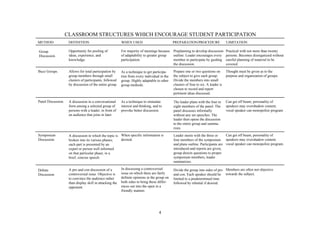
    4 CLASSROOM STRUCTURES WHICHENCOURAGE STUDENT PARTICIPATION METHOD DEFINITION WHEN USED PREPARATION/PROCEDURE LIMITATION Group Discussion. Prepare one or two questions on the subject to give each group. Divide the members into small clusters of four to six. A leader is chosen to record and report pertinent ideas discussed. Thought must be given as to the purpose and organization of groups. Panel Discussion. As a technique to stimulate interest and thinking, and to provoke better discussion. Members are often not objective towards the subject. Opportunity for pooling of ideas, experience, and knowledge. For majority of meetings because of adaptability to greater group participation. Preplanning to develop discussion outline. Leader encourages every member to participate by guiding the discussion. Practical with not more than twenty persons. Becomes disorganized without careful planning of material to be covered. Buzz Groups. Allows for total participation by group members through small clusters of participants, followed by discussion of the entire group. As a technique to get participa- tion from every individual in the group. Highly adaptable to other group methods. A discussion in a conversational form among a selected group of persons with a leader, in front of an audience that joins in later. The leader plans with the four to eight members of the panel. The panel discusses informally without any set speeches. The leader then opens the discussion to the entire group and summa- rizes. Can get off beam; personality of speakers may overshadow content; vocal speaker can monopolize program Symposium Discussion. A discussion in which the topic is broken into its various phases; each part is presented by an expert or person well informed on that particular phase, in a brief, concise speech. When specific information is desired. Leader meets with the three or four members of the symposium and plans outline. Participants are introduced and reports are given, group directs questions to proper symposium members, leader summarizes. Can get off beam; personality of speakers may overshadow content. vocal speaker can monopolize program. Debate Discussion. A pro and con discussion of a controversial issue. Objective is to convince the audience rather than display skill in attacking the opponent. In discussing a controversial issue on which there are fairly definite opinions in the group on both sides to bring these differ- ences out into the open in a friendly manner. Divide the group into sides of pro and con. Each speaker should be limited to a predetermined time followed by rebuttal if desired. https://www.cte.cornell.edu/documents/Classroom%20Structures.pdf retrieved at:
  • 2.
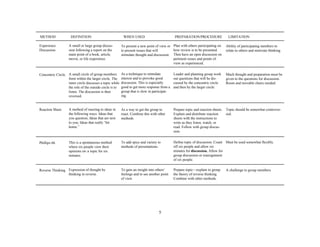
    5 METHOD DEFINITION WHENUSED PREPARATION/PROCEDURE LIMITATION Experience Discussion. A small or large group discus- sion following a report on the main point of a book, article, movie, or life experience. To present a new point of view or to present issues that will stimulate thought and discussion. Plan with others participating on how review is to be presented. Then have an open discussion on pertinent issues and points of view as experienced. Ability of participating members to relate to others and motivate thinking. Concentric Circle. A small circle of group members form within the larger circle. The inner circle discusses a topic while the role of the outside circle is to listen. The discussion is then reversed. As a technique to stimulate interest and to provoke good discussion. This is especially good to get more response from a group that is slow in participat- ing. Leader and planning group work out questions that will be dis- cussed by the concentric circle and then by the larger circle. Much thought and preparation must be given to the questions for discussion. Room and movable chairs needed. Reaction Sheet. A method of reacting to ideas in the following ways: Ideas that you question; Ideas that are new to you; Ideas that really “hit home.” As a way to get the group to react. Combine this with other methods Prepare topic and reaction sheets. Explain and distribute reaction sheets with the instructions to write as they listen, watch, or read. Follow with group discus- sion. Topic should be somewhat controver- sial. Phillips 66. This is a spontaneous method where six people view their opinions on a topic for six minutes. To add spice and variety to methods of presentations. Define topic of discussion. Count off six people and allow six minutes for discussion. Allow for group discussion or reassignment of six people. Must be used somewhat flexibly. Reverse Thinking. Expression of thought by thinking in reverse. To gain an insight into others’ feelings and to see another point of view Prepare topic—explain to group the theory of reverse thinking. Combine with other methods. A challenge to group members.
  • 3.
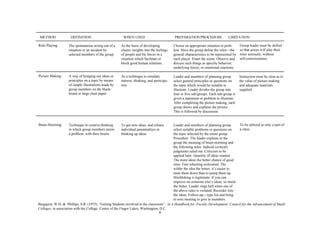
    6 Role Playing. Thespontaneous acting out of a situation or an incident by selected members of the group. As the basis of developing clearer insights into the feelings of people and He forces in a situation which facilitate or block good human relations. METHOD DEFINITION WHEN USED PREPARATION/PROCEDURE LIMITATION Group leader must be skilled so that actors will play their roles seriously, without self-consciousness. Choose an appropriate situation or prob- lem. Have the group define the roles—the general characteristics to be represented by each player. Enact the scene. Observe and discuss such things as specific behavior, underlying forces, or emotional reactions. As a technique to simulate interest, thinking, and participa- tion. Instruction must be clear as to the value of picture making and adequate materials supplied. Leader and members of planning group select general principles or questions on the topic which would be suitable to illustrate. Leader divides the group into four or five sub-groups. Each sub-group is given a statement or problem to illustrate. After completing the picture making, each group shows and explains the picture. This is followed by discussion. Picture Making. A way of bringing out ideas or principles on a topic by means of simple illustrations made by group members on the black- board or large chart paper. To get new ideas, and release individual potentialities in thinking up ideas. Brain-Storming Technique in creative thinking in which group members storm a problem. with their brains. Leader and members of planning group select suitable problems or questions on the topic selected by the entire group. Procedure: The leader explains to the group the meaning of brain-storming and the following rules: Judicial (critical) judgments ruled out. Criticism to be applied later. Quantity of ideas wanted. The more ideas the better chance of good ones. Free wheeling welcomed. The wilder the idea the better; it’s easier to tame them down than to pump them up. Hitchhiking is legitimate. If you can improve on someone else’s ideas, so much the better. Leader rings bell when one of the above rules is violated. Recorder lists the ideas. Follow-up—type list and bring to next meeting to give to members. To be utilized as only a part of a class. Bergquist, W.H. & Phillips, S.R. (1975). “Getting Students involved in the classroom”, in A Handbook for Faculty Development. Council for the Advancement of Small Colleges, in association with the College Center of the Finger Lakes, Washington, D.C.