Refresh the World.
Make a Difference.
COMPANY
THE
2020 Business &
Environmental, Social and
Governance Report
2
The Coca–Cola Company 2020 Business & ESG Report
Our purpose and passion have
always been refreshment.
Being there when people enjoy and share in life’s
best moments. And as we and the world look to
renew ourselves, we must continue to work together
and strive to make the world a better place for
every person, everywhere.
3	 Chairman & CEO Message
5	 Board of Directors
6	 Our Response to COVID-19
8	 Our Priorities & Progress
12	 At a Glance
13	 How We Operate
14	 Financial Highlights
15	 Building a Total Beverage Company
16	
Innovating to Become a
Total Beverage Company
17	 Governance  Management
18	
Priority Environmental, Social 
Governance (ESG) Issues
19	 Stakeholder Engagement  Partnerships
20	 Water Leadership
25	
RAIN: A Decade of Clean Water
Projects Across Africa
26	 Our Portfolio/Reducing Added Sugar
30	
World Without Waste
34	
Addressing Climate Change and the
Circular Economy Through Public Policy
35	Climate
39 	
Supplier Engagements Advance
Climate Action
40	 Sustainable Agriculture
44	 People  Communities
45	 Human Rights
46	Enabling Women:
A Decade of Achievement
48	Supporting Micro-Businesses
in the Philippines
49	 Employee Safety  Health
50	 Diversity, Equity  Inclusion
52	
Promoting Racial Equity at Our Company
and in Our Communities
53	
Giving Back to Communities
54	 Operations Highlights
55	 Asia Pacific
56	 Europe, Middle East  Africa
57	 Latin America
58	 North America	
59	Global Ventures/
Bottling Investments Group
60	 About This Report
61	 Data Appendix
62	
Financial  Portfolio Data
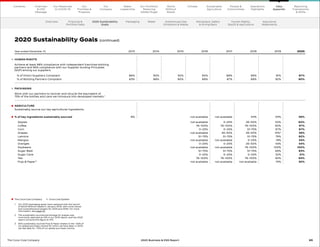
68	 2020 Sustainability Goals
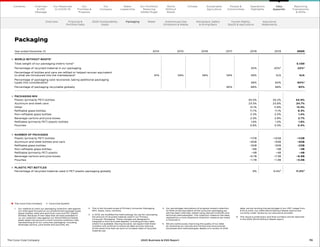
70	Packaging
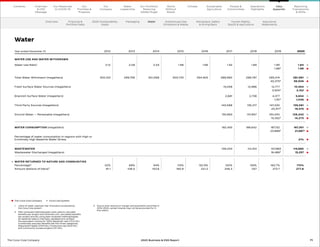
71	Water
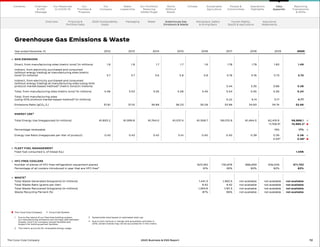
72	 Greenhouse Gas Emissions  Waste
73	 Workplace, Safety  Giving Back
75	
Human Rights, 5by20  Agriculture
76	 Assurance Statements
81	
Reporting Frameworks  Sustainable
Development Goals (SDGs)
Our
Company
Chairman
 CEO
Message
Our
Priorities 
Progress
Our Response
to COVID-19
Our Portfolio/
Reducing
Added Sugar
Water
Leadership
World
Without
Waste
Climate Sustainable
Agriculture
People 
Communities
Operations
Highlights
Data
Appendix
Reporting
Frameworks
 SDGs
Contents
3
The Coca–Cola Company 2020 Business  ESG Report
I’ve long believed that history
provides lessons that can apply
to life today.
Looking back, The Coca-Cola
Company has weathered
many difficult times over its 135
years. Each time, we’ve turned
adversity into opportunity.
In 2020, we experienced history
once again.
Historians of the future will decide how the events of
2020 reshaped the world. I already know this—the year of
the pandemic has changed our business and our industry
in ways that will endure. We’ve learned much in the last
year, and it will help us continue to change for the better.
Today, when I reflect on 2020, one of the words that
comes to mind is resilience. Our people and our business
were resilient in the face of extraordinary challenges. Our
people quickly adapted to new conditions to support our
communities and our business.
We also showed great resolve in continuing to pursue
goals that did not change—all guided by the purpose of
our company: to refresh the world and make a difference.
Environmental, Social  Governance
Our environmental, social and governance (ESG) goals
are embedded in how we operate as a business—they
are part of our very foundation. In 2020, I was commonly
asked whether ESG goals would change or take a back
seat to other priorities during the crisis. The answer—then
and now—is that ESG remains core to what we do.
For example, we continued our World Without Waste
efforts in 2020, even in the midst of many temporary
disruptions. Across markets representing 30% of our
global volume, we offer 100% recycled plastic packaging
options in at least one brand. This number grew in 2020,
and we’re now offering packages made of 100% recycled
PET in around 30 markets.
In 2020, we also developed a goal to reduce our use of
virgin PET by a cumulative 3 million metric tons globally
by 2025. This is the equivalent of taking out one whole
year’s worth of virgin plastic over the next five years.
And the Netherlands and Norway became the second
and third markets after Sweden to announce that we’ll
manufacture entire local portfolios in 100% recycled PET.
Packaging has a close link to climate, and 2020 also saw
important progress in defining our goals. The company
supports a vision to be net-zero carbon by 2050, and
we have set a 2030 science-based target to reduce our
greenhouse gas emissions by 25% as compared to a
2015 baseline.
We’ve been on a journey to drive progress against
intersecting priorities like water and building resilient
communities. We’ve developed a science-based 2030
JAMES QUINCEY
Chairman and Chief Executive Officer
Chairman 
CEO Message
Our
Company
Our
Priorities 
Progress
Our Response
to COVID-19
Contents Our Portfolio/
Reducing
Added Sugar
Water
Leadership
World
Without
Waste
Climate Sustainable
Agriculture
People 
Communities
Operations
Highlights
Data
Appendix
Reporting
Frameworks
 SDGs
Chairman
 CEO
Message
4
The Coca–Cola Company 2020 Business  ESG Report
water strategy focused on achieving water security
where the company operates and sources ingredients.
We will maintain 100% replenishment globally, focusing
on improving watershed health in water-stressed areas
that are critical to the business and that support our
agricultural supply chain. Since 2010, our water, sanitation
and hygiene programs have also reached more than
13.5 million people globally.
Finally, 2020 marked an exciting milestone in our social
impact work. We surpassed our goal of enabling the
economic empowerment of 5 million women through our
5by20® program, creating shared value for these women,
their families and communities.
Changing to a Networked Organization
Our ongoing commitment to ESG goals in 2020 was an
example of where we left critical objectives unchanged—
indeed, we enhanced them.
In other places, there were vast changes, including in the
way we operate our business.
In 2020, we announced plans to build a new, networked
organization that combines the power of scale with the
deep knowledge required to win in markets locally. Nine
operating units were established to focus on regional
and local execution, working closely with five marketing
category leadership teams that span the globe.
This structure is supported by our new Platform Services
organization and center functions, which collectively
provide global services and expertise across a range of
critical capabilities.
Together, this networked organization will accelerate our
transformation as a digitized, data-driven enterprise that
can execute marketing, commercial, sales and distribution
strategies in both the online and physical worlds.
A Winning Growth Portfolio
We are positioning our portfolio for success, identifying
the right brands that will drive quality leadership and
help us achieve our Beverages for Life vision. In 2020, we
streamlined our portfolio to approximately 200 master
brands, allowing us to focus attention and resources on
what we do best: brand building and innovation.
Great brands begin with a deep understanding
of consumers, what they want and converting that
insight into superior, quality products. We will continue
to grow our brands through focused execution and
targeted innovation.
Despite the challenges we faced in 2020, we saw strong
performance in key segments of our portfolio, including:
•	 
Trademark Coca-Cola returned to growth in the
back half of the year, with strong performance from
Coca-Cola Zero Sugar, which grew volume 4% for
the year.
•	
As consumers shifted to drinking more beverages
at home, we saw Simply and fairlife grow double digits
in North America.
•	
Certain water brands saw strong growth, including
AHA and Topo Chico Sparkling Mineral Water.
We also made strides in innovation. For example, we
introduced our first touchless Freestyle machines in the
United States, which allow consumers to choose and pour
drinks from their phones in just a few seconds without the
need to create an account or download an app.
We also continued to change the recipes of our beverages
and reduce added sugar, along with offering smaller
portion sizes. We removed approximately 125,000
tons of added sugar on an annualized basis through
approximately 140 product reformulations in 2020. We’re
innovating and bringing drinks with additional benefits to
market and promoting options with low or no calories.
Finally, we are on a journey to strengthen our marketing
efficiency and effectiveness. By improving our processes,
eliminating duplication and optimizing spending,
we will increase our effectiveness and fuel reinvestment
in our brands.
The Extraordinary Actions of 2020
Our purpose is to refresh the world and make a difference.
This guides us in good times and challenging times.
During 2020, the Coca-Cola system focused on helping
communities through COVID-19 relief efforts around
the world. These donations made by the system, when
combined with independent contributions from
The Coca-Cola Foundation, total more than $90 million,
benefiting more than 25 million people in 118 countries
and territories.
But the pandemic wasn’t the only crisis of 2020. Last year,
we were again reminded that there’s no place in our world
for racism. We have a duty to strive for greater justice
and equity within our own company as well as within the
communities where we operate. Our pledge is that we will
do our part to listen, learn and act. Our company must
play a visible and proactive role in creating change.
A diverse and inclusive workplace is both the right thing
to do and a strategic business priority. Diversity fosters
creativity, innovation and connection to the communities
we serve. To that end, we have announced our 2030
aspirations:
•	 To mirror the diversity of the markets we serve.
•	
In the United States, our ambition is to align our
race and ethnicity representation to census data
across all job levels.
•	 For our company to be 50% led by women globally.
In this report, we share data that reflects our company’s
current diversity across both race (in the United States)
and gender for the general employee population, as well
as at the leadership level. We will continue to report this
data annually.
Finally, our resilience in 2020 gives me renewed
confidence that our best years remain ahead. Thankfully,
a good starting point matters. As a system, we went
into the crisis in a strong position. We are emerging
even stronger.
James Quincey
Chairman and Chief Executive Officer
April 20, 2021
Our
Company
Our
Priorities 
Progress
Our Response
to COVID-19
Contents Our Portfolio/
Reducing
Added Sugar
Water
Leadership
World
Without
Waste
Climate Sustainable
Agriculture
People 
Communities
Operations
Highlights
Data
Appendix
Reporting
Frameworks
 SDGs
Chairman
 CEO
Message
5
The Coca–Cola Company 2020 Business  ESG Report
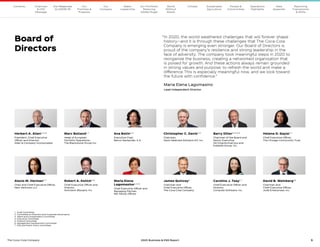
Board of
Directors
1	 Audit Committee
2	 Committee on Directors and Corporate Governance
3	 Talent and Compensation Committee
4	 Executive Committee
5	 Finance Committee
6	 Management Development Committee
7	 ESG and Public Policy Committee
Marc Bolland1, 7
Head of European
Portfolio Operations,
The Blackstone Group Inc.
Christopher C. Davis3, 5
Chairman,
Davis Selected Advisers-NY, Inc.
Herbert A. Allen4, 5, 6
President, Chief Executive
Officer and Director,
Allen  Company Incorporated
Ana Botín2, 5
Executive Chair,
Banco Santander, S.A.
Barry Diller2, 4, 5, 6
Chairman of the Board and
Senior Executive,
IAC/InterActiveCorp and
Expedia Group, Inc.
Helene D. Gayle3, 7
Chief Executive Officer,
The Chicago Community Trust
James Quincey4
Chairman and
Chief Executive Officer,
The Coca-Cola Company
Robert A. Kotick5, 6
Chief Executive Officer and
Director,
Activision Blizzard, Inc.
Caroline J. Tsay1, 7
Chief Executive Officer and
Director,
Compute Software, Inc.
Alexis M. Herman3, 7
Chair and Chief Executive Officer,
New Ventures LLC
Maria Elena
Lagomasino2, 3, 6
Chief Executive Officer and
Managing Partner,
WE Family Offices
David B. Weinberg1,6
Chairman and
Chief Executive Officer,
Judd Enterprises, Inc.
“In 2020, the world weathered challenges that will forever shape
history—and it is through these challenges that The Coca-Cola
Company is emerging even stronger. Our Board of Directors is
proud of the company’s resilience and strong leadership in the
face of adversity. The company took meaningful steps in 2020 to
reorganize the business, creating a networked organization that
is poised for growth. And these actions always remain grounded
in strong values and purpose: to refresh the world and make a
difference.This is especially meaningful now, and we look toward
the future with confidence.”
Maria Elena Lagomasino
Lead Independent Director
Our
Company
Chairman
 CEO
Message
Our
Priorities 
Progress
Our Response
to COVID-19
Contents Our Portfolio/
Reducing
Added Sugar
Water
Leadership
World
Without
Waste
Climate Sustainable
Agriculture
People 
Communities
Operations
Highlights
Data
Appendix
Reporting
Frameworks
 SDGs
Our Response
to COVID-19
6
The Coca–Cola Company 2020 Business  ESG Report
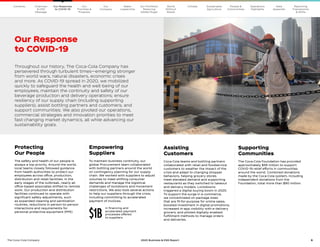
Our Response
to COVID-19
Throughout our history, The Coca-Cola Company has
persevered through turbulent times—emerging stronger
from world wars, natural disasters, economic crises
and more. As COVID-19 spread in 2020, we mobilized
quickly to safeguard the health and well-being of our
employees; maintain the continuity and safety of our
beverage production and delivery operations; ensure
resiliency of our supply chain (including supporting
suppliers); assist bottling partners and customers; and
support communities. We also pivoted our operations,
commercial strategies and innovation priorities to meet
fast-changing market dynamics, all while advancing our
sustainability goals.
Protecting
Our People
The safety and health of our people is
always a top priority. Around the world,
local teams closely followed guidance
from health authorities to protect our
employees across office, production,
distribution and retail facilities. In the
early stages of the outbreak, nearly all
office-based associates shifted to remote
work. Our production and distribution
facilities continued to operate with
significant safety adjustments, such
as expanded cleaning and sanitization
routines, reductions in person-to-person
interactions and requirements for
personal protective equipment (PPE).
Empowering
Suppliers
To maintain business continuity, our
global Procurement team collaborated
with bottling partners around the world
on contingency planning for our supply
chain. We worked with suppliers to adjust
volumes to meet shifting consumer
demands and manage the logistical
challenges of lockdowns and movement
restrictions. We also took several actions
to help our suppliers through the crisis,
including committing to accelerated
payment of invoices.
$1B
in financing and
accelerated payment
processes offered
to suppliers
Assisting
Customers
Coca-Cola teams and bottling partners
collaborated with retail and foodservice
customers to weather the impact of the
crisis and adapt to changing shopper
behaviors, helping grocery stores
meet elevated demand and supporting
restaurants as they switched to takeout
and delivery models. Lockdowns
triggered a digital buying boom in 2020.
To support the surge in e-commerce,
we concentrated on package sizes
that are fit-for-purpose for online sales;
boosted investment in digital promotions;
increased in-app visibility with e-delivery
grocers; and piloted digitally enabled
fulfillment methods to manage orders
and deliveries.
Supporting
Communities
The Coca-Cola Foundation has provided
approximately $56 million to support
COVID-19 relief efforts in communities
around the world. Combined donations
made by the Coca-Cola system, including
independent donations from the
Foundation, total more than $90 million.
Our
Company
Chairman
 CEO
Message
Our
Priorities 
Progress
Contents Our Portfolio/
Reducing
Added Sugar
Water
Leadership
World
Without
Waste
Climate Sustainable
Agriculture
People 
Communities
Operations
Highlights
Data
Appendix
Reporting
Frameworks
 SDGs
Our Response
to COVID-19
7
The Coca–Cola Company 2020 Business  ESG Report
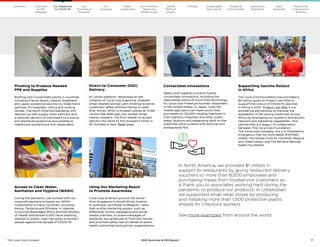
Pivoting to Produce Needed
PPE and Supplies
Bottling and concentrate plants in countries
including France, Brazil, Ireland, Swaziland
and Japan pivoted production to make hand
sanitizer for hospitals, clinics and nursing
homes. The North America Operating Unit
teamed up with supply chain partners and
a national network of volunteers to produce
and distribute protective face shields to
healthcare workers and first responders.
Contactless Innovations
Safety and hygiene concerns fueled
contactless innovations, including the
nationwide rollout of touch-free technology
for Coca-Cola Freestyle fountain dispensers
in the United States. In Japan, Coke ON
mobile app users can make touch-free
purchases on 30,000 vending machines in
train stations, hospitals and other public
areas. Buttons and dispensing slots on the
machines were covered with antiviral and
antibacterial film.
Using Our Marketing Reach
to Promote Awareness
Coca-Cola locations around the world—
from Singapore to South Africa, Austria
to Australia, and Brazil to Belgium—used
high-profile marketing assets, such as
billboards, trucks, packaging and social
media channels, to share messages of
solidarity and gratitude to front-line heroes
and promote safety tips on behalf of public
health authorities and partner organizations.
Access to Clean Water,
Sanitation and Hygiene (WASH)
During the pandemic, we worked with our
nonprofit partners to boost our WASH
investments in many countries, including
Kenya, Tanzania and Ethiopia. In Uganda,
Coca-Cola Beverages Africa and the Ministry
of Health distributed 5,000 hand-washing
stations in public, high-risk areas to protect
people against the spread of COVID-19.
Direct-to-Consumer (D2C)
Delivery
An online platform, developed at the
initiative of Coca-Cola Argentina, enabled
small retailers across Latin America to serve
customers safely without having to open
their stores. When a shopper places an order
via the free Wabi app, the system pings
nearby retailers. The first retailer to accept
delivers the items to the shopper’s home in
30 minutes or less. Read more.
Supporting Vaccine Rollout
in Africa
The Coca-Cola Foundation has provided a
$2 million grant to Project Last Mile to
support the rollout of COVID-19 vaccines
in Africa in 2021. Project Last Mile is our
pioneering partnership to improve the
availability of life-saving medicines across
Africa by leveraging our system’s distribution
network and marketing capabilities. This
partnership is a legacy of collaboration
between The Coca-Cola Foundation,
The Coca-Cola Company, the U.S. President’s
Emergency Plan for AIDS Relief (PEPFAR),
USAID, The Global Fund for HIV/AIDS, Malaria
and Tuberculosis, and The Bill and Melinda
Gates Foundation.
In North America, we provided $1 million in
support to restaurants by giving restaurant delivery
vouchers to more than 8,000 employees and
purchasing meals from foodservice customers as
a thank you to associates working hard during the
pandemic to produce our products. In Uzbekistan,
we supported small retail stores by producing
and installing more than 1,500 protective plastic
shields for checkout workers.
See more examples from around the world.
Our
Company
Chairman
 CEO
Message
Our
Priorities 
Progress
Contents Our Portfolio/
Reducing
Added Sugar
Water
Leadership
World
Without
Waste
Climate Sustainable
Agriculture
People 
Communities
Operations
Highlights
Data
Appendix
Reporting
Frameworks
 SDGs
Our Response
to COVID-19
8
The Coca–Cola Company 2020 Business  ESG Report
The Coca–Cola Company
1	
Calculated with self-reported and internally validated data.
2	
As estimated working with our many external partners and
using generally accepted, independently peer-reviewed
scientific and technical methods. External assurance of 100%
annual replenishment rate. Finished beverages based on global
sales volume. Water in production based on total system
consumptive use.
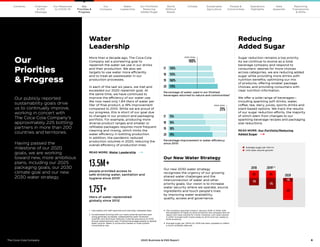
More than a decade ago, The Coca-Cola
Company set a pioneering goal to
replenish the water we use in our drinks
and their production. We also set
targets to use water more efficiently
and to treat all wastewater in our
production processes.
In each of the last six years, we met and
exceeded our 2020 replenish goal. At
the same time, we have continued to
improve the efficiency of our water use.
We now need only 1.84 liters of water per
liter of final product, a 19% improvement
compared to 2010. While we are proud of
our progress, this is short of our goal due
to changes in our product and packaging
portfolio. For example, producing more
diverse product ranges and smaller or
refillable packages requires more frequent
cleaning and rinsing, which limits the
water efficiency in bottling production.
In addition, the pandemic reduced
production volumes in 2020, reducing the
overall efficiency of production lines.
READ MORE: Water Leadership 
Water
Leadership
Reducing
Added Sugar
Our New Water Strategy
Our new 2030 water strategy
recognizes the urgency of our growing
shared water challenges and the
interconnection of water and other
priority goals. Our vision is to increase
water security where we operate, source
ingredients and touch people’s lives
by improving water availability,
quality, access and governance.
Sugar reduction remains a top priority.
As we continue to evolve as a total
beverage company and respond to
consumers’ desires for more choices
across categories, we are reducing added
sugar while providing more drinks with
nutrition benefits; optimizing our mix
of products; offering smaller package
choices; and providing consumers with
clear nutrition information.
We offer a wide range of beverages—
including sparkling soft drinks, water,
coffee, tea, dairy, juices, sports drinks and
plant-based options. We track the results
of our sugar reduction efforts, the majority
of which stem from changes to our
sparkling beverage recipes and packaging
size reductions.
READ MORE: Our Portfolio/Reducing
Added Sugar 
Our publicly reported
sustainability goals drive
us to continually improve,
working in concert with
The Coca-Cola Company’s
approximately 225 bottling
partners in more than 200
countries and territories.
Having passed the
milestone of our 2020
goals, we are working
toward new, more ambitious
plans, including our 2025
packaging goals, our 2030
climate goal and our new
2030 water strategy.
Our
Priorities
 Progress
Average sugar per 100 ml
Unit case volume growth
2%
–3%
–6%
–1%
20193, 4
2%
–2%
2018
2020
Percentage improvement in water efficiency
since 2010
17 15%
18 16%
19 18%
20 19%
2020 GOAL
25%
Percentage of water used in our finished
beverages returned to nature and communities2
17 150%
18 155%
19 160%
20 170%
2020 GOAL
100%
13.5M+
people provided access to
safe drinking water, sanitation and
hygiene since 20101
1.75T+
liters of water replenished
globally since 2012
3	
The company acquired Costa in January 2019. In 2019, with
the exception of ready-to-drink products, the company did not
report unit case volume for Costa. However, unit case volume
in 2020 includes both Costa ready-to-drink and non-ready-to-
drink products.
4	 
Average sugar per 100ml for 2019 has been updated to reflect
a more complete data set.
Our
Company
Chairman
 CEO
Message
Our Response
to COVID-19
Contents Our Portfolio/
Reducing
Added Sugar
Water
Leadership
World
Without
Waste
Climate Sustainable
Agriculture
People 
Communities
Operations
Highlights
Data
Appendix
Reporting
Frameworks
 SDGs
Our
Priorities 
Progress
9
The Coca–Cola Company 2020 Business  ESG Report
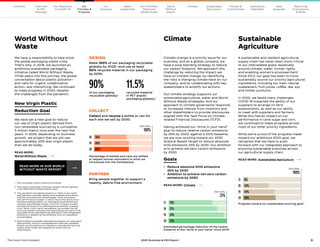
Climate change is a priority issue for our
business, and as a global company, we
have a long-standing strategy to reduce
our carbon footprint. We approach this
challenge by reducing the impact we
have on climate change; by identifying
the risks a changing climate have on our
company; and by collaborating with key
stakeholders to amplify our actions.
Our climate strategy supports our
sustainable agriculture, water and World
Without Waste strategies. And our
approach to climate governance responds
to increased interest from investors and
other stakeholders to provide disclosures
aligned with the Task Force on Climate-
related Financial Disclosures (TCFD).
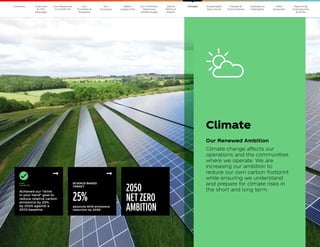
Having achieved our “drink in your hand”
goal to reduce relative carbon emissions
by 25% by 2020, against a 2010 baseline,
we are now working toward our 2030
Science-Based Target to reduce absolute
GHG emissions 25% by 2030. Our ambition
is to achieve net-zero carbon emissions
by 2050.
Goals
•	
Reduce absolute GHG emissions
25% by 2030
•	
Ambition to achieve net-zero carbon
emissions by 2050
READ MORE: Climate 
Climate
A sustainable and resilient agricultural
supply chain has never been more critical
to our interrelated goals, especially
around climate, water, human rights
and enabling women’s empowerment.
Since 2013, our goal has been to more
sustainably source our priority agricultural
ingredients, including our main natural
sweeteners, fruit juices, coffee, tea, soy
and timber products.
In 2020, we faced many challenges.
COVID-19 impacted the ability of our
suppliers to arrange on-farm
assessments, as well as our ability
to meet with suppliers and farmers.
While this had an impact on our
performance in cane sugar and corn,
we continued to make progress across
most of our other priority ingredients.
While we’re proud of the progress made
toward our ambitious 2020 goal, we
recognize that we have to push
forward with our integrated approach to
ensuring sustainable practices across
our agricultural supply chain.
READ MORE: Sustainable Agriculture 
Sustainable
Agriculture
1	 Only recyclable where infrastructure exists.
2	 
This result is preliminary and final numbers will be reported
in the 2020 World Without Waste report.
3	
The calculation of progress toward our “drink in your hand”
goal has been internally vetted using accepted and relevant
scientific and technical methodologies, which are aligned
with GHG Protocol Scopes 1, 2 and 3. Due to the nature of our
franchise bottling system, our manufacturing emissions are
normally split between Scopes 1 and 2 for company-owned
facilities and Scope 3 for bottling partner facilities. However,
in our “drink in your hand” calculations, we consider the full
Coca-Cola system (including franchise bottling partners) in the
calculation of our manufacturing, distribution and refrigeration
emissions, in addition to the emissions from our ingredients
and packaging.
4	
Data is based on supplier reporting according to our assurance
requirements, which is consolidated and internally validated.
Results can fluctuate due to changes in volumes and sourcing
origins while we get new suppliers on board with our
requirements.
World Without
Waste
We have a responsibility to help solve
the global packaging waste crisis.
That’s why, in 2018, we launched an
ambitious sustainable packaging
initiative called World Without Waste.
Three years into this journey, the global
conversation about plastic pollution—
and calls for urgent, collaborative
action—are intensifying. We continued
to make progress in 2020, despite
the challenges from the pandemic.
New Virgin Plastic
Reduction Goal
We have set a new goal to reduce
our use of virgin plastic derived from
non-renewable sources by a cumulative
3 million metric tons over the next five
years. In 2025, depending on business
growth, we project that we will use
approximately 20% less virgin plastic
than we do today.
READ MORE:
World Without Waste 
DESIGN
Make 100% of our packaging recyclable
globally by 2025—and use at least
50% recycled material in our packaging
by 2030.
11.5%
recycled material
in PET plastic
packaging globally2
90%
of our packaging
recyclable globally1
PARTNER
Bring people together to support a
healthy, debris-free environment.
Estimated percentage reduction of the carbon
footprint of the “drink in your hand” since 20103
17 19%
18 21%
19 24%
20 25%
2020 GOAL
25%
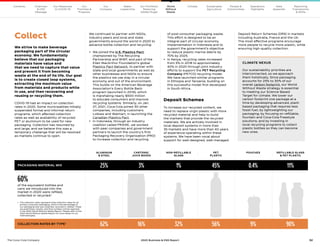
COLLECT
Collect and recycle a bottle or can for
each one we sell by 2030.
Percentage of bottles and cans we refilled
or helped recover equivalent to what we
introduced into the marketplace
19 60%
20 60%2
18 56%
2030 GOAL
100%
Progress toward our sustainable sourcing goal4
13 8%
18 44%
19 54%
20 56%
2020 GOAL
100%
Our
Company
Chairman
 CEO
Message
Our Response
to COVID-19
Contents Our Portfolio/
Reducing
Added Sugar
Water
Leadership
World
Without
Waste
Climate Sustainable
Agriculture
People 
Communities
Operations
Highlights
Data
Appendix
Reporting
Frameworks
 SDGs
Our
Priorities 
Progress
READ MORE IN OUR WORLD
WITHOUT WASTE REPORT  
10
The Coca–Cola Company 2020 Business  ESG Report
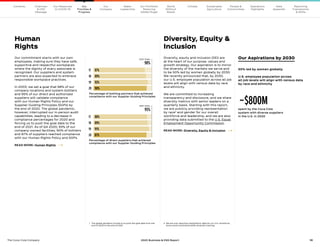
17 87%
18 89%
19 92%
20 90%
20211
GOAL
98%
Percentage of bottling partners that achieved
compliance with our Supplier Guiding Principles
Our commitment starts with our own
employees, making sure they have safe,
supportive and respectful workplaces
where the dignity of every associate is
recognized. Our suppliers and system
partners are also expected to embrace
responsible workplace practices.
In 2003, we set a goal that 98% of our
company locations and system bottlers
and 95% of our direct and authorized
suppliers will validate compliance
with our Human Rights Policy and our
Supplier Guiding Principles (SGPs) by
the end of 2020. The global pandemic,
however, interrupted our in-person audit
capabilities, leading to a decrease in
compliance percentages for 2020 and
forcing us to push the goal date to the
end of 2021. As of Q4 2020, 93% of our
company-owned facilities, 90% of bottlers
and 87% of suppliers reached compliance
with our Human Rights Policy and SGPs.
READ MORE: Human Rights 
Human
Rights
Diversity, Equity 
Inclusion
17 88%
18 89%
19 91%
20 87%
20211
GOAL
95%
Percentage of direct suppliers that achieved
compliance with our Supplier Guiding Principles
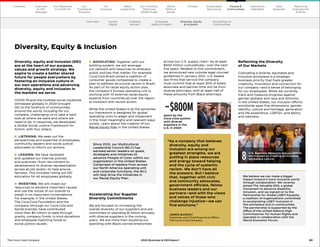
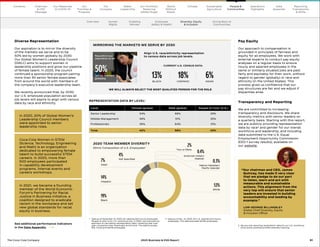
Diversity, equity and inclusion (DEI) are
at the heart of our purpose, values and
growth strategy. Our aspiration is to mirror
the diversity of the markets we serve and
to be 50% led by women globally by 2030.
We recently announced that, by 2030,
our U.S. employee population across all job
levels will align with census data by race
and ethnicity.
We are committed to increasing
transparency and disclosure, and we share
diversity metrics with senior leaders on a
quarterly basis. Starting with this report,
we are publicly providing representation
by race2
and gender for our overall
workforce and leadership, and we are also
providing data submitted to the U.S. Equal
Employment Opportunity Commission.
READ MORE: Diversity, Equity  Inclusion 
~$800M
spent by the Coca-Cola
system with diverse suppliers
in the U.S. in 2020
Our Aspirations by 2030
50% led by women globally
U.S. employee population across
all job levels will align with census data
by race and ethnicity
2	
We are only reporting racial/ethnic data for our U.S. workforce,
since some countries prohibit diversity tracking.
1	
The global pandemic forced us to push the goal date from the
end of 2020 to the end of 2021.
Our
Company
Chairman
 CEO
Message
Our Response
to COVID-19
Contents Our Portfolio/
Reducing
Added Sugar
Water
Leadership
World
Without
Waste
Climate Sustainable
Agriculture
People 
Communities
Operations
Highlights
Data
Appendix
Reporting
Frameworks
 SDGs
Our
Priorities 
Progress
11
The Coca–Cola Company 2020 Business  ESG Report
Enabling
Women
Giving
Back
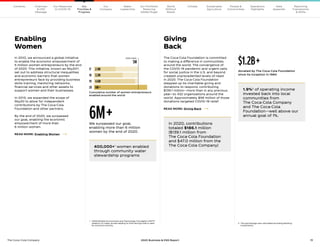
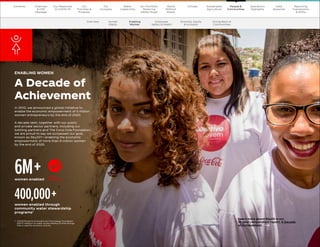
In 2010, we announced a global initiative
to enable the economic empowerment of
5 million women entrepreneurs by the end
of 2020. This initiative, known as 5by20®,
set out to address structural inequalities
and economic barriers that women
entrepreneurs face by providing business
skills training, mentoring networks,
financial services and other assets to
support women and their businesses.
In 2013, we expanded the scope of
5by20 to allow for independent
contributions by The Coca-Cola
Foundation and other partners.
By the end of 2020, we surpassed
our goal, enabling the economic
empowerment of more than
6 million women.
READ MORE: Enabling Women 
The Coca-Cola Foundation is committed
to making a difference in communities
around the world. The convergence of
the COVID-19 pandemic and urgent calls
for social justice in the U.S. and beyond
created unprecedented levels of need
in 2020. The Coca-Cola Foundation
stepped up its charitable giving and
donations to respond, contributing
$139.1 million—more than in any previous
year—to 432 organizations around the
world. Approximately $56 million of those
donations targeted COVID-19 relief.
READ MORE: Giving Back 
Cumulative number of women entrepreneurs
enabled around the world
17 2.4M
18 3.2M
19 4.6M
20 6M+
2020 GOAL
5M
6M+
We surpassed our goal,
enabling more than 6 million
women by the end of 2020.
$1.2B+
donated by The Coca-Cola Foundation
since its inception in 1984
1.9%2
of operating income
invested back into local
communities from
The Coca-Cola Company
and The Coca-Cola
Foundation—well above our
annual goal of 1%.
In 2020, contributions
totaled $186.1 million
($139.1 million from
The Coca-Cola Foundation
and $47.0 million from the
The Coca-Cola Company)
400,000+1
women enabled
through community water
stewardship programs
2	
This percentage was calculated excluding Bottling
Investments.
1	
USAID/Global Environment and Technology Foundation (GETF)
research on water access leading to time savings that is used
for economic activity.
Our
Company
Chairman
 CEO
Message
Our Response
to COVID-19
Contents Our Portfolio/
Reducing
Added Sugar
Water
Leadership
World
Without
Waste
Climate Sustainable
Agriculture
People 
Communities
Operations
Highlights
Data
Appendix
Reporting
Frameworks
 SDGs
Our
Priorities 
Progress
12
The Coca–Cola Company 2020 Business  ESG Report
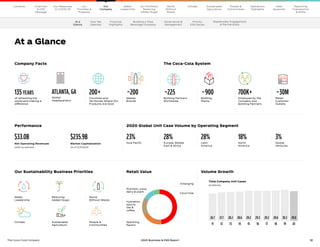
At a Glance
Performance 2020 Global Unit Case Volume by Operating Segment
$33.0B
Net Operating Revenues
(2020, as reported)
$235.9B
Market Capitalization
(As of 12/31/2020)
23%
Asia Pacific
28%
Europe, Middle
East  Africa
28%
Latin
America
18%
North
America
3%
Global
Ventures
Water
Leadership
Reducing
Added Sugar
World
Without Waste
Climate Sustainable
Agriculture
People 
Communities
Total Company Unit Cases
(in billions)
Our Sustainability Business Priorities Volume Growth
Retail Value
26.7
11
27.7
12
28.2
13
28.6
14
29.2
15
29.3
16
29.2
17
29.6
18
30.3
19
29.0
20
Coca-Cola
Emerging
Hydration,
sports,
tea 
coffee
Nutrition, juice,
dairy  plant
Sparkling
flavors
Company Facts The Coca-Cola System
135 YEARS
of refreshing the
world and making a
difference
~225
Bottling Partners
Worldwide
ATLANTA, GA
Global
Headquarters
~900
Bottling
Plants
200+
Countries and
Territories Where Our
Products Are Sold
~200
Master
Brands
700K+
Employed by the
Company and
Bottling Partners
~30M
Retail
Customer
Outlets
How We
Operate
Financial
Highlights
Building a Total
Beverage Company
Governance 
Management
Priority
ESG Issues
Stakeholder Engagement
 Partnerships
Our
Company
Chairman
 CEO
Message
Our
Priorities 
Progress
Our Response
to COVID-19
Contents Our Portfolio/
Reducing
Added Sugar
Water
Leadership
World
Without
Waste
Climate Sustainable
Agriculture
People 
Communities
Operations
Highlights
Data
Appendix
Reporting
Frameworks
 SDGs
At a
Glance
Our
Company
13
The Coca–Cola Company 2020 Business  ESG Report
1	 
The Coca‑Cola Company and its bottling partners are
collectively known as the Coca-Cola system. The Coca‑Cola
Company does not own, manage or control most local
bottling companies.
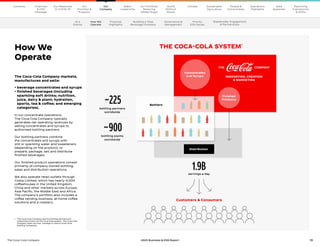
The Coca-Cola Company markets,
manufactures and sells:
• 
beverage concentrates and syrups
• 
finished beverages (including
sparkling soft drinks; nutrition,
juice, dairy  plant; hydration,
sports, tea  coffee; and emerging
categories).
In our concentrate operations,
The Coca-Cola Company typically
generates net operating revenues by
selling concentrates and syrups to
authorized bottling partners.
Our bottling partners combine
the concentrates and syrups with
still or sparkling water and sweeteners
(depending on the product), to
prepare, package, sell and distribute
finished beverages.
Our finished product operations consist
primarily of company-owned bottling,
sales and distribution operations.
We also operate retail outlets through
Costa Limited, which has nearly 4,000
coffeehouses in the United Kingdom,
China and other markets across Europe,
Asia Pacific, the Middle East and Africa.
The company’s portfolio also includes a
coffee vending business, at-home coffee
solutions and a roastery.
How We
Operate
THE COCA-COLA SYSTEM¹
Customers  Consumers
Bottlers
INNOVATION, CREATION
 MARKETING
COMPANY
THE
Distribution
1.9B
servings a day
~225
bottling partners
worldwide
~900
bottling plants
worldwide
Finished
Products
Concentrates
and Syrups
At a
Glance
Financial
Highlights
Building a Total
Beverage Company
Governance 
Management
Priority
ESG Issues
Stakeholder Engagement
 Partnerships
Our
Company
Chairman
 CEO
Message
Our
Priorities 
Progress
Our Response
to COVID-19
Contents Our Portfolio/
Reducing
Added Sugar
Water
Leadership
World
Without
Waste
Climate Sustainable
Agriculture
People 
Communities
Operations
Highlights
Data
Appendix
Reporting
Frameworks
 SDGs
How We
Operate
Our
Company
14
The Coca–Cola Company 2020 Business  ESG Report
1	 
Organic revenue is a non-GAAP financial measure. Reported
net operating revenues declined 11%, grew 9% and declined 5%
for the years ended Dec. 31, 2020, 2019 and 2018, respectively.
2	 
Reflects comparable currency neutral operating income, which
is a non-GAAP financial measure. Reported operating income
declined 11% and grew 10% and 18% for the years ended Dec. 31,
2020, 2019 and 2018, respectively.
3	 
Reflects comparable currency neutral diluted net income per
share, which is a non-GAAP financial measure. Reported diluted
net income per share declined 13% and grew 38% and 419% for
the years ended Dec. 31, 2020, 2019 and 2018, respectively.
4	 
Adjusted free cash flow conversion ratio = free cash flow
adjusted for pension contributions divided by net income
adjusted for noncash items impacting comparability. Adjusted
free cash flow conversion ratio is a non-GAAP financial
measure.
Note: See page 63 for a reconciliation of non-GAAP financial
measures to our results as reported under GAAP.
For more Financial Data, see the
Data Appendix. 
2018 2019 2020
(In millions except per share data)
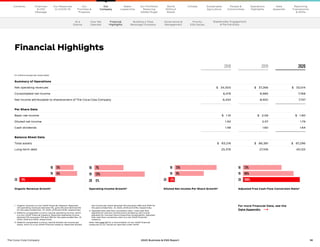
Summary of Operations
Net operating revenues $ 34,300 $ 37,266 $ 33,014
Consolidated net income 6,476 8,985 7,768
Net income attributable to shareowners of The Coca-Cola Company 6,434 8,920 7,747
Per Share Data
Basic net income $ 1.51 $ 2.09 $ 1.80
Diluted net income 1.50 2.07 1.79
Cash dividends 1.56 1.60 1.64
Balance Sheet Data
Total assets $ 83,216 $ 86,381 $ 87,296
Long-term debt 25,376 27,516 40,125
Financial Highlights
Diluted Net Income Per Share Growth3
Adjusted Free Cash Flow Conversion Ratio4
Operating Income Growth2
Organic Revenue Growth1
18 5%
19 6%
20 –9%
18 7%
19 13%
20 0%
18 13%
19 9%
20 –2%
18 73%
19 96%
20 108%
At a
Glance
How We
Operate
Building a Total
Beverage Company
Governance 
Management
Priority
ESG Issues
Stakeholder Engagement
 Partnerships
Our
Company
Chairman
 CEO
Message
Our
Priorities 
Progress
Our Response
to COVID-19
Contents Our Portfolio/
Reducing
Added Sugar
Water
Leadership
World
Without
Waste
Climate Sustainable
Agriculture
People 
Communities
Operations
Highlights
Data
Appendix
Reporting
Frameworks
 SDGs
Financial
Highlights
Our
Company
15
The Coca–Cola Company 2020 Business  ESG Report
Building a Total
Beverage Company
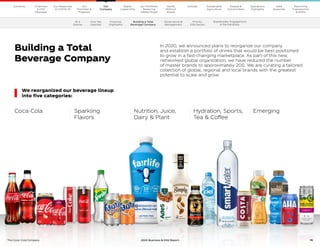
In 2020, we announced plans to reorganize our company
and establish a portfolio of drinks that would be best positioned
to grow in a fast-changing marketplace. As part of this new,
networked global organization, we have reduced the number
of master brands to approximately 200. We are curating a tailored
collection of global, regional and local brands with the greatest
potential to scale and grow.
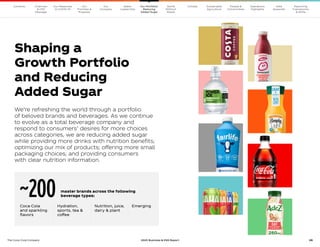
Coca-Cola Nutrition, Juice,
Dairy  Plant
Sparkling
Flavors
Hydration, Sports,
Tea  Coffee
Emerging
We reorganized our beverage lineup
into five categories:
At a
Glance
How We
Operate
Financial
Highlights
Governance 
Management
Priority
ESG Issues
Stakeholder Engagement
 Partnerships
Our
Company
Chairman
 CEO
Message
Our
Priorities 
Progress
Our Response
to COVID-19
Contents Our Portfolio/
Reducing
Added Sugar
Water
Leadership
World
Without
Waste
Climate Sustainable
Agriculture
People 
Communities
Operations
Highlights
Data
Appendix
Reporting
Frameworks
 SDGs
Building a Total
Beverage Company
Our
Company
16
The Coca–Cola Company 2020 Business  ESG Report
Innovating to Become a Total Beverage Company
Since its birth at a soda fountain
in downtown Atlanta in 1886,
The Coca-Cola Company has grown
through innovation. The company’s
iconic drink went from the fountain
into bottles before entering markets
around the United States—and,
eventually, the world.
More than a century later, we’re still
committed to innovation while staying
focused on our Beverages for Life
ambition to provide drinks for every
occasion.
In 2020, we announced plans to reshape
our beverage portfolio and transition
from 400 master brands to approximately
200—the ones that are best positioned
for growth and scale. We’re challenging
ourselves to think differently about
our brands, identifying the greatest
opportunities and prioritizing our
investments and resources.
Discontinuing some brands allows us to
invest in growing trademarks like Minute
Maid and Simply and to put more weight
behind promising innovations like AHA
flavored sparkling water, Topo Chico
Hard Seltzer and Coca-Cola Energy.
The portfolio reset also better positions
us to nurture local innovations and propel
successful regional brands to the global
marketplace.
Our innovation teams are focused on
creating drinks that fit into our consumers’
lives, including categories such as
enhanced hydration and plant-based
drinks. And our innovation lens isn’t
only focused on beverages—we’re
also innovating packaging solutions
and finding new ways to deliver our
products, such as the Wabi mobile app.
Read more stories 1 2 3 4 5 6
AHA
Launched in 2020, our new line of
sparkling water comes in eight flavors
with no sweeteners, no calories and
no sodium. Some of them include
a spark of caffeine. The brand also
unveiled two new flavors in early
2021: Raspberry + Acai and Mango +
Black Tea. In the fast-growing flavored
unsweetened sparkling water
category in North America,
AHA showed strong results in its
first year, carving out a market share
of about 8% and outperforming
competitors.
Costa Coffee Ready-to-Drink
Following the successful 2019 launch
of Costa Coffee’s ready-to-drink cold
coffee in a can in both the UK and
Poland, 2020 has seen the category
continue to grow. The brand has
launched its range into markets
including Switzerland, Ireland and
Costa’s second biggest market, China.
Within its first year, the ready-to-drink
range delivered strong performance.
In China, ready-to-drink has helped
accelerate the Costa brand by
creating opportunities to reach
consumers in new coffee occasions—
with distribution continuing to
expand. In 2021, a strong new product
development pipeline will build on
the core range currently on offer.
Costa Coffee’s ready-to-drink is made
with the brand’s Signature Mocha
Italia Blend; a recipe developed by
the Costa brothers in 1971 and loved
by consumers for the last 50 years.
The beans that go into this blend are
always Rainforest Alliance certified—
whether they are served in a can,
bottle, cup or pod.
Coca-Cola® with Coffee
Our breakthrough innovation, which
sips like a Coke and finishes like a
coffee, piloted in Japan in 2018 and
is now available in nearly 50 markets
worldwide. It also has zero-sugar
options and is available in flavors such
as vanilla and caramel.
smartwater+
In early 2021, we launched this
new line of premium waters with
unique ingredients and flavor
extracts, such as ginseng and green
tea, dandelion and lemon, and
ashwagandha (an ancient herb)
and tangerine.
“
Our goal is to converge on
disruptive innovations that are
going to move the needle—not just
in the marketplace, but at a scale
that’s relevant to The Coca-Cola
Company.”
	 JAMES QUINCEY
	 Chairman and Chief Executive Officer
	 The Coca-Cola Company
Our
Company
Chairman
 CEO
Message
Our
Priorities 
Progress
Our Response
to COVID-19
Contents Our Portfolio/
Reducing
Added Sugar
Water
Leadership
World
Without
Waste
Climate Sustainable
Agriculture
People 
Communities
Operations
Highlights
Data
Appendix
Reporting
Frameworks
 SDGs
17
The Coca–Cola Company 2020 Business  ESG Report
Governance  Management
Corporate Governance
At The Coca-Cola Company, our sound
business principles and practices foster
an innovative and collaborative culture,
which is committed to ethical behavior,
accountability and transparency. The
company’s Board of Directors has a
number of committees to assist in
discharging its duties. These include
an Audit Committee, a Talent and
Compensation Committee, a Committee
on Directors and Corporate Governance,
a Finance Committee, a Management
Development Committee, an ESG
and Public Policy Committee and an
Executive Committee. The charter for
each committee can be viewed on our
website. Information about the company’s
corporate governance, including our
Code of Business Conduct, Corporate
Governance Guidelines, Certificate of
Incorporation and Bylaws, is also on
our website. For more information or to
contact us, visit our website.
ESG Governance
The Board’s ESG and Public Policy
Committee assists the Board in
overseeing the company’s policies
and programs and related risks to the
company that concern environmental,
social, legislative, regulatory and
public policy matters, including progress
against the company’s ESG goals.
The Committee’s scope includes public
issues of significance that may affect the
company’s business, our shareowners,
the broader stakeholder community or
the general public. This entails evaluating
and reviewing information pertaining
to social, political and environmental
trends, with oversight over ESG goals
and human rights practices.
The Committee reviews, at least annually,
all shareowner proposals, public policy
advocacy efforts, political contributions
and charitable contributions to ensure
alignment with company policy. The
Committee reports regularly to the full
Board on these matters. The Committee
also receives periodic updates on priority
ESG issues, including information on
actions and progress toward goals.
Annually, the Committee conducts a
self-evaluation, which it presents to
the full Board.
Our Board’s Talent and Compensation
Committee oversees human capital
management policies and strategies
across the company. This senior-level
commitment and alignment drives the
top-down effect of ensuring company
leaders are invested in building
accountability.
Our ESG Approach Across
the Coca-Cola System
We pursue our ESG goals through a
concerted effort by The Coca-Cola
Company and approximately 225 bottling
partners in more than 200 countries
and territories. We aim to achieve
our ambitious goals to drive system1
-
wide change. We have robust internal
processes and an effective internal
control environment that facilitate
the identification and management of
risks and regular communication with
the Board, our Chairman and CEO and
internal teams such as the Enterprise
Risk Management team and Risk Steering
Committee. Beyond this, our Stakeholder
Engagement function works with
business units, bottling partners, NGOs,
governments and people in communities
all around the world to identify risks
and progress toward our goals.
For more about our approach to risk
management and priority issues, see
Our Priority ESG Issues.
Our Approach to Disclosure
We aim to provide stakeholders
with complete, transparent and
candid information in all our public
communications. This is our third annual
Business  ESG Report, which combines
our financial data and sustainability
progress and performance into one
publication. We also respond to the CDP
climate and water questionnaires and
make those disclosures publicly available.
For this report, we have updated our
priority issues matrix and continued
to expand our disclosure, including around
public policy, supply chain, and diversity,
equity and inclusion. We also provide an
index to the Task Force on Climate-related
Financial Disclosures.
We recognize that there is a need
for standardization across reporting
frameworks, and we’re continually
evaluating reporting options and listening
to stakeholder feedback.
We have a robust reporting process
that spans many years. This report is
prepared in accordance with the Global
Reporting Initiative (GRI) Standards, a
globally recognized framework, and this
is the tenth year that these principles
have informed our reporting process.
For more information about disclosure
in this report, please see the Reporting
Frameworks. We also provide an index for
the Sustainability Accounting Standards
Board (SASB), and Coca-Cola participates
in the SASB Advisory Group.
Political Contributions
The ESG  Public Policy Committee of our
Board of Directors annually reviews and
approves our advocacy efforts, including
all U.S. political contributions from both
Political Action Committee (PAC) funds
and, where allowed by applicable law, the
company’s general treasury funds. We
have always taken a bipartisan approach
to political contributions, and we have
always evaluated our giving based on
our political engagement criteria, which
we share publicly. Last year we updated
our political giving policy to ensure we
are evaluating a broader range of criteria.
Following the violent events that unfolded
in the U.S. Capitol on January 6, 2021,
The Coca-Cola Company and the
Coca-Cola Political Action Committee
suspended political giving to further
review how we best use our resources to
promote and advocate for the things we
believe in and align with our company’s
purpose and values. That review is still
under way. Information on our political
contributions from the last few years is
available on our website.
Read about some of our recent
public policy initiatives, particularly
around waste reduction and climate
change.
The Coca-Cola Company was
recognized as a trendsetter
in political disclosures and
accountability in the 2020 CPA-
Zicklin Index, which is produced
annually by the Center for Political
Accountability.
1	 
The Coca-Cola Company and its bottling partners are
collectively known as the Coca-Cola system. The Coca-Cola
Company does not own, manage or control most local
bottling companies.
At a
Glance
How We
Operate
Financial
Highlights
Building a Total
Beverage Company
Priority
ESG Issues
Stakeholder Engagement
 Partnerships
Our
Company
Chairman
 CEO
Message
Our
Priorities 
Progress
Our Response
to COVID-19
Contents Our Portfolio/
Reducing
Added Sugar
Water
Leadership
World
Without
Waste
Climate Sustainable
Agriculture
People 
Communities
Operations
Highlights
Data
Appendix
Reporting
Frameworks
 SDGs
Governance 
Management
Our
Company
18
The Coca–Cola Company 2020 Business  ESG Report
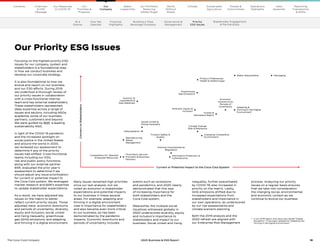
Our Priority ESG Issues
Focusing on the highest-priority ESG
issues for our company, system and
stakeholders is a foundational step
in how we conduct business and
develop our corporate strategy.
It is also foundational to how we
evolve and report on our business
and our ESG efforts. During 2019,
we undertook a thorough review of
our priority issues in collaboration
with a cross-functional internal
team and key external stakeholders.
These stakeholders represented
deep expertise across a range of
issues and sectors, including NGOs,
academia, some of our business
partners, customers and beyond.
We were guided by BSR, a leading
sustainability NGO.
In light of the COVID-19 pandemic
and the increased spotlight on
social justice in the United States
and around the world in 2020,
we reviewed our assessment to
determine if any of the priority
issues had shifted. Cross-functional
teams including our ESG,
risk and public policy functions,
along with our external partner
BSR, evaluated the prior year’s
assessment to determine if we
should adjust any issue prioritization
for current or potential impact to
the Coca-Cola system. We leveraged
market research and BSR’s expertise
to update stakeholder expectations.
As a result, we have adjusted key
issues on the matrix to better
reflect current priority issues. Those
adjusted were: economic downturns
and periods of uncertainty; diversity,
equity and inclusion; social unrest
and rising inequality; greenhouse
gas (GHG) emissions; and adapting
and thriving in a digital environment.
Many issues remained high priorities
since our last analysis, but we
noted an evolution in stakeholder
expectations and potential impacts
to our business in these several
areas. For example, adapting and
thriving in a digital environment
rose in importance for stakeholders
and also became even more critical
to our business, as has been
demonstrated by the pandemic
impacts. Economic downturns and
periods of uncertainty includes
events such as recessions
and pandemics, and 2020 clearly
demonstrated that this was
of increasing importance for
both stakeholders and the
Coca-Cola system.
Meanwhile, the multiple social
injustices witnessed globally in
2020 underscored diversity, equity
and inclusion’s importance to
stakeholders and impact to our
business. Social unrest and rising
inequality, further exacerbated
by COVID-19, also increased in
priority on the matrix. Lastly,
GHG emissions shifted due to
increased expectations from
stakeholders and importance in
our own operations, as underscored
by our risk assessments and
climate scenario planning.
Both the 2019 analysis and the
2020 refresh are aligned with
our Enterprise Risk Management
process. Analyzing our priority
issues on a regular basis ensures
that we take into consideration
the changing social, environmental
and economic context as we
continue to evolve our business.
1	
In our 2019 report, this issue was named “Digital
Disruption.” It has been updated to “Adapting and
Thriving in the Digital Environment.”
At a
Glance
How We
Operate
Financial
Highlights
Building a Total
Beverage Company
Governance 
Management
Stakeholder Engagement
 Partnerships
Our
Company
Chairman
 CEO
Message
Our
Priorities 
Progress
Our Response
to COVID-19
Contents Our Portfolio/
Reducing
Added Sugar
Water
Leadership
World
Without
Waste
Climate Sustainable
Agriculture
People 
Communities
Operations
Highlights
Data
Appendix
Reporting
Frameworks
 SDGs
Priority
ESG Issues
Packaging
Water Stewardship
Deforestation
Adapting 
Thriving in the Digital
Environment1
Product Preferences,
Health  Added Sugar
Scarcity of
Ingredients 
Raw Materials
Manufacturing
Waste
Management
Competition for Talented
Employee Resources
Economic
Downturns 
Periods of
Uncertainty
Climate Change
Risk  Resilience
Changing Competitive
Environment
Political Uncertainties 
Regulation
Information Protection 
Cybersecurity
Third-Party Service
Providers  Business
Partners
Product Safety 
Quality
Human 
Workplace Rights
Diversity, Equity 
Inclusion
Social Unrest 
Rising Inequality
Greenhouse
Gas Emissions
Concern
to
Stakeholders
Current or Potential Impact to the Coca-Cola System
Our
Company
19
The Coca–Cola Company 2020 Business  ESG Report
Stakeholder
Engagement 
Partnerships
At The Coca-Cola Company, we
believe that companies must play
a role in creating the systemic
change necessary to achieve a
more just and equitable society,
a more sustainable economy
and a healthier planet.
We also believe that businesses,
governments, NGOs and civil society can
achieve effective outcomes when working
together through meaningful partnerships
to drive collective action and build shared
opportunities for people and communities
around the world.
Multi-stakeholder collaboration is
especially critical if we intend to make
significant strides toward eliminating
plastic waste, reducing carbon emissions,
ensuring access to clean water and
achieving racial equity. Throughout this
report, we seek to demonstrate our
ambition and leadership in the industry,
using our leverage on the most pressing
global challenges that require broad
collective action.
If the COVID-19 pandemic has taught us
anything, it is that we cannot act alone.
The deep vulnerabilities exposed have
been a moment of convergence that has
highlighted the interconnected nature
of our world. It has demonstrated the
pressing need for systemic change
and created a greater sense of urgency
for businesses to move the needle
on environmental, social and governance
initiatives. The pandemic also further
underscored the intersection of
The Coca-Cola Company’s own
sustainability goals amidst the converging
crises of climate change, social inequality
and economic uncertainty.
We are committed to engaging proactively
with partners and stakeholders in all
of the countries in which we operate.
The insights and feedback of our key
stakeholders inform our sustainability
strategy across our goals. Stakeholder
feedback is also fundamental to our
priorities assessments, which are
used to inform sustainability strategy,
engagement, reporting and disclosure.
When engaging with stakeholders, we
apply the principles of transparency,
inclusiveness, consistency and
accountability to promote positive
impact and create a virtuous cycle of
collaboration.
We take a similar collaborative,
multi-stakeholder approach to our efforts
to promote systemic change through
public policy.
READ MORE: Public Policy feature 
WORLD ECONOMIC FORUM
At the World Economic Forum’s Annual
Meeting in January, our Chairman and CEO
and leaders of our sustainability teams
met with leaders across government,
the private sector and civil society,
speaking on the role that corporations
can play on critical issues ranging from
packaging waste reduction to water
scarcity. Following that, as meetings
moved to a virtual format, we participated
in a range of Forum events including the
Virtual Oceans Dialogue.
HUMAN RIGHTS CONFERENCE
In October, we hosted (virtually) our
12th annual Business  Human Rights
Conference, in partnership with the
U.S. Council for International Business,
the U.S. Chamber of Commerce and
the International Organization of
Employers. Michelle Bachelet, the UN
High Commissioner for Human Rights,
presented the keynote address.
UN GLOBAL COMPACT
Each year, through the UN Global
Compact, we participate in a range of
events surrounding the United Nations
General Assembly, including ESG-focused
panel discussions. This year, it was held
virtually in September, and we were
pleased to join more than 1,200 CEOs from
other companies in over 100 countries
to sign the Statement from Business
Leaders for Renewed Global Cooperation,
supporting the UN mission and inclusive
multilateralism.
CERES
Also in October, Chairman and CEO
James Quincey helped to unveil the
Ceres’ Roadmap 2030, a 10-year action
plan for sustainable business leadership
that aims to stabilize the climate, protect
water and natural resources, and build
a just and inclusive economy. Quincey
called the roadmap “a bold action plan
for companies to grow and strengthen
their businesses while taking on critical
environmental and social issues.”
Learn about some of the other partnerships
we’ve formed or joined to make an impact
on important issues including water, sugar
reduction, waste, climate and sustainable
agriculture. 
Key Partnership Events
The following are just some of the key events we participated in during 2020.
At a
Glance
How We
Operate
Financial
Highlights
Building a Total
Beverage Company
Governance 
Management
Priority
ESG Issues
Our
Company
Chairman
 CEO
Message
Our
Priorities 
Progress
Our Response
to COVID-19
Contents Our Portfolio/
Reducing
Added Sugar
Water
Leadership
World
Without
Waste
Climate Sustainable
Agriculture
People 
Communities
Operations
Highlights
Data
Appendix
Reporting
Frameworks
 SDGs
Stakeholder Engagement
 Partnerships
Our
Company
20
The Coca–Cola Company 2020 Business  ESG Report
Water
Leadership
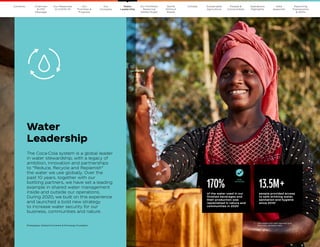
13.5M+
people provided access
to safe drinking water,
sanitation and hygiene
since 20101
The Coca-Cola system is a global leader
in water stewardship, with a legacy of
ambition, innovation and partnerships
to “Reduce, Recycle and Replenish”
the water we use globally. Over the
past 10 years, together with our
bottling partners, we have set a leading
example in shared water management
inside and outside our operations.
During 2020, we built on this experience
and launched a bold new strategy
to increase water security for our
business, communities and nature.
Photography: Global Environment  Technology Foundation
1	 
Calculated with self-reported and
internally validated data.
170%
of the water used in our
finished beverages and
their production was
replenished in nature and
communities in 2020
GOAL
ACHIEVED
Our
Company
Chairman
 CEO
Message
Our
Priorities 
Progress
Our Response
to COVID-19
Contents Our Portfolio/
Reducing
Added Sugar
World
Without
Waste
Climate Sustainable
Agriculture
People 
Communities
Operations
Highlights
Data
Appendix
Reporting
Frameworks
 SDGs
Water
Leadership
21
The Coca–Cola Company 2020 Business  ESG Report
OUR PROGRESS: WHAT WE ACHIEVED SO FAR
1	www.weforum.org/reports/the-global-risks-report-2020
2	 files.wri.org/s3fs-public/achieving-abundance.pdf
3	www.unwater.org/water-facts/water-sanitation-and-hygiene/
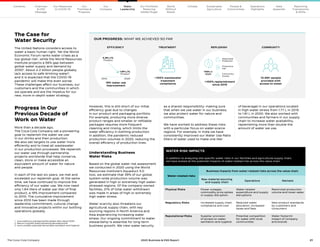
WATER RISK IMPACTS
In addition to analyzing site-specific water risks in our facilities and agricultural supply chain,
we have looked at the potential impacts of water-related risk across the value chain.
Water-related risks
Business impacts from water-related risks across the value chain
Raw material sourcing
and supply chain
Operations Markets
Physical Risks Power outages,
commodity price spikes
or supply disruption
Water-related
expenditure and supply
disruptions
Restricted production
volume and lower sales
Regulatory Risks Increased supply chain
compliance and cost
Reduced water
allocation, increased
taxes and fees
New product standards
by customers and
consumers
Reputational Risks Supplier provision
of access to water,
sanitation and hygiene
Potential competition
for water with local
communities
Water footprint
impact of company
and brands
However, this is still short of our initial
efficiency goal due to changes
in our product and packaging portfolio.
For example, producing more diverse
product ranges and smaller or refillable
packages requires more frequent
cleaning and rinsing, which limits the
water efficiency in bottling production.
In addition, the pandemic reduced
production volumes in 2020, reducing the
overall efficiency of production lines.
Understanding Business
Water Risks
Based on the global water risk assessment
we conducted in 2020 using the World
Resources Institute’s Aqueduct 3.0
tool, we estimate that 39% of our global
system-wide production volume was
generated in high or extremely high water-
stressed regions. Of the company-owned
facilities, 21% of total water withdrawn
was made in areas of high or extremely
high water stress.
Water scarcity also threatens our
agricultural supply chain, with key
sourcing regions in North America and
Asia experiencing increasing water
stress. Our ongoing commitment to water
stewardship is essential for long-term
business growth. We view water security
as a shared responsibility: making sure
that when we use water in our business,
we also protect water for nature and
communities.
We have worked to address these risks
with a particular focus on water-scarce
regions. For example, in India we have
consistently improved our Water Use Ratio
(liters of water used to make one liter
of beverage) in our operations located
in high water stress from 1.77 L in 2015
to 1.61 L in 2020. We also worked with
communities and farmers in our supply
chain to increase water availability,
replenishing more than double the
amount of water we use.
The Case for
Water Security
The United Nations considers access to
water a basic human right. Yet the World
Economic Forum ranks water crises as a
top global risk1
, while the World Resources
Institute projects a 56% gap between
global water supply and demand by
20302
. About 2.2 billion people globally
lack access to safe drinking water3
,
and it is expected that the COVID-19
pandemic will make this even worse.
These challenges affect our business, our
customers and the communities in which
we operate and are the impetus for our
new, more in-depth water strategy.
Progress in Our
Previous Decade of
Work on Water
More than a decade ago,
The Coca-Cola Company set a pioneering
goal to replenish the water we use
in our drinks and their production.
We also set targets to use water more
efficiently and to treat all wastewater
in our production processes. We replenish
our water use through partnership
projects worldwide that help conserve,
clean, store or make accessible an
equivalent amount of water for nature
and people.
In each of the last six years, we met and
exceeded our replenish goal. At the same
time, we have continued to improve the
efficiency of our water use. We now need
only 1.84 liters of water per liter of final
product, a 19% improvement compared
to 2010. The cumulative improvement
since 2010 has been made through
leadership commitment, cultural change
and innovative projects within our bottling
operations globally.
REPLENISH
TREATMENT
~100% wastewater
treatment
compliance
100% replenishment
since 2015
COMMUNITY
13.5M+ people
provided with
access to water
EFFICIENCY
2.26 L/1L
Product
1.84 L/1L
Product
2010 2020
19% water use
improvement
170% in
2020 Community
Access
Productive
Use
Watershed
Protection
Our
Company
Chairman
 CEO
Message
Our
Priorities 
Progress
Our Response
to COVID-19
Contents Our Portfolio/
Reducing
Added Sugar
Water
Leadership
World
Without
Waste
Climate Sustainable
Agriculture
People 
Communities
Operations
Highlights
Data
Appendix
Reporting
Frameworks
 SDGs
Water
Leadership
22
The Coca–Cola Company 2020 Business  ESG Report
1 	 Subject to context-based validation and target setting
2030 WATER STRATEGY OVERVIEW
2030 WATER
VISION
Increase water security where we operate, source ingredients and touch people’s lives by improving water availability, quality, access and governance.
2030 Desired
Outcome
REDUCED SHARED WATER CHALLENGES ENHANCED COMMUNITY WATER RESILIENCE IMPROVED WATERSHED HEALTH
2030
Global Goals
OUR OPERATIONS
Regenerative water use and
advanced efficiency
OUR COMMUNITIES
Access to water and sanitation, and resilience,
with a focus on women and girls
OUR WATERSHEDS
Measurable contribution
to watershed health
High-level
Targets
• 100% regenerative water use in all leadership locations
• 
Drive advanced water efficiency improvements in
water-stressed contexts1
• 
100% compliance with global water stewardship
requirements
• 
100% of priority communities supported with water
and sanitation access
• 
100% WASH (water, sanitation and hygiene) provision
in bottling system and supply chain
• Support community climate adaptation and recovery
• 
100% watershed stewardship implementation in
priority watersheds
• 
100% advanced water management practices for 
ingredients grown in water-stressed regions 
Global
Replenishment
Maintain at least 100% global replenishment of direct water use through contextualized interventions for operations, communities and watersheds.
Priority Levers
for Change
ADVOCACY AND GOVERNANCE  /  COLLABORATION AND COLLECTIVE ACTION  /  TRANSPARENCY AND REPORTING
Our
Company
Chairman
 CEO
Message
Our
Priorities 
Progress
Our Response
to COVID-19
Contents Our Portfolio/
Reducing
Added Sugar
Water
Leadership
World
Without
Waste
Climate Sustainable
Agriculture
People 
Communities
Operations
Highlights
Data
Appendix
Reporting
Frameworks
 SDGs
Our 2030
Water Strategy
During 2020, we finalized our new
water strategy, which was based on
our robust water risk assessment and
the integration of feedback gathered
systematically from our bottlers and
partners and through stakeholder
engagement with NGOs, governments
and other leading companies.
The 2030 water strategy recognizes the
urgency of our growing shared water
challenges and the interconnection of
water and other priority goals (read more
in Water Runs Through It: Connecting
Our Key Issues). It identifies our vision,
desired outcomes and priority levers for
change. It also set targets and spells out
key actions to be taken throughout our
system to achieve the targets (see graphic
below). Read more about our strategy on
our website.
Our Approach
The 2030 strategy acknowledges
that water challenges—whether water
stress, poor quality or lack of access—
are fundamentally local in nature.
Specific water targets and interventions
must be born of a deep understanding
of the local context.
Globally, we remain committed to
providing leadership on water through
ambitious water stewardship, including
robust water risk management,
continuous efficiency improvement,
wastewater treatment and 100%
replenishment, but we are shifting
our focus toward making a greater impact
on people and ecosystems where it
matters most.
Innovation for Water Security
We are prioritizing our efforts based on
deep-dive analyses of water risks at
our facilities and the locations where
we source our ingredients. These
analyses identify “leadership locations”
and “priority watersheds” to address
particular water risks and drive innovation
for water security where we operate
and source ingredients.
Important new and innovative goals
for 2030 include:
•	
Regenerative Water Use: New,
integrated circular water use in our
operations (Reduce, Reuse, Recycle,
Replenish)
•	
Community Resilience: Inclusion
of community climate adaptation,
in addition to access to water
and sanitation, and focus on women
and girls
•	
Watershed Health: New framework
to address shared water challenges
(quantity, quality, ecosystems,
infrastructure, governance)
•	
Agriculture: Expansion of scope to
water in agriculture, with a focus on
stressed sourcing regions
Water
Leadership
23
The Coca–Cola Company 2020 Business  ESG Report
THE COCA-COLA COMPANY ENTERPRISE WATER FOOTPRINT
During 2020, we completed an enterprise water footprint that showed that
93% of our system’s total blue water footprint is in the supply chain—with the
largest part attributed to growing the ingredients needed for our products.
WATER RUNS THROUGH IT:
CONNECTING OUR KEY ISSUES
Our 2030 water strategy is built on a recognition that water risks and
opportunities intertwine with many of the key issues for our company, customers
and communities now and in the future. For example, climate change is increasing
water stresses, so building climate resilience into our water strategy helps us to
address business risks and to harness investment opportunities and solutions,
especially using nature-based solutions. Agriculture depends on water and is
critical to managing our carbon emissions. Our new Principles for Sustainable
Agriculture and our new 2030 Water-Ag roadmap will highlight the opportunities
for progress on sustainable agriculture, climate and water. Our work on access to
clean water and sanitation provides multiple quantifiable benefits for women’s
empowerment. These threads come together through our strategies and key
initiatives such as RAIN.
1 	 https://www.2030wrg.org/publications/
INGREDIENTS MANUFACTURING
PACKAGING DISTRIBUTION COOLING 
DISPENSING
92% 1% 7%
BLUE WATER USE: SURFACE AND GROUNDWATER
See additional performance indicators
in the Data Appendix. 
Our
Company
Chairman
 CEO
Message
Our
Priorities 
Progress
Our Response
to COVID-19
Contents Our Portfolio/
Reducing
Added Sugar
Water
Leadership
World
Without
Waste
Climate Sustainable
Agriculture
People 
Communities
Operations
Highlights
Data
Appendix
Reporting
Frameworks
 SDGs
Scaling Solutions
Meeting 21st-century water challenges
requires persistence and collaboration
across geographic and organizational
boundaries.
The Coca-Cola Company is a global
member of the 2030 Water Resources
Group (2030WRG) which works to address
the growing gap in water resource
availability by transforming agricultural
value chains, promoting circular water use
and championing technological innovation
through multi-stakeholder engagement,
project investment and policy reform.
Since 2009, 2030WRG has worked with
900 diverse local partners on water
governance, cut freshwater abstraction
and wastewater discharge by billions of
liters and facilitated nearly $900 million
of investment into infrastructure and
technology.1
Through our decade-long partnership
with WWF, we have supported projects
in 39 countries that focused on water
access, security or resilience. In 2020, we
Our Water Footprint published two new guides, including the
report Rising to Resilience: How water
stewardship can help business build
climate resilience, which provides tools to
prepare and respond to climate change’s
effects on water resources. It highlights
the company’s climate resilience pilot with
WWF in Guatemala.
We also work with WWF in the Yangtze
River basin in China, which is home to
hundreds of millions of people and to
incredible biodiversity. Together with
the Hunan provincial government, we’ve
partnered to improve the health of
the Liuyang River, the Xiang River and
Dongting Lake.
In addition to these major partnerships,
we collaborate with many other
organizations to address shared water
challenges. During 2020, we joined the
CEO Water Mandate’s Water Resilience
Coalition and WASH4WORK, became a
signatory of Business for Nature’s Call to
Action, “Nature is Everyone’s Business,”
and engaged in multiple collective
action initiatives to advance common
approaches to quantifying and advancing
corporate water stewardship.
Through our decade-long
partnership with WWF,
we have carried out joint
water resilience and security
projects in 39 countries.
Water
Leadership
24
The Coca–Cola Company 2020 Business  ESG Report
FOCUS
AREA
FOCUS
AREA
FOCUS
AREA
Our
Company
Chairman
 CEO
Message
Our
Priorities 
Progress
Our Response
to COVID-19
Contents Our Portfolio/
Reducing
Added Sugar
World
Without
Waste
Climate Sustainable
Agriculture
People 
Communities
Operations
Highlights
Data
Appendix
Reporting
Frameworks
 SDGs
2020 Highlights
Conserving Native Forest,
Replenishing Water
In northern Uruguay, the Lunarejo Valley provides a
unique refuge for native flora and fauna. But over the last
decade, the Valley’s biodiversity, water resources and
soil health have been threatened by overgrazing, logging,
and population growth. Since 2017, Coca-Cola de Uruguay,
together with INDRA Foundation and AVINA have worked
in alliance with producers, families, NGOs and government
institutions toward a goal of protecting at least 3,000
hectares of the native forest of the Lunarejo Valley. In
2020 we have reached 3,000 hectares protected through
agreements with producers on sustainable water use,
native forest and soil conservation and the promotion of
rural ecotourism.
Fighting Poverty Through
Water Access
Coca-Cola Foundation Philippines, through its Agos
Program, collaborated with Del Monte Foundation, Inc.
Philippines and the local government unit of Barangay
Kulasi in Sumilao, Bukidnon to provide farmers and their
families access to clean and potable water. Before the
construction of the water system, villagers had to walk
to and queue up at a single faucet. Now, they have 25
community faucets, which has also allowed increased
production of crops and vegetables. The project lifted the
poorest community members out of extreme poverty and
enabled 61 families to install sanitary toilets. By making
safe water accessible to more families, projects like this
also reduce the incidence of water-borne diseases.
Wetlands to
the Rescue
In southwest Ontario, Canada, draining of wetlands over
time has led to increased runoff and pollution of Lake Erie.
In partnership with The Coca-Cola Foundation, Ducks
Unlimited Canada and Ducks Unlimited, Inc. restored 22
wetlands totaling about 10 hectares through a nature-
based solution that uses the wetlands to reduce runoff
and nutrient pollution and slow the release of water.
This “green infrastructure” approach cuts down on
phosphorus entering Lake Erie, helping to prevent algal
blooms and oxygen depletion that threaten both the
ecosystem and human health. The restored wetlands are
projected to treat 1.4 billion liters of water per year.
WATERSHED WATERSHED
COMMUNITIES
Water
Leadership
25
The Coca–Cola Company 2020 Business  ESG Report
Millions of people across Africa
lack access to safe and clean water
for drinking, cooking and basic
sanitation. In 2009, backed by a
$65 million commitment, The
Coca-Cola Foundation introduced
the Replenish Africa Initiative
(RAIN) to improve water access—
and measurably improve lives.
Over the course of a decade, RAIN made
catalytic investments to impact more than
6 million people across 41 countries and
territories through a range of water-based
initiatives that were tailored to address
local community needs. Managed by
the Global Environment  Technology
Foundation, RAIN harnessed resources
from a vast network of more than
300 partners, including governments,
the private sector and civil society
to support projects with multiple
socioeconomic benefits.
Many of the projects focused on
improvements for water, sanitation and
hygiene (WASH), which took on added
urgency in 2020 to reduce the spread of
COVID-19. According to one recent study,
only one-third of households in 16 sub-
Saharan African countries have soap and
water readily available at home to wash
their hands.1
The initiative enabled the empowerment
of more than 400,000 women through
access to water, saving them significant
time from water collection and
creating opportunities for employment,
entrepreneurship and skills generation
through water-related projects in their
communities. (Learn more about our
5by20 initiative.) RAIN also provided
more than 1,200 schools with clean water
access, sanitation facilities, handwashing
stations and hygiene training. With
reduced risks of disease and absenteeism,
children in these schools now have a
healthier learning environment and an
opportunity to reach their full potential.
RAIN: A Decade of Clean Water
Projects Across Africa
Aligns with these UN Sustainability Goals
1	
Jiwani, S.S., Antiporta, D.A. Inequalities in access to water and soap matter for the COVID-19 response in sub-Saharan Africa. Int J Equity
Health 19, 82 (2020). https://doi.org/10.1186/s12939-020-01199-z
2	
Impact data includes several projects from 2008 that were
grandfathered into the initiative.
Photography: Global Environment  Technology Foundation
“
We launched RAIN with a goal
of transforming lives and
building more resilient
communities through water—
from supplying sources of clean
drinking water and improving
sanitation and hygiene to
supporting climate-smart
agriculture and returning water
back to nature. The program
demonstrates the power
of partnerships and the
successes that can be achieved
when we work together for
long-term solutions.”
BEA PEREZ
Chair and President of
The Coca-Cola Foundation
KEY FOCUS AREAS
WATER, SANITATION 
HYGIENE (WASH)
Community access to water
and sanitation projects,
promoting improved hygiene
behaviors for positive impacts
on health and development
PRODUCTIVE USE
OF WATER
Projects to promote efficient
and sustainable use of water
for economic development
WATERSHED
PROTECTION
Conservation projects in
critical water basins that
provide upstream economic
services and downstream
community water supply
RAIN’S IMPACT 2008–20202
4,000+
communities
served
41
African
countries
400,000+
women
enabled
1.1M+
people with
improved
sanitation
450,000+
hectares of land
with improved water
management
1,200+
schools with
improved water
access
6M+
people
GOAL
ACHIEVED
Read more stories 1 2 3 4 5 6
Our
Company
Chairman
 CEO
Message
Our
Priorities 
Progress
Our Response
to COVID-19
Contents Our Portfolio/
Reducing
Added Sugar
Water
Leadership
World
Without
Waste
Climate Sustainable
Agriculture
People 
Communities
Operations
Highlights
Data
Appendix
Reporting
Frameworks
 SDGs
26
The Coca–Cola Company 2020 Business  ESG Report
Our
Company
Chairman
 CEO
Message
Our
Priorities 
Progress
Our Response
to COVID-19
Contents Water
Leadership
World
Without
Waste
Climate Sustainable
Agriculture
People 
Communities
Operations
Highlights
Data
Appendix
Reporting
Frameworks
 SDGs
Our Portfolio/
Reducing
Added Sugar
Shaping a
Growth Portfolio
and Reducing
Added Sugar
We’re refreshing the world through a portfolio
of beloved brands and beverages. As we continue
to evolve as a total beverage company and
respond to consumers’ desires for more choices
across categories, we are reducing added sugar
while providing more drinks with nutrition benefits;
optimizing our mix of products; offering more small
packaging choices; and providing consumers
with clear nutrition information.
master brands across the following
beverage types:
Coca-Cola
and sparkling
flavors
Hydration,
sports, tea 
coffee
Nutrition, juice,
dairy  plant
Emerging
~200
27
The Coca–Cola Company 2020 Business  ESG Report
Our
Company
Chairman
 CEO
Message
Our
Priorities 
Progress
Our Response
to COVID-19
Contents Water
Leadership
World
Without
Waste
Climate Sustainable
Agriculture
People 
Communities
Operations
Highlights
Data
Appendix
Reporting
Frameworks
 SDGs
Our Portfolio/
Reducing
Added Sugar
In 2020, we announced plans to streamline our
beverage lineup in order to improve efficiency
and drive brand building and innovation. The new
portfolio will focus on brands with the greatest
potential to scale and grow.
To keep pace with the evolving needs and tastes
of consumers, we’re staying focused on the four
key actions at the heart of our beverage strategy:
Reducing added sugar
across our portfolio
Offering
a portfolio
of drinks
with nutrition
and hydration
benefits
Providing smaller
package choices
so it’s easier for
consumers to control
added sugar intake
Giving people the
information they need
to make informed choices
Transforming
Our Portfolio
28
The Coca–Cola Company 2020 Business  ESG Report
1	
The calories per pack metric takes into account both levers to
reduce sugar: recipe changes and package size changes.
2	
Average calories per pack for 2018 and 2019 have been
updated to reflect a more complete data set.
3 	
This metric is based on the number of products in our
beverage portfolio.
Original Taste,
Less Sugar
In some markets around the world,
zero-calorie beverages have not
yet developed a strong consumer
base. But many consumers tell us
they want more drinks that have
less sugar and fewer calories than
our original recipes. In response,
we have created reduced sugar
variations of our classic Coca-Cola
recipe. Our Coca-Cola recipe with
30% less sugar began in Mexico in
2018, and has since expanded to
nearly 40 countries globally.
We participate in nearly
40 calorie/sugar reduction
initiatives globally.
4	
Low- or no-sugar products have between zero and 5g of
added sugar per 100 ml.
5	
The company acquired Costa in January 2019. In 2019,
with the exception of ready-to-drink products, the company
did not report unit case volume for Costa. However, unit
case volume in 2020 includes both ready-to-drink and non-
ready-to-drink Costa products.
6	
Average sugar per 100 ml for 2019 has been updated to
reflect a more complete data set.
Smaller packaging options aim to help
people control added sugar intake more
easily for themselves and their families.
Globally, about 42% of our sparkling soft
drink brands come in packages of 250 ml
(8.5 oz) or less.
Our
Company
Chairman
 CEO
Message
Our
Priorities 
Progress
Our Response
to COVID-19
Contents Water
Leadership
World
Without
Waste
Climate Sustainable
Agriculture
People 
Communities
Operations
Highlights
Data
Appendix
Reporting
Frameworks
 SDGs
Sugar Reduction
Initiatives
In cooperation with our industry peers,
we participate in many sugar reduction
initiatives around the world, tailoring our
approach to help reduce intake of added
sugars to meet expectations of local
consumers and stakeholders.
The European soft drink industry,
UNESDA, announced in 2020 that the
industry collectively reduced added
sugars in drinks across Europe by an
average of 14.6% between 2015 and 2019,
exceeding the 10% reduction commitment.
In the UK, Public Health England’s
October 2020 Sugar Reduction Progress
Report found that Coca-Cola Great Britain
achieved a 24% reduction for sparkling
beverages between 2015 and 2019,
exceeding a voluntary 20% reduction
target.
The Coca-Cola system in Australia
exceeded its commitment to reduce sugar
by 10% by 2020 from a 2015 baseline,
achieving an overall reduction of 11.2%.
This reduction forms part of an industry-
wide pledge coordinated by the Australian
Beverages Council for a 10% sugar
reduction by 2020 and 20% by 2025.
In North America, we’re part of the
American Beverage Association’s Balance
Calories Initiative, which has committed
to decrease beverage calories in the
American diet by 20% per person by 2025.
According to an interim report released
in September 2020, beverage calories
had fallen by 5.6% from 2014 to 2019; the
report noted that 2019 represented the
largest single-year reduction in calorie
consumption—and the third consecutive
year of calorie decreases. While we were
pleased the report showed a decrease in
calories, we recognize there’s much work
to be done to achieve the 20% reduction
by 2025. The Mexican Beverage Industry
Association, meanwhile, has committed to
reducing the calorie content of its member
companies’ portfolios by 20% between
2018 and 2024.
Average sugar per 100 ml
Unit case volume growth
2%
-3%
-6%
-1%
2019
2%
-2%
2018
2020
2%
–3%
–6%
–1%
2019
2%
–2%
2018
2020
In 2020, average sugar per 100 ml
declined slightly along with an overall
decline in sales, impacted by the COVID-19
pandemic. The previous year, we reduced
added sugar while increasing global
sales.5, 6
POWERADE™
has grown its zero-
sugar, zero-calorie
options over the last
five years, which
aided in a 22% calorie
reduction across
total volume.
TOTAL RECIPE
CHANGES GLOBALLY:
2017 	 = 	 ~310
2018	 = 	 ~400
2019 	 = 	 ~275
2020 	 = 	 ~140
The UK is the first
country in the world
where we sell more
no-sugar cola than
regular Coca-Cola
(sales of diet and
zero-sugar combined).
tons of added sugar
removed on an
annualized basis
through recipe
changes in 2020.
~125,000 of our 20 top brands
are low- or no-sugar
or have a low- or
no-sugar option, and
~36%3
of our beverage
portfolio is low- or
no-sugar.4
18
Reducing
Added Sugar
Leading health authorities recommend
that individuals should consume no more
than 10% of their total daily calories from
added sugar. The Coca-Cola Company
embraces this recommendation, providing
choices that support what consumers
want and need.
Sugar reduction remains a top priority,
and we continue to adjust our recipes
to reduce added sugar, promote low-
and no-calorie beverage options, and
make smaller packages more available
to enable portion control. Over the
past decade we have invested heavily
in natural sweetener research leading
to the discovery, development and
commercialization of sweeteners by
The Coca-Cola Company and partners.
We’re exploring and bringing to market
new alternatives that maintain the great
tastes people love but with less added
sugar and fewer calories. Globally,
Coca-Cola Zero Sugar has become a
popular alternative to our original formula
and has continued to show strong
growth in 2020.
We track the results of our sugar-
reduction efforts; the majority of the
added-sugar reductions stem from
changes to our sparkling beverage recipes
and packaging size reductions. Average
calories per pack1
dropped by 2.3% in
2018 and by another 7.0% in 20192
;
in 2020, however, average calories per
pack increased by 4.9%— the result of a
shift in consumer purchasing patterns due
to the pandemic, as many outlets were
closed. This led to a decrease in individual
servings and out-of-home consumption
and an increase in purchases of larger
pack sizes for sharing at home.
23%
growth for mini
cans in North
America in 2020,
offering portion
control to
consumers
In 2020, Coca-Cola
Zero Sugar grew
by double digits in
59 countries and
territories.
Our Portfolio/
Reducing
Added Sugar
29
The Coca–Cola Company 2020 Business  ESG Report
FUZE TEA
Fuze Tea with zero sugar is a
raspberry and mint flavored
beverage with concentrated black
tea infusion and mint extract
with sweeteners.
1	
Calorie information (expressed as calories, kilocalories,
or
kilojoules) is provided on the front of our packages,
with
the exception of returnable or refillable proprietary
and
multipurpose bottles (glass and plastic) with permanent
printed labels; and unflavored and unsweetened still or
sparkling bottled water, including mineral water.
RESPONSIBLE MARKETING FOR
NON-ALCOHOLIC BEVERAGES
We do not target our advertising to children under
age 12, anywhere in the world. Our policy applies
to all our products, regardless of nutritional profile,
as we honor the rights of parents and caregivers to
make choices for their children.
Our policy responds to changing societal concerns
and we partner with industry to scale collective
action, including in responsible marketing pledge
programs of the International Food  Beverage
Alliance (IFBA) at the global level, the EU Pledge
in the European Union and The Children’s Food
and Beverage Advertising Initiative (CFBAI) in the
United States.
AHA SPARKLING WATER
Launched in 2020, our new line
of sparkling water comes in eight
flavors with no sweeteners, no
calories and no sodium. Some of
them include a spark of caffeine.
The brand also unveiled two new
flavors in early 2021: Raspberry +
Acai and Mango + Black Tea. In the
fast-growing flavored unsweetened
sparkling water category in North
America, AHA showed strong
results in its first year, carving out
a market share of about 8% and
outperforming competitors.
Our
Company
Chairman
 CEO
Message
Our
Priorities 
Progress
Our Response
to COVID-19
Contents Water
Leadership
World
Without
Waste
Climate Sustainable
Agriculture
People 
Communities
Operations
Highlights
Data
Appendix
Reporting
Frameworks
 SDGs
Our Portfolio/
Reducing
Added Sugar
We are bringing drinks such as plant-
based beverages and juices, fortified
beverages and purified water to more
people in more places.
We’re also adding vitamins and essential
micronutrients to our beverages to make
them more nutritious.
Some examples include:

Minute Maid Vita Punch is a range
of juice drinks containing a blend of
apple, pineapple, mango and guava juice.
The drinks also contain micronutrients,
including magnesium and potassium,
and provide 100% of one’s daily
requirement of vitamin C to support
immunity.
Minute Maid Nutriforce is a ready-to-
serve juice drink containing delicious
blends of home grown fruits from
India with the added benefits of
micronutrients. They contain a blend of
seven micronutrients—iron, zinc, vitamin
B2, vitamin B12, folic acid, vitamin A and
vitamin C, which are all essential nutrients
for the healthy development of children.

POWERADE® POWER WATER, available
in three flavors, offers a zero-sugar way
to power through a workout. It is packed
with B vitamins and our unique ION4
Advanced Electrolyte System.
Simply Almond Unsweetened has just
four simple, all-natural ingredients, and is
dairy free and gluten free.
Launched fairlife® ultra-filtered milk
in Canada, made with 100% local Canadian
milk in partnership with Dairy Farmers
of Ontario.
Read more about fairlife in their Annual
Stewardship Report. 
Giving People the
Information They Need
We are a leader in the food and beverage
industry by putting clear, easy-to-find
nutrition information on the front of our
packages to support informed consumer
choice.
Nearly 100% of our products globally,
except water, provide front of pack
energy/calorie information.1
We’re also
making our online product nutrition
information more transparent and easier
to navigate.
Front-of-pack nutrition labels have
been identified as being able to help
improve the dietary habits of populations
and aid in the prevention of obesity
and non-communicable diseases.
They can help consumers interpret
the nutritional quality of products
by providing simplified nutritional
information. There are several labeling
schemes being used globally, and we will
ensure ongoing compliance or voluntarily
implement labeling schemes that help
consumers make informed choices.
Read our Responsible Marketing Policy
and our new Global Policy On Alcohol
Responsibility. 
Offering Drinks
With Nutrition Benefits
30
The Coca–Cola Company 2020 Business  ESG Report 30
The Coca–Cola Company 2020 Business  ESG Report
World Without Waste has signaled a
renewed focus on our entire packaging
lifecycle—from how bottles and cans are
designed and produced, to how they’re
recycled and repurposed—through a
focus on three fundamental goals:
DESIGN
Make 100% of our packaging recyclable
globally by 2025—and use at least 50%
recycled material in our packaging
by 2030.
COLLECT
Collect and recycle a bottle or can for
each one we sell by 2030.
PARTNER
Bring people together to support a
healthy, debris-free environment.
World Without
Waste
We have a responsibility to help solve
the global packaging waste crisis.
That’s why, in 2018, we launched an
ambitious sustainable packaging
initiative called World Without Waste.
Now, three years into this journey,
the global conversation about plastic
pollution—and calls for urgent,
collaborative action—are intensifying.
We continued to make progress in
2020, despite the challenges from
the pandemic.
READ MORE IN OUR WORLD
WITHOUT WASTE REPORT  
Our
Company
Chairman
 CEO
Message
Our
Priorities 
Progress
Our Response
to COVID-19
Contents Our Portfolio/
Reducing
Added Sugar
Water
Leadership
Climate Sustainable
Agriculture
People 
Communities
Operations
Highlights
Data
Appendix
Reporting
Frameworks
 SDGs
World
Without
Waste
31
The Coca–Cola Company 2020 Business  ESG Report
1 	 
These results are preliminary and final numbers will be
reported in the 2020 World Without Waste report.
2	
Except where otherwise indicated, where reference is made
in this report to 100% Recycled PET or 100% Recycled Plastic
Beverage Packaging, we are referring to the material from
which the plastic bottle is made, not the cap and label.
Many packaging formats have a role
to play in delivering our beverages,
including glass, PET plastic, aluminum,
refillable bottles and even virtually
package-less solutions. We are working
to make all of our packaging more
sustainable.
Goal
Use at least 50% recycled
material in our packaging
globally by 2030
2020 STATUS: 22% ACROSS
ALL MATERIALS AND 11.5% FOR
PET PLASTIC1
Goal
Make 100% of our
packaging recyclable
globally by 2025
2020 STATUS: 90% GLOBALLY
New Virgin Plastic
Reduction Goal
We have set a new goal to reduce
our use of virgin plastic derived
from non-renewable sources
by a cumulative 3 million metric
tons over the next five years. In
2025, depending on business
growth, we project that we
will use approximately 20%
less virgin plastic than we do
today as we ramp up adoption
of recycled materials, pursue
our lightweighting initiatives
and expand our use of refillable,
fountain and virtually package-
less models.
Design REFILLABLE PACKAGING
COVID-19 accelerated our focus
on refillable packaging, which
addresses both affordability and
sustainability concerns. In 2020,
Colombia and other new Brazilian
territories adopted the “universal
bottle” first developed by Coca-Cola
Brazil to drive efficiency by using
the same package for multiple core
brands, an innovation now available
in: Argentina, Brazil, Colombia, Chile,
Mexico, Guatemala and Panama.
And, in Chile, we partnered with
Petrobras to launch a pilot to sell
returnable bottles in convenience
stores.
According to research conducted
with Ipsos, the pandemic has made
people more aware of packaging
waste and driven preference for
refillable packages. To address
these trends, our global customer
and commercial team is rolling
out a holistic refillables strategy,
including a guidebook to help
markets implement localized plans.
As of 2020, reusable bottles
represented more than 25% of sales
in Coca-Cola Latin America and
were the fastest-growing packaging
format in 2018 and 2019.
READ MORE IN OUR WORLD
WITHOUT WASTE REPORT  
Our
Company
Chairman
 CEO
Message
Our
Priorities 
Progress
Our Response
to COVID-19
Contents Our Portfolio/
Reducing
Added Sugar
Water
Leadership
World
Without
Waste
Climate Sustainable
Agriculture
People 
Communities
Operations
Highlights
Data
Appendix
Reporting
Frameworks
 SDGs
Packaging Innovations
Some plastics have high value and lend
themselves to being part of the circular
economy. Others are hard to reuse
or recycle and have little value. We are
prioritizing and recycling higher-value
plastics and turning them into new
bottles, replacing hard-to-recycle plastics,
and innovating with new technologies to
advance circularity for plastics in
the middle.
Highlights of our 2020 sustainable
packaging innovations include:
•	Introduced a label-less 100% rPET
bottle in Japan, for the I LOHAS natural
mineral water brand, to simplify
material sorting and recycling.
•	
Developed and commercialized
resealable caps made from 30%
recycled plastic—a beverage industry
first—for DASANI bottles in the
United States.
•	 
Coca-Cola European Partners (CCEP)
introduced CanCollar®, a paperboard-
based ring solution for multipack cans,
in Spain.
•	 
Coca-Cola Hellenic Bottling Company
(HBC) began the rollout of KeelClip™
technology in the Republic of Ireland,
Northern Ireland and Austria as the
first step in its commitment to replace
plastic wrap on all can multipacks in
its European Union markets.
100% Recycled PET
PET, our highest-volume packaging
material, is valuable, versatile, lightweight,
recyclable and can be made into
refillable bottles. We now offer beverages
packaged in 100% recycled PET plastic
(rPET)2
in around 30 markets. In 2020,
the Netherlands and Norway announced
transitions to 100% rPET for their entire
plastic packaging portfolios, joining their
neighbors in Sweden.
In early 2021, our North America business
announced a series of 100% rPET
innovations spanning our portfolio
and including multiple brands and
packaging sizes.
Combined, these innovations will
result in a 20% reduction in use of
new (virgin) plastic across our North
American portfolio compared to 2018
and collectively reduce an estimated
10,000 metric tons of greenhouse gas
(GHG) emissions annually.
Low oil prices made virgin plastic much
less expensive in 2020, expanding the
cost difference between virgin and
recycled PET, yet we continued to work
with suppliers and partners to drive the
availability of recycled PET and reduce
premiums for the material.
See additional performance indicators
in the Data Appendix.  
markets use 100%
rPET2
for their
entire plastic
packaging portfolio
3
~30
markets representing
approximately 30%
of our total sales offer
at least one brand in
100% rPET packaging
In 20+ markets,
refillables account
for 50% or more of
our sales
50%
25%
In 40+ markets,
refillables account
for 25% or more
of sales
World
Without
Waste
32
The Coca–Cola Company 2020 Business  ESG Report
Collect
REFILLABLE GLASS
 PET PLASTIC
NON-REFILLABLE
GLASS
ALUMINUM
 STEEL
PET
PLASTIC
POUCHES
CARTONS/
JUICE BOXES
of the equivalent bottles and
cans we introduced into the
market in 2020 were refilled,
collected or recycled.1
60%
25%
62%
1%
32%
45%
56%
0.4%
9%
11%
90%
3%
16%
CLIMATE NEXUS
Our sustainability priorities are
interconnected, so we approach
them holistically. Since packaging
accounts for 25% to 30% of our
overall carbon footprint, our World
Without Waste strategy is essential
to meeting our Science-Based
Target for climate. We lower our
carbon footprint one package at a
time by developing advanced, plant-
based packaging that requires less
fossil fuel; by lightweighting our
packaging; by focusing on refillable,
fountain and Coca-Cola Freestyle
solutions; and by investing in
local recycling programs to collect
plastic bottles so they can become
new ones.
1 	
The collection rates represent total collection rates for all
primary consumer packaging, which is the percentage of
our packaging that was collected, recycled or refilled. These
are preliminary results, and final numbers will be reported
in the 2020 World Without Waste Report. Please refer to the
2020 World Without Waste Report for more detail on our
methodologies.
Our
Company
Chairman
 CEO
Message
Our
Priorities 
Progress
Our Response
to COVID-19
Contents Our Portfolio/
Reducing
Added Sugar
Water
Leadership
World
Without
Waste
Climate Sustainable
Agriculture
People 
Communities
Operations
Highlights
Data
Appendix
Reporting
Frameworks
 SDGs
We strive to make beverage
packaging part of the circular
economy. We fundamentally
believe that our packaging
materials have value and
that we need to capture that value
and prevent it from becoming
waste at the end of its life. Our goal
is to create closed loop systems,
extracting the maximum value
from materials and products while
in use, and then recovering and
reusing or recycling them.
COVID-19 had an impact on collection
rates in 2020. Some municipalities initially
suspended formal and informal return
programs, which affected collection
rates as well as availability of recycled
PET or aluminum to be used for new
packaging. Collection has resumed by
and large, and we believe this was a
temporary challenge that will be resolved
as markets continue to open.
PACKAGING MATERIAL MIX
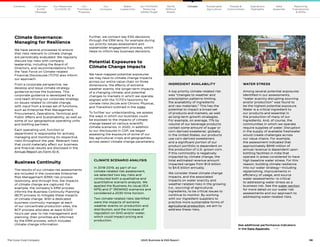
COLLECTION RATES BY TYPE1
We continued to partner with NGOs,
industry peers and local and state
governments around the world in 2020 to
advance bottle collection and recycling:
•	
We joined the U.S. Plastics Pact,
championed by The Recycling
Partnership and WWF, and part of the
Ellen MacArthur Foundation’s global
Plastics Pact Network, to partner with
state and local governments as well as
other businesses and NGOs to ensure
the plastics we use stay in a circular
economy and out of the environment.
This builds on the American Beverage
Association’s Every Bottle Back
program (launched in 2019), which
is marshaling nearly $500 million
to educate consumers and improve
recycling systems. Similarly, on Jan.
27, 2021, Coca-Cola joined 30 other
companies, including customers
Loblaw and Walmart, in launching the
Canadian Plastics Pact.
•	
In Indonesia, through an industry
coalition called PRAISE, we worked
with peer companies and government
partners to launch the country’s first
Packaging Recovery Organization (PRO)
to increase collection and recycling
of post-consumer packaging waste.
This effort is designed to be an
integral part of circular economy
implementation in Indonesia and to
support the government’s objective
to reduce plastic marine debris by
70% by 2025.
•	
In Kenya, recycling rates increased
from 5% in 2018 to approximately
40% in 2020 through joint industry
efforts to support the PET Recycling
Company (PETCO) recycling model.
We have launched similar programs
in Ethiopia and Tanzania, building on
this successful model first developed
in South Africa.
Deposit Schemes
To increase our recycled content, we
need to replace virgin plastic with more
recycled material and help to build
the markets that provide the recycled
materials. We are actively involved in
local deposit systems in more than
35 markets and have more than 40 years
of experience operating within these
systems. We have been vocal about
support for well-designed, well-managed
Deposit Return Schemes (DRS) in markets
including Australia, France and the UK.
The most effective programs encourage
more people to recycle more plastic, while
ensuring high-quality collection.
World
Without
Waste
33
The Coca–Cola Company 2020 Business  ESG Report
1	
First-generation paper bottle prototype includes plastic
closure and plastic lining made from 100% recycled PET.
All components of the bottle are recyclable.
Partner
Our
Company
Chairman
 CEO
Message
Our
Priorities 
Progress
Our Response
to COVID-19
Contents Our Portfolio/
Reducing
Added Sugar
Water
Leadership
World
Without
Waste
Climate Sustainable
Agriculture
People 
Communities
Operations
Highlights
Data
Appendix
Reporting
Frameworks
 SDGs
Partnership across business,
government and civil society is
fundamental to scaling solutions
and critical to reaching our climate
target and achieving a circular
economy. We remain committed
to help drive collective action,
working with stakeholders,
suppliers, nonprofits, communities,
customers and industry peers
to invest in recycling innovation,
facilities, organizations and
initiatives.
Asia  Circulate Capital, an investment
fund focused on ventures, infrastructure
and innovations that prevent the flow
of plastic into oceans and advance the
circular economy, took steps in 2020 to
invest in seven pioneering companies in
India and Indonesia using technology to
fight plastic pollution and transform the
waste management and recycling value
chain. This includes two Indian companies
poised to become the first food-grade,
bottle-to-bottle rPET producers in that
market. We were an inaugural investor in
the fund, which has raised more than
$100 million since its launch in 2019.
Thailand  Part of a global initiative to
remove waste from rivers, The Coca-Cola
Foundation and Benioff Ocean Initiative
have partnered with the TerraCycle Thai
Foundation to install two marine waste
traps in the Lat Phrao Canal to reduce
debris entering into the Chao Phraya River
in Bangkok, Thailand. From mid June to
December 2020, over 133 metric tonnes of
waste was collected from the canal, with
a highest daily collection rate of nearly
2.5 tonnes in a single day.
Global  Joined The Consumer Goods
Forum (CGF) Plastic Waste Coalition
of Action, a CEO-led effort to develop
a framework for Extended Producer
Responsibility (EPR) programs to support
the improvement and development of
waste management systems around
the world. The Coalition published an
aligned position on extended producer
responsibility (EPR) and is now working to
advance more progressive policy in key
priority countries.
Ghana  Coca-Cola joined the steering
committee for Africa’s first national
Plastic Action Partnership in Ghana.
Ghana generates more than 1 million tons
of plastic waste per year, with only
5% collected for recycling. We are working
with more than 120 affiliated partners
to support Ghana in the transition toward
a fully circular economy for plastics.
Europe  Our RD team in Brussels
collaborated with Danish startup Paboco
to develop a recyclable paper bottle
prototype, which will be piloted in 2021
via an online retailer in Hungary with our
plant-based beverage brand AdeZ.1
Philippines  Coca-Cola Beverages
Philippines signed an agreement with
Indorama Ventures to establish PETValue,
the country’s largest bottle-to-bottle
recycling facility, capable of processing
almost 2 billion plastic bottles per year.
Indorama Ventures—our largest PET
supplier—recently purchased and is
expanding PET recycling facilities in Brazil
and Poland, adding to their recycling
facilities in Mexico, the United States,
France, the Netherlands, Thailand and the
Philippines joint venture.
World
Without
Waste
READ MORE IN OUR WORLD
WITHOUT WASTE REPORT  
Global  Signed a business manifesto
calling for a UN treaty on plastic pollution
to urgently address the fragmented
landscape of regulation, and complement
existing voluntary measures, and as such
help drive the transition to a circular
economy for plastic—at speed and scale.
We fully support this initiative for a global
agreement to tackle plastic pollution, led
by WWF, the Ellen MacArthur Foundation,
and others.
34
The Coca–Cola Company 2020 Business  ESG Report
Since global challenges such as plastic
waste and climate change are far
too great for any single government,
company or industry to solve,
partnership is more critical than ever.
The need to further align our advocacy
efforts and our sustainability goals
served as a catalyst for greater
collaboration and more proactive
engagement in 2020—a year in which
we worked to drive meaningful policy
change with business peers, civil
society organizations and all levels
of government.
“The pandemic has further highlighted the
need for collaboration among business,
government and civil society through
effective policymaking, which sets the
framework for engagement and action,”
said Michael Goltzman, Vice President
of Global Policy and Sustainability,
The Coca-Cola Company. “By actively
participating in these discussions, we
seek to provide informed, constructive
contributions that create shared value
for our business, our planet and society
as a whole.”
Recycling and Reuse
An efficient circular economy for our
packaging requires collaboration and
financing. Use of recycled materials in
our packaging is only possible when
governments allow it and encourage it,
and the same is true for effective waste
management and recycling systems.
Like many issues, no globally accepted
standard exists for food-grade recycled
content PET (rPET), so we must work
with governments, often through trade
associations, to provide evidence of the
safety and quality of recycled materials.
To expand the Coca-Cola system’s use of
rPET in our packaging, we have engaged
with industry partners to work with
governments to establish rPET standards
for food and beverage packaging. Over
the last year, two governments set such
standards: Bangladesh and Nigeria.
We work with policymakers and industry
partners to advocate for effective
Extended Producer Responsibility
(EPR) systems that provide an efficient,
financially sustainable collection program
for all recyclable materials to ensure
we can collect more bottles and cans
for recycling and reuse. Recently, we
developed an industry position on the
optimal design of EPR programs through
the Consumer Goods Forum (CGF) Plastic
Waste Coalition of Action—extending
beyond the beverage industry. And
we continue to support well-designed,
well-managed Deposit Return Schemes
in more than 35 markets to increase
packaging collection that provides the
raw material to create more recycled
content for our bottles.
In 2020, we joined the U.S. Plastics
Pact, championed by The Recycling
Partnership, World Wildlife Fund (WWF)
and the Ellen MacArthur Foundation
to partner with state and local
governments to enable legislation that
drives toward a circular economy. The
U.S. Plastics Pact builds on the American
Beverage Association’s Every Bottle Back
initiative, which is marshaling nearly
$500 million to educate consumers and
improve recycling systems with state-of-
the-art infrastructure, including $4 million
invested in 2020 to recycle nearly 38
million pounds of PET plastic in Dallas,
Texas; Kenosha, Wis.; and Oklahoma City,
Okla. Similarly, in January 2021, we joined
30 other companies, including customers
Loblaw and Walmart, in launching the
Canadian Plastic Pact.
In Ghana, building on the model first
tested in Indonesia, through the World
Economic Forum’s Global Plastic Action
Partnership (GPAP), we have a multi-
stakeholder, national action plan in
place for plastics. And we continue to
explore opportunities to expand the PET
Recycling Company (PETCO) model—an
industry body first introduced in South
Africa that promotes and regulates PET
recycling, and partners with recyclers
to create new products made from
recycled PET—to other countries in Africa,
including Kenya, where recycling rates
for PET packaging have increased from
5% to around 40% in the first two years of
implementation.
We also joined more than 30 other
companies in signing a business
manifesto calling for a global UN treaty
on plastic pollution to urgently address
the fragmented regulatory landscape
and accelerate progress toward a circular
economy for plastics, supporting an
existing call from WWF and the Ellen
MacArthur Foundation. Collectively, we
believe a global framework of goals
and targets, together with national
government action plans and consistent
measurement, are needed to harmonize
policy efforts, enhance investment
planning, stimulate innovation and
coordinate infrastructure development.
Climate Action
In 2020, we took steps to support several
policy positions that align with our
climate reduction targets. We were part
of the working group that developed the
Business Roundtable’s (BRT) updated
climate position announced in October
2020. The statement outlines high-level
climate actions U.S. federal policymakers
can take and calls for public/private
partnerships to achieve the greenhouse
gas (GHG) emission reductions outlined in
the Paris Agreement.
We also joined a coalition of companies
in successfully petitioning the U.S.
Chamber of Commerce to update its
policy on climate change. We sent a letter
encouraging the Chamber to embrace the
BRT statement and continue to play an
active role in both the Chamber’s Climate
Task Force Advisory Group and Climate
Solutions Working Group.
We supported “America Is All In,” a
statement made by the “We Are Still In”
movement calling on U.S. President
Joe Biden and his administration to rejoin
the Paris Agreement. The coalition of
nearly 4,000 NGO, business, government
and civil society leaders (with coordination
from WWF) supports aggressive plans
to address the dual threats of climate
change and COVID-19.
Read more in the Climate section.  
Addressing Climate Change and the
Circular Economy Through Public Policy
Aligns with these UN Sustainability Goals
Read more stories 1 2 3 4 5 6
Our
Company
Chairman
 CEO
Message
Our
Priorities 
Progress
Our Response
to COVID-19
Contents Our Portfolio/
Reducing
Added Sugar
Water
Leadership
World
Without
Waste
Climate Sustainable
Agriculture
People 
Communities
Operations
Highlights
Data
Appendix
Reporting
Frameworks
 SDGs
35
The Coca–Cola Company 2020 Business  ESG Report 35
The Coca–Cola Company 2020 Business  ESG Report
2050
NET ZERO
AMBITION
Climate
Our Renewed Ambition
Climate change affects our
operations and the communities
where we operate. We are
increasing our ambition to
reduce our own carbon footprint
while ensuring we understand
and prepare for climate risks in
the short and long term.
25%
absolute GHG emissions
reduction by 2030
Achieved our “drink
in your hand” goal to
reduce relative carbon
emissions by 25%
by 2020 against a
2010 baseline
GOAL
ACHIEVED
Our
Company
Chairman
 CEO
Message
Our
Priorities 
Progress
Our Response
to COVID-19
Contents Our Portfolio/
Reducing
Added Sugar
Water
Leadership
World
Without
Waste
Sustainable
Agriculture
People 
Communities
Operations
Highlights
Data
Appendix
Reporting
Frameworks
 SDGs
Climate
SCIENCE-BASED
TARGET
36
The Coca–Cola Company 2020 Business  ESG Report
1	 See footnote 3 on page 9.
2	
The Science-Based Target is an absolute target, so we need to
achieve these reductions even with continued growth.
3	 See graphic on next page.
Estimated percentage reduction of the carbon
footprint of the “drink in your hand” since 20101
17 19%
18 21%
19 24%
20 25%
2020 GOAL
25%
GOAL
ACHIEVED
Our
Company
Chairman
 CEO
Message
Our
Priorities 
Progress
Our Response
to COVID-19
Contents Our Portfolio/
Reducing
Added Sugar
Water
Leadership
World
Without
Waste
Sustainable
Agriculture
People 
Communities
Operations
Highlights
Data
Appendix
Reporting
Frameworks
 SDGs
Climate
Climate change is a priority issue for our
business and, as a global company, we
have a long-standing strategy to reduce
our carbon footprint.
Our approach to climate is threefold: to
reduce the impact our business has on the
climate, manage risks and impacts climate
change has on us, and partner with others
to make an even greater contribution.
We continue to track and report our
progress, and revise our goals to drive
improved performance and ambition.
We develop solutions related to many
interconnected climate-related issues,
including ingredient and raw material
scarcity, more frequent and severe natural
disasters, water stress, greenhouse gas
(GHG) emissions, energy management
and packaging. We also recognize that the
impacts of climate change are not equally
felt across geographies and populations,
which can exacerbate inequality and
social unrest and in turn affect our
business.
To ensure we address these risks—and
leverage key opportunities—we have
taken several actions. We have increased
the ambition and reach of our climate
goals across the system. Along with
the actions described in this section,
we are also committed to climate
action integrated with other priority
sustainability issues. For example, climate
resilience is a key aspect of our water
strategy. Our sustainable agriculture
practices include a focus on lower carbon
PHASE CHANGE IN CLIMATE GOALS
Our ambition is to achieve net-zero carbon emissions by 2050
2020
Our “drink in your
hand” goal, to
reduce relative
carbon emissions
by 25% by 2020
against a 2010
baseline—achieved
on target
We see the
journey as a
three-phased
approach:
2030
Our 2030 Science-
Based Target, to
reduce absolute
GHG emissions
25% by 2030
2050
Ambition to achieve
net-zero carbon
emissions by 2050
Our Science-Based Target is a critical step toward our 2050 net zero ambition.
This target is based on a warming scenario below 2˚C. As we stretch toward
our ambition to be net zero by 2050, we will also evolve our strategy to be on
a 1.5°C path2
.
emissions. And our World Without Waste
Program contributes significantly to our
GHG reduction goals.
Science-Based Targets in
the Coca-Cola System
Our target to reduce absolute Scope 1, 2
and 3 GHG emissions by 25% by 2030 is
aligned with the climate science reflected
in the Paris Agreement. We also support
a vision to be net zero carbon by 2050,
and our Science-Based Target is a critical
milestone that supports this longer-term
ambition.
Our target represents the emissions
the Coca-Cola system must reduce to
contribute our fair share to global efforts,
in alignment with the guidance of the
Science-Based Targets initiative.
Our target builds on our long-standing
commitment to reducing our carbon
footprint, and is the next phase after
our “drink in your hand” target. Instead
of a relative target to reduce emissions
per package, it is an absolute target to
reduce our total GHG emissions by 25%,
regardless of our volume growth. Our goal
decouples GHG emissions from our sales
growth, an approach that is more aligned
with industry best practice.
Achieving these reductions will require us
to continue the progress we have made
over the last few years. The work we are
doing through sustainable agriculture
and product reformulations will help
us to achieve the target. As we look at
our ingredients, we are assessing which
have the highest GHG footprint, and
then putting in place plans to switch
ingredients and work with suppliers to
reduce our impact.
Likewise, our investments in renewable
energy, combined with increased
adoption of low-carbon technologies, will
contribute. And, since packaging accounts
for almost one-third of our overall carbon
footprint,3
our World Without Waste
strategy is essential for us to meet this
target. By developing advanced, plant-
based packaging that requires less
petroleum-based virgin plastic, through
light-weighting our packaging, by focusing
on refillable, fountain and Coca-Cola
Freestyle solutions, and by investing in
local recycling programs to collect old
bottles so they can become new ones,
we are lowering our carbon footprint to
contribute to this target.
However, new programs will still be
needed to reach the target. And because
up to 90% of the carbon footprint of our
business is embedded in the things we
buy, we know there must be a major
focus on engaging suppliers. To that end,
beyond our existing efforts in packaging
and agricultural procurement, we are
implementing more robust supplier
engagement programs on cold drink
equipment and renewable energy.
In addition, several of our bottling
partners have announced their own
Science-Based Targets, which will help
drive even more positive climate action
across the Coca-Cola system. These
include Coca-Cola European Partners,
Swire Coca-Cola Limited (Asia), Coca-Cola
FEMSA (Mexico) and Coca-Cola Hellenic
Bottling Company AG (Switzerland).
Learn how we are advocating for climate
action: Public Policy Feature. 
Our Approach to Climate Action
Progress to “Drink in Your Hand” Goal
37
The Coca–Cola Company 2020 Business  ESG Report
Renewable Energy Commitments
Transitioning to renewable energy in the production of our products in every
region will be essential to meeting our global climate goals, as we estimate that
manufacturing currently accounts for as much as 15% of our GHG emissions.
To this end, we created a Renewable Energy Guide to help local teams make
informed decisions on potential investments, and we have been working locally in
several markets to embrace renewable energy initiatives.
These efforts are having an impact. In 2019, 15% of our system’s electricity
demand was met with renewable sources. In 2020, we increased that to 17%.
Solar panels at the National Beverage Company in Ramallah.
KEY INITIATIVES WILL BE NEEDED ACROSS THE SUPPLY CHAIN
INGREDIENTS PACKAGING MANUFACTURING DISTRIBUTION CDE
Supplier
Engagement
World Without
Waste goals
Renewable
energy
Fuel
efficiency
Equipment
innovation
Sustainable
Agriculture
Supplier
Engagement
Increased energy
efficiency
Fuel innovations –
biofuels
Energy
efficiency
Monitoring portfolio
changes
Supplier renewable
energy use
No heavy fuel 
coal use
Vehicle
innovation
Customer
partnerships
RCG across
Product Portfolio
BioPET
Improvement
in Co2 Yields
Optimized route
design
HFC-free
Additional Light
weighting
KEY INITIATIVES WILL BE NEEDED ACROSS THE SUPPLY CHAIN
INGREDIENTS PACKAGING MANUFACTURING DISTRIBUTION COOLING 
DISPENSING
Supplier
engagement
World Without
Waste goals
Renewable
energy
Fuel
efficiency
Equipment
innovation
Sustainable
agriculture
Supplier
engagement
Increased
energy efficiency
Fuel innovations
– biofuels
Energy
efficiency
Product
reformulation
Supplier
renewable
energy use
Less heavy fuel
 coal use
Vehicle
innovation
Customer
partnerships
Bio-based
packaging
Improvement
in CO2
yields
Optimized
route design
Hydrofluoro-
carbon-(HFC)
free
Additional light-
weighting
Refillables
ESTIMATED SHARE OF CARBON EMISSIONS
20–25% 25–30% 10–15% 5–10% 30–35%
Our
Company
Chairman
 CEO
Message
Our
Priorities 
Progress
Our Response
to COVID-19
Contents Our Portfolio/
Reducing
Added Sugar
Water
Leadership
World
Without
Waste
Sustainable
Agriculture
People 
Communities
Operations
Highlights
Data
Appendix
Reporting
Frameworks
 SDGs
Climate
38
The Coca–Cola Company 2020 Business  ESG Report
WATER STRESS
Among several potential exposures
identified in our assessments,
“water scarcity disrupting sourcing
and/or production” was found to
be the highest potential exposure.
Water is a critical ingredient to
our products and essential in
the production of many of our
ingredients. And, of course, the
communities in which we operate
require supplies of water. Disruption
in the supply of available freshwater
would create challenges across
our value chains. For example,
the assessment indicated that
approximately $946 million of
annual revenue is dependent upon
bottling facilities in India that
operate in areas considered to have
high baseline water stress. For this
reason, building climate resilience
into our water strategy—including
replenishing, improvements in
efficiency of usage, and source
water assessments—is critical
to addressing water stress as a
business risk. See the water section
for more detail on our water risk
assessments and our approach to
addressing water-related risks.
INGREDIENT AVAILABILITY
A top priority climate-related risk
was “changes to weather and
precipitation patterns limiting
the availability of ingredients
and raw materials.” This has the
potential to impact a broad set
of products and markets, as well
as long-term growth strategies.
For example, on average, 71% by
volume of our beverage products
contain some amount of sugar or
corn-derived sweetener, globally.
In the United States, our products
use corn-derived sweeteners
and a significant portion of our
product portfolio is dependent on
the production of U.S.-grown corn.
If this commodity is negatively
impacted by climate change, the
total estimated revenue amount
impacted ranges from $1.6 billion
to $4.6 billion annually.
We consider these climate change
impacts, and the associated
impacts on water scarcity and
weather-related risks in the growing
(i.e., sourcing) of agricultural
ingredients, to be critical issues to
continue to monitor. By working
with our ingredient suppliers to
practice more sustainable forms of
agricultural production, we aim to
address these risks.
CLIMATE SCENARIO ANALYSIS
In 2018-2019, as part of our
climate-related risk assessment,
we selected two key risks and
conducted both a qualitative and
quantitative scenario analysis. We
applied the Business As Usual (IEA
NPS) and 2° (REMIND) scenarios and
considered a 2030 time horizon.
Two climate-related risks identified
were the impacts of extreme
weather events on production and
distribution; and the increase of
regulation on GHG and/or water,
which could impact pricing and
production.
Our
Company
Chairman
 CEO
Message
Our
Priorities 
Progress
Our Response
to COVID-19
Contents Our Portfolio/
Reducing
Added Sugar
Water
Leadership
World
Without
Waste
Sustainable
Agriculture
People 
Communities
Operations
Highlights
Data
Appendix
Reporting
Frameworks
 SDGs
Climate
See additional performance indicators
in the Data Appendix.  
Climate Governance:
Managing for Resilience
We have several processes to ensure
that risks relevant to climate change
are periodically evaluated. We regularly
discuss top risks with company
leadership, including the Board of
Directors, and recommendations from
the Task Force on Climate-related
Financial Disclosures (TCFD) also inform
our approach.
From a corporate perspective, we
develop and issue climate strategy
guidance across the business. This
corporate guidance is developed by a
core team driving our corporate strategy
on issues related to climate change,
with input from a broad set of functions,
such as Enterprise Risk Management,
Procurement, Operations, Technical and
Public Affairs and Sustainability, as well as
some of our geographical operating units
and bottling partners.
Each operating unit, function or
department is responsible for actively
managing and monitoring its respective
risks throughout the year. Relevant risks
that could materially affect our business
and financial results are disclosed in the
Annual Report on Form 10-K.
Business Continuity
The results of our climate risk assessments
are included in the corporate Enterprise
Risk Management (ERM) risk process
taxonomy, and through this, the impacts
of climate change are captured. For
example, the company’s ERM process
informs the Business Continuity Planning
(BCP) process to mitigate these impacts
of climate change. With a dedicated
business continuity manager at each
of our concentrate production sites, the
BCP process allocates at least 6,000
hours per year to risk management and
planning; their priorities are informed
by the ERM process, which includes
climate-change information.
Further, we connect key ESG decisions
through the ERM lens, for example during
our priority issues assessment and
stakeholder engagement process, which
helps to inform key business decisions.
Potential Exposures to
Climate Change Impacts
We have mapped potential exposures
we may have to climate change impacts
across our entire value chain on three
dimensions: the effects of extreme
weather events; the longer-term impacts
of a changing climate; and potential
changes to markets in which we operate,
aligned with the TCFD’s taxonomy for
climate risks (Acute and Chronic Physical,
and Transition) outlined in the index.
To further our understanding, we assess
the ways in which our business could
be exposed to the impacts of climate
change based on various scientific
climate scenarios. In 2020, in addition
to our disclosures in CDP, we began
assessing the exposure of some of our
key agricultural crops and geographies,
across select climate change parameters.
39
The Coca–Cola Company 2020 Business  ESG Report
For more than a decade,
we have encouraged our suppliers
to report to CDP.
Approximately 85% of our
overall carbon footprint lies
in our supply chain. Therefore,
engaging suppliers is critical
to achieving our Science-
Based Target.
Among all of our suppliers, approximately
70% of our total emissions reside in four
key sourcing categories: sugar, metals,
plastic, and glass. For these categories,
we have begun pilots with several
partners to gather supplier-specific
emissions data to integrate into our own
calculations. For examples of our work
with packaging suppliers, see the World
Without Waste section.
Building on our ongoing supplier
engagement efforts, in 2020 we shared
our renewed commitment to sustainability
with our key suppliers through a letter
from our Chief Procurement Officer and
Chairman of our bottling partners’ Cross
Enterprise Procurement Group. This
letter emphasized the importance of our
continued partnership with suppliers to
achieve our sustainability goals, clarifying
our approach to date and providing an
update on new elements of our strategy.
The letter provides context on our
Science-Based Target and highlights the
role of suppliers to achieve our planned
Scope 3 reductions. It also motivates
supplier action by providing information
on our 2021 goal to have 95% of direct
and authorized suppliers comply with our
Supplier Guiding Principles, upholding our
Human Rights Policy.
Across all areas of
sustainability, we are
increasing our focus
on transparency to
better identify risks and
opportunities within
our value chains. Many
of our stakeholders expect
this transparency, and
with much of our collective
impact resting within our
supply chains, increased
transparency is essential
for advancing our
sustainability goals.
Supplier Engagements Advance
Climate Action
In 2021, we were
recognized on
the CDP Supplier
Engagement
Leaderboard
among the top
7% of companies
for supplier
engagement.
Read more stories 1 2 3 4 5 6
Aligns with these UN Sustainability Goals
Our
Company
Chairman
 CEO
Message
Our
Priorities 
Progress
Our Response
to COVID-19
Contents Our Portfolio/
Reducing
Added Sugar
Water
Leadership
World
Without
Waste
Climate Sustainable
Agriculture
People 
Communities
Operations
Highlights
Data
Appendix
Reporting
Frameworks
 SDGs
In 2020, we requested
to disclose to CDP’s Climate
questionnaire. In 2021, we plan to
triple the number of suppliers
we request to respond.
149 KEY SUPPLIERS
suppliers indicated that
they have already set
Science-Based Targets
of their own
15
2/3
of suppliers responded
to our request to
report their climate
data to the CDP
For more information about our
reporting on climate change, see the
TCFD index.  
40
The Coca–Cola Company 2020 Business  ESG Report 40
The Coca–Cola Company 2020 Business  ESG Report
56%
of our priority
ingredients volume
was sourced sustainably
in 2020, compared
to 54% in 2019 and
8% in 2013
Sustainable
Agriculture
A sustainable and resilient
agricultural supply chain has
never been more critical to our
interrelated goals, especially around
climate, water, human rights and
women’s enablement. In 2020, we
completed a comprehensive review
of our Sustainable Agriculture
Guiding Principles (SAGP) and their
governance, and in 2021 we issued
new Principles for Sustainable
Agriculture (PSA) while continuing
to work with our suppliers and
partners to create systemic change
in our agricultural supply chain.
Our
Company
Chairman
 CEO
Message
Our
Priorities 
Progress
Our Response
to COVID-19
Contents Our Portfolio/
Reducing
Added Sugar
Water
Leadership
World
Without
Waste
Climate People 
Communities
Operations
Highlights
Data
Appendix
Reporting
Frameworks
 SDGs
Sustainable
Agriculture
41
The Coca–Cola Company 2020 Business  ESG Report
CONNECTING CLIMATE, WATER AND AGRICULTURE
The third-party standards we approved as aligned with the PSA include extensive
water management requirements, including measuring extraction, practicing
efficient irrigation and managing runoff, as well as climate-smart practices for
protecting soils, land and ecosystems. Water use in our ingredient supply chain is a
major focus of our new 2030 water strategy, while our climate strategy recognizes
the need for agricultural practices to reduce net greenhouse gas emissions.
Our
Company
Chairman
 CEO
Message
Our
Priorities 
Progress
Our Response
to COVID-19
Contents Our Portfolio/
Reducing
Added Sugar
Water
Leadership
World
Without
Waste
Climate Sustainable
Agriculture
People 
Communities
Operations
Highlights
Data
Appendix
Reporting
Frameworks
 SDGs
Since 2013, our goal has been
to more sustainably source our
priority agricultural ingredients.
For The Coca-Cola Company,
“sustainably sourced” means our
suppliers can demonstrate that
the farms growing our ingredients
meet one of a suite of leading
global sustainability standards
that are aligned with our Principles
for Sustainable Agriculture (PSA)
and cover human and workplace
rights, environmental protection,
responsible farm management and
animal health and welfare.
Approved global standards can be
found on our website and include
Bonsucro for sugar, the Sustainable
Agriculture Initiative Platform – Farm
Sustainability Assessment (SAI-FSA)
for multiple ingredients and Field to
Market for U.S. corn.
Refreshing Our Policies:
New Principles for Sustainable
Agriculture
During 2020, we conducted a
comprehensive review of our policies and
principles for sustainable agriculture,
including the launch of our first Animal
Health and Welfare Guiding Principles
and our new PSAs, which are replacing
the Sustainable Agriculture Guiding
Principles (SAGP). Based on the input
of multiple stakeholders and experts,
we updated and strengthened our
expectations on sustainable agriculture
practices across our ingredients and
plant-based packaging materials—for
example on human rights, labor and
income, the protection of water sources,
ecosystems, forests and biodiversity, as
well as animal welfare. We also introduced
a comprehensive bottler and supplier
governance system for sustainable
agriculture, which aims to encourage
continuous improvement toward credible
global assurance schemes and standards
across our agriculture supply chain.
Understanding Risks in
Our Ingredient Supply Chain
With our vast and global supply chain,
it is critical that we aim our attention at
the areas of greatest risk and opportunity
for influencing change. We conducted a
comprehensive risk review of our priority
ingredients, working with partners like
WWF and external indices such as the
U.S. Bureau of International Labor Affairs’
List of Goods Produced by Child Labor
or Forced Labor to build a picture of the
risks associated with those ingredients
in the origins from which we source. As
an example, sugar cane was identified as
an ingredient with inherent risk. To better
understand risks in sugar cane, we have
been conducting country studies in
key markets to understand the risk of
child labor, forced labor and land rights
in key markets. We have published 21
reports to date, some of which highlight
operational as well as broader structural
risk factors. Based on these insights,
we are engaging specific suppliers to
improve ongoing due diligence and build
collaborative remediation approaches.
Strengthening Our
Dairy Supply Chain
As our portfolio has diversified and
expanded, so too has our footprint in the
dairy industry. As a result, we worked
with globally recognized experts to
establish a comprehensive set of Animal
Health and Welfare Guiding Principles,
which are also reflected in the PSA.
Embedded in the Guiding Principles are
the Five Freedoms of Animal Welfare,
requirements for continuous improvement
of specific practices on dairy farms, and a
commitment to work with cross-industry
initiatives such as the SAI Sustainable
Dairy Partnership to advance dairy animal
welfare standards globally.
Learn more about sustainability progress
from one of our dairy brands, fairlife, in their
Annual Stewardship Report.  
Disclosing Our Supply
Chain Partners
We recognize the important work that
stakeholders such as Oxfam have
undertaken to encourage and promote
greater levels of transparency in this
area. To provide greater insight and
transparency of our ingredient supply
chain, we have published a list of
Tier 1 suppliers of our top four global
ingredients by volume. The list represents
the top 80% of our global spend in cane
sugar, beet sugar, corn (high fructose
corn syrup) and orange juice.
Growing a More Sustainable Supply Chain
Sustainable
Agriculture
42
The Coca–Cola Company 2020 Business  ESG Report
FOCUS
AREA
1	
Our sustainable agriculture program started back in 2013 with
14 global priority ingredients. Due to changes in our business
and portfolio, palm oil and stevia purchases have been either
discontinued or significantly reduced. We do not include them
in the reporting on a global level.
2	
Data is based on supplier reporting according to our assurance
requirements, which is consolidated and internally validated.
Results can fluctuate due to changes in volumes and sourcing
origins while we get new suppliers on board with our
requirements.
3	
The sustainably sourced percentage for grape was incorrectly
reported as 41% in our 2019 report, and the 2020 report
corrects this figure to 31%.
4	
92% sustainably sourced Pulp  Paper relates to the ~83%
of our global purchase volume for which we have data. In 2019,
we had data for ~75% of our global purchase volume.
79%
LEMON
82%
79%
69%
BEET
SUGAR
83%
69%
82% 84%
TEA
67%
CORN
67%
67%
APPLE
60%
50%
ORANGE
44%
44%
31%
GRAPE3
39%
90%
97%
COFFEE
100%
100%
SOYBEANS
CANE
SUGAR
31%
32%
MANGO
34%
19%
75%
PULP 
PAPER4
92%
75%
GOAL: 100%
PROGRESS TOWARD OUR SUSTAINABLE SOURCING GOAL2
2019 2020
Our
Company
Chairman
 CEO
Message
Our
Priorities 
Progress
Our Response
to COVID-19
Contents Our Portfolio/
Reducing
Added Sugar
Water
Leadership
World
Without
Waste
Climate Sustainable
Agriculture
People 
Communities
Operations
Highlights
Data
Appendix
Reporting
Frameworks
 SDGs
Our complex agricultural supply chain
provides ingredients from countries
around the world, involving large-
and small-scale farmers and supplier
companies, among other actors. Many of
the risks in our supply chain are systemic
and can only be tackled effectively
through industry alignment and pre-
competitive collaboration. In addition
to working directly with our suppliers
to encourage sustainable practices, we
have also helped to build the institutional
capacity to support the transition to
sustainable agriculture, for example,
through collective action in the Bonsucro
and SAI platforms.
We track progress against our sustainable
sourcing goal for 12 global priority1
ingredients, which represent about
80% of our total annual agricultural
ingredient purchases. In 2020, 56%
of these ingredient volumes were
sustainably sourced, up from 54% in 2019
and 8% in 2013 at the beginning of the
program.
2020 has been a challenging year,
with COVID-19 impacting the ability
of our suppliers to arrange on-farm
assessments, as well as our ability
to meet with suppliers and farmers.
Progress Toward Our 2020 Goal
While this has had an impact on our
performance in cane sugar and
corn, which account for a significant
proportion of our overall volume, we
have improved across most of our other
priority ingredients.
While we’re proud of the progress
we’ve made toward our ambitious 2020
goal, we have not achieved it for all
ingredients. We continue to push forward
with our integrated approach to
ensuring sustainable practices across
our agricultural supply chain. Promoting a Simply™
Sustainable Almond Supply
As consumers seek out alternatives to
dairy, almond beverages have become
increasingly popular. Almond milk has
a lower environmental footprint but
relatively high water needs compared
to other dairy alternatives. Partnering
with our supplier, Treehouse California
Almonds, and our Simply brand, which
sources all of its almonds from California,
in 2020 we began a water replenishment
project in the watershed of one of our
primary almond sourcing locations. When
up and running in 2021, this project alone
will help replenish the equivalent of
approximately 20% of the water used to
grow and process Simply’s almond supply.
Working with Treehouse California
Almonds, we have also encouraged the
growers in our supply chain to participate
in the California Almond Sustainability
Program (CASP), which provides tools for
sustainable practices and performance
tracking. By the end of 2020, 100% of
the acres supplying our company were
participating in the program.
WATER
Collaborating to Scale Solutions
Sustainable
Agriculture
See additional performance indicators in the Data Appendix.  
43
The Coca–Cola Company 2020 Business  ESG Report
FOCUS
AREA
FOCUS
AREAS
FOCUS
AREA
FOCUS
AREAS
Our
Company
Chairman
 CEO
Message
Our
Priorities 
Progress
Our Response
to COVID-19
Contents Our Portfolio/
Reducing
Added Sugar
Water
Leadership
World
Without
Waste
Climate Sustainable
Agriculture
People 
Communities
Operations
Highlights
Data
Appendix
Reporting
Frameworks
 SDGs
Raising Sustainable Corn
in the U.S. Heartland
Through an innovative collaboration
with Tate  Lyle, one of our ingredient
partners, and Truterra, a conservation
solutions provider, we are supporting U.S.
Midwestern corn growers to implement
sustainable agriculture practices on land
equivalent to acres used to grow the corn
used in our products.
Participating farmers use cutting-edge
technology and a network of agronomy
advisors to embed up to 26 conservation
practices, including ones that improve
soil health, protect biodiversity and
potentially sequester carbon. The
Coca-Cola Company was Tate  Lyle’s
first customer to pilot the program, which
is part of the Field to Market program
and now covers 1.5 million acres of
sustainably grown corn.
Results from 148,000 acres continuously
enrolled since the start of the pilot
have demonstrated the impacts of the
program: 10% reduction in greenhouse
gases; 6% reduction in topsoil erosion;
and 4% improvement in the soil
conditioning index, an indicator of soil
quality and its ability to retain carbon.
Strengthening Recruitment
and Farming Practices
in Mexico
Since 2017, we have been working in
Mexico with Solidaridad and others to
support 16 sugar mills and mill-owned
farms, training farmers on sustainable
agricultural practices, with a focus on
women and youth, and advising mills on
responsible recruitment practices.
•	 600+ farmers trained
•	13,000+ hectares of land under
agronomy best practice
•	1,700 workers benefitting from
improved practices
We are also founding members of
ASACAM, an alliance of companies,
industry associations and the Mexican
government, working together to drive
improvements across the sugar cane
sector in responsible recruitment
and farm resilience, and to reduce
negative environmental impacts.
See additional performance indicators
in the Data Appendix. 
Protecting Water Through
Sustainable Practices in the UK
WWF and Coca-Cola have been working
together in the UK since 2012 to protect
and replenish unique rivers and streams
while aiding supply chain sustainability
in East Anglia, one of the most water-
stressed areas of Great Britain and a
major area of sugar beet production.
The initiative has provided local farmers
tailored advice to enrich soils and reduce
runoff and nutrient leaching, which in
turn helps to improve river health, water
quality and habitats.
Over a three-year period, the program
replenished around 1.2 billion liters of
water, engaged thousands of farmers and
directly supported more than 100 farmers
to introduce more soil-sensitive practices,
resulting in 4,000+ acres of land being
farmed more sustainably. WWF and
Coca-Cola have also piloted innovative
watershed-scale programs with other
food and drink businesses that source
from the region to drive collective action
on water issues.
Nurturing Sustainable Lemons
and Native Forests
Citromax, a key lemon supplier in
Argentina, has been working with
The Coca-Cola Company to implement
sustainable lemon growing practices
while also restoring native forests.
In 2020, 100% of the lemons supplied
to Coca-Cola by Citromax groves
were produced at Farm Sustainability
Assessment (FSA) Gold level. This is
demonstrated through their Global
GAP + FSA add-on.
Citromax manages 59% of its own
property as native forest, where it has
been restoring populations of valuable
trees, including mahogany, that have been
removed through illegal logging.
The remaining 41% is in citrus plantations.
The company’s commercial nursery
has raised 50,000 native trees for local
reforestation to date.
WATER
SOIL DEFORESTATION
HUMAN RIGHTS
WATER CLIMATE
SOIL
Sustainable
Agriculture
44
The Coca–Cola Company 2020 Business  ESG Report 44
The Coca–Cola Company 2020 Business  ESG Report
Reorganizing for
Future Growth
In 2020, we announced plans to redesign
our organization, which included the
difficult decision to reduce the number
of Coca-Cola positions globally. We are
accelerating our transformation and
moving to a new, networked organizational
structure. This will drive clearer decision-
making and empower the company to
focus on innovation and growth.
Making a Difference for
People and Communities
People are at the heart of everything we do, from

our employees to our customers to those who live in the
communities we serve. We believe each one of us has
the power to make a difference, and our company and
The Coca-Cola Foundation have a long history of investing
in programs and activities that improve lives.
We nurture a culture that values how we work as
much as
what we achieve—emphasizing inclusivity, empowerment,
curiosity and agility. We champion diversity, equity and
inclusion by building a workforce as diverse as the consumers
we serve. And we use our global scale to be a force for
progress and for good.
Our company’s impacts on people extend well beyond our
own business. We are committed to caring for those who make
our success possible, whether through respecting human
rights across our operations and supply chain, empowering
access to equal opportunities, supporting more sustainable
agriculture practices, or giving back to communities through
our philanthropic initiatives.
700K+
employed by
The Coca-Cola Company
and our bottling
partners1
80,300
employed by
The Coca-Cola Company
See additional performance indicators
in the Data Appendix.  1	 We have approximately 225 bottling partners.
Our
Company
Chairman
 CEO
Message
Our
Priorities 
Progress
Our Response
to COVID-19
Contents Our Portfolio/
Reducing
Added Sugar
Water
Leadership
World
Without
Waste
Climate Sustainable
Agriculture
People 
Communities
Operations
Highlights
Reporting
Frameworks
 SDGs
Data
Appendix
Human
Rights
Enabling
Women
Employee
Safety  Health
Diversity, Equity
 Inclusion
Giving Back to
Communities
Our
Company
Chairman
 CEO
Message
Our
Priorities 
Progress
Our Response
to COVID-19
Contents Our Portfolio/
Reducing
Added Sugar
Water
Leadership
World
Without
Waste
Climate Sustainable
Agriculture
People 
Communities
Operations
Highlights
Data
Appendix
Reporting
Frameworks
 SDGs
Overview
45
The Coca–Cola Company 2020 Business  ESG Report 45
The Coca–Cola Company 2020 Business  ESG Report
Our Human Rights Policy sets the
framework for ensuring that we meet
this commitment within our owned
operations and those over which we have
management control. Tools and training
are provided to help our global operations
abide by the policy. We encourage any
suspected violation to be reported, which
can be done through multiple channels,
including an ethics hotline.
Our suppliers and system partners are
also expected to embrace responsible
workplace practices. Our Supplier Guiding
Principles (SGP),1
which are aligned with
our Human Rights Policy, are included in
all contractual agreements between
The Coca-Cola Company and our direct
and authorized suppliers.
In 2020, we worked closely with our
bottlers, audit partners and suppliers to
help them maintain compliance with all
of our policies and principles despite the
many challenges created by the COVID-19
pandemic. Because in-person audits
were not always feasible, we developed
a virtual audit program.
The pandemic has had dramatic impacts
on employment, particularly on vulnerable
workers within our supply chain, making
it more important than ever that we
reinforce our messages around safety and
respect for human rights in the workplace
and in our value chain.
Human Rights in the Agricultural
Supply Chain
As part of a commitment to respect
human rights across our value chain,
The Coca-Cola Company engaged third
parties to evaluate key human rights risks
in our sugar supply chain. Since beginning
the effort in 2013, we have published
21 country-specific studies focused on
child labor, forced labor and land rights
that have helped us better understand
risks and overall systemic challenges
and opportunities. Where risks were
identified, we have followed up through
direct remediation, supplier engagement
and multi-stakeholder initiatives that
are leading to improved human rights
conditions.
Learn more about human rights in
our top sugar sourcing countries in our
interim summary report from 2019. 
See additional performance indicators
in the Data Appendix. 
TRACKING PROGRESS
In 2003, we set a goal that 98% of our company
locations and system bottlers and 95% of our direct and
authorized suppliers will validate compliance with our
Human Rights Policy and our SGPs by the end of 2020.
The global pandemic, however, impacted our in-person
audit capabilities, leading to a decrease in compliance
percentages for 2020 and forcing us to push the goal date
out to the end of 2021. As of Q4 2020, 93% of company-
owned facilities, 90% of bottlers and 87% of suppliers
reached compliance with our Human Rights Policy
and SGPs.
1	
SGP is part of all contractual agreements between

The Coca-Cola Company and our direct and authorized
suppliers. The Human Rights compliance metric reflects

the performance of sites and suppliers critical to the
development of the product, including company operations,
bottling partners, co-packers and direct suppliers of
ingredients, primary packaging and dispensing equipment.
SGP audits may occur in other areas as well, such as
trademarked marketing and promotional equipment;
however, these are not included in the metric.
2,279
audits conducted
in 2020
Our Human Rights Policy, our
Supplier Guiding Principles and
our Principles for Sustainable
Agriculture help ensure that, as
a system, we strive to create
a positive impact in the
communities where we operate,
reduce social and environmental
risks, and address issues when
they arise. These policies and
practices are aligned with the
UN Guiding Principles on Business
and Human Rights.
Supporting
Human Rights
Respect for human rights is at
the foundation of our business and
ingrained in our culture, guiding
our interactions with employees,
bottling partners, suppliers,
customers, consumers and the
communities we serve.
Our commitment starts with our
own employees, making sure
they have safe, supportive and
respectful workplaces where the
dignity of every associate
is recognized.
CENTRE FOR SPORT
AND HUMAN RIGHTS
The Coca-Cola Company is a founding
member of, and provides funding
to, the Centre for Sport and Human
Rights, which is committed to a world
of sport that fully respects human
rights. Respect for human rights is at
the foundation of our business, and
we’re advocating for these principles
to be embedded in the work of our
mega sport partners. As a member of
the Centre’s advisory council, we’re
working to create sporting events
that are respectful and inclusive
for all athletes, spectators and
community members. Additionally,
in Japan, we supported Pride House
Tokyo, a safe space for LGBTQ
athletes, as well as spectators and
community members, at the Olympic
Games Tokyo 2020 and beyond.
Our
Company
Chairman
 CEO
Message
Our
Priorities 
Progress
Our Response
to COVID-19
Contents Our Portfolio/
Reducing
Added Sugar
Water
Leadership
World
Without
Waste
Climate Sustainable
Agriculture
People 
Communities
Operations
Highlights
Reporting
Frameworks
 SDGs
Data
Appendix
Overview Enabling
Women
Employee
Safety  Health
Diversity, Equity
 Inclusion
Giving Back to
Communities
Our
Company
Chairman
 CEO
Message
Our
Priorities 
Progress
Our Response
to COVID-19
Contents Our Portfolio/
Reducing
Added Sugar
Water
Leadership
World
Without
Waste
Climate Sustainable
Agriculture
People 
Communities
Operations
Highlights
Data
Appendix
Reporting
Frameworks
 SDGs
Human
Rights
46
The Coca–Cola Company 2020 Business  ESG Report 46
The Coca–Cola Company 2020 Business  ESG Report
In 2010, we announced a global initiative to
enable the economic empowerment of 5 million
women entrepreneurs by the end of 2020.
A decade later, together with our public
and private sector partners, including our
bottling partners and The Coca-Cola Foundation,
we are proud to say we surpassed our goal,
known as 5by20®—enabling the economic
empowerment of more than 6 million women
by the end of 2020.
ENABLING WOMEN
A Decade of
Achievement
women enabled
6M+
women enabled through
community water stewardship
programs1
400,000+
1	
USAID/Global Environment and Technology Foundation
(GETF) research on water access leading to time savings
that is used for economic activity.
Learn more about 5by20 in our
10-year compendium report, A Decade
of Achievement. 
GOAL
ACHIEVED
Our
Company
Chairman
 CEO
Message
Our
Priorities 
Progress
Our Response
to COVID-19
Contents Our Portfolio/
Reducing
Added Sugar
Water
Leadership
World
Without
Waste
Climate Sustainable
Agriculture
People 
Communities
Operations
Highlights
Reporting
Frameworks
 SDGs
Data
Appendix
Overview Human
Rights
Employee
Safety  Health
Diversity, Equity
 Inclusion
Giving Back to
Communities
Our
Company
Chairman
 CEO
Message
Our
Priorities 
Progress
Our Response
to COVID-19
Contents Our Portfolio/
Reducing
Added Sugar
Water
Leadership
World
Without
Waste
Climate Sustainable
Agriculture
People 
Communities
Operations
Highlights
Data
Appendix
Reporting
Frameworks
 SDGs
Enabling
Women
47
The Coca–Cola Company 2020 Business  ESG Report 47
The Coca–Cola Company 2020 Business  ESG Report
Surpassing
Our 5by20 Goal
Our 5by20® initiative set out to address
structural inequalities and economic
barriers that women entrepreneurs face
by providing business skills training,
mentoring networks, financial services
and other assets to support women and
their businesses.
In 2013, we expanded the scope of 5by20
to allow for independent contributions
by The Coca-Cola Foundation and other
partners. Through generous grants from
the Foundation, through its Women’s
Entrepreneurship Empowerment pillar,
and the company’s collaboration with our
bottling partners, government agencies,
community leaders and NGOs, scalable
partnerships were developed to create
and implement more than 300 programs
across 100 countries.
By the end of 2020, we surpassed
our goal, enabling the economic
empowerment of more than 6 million
women.1
Water stewardship is a core sustainability
pillar for the company, and we have seen
evidence that water is linked to women’s
economic empowerment. A 2018 Ipsos
research study2
explored the larger
benefits to women through water access
programs. (Learn more in the RAIN feature
on page 25).
There are several lessons to be
learned from our 5by20 programs.
Effective partnerships with like-minded
organizations—and the ability to scale and
adapt programming to local challenges—
were essential factors in achieving our
goal. From the outset, we wanted our
impact to be measurable, backed by data
endorsed by stakeholders, and reviewed
and assured by independent third parties.
While we are pleased to have surpassed
our goal, we recognize the devastating
impacts of COVID-19 on women in
particular. The United Nations noted that
even limited gender equality gains made
over recent years risk being rolled back
because of the pandemic.3
Our efforts to enable the economic
empowerment of our communities,
and to making a positive difference,
will continue. However, the challenges
facing female entrepreneurs across
the world remain enormous. Collective
and deliberate action over time—
among the private sector, government
and civil society—will be essential
for transformative change. We intend
to expand our current programs
and industry engagement.
Learn about our 5by20 work in
the Philippines. 
See additional performance
indicators in the Data Appendix. 
1	 As of Dec. 31, 2020.
2	
Assessing the “Economic Empowerment Impacts of WASH and
Water Access Intervention on Women.” Ipsos 2018 Report.
3 	
United Nations Policy Brief, “The Impact of COVID-19 on
Women,” 9 April 2020. Available at: www.unwomen.org/en/
digital-library/publications/2020/04/policy-brief-the-impact-of-
covid-19-on-women
Number of Women Enabled in the
Top 5 Countries from 2011-2020
1. UNITED STATES	 1,054,034
2. KENYA	 948,168
3. POLAND	 706,505
4. CHINA	 530,629
5. NIGERIA	 476,478
All of the 6 million-plus
beneficiaries:
 	
Were at least in their 16th
year of age
 
	
Participated in one or
more 5by20 economically
enabling activities
 	
Faced barriers addressed by the
programs’ enabling activities
 	
Were current or prospective
female entrepreneurs
Coca-Cola Azerbaijan recently
received the U.S. Secretary of
State’s Award for Corporate
Excellence in the category
of Women’s Economic
Empowerment
HARNESSING THE
POWER OF TECHNOLOGY
Around the world, the use of
technology is a powerful tool to
enable economic empowerment.
A number of the 5by20 programs
provide online business skills training
and mentorship opportunities for
women to start or expand a business
and network with their peers. Some
of these programs enable women to
achieve financial independence. In
the Ukraine, for example, the #ICAN
empowerment program, delivered
by the Olena Pinchuk Foundation,
offers online peer mentorship and
networking opportunities for women
seeking to grow their businesses.
In the U.S., our support of digital
programs run by the Adelante
Movement, the Women’s Business
Enterprise Council and the National
Minority Supplier Development
Council has helped women
entrepreneurs of color strengthen
their businesses and helped keep
the initiatives running during the
pandemic.
We surpassed our goal,
enabling more than 6 million
women by the end of 2020.
6M+
GOAL
ACHIEVED
Our
Company
Chairman
 CEO
Message
Our
Priorities 
Progress
Our Response
to COVID-19
Contents Our Portfolio/
Reducing
Added Sugar
Water
Leadership
World
Without
Waste
Climate Sustainable
Agriculture
People 
Communities
Operations
Highlights
Reporting
Frameworks
 SDGs
Data
Appendix
Overview Human
Rights
Employee
Safety  Health
Diversity, Equity
 Inclusion
Giving Back to
Communities
Our
Company
Chairman
 CEO
Message
Our
Priorities 
Progress
Our Response
to COVID-19
Contents Our Portfolio/
Reducing
Added Sugar
Water
Leadership
World
Without
Waste
Climate Sustainable
Agriculture
People 
Communities
Operations
Highlights
Data
Appendix
Reporting
Frameworks
 SDGs
Enabling
Women
48
The Coca–Cola Company 2020 Business  ESG Report
In the Philippines, sari-sari stores
are a ubiquitous element of local
life—part convenience store, part
gathering place and integral to
the archipelago’s economy and
culture. “Sari-sari” means “variety”
or “sundry” in Tagalog, and the
tiny one-stop-shops stock a broad
range of foods, beverages and
everyday necessities.
About 86% of the sari-sari owners and
operators are women. Over the last
decade, as part of our 5by20 commitment,
The Coca-Cola Company has invested
in targeted economic empowerment
programs to support these female
entrepreneurs, building their business
skills and financial acumen.
But the COVID-19 pandemic hit sari-sari
owners especially hard. According to
the Philippine Association of Stores and
Carinderia Owners, 42% of sari-sari stores
and 75% of carinderias—small food stalls—
were forced to close in the early months
of 2020. Many of those that managed
to stay open had trouble keeping
their shelves stocked, forcing them to
significantly downsize their operations.
Seeing an urgent need, Coca-Cola
Philippines partnered with government
agencies and two leading micro-finance
institutions to create the Rebuilding
Sari-Sari Stores Through Access to
Resources and Trade (ReSTART) initiative.
The program allocated approximately
$3.2 million in loan packages to some
15,000 micro-retailers so they could
reopen safely. The loan packages include
30% goods and products, and 70% cash,
with low service fee rates from 0.0% to
less than 1%. ReSTART also distributed
“safe store” kits of plastic covers, personal
protective equipment and safety
information guidelines for retail shops.
Corazon, who runs a sari-sari store in
Manila, received a loan to help her get
back on her feet after suffering a large
drop in sales and profits during COVID-19
lockdowns. “With the help of Coca-Cola,
we are now doing OK, and we were able
to get back to our usual business profits,”
she said.
Annie, another loan recipient with a
Manila-based shop, said support from
ReSTART allowed her to get back to
“almost normal” operations.
“Coca-Cola has long recognized the
significant role that micro-retailers play
in helping sustain the Philippine economy
and our own business,” said Jonah De
Lumen-Pernia, Coca-Cola Philippines
Public Affairs and Communications
Director. “The COVID-19 crisis did not
change our commitment and in fact
pushed us to go even further, ramping up
our support to help their recovery. Indeed,
their resilience is the nation’s resilience.”
48
The Coca–Cola Company 2020 Business  ESG Report
230,000+
women enabled in the
Philippines since 2011
through our 5by20 STAR
Program (Sari-Sari Store
Training and Access to
Resources)
15,000
women enabled through
ReSTART
AWARDS
Coca-Cola Philippines was
honored with two UN Women
2020 Asia-Pacific Women’s
Empowerment Principles Awards
for Gender-Responsive Workplace
and Community  Industry
Engagement Categories. The
awards recognize exemplary
business practices that promote
gender equality aligned with UN
Sustainable Development Goals
Over the last
decade, our 5by20
program in the
Philippines reached:
17
Regions
81
Provinces
778
Cities and
municipalities
530
Trainers
accredited
Annie
Corazon
Aligns with these UN Sustainability Goals
Supporting Micro-Businesses
in the Philippines
Read more stories 1 2 3 4 5 6
Our
Company
Chairman
 CEO
Message
Our
Priorities 
Progress
Our Response
to COVID-19
Contents Our Portfolio/
Reducing
Added Sugar
Water
Leadership
World
Without
Waste
Climate Sustainable
Agriculture
People 
Communities
Operations
Highlights
Data
Appendix
Reporting
Frameworks
 SDGs
49
The Coca–Cola Company 2020 Business  ESG Report 49
The Coca–Cola Company 2020 Business  ESG Report
2.2
11
2.3
12
1.9
13
1.9
14
1.6
15
1.29
16
0.57
17
0.38
18
0.321 0.341
19 20
Employee
Safety  Health
We believe that a safe workplace
is fundamental to our success as a
company.
Employee safety took on
added urgency in 2020 as we
implemented rigorous
countermeasures to protect our
people from the spread of
COVID-19 while continuing to
support the needs of our
customers and communities.
We quickly pivoted our global operations
so most office-based associates could
work from home. At the same time, we
deployed protective equipment and tools
for essential workers to stay safe in our
production facilities and laboratories
and across our distribution network.
Our robust safety measures included
enhanced cleaning and sanitation
procedures, temperature monitoring,
mask requirements and social distancing
rules, and split shifts at manufacturing
facilities to limit the number of people in
a plant at any one time and ensure safe
changeovers.
LEARN MORE: on page 6. 
Safety Management
We give associates within the Coca-Cola
system the tools, training and resources
needed to ensure their safety, promoting
a culture that empowers safe behavior
across each element of our business.
Our goal is to achieve zero work-related
injuries and illnesses for all employees
and contractors, driven by our vision of
Zero Is Possible.
To help us get there, our Coca-Cola
Operating Requirements (KORE) define
the policies and standards for managing
safety, the environment and product
quality throughout our operations.
KORE requires our manufacturing and
distribution facilities to implement
health and safety management systems
that improve employee safety, reduce
workplace risks and instill a mindset of
continuous improvement.
In 2020, we invested in our digital
Environmental Occupational Health and
Safety (EOSH) performance management
tools to give us greater visibility to
expanded environmental and safety data
system-wide and a better understanding
of performance for targeted initiatives and
business decision-making.
The new platform also helps us identify
the precursors that can lead to serious
injuries and fatalities—and thereby
establish ways to prevent them. Alongside
the protocols, we introduced our Life
Saving Rules, a set of easy-to-understand,
non-negotiable requirements to further
prevent serious injuries and fatalities and
effectively evaluate the strength of safety
defenses in place.
LOST-TIME INCIDENT RATE
See additional performance indicators in the Data Appendix. 
VIRTUAL AUDIT PROCESS
In a typical year, we regularly conduct
unannounced physical audits across
operations and bottling partners as part of
our push toward continuous improvement.
During the pandemic, we took advantage
of technology and switched to a Virtual
Audit Process (VAP) framework to validate
workplace safety as well as food safety,
quality and environmental risks. The VAP
also helped confirm and validate COVID-19
controls and countermeasures were
effectively implemented.
1	
The total number of employees includes our acquisition of Costa Limited. However, those employees are currently
excluded in our 2019 and 2020 reporting of LTIR.
Our
Company
Chairman
 CEO
Message
Our
Priorities 
Progress
Our Response
to COVID-19
Contents Our Portfolio/
Reducing
Added Sugar
Water
Leadership
World
Without
Waste
Climate Sustainable
Agriculture
People 
Communities
Operations
Highlights
Reporting
Frameworks
 SDGs
Data
Appendix
Overview Human
Rights
Enabling
Women
Diversity, Equity
 Inclusion
Giving Back to
Communities
Our
Company
Chairman
 CEO
Message
Our
Priorities 
Progress
Our Response
to COVID-19
Contents Our Portfolio/
Reducing
Added Sugar
Water
Leadership
World
Without
Waste
Climate Sustainable
Agriculture
People 
Communities
Operations
Highlights
Data
Appendix
Reporting
Frameworks
 SDGs
Employee
Safety  Health
50
The Coca–Cola Company 2020 Business  ESG Report 50
The Coca–Cola Company 2020 Business  ESG Report
Diversity, equity and inclusion (DEI)
are at the heart of our purpose,
values and growth strategy. We
aspire to create a better shared
future for people everywhere by
fostering an inclusive culture in
our own operations and advancing
diversity, equity and inclusion in
the markets we serve.
COVID-19 and the multiple social injustices
witnessed globally in 2020 brought
DEI to the forefront of communities
around the world, including for our
company, challenging us to take a hard
look at where we were and where we
need to be. In response, we developed
a Global Social Justice Framework for
Action, with four pillars:
 LISTENING: We seek out the
perspectives and expertise of employees,
community leaders and social justice
advocates to inform our actions.
 LEADING: We have reviewed
and updated our internal policies
and practices—from recruitment to
development to diverse representation
across all job levels—to help ensure
fairness. This includes rolling out DEI
education for all employees globally.
 INVESTING: We will invest our
resources to advance important causes
and use the voices of our brands to
weigh in on important conversations.
For example, in the United States,
The Coca-Cola Foundation and the
company (through our Coca-Cola and
Sprite brands), have contributed
more than $5 million to date through
grants, company funds, in-kind donations
and employee matching funds to
social justice causes.
Accelerating Our Supplier
Diversity Commitments
We are focused on increasing the
overall diversity of our suppliers and are
committed to spending $1 billion annually
with diverse suppliers in the coming
years. We are more than doubling our
spending with Black-owned enterprises
across our U.S. supply chain—by at least
$500 million cumulatively—over the next
five years. Related to this commitment,
we announced new outside legal counsel
guidelines in January 2021. U.S.-based
law firms that service the company
must commit that at least 30% of billed
associate and partner time will be from
diverse attorneys, with at least half of
these amounts from Black attorneys.
Diversity, Equity  Inclusion
 ADVOCATING: Together with our
bottling system, we will leverage
our network and resources to embrace
public policies that matter. For example,
Coca-Cola Brazil joined a coalition of
consumer goods companies to create a
plan to address structural racism in Brazil.
As part of its racial equity action plan,
the company’s Europe operating unit is
working with 10 external racial-equity
experts from countries all over the region
to kickstart anti-racism action.
While the United States is at the epicenter,
our framework is designed for global
operating units to adapt and implement
in the most meaningful and relevant ways
locally. Learn about the creation of our
Racial Equity Plan in the United States.
“
As a company that believes
diversity, equity and
inclusion are among our
greatest strengths, we are
putting in place resources
and energy toward helping
end the cycle of systemic
racism. We don’t have all
the answers. But I believe
that, together with civic
and community advocates,
government officials, fellow
business leaders and our
partners—and with the views
and voices of those who
challenge injustice—we can
find solutions.”
JAMES QUINCEY
Chairman and Chief Executive Officer
The Coca-Cola Company
~$800M
spent by the
Coca-Cola system
with diverse
suppliers in the
U.S. in 2020
Reflecting the Diversity
of Our Markets
Cultivating a diverse, equitable and
inclusive workplace is a strategic
business priority that fuels greater
creativity, innovation and connection for
our company—and a sense of belonging
for our employees. While we currently
track and measure progress against
gender globally and race and ethnicity
in the United States, our inclusion efforts
worldwide span five dimensions: gender
identity, culture and heritage, generation
and life experience, LGBTQ+, and ability
and wellness.
Since 2012, our Multicultural
Leadership Council (MLC) has
advised senior leaders on goals,
strategies and initiatives to
advance People of Color within our
organization in the United States.
Comprised of leaders from across
our North America operating unit
and corporate functions, the MLC
will help drive the initiatives in
our Racial Equity Plan.
We believe we can make a bigger
impact toward a more inclusive world
through collaboration. We recently
joined The Valuable 500, a global
movement to advance disability
inclusion, and we signed on to the
Partnership for Global LGBTI Equality,
a coalition of organizations committed
to accelerating LGBTI inclusion in
the workplace and in communities.
The partnership is supported by the
Office of the United Nations High
Commissioner for Human Rights and
operates in collaboration with the
World Economic Forum.
U.S. Business Resource Groups (BRGs)
are focused on creating an inclusive
workplace culture.
8
Our
Company
Chairman
 CEO
Message
Our
Priorities 
Progress
Our Response
to COVID-19
Contents Our Portfolio/
Reducing
Added Sugar
Water
Leadership
World
Without
Waste
Climate Sustainable
Agriculture
People 
Communities
Operations
Highlights
Reporting
Frameworks
 SDGs
Data
Appendix
Overview Human
Rights
Enabling
Women
Employee
Safety  Health
Giving Back to
Communities
Our
Company
Chairman
 CEO
Message
Our
Priorities 
Progress
Our Response
to COVID-19
Contents Our Portfolio/
Reducing
Added Sugar
Water
Leadership
World
Without
Waste
Climate Sustainable
Agriculture
People 
Communities
Operations
Highlights
Data
Appendix
Reporting
Frameworks
 SDGs
Diversity, Equity
 Inclusion
51
The Coca–Cola Company 2020 Business  ESG Report 51
The Coca–Cola Company 2020 Business  ESG Report
53%
White
2%
Two or More
19%
Black
14%
Hispanic
7%
Asian
4%
Not Specified
0.3%
Native Hawaiian/
Pacific Islander
0.4%
American Indian/
Alaskan
Pay Equity
Our approach to compensation is
grounded in principles of fairness and
equity for all employees. We work with
external experts to conduct pay equity
analyses on a regular basis to ensure
hourly and salaried employees in the
same or similarly situated jobs are paid
fairly and equitably for their work, without
regard to gender (globally) or race and
ethnicity (in the United States). This
process gives us confidence that our
pay structures are fair and we adjust if
disparities arise.
Transparency and Reporting
We are committed to increasing
transparency and disclosure. We share
diversity metrics with senior leaders on
a quarterly basis. Starting with this report,
we are publicly providing representation
data by race3
and gender for our overall
workforce and leadership, and including
data submitted to the U.S. Equal
Employment Opportunity Commission
(EEO-1 survey results), available on
our website.
Diverse Representation
Our aspiration is to mirror the diversity
of the markets we serve and to be
50% led by women globally by 2030.
Our Global Women’s Leadership Council
(GWLC) aims to support women in
leadership positions and grow our pipeline
of female talent. In 2020, the council
continued a sponsorship program pairing
more than 30 senior female associates
from around the world with members of
the company’s executive leadership team.
We recently announced that, by 2030,
our U.S. employee population across all
job levels will aspire to align with census
data by race and ethnicity.
3 	
We are only reporting racial/ethnic data for our U.S. workforce,
since some countries prohibit diversity tracking.
MIRRORING THE MARKETS WE SERVE BY 2030
WE WILL ALWAYS SELECT THE MOST QUALIFIED PERSON FOR THE ROLE
Align U.S. race/ethnicity representation
to census data across job levels.
CURRENT U.S. CENSUS DATA:
13%
BLACK
18%
HISPANIC
6%
ASIAN
1 	
Data as of December 31, 2020, for salaried and hourly employees.
People of color is for U.S. workforce only. In 2020, we improved our
approach to calculating representation data, rendering year-over-
year comparison less meaningful at this time. This data excludes
BIG, Costa and fairlife employees.
REPRESENTATION DATA BY LEVEL1
Level Female (global) Male (global) People of Color (U.S.)
Senior Leadership 34% 66% 29%
Middle Management 49% 51% 35%
Professionals 36% 64% 51%
Total 42% 58% 43%
2	
Data as of Dec. 31, 2020, for U.S. salaried and hourly
employees. This data excludes fairlife employees.
2020 TEAM MEMBER DIVERSITY
Ethnic Composition of U.S. Employees2
“
Our chairman and CEO, James
Quincey, has made it very clear
that we pledge to do our part
to listen, learn and act with
measurable and sustainable
actions. This alignment from the
very top will ensure that senior
leaders are invested in building
accountability and leading by
example.”
	 LORI GEORGE BILLINGSLEY
	
Global Chief Diversity, Equity
 Inclusion Officer

In 2020, 20% of Global Women’s
Leadership Council members
were appointed to senior
leadership roles.
Coca-Cola Women in STEM
(Science, Technology, Engineering
and Math) is an organization
dedicated to empowering female
talent to build successful STEM
careers. In 2020, more than
500 employees participated
in capability development
programs, internal events and
careers workshops.

In 2021, we became a founding
member of the World Economic
Forum’s Partnering for Racial
Justice in Business Initiative, a
coalition designed to eradicate
racism in the workplace and set
new global standards for racial
equity in business.
50%
led by women
globally
Reconfirm our
aspiration to be
See additional performance indicators
in the Data Appendix. 
Our
Company
Chairman
 CEO
Message
Our
Priorities 
Progress
Our Response
to COVID-19
Contents Our Portfolio/
Reducing
Added Sugar
Water
Leadership
World
Without
Waste
Climate Sustainable
Agriculture
People 
Communities
Operations
Highlights
Reporting
Frameworks
 SDGs
Data
Appendix
Overview Human
Rights
Enabling
Women
Employee
Safety  Health
Giving Back to
Communities
Our
Company
Chairman
 CEO
Message
Our
Priorities 
Progress
Our Response
to COVID-19
Contents Our Portfolio/
Reducing
Added Sugar
Water
Leadership
World
Without
Waste
Climate Sustainable
Agriculture
People 
Communities
Operations
Highlights
Data
Appendix
Reporting
Frameworks
 SDGs
Diversity, Equity
 Inclusion
52
The Coca–Cola Company 2020 Business  ESG Report
In June 2020—in the wake of
the murder of George Floyd in
Minneapolis and widespread civil
unrest—our company took a hard
look at the role we must play in
helping end the cycle of systemic
racism. Following an employee
town hall that generated hundreds
of ideas, unfiltered comments
and candid questions, Chairman
and CEO James Quincey and
his leadership team appointed
a diverse group of employees
representing various functions,
ethnicities, generations and
perspectives to develop a holistic
U.S. Racial Equity Action Plan for
the company’s operations in the
United States.
“We were empowered right out of the
gate,” said Tanika Cabral, Vice President
of Customer Leadership, North America
Operating Unit, and team co-lead. “We
were challenged to think big and to bring
to this work an unprecedented degree of
nontraditional thinking and energy. We
told ourselves from the start that if our
plans didn’t scare us a little, then they
were not the right plans.”
The team’s approach was grounded in
listening and learning, tapping into a
cross-cultural, cross-functional network
of colleagues, plus stakeholders, partners
and leading social advocates. Senior
leaders empowered the team to devote
significant time to this important work,
and an executive steering committee
provided weekly input.
Step one was a deep dive into our
company’s diversity, equity and inclusion
(DEI) journey to understand past barriers
and missed opportunities. Strategies
launched in the early 2000s worked
for those times, and notable progress
was made in hiring, promotion and
compensation practices for Black
employees. But over time, progress
stalled.
What was missing, the team concluded,
was a resolute focus on internal policies
and practices. “Disrupting systemic
racism and achieving true equity requires
first taking a close look at ourselves
as an organization,” said Jamal Booker,
Strategic Communications Director, Latin
America Operating Unit, and team co-lead.
These insights informed five workstreams
focused on workplace priorities—from
stepping up diversity recruitment
efforts to implementing mandatory DEI
training—and community advocacy and
engagement efforts such as publicly
supporting legislation to increase
penalties for crimes of prejudice and
donating to partner organizations
pursuing social justice.
The team pushed boundaries and
challenged conventional processes for
everything from pay equity analyses to
political giving criteria. They brought fresh
energy and perspectives, asking tough
questions to ultimately generate more
ideas and results.
This led to a roadmap built with progress
and permanence in mind. Highlights
include diverse employee and leadership
representation goals to mirror the
markets we serve by 2030 and other
resources to promote empathy and
authentic conversations about race with
the goal of creating a more inclusive,
equitable workplace.
This work will continue to evolve, and we
know we won’t always get everything
right. We believe it is vital to continually
listen, learn and adapt.
“Our goal,” said Booker, “is to drive the
change that will make future Coca-Cola
employees—and the world—point back to
2020 as a major turning point.”
Aligns with this UN Sustainability Goal
Promoting Racial Equity at Our Company
and in Our Communities
COCA-COLA RACIAL EQUITY PLAN BY THE NUMBERS
$500M
earmarked for
increasing spending
with Black-owned
businesses over the
next 5 years, more
than double the
company’s current
spend
$5.64M
in grants, donations
and employee matching
programs in response
to social justice causes
from The Coca-Cola
Company and The
Coca-Cola Foundation
throughout 2020
3STATES
where we are
advocating for the
passage of hate crimes
legislation
12MONTHS
to embed diversity,
equity and inclusion
into our systems and
processes
3CHANNELS
for ongoing reporting
of our diversity and pay
equity data, including
our Business  ESG
Report, publicly sharing
the information we
submit to the EEOC,
and content posted to
our company website
coca-colacompany.com
of employees will have
access to diversity,
equity and inclusion
curriculum.
100%
PEOPLE COMMUNITIES
Read more stories 1 2 3 4 5 6
Our
Company
Chairman
 CEO
Message
Our
Priorities 
Progress
Our Response
to COVID-19
Contents Our Portfolio/
Reducing
Added Sugar
Water
Leadership
World
Without
Waste
Climate Sustainable
Agriculture
People 
Communities
Operations
Highlights
Data
Appendix
Reporting
Frameworks
 SDGs
53
The Coca–Cola Company 2020 Business  ESG Report 53
The Coca–Cola Company 2020 Business  ESG Report
40%
12%
12%
2020 Contributions
$139.1M
6%
4% 3%
10%
8%
5%
$56.0M
COVID-19
$17.2M
Water  Environment
$16.3M
Recycling
$10.4M
Women’s
Enablement
$13.0M
Education 
Youth Development
$8.3M
Community Well-Being
$7.4M
Matching Gifts
$5.8M
Disaster Relief 
Humanitarian Aid
$4.7M
Social Justice
Learn about The Coca-Cola
Foundation’s investment in
The Replenish Africa Initiative
(RAIN), a groundbreaking
program that has improved
access to clean water, sanitation
and hygiene for 6 million people
in 41 countries and territories.  
Photograph: Global Environment 
Technology Foundation
Giving Back
to Communities
The Coca-Cola Foundation is
committed to making a difference in
communities around the world.
The convergence of the COVID-19
pandemic and urgent calls for social
justice in the U.S. and beyond created
unprecedented levels of need in 2020.
The Coca-Cola Foundation stepped up
our charitable giving and donations
to respond, contributing $139.1 million—
more than in any previous year—to
432 organizations around the world.
The Coca-Cola system donations and
independent contributions from The
Coca-Cola Foundation total more than
$90 million to date to support COVID-19
relief efforts in communities around
the world through a combination of
product donations, in-kind services and
equipment, monetary donations and
grants to relief agencies and personal
protective equipment, among other
initiatives. Learn more on page 6.
Disaster Relief
The Coca-Cola Foundation provided
more than $5.5 million in immediate relief
support to nonprofits in 15 countries
impacted by natural disasters in 2020—
from forest fires in Australia to typhoons
in the Philippines to earthquakes in
Turkey—a 60% increase over 2019.
The company’s Employee Disaster Relief
Fund provided $678,321 to associates
impacted by natural disasters and
COVID-19—a 695% increase over the
previous year.
Promoting Racial Equity
Diversity, equity and inclusion are
at the heart of our purpose. In 2020,
the company created a Global Social
Justice Framework grounded in four
pillars—listening, leading, investing and
advocating—in order to focus our efforts.
The Coca-Cola Foundation contributed
$4.7 million to 10 leading social justice
organizations in the United States, which
will use the funds to educate, build
understanding and promote change.
Learn more in the Diversity, Equity 
Inclusion section.
Download a complete list of
2020 Foundation grants here. 
See additional performance indicators
in the Data Appendix. 
$1.2B+ DONATED
by The Coca-Cola Foundation since
its inception in 1984
1.9%
of operating income1
invested
back into local communities from
The Coca-Cola Company and
The Coca-Cola Foundation—
well above our annual goal of 1%
1 	
This percentage was calculated excluding Bottling
Investments.
Our
Company
Chairman
 CEO
Message
Our
Priorities 
Progress
Our Response
to COVID-19
Contents Our Portfolio/
Reducing
Added Sugar
Water
Leadership
World
Without
Waste
Climate Sustainable
Agriculture
People 
Communities
Operations
Highlights
Reporting
Frameworks
 SDGs
Data
Appendix
Overview Human
Rights
Enabling
Women
Employee
Safety  Health
Diversity, Equity
 Inclusion
Our
Company
Chairman
 CEO
Message
Our
Priorities 
Progress
Our Response
to COVID-19
Contents Our Portfolio/
Reducing
Added Sugar
Water
Leadership
World
Without
Waste
Climate Sustainable
Agriculture
People 
Communities
Operations
Highlights
Data
Appendix
Reporting
Frameworks
 SDGs
Giving Back to
Communities
54
The Coca–Cola Company 2020 Business  ESG Report
Operations
Highlights
servings each
day in more than
200 countries and
territories around
the world
In 2020, The Coca-Cola Company announced
strategic steps to reorganize and better enable
the Coca-Cola system to pursue its Beverages for
Life ambition. This new, networked organization is
comprised of operating units focused on regional
and local execution that will work closely with five
marketing category leadership teams that span
the globe to rapidly scale ideas. This structure is
supported by our new Platform Services organization
and center functions, which collectively provide
global services and expertise across a range of
critical capabilities.
The company’s new operating structure, effective Jan. 1, 2021,
includes nine operating units that sit under four geographic operating
segments—Asia Pacific; Europe, Middle East  Africa; Latin America; and
North America—plus Global Ventures and Bottling Investments Group.
The following pages offer a look at our operations, their business results
and some key activities. All results are reflected using the company’s
2020 operating structure.
2020 Worldwide Unit Case Volume
by Operating Segment
Asia
Pacific
Europe, Middle East
 Africa
Latin
America
North
America
Global Ventures /
Bottling Investments Group
Our
Company
Chairman
 CEO
Message
Our
Priorities 
Progress
Our Response
to COVID-19
Contents Our Portfolio/
Reducing
Added Sugar
Water
Leadership
World
Without
Waste
Climate Sustainable
Agriculture
People 
Communities
Operations
Highlights
Data
Appendix
Reporting
Frameworks
 SDGs
Overview
1.9B Asia Pacific
23%
Latin America
28%
Global Ventures
3%
Europe, Middle
East  Africa
28%
North America
18%
55
The Coca–Cola Company 2020 Business  ESG Report
Leading the Way in Green
Energy with Solar
In Sri Lanka, Coca-Cola Beverages
Sri Lanka Ltd. (CCBSL) boasts one of
the country’s largest single-location
solar rooftops. The Biyagama project
was completed in 2019 and recently
inaugurated as part of our company’s
pledge to source renewable energy
and reduce our carbon footprint.
The installation includes more than
5,000 solar panels over approximately
80% of the bottling facility’s roof.
Together, these panels will generate
an estimated 2,730 megawatt hours
a year of renewable energy to the
national grid.
45%
23%
14%
13%
5%
63%
22%
8%
7%
Asia Pacific
Organic Revenue Growth
(Non-GAAP)
18 5%
19 5%
20 (12%)
Comparable Currency Neutral Operating
Income Growth (Non-GAAP)
18 5%
19 3%
20 (6%)
2020 Unit Case Volume
by Category Cluster1
2020 Unit Case Volume
by Business Unit
	Sparkling
Soft Drinks 
	Water and
Sports Drinks
	Juice, Dairy
and Plant-
Based 
	 
Tea and Coffee
	Greater China
 Korea 
	 ASEAN 
	Japan
	
India  South
West Asia
	 South Pacific
Unit Case
Volume Growth
18 19 20
Juice, Dairy
and Plant-Based (3%) 2% (16%)
Sparkling
Soft Drinks 4% 8% (5%)
Tea and Coffee 4% 2% (8%)
Water and
Sports Drinks 5% 1% (16%)
•	
We are emerging stronger in China,
gaining market share for the full year in
both on- and off-premise.
•	
We saw strong performance in Asia
Pacific from Trademark Coca-Cola,
which grew 2% in 2020, led by 24%
growth in Coca-Cola Zero Sugar.
•	
In Japan, we introduced a label-less
100% rPET bottle for the I LOHAS
natural mineral water brand in order to
simplify material sorting and recycling.
•	
We reduced added sugar in Fanta
Orange by 35% in New Zealand and
reduced added sugar in Lift Lemon
by 50% in Australia.
2020 Highlights
2020 Unit Case Volume
by Country
China 40% Australia 4%
Japan 14% South Korea 3%
India 12% Indonesia 3%
Philippines 9% Vietnam 2%
Thailand 6% Other 7%
Note: See page 63 for a reconciliation of non-GAAP financial
measures to our results as reported under GAAP.
1	 Excluding Energy Drinks Cluster.
“
Energy security is a critical
requirement for the country’s
sustainable future, and we
are proud to play a proactive
role in helping Sri Lanka
achieve this.”
MAYANK ARORA
Managing Director, CCBSL
Overview Europe, Middle East
 Africa
Latin
America
North
America
Global Ventures /
Bottling Investments Group
Our
Company
Chairman
 CEO
Message
Our
Priorities 
Progress
Our Response
to COVID-19
Contents Our Portfolio/
Reducing
Added Sugar
Water
Leadership
World
Without
Waste
Climate Sustainable
Agriculture
People 
Communities
Operations
Highlights
Data
Appendix
Reporting
Frameworks
 SDGs
Asia
Pacific
56
The Coca–Cola Company 2020 Business  ESG Report
Germany 8% Russia 5%
South Africa 7% Nigeria 4%
Turkey 6% Pakistan 4%
Great Britain 6% France 4%
Spain 5% Other 51%
18 19 20
Juice, Dairy
and Plant-Based (2%) (1%) (9%)
Sparkling
Soft Drinks 2% 2% (4%)
Tea and Coffee 3% 3% (18%)
Water and
Sports Drinks 3% 3% (18%)
28%
22%
20%
13%
10%
7%
81%
12%
5% 2%
Europe, Middle East  Africa
Organic Revenue Growth (Non-GAAP)
18 7%
19 5%
20 (13%)
Comparable Currency Neutral Operating
Income Growth (Non-GAAP)
18 7%
19 9%
20 (1%)
2020 Unit Case Volume by Category Cluster2
2020 Unit Case Volume by Business Unit
	Western
Europe 
	Central 
Eastern
Europe 
	
Middle East 
North Africa
	South 
East Africa
	Turkey,
Caucasus 
Central Asia
	West Africa
Unit Case Volume Growth
•	
EMEA showed resilience despite
experiencing varying levels
of lockdown throughout most of
the year.
•	
We saw strong volume performance
in West Africa, primarily led by the
sparkling soft drinks category.
•	 
In the UK, Costa Coffee gave National
Health Service (NHS) workers a well-
deserved coffee break with 250,000+
free hot drinks donated in the initial
days of the COVID-19 outbreak and
thousands of Costa Coffee cans
delivered to hospitals.
•	 
In response to COVID-19, Coca-Cola
Beverages Africa set up foot-operated
community handwashing stations
at bus and train stations and outside
bottling plants in Tanzania and Ethiopia,
with donated water and soap.
2020 Highlights
2020 Unit Case Volume by Country
2	 Excluding Energy Drinks Cluster
1	 Excludes cap and label
	Sparkling
Soft Drinks 
	Water and
Sports Drinks
	Juice, Dairy
and Plant-
Based 
	 
Tea and Coffee
Note: See page 63 for a reconciliation of non-GAAP financial
measures to our results as reported under GAAP.
Overview Asia
Pacific
Latin
America
North
America
Global Ventures /
Bottling Investments Group
Our
Company
Chairman
 CEO
Message
Our
Priorities 
Progress
Our Response
to COVID-19
Contents Our Portfolio/
Reducing
Added Sugar
Water
Leadership
World
Without
Waste
Climate Sustainable
Agriculture
People 
Communities
Operations
Highlights
Data
Appendix
Reporting
Frameworks
 SDGs
Europe, Middle East
 Africa
Achieving 50% rPET Portfolio
in Great Britain and Belgium
PET, our highest-volume packaging
material, is versatile, lightweight,
recyclable and can be made into
refillable bottles. We now offer
beverages packaged in 100% recycled
PET plastic (rPET)1
in around 30
markets. Despite availability and pricing
challenges during COVID-19, Coca-Cola
Great Britain and Coca-Cola Belgium
transitioned their full portfolios to
50% recycled material (up from 25%)
by the end of 2020. In the UK alone,
this latest milestone means that we
are removing more than 21,000 tonnes
of new (virgin) plastic per year, although
our goal is to go even further.
57
The Coca–Cola Company 2020 Business  ESG Report
18 19 20
Juice, Dairy
and Plant-Based 4% (1%) (6%)
Sparkling
Soft Drinks 0% 0% (1%)
Tea and Coffee 0% 6% (1%)
Water and
Sports Drinks 1% 5% (4%)
Mexico 47% Peru 3%
Brazil 23% El Salvador 2%
Argentina 6% Bolivia 2%
Chile 4% Ecuador 2%
Colombia 3% Other 8%
47%
23%
16%
14%
2%
74%
18%
6%
Latin America
Organic Revenue Growth (Non-GAAP)
18 11%
19 13%
20 (1%)
Comparable Currency Neutral Operating
Income Growth (Non-GAAP)
18 16%
19 17%
20 12%
2020 Unit Case Volume by Category Cluster1
2020 Unit Case Volume by Business Unit
	Mexico 
	Brazil 
	South Latin
	 Latin Center
Unit Case Volume Growth
•	
In 2020, Brazil’s volume results
remained strong, and Mexico improved
sequentially in the second half
of the year.
•	
We saw single serve recover as a
percent of mix in our business in
the fourth quarter, and multi-serve
refillables grew at a double-digit rate.
•	
In Bolivia, we supported the
“Watershared” project with partner
Fundacion Natura Bolivia to protect the
aquifers that supply water to our
Santa Cruz plant and the local
community. This project established
agreements to protect nearly 28,000
hectares of native forest, with water
replenishment benefits totaling
1.98 million liters per year.
•	
As of 2020, reusable bottles represent
more than 25% of sales, and we have
invested as a system in Latin America
in expanding our returnable package
offerings across our entire portfolio.
2020 Highlights
2020 Unit Case Volume by Country
1	 Excluding Energy Drinks Cluster.
	Sparkling
Soft Drinks 
	Water and
Sports Drinks
	Juice, Dairy
and Plant-
Based 
	 
Tea and Coffee
“
With Wabi, I was able to
reach a previously unimagined
customer segment. I was able
to retain them and generate
higher income.”
OMAR P.
Shop owner and Wabi app user
from Peru
Note: See page 63 for a reconciliation of non-GAAP financial
measures to our results as reported under GAAP.
Overview Asia
Pacific
Europe, Middle East
 Africa
North
America
Global Ventures /
Bottling Investments Group
Our
Company
Chairman
 CEO
Message
Our
Priorities 
Progress
Our Response
to COVID-19
Contents Our Portfolio/
Reducing
Added Sugar
Water
Leadership
World
Without
Waste
Climate Sustainable
Agriculture
People 
Communities
Operations
Highlights
Data
Appendix
Reporting
Frameworks
 SDGs
Latin
America
Delivering Groceries
to Consumers
COVID-19 lockdowns put tremendous
pressure on all retailers, particularly
small, independently operated stores in
high-density urban areas that depend
almost solely on foot traffic. The Wabi
app, an online platform created at
the initiative of Coca-Cola Argentina,
allowed operators to stay open
during the pandemic and safely serve
customers without having to physically
open. When a shopper places an order
via a free mobile app, the platform
pings nearby retailers. The first store to
accept the order delivers the items to
the shopper’s doorstep in 30 minutes or
less. Wabi is now live in 23 major cities
across Latin America, as well as Kenya,
Vietnam and Malaysia.
58
The Coca–Cola Company 2020 Business  ESG Report
95%
5%
64%
17%
13%
6%
North America
Organic Revenue Growth (Non-GAAP)
18 0%
19 3%
20 (5%)
Comparable Currency Neutral Operating
Income Growth (Non-GAAP)
18 (6%)
19 5%
20 6%
2020 Unit Case Volume by Category Cluster1
2020 Unit Case Volume by Business Unit
	United States 
	Canada
18 19 20
Juice, Dairy
and Plant-Based (3%) 0% (4%)
Sparkling
Soft Drinks 1% 0% (7%)
Tea and Coffee 0% (1%) (15%)
Water and
Sports Drinks 2% 1% (4%)
Unit Case Volume Growth
•	 
Coca-Cola Zero Sugar grew volume
2% for the year, and mini cans continued
to grow double digits.
•	
Sparkling water trends remained robust
with the expansion of AHA and Topo
Chico Sparkling Mineral Water.
•	
In early 2021, our North America
business announced a series of 100%
rPET innovations spanning our portfolio
and including multiple brands and
packaging sizes.
•	
Launched new fairlife creamers with
just five ingredients, including real
ultra-filtered milk, and available in four
varieties: Hazelnut, Caramel, Vanilla and
Sweet Cream. All four varieties of fairlife
creamers are made without artificial
flavors or sweeteners and have 40%
less sugar than regular coffee creamers.
2020 Highlights
1	 Excluding Energy Drinks Cluster.
	Sparkling
Soft Drinks 
	Water and
Sports Drinks
	Juice, Dairy
and Plant-
Based 
	 
Tea and Coffee
Note: See page 63 for a reconciliation of non-GAAP financial
measures to our results as reported under GAAP.
Overview Asia
Pacific
Europe, Middle East
 Africa
Latin
America
Global Ventures /
Bottling Investments Group
Our
Company
Chairman
 CEO
Message
Our
Priorities 
Progress
Our Response
to COVID-19
Contents Our Portfolio/
Reducing
Added Sugar
Water
Leadership
World
Without
Waste
Climate Sustainable
Agriculture
People 
Communities
Operations
Highlights
Data
Appendix
Reporting
Frameworks
 SDGs
North
America
DASANI Recycled Bottle Caps:
A New Twist
Coca-Cola North America is bringing a
new twist to sustainable packaging by
using caps made from 30% recycled
high-density polyethylene (HDPE)
plastic—a beverage industry first—on
DASANI bottles. The breakthrough
development won the coveted Plastics
News’ 2020 Plastics Caps  Closures
Innovation Award as the first beverage
closure made from post-consumer
recycled content. An initial pilot in
California also included a monolayer
label for DASANI bottles featuring
40% less plastic than existing labels.
The labels separate more easily in the
recycling stream, which means bottles
can be more easily recycled and used
to make new bottles.
59
The Coca–Cola Company 2020 Business  ESG Report
Global Ventures Bottling Investments Group
•	
BIG further improved operating
margin performance and made
progress on cooler productivity and
SKU rationalization.
•	
Almost all markets gained or
maintained share, with Vietnam
achieving a new record-high
sparkling share.
In 2018, we created a new operating
segment to house Costa Ltd. (acquisition
closed in January 2019), as well as other
brands, acquisitions and investments that
we believe can be scaled globally. Global
Ventures includes Costa coffee, Monster
beverages, innocent juices and smoothies,
and dogadan tea. The majority of Global
Ventures’ revenue consists of Costa coffee
and innocent, which together account
for approximately 90% of total Global
Ventures’ revenue.
In January 2006, our company-owned
bottling operations were brought
together to form the Bottling Investments
Group (BIG) to ensure these operations
receive the appropriate investments and
expertise to foster long-term success.
By strategically investing in select bottling
operations and taking them under
company ownership, we can utilize
the leadership and resources of
The Coca-Cola Company to drive long-
term growth in critical markets. When an
operation is stable and thriving, BIG’s
goal is to find a qualified partner to
assume operations and continue to invest
in and grow the business.
Our current footprint of bottlers exists in
South East and South West Asia, parts of
Africa and the Middle East. We continue to
drive strong performance within BIG while
maximizing returns on our investments.
2020 Highlights
2020 Highlights
 Bangladesh
 Myanmar
 Vietnam
 Cambodia
 Philippines
 Malaysia
 Singapore
India 
Nepal 
Sri Lanka 
 Oman
BIG BOTTLER
COCA-COLA BEVERAGES AFRICA
 Kenya
 Tanzania
Namibia 
Ethiopia 
Ghana 
Zambia 
Uganda 
South Africa 
 Mozambique
 Botswana
INNOCENT

innocent continued its expansion
through innovation and by
launching in new markets, including
China and Japan.
COSTA
•	
Costa remained “Most Missed
Brand” throughout 2020 amidst
the COVID-19 restrictions.
•	
Costa Express machines
continued to perform well with
sales +5% for 2020.
•	
We continued to expand
Costa and pursue multi-platform
offerings in key markets
including China, Japan and
the United States.
Overview Asia
Pacific
Europe, Middle East
 Africa
Latin
America
North
America
Our
Company
Chairman
 CEO
Message
Our
Priorities 
Progress
Our Response
to COVID-19
Contents Our Portfolio/
Reducing
Added Sugar
Water
Leadership
World
Without
Waste
Climate Sustainable
Agriculture
People 
Communities
Operations
Highlights
Data
Appendix
Reporting
Frameworks
 SDGs
Global Ventures /
Bottling Investments Group
60
The Coca–Cola Company 2020 Business  ESG Report
About This Report
SCOPE OF THE REPORT
This 2020 Business  ESG Report is
The Coca-Cola Company’s third report to
integrate overall business and sustainability
performance, data and context, reflecting our
continued journey toward driving sustainable
business practices into our core strategy.
This report has been prepared in accordance
with Global Reporting Initiative (GRI) Standards:
core option and is our first report to include
an index for the standards set by the
Sustainability Accounting Standards Board
(SASB). We provide indices for GRI, SASB and
information relevant to the Task Force on
Climate-related Financial Disclosures.
This report also meets the requirements
of the United Nations Global Compact Advanced
Communication on Progress and aligns
with the United Nations Guiding Principles
Reporting Framework.
Limited assurance over select sustainability
metrics was obtained from Ernst  Young LLP
(as indicated in the Report of Independent
Accountants).
Except as otherwise noted, this report covers
the 2020 performance of The Coca-Cola
Company and the Coca-Cola system (our
company and our bottling partners), as
applicable. Therefore, references to “currently,”
“to date” or similar expressions reflect
information as of Dec. 31, 2020. Some initiatives
that were launched in early 2021 are included
in order to provide the most relevant information
to stakeholders.
At times, we may revisit our prior estimates
and historical performance data to ensure their
accuracy and make any necessary corrections
to our public reporting. Although our data has
been internally vetted using accepted and
relevant scientific and technical methodologies,
historical performance data may be revised
due to reasons such as new data availability;
industry-driven changes to methodologies;
improvement in data collection and measuring
systems; or activities such as joint ventures
or mergers and acquisitions. In cases where
historical information is revised, we will footnote
the change with a clear explanation. Statements
about future developments and past occurrences
are based on information and assumptions
available as of the date of publication. While
we are committed to providing timely updates,
the company holds no obligation to update
information or statements. Certain information
in this report regarding the company and the
Coca-Cola system comes from third-party
sources and operations outside of our control.
We believe such information has been accurately
collected and reported, and that the underlying
methodology is sound.
COMMON STOCK
The Coca-Cola Company common stock is listed
on the New York Stock Exchange, traded under
the ticker symbol KO. The company has been
one of the 30 companies in the Dow Jones
Industrial Average since 1987. As of Dec. 31, 2020,
there were approximately 4.30 billion shares
outstanding and 198,019 shareowners of record.
DIVIDENDS
At its February 2021 meeting, the Board of
Directors increased our quarterly dividend 2.4%
to $0.42 per share, equivalent to $1.68 per share
in 2021. The company has increased dividends in
each of the last 59 years. Dividends are normally
paid four times a year, usually in April, July,
October and December. The company has paid
399 consecutive dividends, beginning in 1920.
DIRECT STOCK PURCHASE AND
DIVIDEND REINVESTMENT
Computershare Trust Company, N.A., sponsors
and administers a direct stock purchase and
dividend reinvestment plan for common stock
of The Coca-Cola Company. The Computershare
Investment Plan allows investors to directly
purchase and sell shares of company common
stock and reinvest dividends. To view or
request plan materials please log on to
www.computershare.com/investor and click
on “invest now”.
SHAREOWNER ACCOUNT ASSISTANCE
For information and maintenance on your
shareowner of record account, please contact:
Computershare Investor Services
P.O. Box 505005
Louisville, KY 40233
Telephone: (888) COKE-SHR (265-3747)
or (781) 575-2653
Hearing Impaired: (800) 490-1493
Fax: (781) 575-3605
Email: coca-cola@computershare.com
Internet: www.computershare.com/coca-cola
SHAREOWNER INTERNET
ACCOUNT ACCESS
For account access via the internet, please log
on to www.computershare.com/investor.
Once registered, shareowners can view account
history and complete transactions online.
ELECTRONIC DELIVERY
If you are a shareowner of record, you have an
opportunity to help the environment by signing
up to receive your shareowner communications,
including proxy materials, account statements
and tax forms, electronically.
To enroll in e-delivery, please log on to your
account at www.computershare.com/investor
and click on “go paperless.” As a thank you, the
company will have a tree planted on your behalf
through American Forests.
FORWARD-LOOKING STATEMENTS
This report may contain statements, estimates
or projections that constitute “forward-looking
statements” as defined under U.S. federal
securities laws. Generally, the words “believe,”
“expect,” “intend,” “estimate,” “anticipate,”
“project,” “will” and similar expressions identify
forward-looking statements, which generally
are not historical in nature. Forward-looking
statements are subject to certain risks and
uncertainties that could cause The Coca-Cola
Company’s actual results to differ materially
from its historical experience and our present
expectations or projections. These risks include,
but are not limited to, the negative impacts
of the COVID-19 pandemic on our business;
an inability to realize the economic benefits
from our productivity initiatives, including our
reorganization and related strategic realignment
initiatives; an inability to attract or retain a
highly skilled and diverse workforce; increased
competition; an inability to renew collective
bargaining agreements on satisfactory terms,
or we or our bottling partners experience
strikes, work stoppages or labor unrest; an
inability to be successful in our innovation
activities; changes in the retail landscape or
the loss of key retail or foodservice customers;
an inability to expand operations in emerging
and developing markets; increased cost,
disruption of supply or shortage of energy or
fuel; increased cost, disruption of supply or
shortage of ingredients, other raw materials,
packaging materials, aluminum cans and other
containers; an inability to successfully manage
new product launches; obesity and other health-
related concerns; evolving consumer product
and shopping preferences; product safety and
quality concerns; perceived negative health
consequences of certain ingredients, such as
non-nutritive sweeteners and biotechnology-
derived substances, and of other substances
present in our beverage products or packaging
materials; damage to our brand image, corporate
reputation and social license to operate from
negative publicity, whether or not warranted,
concerning product safety or quality, workplace
and human rights, obesity or other issues; an
inability to maintain good relationships with our
bottling partners; deterioration in our bottling
partners’ financial condition; an inability to
successfully integrate and manage consolidated
bottling operations or other acquired businesses
or brands; an inability to successfully manage
our refranchising activities; increases in income
tax rates, changes in income tax laws or the
unfavorable resolution of tax matters, including
the outcome of our ongoing tax dispute or any
related disputes with the IRS; the possibility that
the assumptions used to calculate our estimated
aggregate incremental tax and interest liability
related to the potential unfavorable outcome
of the ongoing tax dispute with the IRS could
significantly change; increased or new indirect
taxes in the United States and throughout
the world; changes in laws and regulations
relating to beverage containers and packaging;
significant additional labeling or warning
requirements or limitations on the marketing
or sale of our products; litigation or legal
proceedings; conducting business in markets
with high-risk legal compliance environments;
failure to adequately protect, or disputes relating
to, trademarks, formulae and other intellectual
property rights; changes in, or failure to comply
with, the laws and regulations applicable to our
products or our business operations; fluctuations
in foreign currency exchange rates; interest
rate increases; unfavorable general economic
conditions in the United States and international
markets; an inability to achieve our overall long-
term growth objectives; default by or failure
of one or more of our counterparty financial
institutions; impairment charges; failure to realize
a significant portion of the anticipated benefits
of our strategic relationship with Monster
Beverage Corporation; an inability to protect our
information systems against service interruption,
misappropriation of data or breaches of security;
failure to comply with personal data protection
and privacy laws; failure to digitize the Coca-Cola
system; failure by our third-party service
providers and business partners to satisfactorily
fulfill their commitments and responsibilities;
increasing concerns about the environmental
impact of plastic bottles and other plastic
packaging materials; water scarcity and poor
quality; increased demand for food products
and decreased agricultural productivity; climate
change and legal or regulatory responses
thereto; adverse weather conditions; and other
risks discussed in our filings with the Securities
and Exchange Commission (the “SEC”), including
our Annual Report on Form 10-K for the year
ended Dec. 31, 2020 and our subsequently filed
reports, which filings are available from the SEC.
You should not place undue reliance on forward-
looking statements, which speak only as of the
date they are made. We undertake no obligation
to publicly update or revise any forward-looking
statements.
Design: Ideas On Purpose, NYC.
Content: BuzzWord, Inc.
Our
Company
Chairman
 CEO
Message
Our
Priorities 
Progress
Our Response
to COVID-19
Contents Our Portfolio/
Reducing
Added Sugar
Water
Leadership
World
Without
Waste
Climate Sustainable
Agriculture
People 
Communities
Operations
Highlights
Data
Appendix
Reporting
Frameworks
 SDGs
61
The Coca–Cola Company 2020 Business  ESG Report
To respond to stakeholder interest
and provide greater disclosure and
transparency, we have prepared this
Data Appendix. It provides additional
financial and sustainability data, including
performance data for our sustainability
goals as well as other important topics.
Some data provided is for
The Coca‑Cola Company, while some
is for the Coca‑Cola system.
This is noted with color-coded circles.
  The Coca-Cola Company      Coca-Cola System
Data
Appendix
For more information on
the Coca-Cola system see page 13. 
62	 Financial  Portfolio Data
62	
Revenue, Operating Income and
Unit Case Volume by Operating Group
63	
Reconciliation of GAAP and Non-GAAP
Financial Measures
67	Portfolio
68	 2020 Sustainability Goals
70	 Packaging
71	 Water
72	 Greenhouse Gas Emissions  Waste
73	 Workplace, Safety  Giving Back
75	
Human Rights, 5by20  Agriculture
76	 Assurance Statements 	 69
Reporting Framework Indexes
Global Reporting Initiative
Task Force on Climate-related
Financial Disclosures
Sustainability Accounting Standards Board
UN Global Compact Principles
UN Guiding Principles Reporting
Framework
Additional Information
CDP: The Coca-Cola Company—
Climate 2020
CDP: The Coca-Cola Company—Water 2020
World Without Waste: Our 2019 Progress
Human Rights in The Coca-Cola Company
Sugar Supply Chain: Lessons and
Opportunities
Financial 
Portfolio Data
2020 Sustainability
Goals
Packaging Water Greenhouse Gas
Emissions  Waste
Workplace, Safety
 Giving Back
Human Rights,
5by20  Agriculture
Assurance
Statements
Our
Company
Chairman
 CEO
Message
Our
Priorities 
Progress
Our Response
to COVID-19
Contents Our Portfolio/
Reducing
Added Sugar
Water
Leadership
World
Without
Waste
Climate Sustainable
Agriculture
People 
Communities
Operations
Highlights
Reporting
Frameworks
 SDGs
Data
Appendix
Overview
The Coca‑Cola Company     Coca‑Cola System
Equity Method Investments in Publicly Traded Bottling Companies
(Top 5 based on unit case volume)
  Percent of
Company’s
2020 Worldwide
Unit Case
Volume
 Company’s
Ownership
Interest as of
Dec. 31, 2020
Coca‑Cola FEMSA S.A.B. de C.V. 11% 28%
Coca‑Cola FEMSA is the largest independent Coca‑Cola bottler in the world by volume. Coca‑Cola FEMSA operates
in Mexico and nine other countries in Central America and South America.
Coca‑Cola European Partners plc 8% 19%
Coca‑Cola European Partners is the second largest independent Coca‑Cola bottler by volume and the largest
independent bottler by revenues, operating in 13 countries in Europe—serving a population of more than
300 million people.
Coca‑Cola HBC AG (Coca‑Cola Hellenic) 8% 23%
Coca‑Cola Hellenic is the third largest independent Coca‑Cola bottler by volume, operating in 28 countries across
three continents—serving a population of more than 600 million people.
Coca‑Cola Icecek A.S. 4% 20%
Coca‑Cola Icecek is one of the largest independent Coca‑Cola bottlers, with operations in Azerbaijan, Iraq, Jordan,
Kazakhstan, Kyrgyzstan, Pakistan, Syria, Tajikistan, Turkey and Turkmenistan.
Coca‑Cola Bottlers Japan Holdings Inc. 3% 19%
In 2017, Coca‑Cola West Co., Ltd. and Coca‑Cola East Japan Co., Ltd. integrated their businesses to establish
Coca‑Cola Bottlers Japan, the largest Coca‑Cola bottler in Japan, serving a population of more than 100 million people.
2018–2020 Revenue, Operating Income and Unit Case Volume by Operating Segment
Year ended December 31, 2018 2019 2020
(Dollars are in millions) Net Operating
Revenues
Operating
Income
Unit Case
Volume Growth
Net Operating
Revenues
Operating
Income
Unit Case
Volume Growth
Net Operating
Revenues
Operating
Income
Unit Case
Volume Growth
Europe, Middle East  Africa 	 $ 	 7,099 	 $ 	 3,693 2% 	 $ 	 7,058 	 $ 	 3,551 2% 	 $ 	 6,057 	 $ 	 3,313 (6%)
Latin America 4,010 2,318 0% 4,118 2,375 1% 3,499 2,116 (2%)
North America 11,630 2,318 0% 11,915 2,594 0% 11,477 2,471 (7%)
Asia Pacific 5,185 2,271 4% 5,327 2,282 5% 4,722 2,133 (9%)
Global Ventures 770 152 8% 2,562 334 7% 1,991 (123) (13%)
Bottling Investments 6,787 (197) (15%) 7,440 358 24% 6,265 308 (15%)
62
The Coca–Cola Company 2020 Business  ESG Report
Financial  Portfolio Data
Overview 2020 Sustainability
Goals
Packaging Water Greenhouse Gas
Emissions  Waste
Workplace, Safety
 Giving Back
Human Rights,
5by20  Agriculture
Assurance
Statements
Our
Company
Chairman
 CEO
Message
Our
Priorities 
Progress
Our Response
to COVID-19
Contents Our Portfolio/
Reducing
Added Sugar
Water
Leadership
World
Without
Waste
Climate Sustainable
Agriculture
People 
Communities
Operations
Highlights
Reporting
Frameworks
 SDGs
Data
Appendix
Financial 
Portfolio Data
The Coca‑Cola Company     Coca‑Cola System
	
Note: Certain columns may not add due to rounding. Certain growth
rates may not recalculate using the rounded dollar amounts provided.
1	

Impact of adoption of new revenue recognition accounting standard
Year ended December 31, 2017 2018 2019 2020
(In millions except per share data)
Net
Operating
Revenues
Operating
Income
Diluted
Net Income
Per Share
Net
Operating
Revenues
Operating
Income
Diluted
Net Income
Per Share
Net
Operating
Revenues
Operating
Income
Diluted
Net Income
Per Share
Net
Operating
Revenues
Operating
Income
Diluted
Net Income
Per Share
(Unaudited)
Reported (GAAP) 	$	36,212 	 $ 	 7,755 	 $ 	 0.29 	 $	34,300 	 $ 	 9,152 	 $ 	 1.50 	 $   37,266 	 $   10,086 	$	 2.07 $  33,014 	 $  8,997 	$	 1.79
Items Impacting Comparability:
Asset Impairments — 737 0.15 — 450 0.22 — 42 0.18 — 238 0.11
Strategic Realignment — — — — — — — — — — 413 0.08
Productivity and Reinvestment — 534 0.10 — 440 0.09 — 264 0.05 — 99 0.02
Equity Investees — — 0.02 — — 0.03 — — 0.02 — — 0.05
Transaction Gains/Losses — 302 0.49 — 158 0.24 — 149 (0.08) — 51 (0.22)
CCBA Unrecognized Depreciation
and Amortization — (90) (0.01) — (372) (0.04) — (148) (0.02) — — —
Other Items 6 368 0.06 (9) 58 0.08 14 16 (0.03) (15) (28) 0.07
Certain Tax Matters — — 0.83 — — (0.02) — — (0.08) — — 0.05
Comparable (Non-GAAP) 	 $ 	 36,218 	 $ 	 9,606 	 $	 1.92 	 $ 	 34,291 	 $ 	 9,886 	 $ 	 2.08 	 $ 	 37,280 	 $	 10,409 	 $	 2.11 	 $ 	32,999 	 $ 	 9,770 	 $	 1.95
% Change — Reported (GAAP) (5) 9 (11)
% Currency Impact (1) (4) (2)
% Change — Currency Neutral (Non-GAAP) (4) 13 (9)
% Acquisitions, Divestitures and Structural Changes (11) 7 0
% Impact of Accounting Changes1
2 N/A N/A
% Change — Organic Revenues (Non-GAAP) 5 6 (9)
% Change — Reported (GAAP) 18 419 10 38 (11) (13)
% Currency Impact (5) (30) (9) (11) (6) (6)
% Change — Currency Neutral (Non-GAAP) 23 449 19 49 (5) (8)
% Impact of Items Impacting Comparability (Non-GAAP) 15 410 5 37 (5) (6)
% Change — Comparable (Non-GAAP) 3 9 5 1 (6) (8)
% Comparable Currency Impact (Non-GAAP) (5) (4) (8) (8) (6) (6)
% Change — Comparable Currency Neutral (Non-GAAP) 7 13 13 9 0 (2)
		
Reconciliation of GAAP and Non-GAAP Financial Measures
The company reports its financial results in accordance with accounting
principles generally accepted in the United States (“GAAP” or referred
to herein as “reported”). However, management believes that certain
non-GAAP financial measures provide investors with additional meaningful
financial information that should be considered when assessing our
underlying business performance and trends. Management also uses
these non-GAAP financial measures in making financial, operating,
compensation and planning decisions and in evaluating the company’s
performance. Non-GAAP financial measures should be viewed in
addition to, and not as an alternative for, the company’s reported results
prepared in accordance with GAAP. Our non-GAAP financial measures
do not represent a comprehensive basis of accounting.
For additional details regarding the reconciliation of GAAP and non-GAAP
financial measures below, see the company’s Current Reports on Form 8-K
filed with the SEC on Feb. 10, 2021, Jan. 30, 2020 and Feb. 14, 2019. This
information is also available in the “Investors” section of the company’s
website, www.coca-colacompany.com.
63
The Coca–Cola Company 2020 Business  ESG Report
Overview 2020 Sustainability
Goals
Packaging Water Greenhouse Gas
Emissions  Waste
Workplace, Safety
 Giving Back
Human Rights,
5by20  Agriculture
Assurance
Statements
Our
Company
Chairman
 CEO
Message
Our
Priorities 
Progress
Our Response
to COVID-19
Contents Our Portfolio/
Reducing
Added Sugar
Water
Leadership
World
Without
Waste
Climate Sustainable
Agriculture
People 
Communities
Operations
Highlights
Reporting
Frameworks
 SDGs
Data
Appendix
Financial 
Portfolio Data
The Coca‑Cola Company     Coca‑Cola System
1	 
Cash flow conversion ratio is calculated by dividing net
cash provided by operating activities by net income
attributable to shareowners of The Coca-Cola Company.
2	 
Adjusted free cash flow conversion ratio is calculated by
dividing adjusted free cash flow by adjusted net income
attributable to shareowners of The Coca-Cola Company.
Free Cash Flow and Adjusted Free Cash Flow Conversion Ratio
Year ended December 31, 2018 2019 2020
(In millions)
Net Cash Provided by Operating Activities 	 $ 	 7,627 		 			 $ 	 10,471 		 	 $ 	 9,844
Purchases of Property, Plant and Equipment (1,548) (2,054) (1,177)
Free Cash Flow (Non-GAAP) 6,079 8,417 8,667
Plus: Cash Payments for Pension Plan Contributions — — —
Adjusted Free Cash Flow (Non-GAAP) 	 $	 6,079 	 	
	 $	 8,417 	 $	 8,667
Net Income Attributable to Shareowners of
The Coca-Cola Company 	 $ 	 6,434 			 $ 	 8,920 	 $ 	 7,747
Noncash Items Impacting Comparability:
Asset Impairments 925 773 493
Equity Investees 120 96 216
Transaction Gains/Losses 759 (463) (933)
CCBA Unrecognized Depreciation and Amortization (170) (67) —
Other Items 315 (148) 291
Certain Tax Matters (92) (331) 207
Adjusted Net Income Attributable to Shareowners
of The Coca‑Cola Company (Non-GAAP) 	 $ 	 8,291 	 	
	 $ 	 8,780 	 $ 	 8,021
Cash Flow Conversion Ratio1
119% 117% 127%
Adjusted Free Cash Flow Conversion Ratio (Non-GAAP)2
73% 96% 108%
Reconciliation of GAAP and Non-GAAP Financial Measures
The company reports its financial results in accordance with accounting
principles generally accepted in the United States (“GAAP” or referred
to herein as “reported”). However, management believes that certain
non-GAAP financial measures provide investors with additional meaningful
financial information that should be considered when assessing our
underlying business performance and trends. Management also uses
these non-GAAP financial measures in making financial, operating,
compensation and planning decisions and in evaluating the company’s
performance. Non-GAAP financial measures should be viewed in
addition to, and not as an alternative for, the company’s reported results
prepared in accordance with GAAP. Our non-GAAP financial measures
do not represent a comprehensive basis of accounting.
For additional details regarding the reconciliation of GAAP and non-GAAP
financial measures below, see the company’s Current Reports on Form 8-K
filed with the SEC on Feb. 10, 2021, Jan. 30, 2020 and Feb. 14, 2019. This
information is also available in the “Investors” section of the company’s
website, www.coca-colacompany.com.
64
The Coca–Cola Company 2020 Business  ESG Report
Overview 2020 Sustainability
Goals
Packaging Water Greenhouse Gas
Emissions  Waste
Workplace, Safety
 Giving Back
Human Rights,
5by20  Agriculture
Assurance
Statements
Our
Company
Chairman
 CEO
Message
Our
Priorities 
Progress
Our Response
to COVID-19
Contents Our Portfolio/
Reducing
Added Sugar
Water
Leadership
World
Without
Waste
Climate Sustainable
Agriculture
People 
Communities
Operations
Highlights
Reporting
Frameworks
 SDGs
Data
Appendix
Financial 
Portfolio Data
The Coca‑Cola Company     Coca‑Cola System
	
Note: Certain columns may not add due to rounding. Certain growth
rates may not recalculate using the rounded dollar amounts provided.
1	
Impact of adoption of new revenue recognition accounting standard.
Net Operating Revenues by Operating Segment
Year ended December 31, 2018 2019 2020
(In millions) Europe,
Middle East
 Africa
Latin
America
North
America Asia Pacific
Europe,
Middle East
 Africa
Latin
America
North
America Asia Pacific
Europe,
Middle East
 Africa
Latin
America
North
America Asia Pacific
Reported (GAAP) $	7,099 $	4,010 $	11,630 $	5,185 $	7,058 $	4,118 $	11,915 $	5,327 $	 6,057 $	3,499 $	11,477 $	4,722
Items Impacting Comparability:
Other Items — — — — — — — — (9) 1 1 1
Comparable (Non-GAAP) $	 7,099 $	 4,010 $	 11,630 $	 5,185 $	 7,058 $	 4,118 $	 11,915 $	 5,327 $	 6,048 $	 3,500 $	 11,478 $	 4,723
2017 2018 2019
Reported (GAAP) $	6,822 $	4,026 $	10,629 $	5,162 $	7,099 $	4,010 $	11,630 $	5,185 $	7,058 $	4,118 $	11,915 $	5,327
Items Impacting Comparability:
Other Items — — (10) — — — — — — — — —
Comparable (Non-GAAP) $	 6,822 $	 4,026 $	 10,619 $	 5,162 $	 7,099 $	 4,010 $	 11,630 $	 5,185 $	 7,058 $	 4,118 $	 11,915 $	 5,327
% Change — Reported (GAAP) 4 0 9 0 (1) 3 2 3 (14) (15) (4) (11)
% Currency Impact (2) (9) 0 1 (9) (10) 0 (1) (2) (14) 0 0
% Change — Currency Neutral (Non-GAAP) 6 8 10 0 8 13 3 4 (12) (1) (4) (11)
% Acquisitions, Divestitures and Structural Changes 1 0 (1) (1) 3 0 0 (1) 0 0 2 0
% Impact of Accounting Changes1
(3) (3) 11 (5) N/A N/A N/A N/A N/A N/A N/A N/A
% Change — Organic Revenues (Non-GAAP) 7 11 0 5 5 13 3 5 (13) (1) (5) (12)
Reconciliation of GAAP and Non-GAAP Financial Measures
The company reports its financial results in accordance with accounting
principles generally accepted in the United States (“GAAP” or referred
to herein as “reported”). However, management believes that certain
non-GAAP financial measures provide investors with additional meaningful
financial information that should be considered when assessing our
underlying business performance and trends. Management also uses
these non-GAAP financial measures in making financial, operating,
compensation and planning decisions and in evaluating the company’s
performance. Non-GAAP financial measures should be viewed in
addition to, and not as an alternative for, the company’s reported results
prepared in accordance with GAAP. Our non-GAAP financial measures
do not represent a comprehensive basis of accounting.
For additional details regarding the reconciliation of GAAP and non-GAAP
financial measures below, see the company’s Current Reports on Form 8-K
filed with the SEC on Feb. 10, 2021, Jan. 30, 2020 and Feb. 14, 2019. This
information is also available in the “Investors” section of the company’s
website, www.coca-colacompany.com.
65
The Coca–Cola Company 2020 Business  ESG Report
Overview 2020 Sustainability
Goals
Packaging Water Greenhouse Gas
Emissions  Waste
Workplace, Safety
 Giving Back
Human Rights,
5by20  Agriculture
Assurance
Statements
Our
Company
Chairman
 CEO
Message
Our
Priorities 
Progress
Our Response
to COVID-19
Contents Our Portfolio/
Reducing
Added Sugar
Water
Leadership
World
Without
Waste
Climate Sustainable
Agriculture
People 
Communities
Operations
Highlights
Reporting
Frameworks
 SDGs
Data
Appendix
Financial 
Portfolio Data
The Coca‑Cola Company     Coca‑Cola System
	
Note: Certain columns may not add due to rounding. Certain percentages
may not recalculate using the rounded dollar amounts provided.
Operating Income by Operating Segment
Year ended December 31, 2018 2019 2020
(In millions) Europe,
Middle East
 Africa
Latin
America
North
America Asia Pacific
Europe,
Middle East
 Africa
Latin
America
North
America Asia Pacific
Europe,
Middle East
 Africa
Latin
America
North
America Asia Pacific
Reported (GAAP) $	3,693 $	2,318 $	2,318 $	2,271 	$	 3,551 $	2,375 $	2,594 $	2,282 	$	 3,313 $	2,116 $	2,471 $	2,133
Items Impacting Comparability:
Asset Impairments — — — — — — — 42 — 10 215 —
Strategic Realignment — — — — — — — — 78 19 115 31
Productivity and Reinvestment (3) 4 175 (4) 2 1 62 — (5) — — —
Other Items — — 37 — — — (4) — (9) 1 1 1
Comparable (Non-GAAP) $	 3,690 $	 2,322 $	 2,530 $	 2,267 	$	 3,553 $	 2,376 $	 2,652 $	 2,324 	$	 3,377 $	 2,146 $	 2,802 $	 2,165
2017 2018 2019
Reported (GAAP) $	3,585 $	2,215 $	2,472 $	2,136 	$	 3,693	 $	2,318 $	2,318 $	2,271 	$	 3,551 $	2,375 $	2,594 $	2,282
Items Impacting Comparability:
Asset Impairments — — — — — — — — — — — 42
Productivity and Reinvestment 26 7 241 10 (3) 4 175 (4) 2 1 62 —
Other Items — — (14) — — — 37 — — — (4) —
Comparable (Non-GAAP) $	 3,611 $	 2,222 $	 2,699 $	 2,146 $	 3,690 $	 2,322 $	 2,530 $	 2,267 	$	 3,553 $	 2,376 $	 2,652 $	 2,324
% Change — Reported (GAAP) 3 5 (6) 6 (4) 2 12 0 (7) (11) (5) (7)
% Currency Impact (5) (12) 0 0 (12) (14) 0 (1) (3) (21) 0 (1)
% Change — Currency Neutral (Non-GAAP) 8 16 (6) 6 9 17 12 1 (3) 11 (5) (6)
% 
Impact of Items Impacting Comparability (Non-GAAP) 1 0 0 1 0 0 7 (2) (2) (1) (10) 0
% Change — Comparable (Non-GAAP) 2 4 (6) 6 (4) 2 5 3 (5) (10) 6 (7)
% Comparable Currency Impact (Non-GAAP) (5) (12) 0 0 (12) (14) 0 (1) (4) (21) 0 (1)
% 
Change — Comparable Currency Neutral (Non-GAAP) 7 16 (6) 5 9 17 5 3 (1) 12 6 (6)
Reconciliation of GAAP and Non-GAAP Financial Measures
The company reports its financial results in accordance with accounting
principles generally accepted in the United States (“GAAP” or referred
to herein as “reported”). However, management believes that certain
non-GAAP financial measures provide investors with additional meaningful
financial information that should be considered when assessing our
underlying business performance and trends. Management also uses
these non-GAAP financial measures in making financial, operating,
compensation and planning decisions and in evaluating the company’s
performance. Non-GAAP financial measures should be viewed in
addition to, and not as an alternative for, the company’s reported results
prepared in accordance with GAAP. Our non-GAAP financial measures
do not represent a comprehensive basis of accounting.
For additional details regarding the reconciliation of GAAP and non-GAAP
financial measures below, see the company’s Current Reports on Form 8-K
filed with the SEC on Feb. 10, 2021, Jan. 30, 2020 and Feb. 14, 2019. This
information is also available in the “Investors” section of the company’s
website, www.coca-colacompany.com.
66
The Coca–Cola Company 2020 Business  ESG Report
Overview 2020 Sustainability
Goals
Packaging Water Greenhouse Gas
Emissions  Waste
Workplace, Safety
 Giving Back
Human Rights,
5by20  Agriculture
Assurance
Statements
Our
Company
Chairman
 CEO
Message
Our
Priorities 
Progress
Our Response
to COVID-19
Contents Our Portfolio/
Reducing
Added Sugar
Water
Leadership
World
Without
Waste
Climate Sustainable
Agriculture
People 
Communities
Operations
Highlights
Reporting
Frameworks
 SDGs
Data
Appendix
Financial 
Portfolio Data
The Coca‑Cola Company     Coca‑Cola System
1	
According to an analysis by Accenture Media Management
commissioned by the International Food  Beverage
Alliance, measuring industry compliance. Accenture’s
analysis includes a globally representative sample of
markets. Audience threshold used in Accenture’s study was
more than 35% children younger than 12.
Portfolio
Year ended December 31, 2012 2013 2014 2015 2016 2017 2018 2019 2020
VOLUME (in billions)
Volume — Unit Cases 27.7 28.2 28.6 29.2 29.3 29.2 29.6 30.3 29.0
Volume — Liters 157.3 160.1 162.4 165.8 166.4 165.8 168.1 172.0 164.5
RESPONSIBLE MARKETING
(Market responsibly, including no advertising to
children under the age of 12 anywhere in the world.1
)
Print 100% 100% 100% 100% 100% 100% not available not available not available
Online 100% 100% 99.5% 99.8% 100% 99.8% not available not available not available
Television 94% 96.9% 88.5% 97.0% 95.2% 95.0% not available not available not available
LOW- AND NO-CALORIE PORTFOLIO
Low- or no-calorie sales (percent of volume sold
that is low- or no-calorie) 25.2% 27.3% 27.2% 29.0% 28.2%
Percent of the company’s sparkling soft drink brands
available in packages of 250 milliliters (8.5 ounces)
or less
about 40%  40% 44% 42% 42%
FRONT OF PACKAGE LABELING
Provide transparent nutrition information, featuring
calories on the front of all of our packages.
nearly all
markets
nearly all
markets
nearly all
markets
nearly all
markets
nearly all
markets
nearly all
markets
nearly all
markets
67
The Coca–Cola Company 2020 Business  ESG Report
Overview 2020 Sustainability
Goals
Packaging Water Greenhouse Gas
Emissions  Waste
Workplace, Safety
 Giving Back
Human Rights,
5by20  Agriculture
Assurance
Statements
Our
Company
Chairman
 CEO
Message
Our
Priorities 
Progress
Our Response
to COVID-19
Contents Our Portfolio/
Reducing
Added Sugar
Water
Leadership
World
Without
Waste
Climate Sustainable
Agriculture
People 
Communities
Operations
Highlights
Reporting
Frameworks
 SDGs
Data
Appendix
Financial 
Portfolio Data
The Coca‑Cola Company       Coca‑Cola System
1	
The calculation of progress toward our “drink in your
hand” goal has been internally vetted using accepted
and relevant scientific and technical methodologies,
which are aligned with GHG Protocol Scopes 1, 2 and 3.
Due to the nature of our franchise bottling system,
our manufacturing emissions are normally split between
Scopes 1 and 2 for company-owned facilities and
Scope 3 for bottling partner facilities. However, in our
“drink in your hand” calculations, we consider the full
Coca‑Cola system (including franchise bottling partners)
in the calculation of our manufacturing, distribution
and refrigeration emissions.
2	
This number includes charitable grants awarded
by The Coca-Cola Foundation and donations made
by The Coca‑Cola Company.
3	
This percentage was calculated excluding Bottling
Investments.
4	
Peer-reviewed methodologies were used to calculate
benefits per project and business unit. All replenish data
is internally validated and verified. The equivalent volume
for 100% Replenish rate (170.0 ML) is externally assured.
Benefits fall into three categories: Watershed Health
(219.9 ML), Productive Use (40.6 ML) and Community
Access projects (13.1 ML).
Year ended December 31, 2012 2013 2014 2015 2016 2017 2018 2019 2020
CARBON
Reduce the carbon footprint of the “drink in your hand”
by 25% (2010 baseline).1
Draft reduction targets have been set
through 2020 by business units. 12% 	 14% 	 19% 21% 24% 25%
GIVING BACK
Give back at least 1 percent of the company’s operating
income annually.
Total Dollars (in millions)2
	 $	 102 	 $	 143 	 $	 126 	 $	 117 	 $	 106 	 $	 138 	 $ 	 125 	 $ 	 125 	 $ 	 186.1
% of Operating Income3
0.9% 1.4% 1.3% 1.9% 1.2% 1.6% 1.5% 1.3% 1.9%
WATER
Safely return to communities and nature an amount of water equivalent
to what we use in our finished beverages and their production.
% of Sales Volume Replenished 94.0% 115.0% 132.9% 150.0% 155.0% 160.7% 170%
Total Water Replenished (liters of water in billions)4
153.6 190.9 221.2 248.3 257.0 273.7 277.8
Improve water efficiency in manufacturing operations by 25%.
Ratio of Water Used Per Liter of Product Produced 2.03 1.98 1.96 1.92 1.89 1.85 1.84
% Water Used Reduction Since 2010 10% 12% 13% 15% 16% 18% 19%
WOMEN
Enable the economic empowerment of 5 million women
across our global value chain.
# of Women Economically Enabled (cumulative) 296,452 552,164 864,996 1,237,734 1,751,626 2,413,079 3,278,866 4,602,033 6,073,117
68
The Coca–Cola Company 2020 Business  ESG Report
2020 Sustainability Goals
Overview Financial 
Portfolio Data
Packaging Water Greenhouse Gas
Emissions  Waste
Workplace, Safety
 Giving Back
Human Rights,
5by20  Agriculture
Assurance
Statements
Our
Company
Chairman
 CEO
Message
Our
Priorities 
Progress
Our Response
to COVID-19
Contents Our Portfolio/
Reducing
Added Sugar
Water
Leadership
World
Without
Waste
Climate Sustainable
Agriculture
People 
Communities
Operations
Highlights
Reporting
Frameworks
 SDGs
Data
Appendix
2020 Sustainability
Goals
The Coca‑Cola Company     Coca‑Cola System
1	
Our 2020 packaging goals were replaced with the launch
of World Without Waste in January 2018, with more robust
and comprehensive targets for 2025 and 2030. For more
information, see page 30.
2	
The sustainably sourced percentage for grapes was
incorrectly reported as 41% in our 2019 report, and the 2020
report corrects this figure to 31%.
3	
92% sustainably sourced Pulp  Paper relates to the ~83% of
our global purchase volume for which we have data. In 2019,
we had data for ~75% of our global purchase volume.
Year ended December 31, 2013 2014 2015 2016 2017 2018 2019 2020
HUMAN RIGHTS
Achieve at least 98% compliance with independent franchise bottling
partners and 95% compliance with our Supplier Guiding Principles
(SGP) among our suppliers.
% of Direct Suppliers Compliant 86% 90% 92% 90% 88% 89% 91% 87%
% of Bottling Partners Compliant 83% 88% 90% 89% 87% 89% 92% 90%
PACKAGING
Work with our partners to recover and recycle the equivalent of
75% of the bottles and cans we introduce into developed markets.1
AGRICULTURE
Sustainably source our key agricultural ingredients.
% of key ingredients sustainably sourced 8% not available not available 44% 54% 56%
Apples not available 0–25% 26–50% 50% 60%
Coffee 76–100% 76–100% 76–100% 90% 97%
Corn 0–25% 0–25% 51–75% 67% 67%
Grapes not available 26–50% 26–50% 31%2
39%
Lemons 51–75% 51–75% 51–75% 79% 82%
Mangos not available not available 0–25% 19% 34%
Oranges 0–25% 0–25% 26–50% 44% 44%
Soybeans not available not available 76–100% 100% 100%
Sugar Beet 51–75% 51–75% 51–75% 69% 83%
Sugar Cane 0–25% 0–25% 0–25% 32% 31%
Tea 76–100% 76–100% 76–100% 82% 84%
Pulp  Paper3
not available not available not available 75% 92%
69
The Coca–Cola Company 2020 Business  ESG Report
2020 Sustainability Goals (continued)
Overview Financial 
Portfolio Data
Packaging Water Greenhouse Gas
Emissions  Waste
Workplace, Safety
 Giving Back
Human Rights,
5by20  Agriculture
Assurance
Statements
Our
Company
Chairman
 CEO
Message
Our
Priorities 
Progress
Our Response
to COVID-19
Contents Our Portfolio/
Reducing
Added Sugar
Water
Leadership
World
Without
Waste
Climate Sustainable
Agriculture
People 
Communities
Operations
Highlights
Reporting
Frameworks
 SDGs
Data
Appendix
2020 Sustainability
Goals
The Coca‑Cola Company     Coca‑Cola System
1	
Our method to track our packaging collection rate against
our 2020 goal focused on our predominant package types
(glass bottles, steel and aluminum cans and PET plastic
bottles). Because of new data that we have available to
us, our collection rate against our World Without Waste
goals takes into account a more inclusive collection rate,
representing all of our consumer packaging—including
beverage cartons, juice boxes and pouches, etc.
2	
This is the focused scope of Primary Consumer Packaging
(PET, Glass, Cans, Cartons).
3	 
In 2019, we modified the methodology we use for calculating
the amount of recycled material used in our Primary
Consumer Packaging. These changes are designed to
integrate a more accurate dataset, including primary data
where it is available. Moving forward, we expect that these
numbers will continue to evolve as data sources improve,
at the same time that we work to increase rates of recycled
material use.
4	
Our percentage calculations of progress toward collection
of 100% of the equivalent of the consumer packaging we
sell has been internally vetted using relevant scientific and
technical methodologies. This collection measure has been
replaced by a more expansive collection measure (as noted
in footnote 1).
5	
We are continuously improving the quality of our data
by reviewing our sources and introducing more precise
processes and methodologies. Based on a review of 2019
data, we are revising the percentage of our rPET usage from
9.7% to 9.4%. Our 2020 World Without Waste metrics are
currently under review by our assurance provider.
6	 
This result is preliminary and final numbers will be reported
in the 2020 World Without Waste report.
Year ended December 31, 2014 2015 2016 2017 2018 2019 2020
WORLD WITHOUT WASTE1
Total weight of our packaging (metric tons)2
5.13M
Percentage of recycled material in our packaging 30% 20%3
22%6
Percentage of bottles and cans we refilled or helped recover equivalent
to what we introduced into the marketplace4
61% 59% 59% 59% 58% N/A N/A
Percentage of packaging sold recovered, taking additional packaging
types into consideration1
56% 60% 60%6
Percentage of packaging recyclable globally 85% 88% 88% 90%
PACKAGING MIX
Plastic (primarily PET) bottles 45.5% 45.2% 44.9%
Aluminum and steel cans 23.5% 23.8% 24.7%
Other 12.1% 11.8% 13.4%
Refillable glass bottles 11.7% 11.1% 9.3%
Non-refillable glass bottles 2.3% 2.0% 1.4%
Beverage cartons and juice boxes 2.5% 2.8% 2.7%
Refillable (primarily PET) plastic bottles 1.6% 1.5% 1.6%
Pouches 0.6% 0.5% 0.4%
NUMBER OF PACKAGES
Plastic (primarily PET) bottles ~117B ~120B ~112B
Aluminum and steel bottles and cans ~60B ~63B ~62B
Refillable glass bottles ~30B ~30B ~23B
Non-refillable glass bottles ~6B ~5B ~4B
Refillable (primarily PET) plastic ~4B ~4B ~4B
Beverage cartons and juice boxes ~6.7B ~7.3B ~6.8B
Pouches ~1.7B ~1.3B ~0.9B
PLASTIC PET BOTTLES
Percentage of recycled material used in PET plastic packaging globally 9% 9.4%5
11.5%6
70
The Coca–Cola Company 2020 Business  ESG Report
Packaging
Overview Financial 
Portfolio Data
2020 Sustainability
Goals
Water Greenhouse Gas
Emissions  Waste
Workplace, Safety
 Giving Back
Human Rights,
5by20  Agriculture
Assurance
Statements
Our
Company
Chairman
 CEO
Message
Our
Priorities 
Progress
Our Response
to COVID-19
Contents Our Portfolio/
Reducing
Added Sugar
Water
Leadership
World
Without
Waste
Climate Sustainable
Agriculture
People 
Communities
Operations
Highlights
Reporting
Frameworks
 SDGs
Data
Appendix
Packaging
1	
Liters of water used per liter of product produced by
the Coca‑Cola system
2	
Peer-reviewed methodologies were used to calculate
benefits per project and business unit; calculated benefits
per project and BU using peer-reviewed methodologies;  
all replenish data is internally validated and verified;
the equivalent volume for 100% Replenish rate (170.0 ML)
is externally assured; Benefits fall into three categories:
Watershed Health (219.9 ML), Productive Use (40.6 ML)
and Community Access projects (13.1 ML).
3	
Due to joint venture or merger and acquisition activities in
2019–2020, certain brands may not be accounted for in
this metric.
	 The Coca‑Cola Company     Coca‑Cola System
Year ended December 31, 2012 2013 2014 2015 2016 2017 2018 2019 2020
WATER USE AND WATER WITHDRAWN
Water Use Ratio1
2.12 2.08 2.03 1.98 1.96 1.92 1.89 	 1.85 	 1.84
	1.88	
3
	1.96	
Total Water Withdrawn (megaliters) 302,103 299,756 301,068 300,733 294,925 288,990 298,797 	295,014 	281,991
	40,375	
3
	36,946	
Fresh Surface Water Sources (megaliters) 15,058 12,986 	 12,777 	 10,554
	3,554	
3
	2,152	
Brackish Surface Water (megaliters) 2,681 2,738 	 4,377 	 5,654
	1,151	
3
	1,046	
Third-Party Sources (megaliters) 140,588 135,217 	 147,430 	 139,581
	20,317	
3
	19,475	
Ground Water — Renewable (megaliters) 130,663 147,857 	 130,430 	 126,202
	15,352	
3
	14,273	
WATER CONSUMPTION (megaliters) 182,455 186,642 	 187,132 	 167,301
	23,889	
3
	21,687	
3
Percentage of water consumption in regions with High or
Extremely High Baseline Water Stress 	21%	
WASTEWATER 106,534 112,154 107,883 	 114,690
Wastewater Discharged (megaliters) 	16,486	
3
	15,257	
WATER RETURNED TO NATURE AND COMMUNITIES
Percentage2
52% 68% 94% 115% 132.9% 150% 155% 	160.7% 	170%
Amount (billions of liters)2
81.1 108.5 153.6 190.9 221.2 248.3 257 	 273.7 	 277.8
71
The Coca–Cola Company 2020 Business  ESG Report
Water
Overview Financial 
Portfolio Data
2020 Sustainability
Goals
Packaging Greenhouse Gas
Emissions  Waste
Workplace, Safety
 Giving Back
Human Rights,
5by20  Agriculture
Assurance
Statements
Our
Company
Chairman
 CEO
Message
Our
Priorities 
Progress
Our Response
to COVID-19
Contents Our Portfolio/
Reducing
Added Sugar
Water
Leadership
World
Without
Waste
Climate Sustainable
Agriculture
People 
Communities
Operations
Highlights
Reporting
Frameworks
 SDGs
Data
Appendix
Water
1	
Due to the nature of our franchise bottling system,
our manufacturing emissions are normally split between
Scopes 1 and 2 for company-owned facilities and
Scope 3 for bottling partner facilities.
2	 This metric accounts for renewable energy usage.
3	 Systemwide total based on estimated total use
4	
Due to joint venture or merger and acquisition activities in
2019, certain brands may not be accounted for in this metric.
	 The Coca‑Cola Company     Coca‑Cola System
Year ended December 31, 2012 2013 2014 2015 2016 2017 2018 2019 2020
GHG EMISSIONS
Direct, from manufacturing sites (metric tons)1
(in millions) 	 1.8 	 1.8 	 1.7 	 1.7 	 1.6 	 1.78 1.79 	1.83 	1.49
Indirect, from electricity purchased and consumed
(without energy trading) at manufacturing sites (metric
tons)1
(in millions) 3.7 	3.7 3.6 3.8 3.8 3.76 3.76 	3.73 	3.75
Indirect, from electricity purchased and consumed
(without energy trading) at manufacturing sites (using GHG
protocol market-based method)2
(metric tons) (in millions) 3.44 3.35 	3.88 	3.28
Total, from manufacturing sites (metric tons)1
(in millions) 5.48 5.53 5.55 5.58 5.45 5.54 5.55 	5.56 	5.24
Total, from manufacturing sites
(using GHG protocol market-based method)2
(in millions) 5.22 5.14 	5.71 	4.77
Emissions Ratio (gCO2 /L) 37.81 37.10 36.89 36.23 35.29 33.96 34.83 	34.74 	33.96
ENERGY USE3
Total Energy Use (megajoules) (in millions)
	
61,853.2 	 61,599.8 	 61,764.0 	 61,037.4 	 61,558.7 	 59,070.9 	 61,464.0 	62,419.9 	58,888.1
	11,758.9	
4
	10,985.2	
4
Percentage renewable 	15% 	17%
Energy Use Ratio (megajoules per liter of product) 0.43 0.43 0.42 0.41 0.40 0.40 0.39 	0.39 	0.38
	0.54	
4
	0.58	
4
FLEET FUEL MANAGEMENT
Fleet fuel consumed (L of Diesel Eq.) 	1.09B
HFC-FREE COOLERS
Number of pieces of HFC-free refrigeration equipment placed 623,160 730,876 886,693 	 918,009 	 571,753
Percentage of all coolers introduced in year that are HFC‑free3
61% 65% 80% 	82% 	83%
WASTE3
Total Waste Generated (kilograms) (in millions) 1,441.3 1,360.5 not available 	 not available 	not available
Total Waste Ratio (grams per liter) 9.42 9.42 not available 	 not available 	not available
Total Waste Recovered (kilograms) (in millions) 1,264.6 1,181.3 not available 	 not available 	not available
Waste Recycling Percent (%) 87% 86% not available 	 not available 	not available
72
The Coca–Cola Company 2020 Business  ESG Report
Greenhouse Gas Emissions  Waste
Overview Financial 
Portfolio Data
2020 Sustainability
Goals
Packaging Water Workplace, Safety
 Giving Back
Human Rights,
5by20  Agriculture
Assurance
Statements
Our
Company
Chairman
 CEO
Message
Our
Priorities 
Progress
Our Response
to COVID-19
Contents Our Portfolio/
Reducing
Added Sugar
Water
Leadership
World
Without
Waste
Climate Sustainable
Agriculture
People 
Communities
Operations
Highlights
Reporting
Frameworks
 SDGs
Data
Appendix
Greenhouse Gas
Emissions  Waste
The Coca‑Cola Company     Coca‑Cola System
1	
Corporate associates are included in the geographic area in which they work.
Bottling Investments is an operating segment with associates located in two
of our four geographic operating segments. Numbers are approximate and as
of Dec. 31, 2020.
2 	
Data as of Dec. 31, 2020, for salaried and hourly employees. People of color
is for U.S. workforce only. In 2020, we improved our approach to calculating
representation data, rendering year-over-year comparisons less meaningful
at this time. This data excludes BIG, Costa and fairlife employees.
3	
The total number of employees includes our acquisition of Costa Limited.
However, those employees are currently excluded in our 2019 and
2020 reporting of LTIR.
Year ended December 31, 2012 2013 2014 2015 2016 2017 2018 2019 2020
LOST-TIME INCIDENT RATE 2.3 1.9 1.9 1.6 1.29 0.57 0.38 0.323
0.343
NUMBER OF EMPLOYEES
Global Workforce1
150,900 130,600 129,200 123,200 100,300 61,800 62,600 86,200 80,300
North America 3,500 3,900 7,000 10,000 10,700 11,000 12,100 10,800 10,000
Bottling Investments 71,000 69,200 64,700 57,200 46,600 7,700 — — —
Latin America 2,300 2,400 2,500 2,400 2,500 2,500 2,400 2,400 2,200
Bottling Investments 12,000 2,200 2,200 2,000 2,000 1,900 — — —
Europe, Middle East  Africa 4,800 5,200 5,100 4,900 4,400 4,100 4,300 5,700 5,300
Bottling Investments 12,800 12,000 10,400 10,700 — 15,300 15,400 17,000 17,300
Asia Pacific 2,800 3,000 2,800 2,600 2,600 2,600 2,600 2,900 2,700
Bottling Investments 41,700 32,700 34,500 33,400 31,500 16,700 25,800 25,700 23,800
Global Ventures 21,700 19,000
REPRESENTATION DATA BY LEVEL2
Female (global)
	 Senior Leadership 34%
	 Middle Management 49%
	Professionals 36%
	 Total 42%
Male (global)
	 Senior Leadership 66%
	 Middle Management 51%
	Professionals 64%
	 Total 58%
People of Color (U.S.)
	 Senior Leadership 29%
	 Middle Management 35%
	Professionals 51%
	 Total 43%
73
The Coca–Cola Company 2020 Business  ESG Report
Workplace, Safety  Giving Back
Overview Financial 
Portfolio Data
2020 Sustainability
Goals
Packaging Water Greenhouse Gas
Emissions  Waste
Human Rights,
5by20  Agriculture
Assurance
Statements
Our
Company
Chairman
 CEO
Message
Our
Priorities 
Progress
Our Response
to COVID-19
Contents Our Portfolio/
Reducing
Added Sugar
Water
Leadership
World
Without
Waste
Climate Sustainable
Agriculture
People 
Communities
Operations
Highlights
Reporting
Frameworks
 SDGs
Data
Appendix
Workplace, Safety
 Giving Back
The Coca‑Cola Company     Coca‑Cola System
1 	
Ethnic composition of U.S. employees. Data as of Dec. 31, 2020, for salaried
and hourly employees. In 2020, we improved our approach to calculating
representation data, rendering year-over-year comparison less meaningful
at this time.This data excludes fairlife employees.
2	 
In 2019, Employee Relations redefined how cases were captured in the
case management tool of record. Therefore, the reported figure includes
only those allegations that required investigations only as opposed to
generalized questions raised to Employee Relations. Please note, however,
that all questions presented to Employee Relations were answered even if
the question did not warrant an investigation. While we previously
reported on all cases and questions raised through our case
management tool, we no longer capture that data. This helps us to
ensure that we have more accurate visibility to annual Human Rights
cases. This change accounts for the 2019 variance when compared to
previous years.
3	 
This number includes charitable grants awarded by The Coca-Cola
Foundation and donations made by The Coca‑Cola Company.
4 	 This percentage was calculated excluding Bottling Investments.
Year ended December 31, 2012 2013 2014 2015 2016 2017 2018 2019 2020
TEAM MEMBER DIVERSITY1
American Indian/Alaskan 0.4%
Asian 7%
Black 19%
Hispanic 14%
Native Hawaiian/Pacific Islander 0.3%
Not Specified 4%
Two or More 2%
White 53%
WORKPLACE RIGHTS CASES REPORTED BY CATEGORY
Ask a Workplace Rights Question 20 11 8 2 — —
Child Labor 1 — — — — —
Discrimination 88 55 42 59 452
30
Forced Labor 3 — — — — —
Freedom of Association 3 4 1 1 — —
Retaliation 47 37 23 17 172
17
Safe and Healthy Workplace 55 33 22 31 52
74
Work Hours and Wages 64 42 34 36 182
5
Workplace Security 20 10 13 15 122
9
Total Cases 300 192 143 161 972
135
INVESTMENT BACK INTO LOCAL COMMUNITIES
Amount of charitable contributions made by
The Coca-Cola Company and The Coca-Cola
Foundation (in millions)3
	 $	 102 	 $	 143 	 $	 126 	 $	 117 	 $	 106 	 $ 	 138 	 $	 125 	 $	 125 	 $	 186.1
Percentage of the company’s operating income4
0.9% 1.4% 1.3% 1.9% 1.2% 1.6% 1.5% 1.3% 1.9%
74
The Coca–Cola Company 2020 Business  ESG Report
Workplace, Safety  Giving Back (continued)
Overview Financial 
Portfolio Data
2020 Sustainability
Goals
Packaging Water Greenhouse Gas
Emissions  Waste
Human Rights,
5by20  Agriculture
Assurance
Statements
Our
Company
Chairman
 CEO
Message
Our
Priorities 
Progress
Our Response
to COVID-19
Contents Our Portfolio/
Reducing
Added Sugar
Water
Leadership
World
Without
Waste
Climate Sustainable
Agriculture
People 
Communities
Operations
Highlights
Reporting
Frameworks
 SDGs
Data
Appendix
Workplace, Safety
 Giving Back
The Coca‑Cola Company     Coca‑Cola System
1	
Includes reports and allegations raised through
The Coca‑Cola Company’s Human Rights Policy
reporting process	
2	 Independent third-party audits
3	
The sustainably sourced percentage for grapes was
incorrectly reported as 41% in our 2019 report, and the 2020
report corrects this figure to 31%.
4	
92% sustainably sourced Pulp  Paper relates to the ~83% of
our global purchase volume for which we have data. In 2019,
we had data for ~75% of our global purchase volume.
Year ended December 31, 2012 2013 2014 2015 2016 2017 2018 2019 2020
HUMAN RIGHTS AUDITS BY REGION
Total1
2,318 2,789 3,204 2,823 2,778 2,279
Africa2
120 188 259 236 206 165
Eurasia2
116 93 133 109 78 89
Europe2
218 339 356 280 376 296
Latin America2
563 705 775 627 698 571
Middle East  North Africa2
57 77 109 107 95 56
North America2
171 180 266 208 161 124
Pacific2
1,073 1,207 1,306 1,256 1,164 978
NUMBER OF WOMEN ECONOMICALLY ENABLED (cumulative)
Through 5by20 program (launched in 2010) 296,452 552,164 864,996 1,237,734 1,751,626 2,413,079 3,278,866 4,602,033 6,073,117
AGRICULTURE
Sustainably source our key agricultural ingredients
% of key ingredients sustainably sourced 8% not available not available 44% 54% 56%
Apples not available 0–25% 26–50% 50% 60%
Coffee 76–100% 76–100% 76–100% 90% 97%
Corn 0–25% 0–25% 51–75% 67% 67%
Grapes not available 26–50% 26–50% 31%3
39%
Lemons 51–75% 51–75% 51–75% 79% 82%
Mangos not available not available 0–25% 19% 34%
Oranges 0–25% 0–25% 26–50% 44% 44%
Soybeans not available not available 76–100% 100% 100%
Sugar Beet 51–75% 51–75% 51–75% 69% 83%
Sugar Cane 0–25% 0–25% 0–25% 32% 31%
Tea 76–100% 76–100% 76–100% 82% 84%
Pulp  Paper4
not available not available not available 75% 92%
75
The Coca–Cola Company 2020 Business  ESG Report
Human Rights, 5by20  Agriculture
Overview Financial 
Portfolio Data
2020 Sustainability
Goals
Packaging Water Greenhouse Gas
Emissions  Waste
Workplace, Safety
 Giving Back
Assurance
Statements
Our
Company
Chairman
 CEO
Message
Our
Priorities 
Progress
Our Response
to COVID-19
Contents Our Portfolio/
Reducing
Added Sugar
Water
Leadership
World
Without
Waste
Climate Sustainable
Agriculture
People 
Communities
Operations
Highlights
Reporting
Frameworks
 SDGs
Data
Appendix
Human Rights,
5by20  Agriculture
76
The Coca–Cola Company 2020 Business  ESG Report
5by20® Program Assurance Statement
Replenish Africa Initiative (RAIN)
Assurance Statement
2020 Business  ESG Report
Assurance Statement
Assurance
Statements
Overview Financial 
Portfolio Data
2020 Sustainability
Goals
Packaging Water Greenhouse Gas
Emissions  Waste
Workplace, Safety
 Giving Back
Human Rights,
5by20  Agriculture
Our
Company
Chairman
 CEO
Message
Our
Priorities 
Progress
Our Response
to COVID-19
Contents Our Portfolio/
Reducing
Added Sugar
Water
Leadership
World
Without
Waste
Climate Sustainable
Agriculture
People 
Communities
Operations
Highlights
Reporting
Frameworks
 SDGs
Data
Appendix
Assurance
Statements
77
The Coca–Cola Company 2020 Business  ESG Report
Independent Accountants’ Review Report
To the Management of The Coca-Cola Company
We have reviewed The Coca-Cola
Company Schedule of Selected
Sustainability Indicators (the “Subject
Matter”) included in the Appendix for
the year ended December 31, 2020
in accordance with the Selected
Sustainability Indicators Criteria set forth
in Note 2 (the “Criteria”) included in the
Appendix. The Coca-Cola Company’s
management is responsible for the
Subject Matter, in accordance with the
Criteria. Our responsibility is to express
a conclusion on the Subject Matter
based on our review.
Our review was conducted in accordance
with attestation standards established
by the American Institute of Certified
Public Accountants (AICPA) AT-C section
105, Concepts Common to All Attestation
Engagements, and AT-C section 210,
Review Engagements. Those standards
require that we plan and perform our
review to obtain limited assurance about
whether any material modifications should
be made to the Subject Matter in order
for it to be in accordance with the Criteria.
A review consists principally of applying
analytical procedures, making inquiries
of persons responsible for the subject
matter, obtaining an understanding of the
data management systems and processes
used to generate, aggregate and report
the Subject Matter and performing
such other procedures as we considered
necessary in the circumstances.
A review is substantially less in scope
than an examination, the objective of
which is to obtain reasonable assurance
about whether the Subject Matter is
in accordance with the Criteria, in all
material respects, in order to express an
opinion. Accordingly, we do not express
such an opinion. A review also does not
provide assurance that we became aware
of all significant matters that would be
disclosed in an examination. We believe
that our review provides a reasonable
basis for our conclusion.
In performing our review, we have also
complied with the independence and
other ethical requirements set forth in
the Code of Professional Conduct and
applied the Statements on Quality Control
Standards established by the AICPA.
As described in Note 3 of the Appendix,
the Subject Matter is subject to
measurement uncertainties resulting from
limitations inherent in the nature and the
methods used for determining such data.
The selection of different but acceptable
measurement techniques can result
in materially different measurements.
The precision of different measurement
techniques may also vary.
The information included in
The Coca-Cola Company’s 2020 Business
 Environmental, Social and Governance
Report, other than the Subject Matter,
has not been subjected to the procedures
applied in our review and, accordingly,
we express no conclusion on it.
Based on our review, we are not aware
of any material modifications that should
be made to the Schedule of Selected
Sustainability Indicators for the year
ended December 31, 2020, in order for it
to be in accordance with the Criteria.
April 19, 2021
Overview Financial 
Portfolio Data
2020 Sustainability
Goals
Packaging Water Greenhouse Gas
Emissions  Waste
Workplace, Safety
 Giving Back
Human Rights,
5by20  Agriculture
Our
Company
Chairman
 CEO
Message
Our
Priorities 
Progress
Our Response
to COVID-19
Contents Our Portfolio/
Reducing
Added Sugar
Water
Leadership
World
Without
Waste
Climate Sustainable
Agriculture
People 
Communities
Operations
Highlights
Reporting
Frameworks
 SDGs
Data
Appendix
Assurance
Statements
Ernst  Young LLP
Suite 1000
55 Ivan Allen Jr. Boulevard
Atlanta, GA 30308
Tel: +1 404 874 8300
Fax: +1 404 817 5589
ey.com
Appendix–Schedule of Selected Sustainability Indicators
For the year ended December 31, 2020
Note 1: Scope of Reporting
The Coca-Cola global business system is composed of the Coca-Cola company (TCCC) and
225 bottling partners. The bottling partners manufacture, package, merchandise and distribute the
final beverages to customers and/or consumers. TCCC and its bottling partners together are
collectively known as the Coca-Cola system (TCCS), or simply “system.” TCCC does not own, manage,
or control most local bottling companies.
Although the system is not a single entity from a legal or managerial perspective, TCCC strives
to positively influence environmental activities and policies throughout the bottling system and to
become more transparent by reporting information from both company-owned operations and
the broader system. Contract manufacturers are also used to manufacture and distribute
Coca-Cola brands.
In accordance with TCCC’s policies and procedures, newly acquired facilities have up to two years
to begin reporting data for inclusion in the external reporting of the Selected Sustainability Indicators.
INDICATOR NAME SCOPE UNIT REPORTED VALUE
Greenhouse gas emissions
(manufacturing activities)
The Coca-Cola System CO2
e emissions in millions of metric tonnes 5.24
Water replenish Projects funded by The Coca-Cola Company,
The Coca-Cola Foundation and/or
The Coca-Cola System
Liters of water replenished per liters of finished
beverages sold
More than 100%
Water use ratio The Coca-Cola System Liters of water used per liter of
product produced
1.84
Lost Time Incident Rate The Coca-Cola Company Number of lost time incidents multiplied
by 200,000 and divided by the number
of hours worked
0.34
78
The Coca–Cola Company 2020 Business  ESG Report
Overview Financial 
Portfolio Data
2020 Sustainability
Goals
Packaging Water Greenhouse Gas
Emissions  Waste
Workplace, Safety
 Giving Back
Human Rights,
5by20  Agriculture
Our
Company
Chairman
 CEO
Message
Our
Priorities 
Progress
Our Response
to COVID-19
Contents Our Portfolio/
Reducing
Added Sugar
Water
Leadership
World
Without
Waste
Climate Sustainable
Agriculture
People 
Communities
Operations
Highlights
Reporting
Frameworks
 SDGs
Data
Appendix
Assurance
Statements
INDICATOR NAME CRITERIA
Greenhouse gas emissions
(manufacturing activities)
The criteria can be found in the “Carbon Accounting Manual.” This includes scope 1 and 2 carbon dioxide equivalent (CO2
e) emissions from manufacturing and
scope 3 CO2
e emissions from franchises. Emissions from standalone (i.e., not co-located) warehouses, distribution centers and offices (based on emissions
being lower than the threshold of five percent of total Scope 1, 2 and 3 emissions) are excluded, CO2
loss during productionand AC/Chiller are excluded.
Water replenish The intent of the replenish program is to develop a global portfolio of Community Water Partnership (CWP) projects that yield an annual volumetric water
benefit equivalent to the company’s annual global sales volume. Water replenish is defined as the ratio of water safely provided to communities and to nature
by the community water partnership portfolio divided by sales volume of company beverage products as disclosed in the 2020 10-K.* Volumetric project
benefits are quantified using TCCC’s peer reviewed methodology as outlined in the Corporate Water Stewardship: Achieving a Sustainable Balance paper
published in the Journal of Management and Sustainability in November 2013. There are three primary CWP project types:
1. Watershed Protection and Restoration
2. Water Access and Sanitation
3. Water for Productive Use
While public education, awareness programs and business engagement on water policy reform are critical responses to water risks and challenges, the water
replenish contributions from such efforts cannot reliably be quantified and are not included in the water replenish indicator. As many replenish projects are co-
financed with partners, TCCC claims the portion of the total water benefits equivalent to the company’s cost share for the project. TCCC also claims the annual
water benefits from each project following a benefit duration framework of 15 years as long as the projects remain in productive service.
For individual projects with benefits greater than 5% of global sales volume, benefits are capped at 5% of global sales volume or 100% of the business unit
sales volume, whichever is greater.
Water use ratio Water use ratio (efficiency) is defined as liters of water used per liter of product produced. Total water used is the total of all water used by the Coca-Cola
system in all global production facilities and co-located distribution centers, from all sources, including municipal, well, surface water, and collected rain
water. This includes water used for: production; water treatment; boiler makeup; cooling (contact and non-contact); cleaning and sanitation; backwashing
filters; irrigation; washing trucks and other vehicles; kitchen or canteen; toilets and sinks; and fire control. This does not include return water or non-branded
bulk water donated to the community. Liters of product produced include all production, not just saleable products.
Note 2: Selected Sustainability Indicators Criteria
79
The Coca–Cola Company 2020 Business  ESG Report
Overview Financial 
Portfolio Data
2020 Sustainability
Goals
Packaging Water Greenhouse Gas
Emissions  Waste
Workplace, Safety
 Giving Back
Human Rights,
5by20  Agriculture
Our
Company
Chairman
 CEO
Message
Our
Priorities 
Progress
Our Response
to COVID-19
Contents Our Portfolio/
Reducing
Added Sugar
Water
Leadership
World
Without
Waste
Climate Sustainable
Agriculture
People 
Communities
Operations
Highlights
Reporting
Frameworks
 SDGs
Data
Appendix
Assurance
Statements
INDICATOR NAME CRITERIA
Lost time incident rate The Lost Time Incident Rate (LTIR) represents the number of Lost Time Incidents (LTI) per 100 employees. Total LTI is multiplied by 200,000 (100 full time
equivalent employees working 40 hours per week for 50 weeks) then divided by the number of hours worked for the reporting period.
Scope: The scope of reporting is limited to self-reported data collected for TCCC and active company-owned or controlled production facilities, distribution
centers, offices, laboratories and route-to-market (fleet) operations as of December 31, 2020.
Lost Time Incident: An LTI is a self-reported work-related injury or illness, including fatality that results in one or more Lost Days. TCCC’s LTIR was determined
as of April 14, 2021, for the year ended December 31, 2020 as a minor incident developing into an LTI over time could result in additional LTIs.
Lost day: A Lost Day occurs when, in the opinion of the medical professional of record, the employee’s workrelated injury or illness prevents the person from
being able to work. The first counted Lost Day is the first day following the injury, regardless of whether it was a scheduled workday, and ends when the
person is able, in the opinion of the medical professional of record, to return to work, leaves employment, or reaches 180 Lost Days.
Hours worked: The hours worked include total hours worked during the reporting period by all employees. This excludes hours not worked, such as vacation,
holidays, or absences.
Employees: Employees include all hourly, salary and temporary employees who are on the payroll of the company (as well as non-payroll contractors and
temporary employees for whom facility or fleet management provides day-to-day supervision of their work and provides the details, means, methods and
processes by which the work objective is accomplished).
Uncertainties in reported LTIR: LTIR is subject to measurement uncertainties resulting from limitations inherent in the nature and the methods used for
determining such data. The number of LTIs is based upon employees self-reporting work-related injuries or illnesses to TCCC which may be affected by culture,
societal norms and/or regulations. To the extent an LTI is not self-reported, it would not be included in the LTIR calculation.
Note 3: Measurement Uncertainties
The Subject Matter is subject to measurement uncertainties resulting from limitations inherent in the
nature and the methods used for determining such data. The selection of different but acceptable
measurement techniques can result in materially different measurements. The precision of different
measurement techniques may also vary.
*	
Sales volume is measured in number of unit cases (or unit
case equivalents) of company beverage products directly
or indirectly sold by the company and its bottling partners
(“Coca-Cola system”) to customers as reported by TCCC
and the bottlers to TCCC and disclosed in the 2020 10-K.
A ‘‘unit case’’ is a unit of measurement equal to 192 U.S. fluid
ounces (5.678 liters) of finished beverage (24 eight-ounce
servings). Refer to TCCC 2020 10-K for additional information
regarding the 2020 measured Unit Cases.
Note 2: Selected Sustainability Indicators Criteria (continued)
80
The Coca–Cola Company 2020 Business  ESG Report
Overview Financial 
Portfolio Data
2020 Sustainability
Goals
Packaging Water Greenhouse Gas
Emissions  Waste
Workplace, Safety
 Giving Back
Human Rights,
5by20  Agriculture
Our
Company
Chairman
 CEO
Message
Our
Priorities 
Progress
Our Response
to COVID-19
Contents Our Portfolio/
Reducing
Added Sugar
Water
Leadership
World
Without
Waste
Climate Sustainable
Agriculture
People 
Communities
Operations
Highlights
Reporting
Frameworks
 SDGs
Data
Appendix
Assurance
Statements
81
The Coca–Cola Company 2020 Business  ESG Report 81
Our
Company
Chairman
 CEO
Message
Our
Priorities 
Progress
Our Response
to COVID-19
Contents Our Portfolio/
Reducing
Added Sugar
Water
Leadership
World
Without
Waste
Climate Sustainable
Agriculture
People 
Communities
Operations
Highlights
Data
Appendix
Reporting
Frameworks
 SDGs
In a separate PDF document available
here, we index the contents of this report
to several important reporting frameworks
and standards.
Global Reporting Initiative (GRI)
The Sustainability Accounting Standards Board (SASB)
The Task Force on Climate-related Financial Disclosures (TCFD)
The United Nations Sustainable Development Goals (SDGs)
The United Nations Global Compact (UNGC)
The United Nations Guiding Principles Reporting
Framework (UNGPRF)
GRI provides a globally recognized framework
for companies to measure and communicate
their environmental, economic, social and
governance performance. We prepared this report
in accordance with the 2016 GRI Standards: Core
option. This is the tenth consecutive year that these
reporting principles have informed our reporting
process, and we assess our progress against
these guidelines. In this report, the GRI General
Disclosures are solely for The Coca-Cola Company.
For all other indicators, the scope is identified in
the referenced documents. Beyond reporting on
performance indicators required by the GRI, we
report on additional indicators important to our
broad range of stakeholders.
This report also meets the requirements of the
UNGC Advanced Communication on Progress
and aligns with the UNGPRF, which addresses
reporting on human rights.
We review our reporting regularly and
aim to be as responsive as possible to our
stakeholders’ feedback.
Reporting
Frameworks 
SDGs
COMPANY
THE
Version 4: 6/14/2021
www.coca-colacompany.com

Coca cola-report-2020

  • 1.
    Refresh the World. Makea Difference. COMPANY THE 2020 Business & Environmental, Social and Governance Report
  • 2.
    2 The Coca–Cola Company2020 Business & ESG Report Our purpose and passion have always been refreshment. Being there when people enjoy and share in life’s best moments. And as we and the world look to renew ourselves, we must continue to work together and strive to make the world a better place for every person, everywhere. 3 Chairman & CEO Message 5 Board of Directors 6 Our Response to COVID-19 8 Our Priorities & Progress 12 At a Glance 13 How We Operate 14 Financial Highlights 15 Building a Total Beverage Company 16 Innovating to Become a Total Beverage Company 17 Governance Management 18 Priority Environmental, Social Governance (ESG) Issues 19 Stakeholder Engagement Partnerships 20 Water Leadership 25 RAIN: A Decade of Clean Water Projects Across Africa 26 Our Portfolio/Reducing Added Sugar 30 World Without Waste 34 Addressing Climate Change and the Circular Economy Through Public Policy 35 Climate 39 Supplier Engagements Advance Climate Action 40 Sustainable Agriculture 44 People Communities 45 Human Rights 46 Enabling Women: A Decade of Achievement 48 Supporting Micro-Businesses in the Philippines 49 Employee Safety Health 50 Diversity, Equity Inclusion 52 Promoting Racial Equity at Our Company and in Our Communities 53 Giving Back to Communities 54 Operations Highlights 55 Asia Pacific 56 Europe, Middle East Africa 57 Latin America 58 North America 59 Global Ventures/ Bottling Investments Group 60 About This Report 61 Data Appendix 62 Financial Portfolio Data 68 2020 Sustainability Goals 70 Packaging 71 Water 72 Greenhouse Gas Emissions Waste 73 Workplace, Safety Giving Back 75 Human Rights, 5by20 Agriculture 76 Assurance Statements 81 Reporting Frameworks Sustainable Development Goals (SDGs) Our Company Chairman CEO Message Our Priorities Progress Our Response to COVID-19 Our Portfolio/ Reducing Added Sugar Water Leadership World Without Waste Climate Sustainable Agriculture People Communities Operations Highlights Data Appendix Reporting Frameworks SDGs Contents
  • 3.
    3 The Coca–Cola Company2020 Business ESG Report I’ve long believed that history provides lessons that can apply to life today. Looking back, The Coca-Cola Company has weathered many difficult times over its 135 years. Each time, we’ve turned adversity into opportunity. In 2020, we experienced history once again. Historians of the future will decide how the events of 2020 reshaped the world. I already know this—the year of the pandemic has changed our business and our industry in ways that will endure. We’ve learned much in the last year, and it will help us continue to change for the better. Today, when I reflect on 2020, one of the words that comes to mind is resilience. Our people and our business were resilient in the face of extraordinary challenges. Our people quickly adapted to new conditions to support our communities and our business. We also showed great resolve in continuing to pursue goals that did not change—all guided by the purpose of our company: to refresh the world and make a difference. Environmental, Social Governance Our environmental, social and governance (ESG) goals are embedded in how we operate as a business—they are part of our very foundation. In 2020, I was commonly asked whether ESG goals would change or take a back seat to other priorities during the crisis. The answer—then and now—is that ESG remains core to what we do. For example, we continued our World Without Waste efforts in 2020, even in the midst of many temporary disruptions. Across markets representing 30% of our global volume, we offer 100% recycled plastic packaging options in at least one brand. This number grew in 2020, and we’re now offering packages made of 100% recycled PET in around 30 markets. In 2020, we also developed a goal to reduce our use of virgin PET by a cumulative 3 million metric tons globally by 2025. This is the equivalent of taking out one whole year’s worth of virgin plastic over the next five years. And the Netherlands and Norway became the second and third markets after Sweden to announce that we’ll manufacture entire local portfolios in 100% recycled PET. Packaging has a close link to climate, and 2020 also saw important progress in defining our goals. The company supports a vision to be net-zero carbon by 2050, and we have set a 2030 science-based target to reduce our greenhouse gas emissions by 25% as compared to a 2015 baseline. We’ve been on a journey to drive progress against intersecting priorities like water and building resilient communities. We’ve developed a science-based 2030 JAMES QUINCEY Chairman and Chief Executive Officer Chairman CEO Message Our Company Our Priorities Progress Our Response to COVID-19 Contents Our Portfolio/ Reducing Added Sugar Water Leadership World Without Waste Climate Sustainable Agriculture People Communities Operations Highlights Data Appendix Reporting Frameworks SDGs Chairman CEO Message
  • 4.
    4 The Coca–Cola Company2020 Business ESG Report water strategy focused on achieving water security where the company operates and sources ingredients. We will maintain 100% replenishment globally, focusing on improving watershed health in water-stressed areas that are critical to the business and that support our agricultural supply chain. Since 2010, our water, sanitation and hygiene programs have also reached more than 13.5 million people globally. Finally, 2020 marked an exciting milestone in our social impact work. We surpassed our goal of enabling the economic empowerment of 5 million women through our 5by20® program, creating shared value for these women, their families and communities. Changing to a Networked Organization Our ongoing commitment to ESG goals in 2020 was an example of where we left critical objectives unchanged— indeed, we enhanced them. In other places, there were vast changes, including in the way we operate our business. In 2020, we announced plans to build a new, networked organization that combines the power of scale with the deep knowledge required to win in markets locally. Nine operating units were established to focus on regional and local execution, working closely with five marketing category leadership teams that span the globe. This structure is supported by our new Platform Services organization and center functions, which collectively provide global services and expertise across a range of critical capabilities. Together, this networked organization will accelerate our transformation as a digitized, data-driven enterprise that can execute marketing, commercial, sales and distribution strategies in both the online and physical worlds. A Winning Growth Portfolio We are positioning our portfolio for success, identifying the right brands that will drive quality leadership and help us achieve our Beverages for Life vision. In 2020, we streamlined our portfolio to approximately 200 master brands, allowing us to focus attention and resources on what we do best: brand building and innovation. Great brands begin with a deep understanding of consumers, what they want and converting that insight into superior, quality products. We will continue to grow our brands through focused execution and targeted innovation. Despite the challenges we faced in 2020, we saw strong performance in key segments of our portfolio, including: • Trademark Coca-Cola returned to growth in the back half of the year, with strong performance from Coca-Cola Zero Sugar, which grew volume 4% for the year. • As consumers shifted to drinking more beverages at home, we saw Simply and fairlife grow double digits in North America. • Certain water brands saw strong growth, including AHA and Topo Chico Sparkling Mineral Water. We also made strides in innovation. For example, we introduced our first touchless Freestyle machines in the United States, which allow consumers to choose and pour drinks from their phones in just a few seconds without the need to create an account or download an app. We also continued to change the recipes of our beverages and reduce added sugar, along with offering smaller portion sizes. We removed approximately 125,000 tons of added sugar on an annualized basis through approximately 140 product reformulations in 2020. We’re innovating and bringing drinks with additional benefits to market and promoting options with low or no calories. Finally, we are on a journey to strengthen our marketing efficiency and effectiveness. By improving our processes, eliminating duplication and optimizing spending, we will increase our effectiveness and fuel reinvestment in our brands. The Extraordinary Actions of 2020 Our purpose is to refresh the world and make a difference. This guides us in good times and challenging times. During 2020, the Coca-Cola system focused on helping communities through COVID-19 relief efforts around the world. These donations made by the system, when combined with independent contributions from The Coca-Cola Foundation, total more than $90 million, benefiting more than 25 million people in 118 countries and territories. But the pandemic wasn’t the only crisis of 2020. Last year, we were again reminded that there’s no place in our world for racism. We have a duty to strive for greater justice and equity within our own company as well as within the communities where we operate. Our pledge is that we will do our part to listen, learn and act. Our company must play a visible and proactive role in creating change. A diverse and inclusive workplace is both the right thing to do and a strategic business priority. Diversity fosters creativity, innovation and connection to the communities we serve. To that end, we have announced our 2030 aspirations: • To mirror the diversity of the markets we serve. • In the United States, our ambition is to align our race and ethnicity representation to census data across all job levels. • For our company to be 50% led by women globally. In this report, we share data that reflects our company’s current diversity across both race (in the United States) and gender for the general employee population, as well as at the leadership level. We will continue to report this data annually. Finally, our resilience in 2020 gives me renewed confidence that our best years remain ahead. Thankfully, a good starting point matters. As a system, we went into the crisis in a strong position. We are emerging even stronger. James Quincey Chairman and Chief Executive Officer April 20, 2021 Our Company Our Priorities Progress Our Response to COVID-19 Contents Our Portfolio/ Reducing Added Sugar Water Leadership World Without Waste Climate Sustainable Agriculture People Communities Operations Highlights Data Appendix Reporting Frameworks SDGs Chairman CEO Message
  • 5.
    5 The Coca–Cola Company2020 Business ESG Report Board of Directors 1 Audit Committee 2 Committee on Directors and Corporate Governance 3 Talent and Compensation Committee 4 Executive Committee 5 Finance Committee 6 Management Development Committee 7 ESG and Public Policy Committee Marc Bolland1, 7 Head of European Portfolio Operations, The Blackstone Group Inc. Christopher C. Davis3, 5 Chairman, Davis Selected Advisers-NY, Inc. Herbert A. Allen4, 5, 6 President, Chief Executive Officer and Director, Allen Company Incorporated Ana Botín2, 5 Executive Chair, Banco Santander, S.A. Barry Diller2, 4, 5, 6 Chairman of the Board and Senior Executive, IAC/InterActiveCorp and Expedia Group, Inc. Helene D. Gayle3, 7 Chief Executive Officer, The Chicago Community Trust James Quincey4 Chairman and Chief Executive Officer, The Coca-Cola Company Robert A. Kotick5, 6 Chief Executive Officer and Director, Activision Blizzard, Inc. Caroline J. Tsay1, 7 Chief Executive Officer and Director, Compute Software, Inc. Alexis M. Herman3, 7 Chair and Chief Executive Officer, New Ventures LLC Maria Elena Lagomasino2, 3, 6 Chief Executive Officer and Managing Partner, WE Family Offices David B. Weinberg1,6 Chairman and Chief Executive Officer, Judd Enterprises, Inc. “In 2020, the world weathered challenges that will forever shape history—and it is through these challenges that The Coca-Cola Company is emerging even stronger. Our Board of Directors is proud of the company’s resilience and strong leadership in the face of adversity. The company took meaningful steps in 2020 to reorganize the business, creating a networked organization that is poised for growth. And these actions always remain grounded in strong values and purpose: to refresh the world and make a difference.This is especially meaningful now, and we look toward the future with confidence.” Maria Elena Lagomasino Lead Independent Director Our Company Chairman CEO Message Our Priorities Progress Our Response to COVID-19 Contents Our Portfolio/ Reducing Added Sugar Water Leadership World Without Waste Climate Sustainable Agriculture People Communities Operations Highlights Data Appendix Reporting Frameworks SDGs Our Response to COVID-19
  • 6.
    6 The Coca–Cola Company2020 Business ESG Report Our Response to COVID-19 Throughout our history, The Coca-Cola Company has persevered through turbulent times—emerging stronger from world wars, natural disasters, economic crises and more. As COVID-19 spread in 2020, we mobilized quickly to safeguard the health and well-being of our employees; maintain the continuity and safety of our beverage production and delivery operations; ensure resiliency of our supply chain (including supporting suppliers); assist bottling partners and customers; and support communities. We also pivoted our operations, commercial strategies and innovation priorities to meet fast-changing market dynamics, all while advancing our sustainability goals. Protecting Our People The safety and health of our people is always a top priority. Around the world, local teams closely followed guidance from health authorities to protect our employees across office, production, distribution and retail facilities. In the early stages of the outbreak, nearly all office-based associates shifted to remote work. Our production and distribution facilities continued to operate with significant safety adjustments, such as expanded cleaning and sanitization routines, reductions in person-to-person interactions and requirements for personal protective equipment (PPE). Empowering Suppliers To maintain business continuity, our global Procurement team collaborated with bottling partners around the world on contingency planning for our supply chain. We worked with suppliers to adjust volumes to meet shifting consumer demands and manage the logistical challenges of lockdowns and movement restrictions. We also took several actions to help our suppliers through the crisis, including committing to accelerated payment of invoices. $1B in financing and accelerated payment processes offered to suppliers Assisting Customers Coca-Cola teams and bottling partners collaborated with retail and foodservice customers to weather the impact of the crisis and adapt to changing shopper behaviors, helping grocery stores meet elevated demand and supporting restaurants as they switched to takeout and delivery models. Lockdowns triggered a digital buying boom in 2020. To support the surge in e-commerce, we concentrated on package sizes that are fit-for-purpose for online sales; boosted investment in digital promotions; increased in-app visibility with e-delivery grocers; and piloted digitally enabled fulfillment methods to manage orders and deliveries. Supporting Communities The Coca-Cola Foundation has provided approximately $56 million to support COVID-19 relief efforts in communities around the world. Combined donations made by the Coca-Cola system, including independent donations from the Foundation, total more than $90 million. Our Company Chairman CEO Message Our Priorities Progress Contents Our Portfolio/ Reducing Added Sugar Water Leadership World Without Waste Climate Sustainable Agriculture People Communities Operations Highlights Data Appendix Reporting Frameworks SDGs Our Response to COVID-19
  • 7.
    7 The Coca–Cola Company2020 Business ESG Report Pivoting to Produce Needed PPE and Supplies Bottling and concentrate plants in countries including France, Brazil, Ireland, Swaziland and Japan pivoted production to make hand sanitizer for hospitals, clinics and nursing homes. The North America Operating Unit teamed up with supply chain partners and a national network of volunteers to produce and distribute protective face shields to healthcare workers and first responders. Contactless Innovations Safety and hygiene concerns fueled contactless innovations, including the nationwide rollout of touch-free technology for Coca-Cola Freestyle fountain dispensers in the United States. In Japan, Coke ON mobile app users can make touch-free purchases on 30,000 vending machines in train stations, hospitals and other public areas. Buttons and dispensing slots on the machines were covered with antiviral and antibacterial film. Using Our Marketing Reach to Promote Awareness Coca-Cola locations around the world— from Singapore to South Africa, Austria to Australia, and Brazil to Belgium—used high-profile marketing assets, such as billboards, trucks, packaging and social media channels, to share messages of solidarity and gratitude to front-line heroes and promote safety tips on behalf of public health authorities and partner organizations. Access to Clean Water, Sanitation and Hygiene (WASH) During the pandemic, we worked with our nonprofit partners to boost our WASH investments in many countries, including Kenya, Tanzania and Ethiopia. In Uganda, Coca-Cola Beverages Africa and the Ministry of Health distributed 5,000 hand-washing stations in public, high-risk areas to protect people against the spread of COVID-19. Direct-to-Consumer (D2C) Delivery An online platform, developed at the initiative of Coca-Cola Argentina, enabled small retailers across Latin America to serve customers safely without having to open their stores. When a shopper places an order via the free Wabi app, the system pings nearby retailers. The first retailer to accept delivers the items to the shopper’s home in 30 minutes or less. Read more. Supporting Vaccine Rollout in Africa The Coca-Cola Foundation has provided a $2 million grant to Project Last Mile to support the rollout of COVID-19 vaccines in Africa in 2021. Project Last Mile is our pioneering partnership to improve the availability of life-saving medicines across Africa by leveraging our system’s distribution network and marketing capabilities. This partnership is a legacy of collaboration between The Coca-Cola Foundation, The Coca-Cola Company, the U.S. President’s Emergency Plan for AIDS Relief (PEPFAR), USAID, The Global Fund for HIV/AIDS, Malaria and Tuberculosis, and The Bill and Melinda Gates Foundation. In North America, we provided $1 million in support to restaurants by giving restaurant delivery vouchers to more than 8,000 employees and purchasing meals from foodservice customers as a thank you to associates working hard during the pandemic to produce our products. In Uzbekistan, we supported small retail stores by producing and installing more than 1,500 protective plastic shields for checkout workers. See more examples from around the world. Our Company Chairman CEO Message Our Priorities Progress Contents Our Portfolio/ Reducing Added Sugar Water Leadership World Without Waste Climate Sustainable Agriculture People Communities Operations Highlights Data Appendix Reporting Frameworks SDGs Our Response to COVID-19
  • 8.
    8 The Coca–Cola Company2020 Business ESG Report The Coca–Cola Company 1 Calculated with self-reported and internally validated data. 2 As estimated working with our many external partners and using generally accepted, independently peer-reviewed scientific and technical methods. External assurance of 100% annual replenishment rate. Finished beverages based on global sales volume. Water in production based on total system consumptive use. More than a decade ago, The Coca-Cola Company set a pioneering goal to replenish the water we use in our drinks and their production. We also set targets to use water more efficiently and to treat all wastewater in our production processes. In each of the last six years, we met and exceeded our 2020 replenish goal. At the same time, we have continued to improve the efficiency of our water use. We now need only 1.84 liters of water per liter of final product, a 19% improvement compared to 2010. While we are proud of our progress, this is short of our goal due to changes in our product and packaging portfolio. For example, producing more diverse product ranges and smaller or refillable packages requires more frequent cleaning and rinsing, which limits the water efficiency in bottling production. In addition, the pandemic reduced production volumes in 2020, reducing the overall efficiency of production lines. READ MORE: Water Leadership  Water Leadership Reducing Added Sugar Our New Water Strategy Our new 2030 water strategy recognizes the urgency of our growing shared water challenges and the interconnection of water and other priority goals. Our vision is to increase water security where we operate, source ingredients and touch people’s lives by improving water availability, quality, access and governance. Sugar reduction remains a top priority. As we continue to evolve as a total beverage company and respond to consumers’ desires for more choices across categories, we are reducing added sugar while providing more drinks with nutrition benefits; optimizing our mix of products; offering smaller package choices; and providing consumers with clear nutrition information. We offer a wide range of beverages— including sparkling soft drinks, water, coffee, tea, dairy, juices, sports drinks and plant-based options. We track the results of our sugar reduction efforts, the majority of which stem from changes to our sparkling beverage recipes and packaging size reductions. READ MORE: Our Portfolio/Reducing Added Sugar  Our publicly reported sustainability goals drive us to continually improve, working in concert with The Coca-Cola Company’s approximately 225 bottling partners in more than 200 countries and territories. Having passed the milestone of our 2020 goals, we are working toward new, more ambitious plans, including our 2025 packaging goals, our 2030 climate goal and our new 2030 water strategy. Our Priorities Progress Average sugar per 100 ml Unit case volume growth 2% –3% –6% –1% 20193, 4 2% –2% 2018 2020 Percentage improvement in water efficiency since 2010 17 15% 18 16% 19 18% 20 19% 2020 GOAL 25% Percentage of water used in our finished beverages returned to nature and communities2 17 150% 18 155% 19 160% 20 170% 2020 GOAL 100% 13.5M+ people provided access to safe drinking water, sanitation and hygiene since 20101 1.75T+ liters of water replenished globally since 2012 3 The company acquired Costa in January 2019. In 2019, with the exception of ready-to-drink products, the company did not report unit case volume for Costa. However, unit case volume in 2020 includes both Costa ready-to-drink and non-ready-to- drink products. 4 Average sugar per 100ml for 2019 has been updated to reflect a more complete data set. Our Company Chairman CEO Message Our Response to COVID-19 Contents Our Portfolio/ Reducing Added Sugar Water Leadership World Without Waste Climate Sustainable Agriculture People Communities Operations Highlights Data Appendix Reporting Frameworks SDGs Our Priorities Progress
  • 9.
    9 The Coca–Cola Company2020 Business ESG Report Climate change is a priority issue for our business, and as a global company, we have a long-standing strategy to reduce our carbon footprint. We approach this challenge by reducing the impact we have on climate change; by identifying the risks a changing climate have on our company; and by collaborating with key stakeholders to amplify our actions. Our climate strategy supports our sustainable agriculture, water and World Without Waste strategies. And our approach to climate governance responds to increased interest from investors and other stakeholders to provide disclosures aligned with the Task Force on Climate- related Financial Disclosures (TCFD). Having achieved our “drink in your hand” goal to reduce relative carbon emissions by 25% by 2020, against a 2010 baseline, we are now working toward our 2030 Science-Based Target to reduce absolute GHG emissions 25% by 2030. Our ambition is to achieve net-zero carbon emissions by 2050. Goals • Reduce absolute GHG emissions 25% by 2030 • Ambition to achieve net-zero carbon emissions by 2050 READ MORE: Climate  Climate A sustainable and resilient agricultural supply chain has never been more critical to our interrelated goals, especially around climate, water, human rights and enabling women’s empowerment. Since 2013, our goal has been to more sustainably source our priority agricultural ingredients, including our main natural sweeteners, fruit juices, coffee, tea, soy and timber products. In 2020, we faced many challenges. COVID-19 impacted the ability of our suppliers to arrange on-farm assessments, as well as our ability to meet with suppliers and farmers. While this had an impact on our performance in cane sugar and corn, we continued to make progress across most of our other priority ingredients. While we’re proud of the progress made toward our ambitious 2020 goal, we recognize that we have to push forward with our integrated approach to ensuring sustainable practices across our agricultural supply chain. READ MORE: Sustainable Agriculture  Sustainable Agriculture 1 Only recyclable where infrastructure exists. 2 This result is preliminary and final numbers will be reported in the 2020 World Without Waste report. 3 The calculation of progress toward our “drink in your hand” goal has been internally vetted using accepted and relevant scientific and technical methodologies, which are aligned with GHG Protocol Scopes 1, 2 and 3. Due to the nature of our franchise bottling system, our manufacturing emissions are normally split between Scopes 1 and 2 for company-owned facilities and Scope 3 for bottling partner facilities. However, in our “drink in your hand” calculations, we consider the full Coca-Cola system (including franchise bottling partners) in the calculation of our manufacturing, distribution and refrigeration emissions, in addition to the emissions from our ingredients and packaging. 4 Data is based on supplier reporting according to our assurance requirements, which is consolidated and internally validated. Results can fluctuate due to changes in volumes and sourcing origins while we get new suppliers on board with our requirements. World Without Waste We have a responsibility to help solve the global packaging waste crisis. That’s why, in 2018, we launched an ambitious sustainable packaging initiative called World Without Waste. Three years into this journey, the global conversation about plastic pollution— and calls for urgent, collaborative action—are intensifying. We continued to make progress in 2020, despite the challenges from the pandemic. New Virgin Plastic Reduction Goal We have set a new goal to reduce our use of virgin plastic derived from non-renewable sources by a cumulative 3 million metric tons over the next five years. In 2025, depending on business growth, we project that we will use approximately 20% less virgin plastic than we do today. READ MORE: World Without Waste  DESIGN Make 100% of our packaging recyclable globally by 2025—and use at least 50% recycled material in our packaging by 2030. 11.5% recycled material in PET plastic packaging globally2 90% of our packaging recyclable globally1 PARTNER Bring people together to support a healthy, debris-free environment. Estimated percentage reduction of the carbon footprint of the “drink in your hand” since 20103 17 19% 18 21% 19 24% 20 25% 2020 GOAL 25% COLLECT Collect and recycle a bottle or can for each one we sell by 2030. Percentage of bottles and cans we refilled or helped recover equivalent to what we introduced into the marketplace 19 60% 20 60%2 18 56% 2030 GOAL 100% Progress toward our sustainable sourcing goal4 13 8% 18 44% 19 54% 20 56% 2020 GOAL 100% Our Company Chairman CEO Message Our Response to COVID-19 Contents Our Portfolio/ Reducing Added Sugar Water Leadership World Without Waste Climate Sustainable Agriculture People Communities Operations Highlights Data Appendix Reporting Frameworks SDGs Our Priorities Progress READ MORE IN OUR WORLD WITHOUT WASTE REPORT  
  • 10.
    10 The Coca–Cola Company2020 Business ESG Report 17 87% 18 89% 19 92% 20 90% 20211 GOAL 98% Percentage of bottling partners that achieved compliance with our Supplier Guiding Principles Our commitment starts with our own employees, making sure they have safe, supportive and respectful workplaces where the dignity of every associate is recognized. Our suppliers and system partners are also expected to embrace responsible workplace practices. In 2003, we set a goal that 98% of our company locations and system bottlers and 95% of our direct and authorized suppliers will validate compliance with our Human Rights Policy and our Supplier Guiding Principles (SGPs) by the end of 2020. The global pandemic, however, interrupted our in-person audit capabilities, leading to a decrease in compliance percentages for 2020 and forcing us to push the goal date to the end of 2021. As of Q4 2020, 93% of our company-owned facilities, 90% of bottlers and 87% of suppliers reached compliance with our Human Rights Policy and SGPs. READ MORE: Human Rights  Human Rights Diversity, Equity Inclusion 17 88% 18 89% 19 91% 20 87% 20211 GOAL 95% Percentage of direct suppliers that achieved compliance with our Supplier Guiding Principles Diversity, equity and inclusion (DEI) are at the heart of our purpose, values and growth strategy. Our aspiration is to mirror the diversity of the markets we serve and to be 50% led by women globally by 2030. We recently announced that, by 2030, our U.S. employee population across all job levels will align with census data by race and ethnicity. We are committed to increasing transparency and disclosure, and we share diversity metrics with senior leaders on a quarterly basis. Starting with this report, we are publicly providing representation by race2 and gender for our overall workforce and leadership, and we are also providing data submitted to the U.S. Equal Employment Opportunity Commission. READ MORE: Diversity, Equity Inclusion  ~$800M spent by the Coca-Cola system with diverse suppliers in the U.S. in 2020 Our Aspirations by 2030 50% led by women globally U.S. employee population across all job levels will align with census data by race and ethnicity 2 We are only reporting racial/ethnic data for our U.S. workforce, since some countries prohibit diversity tracking. 1 The global pandemic forced us to push the goal date from the end of 2020 to the end of 2021. Our Company Chairman CEO Message Our Response to COVID-19 Contents Our Portfolio/ Reducing Added Sugar Water Leadership World Without Waste Climate Sustainable Agriculture People Communities Operations Highlights Data Appendix Reporting Frameworks SDGs Our Priorities Progress
  • 11.
    11 The Coca–Cola Company2020 Business ESG Report Enabling Women Giving Back In 2010, we announced a global initiative to enable the economic empowerment of 5 million women entrepreneurs by the end of 2020. This initiative, known as 5by20®, set out to address structural inequalities and economic barriers that women entrepreneurs face by providing business skills training, mentoring networks, financial services and other assets to support women and their businesses. In 2013, we expanded the scope of 5by20 to allow for independent contributions by The Coca-Cola Foundation and other partners. By the end of 2020, we surpassed our goal, enabling the economic empowerment of more than 6 million women. READ MORE: Enabling Women  The Coca-Cola Foundation is committed to making a difference in communities around the world. The convergence of the COVID-19 pandemic and urgent calls for social justice in the U.S. and beyond created unprecedented levels of need in 2020. The Coca-Cola Foundation stepped up its charitable giving and donations to respond, contributing $139.1 million—more than in any previous year—to 432 organizations around the world. Approximately $56 million of those donations targeted COVID-19 relief. READ MORE: Giving Back  Cumulative number of women entrepreneurs enabled around the world 17 2.4M 18 3.2M 19 4.6M 20 6M+ 2020 GOAL 5M 6M+ We surpassed our goal, enabling more than 6 million women by the end of 2020. $1.2B+ donated by The Coca-Cola Foundation since its inception in 1984 1.9%2 of operating income invested back into local communities from The Coca-Cola Company and The Coca-Cola Foundation—well above our annual goal of 1%. In 2020, contributions totaled $186.1 million ($139.1 million from The Coca-Cola Foundation and $47.0 million from the The Coca-Cola Company) 400,000+1 women enabled through community water stewardship programs 2 This percentage was calculated excluding Bottling Investments. 1 USAID/Global Environment and Technology Foundation (GETF) research on water access leading to time savings that is used for economic activity. Our Company Chairman CEO Message Our Response to COVID-19 Contents Our Portfolio/ Reducing Added Sugar Water Leadership World Without Waste Climate Sustainable Agriculture People Communities Operations Highlights Data Appendix Reporting Frameworks SDGs Our Priorities Progress
  • 12.
    12 The Coca–Cola Company2020 Business ESG Report At a Glance Performance 2020 Global Unit Case Volume by Operating Segment $33.0B Net Operating Revenues (2020, as reported) $235.9B Market Capitalization (As of 12/31/2020) 23% Asia Pacific 28% Europe, Middle East Africa 28% Latin America 18% North America 3% Global Ventures Water Leadership Reducing Added Sugar World Without Waste Climate Sustainable Agriculture People Communities Total Company Unit Cases (in billions) Our Sustainability Business Priorities Volume Growth Retail Value 26.7 11 27.7 12 28.2 13 28.6 14 29.2 15 29.3 16 29.2 17 29.6 18 30.3 19 29.0 20 Coca-Cola Emerging Hydration, sports, tea coffee Nutrition, juice, dairy plant Sparkling flavors Company Facts The Coca-Cola System 135 YEARS of refreshing the world and making a difference ~225 Bottling Partners Worldwide ATLANTA, GA Global Headquarters ~900 Bottling Plants 200+ Countries and Territories Where Our Products Are Sold ~200 Master Brands 700K+ Employed by the Company and Bottling Partners ~30M Retail Customer Outlets How We Operate Financial Highlights Building a Total Beverage Company Governance Management Priority ESG Issues Stakeholder Engagement Partnerships Our Company Chairman CEO Message Our Priorities Progress Our Response to COVID-19 Contents Our Portfolio/ Reducing Added Sugar Water Leadership World Without Waste Climate Sustainable Agriculture People Communities Operations Highlights Data Appendix Reporting Frameworks SDGs At a Glance Our Company
  • 13.
    13 The Coca–Cola Company2020 Business ESG Report 1 The Coca‑Cola Company and its bottling partners are collectively known as the Coca-Cola system. The Coca‑Cola Company does not own, manage or control most local bottling companies. The Coca-Cola Company markets, manufactures and sells: • beverage concentrates and syrups • finished beverages (including sparkling soft drinks; nutrition, juice, dairy plant; hydration, sports, tea coffee; and emerging categories). In our concentrate operations, The Coca-Cola Company typically generates net operating revenues by selling concentrates and syrups to authorized bottling partners. Our bottling partners combine the concentrates and syrups with still or sparkling water and sweeteners (depending on the product), to prepare, package, sell and distribute finished beverages. Our finished product operations consist primarily of company-owned bottling, sales and distribution operations. We also operate retail outlets through Costa Limited, which has nearly 4,000 coffeehouses in the United Kingdom, China and other markets across Europe, Asia Pacific, the Middle East and Africa. The company’s portfolio also includes a coffee vending business, at-home coffee solutions and a roastery. How We Operate THE COCA-COLA SYSTEM¹ Customers Consumers Bottlers INNOVATION, CREATION MARKETING COMPANY THE Distribution 1.9B servings a day ~225 bottling partners worldwide ~900 bottling plants worldwide Finished Products Concentrates and Syrups At a Glance Financial Highlights Building a Total Beverage Company Governance Management Priority ESG Issues Stakeholder Engagement Partnerships Our Company Chairman CEO Message Our Priorities Progress Our Response to COVID-19 Contents Our Portfolio/ Reducing Added Sugar Water Leadership World Without Waste Climate Sustainable Agriculture People Communities Operations Highlights Data Appendix Reporting Frameworks SDGs How We Operate Our Company
  • 14.
    14 The Coca–Cola Company2020 Business ESG Report 1 Organic revenue is a non-GAAP financial measure. Reported net operating revenues declined 11%, grew 9% and declined 5% for the years ended Dec. 31, 2020, 2019 and 2018, respectively. 2 Reflects comparable currency neutral operating income, which is a non-GAAP financial measure. Reported operating income declined 11% and grew 10% and 18% for the years ended Dec. 31, 2020, 2019 and 2018, respectively. 3 Reflects comparable currency neutral diluted net income per share, which is a non-GAAP financial measure. Reported diluted net income per share declined 13% and grew 38% and 419% for the years ended Dec. 31, 2020, 2019 and 2018, respectively. 4 Adjusted free cash flow conversion ratio = free cash flow adjusted for pension contributions divided by net income adjusted for noncash items impacting comparability. Adjusted free cash flow conversion ratio is a non-GAAP financial measure. Note: See page 63 for a reconciliation of non-GAAP financial measures to our results as reported under GAAP. For more Financial Data, see the Data Appendix.  2018 2019 2020 (In millions except per share data) Summary of Operations Net operating revenues $ 34,300 $ 37,266 $ 33,014 Consolidated net income 6,476 8,985 7,768 Net income attributable to shareowners of The Coca-Cola Company 6,434 8,920 7,747 Per Share Data Basic net income $ 1.51 $ 2.09 $ 1.80 Diluted net income 1.50 2.07 1.79 Cash dividends 1.56 1.60 1.64 Balance Sheet Data Total assets $ 83,216 $ 86,381 $ 87,296 Long-term debt 25,376 27,516 40,125 Financial Highlights Diluted Net Income Per Share Growth3 Adjusted Free Cash Flow Conversion Ratio4 Operating Income Growth2 Organic Revenue Growth1 18 5% 19 6% 20 –9% 18 7% 19 13% 20 0% 18 13% 19 9% 20 –2% 18 73% 19 96% 20 108% At a Glance How We Operate Building a Total Beverage Company Governance Management Priority ESG Issues Stakeholder Engagement Partnerships Our Company Chairman CEO Message Our Priorities Progress Our Response to COVID-19 Contents Our Portfolio/ Reducing Added Sugar Water Leadership World Without Waste Climate Sustainable Agriculture People Communities Operations Highlights Data Appendix Reporting Frameworks SDGs Financial Highlights Our Company
  • 15.
    15 The Coca–Cola Company2020 Business ESG Report Building a Total Beverage Company In 2020, we announced plans to reorganize our company and establish a portfolio of drinks that would be best positioned to grow in a fast-changing marketplace. As part of this new, networked global organization, we have reduced the number of master brands to approximately 200. We are curating a tailored collection of global, regional and local brands with the greatest potential to scale and grow. Coca-Cola Nutrition, Juice, Dairy Plant Sparkling Flavors Hydration, Sports, Tea Coffee Emerging We reorganized our beverage lineup into five categories: At a Glance How We Operate Financial Highlights Governance Management Priority ESG Issues Stakeholder Engagement Partnerships Our Company Chairman CEO Message Our Priorities Progress Our Response to COVID-19 Contents Our Portfolio/ Reducing Added Sugar Water Leadership World Without Waste Climate Sustainable Agriculture People Communities Operations Highlights Data Appendix Reporting Frameworks SDGs Building a Total Beverage Company Our Company
  • 16.
    16 The Coca–Cola Company2020 Business ESG Report Innovating to Become a Total Beverage Company Since its birth at a soda fountain in downtown Atlanta in 1886, The Coca-Cola Company has grown through innovation. The company’s iconic drink went from the fountain into bottles before entering markets around the United States—and, eventually, the world. More than a century later, we’re still committed to innovation while staying focused on our Beverages for Life ambition to provide drinks for every occasion. In 2020, we announced plans to reshape our beverage portfolio and transition from 400 master brands to approximately 200—the ones that are best positioned for growth and scale. We’re challenging ourselves to think differently about our brands, identifying the greatest opportunities and prioritizing our investments and resources. Discontinuing some brands allows us to invest in growing trademarks like Minute Maid and Simply and to put more weight behind promising innovations like AHA flavored sparkling water, Topo Chico Hard Seltzer and Coca-Cola Energy. The portfolio reset also better positions us to nurture local innovations and propel successful regional brands to the global marketplace. Our innovation teams are focused on creating drinks that fit into our consumers’ lives, including categories such as enhanced hydration and plant-based drinks. And our innovation lens isn’t only focused on beverages—we’re also innovating packaging solutions and finding new ways to deliver our products, such as the Wabi mobile app. Read more stories 1 2 3 4 5 6 AHA Launched in 2020, our new line of sparkling water comes in eight flavors with no sweeteners, no calories and no sodium. Some of them include a spark of caffeine. The brand also unveiled two new flavors in early 2021: Raspberry + Acai and Mango + Black Tea. In the fast-growing flavored unsweetened sparkling water category in North America, AHA showed strong results in its first year, carving out a market share of about 8% and outperforming competitors. Costa Coffee Ready-to-Drink Following the successful 2019 launch of Costa Coffee’s ready-to-drink cold coffee in a can in both the UK and Poland, 2020 has seen the category continue to grow. The brand has launched its range into markets including Switzerland, Ireland and Costa’s second biggest market, China. Within its first year, the ready-to-drink range delivered strong performance. In China, ready-to-drink has helped accelerate the Costa brand by creating opportunities to reach consumers in new coffee occasions— with distribution continuing to expand. In 2021, a strong new product development pipeline will build on the core range currently on offer. Costa Coffee’s ready-to-drink is made with the brand’s Signature Mocha Italia Blend; a recipe developed by the Costa brothers in 1971 and loved by consumers for the last 50 years. The beans that go into this blend are always Rainforest Alliance certified— whether they are served in a can, bottle, cup or pod. Coca-Cola® with Coffee Our breakthrough innovation, which sips like a Coke and finishes like a coffee, piloted in Japan in 2018 and is now available in nearly 50 markets worldwide. It also has zero-sugar options and is available in flavors such as vanilla and caramel. smartwater+ In early 2021, we launched this new line of premium waters with unique ingredients and flavor extracts, such as ginseng and green tea, dandelion and lemon, and ashwagandha (an ancient herb) and tangerine. “ Our goal is to converge on disruptive innovations that are going to move the needle—not just in the marketplace, but at a scale that’s relevant to The Coca-Cola Company.” JAMES QUINCEY Chairman and Chief Executive Officer The Coca-Cola Company Our Company Chairman CEO Message Our Priorities Progress Our Response to COVID-19 Contents Our Portfolio/ Reducing Added Sugar Water Leadership World Without Waste Climate Sustainable Agriculture People Communities Operations Highlights Data Appendix Reporting Frameworks SDGs
  • 17.
    17 The Coca–Cola Company2020 Business ESG Report Governance Management Corporate Governance At The Coca-Cola Company, our sound business principles and practices foster an innovative and collaborative culture, which is committed to ethical behavior, accountability and transparency. The company’s Board of Directors has a number of committees to assist in discharging its duties. These include an Audit Committee, a Talent and Compensation Committee, a Committee on Directors and Corporate Governance, a Finance Committee, a Management Development Committee, an ESG and Public Policy Committee and an Executive Committee. The charter for each committee can be viewed on our website. Information about the company’s corporate governance, including our Code of Business Conduct, Corporate Governance Guidelines, Certificate of Incorporation and Bylaws, is also on our website. For more information or to contact us, visit our website. ESG Governance The Board’s ESG and Public Policy Committee assists the Board in overseeing the company’s policies and programs and related risks to the company that concern environmental, social, legislative, regulatory and public policy matters, including progress against the company’s ESG goals. The Committee’s scope includes public issues of significance that may affect the company’s business, our shareowners, the broader stakeholder community or the general public. This entails evaluating and reviewing information pertaining to social, political and environmental trends, with oversight over ESG goals and human rights practices. The Committee reviews, at least annually, all shareowner proposals, public policy advocacy efforts, political contributions and charitable contributions to ensure alignment with company policy. The Committee reports regularly to the full Board on these matters. The Committee also receives periodic updates on priority ESG issues, including information on actions and progress toward goals. Annually, the Committee conducts a self-evaluation, which it presents to the full Board. Our Board’s Talent and Compensation Committee oversees human capital management policies and strategies across the company. This senior-level commitment and alignment drives the top-down effect of ensuring company leaders are invested in building accountability. Our ESG Approach Across the Coca-Cola System We pursue our ESG goals through a concerted effort by The Coca-Cola Company and approximately 225 bottling partners in more than 200 countries and territories. We aim to achieve our ambitious goals to drive system1 - wide change. We have robust internal processes and an effective internal control environment that facilitate the identification and management of risks and regular communication with the Board, our Chairman and CEO and internal teams such as the Enterprise Risk Management team and Risk Steering Committee. Beyond this, our Stakeholder Engagement function works with business units, bottling partners, NGOs, governments and people in communities all around the world to identify risks and progress toward our goals. For more about our approach to risk management and priority issues, see Our Priority ESG Issues. Our Approach to Disclosure We aim to provide stakeholders with complete, transparent and candid information in all our public communications. This is our third annual Business ESG Report, which combines our financial data and sustainability progress and performance into one publication. We also respond to the CDP climate and water questionnaires and make those disclosures publicly available. For this report, we have updated our priority issues matrix and continued to expand our disclosure, including around public policy, supply chain, and diversity, equity and inclusion. We also provide an index to the Task Force on Climate-related Financial Disclosures. We recognize that there is a need for standardization across reporting frameworks, and we’re continually evaluating reporting options and listening to stakeholder feedback. We have a robust reporting process that spans many years. This report is prepared in accordance with the Global Reporting Initiative (GRI) Standards, a globally recognized framework, and this is the tenth year that these principles have informed our reporting process. For more information about disclosure in this report, please see the Reporting Frameworks. We also provide an index for the Sustainability Accounting Standards Board (SASB), and Coca-Cola participates in the SASB Advisory Group. Political Contributions The ESG Public Policy Committee of our Board of Directors annually reviews and approves our advocacy efforts, including all U.S. political contributions from both Political Action Committee (PAC) funds and, where allowed by applicable law, the company’s general treasury funds. We have always taken a bipartisan approach to political contributions, and we have always evaluated our giving based on our political engagement criteria, which we share publicly. Last year we updated our political giving policy to ensure we are evaluating a broader range of criteria. Following the violent events that unfolded in the U.S. Capitol on January 6, 2021, The Coca-Cola Company and the Coca-Cola Political Action Committee suspended political giving to further review how we best use our resources to promote and advocate for the things we believe in and align with our company’s purpose and values. That review is still under way. Information on our political contributions from the last few years is available on our website. Read about some of our recent public policy initiatives, particularly around waste reduction and climate change. The Coca-Cola Company was recognized as a trendsetter in political disclosures and accountability in the 2020 CPA- Zicklin Index, which is produced annually by the Center for Political Accountability. 1 The Coca-Cola Company and its bottling partners are collectively known as the Coca-Cola system. The Coca-Cola Company does not own, manage or control most local bottling companies. At a Glance How We Operate Financial Highlights Building a Total Beverage Company Priority ESG Issues Stakeholder Engagement Partnerships Our Company Chairman CEO Message Our Priorities Progress Our Response to COVID-19 Contents Our Portfolio/ Reducing Added Sugar Water Leadership World Without Waste Climate Sustainable Agriculture People Communities Operations Highlights Data Appendix Reporting Frameworks SDGs Governance Management Our Company
  • 18.
    18 The Coca–Cola Company2020 Business ESG Report Our Priority ESG Issues Focusing on the highest-priority ESG issues for our company, system and stakeholders is a foundational step in how we conduct business and develop our corporate strategy. It is also foundational to how we evolve and report on our business and our ESG efforts. During 2019, we undertook a thorough review of our priority issues in collaboration with a cross-functional internal team and key external stakeholders. These stakeholders represented deep expertise across a range of issues and sectors, including NGOs, academia, some of our business partners, customers and beyond. We were guided by BSR, a leading sustainability NGO. In light of the COVID-19 pandemic and the increased spotlight on social justice in the United States and around the world in 2020, we reviewed our assessment to determine if any of the priority issues had shifted. Cross-functional teams including our ESG, risk and public policy functions, along with our external partner BSR, evaluated the prior year’s assessment to determine if we should adjust any issue prioritization for current or potential impact to the Coca-Cola system. We leveraged market research and BSR’s expertise to update stakeholder expectations. As a result, we have adjusted key issues on the matrix to better reflect current priority issues. Those adjusted were: economic downturns and periods of uncertainty; diversity, equity and inclusion; social unrest and rising inequality; greenhouse gas (GHG) emissions; and adapting and thriving in a digital environment. Many issues remained high priorities since our last analysis, but we noted an evolution in stakeholder expectations and potential impacts to our business in these several areas. For example, adapting and thriving in a digital environment rose in importance for stakeholders and also became even more critical to our business, as has been demonstrated by the pandemic impacts. Economic downturns and periods of uncertainty includes events such as recessions and pandemics, and 2020 clearly demonstrated that this was of increasing importance for both stakeholders and the Coca-Cola system. Meanwhile, the multiple social injustices witnessed globally in 2020 underscored diversity, equity and inclusion’s importance to stakeholders and impact to our business. Social unrest and rising inequality, further exacerbated by COVID-19, also increased in priority on the matrix. Lastly, GHG emissions shifted due to increased expectations from stakeholders and importance in our own operations, as underscored by our risk assessments and climate scenario planning. Both the 2019 analysis and the 2020 refresh are aligned with our Enterprise Risk Management process. Analyzing our priority issues on a regular basis ensures that we take into consideration the changing social, environmental and economic context as we continue to evolve our business. 1 In our 2019 report, this issue was named “Digital Disruption.” It has been updated to “Adapting and Thriving in the Digital Environment.” At a Glance How We Operate Financial Highlights Building a Total Beverage Company Governance Management Stakeholder Engagement Partnerships Our Company Chairman CEO Message Our Priorities Progress Our Response to COVID-19 Contents Our Portfolio/ Reducing Added Sugar Water Leadership World Without Waste Climate Sustainable Agriculture People Communities Operations Highlights Data Appendix Reporting Frameworks SDGs Priority ESG Issues Packaging Water Stewardship Deforestation Adapting Thriving in the Digital Environment1 Product Preferences, Health Added Sugar Scarcity of Ingredients Raw Materials Manufacturing Waste Management Competition for Talented Employee Resources Economic Downturns Periods of Uncertainty Climate Change Risk Resilience Changing Competitive Environment Political Uncertainties Regulation Information Protection Cybersecurity Third-Party Service Providers Business Partners Product Safety Quality Human Workplace Rights Diversity, Equity Inclusion Social Unrest Rising Inequality Greenhouse Gas Emissions Concern to Stakeholders Current or Potential Impact to the Coca-Cola System Our Company
  • 19.
    19 The Coca–Cola Company2020 Business ESG Report Stakeholder Engagement Partnerships At The Coca-Cola Company, we believe that companies must play a role in creating the systemic change necessary to achieve a more just and equitable society, a more sustainable economy and a healthier planet. We also believe that businesses, governments, NGOs and civil society can achieve effective outcomes when working together through meaningful partnerships to drive collective action and build shared opportunities for people and communities around the world. Multi-stakeholder collaboration is especially critical if we intend to make significant strides toward eliminating plastic waste, reducing carbon emissions, ensuring access to clean water and achieving racial equity. Throughout this report, we seek to demonstrate our ambition and leadership in the industry, using our leverage on the most pressing global challenges that require broad collective action. If the COVID-19 pandemic has taught us anything, it is that we cannot act alone. The deep vulnerabilities exposed have been a moment of convergence that has highlighted the interconnected nature of our world. It has demonstrated the pressing need for systemic change and created a greater sense of urgency for businesses to move the needle on environmental, social and governance initiatives. The pandemic also further underscored the intersection of The Coca-Cola Company’s own sustainability goals amidst the converging crises of climate change, social inequality and economic uncertainty. We are committed to engaging proactively with partners and stakeholders in all of the countries in which we operate. The insights and feedback of our key stakeholders inform our sustainability strategy across our goals. Stakeholder feedback is also fundamental to our priorities assessments, which are used to inform sustainability strategy, engagement, reporting and disclosure. When engaging with stakeholders, we apply the principles of transparency, inclusiveness, consistency and accountability to promote positive impact and create a virtuous cycle of collaboration. We take a similar collaborative, multi-stakeholder approach to our efforts to promote systemic change through public policy. READ MORE: Public Policy feature  WORLD ECONOMIC FORUM At the World Economic Forum’s Annual Meeting in January, our Chairman and CEO and leaders of our sustainability teams met with leaders across government, the private sector and civil society, speaking on the role that corporations can play on critical issues ranging from packaging waste reduction to water scarcity. Following that, as meetings moved to a virtual format, we participated in a range of Forum events including the Virtual Oceans Dialogue. HUMAN RIGHTS CONFERENCE In October, we hosted (virtually) our 12th annual Business Human Rights Conference, in partnership with the U.S. Council for International Business, the U.S. Chamber of Commerce and the International Organization of Employers. Michelle Bachelet, the UN High Commissioner for Human Rights, presented the keynote address. UN GLOBAL COMPACT Each year, through the UN Global Compact, we participate in a range of events surrounding the United Nations General Assembly, including ESG-focused panel discussions. This year, it was held virtually in September, and we were pleased to join more than 1,200 CEOs from other companies in over 100 countries to sign the Statement from Business Leaders for Renewed Global Cooperation, supporting the UN mission and inclusive multilateralism. CERES Also in October, Chairman and CEO James Quincey helped to unveil the Ceres’ Roadmap 2030, a 10-year action plan for sustainable business leadership that aims to stabilize the climate, protect water and natural resources, and build a just and inclusive economy. Quincey called the roadmap “a bold action plan for companies to grow and strengthen their businesses while taking on critical environmental and social issues.” Learn about some of the other partnerships we’ve formed or joined to make an impact on important issues including water, sugar reduction, waste, climate and sustainable agriculture.  Key Partnership Events The following are just some of the key events we participated in during 2020. At a Glance How We Operate Financial Highlights Building a Total Beverage Company Governance Management Priority ESG Issues Our Company Chairman CEO Message Our Priorities Progress Our Response to COVID-19 Contents Our Portfolio/ Reducing Added Sugar Water Leadership World Without Waste Climate Sustainable Agriculture People Communities Operations Highlights Data Appendix Reporting Frameworks SDGs Stakeholder Engagement Partnerships Our Company
  • 20.
    20 The Coca–Cola Company2020 Business ESG Report Water Leadership 13.5M+ people provided access to safe drinking water, sanitation and hygiene since 20101 The Coca-Cola system is a global leader in water stewardship, with a legacy of ambition, innovation and partnerships to “Reduce, Recycle and Replenish” the water we use globally. Over the past 10 years, together with our bottling partners, we have set a leading example in shared water management inside and outside our operations. During 2020, we built on this experience and launched a bold new strategy to increase water security for our business, communities and nature. Photography: Global Environment Technology Foundation 1 Calculated with self-reported and internally validated data. 170% of the water used in our finished beverages and their production was replenished in nature and communities in 2020 GOAL ACHIEVED Our Company Chairman CEO Message Our Priorities Progress Our Response to COVID-19 Contents Our Portfolio/ Reducing Added Sugar World Without Waste Climate Sustainable Agriculture People Communities Operations Highlights Data Appendix Reporting Frameworks SDGs Water Leadership
  • 21.
    21 The Coca–Cola Company2020 Business ESG Report OUR PROGRESS: WHAT WE ACHIEVED SO FAR 1 www.weforum.org/reports/the-global-risks-report-2020 2 files.wri.org/s3fs-public/achieving-abundance.pdf 3 www.unwater.org/water-facts/water-sanitation-and-hygiene/ WATER RISK IMPACTS In addition to analyzing site-specific water risks in our facilities and agricultural supply chain, we have looked at the potential impacts of water-related risk across the value chain. Water-related risks Business impacts from water-related risks across the value chain Raw material sourcing and supply chain Operations Markets Physical Risks Power outages, commodity price spikes or supply disruption Water-related expenditure and supply disruptions Restricted production volume and lower sales Regulatory Risks Increased supply chain compliance and cost Reduced water allocation, increased taxes and fees New product standards by customers and consumers Reputational Risks Supplier provision of access to water, sanitation and hygiene Potential competition for water with local communities Water footprint impact of company and brands However, this is still short of our initial efficiency goal due to changes in our product and packaging portfolio. For example, producing more diverse product ranges and smaller or refillable packages requires more frequent cleaning and rinsing, which limits the water efficiency in bottling production. In addition, the pandemic reduced production volumes in 2020, reducing the overall efficiency of production lines. Understanding Business Water Risks Based on the global water risk assessment we conducted in 2020 using the World Resources Institute’s Aqueduct 3.0 tool, we estimate that 39% of our global system-wide production volume was generated in high or extremely high water- stressed regions. Of the company-owned facilities, 21% of total water withdrawn was made in areas of high or extremely high water stress. Water scarcity also threatens our agricultural supply chain, with key sourcing regions in North America and Asia experiencing increasing water stress. Our ongoing commitment to water stewardship is essential for long-term business growth. We view water security as a shared responsibility: making sure that when we use water in our business, we also protect water for nature and communities. We have worked to address these risks with a particular focus on water-scarce regions. For example, in India we have consistently improved our Water Use Ratio (liters of water used to make one liter of beverage) in our operations located in high water stress from 1.77 L in 2015 to 1.61 L in 2020. We also worked with communities and farmers in our supply chain to increase water availability, replenishing more than double the amount of water we use. The Case for Water Security The United Nations considers access to water a basic human right. Yet the World Economic Forum ranks water crises as a top global risk1 , while the World Resources Institute projects a 56% gap between global water supply and demand by 20302 . About 2.2 billion people globally lack access to safe drinking water3 , and it is expected that the COVID-19 pandemic will make this even worse. These challenges affect our business, our customers and the communities in which we operate and are the impetus for our new, more in-depth water strategy. Progress in Our Previous Decade of Work on Water More than a decade ago, The Coca-Cola Company set a pioneering goal to replenish the water we use in our drinks and their production. We also set targets to use water more efficiently and to treat all wastewater in our production processes. We replenish our water use through partnership projects worldwide that help conserve, clean, store or make accessible an equivalent amount of water for nature and people. In each of the last six years, we met and exceeded our replenish goal. At the same time, we have continued to improve the efficiency of our water use. We now need only 1.84 liters of water per liter of final product, a 19% improvement compared to 2010. The cumulative improvement since 2010 has been made through leadership commitment, cultural change and innovative projects within our bottling operations globally. REPLENISH TREATMENT ~100% wastewater treatment compliance 100% replenishment since 2015 COMMUNITY 13.5M+ people provided with access to water EFFICIENCY 2.26 L/1L Product 1.84 L/1L Product 2010 2020 19% water use improvement 170% in 2020 Community Access Productive Use Watershed Protection Our Company Chairman CEO Message Our Priorities Progress Our Response to COVID-19 Contents Our Portfolio/ Reducing Added Sugar Water Leadership World Without Waste Climate Sustainable Agriculture People Communities Operations Highlights Data Appendix Reporting Frameworks SDGs Water Leadership
  • 22.
    22 The Coca–Cola Company2020 Business ESG Report 1 Subject to context-based validation and target setting 2030 WATER STRATEGY OVERVIEW 2030 WATER VISION Increase water security where we operate, source ingredients and touch people’s lives by improving water availability, quality, access and governance. 2030 Desired Outcome REDUCED SHARED WATER CHALLENGES ENHANCED COMMUNITY WATER RESILIENCE IMPROVED WATERSHED HEALTH 2030 Global Goals OUR OPERATIONS Regenerative water use and advanced efficiency OUR COMMUNITIES Access to water and sanitation, and resilience, with a focus on women and girls OUR WATERSHEDS Measurable contribution to watershed health High-level Targets • 100% regenerative water use in all leadership locations • Drive advanced water efficiency improvements in water-stressed contexts1 • 100% compliance with global water stewardship requirements • 100% of priority communities supported with water and sanitation access • 100% WASH (water, sanitation and hygiene) provision in bottling system and supply chain • Support community climate adaptation and recovery • 100% watershed stewardship implementation in priority watersheds • 100% advanced water management practices for  ingredients grown in water-stressed regions  Global Replenishment Maintain at least 100% global replenishment of direct water use through contextualized interventions for operations, communities and watersheds. Priority Levers for Change ADVOCACY AND GOVERNANCE  /  COLLABORATION AND COLLECTIVE ACTION  /  TRANSPARENCY AND REPORTING Our Company Chairman CEO Message Our Priorities Progress Our Response to COVID-19 Contents Our Portfolio/ Reducing Added Sugar Water Leadership World Without Waste Climate Sustainable Agriculture People Communities Operations Highlights Data Appendix Reporting Frameworks SDGs Our 2030 Water Strategy During 2020, we finalized our new water strategy, which was based on our robust water risk assessment and the integration of feedback gathered systematically from our bottlers and partners and through stakeholder engagement with NGOs, governments and other leading companies. The 2030 water strategy recognizes the urgency of our growing shared water challenges and the interconnection of water and other priority goals (read more in Water Runs Through It: Connecting Our Key Issues). It identifies our vision, desired outcomes and priority levers for change. It also set targets and spells out key actions to be taken throughout our system to achieve the targets (see graphic below). Read more about our strategy on our website. Our Approach The 2030 strategy acknowledges that water challenges—whether water stress, poor quality or lack of access— are fundamentally local in nature. Specific water targets and interventions must be born of a deep understanding of the local context. Globally, we remain committed to providing leadership on water through ambitious water stewardship, including robust water risk management, continuous efficiency improvement, wastewater treatment and 100% replenishment, but we are shifting our focus toward making a greater impact on people and ecosystems where it matters most. Innovation for Water Security We are prioritizing our efforts based on deep-dive analyses of water risks at our facilities and the locations where we source our ingredients. These analyses identify “leadership locations” and “priority watersheds” to address particular water risks and drive innovation for water security where we operate and source ingredients. Important new and innovative goals for 2030 include: • Regenerative Water Use: New, integrated circular water use in our operations (Reduce, Reuse, Recycle, Replenish) • Community Resilience: Inclusion of community climate adaptation, in addition to access to water and sanitation, and focus on women and girls • Watershed Health: New framework to address shared water challenges (quantity, quality, ecosystems, infrastructure, governance) • Agriculture: Expansion of scope to water in agriculture, with a focus on stressed sourcing regions Water Leadership
  • 23.
    23 The Coca–Cola Company2020 Business ESG Report THE COCA-COLA COMPANY ENTERPRISE WATER FOOTPRINT During 2020, we completed an enterprise water footprint that showed that 93% of our system’s total blue water footprint is in the supply chain—with the largest part attributed to growing the ingredients needed for our products. WATER RUNS THROUGH IT: CONNECTING OUR KEY ISSUES Our 2030 water strategy is built on a recognition that water risks and opportunities intertwine with many of the key issues for our company, customers and communities now and in the future. For example, climate change is increasing water stresses, so building climate resilience into our water strategy helps us to address business risks and to harness investment opportunities and solutions, especially using nature-based solutions. Agriculture depends on water and is critical to managing our carbon emissions. Our new Principles for Sustainable Agriculture and our new 2030 Water-Ag roadmap will highlight the opportunities for progress on sustainable agriculture, climate and water. Our work on access to clean water and sanitation provides multiple quantifiable benefits for women’s empowerment. These threads come together through our strategies and key initiatives such as RAIN. 1 https://www.2030wrg.org/publications/ INGREDIENTS MANUFACTURING PACKAGING DISTRIBUTION COOLING DISPENSING 92% 1% 7% BLUE WATER USE: SURFACE AND GROUNDWATER See additional performance indicators in the Data Appendix.  Our Company Chairman CEO Message Our Priorities Progress Our Response to COVID-19 Contents Our Portfolio/ Reducing Added Sugar Water Leadership World Without Waste Climate Sustainable Agriculture People Communities Operations Highlights Data Appendix Reporting Frameworks SDGs Scaling Solutions Meeting 21st-century water challenges requires persistence and collaboration across geographic and organizational boundaries. The Coca-Cola Company is a global member of the 2030 Water Resources Group (2030WRG) which works to address the growing gap in water resource availability by transforming agricultural value chains, promoting circular water use and championing technological innovation through multi-stakeholder engagement, project investment and policy reform. Since 2009, 2030WRG has worked with 900 diverse local partners on water governance, cut freshwater abstraction and wastewater discharge by billions of liters and facilitated nearly $900 million of investment into infrastructure and technology.1 Through our decade-long partnership with WWF, we have supported projects in 39 countries that focused on water access, security or resilience. In 2020, we Our Water Footprint published two new guides, including the report Rising to Resilience: How water stewardship can help business build climate resilience, which provides tools to prepare and respond to climate change’s effects on water resources. It highlights the company’s climate resilience pilot with WWF in Guatemala. We also work with WWF in the Yangtze River basin in China, which is home to hundreds of millions of people and to incredible biodiversity. Together with the Hunan provincial government, we’ve partnered to improve the health of the Liuyang River, the Xiang River and Dongting Lake. In addition to these major partnerships, we collaborate with many other organizations to address shared water challenges. During 2020, we joined the CEO Water Mandate’s Water Resilience Coalition and WASH4WORK, became a signatory of Business for Nature’s Call to Action, “Nature is Everyone’s Business,” and engaged in multiple collective action initiatives to advance common approaches to quantifying and advancing corporate water stewardship. Through our decade-long partnership with WWF, we have carried out joint water resilience and security projects in 39 countries. Water Leadership
  • 24.
    24 The Coca–Cola Company2020 Business ESG Report FOCUS AREA FOCUS AREA FOCUS AREA Our Company Chairman CEO Message Our Priorities Progress Our Response to COVID-19 Contents Our Portfolio/ Reducing Added Sugar World Without Waste Climate Sustainable Agriculture People Communities Operations Highlights Data Appendix Reporting Frameworks SDGs 2020 Highlights Conserving Native Forest, Replenishing Water In northern Uruguay, the Lunarejo Valley provides a unique refuge for native flora and fauna. But over the last decade, the Valley’s biodiversity, water resources and soil health have been threatened by overgrazing, logging, and population growth. Since 2017, Coca-Cola de Uruguay, together with INDRA Foundation and AVINA have worked in alliance with producers, families, NGOs and government institutions toward a goal of protecting at least 3,000 hectares of the native forest of the Lunarejo Valley. In 2020 we have reached 3,000 hectares protected through agreements with producers on sustainable water use, native forest and soil conservation and the promotion of rural ecotourism. Fighting Poverty Through Water Access Coca-Cola Foundation Philippines, through its Agos Program, collaborated with Del Monte Foundation, Inc. Philippines and the local government unit of Barangay Kulasi in Sumilao, Bukidnon to provide farmers and their families access to clean and potable water. Before the construction of the water system, villagers had to walk to and queue up at a single faucet. Now, they have 25 community faucets, which has also allowed increased production of crops and vegetables. The project lifted the poorest community members out of extreme poverty and enabled 61 families to install sanitary toilets. By making safe water accessible to more families, projects like this also reduce the incidence of water-borne diseases. Wetlands to the Rescue In southwest Ontario, Canada, draining of wetlands over time has led to increased runoff and pollution of Lake Erie. In partnership with The Coca-Cola Foundation, Ducks Unlimited Canada and Ducks Unlimited, Inc. restored 22 wetlands totaling about 10 hectares through a nature- based solution that uses the wetlands to reduce runoff and nutrient pollution and slow the release of water. This “green infrastructure” approach cuts down on phosphorus entering Lake Erie, helping to prevent algal blooms and oxygen depletion that threaten both the ecosystem and human health. The restored wetlands are projected to treat 1.4 billion liters of water per year. WATERSHED WATERSHED COMMUNITIES Water Leadership
  • 25.
    25 The Coca–Cola Company2020 Business ESG Report Millions of people across Africa lack access to safe and clean water for drinking, cooking and basic sanitation. In 2009, backed by a $65 million commitment, The Coca-Cola Foundation introduced the Replenish Africa Initiative (RAIN) to improve water access— and measurably improve lives. Over the course of a decade, RAIN made catalytic investments to impact more than 6 million people across 41 countries and territories through a range of water-based initiatives that were tailored to address local community needs. Managed by the Global Environment Technology Foundation, RAIN harnessed resources from a vast network of more than 300 partners, including governments, the private sector and civil society to support projects with multiple socioeconomic benefits. Many of the projects focused on improvements for water, sanitation and hygiene (WASH), which took on added urgency in 2020 to reduce the spread of COVID-19. According to one recent study, only one-third of households in 16 sub- Saharan African countries have soap and water readily available at home to wash their hands.1 The initiative enabled the empowerment of more than 400,000 women through access to water, saving them significant time from water collection and creating opportunities for employment, entrepreneurship and skills generation through water-related projects in their communities. (Learn more about our 5by20 initiative.) RAIN also provided more than 1,200 schools with clean water access, sanitation facilities, handwashing stations and hygiene training. With reduced risks of disease and absenteeism, children in these schools now have a healthier learning environment and an opportunity to reach their full potential. RAIN: A Decade of Clean Water Projects Across Africa Aligns with these UN Sustainability Goals 1 Jiwani, S.S., Antiporta, D.A. Inequalities in access to water and soap matter for the COVID-19 response in sub-Saharan Africa. Int J Equity Health 19, 82 (2020). https://doi.org/10.1186/s12939-020-01199-z 2 Impact data includes several projects from 2008 that were grandfathered into the initiative. Photography: Global Environment Technology Foundation “ We launched RAIN with a goal of transforming lives and building more resilient communities through water— from supplying sources of clean drinking water and improving sanitation and hygiene to supporting climate-smart agriculture and returning water back to nature. The program demonstrates the power of partnerships and the successes that can be achieved when we work together for long-term solutions.” BEA PEREZ Chair and President of The Coca-Cola Foundation KEY FOCUS AREAS WATER, SANITATION HYGIENE (WASH) Community access to water and sanitation projects, promoting improved hygiene behaviors for positive impacts on health and development PRODUCTIVE USE OF WATER Projects to promote efficient and sustainable use of water for economic development WATERSHED PROTECTION Conservation projects in critical water basins that provide upstream economic services and downstream community water supply RAIN’S IMPACT 2008–20202 4,000+ communities served 41 African countries 400,000+ women enabled 1.1M+ people with improved sanitation 450,000+ hectares of land with improved water management 1,200+ schools with improved water access 6M+ people GOAL ACHIEVED Read more stories 1 2 3 4 5 6 Our Company Chairman CEO Message Our Priorities Progress Our Response to COVID-19 Contents Our Portfolio/ Reducing Added Sugar Water Leadership World Without Waste Climate Sustainable Agriculture People Communities Operations Highlights Data Appendix Reporting Frameworks SDGs
  • 26.
    26 The Coca–Cola Company2020 Business ESG Report Our Company Chairman CEO Message Our Priorities Progress Our Response to COVID-19 Contents Water Leadership World Without Waste Climate Sustainable Agriculture People Communities Operations Highlights Data Appendix Reporting Frameworks SDGs Our Portfolio/ Reducing Added Sugar Shaping a Growth Portfolio and Reducing Added Sugar We’re refreshing the world through a portfolio of beloved brands and beverages. As we continue to evolve as a total beverage company and respond to consumers’ desires for more choices across categories, we are reducing added sugar while providing more drinks with nutrition benefits; optimizing our mix of products; offering more small packaging choices; and providing consumers with clear nutrition information. master brands across the following beverage types: Coca-Cola and sparkling flavors Hydration, sports, tea coffee Nutrition, juice, dairy plant Emerging ~200
  • 27.
    27 The Coca–Cola Company2020 Business ESG Report Our Company Chairman CEO Message Our Priorities Progress Our Response to COVID-19 Contents Water Leadership World Without Waste Climate Sustainable Agriculture People Communities Operations Highlights Data Appendix Reporting Frameworks SDGs Our Portfolio/ Reducing Added Sugar In 2020, we announced plans to streamline our beverage lineup in order to improve efficiency and drive brand building and innovation. The new portfolio will focus on brands with the greatest potential to scale and grow. To keep pace with the evolving needs and tastes of consumers, we’re staying focused on the four key actions at the heart of our beverage strategy: Reducing added sugar across our portfolio Offering a portfolio of drinks with nutrition and hydration benefits Providing smaller package choices so it’s easier for consumers to control added sugar intake Giving people the information they need to make informed choices Transforming Our Portfolio
  • 28.
    28 The Coca–Cola Company2020 Business ESG Report 1 The calories per pack metric takes into account both levers to reduce sugar: recipe changes and package size changes. 2 Average calories per pack for 2018 and 2019 have been updated to reflect a more complete data set. 3 This metric is based on the number of products in our beverage portfolio. Original Taste, Less Sugar In some markets around the world, zero-calorie beverages have not yet developed a strong consumer base. But many consumers tell us they want more drinks that have less sugar and fewer calories than our original recipes. In response, we have created reduced sugar variations of our classic Coca-Cola recipe. Our Coca-Cola recipe with 30% less sugar began in Mexico in 2018, and has since expanded to nearly 40 countries globally. We participate in nearly 40 calorie/sugar reduction initiatives globally. 4 Low- or no-sugar products have between zero and 5g of added sugar per 100 ml. 5 The company acquired Costa in January 2019. In 2019, with the exception of ready-to-drink products, the company did not report unit case volume for Costa. However, unit case volume in 2020 includes both ready-to-drink and non- ready-to-drink Costa products. 6 Average sugar per 100 ml for 2019 has been updated to reflect a more complete data set. Smaller packaging options aim to help people control added sugar intake more easily for themselves and their families. Globally, about 42% of our sparkling soft drink brands come in packages of 250 ml (8.5 oz) or less. Our Company Chairman CEO Message Our Priorities Progress Our Response to COVID-19 Contents Water Leadership World Without Waste Climate Sustainable Agriculture People Communities Operations Highlights Data Appendix Reporting Frameworks SDGs Sugar Reduction Initiatives In cooperation with our industry peers, we participate in many sugar reduction initiatives around the world, tailoring our approach to help reduce intake of added sugars to meet expectations of local consumers and stakeholders. The European soft drink industry, UNESDA, announced in 2020 that the industry collectively reduced added sugars in drinks across Europe by an average of 14.6% between 2015 and 2019, exceeding the 10% reduction commitment. In the UK, Public Health England’s October 2020 Sugar Reduction Progress Report found that Coca-Cola Great Britain achieved a 24% reduction for sparkling beverages between 2015 and 2019, exceeding a voluntary 20% reduction target. The Coca-Cola system in Australia exceeded its commitment to reduce sugar by 10% by 2020 from a 2015 baseline, achieving an overall reduction of 11.2%. This reduction forms part of an industry- wide pledge coordinated by the Australian Beverages Council for a 10% sugar reduction by 2020 and 20% by 2025. In North America, we’re part of the American Beverage Association’s Balance Calories Initiative, which has committed to decrease beverage calories in the American diet by 20% per person by 2025. According to an interim report released in September 2020, beverage calories had fallen by 5.6% from 2014 to 2019; the report noted that 2019 represented the largest single-year reduction in calorie consumption—and the third consecutive year of calorie decreases. While we were pleased the report showed a decrease in calories, we recognize there’s much work to be done to achieve the 20% reduction by 2025. The Mexican Beverage Industry Association, meanwhile, has committed to reducing the calorie content of its member companies’ portfolios by 20% between 2018 and 2024. Average sugar per 100 ml Unit case volume growth 2% -3% -6% -1% 2019 2% -2% 2018 2020 2% –3% –6% –1% 2019 2% –2% 2018 2020 In 2020, average sugar per 100 ml declined slightly along with an overall decline in sales, impacted by the COVID-19 pandemic. The previous year, we reduced added sugar while increasing global sales.5, 6 POWERADE™ has grown its zero- sugar, zero-calorie options over the last five years, which aided in a 22% calorie reduction across total volume. TOTAL RECIPE CHANGES GLOBALLY: 2017 = ~310 2018 = ~400 2019 = ~275 2020 = ~140 The UK is the first country in the world where we sell more no-sugar cola than regular Coca-Cola (sales of diet and zero-sugar combined). tons of added sugar removed on an annualized basis through recipe changes in 2020. ~125,000 of our 20 top brands are low- or no-sugar or have a low- or no-sugar option, and ~36%3 of our beverage portfolio is low- or no-sugar.4 18 Reducing Added Sugar Leading health authorities recommend that individuals should consume no more than 10% of their total daily calories from added sugar. The Coca-Cola Company embraces this recommendation, providing choices that support what consumers want and need. Sugar reduction remains a top priority, and we continue to adjust our recipes to reduce added sugar, promote low- and no-calorie beverage options, and make smaller packages more available to enable portion control. Over the past decade we have invested heavily in natural sweetener research leading to the discovery, development and commercialization of sweeteners by The Coca-Cola Company and partners. We’re exploring and bringing to market new alternatives that maintain the great tastes people love but with less added sugar and fewer calories. Globally, Coca-Cola Zero Sugar has become a popular alternative to our original formula and has continued to show strong growth in 2020. We track the results of our sugar- reduction efforts; the majority of the added-sugar reductions stem from changes to our sparkling beverage recipes and packaging size reductions. Average calories per pack1 dropped by 2.3% in 2018 and by another 7.0% in 20192 ; in 2020, however, average calories per pack increased by 4.9%— the result of a shift in consumer purchasing patterns due to the pandemic, as many outlets were closed. This led to a decrease in individual servings and out-of-home consumption and an increase in purchases of larger pack sizes for sharing at home. 23% growth for mini cans in North America in 2020, offering portion control to consumers In 2020, Coca-Cola Zero Sugar grew by double digits in 59 countries and territories. Our Portfolio/ Reducing Added Sugar
  • 29.
    29 The Coca–Cola Company2020 Business ESG Report FUZE TEA Fuze Tea with zero sugar is a raspberry and mint flavored beverage with concentrated black tea infusion and mint extract with sweeteners. 1 Calorie information (expressed as calories, kilocalories,
or kilojoules) is provided on the front of our packages,
with the exception of returnable or refillable proprietary
and multipurpose bottles (glass and plastic) with permanent printed labels; and unflavored and unsweetened still or sparkling bottled water, including mineral water. RESPONSIBLE MARKETING FOR NON-ALCOHOLIC BEVERAGES We do not target our advertising to children under age 12, anywhere in the world. Our policy applies to all our products, regardless of nutritional profile, as we honor the rights of parents and caregivers to make choices for their children. Our policy responds to changing societal concerns and we partner with industry to scale collective action, including in responsible marketing pledge programs of the International Food Beverage Alliance (IFBA) at the global level, the EU Pledge in the European Union and The Children’s Food and Beverage Advertising Initiative (CFBAI) in the United States. AHA SPARKLING WATER Launched in 2020, our new line of sparkling water comes in eight flavors with no sweeteners, no calories and no sodium. Some of them include a spark of caffeine. The brand also unveiled two new flavors in early 2021: Raspberry + Acai and Mango + Black Tea. In the fast-growing flavored unsweetened sparkling water category in North America, AHA showed strong results in its first year, carving out a market share of about 8% and outperforming competitors. Our Company Chairman CEO Message Our Priorities Progress Our Response to COVID-19 Contents Water Leadership World Without Waste Climate Sustainable Agriculture People Communities Operations Highlights Data Appendix Reporting Frameworks SDGs Our Portfolio/ Reducing Added Sugar We are bringing drinks such as plant- based beverages and juices, fortified beverages and purified water to more people in more places. We’re also adding vitamins and essential micronutrients to our beverages to make them more nutritious. Some examples include: Minute Maid Vita Punch is a range of juice drinks containing a blend of apple, pineapple, mango and guava juice. The drinks also contain micronutrients, including magnesium and potassium, and provide 100% of one’s daily requirement of vitamin C to support immunity. Minute Maid Nutriforce is a ready-to- serve juice drink containing delicious blends of home grown fruits from India with the added benefits of micronutrients. They contain a blend of seven micronutrients—iron, zinc, vitamin B2, vitamin B12, folic acid, vitamin A and vitamin C, which are all essential nutrients for the healthy development of children. POWERADE® POWER WATER, available in three flavors, offers a zero-sugar way to power through a workout. It is packed with B vitamins and our unique ION4 Advanced Electrolyte System. Simply Almond Unsweetened has just four simple, all-natural ingredients, and is dairy free and gluten free. Launched fairlife® ultra-filtered milk in Canada, made with 100% local Canadian milk in partnership with Dairy Farmers of Ontario. Read more about fairlife in their Annual Stewardship Report.  Giving People the Information They Need We are a leader in the food and beverage industry by putting clear, easy-to-find nutrition information on the front of our packages to support informed consumer choice. Nearly 100% of our products globally, except water, provide front of pack energy/calorie information.1 We’re also making our online product nutrition information more transparent and easier to navigate. Front-of-pack nutrition labels have been identified as being able to help improve the dietary habits of populations and aid in the prevention of obesity and non-communicable diseases. They can help consumers interpret the nutritional quality of products by providing simplified nutritional information. There are several labeling schemes being used globally, and we will ensure ongoing compliance or voluntarily implement labeling schemes that help consumers make informed choices. Read our Responsible Marketing Policy and our new Global Policy On Alcohol Responsibility.  Offering Drinks With Nutrition Benefits
  • 30.
    30 The Coca–Cola Company2020 Business ESG Report 30 The Coca–Cola Company 2020 Business ESG Report World Without Waste has signaled a renewed focus on our entire packaging lifecycle—from how bottles and cans are designed and produced, to how they’re recycled and repurposed—through a focus on three fundamental goals: DESIGN Make 100% of our packaging recyclable globally by 2025—and use at least 50% recycled material in our packaging by 2030. COLLECT Collect and recycle a bottle or can for each one we sell by 2030. PARTNER Bring people together to support a healthy, debris-free environment. World Without Waste We have a responsibility to help solve the global packaging waste crisis. That’s why, in 2018, we launched an ambitious sustainable packaging initiative called World Without Waste. Now, three years into this journey, the global conversation about plastic pollution—and calls for urgent, collaborative action—are intensifying. We continued to make progress in 2020, despite the challenges from the pandemic. READ MORE IN OUR WORLD WITHOUT WASTE REPORT   Our Company Chairman CEO Message Our Priorities Progress Our Response to COVID-19 Contents Our Portfolio/ Reducing Added Sugar Water Leadership Climate Sustainable Agriculture People Communities Operations Highlights Data Appendix Reporting Frameworks SDGs World Without Waste
  • 31.
    31 The Coca–Cola Company2020 Business ESG Report 1 These results are preliminary and final numbers will be reported in the 2020 World Without Waste report. 2 Except where otherwise indicated, where reference is made in this report to 100% Recycled PET or 100% Recycled Plastic Beverage Packaging, we are referring to the material from which the plastic bottle is made, not the cap and label. Many packaging formats have a role to play in delivering our beverages, including glass, PET plastic, aluminum, refillable bottles and even virtually package-less solutions. We are working to make all of our packaging more sustainable. Goal Use at least 50% recycled material in our packaging globally by 2030 2020 STATUS: 22% ACROSS ALL MATERIALS AND 11.5% FOR PET PLASTIC1 Goal Make 100% of our packaging recyclable globally by 2025 2020 STATUS: 90% GLOBALLY New Virgin Plastic Reduction Goal We have set a new goal to reduce our use of virgin plastic derived from non-renewable sources by a cumulative 3 million metric tons over the next five years. In 2025, depending on business growth, we project that we will use approximately 20% less virgin plastic than we do today as we ramp up adoption of recycled materials, pursue our lightweighting initiatives and expand our use of refillable, fountain and virtually package- less models. Design REFILLABLE PACKAGING COVID-19 accelerated our focus on refillable packaging, which addresses both affordability and sustainability concerns. In 2020, Colombia and other new Brazilian territories adopted the “universal bottle” first developed by Coca-Cola Brazil to drive efficiency by using the same package for multiple core brands, an innovation now available in: Argentina, Brazil, Colombia, Chile, Mexico, Guatemala and Panama. And, in Chile, we partnered with Petrobras to launch a pilot to sell returnable bottles in convenience stores. According to research conducted with Ipsos, the pandemic has made people more aware of packaging waste and driven preference for refillable packages. To address these trends, our global customer and commercial team is rolling out a holistic refillables strategy, including a guidebook to help markets implement localized plans. As of 2020, reusable bottles represented more than 25% of sales in Coca-Cola Latin America and were the fastest-growing packaging format in 2018 and 2019. READ MORE IN OUR WORLD WITHOUT WASTE REPORT   Our Company Chairman CEO Message Our Priorities Progress Our Response to COVID-19 Contents Our Portfolio/ Reducing Added Sugar Water Leadership World Without Waste Climate Sustainable Agriculture People Communities Operations Highlights Data Appendix Reporting Frameworks SDGs Packaging Innovations Some plastics have high value and lend themselves to being part of the circular economy. Others are hard to reuse or recycle and have little value. We are prioritizing and recycling higher-value plastics and turning them into new bottles, replacing hard-to-recycle plastics, and innovating with new technologies to advance circularity for plastics in the middle. Highlights of our 2020 sustainable packaging innovations include: • Introduced a label-less 100% rPET bottle in Japan, for the I LOHAS natural mineral water brand, to simplify material sorting and recycling. • Developed and commercialized resealable caps made from 30% recycled plastic—a beverage industry first—for DASANI bottles in the United States. • Coca-Cola European Partners (CCEP) introduced CanCollar®, a paperboard- based ring solution for multipack cans, in Spain. • Coca-Cola Hellenic Bottling Company (HBC) began the rollout of KeelClip™ technology in the Republic of Ireland, Northern Ireland and Austria as the first step in its commitment to replace plastic wrap on all can multipacks in its European Union markets. 100% Recycled PET PET, our highest-volume packaging material, is valuable, versatile, lightweight, recyclable and can be made into refillable bottles. We now offer beverages packaged in 100% recycled PET plastic (rPET)2 in around 30 markets. In 2020, the Netherlands and Norway announced transitions to 100% rPET for their entire plastic packaging portfolios, joining their neighbors in Sweden. In early 2021, our North America business announced a series of 100% rPET innovations spanning our portfolio and including multiple brands and packaging sizes. Combined, these innovations will result in a 20% reduction in use of new (virgin) plastic across our North American portfolio compared to 2018 and collectively reduce an estimated 10,000 metric tons of greenhouse gas (GHG) emissions annually. Low oil prices made virgin plastic much less expensive in 2020, expanding the cost difference between virgin and recycled PET, yet we continued to work with suppliers and partners to drive the availability of recycled PET and reduce premiums for the material. See additional performance indicators in the Data Appendix.   markets use 100% rPET2 for their entire plastic packaging portfolio 3 ~30 markets representing approximately 30% of our total sales offer at least one brand in 100% rPET packaging In 20+ markets, refillables account for 50% or more of our sales 50% 25% In 40+ markets, refillables account for 25% or more of sales World Without Waste
  • 32.
    32 The Coca–Cola Company2020 Business ESG Report Collect REFILLABLE GLASS PET PLASTIC NON-REFILLABLE GLASS ALUMINUM STEEL PET PLASTIC POUCHES CARTONS/ JUICE BOXES of the equivalent bottles and cans we introduced into the market in 2020 were refilled, collected or recycled.1 60% 25% 62% 1% 32% 45% 56% 0.4% 9% 11% 90% 3% 16% CLIMATE NEXUS Our sustainability priorities are interconnected, so we approach them holistically. Since packaging accounts for 25% to 30% of our overall carbon footprint, our World Without Waste strategy is essential to meeting our Science-Based Target for climate. We lower our carbon footprint one package at a time by developing advanced, plant- based packaging that requires less fossil fuel; by lightweighting our packaging; by focusing on refillable, fountain and Coca-Cola Freestyle solutions; and by investing in local recycling programs to collect plastic bottles so they can become new ones. 1 The collection rates represent total collection rates for all primary consumer packaging, which is the percentage of our packaging that was collected, recycled or refilled. These are preliminary results, and final numbers will be reported in the 2020 World Without Waste Report. Please refer to the 2020 World Without Waste Report for more detail on our methodologies. Our Company Chairman CEO Message Our Priorities Progress Our Response to COVID-19 Contents Our Portfolio/ Reducing Added Sugar Water Leadership World Without Waste Climate Sustainable Agriculture People Communities Operations Highlights Data Appendix Reporting Frameworks SDGs We strive to make beverage packaging part of the circular economy. We fundamentally believe that our packaging materials have value and that we need to capture that value and prevent it from becoming waste at the end of its life. Our goal is to create closed loop systems, extracting the maximum value from materials and products while in use, and then recovering and reusing or recycling them. COVID-19 had an impact on collection rates in 2020. Some municipalities initially suspended formal and informal return programs, which affected collection rates as well as availability of recycled PET or aluminum to be used for new packaging. Collection has resumed by and large, and we believe this was a temporary challenge that will be resolved as markets continue to open. PACKAGING MATERIAL MIX COLLECTION RATES BY TYPE1 We continued to partner with NGOs, industry peers and local and state governments around the world in 2020 to advance bottle collection and recycling: • We joined the U.S. Plastics Pact, championed by The Recycling Partnership and WWF, and part of the Ellen MacArthur Foundation’s global Plastics Pact Network, to partner with state and local governments as well as other businesses and NGOs to ensure the plastics we use stay in a circular economy and out of the environment. This builds on the American Beverage Association’s Every Bottle Back program (launched in 2019), which is marshaling nearly $500 million to educate consumers and improve recycling systems. Similarly, on Jan. 27, 2021, Coca-Cola joined 30 other companies, including customers Loblaw and Walmart, in launching the Canadian Plastics Pact. • In Indonesia, through an industry coalition called PRAISE, we worked with peer companies and government partners to launch the country’s first Packaging Recovery Organization (PRO) to increase collection and recycling of post-consumer packaging waste. This effort is designed to be an integral part of circular economy implementation in Indonesia and to support the government’s objective to reduce plastic marine debris by 70% by 2025. • In Kenya, recycling rates increased from 5% in 2018 to approximately 40% in 2020 through joint industry efforts to support the PET Recycling Company (PETCO) recycling model. We have launched similar programs in Ethiopia and Tanzania, building on this successful model first developed in South Africa. Deposit Schemes To increase our recycled content, we need to replace virgin plastic with more recycled material and help to build the markets that provide the recycled materials. We are actively involved in local deposit systems in more than 35 markets and have more than 40 years of experience operating within these systems. We have been vocal about support for well-designed, well-managed Deposit Return Schemes (DRS) in markets including Australia, France and the UK. The most effective programs encourage more people to recycle more plastic, while ensuring high-quality collection. World Without Waste
  • 33.
    33 The Coca–Cola Company2020 Business ESG Report 1 First-generation paper bottle prototype includes plastic closure and plastic lining made from 100% recycled PET. All components of the bottle are recyclable. Partner Our Company Chairman CEO Message Our Priorities Progress Our Response to COVID-19 Contents Our Portfolio/ Reducing Added Sugar Water Leadership World Without Waste Climate Sustainable Agriculture People Communities Operations Highlights Data Appendix Reporting Frameworks SDGs Partnership across business, government and civil society is fundamental to scaling solutions and critical to reaching our climate target and achieving a circular economy. We remain committed to help drive collective action, working with stakeholders, suppliers, nonprofits, communities, customers and industry peers to invest in recycling innovation, facilities, organizations and initiatives. Asia  Circulate Capital, an investment fund focused on ventures, infrastructure and innovations that prevent the flow of plastic into oceans and advance the circular economy, took steps in 2020 to invest in seven pioneering companies in India and Indonesia using technology to fight plastic pollution and transform the waste management and recycling value chain. This includes two Indian companies poised to become the first food-grade, bottle-to-bottle rPET producers in that market. We were an inaugural investor in the fund, which has raised more than $100 million since its launch in 2019. Thailand  Part of a global initiative to remove waste from rivers, The Coca-Cola Foundation and Benioff Ocean Initiative have partnered with the TerraCycle Thai Foundation to install two marine waste traps in the Lat Phrao Canal to reduce debris entering into the Chao Phraya River in Bangkok, Thailand. From mid June to December 2020, over 133 metric tonnes of waste was collected from the canal, with a highest daily collection rate of nearly 2.5 tonnes in a single day. Global  Joined The Consumer Goods Forum (CGF) Plastic Waste Coalition of Action, a CEO-led effort to develop a framework for Extended Producer Responsibility (EPR) programs to support the improvement and development of waste management systems around the world. The Coalition published an aligned position on extended producer responsibility (EPR) and is now working to advance more progressive policy in key priority countries. Ghana  Coca-Cola joined the steering committee for Africa’s first national Plastic Action Partnership in Ghana. Ghana generates more than 1 million tons of plastic waste per year, with only 5% collected for recycling. We are working with more than 120 affiliated partners to support Ghana in the transition toward a fully circular economy for plastics. Europe  Our RD team in Brussels collaborated with Danish startup Paboco to develop a recyclable paper bottle prototype, which will be piloted in 2021 via an online retailer in Hungary with our plant-based beverage brand AdeZ.1 Philippines  Coca-Cola Beverages Philippines signed an agreement with Indorama Ventures to establish PETValue, the country’s largest bottle-to-bottle recycling facility, capable of processing almost 2 billion plastic bottles per year. Indorama Ventures—our largest PET supplier—recently purchased and is expanding PET recycling facilities in Brazil and Poland, adding to their recycling facilities in Mexico, the United States, France, the Netherlands, Thailand and the Philippines joint venture. World Without Waste READ MORE IN OUR WORLD WITHOUT WASTE REPORT   Global  Signed a business manifesto calling for a UN treaty on plastic pollution to urgently address the fragmented landscape of regulation, and complement existing voluntary measures, and as such help drive the transition to a circular economy for plastic—at speed and scale. We fully support this initiative for a global agreement to tackle plastic pollution, led by WWF, the Ellen MacArthur Foundation, and others.
  • 34.
    34 The Coca–Cola Company2020 Business ESG Report Since global challenges such as plastic waste and climate change are far too great for any single government, company or industry to solve, partnership is more critical than ever. The need to further align our advocacy efforts and our sustainability goals served as a catalyst for greater collaboration and more proactive engagement in 2020—a year in which we worked to drive meaningful policy change with business peers, civil society organizations and all levels of government. “The pandemic has further highlighted the need for collaboration among business, government and civil society through effective policymaking, which sets the framework for engagement and action,” said Michael Goltzman, Vice President of Global Policy and Sustainability, The Coca-Cola Company. “By actively participating in these discussions, we seek to provide informed, constructive contributions that create shared value for our business, our planet and society as a whole.” Recycling and Reuse An efficient circular economy for our packaging requires collaboration and financing. Use of recycled materials in our packaging is only possible when governments allow it and encourage it, and the same is true for effective waste management and recycling systems. Like many issues, no globally accepted standard exists for food-grade recycled content PET (rPET), so we must work with governments, often through trade associations, to provide evidence of the safety and quality of recycled materials. To expand the Coca-Cola system’s use of rPET in our packaging, we have engaged with industry partners to work with governments to establish rPET standards for food and beverage packaging. Over the last year, two governments set such standards: Bangladesh and Nigeria. We work with policymakers and industry partners to advocate for effective Extended Producer Responsibility (EPR) systems that provide an efficient, financially sustainable collection program for all recyclable materials to ensure we can collect more bottles and cans for recycling and reuse. Recently, we developed an industry position on the optimal design of EPR programs through the Consumer Goods Forum (CGF) Plastic Waste Coalition of Action—extending beyond the beverage industry. And we continue to support well-designed, well-managed Deposit Return Schemes in more than 35 markets to increase packaging collection that provides the raw material to create more recycled content for our bottles. In 2020, we joined the U.S. Plastics Pact, championed by The Recycling Partnership, World Wildlife Fund (WWF) and the Ellen MacArthur Foundation to partner with state and local governments to enable legislation that drives toward a circular economy. The U.S. Plastics Pact builds on the American Beverage Association’s Every Bottle Back initiative, which is marshaling nearly $500 million to educate consumers and improve recycling systems with state-of- the-art infrastructure, including $4 million invested in 2020 to recycle nearly 38 million pounds of PET plastic in Dallas, Texas; Kenosha, Wis.; and Oklahoma City, Okla. Similarly, in January 2021, we joined 30 other companies, including customers Loblaw and Walmart, in launching the Canadian Plastic Pact. In Ghana, building on the model first tested in Indonesia, through the World Economic Forum’s Global Plastic Action Partnership (GPAP), we have a multi- stakeholder, national action plan in place for plastics. And we continue to explore opportunities to expand the PET Recycling Company (PETCO) model—an industry body first introduced in South Africa that promotes and regulates PET recycling, and partners with recyclers to create new products made from recycled PET—to other countries in Africa, including Kenya, where recycling rates for PET packaging have increased from 5% to around 40% in the first two years of implementation. We also joined more than 30 other companies in signing a business manifesto calling for a global UN treaty on plastic pollution to urgently address the fragmented regulatory landscape and accelerate progress toward a circular economy for plastics, supporting an existing call from WWF and the Ellen MacArthur Foundation. Collectively, we believe a global framework of goals and targets, together with national government action plans and consistent measurement, are needed to harmonize policy efforts, enhance investment planning, stimulate innovation and coordinate infrastructure development. Climate Action In 2020, we took steps to support several policy positions that align with our climate reduction targets. We were part of the working group that developed the Business Roundtable’s (BRT) updated climate position announced in October 2020. The statement outlines high-level climate actions U.S. federal policymakers can take and calls for public/private partnerships to achieve the greenhouse gas (GHG) emission reductions outlined in the Paris Agreement. We also joined a coalition of companies in successfully petitioning the U.S. Chamber of Commerce to update its policy on climate change. We sent a letter encouraging the Chamber to embrace the BRT statement and continue to play an active role in both the Chamber’s Climate Task Force Advisory Group and Climate Solutions Working Group. We supported “America Is All In,” a statement made by the “We Are Still In” movement calling on U.S. President Joe Biden and his administration to rejoin the Paris Agreement. The coalition of nearly 4,000 NGO, business, government and civil society leaders (with coordination from WWF) supports aggressive plans to address the dual threats of climate change and COVID-19. Read more in the Climate section.   Addressing Climate Change and the Circular Economy Through Public Policy Aligns with these UN Sustainability Goals Read more stories 1 2 3 4 5 6 Our Company Chairman CEO Message Our Priorities Progress Our Response to COVID-19 Contents Our Portfolio/ Reducing Added Sugar Water Leadership World Without Waste Climate Sustainable Agriculture People Communities Operations Highlights Data Appendix Reporting Frameworks SDGs
  • 35.
    35 The Coca–Cola Company2020 Business ESG Report 35 The Coca–Cola Company 2020 Business ESG Report 2050 NET ZERO AMBITION Climate Our Renewed Ambition Climate change affects our operations and the communities where we operate. We are increasing our ambition to reduce our own carbon footprint while ensuring we understand and prepare for climate risks in the short and long term. 25% absolute GHG emissions reduction by 2030 Achieved our “drink in your hand” goal to reduce relative carbon emissions by 25% by 2020 against a 2010 baseline GOAL ACHIEVED Our Company Chairman CEO Message Our Priorities Progress Our Response to COVID-19 Contents Our Portfolio/ Reducing Added Sugar Water Leadership World Without Waste Sustainable Agriculture People Communities Operations Highlights Data Appendix Reporting Frameworks SDGs Climate SCIENCE-BASED TARGET
  • 36.
    36 The Coca–Cola Company2020 Business ESG Report 1 See footnote 3 on page 9. 2 The Science-Based Target is an absolute target, so we need to achieve these reductions even with continued growth. 3 See graphic on next page. Estimated percentage reduction of the carbon footprint of the “drink in your hand” since 20101 17 19% 18 21% 19 24% 20 25% 2020 GOAL 25% GOAL ACHIEVED Our Company Chairman CEO Message Our Priorities Progress Our Response to COVID-19 Contents Our Portfolio/ Reducing Added Sugar Water Leadership World Without Waste Sustainable Agriculture People Communities Operations Highlights Data Appendix Reporting Frameworks SDGs Climate Climate change is a priority issue for our business and, as a global company, we have a long-standing strategy to reduce our carbon footprint. Our approach to climate is threefold: to reduce the impact our business has on the climate, manage risks and impacts climate change has on us, and partner with others to make an even greater contribution. We continue to track and report our progress, and revise our goals to drive improved performance and ambition. We develop solutions related to many interconnected climate-related issues, including ingredient and raw material scarcity, more frequent and severe natural disasters, water stress, greenhouse gas (GHG) emissions, energy management and packaging. We also recognize that the impacts of climate change are not equally felt across geographies and populations, which can exacerbate inequality and social unrest and in turn affect our business. To ensure we address these risks—and leverage key opportunities—we have taken several actions. We have increased the ambition and reach of our climate goals across the system. Along with the actions described in this section, we are also committed to climate action integrated with other priority sustainability issues. For example, climate resilience is a key aspect of our water strategy. Our sustainable agriculture practices include a focus on lower carbon PHASE CHANGE IN CLIMATE GOALS Our ambition is to achieve net-zero carbon emissions by 2050 2020 Our “drink in your hand” goal, to reduce relative carbon emissions by 25% by 2020 against a 2010 baseline—achieved on target We see the journey as a three-phased approach: 2030 Our 2030 Science- Based Target, to reduce absolute GHG emissions 25% by 2030 2050 Ambition to achieve net-zero carbon emissions by 2050 Our Science-Based Target is a critical step toward our 2050 net zero ambition. This target is based on a warming scenario below 2˚C. As we stretch toward our ambition to be net zero by 2050, we will also evolve our strategy to be on a 1.5°C path2 . emissions. And our World Without Waste Program contributes significantly to our GHG reduction goals. Science-Based Targets in the Coca-Cola System Our target to reduce absolute Scope 1, 2 and 3 GHG emissions by 25% by 2030 is aligned with the climate science reflected in the Paris Agreement. We also support a vision to be net zero carbon by 2050, and our Science-Based Target is a critical milestone that supports this longer-term ambition. Our target represents the emissions the Coca-Cola system must reduce to contribute our fair share to global efforts, in alignment with the guidance of the Science-Based Targets initiative. Our target builds on our long-standing commitment to reducing our carbon footprint, and is the next phase after our “drink in your hand” target. Instead of a relative target to reduce emissions per package, it is an absolute target to reduce our total GHG emissions by 25%, regardless of our volume growth. Our goal decouples GHG emissions from our sales growth, an approach that is more aligned with industry best practice. Achieving these reductions will require us to continue the progress we have made over the last few years. The work we are doing through sustainable agriculture and product reformulations will help us to achieve the target. As we look at our ingredients, we are assessing which have the highest GHG footprint, and then putting in place plans to switch ingredients and work with suppliers to reduce our impact. Likewise, our investments in renewable energy, combined with increased adoption of low-carbon technologies, will contribute. And, since packaging accounts for almost one-third of our overall carbon footprint,3 our World Without Waste strategy is essential for us to meet this target. By developing advanced, plant- based packaging that requires less petroleum-based virgin plastic, through light-weighting our packaging, by focusing on refillable, fountain and Coca-Cola Freestyle solutions, and by investing in local recycling programs to collect old bottles so they can become new ones, we are lowering our carbon footprint to contribute to this target. However, new programs will still be needed to reach the target. And because up to 90% of the carbon footprint of our business is embedded in the things we buy, we know there must be a major focus on engaging suppliers. To that end, beyond our existing efforts in packaging and agricultural procurement, we are implementing more robust supplier engagement programs on cold drink equipment and renewable energy. In addition, several of our bottling partners have announced their own Science-Based Targets, which will help drive even more positive climate action across the Coca-Cola system. These include Coca-Cola European Partners, Swire Coca-Cola Limited (Asia), Coca-Cola FEMSA (Mexico) and Coca-Cola Hellenic Bottling Company AG (Switzerland). Learn how we are advocating for climate action: Public Policy Feature.  Our Approach to Climate Action Progress to “Drink in Your Hand” Goal
  • 37.
    37 The Coca–Cola Company2020 Business ESG Report Renewable Energy Commitments Transitioning to renewable energy in the production of our products in every region will be essential to meeting our global climate goals, as we estimate that manufacturing currently accounts for as much as 15% of our GHG emissions. To this end, we created a Renewable Energy Guide to help local teams make informed decisions on potential investments, and we have been working locally in several markets to embrace renewable energy initiatives. These efforts are having an impact. In 2019, 15% of our system’s electricity demand was met with renewable sources. In 2020, we increased that to 17%. Solar panels at the National Beverage Company in Ramallah. KEY INITIATIVES WILL BE NEEDED ACROSS THE SUPPLY CHAIN INGREDIENTS PACKAGING MANUFACTURING DISTRIBUTION CDE Supplier Engagement World Without Waste goals Renewable energy Fuel efficiency Equipment innovation Sustainable Agriculture Supplier Engagement Increased energy efficiency Fuel innovations – biofuels Energy efficiency Monitoring portfolio changes Supplier renewable energy use No heavy fuel coal use Vehicle innovation Customer partnerships RCG across Product Portfolio BioPET Improvement in Co2 Yields Optimized route design HFC-free Additional Light weighting KEY INITIATIVES WILL BE NEEDED ACROSS THE SUPPLY CHAIN INGREDIENTS PACKAGING MANUFACTURING DISTRIBUTION COOLING DISPENSING Supplier engagement World Without Waste goals Renewable energy Fuel efficiency Equipment innovation Sustainable agriculture Supplier engagement Increased energy efficiency Fuel innovations – biofuels Energy efficiency Product reformulation Supplier renewable energy use Less heavy fuel coal use Vehicle innovation Customer partnerships Bio-based packaging Improvement in CO2 yields Optimized route design Hydrofluoro- carbon-(HFC) free Additional light- weighting Refillables ESTIMATED SHARE OF CARBON EMISSIONS 20–25% 25–30% 10–15% 5–10% 30–35% Our Company Chairman CEO Message Our Priorities Progress Our Response to COVID-19 Contents Our Portfolio/ Reducing Added Sugar Water Leadership World Without Waste Sustainable Agriculture People Communities Operations Highlights Data Appendix Reporting Frameworks SDGs Climate
  • 38.
    38 The Coca–Cola Company2020 Business ESG Report WATER STRESS Among several potential exposures identified in our assessments, “water scarcity disrupting sourcing and/or production” was found to be the highest potential exposure. Water is a critical ingredient to our products and essential in the production of many of our ingredients. And, of course, the communities in which we operate require supplies of water. Disruption in the supply of available freshwater would create challenges across our value chains. For example, the assessment indicated that approximately $946 million of annual revenue is dependent upon bottling facilities in India that operate in areas considered to have high baseline water stress. For this reason, building climate resilience into our water strategy—including replenishing, improvements in efficiency of usage, and source water assessments—is critical to addressing water stress as a business risk. See the water section for more detail on our water risk assessments and our approach to addressing water-related risks. INGREDIENT AVAILABILITY A top priority climate-related risk was “changes to weather and precipitation patterns limiting the availability of ingredients and raw materials.” This has the potential to impact a broad set of products and markets, as well as long-term growth strategies. For example, on average, 71% by volume of our beverage products contain some amount of sugar or corn-derived sweetener, globally. In the United States, our products use corn-derived sweeteners and a significant portion of our product portfolio is dependent on the production of U.S.-grown corn. If this commodity is negatively impacted by climate change, the total estimated revenue amount impacted ranges from $1.6 billion to $4.6 billion annually. We consider these climate change impacts, and the associated impacts on water scarcity and weather-related risks in the growing (i.e., sourcing) of agricultural ingredients, to be critical issues to continue to monitor. By working with our ingredient suppliers to practice more sustainable forms of agricultural production, we aim to address these risks. CLIMATE SCENARIO ANALYSIS In 2018-2019, as part of our climate-related risk assessment, we selected two key risks and conducted both a qualitative and quantitative scenario analysis. We applied the Business As Usual (IEA NPS) and 2° (REMIND) scenarios and considered a 2030 time horizon. Two climate-related risks identified were the impacts of extreme weather events on production and distribution; and the increase of regulation on GHG and/or water, which could impact pricing and production. Our Company Chairman CEO Message Our Priorities Progress Our Response to COVID-19 Contents Our Portfolio/ Reducing Added Sugar Water Leadership World Without Waste Sustainable Agriculture People Communities Operations Highlights Data Appendix Reporting Frameworks SDGs Climate See additional performance indicators in the Data Appendix.   Climate Governance: Managing for Resilience We have several processes to ensure that risks relevant to climate change are periodically evaluated. We regularly discuss top risks with company leadership, including the Board of Directors, and recommendations from the Task Force on Climate-related Financial Disclosures (TCFD) also inform our approach. From a corporate perspective, we develop and issue climate strategy guidance across the business. This corporate guidance is developed by a core team driving our corporate strategy on issues related to climate change, with input from a broad set of functions, such as Enterprise Risk Management, Procurement, Operations, Technical and Public Affairs and Sustainability, as well as some of our geographical operating units and bottling partners. Each operating unit, function or department is responsible for actively managing and monitoring its respective risks throughout the year. Relevant risks that could materially affect our business and financial results are disclosed in the Annual Report on Form 10-K. Business Continuity The results of our climate risk assessments are included in the corporate Enterprise Risk Management (ERM) risk process taxonomy, and through this, the impacts of climate change are captured. For example, the company’s ERM process informs the Business Continuity Planning (BCP) process to mitigate these impacts of climate change. With a dedicated business continuity manager at each of our concentrate production sites, the BCP process allocates at least 6,000 hours per year to risk management and planning; their priorities are informed by the ERM process, which includes climate-change information. Further, we connect key ESG decisions through the ERM lens, for example during our priority issues assessment and stakeholder engagement process, which helps to inform key business decisions. Potential Exposures to Climate Change Impacts We have mapped potential exposures we may have to climate change impacts across our entire value chain on three dimensions: the effects of extreme weather events; the longer-term impacts of a changing climate; and potential changes to markets in which we operate, aligned with the TCFD’s taxonomy for climate risks (Acute and Chronic Physical, and Transition) outlined in the index. To further our understanding, we assess the ways in which our business could be exposed to the impacts of climate change based on various scientific climate scenarios. In 2020, in addition to our disclosures in CDP, we began assessing the exposure of some of our key agricultural crops and geographies, across select climate change parameters.
  • 39.
    39 The Coca–Cola Company2020 Business ESG Report For more than a decade, we have encouraged our suppliers to report to CDP. Approximately 85% of our overall carbon footprint lies in our supply chain. Therefore, engaging suppliers is critical to achieving our Science- Based Target. Among all of our suppliers, approximately 70% of our total emissions reside in four key sourcing categories: sugar, metals, plastic, and glass. For these categories, we have begun pilots with several partners to gather supplier-specific emissions data to integrate into our own calculations. For examples of our work with packaging suppliers, see the World Without Waste section. Building on our ongoing supplier engagement efforts, in 2020 we shared our renewed commitment to sustainability with our key suppliers through a letter from our Chief Procurement Officer and Chairman of our bottling partners’ Cross Enterprise Procurement Group. This letter emphasized the importance of our continued partnership with suppliers to achieve our sustainability goals, clarifying our approach to date and providing an update on new elements of our strategy. The letter provides context on our Science-Based Target and highlights the role of suppliers to achieve our planned Scope 3 reductions. It also motivates supplier action by providing information on our 2021 goal to have 95% of direct and authorized suppliers comply with our Supplier Guiding Principles, upholding our Human Rights Policy. Across all areas of sustainability, we are increasing our focus on transparency to better identify risks and opportunities within our value chains. Many of our stakeholders expect this transparency, and with much of our collective impact resting within our supply chains, increased transparency is essential for advancing our sustainability goals. Supplier Engagements Advance Climate Action In 2021, we were recognized on the CDP Supplier Engagement Leaderboard among the top 7% of companies for supplier engagement. Read more stories 1 2 3 4 5 6 Aligns with these UN Sustainability Goals Our Company Chairman CEO Message Our Priorities Progress Our Response to COVID-19 Contents Our Portfolio/ Reducing Added Sugar Water Leadership World Without Waste Climate Sustainable Agriculture People Communities Operations Highlights Data Appendix Reporting Frameworks SDGs In 2020, we requested to disclose to CDP’s Climate questionnaire. In 2021, we plan to triple the number of suppliers we request to respond. 149 KEY SUPPLIERS suppliers indicated that they have already set Science-Based Targets of their own 15 2/3 of suppliers responded to our request to report their climate data to the CDP For more information about our reporting on climate change, see the TCFD index.  
  • 40.
    40 The Coca–Cola Company2020 Business ESG Report 40 The Coca–Cola Company 2020 Business ESG Report 56% of our priority ingredients volume was sourced sustainably in 2020, compared to 54% in 2019 and 8% in 2013 Sustainable Agriculture A sustainable and resilient agricultural supply chain has never been more critical to our interrelated goals, especially around climate, water, human rights and women’s enablement. In 2020, we completed a comprehensive review of our Sustainable Agriculture Guiding Principles (SAGP) and their governance, and in 2021 we issued new Principles for Sustainable Agriculture (PSA) while continuing to work with our suppliers and partners to create systemic change in our agricultural supply chain. Our Company Chairman CEO Message Our Priorities Progress Our Response to COVID-19 Contents Our Portfolio/ Reducing Added Sugar Water Leadership World Without Waste Climate People Communities Operations Highlights Data Appendix Reporting Frameworks SDGs Sustainable Agriculture
  • 41.
    41 The Coca–Cola Company2020 Business ESG Report CONNECTING CLIMATE, WATER AND AGRICULTURE The third-party standards we approved as aligned with the PSA include extensive water management requirements, including measuring extraction, practicing efficient irrigation and managing runoff, as well as climate-smart practices for protecting soils, land and ecosystems. Water use in our ingredient supply chain is a major focus of our new 2030 water strategy, while our climate strategy recognizes the need for agricultural practices to reduce net greenhouse gas emissions. Our Company Chairman CEO Message Our Priorities Progress Our Response to COVID-19 Contents Our Portfolio/ Reducing Added Sugar Water Leadership World Without Waste Climate Sustainable Agriculture People Communities Operations Highlights Data Appendix Reporting Frameworks SDGs Since 2013, our goal has been to more sustainably source our priority agricultural ingredients. For The Coca-Cola Company, “sustainably sourced” means our suppliers can demonstrate that the farms growing our ingredients meet one of a suite of leading global sustainability standards that are aligned with our Principles for Sustainable Agriculture (PSA) and cover human and workplace rights, environmental protection, responsible farm management and animal health and welfare. Approved global standards can be found on our website and include Bonsucro for sugar, the Sustainable Agriculture Initiative Platform – Farm Sustainability Assessment (SAI-FSA) for multiple ingredients and Field to Market for U.S. corn. Refreshing Our Policies: New Principles for Sustainable Agriculture During 2020, we conducted a comprehensive review of our policies and principles for sustainable agriculture, including the launch of our first Animal Health and Welfare Guiding Principles and our new PSAs, which are replacing the Sustainable Agriculture Guiding Principles (SAGP). Based on the input of multiple stakeholders and experts, we updated and strengthened our expectations on sustainable agriculture practices across our ingredients and plant-based packaging materials—for example on human rights, labor and income, the protection of water sources, ecosystems, forests and biodiversity, as well as animal welfare. We also introduced a comprehensive bottler and supplier governance system for sustainable agriculture, which aims to encourage continuous improvement toward credible global assurance schemes and standards across our agriculture supply chain. Understanding Risks in Our Ingredient Supply Chain With our vast and global supply chain, it is critical that we aim our attention at the areas of greatest risk and opportunity for influencing change. We conducted a comprehensive risk review of our priority ingredients, working with partners like WWF and external indices such as the U.S. Bureau of International Labor Affairs’ List of Goods Produced by Child Labor or Forced Labor to build a picture of the risks associated with those ingredients in the origins from which we source. As an example, sugar cane was identified as an ingredient with inherent risk. To better understand risks in sugar cane, we have been conducting country studies in key markets to understand the risk of child labor, forced labor and land rights in key markets. We have published 21 reports to date, some of which highlight operational as well as broader structural risk factors. Based on these insights, we are engaging specific suppliers to improve ongoing due diligence and build collaborative remediation approaches. Strengthening Our Dairy Supply Chain As our portfolio has diversified and expanded, so too has our footprint in the dairy industry. As a result, we worked with globally recognized experts to establish a comprehensive set of Animal Health and Welfare Guiding Principles, which are also reflected in the PSA. Embedded in the Guiding Principles are the Five Freedoms of Animal Welfare, requirements for continuous improvement of specific practices on dairy farms, and a commitment to work with cross-industry initiatives such as the SAI Sustainable Dairy Partnership to advance dairy animal welfare standards globally. Learn more about sustainability progress from one of our dairy brands, fairlife, in their Annual Stewardship Report.   Disclosing Our Supply Chain Partners We recognize the important work that stakeholders such as Oxfam have undertaken to encourage and promote greater levels of transparency in this area. To provide greater insight and transparency of our ingredient supply chain, we have published a list of Tier 1 suppliers of our top four global ingredients by volume. The list represents the top 80% of our global spend in cane sugar, beet sugar, corn (high fructose corn syrup) and orange juice. Growing a More Sustainable Supply Chain Sustainable Agriculture
  • 42.
    42 The Coca–Cola Company2020 Business ESG Report FOCUS AREA 1 Our sustainable agriculture program started back in 2013 with 14 global priority ingredients. Due to changes in our business and portfolio, palm oil and stevia purchases have been either discontinued or significantly reduced. We do not include them in the reporting on a global level. 2 Data is based on supplier reporting according to our assurance requirements, which is consolidated and internally validated. Results can fluctuate due to changes in volumes and sourcing origins while we get new suppliers on board with our requirements. 3 The sustainably sourced percentage for grape was incorrectly reported as 41% in our 2019 report, and the 2020 report corrects this figure to 31%. 4 92% sustainably sourced Pulp Paper relates to the ~83% of our global purchase volume for which we have data. In 2019, we had data for ~75% of our global purchase volume. 79% LEMON 82% 79% 69% BEET SUGAR 83% 69% 82% 84% TEA 67% CORN 67% 67% APPLE 60% 50% ORANGE 44% 44% 31% GRAPE3 39% 90% 97% COFFEE 100% 100% SOYBEANS CANE SUGAR 31% 32% MANGO 34% 19% 75% PULP PAPER4 92% 75% GOAL: 100% PROGRESS TOWARD OUR SUSTAINABLE SOURCING GOAL2 2019 2020 Our Company Chairman CEO Message Our Priorities Progress Our Response to COVID-19 Contents Our Portfolio/ Reducing Added Sugar Water Leadership World Without Waste Climate Sustainable Agriculture People Communities Operations Highlights Data Appendix Reporting Frameworks SDGs Our complex agricultural supply chain provides ingredients from countries around the world, involving large- and small-scale farmers and supplier companies, among other actors. Many of the risks in our supply chain are systemic and can only be tackled effectively through industry alignment and pre- competitive collaboration. In addition to working directly with our suppliers to encourage sustainable practices, we have also helped to build the institutional capacity to support the transition to sustainable agriculture, for example, through collective action in the Bonsucro and SAI platforms. We track progress against our sustainable sourcing goal for 12 global priority1 ingredients, which represent about 80% of our total annual agricultural ingredient purchases. In 2020, 56% of these ingredient volumes were sustainably sourced, up from 54% in 2019 and 8% in 2013 at the beginning of the program. 2020 has been a challenging year, with COVID-19 impacting the ability of our suppliers to arrange on-farm assessments, as well as our ability to meet with suppliers and farmers. Progress Toward Our 2020 Goal While this has had an impact on our performance in cane sugar and corn, which account for a significant proportion of our overall volume, we have improved across most of our other priority ingredients. While we’re proud of the progress we’ve made toward our ambitious 2020 goal, we have not achieved it for all ingredients. We continue to push forward with our integrated approach to ensuring sustainable practices across our agricultural supply chain. Promoting a Simply™ Sustainable Almond Supply As consumers seek out alternatives to dairy, almond beverages have become increasingly popular. Almond milk has a lower environmental footprint but relatively high water needs compared to other dairy alternatives. Partnering with our supplier, Treehouse California Almonds, and our Simply brand, which sources all of its almonds from California, in 2020 we began a water replenishment project in the watershed of one of our primary almond sourcing locations. When up and running in 2021, this project alone will help replenish the equivalent of approximately 20% of the water used to grow and process Simply’s almond supply. Working with Treehouse California Almonds, we have also encouraged the growers in our supply chain to participate in the California Almond Sustainability Program (CASP), which provides tools for sustainable practices and performance tracking. By the end of 2020, 100% of the acres supplying our company were participating in the program. WATER Collaborating to Scale Solutions Sustainable Agriculture See additional performance indicators in the Data Appendix.  
  • 43.
    43 The Coca–Cola Company2020 Business ESG Report FOCUS AREA FOCUS AREAS FOCUS AREA FOCUS AREAS Our Company Chairman CEO Message Our Priorities Progress Our Response to COVID-19 Contents Our Portfolio/ Reducing Added Sugar Water Leadership World Without Waste Climate Sustainable Agriculture People Communities Operations Highlights Data Appendix Reporting Frameworks SDGs Raising Sustainable Corn in the U.S. Heartland Through an innovative collaboration with Tate Lyle, one of our ingredient partners, and Truterra, a conservation solutions provider, we are supporting U.S. Midwestern corn growers to implement sustainable agriculture practices on land equivalent to acres used to grow the corn used in our products. Participating farmers use cutting-edge technology and a network of agronomy advisors to embed up to 26 conservation practices, including ones that improve soil health, protect biodiversity and potentially sequester carbon. The Coca-Cola Company was Tate Lyle’s first customer to pilot the program, which is part of the Field to Market program and now covers 1.5 million acres of sustainably grown corn. Results from 148,000 acres continuously enrolled since the start of the pilot have demonstrated the impacts of the program: 10% reduction in greenhouse gases; 6% reduction in topsoil erosion; and 4% improvement in the soil conditioning index, an indicator of soil quality and its ability to retain carbon. Strengthening Recruitment and Farming Practices in Mexico Since 2017, we have been working in Mexico with Solidaridad and others to support 16 sugar mills and mill-owned farms, training farmers on sustainable agricultural practices, with a focus on women and youth, and advising mills on responsible recruitment practices. • 600+ farmers trained • 13,000+ hectares of land under agronomy best practice • 1,700 workers benefitting from improved practices We are also founding members of ASACAM, an alliance of companies, industry associations and the Mexican government, working together to drive improvements across the sugar cane sector in responsible recruitment and farm resilience, and to reduce negative environmental impacts. See additional performance indicators in the Data Appendix.  Protecting Water Through Sustainable Practices in the UK WWF and Coca-Cola have been working together in the UK since 2012 to protect and replenish unique rivers and streams while aiding supply chain sustainability in East Anglia, one of the most water- stressed areas of Great Britain and a major area of sugar beet production. The initiative has provided local farmers tailored advice to enrich soils and reduce runoff and nutrient leaching, which in turn helps to improve river health, water quality and habitats. Over a three-year period, the program replenished around 1.2 billion liters of water, engaged thousands of farmers and directly supported more than 100 farmers to introduce more soil-sensitive practices, resulting in 4,000+ acres of land being farmed more sustainably. WWF and Coca-Cola have also piloted innovative watershed-scale programs with other food and drink businesses that source from the region to drive collective action on water issues. Nurturing Sustainable Lemons and Native Forests Citromax, a key lemon supplier in Argentina, has been working with The Coca-Cola Company to implement sustainable lemon growing practices while also restoring native forests. In 2020, 100% of the lemons supplied to Coca-Cola by Citromax groves were produced at Farm Sustainability Assessment (FSA) Gold level. This is demonstrated through their Global GAP + FSA add-on. Citromax manages 59% of its own property as native forest, where it has been restoring populations of valuable trees, including mahogany, that have been removed through illegal logging. The remaining 41% is in citrus plantations. The company’s commercial nursery has raised 50,000 native trees for local reforestation to date. WATER SOIL DEFORESTATION HUMAN RIGHTS WATER CLIMATE SOIL Sustainable Agriculture
  • 44.
    44 The Coca–Cola Company2020 Business ESG Report 44 The Coca–Cola Company 2020 Business ESG Report Reorganizing for Future Growth In 2020, we announced plans to redesign our organization, which included the difficult decision to reduce the number of Coca-Cola positions globally. We are accelerating our transformation and moving to a new, networked organizational structure. This will drive clearer decision- making and empower the company to focus on innovation and growth. Making a Difference for People and Communities People are at the heart of everything we do, from
 our employees to our customers to those who live in the communities we serve. We believe each one of us has the power to make a difference, and our company and The Coca-Cola Foundation have a long history of investing in programs and activities that improve lives. We nurture a culture that values how we work as
much as what we achieve—emphasizing inclusivity, empowerment, curiosity and agility. We champion diversity, equity and inclusion by building a workforce as diverse as the consumers we serve. And we use our global scale to be a force for progress and for good. Our company’s impacts on people extend well beyond our own business. We are committed to caring for those who make our success possible, whether through respecting human rights across our operations and supply chain, empowering access to equal opportunities, supporting more sustainable agriculture practices, or giving back to communities through our philanthropic initiatives. 700K+ employed by The Coca-Cola Company and our bottling partners1 80,300 employed by The Coca-Cola Company See additional performance indicators in the Data Appendix.  1 We have approximately 225 bottling partners. Our Company Chairman CEO Message Our Priorities Progress Our Response to COVID-19 Contents Our Portfolio/ Reducing Added Sugar Water Leadership World Without Waste Climate Sustainable Agriculture People Communities Operations Highlights Reporting Frameworks SDGs Data Appendix Human Rights Enabling Women Employee Safety Health Diversity, Equity Inclusion Giving Back to Communities Our Company Chairman CEO Message Our Priorities Progress Our Response to COVID-19 Contents Our Portfolio/ Reducing Added Sugar Water Leadership World Without Waste Climate Sustainable Agriculture People Communities Operations Highlights Data Appendix Reporting Frameworks SDGs Overview
  • 45.
    45 The Coca–Cola Company2020 Business ESG Report 45 The Coca–Cola Company 2020 Business ESG Report Our Human Rights Policy sets the framework for ensuring that we meet this commitment within our owned operations and those over which we have management control. Tools and training are provided to help our global operations abide by the policy. We encourage any suspected violation to be reported, which can be done through multiple channels, including an ethics hotline. Our suppliers and system partners are also expected to embrace responsible workplace practices. Our Supplier Guiding Principles (SGP),1 which are aligned with our Human Rights Policy, are included in all contractual agreements between The Coca-Cola Company and our direct and authorized suppliers. In 2020, we worked closely with our bottlers, audit partners and suppliers to help them maintain compliance with all of our policies and principles despite the many challenges created by the COVID-19 pandemic. Because in-person audits were not always feasible, we developed a virtual audit program. The pandemic has had dramatic impacts on employment, particularly on vulnerable workers within our supply chain, making it more important than ever that we reinforce our messages around safety and respect for human rights in the workplace and in our value chain. Human Rights in the Agricultural Supply Chain As part of a commitment to respect human rights across our value chain, The Coca-Cola Company engaged third parties to evaluate key human rights risks in our sugar supply chain. Since beginning the effort in 2013, we have published 21 country-specific studies focused on child labor, forced labor and land rights that have helped us better understand risks and overall systemic challenges and opportunities. Where risks were identified, we have followed up through direct remediation, supplier engagement and multi-stakeholder initiatives that are leading to improved human rights conditions. Learn more about human rights in our top sugar sourcing countries in our interim summary report from 2019.  See additional performance indicators in the Data Appendix.  TRACKING PROGRESS In 2003, we set a goal that 98% of our company locations and system bottlers and 95% of our direct and authorized suppliers will validate compliance with our Human Rights Policy and our SGPs by the end of 2020. The global pandemic, however, impacted our in-person audit capabilities, leading to a decrease in compliance percentages for 2020 and forcing us to push the goal date out to the end of 2021. As of Q4 2020, 93% of company- owned facilities, 90% of bottlers and 87% of suppliers reached compliance with our Human Rights Policy and SGPs. 1 SGP is part of all contractual agreements between
 The Coca-Cola Company and our direct and authorized suppliers. The Human Rights compliance metric reflects
 the performance of sites and suppliers critical to the development of the product, including company operations, bottling partners, co-packers and direct suppliers of ingredients, primary packaging and dispensing equipment. SGP audits may occur in other areas as well, such as trademarked marketing and promotional equipment; however, these are not included in the metric. 2,279 audits conducted in 2020 Our Human Rights Policy, our Supplier Guiding Principles and our Principles for Sustainable Agriculture help ensure that, as a system, we strive to create a positive impact in the communities where we operate, reduce social and environmental risks, and address issues when they arise. These policies and practices are aligned with the UN Guiding Principles on Business and Human Rights. Supporting Human Rights Respect for human rights is at the foundation of our business and ingrained in our culture, guiding our interactions with employees, bottling partners, suppliers, customers, consumers and the communities we serve. Our commitment starts with our own employees, making sure they have safe, supportive and respectful workplaces where the dignity of every associate is recognized. CENTRE FOR SPORT AND HUMAN RIGHTS The Coca-Cola Company is a founding member of, and provides funding to, the Centre for Sport and Human Rights, which is committed to a world of sport that fully respects human rights. Respect for human rights is at the foundation of our business, and we’re advocating for these principles to be embedded in the work of our mega sport partners. As a member of the Centre’s advisory council, we’re working to create sporting events that are respectful and inclusive for all athletes, spectators and community members. Additionally, in Japan, we supported Pride House Tokyo, a safe space for LGBTQ athletes, as well as spectators and community members, at the Olympic Games Tokyo 2020 and beyond. Our Company Chairman CEO Message Our Priorities Progress Our Response to COVID-19 Contents Our Portfolio/ Reducing Added Sugar Water Leadership World Without Waste Climate Sustainable Agriculture People Communities Operations Highlights Reporting Frameworks SDGs Data Appendix Overview Enabling Women Employee Safety Health Diversity, Equity Inclusion Giving Back to Communities Our Company Chairman CEO Message Our Priorities Progress Our Response to COVID-19 Contents Our Portfolio/ Reducing Added Sugar Water Leadership World Without Waste Climate Sustainable Agriculture People Communities Operations Highlights Data Appendix Reporting Frameworks SDGs Human Rights
  • 46.
    46 The Coca–Cola Company2020 Business ESG Report 46 The Coca–Cola Company 2020 Business ESG Report 46 The Coca–Cola Company 2020 Business ESG Report In 2010, we announced a global initiative to enable the economic empowerment of 5 million women entrepreneurs by the end of 2020. A decade later, together with our public and private sector partners, including our bottling partners and The Coca-Cola Foundation, we are proud to say we surpassed our goal, known as 5by20®—enabling the economic empowerment of more than 6 million women by the end of 2020. ENABLING WOMEN A Decade of Achievement women enabled 6M+ women enabled through community water stewardship programs1 400,000+ 1 USAID/Global Environment and Technology Foundation (GETF) research on water access leading to time savings that is used for economic activity. Learn more about 5by20 in our 10-year compendium report, A Decade of Achievement.  GOAL ACHIEVED Our Company Chairman CEO Message Our Priorities Progress Our Response to COVID-19 Contents Our Portfolio/ Reducing Added Sugar Water Leadership World Without Waste Climate Sustainable Agriculture People Communities Operations Highlights Reporting Frameworks SDGs Data Appendix Overview Human Rights Employee Safety Health Diversity, Equity Inclusion Giving Back to Communities Our Company Chairman CEO Message Our Priorities Progress Our Response to COVID-19 Contents Our Portfolio/ Reducing Added Sugar Water Leadership World Without Waste Climate Sustainable Agriculture People Communities Operations Highlights Data Appendix Reporting Frameworks SDGs Enabling Women
  • 47.
    47 The Coca–Cola Company2020 Business ESG Report 47 The Coca–Cola Company 2020 Business ESG Report Surpassing Our 5by20 Goal Our 5by20® initiative set out to address structural inequalities and economic barriers that women entrepreneurs face by providing business skills training, mentoring networks, financial services and other assets to support women and their businesses. In 2013, we expanded the scope of 5by20 to allow for independent contributions by The Coca-Cola Foundation and other partners. Through generous grants from the Foundation, through its Women’s Entrepreneurship Empowerment pillar, and the company’s collaboration with our bottling partners, government agencies, community leaders and NGOs, scalable partnerships were developed to create and implement more than 300 programs across 100 countries. By the end of 2020, we surpassed our goal, enabling the economic empowerment of more than 6 million women.1 Water stewardship is a core sustainability pillar for the company, and we have seen evidence that water is linked to women’s economic empowerment. A 2018 Ipsos research study2 explored the larger benefits to women through water access programs. (Learn more in the RAIN feature on page 25). There are several lessons to be learned from our 5by20 programs. Effective partnerships with like-minded organizations—and the ability to scale and adapt programming to local challenges— were essential factors in achieving our goal. From the outset, we wanted our impact to be measurable, backed by data endorsed by stakeholders, and reviewed and assured by independent third parties. While we are pleased to have surpassed our goal, we recognize the devastating impacts of COVID-19 on women in particular. The United Nations noted that even limited gender equality gains made over recent years risk being rolled back because of the pandemic.3 Our efforts to enable the economic empowerment of our communities, and to making a positive difference, will continue. However, the challenges facing female entrepreneurs across the world remain enormous. Collective and deliberate action over time— among the private sector, government and civil society—will be essential for transformative change. We intend to expand our current programs and industry engagement. Learn about our 5by20 work in the Philippines.  See additional performance indicators in the Data Appendix.  1 As of Dec. 31, 2020. 2 Assessing the “Economic Empowerment Impacts of WASH and Water Access Intervention on Women.” Ipsos 2018 Report. 3 United Nations Policy Brief, “The Impact of COVID-19 on Women,” 9 April 2020. Available at: www.unwomen.org/en/ digital-library/publications/2020/04/policy-brief-the-impact-of- covid-19-on-women Number of Women Enabled in the Top 5 Countries from 2011-2020 1. UNITED STATES 1,054,034 2. KENYA 948,168 3. POLAND 706,505 4. CHINA 530,629 5. NIGERIA 476,478 All of the 6 million-plus beneficiaries: Were at least in their 16th year of age Participated in one or more 5by20 economically enabling activities Faced barriers addressed by the programs’ enabling activities Were current or prospective female entrepreneurs Coca-Cola Azerbaijan recently received the U.S. Secretary of State’s Award for Corporate Excellence in the category of Women’s Economic Empowerment HARNESSING THE POWER OF TECHNOLOGY Around the world, the use of technology is a powerful tool to enable economic empowerment. A number of the 5by20 programs provide online business skills training and mentorship opportunities for women to start or expand a business and network with their peers. Some of these programs enable women to achieve financial independence. In the Ukraine, for example, the #ICAN empowerment program, delivered by the Olena Pinchuk Foundation, offers online peer mentorship and networking opportunities for women seeking to grow their businesses. In the U.S., our support of digital programs run by the Adelante Movement, the Women’s Business Enterprise Council and the National Minority Supplier Development Council has helped women entrepreneurs of color strengthen their businesses and helped keep the initiatives running during the pandemic. We surpassed our goal, enabling more than 6 million women by the end of 2020. 6M+ GOAL ACHIEVED Our Company Chairman CEO Message Our Priorities Progress Our Response to COVID-19 Contents Our Portfolio/ Reducing Added Sugar Water Leadership World Without Waste Climate Sustainable Agriculture People Communities Operations Highlights Reporting Frameworks SDGs Data Appendix Overview Human Rights Employee Safety Health Diversity, Equity Inclusion Giving Back to Communities Our Company Chairman CEO Message Our Priorities Progress Our Response to COVID-19 Contents Our Portfolio/ Reducing Added Sugar Water Leadership World Without Waste Climate Sustainable Agriculture People Communities Operations Highlights Data Appendix Reporting Frameworks SDGs Enabling Women
  • 48.
    48 The Coca–Cola Company2020 Business ESG Report In the Philippines, sari-sari stores are a ubiquitous element of local life—part convenience store, part gathering place and integral to the archipelago’s economy and culture. “Sari-sari” means “variety” or “sundry” in Tagalog, and the tiny one-stop-shops stock a broad range of foods, beverages and everyday necessities. About 86% of the sari-sari owners and operators are women. Over the last decade, as part of our 5by20 commitment, The Coca-Cola Company has invested in targeted economic empowerment programs to support these female entrepreneurs, building their business skills and financial acumen. But the COVID-19 pandemic hit sari-sari owners especially hard. According to the Philippine Association of Stores and Carinderia Owners, 42% of sari-sari stores and 75% of carinderias—small food stalls— were forced to close in the early months of 2020. Many of those that managed to stay open had trouble keeping their shelves stocked, forcing them to significantly downsize their operations. Seeing an urgent need, Coca-Cola Philippines partnered with government agencies and two leading micro-finance institutions to create the Rebuilding Sari-Sari Stores Through Access to Resources and Trade (ReSTART) initiative. The program allocated approximately $3.2 million in loan packages to some 15,000 micro-retailers so they could reopen safely. The loan packages include 30% goods and products, and 70% cash, with low service fee rates from 0.0% to less than 1%. ReSTART also distributed “safe store” kits of plastic covers, personal protective equipment and safety information guidelines for retail shops. Corazon, who runs a sari-sari store in Manila, received a loan to help her get back on her feet after suffering a large drop in sales and profits during COVID-19 lockdowns. “With the help of Coca-Cola, we are now doing OK, and we were able to get back to our usual business profits,” she said. Annie, another loan recipient with a Manila-based shop, said support from ReSTART allowed her to get back to “almost normal” operations. “Coca-Cola has long recognized the significant role that micro-retailers play in helping sustain the Philippine economy and our own business,” said Jonah De Lumen-Pernia, Coca-Cola Philippines Public Affairs and Communications Director. “The COVID-19 crisis did not change our commitment and in fact pushed us to go even further, ramping up our support to help their recovery. Indeed, their resilience is the nation’s resilience.” 48 The Coca–Cola Company 2020 Business ESG Report 230,000+ women enabled in the Philippines since 2011 through our 5by20 STAR Program (Sari-Sari Store Training and Access to Resources) 15,000 women enabled through ReSTART AWARDS Coca-Cola Philippines was honored with two UN Women 2020 Asia-Pacific Women’s Empowerment Principles Awards for Gender-Responsive Workplace and Community Industry Engagement Categories. The awards recognize exemplary business practices that promote gender equality aligned with UN Sustainable Development Goals Over the last decade, our 5by20 program in the Philippines reached: 17 Regions 81 Provinces 778 Cities and municipalities 530 Trainers accredited Annie Corazon Aligns with these UN Sustainability Goals Supporting Micro-Businesses in the Philippines Read more stories 1 2 3 4 5 6 Our Company Chairman CEO Message Our Priorities Progress Our Response to COVID-19 Contents Our Portfolio/ Reducing Added Sugar Water Leadership World Without Waste Climate Sustainable Agriculture People Communities Operations Highlights Data Appendix Reporting Frameworks SDGs
  • 49.
    49 The Coca–Cola Company2020 Business ESG Report 49 The Coca–Cola Company 2020 Business ESG Report 2.2 11 2.3 12 1.9 13 1.9 14 1.6 15 1.29 16 0.57 17 0.38 18 0.321 0.341 19 20 Employee Safety Health We believe that a safe workplace is fundamental to our success as a company. Employee safety took on added urgency in 2020 as we implemented rigorous countermeasures to protect our people from the spread of COVID-19 while continuing to support the needs of our customers and communities. We quickly pivoted our global operations so most office-based associates could work from home. At the same time, we deployed protective equipment and tools for essential workers to stay safe in our production facilities and laboratories and across our distribution network. Our robust safety measures included enhanced cleaning and sanitation procedures, temperature monitoring, mask requirements and social distancing rules, and split shifts at manufacturing facilities to limit the number of people in a plant at any one time and ensure safe changeovers. LEARN MORE: on page 6.  Safety Management We give associates within the Coca-Cola system the tools, training and resources needed to ensure their safety, promoting a culture that empowers safe behavior across each element of our business. Our goal is to achieve zero work-related injuries and illnesses for all employees and contractors, driven by our vision of Zero Is Possible. To help us get there, our Coca-Cola Operating Requirements (KORE) define the policies and standards for managing safety, the environment and product quality throughout our operations. KORE requires our manufacturing and distribution facilities to implement health and safety management systems that improve employee safety, reduce workplace risks and instill a mindset of continuous improvement. In 2020, we invested in our digital Environmental Occupational Health and Safety (EOSH) performance management tools to give us greater visibility to expanded environmental and safety data system-wide and a better understanding of performance for targeted initiatives and business decision-making. The new platform also helps us identify the precursors that can lead to serious injuries and fatalities—and thereby establish ways to prevent them. Alongside the protocols, we introduced our Life Saving Rules, a set of easy-to-understand, non-negotiable requirements to further prevent serious injuries and fatalities and effectively evaluate the strength of safety defenses in place. LOST-TIME INCIDENT RATE See additional performance indicators in the Data Appendix.  VIRTUAL AUDIT PROCESS In a typical year, we regularly conduct unannounced physical audits across operations and bottling partners as part of our push toward continuous improvement. During the pandemic, we took advantage of technology and switched to a Virtual Audit Process (VAP) framework to validate workplace safety as well as food safety, quality and environmental risks. The VAP also helped confirm and validate COVID-19 controls and countermeasures were effectively implemented. 1 The total number of employees includes our acquisition of Costa Limited. However, those employees are currently excluded in our 2019 and 2020 reporting of LTIR. Our Company Chairman CEO Message Our Priorities Progress Our Response to COVID-19 Contents Our Portfolio/ Reducing Added Sugar Water Leadership World Without Waste Climate Sustainable Agriculture People Communities Operations Highlights Reporting Frameworks SDGs Data Appendix Overview Human Rights Enabling Women Diversity, Equity Inclusion Giving Back to Communities Our Company Chairman CEO Message Our Priorities Progress Our Response to COVID-19 Contents Our Portfolio/ Reducing Added Sugar Water Leadership World Without Waste Climate Sustainable Agriculture People Communities Operations Highlights Data Appendix Reporting Frameworks SDGs Employee Safety Health
  • 50.
    50 The Coca–Cola Company2020 Business ESG Report 50 The Coca–Cola Company 2020 Business ESG Report Diversity, equity and inclusion (DEI) are at the heart of our purpose, values and growth strategy. We aspire to create a better shared future for people everywhere by fostering an inclusive culture in our own operations and advancing diversity, equity and inclusion in the markets we serve. COVID-19 and the multiple social injustices witnessed globally in 2020 brought DEI to the forefront of communities around the world, including for our company, challenging us to take a hard look at where we were and where we need to be. In response, we developed a Global Social Justice Framework for Action, with four pillars: LISTENING: We seek out the perspectives and expertise of employees, community leaders and social justice advocates to inform our actions. LEADING: We have reviewed and updated our internal policies and practices—from recruitment to development to diverse representation across all job levels—to help ensure fairness. This includes rolling out DEI education for all employees globally. INVESTING: We will invest our resources to advance important causes and use the voices of our brands to weigh in on important conversations. For example, in the United States, The Coca-Cola Foundation and the company (through our Coca-Cola and Sprite brands), have contributed more than $5 million to date through grants, company funds, in-kind donations and employee matching funds to social justice causes. Accelerating Our Supplier Diversity Commitments We are focused on increasing the overall diversity of our suppliers and are committed to spending $1 billion annually with diverse suppliers in the coming years. We are more than doubling our spending with Black-owned enterprises across our U.S. supply chain—by at least $500 million cumulatively—over the next five years. Related to this commitment, we announced new outside legal counsel guidelines in January 2021. U.S.-based law firms that service the company must commit that at least 30% of billed associate and partner time will be from diverse attorneys, with at least half of these amounts from Black attorneys. Diversity, Equity Inclusion ADVOCATING: Together with our bottling system, we will leverage our network and resources to embrace public policies that matter. For example, Coca-Cola Brazil joined a coalition of consumer goods companies to create a plan to address structural racism in Brazil. As part of its racial equity action plan, the company’s Europe operating unit is working with 10 external racial-equity experts from countries all over the region to kickstart anti-racism action. While the United States is at the epicenter, our framework is designed for global operating units to adapt and implement in the most meaningful and relevant ways locally. Learn about the creation of our Racial Equity Plan in the United States. “ As a company that believes diversity, equity and inclusion are among our greatest strengths, we are putting in place resources and energy toward helping end the cycle of systemic racism. We don’t have all the answers. But I believe that, together with civic and community advocates, government officials, fellow business leaders and our partners—and with the views and voices of those who challenge injustice—we can find solutions.” JAMES QUINCEY Chairman and Chief Executive Officer The Coca-Cola Company ~$800M spent by the Coca-Cola system with diverse suppliers in the U.S. in 2020 Reflecting the Diversity of Our Markets Cultivating a diverse, equitable and inclusive workplace is a strategic business priority that fuels greater creativity, innovation and connection for our company—and a sense of belonging for our employees. While we currently track and measure progress against gender globally and race and ethnicity in the United States, our inclusion efforts worldwide span five dimensions: gender identity, culture and heritage, generation and life experience, LGBTQ+, and ability and wellness. Since 2012, our Multicultural Leadership Council (MLC) has advised senior leaders on goals, strategies and initiatives to advance People of Color within our organization in the United States. Comprised of leaders from across our North America operating unit and corporate functions, the MLC will help drive the initiatives in our Racial Equity Plan. We believe we can make a bigger impact toward a more inclusive world through collaboration. We recently joined The Valuable 500, a global movement to advance disability inclusion, and we signed on to the Partnership for Global LGBTI Equality, a coalition of organizations committed to accelerating LGBTI inclusion in the workplace and in communities. The partnership is supported by the Office of the United Nations High Commissioner for Human Rights and operates in collaboration with the World Economic Forum. U.S. Business Resource Groups (BRGs) are focused on creating an inclusive workplace culture. 8 Our Company Chairman CEO Message Our Priorities Progress Our Response to COVID-19 Contents Our Portfolio/ Reducing Added Sugar Water Leadership World Without Waste Climate Sustainable Agriculture People Communities Operations Highlights Reporting Frameworks SDGs Data Appendix Overview Human Rights Enabling Women Employee Safety Health Giving Back to Communities Our Company Chairman CEO Message Our Priorities Progress Our Response to COVID-19 Contents Our Portfolio/ Reducing Added Sugar Water Leadership World Without Waste Climate Sustainable Agriculture People Communities Operations Highlights Data Appendix Reporting Frameworks SDGs Diversity, Equity Inclusion
  • 51.
    51 The Coca–Cola Company2020 Business ESG Report 51 The Coca–Cola Company 2020 Business ESG Report 53% White 2% Two or More 19% Black 14% Hispanic 7% Asian 4% Not Specified 0.3% Native Hawaiian/ Pacific Islander 0.4% American Indian/ Alaskan Pay Equity Our approach to compensation is grounded in principles of fairness and equity for all employees. We work with external experts to conduct pay equity analyses on a regular basis to ensure hourly and salaried employees in the same or similarly situated jobs are paid fairly and equitably for their work, without regard to gender (globally) or race and ethnicity (in the United States). This process gives us confidence that our pay structures are fair and we adjust if disparities arise. Transparency and Reporting We are committed to increasing transparency and disclosure. We share diversity metrics with senior leaders on a quarterly basis. Starting with this report, we are publicly providing representation data by race3 and gender for our overall workforce and leadership, and including data submitted to the U.S. Equal Employment Opportunity Commission (EEO-1 survey results), available on our website. Diverse Representation Our aspiration is to mirror the diversity of the markets we serve and to be 50% led by women globally by 2030. Our Global Women’s Leadership Council (GWLC) aims to support women in leadership positions and grow our pipeline of female talent. In 2020, the council continued a sponsorship program pairing more than 30 senior female associates from around the world with members of the company’s executive leadership team. We recently announced that, by 2030, our U.S. employee population across all job levels will aspire to align with census data by race and ethnicity. 3 We are only reporting racial/ethnic data for our U.S. workforce, since some countries prohibit diversity tracking. MIRRORING THE MARKETS WE SERVE BY 2030 WE WILL ALWAYS SELECT THE MOST QUALIFIED PERSON FOR THE ROLE Align U.S. race/ethnicity representation to census data across job levels. CURRENT U.S. CENSUS DATA: 13% BLACK 18% HISPANIC 6% ASIAN 1 Data as of December 31, 2020, for salaried and hourly employees. People of color is for U.S. workforce only. In 2020, we improved our approach to calculating representation data, rendering year-over- year comparison less meaningful at this time. This data excludes BIG, Costa and fairlife employees. REPRESENTATION DATA BY LEVEL1 Level Female (global) Male (global) People of Color (U.S.) Senior Leadership 34% 66% 29% Middle Management 49% 51% 35% Professionals 36% 64% 51% Total 42% 58% 43% 2 Data as of Dec. 31, 2020, for U.S. salaried and hourly employees. This data excludes fairlife employees. 2020 TEAM MEMBER DIVERSITY Ethnic Composition of U.S. Employees2 “ Our chairman and CEO, James Quincey, has made it very clear that we pledge to do our part to listen, learn and act with measurable and sustainable actions. This alignment from the very top will ensure that senior leaders are invested in building accountability and leading by example.” LORI GEORGE BILLINGSLEY Global Chief Diversity, Equity Inclusion Officer In 2020, 20% of Global Women’s Leadership Council members were appointed to senior leadership roles. Coca-Cola Women in STEM (Science, Technology, Engineering and Math) is an organization dedicated to empowering female talent to build successful STEM careers. In 2020, more than 500 employees participated in capability development programs, internal events and careers workshops. In 2021, we became a founding member of the World Economic Forum’s Partnering for Racial Justice in Business Initiative, a coalition designed to eradicate racism in the workplace and set new global standards for racial equity in business. 50% led by women globally Reconfirm our aspiration to be See additional performance indicators in the Data Appendix.  Our Company Chairman CEO Message Our Priorities Progress Our Response to COVID-19 Contents Our Portfolio/ Reducing Added Sugar Water Leadership World Without Waste Climate Sustainable Agriculture People Communities Operations Highlights Reporting Frameworks SDGs Data Appendix Overview Human Rights Enabling Women Employee Safety Health Giving Back to Communities Our Company Chairman CEO Message Our Priorities Progress Our Response to COVID-19 Contents Our Portfolio/ Reducing Added Sugar Water Leadership World Without Waste Climate Sustainable Agriculture People Communities Operations Highlights Data Appendix Reporting Frameworks SDGs Diversity, Equity Inclusion
  • 52.
    52 The Coca–Cola Company2020 Business ESG Report In June 2020—in the wake of the murder of George Floyd in Minneapolis and widespread civil unrest—our company took a hard look at the role we must play in helping end the cycle of systemic racism. Following an employee town hall that generated hundreds of ideas, unfiltered comments and candid questions, Chairman and CEO James Quincey and his leadership team appointed a diverse group of employees representing various functions, ethnicities, generations and perspectives to develop a holistic U.S. Racial Equity Action Plan for the company’s operations in the United States. “We were empowered right out of the gate,” said Tanika Cabral, Vice President of Customer Leadership, North America Operating Unit, and team co-lead. “We were challenged to think big and to bring to this work an unprecedented degree of nontraditional thinking and energy. We told ourselves from the start that if our plans didn’t scare us a little, then they were not the right plans.” The team’s approach was grounded in listening and learning, tapping into a cross-cultural, cross-functional network of colleagues, plus stakeholders, partners and leading social advocates. Senior leaders empowered the team to devote significant time to this important work, and an executive steering committee provided weekly input. Step one was a deep dive into our company’s diversity, equity and inclusion (DEI) journey to understand past barriers and missed opportunities. Strategies launched in the early 2000s worked for those times, and notable progress was made in hiring, promotion and compensation practices for Black employees. But over time, progress stalled. What was missing, the team concluded, was a resolute focus on internal policies and practices. “Disrupting systemic racism and achieving true equity requires first taking a close look at ourselves as an organization,” said Jamal Booker, Strategic Communications Director, Latin America Operating Unit, and team co-lead. These insights informed five workstreams focused on workplace priorities—from stepping up diversity recruitment efforts to implementing mandatory DEI training—and community advocacy and engagement efforts such as publicly supporting legislation to increase penalties for crimes of prejudice and donating to partner organizations pursuing social justice. The team pushed boundaries and challenged conventional processes for everything from pay equity analyses to political giving criteria. They brought fresh energy and perspectives, asking tough questions to ultimately generate more ideas and results. This led to a roadmap built with progress and permanence in mind. Highlights include diverse employee and leadership representation goals to mirror the markets we serve by 2030 and other resources to promote empathy and authentic conversations about race with the goal of creating a more inclusive, equitable workplace. This work will continue to evolve, and we know we won’t always get everything right. We believe it is vital to continually listen, learn and adapt. “Our goal,” said Booker, “is to drive the change that will make future Coca-Cola employees—and the world—point back to 2020 as a major turning point.” Aligns with this UN Sustainability Goal Promoting Racial Equity at Our Company and in Our Communities COCA-COLA RACIAL EQUITY PLAN BY THE NUMBERS $500M earmarked for increasing spending with Black-owned businesses over the next 5 years, more than double the company’s current spend $5.64M in grants, donations and employee matching programs in response to social justice causes from The Coca-Cola Company and The Coca-Cola Foundation throughout 2020 3STATES where we are advocating for the passage of hate crimes legislation 12MONTHS to embed diversity, equity and inclusion into our systems and processes 3CHANNELS for ongoing reporting of our diversity and pay equity data, including our Business ESG Report, publicly sharing the information we submit to the EEOC, and content posted to our company website coca-colacompany.com of employees will have access to diversity, equity and inclusion curriculum. 100% PEOPLE COMMUNITIES Read more stories 1 2 3 4 5 6 Our Company Chairman CEO Message Our Priorities Progress Our Response to COVID-19 Contents Our Portfolio/ Reducing Added Sugar Water Leadership World Without Waste Climate Sustainable Agriculture People Communities Operations Highlights Data Appendix Reporting Frameworks SDGs
  • 53.
    53 The Coca–Cola Company2020 Business ESG Report 53 The Coca–Cola Company 2020 Business ESG Report 40% 12% 12% 2020 Contributions $139.1M 6% 4% 3% 10% 8% 5% $56.0M COVID-19 $17.2M Water Environment $16.3M Recycling $10.4M Women’s Enablement $13.0M Education Youth Development $8.3M Community Well-Being $7.4M Matching Gifts $5.8M Disaster Relief Humanitarian Aid $4.7M Social Justice Learn about The Coca-Cola Foundation’s investment in The Replenish Africa Initiative (RAIN), a groundbreaking program that has improved access to clean water, sanitation and hygiene for 6 million people in 41 countries and territories.   Photograph: Global Environment Technology Foundation Giving Back to Communities The Coca-Cola Foundation is committed to making a difference in communities around the world. The convergence of the COVID-19 pandemic and urgent calls for social justice in the U.S. and beyond created unprecedented levels of need in 2020. The Coca-Cola Foundation stepped up our charitable giving and donations to respond, contributing $139.1 million— more than in any previous year—to 432 organizations around the world. The Coca-Cola system donations and independent contributions from The Coca-Cola Foundation total more than $90 million to date to support COVID-19 relief efforts in communities around the world through a combination of product donations, in-kind services and equipment, monetary donations and grants to relief agencies and personal protective equipment, among other initiatives. Learn more on page 6. Disaster Relief The Coca-Cola Foundation provided more than $5.5 million in immediate relief support to nonprofits in 15 countries impacted by natural disasters in 2020— from forest fires in Australia to typhoons in the Philippines to earthquakes in Turkey—a 60% increase over 2019. The company’s Employee Disaster Relief Fund provided $678,321 to associates impacted by natural disasters and COVID-19—a 695% increase over the previous year. Promoting Racial Equity Diversity, equity and inclusion are at the heart of our purpose. In 2020, the company created a Global Social Justice Framework grounded in four pillars—listening, leading, investing and advocating—in order to focus our efforts. The Coca-Cola Foundation contributed $4.7 million to 10 leading social justice organizations in the United States, which will use the funds to educate, build understanding and promote change. Learn more in the Diversity, Equity Inclusion section. Download a complete list of 2020 Foundation grants here.  See additional performance indicators in the Data Appendix.  $1.2B+ DONATED by The Coca-Cola Foundation since its inception in 1984 1.9% of operating income1 invested back into local communities from The Coca-Cola Company and The Coca-Cola Foundation— well above our annual goal of 1% 1 This percentage was calculated excluding Bottling Investments. Our Company Chairman CEO Message Our Priorities Progress Our Response to COVID-19 Contents Our Portfolio/ Reducing Added Sugar Water Leadership World Without Waste Climate Sustainable Agriculture People Communities Operations Highlights Reporting Frameworks SDGs Data Appendix Overview Human Rights Enabling Women Employee Safety Health Diversity, Equity Inclusion Our Company Chairman CEO Message Our Priorities Progress Our Response to COVID-19 Contents Our Portfolio/ Reducing Added Sugar Water Leadership World Without Waste Climate Sustainable Agriculture People Communities Operations Highlights Data Appendix Reporting Frameworks SDGs Giving Back to Communities
  • 54.
    54 The Coca–Cola Company2020 Business ESG Report Operations Highlights servings each day in more than 200 countries and territories around the world In 2020, The Coca-Cola Company announced strategic steps to reorganize and better enable the Coca-Cola system to pursue its Beverages for Life ambition. This new, networked organization is comprised of operating units focused on regional and local execution that will work closely with five marketing category leadership teams that span the globe to rapidly scale ideas. This structure is supported by our new Platform Services organization and center functions, which collectively provide global services and expertise across a range of critical capabilities. The company’s new operating structure, effective Jan. 1, 2021, includes nine operating units that sit under four geographic operating segments—Asia Pacific; Europe, Middle East Africa; Latin America; and North America—plus Global Ventures and Bottling Investments Group. The following pages offer a look at our operations, their business results and some key activities. All results are reflected using the company’s 2020 operating structure. 2020 Worldwide Unit Case Volume by Operating Segment Asia Pacific Europe, Middle East Africa Latin America North America Global Ventures / Bottling Investments Group Our Company Chairman CEO Message Our Priorities Progress Our Response to COVID-19 Contents Our Portfolio/ Reducing Added Sugar Water Leadership World Without Waste Climate Sustainable Agriculture People Communities Operations Highlights Data Appendix Reporting Frameworks SDGs Overview 1.9B Asia Pacific 23% Latin America 28% Global Ventures 3% Europe, Middle East Africa 28% North America 18%
  • 55.
    55 The Coca–Cola Company2020 Business ESG Report Leading the Way in Green Energy with Solar In Sri Lanka, Coca-Cola Beverages Sri Lanka Ltd. (CCBSL) boasts one of the country’s largest single-location solar rooftops. The Biyagama project was completed in 2019 and recently inaugurated as part of our company’s pledge to source renewable energy and reduce our carbon footprint. The installation includes more than 5,000 solar panels over approximately 80% of the bottling facility’s roof. Together, these panels will generate an estimated 2,730 megawatt hours a year of renewable energy to the national grid. 45% 23% 14% 13% 5% 63% 22% 8% 7% Asia Pacific Organic Revenue Growth (Non-GAAP) 18 5% 19 5% 20 (12%) Comparable Currency Neutral Operating Income Growth (Non-GAAP) 18 5% 19 3% 20 (6%) 2020 Unit Case Volume by Category Cluster1 2020 Unit Case Volume by Business Unit Sparkling Soft Drinks  Water and Sports Drinks Juice, Dairy and Plant- Based  Tea and Coffee Greater China Korea  ASEAN  Japan India South West Asia South Pacific Unit Case Volume Growth 18 19 20 Juice, Dairy and Plant-Based (3%) 2% (16%) Sparkling Soft Drinks 4% 8% (5%) Tea and Coffee 4% 2% (8%) Water and Sports Drinks 5% 1% (16%) • We are emerging stronger in China, gaining market share for the full year in both on- and off-premise. • We saw strong performance in Asia Pacific from Trademark Coca-Cola, which grew 2% in 2020, led by 24% growth in Coca-Cola Zero Sugar. • In Japan, we introduced a label-less 100% rPET bottle for the I LOHAS natural mineral water brand in order to simplify material sorting and recycling. • We reduced added sugar in Fanta Orange by 35% in New Zealand and reduced added sugar in Lift Lemon by 50% in Australia. 2020 Highlights 2020 Unit Case Volume by Country China 40% Australia 4% Japan 14% South Korea 3% India 12% Indonesia 3% Philippines 9% Vietnam 2% Thailand 6% Other 7% Note: See page 63 for a reconciliation of non-GAAP financial measures to our results as reported under GAAP. 1 Excluding Energy Drinks Cluster. “ Energy security is a critical requirement for the country’s sustainable future, and we are proud to play a proactive role in helping Sri Lanka achieve this.” MAYANK ARORA Managing Director, CCBSL Overview Europe, Middle East Africa Latin America North America Global Ventures / Bottling Investments Group Our Company Chairman CEO Message Our Priorities Progress Our Response to COVID-19 Contents Our Portfolio/ Reducing Added Sugar Water Leadership World Without Waste Climate Sustainable Agriculture People Communities Operations Highlights Data Appendix Reporting Frameworks SDGs Asia Pacific
  • 56.
    56 The Coca–Cola Company2020 Business ESG Report Germany 8% Russia 5% South Africa 7% Nigeria 4% Turkey 6% Pakistan 4% Great Britain 6% France 4% Spain 5% Other 51% 18 19 20 Juice, Dairy and Plant-Based (2%) (1%) (9%) Sparkling Soft Drinks 2% 2% (4%) Tea and Coffee 3% 3% (18%) Water and Sports Drinks 3% 3% (18%) 28% 22% 20% 13% 10% 7% 81% 12% 5% 2% Europe, Middle East Africa Organic Revenue Growth (Non-GAAP) 18 7% 19 5% 20 (13%) Comparable Currency Neutral Operating Income Growth (Non-GAAP) 18 7% 19 9% 20 (1%) 2020 Unit Case Volume by Category Cluster2 2020 Unit Case Volume by Business Unit Western Europe  Central Eastern Europe  Middle East North Africa South East Africa Turkey, Caucasus Central Asia West Africa Unit Case Volume Growth • EMEA showed resilience despite experiencing varying levels of lockdown throughout most of the year. • We saw strong volume performance in West Africa, primarily led by the sparkling soft drinks category. • In the UK, Costa Coffee gave National Health Service (NHS) workers a well- deserved coffee break with 250,000+ free hot drinks donated in the initial days of the COVID-19 outbreak and thousands of Costa Coffee cans delivered to hospitals. • In response to COVID-19, Coca-Cola Beverages Africa set up foot-operated community handwashing stations at bus and train stations and outside bottling plants in Tanzania and Ethiopia, with donated water and soap. 2020 Highlights 2020 Unit Case Volume by Country 2 Excluding Energy Drinks Cluster 1 Excludes cap and label Sparkling Soft Drinks  Water and Sports Drinks Juice, Dairy and Plant- Based  Tea and Coffee Note: See page 63 for a reconciliation of non-GAAP financial measures to our results as reported under GAAP. Overview Asia Pacific Latin America North America Global Ventures / Bottling Investments Group Our Company Chairman CEO Message Our Priorities Progress Our Response to COVID-19 Contents Our Portfolio/ Reducing Added Sugar Water Leadership World Without Waste Climate Sustainable Agriculture People Communities Operations Highlights Data Appendix Reporting Frameworks SDGs Europe, Middle East Africa Achieving 50% rPET Portfolio in Great Britain and Belgium PET, our highest-volume packaging material, is versatile, lightweight, recyclable and can be made into refillable bottles. We now offer beverages packaged in 100% recycled PET plastic (rPET)1 in around 30 markets. Despite availability and pricing challenges during COVID-19, Coca-Cola Great Britain and Coca-Cola Belgium transitioned their full portfolios to 50% recycled material (up from 25%) by the end of 2020. In the UK alone, this latest milestone means that we are removing more than 21,000 tonnes of new (virgin) plastic per year, although our goal is to go even further.
  • 57.
    57 The Coca–Cola Company2020 Business ESG Report 18 19 20 Juice, Dairy and Plant-Based 4% (1%) (6%) Sparkling Soft Drinks 0% 0% (1%) Tea and Coffee 0% 6% (1%) Water and Sports Drinks 1% 5% (4%) Mexico 47% Peru 3% Brazil 23% El Salvador 2% Argentina 6% Bolivia 2% Chile 4% Ecuador 2% Colombia 3% Other 8% 47% 23% 16% 14% 2% 74% 18% 6% Latin America Organic Revenue Growth (Non-GAAP) 18 11% 19 13% 20 (1%) Comparable Currency Neutral Operating Income Growth (Non-GAAP) 18 16% 19 17% 20 12% 2020 Unit Case Volume by Category Cluster1 2020 Unit Case Volume by Business Unit Mexico  Brazil  South Latin Latin Center Unit Case Volume Growth • In 2020, Brazil’s volume results remained strong, and Mexico improved sequentially in the second half of the year. • We saw single serve recover as a percent of mix in our business in the fourth quarter, and multi-serve refillables grew at a double-digit rate. • In Bolivia, we supported the “Watershared” project with partner Fundacion Natura Bolivia to protect the aquifers that supply water to our Santa Cruz plant and the local community. This project established agreements to protect nearly 28,000 hectares of native forest, with water replenishment benefits totaling 1.98 million liters per year. • As of 2020, reusable bottles represent more than 25% of sales, and we have invested as a system in Latin America in expanding our returnable package offerings across our entire portfolio. 2020 Highlights 2020 Unit Case Volume by Country 1 Excluding Energy Drinks Cluster. Sparkling Soft Drinks  Water and Sports Drinks Juice, Dairy and Plant- Based  Tea and Coffee “ With Wabi, I was able to reach a previously unimagined customer segment. I was able to retain them and generate higher income.” OMAR P. Shop owner and Wabi app user from Peru Note: See page 63 for a reconciliation of non-GAAP financial measures to our results as reported under GAAP. Overview Asia Pacific Europe, Middle East Africa North America Global Ventures / Bottling Investments Group Our Company Chairman CEO Message Our Priorities Progress Our Response to COVID-19 Contents Our Portfolio/ Reducing Added Sugar Water Leadership World Without Waste Climate Sustainable Agriculture People Communities Operations Highlights Data Appendix Reporting Frameworks SDGs Latin America Delivering Groceries to Consumers COVID-19 lockdowns put tremendous pressure on all retailers, particularly small, independently operated stores in high-density urban areas that depend almost solely on foot traffic. The Wabi app, an online platform created at the initiative of Coca-Cola Argentina, allowed operators to stay open during the pandemic and safely serve customers without having to physically open. When a shopper places an order via a free mobile app, the platform pings nearby retailers. The first store to accept the order delivers the items to the shopper’s doorstep in 30 minutes or less. Wabi is now live in 23 major cities across Latin America, as well as Kenya, Vietnam and Malaysia.
  • 58.
    58 The Coca–Cola Company2020 Business ESG Report 95% 5% 64% 17% 13% 6% North America Organic Revenue Growth (Non-GAAP) 18 0% 19 3% 20 (5%) Comparable Currency Neutral Operating Income Growth (Non-GAAP) 18 (6%) 19 5% 20 6% 2020 Unit Case Volume by Category Cluster1 2020 Unit Case Volume by Business Unit United States  Canada 18 19 20 Juice, Dairy and Plant-Based (3%) 0% (4%) Sparkling Soft Drinks 1% 0% (7%) Tea and Coffee 0% (1%) (15%) Water and Sports Drinks 2% 1% (4%) Unit Case Volume Growth • Coca-Cola Zero Sugar grew volume 2% for the year, and mini cans continued to grow double digits. • Sparkling water trends remained robust with the expansion of AHA and Topo Chico Sparkling Mineral Water. • In early 2021, our North America business announced a series of 100% rPET innovations spanning our portfolio and including multiple brands and packaging sizes. • Launched new fairlife creamers with just five ingredients, including real ultra-filtered milk, and available in four varieties: Hazelnut, Caramel, Vanilla and Sweet Cream. All four varieties of fairlife creamers are made without artificial flavors or sweeteners and have 40% less sugar than regular coffee creamers. 2020 Highlights 1 Excluding Energy Drinks Cluster. Sparkling Soft Drinks  Water and Sports Drinks Juice, Dairy and Plant- Based  Tea and Coffee Note: See page 63 for a reconciliation of non-GAAP financial measures to our results as reported under GAAP. Overview Asia Pacific Europe, Middle East Africa Latin America Global Ventures / Bottling Investments Group Our Company Chairman CEO Message Our Priorities Progress Our Response to COVID-19 Contents Our Portfolio/ Reducing Added Sugar Water Leadership World Without Waste Climate Sustainable Agriculture People Communities Operations Highlights Data Appendix Reporting Frameworks SDGs North America DASANI Recycled Bottle Caps: A New Twist Coca-Cola North America is bringing a new twist to sustainable packaging by using caps made from 30% recycled high-density polyethylene (HDPE) plastic—a beverage industry first—on DASANI bottles. The breakthrough development won the coveted Plastics News’ 2020 Plastics Caps Closures Innovation Award as the first beverage closure made from post-consumer recycled content. An initial pilot in California also included a monolayer label for DASANI bottles featuring 40% less plastic than existing labels. The labels separate more easily in the recycling stream, which means bottles can be more easily recycled and used to make new bottles.
  • 59.
    59 The Coca–Cola Company2020 Business ESG Report Global Ventures Bottling Investments Group • BIG further improved operating margin performance and made progress on cooler productivity and SKU rationalization. • Almost all markets gained or maintained share, with Vietnam achieving a new record-high sparkling share. In 2018, we created a new operating segment to house Costa Ltd. (acquisition closed in January 2019), as well as other brands, acquisitions and investments that we believe can be scaled globally. Global Ventures includes Costa coffee, Monster beverages, innocent juices and smoothies, and dogadan tea. The majority of Global Ventures’ revenue consists of Costa coffee and innocent, which together account for approximately 90% of total Global Ventures’ revenue. In January 2006, our company-owned bottling operations were brought together to form the Bottling Investments Group (BIG) to ensure these operations receive the appropriate investments and expertise to foster long-term success. By strategically investing in select bottling operations and taking them under company ownership, we can utilize the leadership and resources of The Coca-Cola Company to drive long- term growth in critical markets. When an operation is stable and thriving, BIG’s goal is to find a qualified partner to assume operations and continue to invest in and grow the business. Our current footprint of bottlers exists in South East and South West Asia, parts of Africa and the Middle East. We continue to drive strong performance within BIG while maximizing returns on our investments. 2020 Highlights 2020 Highlights  Bangladesh  Myanmar  Vietnam  Cambodia  Philippines  Malaysia  Singapore India  Nepal  Sri Lanka   Oman BIG BOTTLER COCA-COLA BEVERAGES AFRICA  Kenya  Tanzania Namibia  Ethiopia  Ghana  Zambia  Uganda  South Africa   Mozambique  Botswana INNOCENT innocent continued its expansion through innovation and by launching in new markets, including China and Japan. COSTA • Costa remained “Most Missed Brand” throughout 2020 amidst the COVID-19 restrictions. • Costa Express machines continued to perform well with sales +5% for 2020. • We continued to expand Costa and pursue multi-platform offerings in key markets including China, Japan and the United States. Overview Asia Pacific Europe, Middle East Africa Latin America North America Our Company Chairman CEO Message Our Priorities Progress Our Response to COVID-19 Contents Our Portfolio/ Reducing Added Sugar Water Leadership World Without Waste Climate Sustainable Agriculture People Communities Operations Highlights Data Appendix Reporting Frameworks SDGs Global Ventures / Bottling Investments Group
  • 60.
    60 The Coca–Cola Company2020 Business ESG Report About This Report SCOPE OF THE REPORT This 2020 Business ESG Report is The Coca-Cola Company’s third report to integrate overall business and sustainability performance, data and context, reflecting our continued journey toward driving sustainable business practices into our core strategy. This report has been prepared in accordance with Global Reporting Initiative (GRI) Standards: core option and is our first report to include an index for the standards set by the Sustainability Accounting Standards Board (SASB). We provide indices for GRI, SASB and information relevant to the Task Force on Climate-related Financial Disclosures. This report also meets the requirements of the United Nations Global Compact Advanced Communication on Progress and aligns with the United Nations Guiding Principles Reporting Framework. Limited assurance over select sustainability metrics was obtained from Ernst Young LLP (as indicated in the Report of Independent Accountants). Except as otherwise noted, this report covers the 2020 performance of The Coca-Cola Company and the Coca-Cola system (our company and our bottling partners), as applicable. Therefore, references to “currently,” “to date” or similar expressions reflect information as of Dec. 31, 2020. Some initiatives that were launched in early 2021 are included in order to provide the most relevant information to stakeholders. At times, we may revisit our prior estimates and historical performance data to ensure their accuracy and make any necessary corrections to our public reporting. Although our data has been internally vetted using accepted and relevant scientific and technical methodologies, historical performance data may be revised due to reasons such as new data availability; industry-driven changes to methodologies; improvement in data collection and measuring systems; or activities such as joint ventures or mergers and acquisitions. In cases where historical information is revised, we will footnote the change with a clear explanation. Statements about future developments and past occurrences are based on information and assumptions available as of the date of publication. While we are committed to providing timely updates, the company holds no obligation to update information or statements. Certain information in this report regarding the company and the Coca-Cola system comes from third-party sources and operations outside of our control. We believe such information has been accurately collected and reported, and that the underlying methodology is sound. COMMON STOCK The Coca-Cola Company common stock is listed on the New York Stock Exchange, traded under the ticker symbol KO. The company has been one of the 30 companies in the Dow Jones Industrial Average since 1987. As of Dec. 31, 2020, there were approximately 4.30 billion shares outstanding and 198,019 shareowners of record. DIVIDENDS At its February 2021 meeting, the Board of Directors increased our quarterly dividend 2.4% to $0.42 per share, equivalent to $1.68 per share in 2021. The company has increased dividends in each of the last 59 years. Dividends are normally paid four times a year, usually in April, July, October and December. The company has paid 399 consecutive dividends, beginning in 1920. DIRECT STOCK PURCHASE AND DIVIDEND REINVESTMENT Computershare Trust Company, N.A., sponsors and administers a direct stock purchase and dividend reinvestment plan for common stock of The Coca-Cola Company. The Computershare Investment Plan allows investors to directly purchase and sell shares of company common stock and reinvest dividends. To view or request plan materials please log on to www.computershare.com/investor and click on “invest now”. SHAREOWNER ACCOUNT ASSISTANCE For information and maintenance on your shareowner of record account, please contact: Computershare Investor Services P.O. Box 505005 Louisville, KY 40233 Telephone: (888) COKE-SHR (265-3747) or (781) 575-2653 Hearing Impaired: (800) 490-1493 Fax: (781) 575-3605 Email: coca-cola@computershare.com Internet: www.computershare.com/coca-cola SHAREOWNER INTERNET ACCOUNT ACCESS For account access via the internet, please log on to www.computershare.com/investor. Once registered, shareowners can view account history and complete transactions online. ELECTRONIC DELIVERY If you are a shareowner of record, you have an opportunity to help the environment by signing up to receive your shareowner communications, including proxy materials, account statements and tax forms, electronically. To enroll in e-delivery, please log on to your account at www.computershare.com/investor and click on “go paperless.” As a thank you, the company will have a tree planted on your behalf through American Forests. FORWARD-LOOKING STATEMENTS This report may contain statements, estimates or projections that constitute “forward-looking statements” as defined under U.S. federal securities laws. Generally, the words “believe,” “expect,” “intend,” “estimate,” “anticipate,” “project,” “will” and similar expressions identify forward-looking statements, which generally are not historical in nature. Forward-looking statements are subject to certain risks and uncertainties that could cause The Coca-Cola Company’s actual results to differ materially from its historical experience and our present expectations or projections. These risks include, but are not limited to, the negative impacts of the COVID-19 pandemic on our business; an inability to realize the economic benefits from our productivity initiatives, including our reorganization and related strategic realignment initiatives; an inability to attract or retain a highly skilled and diverse workforce; increased competition; an inability to renew collective bargaining agreements on satisfactory terms, or we or our bottling partners experience strikes, work stoppages or labor unrest; an inability to be successful in our innovation activities; changes in the retail landscape or the loss of key retail or foodservice customers; an inability to expand operations in emerging and developing markets; increased cost, disruption of supply or shortage of energy or fuel; increased cost, disruption of supply or shortage of ingredients, other raw materials, packaging materials, aluminum cans and other containers; an inability to successfully manage new product launches; obesity and other health- related concerns; evolving consumer product and shopping preferences; product safety and quality concerns; perceived negative health consequences of certain ingredients, such as non-nutritive sweeteners and biotechnology- derived substances, and of other substances present in our beverage products or packaging materials; damage to our brand image, corporate reputation and social license to operate from negative publicity, whether or not warranted, concerning product safety or quality, workplace and human rights, obesity or other issues; an inability to maintain good relationships with our bottling partners; deterioration in our bottling partners’ financial condition; an inability to successfully integrate and manage consolidated bottling operations or other acquired businesses or brands; an inability to successfully manage our refranchising activities; increases in income tax rates, changes in income tax laws or the unfavorable resolution of tax matters, including the outcome of our ongoing tax dispute or any related disputes with the IRS; the possibility that the assumptions used to calculate our estimated aggregate incremental tax and interest liability related to the potential unfavorable outcome of the ongoing tax dispute with the IRS could significantly change; increased or new indirect taxes in the United States and throughout the world; changes in laws and regulations relating to beverage containers and packaging; significant additional labeling or warning requirements or limitations on the marketing or sale of our products; litigation or legal proceedings; conducting business in markets with high-risk legal compliance environments; failure to adequately protect, or disputes relating to, trademarks, formulae and other intellectual property rights; changes in, or failure to comply with, the laws and regulations applicable to our products or our business operations; fluctuations in foreign currency exchange rates; interest rate increases; unfavorable general economic conditions in the United States and international markets; an inability to achieve our overall long- term growth objectives; default by or failure of one or more of our counterparty financial institutions; impairment charges; failure to realize a significant portion of the anticipated benefits of our strategic relationship with Monster Beverage Corporation; an inability to protect our information systems against service interruption, misappropriation of data or breaches of security; failure to comply with personal data protection and privacy laws; failure to digitize the Coca-Cola system; failure by our third-party service providers and business partners to satisfactorily fulfill their commitments and responsibilities; increasing concerns about the environmental impact of plastic bottles and other plastic packaging materials; water scarcity and poor quality; increased demand for food products and decreased agricultural productivity; climate change and legal or regulatory responses thereto; adverse weather conditions; and other risks discussed in our filings with the Securities and Exchange Commission (the “SEC”), including our Annual Report on Form 10-K for the year ended Dec. 31, 2020 and our subsequently filed reports, which filings are available from the SEC. You should not place undue reliance on forward- looking statements, which speak only as of the date they are made. We undertake no obligation to publicly update or revise any forward-looking statements. Design: Ideas On Purpose, NYC. Content: BuzzWord, Inc. Our Company Chairman CEO Message Our Priorities Progress Our Response to COVID-19 Contents Our Portfolio/ Reducing Added Sugar Water Leadership World Without Waste Climate Sustainable Agriculture People Communities Operations Highlights Data Appendix Reporting Frameworks SDGs
  • 61.
    61 The Coca–Cola Company2020 Business ESG Report To respond to stakeholder interest and provide greater disclosure and transparency, we have prepared this Data Appendix. It provides additional financial and sustainability data, including performance data for our sustainability goals as well as other important topics. Some data provided is for The Coca‑Cola Company, while some is for the Coca‑Cola system. This is noted with color-coded circles.   The Coca-Cola Company      Coca-Cola System Data Appendix For more information on the Coca-Cola system see page 13.  62 Financial Portfolio Data 62 Revenue, Operating Income and Unit Case Volume by Operating Group 63 Reconciliation of GAAP and Non-GAAP Financial Measures 67 Portfolio 68 2020 Sustainability Goals 70 Packaging 71 Water 72 Greenhouse Gas Emissions Waste 73 Workplace, Safety Giving Back 75 Human Rights, 5by20 Agriculture 76 Assurance Statements 69 Reporting Framework Indexes Global Reporting Initiative Task Force on Climate-related Financial Disclosures Sustainability Accounting Standards Board UN Global Compact Principles UN Guiding Principles Reporting Framework Additional Information CDP: The Coca-Cola Company— Climate 2020 CDP: The Coca-Cola Company—Water 2020 World Without Waste: Our 2019 Progress Human Rights in The Coca-Cola Company Sugar Supply Chain: Lessons and Opportunities Financial Portfolio Data 2020 Sustainability Goals Packaging Water Greenhouse Gas Emissions Waste Workplace, Safety Giving Back Human Rights, 5by20 Agriculture Assurance Statements Our Company Chairman CEO Message Our Priorities Progress Our Response to COVID-19 Contents Our Portfolio/ Reducing Added Sugar Water Leadership World Without Waste Climate Sustainable Agriculture People Communities Operations Highlights Reporting Frameworks SDGs Data Appendix Overview
  • 62.
    The Coca‑Cola Company   Coca‑Cola System Equity Method Investments in Publicly Traded Bottling Companies (Top 5 based on unit case volume)   Percent of Company’s 2020 Worldwide Unit Case Volume  Company’s Ownership Interest as of Dec. 31, 2020 Coca‑Cola FEMSA S.A.B. de C.V. 11% 28% Coca‑Cola FEMSA is the largest independent Coca‑Cola bottler in the world by volume. Coca‑Cola FEMSA operates in Mexico and nine other countries in Central America and South America. Coca‑Cola European Partners plc 8% 19% Coca‑Cola European Partners is the second largest independent Coca‑Cola bottler by volume and the largest independent bottler by revenues, operating in 13 countries in Europe—serving a population of more than 300 million people. Coca‑Cola HBC AG (Coca‑Cola Hellenic) 8% 23% Coca‑Cola Hellenic is the third largest independent Coca‑Cola bottler by volume, operating in 28 countries across three continents—serving a population of more than 600 million people. Coca‑Cola Icecek A.S. 4% 20% Coca‑Cola Icecek is one of the largest independent Coca‑Cola bottlers, with operations in Azerbaijan, Iraq, Jordan, Kazakhstan, Kyrgyzstan, Pakistan, Syria, Tajikistan, Turkey and Turkmenistan. Coca‑Cola Bottlers Japan Holdings Inc. 3% 19% In 2017, Coca‑Cola West Co., Ltd. and Coca‑Cola East Japan Co., Ltd. integrated their businesses to establish Coca‑Cola Bottlers Japan, the largest Coca‑Cola bottler in Japan, serving a population of more than 100 million people. 2018–2020 Revenue, Operating Income and Unit Case Volume by Operating Segment Year ended December 31, 2018 2019 2020 (Dollars are in millions) Net Operating Revenues Operating Income Unit Case Volume Growth Net Operating Revenues Operating Income Unit Case Volume Growth Net Operating Revenues Operating Income Unit Case Volume Growth Europe, Middle East Africa $ 7,099 $ 3,693 2% $ 7,058 $ 3,551 2% $ 6,057 $ 3,313 (6%) Latin America 4,010 2,318 0% 4,118 2,375 1% 3,499 2,116 (2%) North America 11,630 2,318 0% 11,915 2,594 0% 11,477 2,471 (7%) Asia Pacific 5,185 2,271 4% 5,327 2,282 5% 4,722 2,133 (9%) Global Ventures 770 152 8% 2,562 334 7% 1,991 (123) (13%) Bottling Investments 6,787 (197) (15%) 7,440 358 24% 6,265 308 (15%) 62 The Coca–Cola Company 2020 Business ESG Report Financial Portfolio Data Overview 2020 Sustainability Goals Packaging Water Greenhouse Gas Emissions Waste Workplace, Safety Giving Back Human Rights, 5by20 Agriculture Assurance Statements Our Company Chairman CEO Message Our Priorities Progress Our Response to COVID-19 Contents Our Portfolio/ Reducing Added Sugar Water Leadership World Without Waste Climate Sustainable Agriculture People Communities Operations Highlights Reporting Frameworks SDGs Data Appendix Financial Portfolio Data
  • 63.
    The Coca‑Cola Company   Coca‑Cola System Note: Certain columns may not add due to rounding. Certain growth rates may not recalculate using the rounded dollar amounts provided. 1 Impact of adoption of new revenue recognition accounting standard Year ended December 31, 2017 2018 2019 2020 (In millions except per share data) Net Operating Revenues Operating Income Diluted Net Income Per Share Net Operating Revenues Operating Income Diluted Net Income Per Share Net Operating Revenues Operating Income Diluted Net Income Per Share Net Operating Revenues Operating Income Diluted Net Income Per Share (Unaudited) Reported (GAAP) $ 36,212 $ 7,755 $ 0.29 $ 34,300 $ 9,152 $ 1.50 $   37,266 $   10,086 $ 2.07 $  33,014 $  8,997 $ 1.79 Items Impacting Comparability: Asset Impairments — 737 0.15 — 450 0.22 — 42 0.18 — 238 0.11 Strategic Realignment — — — — — — — — — — 413 0.08 Productivity and Reinvestment — 534 0.10 — 440 0.09 — 264 0.05 — 99 0.02 Equity Investees — — 0.02 — — 0.03 — — 0.02 — — 0.05 Transaction Gains/Losses — 302 0.49 — 158 0.24 — 149 (0.08) — 51 (0.22) CCBA Unrecognized Depreciation and Amortization — (90) (0.01) — (372) (0.04) — (148) (0.02) — — — Other Items 6 368 0.06 (9) 58 0.08 14 16 (0.03) (15) (28) 0.07 Certain Tax Matters — — 0.83 — — (0.02) — — (0.08) — — 0.05 Comparable (Non-GAAP) $ 36,218 $ 9,606 $ 1.92 $ 34,291 $ 9,886 $ 2.08 $ 37,280 $ 10,409 $ 2.11 $ 32,999 $ 9,770 $ 1.95 % Change — Reported (GAAP) (5) 9 (11) % Currency Impact (1) (4) (2) % Change — Currency Neutral (Non-GAAP) (4) 13 (9) % Acquisitions, Divestitures and Structural Changes (11) 7 0 % Impact of Accounting Changes1 2 N/A N/A % Change — Organic Revenues (Non-GAAP) 5 6 (9) % Change — Reported (GAAP) 18 419 10 38 (11) (13) % Currency Impact (5) (30) (9) (11) (6) (6) % Change — Currency Neutral (Non-GAAP) 23 449 19 49 (5) (8) % Impact of Items Impacting Comparability (Non-GAAP) 15 410 5 37 (5) (6) % Change — Comparable (Non-GAAP) 3 9 5 1 (6) (8) % Comparable Currency Impact (Non-GAAP) (5) (4) (8) (8) (6) (6) % Change — Comparable Currency Neutral (Non-GAAP) 7 13 13 9 0 (2) Reconciliation of GAAP and Non-GAAP Financial Measures The company reports its financial results in accordance with accounting principles generally accepted in the United States (“GAAP” or referred to herein as “reported”). However, management believes that certain non-GAAP financial measures provide investors with additional meaningful financial information that should be considered when assessing our underlying business performance and trends. Management also uses these non-GAAP financial measures in making financial, operating, compensation and planning decisions and in evaluating the company’s performance. Non-GAAP financial measures should be viewed in addition to, and not as an alternative for, the company’s reported results prepared in accordance with GAAP. Our non-GAAP financial measures do not represent a comprehensive basis of accounting. For additional details regarding the reconciliation of GAAP and non-GAAP financial measures below, see the company’s Current Reports on Form 8-K filed with the SEC on Feb. 10, 2021, Jan. 30, 2020 and Feb. 14, 2019. This information is also available in the “Investors” section of the company’s website, www.coca-colacompany.com. 63 The Coca–Cola Company 2020 Business ESG Report Overview 2020 Sustainability Goals Packaging Water Greenhouse Gas Emissions Waste Workplace, Safety Giving Back Human Rights, 5by20 Agriculture Assurance Statements Our Company Chairman CEO Message Our Priorities Progress Our Response to COVID-19 Contents Our Portfolio/ Reducing Added Sugar Water Leadership World Without Waste Climate Sustainable Agriculture People Communities Operations Highlights Reporting Frameworks SDGs Data Appendix Financial Portfolio Data
  • 64.
    The Coca‑Cola Company   Coca‑Cola System 1 Cash flow conversion ratio is calculated by dividing net cash provided by operating activities by net income attributable to shareowners of The Coca-Cola Company. 2 Adjusted free cash flow conversion ratio is calculated by dividing adjusted free cash flow by adjusted net income attributable to shareowners of The Coca-Cola Company. Free Cash Flow and Adjusted Free Cash Flow Conversion Ratio Year ended December 31, 2018 2019 2020 (In millions) Net Cash Provided by Operating Activities $ 7,627 $ 10,471 $ 9,844 Purchases of Property, Plant and Equipment (1,548) (2,054) (1,177) Free Cash Flow (Non-GAAP) 6,079 8,417 8,667 Plus: Cash Payments for Pension Plan Contributions — — — Adjusted Free Cash Flow (Non-GAAP) $ 6,079 $ 8,417 $ 8,667 Net Income Attributable to Shareowners of The Coca-Cola Company $ 6,434 $ 8,920 $ 7,747 Noncash Items Impacting Comparability: Asset Impairments 925 773 493 Equity Investees 120 96 216 Transaction Gains/Losses 759 (463) (933) CCBA Unrecognized Depreciation and Amortization (170) (67) — Other Items 315 (148) 291 Certain Tax Matters (92) (331) 207 Adjusted Net Income Attributable to Shareowners of The Coca‑Cola Company (Non-GAAP) $ 8,291 $ 8,780 $ 8,021 Cash Flow Conversion Ratio1 119% 117% 127% Adjusted Free Cash Flow Conversion Ratio (Non-GAAP)2 73% 96% 108% Reconciliation of GAAP and Non-GAAP Financial Measures The company reports its financial results in accordance with accounting principles generally accepted in the United States (“GAAP” or referred to herein as “reported”). However, management believes that certain non-GAAP financial measures provide investors with additional meaningful financial information that should be considered when assessing our underlying business performance and trends. Management also uses these non-GAAP financial measures in making financial, operating, compensation and planning decisions and in evaluating the company’s performance. Non-GAAP financial measures should be viewed in addition to, and not as an alternative for, the company’s reported results prepared in accordance with GAAP. Our non-GAAP financial measures do not represent a comprehensive basis of accounting. For additional details regarding the reconciliation of GAAP and non-GAAP financial measures below, see the company’s Current Reports on Form 8-K filed with the SEC on Feb. 10, 2021, Jan. 30, 2020 and Feb. 14, 2019. This information is also available in the “Investors” section of the company’s website, www.coca-colacompany.com. 64 The Coca–Cola Company 2020 Business ESG Report Overview 2020 Sustainability Goals Packaging Water Greenhouse Gas Emissions Waste Workplace, Safety Giving Back Human Rights, 5by20 Agriculture Assurance Statements Our Company Chairman CEO Message Our Priorities Progress Our Response to COVID-19 Contents Our Portfolio/ Reducing Added Sugar Water Leadership World Without Waste Climate Sustainable Agriculture People Communities Operations Highlights Reporting Frameworks SDGs Data Appendix Financial Portfolio Data
  • 65.
    The Coca‑Cola Company   Coca‑Cola System Note: Certain columns may not add due to rounding. Certain growth rates may not recalculate using the rounded dollar amounts provided. 1 Impact of adoption of new revenue recognition accounting standard. Net Operating Revenues by Operating Segment Year ended December 31, 2018 2019 2020 (In millions) Europe, Middle East Africa Latin America North America Asia Pacific Europe, Middle East Africa Latin America North America Asia Pacific Europe, Middle East Africa Latin America North America Asia Pacific Reported (GAAP) $ 7,099 $ 4,010 $ 11,630 $ 5,185 $ 7,058 $ 4,118 $ 11,915 $ 5,327 $ 6,057 $ 3,499 $ 11,477 $ 4,722 Items Impacting Comparability: Other Items — — — — — — — — (9) 1 1 1 Comparable (Non-GAAP) $ 7,099 $ 4,010 $ 11,630 $ 5,185 $ 7,058 $ 4,118 $ 11,915 $ 5,327 $ 6,048 $ 3,500 $ 11,478 $ 4,723 2017 2018 2019 Reported (GAAP) $ 6,822 $ 4,026 $ 10,629 $ 5,162 $ 7,099 $ 4,010 $ 11,630 $ 5,185 $ 7,058 $ 4,118 $ 11,915 $ 5,327 Items Impacting Comparability: Other Items — — (10) — — — — — — — — — Comparable (Non-GAAP) $ 6,822 $ 4,026 $ 10,619 $ 5,162 $ 7,099 $ 4,010 $ 11,630 $ 5,185 $ 7,058 $ 4,118 $ 11,915 $ 5,327 % Change — Reported (GAAP) 4 0 9 0 (1) 3 2 3 (14) (15) (4) (11) % Currency Impact (2) (9) 0 1 (9) (10) 0 (1) (2) (14) 0 0 % Change — Currency Neutral (Non-GAAP) 6 8 10 0 8 13 3 4 (12) (1) (4) (11) % Acquisitions, Divestitures and Structural Changes 1 0 (1) (1) 3 0 0 (1) 0 0 2 0 % Impact of Accounting Changes1 (3) (3) 11 (5) N/A N/A N/A N/A N/A N/A N/A N/A % Change — Organic Revenues (Non-GAAP) 7 11 0 5 5 13 3 5 (13) (1) (5) (12) Reconciliation of GAAP and Non-GAAP Financial Measures The company reports its financial results in accordance with accounting principles generally accepted in the United States (“GAAP” or referred to herein as “reported”). However, management believes that certain non-GAAP financial measures provide investors with additional meaningful financial information that should be considered when assessing our underlying business performance and trends. Management also uses these non-GAAP financial measures in making financial, operating, compensation and planning decisions and in evaluating the company’s performance. Non-GAAP financial measures should be viewed in addition to, and not as an alternative for, the company’s reported results prepared in accordance with GAAP. Our non-GAAP financial measures do not represent a comprehensive basis of accounting. For additional details regarding the reconciliation of GAAP and non-GAAP financial measures below, see the company’s Current Reports on Form 8-K filed with the SEC on Feb. 10, 2021, Jan. 30, 2020 and Feb. 14, 2019. This information is also available in the “Investors” section of the company’s website, www.coca-colacompany.com. 65 The Coca–Cola Company 2020 Business ESG Report Overview 2020 Sustainability Goals Packaging Water Greenhouse Gas Emissions Waste Workplace, Safety Giving Back Human Rights, 5by20 Agriculture Assurance Statements Our Company Chairman CEO Message Our Priorities Progress Our Response to COVID-19 Contents Our Portfolio/ Reducing Added Sugar Water Leadership World Without Waste Climate Sustainable Agriculture People Communities Operations Highlights Reporting Frameworks SDGs Data Appendix Financial Portfolio Data
  • 66.
    The Coca‑Cola Company   Coca‑Cola System Note: Certain columns may not add due to rounding. Certain percentages may not recalculate using the rounded dollar amounts provided. Operating Income by Operating Segment Year ended December 31, 2018 2019 2020 (In millions) Europe, Middle East Africa Latin America North America Asia Pacific Europe, Middle East Africa Latin America North America Asia Pacific Europe, Middle East Africa Latin America North America Asia Pacific Reported (GAAP) $ 3,693 $ 2,318 $ 2,318 $ 2,271 $ 3,551 $ 2,375 $ 2,594 $ 2,282 $ 3,313 $ 2,116 $ 2,471 $ 2,133 Items Impacting Comparability: Asset Impairments — — — — — — — 42 — 10 215 — Strategic Realignment — — — — — — — — 78 19 115 31 Productivity and Reinvestment (3) 4 175 (4) 2 1 62 — (5) — — — Other Items — — 37 — — — (4) — (9) 1 1 1 Comparable (Non-GAAP) $ 3,690 $ 2,322 $ 2,530 $ 2,267 $ 3,553 $ 2,376 $ 2,652 $ 2,324 $ 3,377 $ 2,146 $ 2,802 $ 2,165 2017 2018 2019 Reported (GAAP) $ 3,585 $ 2,215 $ 2,472 $ 2,136 $ 3,693 $ 2,318 $ 2,318 $ 2,271 $ 3,551 $ 2,375 $ 2,594 $ 2,282 Items Impacting Comparability: Asset Impairments — — — — — — — — — — — 42 Productivity and Reinvestment 26 7 241 10 (3) 4 175 (4) 2 1 62 — Other Items — — (14) — — — 37 — — — (4) — Comparable (Non-GAAP) $ 3,611 $ 2,222 $ 2,699 $ 2,146 $ 3,690 $ 2,322 $ 2,530 $ 2,267 $ 3,553 $ 2,376 $ 2,652 $ 2,324 % Change — Reported (GAAP) 3 5 (6) 6 (4) 2 12 0 (7) (11) (5) (7) % Currency Impact (5) (12) 0 0 (12) (14) 0 (1) (3) (21) 0 (1) % Change — Currency Neutral (Non-GAAP) 8 16 (6) 6 9 17 12 1 (3) 11 (5) (6) % Impact of Items Impacting Comparability (Non-GAAP) 1 0 0 1 0 0 7 (2) (2) (1) (10) 0 % Change — Comparable (Non-GAAP) 2 4 (6) 6 (4) 2 5 3 (5) (10) 6 (7) % Comparable Currency Impact (Non-GAAP) (5) (12) 0 0 (12) (14) 0 (1) (4) (21) 0 (1) % Change — Comparable Currency Neutral (Non-GAAP) 7 16 (6) 5 9 17 5 3 (1) 12 6 (6) Reconciliation of GAAP and Non-GAAP Financial Measures The company reports its financial results in accordance with accounting principles generally accepted in the United States (“GAAP” or referred to herein as “reported”). However, management believes that certain non-GAAP financial measures provide investors with additional meaningful financial information that should be considered when assessing our underlying business performance and trends. Management also uses these non-GAAP financial measures in making financial, operating, compensation and planning decisions and in evaluating the company’s performance. Non-GAAP financial measures should be viewed in addition to, and not as an alternative for, the company’s reported results prepared in accordance with GAAP. Our non-GAAP financial measures do not represent a comprehensive basis of accounting. For additional details regarding the reconciliation of GAAP and non-GAAP financial measures below, see the company’s Current Reports on Form 8-K filed with the SEC on Feb. 10, 2021, Jan. 30, 2020 and Feb. 14, 2019. This information is also available in the “Investors” section of the company’s website, www.coca-colacompany.com. 66 The Coca–Cola Company 2020 Business ESG Report Overview 2020 Sustainability Goals Packaging Water Greenhouse Gas Emissions Waste Workplace, Safety Giving Back Human Rights, 5by20 Agriculture Assurance Statements Our Company Chairman CEO Message Our Priorities Progress Our Response to COVID-19 Contents Our Portfolio/ Reducing Added Sugar Water Leadership World Without Waste Climate Sustainable Agriculture People Communities Operations Highlights Reporting Frameworks SDGs Data Appendix Financial Portfolio Data
  • 67.
    The Coca‑Cola Company   Coca‑Cola System 1 According to an analysis by Accenture Media Management commissioned by the International Food Beverage Alliance, measuring industry compliance. Accenture’s analysis includes a globally representative sample of markets. Audience threshold used in Accenture’s study was more than 35% children younger than 12. Portfolio Year ended December 31, 2012 2013 2014 2015 2016 2017 2018 2019 2020 VOLUME (in billions) Volume — Unit Cases 27.7 28.2 28.6 29.2 29.3 29.2 29.6 30.3 29.0 Volume — Liters 157.3 160.1 162.4 165.8 166.4 165.8 168.1 172.0 164.5 RESPONSIBLE MARKETING (Market responsibly, including no advertising to children under the age of 12 anywhere in the world.1 ) Print 100% 100% 100% 100% 100% 100% not available not available not available Online 100% 100% 99.5% 99.8% 100% 99.8% not available not available not available Television 94% 96.9% 88.5% 97.0% 95.2% 95.0% not available not available not available LOW- AND NO-CALORIE PORTFOLIO Low- or no-calorie sales (percent of volume sold that is low- or no-calorie) 25.2% 27.3% 27.2% 29.0% 28.2% Percent of the company’s sparkling soft drink brands available in packages of 250 milliliters (8.5 ounces) or less about 40% 40% 44% 42% 42% FRONT OF PACKAGE LABELING Provide transparent nutrition information, featuring calories on the front of all of our packages. nearly all markets nearly all markets nearly all markets nearly all markets nearly all markets nearly all markets nearly all markets 67 The Coca–Cola Company 2020 Business ESG Report Overview 2020 Sustainability Goals Packaging Water Greenhouse Gas Emissions Waste Workplace, Safety Giving Back Human Rights, 5by20 Agriculture Assurance Statements Our Company Chairman CEO Message Our Priorities Progress Our Response to COVID-19 Contents Our Portfolio/ Reducing Added Sugar Water Leadership World Without Waste Climate Sustainable Agriculture People Communities Operations Highlights Reporting Frameworks SDGs Data Appendix Financial Portfolio Data
  • 68.
    The Coca‑Cola Company Coca‑Cola System 1 The calculation of progress toward our “drink in your hand” goal has been internally vetted using accepted and relevant scientific and technical methodologies, which are aligned with GHG Protocol Scopes 1, 2 and 3. Due to the nature of our franchise bottling system, our manufacturing emissions are normally split between Scopes 1 and 2 for company-owned facilities and Scope 3 for bottling partner facilities. However, in our “drink in your hand” calculations, we consider the full Coca‑Cola system (including franchise bottling partners) in the calculation of our manufacturing, distribution and refrigeration emissions. 2 This number includes charitable grants awarded by The Coca-Cola Foundation and donations made by The Coca‑Cola Company. 3 This percentage was calculated excluding Bottling Investments. 4 Peer-reviewed methodologies were used to calculate benefits per project and business unit. All replenish data is internally validated and verified. The equivalent volume for 100% Replenish rate (170.0 ML) is externally assured. Benefits fall into three categories: Watershed Health (219.9 ML), Productive Use (40.6 ML) and Community Access projects (13.1 ML). Year ended December 31, 2012 2013 2014 2015 2016 2017 2018 2019 2020 CARBON Reduce the carbon footprint of the “drink in your hand” by 25% (2010 baseline).1 Draft reduction targets have been set through 2020 by business units. 12% 14% 19% 21% 24% 25% GIVING BACK Give back at least 1 percent of the company’s operating income annually. Total Dollars (in millions)2 $ 102 $ 143 $ 126 $ 117 $ 106 $ 138 $ 125 $ 125 $ 186.1 % of Operating Income3 0.9% 1.4% 1.3% 1.9% 1.2% 1.6% 1.5% 1.3% 1.9% WATER Safely return to communities and nature an amount of water equivalent to what we use in our finished beverages and their production. % of Sales Volume Replenished 94.0% 115.0% 132.9% 150.0% 155.0% 160.7% 170% Total Water Replenished (liters of water in billions)4 153.6 190.9 221.2 248.3 257.0 273.7 277.8 Improve water efficiency in manufacturing operations by 25%. Ratio of Water Used Per Liter of Product Produced 2.03 1.98 1.96 1.92 1.89 1.85 1.84 % Water Used Reduction Since 2010 10% 12% 13% 15% 16% 18% 19% WOMEN Enable the economic empowerment of 5 million women across our global value chain. # of Women Economically Enabled (cumulative) 296,452 552,164 864,996 1,237,734 1,751,626 2,413,079 3,278,866 4,602,033 6,073,117 68 The Coca–Cola Company 2020 Business ESG Report 2020 Sustainability Goals Overview Financial Portfolio Data Packaging Water Greenhouse Gas Emissions Waste Workplace, Safety Giving Back Human Rights, 5by20 Agriculture Assurance Statements Our Company Chairman CEO Message Our Priorities Progress Our Response to COVID-19 Contents Our Portfolio/ Reducing Added Sugar Water Leadership World Without Waste Climate Sustainable Agriculture People Communities Operations Highlights Reporting Frameworks SDGs Data Appendix 2020 Sustainability Goals
  • 69.
    The Coca‑Cola Company   Coca‑Cola System 1 Our 2020 packaging goals were replaced with the launch of World Without Waste in January 2018, with more robust and comprehensive targets for 2025 and 2030. For more information, see page 30. 2 The sustainably sourced percentage for grapes was incorrectly reported as 41% in our 2019 report, and the 2020 report corrects this figure to 31%. 3 92% sustainably sourced Pulp Paper relates to the ~83% of our global purchase volume for which we have data. In 2019, we had data for ~75% of our global purchase volume. Year ended December 31, 2013 2014 2015 2016 2017 2018 2019 2020 HUMAN RIGHTS Achieve at least 98% compliance with independent franchise bottling partners and 95% compliance with our Supplier Guiding Principles (SGP) among our suppliers. % of Direct Suppliers Compliant 86% 90% 92% 90% 88% 89% 91% 87% % of Bottling Partners Compliant 83% 88% 90% 89% 87% 89% 92% 90% PACKAGING Work with our partners to recover and recycle the equivalent of 75% of the bottles and cans we introduce into developed markets.1 AGRICULTURE Sustainably source our key agricultural ingredients. % of key ingredients sustainably sourced 8% not available not available 44% 54% 56% Apples not available 0–25% 26–50% 50% 60% Coffee 76–100% 76–100% 76–100% 90% 97% Corn 0–25% 0–25% 51–75% 67% 67% Grapes not available 26–50% 26–50% 31%2 39% Lemons 51–75% 51–75% 51–75% 79% 82% Mangos not available not available 0–25% 19% 34% Oranges 0–25% 0–25% 26–50% 44% 44% Soybeans not available not available 76–100% 100% 100% Sugar Beet 51–75% 51–75% 51–75% 69% 83% Sugar Cane 0–25% 0–25% 0–25% 32% 31% Tea 76–100% 76–100% 76–100% 82% 84% Pulp Paper3 not available not available not available 75% 92% 69 The Coca–Cola Company 2020 Business ESG Report 2020 Sustainability Goals (continued) Overview Financial Portfolio Data Packaging Water Greenhouse Gas Emissions Waste Workplace, Safety Giving Back Human Rights, 5by20 Agriculture Assurance Statements Our Company Chairman CEO Message Our Priorities Progress Our Response to COVID-19 Contents Our Portfolio/ Reducing Added Sugar Water Leadership World Without Waste Climate Sustainable Agriculture People Communities Operations Highlights Reporting Frameworks SDGs Data Appendix 2020 Sustainability Goals
  • 70.
    The Coca‑Cola Company   Coca‑Cola System 1 Our method to track our packaging collection rate against our 2020 goal focused on our predominant package types (glass bottles, steel and aluminum cans and PET plastic bottles). Because of new data that we have available to us, our collection rate against our World Without Waste goals takes into account a more inclusive collection rate, representing all of our consumer packaging—including beverage cartons, juice boxes and pouches, etc. 2 This is the focused scope of Primary Consumer Packaging (PET, Glass, Cans, Cartons). 3 In 2019, we modified the methodology we use for calculating the amount of recycled material used in our Primary Consumer Packaging. These changes are designed to integrate a more accurate dataset, including primary data where it is available. Moving forward, we expect that these numbers will continue to evolve as data sources improve, at the same time that we work to increase rates of recycled material use. 4 Our percentage calculations of progress toward collection of 100% of the equivalent of the consumer packaging we sell has been internally vetted using relevant scientific and technical methodologies. This collection measure has been replaced by a more expansive collection measure (as noted in footnote 1). 5 We are continuously improving the quality of our data by reviewing our sources and introducing more precise processes and methodologies. Based on a review of 2019 data, we are revising the percentage of our rPET usage from 9.7% to 9.4%. Our 2020 World Without Waste metrics are currently under review by our assurance provider. 6 This result is preliminary and final numbers will be reported in the 2020 World Without Waste report. Year ended December 31, 2014 2015 2016 2017 2018 2019 2020 WORLD WITHOUT WASTE1 Total weight of our packaging (metric tons)2 5.13M Percentage of recycled material in our packaging 30% 20%3 22%6 Percentage of bottles and cans we refilled or helped recover equivalent to what we introduced into the marketplace4 61% 59% 59% 59% 58% N/A N/A Percentage of packaging sold recovered, taking additional packaging types into consideration1 56% 60% 60%6 Percentage of packaging recyclable globally 85% 88% 88% 90% PACKAGING MIX Plastic (primarily PET) bottles 45.5% 45.2% 44.9% Aluminum and steel cans 23.5% 23.8% 24.7% Other 12.1% 11.8% 13.4% Refillable glass bottles 11.7% 11.1% 9.3% Non-refillable glass bottles 2.3% 2.0% 1.4% Beverage cartons and juice boxes 2.5% 2.8% 2.7% Refillable (primarily PET) plastic bottles 1.6% 1.5% 1.6% Pouches 0.6% 0.5% 0.4% NUMBER OF PACKAGES Plastic (primarily PET) bottles ~117B ~120B ~112B Aluminum and steel bottles and cans ~60B ~63B ~62B Refillable glass bottles ~30B ~30B ~23B Non-refillable glass bottles ~6B ~5B ~4B Refillable (primarily PET) plastic ~4B ~4B ~4B Beverage cartons and juice boxes ~6.7B ~7.3B ~6.8B Pouches ~1.7B ~1.3B ~0.9B PLASTIC PET BOTTLES Percentage of recycled material used in PET plastic packaging globally 9% 9.4%5 11.5%6 70 The Coca–Cola Company 2020 Business ESG Report Packaging Overview Financial Portfolio Data 2020 Sustainability Goals Water Greenhouse Gas Emissions Waste Workplace, Safety Giving Back Human Rights, 5by20 Agriculture Assurance Statements Our Company Chairman CEO Message Our Priorities Progress Our Response to COVID-19 Contents Our Portfolio/ Reducing Added Sugar Water Leadership World Without Waste Climate Sustainable Agriculture People Communities Operations Highlights Reporting Frameworks SDGs Data Appendix Packaging
  • 71.
    1 Liters of waterused per liter of product produced by the Coca‑Cola system 2 Peer-reviewed methodologies were used to calculate benefits per project and business unit; calculated benefits per project and BU using peer-reviewed methodologies;   all replenish data is internally validated and verified; the equivalent volume for 100% Replenish rate (170.0 ML) is externally assured; Benefits fall into three categories: Watershed Health (219.9 ML), Productive Use (40.6 ML) and Community Access projects (13.1 ML). 3 Due to joint venture or merger and acquisition activities in 2019–2020, certain brands may not be accounted for in this metric. The Coca‑Cola Company   Coca‑Cola System Year ended December 31, 2012 2013 2014 2015 2016 2017 2018 2019 2020 WATER USE AND WATER WITHDRAWN Water Use Ratio1 2.12 2.08 2.03 1.98 1.96 1.92 1.89 1.85 1.84 1.88 3 1.96 Total Water Withdrawn (megaliters) 302,103 299,756 301,068 300,733 294,925 288,990 298,797 295,014 281,991 40,375 3 36,946 Fresh Surface Water Sources (megaliters) 15,058 12,986 12,777 10,554 3,554 3 2,152 Brackish Surface Water (megaliters) 2,681 2,738 4,377 5,654 1,151 3 1,046 Third-Party Sources (megaliters) 140,588 135,217 147,430 139,581 20,317 3 19,475 Ground Water — Renewable (megaliters) 130,663 147,857 130,430 126,202 15,352 3 14,273 WATER CONSUMPTION (megaliters) 182,455 186,642 187,132 167,301 23,889 3 21,687 3 Percentage of water consumption in regions with High or Extremely High Baseline Water Stress 21% WASTEWATER 106,534 112,154 107,883 114,690 Wastewater Discharged (megaliters) 16,486 3 15,257 WATER RETURNED TO NATURE AND COMMUNITIES Percentage2 52% 68% 94% 115% 132.9% 150% 155% 160.7% 170% Amount (billions of liters)2 81.1 108.5 153.6 190.9 221.2 248.3 257 273.7 277.8 71 The Coca–Cola Company 2020 Business ESG Report Water Overview Financial Portfolio Data 2020 Sustainability Goals Packaging Greenhouse Gas Emissions Waste Workplace, Safety Giving Back Human Rights, 5by20 Agriculture Assurance Statements Our Company Chairman CEO Message Our Priorities Progress Our Response to COVID-19 Contents Our Portfolio/ Reducing Added Sugar Water Leadership World Without Waste Climate Sustainable Agriculture People Communities Operations Highlights Reporting Frameworks SDGs Data Appendix Water
  • 72.
    1 Due to thenature of our franchise bottling system, our manufacturing emissions are normally split between Scopes 1 and 2 for company-owned facilities and Scope 3 for bottling partner facilities. 2 This metric accounts for renewable energy usage. 3 Systemwide total based on estimated total use 4 Due to joint venture or merger and acquisition activities in 2019, certain brands may not be accounted for in this metric. The Coca‑Cola Company   Coca‑Cola System Year ended December 31, 2012 2013 2014 2015 2016 2017 2018 2019 2020 GHG EMISSIONS Direct, from manufacturing sites (metric tons)1 (in millions) 1.8 1.8 1.7 1.7 1.6 1.78 1.79 1.83 1.49 Indirect, from electricity purchased and consumed (without energy trading) at manufacturing sites (metric tons)1 (in millions) 3.7 3.7 3.6 3.8 3.8 3.76 3.76 3.73 3.75 Indirect, from electricity purchased and consumed (without energy trading) at manufacturing sites (using GHG protocol market-based method)2 (metric tons) (in millions) 3.44 3.35 3.88 3.28 Total, from manufacturing sites (metric tons)1 (in millions) 5.48 5.53 5.55 5.58 5.45 5.54 5.55 5.56 5.24 Total, from manufacturing sites (using GHG protocol market-based method)2 (in millions) 5.22 5.14 5.71 4.77 Emissions Ratio (gCO2 /L) 37.81 37.10 36.89 36.23 35.29 33.96 34.83 34.74 33.96 ENERGY USE3 Total Energy Use (megajoules) (in millions) 61,853.2 61,599.8 61,764.0 61,037.4 61,558.7 59,070.9 61,464.0 62,419.9 58,888.1 11,758.9 4 10,985.2 4 Percentage renewable 15% 17% Energy Use Ratio (megajoules per liter of product) 0.43 0.43 0.42 0.41 0.40 0.40 0.39 0.39 0.38 0.54 4 0.58 4 FLEET FUEL MANAGEMENT Fleet fuel consumed (L of Diesel Eq.) 1.09B HFC-FREE COOLERS Number of pieces of HFC-free refrigeration equipment placed 623,160 730,876 886,693 918,009 571,753 Percentage of all coolers introduced in year that are HFC‑free3 61% 65% 80% 82% 83% WASTE3 Total Waste Generated (kilograms) (in millions) 1,441.3 1,360.5 not available not available not available Total Waste Ratio (grams per liter) 9.42 9.42 not available not available not available Total Waste Recovered (kilograms) (in millions) 1,264.6 1,181.3 not available not available not available Waste Recycling Percent (%) 87% 86% not available not available not available 72 The Coca–Cola Company 2020 Business ESG Report Greenhouse Gas Emissions Waste Overview Financial Portfolio Data 2020 Sustainability Goals Packaging Water Workplace, Safety Giving Back Human Rights, 5by20 Agriculture Assurance Statements Our Company Chairman CEO Message Our Priorities Progress Our Response to COVID-19 Contents Our Portfolio/ Reducing Added Sugar Water Leadership World Without Waste Climate Sustainable Agriculture People Communities Operations Highlights Reporting Frameworks SDGs Data Appendix Greenhouse Gas Emissions Waste
  • 73.
    The Coca‑Cola Company   Coca‑Cola System 1 Corporate associates are included in the geographic area in which they work. Bottling Investments is an operating segment with associates located in two of our four geographic operating segments. Numbers are approximate and as of Dec. 31, 2020. 2 Data as of Dec. 31, 2020, for salaried and hourly employees. People of color is for U.S. workforce only. In 2020, we improved our approach to calculating representation data, rendering year-over-year comparisons less meaningful at this time. This data excludes BIG, Costa and fairlife employees. 3 The total number of employees includes our acquisition of Costa Limited. However, those employees are currently excluded in our 2019 and 2020 reporting of LTIR. Year ended December 31, 2012 2013 2014 2015 2016 2017 2018 2019 2020 LOST-TIME INCIDENT RATE 2.3 1.9 1.9 1.6 1.29 0.57 0.38 0.323 0.343 NUMBER OF EMPLOYEES Global Workforce1 150,900 130,600 129,200 123,200 100,300 61,800 62,600 86,200 80,300 North America 3,500 3,900 7,000 10,000 10,700 11,000 12,100 10,800 10,000 Bottling Investments 71,000 69,200 64,700 57,200 46,600 7,700 — — — Latin America 2,300 2,400 2,500 2,400 2,500 2,500 2,400 2,400 2,200 Bottling Investments 12,000 2,200 2,200 2,000 2,000 1,900 — — — Europe, Middle East Africa 4,800 5,200 5,100 4,900 4,400 4,100 4,300 5,700 5,300 Bottling Investments 12,800 12,000 10,400 10,700 — 15,300 15,400 17,000 17,300 Asia Pacific 2,800 3,000 2,800 2,600 2,600 2,600 2,600 2,900 2,700 Bottling Investments 41,700 32,700 34,500 33,400 31,500 16,700 25,800 25,700 23,800 Global Ventures 21,700 19,000 REPRESENTATION DATA BY LEVEL2 Female (global) Senior Leadership 34% Middle Management 49% Professionals 36% Total 42% Male (global) Senior Leadership 66% Middle Management 51% Professionals 64% Total 58% People of Color (U.S.) Senior Leadership 29% Middle Management 35% Professionals 51% Total 43% 73 The Coca–Cola Company 2020 Business ESG Report Workplace, Safety Giving Back Overview Financial Portfolio Data 2020 Sustainability Goals Packaging Water Greenhouse Gas Emissions Waste Human Rights, 5by20 Agriculture Assurance Statements Our Company Chairman CEO Message Our Priorities Progress Our Response to COVID-19 Contents Our Portfolio/ Reducing Added Sugar Water Leadership World Without Waste Climate Sustainable Agriculture People Communities Operations Highlights Reporting Frameworks SDGs Data Appendix Workplace, Safety Giving Back
  • 74.
    The Coca‑Cola Company   Coca‑Cola System 1 Ethnic composition of U.S. employees. Data as of Dec. 31, 2020, for salaried and hourly employees. In 2020, we improved our approach to calculating representation data, rendering year-over-year comparison less meaningful at this time.This data excludes fairlife employees. 2 In 2019, Employee Relations redefined how cases were captured in the case management tool of record. Therefore, the reported figure includes only those allegations that required investigations only as opposed to generalized questions raised to Employee Relations. Please note, however, that all questions presented to Employee Relations were answered even if the question did not warrant an investigation. While we previously reported on all cases and questions raised through our case management tool, we no longer capture that data. This helps us to ensure that we have more accurate visibility to annual Human Rights cases. This change accounts for the 2019 variance when compared to previous years. 3 This number includes charitable grants awarded by The Coca-Cola Foundation and donations made by The Coca‑Cola Company. 4 This percentage was calculated excluding Bottling Investments. Year ended December 31, 2012 2013 2014 2015 2016 2017 2018 2019 2020 TEAM MEMBER DIVERSITY1 American Indian/Alaskan 0.4% Asian 7% Black 19% Hispanic 14% Native Hawaiian/Pacific Islander 0.3% Not Specified 4% Two or More 2% White 53% WORKPLACE RIGHTS CASES REPORTED BY CATEGORY Ask a Workplace Rights Question 20 11 8 2 — — Child Labor 1 — — — — — Discrimination 88 55 42 59 452 30 Forced Labor 3 — — — — — Freedom of Association 3 4 1 1 — — Retaliation 47 37 23 17 172 17 Safe and Healthy Workplace 55 33 22 31 52 74 Work Hours and Wages 64 42 34 36 182 5 Workplace Security 20 10 13 15 122 9 Total Cases 300 192 143 161 972 135 INVESTMENT BACK INTO LOCAL COMMUNITIES Amount of charitable contributions made by The Coca-Cola Company and The Coca-Cola Foundation (in millions)3 $ 102 $ 143 $ 126 $ 117 $ 106 $ 138 $ 125 $ 125 $ 186.1 Percentage of the company’s operating income4 0.9% 1.4% 1.3% 1.9% 1.2% 1.6% 1.5% 1.3% 1.9% 74 The Coca–Cola Company 2020 Business ESG Report Workplace, Safety Giving Back (continued) Overview Financial Portfolio Data 2020 Sustainability Goals Packaging Water Greenhouse Gas Emissions Waste Human Rights, 5by20 Agriculture Assurance Statements Our Company Chairman CEO Message Our Priorities Progress Our Response to COVID-19 Contents Our Portfolio/ Reducing Added Sugar Water Leadership World Without Waste Climate Sustainable Agriculture People Communities Operations Highlights Reporting Frameworks SDGs Data Appendix Workplace, Safety Giving Back
  • 75.
    The Coca‑Cola Company   Coca‑Cola System 1 Includes reports and allegations raised through The Coca‑Cola Company’s Human Rights Policy reporting process 2 Independent third-party audits 3 The sustainably sourced percentage for grapes was incorrectly reported as 41% in our 2019 report, and the 2020 report corrects this figure to 31%. 4 92% sustainably sourced Pulp Paper relates to the ~83% of our global purchase volume for which we have data. In 2019, we had data for ~75% of our global purchase volume. Year ended December 31, 2012 2013 2014 2015 2016 2017 2018 2019 2020 HUMAN RIGHTS AUDITS BY REGION Total1 2,318 2,789 3,204 2,823 2,778 2,279 Africa2 120 188 259 236 206 165 Eurasia2 116 93 133 109 78 89 Europe2 218 339 356 280 376 296 Latin America2 563 705 775 627 698 571 Middle East North Africa2 57 77 109 107 95 56 North America2 171 180 266 208 161 124 Pacific2 1,073 1,207 1,306 1,256 1,164 978 NUMBER OF WOMEN ECONOMICALLY ENABLED (cumulative) Through 5by20 program (launched in 2010) 296,452 552,164 864,996 1,237,734 1,751,626 2,413,079 3,278,866 4,602,033 6,073,117 AGRICULTURE Sustainably source our key agricultural ingredients % of key ingredients sustainably sourced 8% not available not available 44% 54% 56% Apples not available 0–25% 26–50% 50% 60% Coffee 76–100% 76–100% 76–100% 90% 97% Corn 0–25% 0–25% 51–75% 67% 67% Grapes not available 26–50% 26–50% 31%3 39% Lemons 51–75% 51–75% 51–75% 79% 82% Mangos not available not available 0–25% 19% 34% Oranges 0–25% 0–25% 26–50% 44% 44% Soybeans not available not available 76–100% 100% 100% Sugar Beet 51–75% 51–75% 51–75% 69% 83% Sugar Cane 0–25% 0–25% 0–25% 32% 31% Tea 76–100% 76–100% 76–100% 82% 84% Pulp Paper4 not available not available not available 75% 92% 75 The Coca–Cola Company 2020 Business ESG Report Human Rights, 5by20 Agriculture Overview Financial Portfolio Data 2020 Sustainability Goals Packaging Water Greenhouse Gas Emissions Waste Workplace, Safety Giving Back Assurance Statements Our Company Chairman CEO Message Our Priorities Progress Our Response to COVID-19 Contents Our Portfolio/ Reducing Added Sugar Water Leadership World Without Waste Climate Sustainable Agriculture People Communities Operations Highlights Reporting Frameworks SDGs Data Appendix Human Rights, 5by20 Agriculture
  • 76.
    76 The Coca–Cola Company2020 Business ESG Report 5by20® Program Assurance Statement Replenish Africa Initiative (RAIN) Assurance Statement 2020 Business ESG Report Assurance Statement Assurance Statements Overview Financial Portfolio Data 2020 Sustainability Goals Packaging Water Greenhouse Gas Emissions Waste Workplace, Safety Giving Back Human Rights, 5by20 Agriculture Our Company Chairman CEO Message Our Priorities Progress Our Response to COVID-19 Contents Our Portfolio/ Reducing Added Sugar Water Leadership World Without Waste Climate Sustainable Agriculture People Communities Operations Highlights Reporting Frameworks SDGs Data Appendix Assurance Statements
  • 77.
    77 The Coca–Cola Company2020 Business ESG Report Independent Accountants’ Review Report To the Management of The Coca-Cola Company We have reviewed The Coca-Cola Company Schedule of Selected Sustainability Indicators (the “Subject Matter”) included in the Appendix for the year ended December 31, 2020 in accordance with the Selected Sustainability Indicators Criteria set forth in Note 2 (the “Criteria”) included in the Appendix. The Coca-Cola Company’s management is responsible for the Subject Matter, in accordance with the Criteria. Our responsibility is to express a conclusion on the Subject Matter based on our review. Our review was conducted in accordance with attestation standards established by the American Institute of Certified Public Accountants (AICPA) AT-C section 105, Concepts Common to All Attestation Engagements, and AT-C section 210, Review Engagements. Those standards require that we plan and perform our review to obtain limited assurance about whether any material modifications should be made to the Subject Matter in order for it to be in accordance with the Criteria. A review consists principally of applying analytical procedures, making inquiries of persons responsible for the subject matter, obtaining an understanding of the data management systems and processes used to generate, aggregate and report the Subject Matter and performing such other procedures as we considered necessary in the circumstances. A review is substantially less in scope than an examination, the objective of which is to obtain reasonable assurance about whether the Subject Matter is in accordance with the Criteria, in all material respects, in order to express an opinion. Accordingly, we do not express such an opinion. A review also does not provide assurance that we became aware of all significant matters that would be disclosed in an examination. We believe that our review provides a reasonable basis for our conclusion. In performing our review, we have also complied with the independence and other ethical requirements set forth in the Code of Professional Conduct and applied the Statements on Quality Control Standards established by the AICPA. As described in Note 3 of the Appendix, the Subject Matter is subject to measurement uncertainties resulting from limitations inherent in the nature and the methods used for determining such data. The selection of different but acceptable measurement techniques can result in materially different measurements. The precision of different measurement techniques may also vary. The information included in The Coca-Cola Company’s 2020 Business Environmental, Social and Governance Report, other than the Subject Matter, has not been subjected to the procedures applied in our review and, accordingly, we express no conclusion on it. Based on our review, we are not aware of any material modifications that should be made to the Schedule of Selected Sustainability Indicators for the year ended December 31, 2020, in order for it to be in accordance with the Criteria. April 19, 2021 Overview Financial Portfolio Data 2020 Sustainability Goals Packaging Water Greenhouse Gas Emissions Waste Workplace, Safety Giving Back Human Rights, 5by20 Agriculture Our Company Chairman CEO Message Our Priorities Progress Our Response to COVID-19 Contents Our Portfolio/ Reducing Added Sugar Water Leadership World Without Waste Climate Sustainable Agriculture People Communities Operations Highlights Reporting Frameworks SDGs Data Appendix Assurance Statements Ernst Young LLP Suite 1000 55 Ivan Allen Jr. Boulevard Atlanta, GA 30308 Tel: +1 404 874 8300 Fax: +1 404 817 5589 ey.com
  • 78.
    Appendix–Schedule of SelectedSustainability Indicators For the year ended December 31, 2020 Note 1: Scope of Reporting The Coca-Cola global business system is composed of the Coca-Cola company (TCCC) and 225 bottling partners. The bottling partners manufacture, package, merchandise and distribute the final beverages to customers and/or consumers. TCCC and its bottling partners together are collectively known as the Coca-Cola system (TCCS), or simply “system.” TCCC does not own, manage, or control most local bottling companies. Although the system is not a single entity from a legal or managerial perspective, TCCC strives to positively influence environmental activities and policies throughout the bottling system and to become more transparent by reporting information from both company-owned operations and the broader system. Contract manufacturers are also used to manufacture and distribute Coca-Cola brands. In accordance with TCCC’s policies and procedures, newly acquired facilities have up to two years to begin reporting data for inclusion in the external reporting of the Selected Sustainability Indicators. INDICATOR NAME SCOPE UNIT REPORTED VALUE Greenhouse gas emissions (manufacturing activities) The Coca-Cola System CO2 e emissions in millions of metric tonnes 5.24 Water replenish Projects funded by The Coca-Cola Company, The Coca-Cola Foundation and/or The Coca-Cola System Liters of water replenished per liters of finished beverages sold More than 100% Water use ratio The Coca-Cola System Liters of water used per liter of product produced 1.84 Lost Time Incident Rate The Coca-Cola Company Number of lost time incidents multiplied by 200,000 and divided by the number of hours worked 0.34 78 The Coca–Cola Company 2020 Business ESG Report Overview Financial Portfolio Data 2020 Sustainability Goals Packaging Water Greenhouse Gas Emissions Waste Workplace, Safety Giving Back Human Rights, 5by20 Agriculture Our Company Chairman CEO Message Our Priorities Progress Our Response to COVID-19 Contents Our Portfolio/ Reducing Added Sugar Water Leadership World Without Waste Climate Sustainable Agriculture People Communities Operations Highlights Reporting Frameworks SDGs Data Appendix Assurance Statements
  • 79.
    INDICATOR NAME CRITERIA Greenhousegas emissions (manufacturing activities) The criteria can be found in the “Carbon Accounting Manual.” This includes scope 1 and 2 carbon dioxide equivalent (CO2 e) emissions from manufacturing and scope 3 CO2 e emissions from franchises. Emissions from standalone (i.e., not co-located) warehouses, distribution centers and offices (based on emissions being lower than the threshold of five percent of total Scope 1, 2 and 3 emissions) are excluded, CO2 loss during productionand AC/Chiller are excluded. Water replenish The intent of the replenish program is to develop a global portfolio of Community Water Partnership (CWP) projects that yield an annual volumetric water benefit equivalent to the company’s annual global sales volume. Water replenish is defined as the ratio of water safely provided to communities and to nature by the community water partnership portfolio divided by sales volume of company beverage products as disclosed in the 2020 10-K.* Volumetric project benefits are quantified using TCCC’s peer reviewed methodology as outlined in the Corporate Water Stewardship: Achieving a Sustainable Balance paper published in the Journal of Management and Sustainability in November 2013. There are three primary CWP project types: 1. Watershed Protection and Restoration 2. Water Access and Sanitation 3. Water for Productive Use While public education, awareness programs and business engagement on water policy reform are critical responses to water risks and challenges, the water replenish contributions from such efforts cannot reliably be quantified and are not included in the water replenish indicator. As many replenish projects are co- financed with partners, TCCC claims the portion of the total water benefits equivalent to the company’s cost share for the project. TCCC also claims the annual water benefits from each project following a benefit duration framework of 15 years as long as the projects remain in productive service. For individual projects with benefits greater than 5% of global sales volume, benefits are capped at 5% of global sales volume or 100% of the business unit sales volume, whichever is greater. Water use ratio Water use ratio (efficiency) is defined as liters of water used per liter of product produced. Total water used is the total of all water used by the Coca-Cola system in all global production facilities and co-located distribution centers, from all sources, including municipal, well, surface water, and collected rain water. This includes water used for: production; water treatment; boiler makeup; cooling (contact and non-contact); cleaning and sanitation; backwashing filters; irrigation; washing trucks and other vehicles; kitchen or canteen; toilets and sinks; and fire control. This does not include return water or non-branded bulk water donated to the community. Liters of product produced include all production, not just saleable products. Note 2: Selected Sustainability Indicators Criteria 79 The Coca–Cola Company 2020 Business ESG Report Overview Financial Portfolio Data 2020 Sustainability Goals Packaging Water Greenhouse Gas Emissions Waste Workplace, Safety Giving Back Human Rights, 5by20 Agriculture Our Company Chairman CEO Message Our Priorities Progress Our Response to COVID-19 Contents Our Portfolio/ Reducing Added Sugar Water Leadership World Without Waste Climate Sustainable Agriculture People Communities Operations Highlights Reporting Frameworks SDGs Data Appendix Assurance Statements
  • 80.
    INDICATOR NAME CRITERIA Losttime incident rate The Lost Time Incident Rate (LTIR) represents the number of Lost Time Incidents (LTI) per 100 employees. Total LTI is multiplied by 200,000 (100 full time equivalent employees working 40 hours per week for 50 weeks) then divided by the number of hours worked for the reporting period. Scope: The scope of reporting is limited to self-reported data collected for TCCC and active company-owned or controlled production facilities, distribution centers, offices, laboratories and route-to-market (fleet) operations as of December 31, 2020. Lost Time Incident: An LTI is a self-reported work-related injury or illness, including fatality that results in one or more Lost Days. TCCC’s LTIR was determined as of April 14, 2021, for the year ended December 31, 2020 as a minor incident developing into an LTI over time could result in additional LTIs. Lost day: A Lost Day occurs when, in the opinion of the medical professional of record, the employee’s workrelated injury or illness prevents the person from being able to work. The first counted Lost Day is the first day following the injury, regardless of whether it was a scheduled workday, and ends when the person is able, in the opinion of the medical professional of record, to return to work, leaves employment, or reaches 180 Lost Days. Hours worked: The hours worked include total hours worked during the reporting period by all employees. This excludes hours not worked, such as vacation, holidays, or absences. Employees: Employees include all hourly, salary and temporary employees who are on the payroll of the company (as well as non-payroll contractors and temporary employees for whom facility or fleet management provides day-to-day supervision of their work and provides the details, means, methods and processes by which the work objective is accomplished). Uncertainties in reported LTIR: LTIR is subject to measurement uncertainties resulting from limitations inherent in the nature and the methods used for determining such data. The number of LTIs is based upon employees self-reporting work-related injuries or illnesses to TCCC which may be affected by culture, societal norms and/or regulations. To the extent an LTI is not self-reported, it would not be included in the LTIR calculation. Note 3: Measurement Uncertainties The Subject Matter is subject to measurement uncertainties resulting from limitations inherent in the nature and the methods used for determining such data. The selection of different but acceptable measurement techniques can result in materially different measurements. The precision of different measurement techniques may also vary. * Sales volume is measured in number of unit cases (or unit case equivalents) of company beverage products directly or indirectly sold by the company and its bottling partners (“Coca-Cola system”) to customers as reported by TCCC and the bottlers to TCCC and disclosed in the 2020 10-K. A ‘‘unit case’’ is a unit of measurement equal to 192 U.S. fluid ounces (5.678 liters) of finished beverage (24 eight-ounce servings). Refer to TCCC 2020 10-K for additional information regarding the 2020 measured Unit Cases. Note 2: Selected Sustainability Indicators Criteria (continued) 80 The Coca–Cola Company 2020 Business ESG Report Overview Financial Portfolio Data 2020 Sustainability Goals Packaging Water Greenhouse Gas Emissions Waste Workplace, Safety Giving Back Human Rights, 5by20 Agriculture Our Company Chairman CEO Message Our Priorities Progress Our Response to COVID-19 Contents Our Portfolio/ Reducing Added Sugar Water Leadership World Without Waste Climate Sustainable Agriculture People Communities Operations Highlights Reporting Frameworks SDGs Data Appendix Assurance Statements
  • 81.
    81 The Coca–Cola Company2020 Business ESG Report 81 Our Company Chairman CEO Message Our Priorities Progress Our Response to COVID-19 Contents Our Portfolio/ Reducing Added Sugar Water Leadership World Without Waste Climate Sustainable Agriculture People Communities Operations Highlights Data Appendix Reporting Frameworks SDGs In a separate PDF document available here, we index the contents of this report to several important reporting frameworks and standards. Global Reporting Initiative (GRI) The Sustainability Accounting Standards Board (SASB) The Task Force on Climate-related Financial Disclosures (TCFD) The United Nations Sustainable Development Goals (SDGs) The United Nations Global Compact (UNGC) The United Nations Guiding Principles Reporting Framework (UNGPRF) GRI provides a globally recognized framework for companies to measure and communicate their environmental, economic, social and governance performance. We prepared this report in accordance with the 2016 GRI Standards: Core option. This is the tenth consecutive year that these reporting principles have informed our reporting process, and we assess our progress against these guidelines. In this report, the GRI General Disclosures are solely for The Coca-Cola Company. For all other indicators, the scope is identified in the referenced documents. Beyond reporting on performance indicators required by the GRI, we report on additional indicators important to our broad range of stakeholders. This report also meets the requirements of the UNGC Advanced Communication on Progress and aligns with the UNGPRF, which addresses reporting on human rights. We review our reporting regularly and aim to be as responsive as possible to our stakeholders’ feedback. Reporting Frameworks SDGs
  • 82.