© Mike Rother A3 + IK
Why Your A3 Isn't Working
& What You Can Do About It
1
By Jeff Liker, Mark Rosenthal, Mike Rother
and Jenny Snow-Boscolo
February 2014
© Mike Rother A3 + IK
2
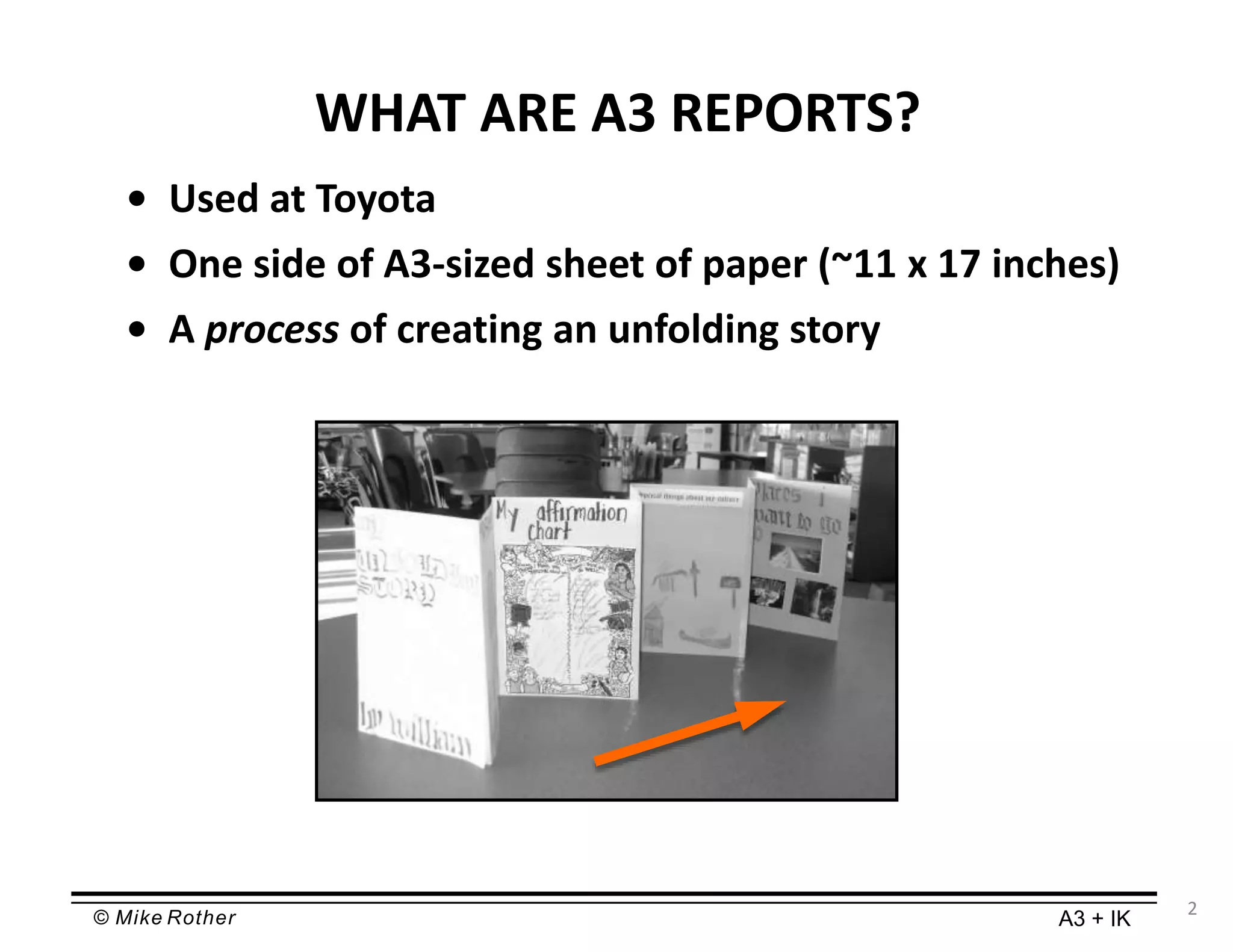
WHAT ARE A3 REPORTS?
• Used at Toyota
• One side of A3-sized sheet of paper (~11 x 17 inches)
• A process of creating an unfolding story
© Mike Rother A3 + IK
3
A3 AT TOYOTA
Developing an A3 story forces you to filter and refine
your thoughts to fit on one large sheet of paper, in such
a way that your manager has their (major) questions
answered by reading that sheet.
Only short A3 training is available at Toyota – maybe an
hour or two. A3 report writing skill is learned from your
Coach/manager and a lot of experience.
1) It’s not just a report. The document evolves along
the way with the process of learning. That process
is more important than the A3 itself.
2) It’s part of a method for teaching (coaching)
systematic, scientific habits of thinking and working.
3) It’s also a method for building consensus.
© Mike Rother A3 + IK
4
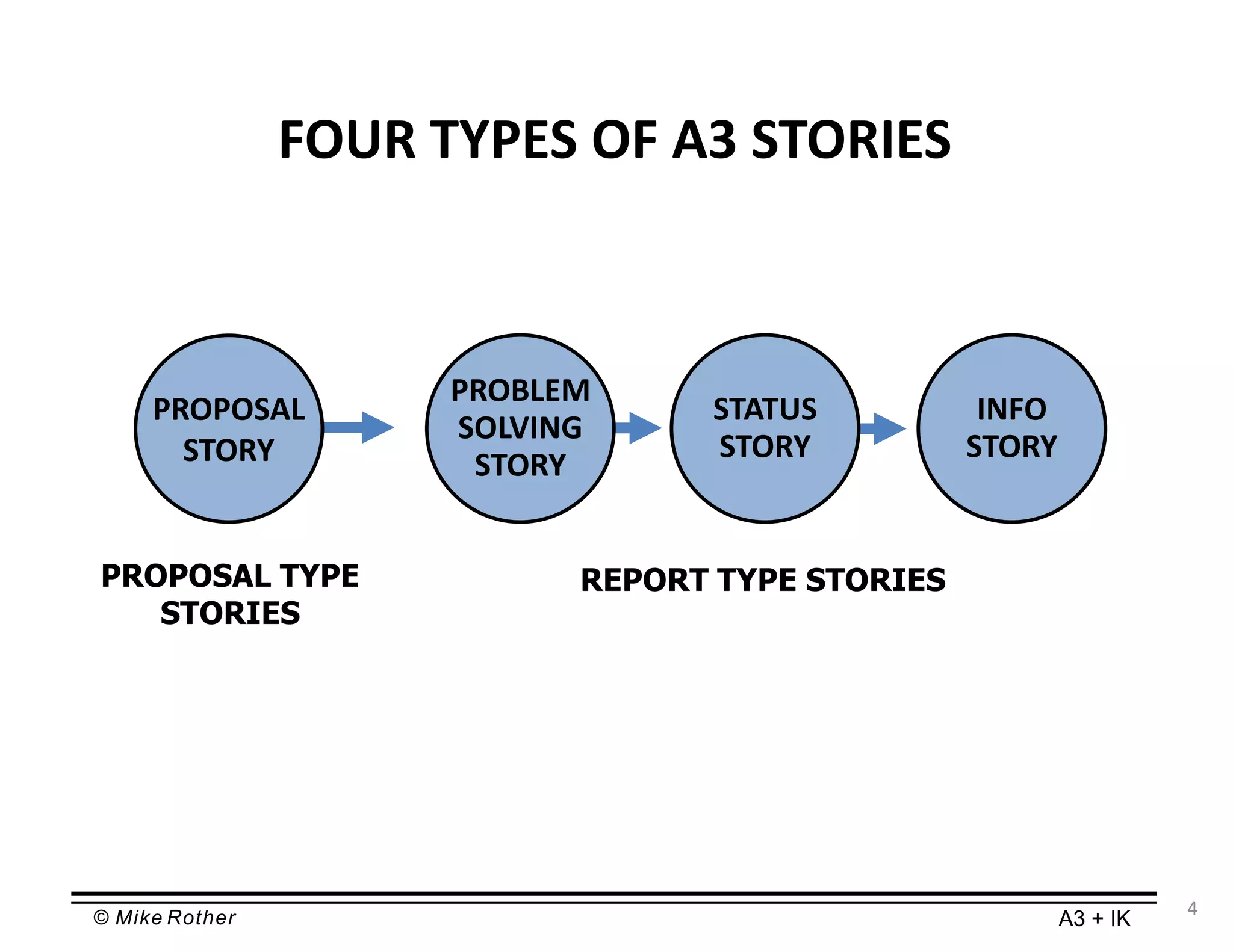
FOUR TYPES OF A3 STORIES
PROPOSAL
STORY
PROBLEM
SOLVING
STORY
STATUS
STORY
INFO
STORY
PROPOSAL TYPE
STORIES
REPORT TYPE STORIES
© Mike Rother A3 + IK
5
PROBLEM SITUATION
TARGET / GOAL
CAUSE ANALYSIS
COUNTERMEASURES
IMPLEMENTATION
FOLLOW-UP
THEME
AUTHOR: ________________________ DATE: ______________
EXAMPLE A3 PROBLEM SOLVING STORY FORMAT
© Mike Rother A3 + IK
WHAT'S THE PURPOSE
OF THE A3 TOOL?
Many of us have heard the stories from Westerners who went to
work at Toyota... At the start of their Toyota career they're
given an assignment and have to create an A3 as they work on
that assignment. As a result, of course, the A3 tool and format
became central in their thinking about Toyota's approach.
However, the A3 format / tool itself is primarily a medium to
facilitate communication between a Toyota Mentor and their
Learner. The goal is not the A3 itself, but to teach the Learner a
scientific pattern of thinking and acting as the Learner works on
a real assignment or problem.
Here's a sobering point for users of the A3 outside of Toyota:
The choreography of that thinking pattern lies more inside the
Mentor's head than in the A3. Just using the A3 does little.
6
© Mike Rother A3 + IK
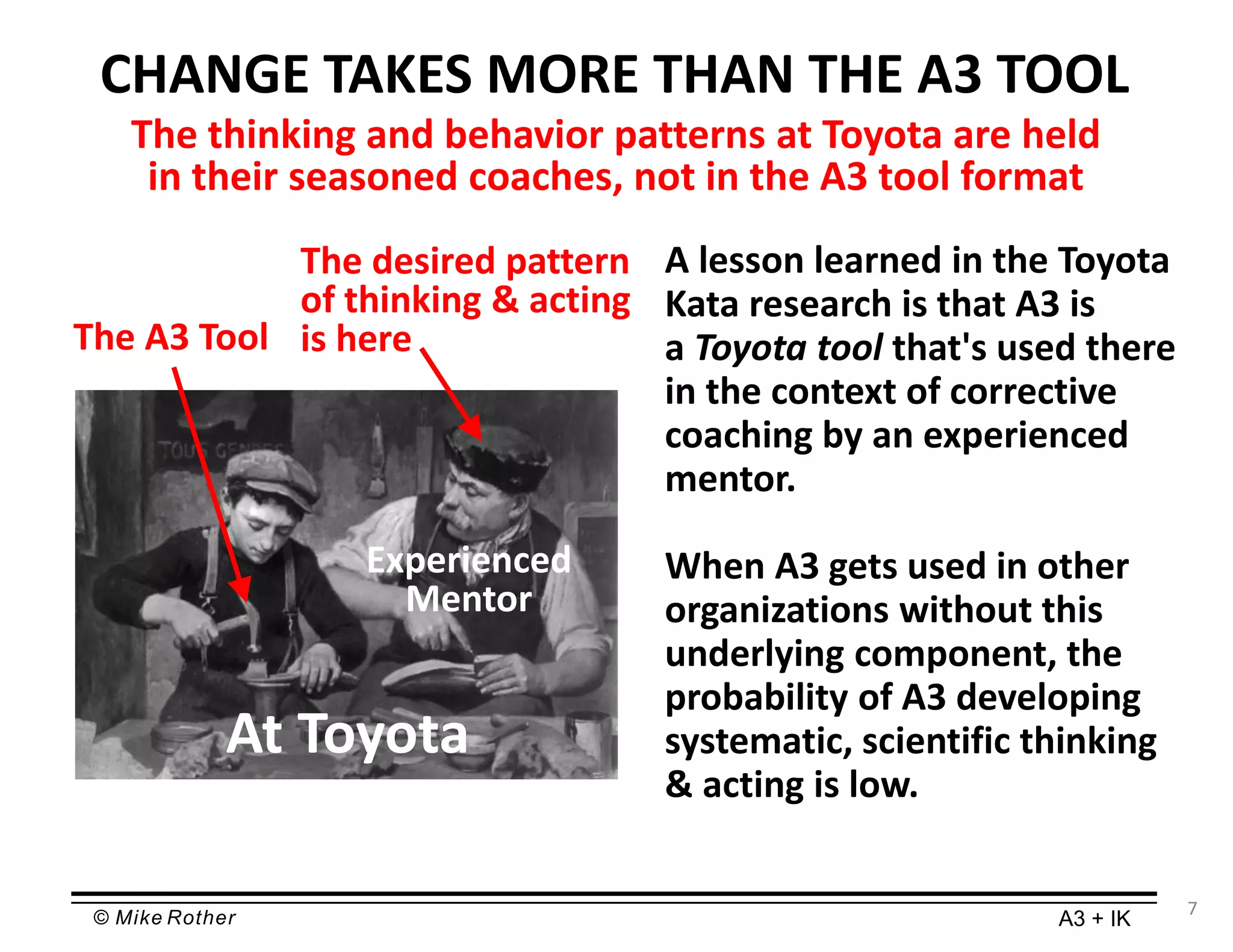
CHANGE TAKES MORE THAN THE A3 TOOL
A lesson learned in the Toyota
Kata research is that A3 is
a Toyota tool that's used there
in the context of corrective
coaching by an experienced
mentor.
When A3 gets used in other
organizations without this
underlying component, the
probability of A3 developing
systematic, scientific thinking
& acting is low.
The thinking and behavior patterns at Toyota are held
in their seasoned coaches, not in the A3 tool format
The A3 Tool
The desired pattern
of thinking & acting
is here
Experienced
Mentor
7
At Toyota
© Mike Rother A3 + IK
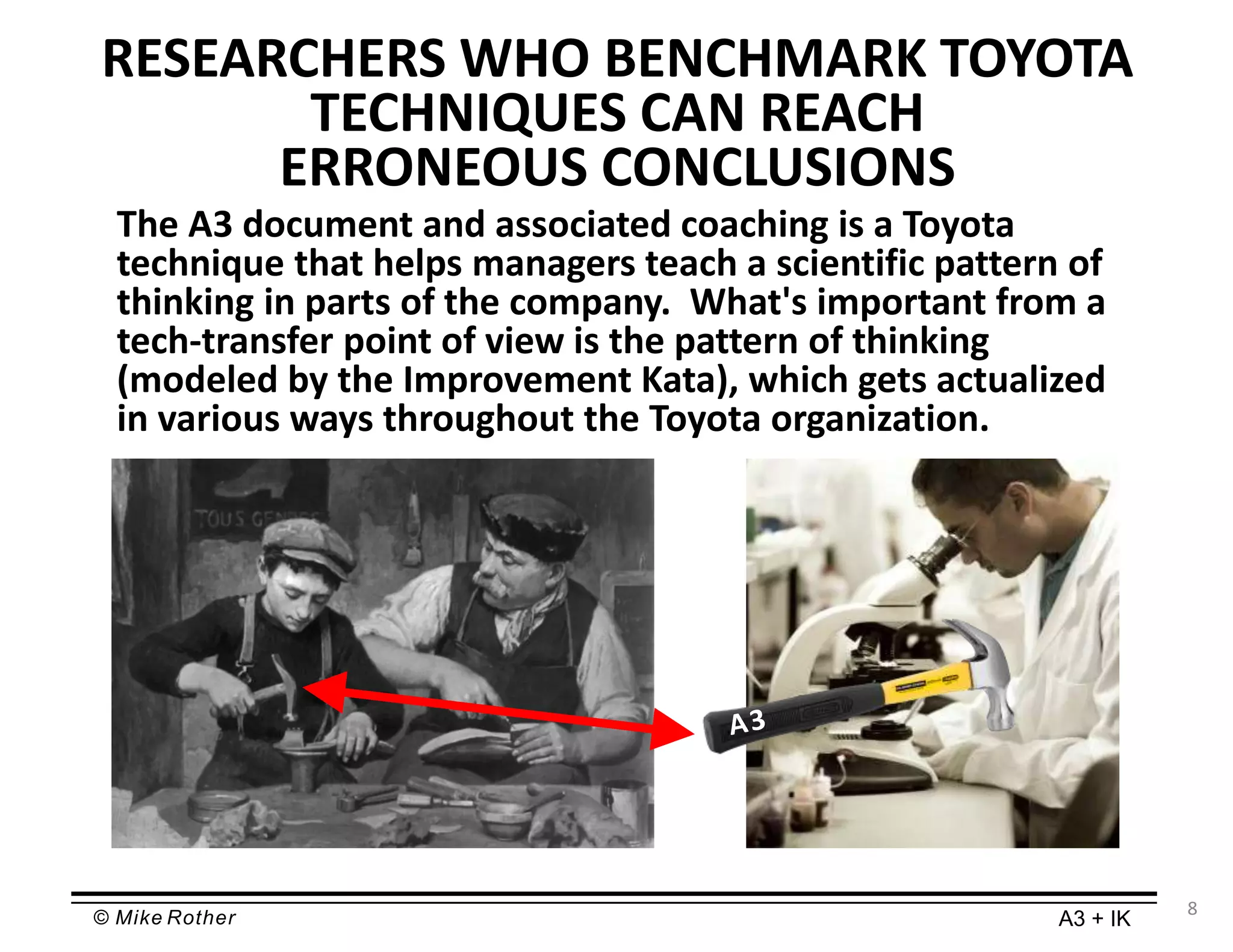
RESEARCHERS WHO BENCHMARK TOYOTA
TECHNIQUES CAN REACH
ERRONEOUS CONCLUSIONS
The A3 document and associated coaching is a Toyota
technique that helps managers teach a scientific pattern of
thinking in parts of the company. What's important from a
tech-transfer point of view is the pattern of thinking
(modeled by the Improvement Kata), which gets actualized
in various ways throughout the Toyota organization.
8
© Mike Rother A3 + IK
WHAT SHOULD WE DO?
We're not at Toyota and we don't have an
experienced Toyota mentor (manager) coaching us
9
© Mike Rother A3 + IK
PRACTICE THE IMPROVEMENT KATA
AND COACHING KATA
A3 as it is used to train people at Toyota and the Improvement Kata /
Coaching Kata (IK/CK) are aimed at the same purpose: Developing
scientific thinking skills (clarity of objective, conducting experiments,
striving based on facts and data).
The A3 alone is more of a summary of a problem-solving process. If
used correctly, the Learner is going through it with coaching, and
hence practice, at every step. At Toyota the coaching is not structured
and it is not necessarily daily. There is no formal coaching protocol
and no protocol for daily practice, though ideally that is what is
desired. It is up to the Coach to determine the frequency and
approach. This means the A3 requires a higher level of coaching skill.
The Improvement Kata & Coaching Kata make this process more
explicit, teachable and transferrable. The purpose of the IK & CK is to
systematize the practice – as in sports & music – that’s more implicit
in Toyota's already-strong culture of improvement. Practicing the
routines of the Improvement Kata and Coaching Kata teaches
foundational thinking that makes the A3 effective at Toyota.
10
© Mike Rother A3 + IK
Practice the structured
routines of the
Improvement Kata
pattern...
SCIENTIFIC THINKING IS
A FOUNDATIONAL SKILL
And get
better at...
• Handling
deviations from
a standard
• Using the A3
• Heijunka
• Respect for
people
• And so on
11
© Mike Rother A3 + IK
BEGINNERS NEED PRACTICE ROUTINES!
12
Both the Learner & Coach benefit from having practice
routines for developing foundational skills and mindset
© Mike Rother A3 + IK
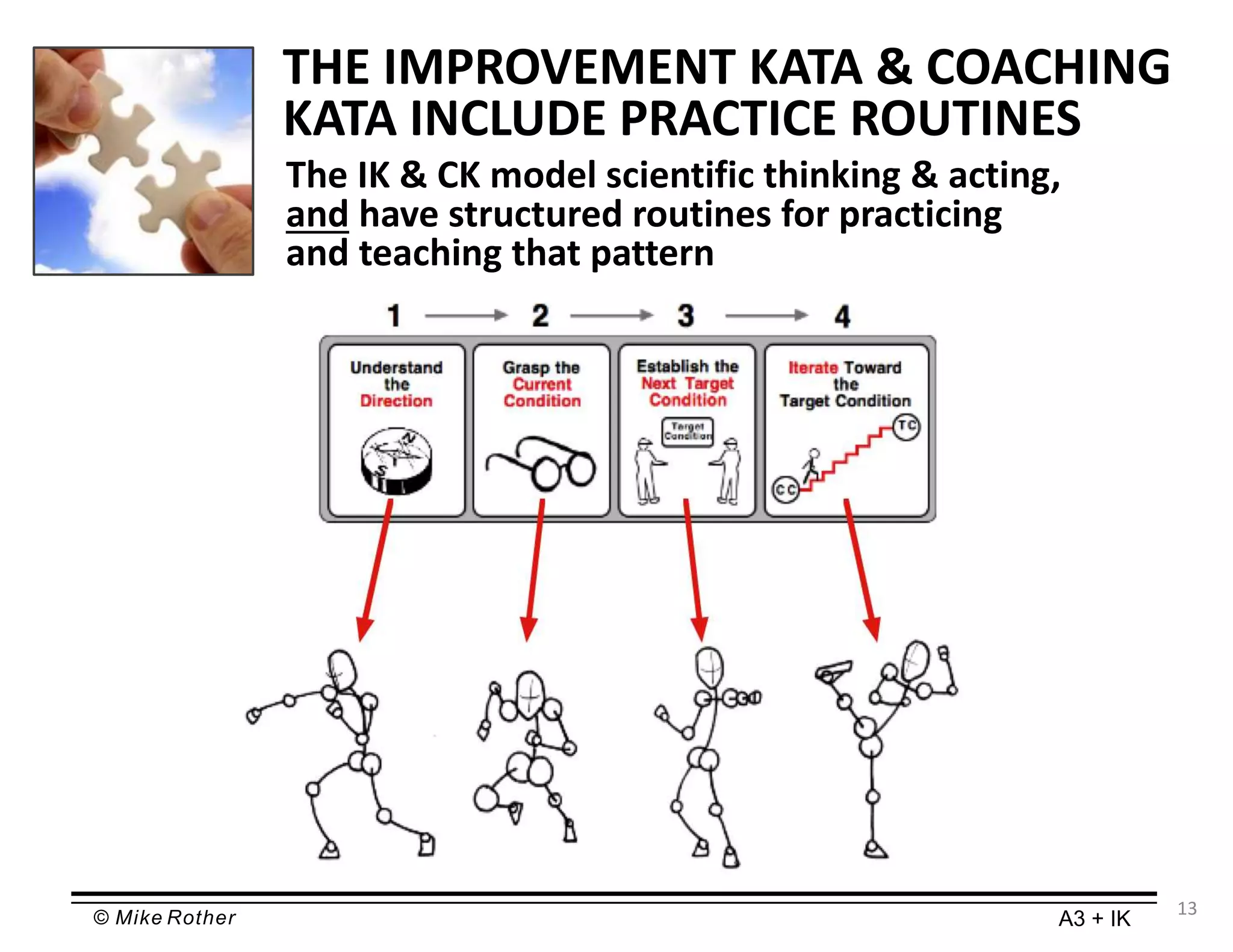
THE IMPROVEMENT KATA & COACHING
KATA INCLUDE PRACTICE ROUTINES
13
The IK & CK model scientific thinking & acting,
and have structured routines for practicing
and teaching that pattern
© Mike Rother A3 + IK
THREE SUGGESTIONS FOR A3 USERS
14
© Mike Rother A3 + IK
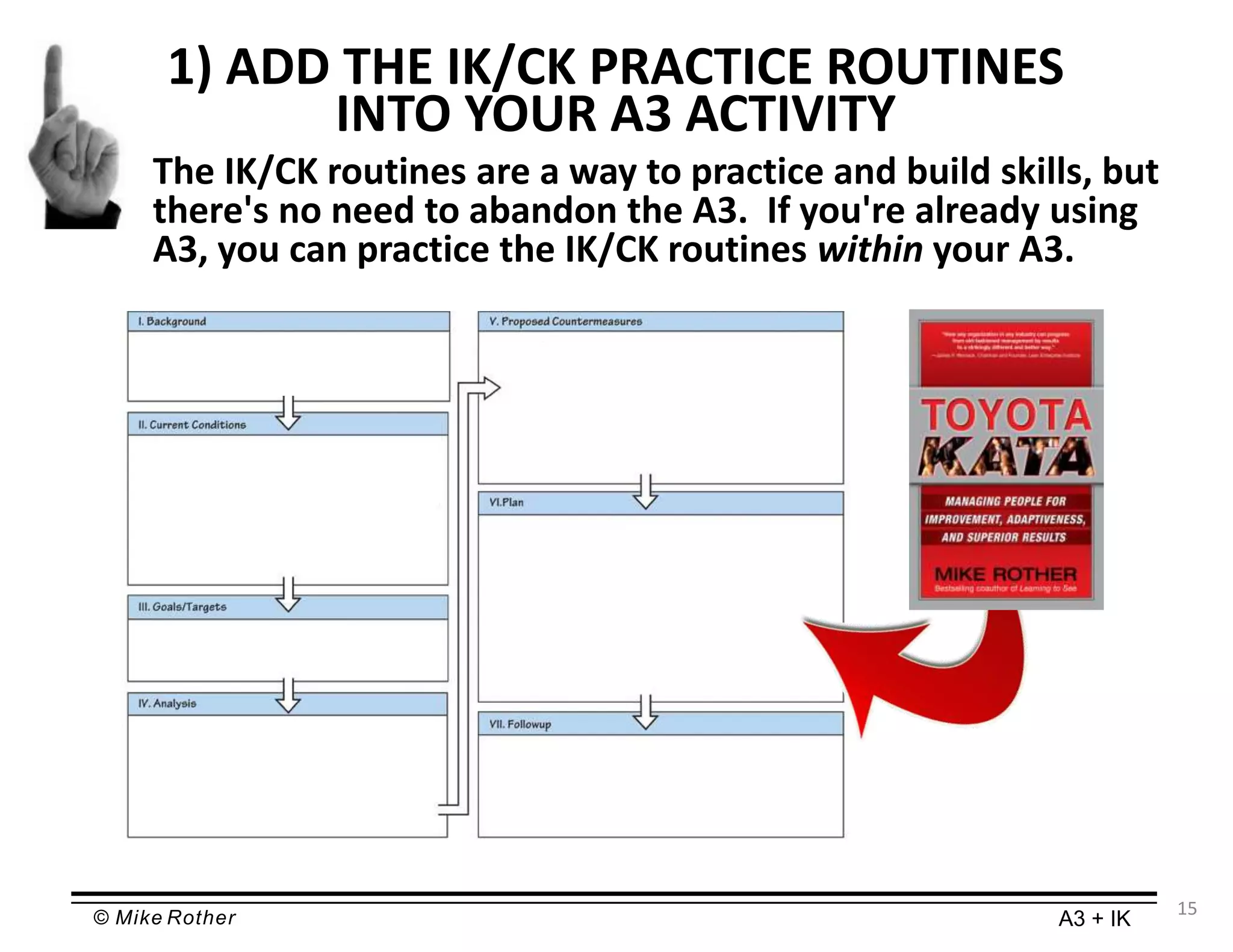
1) ADD THE IK/CK PRACTICE ROUTINES
INTO YOUR A3 ACTIVITY
The IK/CK routines are a way to practice and build skills, but
there's no need to abandon the A3. If you're already using
A3, you can practice the IK/CK routines within your A3.
15
© Mike Rother A3 + IK
SPECIFICALLY
16
PLANNING
EXECUTING
IK/CK practice routines,
as detailed in the online
'Improvement Kata
Handbook'
© Mike Rother A3 + IK
EXAMPLE
17
1. Identify the Problem (Include Challenge and Current Condition)
Terex Problem Solving Report TOPIC/Focus Area: Date/Name:
2. Set a Target
(Define next Target Condition)
3. Analyze Causes (Perceived Obstacles Parking Lot)
5. Check & Evaluate (Final results to achieve Target Condition)
6. Act/Standardize (Yokoten to share best practice)
Challenge Statement
Current Condition/Gap:
4. Propose &Test Countermeasures (PDCA Cycles Records)
Example by Jenny Snow-Boscolo
© Mike Rother A3 + IK
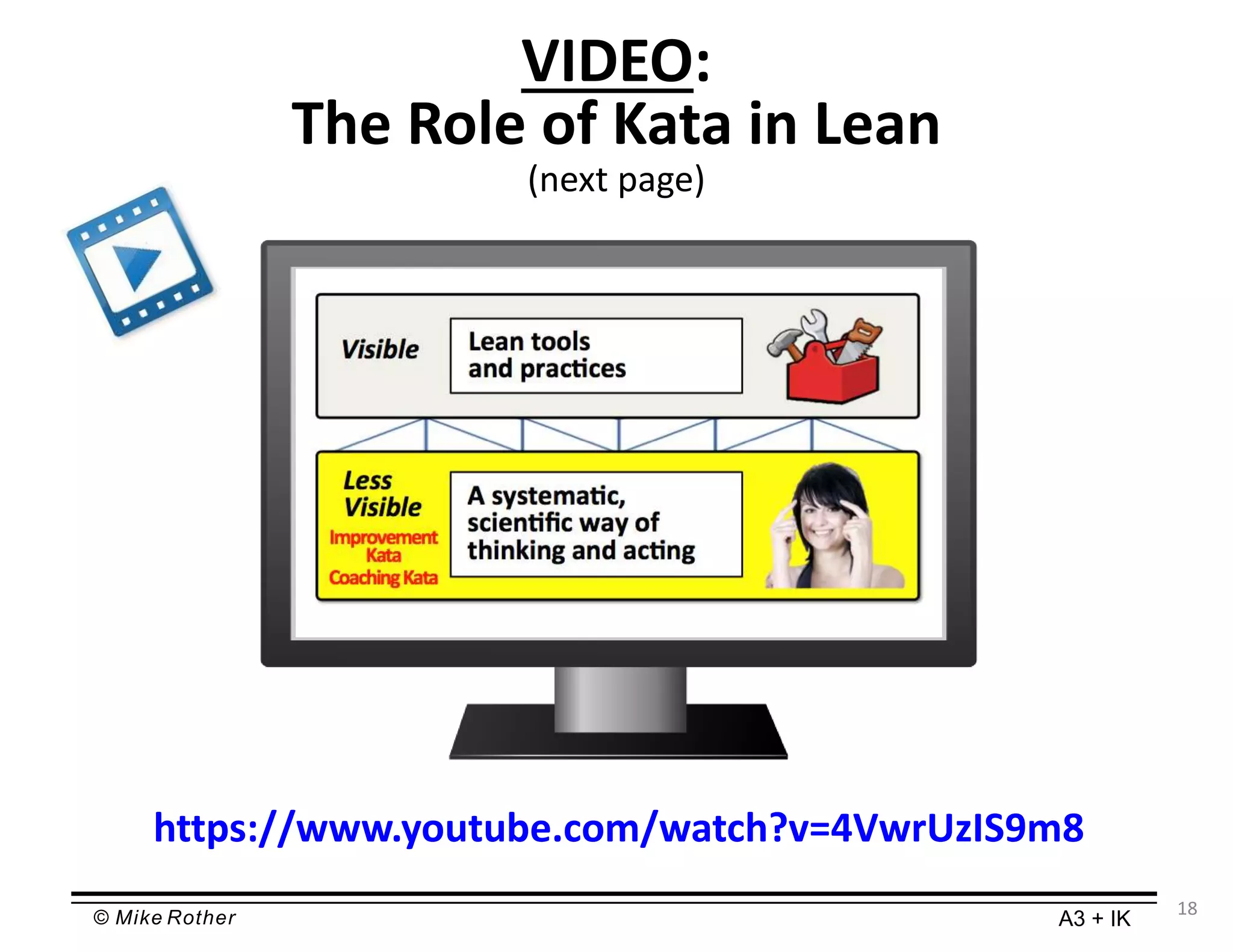
VIDEO:
The Role of Kata in Lean
(next page)
https://www.youtube.com/watch?v=4VwrUzIS9m8
18
© Mike Rother A3 + IK
19
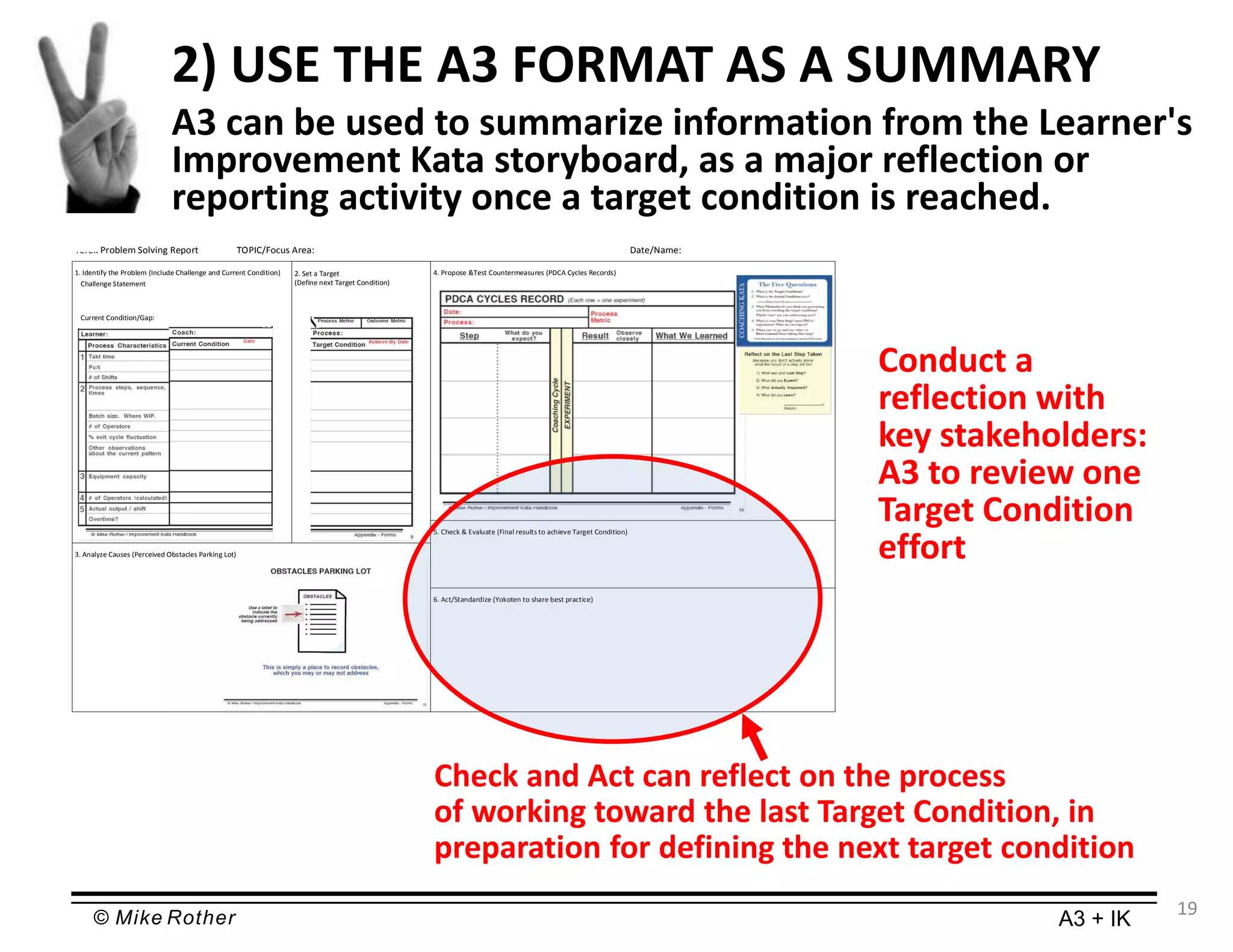
2) USE THE A3 FORMAT AS A SUMMARY
Check and Act can reflect on the process
of working toward the last Target Condition, in
preparation for defining the next target condition
1. Identify the Problem (Include Challenge and Current Condition)
Terex Problem Solving Report TOPIC/Focus Area: Date/Name:
2. Set a Target
(Define next Target Condition)
3. Analyze Causes (Perceived Obstacles Parking Lot)
5. Check & Evaluate (Final results to achieve Target Condition)
6. Act/Standardize (Yokoten to share best practice)
Challenge Statement
Current Condition/Gap:
4. Propose &Test Countermeasures (PDCA Cycles Records)
Conduct a
reflection with
key stakeholders:
A3 to review one
Target Condition
effort
A3 can be used to summarize information from the Learner's
Improvement Kata storyboard, as a major reflection or
reporting activity once a target condition is reached.
© Mike Rother A3 + IK
20
The A3 is particularly useful for individuals trying to get
cross-functional agreement and engagement, by having
a crisp, clear story to circulate and get alignment and
build consensus.
3) USE THE A3 FOR CONSENSUS BUILDING
© Mike Rother A3 + IK
WHETHER IMPROVEMENT KATA
OR A3, YOU’LL NEED:
• A clearly patterned improvement/striving process.
• Broken into elements to practice each element.
• An experienced coach with a defined coaching pattern,
to provide corrective feedback.
• Experiments to iterate toward the target condition.
• Involve those affected.
• Frequent reflection/adjustment, and a major reflection
for closure.
21
© Mike Rother A3 + IK
CONCLUSION
The Improvement Kata and Coaching Kata are
structured teaching tools to shift underlying thought
patterns. The idea is that as proficiency is developed
and the scientific skills and thought patterns take
hold, the structure of the coaching dialogs can move
in the general direction of Toyota's “This is just how
we think and do things" culture. Getting the IK/CK
patterns established is an early target condition.
The Improvement Kata and Coaching Kata are for
organizations that don't think and act scientifically
by default, but want to learn to do so. That means
they are in deliberate practice mode, and the
Improvement Kata and Coaching Kata provide a
structure for that practice.
22
© Mike Rother A3 + IK
23
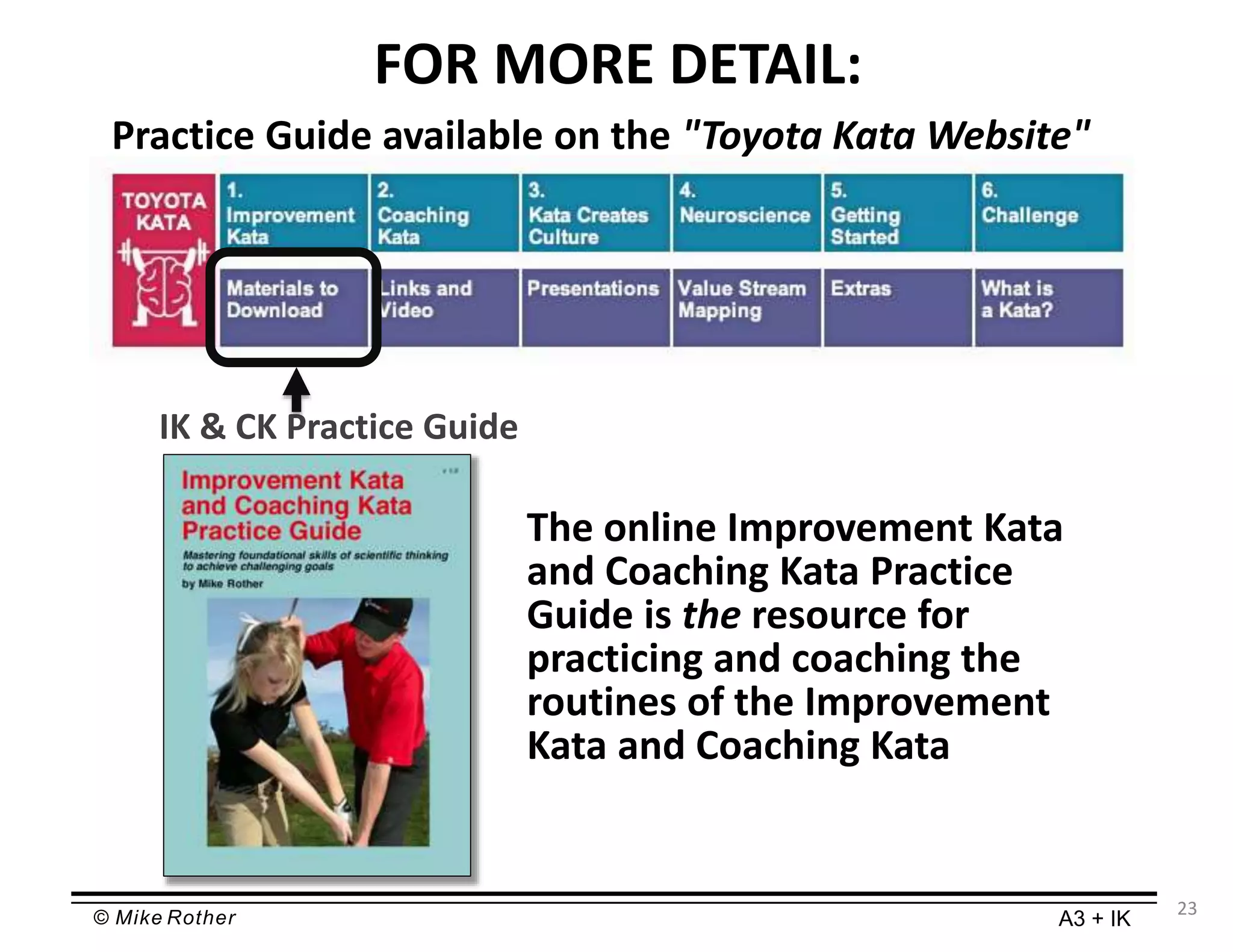
FOR MORE DETAIL:
Practice Guide available on the "Toyota Kata Website"
IK & CK Practice Guide
The online Improvement Kata
and Coaching Kata Practice
Guide is the resource for
practicing and coaching the
routines of the Improvement
Kata and Coaching Kata

Why Your A3 Needs the IK

  • 1.
    © Mike RotherA3 + IK Why Your A3 Isn't Working & What You Can Do About It 1 By Jeff Liker, Mark Rosenthal, Mike Rother and Jenny Snow-Boscolo February 2014
  • 2.
    © Mike RotherA3 + IK 2 WHAT ARE A3 REPORTS? • Used at Toyota • One side of A3-sized sheet of paper (~11 x 17 inches) • A process of creating an unfolding story
  • 3.
    © Mike RotherA3 + IK 3 A3 AT TOYOTA Developing an A3 story forces you to filter and refine your thoughts to fit on one large sheet of paper, in such a way that your manager has their (major) questions answered by reading that sheet. Only short A3 training is available at Toyota – maybe an hour or two. A3 report writing skill is learned from your Coach/manager and a lot of experience. 1) It’s not just a report. The document evolves along the way with the process of learning. That process is more important than the A3 itself. 2) It’s part of a method for teaching (coaching) systematic, scientific habits of thinking and working. 3) It’s also a method for building consensus.
  • 4.
    © Mike RotherA3 + IK 4 FOUR TYPES OF A3 STORIES PROPOSAL STORY PROBLEM SOLVING STORY STATUS STORY INFO STORY PROPOSAL TYPE STORIES REPORT TYPE STORIES
  • 5.
    © Mike RotherA3 + IK 5 PROBLEM SITUATION TARGET / GOAL CAUSE ANALYSIS COUNTERMEASURES IMPLEMENTATION FOLLOW-UP THEME AUTHOR: ________________________ DATE: ______________ EXAMPLE A3 PROBLEM SOLVING STORY FORMAT
  • 6.
    © Mike RotherA3 + IK WHAT'S THE PURPOSE OF THE A3 TOOL? Many of us have heard the stories from Westerners who went to work at Toyota... At the start of their Toyota career they're given an assignment and have to create an A3 as they work on that assignment. As a result, of course, the A3 tool and format became central in their thinking about Toyota's approach. However, the A3 format / tool itself is primarily a medium to facilitate communication between a Toyota Mentor and their Learner. The goal is not the A3 itself, but to teach the Learner a scientific pattern of thinking and acting as the Learner works on a real assignment or problem. Here's a sobering point for users of the A3 outside of Toyota: The choreography of that thinking pattern lies more inside the Mentor's head than in the A3. Just using the A3 does little. 6
  • 7.
    © Mike RotherA3 + IK CHANGE TAKES MORE THAN THE A3 TOOL A lesson learned in the Toyota Kata research is that A3 is a Toyota tool that's used there in the context of corrective coaching by an experienced mentor. When A3 gets used in other organizations without this underlying component, the probability of A3 developing systematic, scientific thinking & acting is low. The thinking and behavior patterns at Toyota are held in their seasoned coaches, not in the A3 tool format The A3 Tool The desired pattern of thinking & acting is here Experienced Mentor 7 At Toyota
  • 8.
    © Mike RotherA3 + IK RESEARCHERS WHO BENCHMARK TOYOTA TECHNIQUES CAN REACH ERRONEOUS CONCLUSIONS The A3 document and associated coaching is a Toyota technique that helps managers teach a scientific pattern of thinking in parts of the company. What's important from a tech-transfer point of view is the pattern of thinking (modeled by the Improvement Kata), which gets actualized in various ways throughout the Toyota organization. 8
  • 9.
    © Mike RotherA3 + IK WHAT SHOULD WE DO? We're not at Toyota and we don't have an experienced Toyota mentor (manager) coaching us 9
  • 10.
    © Mike RotherA3 + IK PRACTICE THE IMPROVEMENT KATA AND COACHING KATA A3 as it is used to train people at Toyota and the Improvement Kata / Coaching Kata (IK/CK) are aimed at the same purpose: Developing scientific thinking skills (clarity of objective, conducting experiments, striving based on facts and data). The A3 alone is more of a summary of a problem-solving process. If used correctly, the Learner is going through it with coaching, and hence practice, at every step. At Toyota the coaching is not structured and it is not necessarily daily. There is no formal coaching protocol and no protocol for daily practice, though ideally that is what is desired. It is up to the Coach to determine the frequency and approach. This means the A3 requires a higher level of coaching skill. The Improvement Kata & Coaching Kata make this process more explicit, teachable and transferrable. The purpose of the IK & CK is to systematize the practice – as in sports & music – that’s more implicit in Toyota's already-strong culture of improvement. Practicing the routines of the Improvement Kata and Coaching Kata teaches foundational thinking that makes the A3 effective at Toyota. 10
  • 11.
    © Mike RotherA3 + IK Practice the structured routines of the Improvement Kata pattern... SCIENTIFIC THINKING IS A FOUNDATIONAL SKILL And get better at... • Handling deviations from a standard • Using the A3 • Heijunka • Respect for people • And so on 11
  • 12.
    © Mike RotherA3 + IK BEGINNERS NEED PRACTICE ROUTINES! 12 Both the Learner & Coach benefit from having practice routines for developing foundational skills and mindset
  • 13.
    © Mike RotherA3 + IK THE IMPROVEMENT KATA & COACHING KATA INCLUDE PRACTICE ROUTINES 13 The IK & CK model scientific thinking & acting, and have structured routines for practicing and teaching that pattern
  • 14.
    © Mike RotherA3 + IK THREE SUGGESTIONS FOR A3 USERS 14
  • 15.
    © Mike RotherA3 + IK 1) ADD THE IK/CK PRACTICE ROUTINES INTO YOUR A3 ACTIVITY The IK/CK routines are a way to practice and build skills, but there's no need to abandon the A3. If you're already using A3, you can practice the IK/CK routines within your A3. 15
  • 16.
    © Mike RotherA3 + IK SPECIFICALLY 16 PLANNING EXECUTING IK/CK practice routines, as detailed in the online 'Improvement Kata Handbook'
  • 17.
    © Mike RotherA3 + IK EXAMPLE 17 1. Identify the Problem (Include Challenge and Current Condition) Terex Problem Solving Report TOPIC/Focus Area: Date/Name: 2. Set a Target (Define next Target Condition) 3. Analyze Causes (Perceived Obstacles Parking Lot) 5. Check & Evaluate (Final results to achieve Target Condition) 6. Act/Standardize (Yokoten to share best practice) Challenge Statement Current Condition/Gap: 4. Propose &Test Countermeasures (PDCA Cycles Records) Example by Jenny Snow-Boscolo
  • 18.
    © Mike RotherA3 + IK VIDEO: The Role of Kata in Lean (next page) https://www.youtube.com/watch?v=4VwrUzIS9m8 18
  • 19.
    © Mike RotherA3 + IK 19 2) USE THE A3 FORMAT AS A SUMMARY Check and Act can reflect on the process of working toward the last Target Condition, in preparation for defining the next target condition 1. Identify the Problem (Include Challenge and Current Condition) Terex Problem Solving Report TOPIC/Focus Area: Date/Name: 2. Set a Target (Define next Target Condition) 3. Analyze Causes (Perceived Obstacles Parking Lot) 5. Check & Evaluate (Final results to achieve Target Condition) 6. Act/Standardize (Yokoten to share best practice) Challenge Statement Current Condition/Gap: 4. Propose &Test Countermeasures (PDCA Cycles Records) Conduct a reflection with key stakeholders: A3 to review one Target Condition effort A3 can be used to summarize information from the Learner's Improvement Kata storyboard, as a major reflection or reporting activity once a target condition is reached.
  • 20.
    © Mike RotherA3 + IK 20 The A3 is particularly useful for individuals trying to get cross-functional agreement and engagement, by having a crisp, clear story to circulate and get alignment and build consensus. 3) USE THE A3 FOR CONSENSUS BUILDING
  • 21.
    © Mike RotherA3 + IK WHETHER IMPROVEMENT KATA OR A3, YOU’LL NEED: • A clearly patterned improvement/striving process. • Broken into elements to practice each element. • An experienced coach with a defined coaching pattern, to provide corrective feedback. • Experiments to iterate toward the target condition. • Involve those affected. • Frequent reflection/adjustment, and a major reflection for closure. 21
  • 22.
    © Mike RotherA3 + IK CONCLUSION The Improvement Kata and Coaching Kata are structured teaching tools to shift underlying thought patterns. The idea is that as proficiency is developed and the scientific skills and thought patterns take hold, the structure of the coaching dialogs can move in the general direction of Toyota's “This is just how we think and do things" culture. Getting the IK/CK patterns established is an early target condition. The Improvement Kata and Coaching Kata are for organizations that don't think and act scientifically by default, but want to learn to do so. That means they are in deliberate practice mode, and the Improvement Kata and Coaching Kata provide a structure for that practice. 22
  • 23.
    © Mike RotherA3 + IK 23 FOR MORE DETAIL: Practice Guide available on the "Toyota Kata Website" IK & CK Practice Guide The online Improvement Kata and Coaching Kata Practice Guide is the resource for practicing and coaching the routines of the Improvement Kata and Coaching Kata