Common Core State Standards
Supporting the new standards for elementary students
by Mary Ann Scheuer
Berkeley Unified School District
April 2014
maryannscheuer@berkeley.net
Twitter: @MaryAnnScheuer
What are the Common Core State
Standards (CCSS)?
The Common Core is a set of high-quality academic standards in
mathematics and English language arts/literacy (ELA). These
learning goals outline what a student should know and be able to
do at the end of each grade.
source: CoreStandards.org
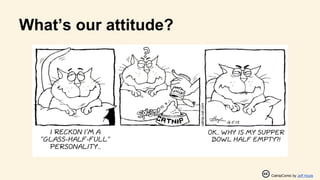
What’s our attitude?
CatnipComic by Jeff Hoyle
Adoption & Implementation
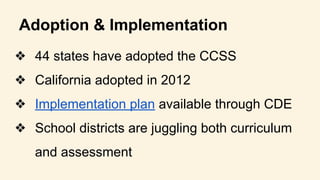
❖ 44 states have adopted the CCSS
❖ California adopted in 2012
❖ Implementation plan available through CDE
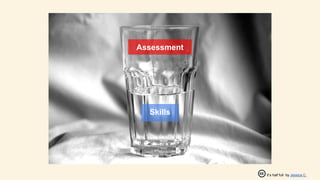
❖ School districts are juggling both curriculum
and assessment
Skills
Assessment
It’s half full by Jessica C.
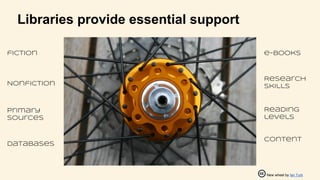
Libraries provide essential support
New wheel by Ian Turk
Nonfiction
Primary
sources
Databases
e-books
Research
skills
Reading
levels
fiction
content
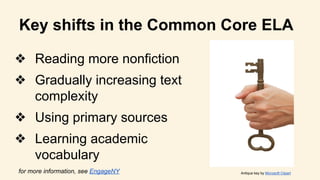
Key shifts in the Common Core ELA
❖ Reading more nonfiction
❖ Gradually increasing text
complexity
❖ Using primary sources
❖ Learning academic
vocabulary
Antique key by Microsoft Clipartfor more information, see EngageNY
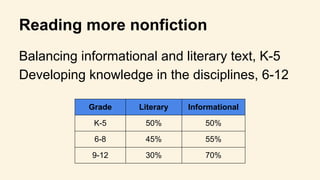
Reading more nonfiction
Balancing informational and literary text, K-5
Developing knowledge in the disciplines, 6-12
Grade Literary Informational
K-5 50% 50%
6-8 45% 55%
9-12 30% 70%
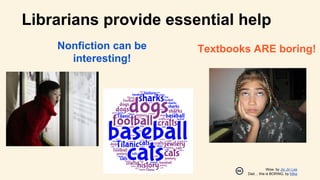
Librarians provide essential help
Wow, by Jip Jin Lee
Dad… this is BORING, by Mike
Nonfiction can be
interesting!
Textbooks ARE boring!
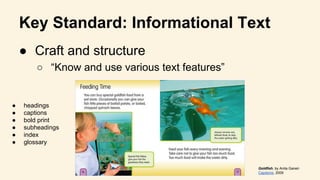
Key Standard: Informational Text
● Craft and structure
○ “Know and use various text features”
● headings
● captions
● bold print
● subheadings
● index
● glossary
Goldfish, by Anita Ganeri
Capstone, 2009
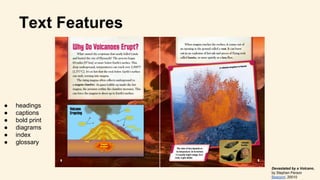
Text Features
● headings
● captions
● bold print
● diagrams
● index
● glossary
Devastated by a Volcano,
by Stephen Person
Bearport, 20010
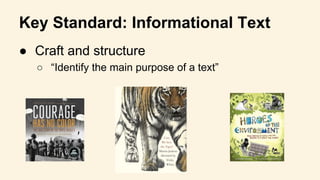
Key Standard: Informational Text
● Craft and structure
○ “Identify the main purpose of a text”
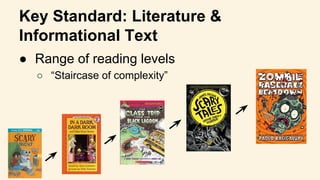
Key Standard: Literature &
Informational Text
● Range of reading levels
○ “Staircase of complexity”
Understanding reading levels
Comparing different systems
○ What do they measure?
○ Which do our schools use?
○ How do we estimate with new books?
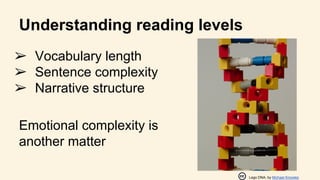
Understanding reading levels
➢ Vocabulary length
➢ Sentence complexity
➢ Narrative structure
Emotional complexity is
another matter
Lego DNA, by Michael Knowles
Resources to learn more
❖ California Department of Education
❖ EngageNY - especially video library (ELA overview)
❖ ALSC Common Core Resources
❖ SLJ webinar archives
❖ Blog features like Common Core IRL
Questions?
Mary Ann Scheuer
Berkeley Unified School District
➢ maryannscheuer@berkeley.net
➢ Twitter: @MaryAnnScheuer
➢ Great Kid Books http:
//greatkidbooks.blogspot.com
Puzzled people by Microsoft Clipart

Common Core State Standards: a presentation for the California Library Association

  • 1.
    Common Core StateStandards Supporting the new standards for elementary students by Mary Ann Scheuer Berkeley Unified School District April 2014 maryannscheuer@berkeley.net Twitter: @MaryAnnScheuer
  • 2.
    What are theCommon Core State Standards (CCSS)? The Common Core is a set of high-quality academic standards in mathematics and English language arts/literacy (ELA). These learning goals outline what a student should know and be able to do at the end of each grade. source: CoreStandards.org
  • 3.
  • 4.
    Adoption & Implementation ❖44 states have adopted the CCSS ❖ California adopted in 2012 ❖ Implementation plan available through CDE ❖ School districts are juggling both curriculum and assessment
  • 5.
  • 6.
    Libraries provide essentialsupport New wheel by Ian Turk Nonfiction Primary sources Databases e-books Research skills Reading levels fiction content
  • 7.
    Key shifts inthe Common Core ELA ❖ Reading more nonfiction ❖ Gradually increasing text complexity ❖ Using primary sources ❖ Learning academic vocabulary Antique key by Microsoft Clipartfor more information, see EngageNY
  • 8.
    Reading more nonfiction Balancinginformational and literary text, K-5 Developing knowledge in the disciplines, 6-12 Grade Literary Informational K-5 50% 50% 6-8 45% 55% 9-12 30% 70%
  • 9.
    Librarians provide essentialhelp Wow, by Jip Jin Lee Dad… this is BORING, by Mike Nonfiction can be interesting! Textbooks ARE boring!
  • 10.
    Key Standard: InformationalText ● Craft and structure ○ “Know and use various text features” ● headings ● captions ● bold print ● subheadings ● index ● glossary Goldfish, by Anita Ganeri Capstone, 2009
  • 11.
    Text Features ● headings ●captions ● bold print ● diagrams ● index ● glossary Devastated by a Volcano, by Stephen Person Bearport, 20010
  • 12.
    Key Standard: InformationalText ● Craft and structure ○ “Identify the main purpose of a text”
  • 13.
    Key Standard: Literature& Informational Text ● Range of reading levels ○ “Staircase of complexity”
  • 14.
    Understanding reading levels Comparingdifferent systems ○ What do they measure? ○ Which do our schools use? ○ How do we estimate with new books?
  • 15.
    Understanding reading levels ➢Vocabulary length ➢ Sentence complexity ➢ Narrative structure Emotional complexity is another matter Lego DNA, by Michael Knowles
  • 16.
    Resources to learnmore ❖ California Department of Education ❖ EngageNY - especially video library (ELA overview) ❖ ALSC Common Core Resources ❖ SLJ webinar archives ❖ Blog features like Common Core IRL
  • 17.
    Questions? Mary Ann Scheuer BerkeleyUnified School District ➢ maryannscheuer@berkeley.net ➢ Twitter: @MaryAnnScheuer ➢ Great Kid Books http: //greatkidbooks.blogspot.com Puzzled people by Microsoft Clipart