ALA Annual Conference
June 29, 2014
Meet the CC IRL Team
Mary Ann Scheuer: School Librarian, Emerson Elementary School (California)
greatkidbooks.blogspot.com
Alyson Beecher: Literacy Specialist, Pasedena Unified School District
(California) kidlitfrenzy.com
Louise Capizzo: Youth Services Librarian, Scarborough Public Library (Maine)
nonfictiondetectives.com
Cathy Potter: School Librarian, Falmouth Elementary School (Maine)
nonfictiondetectives.com
Online access to presentation
http://bit.ly/ccirl2014
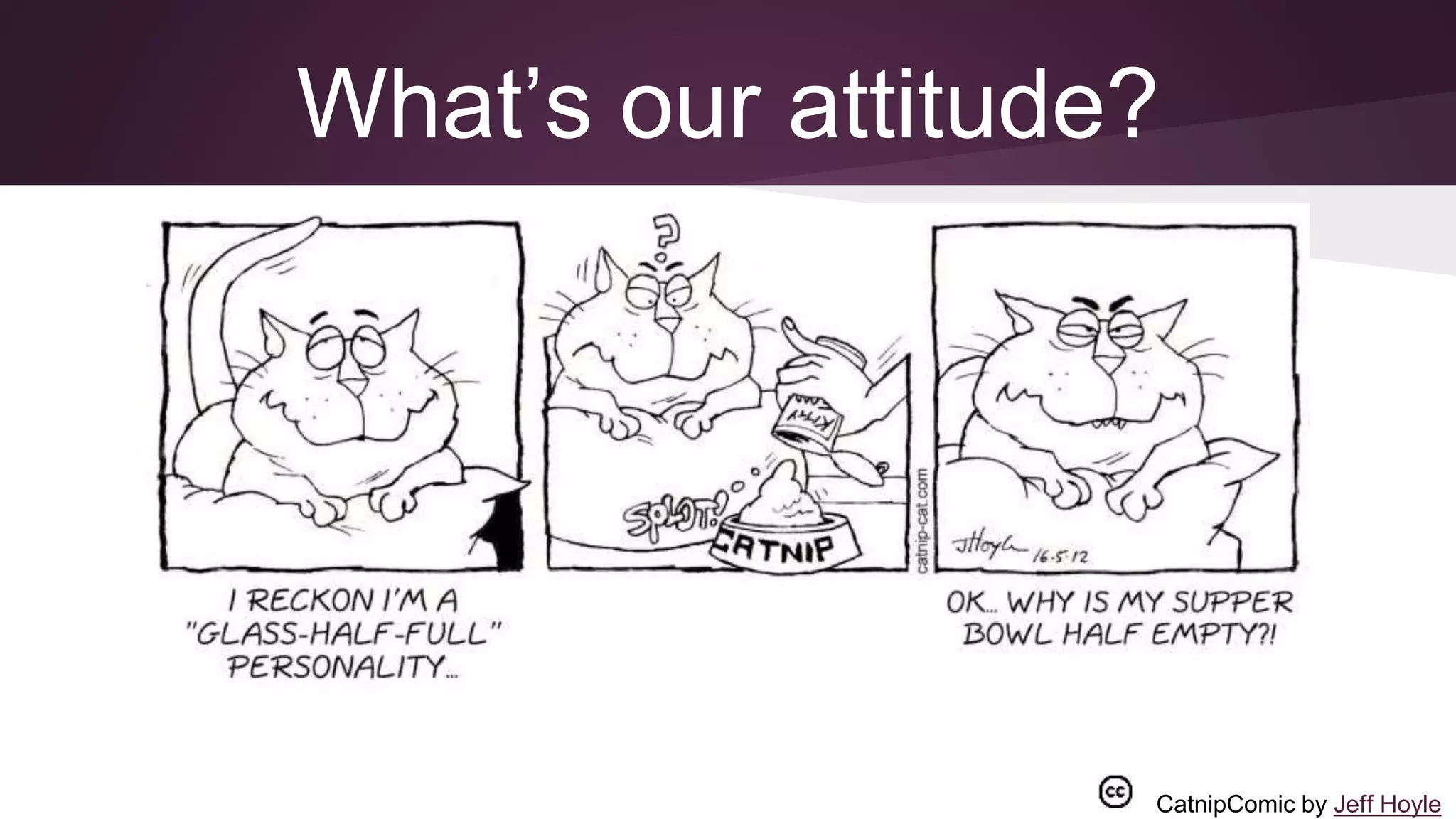
What’s our attitude?
CatnipComic by Jeff Hoyle
Our Goal in Starting CC: IRL
● add library expertise to evaluating
educational resources
● deepen our understanding of the ladder of
complexity
● provide an alternative to prescriptive
curriculum kits
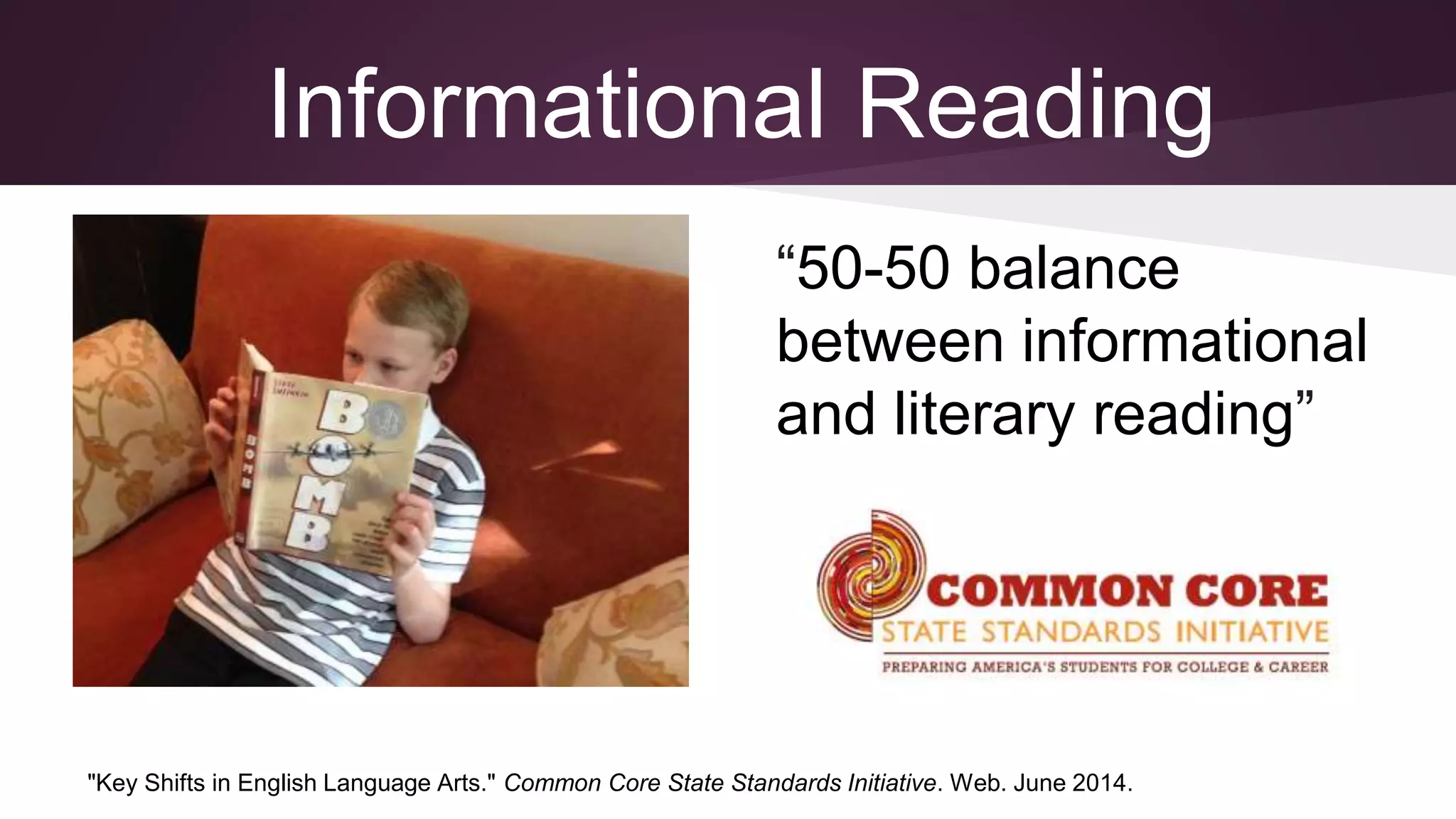
Informational Reading
“50-50 balance
between informational
and literary reading”
"Key Shifts in English Language Arts." Common Core State Standards Initiative. Web. June 2014.
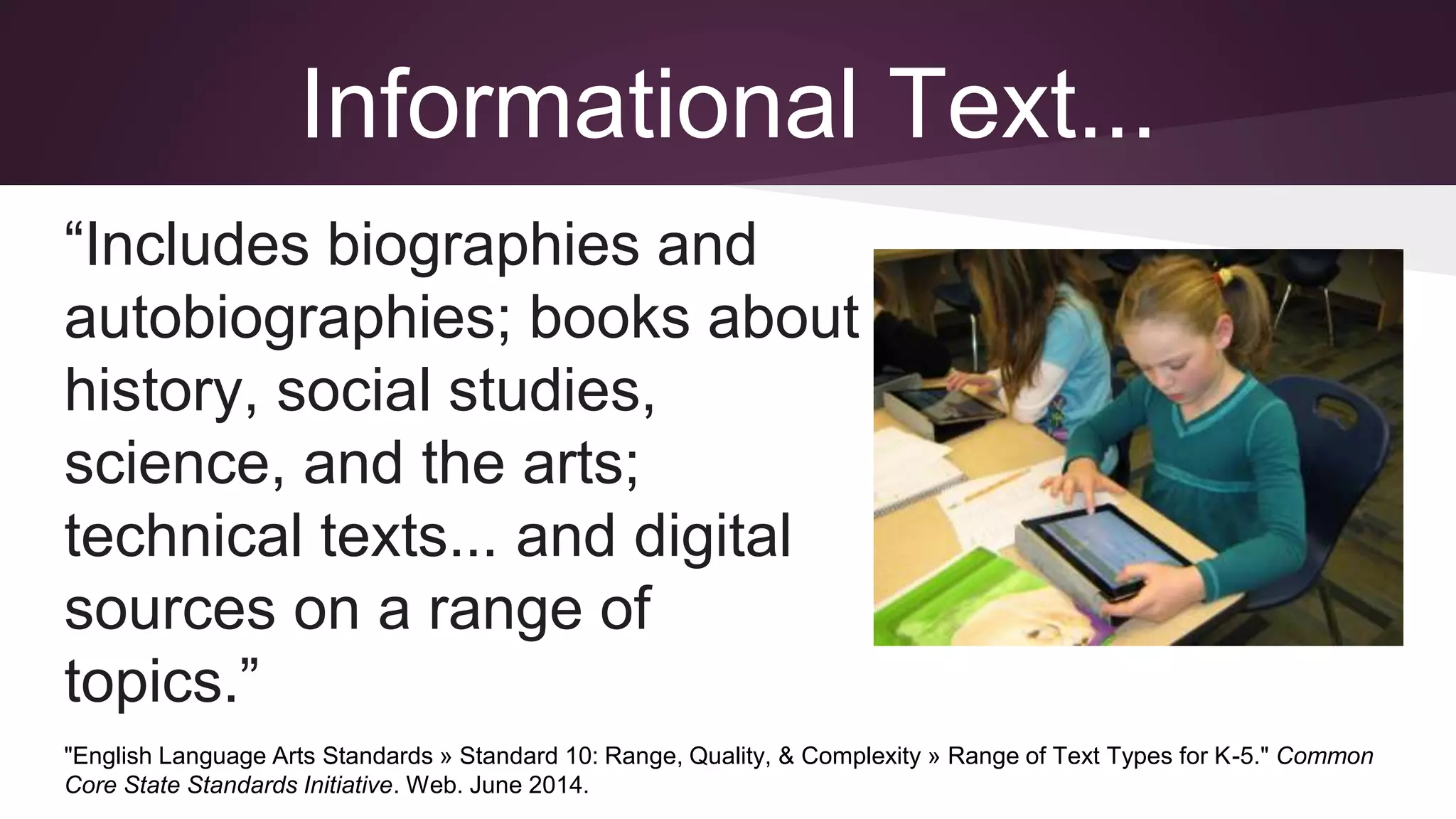
Informational Text...
“Includes biographies and
autobiographies; books about
history, social studies,
science, and the arts;
technical texts... and digital
sources on a range of
topics.”
"English Language Arts Standards » Standard 10: Range, Quality, & Complexity » Range of Text Types for K-5." Common
Core State Standards Initiative. Web. June 2014.
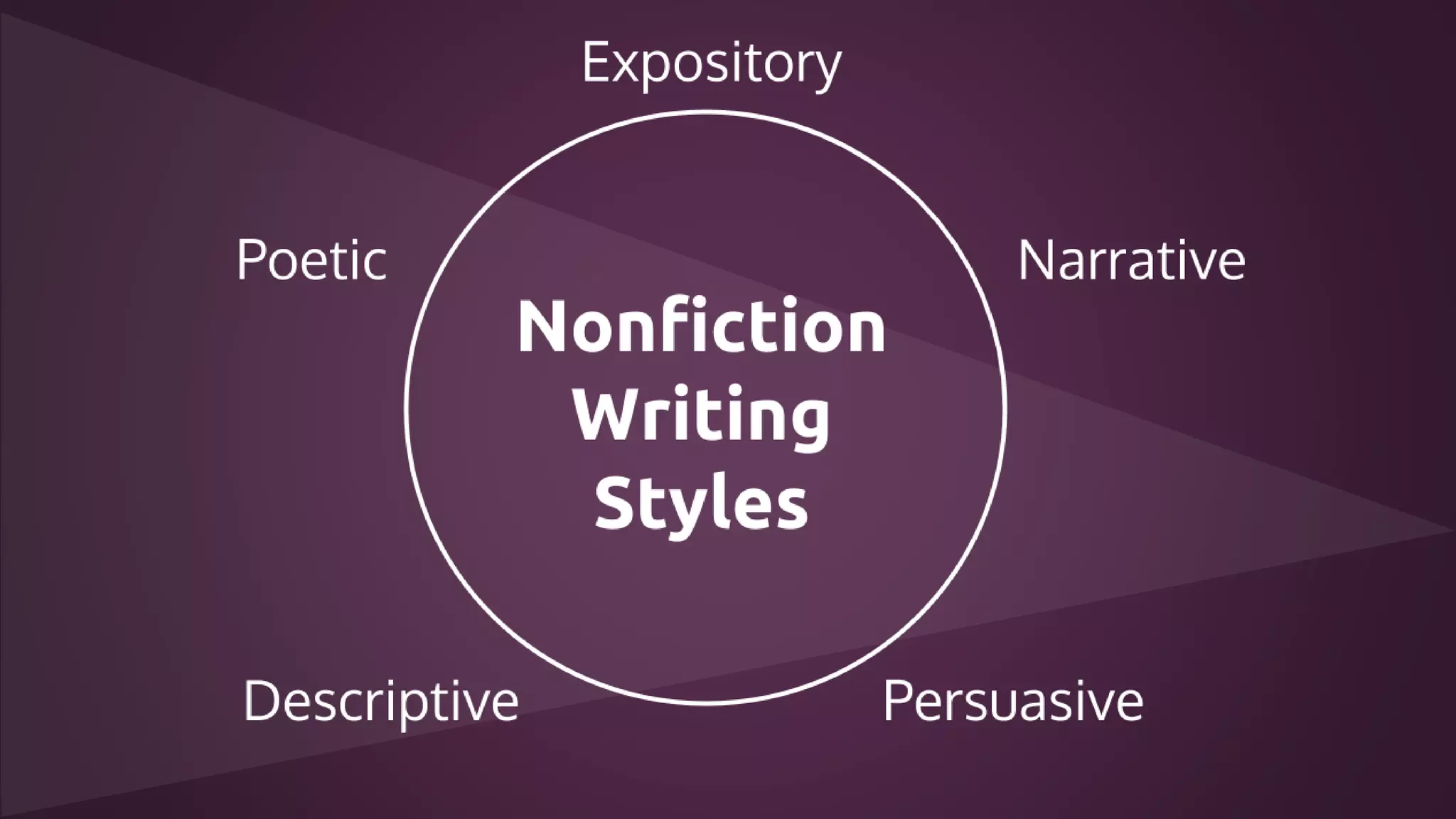
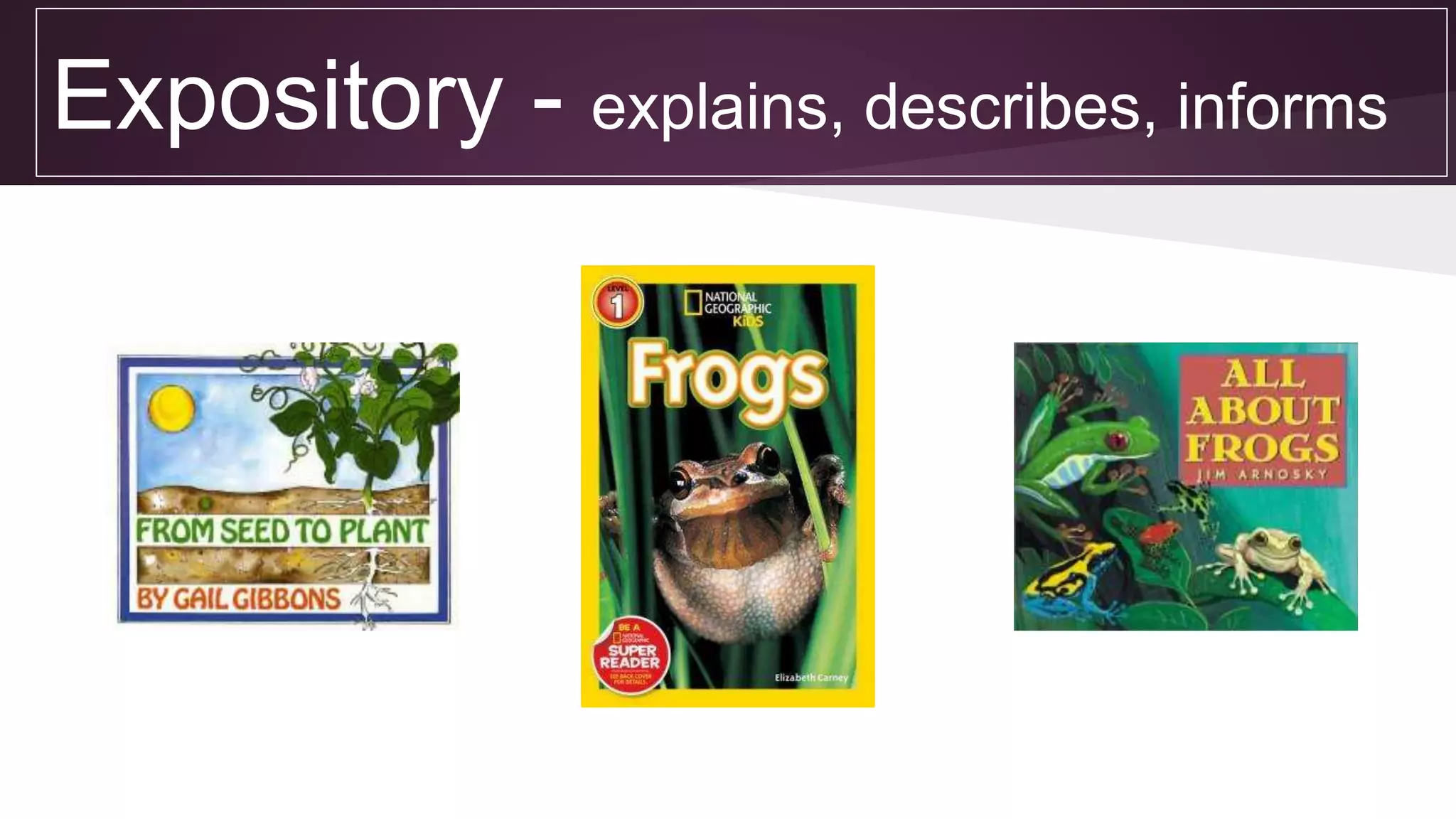
Expository - explains, describes, informs
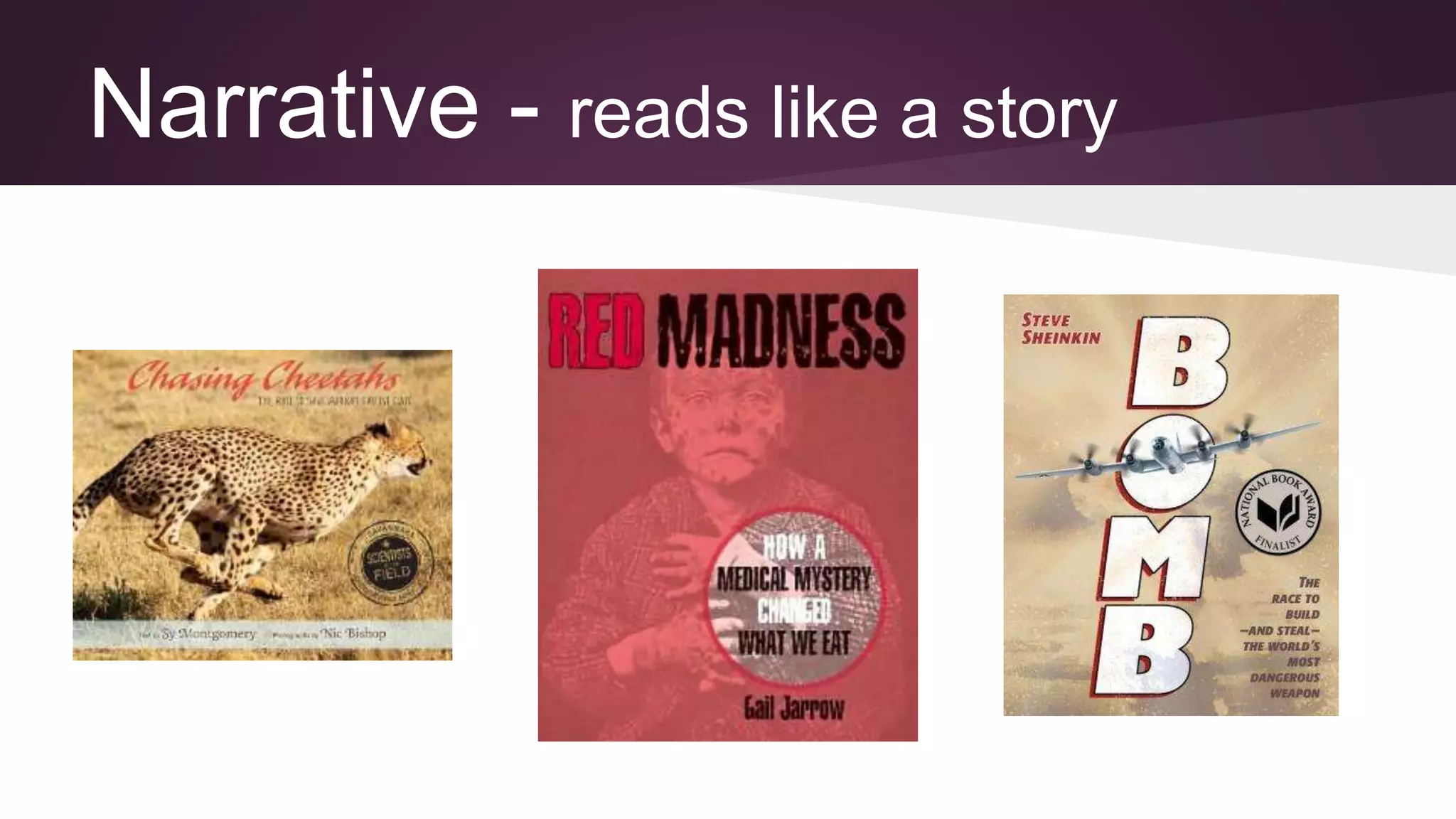
Narrative - reads like a story
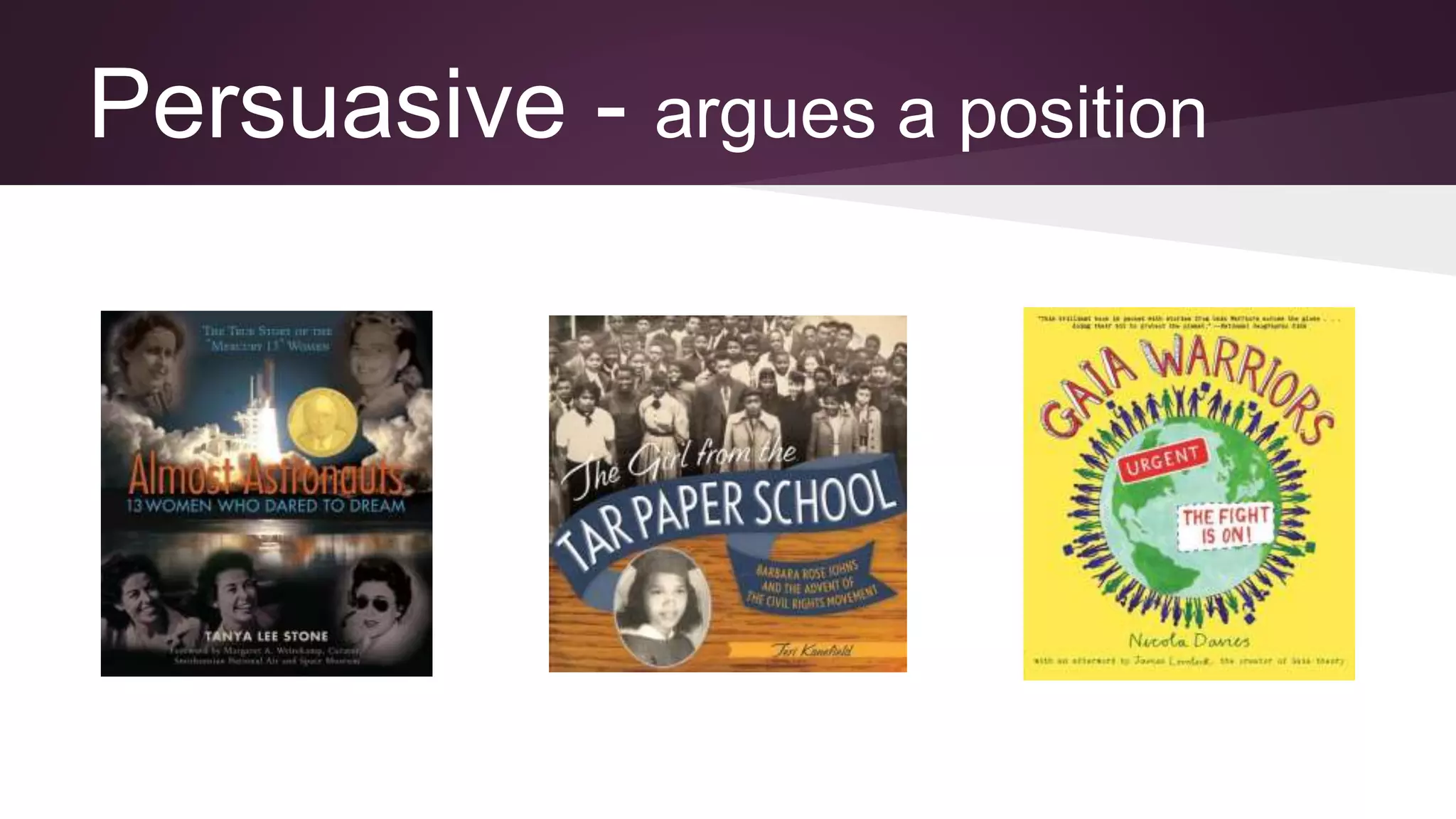
Persuasive - argues a position
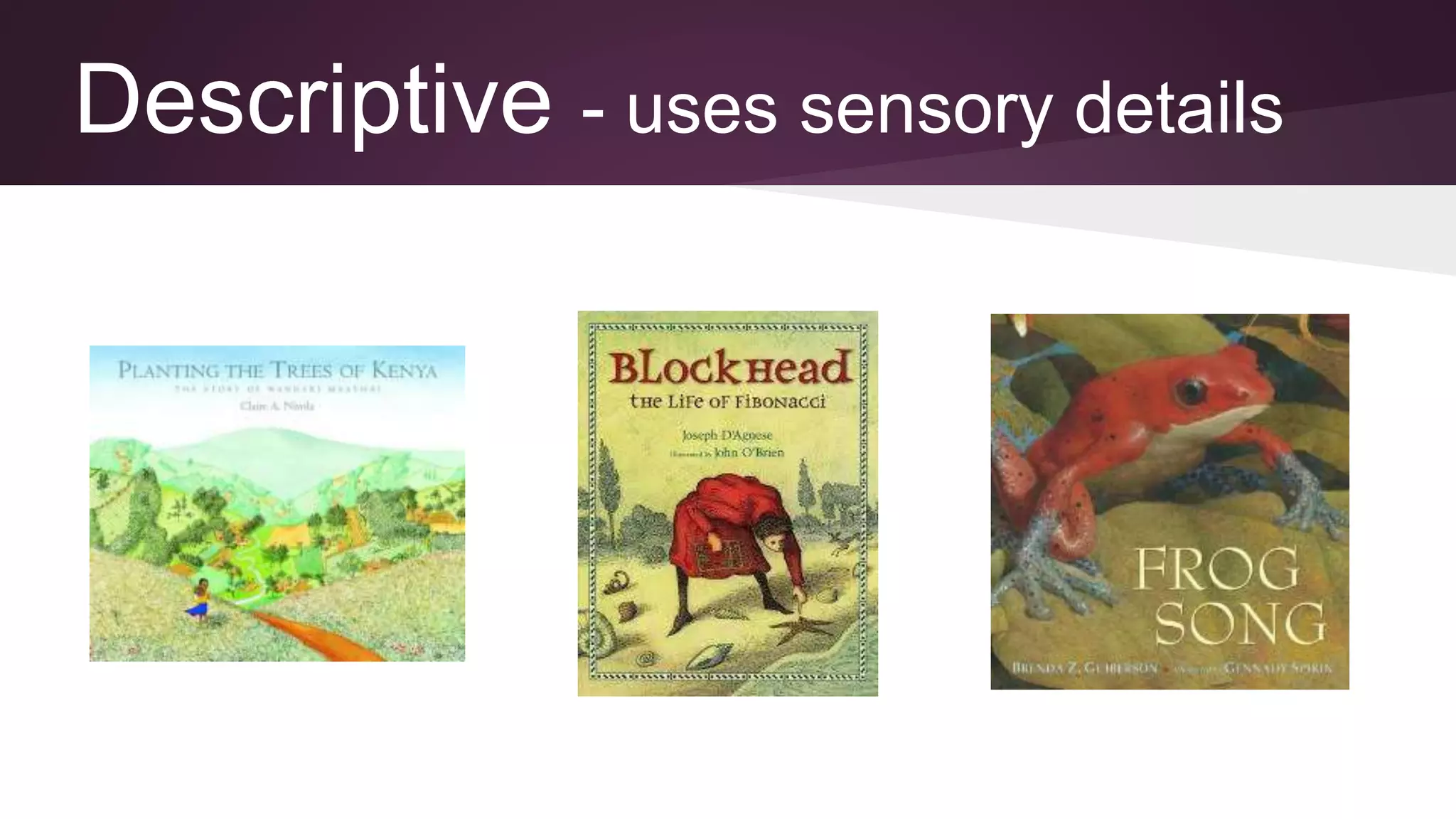
Descriptive - uses sensory details
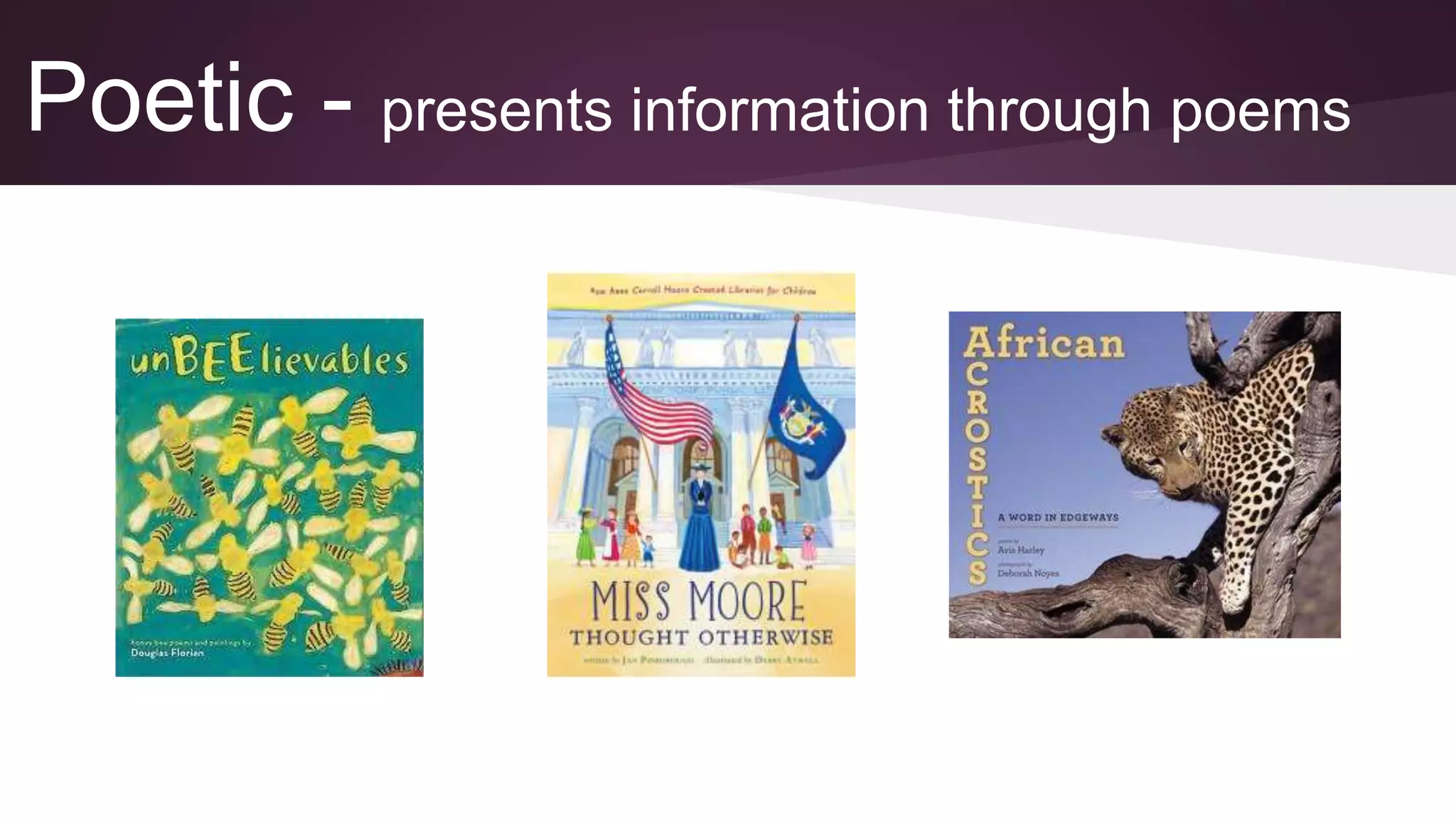
Poetic - presents information through poems
Understanding Reading Levels
Comparing different systems:
● What do they measure?
● Which do our schools use?
● How do we estimate with new books?
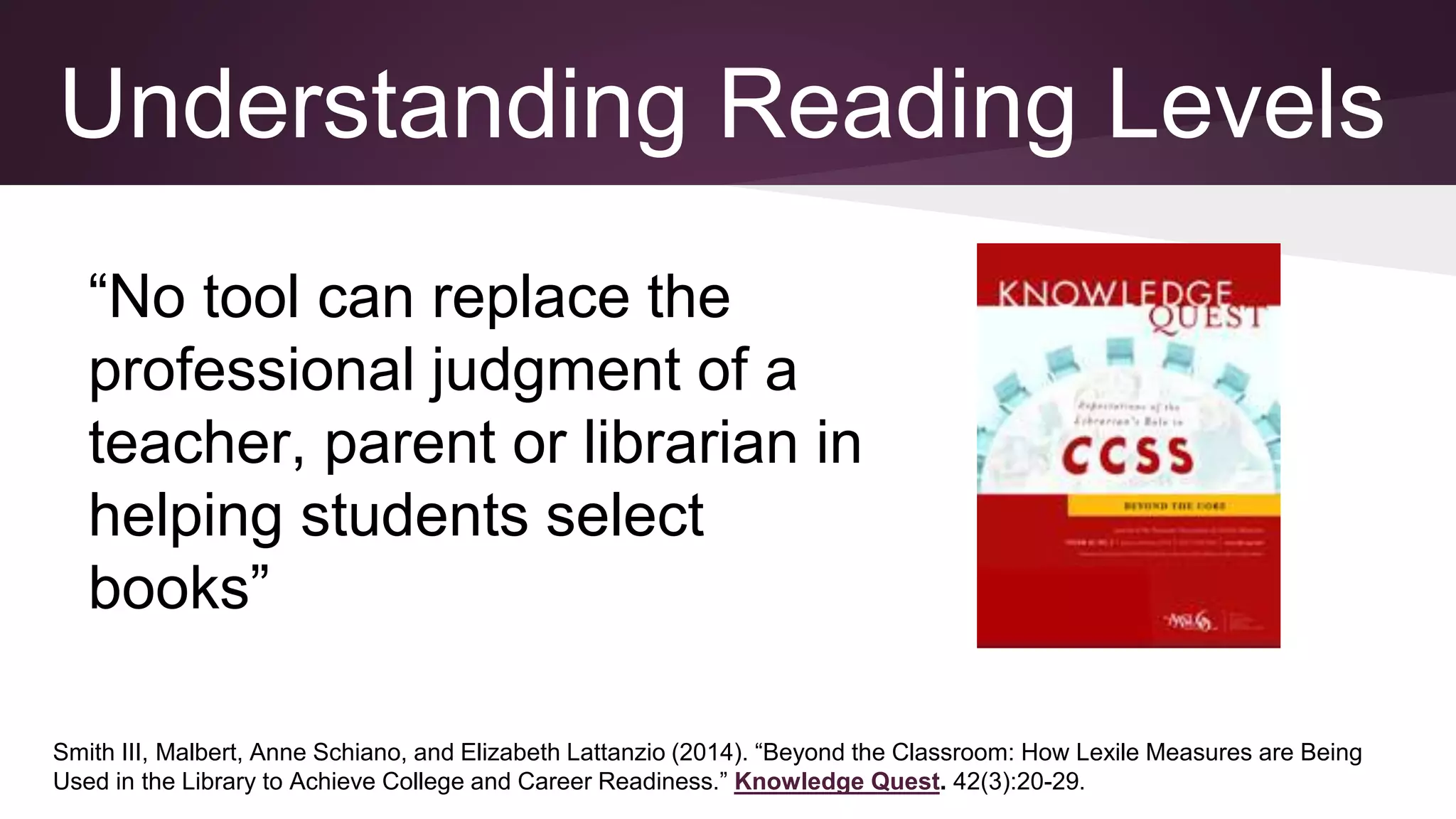
Smith III, Malbert, Anne Schiano, and Elizabeth Lattanzio (2014). “Beyond the Classroom: How Lexile Measures are Being
Used in the Library to Achieve College and Career Readiness.” Knowledge Quest. 42(3):20-29.
Understanding Reading Levels
“No tool can replace the
professional judgment of a
teacher, parent or librarian in
helping students select
books”
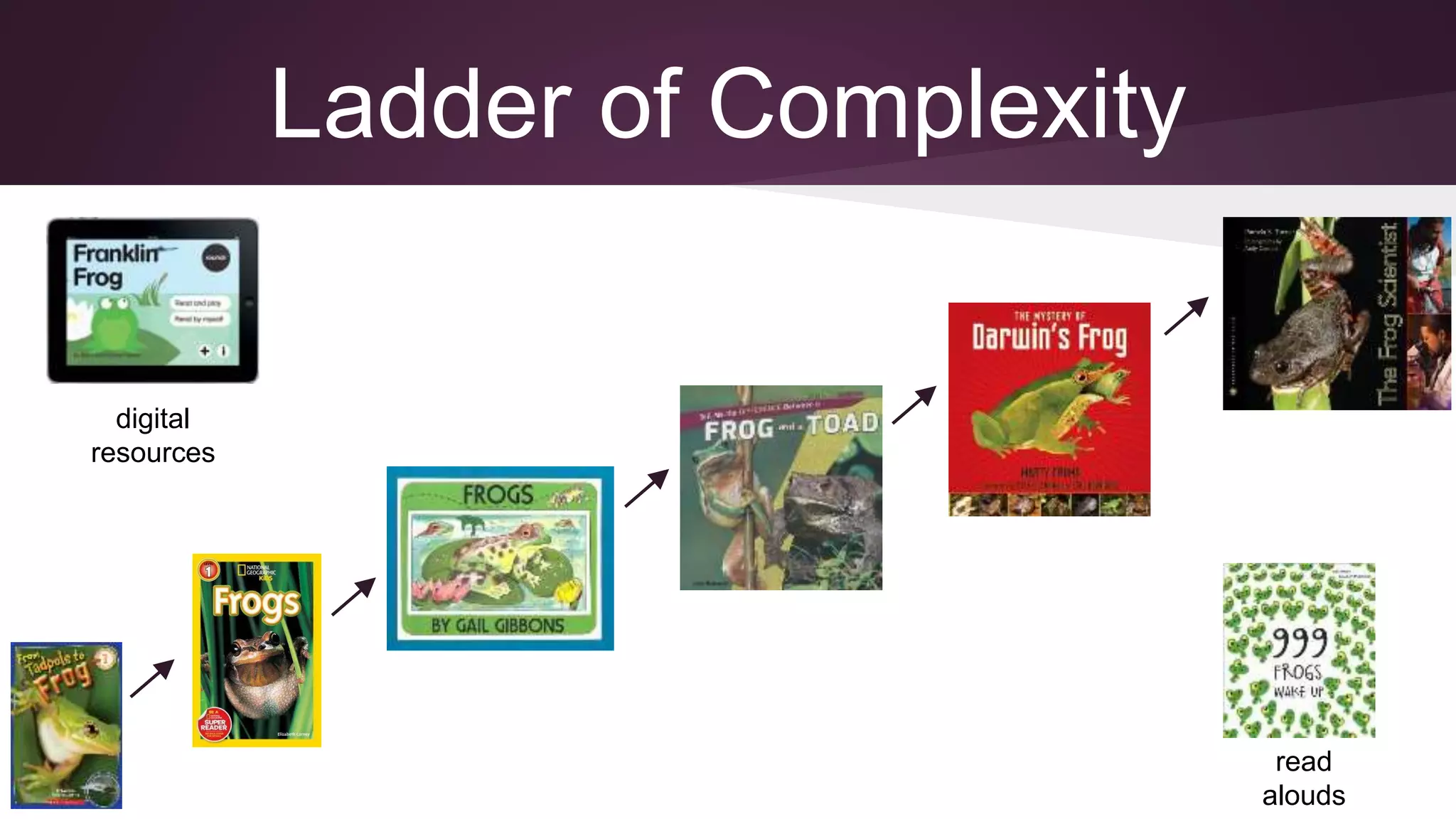
Ladder of Complexity
read
alouds
digital
resources
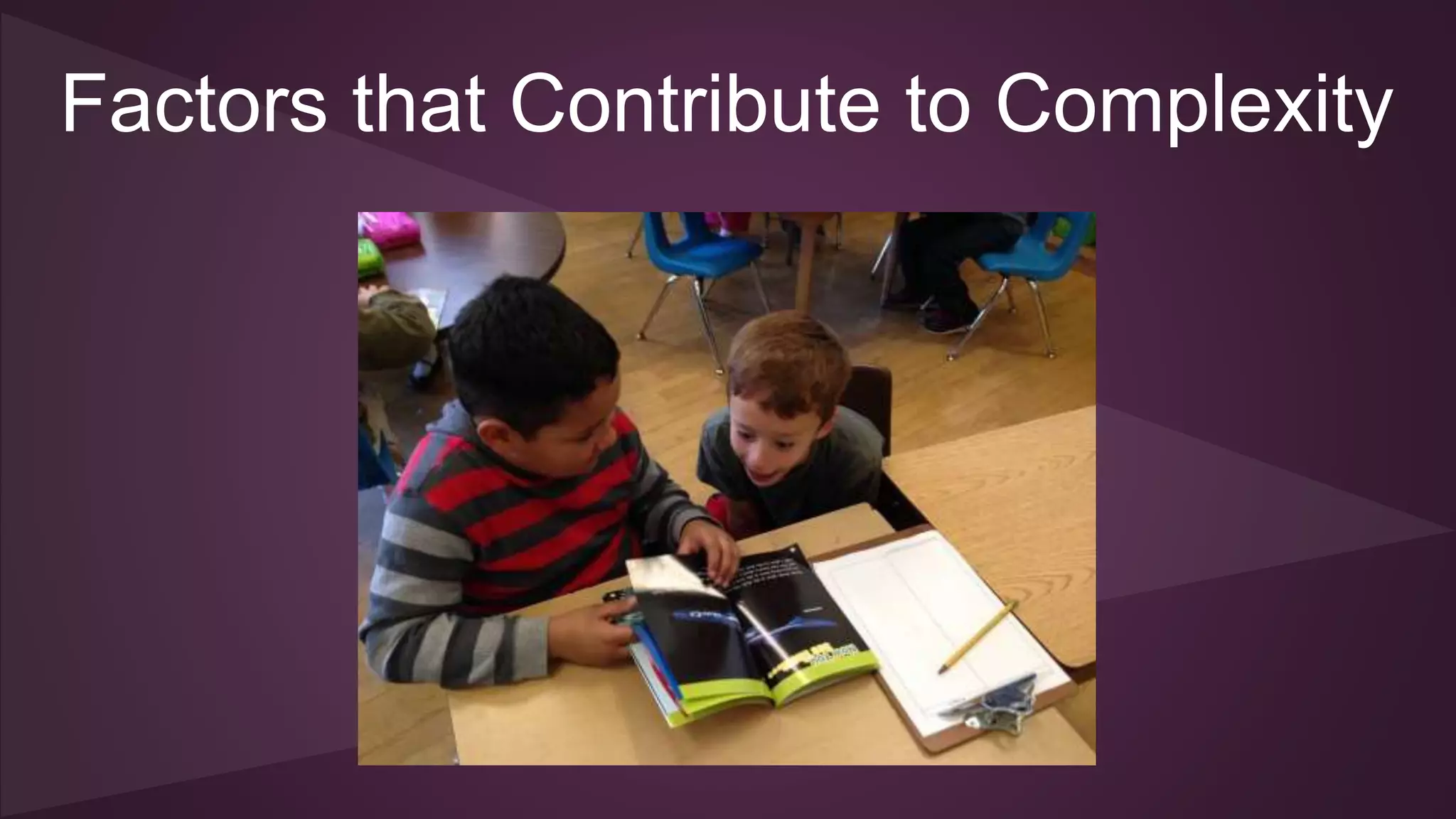
Factors that Contribute to Complexity
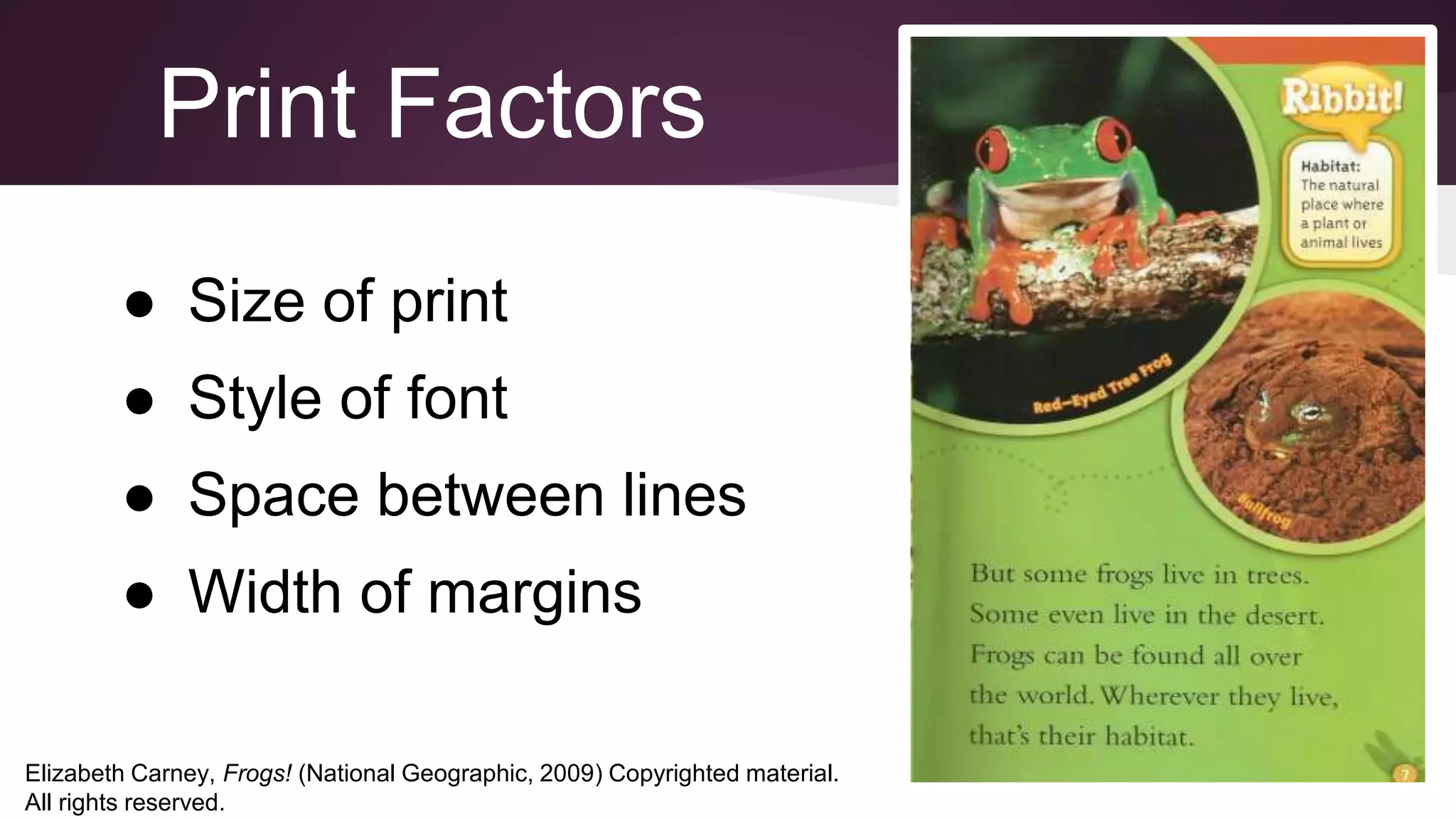
Print Factors
● Size of print
● Style of font
● Space between lines
● Width of margins
Elizabeth Carney, Frogs! (National Geographic, 2009) Copyrighted material.
All rights reserved.
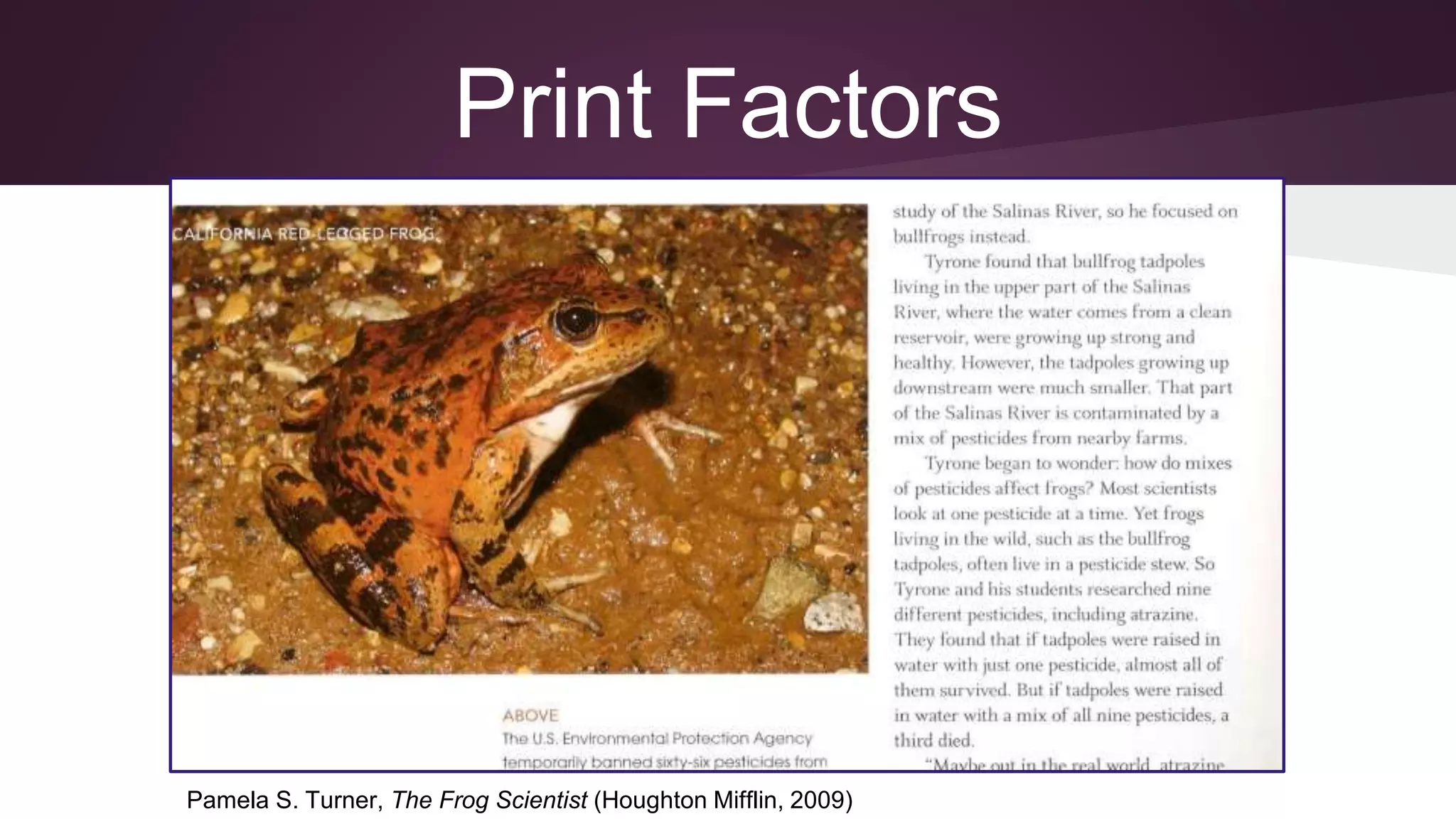
Print Factors
Pamela S. Turner, The Frog Scientist (Houghton Mifflin, 2009)
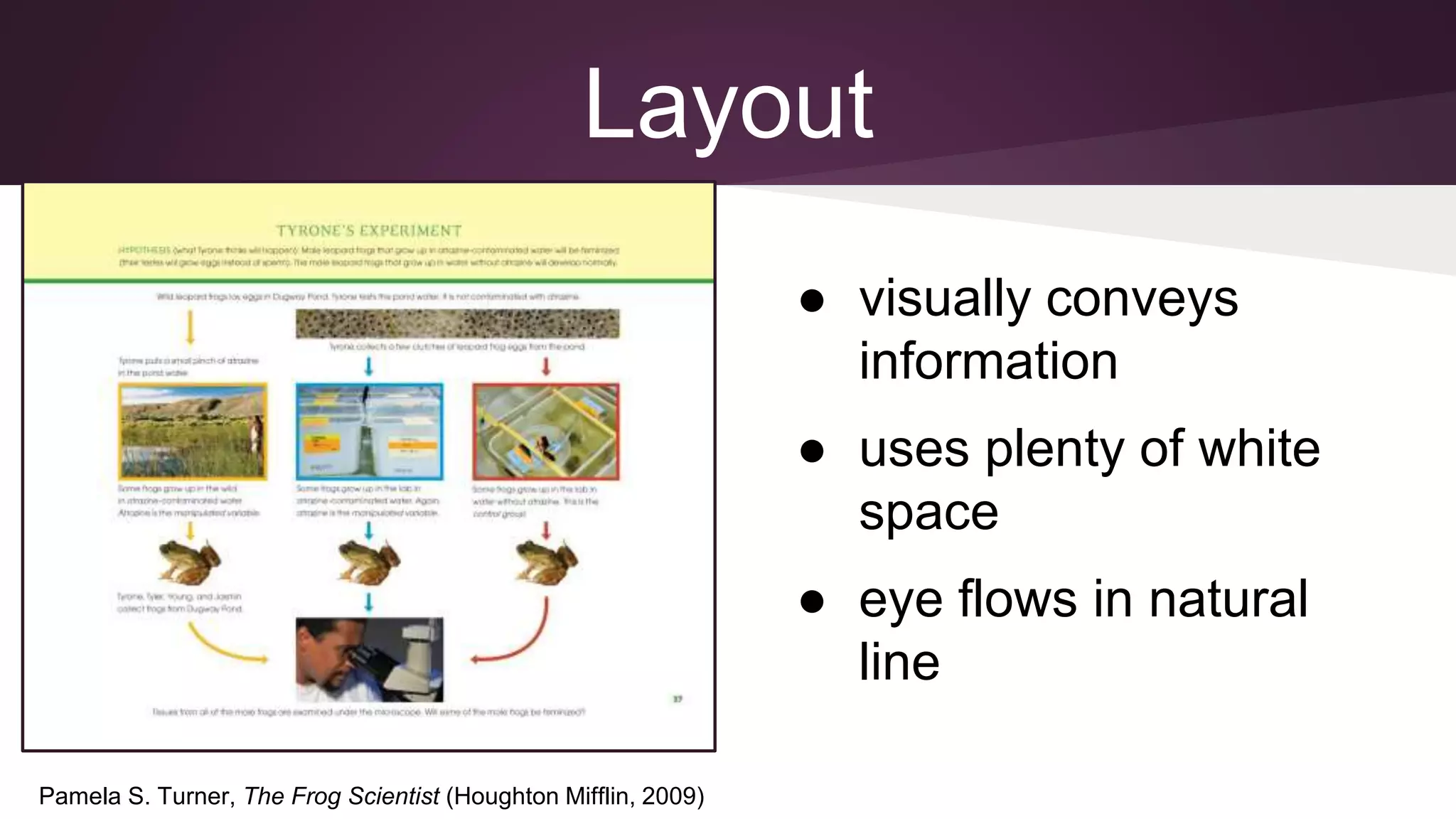
Layout
● visually conveys
information
● uses plenty of white
space
● eye flows in natural
line
Pamela S. Turner, The Frog Scientist (Houghton Mifflin, 2009)
Vocabulary
Definitions - Vocabulary -
Glossary
Don’t they just mean the
same thing?
Book Looking by Nemo
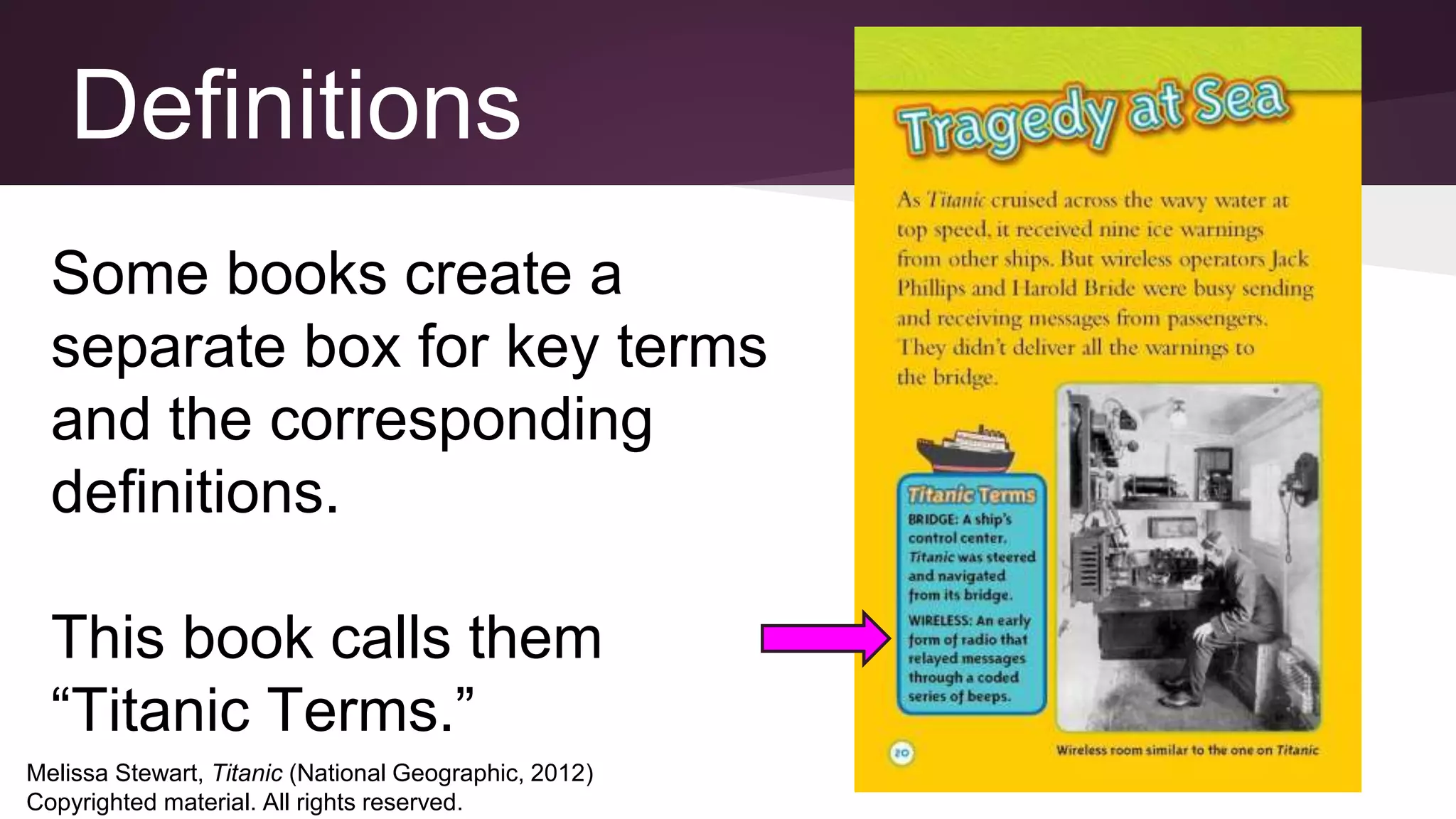
Some books create a
separate box for key terms
and the corresponding
definitions.
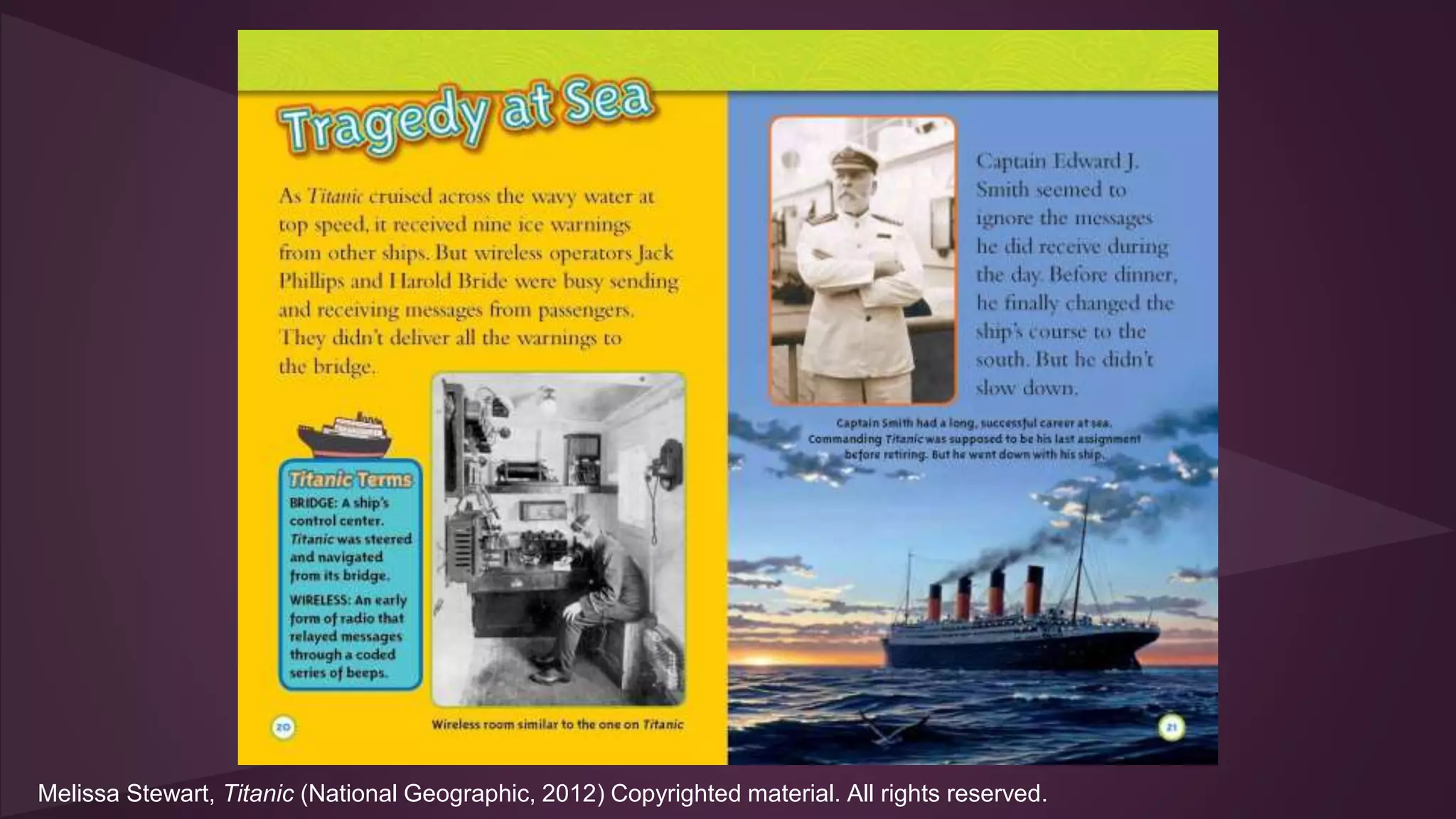
This book calls them
“Titanic Terms.”
Melissa Stewart, Titanic (National Geographic, 2012)
Copyrighted material. All rights reserved.
Definitions
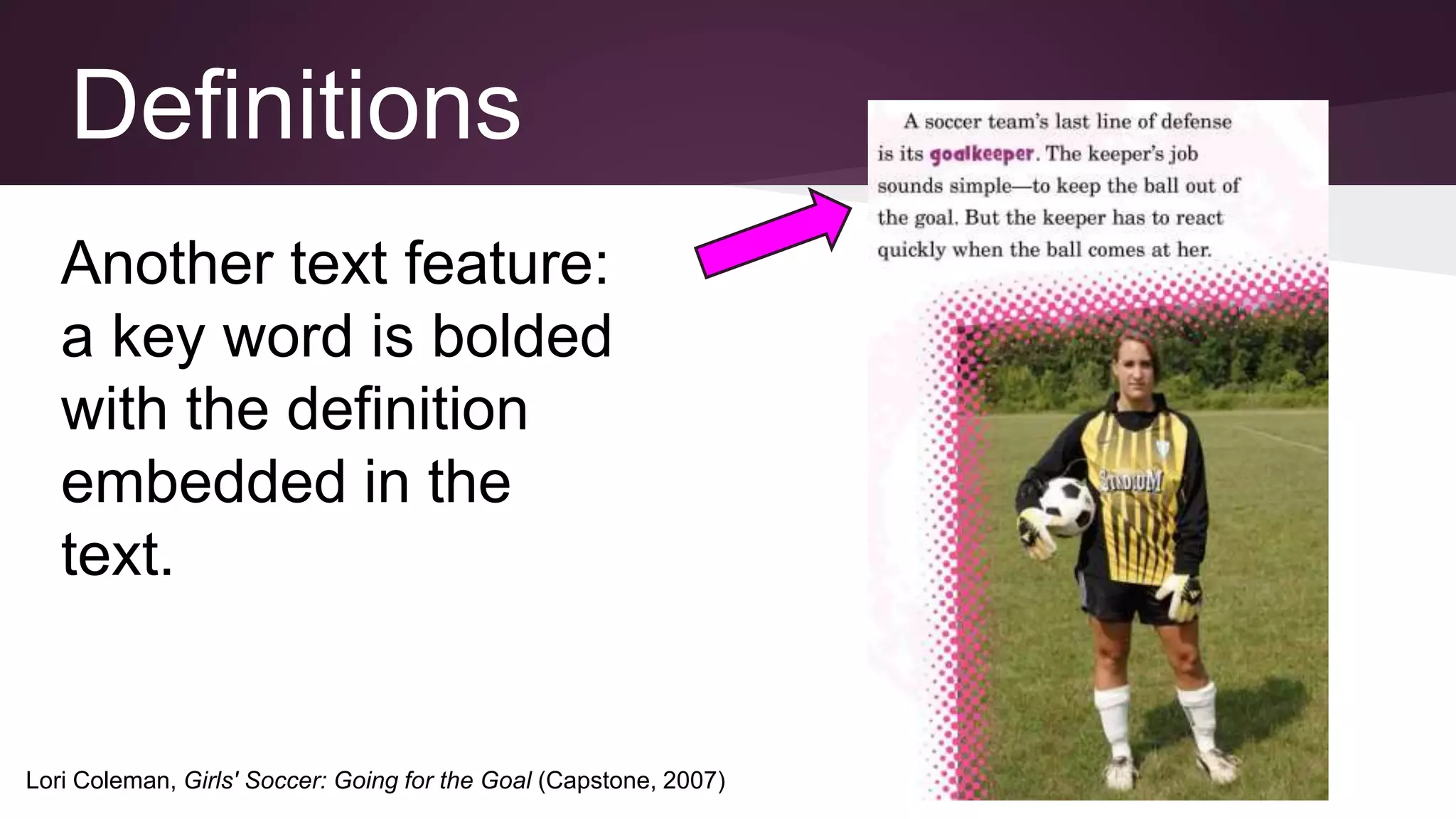
Another text feature:
a key word is bolded
with the definition
embedded in the
text.
Lori Coleman, Girls' Soccer: Going for the Goal (Capstone, 2007)
Definitions
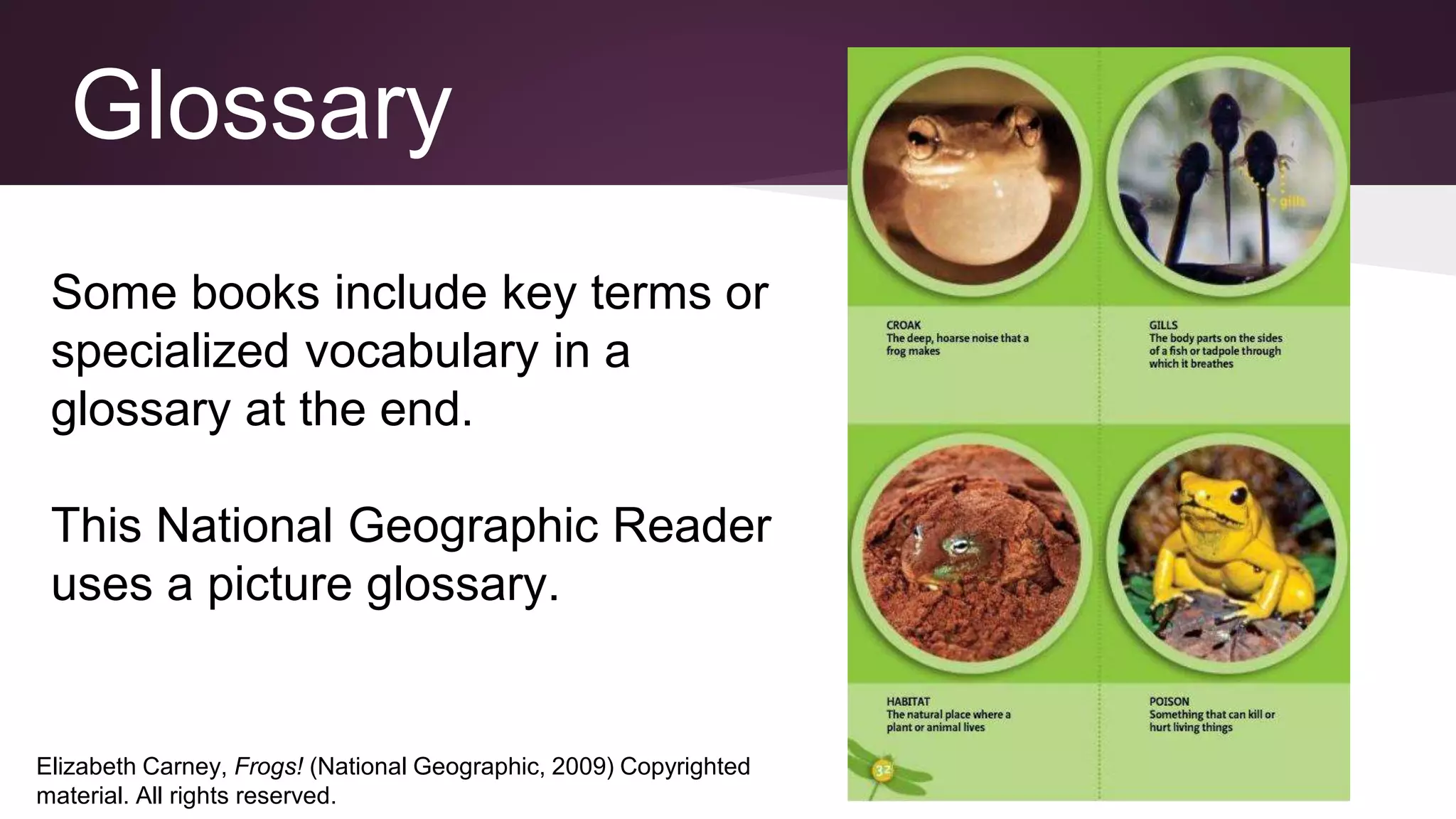
Some books include key terms or
specialized vocabulary in a
glossary at the end.
This National Geographic Reader
uses a picture glossary.
Elizabeth Carney, Frogs! (National Geographic, 2009) Copyrighted
material. All rights reserved.
Glossary
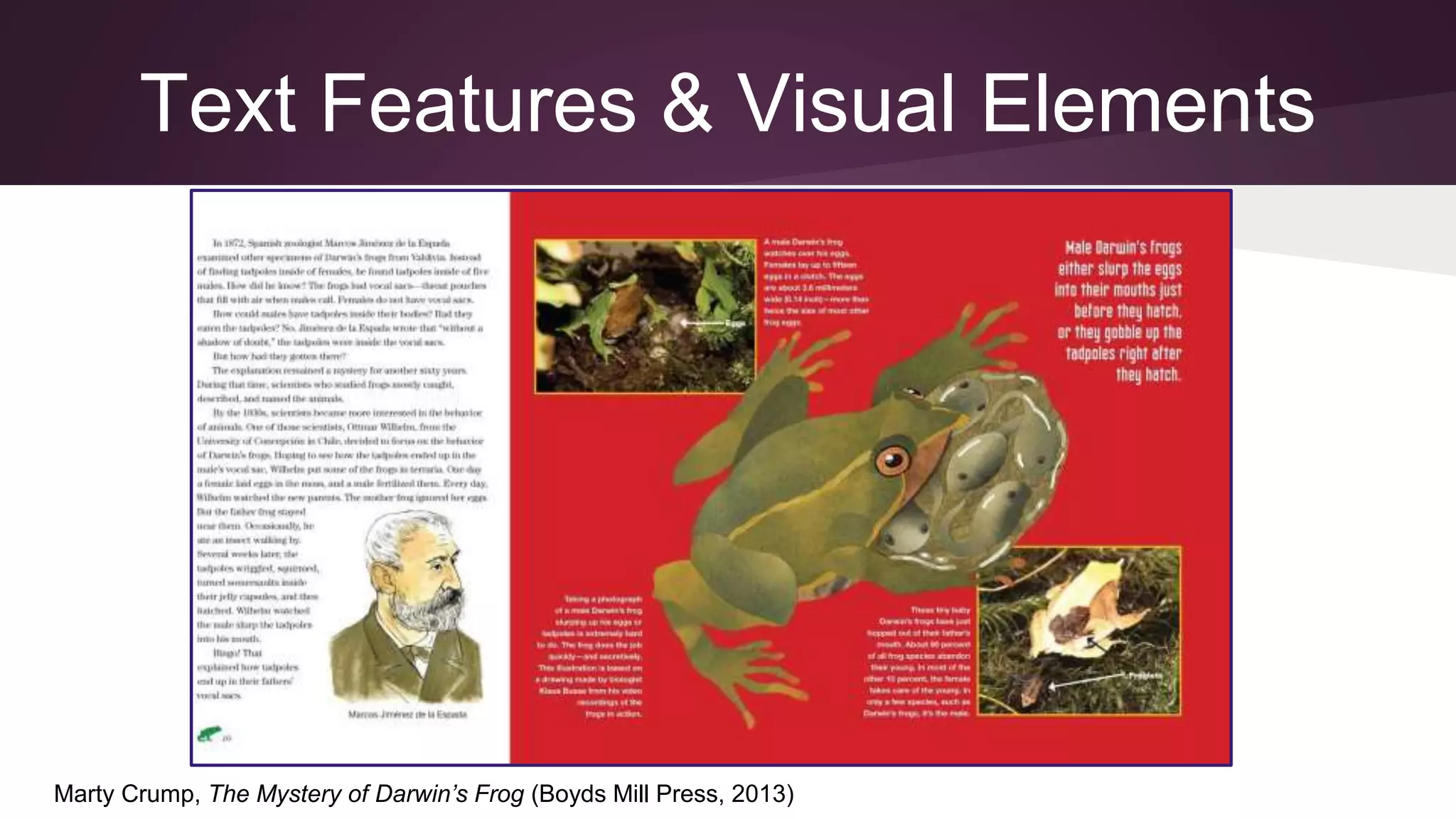
Text Features & Visual Elements
Marty Crump, The Mystery of Darwin’s Frog (Boyds Mill Press, 2013)
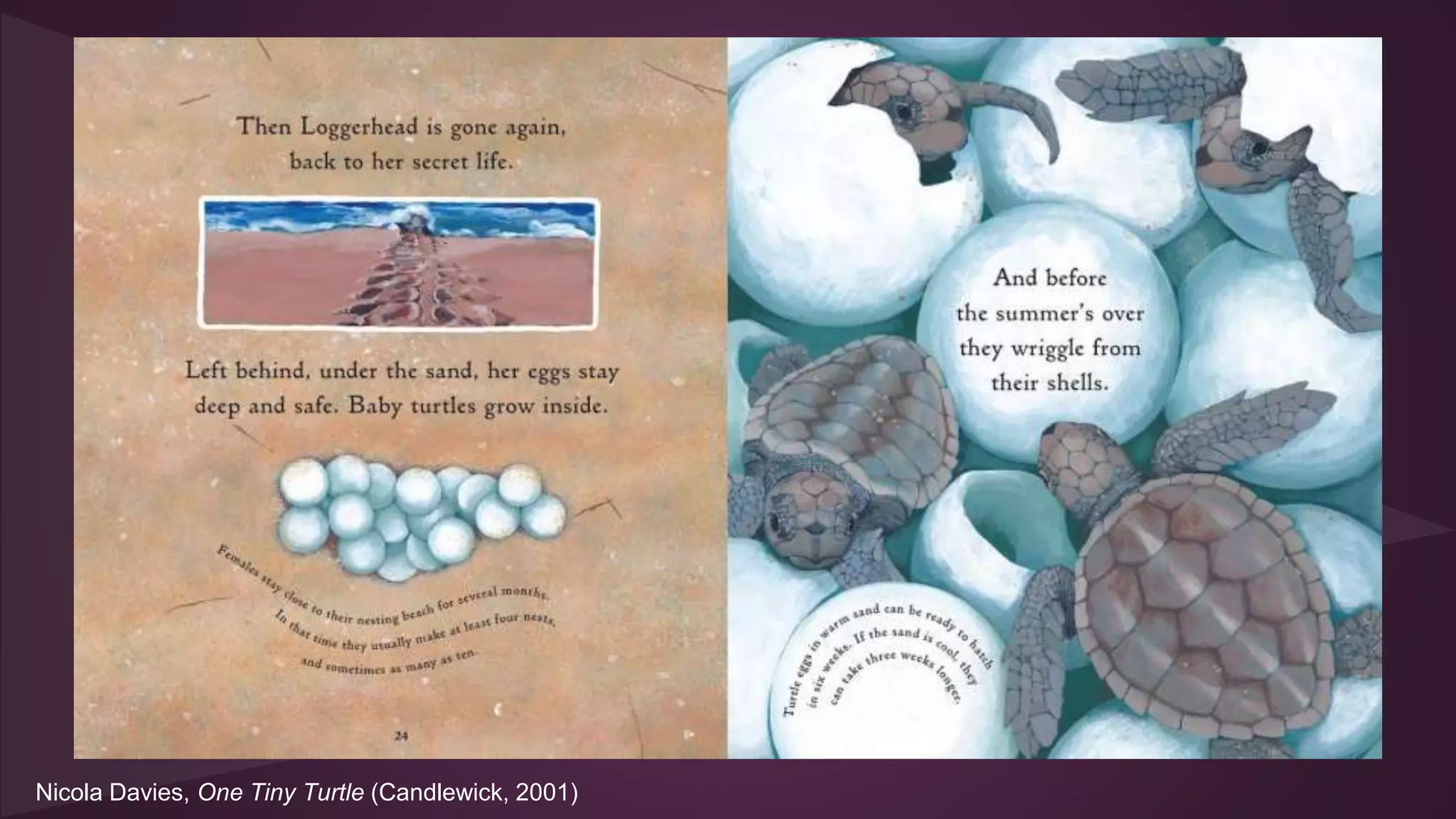
Nicola Davies, One Tiny Turtle (Candlewick, 2001)
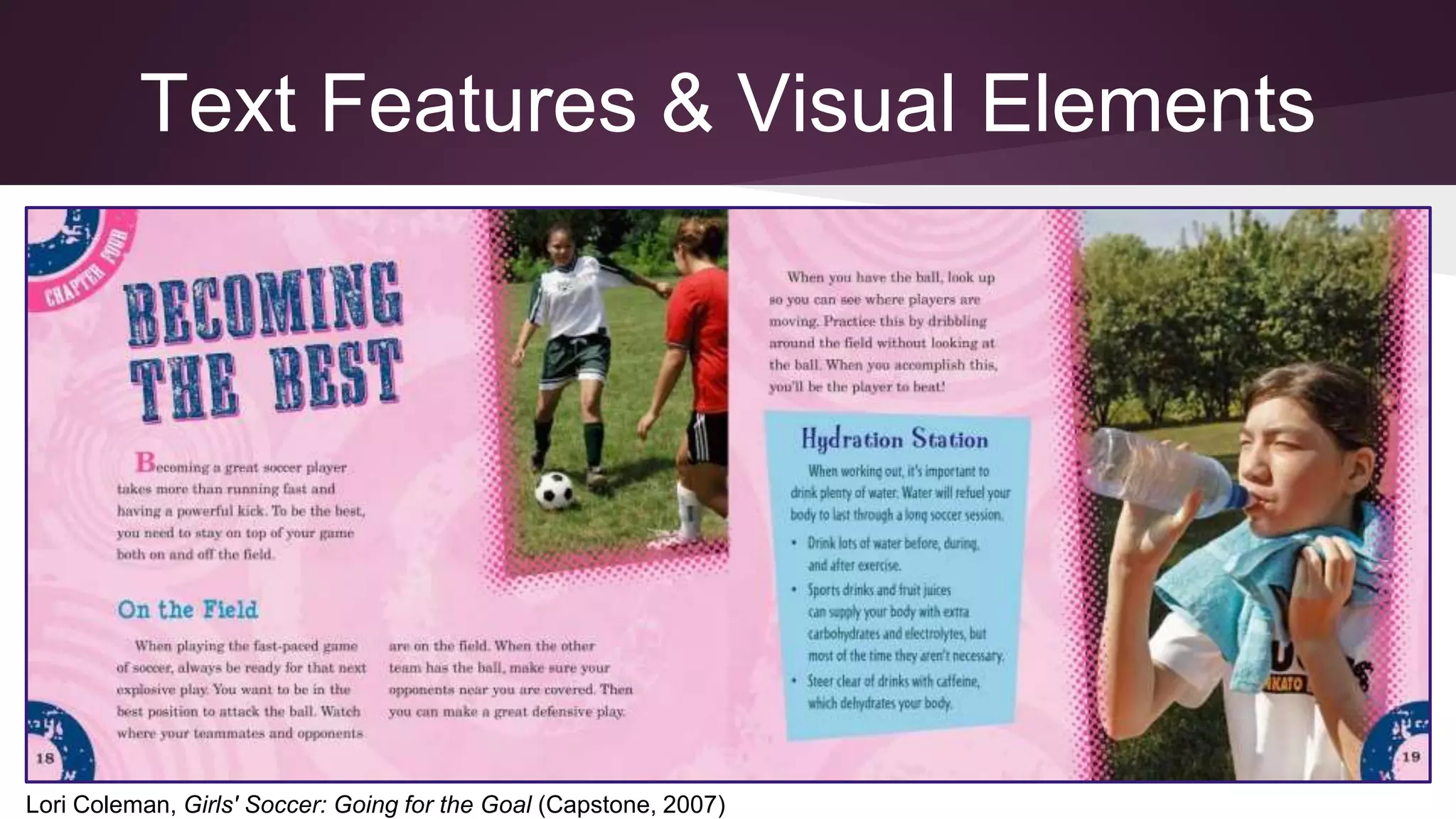
Text Features & Visual Elements
Lori Coleman, Girls' Soccer: Going for the Goal (Capstone, 2007)
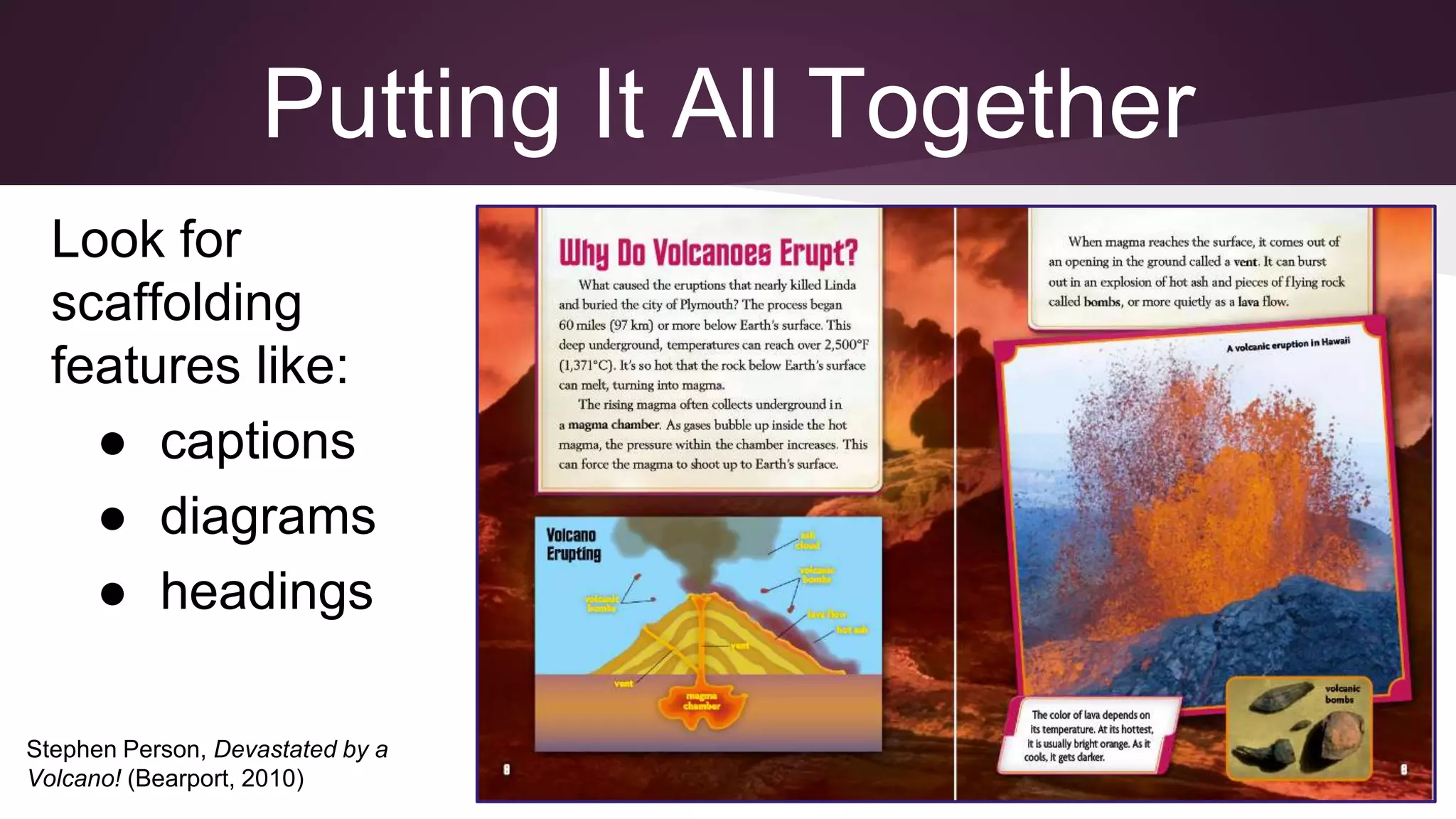
Putting It All Together
Stephen Person, Devastated by a
Volcano! (Bearport, 2010)
Look for
scaffolding
features like:
● captions
● diagrams
● headings
Melissa Stewart, Titanic (National Geographic, 2012) Copyrighted material. All rights reserved.
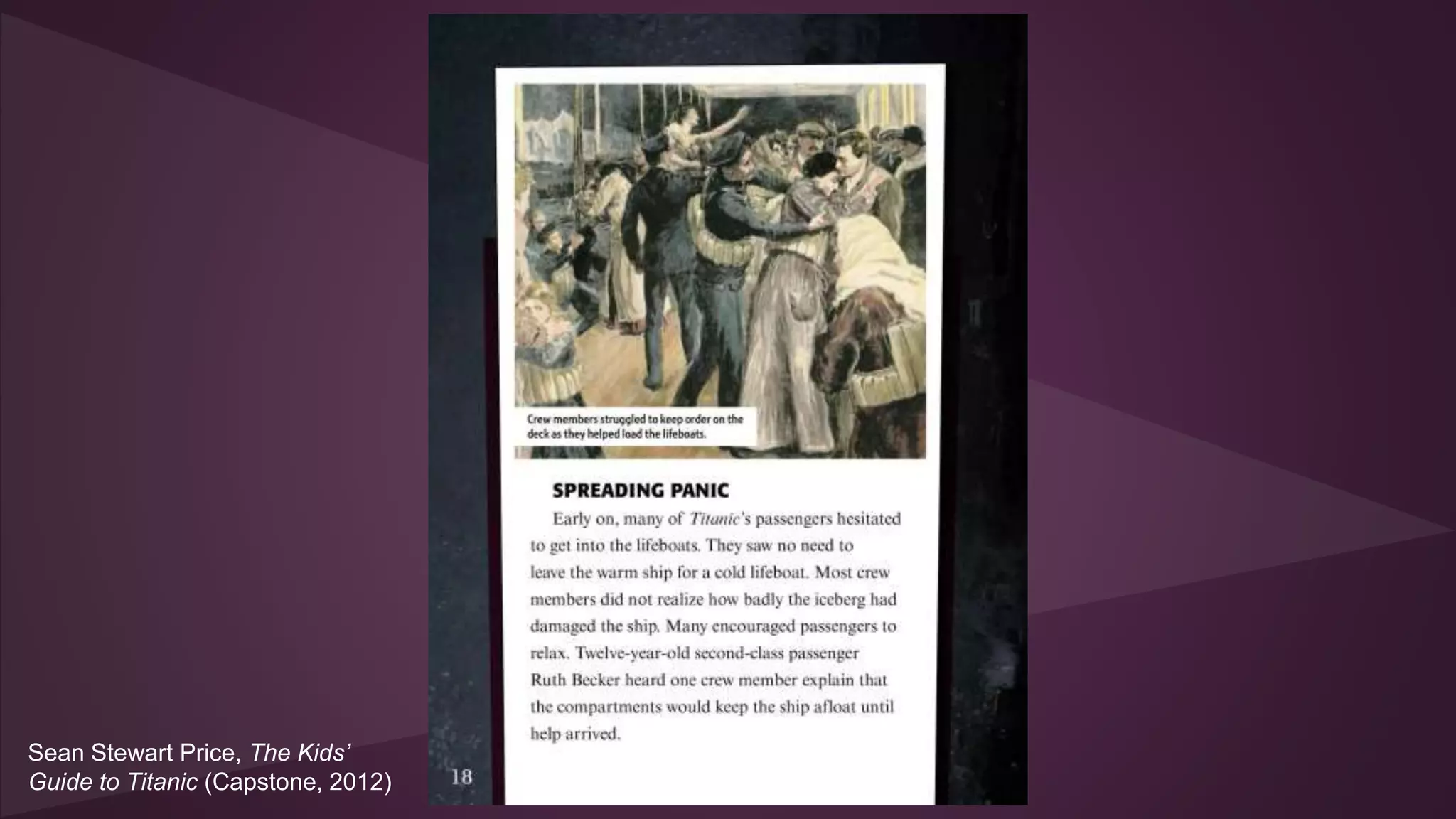
Sean Stewart Price, The Kids’
Guide to Titanic (Capstone, 2012)
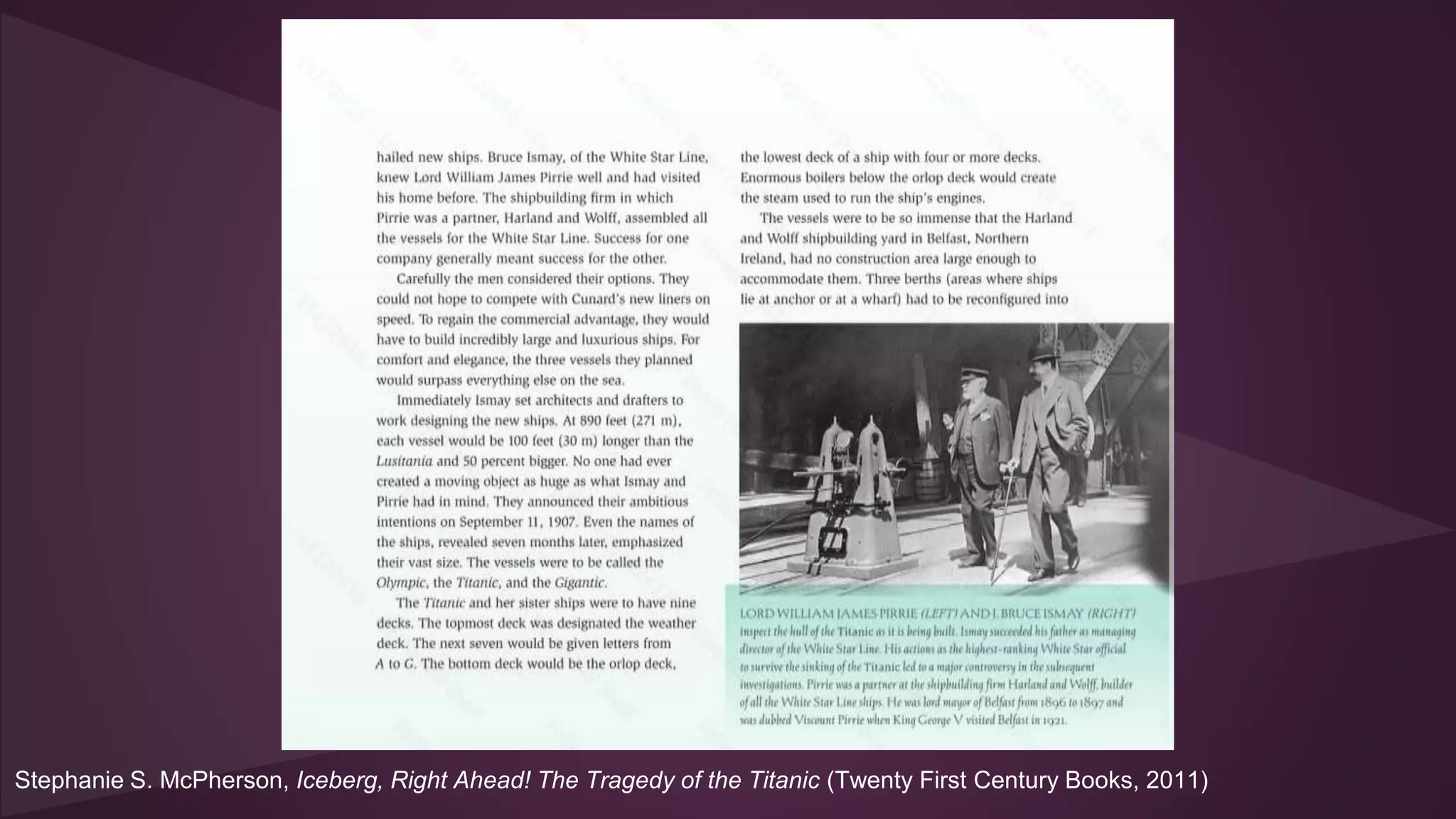
Stephanie S. McPherson, Iceberg, Right Ahead! The Tragedy of the Titanic (Twenty First Century Books, 2011)
Read Alouds
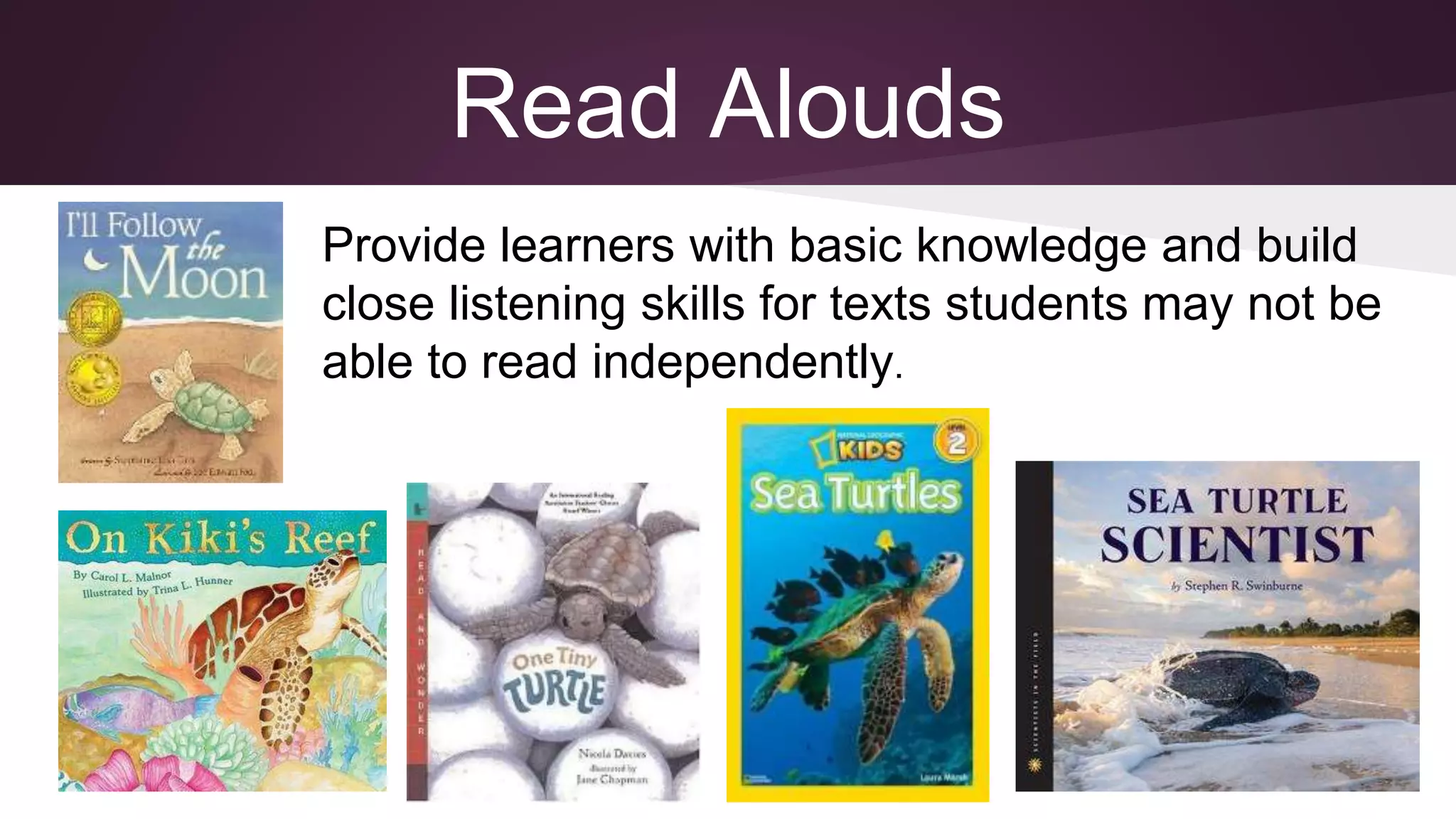
Provide learners with basic knowledge and build
close listening skills for texts students may not be
able to read independently.
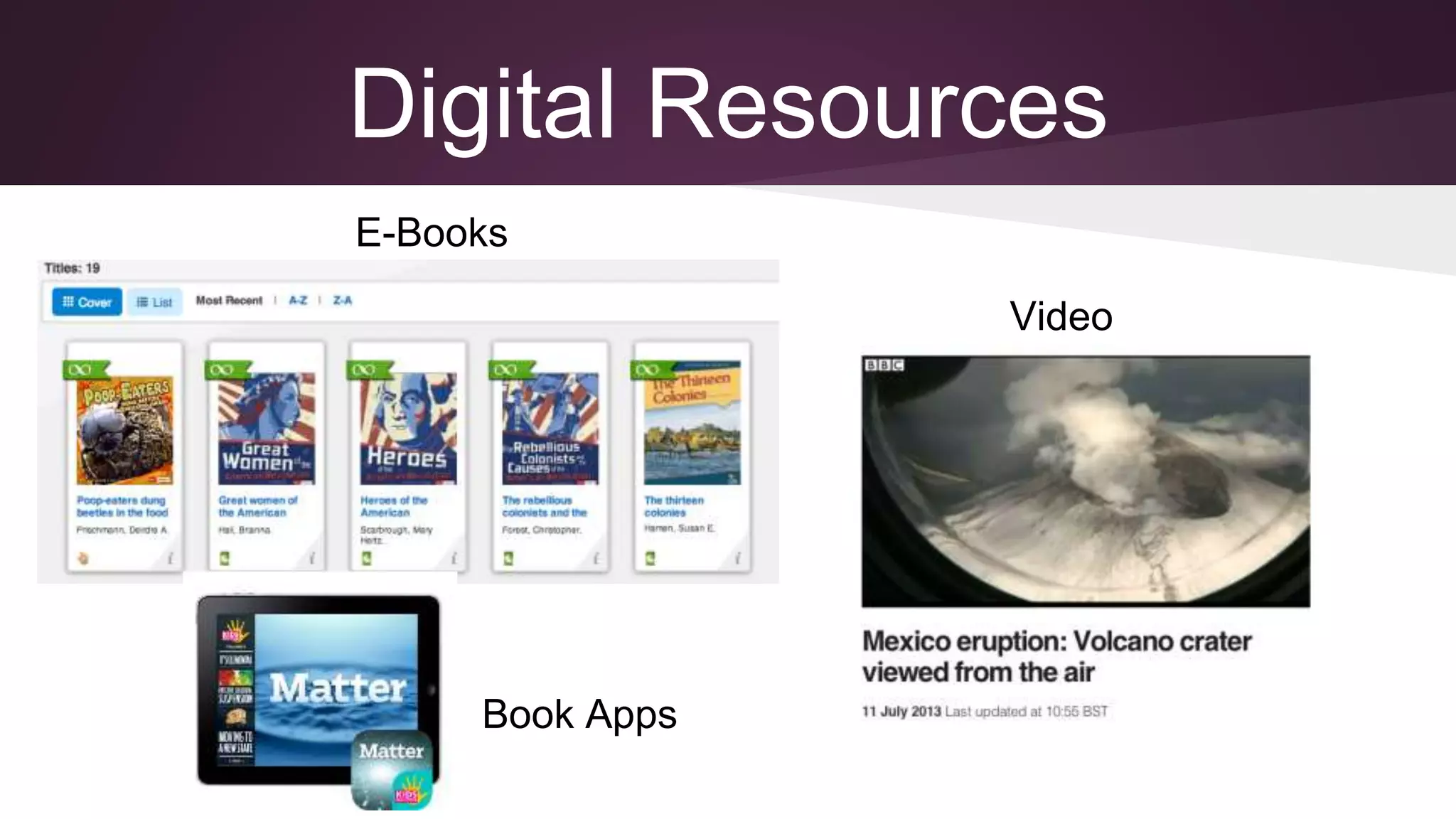
Digital Resources
E-Books
Book Apps
Video
Supporting Teachers & Students
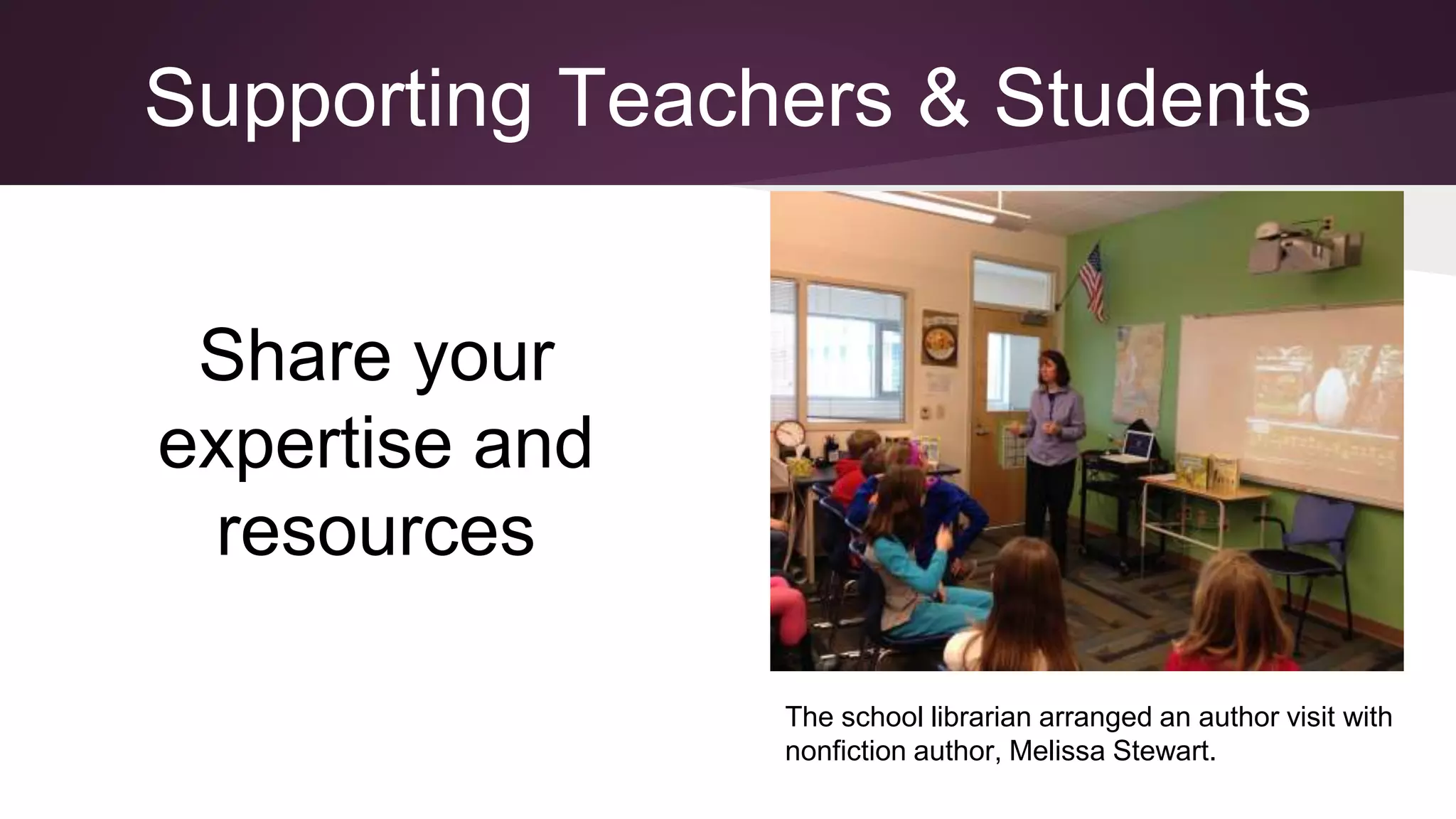
The school librarian arranged an author visit with
nonfiction author, Melissa Stewart.
Share your
expertise and
resources
Building Connections
public librarians
+
school librarians
= a strong partnership
Family Comunity Patchwork by Geralt
Book Gap Challenge
What’s missing from
your collection?
What do we need to
read & review more?
Puzzled people by Microsoft Clipart
Online access
Common Core IRL: In Real Libraries
Find our presentation here: http://bit.ly/ccirl2014
Resources to share:
Common Core IRL: Baseball
http://www.slideshare.net/maryannscheuer/common-core-irl-baseball
Common Core IRL: Frogs
http://www.slideshare.net/maryannscheuer/frogs-cc-irl
Works Cited
Carney, Elizabeth. Frogs! Washington, D.C.: National Geographic, 2009.
Coleman, Lori. Girls' Soccer: Going for the Goal. Mankato, MN: Capstone, 2007.
Crump, Marty, Edel Rodriguez, and Steve Jenkins. The Mystery of Darwin’s Frog. Honesdale, PA: Boyds Mill Press, 2013.
Davies, Nicola and Jane Chapman. One Tiny Turtle. Cambridge, MA: Candlewick, 2001.
"English Language Arts Standards » Standard 10: Range, Quality, & Complexity » Range of Text Types for K-5." Common Core State Standards
Initiative. Web. June 2014.
"Key Shifts in English Language Arts." Common Core State Standards Initiative. Web. June 2014.
McPherson, Stephanie Sammartino. Iceberg Right Ahead!: The Tragedy of the Titanic. Minneapolis, MN: Twenty-First Century Books, 2011.
Person, Stephen. Devastated by a Volcano! New York: Bearport Pub., 2010.
Price, Sean. The Kids' Guide to Titanic. North Mankato, MN: Capstone, 2012.
Smith III, Malbert, Anne Schiano, and Elizabeth Lattanzio (2014). “Beyond the Classroom: How Lexile Measures are Being Used in the Library to
Achieve College and Career Readiness.” Knowledge Quest. 42(3):20-29.
Stewart, Melissa. Titanic. Washington, D.C.: National Geographic, 2012.
Turner, Pamela S., and Andy Comins. The Frog Scientist. Boston: Houghton Mifflin for Children, 2009.
Contact Information
Mary Ann Scheuer- @maryannscheuer
greatkidbooks@gmail.com
Alyson Beecher-@alybee930
kidlitfrenzy@gmail.com
Louise Capizzo- @lcapizzo
thenonfictiondetectives@yahoo.com
Cathy Potter- @cppotter
thenonfictiondetectives@yahoo.com

Common Core IRL: In Real Libraries 2014

  • 1.
  • 2.
    Meet the CCIRL Team Mary Ann Scheuer: School Librarian, Emerson Elementary School (California) greatkidbooks.blogspot.com Alyson Beecher: Literacy Specialist, Pasedena Unified School District (California) kidlitfrenzy.com Louise Capizzo: Youth Services Librarian, Scarborough Public Library (Maine) nonfictiondetectives.com Cathy Potter: School Librarian, Falmouth Elementary School (Maine) nonfictiondetectives.com
  • 3.
    Online access topresentation http://bit.ly/ccirl2014
  • 4.
  • 5.
    Our Goal inStarting CC: IRL ● add library expertise to evaluating educational resources ● deepen our understanding of the ladder of complexity ● provide an alternative to prescriptive curriculum kits
  • 6.
    Informational Reading “50-50 balance betweeninformational and literary reading” "Key Shifts in English Language Arts." Common Core State Standards Initiative. Web. June 2014.
  • 7.
    Informational Text... “Includes biographiesand autobiographies; books about history, social studies, science, and the arts; technical texts... and digital sources on a range of topics.” "English Language Arts Standards » Standard 10: Range, Quality, & Complexity » Range of Text Types for K-5." Common Core State Standards Initiative. Web. June 2014.
  • 9.
    Expository - explains,describes, informs
  • 10.
    Narrative - readslike a story
  • 11.
  • 12.
    Descriptive - usessensory details
  • 13.
    Poetic - presentsinformation through poems
  • 14.
    Understanding Reading Levels Comparingdifferent systems: ● What do they measure? ● Which do our schools use? ● How do we estimate with new books?
  • 15.
    Smith III, Malbert,Anne Schiano, and Elizabeth Lattanzio (2014). “Beyond the Classroom: How Lexile Measures are Being Used in the Library to Achieve College and Career Readiness.” Knowledge Quest. 42(3):20-29. Understanding Reading Levels “No tool can replace the professional judgment of a teacher, parent or librarian in helping students select books”
  • 16.
  • 17.
  • 18.
    Print Factors ● Sizeof print ● Style of font ● Space between lines ● Width of margins Elizabeth Carney, Frogs! (National Geographic, 2009) Copyrighted material. All rights reserved.
  • 19.
    Print Factors Pamela S.Turner, The Frog Scientist (Houghton Mifflin, 2009)
  • 20.
    Layout ● visually conveys information ●uses plenty of white space ● eye flows in natural line Pamela S. Turner, The Frog Scientist (Houghton Mifflin, 2009)
  • 21.
    Vocabulary Definitions - Vocabulary- Glossary Don’t they just mean the same thing? Book Looking by Nemo
  • 22.
    Some books createa separate box for key terms and the corresponding definitions. This book calls them “Titanic Terms.” Melissa Stewart, Titanic (National Geographic, 2012) Copyrighted material. All rights reserved. Definitions
  • 23.
    Another text feature: akey word is bolded with the definition embedded in the text. Lori Coleman, Girls' Soccer: Going for the Goal (Capstone, 2007) Definitions
  • 24.
    Some books includekey terms or specialized vocabulary in a glossary at the end. This National Geographic Reader uses a picture glossary. Elizabeth Carney, Frogs! (National Geographic, 2009) Copyrighted material. All rights reserved. Glossary
  • 25.
    Text Features &Visual Elements Marty Crump, The Mystery of Darwin’s Frog (Boyds Mill Press, 2013)
  • 26.
    Nicola Davies, OneTiny Turtle (Candlewick, 2001)
  • 27.
    Text Features &Visual Elements Lori Coleman, Girls' Soccer: Going for the Goal (Capstone, 2007)
  • 28.
    Putting It AllTogether Stephen Person, Devastated by a Volcano! (Bearport, 2010) Look for scaffolding features like: ● captions ● diagrams ● headings
  • 29.
    Melissa Stewart, Titanic(National Geographic, 2012) Copyrighted material. All rights reserved.
  • 30.
    Sean Stewart Price,The Kids’ Guide to Titanic (Capstone, 2012)
  • 31.
    Stephanie S. McPherson,Iceberg, Right Ahead! The Tragedy of the Titanic (Twenty First Century Books, 2011)
  • 32.
    Read Alouds Provide learnerswith basic knowledge and build close listening skills for texts students may not be able to read independently.
  • 33.
  • 34.
    Supporting Teachers &Students The school librarian arranged an author visit with nonfiction author, Melissa Stewart. Share your expertise and resources
  • 35.
    Building Connections public librarians + schoollibrarians = a strong partnership Family Comunity Patchwork by Geralt
  • 36.
    Book Gap Challenge What’smissing from your collection? What do we need to read & review more? Puzzled people by Microsoft Clipart
  • 37.
    Online access Common CoreIRL: In Real Libraries Find our presentation here: http://bit.ly/ccirl2014 Resources to share: Common Core IRL: Baseball http://www.slideshare.net/maryannscheuer/common-core-irl-baseball Common Core IRL: Frogs http://www.slideshare.net/maryannscheuer/frogs-cc-irl
  • 38.
    Works Cited Carney, Elizabeth.Frogs! Washington, D.C.: National Geographic, 2009. Coleman, Lori. Girls' Soccer: Going for the Goal. Mankato, MN: Capstone, 2007. Crump, Marty, Edel Rodriguez, and Steve Jenkins. The Mystery of Darwin’s Frog. Honesdale, PA: Boyds Mill Press, 2013. Davies, Nicola and Jane Chapman. One Tiny Turtle. Cambridge, MA: Candlewick, 2001. "English Language Arts Standards » Standard 10: Range, Quality, & Complexity » Range of Text Types for K-5." Common Core State Standards Initiative. Web. June 2014. "Key Shifts in English Language Arts." Common Core State Standards Initiative. Web. June 2014. McPherson, Stephanie Sammartino. Iceberg Right Ahead!: The Tragedy of the Titanic. Minneapolis, MN: Twenty-First Century Books, 2011. Person, Stephen. Devastated by a Volcano! New York: Bearport Pub., 2010. Price, Sean. The Kids' Guide to Titanic. North Mankato, MN: Capstone, 2012. Smith III, Malbert, Anne Schiano, and Elizabeth Lattanzio (2014). “Beyond the Classroom: How Lexile Measures are Being Used in the Library to Achieve College and Career Readiness.” Knowledge Quest. 42(3):20-29. Stewart, Melissa. Titanic. Washington, D.C.: National Geographic, 2012. Turner, Pamela S., and Andy Comins. The Frog Scientist. Boston: Houghton Mifflin for Children, 2009.
  • 39.
    Contact Information Mary AnnScheuer- @maryannscheuer greatkidbooks@gmail.com Alyson Beecher-@alybee930 kidlitfrenzy@gmail.com Louise Capizzo- @lcapizzo thenonfictiondetectives@yahoo.com Cathy Potter- @cppotter thenonfictiondetectives@yahoo.com