Understanding the Regulatory Landscape.
Presentation Outline FDA Overview Device Classifications / Submission Types Approval / Clearance Requirements Investigational Devices Combination Products Presentation Outline
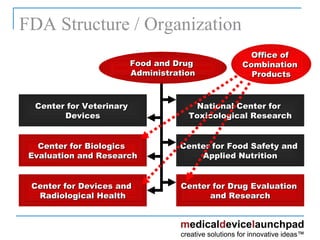
FDA Structure / Organization FDA Structure / Organization Center for Veterinary  Devices Food and Drug  Administration Center for Biologics  Evaluation and Research Center for Devices and  Radiological Health National Center for  Toxicological Research Center for Food Safety and  Applied Nutrition Center for Drug Evaluation  and Research Office of  Combination  Products
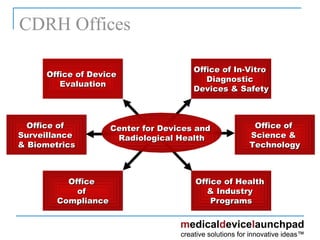
CDRH Offices Office of Device  Evaluation Office of In-Vitro  Diagnostic  Devices & Safety Office of Health  & Industry  Programs Office of  Science &  Technology Office  of  Compliance Office of  Surveillance  & Biometrics Center for Devices and  Radiological Health
FDA Regulatory Framework Federal Food, Drug and Cosmetic Act  (FDC Act) Issued regulation classifying most types of medical devices
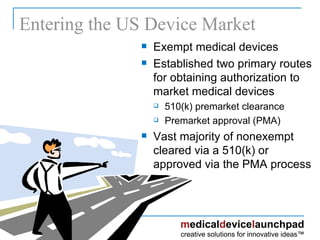
Entering the US Device Market Exempt medical devices Established two primary routes for obtaining authorization to market medical devices 510(k) premarket clearance Premarket approval (PMA) Vast majority of nonexempt cleared via a 510(k) or approved via the PMA process
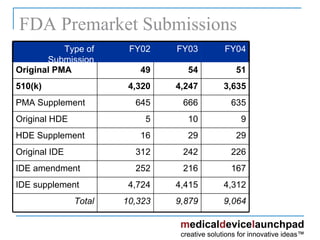
FDA Premarket Submissions 3,635 4,247 4,320 510(k) 167 216 252 IDE amendment 9,879 4,415 242 29 10 666 54 FY03 9,064 10,323 Total 4,312 4,724 IDE supplement 226 312 Original IDE 29 16 HDE Supplement 9 5 Original HDE 635 645 PMA Supplement 51 49 Original PMA FY04 FY02 Type of Submission
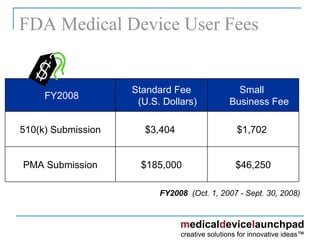
FDA Medical Device User Fees  FDA Fees FY2008   (Oct. 1, 2007 - Sept. 30, 2008) $185,000 $3,404  Standard Fee (U.S. Dollars) $46,250 PMA Submission $1,702  510(k) Submission Small  Business Fee   FY2008
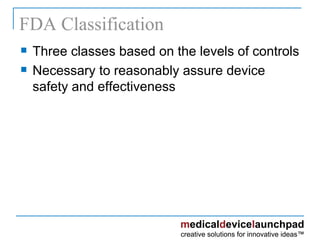
FDA Classification Three classes based on the levels of controls Necessary to reasonably assure device safety and effectiveness
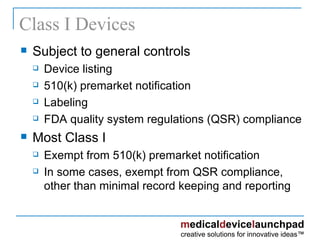
Class I Devices Subject to general controls Device listing 510(k) premarket notification Labeling FDA quality system regulations (QSR) compliance  Most Class I Exempt from 510(k) premarket notification In some cases, exempt from QSR compliance, other than minimal record keeping and reporting
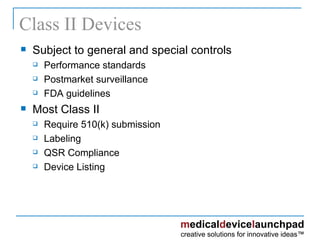
Class II Devices Subject to general and special controls Performance standards Postmarket surveillance FDA guidelines Most Class II Require 510(k) submission Labeling QSR Compliance Device Listing
Class III Devices Subject to general and special controls Life sustaining Life supporting Implantable devices New devices – not found to be substantially equivalent to legally marketed devices Most Class III Require approval of a PMA Unless marketed prior to May 28, 1976 (Preamendment devices) Most stringently regulated
Approval / Clearance Criteria Before a company can market a new device, manufacturer must obtain from the FDA 510(k) premarket clearance, or  premarket approval (PMA) Unless the device is exempt Candidate for alternate submission
510(k) Requirements Description of the new device Photographs Engineering drawing Labeling  Draft promotional materials Identification of predicate device(s) Narrative and tabular comparisons Predicate device’s intended use, indications Technological characteristics Principles of operation Software documentation Sterility information Biocompatibility information Statement or declarations of conformance to applicable standards and guidance documents Summaries of any performance testing Administrative requirements Truthfulness and accuracy statement 510(k) summary Payment of a user fee
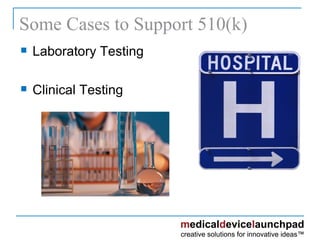
Some Cases to Support 510(k) Laboratory Testing Clinical Testing
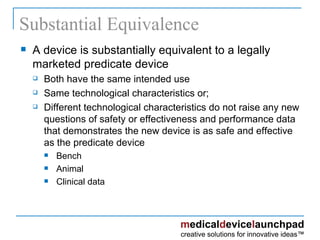
Substantial Equivalence A device is substantially equivalent to a legally marketed predicate device Both have the same intended use Same technological characteristics or;  Different technological characteristics do not raise any new questions of safety or effectiveness and performance data that demonstrates the new device is as safe and effective as the predicate device Bench  Animal Clinical data
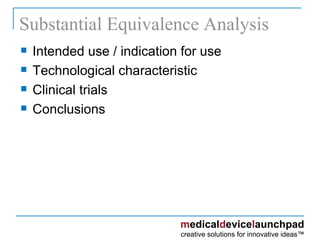
Substantial Equivalence Analysis Intended use / indication for use Technological characteristic Clinical trials Conclusions
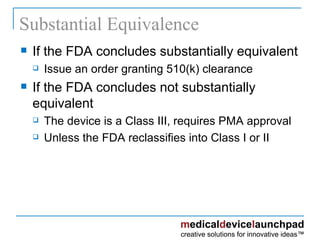
Substantial Equivalence If the FDA concludes substantially equivalent Issue an order granting 510(k) clearance If the FDA concludes not substantially equivalent The device is a Class III, requires PMA approval Unless the FDA reclassifies into Class I or II
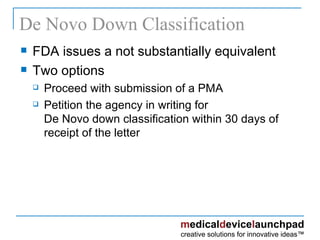
De Novo Down Classification FDA issues a not substantially equivalent Two options Proceed with submission of a PMA Petition the agency in writing for  De Novo down classification within 30 days of receipt of the letter
De Novo Down Classification To qualify, the device must be both “novel and low risk” Novel Limits to not previously classified FDC Act and classified by written notice Low Risk  Application to lower-risk devices the agency has found not substantially equivalent for the lack of a predicate device
De Novo Requirements Within 30 days Description of the device Labeling Justification for recommendation classification Information to support the recommendation bench, animal, human clinical data Usually clinical data is required
De Novo Review FDA has 60 days to review the petition If FDA classifies the device into Class I or II Special control guidance issues Device that can be used a predicate If FDA determines that the device remains Class III PMA approval required to market
PMA Requirements Must demonstrate safety and effectiveness of a new device, supported by valid scientific evidence Convenes an advisory committee Nonbinding recommendation to FDA FDA inspects manufacturer’s facilities to QSR FDA issues  Approval letter, or Non approvable (identifies major deficiencies) PMA
PMA Requirements Complete description of the device Complete description of the components Photographs Engineering drawings of the device Detailed description of the methods, facilities and controls used to manufacture Prepared labeling, advertising literature, any training material Software documentation Sterility information Biocompatibility information Extensive clinical trials Animal studies Bench tests Published and unpublished literature Bibliography of all published reports known concerning the device’s safety or effectiveness
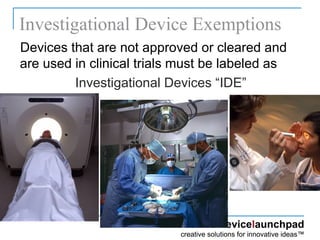
Investigational Device Exemptions Devices that are not approved or cleared and are used in clinical trials must be labeled as Investigational Devices “IDE”
Investigational Device Exemptions The FDA may request Submission of animal or human clinical data to demonstrate equivalence or safety and effectiveness of a device Significant risk Prior approval by an Institutional Review Board (IRB) Informed consent of patients FDA approval of an IDE application
IDE Application 21 CFR Part 812 Clinical study protocol  A significant risk device study  Potential for serious risk to health, safety or welfare to the subjects Intended as an implant Used in supporting or sustaining human life Substantial importance in Diagnosing Curing Mitigating or treating a disease Prevents impairment of human health Potential for serious risk to health, safety or welfare of a subject
IDE Application Non significant risk (NSR) investigated device Requires IRB approval Informed consent Need not obtain FDA approval before study begins
What is a Combination Product? Safe Medical Device Act (1990) 503(g)(1) Products that constitute a combination of a drug, device or biologic Drug – Device Device – Biologic Biologic – Drug Drug – Device – Biologic Note: Drug – Drug, or Device - Device  combination not included here
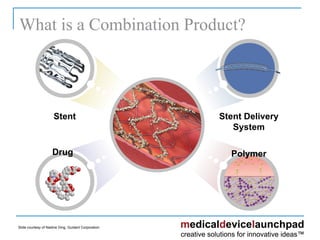
What is a Combination Product?  Stent Drug Stent Delivery System Polymer Slide courtesy of Nadine Ding, Guidant Corporation
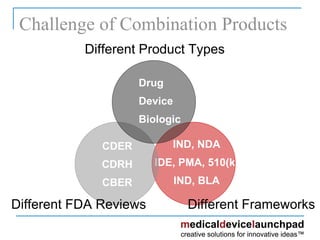
Challenge of Combination Products CDRH CDER CBER NDA, BLA PMA, 510(K) IND, IDE Device Drug Biologic Different Frameworks Different Product Types Different FDA Reviews IND, NDA IDE, PMA, 510(k) IND, BLA CDER CDRH CBER Drug Device Biologic
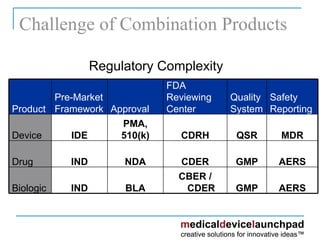
Challenge of Combination Products Regulatory Complexity AERS GMP CBER / CDER BLA IND Biologic AERS GMP CDER NDA IND Drug MDR QSR CDRH PMA, 510(k) IDE Device Safety  Reporting Quality  System FDA  Reviewing  Center Approval Pre-Market Framework Product
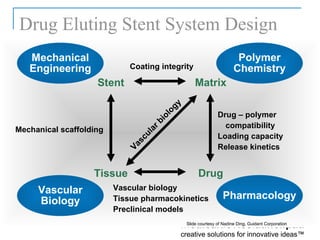
Drug Eluting Stent System Design Slide courtesy of Nadine Ding, Guidant Corporation Drug Matrix Drug – polymer  compatibility Loading capacity Release kinetics Pharmacology Polymer Chemistry Stent Tissue Mechanical scaffolding Mechanical Engineering Vascular   Biology Coating integrity Vascular biology Tissue pharmacokinetics Preclinical models Vascular biology
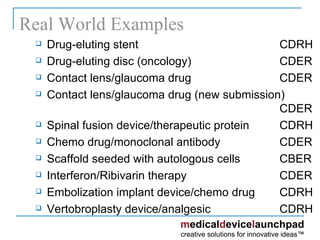
Real World Examples Drug-eluting stent CDRH Drug-eluting disc (oncology) CDER Contact lens/glaucoma drug CDER Contact lens/glaucoma drug (new submission) CDER Spinal fusion device/therapeutic protein CDRH Chemo drug/monoclonal antibody CDER Scaffold seeded with autologous cells CBER Interferon/Ribivarin therapy CDER Embolization implant device/chemo drug CDRH Vertobroplasty device/analgesic CDRH
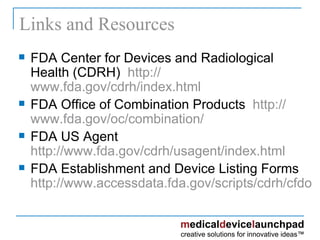
Links and Resources FDA Center for Devices and Radiological Health (CDRH)  http:// www.fda.gov/cdrh/index.html FDA Office of Combination Products  http:// www.fda.gov/oc/combination / FDA US Agent http:// www.fda.gov/cdrh/usagent/index.html FDA Establishment and Device Listing Forms http://www.accessdata.fda.gov/scripts/cdrh/cfdocs/cfRL/printforms.cfm
Thank you For additional information contact: Medical Device Launchpad 800.525.0975

Understanding FDA Requirements Medical Devices

  • 1.
  • 2.
    Presentation Outline FDAOverview Device Classifications / Submission Types Approval / Clearance Requirements Investigational Devices Combination Products Presentation Outline
  • 3.
    FDA Structure /Organization FDA Structure / Organization Center for Veterinary Devices Food and Drug Administration Center for Biologics Evaluation and Research Center for Devices and Radiological Health National Center for Toxicological Research Center for Food Safety and Applied Nutrition Center for Drug Evaluation and Research Office of Combination Products
  • 4.
    CDRH Offices Officeof Device Evaluation Office of In-Vitro Diagnostic Devices & Safety Office of Health & Industry Programs Office of Science & Technology Office of Compliance Office of Surveillance & Biometrics Center for Devices and Radiological Health
  • 5.
    FDA Regulatory FrameworkFederal Food, Drug and Cosmetic Act (FDC Act) Issued regulation classifying most types of medical devices
  • 6.
    Entering the USDevice Market Exempt medical devices Established two primary routes for obtaining authorization to market medical devices 510(k) premarket clearance Premarket approval (PMA) Vast majority of nonexempt cleared via a 510(k) or approved via the PMA process
  • 7.
    FDA Premarket Submissions3,635 4,247 4,320 510(k) 167 216 252 IDE amendment 9,879 4,415 242 29 10 666 54 FY03 9,064 10,323 Total 4,312 4,724 IDE supplement 226 312 Original IDE 29 16 HDE Supplement 9 5 Original HDE 635 645 PMA Supplement 51 49 Original PMA FY04 FY02 Type of Submission
  • 8.
    FDA Medical DeviceUser Fees FDA Fees FY2008 (Oct. 1, 2007 - Sept. 30, 2008) $185,000 $3,404 Standard Fee (U.S. Dollars) $46,250 PMA Submission $1,702 510(k) Submission Small Business Fee   FY2008
  • 9.
    FDA Classification Threeclasses based on the levels of controls Necessary to reasonably assure device safety and effectiveness
  • 10.
    Class I DevicesSubject to general controls Device listing 510(k) premarket notification Labeling FDA quality system regulations (QSR) compliance Most Class I Exempt from 510(k) premarket notification In some cases, exempt from QSR compliance, other than minimal record keeping and reporting
  • 11.
    Class II DevicesSubject to general and special controls Performance standards Postmarket surveillance FDA guidelines Most Class II Require 510(k) submission Labeling QSR Compliance Device Listing
  • 12.
    Class III DevicesSubject to general and special controls Life sustaining Life supporting Implantable devices New devices – not found to be substantially equivalent to legally marketed devices Most Class III Require approval of a PMA Unless marketed prior to May 28, 1976 (Preamendment devices) Most stringently regulated
  • 13.
    Approval / ClearanceCriteria Before a company can market a new device, manufacturer must obtain from the FDA 510(k) premarket clearance, or premarket approval (PMA) Unless the device is exempt Candidate for alternate submission
  • 14.
    510(k) Requirements Descriptionof the new device Photographs Engineering drawing Labeling Draft promotional materials Identification of predicate device(s) Narrative and tabular comparisons Predicate device’s intended use, indications Technological characteristics Principles of operation Software documentation Sterility information Biocompatibility information Statement or declarations of conformance to applicable standards and guidance documents Summaries of any performance testing Administrative requirements Truthfulness and accuracy statement 510(k) summary Payment of a user fee
  • 15.
    Some Cases toSupport 510(k) Laboratory Testing Clinical Testing
  • 16.
    Substantial Equivalence Adevice is substantially equivalent to a legally marketed predicate device Both have the same intended use Same technological characteristics or; Different technological characteristics do not raise any new questions of safety or effectiveness and performance data that demonstrates the new device is as safe and effective as the predicate device Bench Animal Clinical data
  • 17.
    Substantial Equivalence AnalysisIntended use / indication for use Technological characteristic Clinical trials Conclusions
  • 18.
    Substantial Equivalence Ifthe FDA concludes substantially equivalent Issue an order granting 510(k) clearance If the FDA concludes not substantially equivalent The device is a Class III, requires PMA approval Unless the FDA reclassifies into Class I or II
  • 19.
    De Novo DownClassification FDA issues a not substantially equivalent Two options Proceed with submission of a PMA Petition the agency in writing for De Novo down classification within 30 days of receipt of the letter
  • 20.
    De Novo DownClassification To qualify, the device must be both “novel and low risk” Novel Limits to not previously classified FDC Act and classified by written notice Low Risk Application to lower-risk devices the agency has found not substantially equivalent for the lack of a predicate device
  • 21.
    De Novo RequirementsWithin 30 days Description of the device Labeling Justification for recommendation classification Information to support the recommendation bench, animal, human clinical data Usually clinical data is required
  • 22.
    De Novo ReviewFDA has 60 days to review the petition If FDA classifies the device into Class I or II Special control guidance issues Device that can be used a predicate If FDA determines that the device remains Class III PMA approval required to market
  • 23.
    PMA Requirements Mustdemonstrate safety and effectiveness of a new device, supported by valid scientific evidence Convenes an advisory committee Nonbinding recommendation to FDA FDA inspects manufacturer’s facilities to QSR FDA issues Approval letter, or Non approvable (identifies major deficiencies) PMA
  • 24.
    PMA Requirements Completedescription of the device Complete description of the components Photographs Engineering drawings of the device Detailed description of the methods, facilities and controls used to manufacture Prepared labeling, advertising literature, any training material Software documentation Sterility information Biocompatibility information Extensive clinical trials Animal studies Bench tests Published and unpublished literature Bibliography of all published reports known concerning the device’s safety or effectiveness
  • 25.
    Investigational Device ExemptionsDevices that are not approved or cleared and are used in clinical trials must be labeled as Investigational Devices “IDE”
  • 26.
    Investigational Device ExemptionsThe FDA may request Submission of animal or human clinical data to demonstrate equivalence or safety and effectiveness of a device Significant risk Prior approval by an Institutional Review Board (IRB) Informed consent of patients FDA approval of an IDE application
  • 27.
    IDE Application 21CFR Part 812 Clinical study protocol A significant risk device study Potential for serious risk to health, safety or welfare to the subjects Intended as an implant Used in supporting or sustaining human life Substantial importance in Diagnosing Curing Mitigating or treating a disease Prevents impairment of human health Potential for serious risk to health, safety or welfare of a subject
  • 28.
    IDE Application Nonsignificant risk (NSR) investigated device Requires IRB approval Informed consent Need not obtain FDA approval before study begins
  • 29.
    What is aCombination Product? Safe Medical Device Act (1990) 503(g)(1) Products that constitute a combination of a drug, device or biologic Drug – Device Device – Biologic Biologic – Drug Drug – Device – Biologic Note: Drug – Drug, or Device - Device combination not included here
  • 30.
    What is aCombination Product? Stent Drug Stent Delivery System Polymer Slide courtesy of Nadine Ding, Guidant Corporation
  • 31.
    Challenge of CombinationProducts CDRH CDER CBER NDA, BLA PMA, 510(K) IND, IDE Device Drug Biologic Different Frameworks Different Product Types Different FDA Reviews IND, NDA IDE, PMA, 510(k) IND, BLA CDER CDRH CBER Drug Device Biologic
  • 32.
    Challenge of CombinationProducts Regulatory Complexity AERS GMP CBER / CDER BLA IND Biologic AERS GMP CDER NDA IND Drug MDR QSR CDRH PMA, 510(k) IDE Device Safety Reporting Quality System FDA Reviewing Center Approval Pre-Market Framework Product
  • 33.
    Drug Eluting StentSystem Design Slide courtesy of Nadine Ding, Guidant Corporation Drug Matrix Drug – polymer compatibility Loading capacity Release kinetics Pharmacology Polymer Chemistry Stent Tissue Mechanical scaffolding Mechanical Engineering Vascular Biology Coating integrity Vascular biology Tissue pharmacokinetics Preclinical models Vascular biology
  • 34.
    Real World ExamplesDrug-eluting stent CDRH Drug-eluting disc (oncology) CDER Contact lens/glaucoma drug CDER Contact lens/glaucoma drug (new submission) CDER Spinal fusion device/therapeutic protein CDRH Chemo drug/monoclonal antibody CDER Scaffold seeded with autologous cells CBER Interferon/Ribivarin therapy CDER Embolization implant device/chemo drug CDRH Vertobroplasty device/analgesic CDRH
  • 35.
    Links and ResourcesFDA Center for Devices and Radiological Health (CDRH) http:// www.fda.gov/cdrh/index.html FDA Office of Combination Products http:// www.fda.gov/oc/combination / FDA US Agent http:// www.fda.gov/cdrh/usagent/index.html FDA Establishment and Device Listing Forms http://www.accessdata.fda.gov/scripts/cdrh/cfdocs/cfRL/printforms.cfm
  • 36.
    Thank you Foradditional information contact: Medical Device Launchpad 800.525.0975