Name :- Mansi Upadhyay
Roll no :- 18
Semester :- 3
Year :- 2019-20
Paper no :- 9 ( The Modernist Literature)
Topic :- Theme of To The Lighthouse.
E-Mail :- mansiupadhyay06@gmail.com
Submitted to :- Department of English Maharaja
Krishnakumarsinhji Bhavnagar University
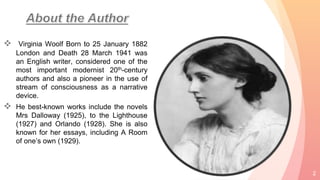
 Virginia Woolf Born to 25 January 1882
London and Death 28 March 1941 was
an English writer, considered one of the
most important modernist 20th-century
authors and also a pioneer in the use of
stream of consciousness as a narrative
device.
 He best-known works include the novels
Mrs Dalloway (1925), to the Lighthouse
(1927) and Orlando (1928). She is also
known for her essays, including A Room
of one’s own (1929).
2
 Inadequacy of Human Relationship
 Its Causes
 Silence : Its Expressive Power
 Importance of the Trivial
 Need of Emotional Sympathy
 The Ebb and Flow of Feelings
 Tensely and Lily Briscoe : Satisfactory Relationship
 Husband – wife Relationship
 The Role of Mrs. Ramsay
3
• Virginia Woolf was fully conscious of the inadequacy of human
relationships.
• Human beings seemed to her isolated and communication between
them partial, often Unsatisfactory, some – times quite mistaken.
• To The Lighthouse shows us various fictional characters, trying,
with varying degrees of success, to establish relationships with the
people around them.
4
• One of the main reasons for the failure to establish satisfactory human
relationships is that words are the main source of communication between
one character and another, and words are often inadequate for the
purpose.
• Sometimes, words fail to express the full complexity of a characters’s
thoughts and feelings, and at other times what the words express is only a
fraction of what a character thinks and feels, and so they become actually
misleading.
• Mrs. Woolf has a keen consciousness of both these aspects of verbal
inadequacy. As Lily stands near to Carmichael on the lawn trying to
explain Mrs. Ramsay, she thinks: she wanted to say not one thing, but
everything.
5
• More often than not silence is more expressive than words.
• Lily realizes this fully, and she feels in greater communication
with Carmichael than if they had spoken.
• They sit on the lawn perfectly silent, but still they seem to
understand each other, and are in perfect sympathy with each
other, without exchanging even a single word.
• Things are often spoiled by saying them. Silence is often more
perfectly expressive.
6
• silence thus often leads to the establishment of satisfactory human
– relationship.
• At other times, things apparently trivial are helpful in this respect.
For example, Mr. Ramsay comes to Lily demanding sympathy.
• Lily is unable to say a single word. And then suddenly she praises
his boots. At once he is pleased and satisfied. At once they are in
sympathy with each other.
• The praise of the boots is something trivial, even comic, but it helps
to establish sympathy and understanding between Lily and Ramsay
and brings them closer together.
7
• Satisfactory human relationship are necessary for happiness in life.
• Such relationship can be established not through logic. Reason and intellect, but
through the emotions. Union of hearts, emotional understanding and sympathy
are needed for satisfactory relationships between mother and children and
husband and wife.
• Thus Mrs. Ramsay who is in sympathy with her children and understands their
psychological needs is loved and respected by them while they hate their father,
who fails to understand their needs because of his cold intellectual approach.
• He tells James that it won’t be fine tomorrow and so he won’t be able to go to the
Lighthouse. This is perfectly true, but the hopes of the poor boys are thus
shattered and he feels like stabbing his father.
• Mrs. Ramsay, who is more warm- hearted and sympathetic, at once assures him
that the wind might change and they might still be able to go on the expedition.
Now this is a lie, but such lies are essential for human happiness.
8
• Mrs. Ramsay is a person who tries to establish communication
between people, and Virginia Woolf shows this in many ways: in
Mrs. Ramsay’s attempt to get Paul and Minta and Lily and Bankes
Married for example, and at the dinner party where, seeing the
unease of her guests, she begins to make the effort to get people
talking, to involve them and so to create something of the time they
are together.
• As a matter of fact, To The Lighthouse presents the reactions of
people to one another in such a way as to create for us the ebb
and flow of feelings, the movements of characters towards one
another from the state of isolation in which each one of us is
trapped by his own sense of inadequacy or his private worries.
9
• His feelings and Lily’s appreciation of them are displayed with
irony and subtlety at the dinner. Tansley desperately wants to
make an impression on the conversation but lacks the self
confidence to make his own opening and sits despising the
superficial chat of Mrs. Ramsay and Bankes.
• Lily has to abandon this truth game, however, because Mrs.
Ramsay, who wants things to go smoothly, silently implores Lily’s
help in making the party comfortable, and so, in nearly the same
words, but with a change of feeling, she again asks him to take
her To The Lighthouse.
10
• Satisfactory relationship between Chales Tansley and the others
at the table is thus established and the party thus becomes a
success. Both Lily’s invitations to Tansley are lies; the first is
recognized by him as a lie and he sees the true feeling of
antagonism that produced it and so they understand one another
for a moment.
• Lily feels that their relationship is therefore falsified; the need for
politeness has involved her in false behaviour, which has not
been seen as false: she had done the usual trick been nice. She
would never know him. He would never know her. Human
relations were all like that, she thought.
11
• Even in the most intimate and most fully explored relationship in the novel,
that of Mr. and Mrs. Ramsay, there is a note of pretence, and falsehood.
• Mrs. Ramsay is forced to praise him to his face and to bolster up his
confidence in a way she feels should not be necessary.
• This aspect of Ramsay, emphasized by the impartiality of Bankes, puts a
strain on his wife and she has to conceal things from him: “…to be afraid
that he might guess.. That his last book was not quite his best book… and
then to hide small daily things, and the children seeing it, and the burden it
laid in them all this diminished the entire joy…” on his side too there is a
reserve; her pessimistic conviction of the misery of life distresses him, and
he cannot communicate with her in her moods of sadness.
• The Window traces the pattern of their relationship from one extreme to the
other.
12
• Mr. Ramsay, who believes that children must be taught to face facts
and know that life is hard, is infuriated by what seems to him his
wife’s dishonesty: “The extraordinary irrationality of her remark, the
folly of women’s minds enraged him… she flew in the face of facts,
made her children hope what was utterly out of the question, in
effect, told lies”.
• Mrs. Ramsay, who belives in making people happy, in protecting
children from losing the contented innocence of childhood, finds her
husband’s attitude equally repugnant: “To pursue truth with such
veils of civilization so wantonly, so brutally was to her… an outrage
of human decency…”
13
• Mrs. Ramsay is one of those characters of Virginia Woolf who
can create harmony between people and break down their
isolation.
• She is a woman who by the exercise of love for people in
general, endeavours to make life happy and comfortable for
them; for the poor by her exercise of philanthropy, for her
children by fostering their talents, for her husband by sympathy
and reassurance: by encouraging people to marry or to get on
well together she creates communication between them.
• She can establish satisfactory human relationships and this fact
makes her a good mother, a good wife; and a good hostess.
14
• In short, To The Lighthouse may rightly be called a study of
the ways and means by which satisfactory human
relationships might be established.
15
16

Mansi presentation p 9

  • 1.
    Name :- MansiUpadhyay Roll no :- 18 Semester :- 3 Year :- 2019-20 Paper no :- 9 ( The Modernist Literature) Topic :- Theme of To The Lighthouse. E-Mail :- mansiupadhyay06@gmail.com Submitted to :- Department of English Maharaja Krishnakumarsinhji Bhavnagar University
  • 2.
     Virginia WoolfBorn to 25 January 1882 London and Death 28 March 1941 was an English writer, considered one of the most important modernist 20th-century authors and also a pioneer in the use of stream of consciousness as a narrative device.  He best-known works include the novels Mrs Dalloway (1925), to the Lighthouse (1927) and Orlando (1928). She is also known for her essays, including A Room of one’s own (1929). 2
  • 3.
     Inadequacy ofHuman Relationship  Its Causes  Silence : Its Expressive Power  Importance of the Trivial  Need of Emotional Sympathy  The Ebb and Flow of Feelings  Tensely and Lily Briscoe : Satisfactory Relationship  Husband – wife Relationship  The Role of Mrs. Ramsay 3
  • 4.
    • Virginia Woolfwas fully conscious of the inadequacy of human relationships. • Human beings seemed to her isolated and communication between them partial, often Unsatisfactory, some – times quite mistaken. • To The Lighthouse shows us various fictional characters, trying, with varying degrees of success, to establish relationships with the people around them. 4
  • 5.
    • One ofthe main reasons for the failure to establish satisfactory human relationships is that words are the main source of communication between one character and another, and words are often inadequate for the purpose. • Sometimes, words fail to express the full complexity of a characters’s thoughts and feelings, and at other times what the words express is only a fraction of what a character thinks and feels, and so they become actually misleading. • Mrs. Woolf has a keen consciousness of both these aspects of verbal inadequacy. As Lily stands near to Carmichael on the lawn trying to explain Mrs. Ramsay, she thinks: she wanted to say not one thing, but everything. 5
  • 6.
    • More oftenthan not silence is more expressive than words. • Lily realizes this fully, and she feels in greater communication with Carmichael than if they had spoken. • They sit on the lawn perfectly silent, but still they seem to understand each other, and are in perfect sympathy with each other, without exchanging even a single word. • Things are often spoiled by saying them. Silence is often more perfectly expressive. 6
  • 7.
    • silence thusoften leads to the establishment of satisfactory human – relationship. • At other times, things apparently trivial are helpful in this respect. For example, Mr. Ramsay comes to Lily demanding sympathy. • Lily is unable to say a single word. And then suddenly she praises his boots. At once he is pleased and satisfied. At once they are in sympathy with each other. • The praise of the boots is something trivial, even comic, but it helps to establish sympathy and understanding between Lily and Ramsay and brings them closer together. 7
  • 8.
    • Satisfactory humanrelationship are necessary for happiness in life. • Such relationship can be established not through logic. Reason and intellect, but through the emotions. Union of hearts, emotional understanding and sympathy are needed for satisfactory relationships between mother and children and husband and wife. • Thus Mrs. Ramsay who is in sympathy with her children and understands their psychological needs is loved and respected by them while they hate their father, who fails to understand their needs because of his cold intellectual approach. • He tells James that it won’t be fine tomorrow and so he won’t be able to go to the Lighthouse. This is perfectly true, but the hopes of the poor boys are thus shattered and he feels like stabbing his father. • Mrs. Ramsay, who is more warm- hearted and sympathetic, at once assures him that the wind might change and they might still be able to go on the expedition. Now this is a lie, but such lies are essential for human happiness. 8
  • 9.
    • Mrs. Ramsayis a person who tries to establish communication between people, and Virginia Woolf shows this in many ways: in Mrs. Ramsay’s attempt to get Paul and Minta and Lily and Bankes Married for example, and at the dinner party where, seeing the unease of her guests, she begins to make the effort to get people talking, to involve them and so to create something of the time they are together. • As a matter of fact, To The Lighthouse presents the reactions of people to one another in such a way as to create for us the ebb and flow of feelings, the movements of characters towards one another from the state of isolation in which each one of us is trapped by his own sense of inadequacy or his private worries. 9
  • 10.
    • His feelingsand Lily’s appreciation of them are displayed with irony and subtlety at the dinner. Tansley desperately wants to make an impression on the conversation but lacks the self confidence to make his own opening and sits despising the superficial chat of Mrs. Ramsay and Bankes. • Lily has to abandon this truth game, however, because Mrs. Ramsay, who wants things to go smoothly, silently implores Lily’s help in making the party comfortable, and so, in nearly the same words, but with a change of feeling, she again asks him to take her To The Lighthouse. 10
  • 11.
    • Satisfactory relationshipbetween Chales Tansley and the others at the table is thus established and the party thus becomes a success. Both Lily’s invitations to Tansley are lies; the first is recognized by him as a lie and he sees the true feeling of antagonism that produced it and so they understand one another for a moment. • Lily feels that their relationship is therefore falsified; the need for politeness has involved her in false behaviour, which has not been seen as false: she had done the usual trick been nice. She would never know him. He would never know her. Human relations were all like that, she thought. 11
  • 12.
    • Even inthe most intimate and most fully explored relationship in the novel, that of Mr. and Mrs. Ramsay, there is a note of pretence, and falsehood. • Mrs. Ramsay is forced to praise him to his face and to bolster up his confidence in a way she feels should not be necessary. • This aspect of Ramsay, emphasized by the impartiality of Bankes, puts a strain on his wife and she has to conceal things from him: “…to be afraid that he might guess.. That his last book was not quite his best book… and then to hide small daily things, and the children seeing it, and the burden it laid in them all this diminished the entire joy…” on his side too there is a reserve; her pessimistic conviction of the misery of life distresses him, and he cannot communicate with her in her moods of sadness. • The Window traces the pattern of their relationship from one extreme to the other. 12
  • 13.
    • Mr. Ramsay,who believes that children must be taught to face facts and know that life is hard, is infuriated by what seems to him his wife’s dishonesty: “The extraordinary irrationality of her remark, the folly of women’s minds enraged him… she flew in the face of facts, made her children hope what was utterly out of the question, in effect, told lies”. • Mrs. Ramsay, who belives in making people happy, in protecting children from losing the contented innocence of childhood, finds her husband’s attitude equally repugnant: “To pursue truth with such veils of civilization so wantonly, so brutally was to her… an outrage of human decency…” 13
  • 14.
    • Mrs. Ramsayis one of those characters of Virginia Woolf who can create harmony between people and break down their isolation. • She is a woman who by the exercise of love for people in general, endeavours to make life happy and comfortable for them; for the poor by her exercise of philanthropy, for her children by fostering their talents, for her husband by sympathy and reassurance: by encouraging people to marry or to get on well together she creates communication between them. • She can establish satisfactory human relationships and this fact makes her a good mother, a good wife; and a good hostess. 14
  • 15.
    • In short,To The Lighthouse may rightly be called a study of the ways and means by which satisfactory human relationships might be established. 15
  • 16.