Co-ordination Chemistry
By
Dr.S.Manimekalai
Assistant Professor of Chemistry
E.M.G.Yadava Women’s College
Madurai
Co-ordination Chemistry
Introduction
 It is the study of a class of compounds formed by
metals
 Coordinate covalent bonds are observed in
complexes
 These compounds are basically the compounds
of the d-block elements
 These compounds have major importance in
industries, metallurgy and pigment
 EDTA is a ligand that is used to determine the
hardness of the water. EDTA is also used for DNA
agarose gel.
Continue…..
The addition compound which is undergoing
 complete ionisation (called double salt) in polar solvent
 partial ionisation ( called complex compounds) in polar
solvent
Ex: double salt: KCl MgCl2 KCl.MgCl2.6H2O
H2O
H3O+ K+Mg2+Cl-
polar solvent complete
dissociation
Complex compounds:
K3[Fe(CN)6] K+ + [Fe(CN)6]-
polar solvent partial ionisation
Continue ……
[ M Lx ] y ionisation sphere
Central metal atom coordination number
ligand
co-ordination sphere
In complex form central metal atom acts as lewis
acid(electron pair acceptor )
Ligand acts as lewis base (electron pair donar)
Transfer of C-H σ bonding electrons is called agostic
interaction M C
H
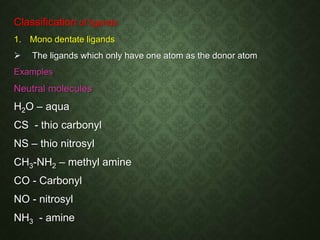
Classification of ligands
1. Mono dentate ligands
 The ligands which only have one atom as the donor atom
Examples
Neutral molecules
H2O – aqua
CS - thio carbonyl
NS – thio nitrosyl
CH3-NH2 – methyl amine
CO - Carbonyl
NO - nitrosyl
NH3 - amine
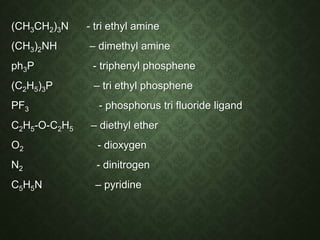
(CH3CH2)3N - tri ethyl amine
(CH3)2NH – dimethyl amine
ph3P - triphenyl phosphene
(C2H5)3P – tri ethyl phosphene
PF3 - phosphorus tri fluoride ligand
C2H5-O-C2H5 – diethyl ether
O2 - dioxygen
N2 - dinitrogen
C5H5N – pyridine
Anions
F- - fluoro
Br- -Bromo
Cl- - Chloro
I- - iodo
OH- - hydroxo
H- - hydrido
SH- - mercapto
CN- - cyano
NC- - isocyano
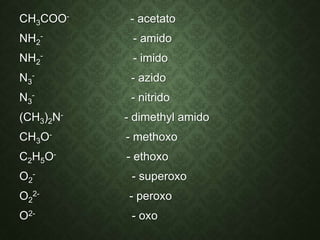
CH3COO- - acetato
NH2
- - amido
NH2
- - imido
N3
- - azido
N3
- - nitrido
(CH3)2N- - dimethyl amido
CH3O- - methoxo
C2H5O- - ethoxo
O2
- - superoxo
O2
2- - peroxo
O2- - oxo
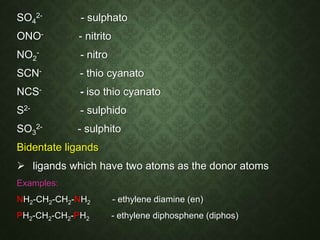
SO4
2- - sulphato
ONO- - nitrito
NO2
- - nitro
SCN- - thio cyanato
NCS- - iso thio cyanato
S2- - sulphido
SO3
2- - sulphito
Bidentate ligands
 ligands which have two atoms as the donor atoms
Examples:
NH2-CH2-CH2-NH2 - ethylene diamine (en)
PH2-CH2-CH2-PH2 - ethylene diphosphene (diphos)
CH3-CH(NH2)-CH2(NH2) - propylene diamine (Pn)
CH3-CH(NH2)-CH(NH2)-CH3 - butylene diamine (Bn)
CH3-C(CH3)(NH2)-C(CH3)(NH2)-CH3- tetra methylene diamine (tn)
NH2NH2 - hydrazine
O=C-O- - oxalato (ox2-)
O=C-O-
O=C O- - carbonato
O-
O=N O- - nitrato
O-
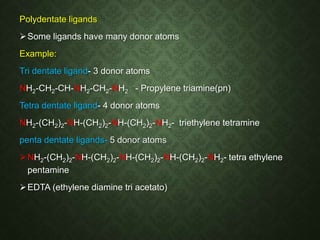
Polydentate ligands
Some ligands have many donor atoms
Example:
Tri dentate ligand- 3 donor atoms
NH2-CH2-CH-NH2-CH2-NH2 - Propylene triamine(pn)
Tetra dentate ligand- 4 donor atoms
NH2-(CH2)2-NH-(CH2)2-NH-(CH2)2-NH2- triethylene tetramine
penta dentate ligands- 5 donor atoms
NH2-(CH2)2-NH-(CH2)2-NH-(CH2)2-NH-(CH2)2-NH2- tetra ethylene
pentamine
EDTA (ethylene diamine tri acetato)
Coordination chemistry-part-1

Coordination chemistry-part-1

  • 1.
    Co-ordination Chemistry By Dr.S.Manimekalai Assistant Professorof Chemistry E.M.G.Yadava Women’s College Madurai
  • 2.
    Co-ordination Chemistry Introduction  Itis the study of a class of compounds formed by metals  Coordinate covalent bonds are observed in complexes  These compounds are basically the compounds of the d-block elements  These compounds have major importance in industries, metallurgy and pigment  EDTA is a ligand that is used to determine the hardness of the water. EDTA is also used for DNA agarose gel.
  • 3.
    Continue….. The addition compoundwhich is undergoing  complete ionisation (called double salt) in polar solvent  partial ionisation ( called complex compounds) in polar solvent Ex: double salt: KCl MgCl2 KCl.MgCl2.6H2O H2O H3O+ K+Mg2+Cl- polar solvent complete dissociation Complex compounds: K3[Fe(CN)6] K+ + [Fe(CN)6]- polar solvent partial ionisation
  • 4.
    Continue …… [ MLx ] y ionisation sphere Central metal atom coordination number ligand co-ordination sphere In complex form central metal atom acts as lewis acid(electron pair acceptor ) Ligand acts as lewis base (electron pair donar) Transfer of C-H σ bonding electrons is called agostic interaction M C H
  • 5.
    Classification of ligands 1.Mono dentate ligands  The ligands which only have one atom as the donor atom Examples Neutral molecules H2O – aqua CS - thio carbonyl NS – thio nitrosyl CH3-NH2 – methyl amine CO - Carbonyl NO - nitrosyl NH3 - amine
  • 6.
    (CH3CH2)3N - triethyl amine (CH3)2NH – dimethyl amine ph3P - triphenyl phosphene (C2H5)3P – tri ethyl phosphene PF3 - phosphorus tri fluoride ligand C2H5-O-C2H5 – diethyl ether O2 - dioxygen N2 - dinitrogen C5H5N – pyridine
  • 7.
    Anions F- - fluoro Br--Bromo Cl- - Chloro I- - iodo OH- - hydroxo H- - hydrido SH- - mercapto CN- - cyano NC- - isocyano
  • 8.
    CH3COO- - acetato NH2 -- amido NH2 - - imido N3 - - azido N3 - - nitrido (CH3)2N- - dimethyl amido CH3O- - methoxo C2H5O- - ethoxo O2 - - superoxo O2 2- - peroxo O2- - oxo
  • 9.
    SO4 2- - sulphato ONO-- nitrito NO2 - - nitro SCN- - thio cyanato NCS- - iso thio cyanato S2- - sulphido SO3 2- - sulphito Bidentate ligands  ligands which have two atoms as the donor atoms Examples: NH2-CH2-CH2-NH2 - ethylene diamine (en) PH2-CH2-CH2-PH2 - ethylene diphosphene (diphos)
  • 10.
    CH3-CH(NH2)-CH2(NH2) - propylenediamine (Pn) CH3-CH(NH2)-CH(NH2)-CH3 - butylene diamine (Bn) CH3-C(CH3)(NH2)-C(CH3)(NH2)-CH3- tetra methylene diamine (tn) NH2NH2 - hydrazine O=C-O- - oxalato (ox2-) O=C-O- O=C O- - carbonato O- O=N O- - nitrato O-
  • 11.
    Polydentate ligands Some ligandshave many donor atoms Example: Tri dentate ligand- 3 donor atoms NH2-CH2-CH-NH2-CH2-NH2 - Propylene triamine(pn) Tetra dentate ligand- 4 donor atoms NH2-(CH2)2-NH-(CH2)2-NH-(CH2)2-NH2- triethylene tetramine penta dentate ligands- 5 donor atoms NH2-(CH2)2-NH-(CH2)2-NH-(CH2)2-NH-(CH2)2-NH2- tetra ethylene pentamine EDTA (ethylene diamine tri acetato)