The Art of
Intelligence
A Practical
Introduction
Machine Learning
50 Shades of Data 1
Lucas Jellema, CTO of AMIS
ODevC Yatra, July 2018
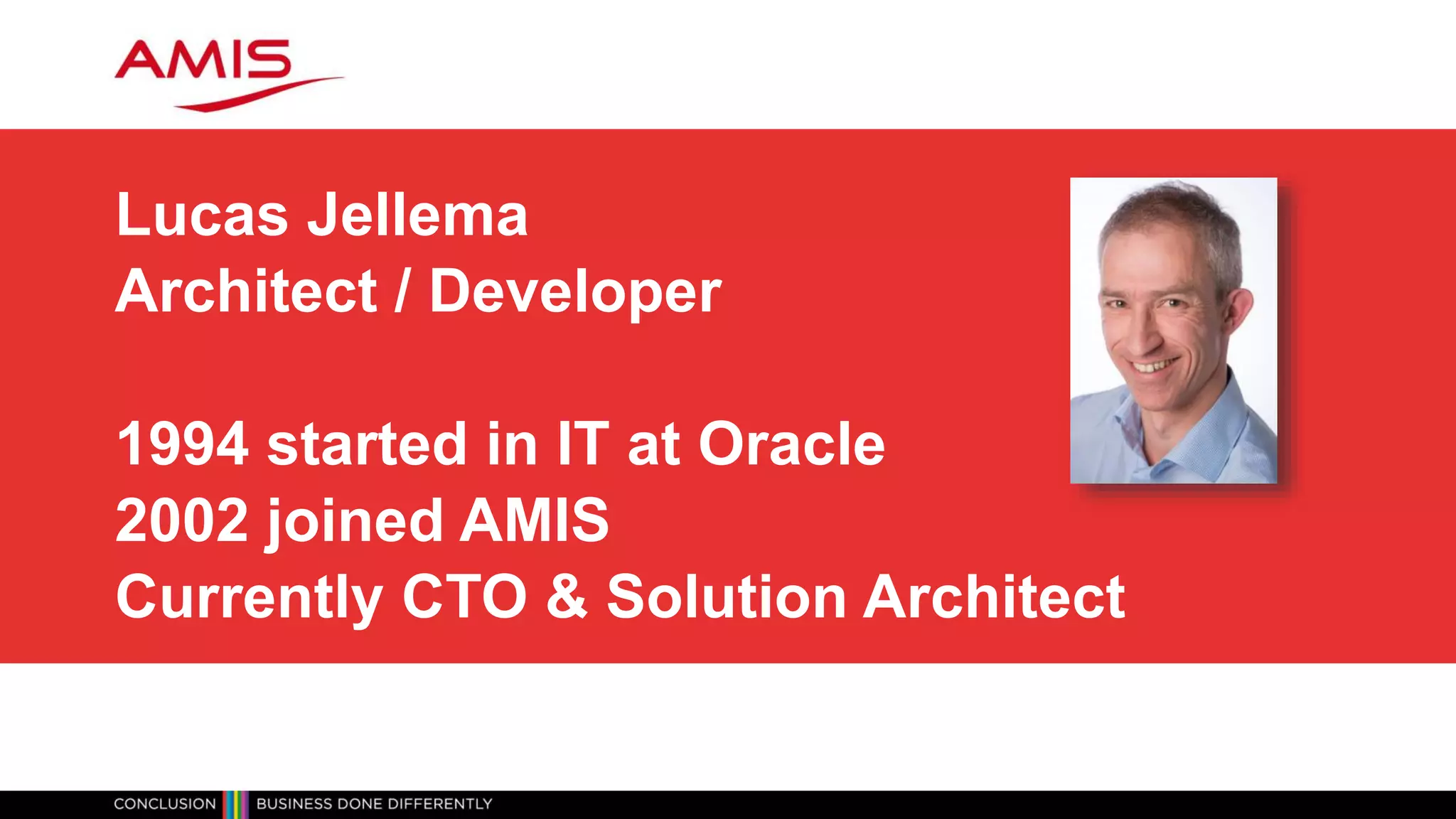
Lucas Jellema
Architect / Developer
1994 started in IT at Oracle
2002 joined AMIS
Currently CTO & Solution Architect
Presenting
• Oracle OpenWorld
• JavaOne
• Oracle Code
• Devoxx
• Java and Oracle User Group meetups
• Java Rockstar (JavaOne 2015)
• OTN Yatra 2013
• ODevC Yatra 2018
50 Shades of Data 3
Writing
• Blogs at http://technology.amis.nl
• 1500 articles – from UI to Middle Tier, Database and Infrastructure
• Articles at Medium, DZone and Oracle Technology Network
• Books for McGraw Hill (Oracle Press)
• Oracle ACE Director & Developer Champion
50 Shades of Data 4
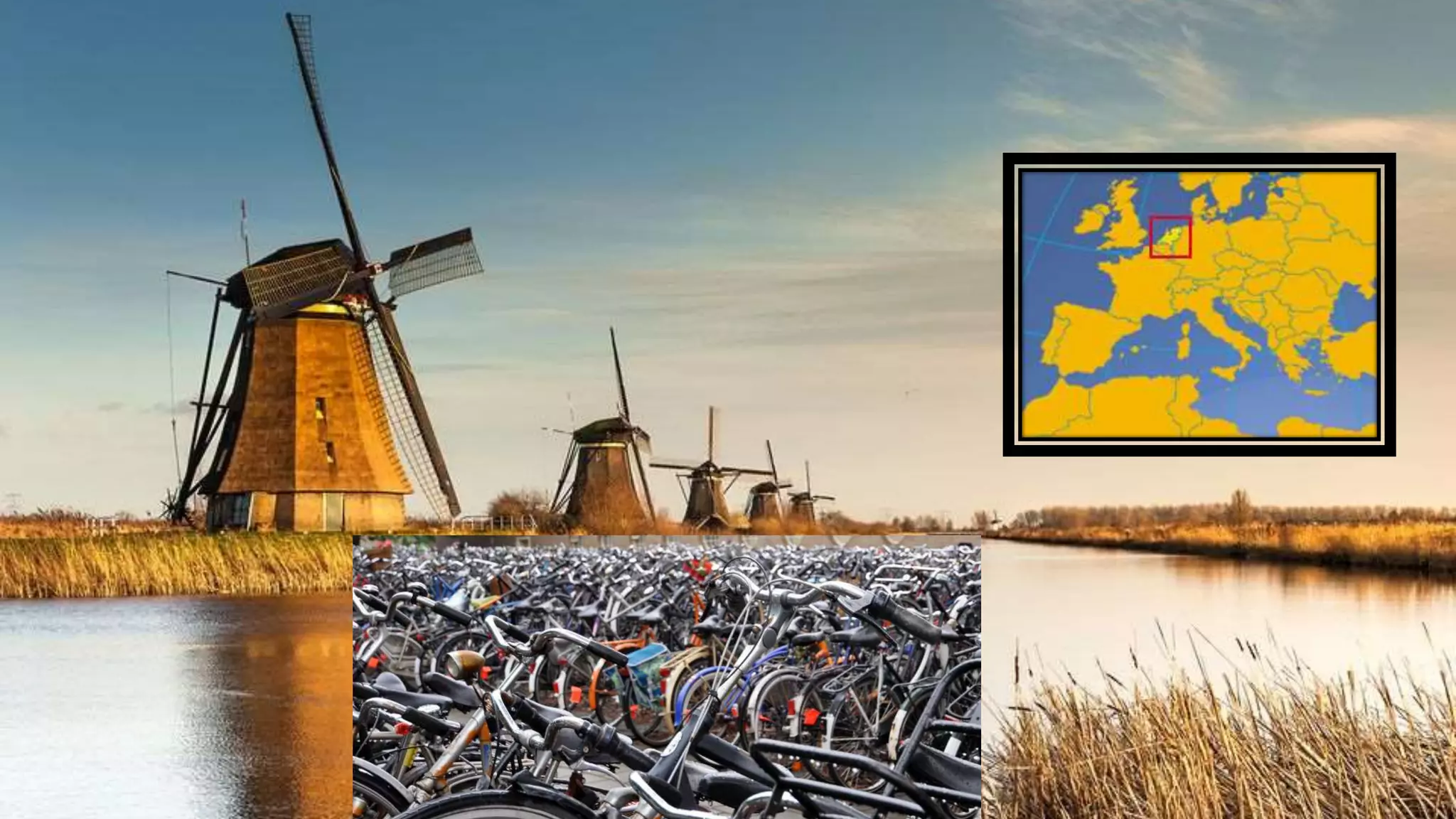
From The Netherlands
50 Shades of Data 5
X = [X1,X2,X3,…,XN]
AGENDA
• What is Machine Learning?
• Why could it be relevant [to you]?
• What does it entail?
• With which algorithms, tools and technologies?
• Oracle and Machine Learning?
• How do you embark on Machine Learning?
• Handson
• Functional/non-technical
• Technical
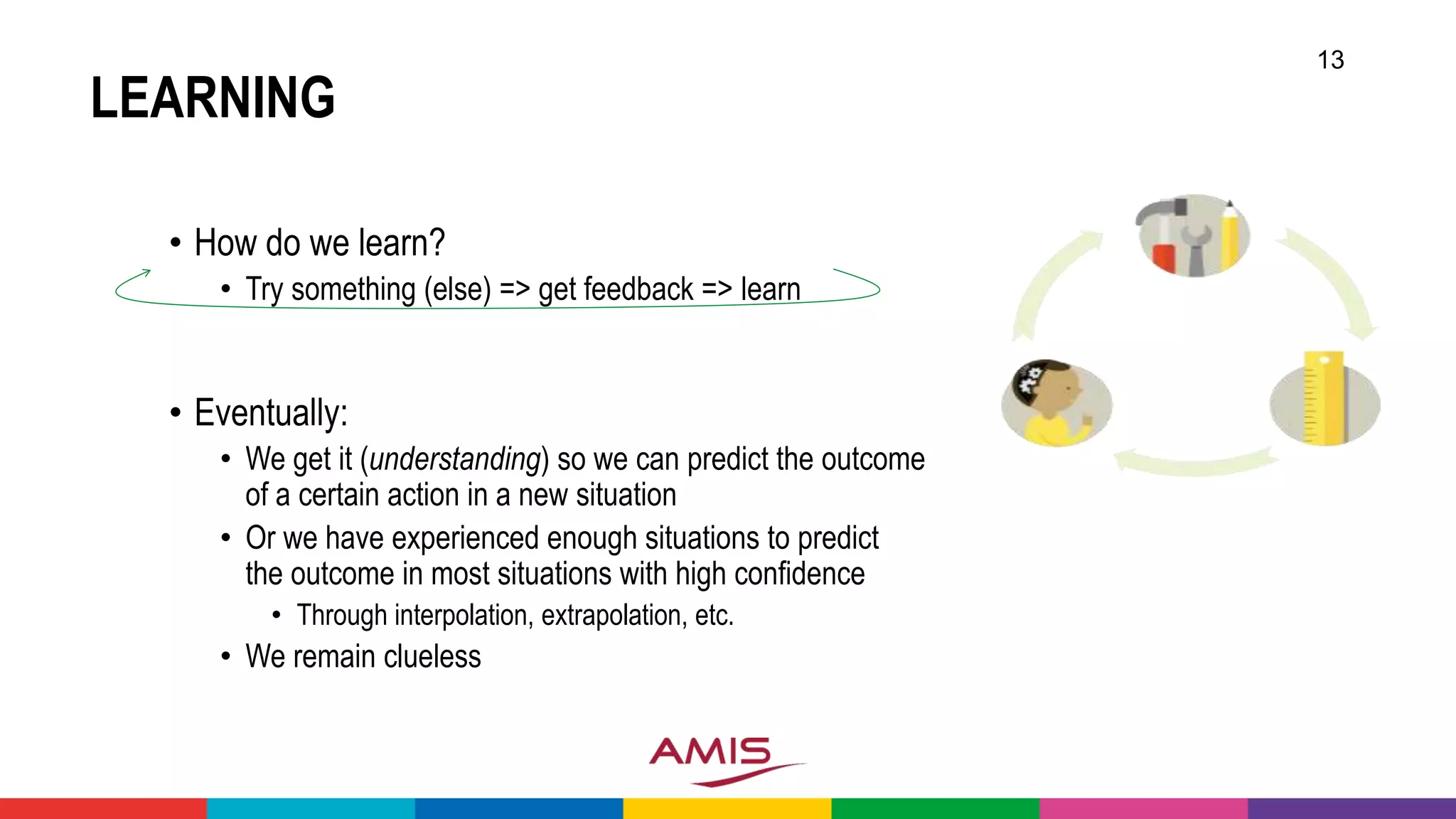
LEARNING
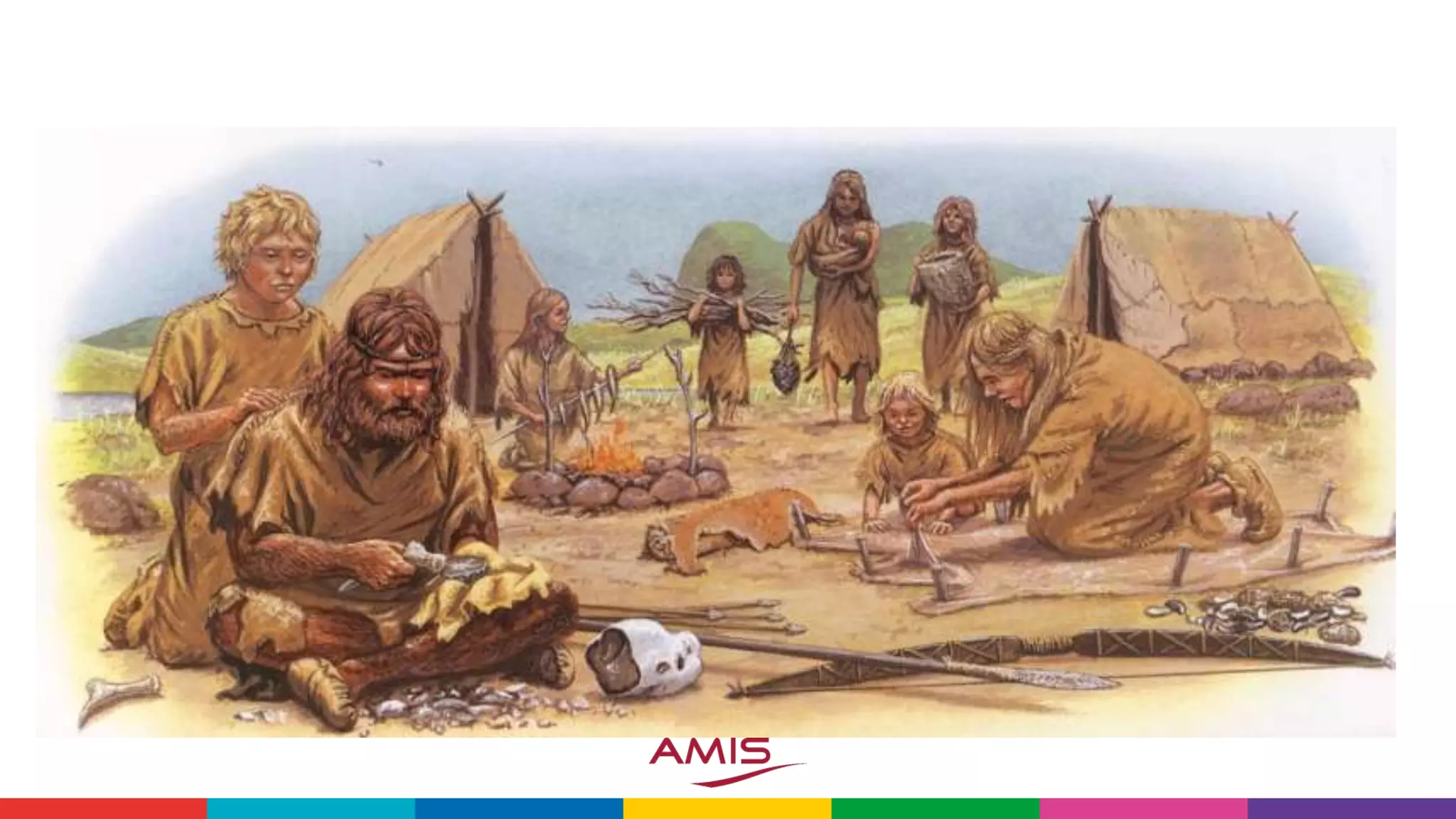
• How do we learn?
• Try something (else) => get feedback => learn
• Eventually:
• We get it (understanding) so we can predict the outcome
of a certain action in a new situation
• Or we have experienced enough situations to predict
the outcome in most situations with high confidence
• Through interpolation, extrapolation, etc.
• We remain clueless
13
MACHINE LEARNING
• Analyze Historical Data (input and result – training set) to discover
Patterns & Models
• Iteratively apply Models to [additional] Input (test set) and compare
model outcome with known actual result to improve the model
• Use Model to predict
outcome for
entirely new data
14
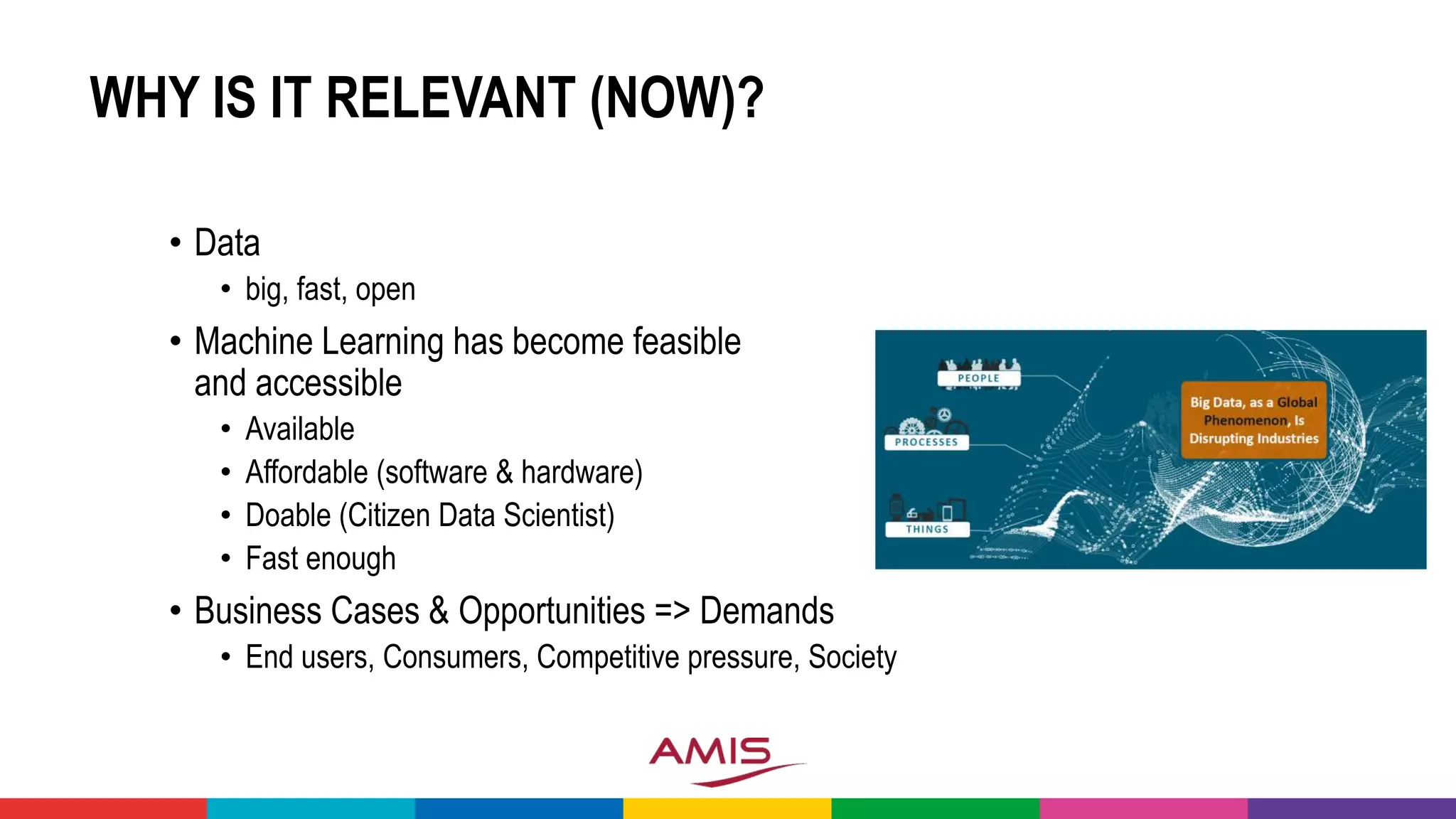
WHY IS IT RELEVANT (NOW)?
• Data
• big, fast, open
• Machine Learning has become feasible
and accessible
• Available
• Affordable (software & hardware)
• Doable (Citizen Data Scientist)
• Fast enough
• Business Cases & Opportunities => Demands
• End users, Consumers, Competitive pressure, Society
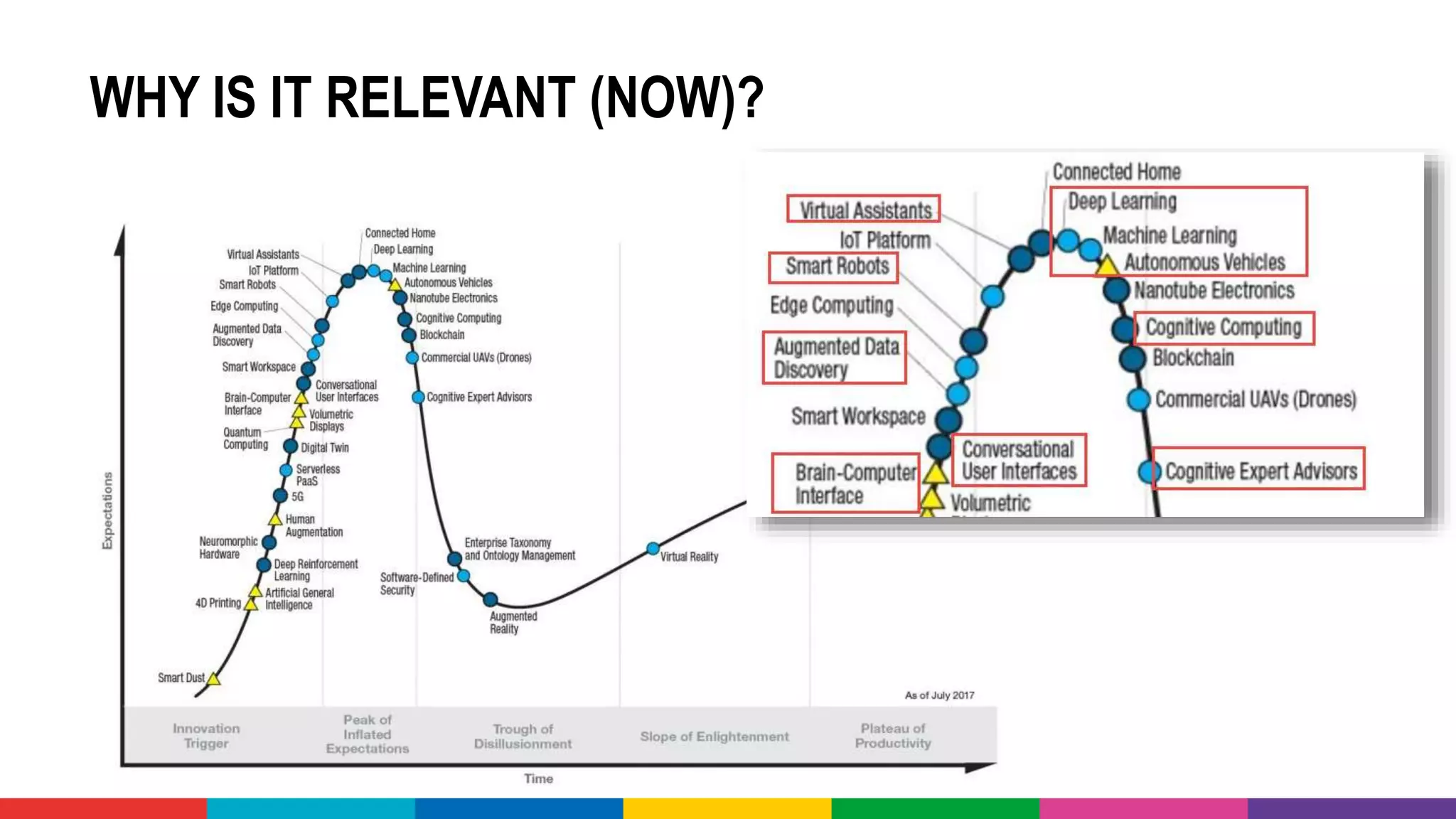
WHY IS IT RELEVANT (NOW)?
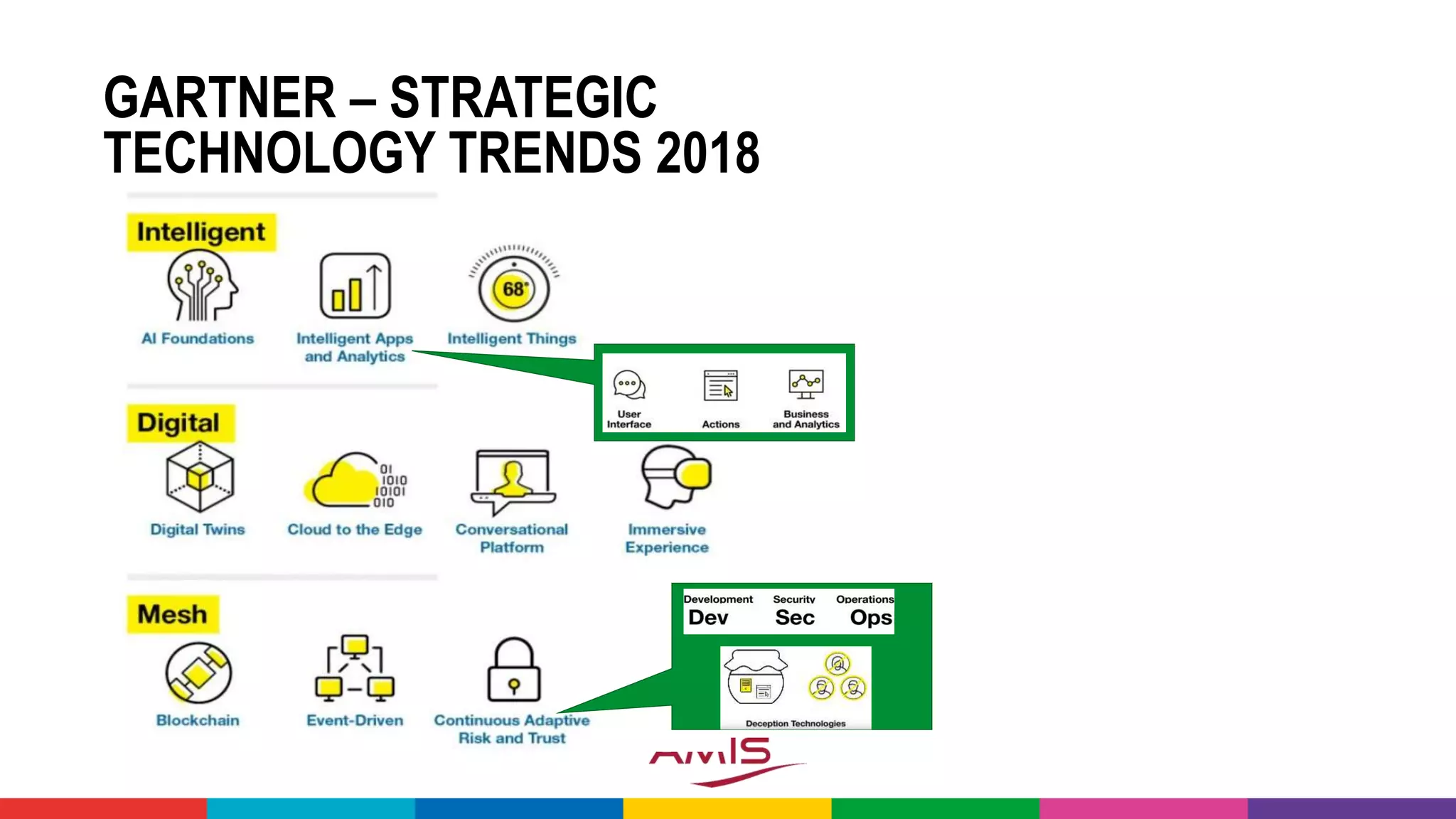
GARTNER – STRATEGIC
TECHNOLOGY TRENDS 2018
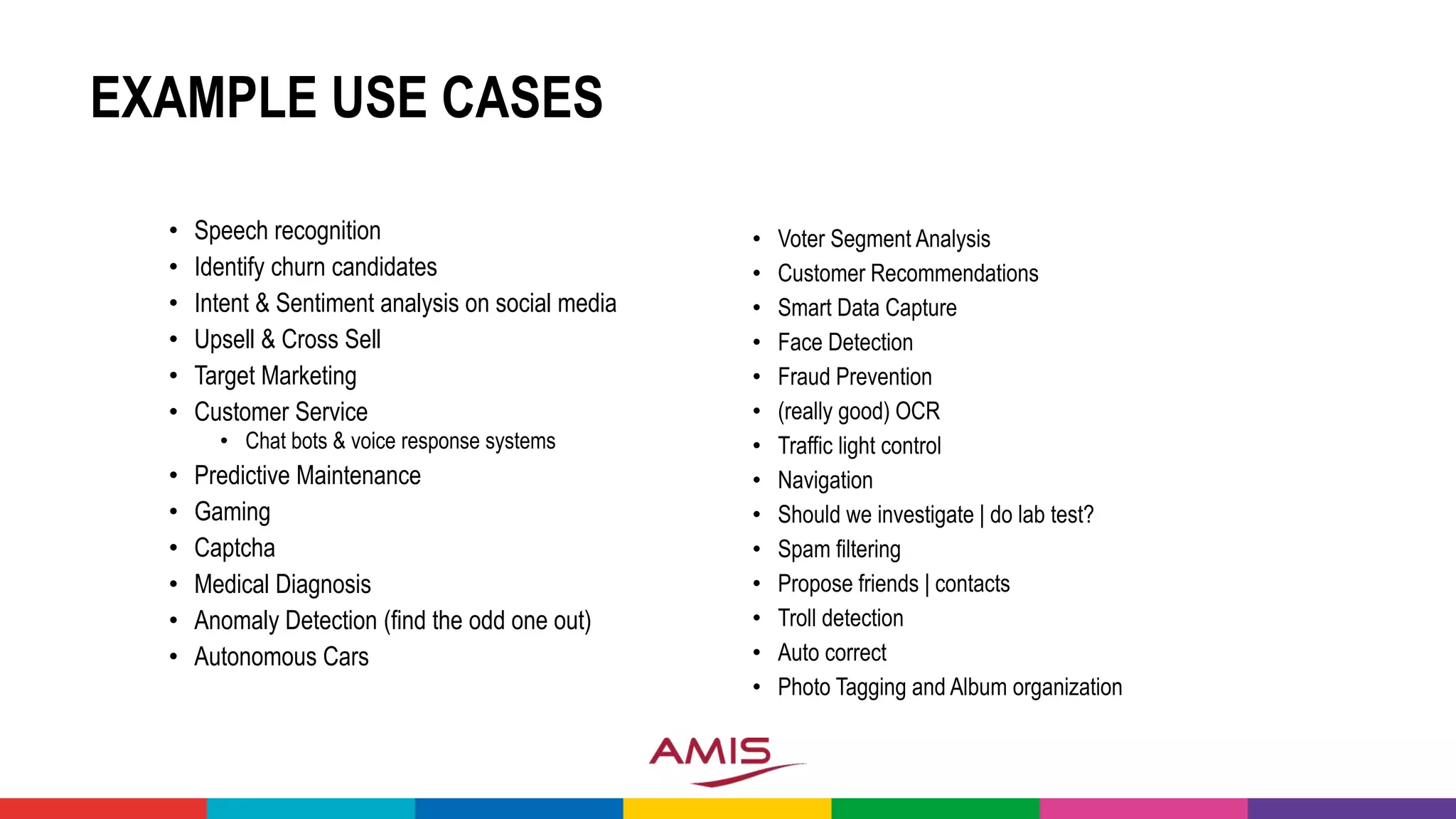
EXAMPLE USE CASES
• Speech recognition
• Identify churn candidates
• Intent & Sentiment analysis on social media
• Upsell & Cross Sell
• Target Marketing
• Customer Service
• Chat bots & voice response systems
• Predictive Maintenance
• Gaming
• Captcha
• Medical Diagnosis
• Anomaly Detection (find the odd one out)
• Autonomous Cars
• Voter Segment Analysis
• Customer Recommendations
• Smart Data Capture
• Face Detection
• Fraud Prevention
• (really good) OCR
• Traffic light control
• Navigation
• Should we investigate | do lab test?
• Spam filtering
• Propose friends | contacts
• Troll detection
• Auto correct
• Photo Tagging and Album organization
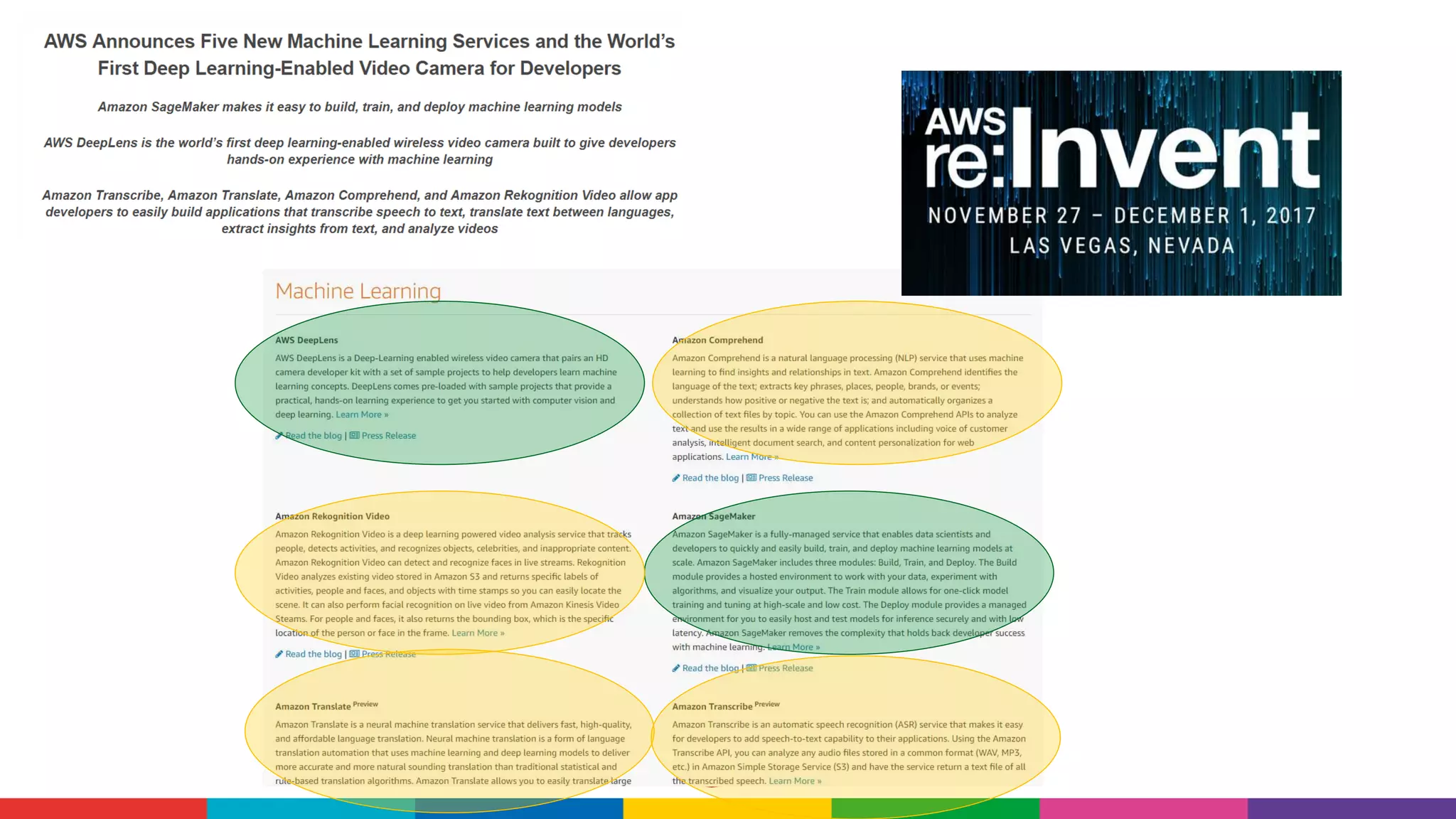
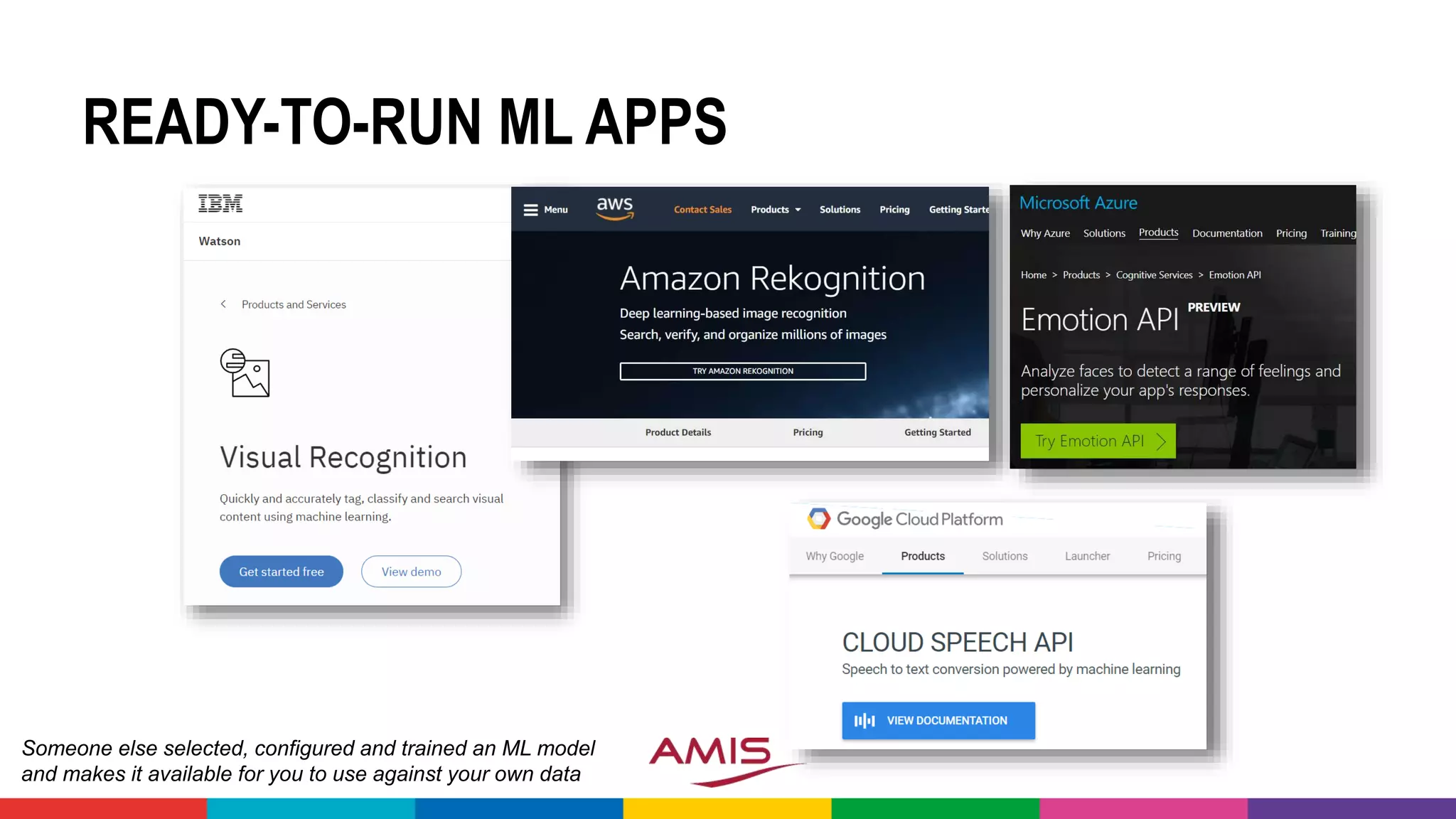
READY-TO-RUN ML APPS
Someone else selected, configured and trained an ML model
and makes it available for you to use against your own data
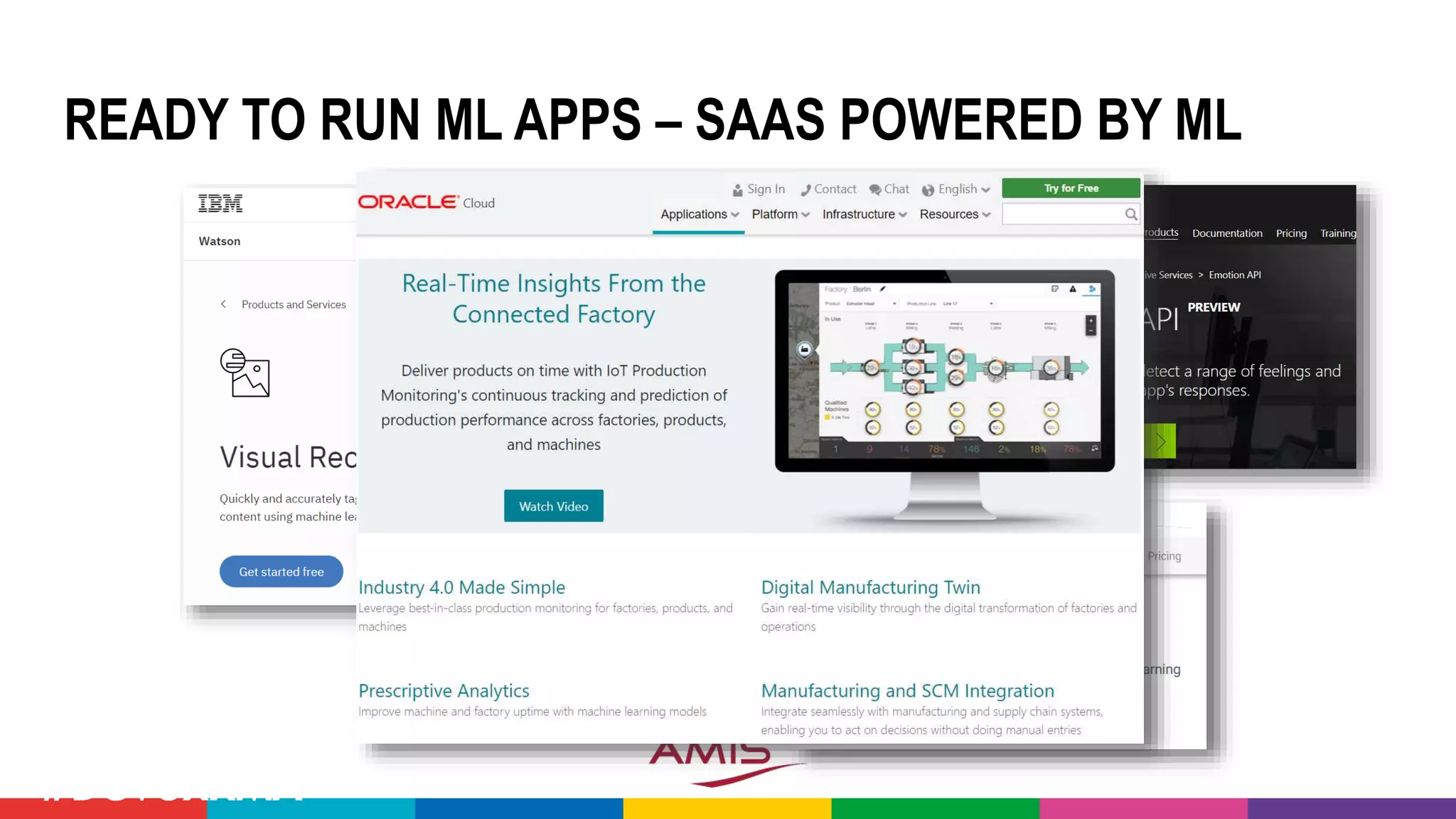
READY TO RUN ML APPS – SAAS POWERED BY ML
#DevoxxMA
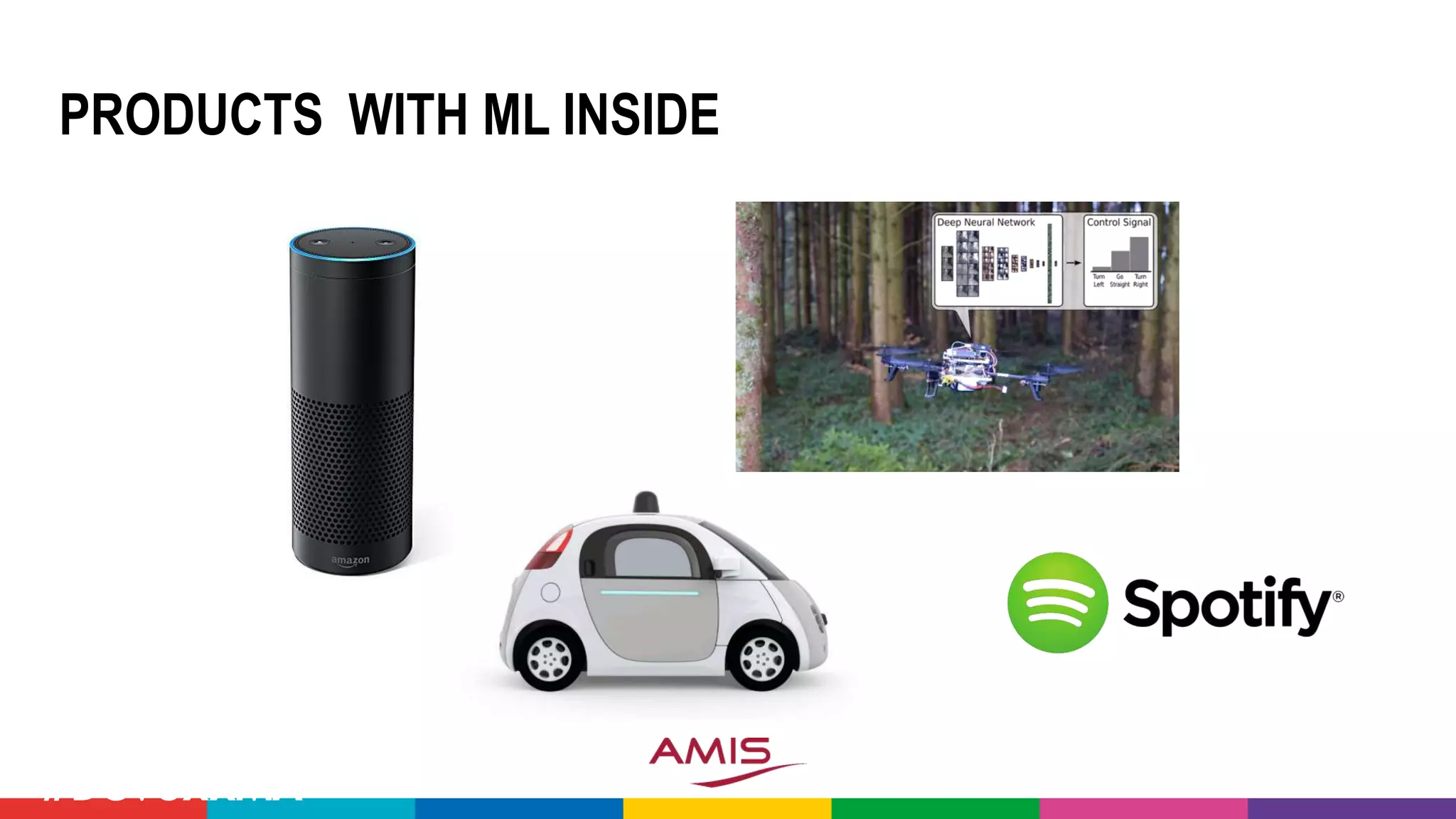
PRODUCTS WITH ML INSIDE
#DevoxxMA
Do It Yourself
Machine Learning
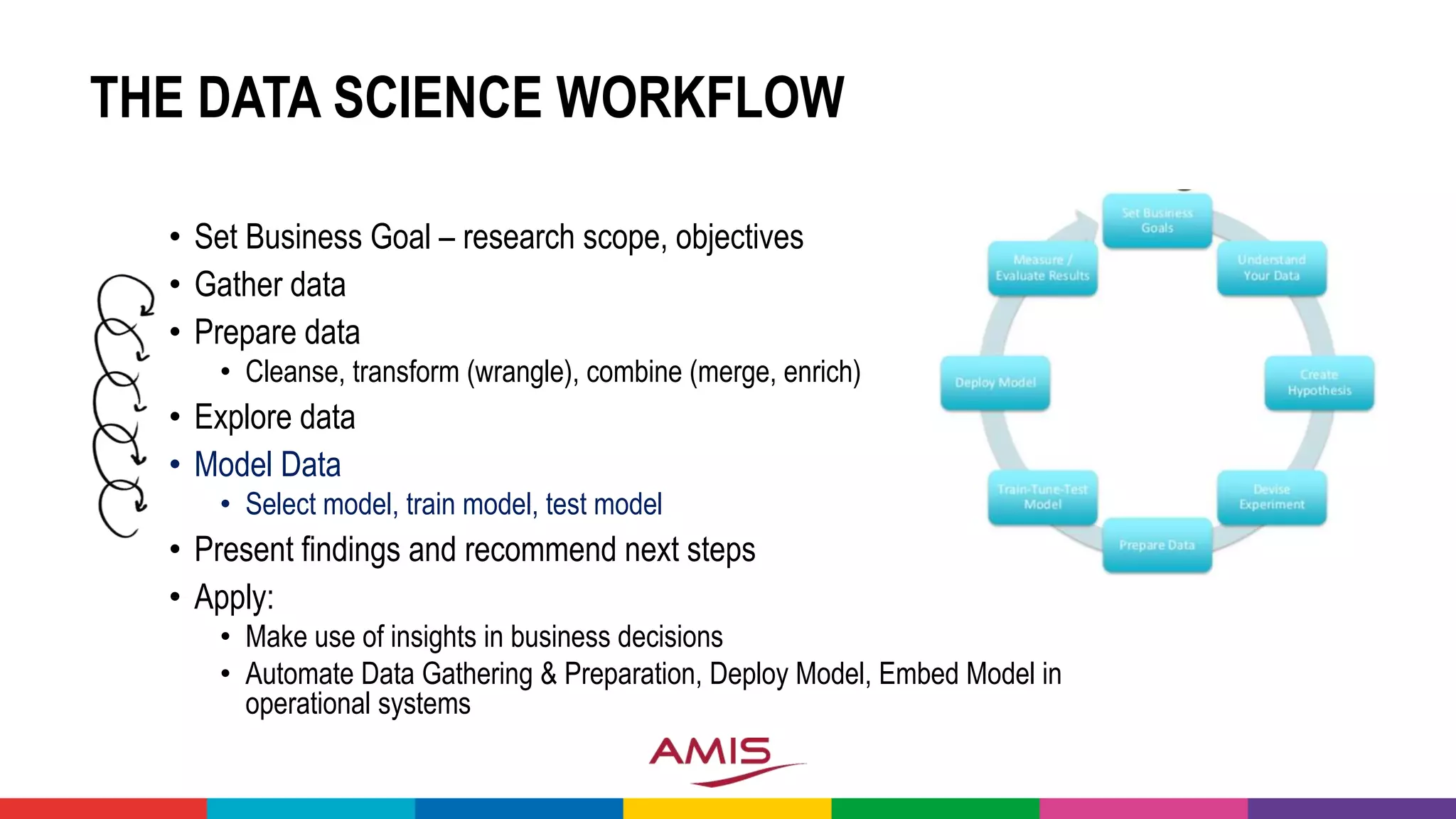
THE DATA SCIENCE WORKFLOW
• Set Business Goal – research scope, objectives
• Gather data
• Prepare data
• Cleanse, transform (wrangle), combine (merge, enrich)
• Explore data
• Model Data
• Select model, train model, test model
• Present findings and recommend next steps
• Apply:
• Make use of insights in business decisions
• Automate Data Gathering & Preparation, Deploy Model, Embed Model in
operational systems
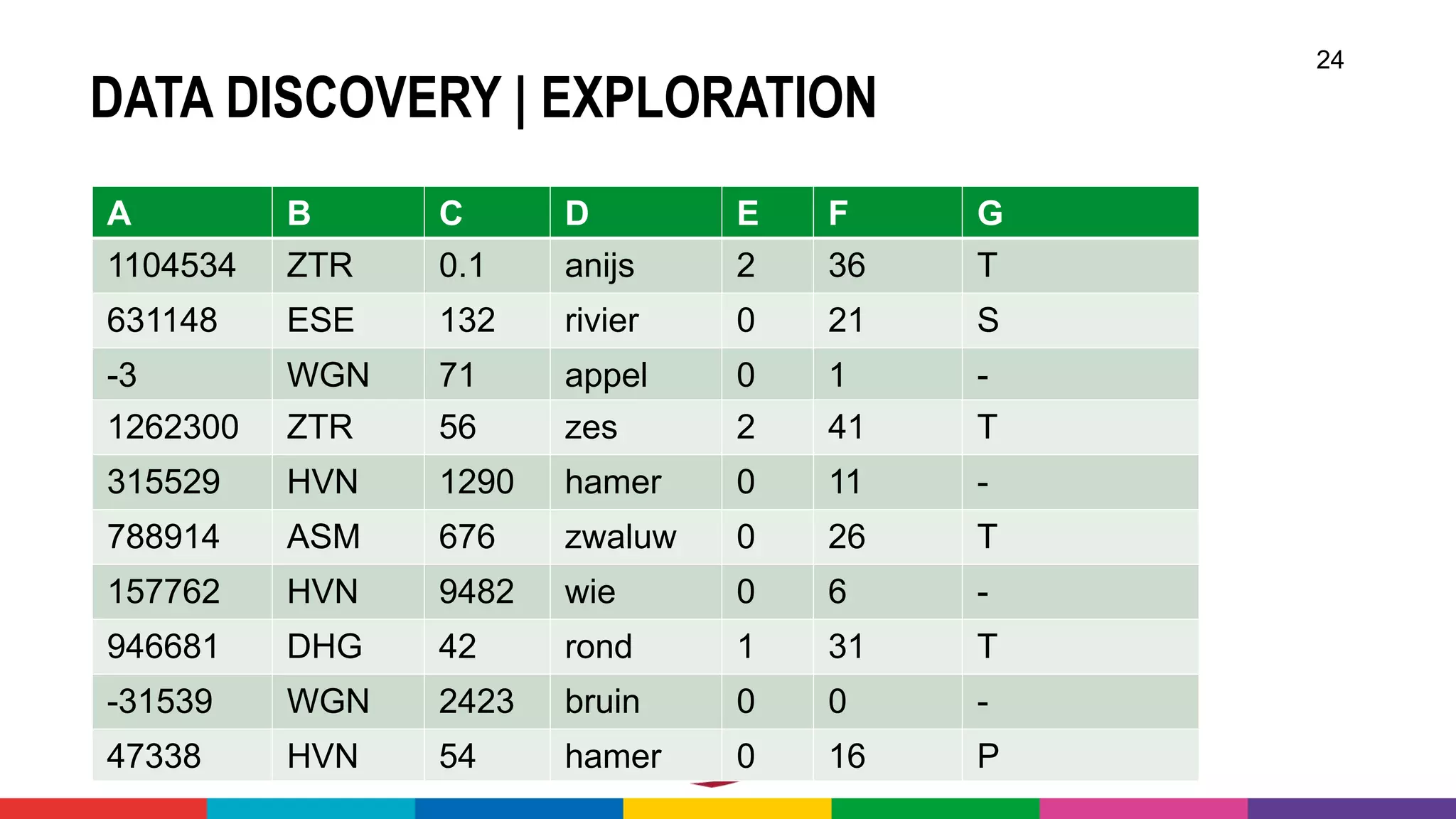
DATA DISCOVERY | EXPLORATION
24
A B C D E F G
1104534 ZTR 0.1 anijs 2 36 T
631148 ESE 132 rivier 0 21 S
-3 WGN 71 appel 0 1 -
1262300 ZTR 56 zes 2 41 T
315529 HVN 1290 hamer 0 11 -
788914 ASM 676 zwaluw 0 26 T
157762 HVN 9482 wie 0 6 -
946681 DHG 42 rond 1 31 T
-31539 WGN 2423 bruin 0 0 -
47338 HVN 54 hamer 0 16 P
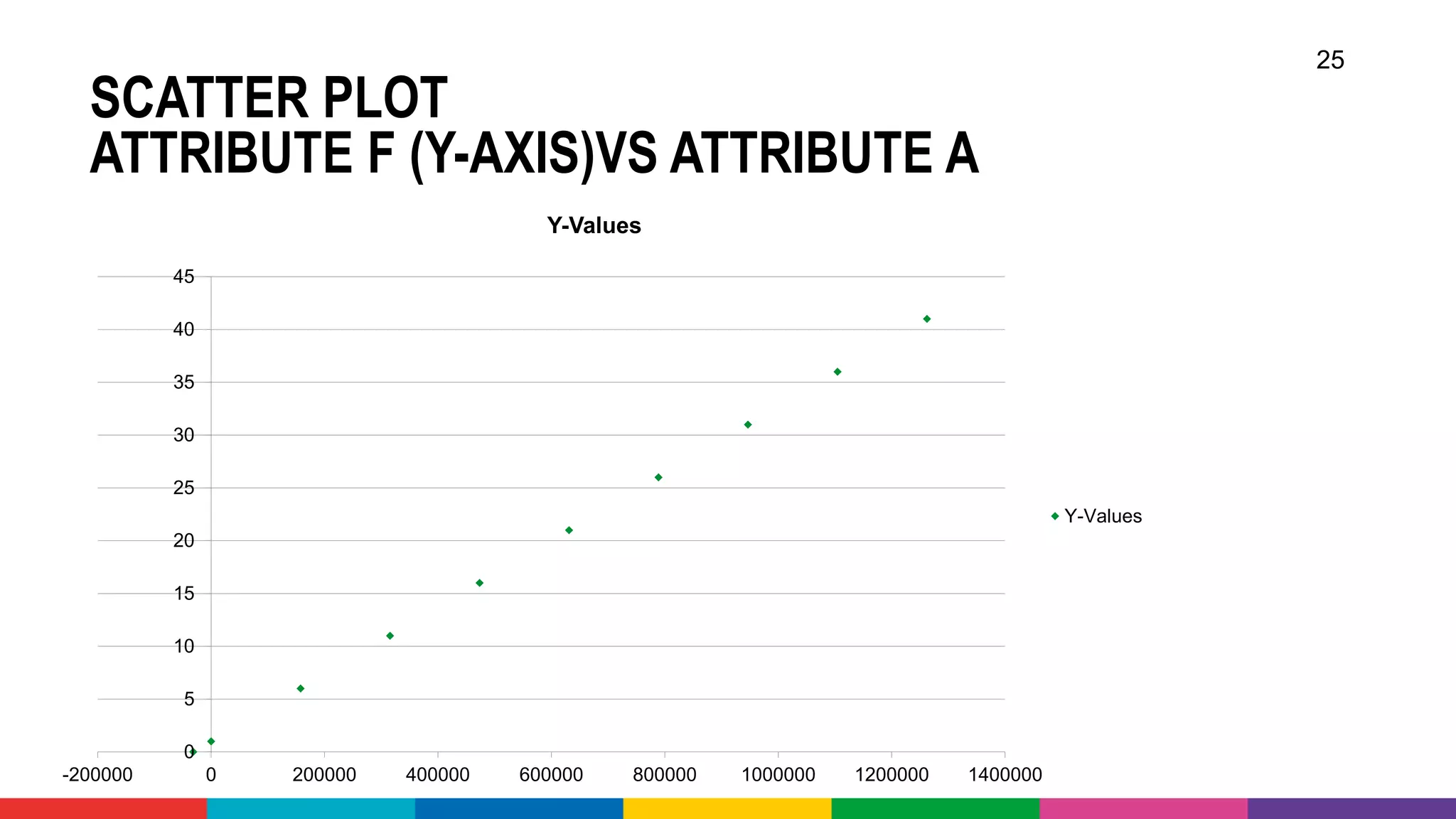
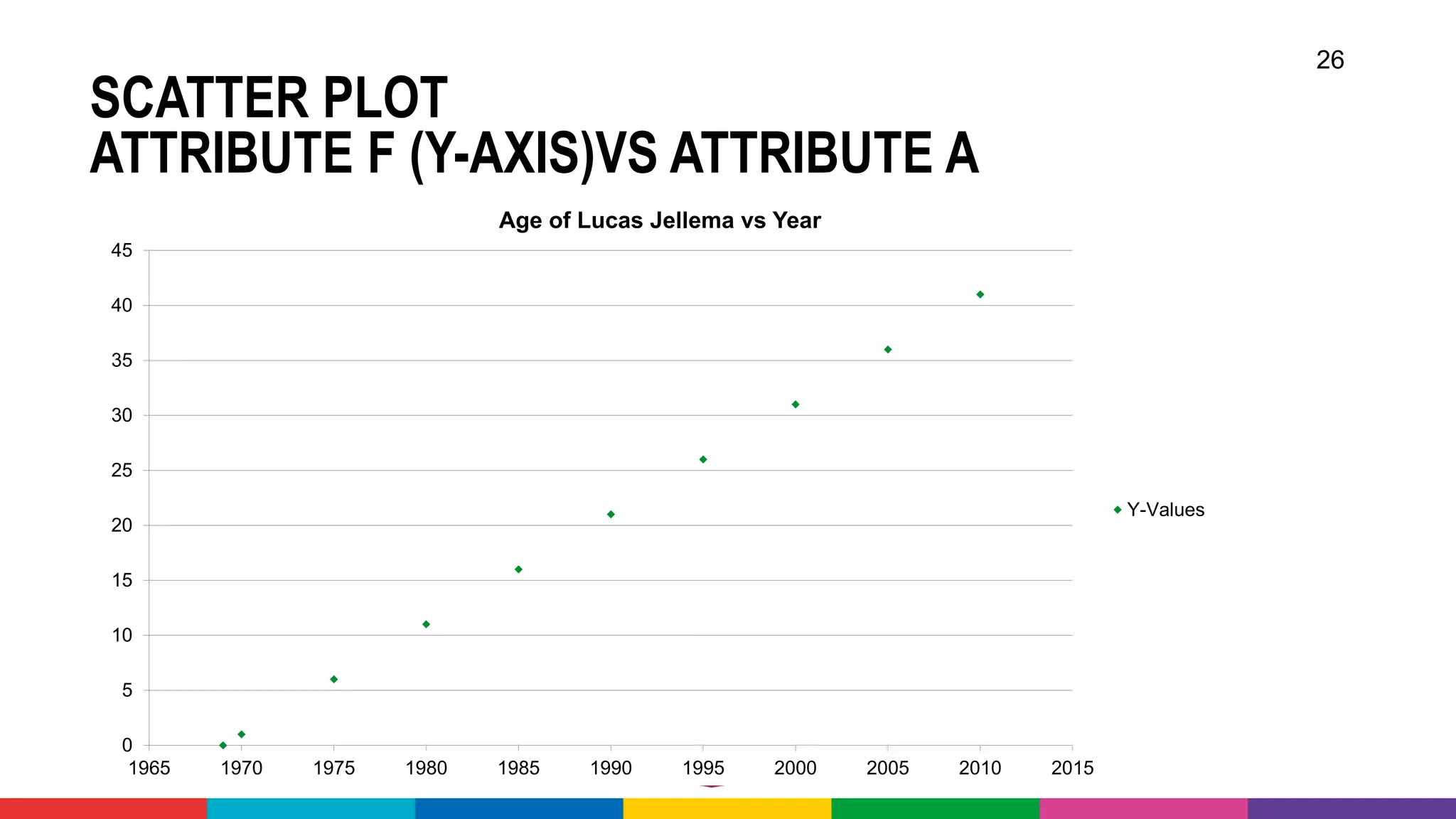
SCATTER PLOT
ATTRIBUTE F (Y-AXIS)VS ATTRIBUTE A
25
0
5
10
15
20
25
30
35
40
45
-200000 0 200000 400000 600000 800000 1000000 1200000 1400000
Y-Values
Y-Values
SCATTER PLOT
ATTRIBUTE F (Y-AXIS)VS ATTRIBUTE A
26
0
5
10
15
20
25
30
35
40
45
1965 1970 1975 1980 1985 1990 1995 2000 2005 2010 2015
Age of Lucas Jellema vs Year
Y-Values
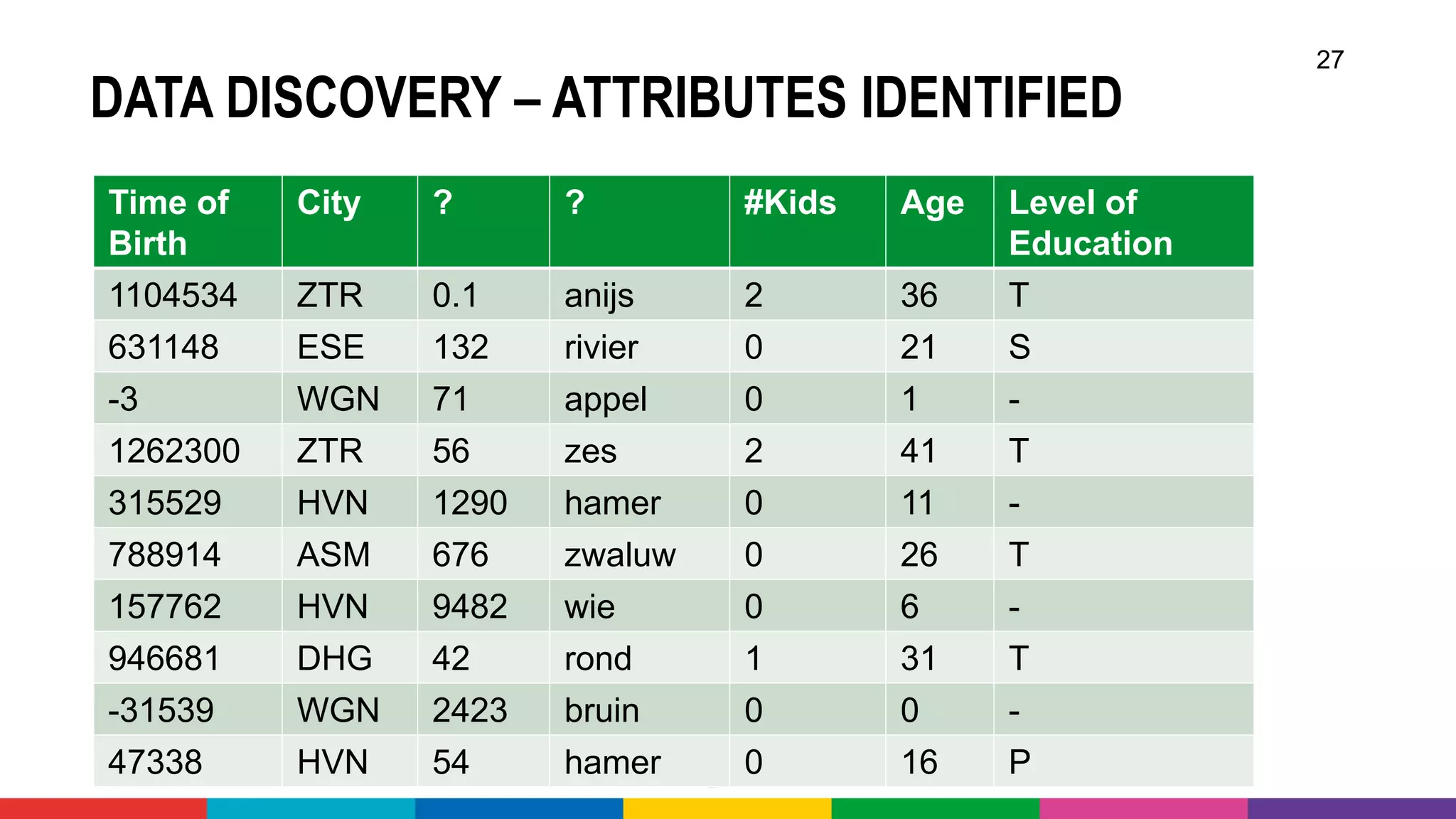
DATA DISCOVERY – ATTRIBUTES IDENTIFIED
27
Time of
Birth
City ? ? #Kids Age Level of
Education
1104534 ZTR 0.1 anijs 2 36 T
631148 ESE 132 rivier 0 21 S
-3 WGN 71 appel 0 1 -
1262300 ZTR 56 zes 2 41 T
315529 HVN 1290 hamer 0 11 -
788914 ASM 676 zwaluw 0 26 T
157762 HVN 9482 wie 0 6 -
946681 DHG 42 rond 1 31 T
-31539 WGN 2423 bruin 0 0 -
47338 HVN 54 hamer 0 16 P
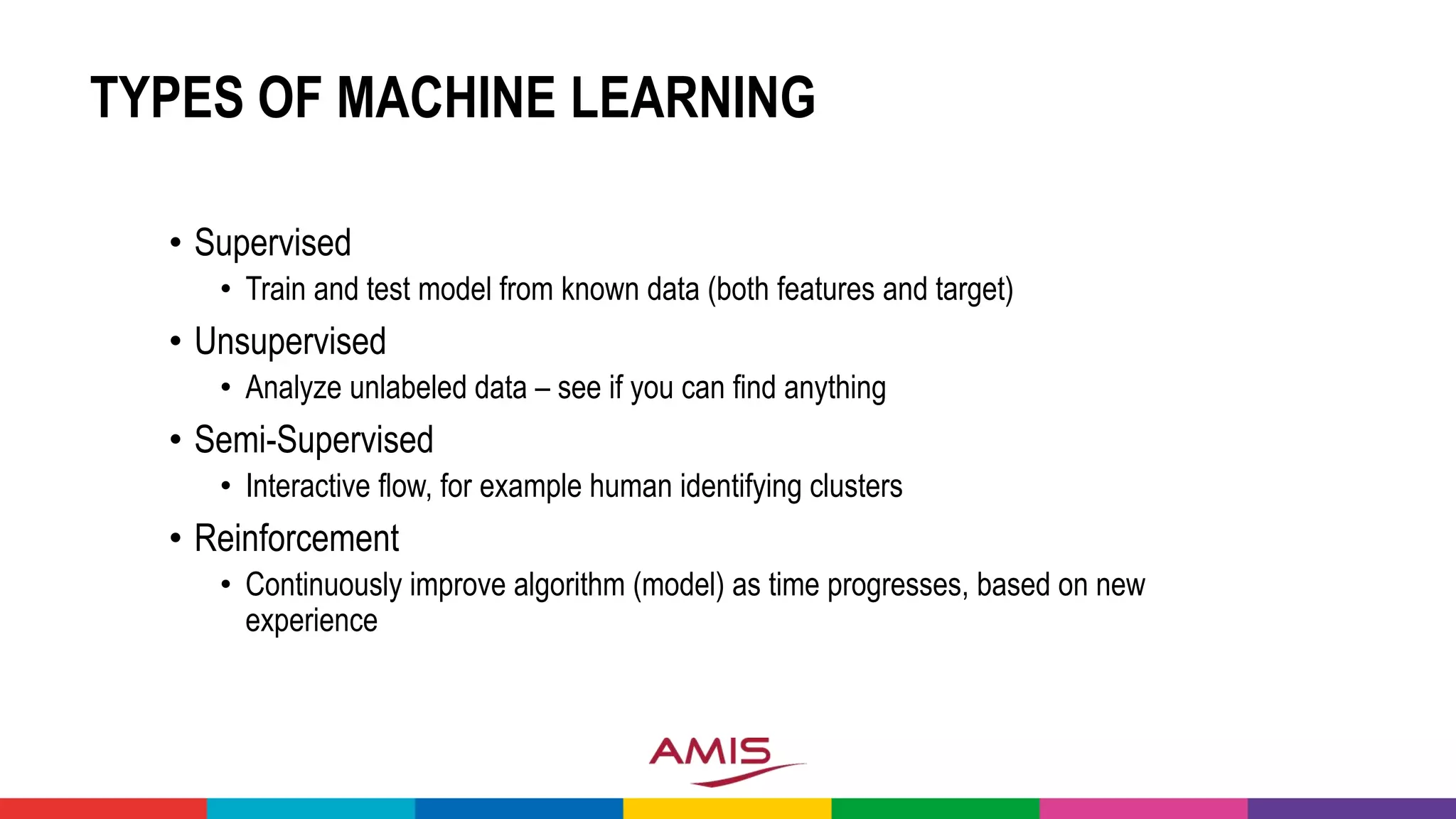
TYPES OF MACHINE LEARNING
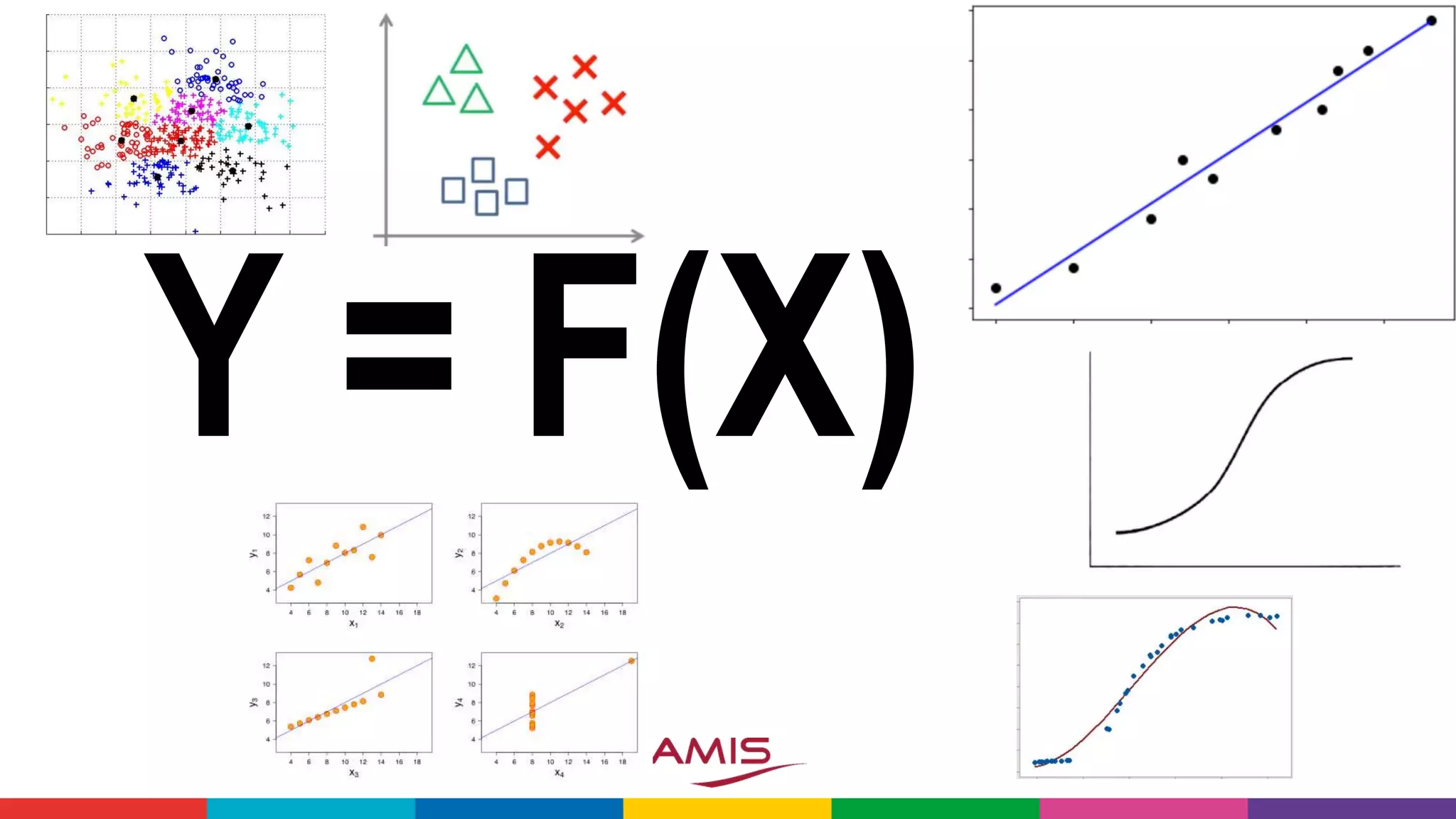
• Supervised
• Train and test model from known data (both features and target)
• Unsupervised
• Analyze unlabeled data – see if you can find anything
• Semi-Supervised
• Interactive flow, for example human identifying clusters
• Reinforcement
• Continuously improve algorithm (model) as time progresses, based on new
experience
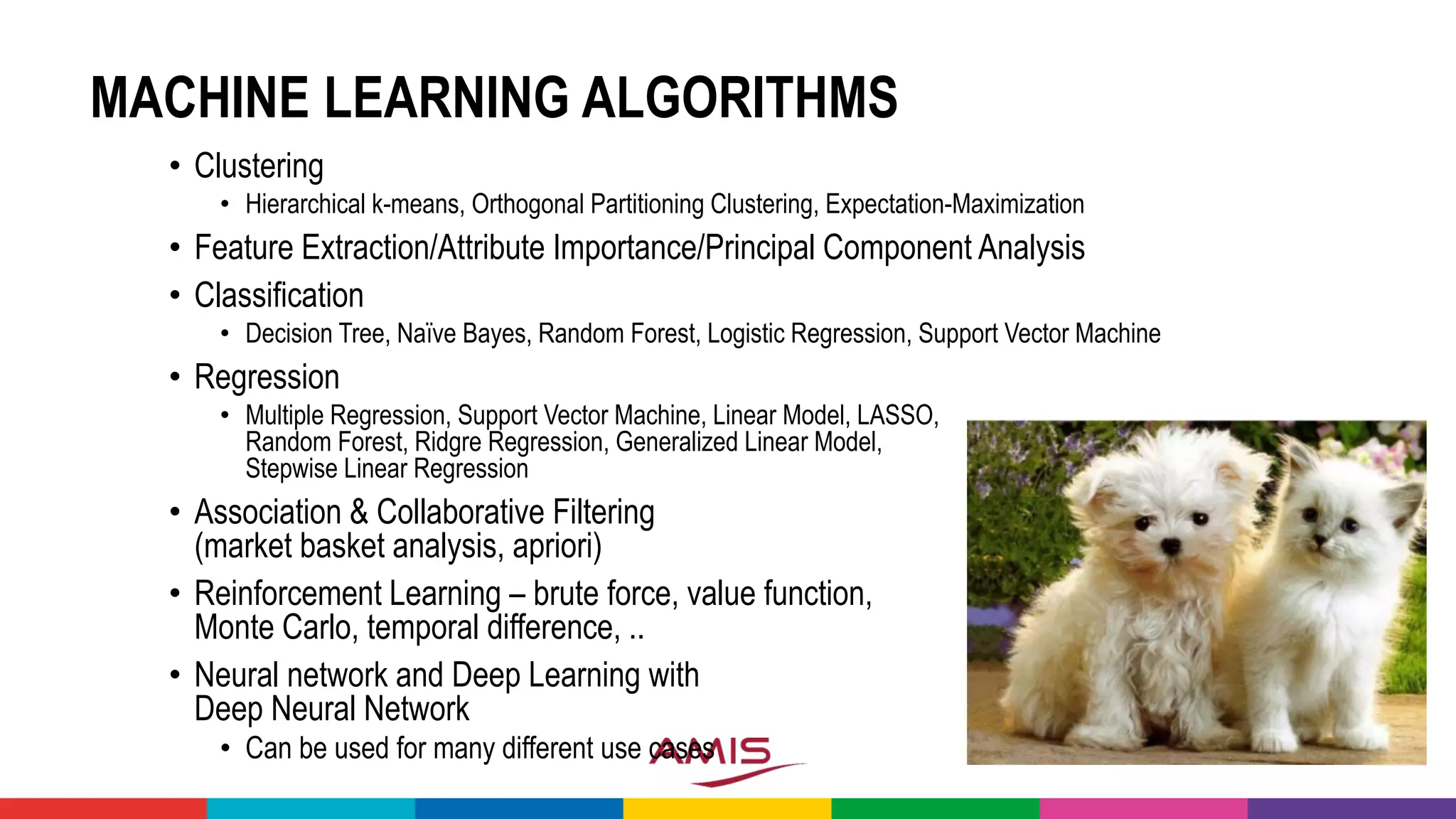
MACHINE LEARNING ALGORITHMS
• Clustering
• Hierarchical k-means, Orthogonal Partitioning Clustering, Expectation-Maximization
• Feature Extraction/Attribute Importance/Principal Component Analysis
• Classification
• Decision Tree, Naïve Bayes, Random Forest, Logistic Regression, Support Vector Machine
• Regression
• Multiple Regression, Support Vector Machine, Linear Model, LASSO,
Random Forest, Ridgre Regression, Generalized Linear Model,
Stepwise Linear Regression
• Association & Collaborative Filtering
(market basket analysis, apriori)
• Reinforcement Learning – brute force, value function,
Monte Carlo, temporal difference, ..
• Neural network and Deep Learning with
Deep Neural Network
• Can be used for many different use cases
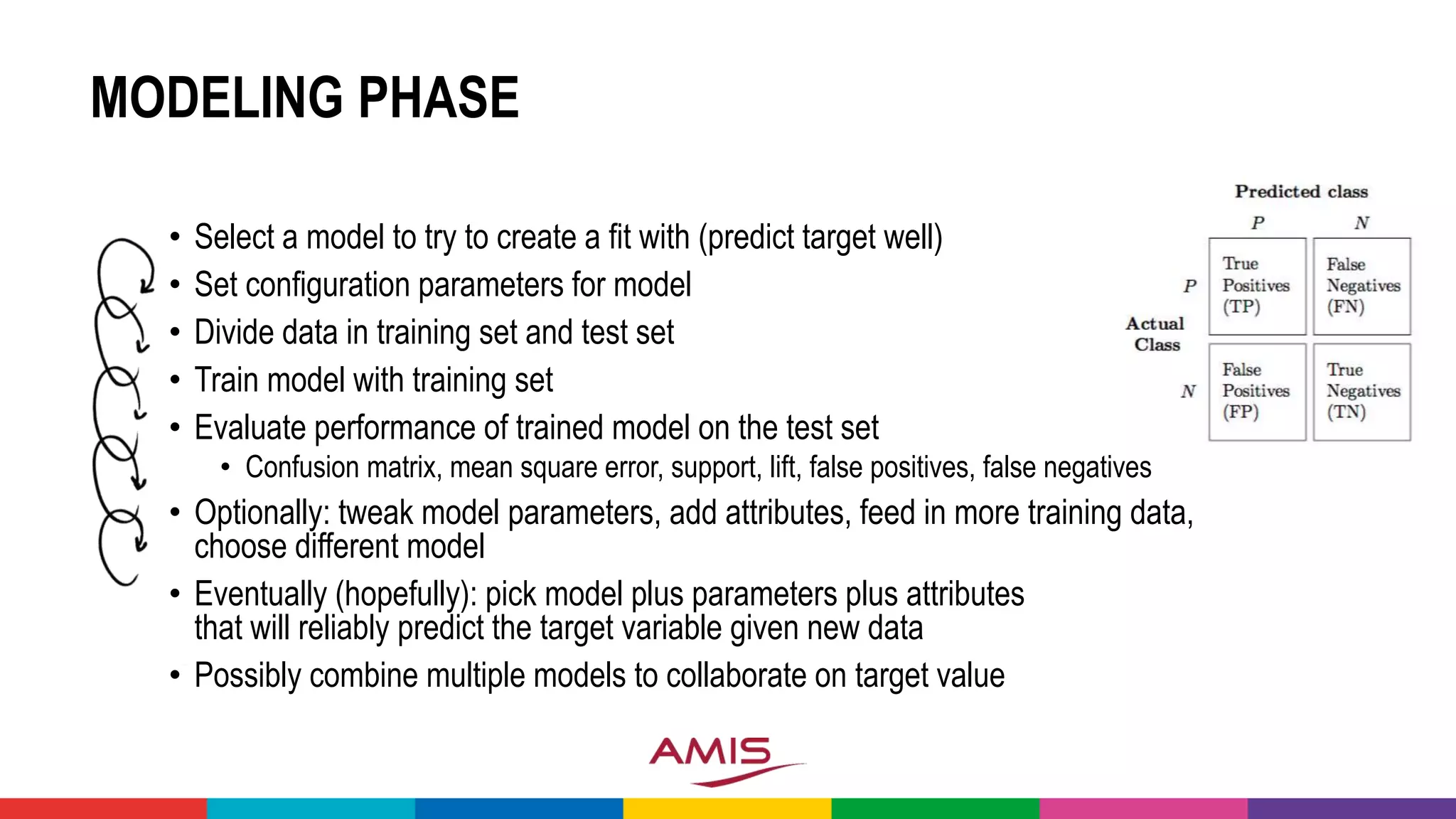
MODELING PHASE
• Select a model to try to create a fit with (predict target well)
• Set configuration parameters for model
• Divide data in training set and test set
• Train model with training set
• Evaluate performance of trained model on the test set
• Confusion matrix, mean square error, support, lift, false positives, false negatives
• Optionally: tweak model parameters, add attributes, feed in more training data,
choose different model
• Eventually (hopefully): pick model plus parameters plus attributes
that will reliably predict the target variable given new data
• Possibly combine multiple models to collaborate on target value
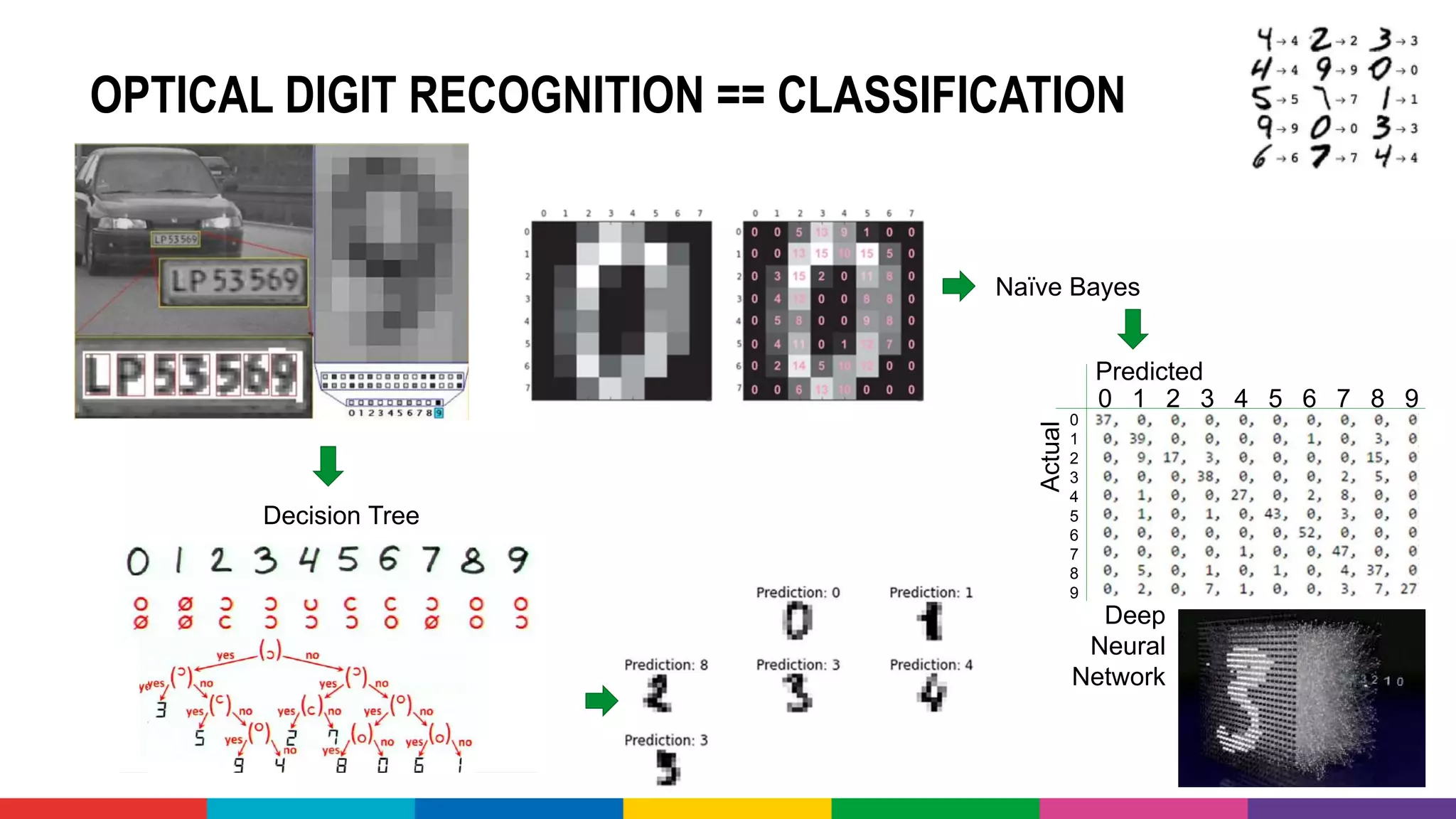
OPTICAL DIGIT RECOGNITION == CLASSIFICATION
Predicted
Actual
0 1 2 3 4 5 6 7 8 9
0
1
2
3
4
5
6
7
8
9
Naïve Bayes
Decision Tree
Deep
Neural
Network
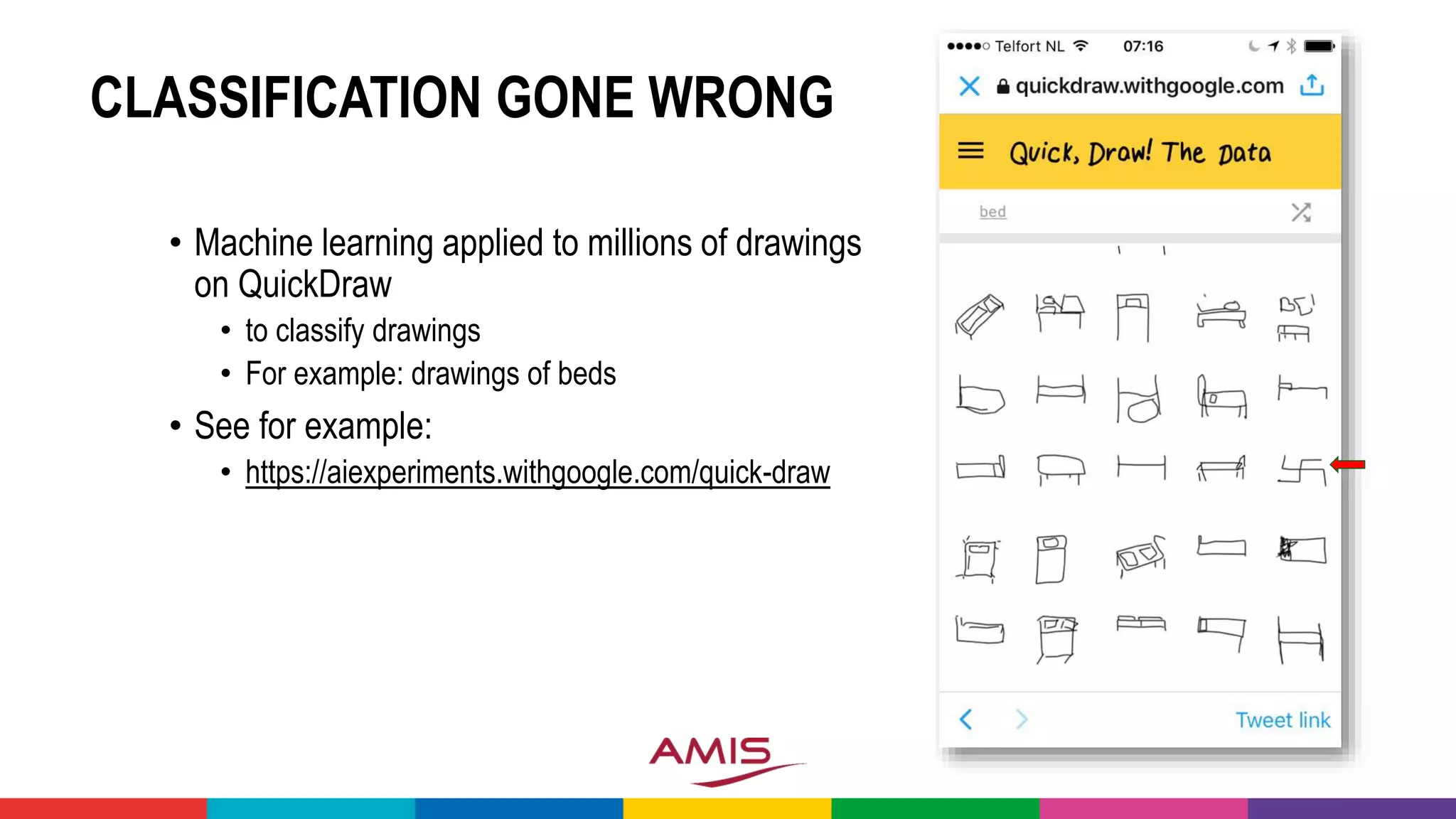
CLASSIFICATION GONE WRONG
• Machine learning applied to millions of drawings
on QuickDraw
• to classify drawings
• For example: drawings of beds
• See for example:
• https://aiexperiments.withgoogle.com/quick-draw
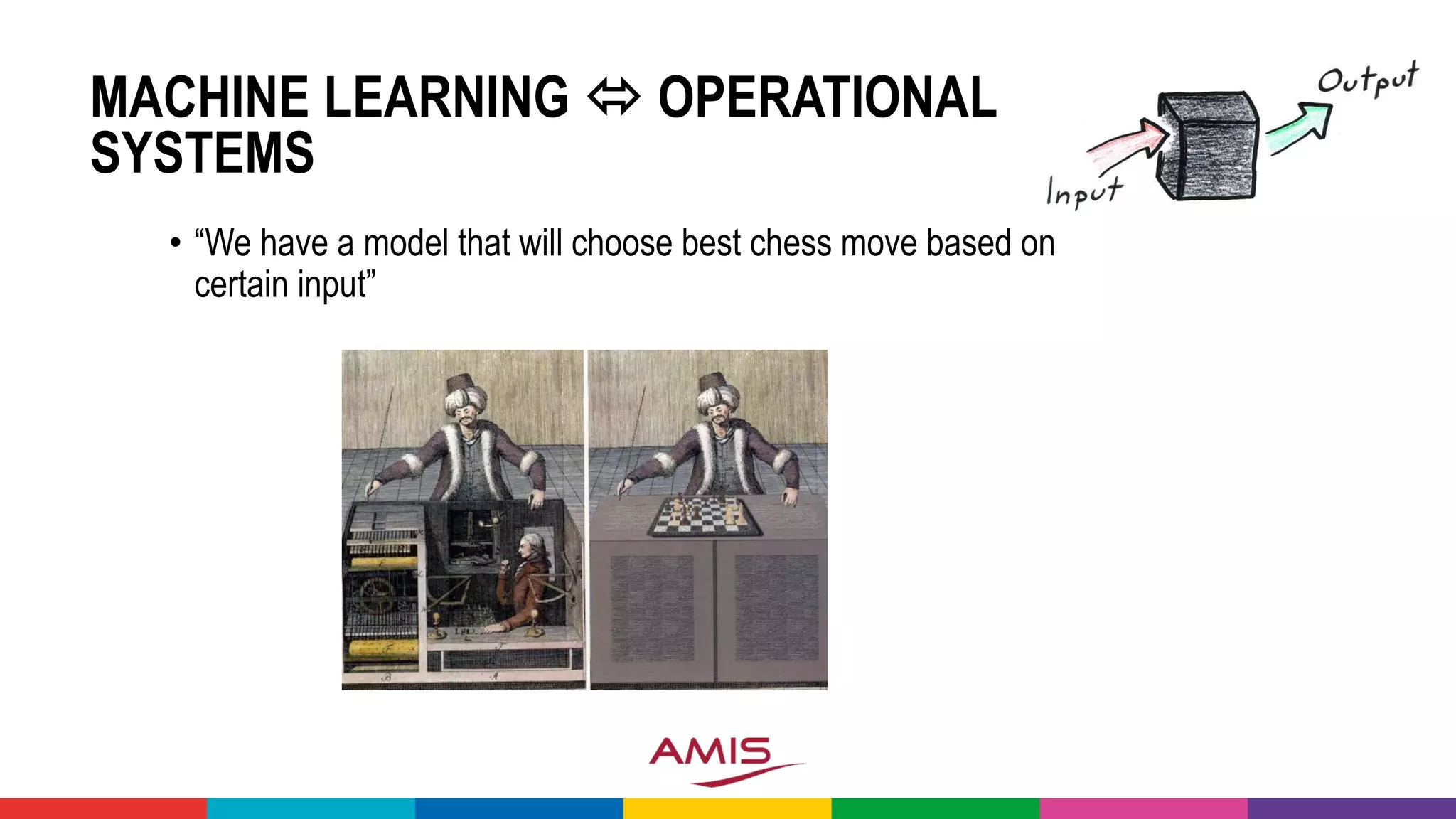
MACHINE LEARNING  OPERATIONAL
SYSTEMS
• “We have a model that will choose best chess move based on
certain input”
MACHINE LEARNING  OPERATIONAL
SYSTEMS
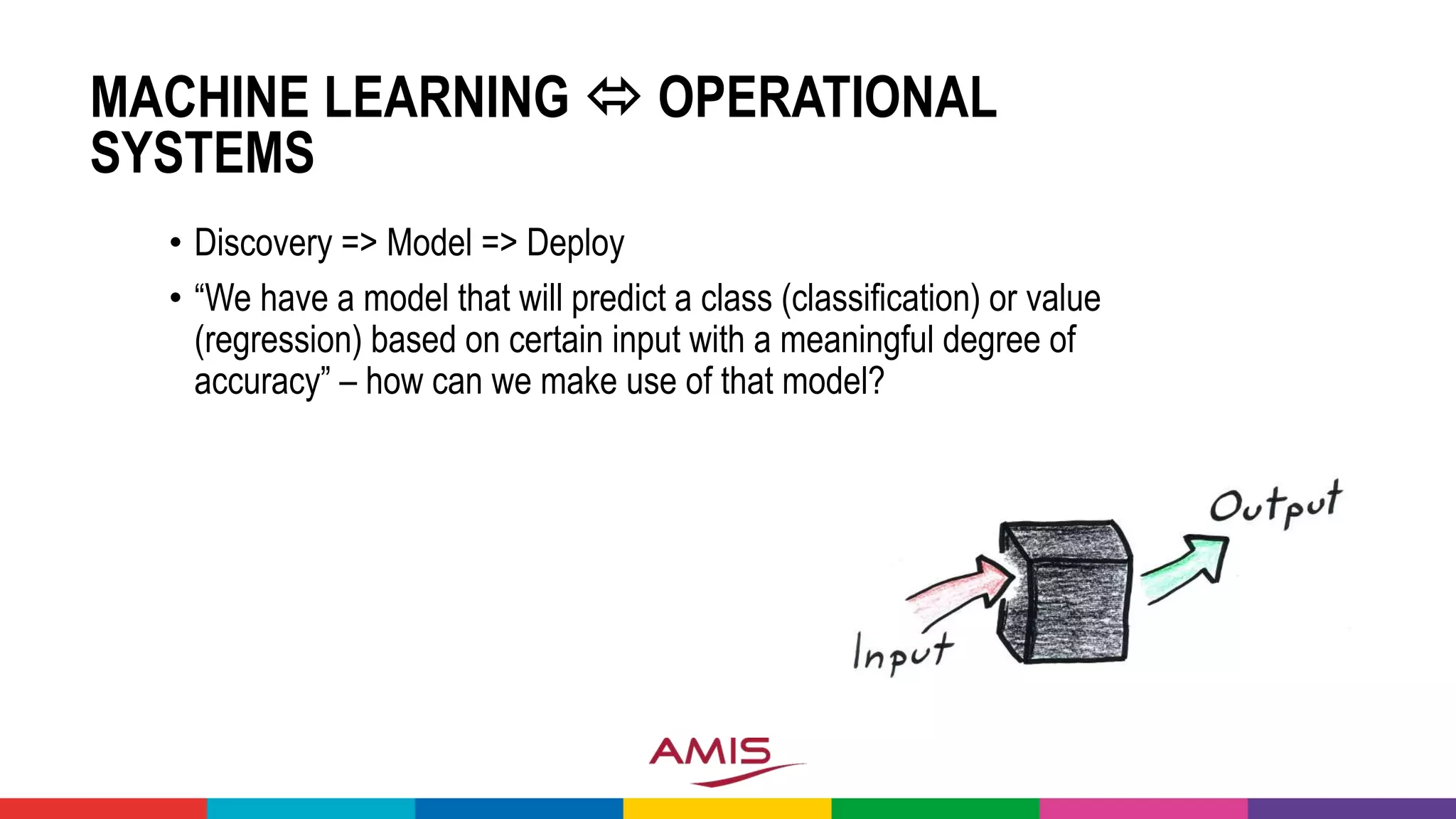
• Discovery => Model => Deploy
• “We have a model that will predict a class (classification) or value
(regression) based on certain input with a meaningful degree of
accuracy” – how can we make use of that model?
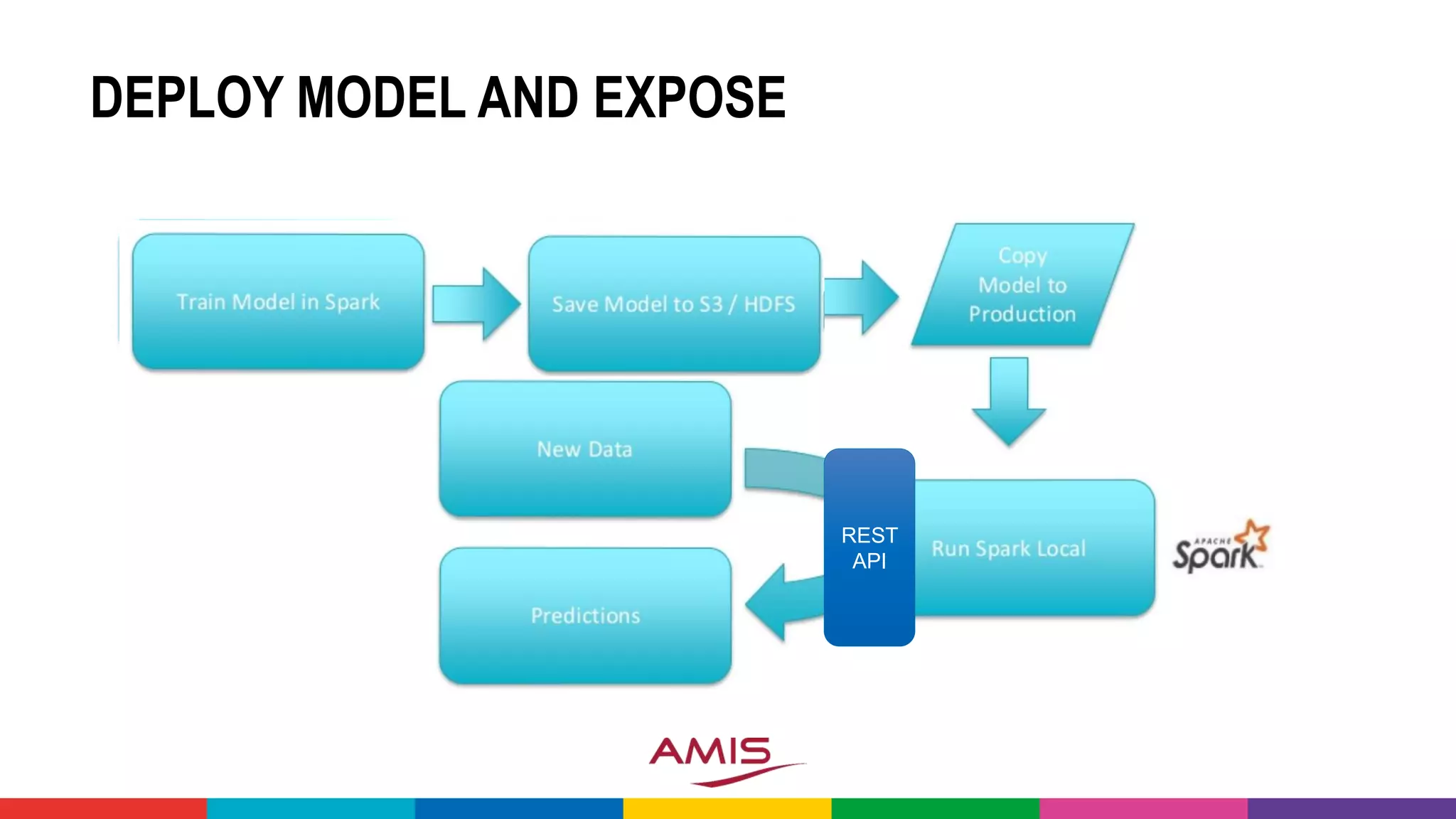
DEPLOY MODEL AND EXPOSE
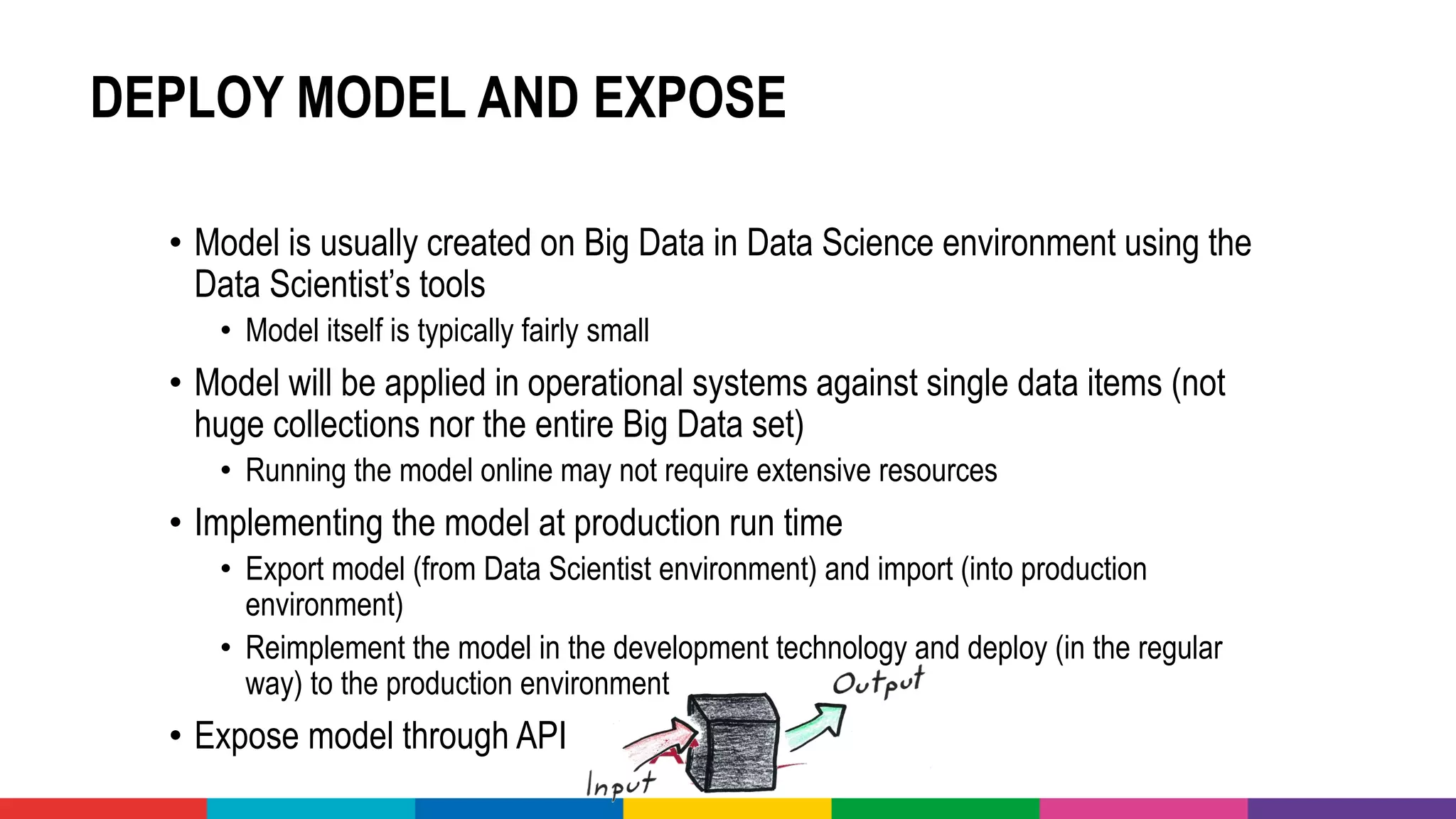
• Model is usually created on Big Data in Data Science environment using the
Data Scientist’s tools
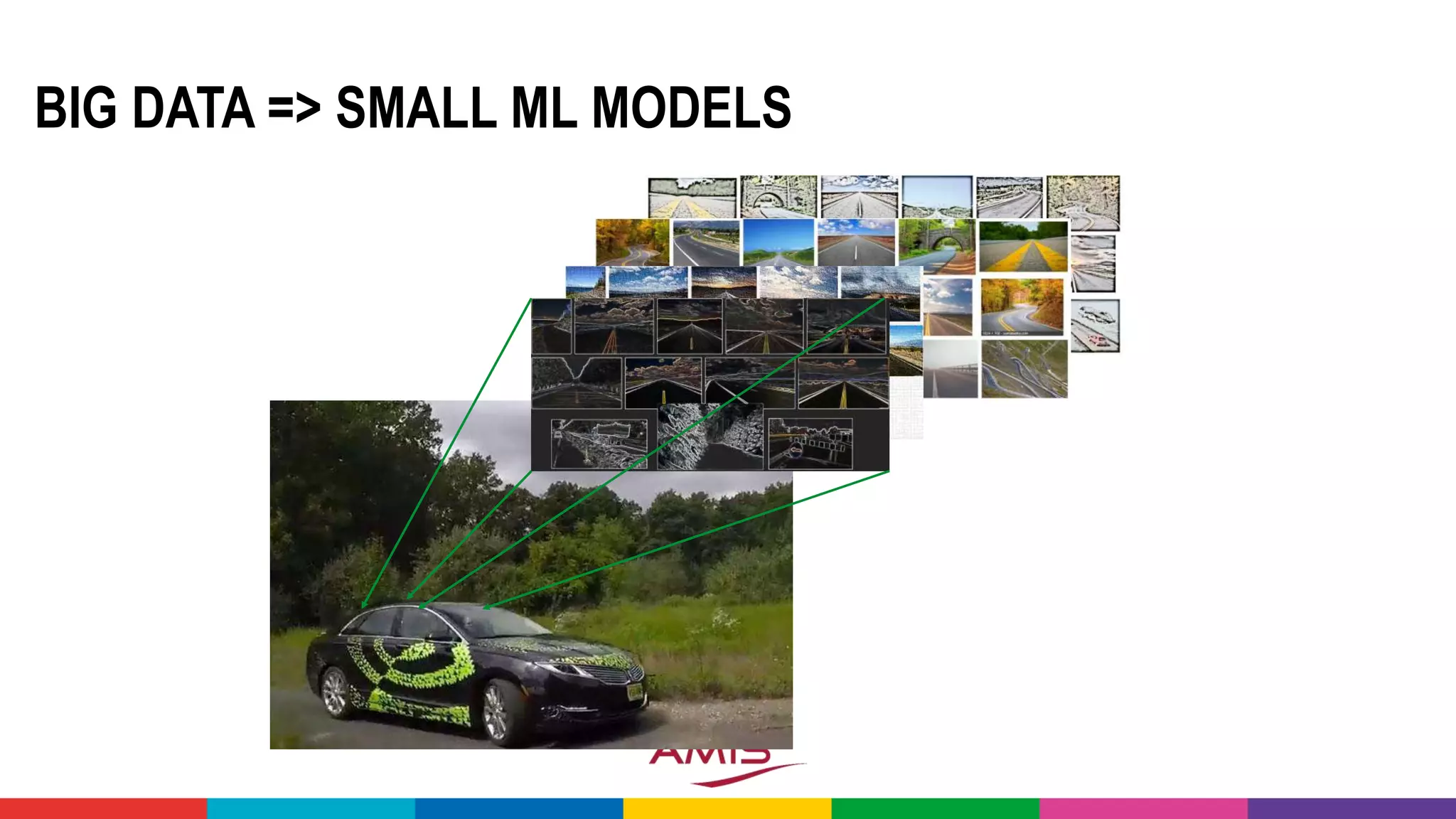
• Model itself is typically fairly small
• Model will be applied in operational systems against single data items (not
huge collections nor the entire Big Data set)
• Running the model online may not require extensive resources
• Implementing the model at production run time
• Export model (from Data Scientist environment) and import (into production
environment)
• Reimplement the model in the development technology and deploy (in the regular
way) to the production environment
• Expose model through API
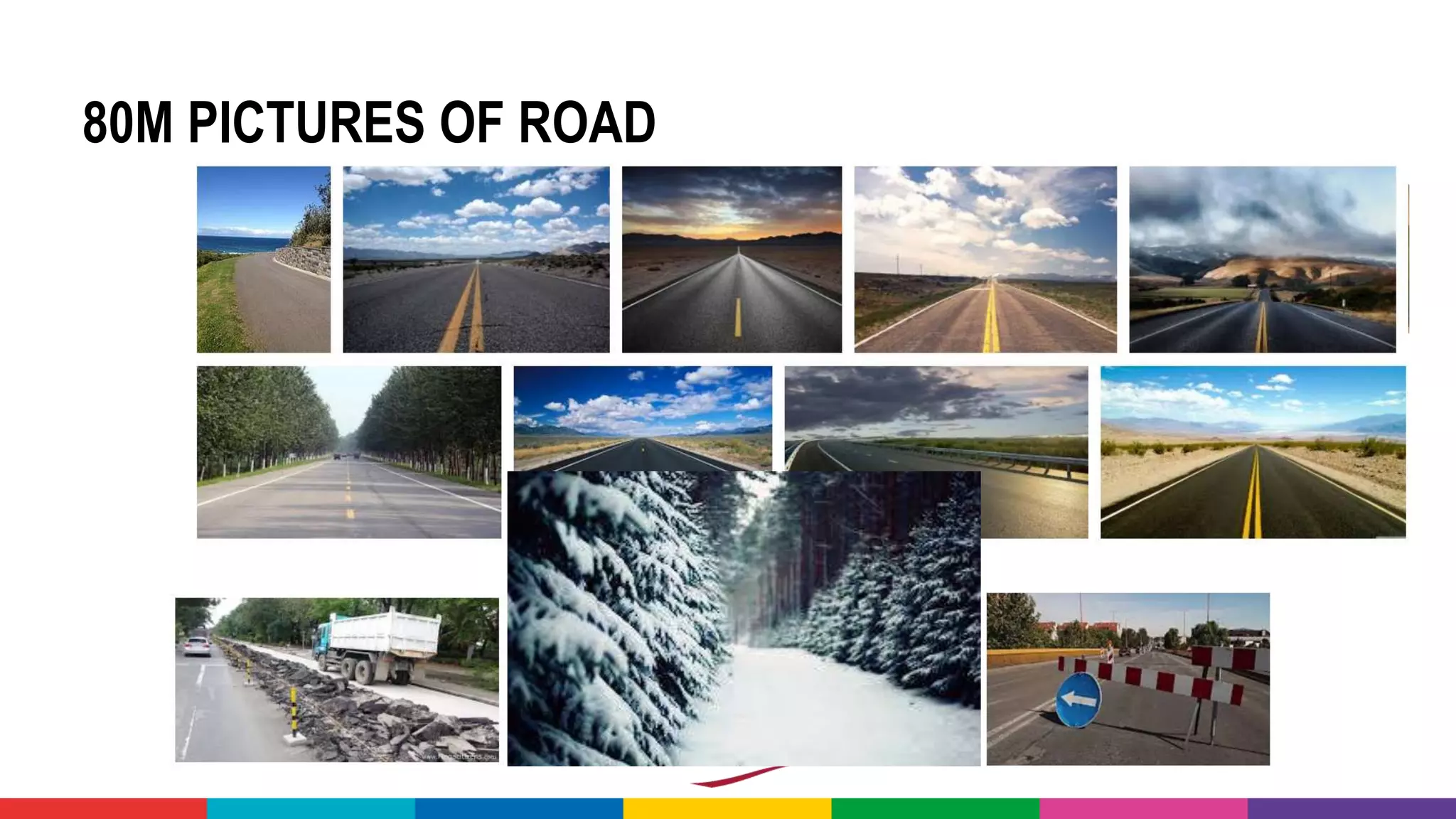
80M PICTURES OF ROAD
BIG DATA => SMALL ML MODELS
DEPLOY MODEL AND EXPOSE
REST
API
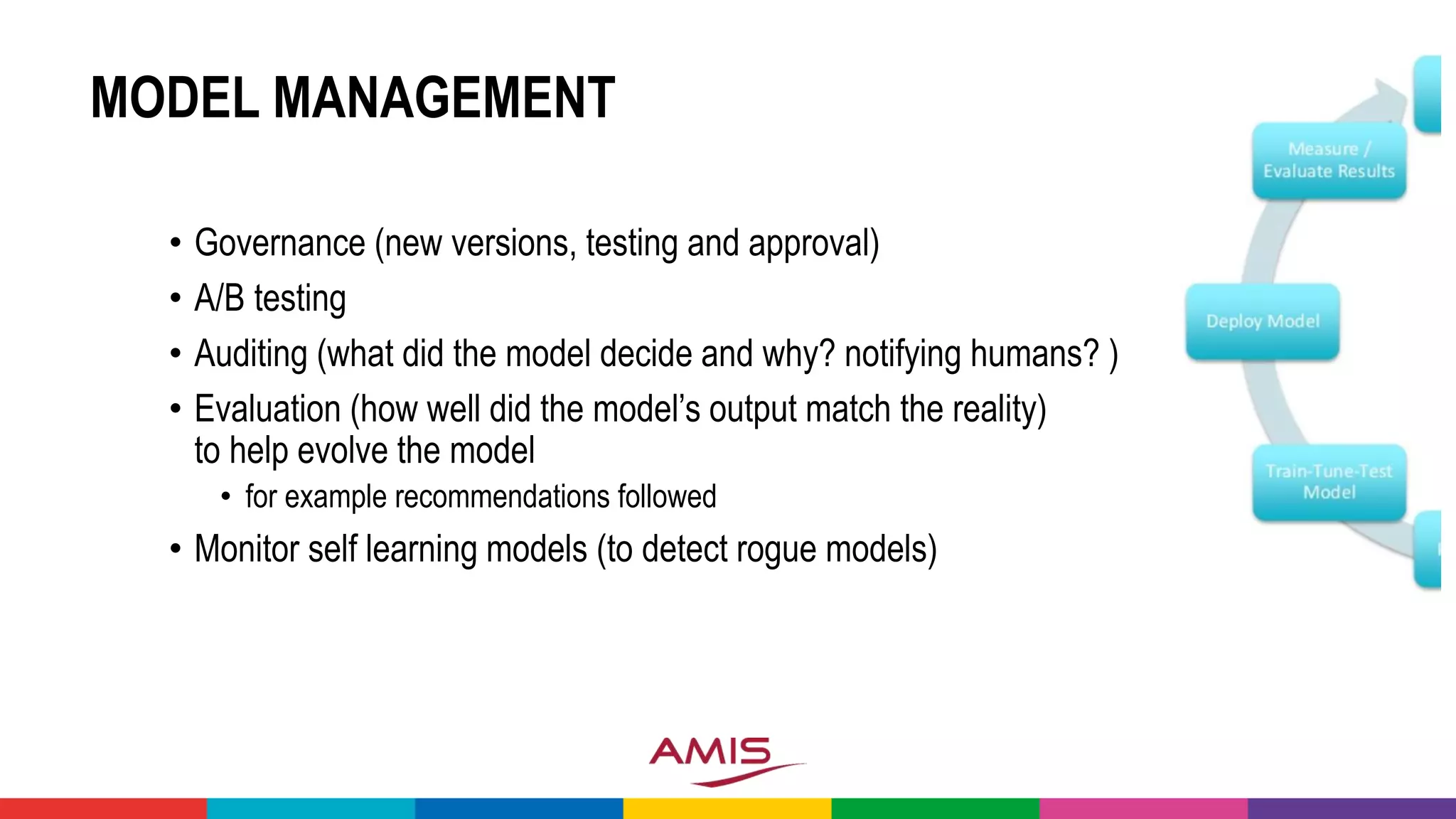
MODEL MANAGEMENT
• Governance (new versions, testing and approval)
• A/B testing
• Auditing (what did the model decide and why? notifying humans? )
• Evaluation (how well did the model’s output match the reality)
to help evolve the model
• for example recommendations followed
• Monitor self learning models (to detect rogue models)
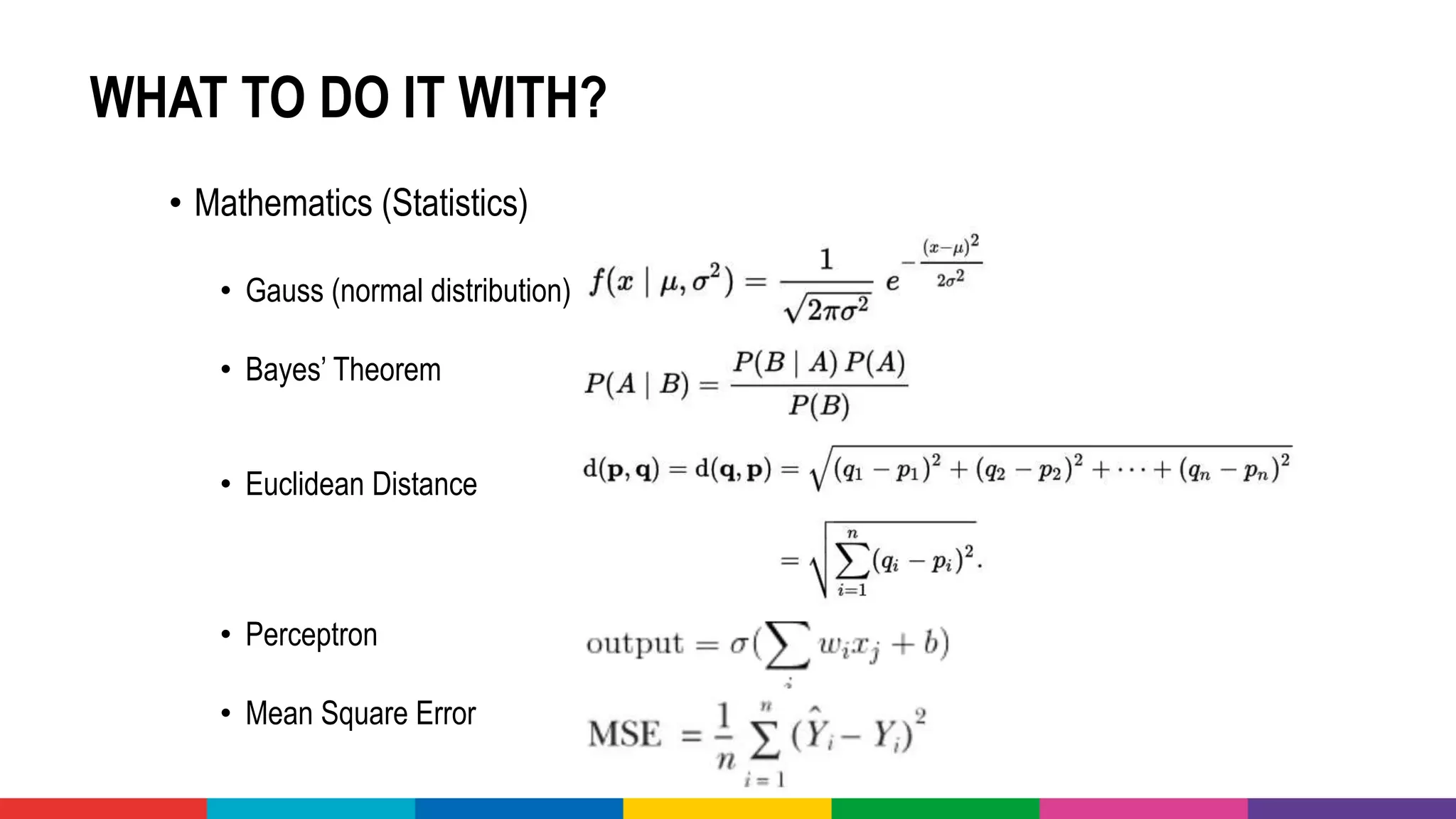
WHAT TO DO IT WITH?
• Mathematics (Statistics)
• Gauss (normal distribution)
• Bayes’ Theorem
• Euclidean Distance
• Perceptron
• Mean Square Error
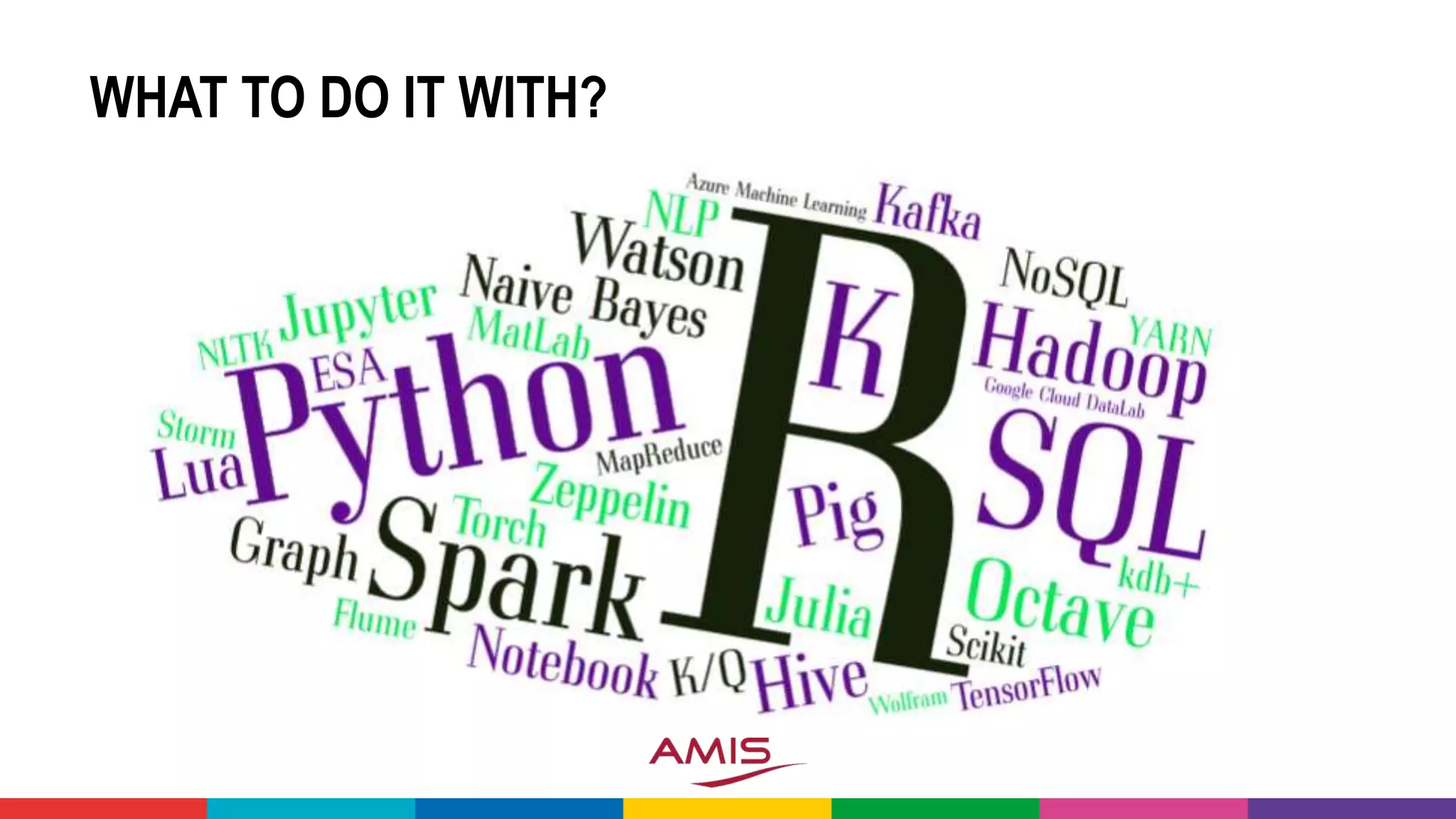
WHAT TO DO IT WITH?
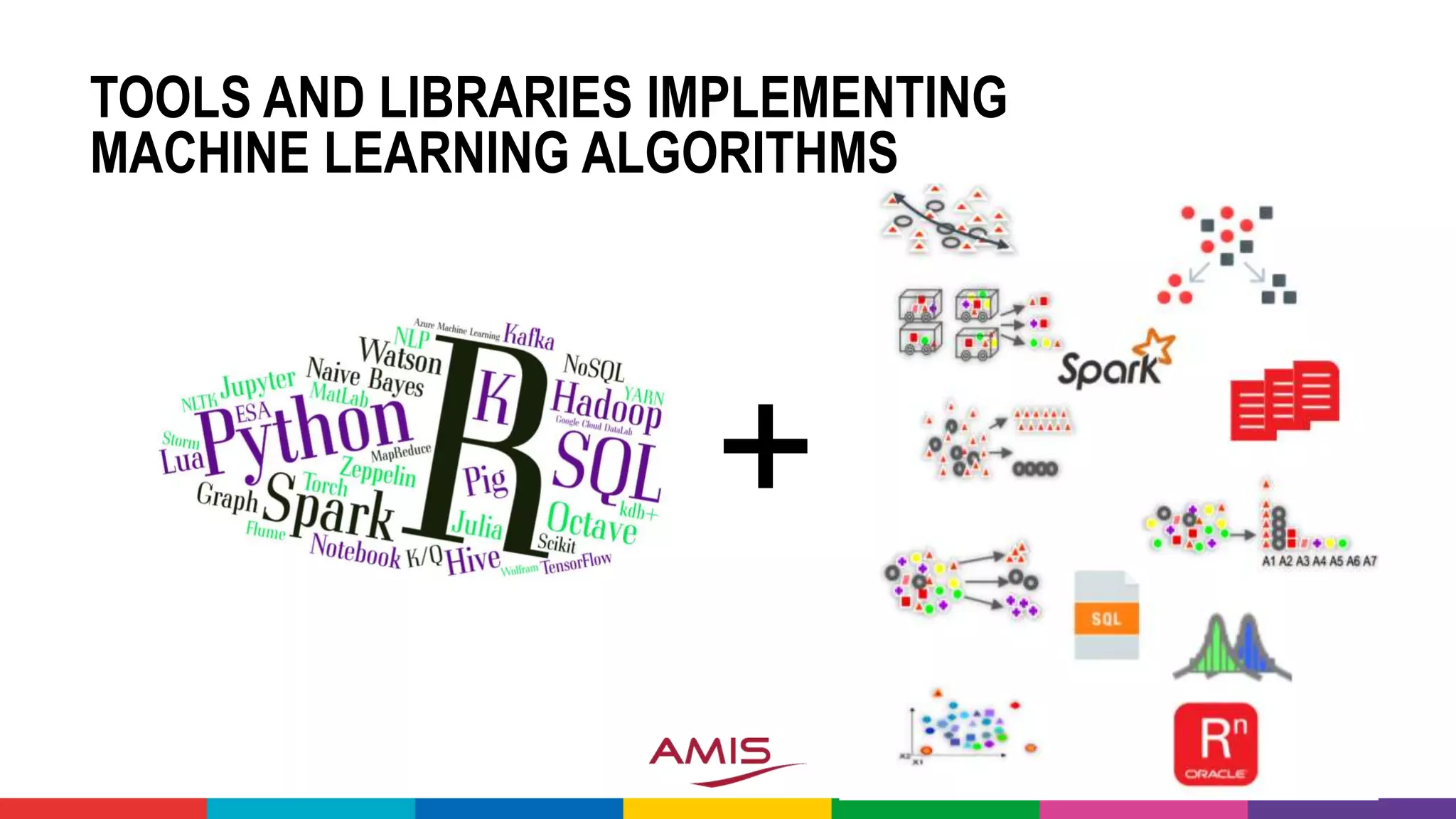
TOOLS AND LIBRARIES IMPLEMENTING
MACHINE LEARNING ALGORITHMS
+
AND OF COURSE
DATA
DATA
HOW TO PICK TOOLS FOR THE JOB
• What are the jobs?
• Gather data
• Prepare data
• Explore and (hopefully) Discover
• Present
• Embed & Deploy Model
• What are considerations?
• Volume
• Speed and Time
• Skills
• Platform
• Cost
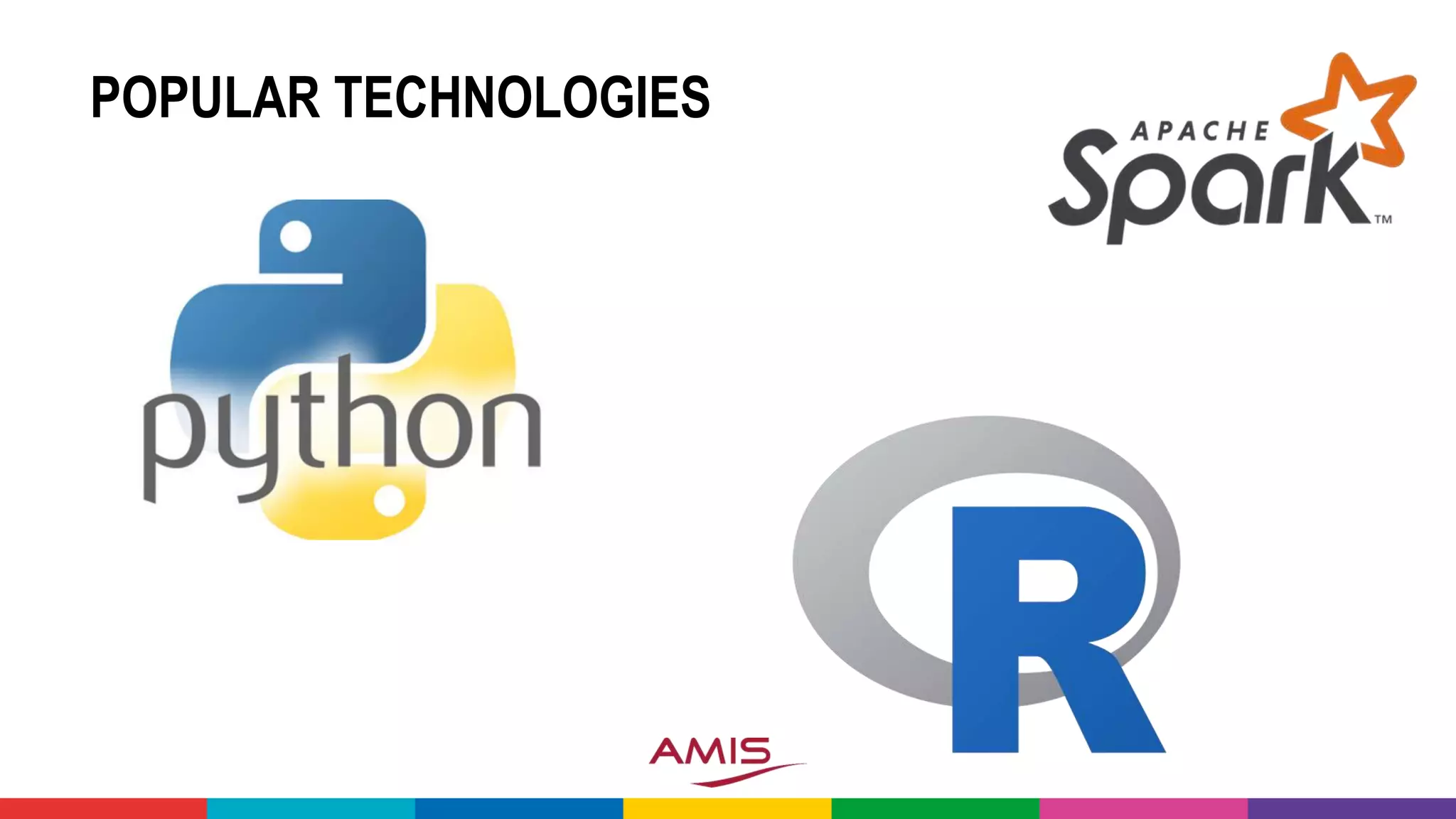
POPULAR TECHNOLOGIES
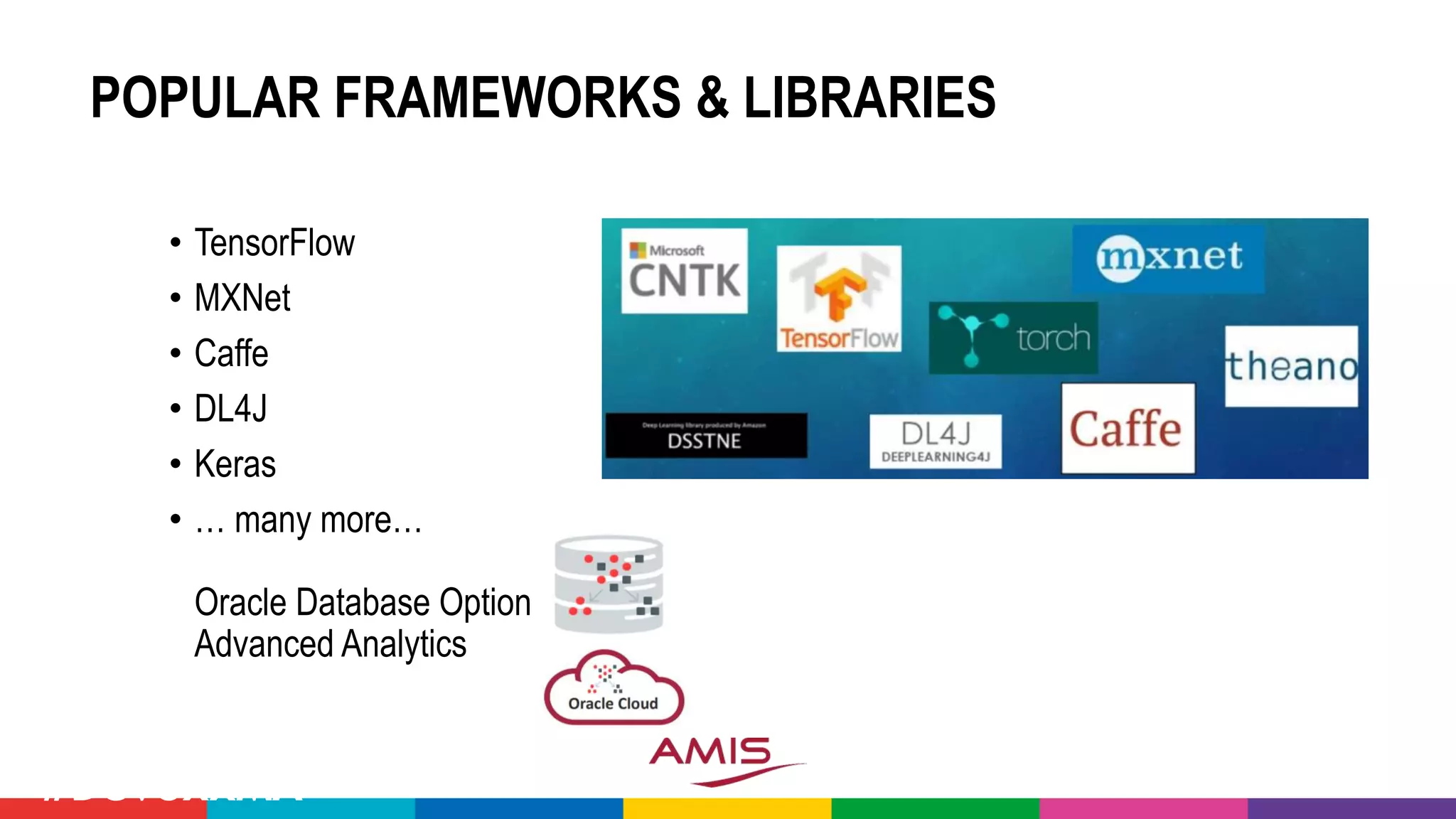
POPULAR FRAMEWORKS & LIBRARIES
• TensorFlow
• MXNet
• Caffe
• DL4J
• Keras
• … many more…
Oracle Database Option
Advanced Analytics
#DevoxxMA
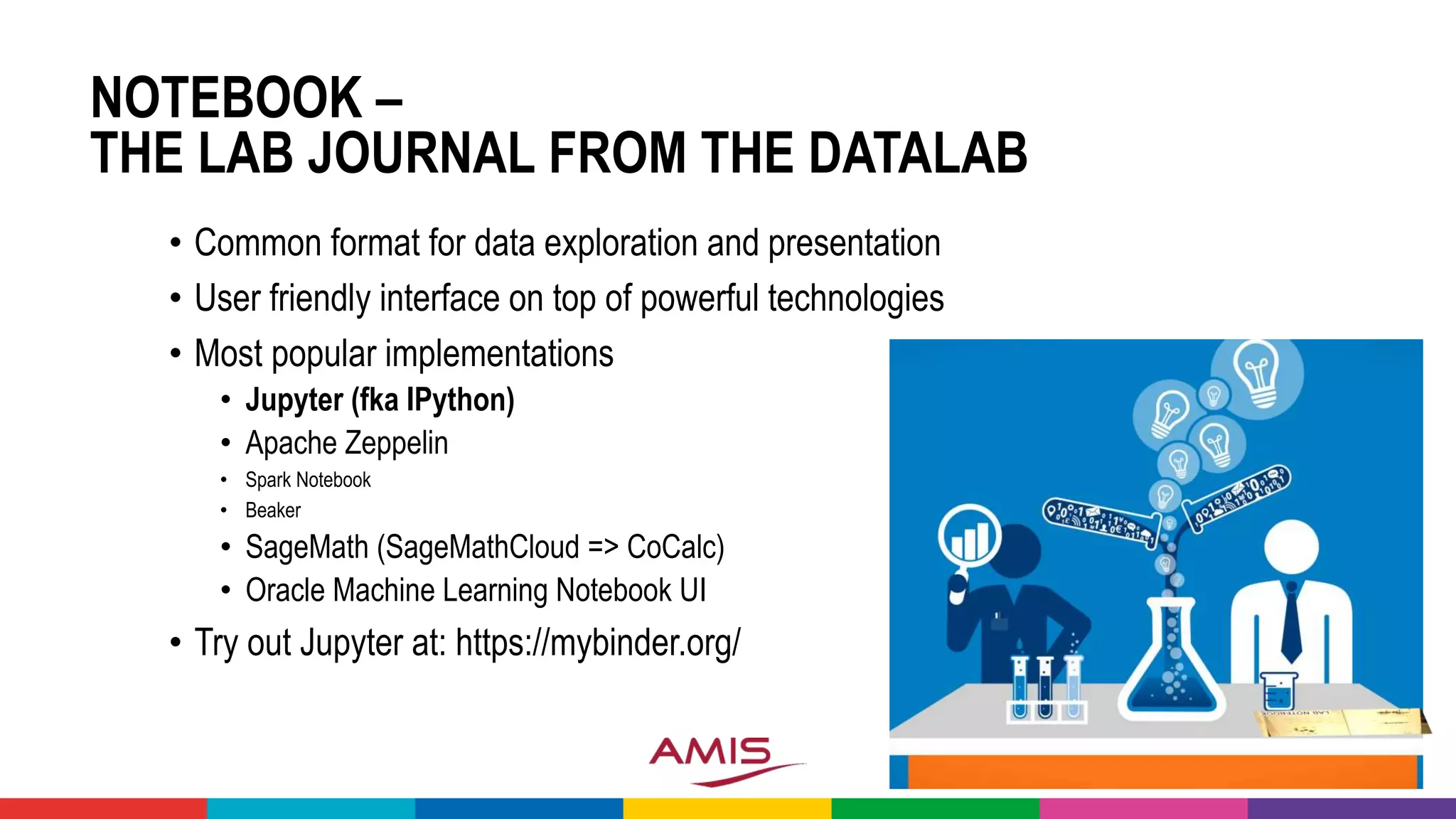
NOTEBOOK –
THE LAB JOURNAL FROM THE DATALAB
• Common format for data exploration and presentation
• User friendly interface on top of powerful technologies
• Most popular implementations
• Jupyter (fka IPython)
• Apache Zeppelin
• Spark Notebook
• Beaker
• SageMath (SageMathCloud => CoCalc)
• Oracle Machine Learning Notebook UI
• Try out Jupyter at: https://mybinder.org/
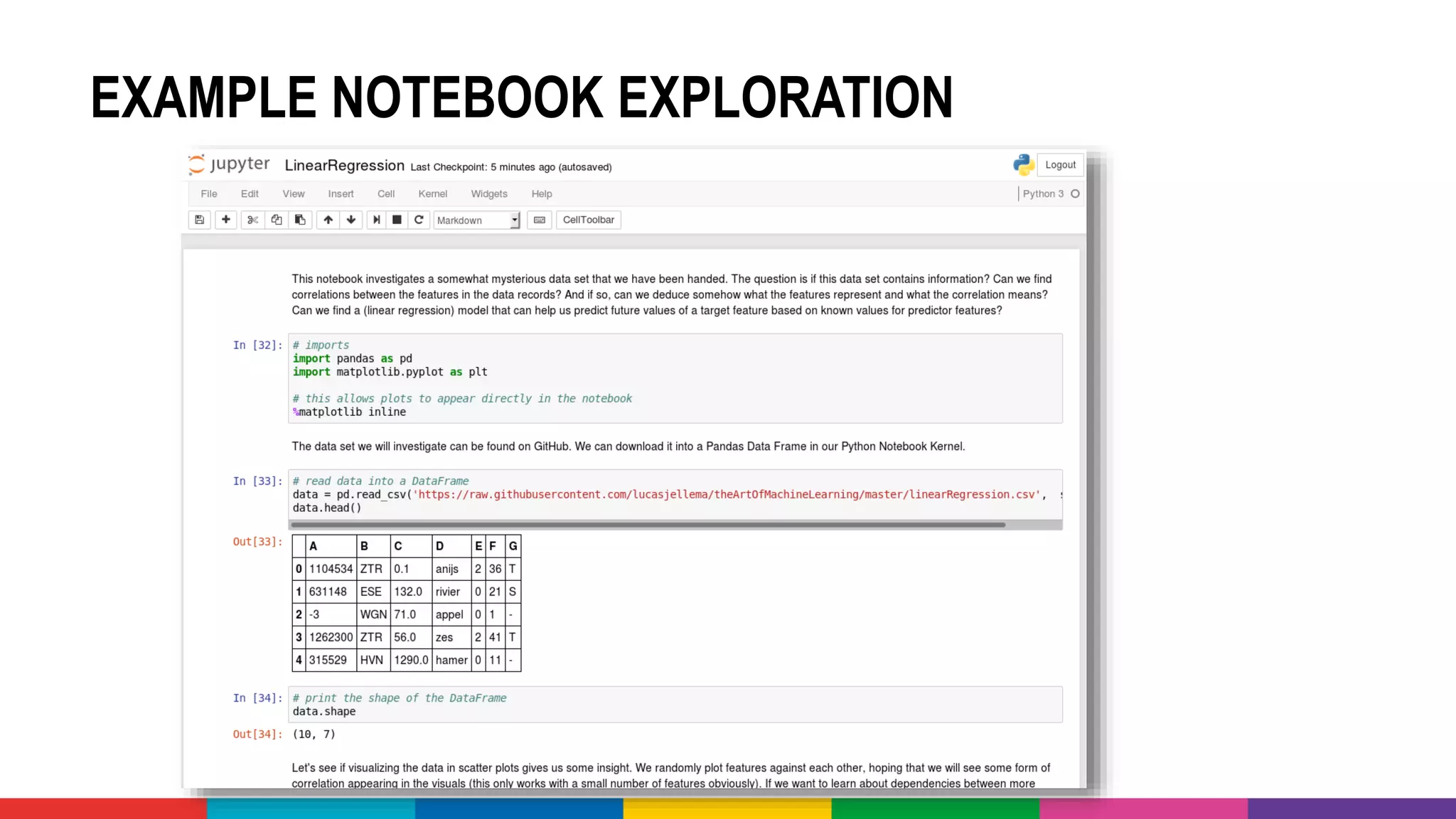
EXAMPLE NOTEBOOK EXPLORATION
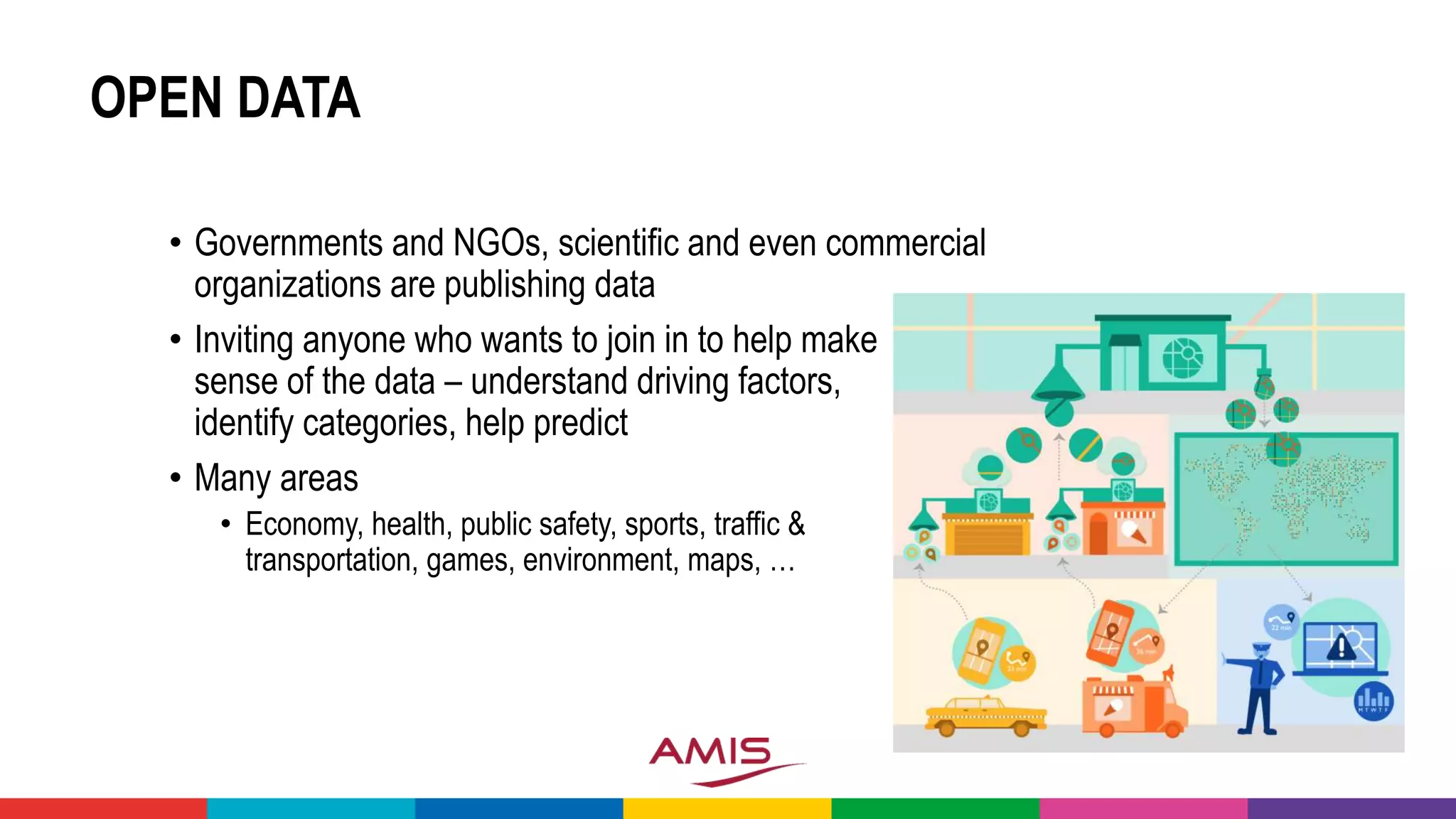
OPEN DATA
• Governments and NGOs, scientific and even commercial
organizations are publishing data
• Inviting anyone who wants to join in to help make
sense of the data – understand driving factors,
identify categories, help predict
• Many areas
• Economy, health, public safety, sports, traffic &
transportation, games, environment, maps, …
OPEN DATA – SOME EXAMPLES
• Kaggle - Data Sets and [Samples of] Data Discovery: www.kaggle.com
• India Government - data.gov.in
• US, EU and UK Government Data: data.gov, open-data.europa.eu and data.gov.uk
• Open Images Data Set: www.image-net.org
• Open Data From World Bank: data.worldbank.org
• Historic Football Data: api.football-data.org
• New York City Open Data - opendata.cityofnewyork.us
• Airports, Airlines, Flight Routes: openflights.org
• Open Database – machine counterpart to Wikipedia: www.wikidata.org
• Google Audio Set (manually annotated audio events)
- research.google.com/audioset/
• Movielens - Movies, viewers and ratings:
files.grouplens.org/datasets/movielens/
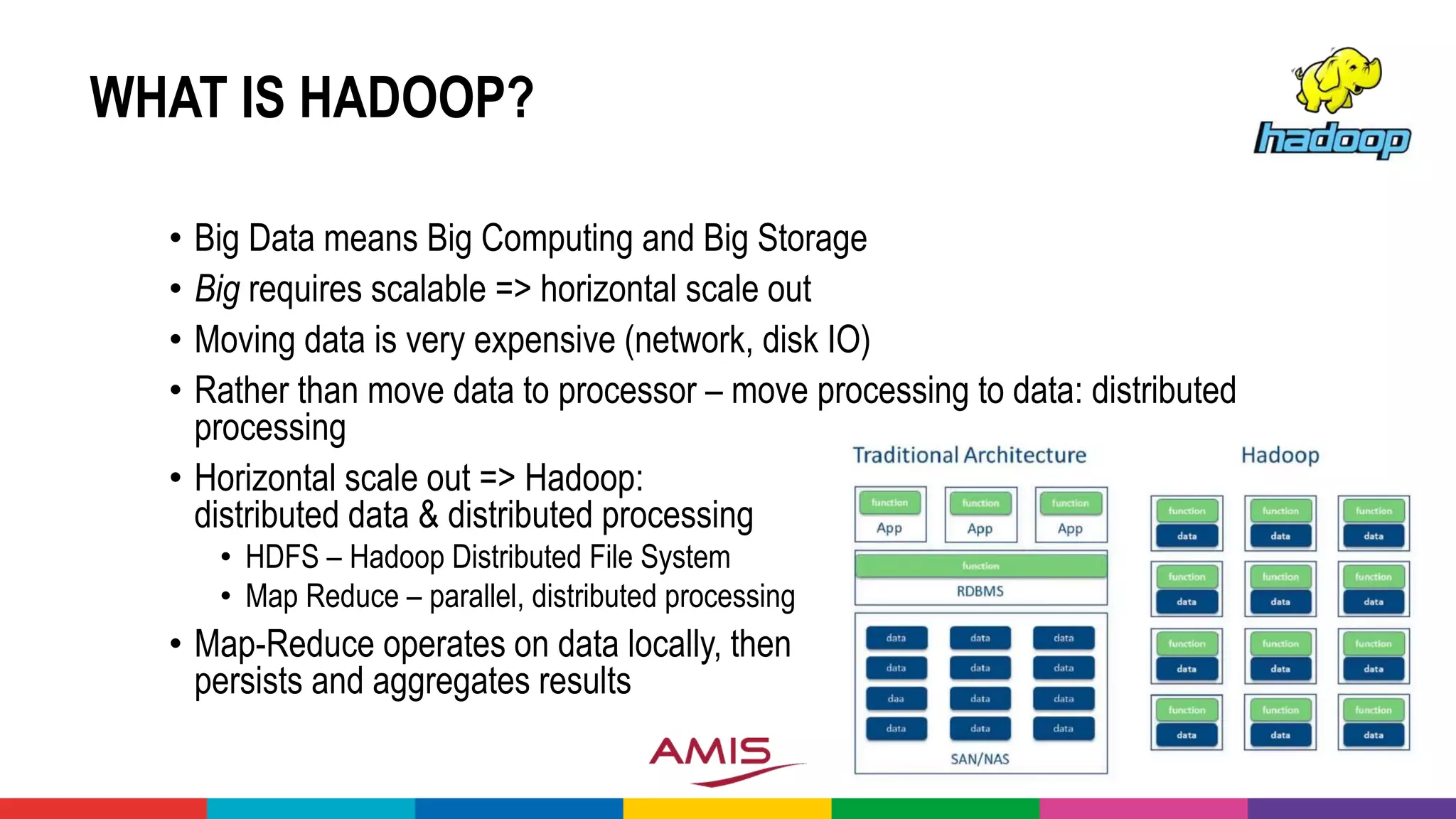
WHAT IS HADOOP?
• Big Data means Big Computing and Big Storage
• Big requires scalable => horizontal scale out
• Moving data is very expensive (network, disk IO)
• Rather than move data to processor – move processing to data: distributed
processing
• Horizontal scale out => Hadoop:
distributed data & distributed processing
• HDFS – Hadoop Distributed File System
• Map Reduce – parallel, distributed processing
• Map-Reduce operates on data locally, then
persists and aggregates results
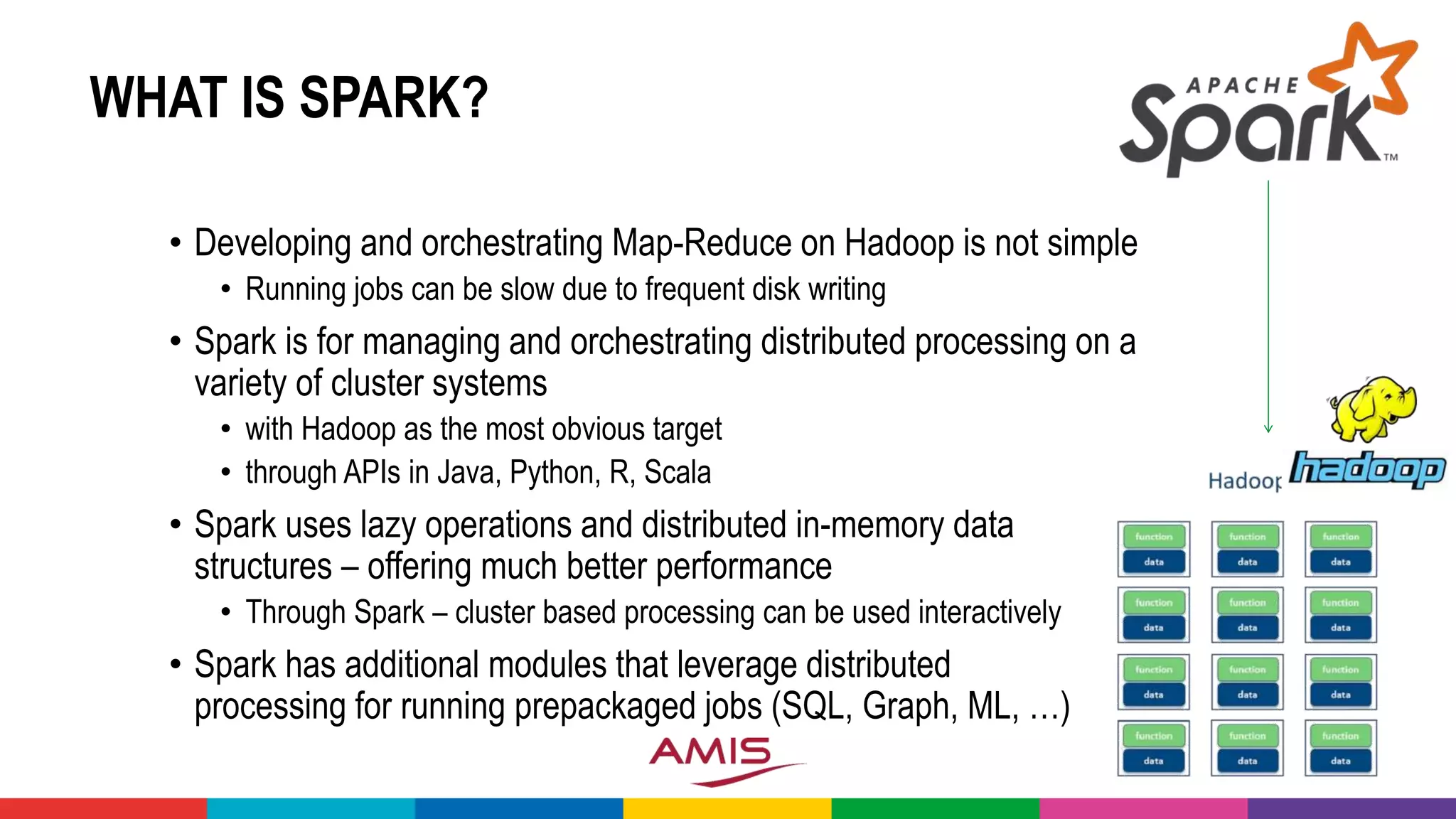
WHAT IS SPARK?
• Developing and orchestrating Map-Reduce on Hadoop is not simple
• Running jobs can be slow due to frequent disk writing
• Spark is for managing and orchestrating distributed processing on a
variety of cluster systems
• with Hadoop as the most obvious target
• through APIs in Java, Python, R, Scala
• Spark uses lazy operations and distributed in-memory data
structures – offering much better performance
• Through Spark – cluster based processing can be used interactively
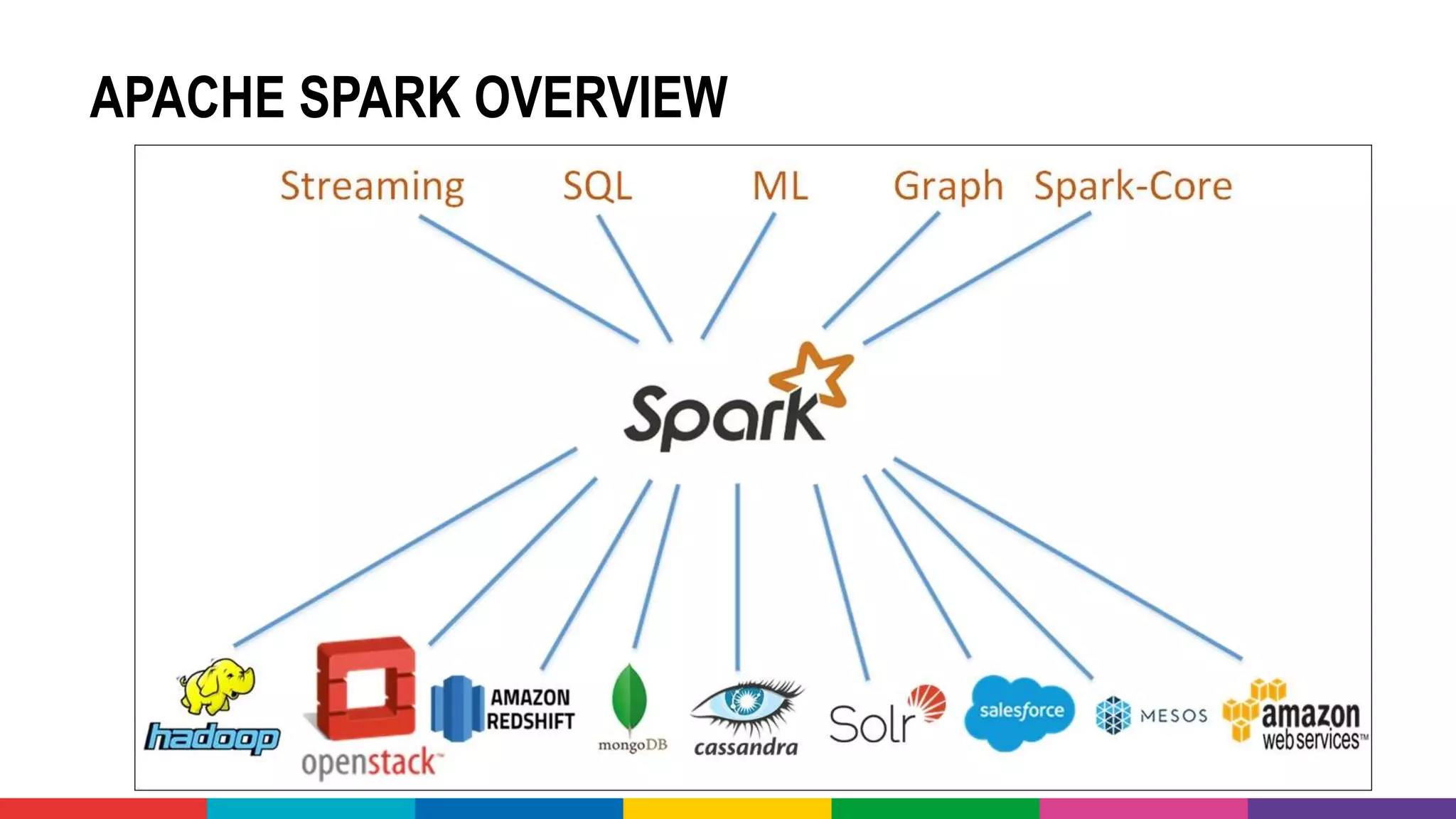
• Spark has additional modules that leverage distributed
processing for running prepackaged jobs (SQL, Graph, ML, …)
APACHE SPARK OVERVIEW
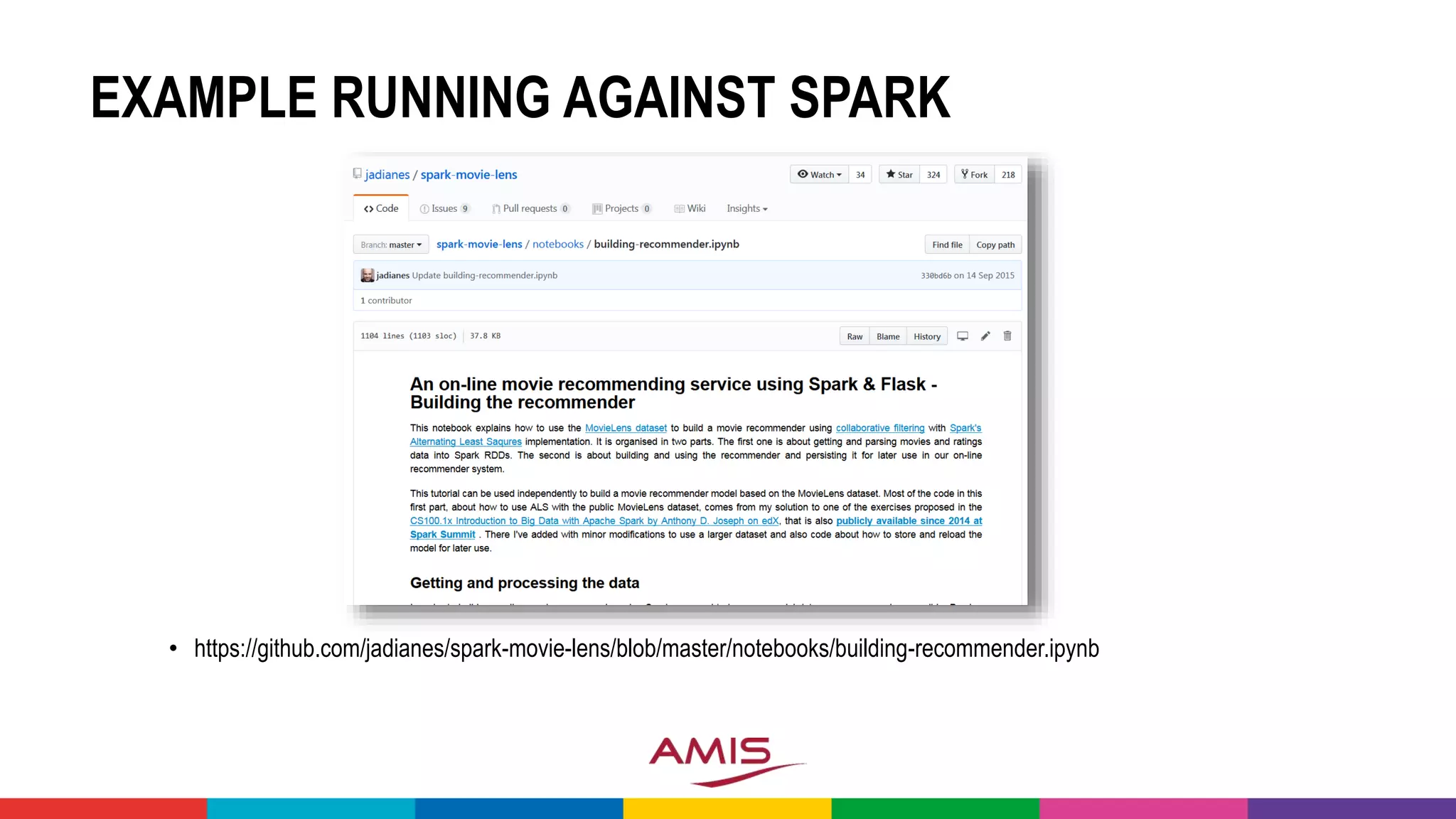
EXAMPLE RUNNING AGAINST SPARK
• https://github.com/jadianes/spark-movie-lens/blob/master/notebooks/building-recommender.ipynb
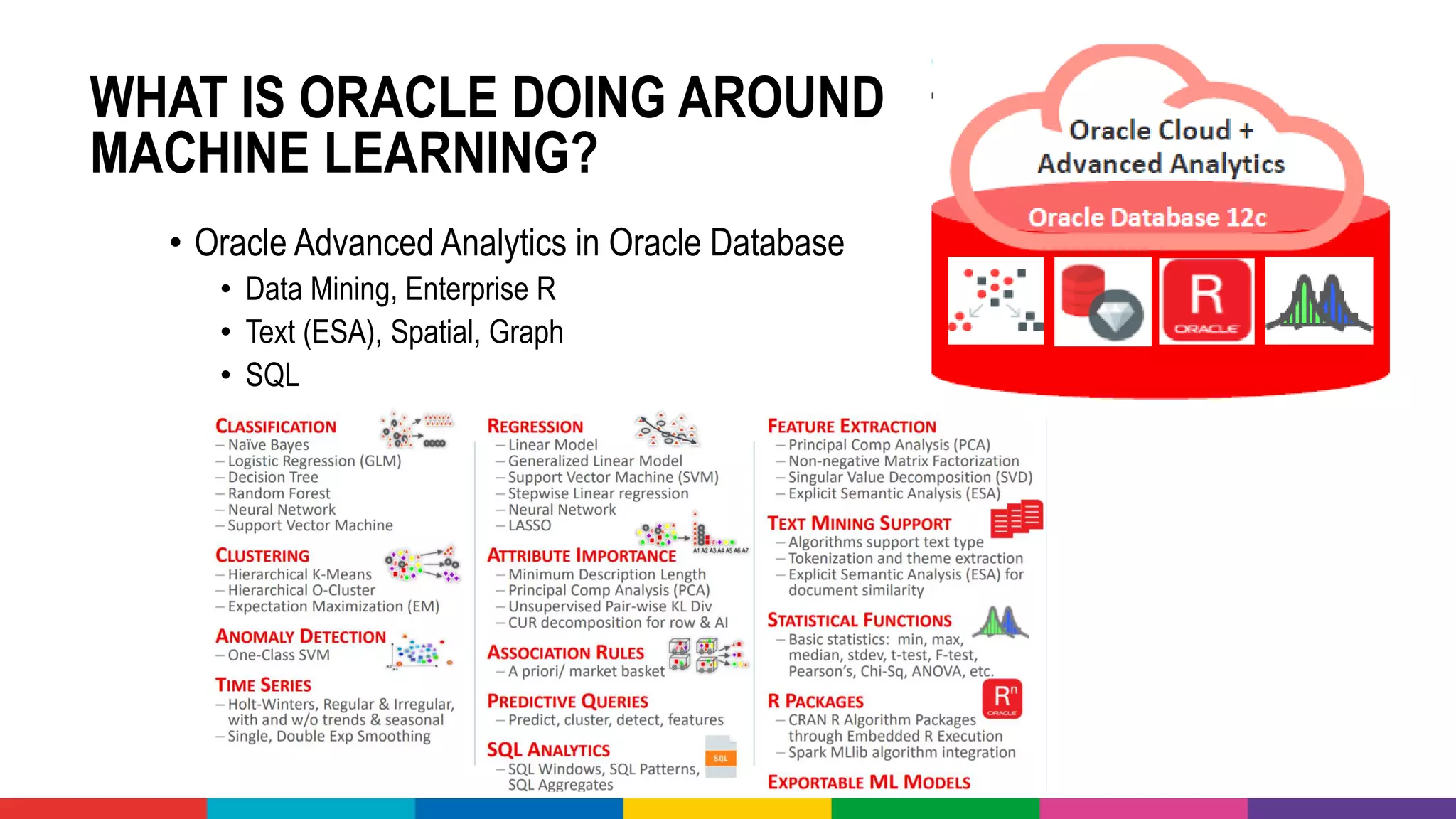
WHAT IS ORACLE DOING AROUND
MACHINE LEARNING?
• Oracle Advanced Analytics in Oracle Database
• Data Mining, Enterprise R
• Text (ESA), Spatial, Graph
• SQL
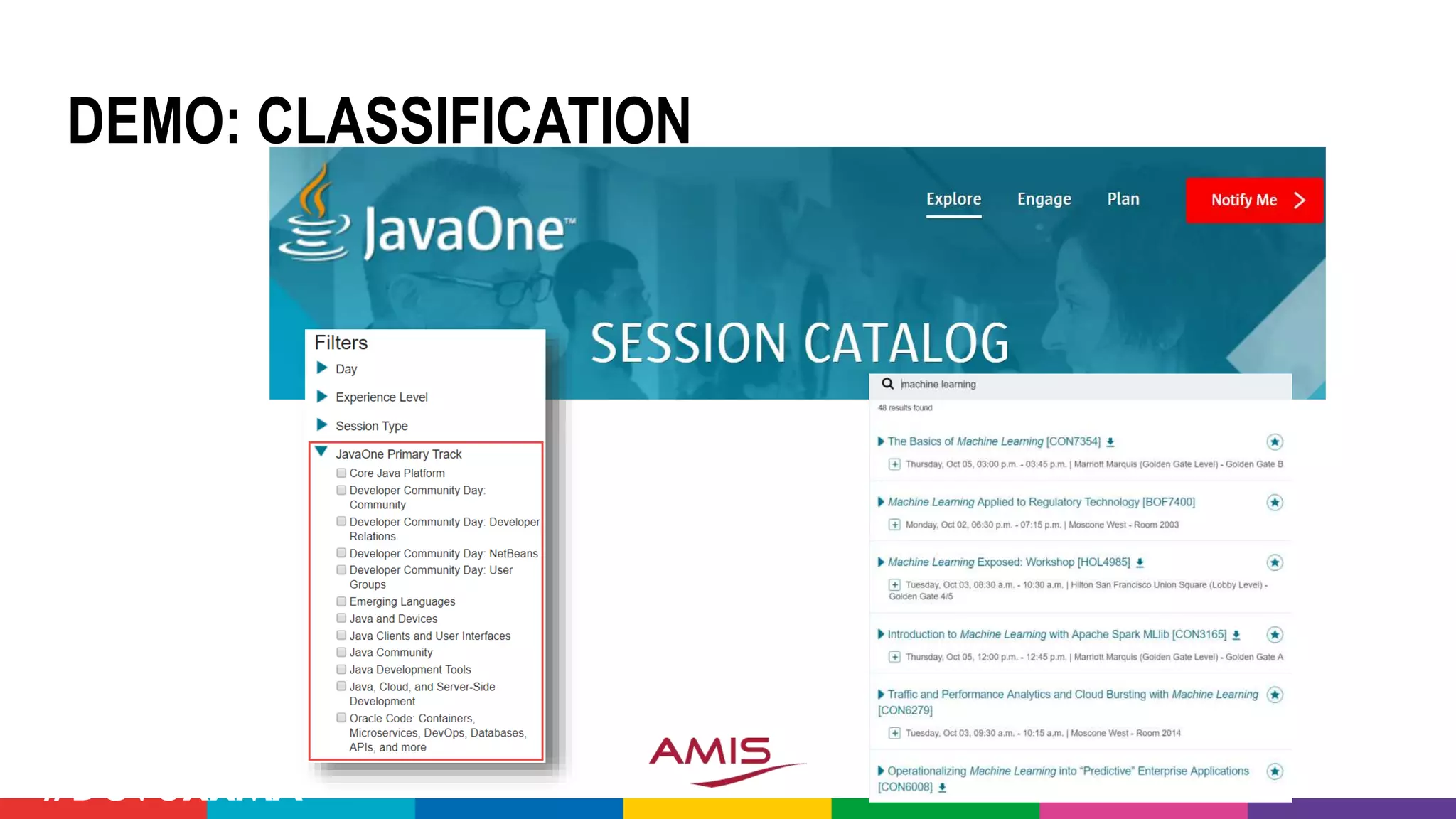
DEMO: CLASSIFICATION
#DevoxxMA
DEMO: CONFERENCE ABSTRACT
CLASSIFICATION CHALLENGE
• Take all conference abstracts for
• Train a Classification Model on
picking the Conference Track
• Based on Title, Summary [, Speaker, Level,…]
• Use the Model to pick the Track
for sessions at
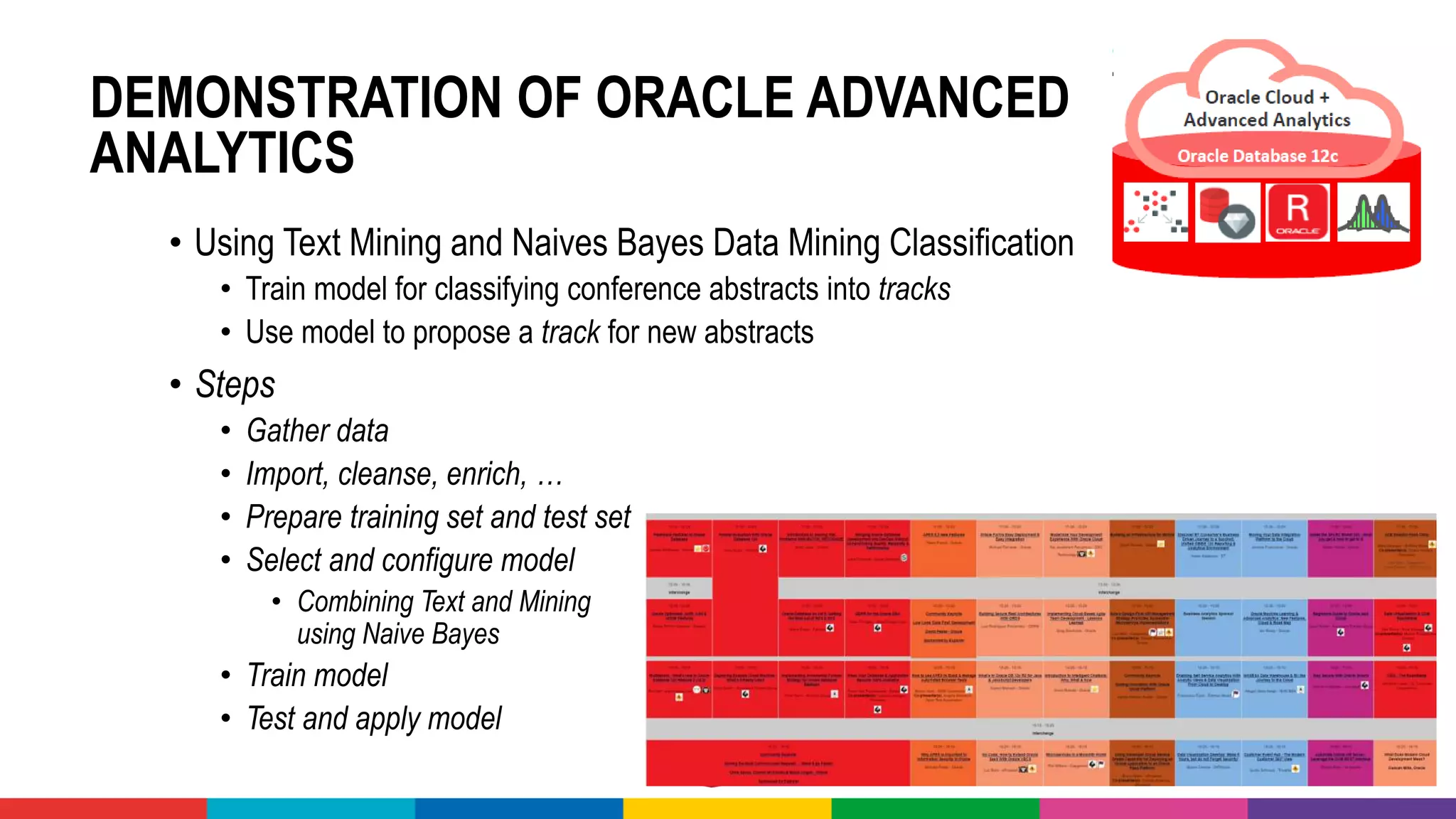
DEMONSTRATION OF ORACLE ADVANCED
ANALYTICS
• Using Text Mining and Naives Bayes Data Mining Classification
• Train model for classifying conference abstracts into tracks
• Use model to propose a track for new abstracts
• Steps
• Gather data
• Import, cleanse, enrich, …
• Prepare training set and test set
• Select and configure model
• Combining Text and Mining
using Naive Bayes
• Train model
• Test and apply model
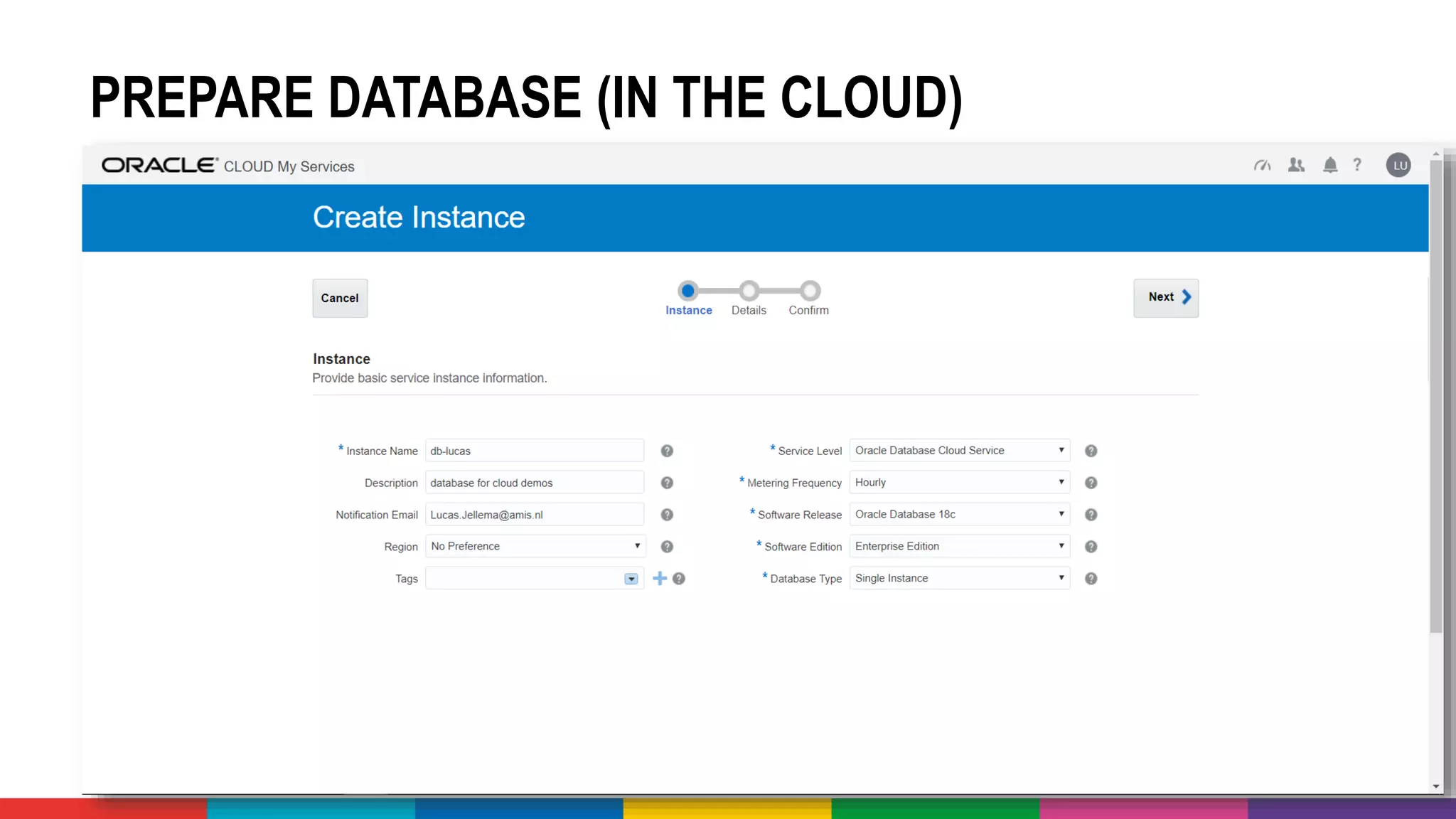
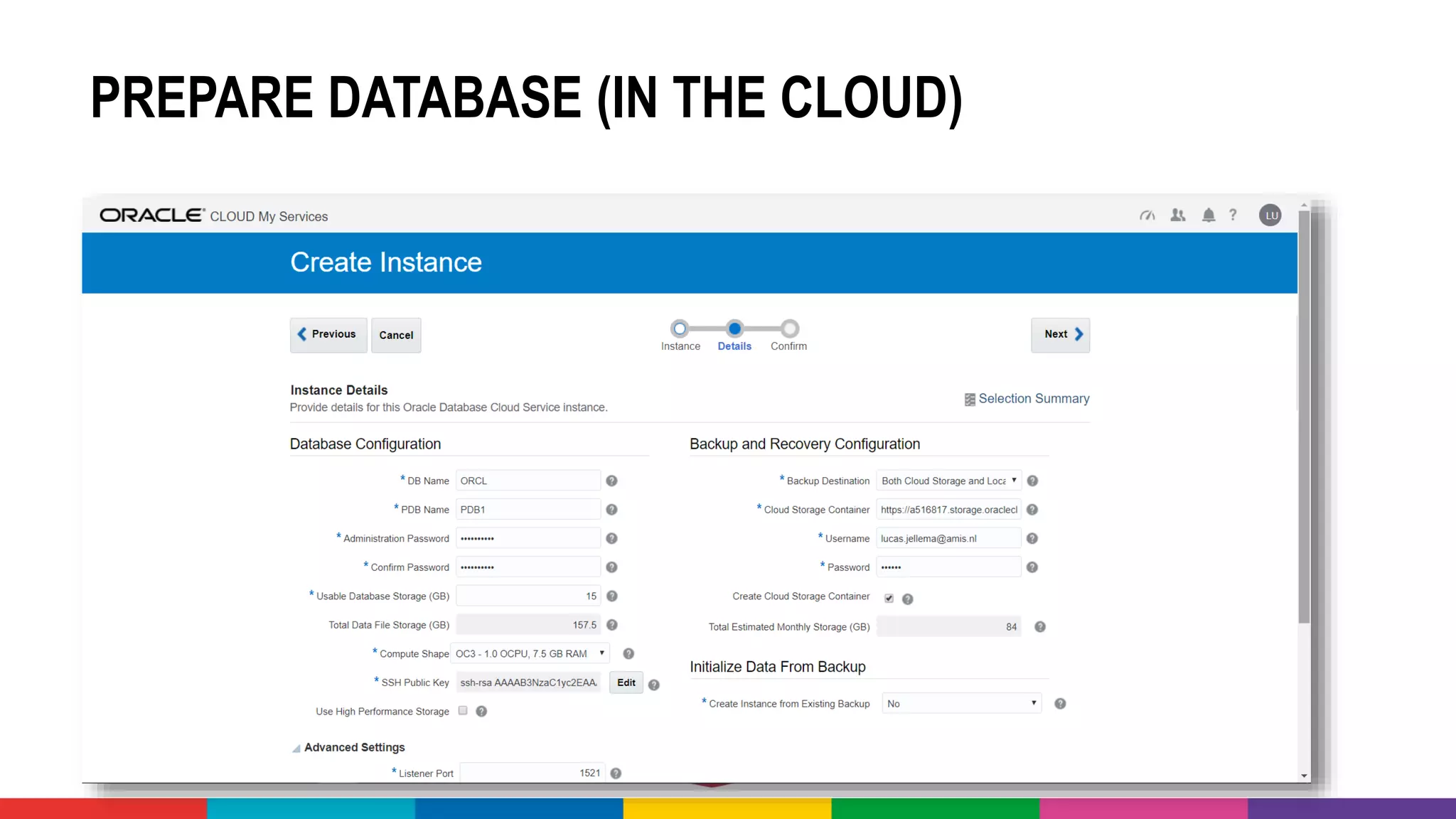
PREPARE DATABASE (IN THE CLOUD)
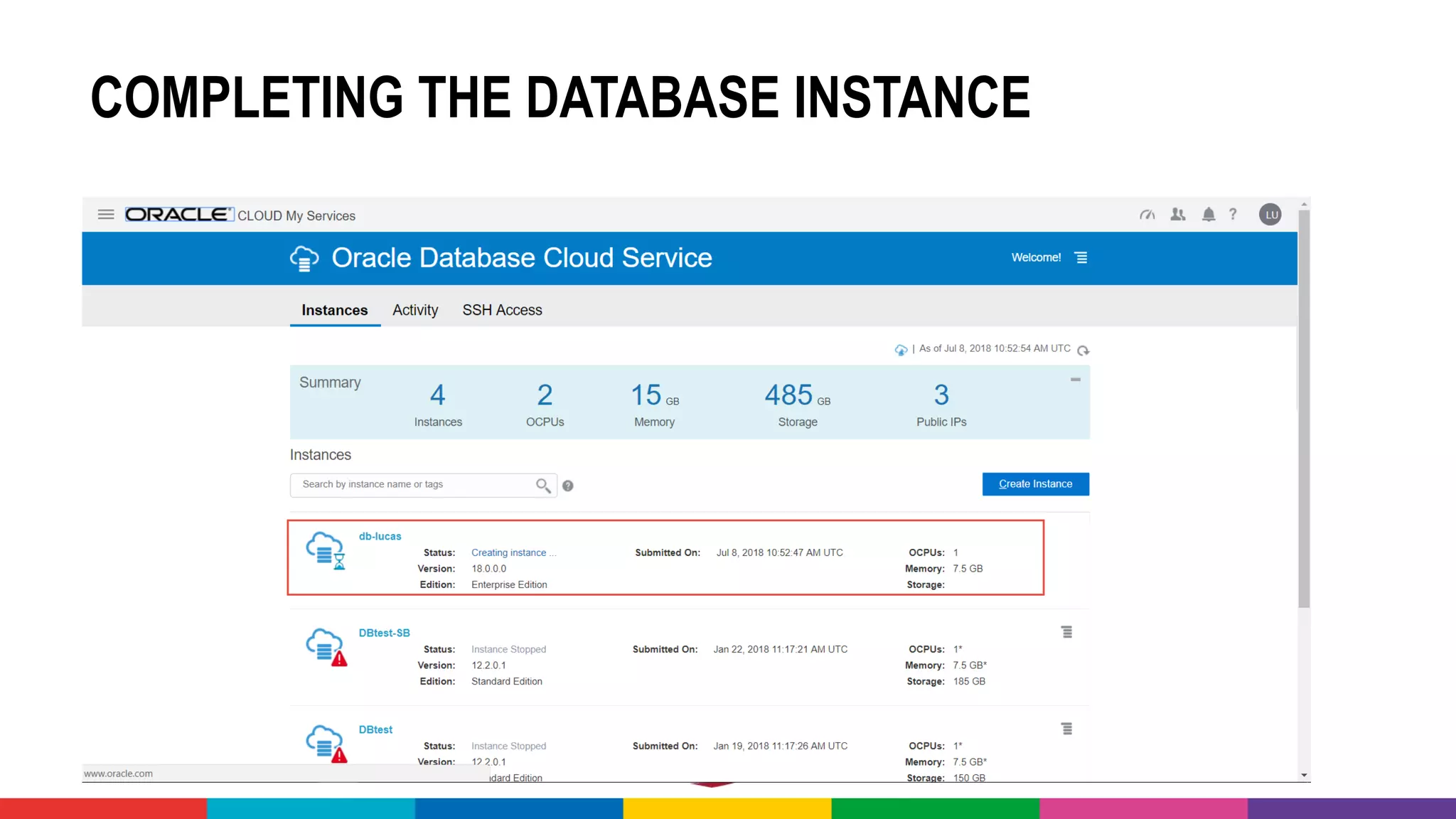
COMPLETING THE DATABASE INSTANCE
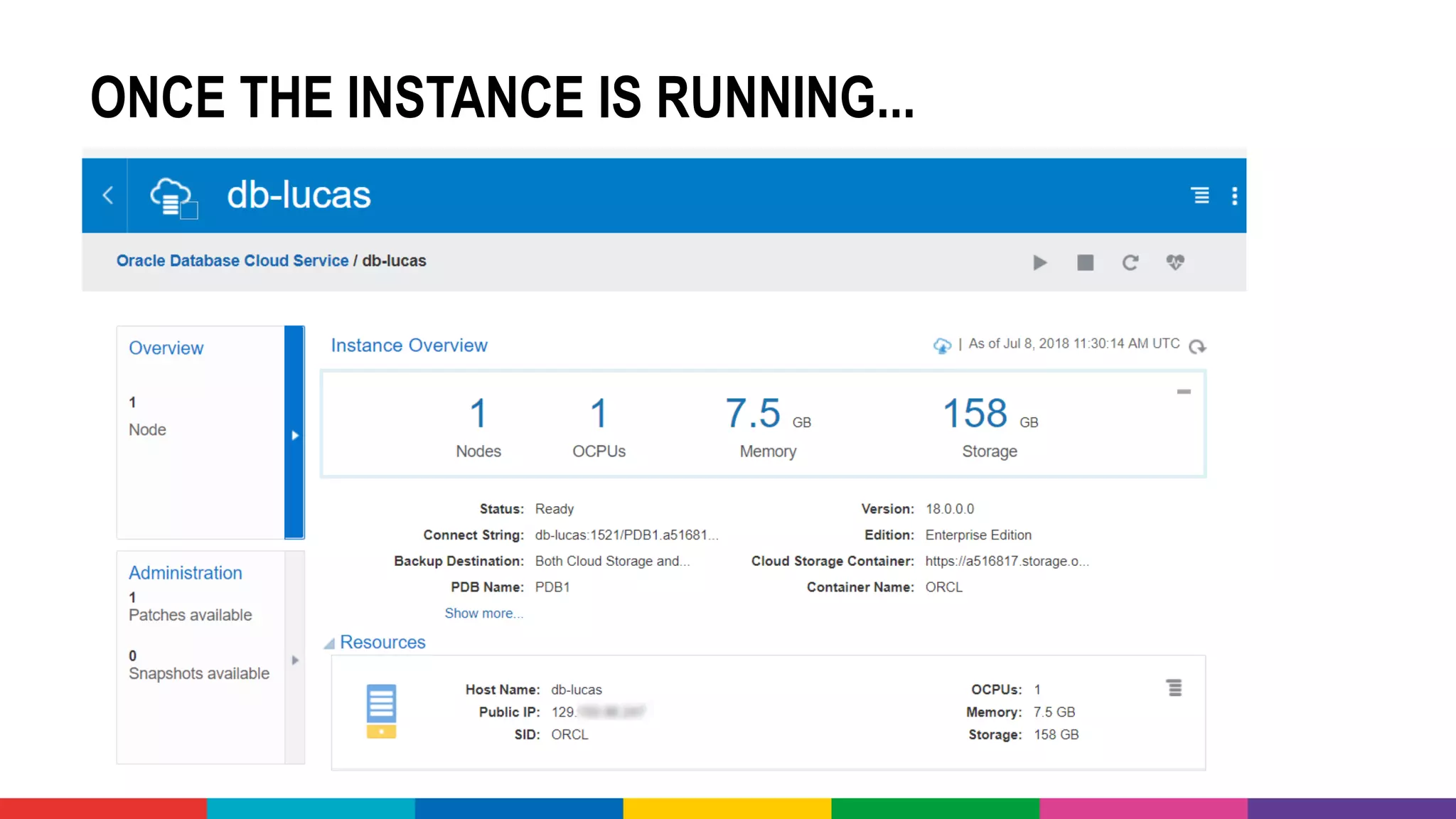
ONCE THE INSTANCE IS RUNNING...
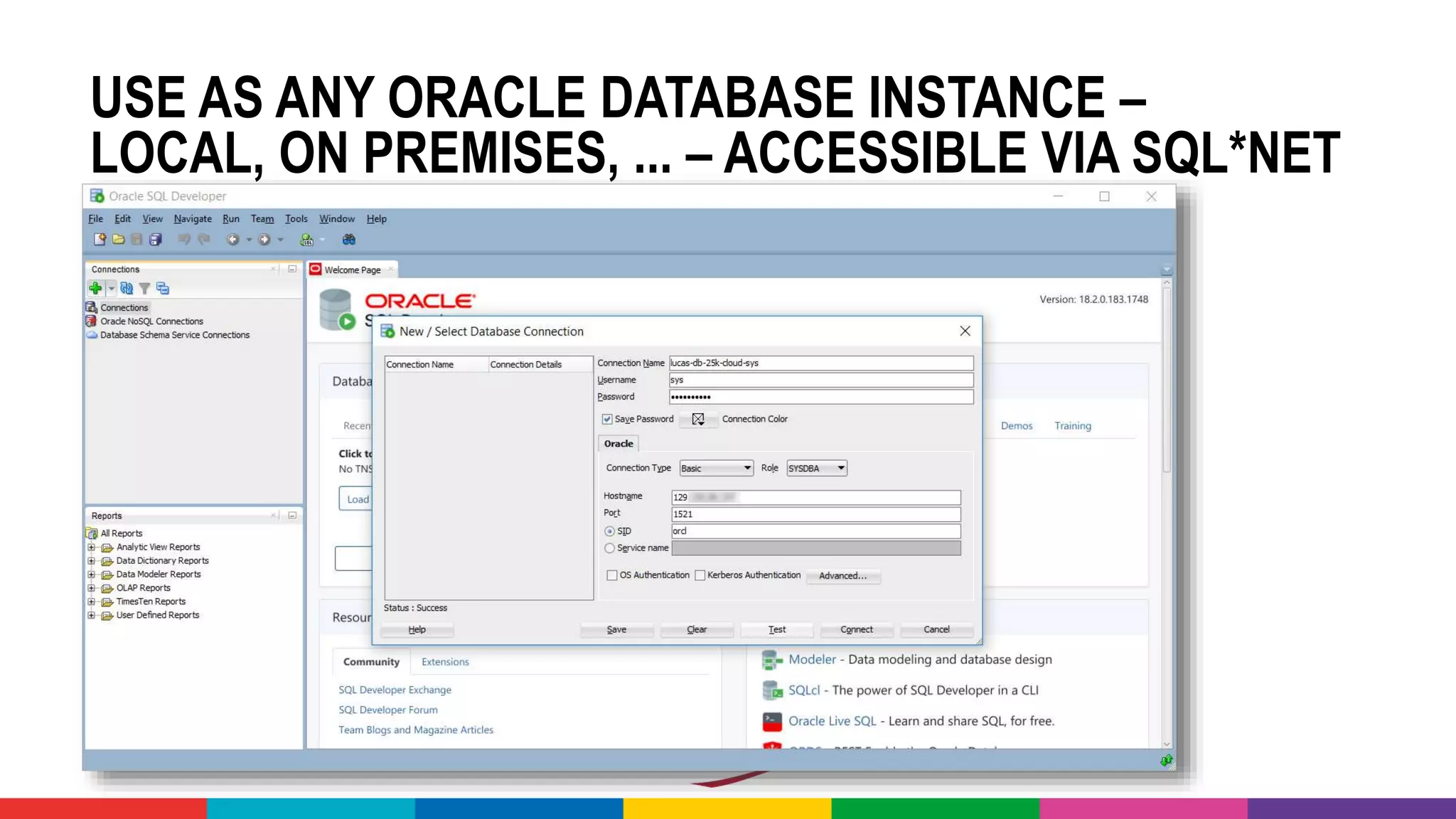
USE AS ANY ORACLE DATABASE INSTANCE –
LOCAL, ON PREMISES, ... – ACCESSIBLE VIA SQL*NET
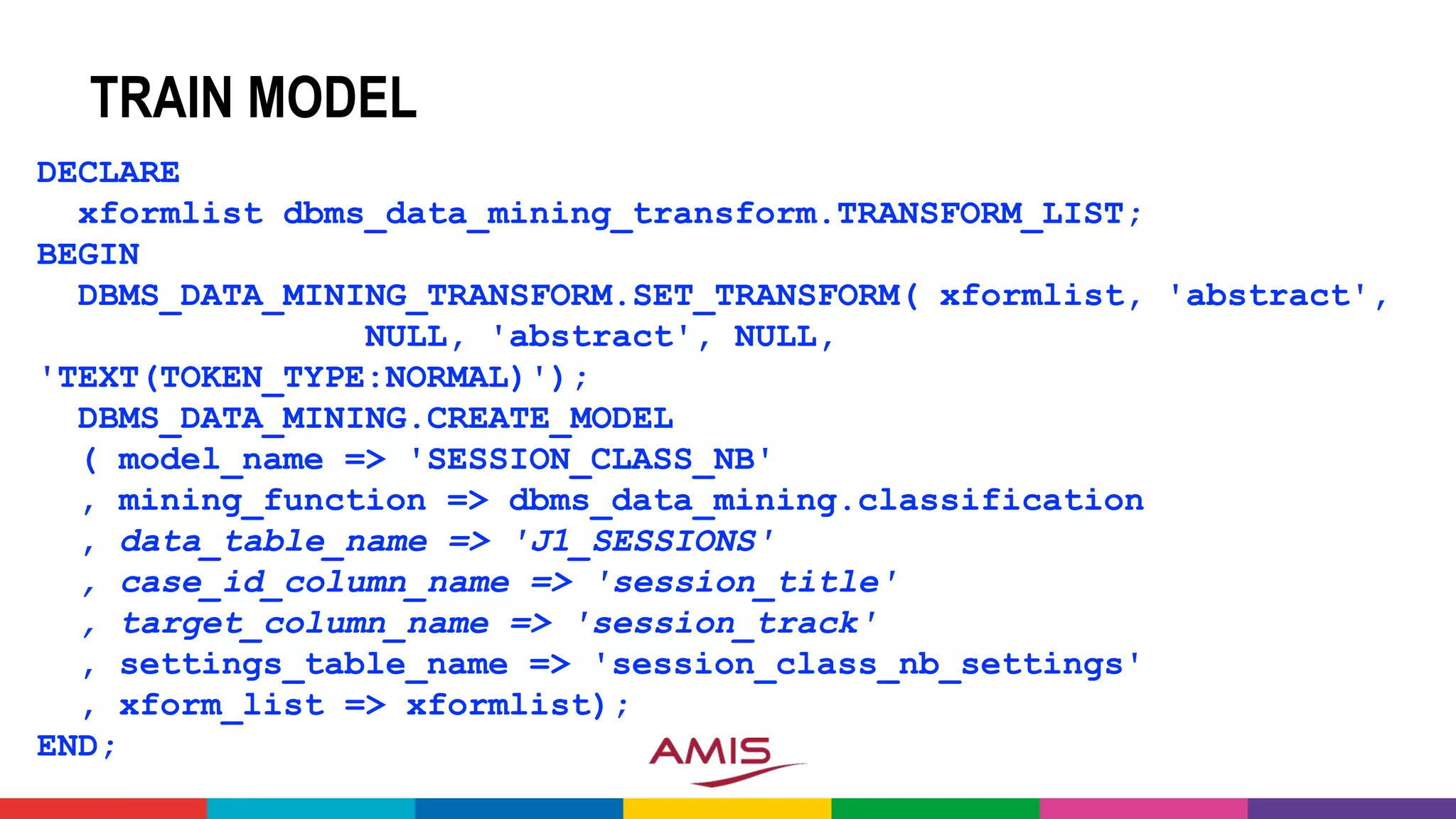
TRAIN MODEL
DECLARE
xformlist dbms_data_mining_transform.TRANSFORM_LIST;
BEGIN
DBMS_DATA_MINING_TRANSFORM.SET_TRANSFORM( xformlist, 'abstract',
NULL, 'abstract', NULL,
'TEXT(TOKEN_TYPE:NORMAL)');
DBMS_DATA_MINING.CREATE_MODEL
( model_name => 'SESSION_CLASS_NB'
, mining_function => dbms_data_mining.classification
, data_table_name => 'J1_SESSIONS'
, case_id_column_name => 'session_title'
, target_column_name => 'session_track'
, settings_table_name => 'session_class_nb_settings'
, xform_list => xformlist);
END;
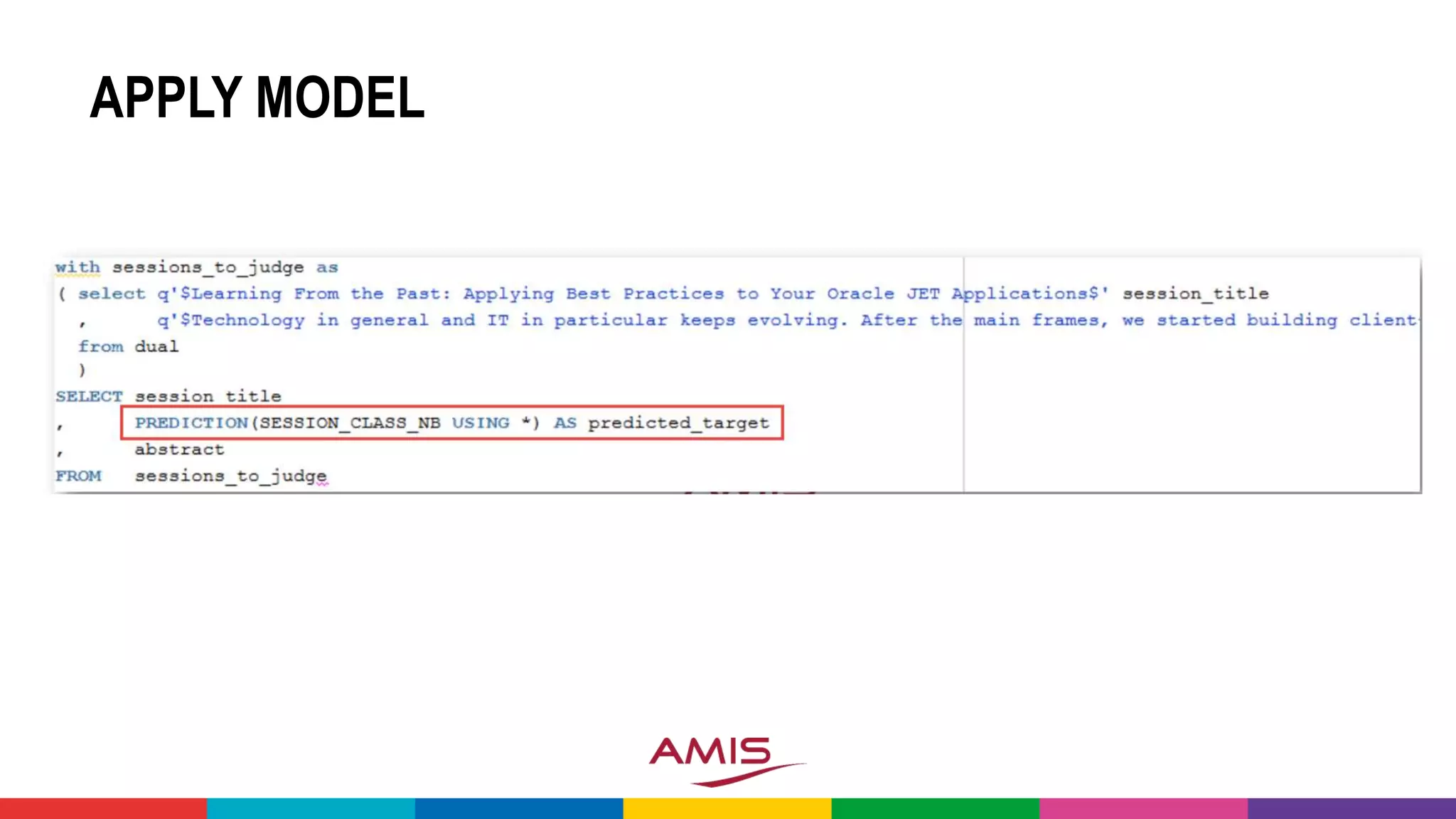
APPLY MODEL
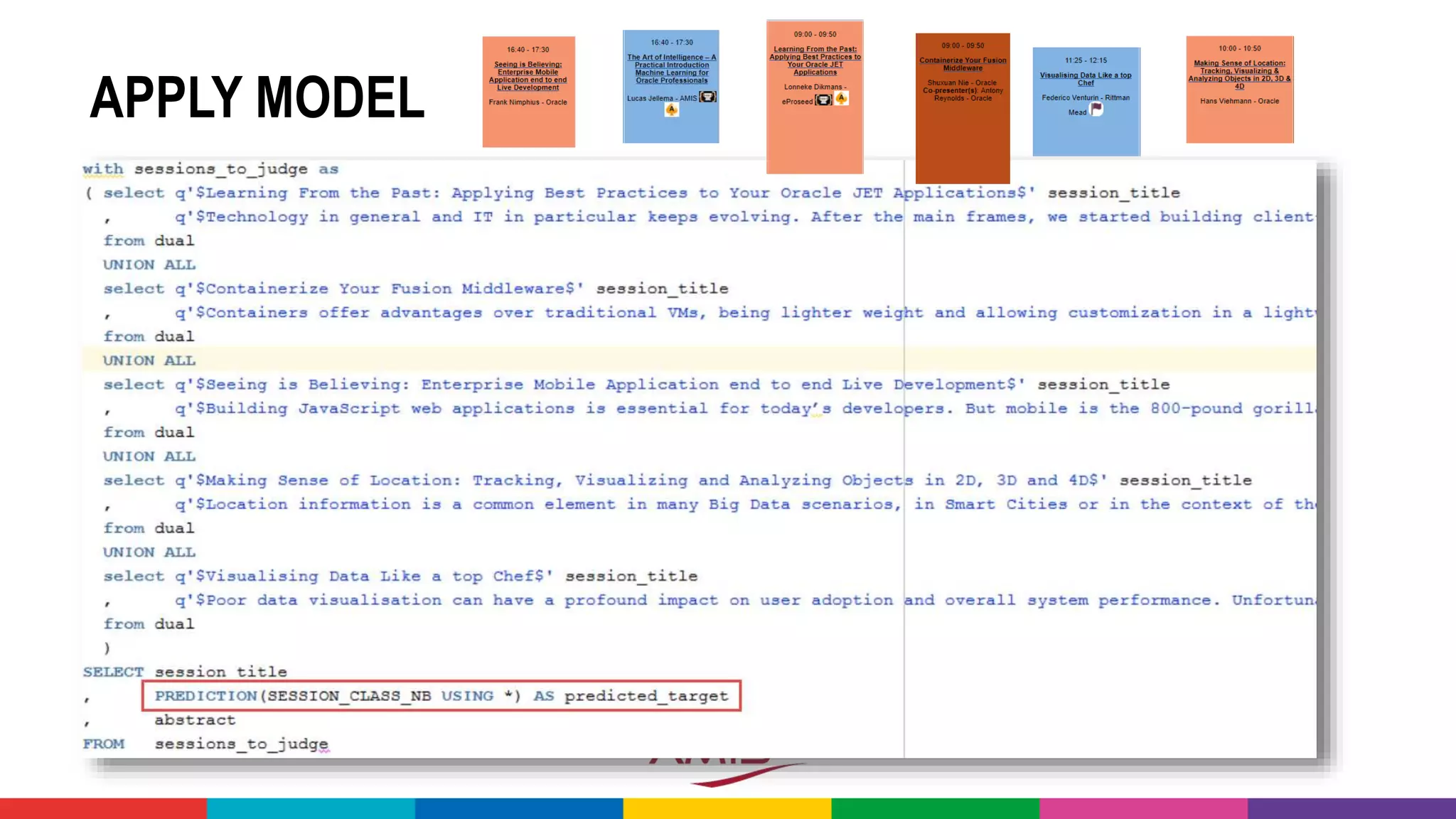
APPLY MODEL
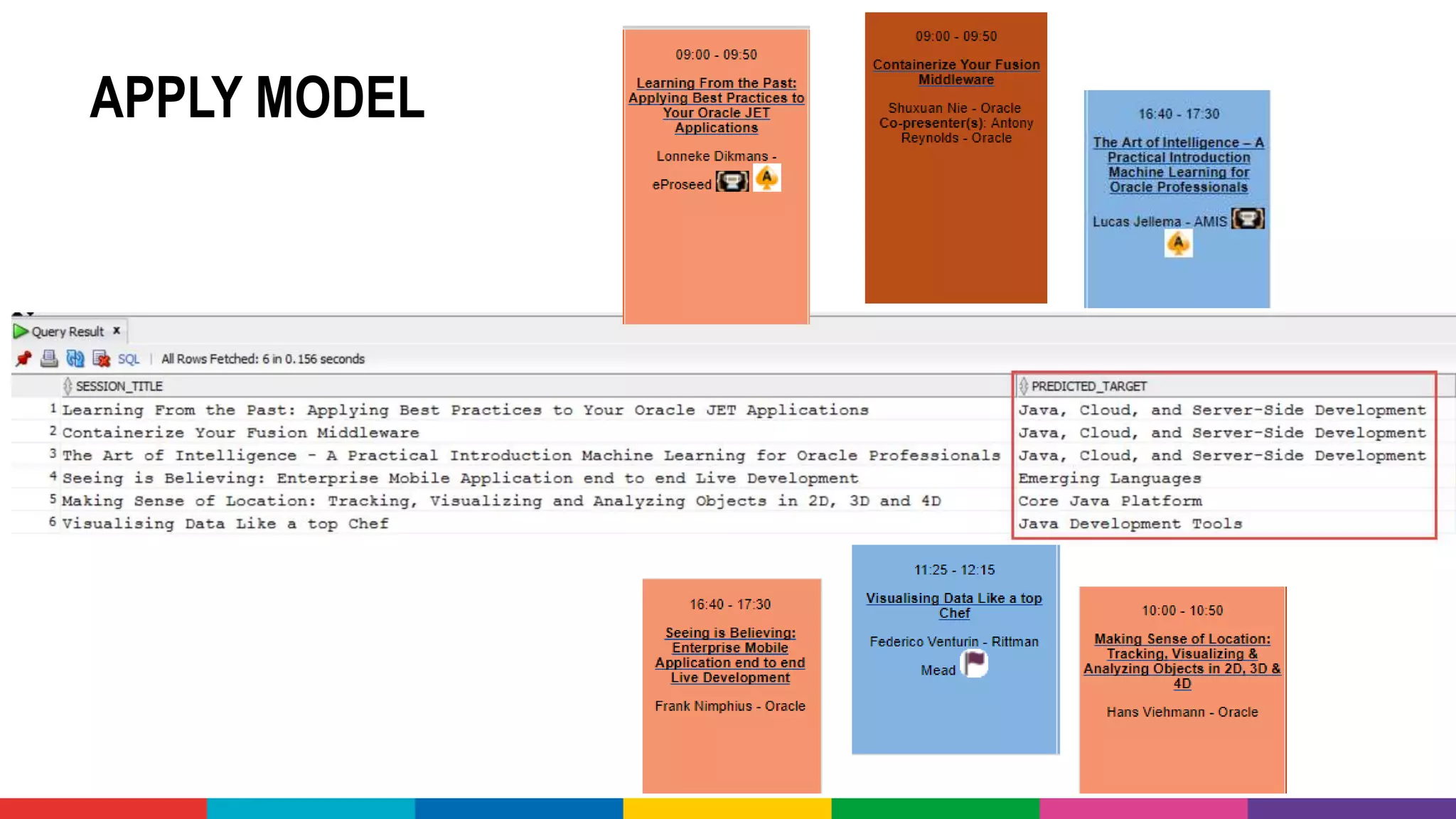
APPLY MODEL
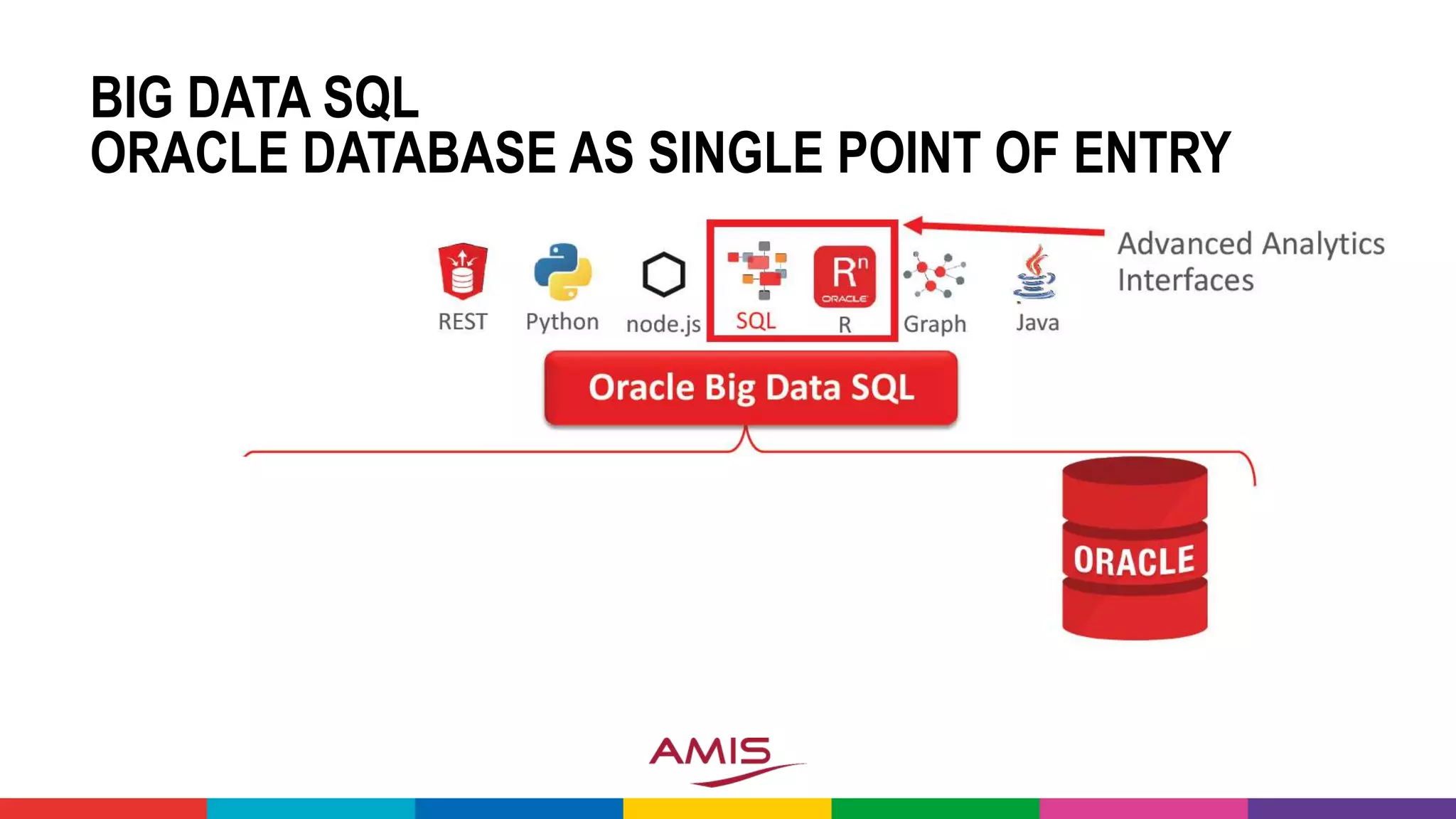
BIG DATA SQL
ORACLE DATABASE AS SINGLE POINT OF ENTRY
MANY CLOUD SERVICES AROUND BIG DATA &
[PREDICTIVE] ANALYTICS & MACHINE LEARNING
70
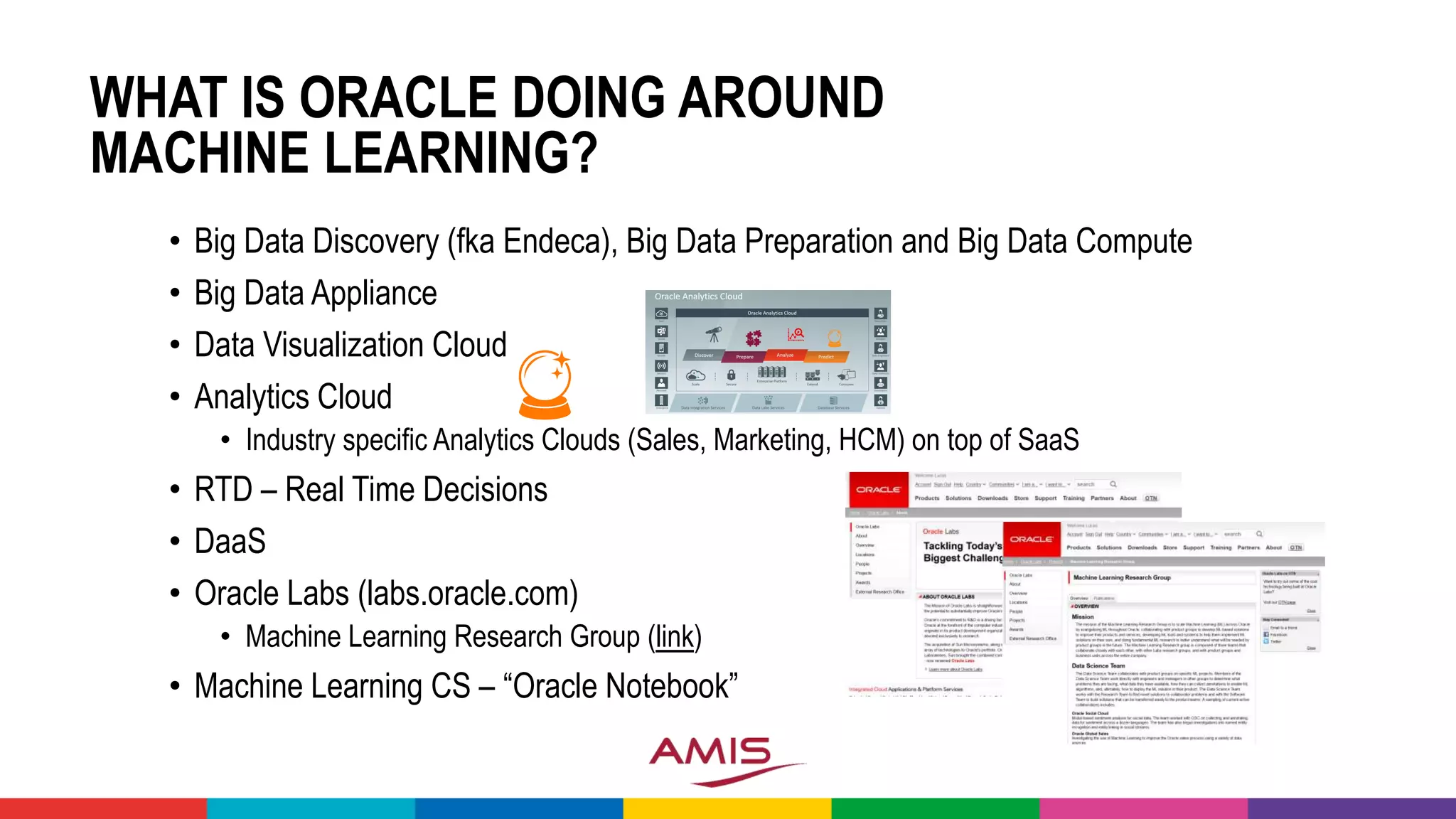
WHAT IS ORACLE DOING AROUND
MACHINE LEARNING?
• Big Data Discovery (fka Endeca), Big Data Preparation and Big Data Compute
• Big Data Appliance
• Data Visualization Cloud
• Analytics Cloud
• Industry specific Analytics Clouds (Sales, Marketing, HCM) on top of SaaS
• RTD – Real Time Decisions
• DaaS
• Oracle Labs (labs.oracle.com)
• Machine Learning Research Group (link)
• Machine Learning CS – “Oracle Notebook”
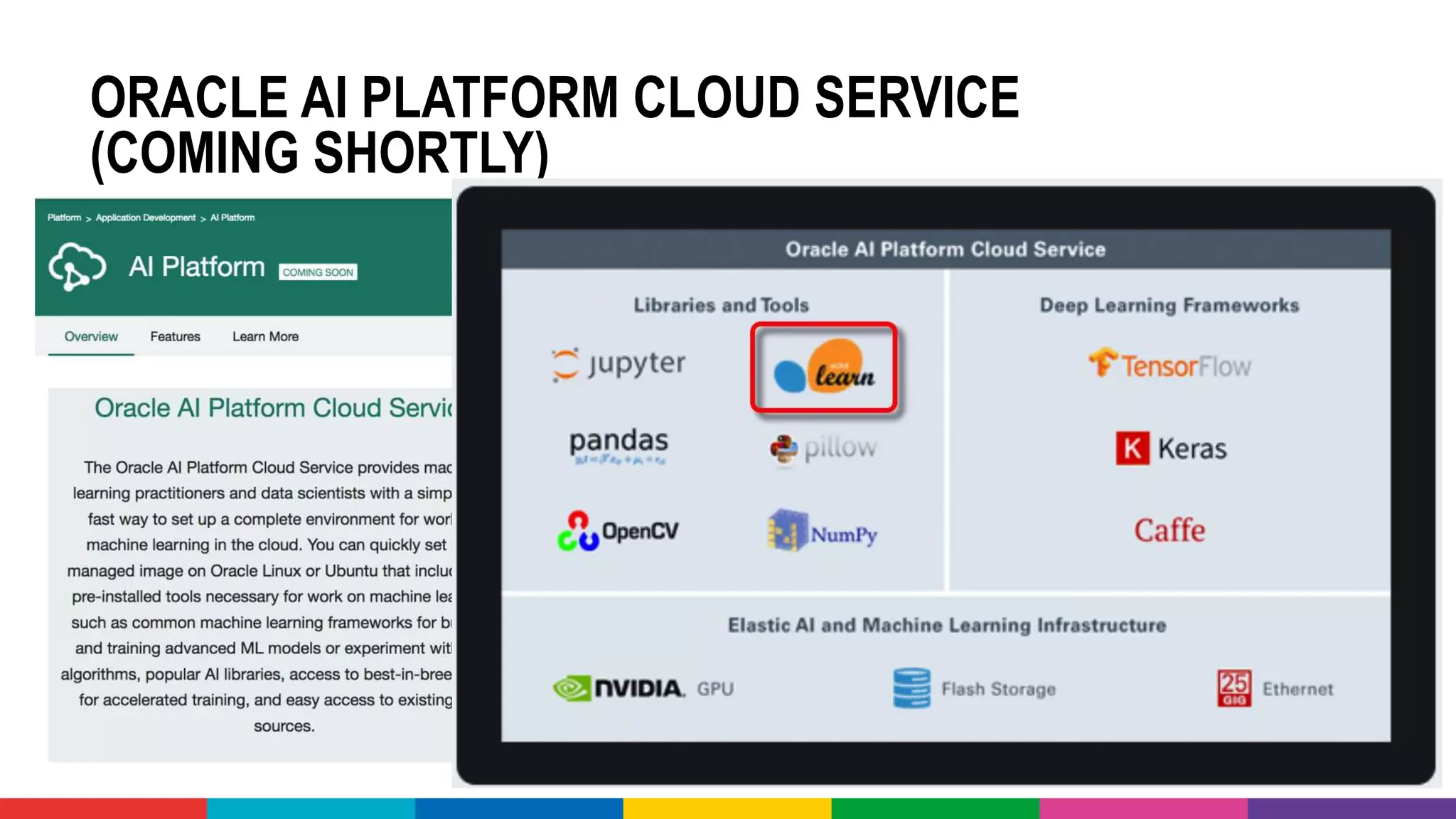
ORACLE AI PLATFORM CLOUD SERVICE
(COMING SHORTLY)
HUMANS LEARNING MACHINE
LEARNING: YOUR FIRST STEPS
#DevoxxMA
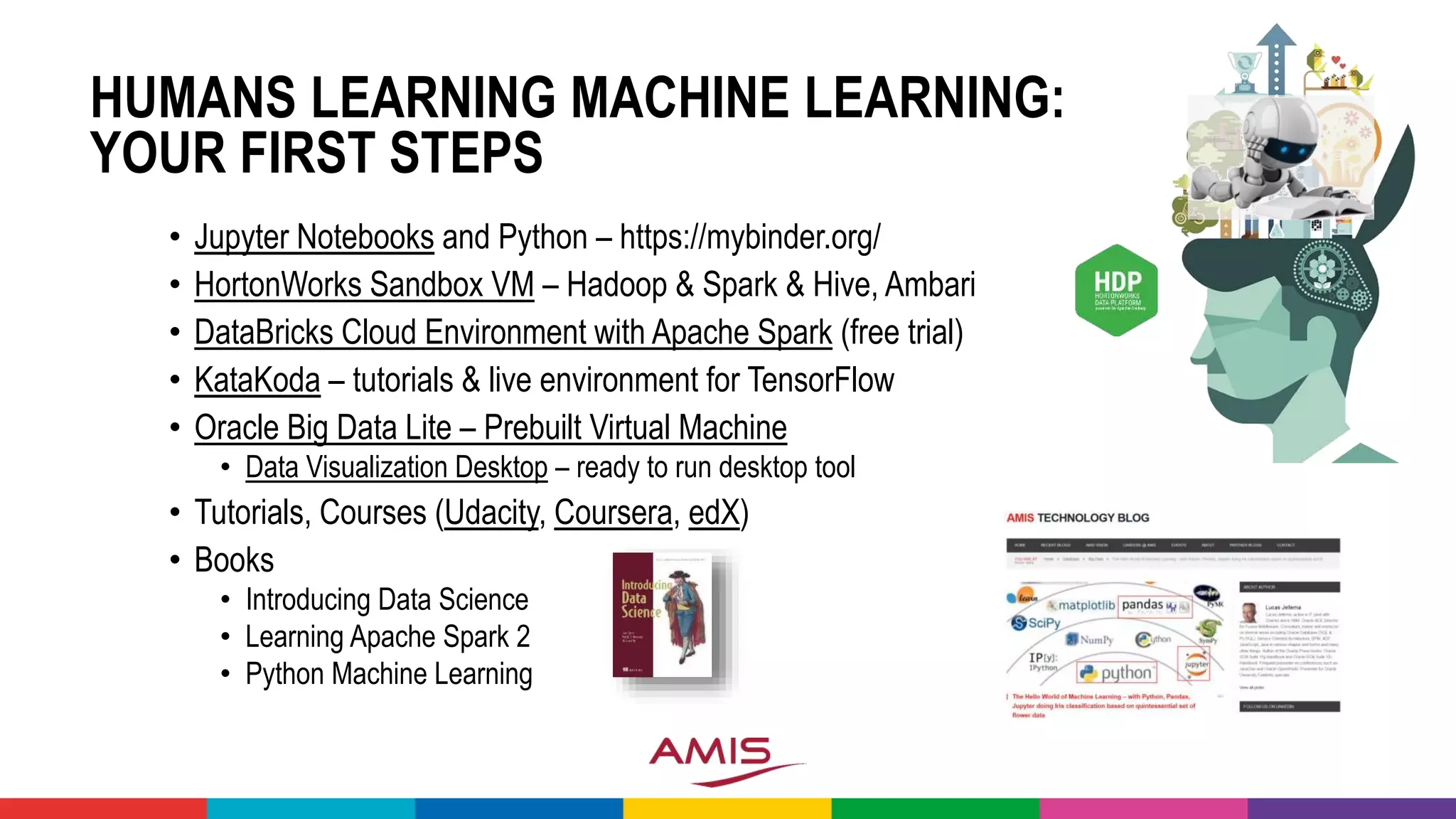
HUMANS LEARNING MACHINE LEARNING:
YOUR FIRST STEPS
• Jupyter Notebooks and Python – https://mybinder.org/
• HortonWorks Sandbox VM – Hadoop & Spark & Hive, Ambari
• DataBricks Cloud Environment with Apache Spark (free trial)
• KataKoda – tutorials & live environment for TensorFlow
• Oracle Big Data Lite – Prebuilt Virtual Machine
• Data Visualization Desktop – ready to run desktop tool
• Tutorials, Courses (Udacity, Coursera, edX)
• Books
• Introducing Data Science
• Learning Apache Spark 2
• Python Machine Learning
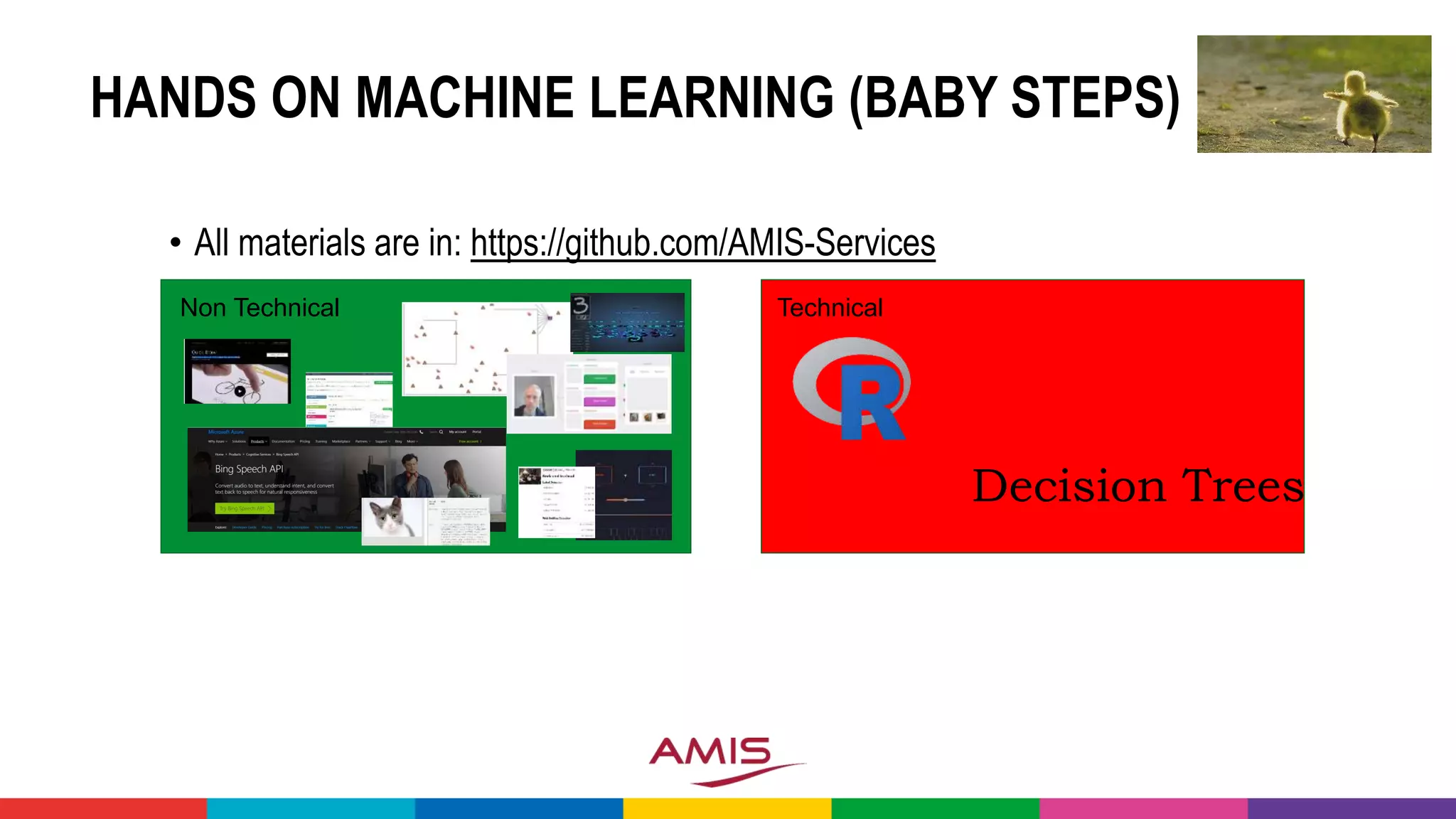
HANDS ON MACHINE LEARNING (BABY STEPS)
• All materials are in: https://github.com/AMIS-Services
Non Technical Technical
Decision Trees
SUMMARY
• IoT, Big Data, Machine Learning => AI
• Recent and Rapid Democratization of Machine Learning
• Algorithms, Storage and Compute Resources, High Level Machine Learning
Frameworks, Education resources , Open Data, Trained ML Models, Out of the
Box SaaS capabilities – powered by ML
• Produce business value today
• Machine Learning by computers helps us(ers) understand historic
data and apply that insight to new data
• Developers have to learn how to incorporate Machine Learning
into their applications – for smarter Uis, more automation, faster
(p)reactions
SUMMARY
• R and Python are most popular technologies for data exploration
and ML model discovery [on small subsets of Big Data]
• Apache Spark (on Hadoop) is frequently used to powercrunch data
(wrangling) and run ML models on Big Data sets
• Notebooks are a popular vehicle in the Data Science lab
• To explore and report
• Oracle is quite active on Machine Learning
• Power PaaS and SaaS with ML
• Provide us with the Machine Learning Data Lab & Run Time (on the cloud)
• Getting started on Machine Learning is fun, smart & well supported
Thank you!
• Blog: technology.amis.nl
• Email: lucas.jellema@amis.nl
• : @lucasjellema
• : lucas-jellema
• : www.amis.nl, info@amis.nl
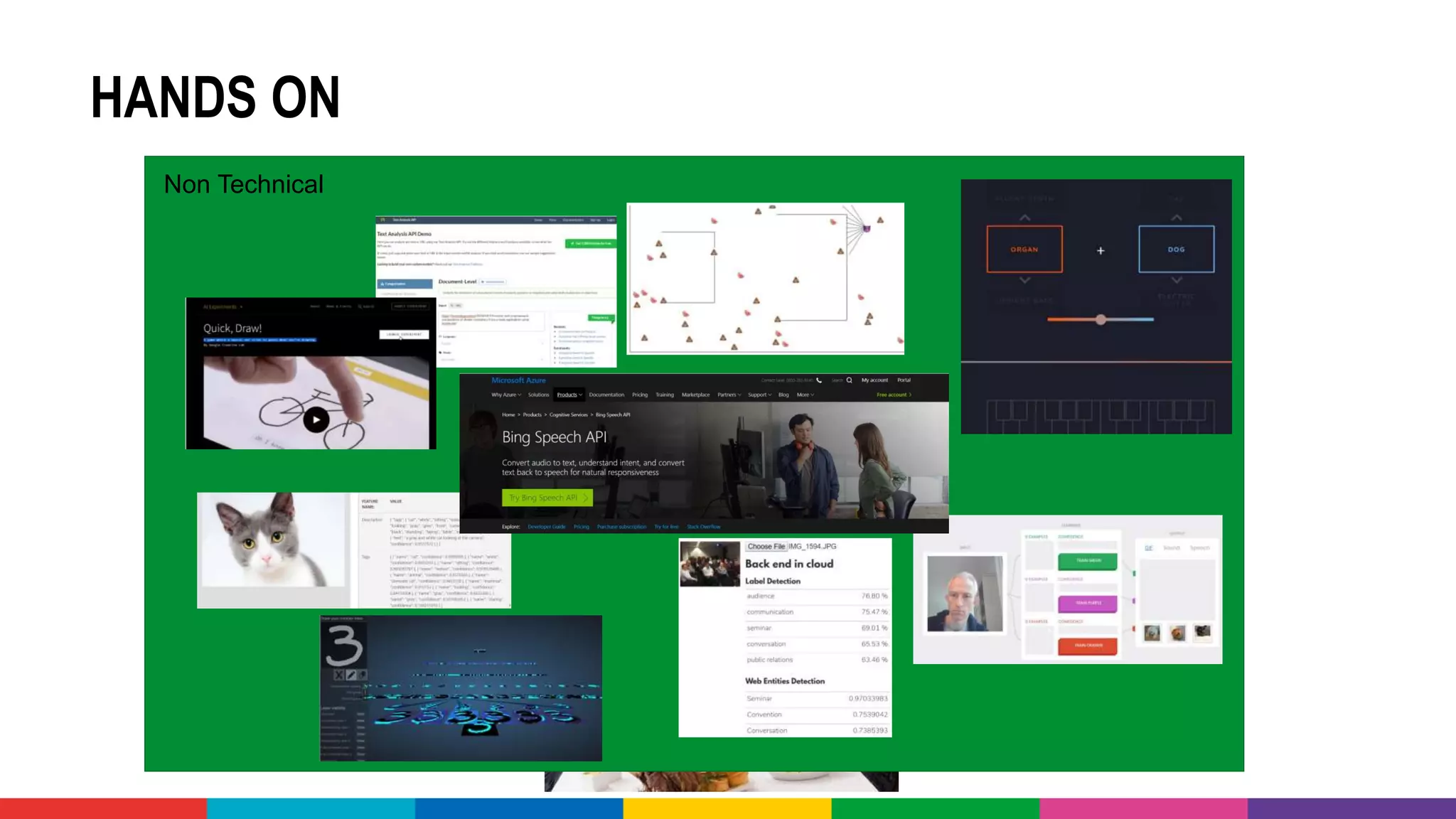
HANDS ON
• Alle materialen staan in: https://github.com/AMIS-Services
Non Technical
REFERENCES
• AI Adventures (Google) https://www.youtube.com/watch?v=RJudqel8DVA
• Twitch TV
https://www.twitch.tv/videos/179940629
and sources on GitHub:
https://github.com/sunilmallya/dl-twitch-series
• Tensor Flow & Deep Learning without a PhD (Devoxx)
https://www.youtube.com/watch?v=vq2nnJ4g6N0
• KataKoda Browser Based Runtime for TensorFlow
https://www.katacoda.com/courses/tensorflow
• And many more
#DevoxxMA

The Art of Intelligence – Introduction Machine Learning for Oracle professionals (ODevCYatra 2018, Hyderabad, Pune, Mumbai)

  • 1.
    The Art of Intelligence APractical Introduction Machine Learning 50 Shades of Data 1 Lucas Jellema, CTO of AMIS ODevC Yatra, July 2018
  • 2.
    Lucas Jellema Architect /Developer 1994 started in IT at Oracle 2002 joined AMIS Currently CTO & Solution Architect
  • 3.
    Presenting • Oracle OpenWorld •JavaOne • Oracle Code • Devoxx • Java and Oracle User Group meetups • Java Rockstar (JavaOne 2015) • OTN Yatra 2013 • ODevC Yatra 2018 50 Shades of Data 3
  • 4.
    Writing • Blogs athttp://technology.amis.nl • 1500 articles – from UI to Middle Tier, Database and Infrastructure • Articles at Medium, DZone and Oracle Technology Network • Books for McGraw Hill (Oracle Press) • Oracle ACE Director & Developer Champion 50 Shades of Data 4
  • 5.
    From The Netherlands 50Shades of Data 5
  • 10.
  • 12.
    AGENDA • What isMachine Learning? • Why could it be relevant [to you]? • What does it entail? • With which algorithms, tools and technologies? • Oracle and Machine Learning? • How do you embark on Machine Learning? • Handson • Functional/non-technical • Technical
  • 13.
    LEARNING • How dowe learn? • Try something (else) => get feedback => learn • Eventually: • We get it (understanding) so we can predict the outcome of a certain action in a new situation • Or we have experienced enough situations to predict the outcome in most situations with high confidence • Through interpolation, extrapolation, etc. • We remain clueless 13
  • 14.
    MACHINE LEARNING • AnalyzeHistorical Data (input and result – training set) to discover Patterns & Models • Iteratively apply Models to [additional] Input (test set) and compare model outcome with known actual result to improve the model • Use Model to predict outcome for entirely new data 14
  • 15.
    WHY IS ITRELEVANT (NOW)? • Data • big, fast, open • Machine Learning has become feasible and accessible • Available • Affordable (software & hardware) • Doable (Citizen Data Scientist) • Fast enough • Business Cases & Opportunities => Demands • End users, Consumers, Competitive pressure, Society
  • 16.
    WHY IS ITRELEVANT (NOW)?
  • 17.
  • 18.
    EXAMPLE USE CASES •Speech recognition • Identify churn candidates • Intent & Sentiment analysis on social media • Upsell & Cross Sell • Target Marketing • Customer Service • Chat bots & voice response systems • Predictive Maintenance • Gaming • Captcha • Medical Diagnosis • Anomaly Detection (find the odd one out) • Autonomous Cars • Voter Segment Analysis • Customer Recommendations • Smart Data Capture • Face Detection • Fraud Prevention • (really good) OCR • Traffic light control • Navigation • Should we investigate | do lab test? • Spam filtering • Propose friends | contacts • Troll detection • Auto correct • Photo Tagging and Album organization
  • 19.
    READY-TO-RUN ML APPS Someoneelse selected, configured and trained an ML model and makes it available for you to use against your own data
  • 20.
    READY TO RUNML APPS – SAAS POWERED BY ML #DevoxxMA
  • 21.
    PRODUCTS WITH MLINSIDE #DevoxxMA
  • 22.
  • 23.
    THE DATA SCIENCEWORKFLOW • Set Business Goal – research scope, objectives • Gather data • Prepare data • Cleanse, transform (wrangle), combine (merge, enrich) • Explore data • Model Data • Select model, train model, test model • Present findings and recommend next steps • Apply: • Make use of insights in business decisions • Automate Data Gathering & Preparation, Deploy Model, Embed Model in operational systems
  • 24.
    DATA DISCOVERY |EXPLORATION 24 A B C D E F G 1104534 ZTR 0.1 anijs 2 36 T 631148 ESE 132 rivier 0 21 S -3 WGN 71 appel 0 1 - 1262300 ZTR 56 zes 2 41 T 315529 HVN 1290 hamer 0 11 - 788914 ASM 676 zwaluw 0 26 T 157762 HVN 9482 wie 0 6 - 946681 DHG 42 rond 1 31 T -31539 WGN 2423 bruin 0 0 - 47338 HVN 54 hamer 0 16 P
  • 25.
    SCATTER PLOT ATTRIBUTE F(Y-AXIS)VS ATTRIBUTE A 25 0 5 10 15 20 25 30 35 40 45 -200000 0 200000 400000 600000 800000 1000000 1200000 1400000 Y-Values Y-Values
  • 26.
    SCATTER PLOT ATTRIBUTE F(Y-AXIS)VS ATTRIBUTE A 26 0 5 10 15 20 25 30 35 40 45 1965 1970 1975 1980 1985 1990 1995 2000 2005 2010 2015 Age of Lucas Jellema vs Year Y-Values
  • 27.
    DATA DISCOVERY –ATTRIBUTES IDENTIFIED 27 Time of Birth City ? ? #Kids Age Level of Education 1104534 ZTR 0.1 anijs 2 36 T 631148 ESE 132 rivier 0 21 S -3 WGN 71 appel 0 1 - 1262300 ZTR 56 zes 2 41 T 315529 HVN 1290 hamer 0 11 - 788914 ASM 676 zwaluw 0 26 T 157762 HVN 9482 wie 0 6 - 946681 DHG 42 rond 1 31 T -31539 WGN 2423 bruin 0 0 - 47338 HVN 54 hamer 0 16 P
  • 28.
    TYPES OF MACHINELEARNING • Supervised • Train and test model from known data (both features and target) • Unsupervised • Analyze unlabeled data – see if you can find anything • Semi-Supervised • Interactive flow, for example human identifying clusters • Reinforcement • Continuously improve algorithm (model) as time progresses, based on new experience
  • 29.
    MACHINE LEARNING ALGORITHMS •Clustering • Hierarchical k-means, Orthogonal Partitioning Clustering, Expectation-Maximization • Feature Extraction/Attribute Importance/Principal Component Analysis • Classification • Decision Tree, Naïve Bayes, Random Forest, Logistic Regression, Support Vector Machine • Regression • Multiple Regression, Support Vector Machine, Linear Model, LASSO, Random Forest, Ridgre Regression, Generalized Linear Model, Stepwise Linear Regression • Association & Collaborative Filtering (market basket analysis, apriori) • Reinforcement Learning – brute force, value function, Monte Carlo, temporal difference, .. • Neural network and Deep Learning with Deep Neural Network • Can be used for many different use cases
  • 30.
    MODELING PHASE • Selecta model to try to create a fit with (predict target well) • Set configuration parameters for model • Divide data in training set and test set • Train model with training set • Evaluate performance of trained model on the test set • Confusion matrix, mean square error, support, lift, false positives, false negatives • Optionally: tweak model parameters, add attributes, feed in more training data, choose different model • Eventually (hopefully): pick model plus parameters plus attributes that will reliably predict the target variable given new data • Possibly combine multiple models to collaborate on target value
  • 31.
    OPTICAL DIGIT RECOGNITION== CLASSIFICATION Predicted Actual 0 1 2 3 4 5 6 7 8 9 0 1 2 3 4 5 6 7 8 9 Naïve Bayes Decision Tree Deep Neural Network
  • 32.
    CLASSIFICATION GONE WRONG •Machine learning applied to millions of drawings on QuickDraw • to classify drawings • For example: drawings of beds • See for example: • https://aiexperiments.withgoogle.com/quick-draw
  • 33.
    MACHINE LEARNING OPERATIONAL SYSTEMS • “We have a model that will choose best chess move based on certain input”
  • 34.
    MACHINE LEARNING OPERATIONAL SYSTEMS • Discovery => Model => Deploy • “We have a model that will predict a class (classification) or value (regression) based on certain input with a meaningful degree of accuracy” – how can we make use of that model?
  • 35.
    DEPLOY MODEL ANDEXPOSE • Model is usually created on Big Data in Data Science environment using the Data Scientist’s tools • Model itself is typically fairly small • Model will be applied in operational systems against single data items (not huge collections nor the entire Big Data set) • Running the model online may not require extensive resources • Implementing the model at production run time • Export model (from Data Scientist environment) and import (into production environment) • Reimplement the model in the development technology and deploy (in the regular way) to the production environment • Expose model through API
  • 36.
  • 37.
    BIG DATA =>SMALL ML MODELS
  • 38.
    DEPLOY MODEL ANDEXPOSE REST API
  • 39.
    MODEL MANAGEMENT • Governance(new versions, testing and approval) • A/B testing • Auditing (what did the model decide and why? notifying humans? ) • Evaluation (how well did the model’s output match the reality) to help evolve the model • for example recommendations followed • Monitor self learning models (to detect rogue models)
  • 40.
    WHAT TO DOIT WITH? • Mathematics (Statistics) • Gauss (normal distribution) • Bayes’ Theorem • Euclidean Distance • Perceptron • Mean Square Error
  • 41.
    WHAT TO DOIT WITH?
  • 42.
    TOOLS AND LIBRARIESIMPLEMENTING MACHINE LEARNING ALGORITHMS +
  • 43.
  • 44.
    HOW TO PICKTOOLS FOR THE JOB • What are the jobs? • Gather data • Prepare data • Explore and (hopefully) Discover • Present • Embed & Deploy Model • What are considerations? • Volume • Speed and Time • Skills • Platform • Cost
  • 45.
  • 46.
    POPULAR FRAMEWORKS &LIBRARIES • TensorFlow • MXNet • Caffe • DL4J • Keras • … many more… Oracle Database Option Advanced Analytics #DevoxxMA
  • 47.
    NOTEBOOK – THE LABJOURNAL FROM THE DATALAB • Common format for data exploration and presentation • User friendly interface on top of powerful technologies • Most popular implementations • Jupyter (fka IPython) • Apache Zeppelin • Spark Notebook • Beaker • SageMath (SageMathCloud => CoCalc) • Oracle Machine Learning Notebook UI • Try out Jupyter at: https://mybinder.org/
  • 48.
  • 49.
    OPEN DATA • Governmentsand NGOs, scientific and even commercial organizations are publishing data • Inviting anyone who wants to join in to help make sense of the data – understand driving factors, identify categories, help predict • Many areas • Economy, health, public safety, sports, traffic & transportation, games, environment, maps, …
  • 50.
    OPEN DATA –SOME EXAMPLES • Kaggle - Data Sets and [Samples of] Data Discovery: www.kaggle.com • India Government - data.gov.in • US, EU and UK Government Data: data.gov, open-data.europa.eu and data.gov.uk • Open Images Data Set: www.image-net.org • Open Data From World Bank: data.worldbank.org • Historic Football Data: api.football-data.org • New York City Open Data - opendata.cityofnewyork.us • Airports, Airlines, Flight Routes: openflights.org • Open Database – machine counterpart to Wikipedia: www.wikidata.org • Google Audio Set (manually annotated audio events) - research.google.com/audioset/ • Movielens - Movies, viewers and ratings: files.grouplens.org/datasets/movielens/
  • 51.
    WHAT IS HADOOP? •Big Data means Big Computing and Big Storage • Big requires scalable => horizontal scale out • Moving data is very expensive (network, disk IO) • Rather than move data to processor – move processing to data: distributed processing • Horizontal scale out => Hadoop: distributed data & distributed processing • HDFS – Hadoop Distributed File System • Map Reduce – parallel, distributed processing • Map-Reduce operates on data locally, then persists and aggregates results
  • 52.
    WHAT IS SPARK? •Developing and orchestrating Map-Reduce on Hadoop is not simple • Running jobs can be slow due to frequent disk writing • Spark is for managing and orchestrating distributed processing on a variety of cluster systems • with Hadoop as the most obvious target • through APIs in Java, Python, R, Scala • Spark uses lazy operations and distributed in-memory data structures – offering much better performance • Through Spark – cluster based processing can be used interactively • Spark has additional modules that leverage distributed processing for running prepackaged jobs (SQL, Graph, ML, …)
  • 53.
  • 54.
    EXAMPLE RUNNING AGAINSTSPARK • https://github.com/jadianes/spark-movie-lens/blob/master/notebooks/building-recommender.ipynb
  • 55.
    WHAT IS ORACLEDOING AROUND MACHINE LEARNING? • Oracle Advanced Analytics in Oracle Database • Data Mining, Enterprise R • Text (ESA), Spatial, Graph • SQL
  • 56.
  • 57.
    DEMO: CONFERENCE ABSTRACT CLASSIFICATIONCHALLENGE • Take all conference abstracts for • Train a Classification Model on picking the Conference Track • Based on Title, Summary [, Speaker, Level,…] • Use the Model to pick the Track for sessions at
  • 58.
    DEMONSTRATION OF ORACLEADVANCED ANALYTICS • Using Text Mining and Naives Bayes Data Mining Classification • Train model for classifying conference abstracts into tracks • Use model to propose a track for new abstracts • Steps • Gather data • Import, cleanse, enrich, … • Prepare training set and test set • Select and configure model • Combining Text and Mining using Naive Bayes • Train model • Test and apply model
  • 59.
  • 60.
  • 61.
  • 62.
    ONCE THE INSTANCEIS RUNNING...
  • 63.
    USE AS ANYORACLE DATABASE INSTANCE – LOCAL, ON PREMISES, ... – ACCESSIBLE VIA SQL*NET
  • 64.
    TRAIN MODEL DECLARE xformlist dbms_data_mining_transform.TRANSFORM_LIST; BEGIN DBMS_DATA_MINING_TRANSFORM.SET_TRANSFORM(xformlist, 'abstract', NULL, 'abstract', NULL, 'TEXT(TOKEN_TYPE:NORMAL)'); DBMS_DATA_MINING.CREATE_MODEL ( model_name => 'SESSION_CLASS_NB' , mining_function => dbms_data_mining.classification , data_table_name => 'J1_SESSIONS' , case_id_column_name => 'session_title' , target_column_name => 'session_track' , settings_table_name => 'session_class_nb_settings' , xform_list => xformlist); END;
  • 65.
  • 66.
  • 67.
  • 68.
    BIG DATA SQL ORACLEDATABASE AS SINGLE POINT OF ENTRY
  • 69.
    MANY CLOUD SERVICESAROUND BIG DATA & [PREDICTIVE] ANALYTICS & MACHINE LEARNING 70
  • 70.
    WHAT IS ORACLEDOING AROUND MACHINE LEARNING? • Big Data Discovery (fka Endeca), Big Data Preparation and Big Data Compute • Big Data Appliance • Data Visualization Cloud • Analytics Cloud • Industry specific Analytics Clouds (Sales, Marketing, HCM) on top of SaaS • RTD – Real Time Decisions • DaaS • Oracle Labs (labs.oracle.com) • Machine Learning Research Group (link) • Machine Learning CS – “Oracle Notebook”
  • 71.
    ORACLE AI PLATFORMCLOUD SERVICE (COMING SHORTLY)
  • 72.
    HUMANS LEARNING MACHINE LEARNING:YOUR FIRST STEPS #DevoxxMA
  • 73.
    HUMANS LEARNING MACHINELEARNING: YOUR FIRST STEPS • Jupyter Notebooks and Python – https://mybinder.org/ • HortonWorks Sandbox VM – Hadoop & Spark & Hive, Ambari • DataBricks Cloud Environment with Apache Spark (free trial) • KataKoda – tutorials & live environment for TensorFlow • Oracle Big Data Lite – Prebuilt Virtual Machine • Data Visualization Desktop – ready to run desktop tool • Tutorials, Courses (Udacity, Coursera, edX) • Books • Introducing Data Science • Learning Apache Spark 2 • Python Machine Learning
  • 74.
    HANDS ON MACHINELEARNING (BABY STEPS) • All materials are in: https://github.com/AMIS-Services Non Technical Technical Decision Trees
  • 75.
    SUMMARY • IoT, BigData, Machine Learning => AI • Recent and Rapid Democratization of Machine Learning • Algorithms, Storage and Compute Resources, High Level Machine Learning Frameworks, Education resources , Open Data, Trained ML Models, Out of the Box SaaS capabilities – powered by ML • Produce business value today • Machine Learning by computers helps us(ers) understand historic data and apply that insight to new data • Developers have to learn how to incorporate Machine Learning into their applications – for smarter Uis, more automation, faster (p)reactions
  • 76.
    SUMMARY • R andPython are most popular technologies for data exploration and ML model discovery [on small subsets of Big Data] • Apache Spark (on Hadoop) is frequently used to powercrunch data (wrangling) and run ML models on Big Data sets • Notebooks are a popular vehicle in the Data Science lab • To explore and report • Oracle is quite active on Machine Learning • Power PaaS and SaaS with ML • Provide us with the Machine Learning Data Lab & Run Time (on the cloud) • Getting started on Machine Learning is fun, smart & well supported
  • 77.
    Thank you! • Blog:technology.amis.nl • Email: lucas.jellema@amis.nl • : @lucasjellema • : lucas-jellema • : www.amis.nl, info@amis.nl
  • 78.
    HANDS ON • Allematerialen staan in: https://github.com/AMIS-Services Non Technical
  • 79.
    REFERENCES • AI Adventures(Google) https://www.youtube.com/watch?v=RJudqel8DVA • Twitch TV https://www.twitch.tv/videos/179940629 and sources on GitHub: https://github.com/sunilmallya/dl-twitch-series • Tensor Flow & Deep Learning without a PhD (Devoxx) https://www.youtube.com/watch?v=vq2nnJ4g6N0 • KataKoda Browser Based Runtime for TensorFlow https://www.katacoda.com/courses/tensorflow • And many more #DevoxxMA

Editor's Notes

  • #8 Why do we study history? To understand the present and predict the future (from current events)
  • #16 IoT Social Media
  • #17 IoT Social Media
  • #30 Market Basket Analysis: https://www.linkedin.com/pulse/using-machine-learning-market-basket-analysis-thomsen
  • #32 http://yann.lecun.com/exdb/mnist/ MNIST – handwritten images
  • #33 https://aiexperiments.withgoogle.com/quick-draw
  • #36 https://www.slideshare.net/databricks/apache-spark-model-deployment
  • #39 https://www.slideshare.net/databricks/apache-spark-model-deployment
  • #40 https://www.slideshare.net/databricks/apache-spark-model-deployment
  • #48 https://www.slideshare.net/AshishBansal17/tensorflow-vs-mxnet
  • #50 https://github.com/lucasjellema/theArtOfMachineLearning/blob/master/LinearRegression.ipynb https://nbviewer.jupyter.org/github/lucasjellema/devoxx17-intro-machine-learning/blob/master/LinearRegression.ipynb https://github.com/lucasjellema/jupyter-notebook-eredivisie/blob/master/EredivisieResults_2016_2017.ipynb https://github.com/jadianes/spark-movie-lens/blob/master/notebooks/building-recommender.ipynb https://github.com/justmarkham/DAT4/blob/master/notebooks/08_linear_regression.ipynb
  • #51 https://openflights.org/data.html - airports, airlines, flight routes Google Audio Set - https://research.google.com/audioset/ (A large-scale dataset of manually annotated audio events) Open Images Data Set - https://github.com/openimages/dataset , www.image-net.org http://api.football-data.org/index UK Data - https://data.gov.uk/ Open Data Sets - https://www.kaggle.com/datasets CBS Open Data - https://www.cbs.nl/nl-nl/onze-diensten/open-data Open Data Sets for Deep learning - https://deeplearning4j.org/opendata Data.gov The home of the US Government’s open data https://open-data.europa.eu/ The home of the European Commission’s open data https://www.wikidata.org (in part originated out of Freebase.org An open database that retrieves its information from sites like Wikipedia, MusicBrains, and the SEC archive ) Data.worldbank.org Open data initiative from the World Bank Aiddata.org Open data for international development Open.fda.gov Open data from the US Food and Drug Administration Google Knowledge Graph API - https://developers.google.com/knowledge-graph/ Detroit Open Data Portal https://data.detroitmi.gov/ Example: Detroit Police Crime statistics: https://data.detroitmi.gov/Public-Safety/-Archived-All-Crime-Incidents-2009-May-5-2017/b4hw-v6w2
  • #52 https://openflights.org/data.html - airports, airlines, flight routes Google Audio Set - https://research.google.com/audioset/ (A large-scale dataset of manually annotated audio events) Open Images Data Set - https://github.com/openimages/dataset , www.image-net.org http://api.football-data.org/index http://files.grouplens.org/datasets/movielens/ml-latest-small-README.html UK Data - https://data.gov.uk/ Open Data Sets - https://www.kaggle.com/datasets CBS Open Data - https://www.cbs.nl/nl-nl/onze-diensten/open-data Open Data Sets for Deep learning - https://deeplearning4j.org/opendata Data.gov The home of the US Government’s open data https://open-data.europa.eu/ The home of the European Commission’s open data https://www.wikidata.org (in part originated out of Freebase.org An open database that retrieves its information from sites like Wikipedia, MusicBrains, and the SEC archive ) Data.worldbank.org Open data initiative from the World Bank Aiddata.org Open data for international development Open.fda.gov Open data from the US Food and Drug Administration Google Knowledge Graph API - https://developers.google.com/knowledge-graph/ Detroit Open Data Portal https://data.detroitmi.gov/ Example: Detroit Police Crime statistics: https://data.detroitmi.gov/Public-Safety/-Archived-All-Crime-Incidents-2009-May-5-2017/b4hw-v6w2
  • #56 https://github.com/jadianes/spark-movie-lens/blob/master/notebooks/building-recommender.ipynb
  • #57 https://www.oracle.com/big-data/big-data-discovery/index.html https://labs.oracle.com/pls/apex/f?p=labs:49:::::P49_PROJECT_ID:7 https://technology.amis.nl/2004/10/16/hidden-plsql-gem-in-10g-dbms_frequent_itemset-for-plsql-based-data-mining/ http://oracledmt.blogspot.nl/2006/05/sql-of-analytics-1-data-mining.html
  • #72 https://www.oracle.com/big-data/big-data-discovery/index.html https://labs.oracle.com/pls/apex/f?p=labs:49:::::P49_PROJECT_ID:7
  • #75 http://tmpnb.org http://www.oracle.com/technetwork/database/bigdata-appliance/oracle-bigdatalite-2104726.html https://www.udacity.com/course/intro-to-machine-learning--ud120 https://www.coursera.org/learn/machine-learning#%20 https://www.edx.org/course/machine-learning-columbiax-csmm-102x-0 https://technology.amis.nl/2017/05/06/the-hello-world-of-machine-learning-with-python-pandas-jupyter-doing-iris-classification-based-on-quintessential-set-of-flower-data/ https://github.com/rhiever/Data-Analysis-and-Machine-Learning-Projects/blob/master/example-data-science-notebook/Example%20Machine%20Learning%20Notebook.ipynb https://databricks.com/try-databricks https://hortonworks.com/products/sandbox/ http://www.oracle.com/technetwork/middleware/oracle-data-visualization/downloads/oracle-data-visualization-desktop-2938957.html