INTRODUCTION TO COMPUTER NETWORK
A computer network is a group of computers linked to each other
that enables the computer to communicate with another computer
and share their resources, data, and applications.
A computer network can be categorized by their size. A computer
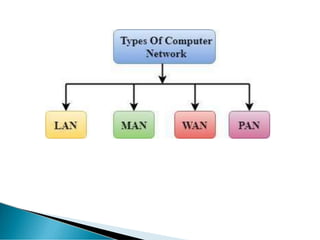
network is mainly of four types:
LAN(Local Area Network)
PAN(Personal Area Network)
MAN(Metropolitan Area Network)
WAN(Wide Area Network)
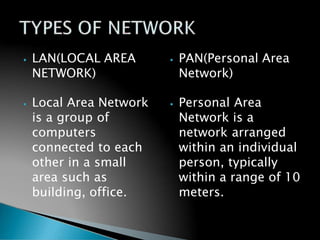
⦁ LAN(LOCAL AREA
NETWORK)
⦁ Local Area Network
is a group of
computers
connected to each
other in a small
area such as
building, office.
⦁ PAN(Personal Area
Network)
⦁ Personal Area
Network is a
network arranged
within an individual
person, typically
within a range of 10
meters.
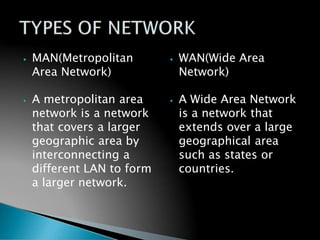
⦁ MAN(Metropolitan
Area Network)
⦁ A metropolitan area
network is a network
that covers a larger
geographic area by
interconnecting a
different LAN to form
a larger network.
⦁ WAN(Wide Area
Network)
⦁ A Wide Area Network
is a network that
extends over a large
geographical area
such as states or
countries.
Topology defines the structure of the network of how all
the components are interconnected to each other. There
are two types of topology: physical and logical topology.
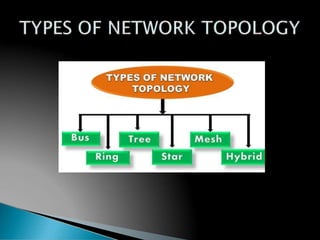
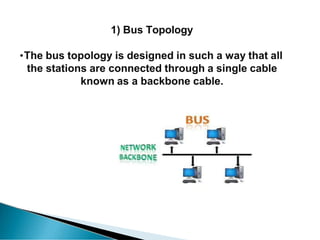
1) Bus Topology
•The bus topology is designed in such a way that all
the stations are connected through a single cable
known as a backbone cable.
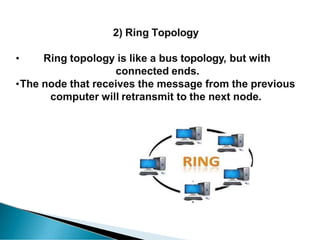
2) Ring Topology
• Ring topology is like a bus topology, but with
connected ends.
•The node that receives the message from the previous
computer will retransmit to the next node.
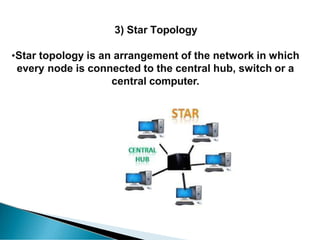
3) Star Topology
•Star topology is an arrangement of the network in which
every node is connected to the central hub, switch or a
central computer.
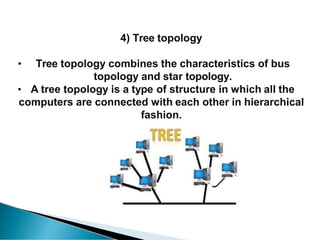
4) Tree topology
• Tree topology combines the characteristics of bus
topology and star topology.
• A tree topology is a type of structure in which all the
computers are connected with each other in hierarchical
fashion.
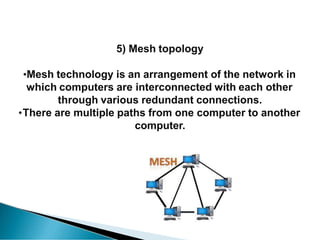
5) Mesh topology
•Mesh technology is an arrangement of the network in
which computers are interconnected with each other
through various redundant connections.
•There are multiple paths from one computer to another
computer.
OSI MODEL TCP / IP MODEL
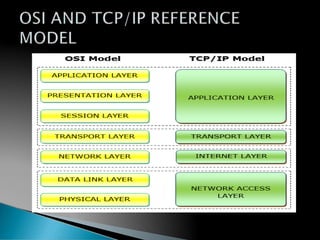
⦁ OSI (Open Systems
Interconnection) is a
reference model for how
applications communicate
over a network. This model
focuses on providing a
visual design of how each
communications layer is
built on top of the other,
starting with the physical
cabling, all the way to the
application that's trying to
communicate with other
devices on a network.
⦁ TCP/IP (Transmission
Control Protocol/Internet
Protocol) is a suite of
communication protocols
that define the standards
for transmitting data
over computer networks,
including the internet.
The TCP/IP protocol is
the foundation of the
internet and enables
devices to communicate
with each other using a
common language.
OSI MODEL TCP / IP MODEL
⦁ OSI model is a generic
model that is based
upon functionalities of
each layer
⦁ OSI model
distinguishes the three
concepts, namely,
services, interfaces,
and protocols.
⦁ TCP/IP model is a
protocol-oriented
standard.
⦁ TCP/IP does not have a
clear distinction
between these three.
PREPARED BY : HARSH SHARMA
ROLL NO. : 22211
THANK YOU
PREPARED BY : AKSHAY
ROLL NO. : 22234

Introduction To Computer Network.pptx

  • 1.
  • 2.
    A computer networkis a group of computers linked to each other that enables the computer to communicate with another computer and share their resources, data, and applications. A computer network can be categorized by their size. A computer network is mainly of four types: LAN(Local Area Network) PAN(Personal Area Network) MAN(Metropolitan Area Network) WAN(Wide Area Network)
  • 4.
    ⦁ LAN(LOCAL AREA NETWORK) ⦁Local Area Network is a group of computers connected to each other in a small area such as building, office. ⦁ PAN(Personal Area Network) ⦁ Personal Area Network is a network arranged within an individual person, typically within a range of 10 meters.
  • 5.
    ⦁ MAN(Metropolitan Area Network) ⦁A metropolitan area network is a network that covers a larger geographic area by interconnecting a different LAN to form a larger network. ⦁ WAN(Wide Area Network) ⦁ A Wide Area Network is a network that extends over a large geographical area such as states or countries.
  • 6.
    Topology defines thestructure of the network of how all the components are interconnected to each other. There are two types of topology: physical and logical topology.
  • 8.
    1) Bus Topology •Thebus topology is designed in such a way that all the stations are connected through a single cable known as a backbone cable.
  • 9.
    2) Ring Topology •Ring topology is like a bus topology, but with connected ends. •The node that receives the message from the previous computer will retransmit to the next node.
  • 10.
    3) Star Topology •Startopology is an arrangement of the network in which every node is connected to the central hub, switch or a central computer.
  • 11.
    4) Tree topology •Tree topology combines the characteristics of bus topology and star topology. • A tree topology is a type of structure in which all the computers are connected with each other in hierarchical fashion.
  • 12.
    5) Mesh topology •Meshtechnology is an arrangement of the network in which computers are interconnected with each other through various redundant connections. •There are multiple paths from one computer to another computer.
  • 13.
    OSI MODEL TCP/ IP MODEL ⦁ OSI (Open Systems Interconnection) is a reference model for how applications communicate over a network. This model focuses on providing a visual design of how each communications layer is built on top of the other, starting with the physical cabling, all the way to the application that's trying to communicate with other devices on a network. ⦁ TCP/IP (Transmission Control Protocol/Internet Protocol) is a suite of communication protocols that define the standards for transmitting data over computer networks, including the internet. The TCP/IP protocol is the foundation of the internet and enables devices to communicate with each other using a common language.
  • 14.
    OSI MODEL TCP/ IP MODEL ⦁ OSI model is a generic model that is based upon functionalities of each layer ⦁ OSI model distinguishes the three concepts, namely, services, interfaces, and protocols. ⦁ TCP/IP model is a protocol-oriented standard. ⦁ TCP/IP does not have a clear distinction between these three.
  • 16.
    PREPARED BY :HARSH SHARMA ROLL NO. : 22211 THANK YOU PREPARED BY : AKSHAY ROLL NO. : 22234