Health Education Theories

 An overview of the foundational
    theories utilized in Health
            Education
Theories
Several theories may be applied when
  teaching Health Education; they include:
• Locus of Control
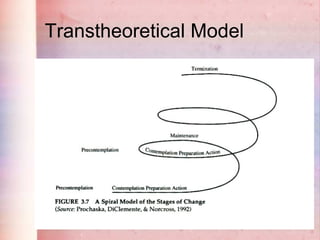
• Transtheoretical Model of Change/Stages of
  Change
• Health Belief Model
• Social Learning Theory/Social Cognitive
  Theory
• Theory of Reasoned Action
• Diffusion
Locus of Control
• An individual’s beliefs or perceptions related to
  their abilities to influence their personal health
  and health outcomes
   – Example: Control, or lack of control over personal health
• Primarily, individuals believe personal health is
  a matter of personal control (internal locus) or
  factors outside of personal control (external)
   – Internal: personal choices, behaviors, habits, self-care,
     positive attitude, hope
   – External: fate, luck, chance, “powerful others”
• In general, the more internally oriented the
  individual, the more positive their health
  outcomes, whereas external individuals tend to
  experience poorer health outcomes
Transtheoretical Model of
 Change/Stages of Change
• Individuals readiness to change/attempt to
  change is based upon their
  placement/positioning within the model; a non-
  linear process in which the person may enter at
  various points and recycle through the process
• 5 Stages:
  –   Stage 1: Pre-contemplation
  –   Stage 2: Contemplation
  –   Stage 3: Decision
  –   Stage 4: Action
  –   Stage 5: Maintenance
Transtheoretical Model
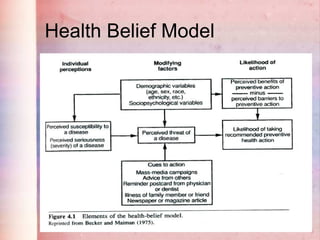
Health Belief Model
•    An individual’s health-related behavior
     depends on the perception of four
     critical areas:
    1. Perceived susceptibility to illness
    2. The perceived potential severity of illness
    3. The perceived benefits of taking
       preventative action
    4. The perceived barriers to taking that action
•    Basically scaring someone into action
     before it’s too late
Health Belief Model
Social Learning Theory
• Behavioral change is affected by:
  – Environmental influences
  – Personal factors
  – Attributes of the behavior itself
• Most importantly, a person must believe in
  his or her capability to perform the behavior
  (self-efficacy)
• Must also perceive an incentive to do so
  (positive expectations outweigh negative)
• The immediate or long-term benefits must
  be valued
Social Learning Theory
•    Self-efficacy can be increased by
     providing the following environment:
    1.   Mastery experience
    2.   Clear instructions
    3.   Skill development
    4.   Modeling desired behavior
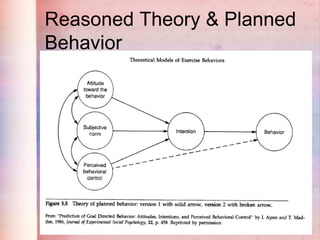
Theory of Reasoned Action
•    Individual performance of a given
     behavior is primarily determined by a
     person’s intention to perform that
     behavior.
•    This intention is determined by two major
     factors:
    1. The person’s attitude toward the behavior
       (beliefs about the outcomes of the behavior
       and value of these outcomes)
    2. The influence of the person’s societal
       environment or subjective norm (beliefs about
       what others think the person should do)
Reasoned Theory & Planned
Behavior
Diffusion
• New ideas/practices are introduced,
  accepted and spread throughout a
  community/society/group by the
  actions/inactions of key ‘early adopters’ who
  are seen as acceptable/desirable
• For diffusion to occur, there must be:
  – An innovation
  – A person who knows about the innovation:
     • Two types: Interpersonal and Mass Media
  – Another person who does not yet know about the
    innovation
Diffusion
• Rate of Adoption: is contingent on the
  following:
  – Relative advantage: innovation is seen as
    improvement or better
  – Compatibility: fit; innovation is in keeping with
    existing values, habits, experience, need
  – Complexity: ease of use v. difficulty in use or
    understanding
  – Trialability: try it out first; samples, free
    introductory offer, money back guarantees
  – Observability: visibility of results; can
    see/experience results; testimonials
THE END

Health education theories

  • 1.
    Health Education Theories An overview of the foundational theories utilized in Health Education
  • 2.
    Theories Several theories maybe applied when teaching Health Education; they include: • Locus of Control • Transtheoretical Model of Change/Stages of Change • Health Belief Model • Social Learning Theory/Social Cognitive Theory • Theory of Reasoned Action • Diffusion
  • 3.
    Locus of Control •An individual’s beliefs or perceptions related to their abilities to influence their personal health and health outcomes – Example: Control, or lack of control over personal health • Primarily, individuals believe personal health is a matter of personal control (internal locus) or factors outside of personal control (external) – Internal: personal choices, behaviors, habits, self-care, positive attitude, hope – External: fate, luck, chance, “powerful others” • In general, the more internally oriented the individual, the more positive their health outcomes, whereas external individuals tend to experience poorer health outcomes
  • 4.
    Transtheoretical Model of Change/Stages of Change • Individuals readiness to change/attempt to change is based upon their placement/positioning within the model; a non- linear process in which the person may enter at various points and recycle through the process • 5 Stages: – Stage 1: Pre-contemplation – Stage 2: Contemplation – Stage 3: Decision – Stage 4: Action – Stage 5: Maintenance
  • 5.
  • 6.
    Health Belief Model • An individual’s health-related behavior depends on the perception of four critical areas: 1. Perceived susceptibility to illness 2. The perceived potential severity of illness 3. The perceived benefits of taking preventative action 4. The perceived barriers to taking that action • Basically scaring someone into action before it’s too late
  • 7.
  • 8.
    Social Learning Theory •Behavioral change is affected by: – Environmental influences – Personal factors – Attributes of the behavior itself • Most importantly, a person must believe in his or her capability to perform the behavior (self-efficacy) • Must also perceive an incentive to do so (positive expectations outweigh negative) • The immediate or long-term benefits must be valued
  • 9.
    Social Learning Theory • Self-efficacy can be increased by providing the following environment: 1. Mastery experience 2. Clear instructions 3. Skill development 4. Modeling desired behavior
  • 10.
    Theory of ReasonedAction • Individual performance of a given behavior is primarily determined by a person’s intention to perform that behavior. • This intention is determined by two major factors: 1. The person’s attitude toward the behavior (beliefs about the outcomes of the behavior and value of these outcomes) 2. The influence of the person’s societal environment or subjective norm (beliefs about what others think the person should do)
  • 11.
    Reasoned Theory &Planned Behavior
  • 12.
    Diffusion • New ideas/practicesare introduced, accepted and spread throughout a community/society/group by the actions/inactions of key ‘early adopters’ who are seen as acceptable/desirable • For diffusion to occur, there must be: – An innovation – A person who knows about the innovation: • Two types: Interpersonal and Mass Media – Another person who does not yet know about the innovation
  • 13.
    Diffusion • Rate ofAdoption: is contingent on the following: – Relative advantage: innovation is seen as improvement or better – Compatibility: fit; innovation is in keeping with existing values, habits, experience, need – Complexity: ease of use v. difficulty in use or understanding – Trialability: try it out first; samples, free introductory offer, money back guarantees – Observability: visibility of results; can see/experience results; testimonials
  • 14.