Upstreaming 201
Mathieu Poirier
ENGINEERS
AND DEVICES
WORKING
TOGETHER
Upstreaming 201
● Highlights from Upstreaming 101
● Get you the right tools to start contributing upstream
● Things to keep in mind when preparing a patch
● Follow-up after a patchset has been submitted
● Overview of commonly used tags
● Any question you may have about upstreaming code
ENGINEERS AND DEVICES
WORKING TOGETHER
Highlights from Upstreaming 101
● Have the right mindset
○ Be Altruist → we win as a community, not as individuals
○ Be Polite → people genuinely want to help
○ Be Patient → the community has no deadline
○ Be Factual → why your submission is important, no “hunch”
○ Be Humble → bragging is unpleasant and doesn’t lead anywhere
○ Be open to change → you will likely have to rewrite/amend your code several times
● Upstreaming 101/201 is a summary of these documents:
○ Documentation/process/*.rst
○ Documentation/process/submitting-patches.rst
● Read those documents before trying to upstream anything
ENGINEERS AND DEVICES
WORKING TOGETHER
A Word About your Name in the Community
● Email/patches you send out stay forever (see marc.info mailing list archive)
● Maintainers are very busy→ Don’t waste their time
● Be mindful of what you do→ Don’t pick fight with people
● Keep people on the CC list and avoid point-to-point discussions
● Once you’re in the blackbook, it is hard to get out of it
http://lists.openwall.net/netdev/2016/03/16/164
ENGINEERS AND DEVICES
WORKING TOGETHER
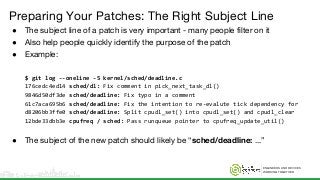
Preparing Your Patches: The Right Subject Line
● The subject line of a patch is very important - many people filter on it
● Also help people quickly identify the purpose of the patch
● Example:
$ git log --oneline -5 kernel/sched/deadline.c
176cedc4ed14 sched/dl: Fix comment in pick_next_task_dl()
9846d50df3de sched/deadline: Fix typo in a comment
61c7aca695b6 sched/deadline: Fix the intention to re-evalute tick dependency for
d8206bb3ffe0 sched/deadline: Split cpudl_set() into cpudl_set() and cpudl_clear
12bde33dbb3e cpufreq / sched: Pass runqueue pointer to cpufreq_update_util()
● The subject of the new patch should likely be “sched/deadline: ...”
ENGINEERS AND DEVICES
WORKING TOGETHER
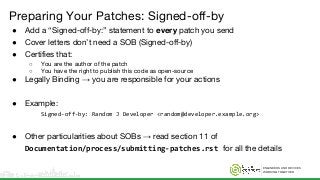
Preparing Your Patches: Signed-off-by
● Add a “Signed-off-by:” statement to every patch you send
● Cover letters don’t need a SOB (Signed-off-by)
● Certifies that:
○ You are the author of the patch
○ You have the right to publish this code as open-source
● Legally Binding → you are responsible for your actions
● Example:
Signed-off-by: Random J Developer <random@developer.example.org>
● Other particularities about SOBs → read section 11 of
Documentation/process/submitting-patches.rst for all the details
ENGINEERS AND DEVICES
WORKING TOGETHER
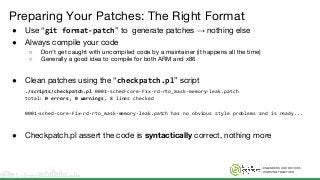
Preparing Your Patches: The Right Format
● Use “git format-patch” to generate patches → nothing else
● Always compile your code
○ Don’t get caught with uncompiled code by a maintainer (it happens all the time)
○ Generally a good idea to compile for both ARM and x86
● Clean patches using the “checkpatch.pl” script
./scripts/checkpatch.pl 0001-sched-core-Fix-rd-rto_mask-memory-leak.patch
total: 0 errors, 0 warnings, 8 lines checked
0001-sched-core-Fix-rd-rto_mask-memory-leak.patch has no obvious style problems and is ready...
● Checkpatch.pl assert the code is syntactically correct, nothing more
ENGINEERS AND DEVICES
WORKING TOGETHER
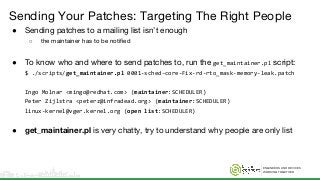
Sending Your Patches: Targeting The Right People
● Sending patches to a mailing list isn’t enough
○ the maintainer has to be notified
● To know who and where to send patches to, run the get_maintainer.pl script:
$ ./scripts/get_maintainer.pl 0001-sched-core-Fix-rd-rto_mask-memory-leak.patch
Ingo Molnar <mingo@redhat.com> (maintainer:SCHEDULER)
Peter Zijlstra <peterz@infradead.org> (maintainer:SCHEDULER)
linux-kernel@vger.kernel.org (open list:SCHEDULER)
● get_maintainer.pl is very chatty, try to understand why people are only list
ENGINEERS AND DEVICES
WORKING TOGETHER
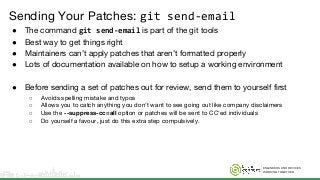
Sending Your Patches: git send-email
● The command git send-email is part of the git tools
● Best way to get things right
● Maintainers can’t apply patches that aren’t formatted properly
● Lots of documentation available on how to setup a working environment
● Before sending a set of patches out for review, send them to yourself first
○ Avoids spelling mistake and typos
○ Allows you to catch anything you don’t want to see going out like company disclaimers
○ Use the --suppress-cc=all option or patches will be sent to CC’ed individuals
○ Do yourself a favour, just do this extra step compulsively.
ENGINEERS AND DEVICES
WORKING TOGETHER
I Have Sent My Patches For Review - Now What?
● Double check on the mailing that patches have been published
● Most maintainers will reply within 7 days
○ It can take longer based on the maintainer’s schedule
● If you don’t get anything back within 7 days
○ Look for the maintainer on the mailing list - good indication on how busy they are
○ Gentle ping:
■ Politely ask the maintainer if they have seen your patches
■ Politely ask the maintainer if there is anything you can do to make reviewing your patches easier for
them
■ Don’t be surprised if they are annoyed by your ping
● It is always a very bad idea to pressure a maintainer
○ The community is not bound by internal company deadlines
ENGINEERS AND DEVICES
WORKING TOGETHER
What To Do With Comments?
● NEVER ignore comments that were received
● If you don’t understand a comment, ask questions
○ It is better to ask questions then sending a new revision with the same problems
● If you don’t agree with a comment, justify your approach
● If people like your code they may reply with “Reviewed-by” or “Acked-by”
○ Don’t forget to take note of them
○ Those are needed for your next revision
○ Greatly motivates a maintainer to accept your code
ENGINEERS AND DEVICES
WORKING TOGETHER
Sending A New Revisions
● When all comments have been addressed, it is time to send another revision
● It greatly helps the reviewers to add a version tag in the header:
[PATCH v2] soc: ti: knav_dma: Fix some error handling
● Revision number can be added by hand or by using the “--subject-prefix”
option when using git format-patch:
$ git format-patch --subject-prefix=”PATCH v2” ....
● As a rule of thumb, wait 24 hours between revisions
○ Avoids flooding the mailing list
○ Reduces the probability of people reviewing the wrong version
○ Gives you time to think about your code again
ENGINEERS AND DEVICES
WORKING TOGETHER
When Your Patch Gets Accepted
● Most subsystem maintainers will notify you via email
● Others will simply add your patch to their tree without notification
● It is your responsibility to check that everything is working properly
○ In linux-next
○ In the next cycle when -rc1 is released
ENGINEERS AND DEVICES
WORKING TOGETHER
Sending More Than One Patch In A Set
● Big patches are always harder to get accepted
○ Huge burden on the reviewers
○ You will likely be told to split a big patch before it can be reviewed
● Split patches in small chunks
○ Each chunk needs to be self-contained
○ Each chunk needs to be bisectable (see git bisect for details)
● When working with a feature that spans multiple patches:
○ Always use a cover letter → “git format-patch --cover-letter ....”
○ Patch version also applies when working with patchsets
ENGINEERS AND DEVICES
WORKING TOGETHER
A Word On “Reviewed-by” And “Acked-by”
● As you become more familiar with a subsystem you may start reviewing other
peoples’ work (greatly encouraged)
● Be careful when using the “Reviewed-by” and “Acked-by” tags
● If you don’t understand the difference, you may convey something you did not
intend to.
ENGINEERS AND DEVICES
WORKING TOGETHER
The “Reviewed-by” Tag
● The strongest way to signify your approval and esteem of a patch
● Indicates that a reviewer has spent time to go through a patch and understand
what it does in details
● Implies the reviewer has knowledge of the subsystem and the patch won’t
break existing code
● May entice a maintainer to spend less time on a patch then they would
normally have done
○ As such, if something goes wrong you may have to answer questions
ENGINEERS AND DEVICES
WORKING TOGETHER
The “Acked-by” tag
● Can be strong or weak, it depends on who gives it
● If you are not the maintainer of the subsystem, an “Acked-by” stipulate that
you have reviewed the code - nothing more (weak semantic)
● When given by the maintainer of a subsystem, an “Acked-by” means the code
can be merged by someone else (strong semantic)
ENGINEERS AND DEVICES
WORKING TOGETHER
Bonus: The “Tested-by” tag
● Very good way to make news friends in the open source community
● Gets you familiar with a subsystem
● Allows you to see how small changes affect things
● Really helps maintainers having greater confidence in a patch
ENGINEERS AND DEVICES
WORKING TOGETHER
Your Turn To Talk
Questions ?
Thank You
#BUD17
For further information: www.linaro.org
BUD17 keynotes and videos on: connect.linaro.org

BUD17-TR03: Upstreaming 201

  • 1.
  • 2.
    ENGINEERS AND DEVICES WORKING TOGETHER Upstreaming 201 ●Highlights from Upstreaming 101 ● Get you the right tools to start contributing upstream ● Things to keep in mind when preparing a patch ● Follow-up after a patchset has been submitted ● Overview of commonly used tags ● Any question you may have about upstreaming code
  • 3.
    ENGINEERS AND DEVICES WORKINGTOGETHER Highlights from Upstreaming 101 ● Have the right mindset ○ Be Altruist → we win as a community, not as individuals ○ Be Polite → people genuinely want to help ○ Be Patient → the community has no deadline ○ Be Factual → why your submission is important, no “hunch” ○ Be Humble → bragging is unpleasant and doesn’t lead anywhere ○ Be open to change → you will likely have to rewrite/amend your code several times ● Upstreaming 101/201 is a summary of these documents: ○ Documentation/process/*.rst ○ Documentation/process/submitting-patches.rst ● Read those documents before trying to upstream anything
  • 4.
    ENGINEERS AND DEVICES WORKINGTOGETHER A Word About your Name in the Community ● Email/patches you send out stay forever (see marc.info mailing list archive) ● Maintainers are very busy→ Don’t waste their time ● Be mindful of what you do→ Don’t pick fight with people ● Keep people on the CC list and avoid point-to-point discussions ● Once you’re in the blackbook, it is hard to get out of it http://lists.openwall.net/netdev/2016/03/16/164
  • 5.
    ENGINEERS AND DEVICES WORKINGTOGETHER Preparing Your Patches: The Right Subject Line ● The subject line of a patch is very important - many people filter on it ● Also help people quickly identify the purpose of the patch ● Example: $ git log --oneline -5 kernel/sched/deadline.c 176cedc4ed14 sched/dl: Fix comment in pick_next_task_dl() 9846d50df3de sched/deadline: Fix typo in a comment 61c7aca695b6 sched/deadline: Fix the intention to re-evalute tick dependency for d8206bb3ffe0 sched/deadline: Split cpudl_set() into cpudl_set() and cpudl_clear 12bde33dbb3e cpufreq / sched: Pass runqueue pointer to cpufreq_update_util() ● The subject of the new patch should likely be “sched/deadline: ...”
  • 6.
    ENGINEERS AND DEVICES WORKINGTOGETHER Preparing Your Patches: Signed-off-by ● Add a “Signed-off-by:” statement to every patch you send ● Cover letters don’t need a SOB (Signed-off-by) ● Certifies that: ○ You are the author of the patch ○ You have the right to publish this code as open-source ● Legally Binding → you are responsible for your actions ● Example: Signed-off-by: Random J Developer <random@developer.example.org> ● Other particularities about SOBs → read section 11 of Documentation/process/submitting-patches.rst for all the details
  • 7.
    ENGINEERS AND DEVICES WORKINGTOGETHER Preparing Your Patches: The Right Format ● Use “git format-patch” to generate patches → nothing else ● Always compile your code ○ Don’t get caught with uncompiled code by a maintainer (it happens all the time) ○ Generally a good idea to compile for both ARM and x86 ● Clean patches using the “checkpatch.pl” script ./scripts/checkpatch.pl 0001-sched-core-Fix-rd-rto_mask-memory-leak.patch total: 0 errors, 0 warnings, 8 lines checked 0001-sched-core-Fix-rd-rto_mask-memory-leak.patch has no obvious style problems and is ready... ● Checkpatch.pl assert the code is syntactically correct, nothing more
  • 8.
    ENGINEERS AND DEVICES WORKINGTOGETHER Sending Your Patches: Targeting The Right People ● Sending patches to a mailing list isn’t enough ○ the maintainer has to be notified ● To know who and where to send patches to, run the get_maintainer.pl script: $ ./scripts/get_maintainer.pl 0001-sched-core-Fix-rd-rto_mask-memory-leak.patch Ingo Molnar <mingo@redhat.com> (maintainer:SCHEDULER) Peter Zijlstra <peterz@infradead.org> (maintainer:SCHEDULER) linux-kernel@vger.kernel.org (open list:SCHEDULER) ● get_maintainer.pl is very chatty, try to understand why people are only list
  • 9.
    ENGINEERS AND DEVICES WORKINGTOGETHER Sending Your Patches: git send-email ● The command git send-email is part of the git tools ● Best way to get things right ● Maintainers can’t apply patches that aren’t formatted properly ● Lots of documentation available on how to setup a working environment ● Before sending a set of patches out for review, send them to yourself first ○ Avoids spelling mistake and typos ○ Allows you to catch anything you don’t want to see going out like company disclaimers ○ Use the --suppress-cc=all option or patches will be sent to CC’ed individuals ○ Do yourself a favour, just do this extra step compulsively.
  • 10.
    ENGINEERS AND DEVICES WORKINGTOGETHER I Have Sent My Patches For Review - Now What? ● Double check on the mailing that patches have been published ● Most maintainers will reply within 7 days ○ It can take longer based on the maintainer’s schedule ● If you don’t get anything back within 7 days ○ Look for the maintainer on the mailing list - good indication on how busy they are ○ Gentle ping: ■ Politely ask the maintainer if they have seen your patches ■ Politely ask the maintainer if there is anything you can do to make reviewing your patches easier for them ■ Don’t be surprised if they are annoyed by your ping ● It is always a very bad idea to pressure a maintainer ○ The community is not bound by internal company deadlines
  • 11.
    ENGINEERS AND DEVICES WORKINGTOGETHER What To Do With Comments? ● NEVER ignore comments that were received ● If you don’t understand a comment, ask questions ○ It is better to ask questions then sending a new revision with the same problems ● If you don’t agree with a comment, justify your approach ● If people like your code they may reply with “Reviewed-by” or “Acked-by” ○ Don’t forget to take note of them ○ Those are needed for your next revision ○ Greatly motivates a maintainer to accept your code
  • 12.
    ENGINEERS AND DEVICES WORKINGTOGETHER Sending A New Revisions ● When all comments have been addressed, it is time to send another revision ● It greatly helps the reviewers to add a version tag in the header: [PATCH v2] soc: ti: knav_dma: Fix some error handling ● Revision number can be added by hand or by using the “--subject-prefix” option when using git format-patch: $ git format-patch --subject-prefix=”PATCH v2” .... ● As a rule of thumb, wait 24 hours between revisions ○ Avoids flooding the mailing list ○ Reduces the probability of people reviewing the wrong version ○ Gives you time to think about your code again
  • 13.
    ENGINEERS AND DEVICES WORKINGTOGETHER When Your Patch Gets Accepted ● Most subsystem maintainers will notify you via email ● Others will simply add your patch to their tree without notification ● It is your responsibility to check that everything is working properly ○ In linux-next ○ In the next cycle when -rc1 is released
  • 14.
    ENGINEERS AND DEVICES WORKINGTOGETHER Sending More Than One Patch In A Set ● Big patches are always harder to get accepted ○ Huge burden on the reviewers ○ You will likely be told to split a big patch before it can be reviewed ● Split patches in small chunks ○ Each chunk needs to be self-contained ○ Each chunk needs to be bisectable (see git bisect for details) ● When working with a feature that spans multiple patches: ○ Always use a cover letter → “git format-patch --cover-letter ....” ○ Patch version also applies when working with patchsets
  • 15.
    ENGINEERS AND DEVICES WORKINGTOGETHER A Word On “Reviewed-by” And “Acked-by” ● As you become more familiar with a subsystem you may start reviewing other peoples’ work (greatly encouraged) ● Be careful when using the “Reviewed-by” and “Acked-by” tags ● If you don’t understand the difference, you may convey something you did not intend to.
  • 16.
    ENGINEERS AND DEVICES WORKINGTOGETHER The “Reviewed-by” Tag ● The strongest way to signify your approval and esteem of a patch ● Indicates that a reviewer has spent time to go through a patch and understand what it does in details ● Implies the reviewer has knowledge of the subsystem and the patch won’t break existing code ● May entice a maintainer to spend less time on a patch then they would normally have done ○ As such, if something goes wrong you may have to answer questions
  • 17.
    ENGINEERS AND DEVICES WORKINGTOGETHER The “Acked-by” tag ● Can be strong or weak, it depends on who gives it ● If you are not the maintainer of the subsystem, an “Acked-by” stipulate that you have reviewed the code - nothing more (weak semantic) ● When given by the maintainer of a subsystem, an “Acked-by” means the code can be merged by someone else (strong semantic)
  • 18.
    ENGINEERS AND DEVICES WORKINGTOGETHER Bonus: The “Tested-by” tag ● Very good way to make news friends in the open source community ● Gets you familiar with a subsystem ● Allows you to see how small changes affect things ● Really helps maintainers having greater confidence in a patch
  • 19.
    ENGINEERS AND DEVICES WORKINGTOGETHER Your Turn To Talk Questions ?
  • 20.
    Thank You #BUD17 For furtherinformation: www.linaro.org BUD17 keynotes and videos on: connect.linaro.org