The University of Sydney Page 1
Learning to co-create
actionable knowledge
across disciplinary and
professional boundaries
Lina Markauskaitė
Acknowledgements:
Peter Goodyear, ARC DP0988307
1 June2018 @ Sydney.Concepts.Westmead
The University of Sydney Page 2
The challenge
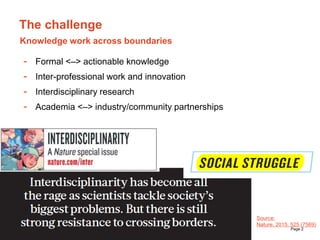
- Formal <–> actionable knowledge
- Inter-professional work and innovation
- Interdisciplinary research
- Academia <–> industry/community partnerships
Knowledge work across boundaries
Source:
Nature, 2015, 525 (7569)
The University of Sydney Page 3
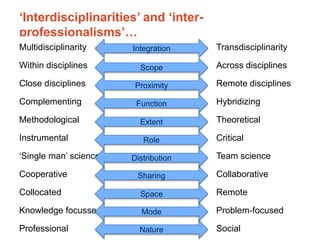
‘Interdisciplinarities’ and ‘inter-
professionalisms’…
Multidisciplinarity
Within disciplines
Close disciplines
Complementing
Methodological
Instrumental
‘Single man’ science
Cooperative
Collocated
Knowledge focussed
Professional
Transdisciplinarity
Across disciplines
Remote disciplines
Hybridizing
Theoretical
Critical
Team science
Collaborative
Remote
Problem-focused
Social
Integration
Scope
Proximity
Function
Extent
Sharing
Nature
Mode
Role
Distribution
Space
The University of Sydney Page 4
The roots
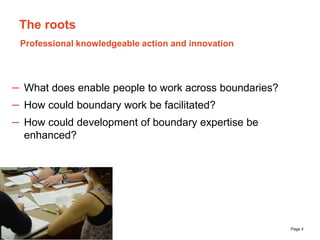
– What does enable people to work across boundaries?
– How could boundary work be facilitated?
– How could development of boundary expertise be
enhanced?
Professional knowledgeable action and innovation
The University of Sydney Page 5
Epistemic fluency
People who are flexible
and adept with respect to
different ways of knowing
about the world can be
said to possess epistemic
fluency
Capability to:
1. to integrate different
kinds of knowledge
2. to coordinate different
ways of knowing
3. to construct
consci(enci)ous self
4. to assemble epistemic
environments
The University of Sydney Page 6
Material foundation of knowledge work
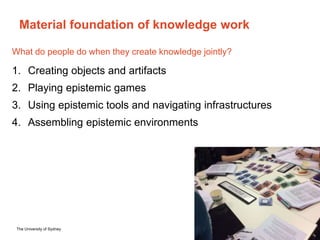
1. Creating objects and artifacts
2. Playing epistemic games
3. Using epistemic tools and navigating infrastructures
4. Assembling epistemic environments
What do people do when they create knowledge jointly?
The University of Sydney Page 7
Working on…
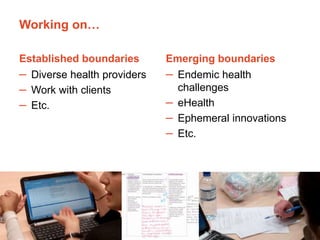
Established boundaries
– Diverse health providers
– Work with clients
– Etc.
Emerging boundaries
– Endemic health
challenges
– eHealth
– Ephemeral innovations
– Etc.
The University of Sydney Page 8
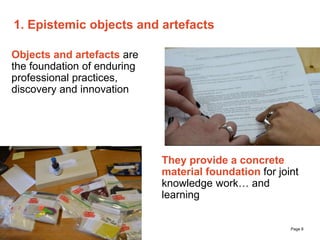
1. Epistemic objects and artefacts
Objects and artefacts are
the foundation of enduring
professional practices,
discovery and innovation
They provide a concrete
material foundation for joint
knowledge work… and
learning
The University of Sydney Page 9
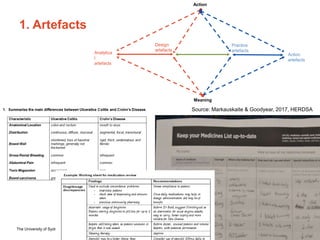
1. Artefacts
Meaning
Practice
artefacts
Action
artefacts
Design
artefacts
Analytica
l
artefacts
Action
Source: Markauskaite & Goodyear, 2017, HERDSA
The University of Sydney Page 10
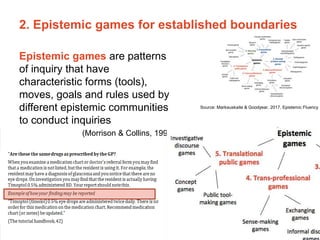
2. Epistemic games for established boundaries
Epistemic games are patterns
of inquiry that have
characteristic forms (tools),
moves, goals and rules used by
different epistemic communities
to conduct inquiries
(Morrison & Collins, 1996)
Examples
– Creating a list
– Creating a taxonomy
– Making a comparison
– Proving a theorem
– Doing a controlled experiment
Source: Markauskaite & Goodyear, 2017, Epistemic Fluency
The University of Sydney Page 11
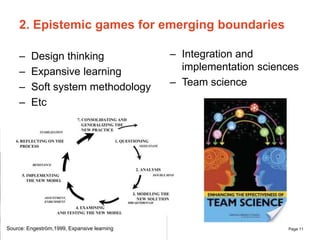
2. Epistemic games for emerging boundaries
– Design thinking
– Expansive learning
– Soft system methodology
– Etc
– Integration and
implementation sciences
– Team science
Source: Engeström,1999, Expansive learning
The University of Sydney Page 12
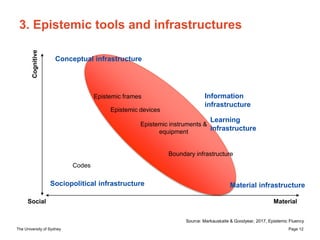
3. Epistemic tools and infrastructures
Social
Cognitive
Material
Epistemic frames
Epistemic devices
Epistemic instruments &
equipment
Codes
Information
infrastructure
Boundary infrastructure
Learning
infrastructure
Material infrastructure
Conceptual infrastructure
Sociopolitical infrastructure
Source: Markauskaite & Goodyear, 2017, Epistemic Fluency
The University of Sydney Page 13
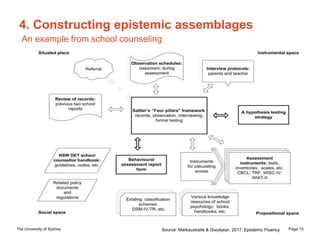
4. Constructing epistemic assemblages
An example from school counseling
Source: Markauskaite & Goodyear, 2017, Epistemic Fluency
The University of Sydney Page 14
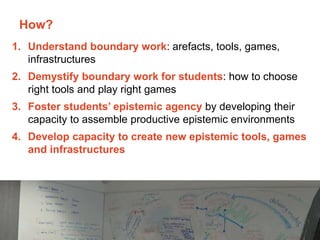
How?
1. Understand boundary work: arefacts, tools, games,
infrastructures
2. Demystify boundary work for students: how to choose
right tools and play right games
3. Foster students’ epistemic agency by developing their
capacity to assemble productive epistemic environments
4. Develop capacity to create new epistemic tools, games
and infrastructures
The University of Sydney Page 15
My final note
Work on the boundaries requires
epistemic awareness and
epistemic fluency
eBook link (Free @USyd via Springer Link)
Website: https://epistemicfluency.com
Twitter: @markauskaite
Email: Lina.Marakauskaite@sydney.edu.au

Learning to co-create actionable knowledge across disciplinary and professional boundaries

  • 1.
    The University ofSydney Page 1 Learning to co-create actionable knowledge across disciplinary and professional boundaries Lina Markauskaitė Acknowledgements: Peter Goodyear, ARC DP0988307 1 June2018 @ Sydney.Concepts.Westmead
  • 2.
    The University ofSydney Page 2 The challenge - Formal <–> actionable knowledge - Inter-professional work and innovation - Interdisciplinary research - Academia <–> industry/community partnerships Knowledge work across boundaries Source: Nature, 2015, 525 (7569)
  • 3.
    The University ofSydney Page 3 ‘Interdisciplinarities’ and ‘inter- professionalisms’… Multidisciplinarity Within disciplines Close disciplines Complementing Methodological Instrumental ‘Single man’ science Cooperative Collocated Knowledge focussed Professional Transdisciplinarity Across disciplines Remote disciplines Hybridizing Theoretical Critical Team science Collaborative Remote Problem-focused Social Integration Scope Proximity Function Extent Sharing Nature Mode Role Distribution Space
  • 4.
    The University ofSydney Page 4 The roots – What does enable people to work across boundaries? – How could boundary work be facilitated? – How could development of boundary expertise be enhanced? Professional knowledgeable action and innovation
  • 5.
    The University ofSydney Page 5 Epistemic fluency People who are flexible and adept with respect to different ways of knowing about the world can be said to possess epistemic fluency Capability to: 1. to integrate different kinds of knowledge 2. to coordinate different ways of knowing 3. to construct consci(enci)ous self 4. to assemble epistemic environments
  • 6.
    The University ofSydney Page 6 Material foundation of knowledge work 1. Creating objects and artifacts 2. Playing epistemic games 3. Using epistemic tools and navigating infrastructures 4. Assembling epistemic environments What do people do when they create knowledge jointly?
  • 7.
    The University ofSydney Page 7 Working on… Established boundaries – Diverse health providers – Work with clients – Etc. Emerging boundaries – Endemic health challenges – eHealth – Ephemeral innovations – Etc.
  • 8.
    The University ofSydney Page 8 1. Epistemic objects and artefacts Objects and artefacts are the foundation of enduring professional practices, discovery and innovation They provide a concrete material foundation for joint knowledge work… and learning
  • 9.
    The University ofSydney Page 9 1. Artefacts Meaning Practice artefacts Action artefacts Design artefacts Analytica l artefacts Action Source: Markauskaite & Goodyear, 2017, HERDSA
  • 10.
    The University ofSydney Page 10 2. Epistemic games for established boundaries Epistemic games are patterns of inquiry that have characteristic forms (tools), moves, goals and rules used by different epistemic communities to conduct inquiries (Morrison & Collins, 1996) Examples – Creating a list – Creating a taxonomy – Making a comparison – Proving a theorem – Doing a controlled experiment Source: Markauskaite & Goodyear, 2017, Epistemic Fluency
  • 11.
    The University ofSydney Page 11 2. Epistemic games for emerging boundaries – Design thinking – Expansive learning – Soft system methodology – Etc – Integration and implementation sciences – Team science Source: Engeström,1999, Expansive learning
  • 12.
    The University ofSydney Page 12 3. Epistemic tools and infrastructures Social Cognitive Material Epistemic frames Epistemic devices Epistemic instruments & equipment Codes Information infrastructure Boundary infrastructure Learning infrastructure Material infrastructure Conceptual infrastructure Sociopolitical infrastructure Source: Markauskaite & Goodyear, 2017, Epistemic Fluency
  • 13.
    The University ofSydney Page 13 4. Constructing epistemic assemblages An example from school counseling Source: Markauskaite & Goodyear, 2017, Epistemic Fluency
  • 14.
    The University ofSydney Page 14 How? 1. Understand boundary work: arefacts, tools, games, infrastructures 2. Demystify boundary work for students: how to choose right tools and play right games 3. Foster students’ epistemic agency by developing their capacity to assemble productive epistemic environments 4. Develop capacity to create new epistemic tools, games and infrastructures
  • 15.
    The University ofSydney Page 15 My final note Work on the boundaries requires epistemic awareness and epistemic fluency eBook link (Free @USyd via Springer Link) Website: https://epistemicfluency.com Twitter: @markauskaite Email: Lina.Marakauskaite@sydney.edu.au

Editor's Notes

  • #2 Sydney.Concepts.Westmead Friday 1st June 2018 : 11.30—12md For information and registration: https://concepts2018.eventbrite.com.au Learning to co-create actionable knowledge across disciplinary and professional boundaries Capability to work across disciplinary and professional boundaries has become an essential attribute of today’s professionals: it is integral to complex professional problem solving; it drives innovation and research; it is key for sustainable development of industries and communities. This presentation will discuss some frontier research ideas on how people develop capability to work across diverse knowledge boundaries and how this capability could be fostered in higher education and workplaces. Speaker: Associate Professor Lina Markauskaite is Co-director of the Centre for Research on Learning and Innovation at the University of Sydney. Her research interests focus on understanding complex scientific and professional practices. She researches how university students and professionals develop expertise to work across traditional knowledge boundaries, use diverse knowledge tools, solve complex problems, innovate and create actionable knowledge. Sydney.Concepts.Westmead is an ongoing series of conversations between researchers across the depth and breadth of the University of Sydney and colleagues from the Westmead precinct. These conversations will cover exciting discoveries and innovations and are aimed at initiating new collaborative opportunities between the university and the broader Westmead community. After the talks you are welcome to join the presenters for a chat. Sydney.Concepts.Westmead Westmead Hospital The Huddle: WECC Level 1
  • #3 Demands of what is expected from future professionals and higher education Knowledge work: evidence-informed and evidence generating practice Teamwork iner-professional and interdisciplinary: multi-disciplinary work, relational expertise (Anne Edwards), interactional expertise (Harry Collins) Participatory ways of knowing: movement from “mass customisation” to open innovation and co-configuration; involvement of customers and users in professional knowledge construction
  • #4 So what do we mean by interdisciplinarity? Some typical taxonomies: Multidisciplinarity, interdisciplinarity, transdisciplinarity (Degree of integration) Within discipline Across disciplines Close disciplines vs remote disciplines Complementing vs hybridizing (Partial integration vs full integration) Methodological vs theoretical Instrumental vs critical Single man vs team science Shared/cooperative vs collaborative Collocated vs remote Knowledge focussed (Basic Mode 1) vs problem focussed (Applied Mode 2) Professional/endogenous vs Social/exogenous There is no one thing “Interdisciplinary expertise” The issue is then What do we mean by “interdisciplinary expertise”? How could we decide what we should teach and how create/choose productive facilitation approaches?
  • #6 Four aspects of eFluency as conscientious inhabiting To integrate different kinds of knowledge (incl formal, functional, grounded concepts) To coordinate different ways of knowing. Play and weave different epistemic games To assemble epistemic environment to support one’s knowledgeable action To construct conscious self 5. To see and sense the world (ie. attunement, capacity to notice/sense what matters, what to select and what to ignore) When we applied the notion of Epistemic fluency to skilful and knowledgeable professional work it became clear that ep. Fluency is not so much about recognising and using ep.games, as about connecting, weaving, constructing. This notion is much more entwined with the material world, and embodied self.
  • #8 Diverse health providers (GPs, specialists, pharmacists, nurses, social workers) Work with clients (patients, carers) Etc. Endemic health challenges (diverse experts and stakeholders) eHealth (data analysts, IT engineers) Ephemeral innovations (nurse – architect) Etc
  • #10 Key is to identify important and powerful kinds of artefacts and help students learn to produce them Learning to construct artefacts as the learning outcome Learning to construct arefacts as a means for learning Not all artefacts are equally productive helping link theoretical/formal and practical knowledge
  • #11 Epistemic games, in simple words are practical methods, that practitioners use to generate knowledge (characteristic ways of conducting inquiries and producing new knowledge) Epistemic games is one (important) kind of such actionable knowledge The idea of epistemic games: Knowledge and knowing producing activity has an underpinning structure. “When people engage in investigations - legal, scientific, moral, political, or other kinds - characteristic moves occur again and again” (Perkins, 1997, 50) Epistemic games – patterns of inquiry that have characteristic forms, moves, goals and rules used by different disciplinary and professional communities to guide inquiry “…there is a bond between the demands of particular disciplines or professions, as they have been socially constituted, and epistemic games. <…> One cannot deal with the law in any serious manner without facility in dealing with rule and precedence-based reasoning.” (Perkins, 1997, 50) “Different contexts (communities of practice) support different ways of knowing, and therefore different kinds of epistemic games...” (Morrison & Collins, 1996, 108) Parallels wit language games Ludvig Wittgenstein: Language game is a form of language that is used by people, but much simpler than the entire language Language is not separate and does not mirror reality. Concepts do not need to be clearly defined to be meaningful. We know the meaning by family resemblance. Speaking of language is part of activity, a form of life
  • #12 https://doi.org/10.1016/j.edurev.2009.12.002
  • #14 Fig 12.1