HUAWEI TECHNOLOGIES CO., LTD.
Apache CarbonData : A New Hadoop
Data Format For Faster Data Analysis
Email: chenliang613@apache.org
Apache CarbonData https://github.com/apache/incubator-carbondata
2
Outline
u Use	Case	&	Motivation	:		Why	introducing	a	new	file	format?
u CarbonData	File	Format	Deep	Dive
u Framework	Integrated	with	CarbonData
u Demo	&	Performance	Comparison
u Future	Plan
3
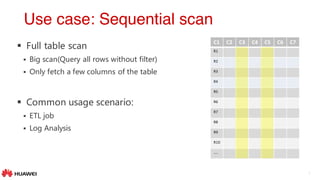
§ Full table scan
§ Big scan(Query all rows without filter)
§ Only fetch a few columns of the table
§ Common usage scenario:
§ ETL job
§ Log Analysis
Use case: Sequential scan
C1 C2 C3 C4 C5 C6 C7
R1
R2
R3
R4
R5
R6
R7
R8
R9
R10
…..
4
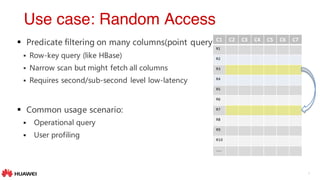
§ Predicate filtering on many columns(point query)
§ Row-key query (like HBase)
§ Narrow scan but might fetch all columns
§ Requires second/sub-second level low-latency
§ Common usage scenario:
§ Operational query
§ User profiling
Use case: Random Access
C1 C2 C3 C4 C5 C6 C7
R1
R2
R3
R4
R5
R6
R7
R8
R9
R10
……
5
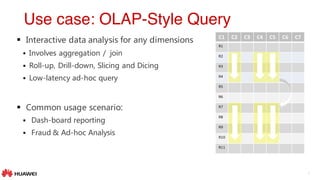
§ Interactive data analysis for any dimensions
§ Involves aggregation / join
§ Roll-up, Drill-down, Slicing and Dicing
§ Low-latency ad-hoc query
§ Common usage scenario:
§ Dash-board reporting
§ Fraud & Ad-hoc Analysis
Use case: OLAP-Style Query
C1 C2 C3 C4 C5 C6 C7
R1
R2
R3
R4
R5
R6
R7
R8
R9
R10
R11
6
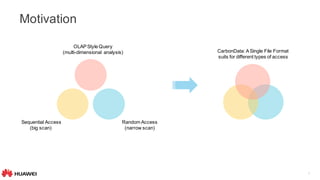
Motivation
Random Access
(narrow scan)
Sequential Access
(big scan)
OLAP Style Query
(multi-dimensional analysis) CarbonData: A Single File Format
suits for different types of access
7
Why CarbonData
Based on the below requirements,we investigated existing file formats in the Hadoop eco-system,but we could not
find a suitable solution that can satisfy all the requirements at the same time, so we start designing CarbonData.
⦁Supportbig scan & only fetch a few columns
⦁Supportprimary key lookup response in sub-second.
⦁Supportinteractive OLAP-style query over big data which involve many filters in a query,this type of workload should
response in seconds.
⦁Supportfast individual record extraction which fetch all columns of the record.
⦁SupportHDFS so that customer can leverage existing Hadoop cluster.
When we investigated Parquet/ORC, it seems they work very well for R1 and R5, but they does not meet for R2,R3,R4.
So we designed CarbonData mainly to add following differentiating features:
⦁Stores data along with index: it can significantly accelerate query performance and reduces the I/O scans and CPU
resources, where there are filters in the query. CarbonData index consists of multiple level of indices, a processing framework
can leverage this index to reduce the task it needs to schedule and process, and it can also do skip scan in more finer grain
unit (called blocklet) in task side scanning instead of scanning the whole file.
⦁Operable encoded data :Through supporting efficient compression and global encoding schemes, can query on
compressed/encoded data, the data can be converted just before returning the results to the users, which is "late
materialized".
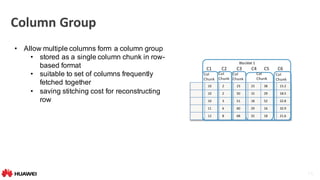
⦁Column group: Allow multiplecolumns to form a column group that would be stored as row format. This reduces the row
reconstruction cost at query time.
⦁Supports for various use cases with one singleData format : like interactive OLAP-stylequery, Sequential Access (big scan),
Random Access (narrow scan).
8
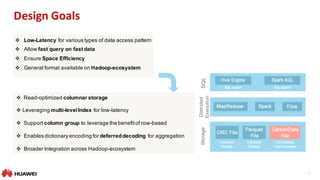
Design	Goals
v Low-Latency for various types of data access pattern
v Allow fast query on fast data
v Ensure Space Efficiency
v General format available on Hadoop-ecosystem
v Read-optimized columnar storage
v Leveraging multi-levelIndex for low-latency
v Support column group to leverage the benefitof row-based
v Enables dictionary encoding for deferreddecoding for aggregation
v Broader Integration across Hadoop-ecosystem
9
Outline
u Use cases & Motivation: Why introducing a new file format?
u CarbonData File Format Deep Dive
u Framework	Integrated	with	CarbonData
u Demo & Performance Comparison
u Future	Plan
10
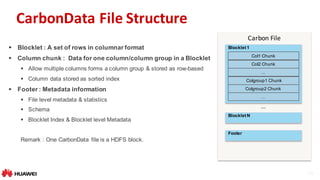
Carbon	File
CarbonData	File	Structure
§ Blocklet : A set of rows in columnar format
§ Column chunk : Data for one column/column group in a Blocklet
§ Allow multiple columns forms a column group & stored as row-based
§ Column data stored as sorted index
§ Footer : Metadata information
§ File level metadata & statistics
§ Schema
§ Blocklet Index & Blocklet level Metadata
Remark : One CarbonData file is a HDFS block.
Blocklet 1
Col1 Chunk
Col2 Chunk
…
Colgroup1 Chunk
Colgroup2 Chunk
…
Blocklet N
…
Footer
11
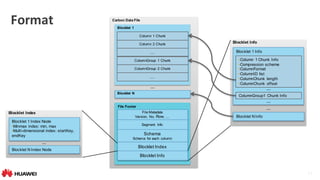
Carbon Data File
Blocklet 1
Column 1 Chunk
Column 2 Chunk
…
ColumnGroup 1 Chunk
ColumnGroup 2 Chunk
…
Blocklet N
File Footer
Blocklet Index
Blocklet 1 Index Node
•Minmax index: min, max
•Multi-dimensional index: startKey,
endKey
Blocklet N Index Node
…
…
Blocklet Info
Blocklet 1 Info
Blocklet N Info
•Column 1 Chunk Info
•Compression scheme
•ColumnFormat
•ColumnID list
•ColumnChunk length
•ColumnChunk offset
…
File Metadata
Version, No. Row, …
Segment Info
Schema
Schema for each column
Blocklet Index
Blocklet Info
ColumnGroup1 Chunk Info
…
…
Format
12
Years Quarters Months Territory Country Quantity Sales
2003 QTR1 Jan EMEA Germany 142 11,432
2003 QTR1 Jan APAC China 541 54,702
2003 QTR1 Jan EMEA Spain 443 44,622
2003 QTR1 Feb EMEA Denmark 545 58,871
2003 QTR1 Feb EMEA Italy 675 56,181
2003 QTR1 Mar APAC India 52 9,749
2003 QTR1 Mar EMEA UK 570 51,018
2003 QTR1 Mar Japan Japan 561 55,245
2003 QTR2 Apr APAC Australia 525 50,398
2003 QTR2 Apr EMEA Germany 144 11,532
[1,1,1,1,1] : [142,11432]
[1,1,1,3,2] : [541,54702]
[1,1,1,1,3] : [443,44622]
[1,1,2,1,4] : [545,58871]
[1,1,2,1,5] : [675,56181]
[1,1,3,3,6] : [52,9749]
[1,1,3,1,7] : [570,51018]
[1,1,3,2,8] : [561,55245]
[1,2,4,3,9] : [525,50398]
[1,2,4,1,1] : [144,11532]
Blocklet
• Data are sorted along MDK (multi-dimensional keys)
• data stored as index in columnar format
Encoding
Blocklet	Logical	View
Sort
(MDK	Index)
[1,1,1,1,1] : [142,11432]
[1,1,1,1,3] : [443,44622]
[1,1,1,3,2] : [541,54702]
[1,1,2,1,4] : [545,58871]
[1,1,2,1,5] : [675,56181]
[1,1,3,1,7] : [570,51018]
[1,1,3,2,8] : [561,55245]
[1,1,3,3,6] : [52,9749]
[1,2,4,1,1] : [144,11532]
[1,2,4,3,9] : [525,50398]
Sorted	MDK	Index
1
1
1
1
1
1
1
1
1
1
1
1
1
1
1
1
1
1
2
2
1
1
1
2
2
3
3
3
4
4
1
1
3
1
1
1
2
3
1
3
142
443
541
545
675
570
561
52
144
525
11432
44622
54702
58871
56181
51018
55245
9749
11532
50398
C1			C2			C3		C4			C5					C6	 C7
1
3
2
4
5
7
8
6
1
9
13
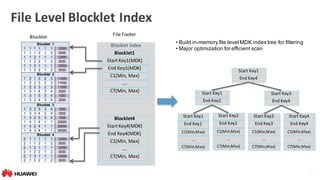
File	Level	Blocklet Index
Blocklet 1
1 1 1 1 1 1 12000
1 1 1 2 1 2 5000
1 1 2 1 1 1 12000
1 1 2 2 1 2 5000
1 1 3 1 1 1 12000
1 1 3 2 1 2 5000
Blocklet 2
1 2 1 3 2 3 11000
1 2 2 3 2 3 11000
1 2 3 3 2 3 11000
1 3 1 4 3 4 2000
1 3 1 5 3 4 1000
1 3 2 4 3 4 2000
Blocklet 3
1 3 2 5 3 4 1000
1 3 3 4 3 4 2000
1 3 3 5 3 4 1000
1 4 1 4 1 1 20000
1 4 2 4 1 1 20000
1 4 3 4 1 1 20000
Blocklet 4
2 1 1 1 1 1 12000
2 1 1 2 1 2 5000
2 1 2 1 1 1 12000
2 1 2 2 1 2 5000
2 1 3 1 1 1 12000
2 1 3 2 1 2 5000
Blocklet	Index
Blocklet1
Start	Key1(MDK)
End	Key1(MDK) Start	Key1
End	Key4
Start	Key1
End	Key2
Start	Key3
End	Key4
Start	Key1
End	Key1
Start	Key2
End	Key2
Start	Key3
End	Key3
Start	Key4
End	Key4
File	FooterBlocklet
• Build in-memory file level MDK index tree for filtering
• Major optimization for efficient scan
C1(Min,	Max)
….
C7(Min,	Max)
Blocklet4
Start	Key4(MDK)
End	Key4(MDK)
C1(Min,	Max)
….
C7(Min,	Max)
C1(Min,Max)
…
C7(Min,Max)
C1(Min,Max)
…
C7(Min,Max)
C1(Min,Max)
…
C7(Min,Max)
C1(Min,Max)
…
C7(Min,Max)
14
Blocklet	Rows
[1|1]		:[1|1]		:[1|1]	:[1|1]		:[1|1]							:	[142]:[11432]
[1|2]		:[1|2]		:[1|2]	:[1|2]		:[1|9]							:	[443]:[44622]
[1|3]		:[1|3]		:[1|3]	:[1|4]		:[2|3]							:	[541]:[54702]
[1|4]		:[1|4]		:[2|4]	:[1|5]		:[3|2]							:	[545]:[58871]
[1|5]		:[1|5]		:[2|5]	:[1|6]		:[4|4]							:	[675]:[56181]
[1|6]		:[1|6]		:[3|6]	:[1|9]		:[5|5]							:	[570]:[51018]
[1|7]		:[1|7]		:[3|7]	:[2|7]		:[6|8]							:	[561]:[55245]
[1|8]		:[1|8]		:[3|8]	:[3|3]	:[7|6]								:	[52]:[9749]
[1|9]		:[2|9]		:[4|9]	:[3|8]		:[8|7]							:	[144]:[11532]
[1|10]:[2|10]:[4|10]:[3|10]	:[9|10]			:	[525]:[50398]
Blocklet
(	sort	column	within	column	chunk)
Run	Length	Encoding	&	Compression
Dim1 Block
1(1-10)
Dim2 Block
1(1-8)
2(9-10)
Dim3 Block
1(1-3)
2(4-5)
3(6-8)
4(9-10)
Dim4 Block
1(1-2,4-6,9)
2(7)
3(3,8,10)
Measure1
Block
Measure2
Block
Dim5 Block
1(1,9)
2(3)
3(2)
4(4)
5(5)
6(8)
7(6)
8(7)
9(10)
Columnar	Store
Column chunk Level
inverted Index
[142]:[11432]
[443]:[44622]
[541]:[54702]
[545]:[58871]
[675]:[56181]
[570]:[51018]
[561]:[55245]
[52]:[9749]
[144]:[11532]
[525]:[50398]
Inverted	Index
• Optionally store column data as inverted index
within column chunk
• Very good benefit for low cardinality column for
Better compression
• Fast predicate filtering
Blocklet	Physical	View
1
10
142
443
541
545
675
570
561
52
144
525
11432
44622
54702
58871
56181
51018
55245
9749
11532
50398
C1
d			r			d				r				d			r				d				r				d			r				d				r
1
10
1
8
2
2
1
10
1
3
2
2
3
3
4
2
1
10
1
6
2
1
3
3
1
2
4
3
9
1
7
1
3
1
…
1
2
2
1
3
1
4
1
5
1
…
1
1
9
1
3
1
2
1
4
1
…
C2 C3 C4 C5 C6 C7
15
10 2 23 23 38 15.2
10 2 50 15 29 18.5
10 3 51 18 52 22.8
11 6 60 29 16 32.9
12 8 68 32 18 21.6
Blocklet	1
C1 C2 C3 C4 C6C5
Col
Chunk
Col
Chunk
Col
Chunk
Col
Chunk
Column	Group	
• Allow multiple columns form a column group
• stored as a single column chunk in row-
based format
• suitable to set of columns frequently
fetched together
• saving stitching cost for reconstructing
row
Col
Chunk
16
Nested	Data	Type	Representation	
• Represented as a composite of two columns
• One column for the element value
• One column for start_index & length of Array
Arrays
• Represented as a composite of finite number
of columns
• Each struct element is a separate column
Struts
Name Array<Ph_Number>
John [192,191]
Sam [121,345,333]
Bob [198,787]
Name Array
[start,len]
Ph_Number
John 0,2 192
Sam 2,3 191
Bob 5,2 121
345
333
198
787
Name Info	Strut<age,gender>
John [31,M]
Sam [45,F]
Bob [16,M]
Name Info.age Info.gender
John 31 M
Sam 45 F
Bob 16 M
17
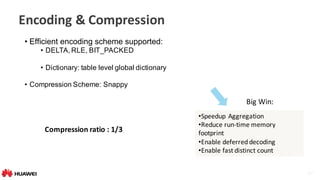
Encoding	&	Compression	
• Efficient encoding scheme supported:
• DELTA, RLE, BIT_PACKED
• Dictionary: table level global dictionary
• Compression Scheme: Snappy
•Speedup	Aggregation
•Reduce	run-time	memory	
footprint
•Enable	deferred	decoding
•Enable	fast	distinct	count
Big	Win:
Compression	ratio	:	1/3
18
Outline
u Use Case & Motivation: Why introducing a new file format?
u CarbonData	File	Format	Deep	Dive
u Framework Integrated with CarbonData
u Demo & Performance Comparison
u Future	Plan
19
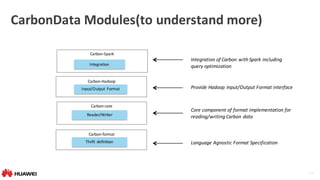
CarbonData Modules(to	understand	more)	
Carbon-format
Carbon-core
Reader/Writer
Thrift	 definition
Carbon-Spark
Integration
Carbon-Hadoop
Input/Output Format
Language	Agnostic	Format	Specification	
Core	component	of	format	implementation	for	
reading/writing	Carbon	data
Provide	Hadoop Input/Output Format	interface
Integration	of	Carbon	with	Spark	including	
query	optimization
20
Blocklet
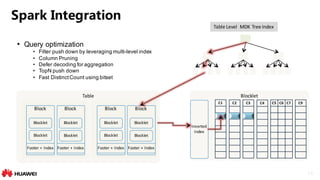
Spark Integration
Table
Block
Footer	+	Index
Blocklet
Blocklet
…
…
C1 C2 C3 C4 C5 C6 C7 C9
Table	Level		MDK	Tree	Index
Inverted
Index
• Query optimization
• Filter push down by leveraging multi-level index
• Column Pruning
• Defer decoding for aggregation
• TopN push down
• Fast DistinctCount using bitset
Block
Blocklet
Blocklet
Footer	+	Index
Block
Footer	+	Index
Blocklet
Blocklet
Block
Blocklet
Blocklet
Footer	+	Index
21
Spark	Integration
• Query CarbonData Table
• DataFrame API
• Spark SQL Statement
CREATE TABLE [IF NOT EXISTS] [db_name.]table_name [(col_name
data_type [COMMENT col_comment], ...)] [COMMENT table_comment]
[PARTITIONED BY (col_name data_type [COMMENT col_comment],
...)] STORED BY ‘org.carbondata.hive.CarbonHanlder’
[TBLPROPERTIES (property_name=property_value, ...)] [AS
select_statement];
22
Outline
u Use Case & Motivation: Why introducing a new file format?
u CarbonData	File	Format	Deep	Dive
u Framework Integrated with CarbonData
u Demo & Performance Comparison
u Future	Plan
23
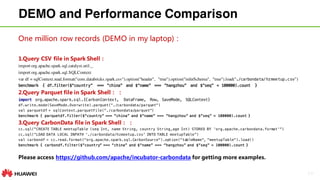
DEMO and Performance Comparison
One million row records (DEMO in my laptop):
1.Query CSV file in Spark Shell:
import org.apache.spark.sql.catalyst.util._
import org.apache.spark.sql.SQLContext
var df = sqlContext.read.format("com.databricks.spark.csv").option("header", "true").option("inferSchema", "true").load("./carbondata/hzmeetup.csv”)
benchmark { df.filter($“country” === “china” and $“name” === “hangzhou” and $“seq” < 100000).count }
2.Query Parquet file in Spark Shell: :
import org.apache.spark.sql.{CarbonContext, DataFrame, Row, SaveMode, SQLContext}
df.write.mode(SaveMode.Overwrite).parquet("./carbondata/parquet")
val parquetdf = sqlContext.parquetFile("./carbondata/parquet")
benchmark { parquetdf.filter($“country” === “china” and $“name” === “hangzhou” and $“seq” < 100000).count }
3.Query CarbonData file in Spark Shell: :
cc.sql("CREATE TABLE meetupTable (seq Int, name String, country String,age Int) STORED BY 'org.apache.carbondata.format'")
cc.sql("LOAD DATA LOCAL INPATH './carbondata/hzmeetup.csv' INTO TABLE meetupTable”)
val carbondf = cc.read.format("org.apache.spark.sql.CarbonSource").option("tableName", "meetupTable").load()
benchmark { carbondf.filter($“country” === “china” and $“name” === “hangzhou” and $“seq” < 100000).count }
Please access https://github.com/apache/incubator-carbondata for getting more examples.
24
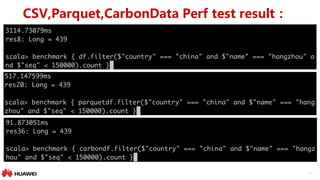
CSV,Parquet,CarbonData Perf test result:
25
Outline
u Motivation: Why introducing a new file format?
u CarbonData	File	Format	Deep	Dive
u Framework Integrated with CarbonData
u Demo & Performance Comparison
u Future Plan
26
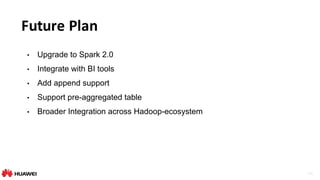
Future	Plan
• Upgrade to Spark 2.0
• Integrate with BI tools
• Add append support
• Support pre-aggregated table
• Broader Integration across Hadoop-ecosystem
27
Community
Welcome contribution to Apache CarbonData Github @:
https://github.com/apache/incubator-carbondata
Thank you
www.huawei.com
Copyright©2014 Huawei Technologies Co., Ltd. All Rights Reserved.
The information in this document may contain predictive statements including, without limitation, statements regarding the
future financial and operating results, future product portfolio, new technology, etc. There are a number of factors that could
cause actual results and developments to differ materially from those expressed or implied in the predictive statements. Therefore,
such information is provided for reference purpose only and constitutes neither an offer nor an acceptance. Huawei may change
the information at any time without notice.

Apache CarbonData:New high performance data format for faster data analysis

  • 1.
    HUAWEI TECHNOLOGIES CO.,LTD. Apache CarbonData : A New Hadoop Data Format For Faster Data Analysis Email: chenliang613@apache.org Apache CarbonData https://github.com/apache/incubator-carbondata
  • 2.
    2 Outline u Use Case & Motivation : Why introducing a new file format? u CarbonData File Format Deep Dive uFramework Integrated with CarbonData u Demo & Performance Comparison u Future Plan
  • 3.
    3 § Full tablescan § Big scan(Query all rows without filter) § Only fetch a few columns of the table § Common usage scenario: § ETL job § Log Analysis Use case: Sequential scan C1 C2 C3 C4 C5 C6 C7 R1 R2 R3 R4 R5 R6 R7 R8 R9 R10 …..
  • 4.
    4 § Predicate filteringon many columns(point query) § Row-key query (like HBase) § Narrow scan but might fetch all columns § Requires second/sub-second level low-latency § Common usage scenario: § Operational query § User profiling Use case: Random Access C1 C2 C3 C4 C5 C6 C7 R1 R2 R3 R4 R5 R6 R7 R8 R9 R10 ……
  • 5.
    5 § Interactive dataanalysis for any dimensions § Involves aggregation / join § Roll-up, Drill-down, Slicing and Dicing § Low-latency ad-hoc query § Common usage scenario: § Dash-board reporting § Fraud & Ad-hoc Analysis Use case: OLAP-Style Query C1 C2 C3 C4 C5 C6 C7 R1 R2 R3 R4 R5 R6 R7 R8 R9 R10 R11
  • 6.
    6 Motivation Random Access (narrow scan) SequentialAccess (big scan) OLAP Style Query (multi-dimensional analysis) CarbonData: A Single File Format suits for different types of access
  • 7.
    7 Why CarbonData Based onthe below requirements,we investigated existing file formats in the Hadoop eco-system,but we could not find a suitable solution that can satisfy all the requirements at the same time, so we start designing CarbonData. ⦁Supportbig scan & only fetch a few columns ⦁Supportprimary key lookup response in sub-second. ⦁Supportinteractive OLAP-style query over big data which involve many filters in a query,this type of workload should response in seconds. ⦁Supportfast individual record extraction which fetch all columns of the record. ⦁SupportHDFS so that customer can leverage existing Hadoop cluster. When we investigated Parquet/ORC, it seems they work very well for R1 and R5, but they does not meet for R2,R3,R4. So we designed CarbonData mainly to add following differentiating features: ⦁Stores data along with index: it can significantly accelerate query performance and reduces the I/O scans and CPU resources, where there are filters in the query. CarbonData index consists of multiple level of indices, a processing framework can leverage this index to reduce the task it needs to schedule and process, and it can also do skip scan in more finer grain unit (called blocklet) in task side scanning instead of scanning the whole file. ⦁Operable encoded data :Through supporting efficient compression and global encoding schemes, can query on compressed/encoded data, the data can be converted just before returning the results to the users, which is "late materialized". ⦁Column group: Allow multiplecolumns to form a column group that would be stored as row format. This reduces the row reconstruction cost at query time. ⦁Supports for various use cases with one singleData format : like interactive OLAP-stylequery, Sequential Access (big scan), Random Access (narrow scan).
  • 8.
    8 Design Goals v Low-Latency forvarious types of data access pattern v Allow fast query on fast data v Ensure Space Efficiency v General format available on Hadoop-ecosystem v Read-optimized columnar storage v Leveraging multi-levelIndex for low-latency v Support column group to leverage the benefitof row-based v Enables dictionary encoding for deferreddecoding for aggregation v Broader Integration across Hadoop-ecosystem
  • 9.
    9 Outline u Use cases& Motivation: Why introducing a new file format? u CarbonData File Format Deep Dive u Framework Integrated with CarbonData u Demo & Performance Comparison u Future Plan
  • 10.
    10 Carbon File CarbonData File Structure § Blocklet :A set of rows in columnar format § Column chunk : Data for one column/column group in a Blocklet § Allow multiple columns forms a column group & stored as row-based § Column data stored as sorted index § Footer : Metadata information § File level metadata & statistics § Schema § Blocklet Index & Blocklet level Metadata Remark : One CarbonData file is a HDFS block. Blocklet 1 Col1 Chunk Col2 Chunk … Colgroup1 Chunk Colgroup2 Chunk … Blocklet N … Footer
  • 11.
    11 Carbon Data File Blocklet1 Column 1 Chunk Column 2 Chunk … ColumnGroup 1 Chunk ColumnGroup 2 Chunk … Blocklet N File Footer Blocklet Index Blocklet 1 Index Node •Minmax index: min, max •Multi-dimensional index: startKey, endKey Blocklet N Index Node … … Blocklet Info Blocklet 1 Info Blocklet N Info •Column 1 Chunk Info •Compression scheme •ColumnFormat •ColumnID list •ColumnChunk length •ColumnChunk offset … File Metadata Version, No. Row, … Segment Info Schema Schema for each column Blocklet Index Blocklet Info ColumnGroup1 Chunk Info … … Format
  • 12.
    12 Years Quarters MonthsTerritory Country Quantity Sales 2003 QTR1 Jan EMEA Germany 142 11,432 2003 QTR1 Jan APAC China 541 54,702 2003 QTR1 Jan EMEA Spain 443 44,622 2003 QTR1 Feb EMEA Denmark 545 58,871 2003 QTR1 Feb EMEA Italy 675 56,181 2003 QTR1 Mar APAC India 52 9,749 2003 QTR1 Mar EMEA UK 570 51,018 2003 QTR1 Mar Japan Japan 561 55,245 2003 QTR2 Apr APAC Australia 525 50,398 2003 QTR2 Apr EMEA Germany 144 11,532 [1,1,1,1,1] : [142,11432] [1,1,1,3,2] : [541,54702] [1,1,1,1,3] : [443,44622] [1,1,2,1,4] : [545,58871] [1,1,2,1,5] : [675,56181] [1,1,3,3,6] : [52,9749] [1,1,3,1,7] : [570,51018] [1,1,3,2,8] : [561,55245] [1,2,4,3,9] : [525,50398] [1,2,4,1,1] : [144,11532] Blocklet • Data are sorted along MDK (multi-dimensional keys) • data stored as index in columnar format Encoding Blocklet Logical View Sort (MDK Index) [1,1,1,1,1] : [142,11432] [1,1,1,1,3] : [443,44622] [1,1,1,3,2] : [541,54702] [1,1,2,1,4] : [545,58871] [1,1,2,1,5] : [675,56181] [1,1,3,1,7] : [570,51018] [1,1,3,2,8] : [561,55245] [1,1,3,3,6] : [52,9749] [1,2,4,1,1] : [144,11532] [1,2,4,3,9] : [525,50398] Sorted MDK Index 1 1 1 1 1 1 1 1 1 1 1 1 1 1 1 1 1 1 2 2 1 1 1 2 2 3 3 3 4 4 1 1 3 1 1 1 2 3 1 3 142 443 541 545 675 570 561 52 144 525 11432 44622 54702 58871 56181 51018 55245 9749 11532 50398 C1 C2 C3 C4 C5 C6 C7 1 3 2 4 5 7 8 6 1 9
  • 13.
    13 File Level Blocklet Index Blocklet 1 11 1 1 1 1 12000 1 1 1 2 1 2 5000 1 1 2 1 1 1 12000 1 1 2 2 1 2 5000 1 1 3 1 1 1 12000 1 1 3 2 1 2 5000 Blocklet 2 1 2 1 3 2 3 11000 1 2 2 3 2 3 11000 1 2 3 3 2 3 11000 1 3 1 4 3 4 2000 1 3 1 5 3 4 1000 1 3 2 4 3 4 2000 Blocklet 3 1 3 2 5 3 4 1000 1 3 3 4 3 4 2000 1 3 3 5 3 4 1000 1 4 1 4 1 1 20000 1 4 2 4 1 1 20000 1 4 3 4 1 1 20000 Blocklet 4 2 1 1 1 1 1 12000 2 1 1 2 1 2 5000 2 1 2 1 1 1 12000 2 1 2 2 1 2 5000 2 1 3 1 1 1 12000 2 1 3 2 1 2 5000 Blocklet Index Blocklet1 Start Key1(MDK) End Key1(MDK) Start Key1 End Key4 Start Key1 End Key2 Start Key3 End Key4 Start Key1 End Key1 Start Key2 End Key2 Start Key3 End Key3 Start Key4 End Key4 File FooterBlocklet • Build in-memory file level MDK index tree for filtering • Major optimization for efficient scan C1(Min, Max) …. C7(Min, Max) Blocklet4 Start Key4(MDK) End Key4(MDK) C1(Min, Max) …. C7(Min, Max) C1(Min,Max) … C7(Min,Max) C1(Min,Max) … C7(Min,Max) C1(Min,Max) … C7(Min,Max) C1(Min,Max) … C7(Min,Max)
  • 14.
    14 Blocklet Rows [1|1] :[1|1] :[1|1] :[1|1] :[1|1] : [142]:[11432] [1|2] :[1|2] :[1|2] :[1|2] :[1|9] : [443]:[44622] [1|3] :[1|3] :[1|3] :[1|4] :[2|3] : [541]:[54702] [1|4] :[1|4] :[2|4] :[1|5] :[3|2] : [545]:[58871] [1|5] :[1|5] :[2|5] :[1|6] :[4|4] : [675]:[56181] [1|6] :[1|6] :[3|6] :[1|9] :[5|5] : [570]:[51018] [1|7] :[1|7] :[3|7] :[2|7] :[6|8] : [561]:[55245] [1|8] :[1|8] :[3|8] :[3|3] :[7|6] : [52]:[9749] [1|9] :[2|9] :[4|9] :[3|8] :[8|7] : [144]:[11532] [1|10]:[2|10]:[4|10]:[3|10] :[9|10] : [525]:[50398] Blocklet ( sort column within column chunk) Run Length Encoding & Compression Dim1 Block 1(1-10) Dim2 Block 1(1-8) 2(9-10) Dim3Block 1(1-3) 2(4-5) 3(6-8) 4(9-10) Dim4 Block 1(1-2,4-6,9) 2(7) 3(3,8,10) Measure1 Block Measure2 Block Dim5 Block 1(1,9) 2(3) 3(2) 4(4) 5(5) 6(8) 7(6) 8(7) 9(10) Columnar Store Column chunk Level inverted Index [142]:[11432] [443]:[44622] [541]:[54702] [545]:[58871] [675]:[56181] [570]:[51018] [561]:[55245] [52]:[9749] [144]:[11532] [525]:[50398] Inverted Index • Optionally store column data as inverted index within column chunk • Very good benefit for low cardinality column for Better compression • Fast predicate filtering Blocklet Physical View 1 10 142 443 541 545 675 570 561 52 144 525 11432 44622 54702 58871 56181 51018 55245 9749 11532 50398 C1 d r d r d r d r d r d r 1 10 1 8 2 2 1 10 1 3 2 2 3 3 4 2 1 10 1 6 2 1 3 3 1 2 4 3 9 1 7 1 3 1 … 1 2 2 1 3 1 4 1 5 1 … 1 1 9 1 3 1 2 1 4 1 … C2 C3 C4 C5 C6 C7
  • 15.
    15 10 2 2323 38 15.2 10 2 50 15 29 18.5 10 3 51 18 52 22.8 11 6 60 29 16 32.9 12 8 68 32 18 21.6 Blocklet 1 C1 C2 C3 C4 C6C5 Col Chunk Col Chunk Col Chunk Col Chunk Column Group • Allow multiple columns form a column group • stored as a single column chunk in row- based format • suitable to set of columns frequently fetched together • saving stitching cost for reconstructing row Col Chunk
  • 16.
    16 Nested Data Type Representation • Represented asa composite of two columns • One column for the element value • One column for start_index & length of Array Arrays • Represented as a composite of finite number of columns • Each struct element is a separate column Struts Name Array<Ph_Number> John [192,191] Sam [121,345,333] Bob [198,787] Name Array [start,len] Ph_Number John 0,2 192 Sam 2,3 191 Bob 5,2 121 345 333 198 787 Name Info Strut<age,gender> John [31,M] Sam [45,F] Bob [16,M] Name Info.age Info.gender John 31 M Sam 45 F Bob 16 M
  • 17.
    17 Encoding & Compression • Efficient encodingscheme supported: • DELTA, RLE, BIT_PACKED • Dictionary: table level global dictionary • Compression Scheme: Snappy •Speedup Aggregation •Reduce run-time memory footprint •Enable deferred decoding •Enable fast distinct count Big Win: Compression ratio : 1/3
  • 18.
    18 Outline u Use Case& Motivation: Why introducing a new file format? u CarbonData File Format Deep Dive u Framework Integrated with CarbonData u Demo & Performance Comparison u Future Plan
  • 19.
    19 CarbonData Modules(to understand more) Carbon-format Carbon-core Reader/Writer Thrift definition Carbon-Spark Integration Carbon-Hadoop Input/OutputFormat Language Agnostic Format Specification Core component of format implementation for reading/writing Carbon data Provide Hadoop Input/Output Format interface Integration of Carbon with Spark including query optimization
  • 20.
    20 Blocklet Spark Integration Table Block Footer + Index Blocklet Blocklet … … C1 C2C3 C4 C5 C6 C7 C9 Table Level MDK Tree Index Inverted Index • Query optimization • Filter push down by leveraging multi-level index • Column Pruning • Defer decoding for aggregation • TopN push down • Fast DistinctCount using bitset Block Blocklet Blocklet Footer + Index Block Footer + Index Blocklet Blocklet Block Blocklet Blocklet Footer + Index
  • 21.
    21 Spark Integration • Query CarbonDataTable • DataFrame API • Spark SQL Statement CREATE TABLE [IF NOT EXISTS] [db_name.]table_name [(col_name data_type [COMMENT col_comment], ...)] [COMMENT table_comment] [PARTITIONED BY (col_name data_type [COMMENT col_comment], ...)] STORED BY ‘org.carbondata.hive.CarbonHanlder’ [TBLPROPERTIES (property_name=property_value, ...)] [AS select_statement];
  • 22.
    22 Outline u Use Case& Motivation: Why introducing a new file format? u CarbonData File Format Deep Dive u Framework Integrated with CarbonData u Demo & Performance Comparison u Future Plan
  • 23.
    23 DEMO and PerformanceComparison One million row records (DEMO in my laptop): 1.Query CSV file in Spark Shell: import org.apache.spark.sql.catalyst.util._ import org.apache.spark.sql.SQLContext var df = sqlContext.read.format("com.databricks.spark.csv").option("header", "true").option("inferSchema", "true").load("./carbondata/hzmeetup.csv”) benchmark { df.filter($“country” === “china” and $“name” === “hangzhou” and $“seq” < 100000).count } 2.Query Parquet file in Spark Shell: : import org.apache.spark.sql.{CarbonContext, DataFrame, Row, SaveMode, SQLContext} df.write.mode(SaveMode.Overwrite).parquet("./carbondata/parquet") val parquetdf = sqlContext.parquetFile("./carbondata/parquet") benchmark { parquetdf.filter($“country” === “china” and $“name” === “hangzhou” and $“seq” < 100000).count } 3.Query CarbonData file in Spark Shell: : cc.sql("CREATE TABLE meetupTable (seq Int, name String, country String,age Int) STORED BY 'org.apache.carbondata.format'") cc.sql("LOAD DATA LOCAL INPATH './carbondata/hzmeetup.csv' INTO TABLE meetupTable”) val carbondf = cc.read.format("org.apache.spark.sql.CarbonSource").option("tableName", "meetupTable").load() benchmark { carbondf.filter($“country” === “china” and $“name” === “hangzhou” and $“seq” < 100000).count } Please access https://github.com/apache/incubator-carbondata for getting more examples.
  • 24.
  • 25.
    25 Outline u Motivation: Whyintroducing a new file format? u CarbonData File Format Deep Dive u Framework Integrated with CarbonData u Demo & Performance Comparison u Future Plan
  • 26.
    26 Future Plan • Upgrade toSpark 2.0 • Integrate with BI tools • Add append support • Support pre-aggregated table • Broader Integration across Hadoop-ecosystem
  • 27.
    27 Community Welcome contribution toApache CarbonData Github @: https://github.com/apache/incubator-carbondata
  • 28.
    Thank you www.huawei.com Copyright©2014 HuaweiTechnologies Co., Ltd. All Rights Reserved. The information in this document may contain predictive statements including, without limitation, statements regarding the future financial and operating results, future product portfolio, new technology, etc. There are a number of factors that could cause actual results and developments to differ materially from those expressed or implied in the predictive statements. Therefore, such information is provided for reference purpose only and constitutes neither an offer nor an acceptance. Huawei may change the information at any time without notice.