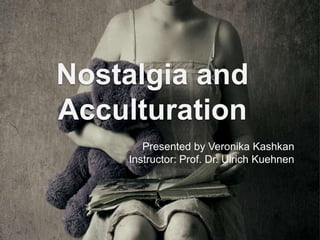
Nostalgia and
Acculturation
       Presented by Veronika Kashkan
    Instructor: Prof. Dr. Ulrich Kuehnen
Content
   Immigration and acculturative stress
   Loneliness
   Nostalgia – basics
   Functions of nostalgia
   Successful integration and nostalgia
   Limitations
   Future directions
   Discussion
Immigration
 Loneliness
Immigration
                   2005:
          191 million immigrants

Reasons:
- Poverty
- Human rights violations
- Famine
- Natural disasters
- Wars
     so on
Immigrant stressors
             Immigrants as a threat

-   Symbolic threat (challenges to the
    collective identity of the majority)

- Material threat
(challenges to the
financial and status
well-being)
Immigrant stressors
 Economic problems
 Language problems
 Policies, customs and norms
 Stereotypes, prejudice and discrimination


      ACCULTURATIVE STRESS
Acculturative stress
“an immigrant’s response to life events that are
        rooted in intercultural contact”

Factors:
- Intrapersonal (motive of migration)
- Society of origin (cultural distance)
- Society of settlement ( multi- or monocultural
  ideology, hierarchy of immigrants)
- Intrapersonal and social (conformity values and
  need for closure)
Consequences of acculturative stress
  Bad mood and anxiety
  Heightened level of depression
  Loneliness
Loneliness
    Loneliness – a psychological state characterized by a
    set of discomforting emotions and cognitions
    (unhappiness, pessimism, self-blame, depression).


- Is associated with perceived lack of social
  support and lower and less satisfying
  relationships than desired;
- Is a universal experience;
- Frequently the solicitation of social support is
  impeded by individual (shyness, poor social
  skills) and situational (relocation) factors.
Consequences of acculturative stress
  Bad mood and anxiety
  Heightened level of depression
                   Loneliness


 Reduced perception          Nostalgia
 of social support        (experiments – 1,2)
Findings about nostalgia


Nostalgia is triggered by bad mood and loneliness
(participants in a bad mood or in a “high
  loneliness” reported higher levels of nostalgia)


Nostalgia can be recruited, either spontaneously or
                    intentionally
Main ideas of the section
 Immigration is a big and fast-growing problem
 Immigrants suffer from not only economic
  problems and stressors connected with new
  mode of life, but also from psychological
  persecution by receiving society
 This cause acculturative stress and loneliness
 Loneliness cause reduced perception of social
  support on the one hand, and nostalgia on the
  other
Nostalgia
Nostalgia
        “a sentimental longing for the past”

            Nostalgia VS Homesickness


- Positive emotion          - Negative emotion
- Sentimental longing       - Psychological problems
- Refers to close others,   - Refers only to the place
moments, places, pets..     of origin
- Occurs frequently         - Short-lived
Nostalgia as an emotion
               Self-relevant and social
 The self, surrounded by others, is the main
 character in the nostalgic narrative; (studies - 3)

                       Positive
- The simultaneous expression of happiness and
  sadness is more frequent than in ordinary events
- Yet, nostalgic events featured more frequent
  expressions of happiness than sadness
- Redemption – a narrative pattern that progresses
  from negative to positive state.
Functions of nostalgia
   Elevating positive affect;

   Supporting self-regard;

   Providing a sense of meaning;

   Fostering self-continuity;

   Strengthening relational bonds and perceptions
    of social support
Elevating positive affect
(Studies – 4)
Nostalgic participants reported more
 positive affect than control participants


    Nostalgia is a pathway through which
       people generate positive affect
Supporting self-regard
Nostalgia affirms valued aspects of the self as a
friend, family of group member         allows to
face threats to self-esteem with reduced
defensiveness

Nostalgic participants reported higher levels of
self-regard than control ones


Nostalgia is a mechanism through which people
            attain positive self-regard
Providing a sense of meaning
Nostalgia facilitates coping with existential
threat by buffering the effects of morality
salience
The more nostalgic participants felt, the more
meaningful they perceived their life to be


   Nostalgia enhanced perceptions of life as
   meaningful and lessened existential fear
Fostering self-continuity
Reflection about a nostalgic event led to higher
perceptions of continuity in one’s life compared
to an ordinary or autobiographical event

The cause of a nostalgic state is negative
discontinuity (being cut off one’s past is
perceived as painful) rather than positive (.. as
pleasant) or neutral


Nostalgia fosters perceptions of self-continuity
Strengthening relational bonds and
      perceptions of social support
 (Studies – 5)
          Nostalgic participants reported:
- feeling more protected and loved,
- reduced attachment anxiety and avoidance,
- being more likely to initiate interactions, self-
  disclose, and provide emotional support for
  others


    Nostalgia strengthens perceptions of social
                      support
But if nostalgia appears as a
    consequence of acculturative
stress, DOES IT HELP TO OVERCOME
                 IT?
Acculturation patterns

 Integration
 Assimilation
 Separation
 Marginalization


Factors, that determine successful integration:
- Psychological health
- Interpersonal adequacy
Psychological health

PH – absence of negative affectivity (bad
mood, loneliness)


Nostalgia has energizing or motivational
consequences. Is positively correlated with the
frequency and intensity of inspiration.
Interpersonal adequacy

            Nostalgia bolsters IA indirectly:
- Positive affect builds social resources (friendship
  and social support)

-   Self-esteem lowers antisocial behavior and
    delinquency problems

-   Sense of meaning is a marker of healthy
    interpersonal functioning (absence of bad habits)

-   Self-continuity is negatively related to antisocial
    behavior and social adjustment (group schism
    and even suicide) and enable integration.
Interpersonal adequacy

         Nostalgia bolsters IA directly:
Increases relational bonds and perception of
social support  Forbearance of aversive social
feedback, cognitive openness and exploratory
orientation  facilitate integration by formation
of new relationships with members of receiving
society


   Nostalgia magnifies perceptions of social
   support, thus counteracting the effect of
                  loneliness
But if nostalgia appears as a
  consequence of acculturative stress,
   DOES IT HELP TO OVERCOME IT?

Yes, it does by providing conditions for
          successful integration
Main ideas of the section
 Nostalgia is a positive self-relevant and social
  emotion
 Nostalgia produces positive affectivity, self-
  regard, self-continuity, sense of meaning and
  strengthens social bonds
 Nostalgia provides psychological health and
  interpersonal adequacy
 Nostalgia contributes to successful integration
Researchers were interested..
   If there is a gender difference in nostalgia
    findings..
NO GENDER EFFECT!!
   If the findings could be generalized..
Is it general?

             The effect was found for:

- Children
- Students
- Adults
   Is resilience connected with nostalgia..


      Resilience – the ability to recover from
           shock, insult, or disturbance.
Influence of resilience

Both resilient and nonresilient people derive
perceived social support from nostalgia;

BUT

Highly resilient people are more likely to recruit
nostalgia when lonely, have incorporated
nostalgia in their arsenal of coping mechanisms
To sum up..
 Immigration is a big and fast-growing
  problem
 Immigrants suffer from not only economic
  problems and stressors connected with
  new mode of life, but also from
  psychological persecution by receiving
  society
 This cause acculturative stress and
  loneliness
 Loneliness cause reduced perception of
  social support on the one hand, and
  nostalgia on the other
 Nostalgia is a positive self-relevant and
  social emotion
 Nostalgia produces positive affectivity,
  self-regard, self-continuity, sense of
  meaning and strengthens social bonds
 Nostalgia provides psychological health
  and interpersonal adequacy
 Nostalgia contributes to successful
  integration and helps to overcome
  consequences of loneliness
Conclusion
Nostalgia is a psychological resource
  that protects and fosters mental
 health. Nostalgia strengthens social
         connectedness and
belongingness, partially ameliorating
  the harmful effects of loneliness
Problems and limitations

-   Being nostalgic too frequent can be an
    unhealthy response to acculturative stress and
    cause separation rather than integration

-   It is not clear how nostalgia will influence other
    acculturation patterns
    (assimilation, segregation, marginalization)

-   Although gender differences were not
    found, gender roles are culture-specific
Future directions
Socioemotional selectivity theory – older people start view
their life span as limited, shift attention from future- and
knowledge-oriented goals and emphasize the importance
of meaning and social networks in life

- Are age-related changes in motivation reflected
in the frequency and content of nostalgia?

- Does nostalgia acquire greater significance in
older age?

- At which acculturative stage is nostalgia a most
potent aid in coping with acculturative stress?
Discussion
1) Think about some practical implications of performed
   findings;
2) Do your personal experiences coincide with findings?
3) What do you think about gender differences in
   nostalgia?
4) How important is nostalgia in other life situations,
   when there is no acculturative stress?
5) What are the others mechanisms that can help
   someone to overcome acculturative stress? May be
   from your experience.
6) How do you feel about likelihood of cultural
   differences in nostalgia? May be individualistic
   societies are less likely to miss other people so much?
7) How did you overcome acculturative stress yourself?
   Did some factors (such as multicultural Jacobs’
   community) helped you?
8) Knowing all the findings about nostalgia what would
   you suggest for those, who suffer from acculturative
   stress?
Thank you!

Congratulations with the last
      presentation ;)

Nostalgia and acculturation

  • 1.
    Nostalgia and Acculturation Presented by Veronika Kashkan Instructor: Prof. Dr. Ulrich Kuehnen
  • 2.
    Content  Immigration and acculturative stress  Loneliness  Nostalgia – basics  Functions of nostalgia  Successful integration and nostalgia  Limitations  Future directions  Discussion
  • 3.
  • 4.
    Immigration 2005: 191 million immigrants Reasons: - Poverty - Human rights violations - Famine - Natural disasters - Wars so on
  • 5.
    Immigrant stressors Immigrants as a threat - Symbolic threat (challenges to the collective identity of the majority) - Material threat (challenges to the financial and status well-being)
  • 6.
    Immigrant stressors  Economicproblems  Language problems  Policies, customs and norms  Stereotypes, prejudice and discrimination ACCULTURATIVE STRESS
  • 7.
    Acculturative stress “an immigrant’sresponse to life events that are rooted in intercultural contact” Factors: - Intrapersonal (motive of migration) - Society of origin (cultural distance) - Society of settlement ( multi- or monocultural ideology, hierarchy of immigrants) - Intrapersonal and social (conformity values and need for closure)
  • 8.
    Consequences of acculturativestress  Bad mood and anxiety  Heightened level of depression  Loneliness
  • 9.
    Loneliness Loneliness – a psychological state characterized by a set of discomforting emotions and cognitions (unhappiness, pessimism, self-blame, depression). - Is associated with perceived lack of social support and lower and less satisfying relationships than desired; - Is a universal experience; - Frequently the solicitation of social support is impeded by individual (shyness, poor social skills) and situational (relocation) factors.
  • 10.
    Consequences of acculturativestress  Bad mood and anxiety  Heightened level of depression Loneliness Reduced perception Nostalgia of social support (experiments – 1,2)
  • 11.
    Findings about nostalgia Nostalgiais triggered by bad mood and loneliness (participants in a bad mood or in a “high loneliness” reported higher levels of nostalgia) Nostalgia can be recruited, either spontaneously or intentionally
  • 12.
    Main ideas ofthe section  Immigration is a big and fast-growing problem  Immigrants suffer from not only economic problems and stressors connected with new mode of life, but also from psychological persecution by receiving society  This cause acculturative stress and loneliness  Loneliness cause reduced perception of social support on the one hand, and nostalgia on the other
  • 13.
  • 14.
    Nostalgia “a sentimental longing for the past” Nostalgia VS Homesickness - Positive emotion - Negative emotion - Sentimental longing - Psychological problems - Refers to close others, - Refers only to the place moments, places, pets.. of origin - Occurs frequently - Short-lived
  • 15.
    Nostalgia as anemotion Self-relevant and social The self, surrounded by others, is the main character in the nostalgic narrative; (studies - 3) Positive - The simultaneous expression of happiness and sadness is more frequent than in ordinary events - Yet, nostalgic events featured more frequent expressions of happiness than sadness - Redemption – a narrative pattern that progresses from negative to positive state.
  • 16.
    Functions of nostalgia  Elevating positive affect;  Supporting self-regard;  Providing a sense of meaning;  Fostering self-continuity;  Strengthening relational bonds and perceptions of social support
  • 17.
    Elevating positive affect (Studies– 4) Nostalgic participants reported more positive affect than control participants Nostalgia is a pathway through which people generate positive affect
  • 18.
    Supporting self-regard Nostalgia affirmsvalued aspects of the self as a friend, family of group member allows to face threats to self-esteem with reduced defensiveness Nostalgic participants reported higher levels of self-regard than control ones Nostalgia is a mechanism through which people attain positive self-regard
  • 19.
    Providing a senseof meaning Nostalgia facilitates coping with existential threat by buffering the effects of morality salience The more nostalgic participants felt, the more meaningful they perceived their life to be Nostalgia enhanced perceptions of life as meaningful and lessened existential fear
  • 20.
    Fostering self-continuity Reflection abouta nostalgic event led to higher perceptions of continuity in one’s life compared to an ordinary or autobiographical event The cause of a nostalgic state is negative discontinuity (being cut off one’s past is perceived as painful) rather than positive (.. as pleasant) or neutral Nostalgia fosters perceptions of self-continuity
  • 21.
    Strengthening relational bondsand perceptions of social support (Studies – 5) Nostalgic participants reported: - feeling more protected and loved, - reduced attachment anxiety and avoidance, - being more likely to initiate interactions, self- disclose, and provide emotional support for others Nostalgia strengthens perceptions of social support
  • 22.
    But if nostalgiaappears as a consequence of acculturative stress, DOES IT HELP TO OVERCOME IT?
  • 23.
    Acculturation patterns  Integration Assimilation  Separation  Marginalization Factors, that determine successful integration: - Psychological health - Interpersonal adequacy
  • 24.
    Psychological health PH –absence of negative affectivity (bad mood, loneliness) Nostalgia has energizing or motivational consequences. Is positively correlated with the frequency and intensity of inspiration.
  • 25.
    Interpersonal adequacy Nostalgia bolsters IA indirectly: - Positive affect builds social resources (friendship and social support) - Self-esteem lowers antisocial behavior and delinquency problems - Sense of meaning is a marker of healthy interpersonal functioning (absence of bad habits) - Self-continuity is negatively related to antisocial behavior and social adjustment (group schism and even suicide) and enable integration.
  • 26.
    Interpersonal adequacy Nostalgia bolsters IA directly: Increases relational bonds and perception of social support  Forbearance of aversive social feedback, cognitive openness and exploratory orientation  facilitate integration by formation of new relationships with members of receiving society Nostalgia magnifies perceptions of social support, thus counteracting the effect of loneliness
  • 27.
    But if nostalgiaappears as a consequence of acculturative stress, DOES IT HELP TO OVERCOME IT? Yes, it does by providing conditions for successful integration
  • 28.
    Main ideas ofthe section  Nostalgia is a positive self-relevant and social emotion  Nostalgia produces positive affectivity, self- regard, self-continuity, sense of meaning and strengthens social bonds  Nostalgia provides psychological health and interpersonal adequacy  Nostalgia contributes to successful integration
  • 29.
  • 30.
    If there is a gender difference in nostalgia findings..
  • 31.
  • 32.
    If the findings could be generalized..
  • 33.
    Is it general? The effect was found for: - Children - Students - Adults
  • 34.
    Is resilience connected with nostalgia.. Resilience – the ability to recover from shock, insult, or disturbance.
  • 35.
    Influence of resilience Bothresilient and nonresilient people derive perceived social support from nostalgia; BUT Highly resilient people are more likely to recruit nostalgia when lonely, have incorporated nostalgia in their arsenal of coping mechanisms
  • 36.
    To sum up.. Immigration is a big and fast-growing problem  Immigrants suffer from not only economic problems and stressors connected with new mode of life, but also from psychological persecution by receiving society  This cause acculturative stress and loneliness  Loneliness cause reduced perception of social support on the one hand, and nostalgia on the other
  • 37.
     Nostalgia isa positive self-relevant and social emotion  Nostalgia produces positive affectivity, self-regard, self-continuity, sense of meaning and strengthens social bonds  Nostalgia provides psychological health and interpersonal adequacy  Nostalgia contributes to successful integration and helps to overcome consequences of loneliness
  • 38.
    Conclusion Nostalgia is apsychological resource that protects and fosters mental health. Nostalgia strengthens social connectedness and belongingness, partially ameliorating the harmful effects of loneliness
  • 39.
    Problems and limitations - Being nostalgic too frequent can be an unhealthy response to acculturative stress and cause separation rather than integration - It is not clear how nostalgia will influence other acculturation patterns (assimilation, segregation, marginalization) - Although gender differences were not found, gender roles are culture-specific
  • 40.
    Future directions Socioemotional selectivitytheory – older people start view their life span as limited, shift attention from future- and knowledge-oriented goals and emphasize the importance of meaning and social networks in life - Are age-related changes in motivation reflected in the frequency and content of nostalgia? - Does nostalgia acquire greater significance in older age? - At which acculturative stage is nostalgia a most potent aid in coping with acculturative stress?
  • 41.
    Discussion 1) Think aboutsome practical implications of performed findings; 2) Do your personal experiences coincide with findings? 3) What do you think about gender differences in nostalgia? 4) How important is nostalgia in other life situations, when there is no acculturative stress? 5) What are the others mechanisms that can help someone to overcome acculturative stress? May be from your experience. 6) How do you feel about likelihood of cultural differences in nostalgia? May be individualistic societies are less likely to miss other people so much? 7) How did you overcome acculturative stress yourself? Did some factors (such as multicultural Jacobs’ community) helped you? 8) Knowing all the findings about nostalgia what would you suggest for those, who suffer from acculturative stress?
  • 42.
    Thank you! Congratulations withthe last presentation ;)