LSINF2335:Prog.Paradigms:
Theory,Pract.andApplic.
Lecture 3 :

Introduction to Smalltalk
LSINF 2335
Programming Paradigms
Prof. Kim Mens
UCL / EPL / INGI
(Slides revised with the help of

Dr. Johan Brichau and partially based

on slides by Kris Gybels and others)
Disclaimer: any pictures used in this presentation
remain with the copyright of their original owner and
were included here for didactical purposes only. In case
of any suspected violation of copyright please contact
me so that I can remove or replace those pictures.
LSINF2335:Prog.Paradigms:
Theory,Pract.andApplic. Smalltalk in a nutshell (1)
■ Pure object-oriented language :
– Everything is an object
– Objects communicate only by message passing
■ Class-based language :
– Every object is an instance of a class
– All classes have a (single) parent class
– Object is the root class
■ Uniform & simple syntax
– Forces one to think object-oriented
– Syntax fits on a single sheet of paper
– Statements read almost like English phrases
– Originally designed as a learning environment for children
■ Dynamically typed
■ Fully reflective language
– IDE entirely written (and modifiable) in Smalltalk itself
2
LSINF2335:Prog.Paradigms:
Theory,Pract.andApplic. Smalltalk in a nutshell (2)
■ Platform independent
– A runtime environment based on VM technology
■ Encourages exploratory programming
■ Memory management (garbage collection)
■ A large set of reusable classes
– basic data structures, GUI classes, DB access, internet, graphics, …
■ Powerful development tools
– browsers, GUI builders, inspectors, change management tools, crash
recovery tools, project management tools, unit testing, refactoring, …
■ Team working environment
– releasing, versioning, deploying
■ Source of inspiration to many other languages and environments
– environment, collections, debugger, reflective features

and many development tools 3
LSINF2335:Prog.Paradigms:
Theory,Pract.andApplic.
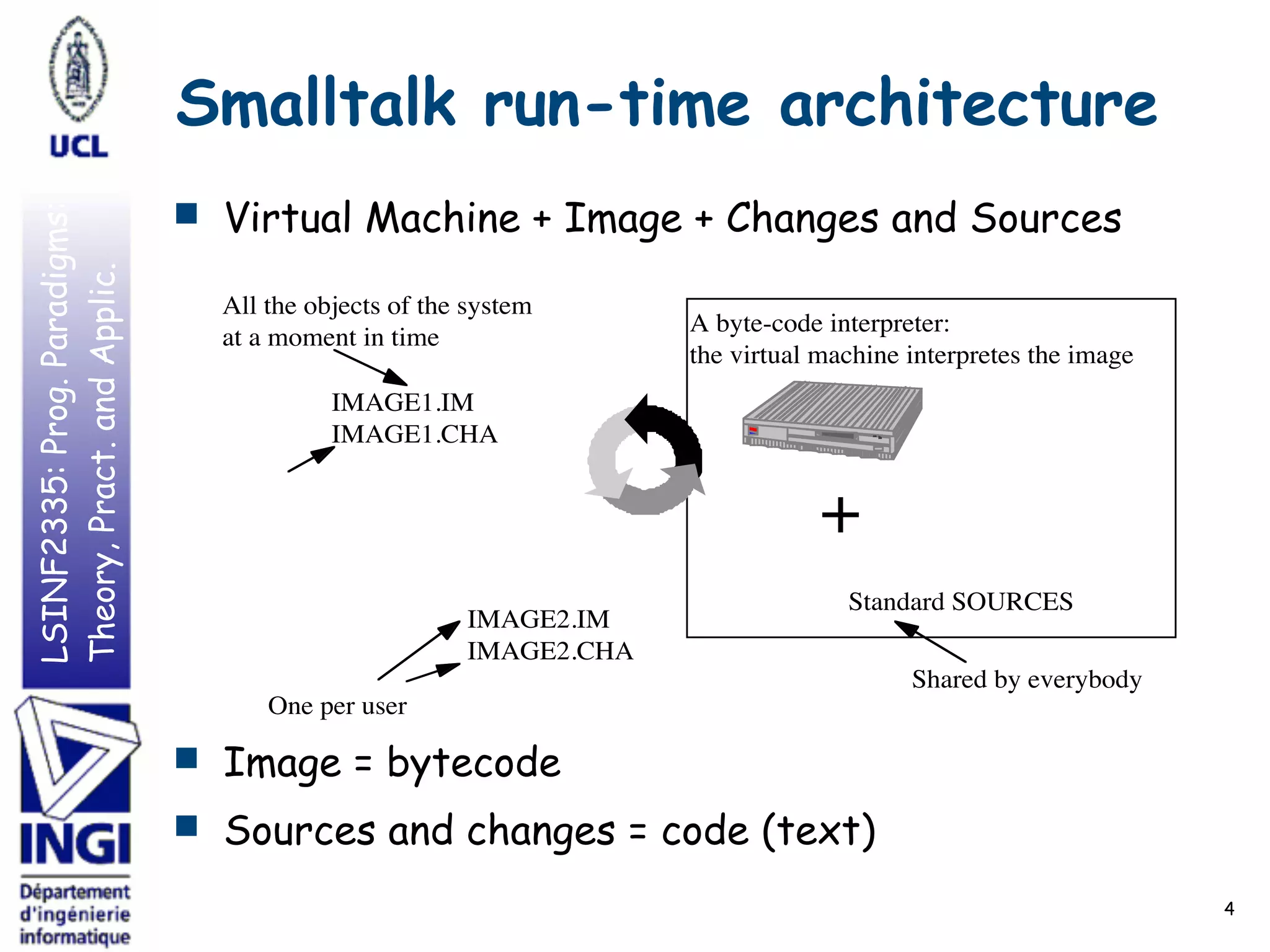
A byte-code interpreter:
the virtual machine interpretes the image
IMAGE2.IM
IMAGE2.CHA
Standard SOURCES
Shared by everybody
IMAGE1.IM
IMAGE1.CHA
All the objects of the system
at a moment in time
One per user
+
Smalltalk run-time architecture
■ Virtual Machine + Image + Changes and Sources
■ Image = bytecode
■ Sources and changes = code (text)
4
LSINF2335:Prog.Paradigms:
Theory,Pract.andApplic.
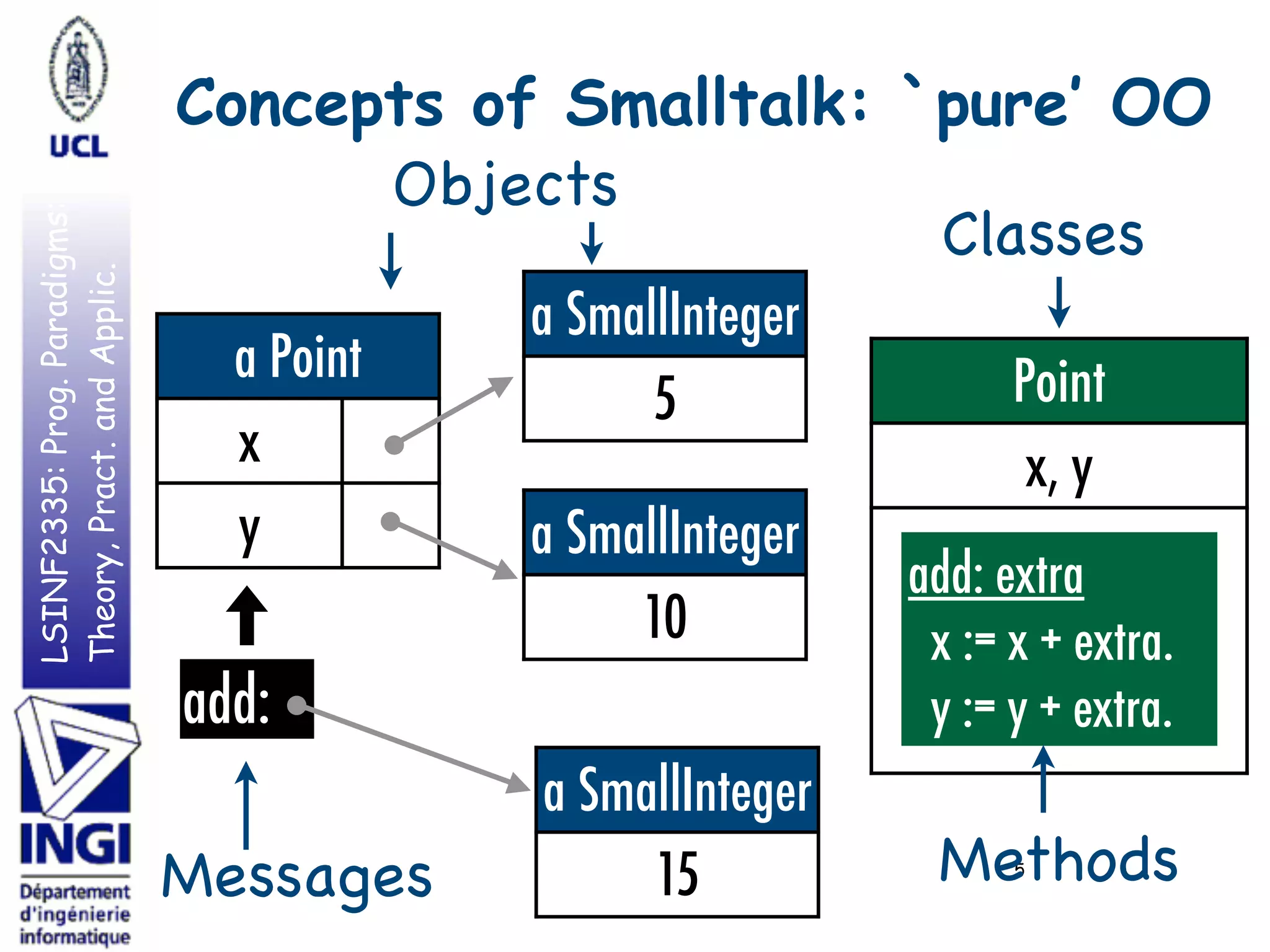
Point
x, y
Classes
Concepts of Smalltalk: `pure’ OO
5
a Point
x
y
a SmallInteger
5
a SmallInteger
10
Objects
add:
a SmallInteger
15Messages
add: extra
x := x + extra.
y := y + extra.
Methods
LSINF2335:Prog.Paradigms:
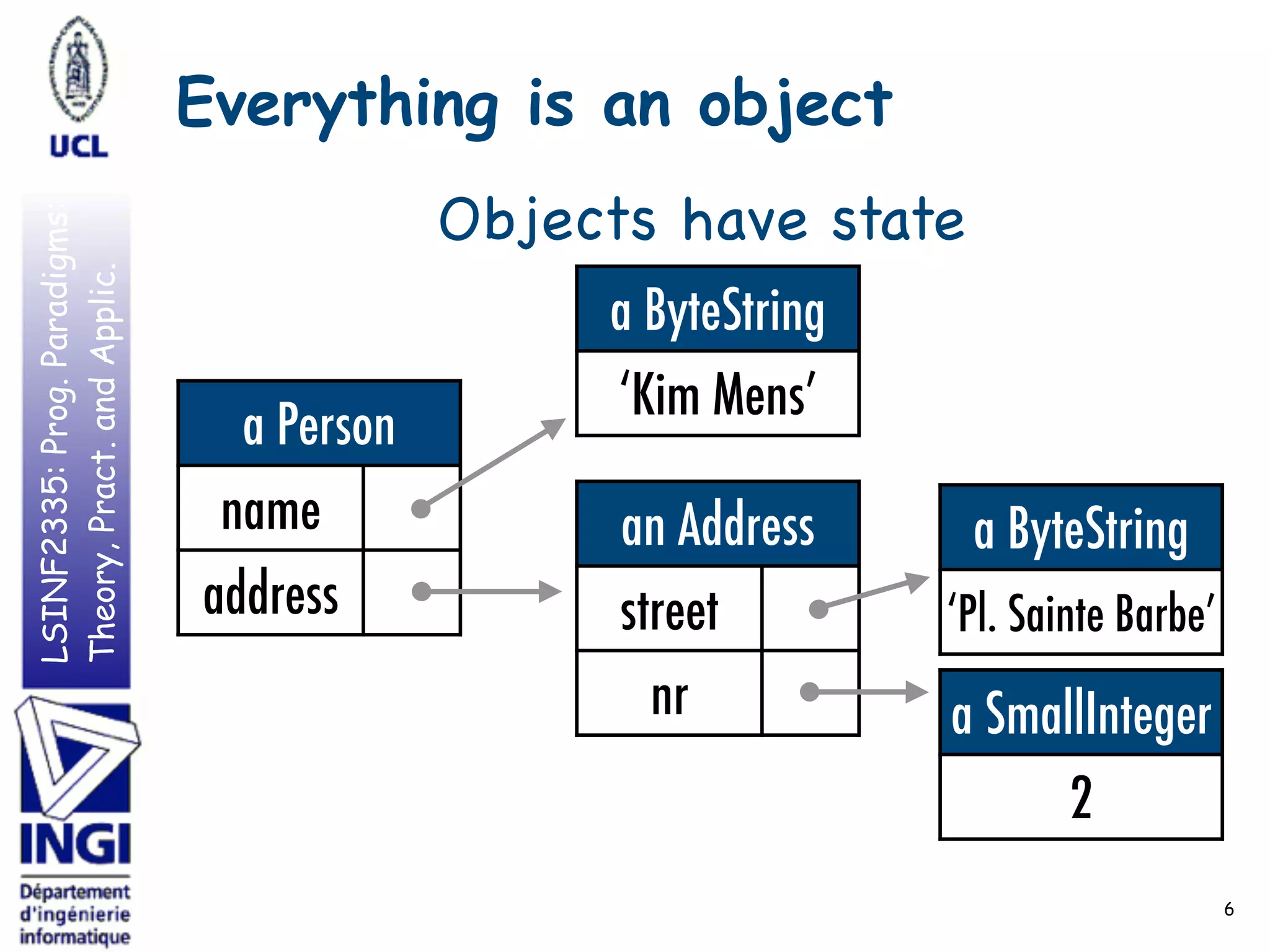
Theory,Pract.andApplic. Everything is an object
6
a Person
name
address
a ByteString
‘Kim Mens’
an Address
street
nr
a ByteString
‘Pl. Sainte Barbe’
a SmallInteger
2
Objects have state
LSINF2335:Prog.Paradigms:
Theory,Pract.andApplic. Everything is an object
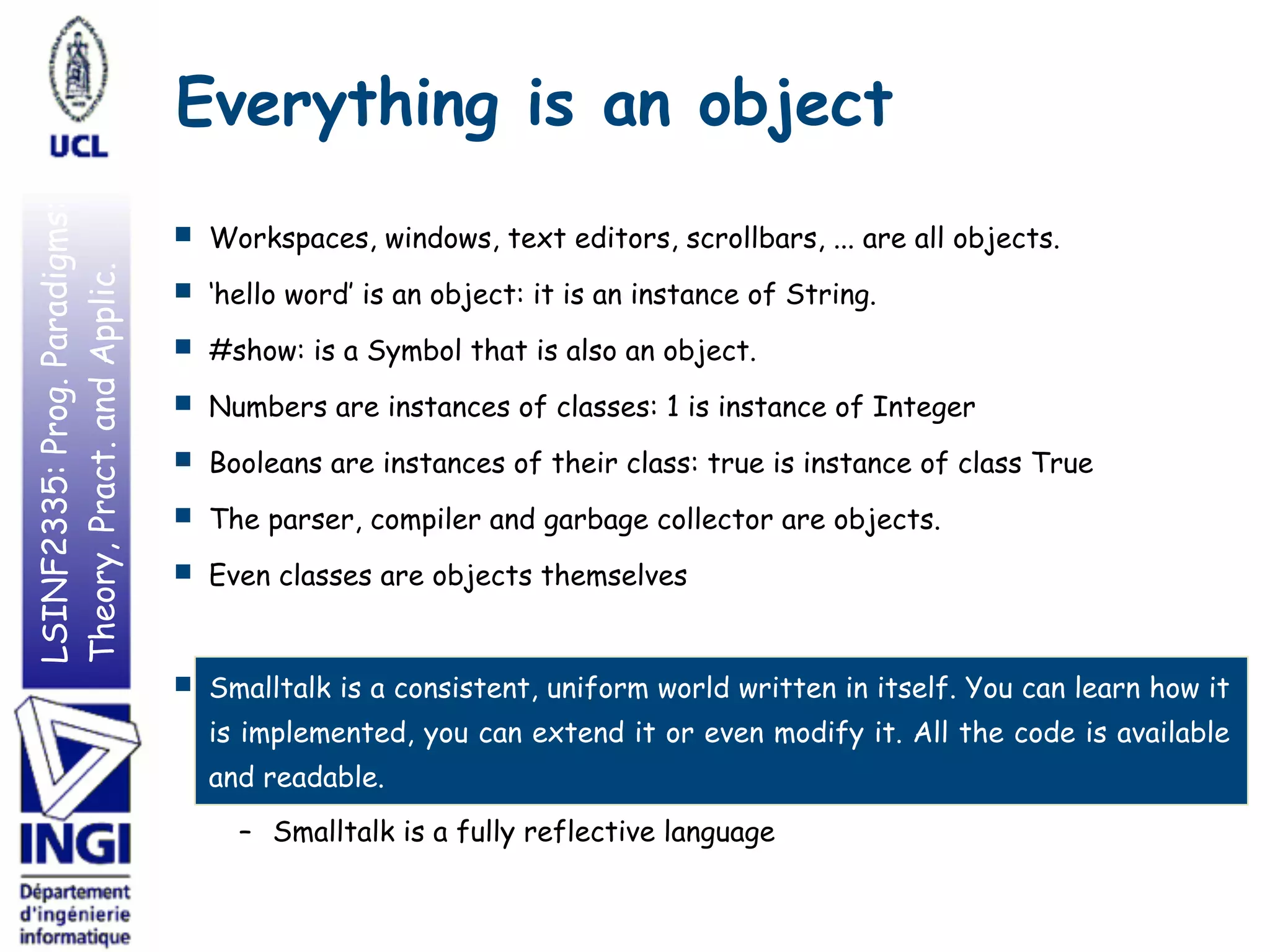
■ Workspaces, windows, text editors, scrollbars, ... are all objects.
■ ‘hello word’ is an object: it is an instance of String.
■ #show: is a Symbol that is also an object.
■ Numbers are instances of classes: 1 is instance of Integer
■ Booleans are instances of their class: true is instance of class True
■ The parser, compiler and garbage collector are objects.
■ Even classes are objects themselves
■ Smalltalk is a consistent, uniform world written in itself. You can learn how it
is implemented, you can extend it or even modify it. All the code is available
and readable.
– Smalltalk is a fully reflective language
LSINF2335:Prog.Paradigms:
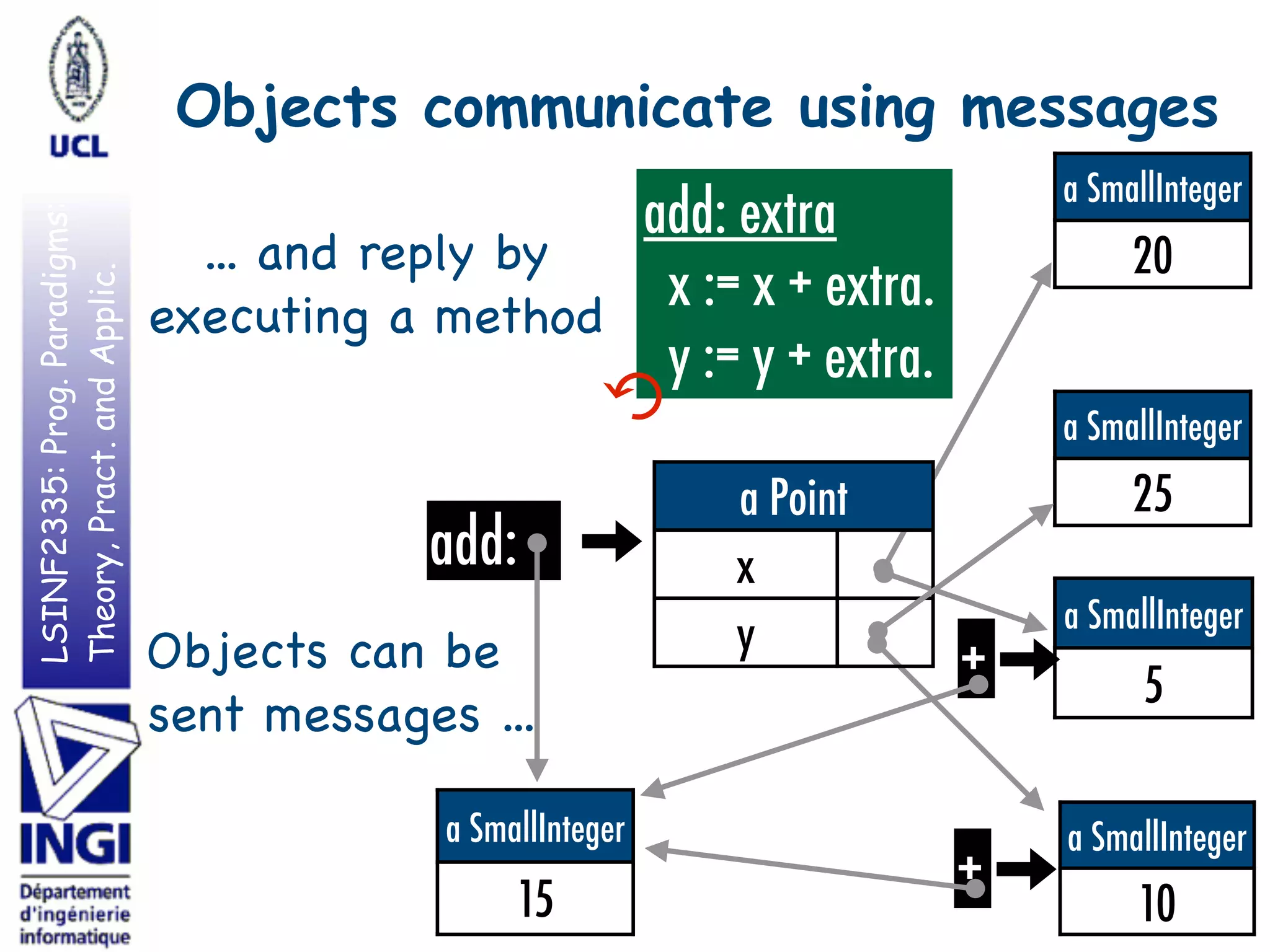
Theory,Pract.andApplic. Objects communicate using messages
8
a SmallInteger
15
add:
Objects can be

sent messages ...
add: extra
x := x + extra.
y := y + extra.
... and reply by
executing a method
↺
a SmallInteger
20
+
a SmallInteger
5
a SmallInteger
10
a Point
x
y
a SmallInteger
25
+
LSINF2335:Prog.Paradigms:
Theory,Pract.andApplic. Objects communicate using messages
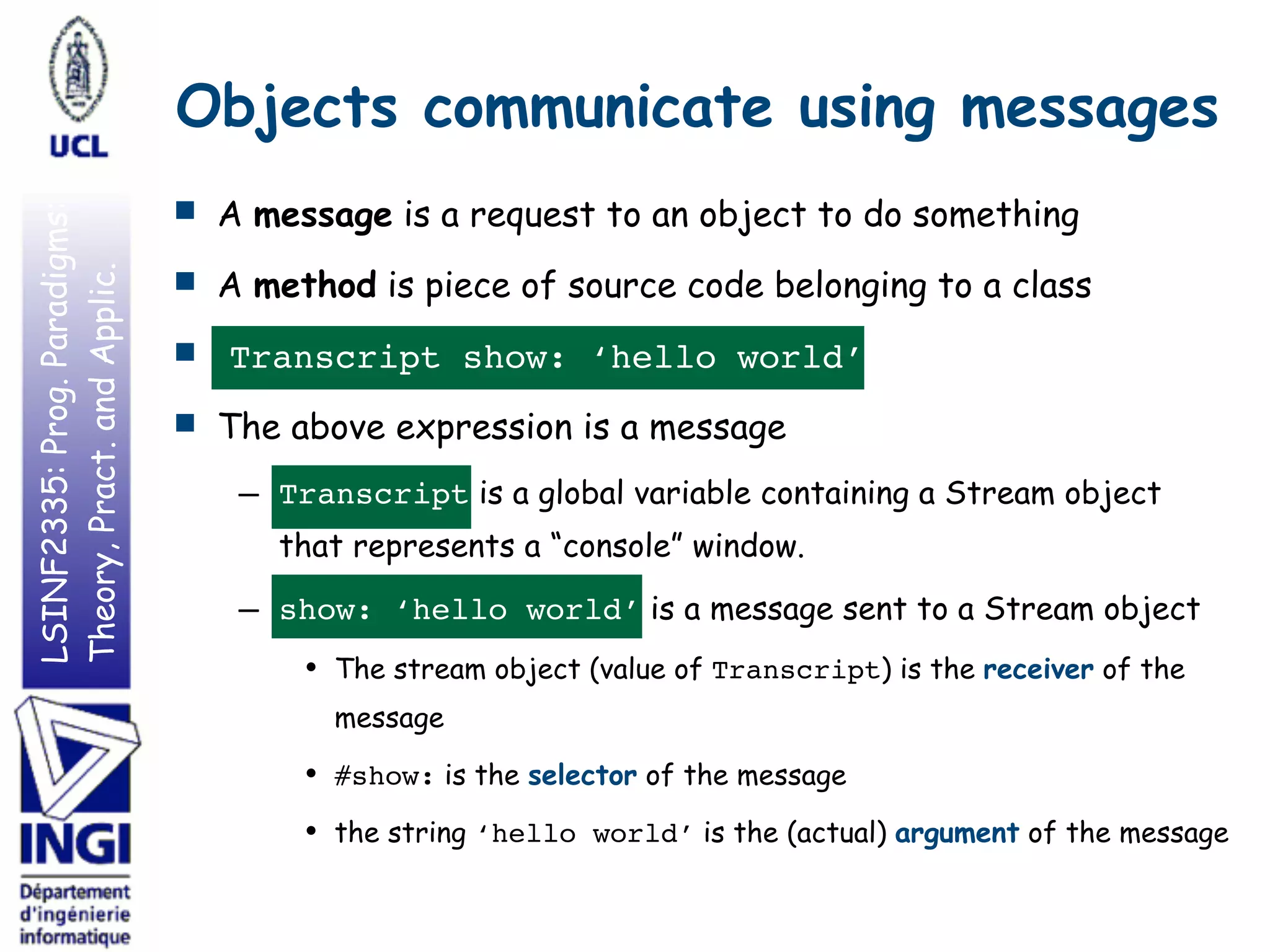
■ A message is a request to an object to do something
■ A method is piece of source code belonging to a class
■ Transcript show: ‘hello world’
■ The above expression is a message
– Transcript is a global variable containing a Stream object
that represents a “console” window.
– show: ‘hello world’ is a message sent to a Stream object
• The stream object (value of Transcript) is the receiver of the
message
• #show: is the selector of the message
• the string ‘hello world’ is the (actual) argument of the message
LSINF2335:Prog.Paradigms:
Theory,Pract.andApplic.
Objects communicate using messages
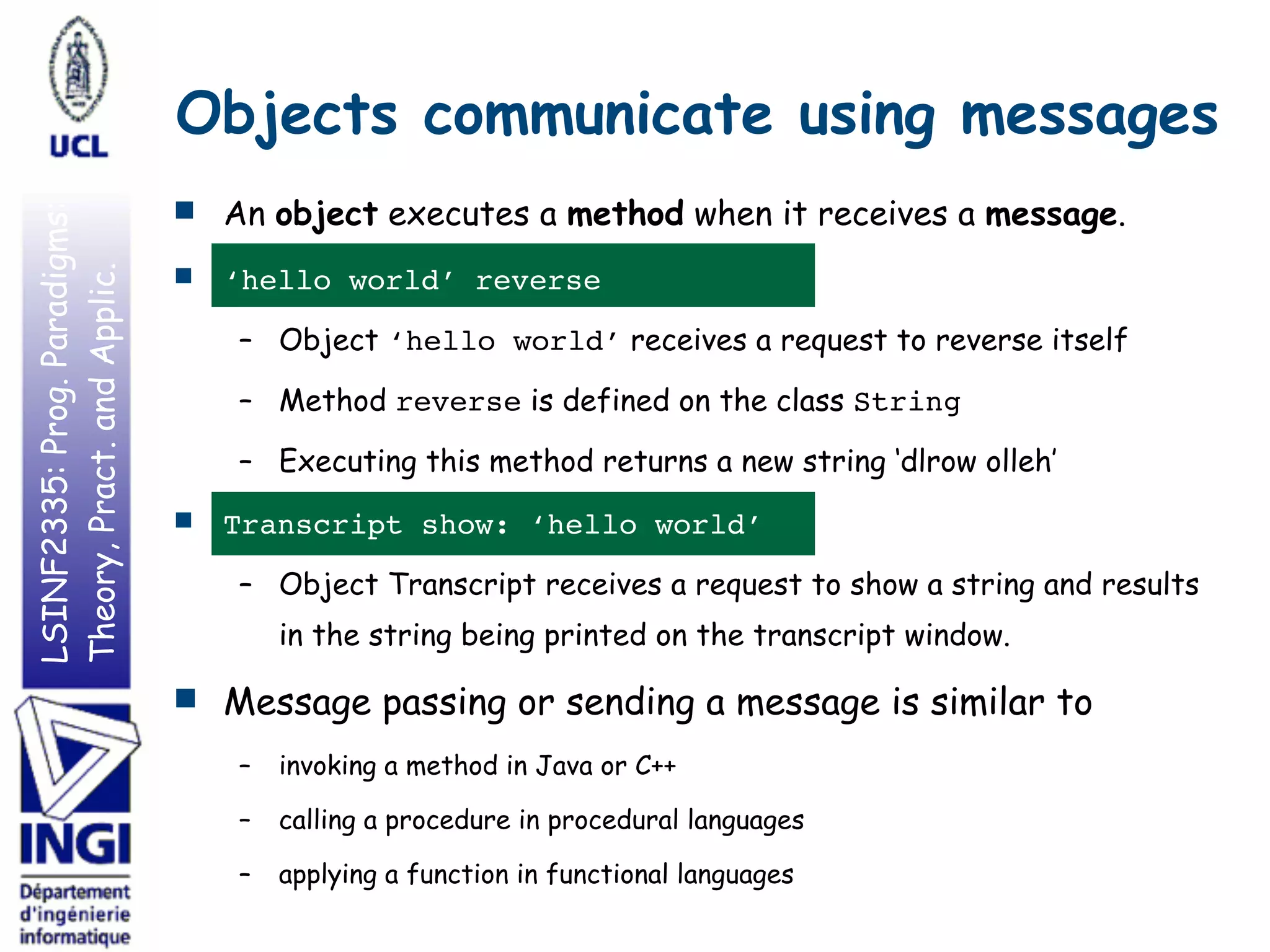
■ An object executes a method when it receives a message.
■ ‘hello world’ reverse
– Object ‘hello world’ receives a request to reverse itself
– Method reverse is defined on the class String
– Executing this method returns a new string ‘dlrow olleh’
■ Transcript show: ‘hello world’
– Object Transcript receives a request to show a string and results
in the string being printed on the transcript window.
■ Message passing or sending a message is similar to
– invoking a method in Java or C++
– calling a procedure in procedural languages
– applying a function in functional languages
LSINF2335:Prog.Paradigms:
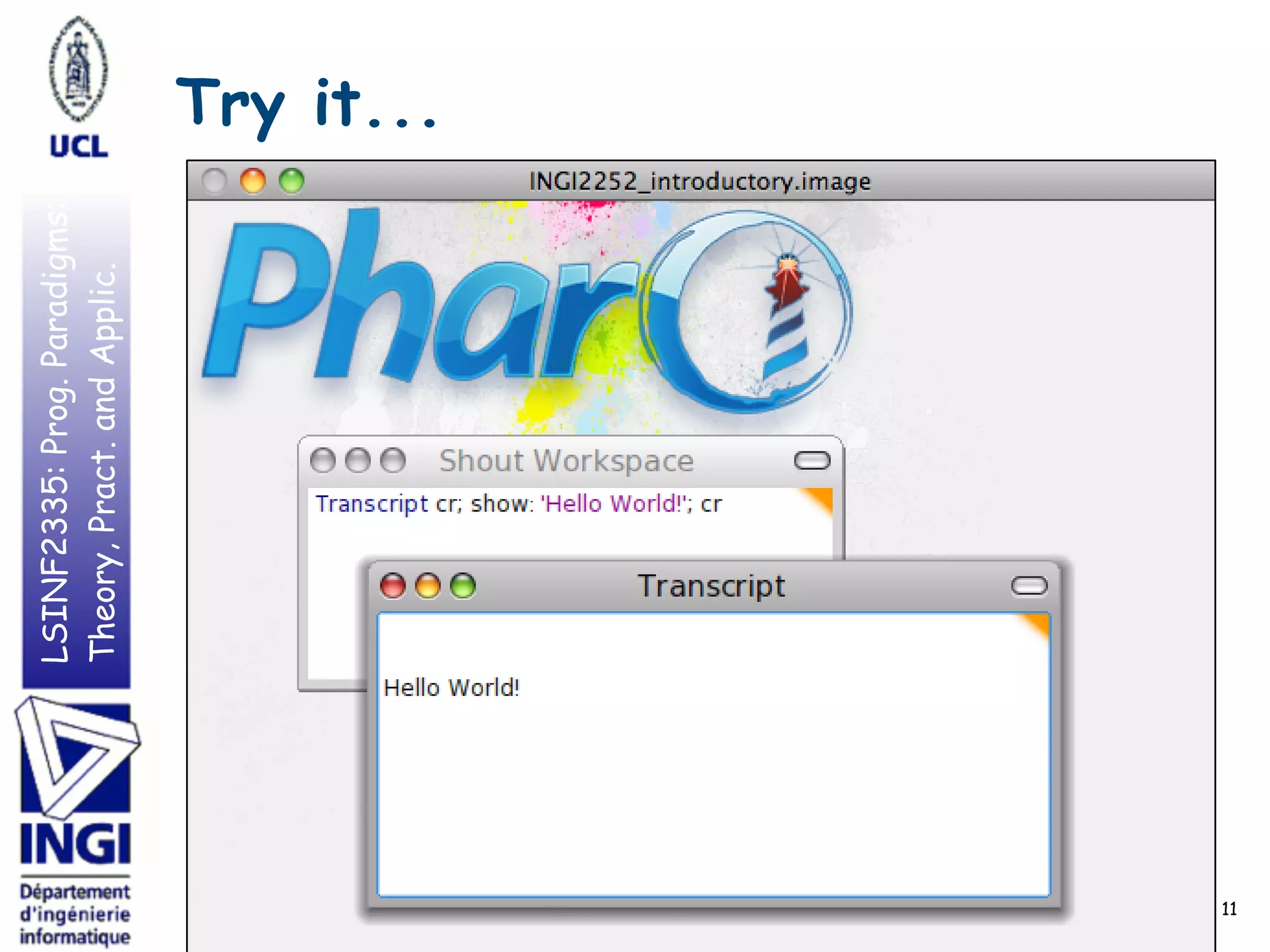
Theory,Pract.andApplic. Try it...
11
LSINF2335:Prog.Paradigms:
Theory,Pract.andApplic. Smalltalk basic expressions
12
Literals
Variable Reference
Message
Expressions
Return
Expressions
Block Expressions
1234
someObject
someObject doSomethingWith: 1234
^ someObject print: ‘Johan’
$a #Johan ‘Kim’ #(#a #b)
a GlobalVariable
[ :x :y | x + y ]
1 + 2 ‘Kim’ , ‘Mens’ #(#a #b) first
LSINF2335:Prog.Paradigms:
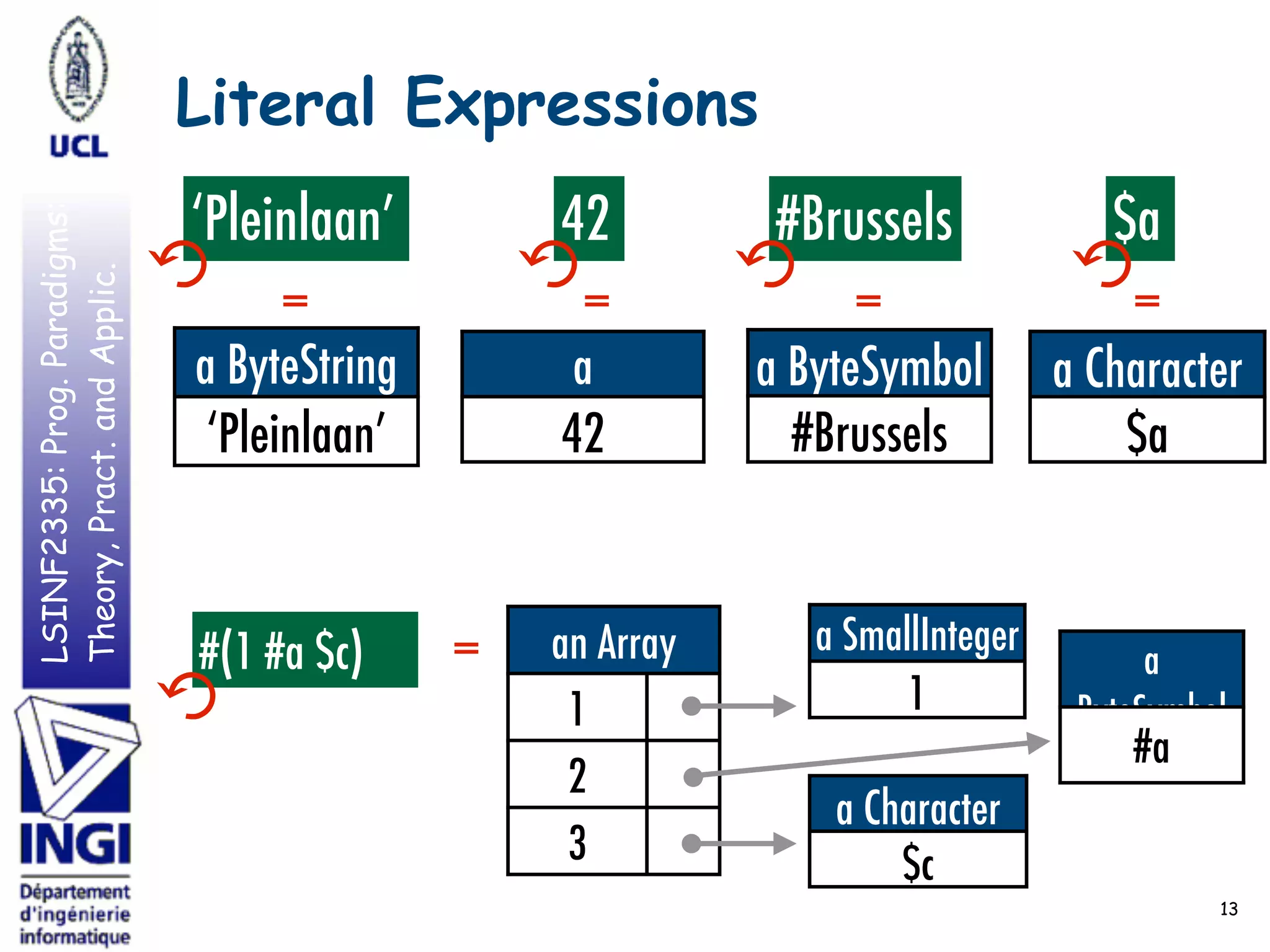
Theory,Pract.andApplic. Literal Expressions
13
a ByteString
‘Pleinlaan’
a
42
a ByteSymbol
#Brussels
a Character
$a
‘Pleinlaan’↺
= = = =
42
↺
#Brussels
↺
$a
↺
#(1 #a $c)
↺
an Array
1
2
3
= a SmallInteger
1
a Character
$c
a
ByteSymbol
#a
LSINF2335:Prog.Paradigms:
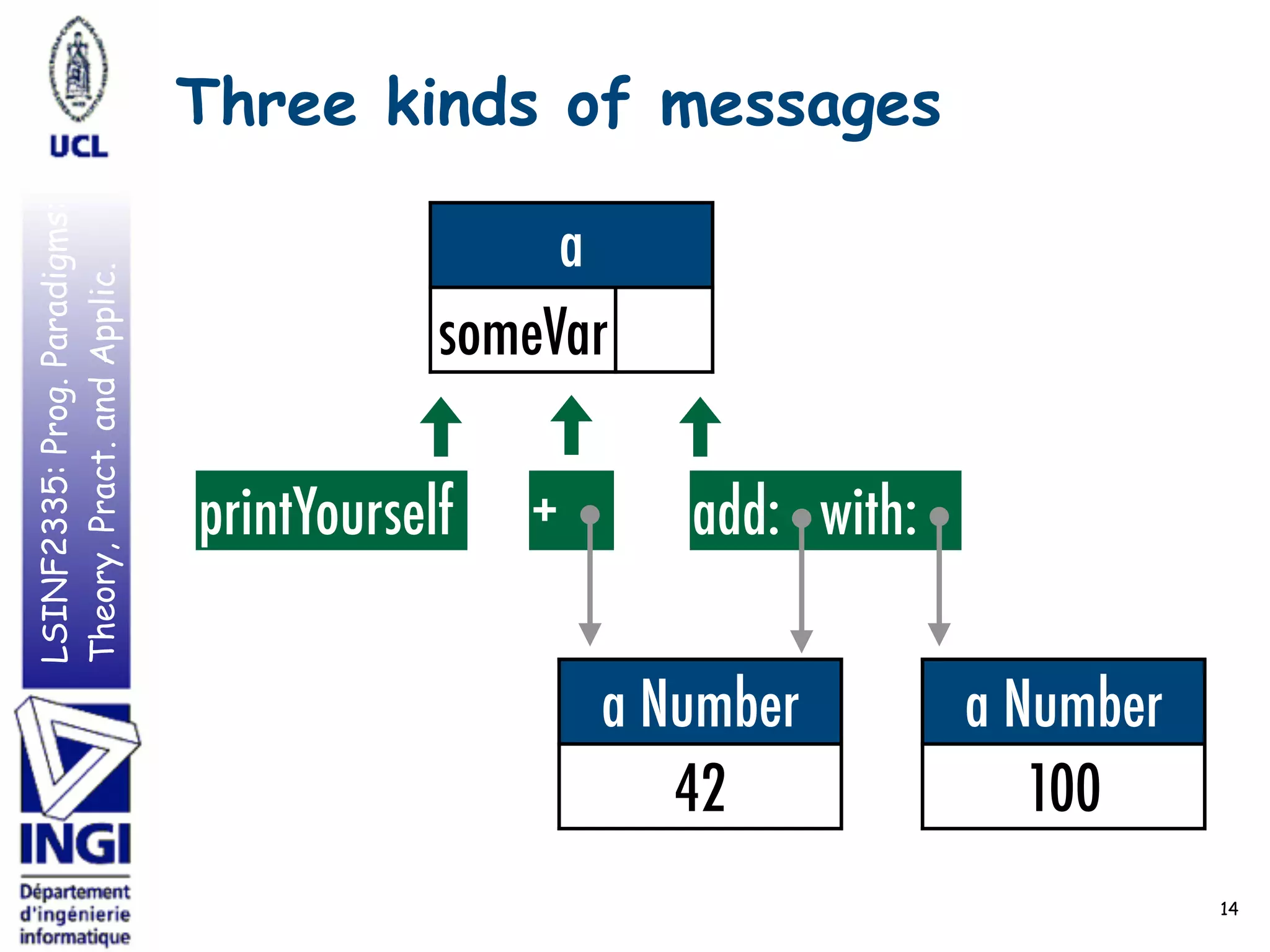
Theory,Pract.andApplic. Three kinds of messages
14
a
SomeObjectsomeVar
+ add: with:
a Number
42
a Number
100
printYourself
LSINF2335:Prog.Paradigms:
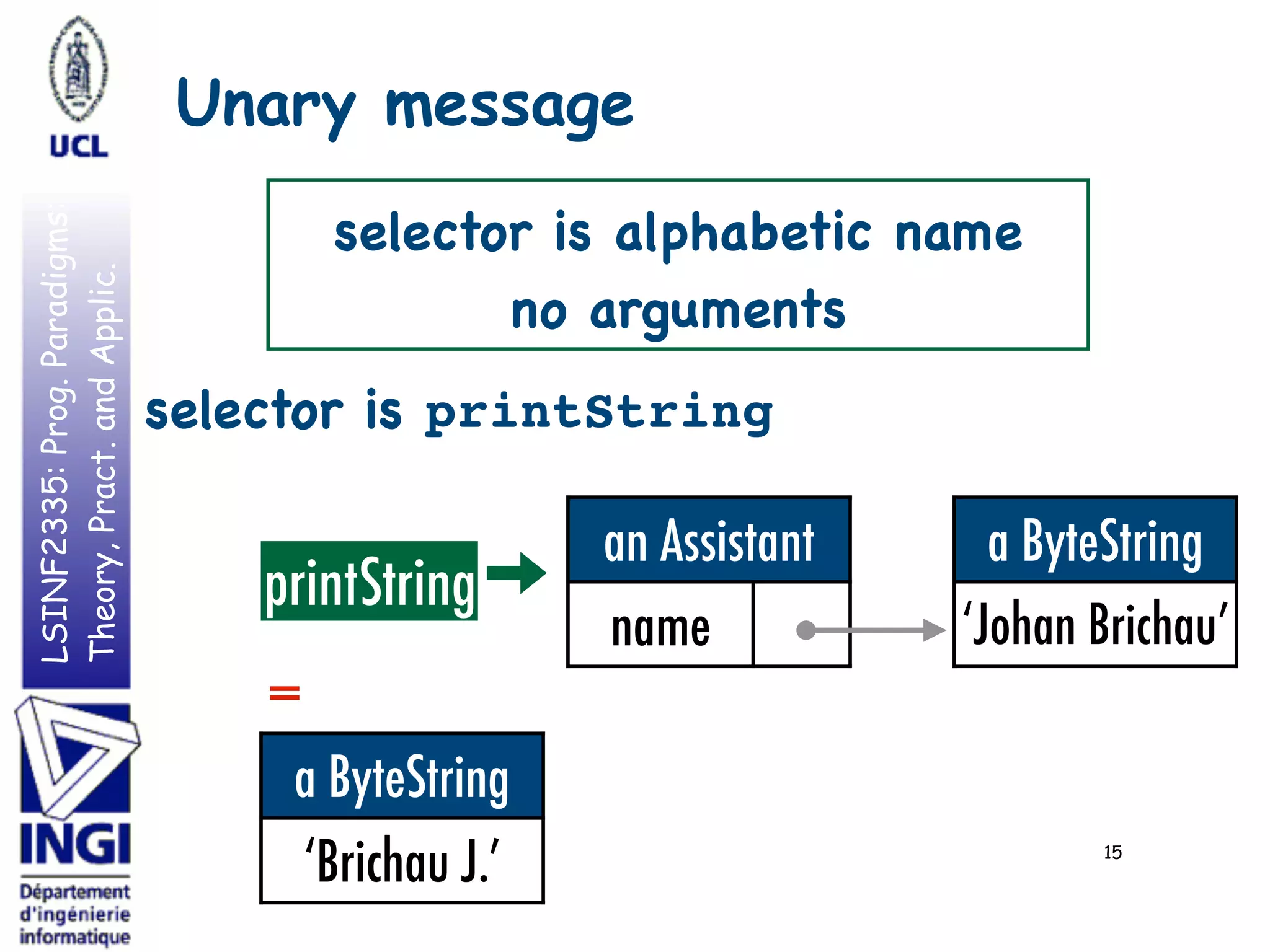
Theory,Pract.andApplic. Unary message
15
printString
an Assistant
name
a ByteString
‘Johan Brichau’
=
a ByteString
‘Brichau J.’
selector is alphabetic name

no arguments
selector is printString
LSINF2335:Prog.Paradigms:
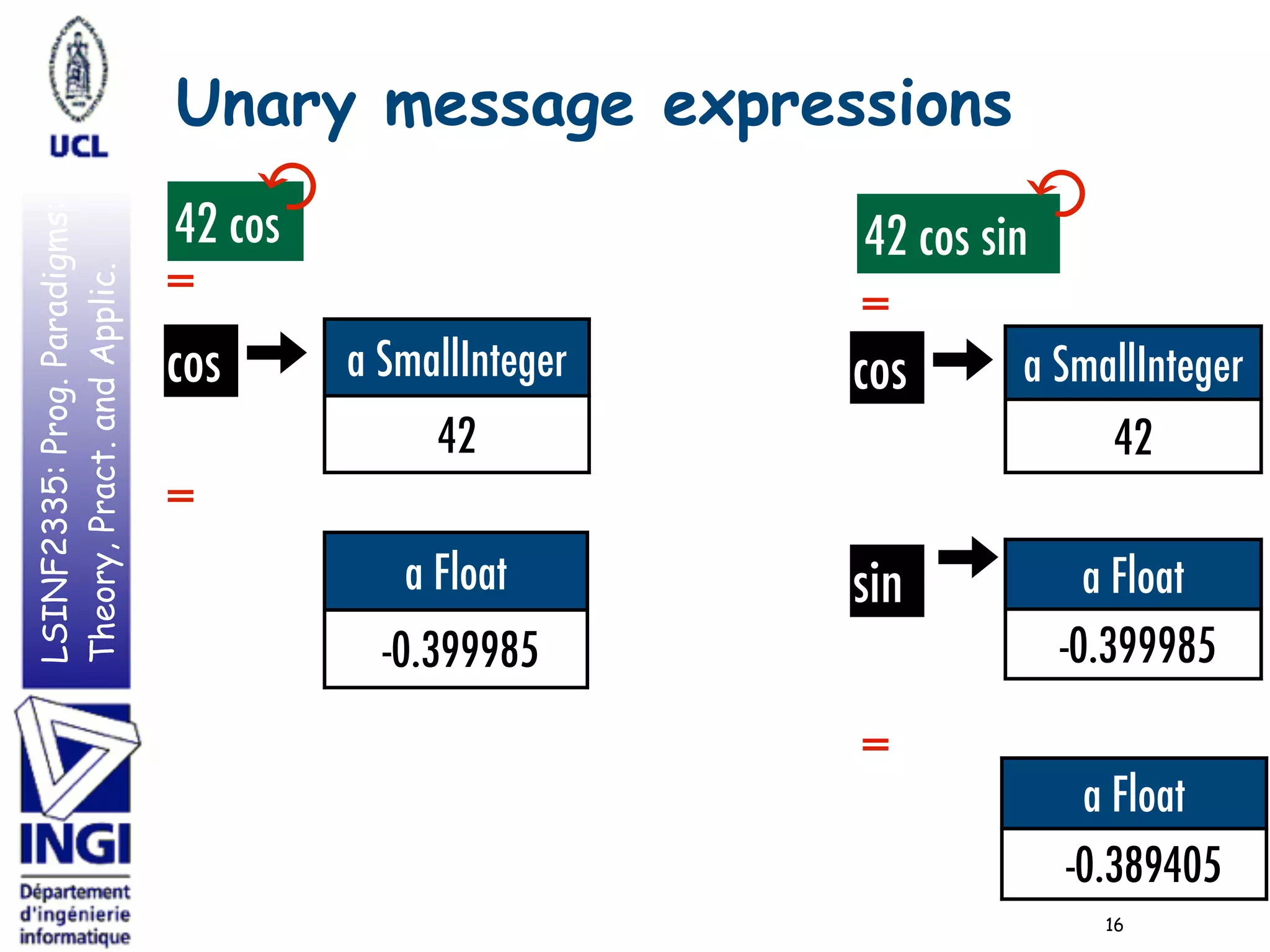
Theory,Pract.andApplic. Unary message expressions
16
42 cos 42 cos sin
↺ =
cos a SmallInteger
42
=
a Float
-0.399985
cos a SmallInteger
42
a Float
-0.399985
↺
sin
=
a Float
-0.389405
=
LSINF2335:Prog.Paradigms:
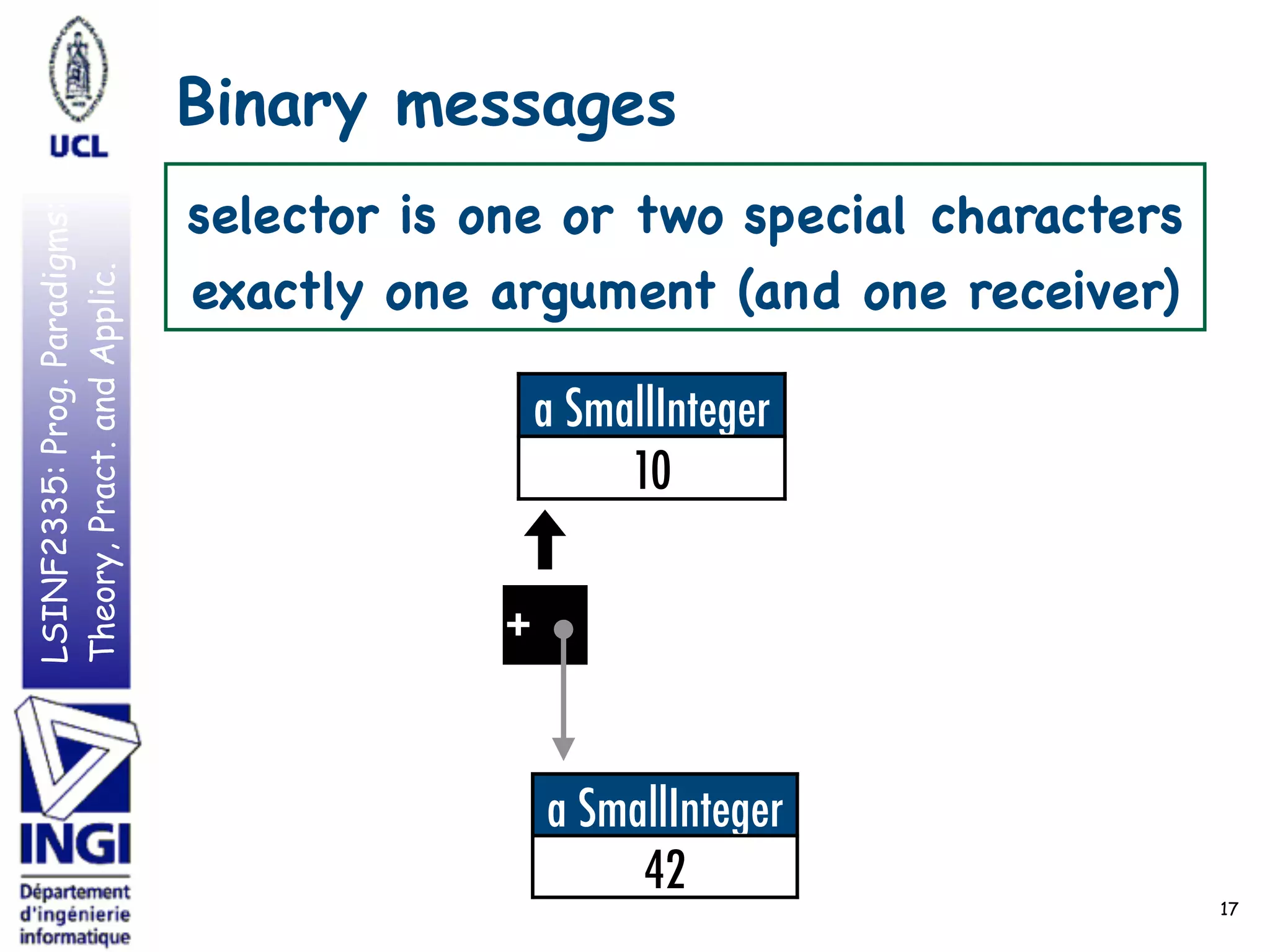
Theory,Pract.andApplic. Binary messages
17
a SmallInteger
10
+
a SmallInteger
42
selector is one or two special characters

exactly one argument (and one receiver)
LSINF2335:Prog.Paradigms:
Theory,Pract.andApplic. Binary message expressions
18
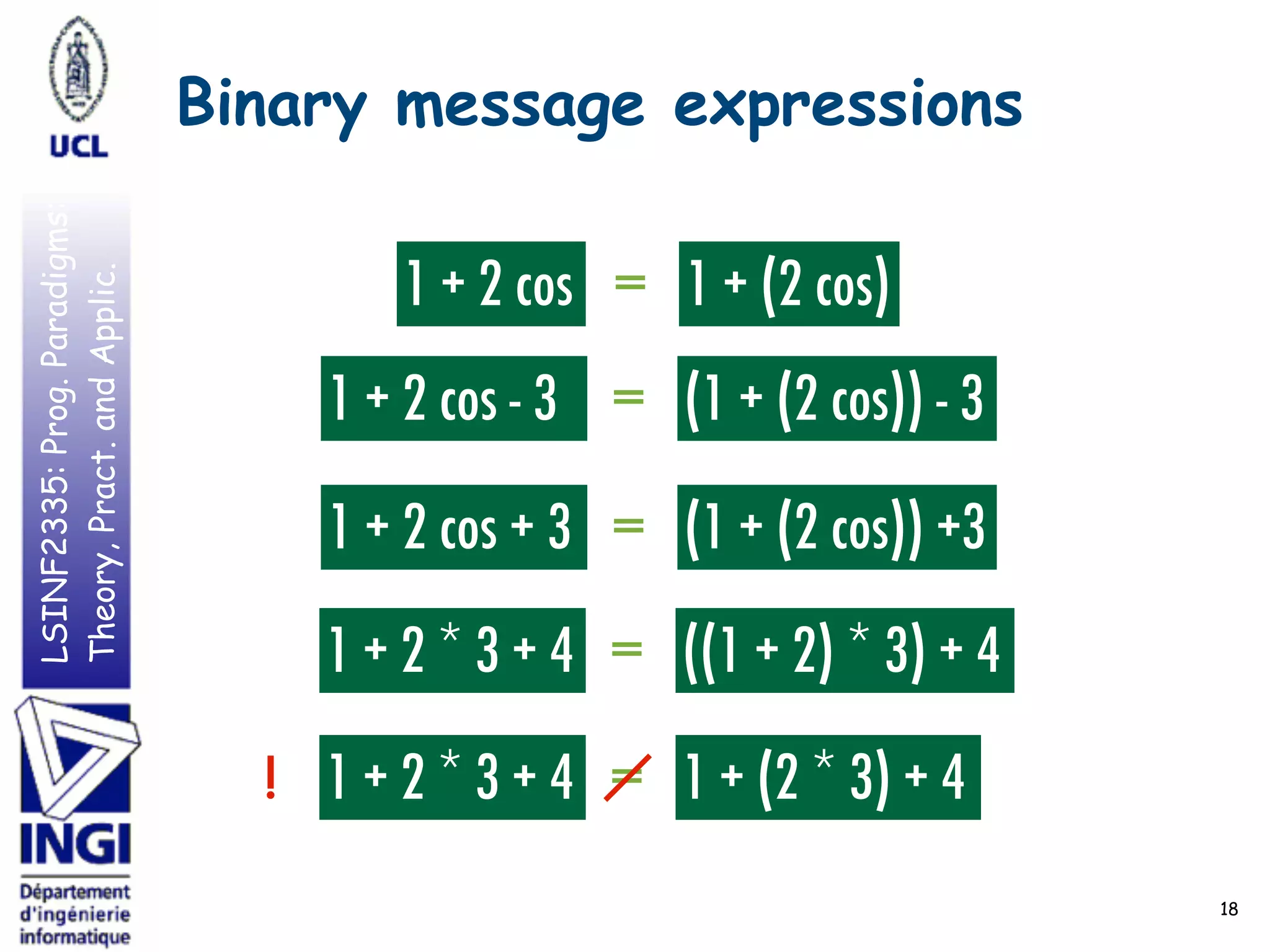
1 + 2 cos 1 + (2 cos)=
1 + 2 cos - 3 (1 + (2 cos)) - 3=
1 + 2 cos + 3 (1 + (2 cos)) +3=
1 + 2 * 3 + 4 ((1 + 2) * 3) + 4=
1 + 2 * 3 + 4 1 + (2 * 3) + 4=!
LSINF2335:Prog.Paradigms:
Theory,Pract.andApplic.
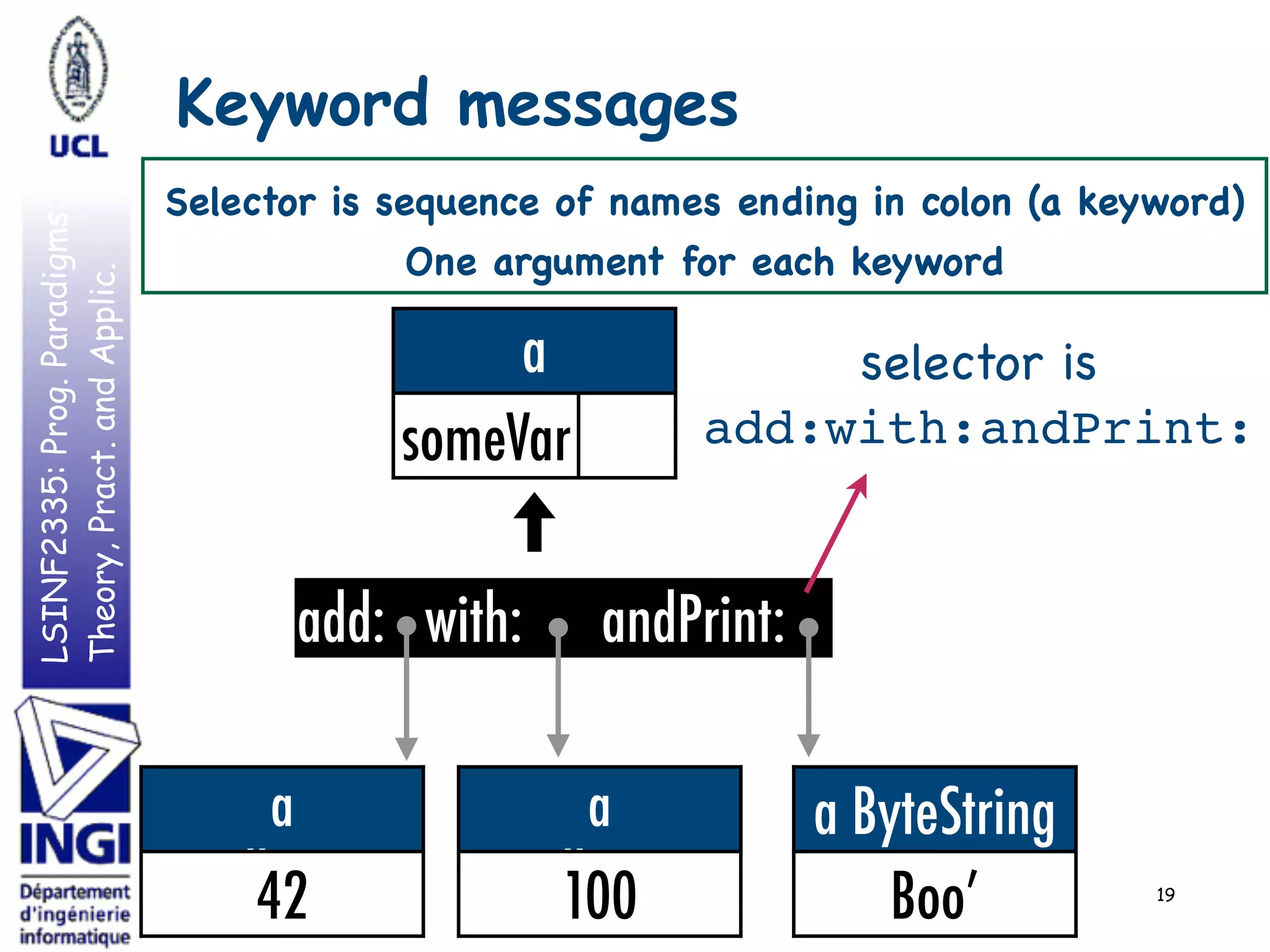
a ByteString
Boo’
Keyword messages
19
a
SomeObjectsomeVar
add: with: andPrint:
a
SmallInteger42
a
SmallInteger100
Selector is sequence of names ending in colon (a keyword)

One argument for each keyword
selector is
add:with:andPrint:
LSINF2335:Prog.Paradigms:
Theory,Pract.andApplic. Keyword message expressions
20
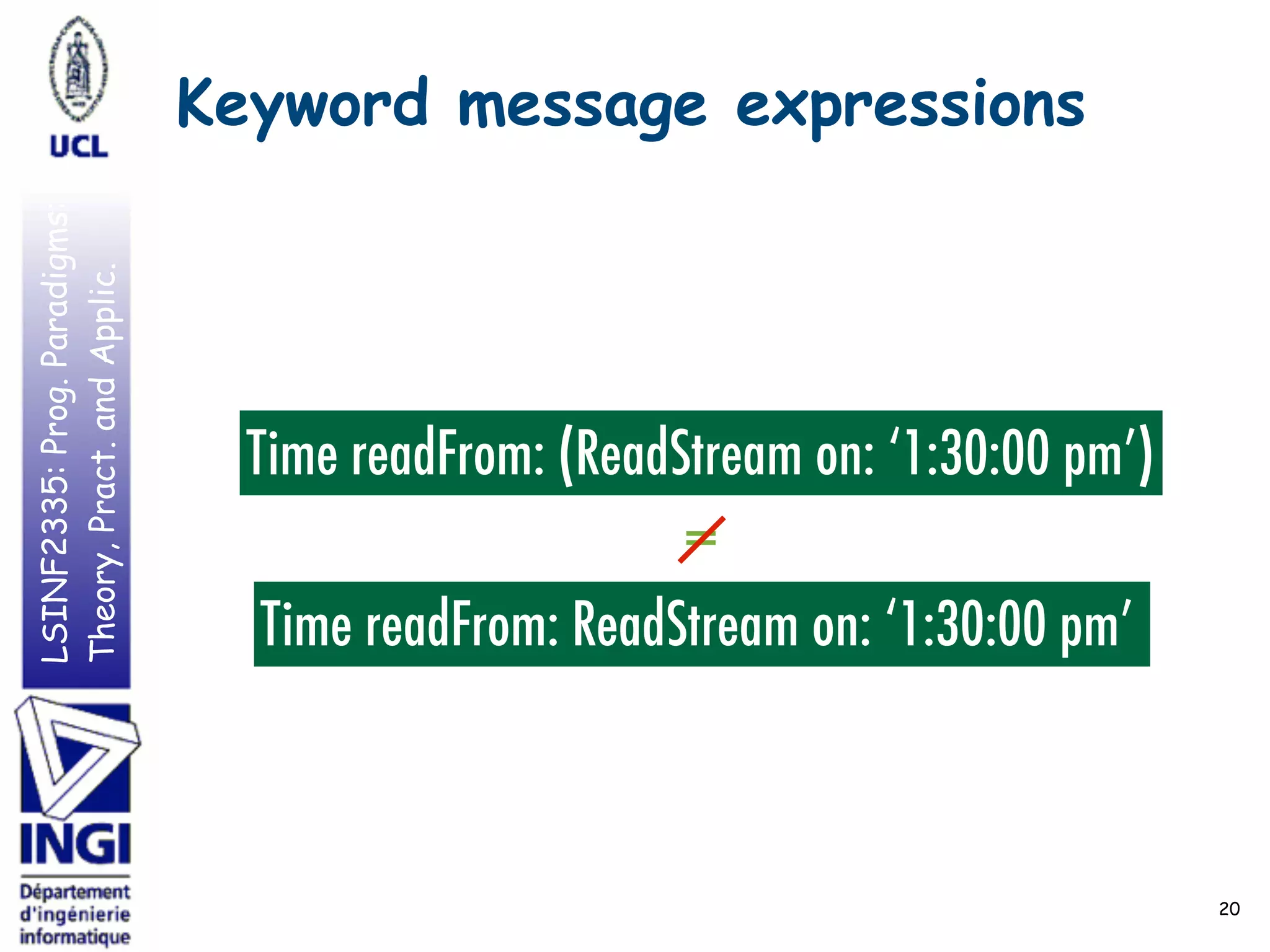
Time readFrom: (ReadStream on: ‘1:30:00 pm’)
Time readFrom: ReadStream on: ‘1:30:00 pm’
=
LSINF2335:Prog.Paradigms:
Theory,Pract.andApplic.
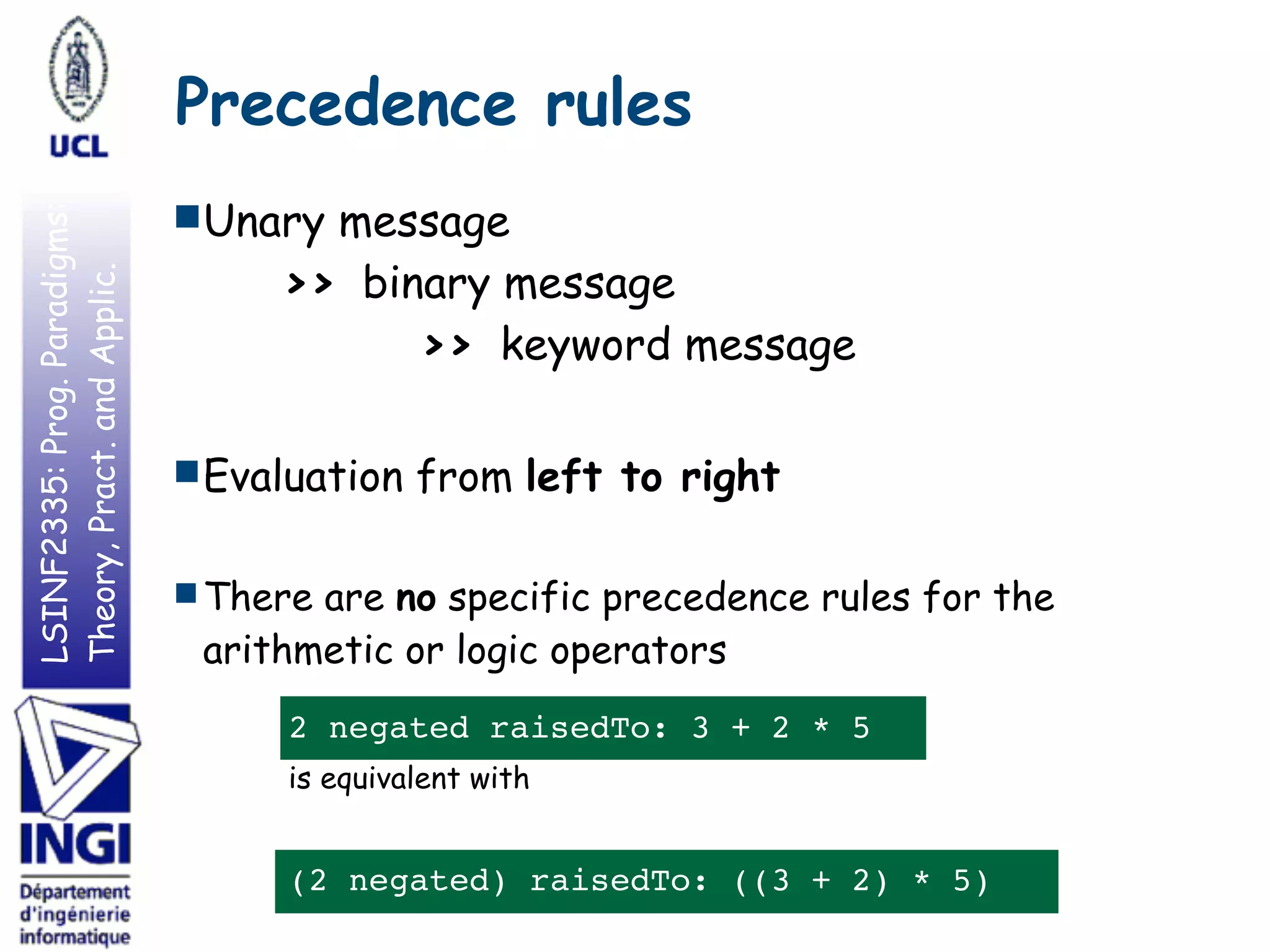
■Unary message 

>> binary message 

>> keyword message
■ Evaluation from left to right
■ There are no specific precedence rules for the
arithmetic or logic operators
2 negated raisedTo: 3 + 2 * 5
is equivalent with
(2 negated) raisedTo: ((3 + 2) * 5)
Precedence rules
LSINF2335:Prog.Paradigms:
Theory,Pract.andApplic.
■ In Java different predefined syntactic constructs like >>, if, for,
while, … are hard-coded into the language grammar
■ In Smalltalk, they are just defined on objects, e.g. :
(>>) bitShift: is just a message sent to numbers
10 bitShift: 2
(if) ifTrue: is just messages sent to a boolean
(1> x) ifTrue: [ … ]
(for) do:, to:do: are just messages to collections or numbers
#(a b c d) do: [:each | Transcript show: each ; cr]
1 to: 10 do: [:each | Transcript show: each printString ]
■ Advantages :
– Language is extensible (very easy to add “new syntax”)
– Simplicity & orthogonality (uniform language design)
Control structures
LSINF2335:Prog.Paradigms:
Theory,Pract.andApplic. Blocks
23
[ :foo :bar |foo + bar ]
↺
a BlockClosure
=
value: value:
Blocks are “delayed” expressions
Blocks can be sent messages to evaluate
the body of the block
[ :foo :bar |foo + bar ] value: 4 value: 2
↺
=
a SmallInteger
6
a BlockClosure
LSINF2335:Prog.Paradigms:
Theory,Pract.andApplic. Block expressions
24
[ Transcript show: 'Boo!'] value
ablock := [ :someName | someName asUppercase ].
ablock value: 'Kim'
[ :a :b| a + b ] valueWithArguments: (Array with: 1 with: 2)
LSINF2335:Prog.Paradigms:
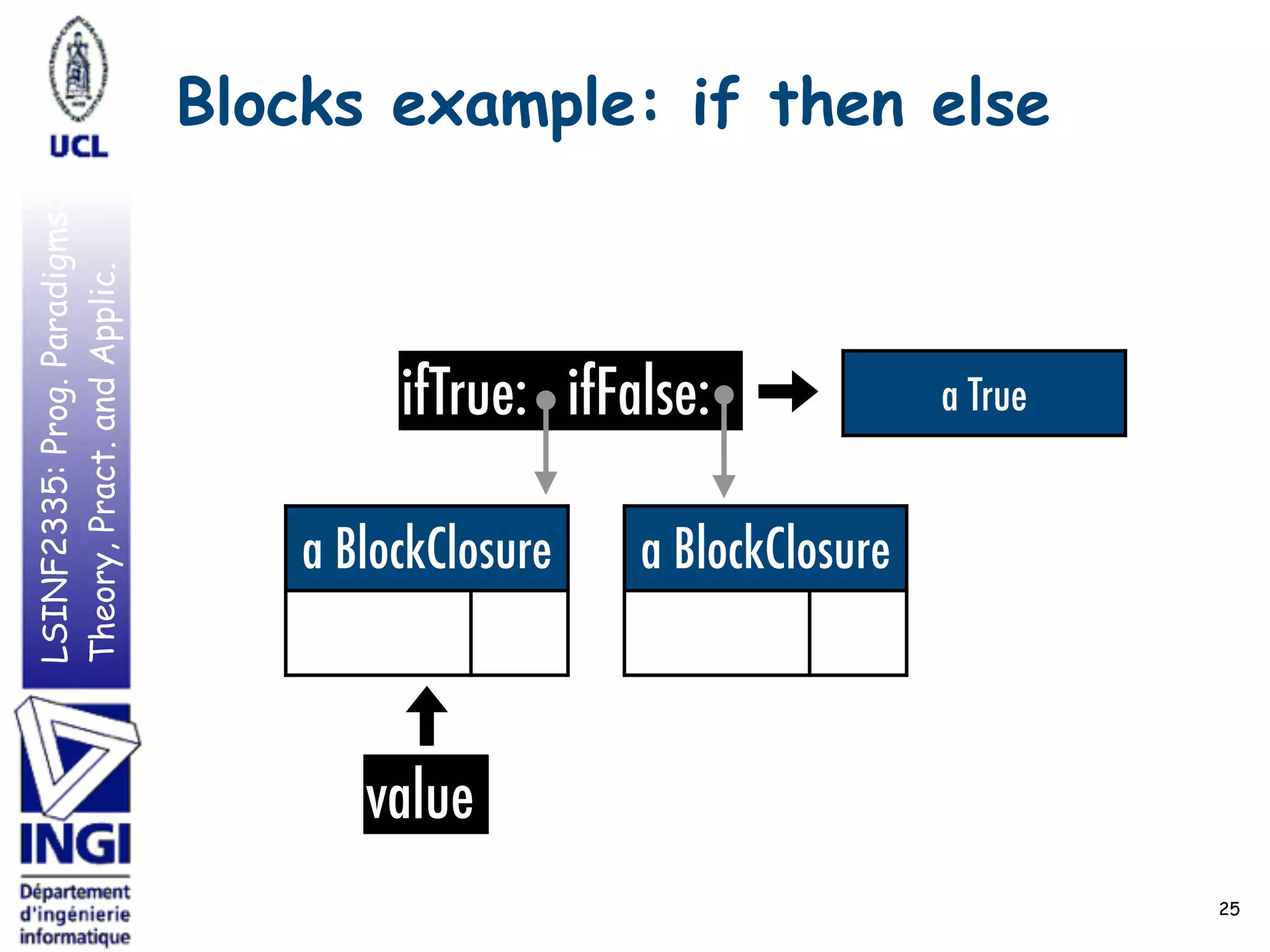
Theory,Pract.andApplic. Blocks example: if then else
25
a TrueifTrue: ifFalse:
a BlockClosure a BlockClosure
value
LSINF2335:Prog.Paradigms:
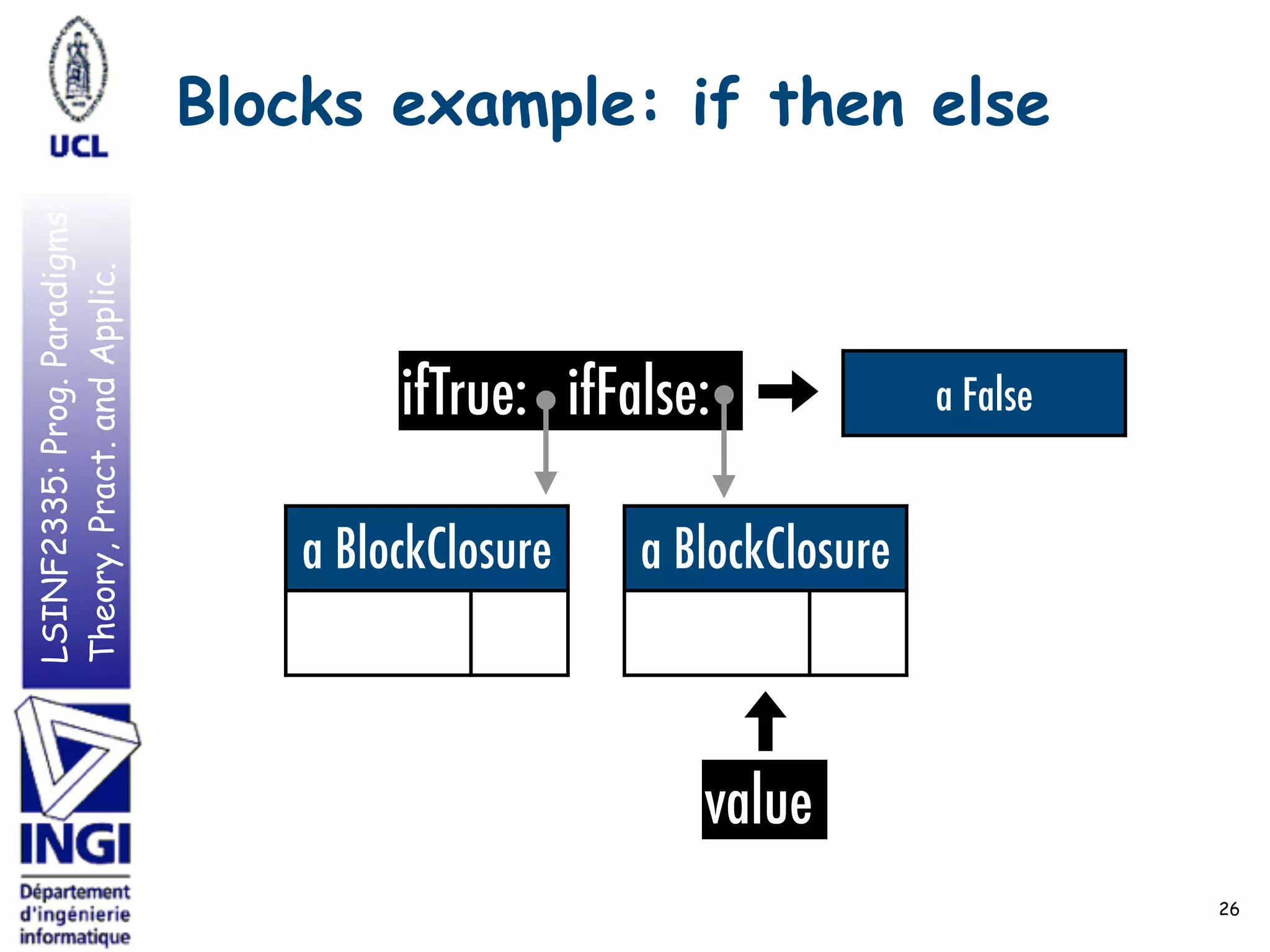
Theory,Pract.andApplic. Blocks example: if then else
26
a FalseifTrue: ifFalse:
a BlockClosure a BlockClosure
value
LSINF2335:Prog.Paradigms:
Theory,Pract.andApplic. Blocks
27
true ifTrue: [ Transcript show: ‘yes’ ] ifFalse: [ Transcript show: ‘no’ ]
(a < b ) ifTrue: [ Transcript show: ‘a smaller’ ]
ifFalse: [ Transcript show: ‘a not smaller’ ]
Transcript show: ((a < b) ifTrue: [ ‘a’ ] ifFalse: [‘a not’ ]) , ‘ smaller’
LSINF2335:Prog.Paradigms:
Theory,Pract.andApplic.
■ A method that illustrates every part of Smalltalk method syntax
except primitives.
uselessMethod: x
|y|
true & false not & (nil isNil)
ifFalse: [self halt].
y := self size + super size.
#($a #a ’a’ 1 1.0)
do: [:each | Transcript
show: (each class name);
show: (each printString);
show: ’ ’].
^ x < y
Power & Simplicity: Syntax on a PostCard
LSINF2335:Prog.Paradigms:
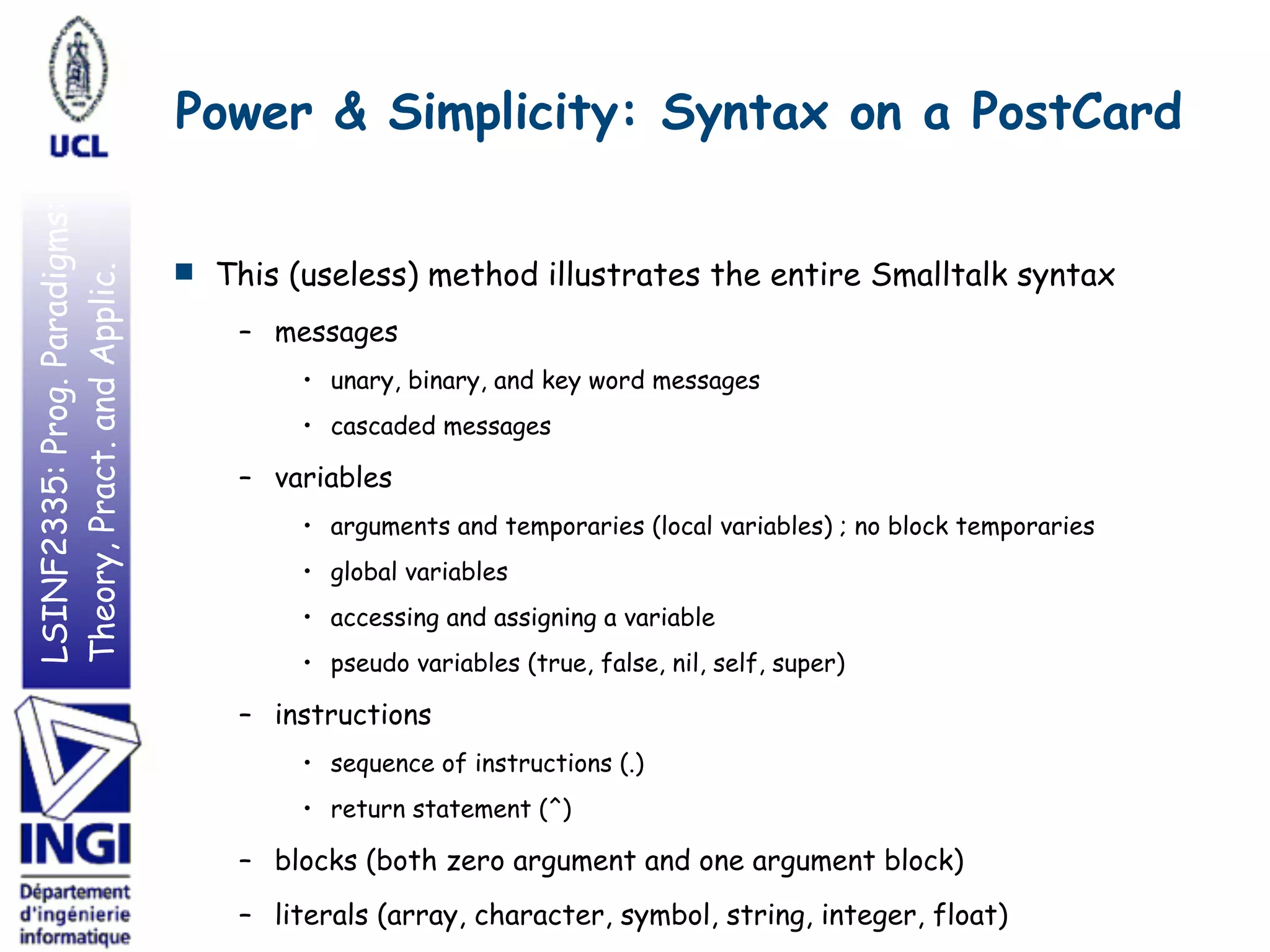
Theory,Pract.andApplic. Power & Simplicity: Syntax on a PostCard
■ This (useless) method illustrates the entire Smalltalk syntax
– messages
• unary, binary, and key word messages
• cascaded messages
– variables
• arguments and temporaries (local variables) ; no block temporaries
• global variables
• accessing and assigning a variable
• pseudo variables (true, false, nil, self, super)
– instructions
• sequence of instructions (.)
• return statement (^)
– blocks (both zero argument and one argument block)
– literals (array, character, symbol, string, integer, float)
LSINF2335:Prog.Paradigms:
Theory,Pract.andApplic.
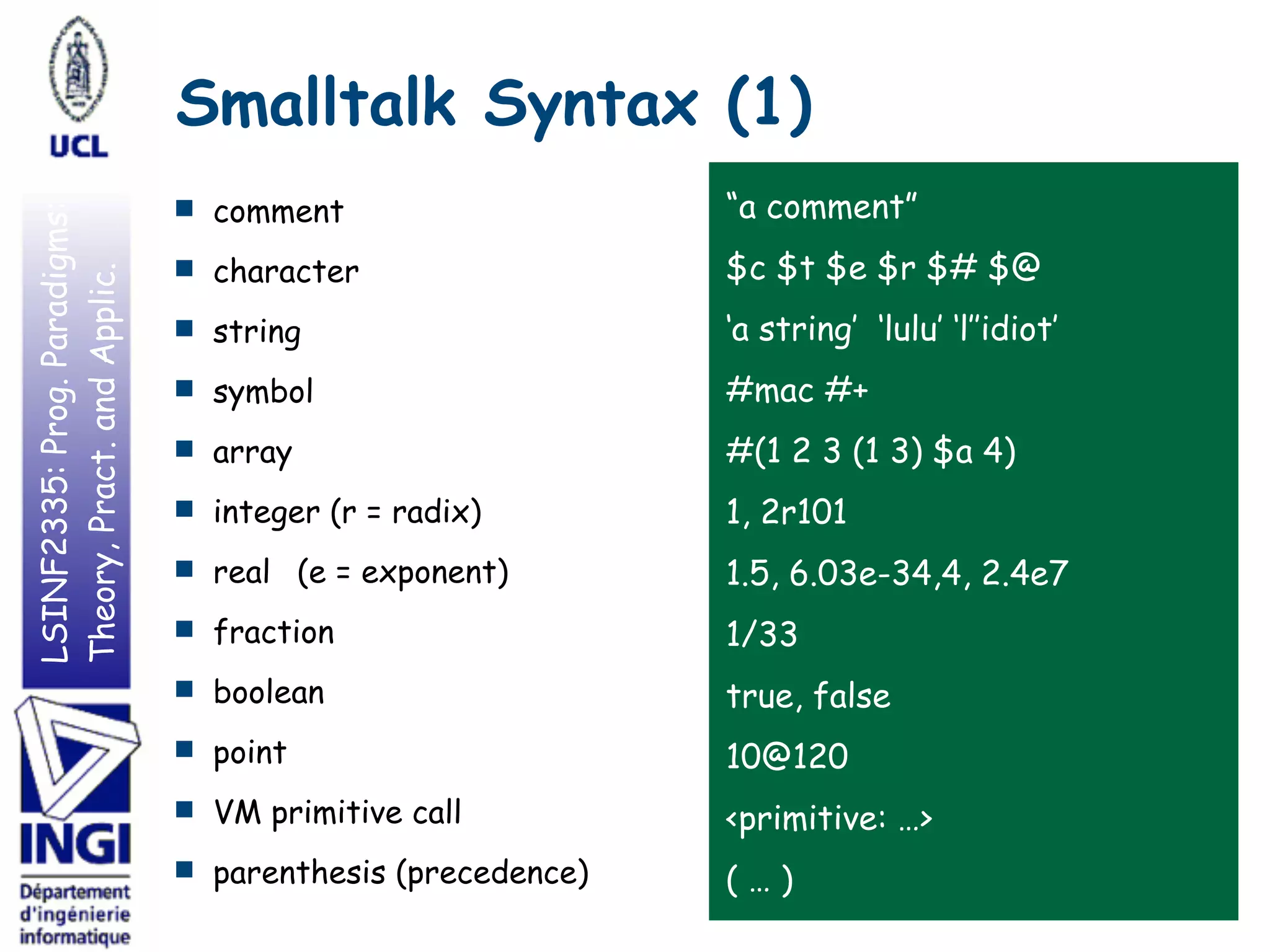
“a comment”
$c $t $e $r $# $@
‘a string’ ‘lulu’ ‘l’’idiot’
#mac #+
#(1 2 3 (1 3) $a 4)
1, 2r101
1.5, 6.03e-34,4, 2.4e7
1/33
true, false
10@120
<primitive: …>
( … )
Smalltalk Syntax (1)
■ comment
■ character
■ string
■ symbol
■ array
■ integer (r = radix)
■ real (e = exponent)
■ fraction
■ boolean
■ point
■ VM primitive call
■ parenthesis (precedence)
LSINF2335:Prog.Paradigms:
Theory,Pract.andApplic.
var := aValue
[:var | |tmp| expr...]
|tmp|
:var
receiver selector
receiver selector arg
receiver kw1: arg1 kw2: arg2
message ; selector; …
message . message
^ message
Smalltalk Syntax (2)
■ assignment
■ a block
■ local variable (method / block)
■ block variable
■ unary message
■ binary message
■ keyword message
■ cascading of messages
= sending several messages to
the same instance
■ sequence of instructions
■ return statement
LSINF2335:Prog.Paradigms:
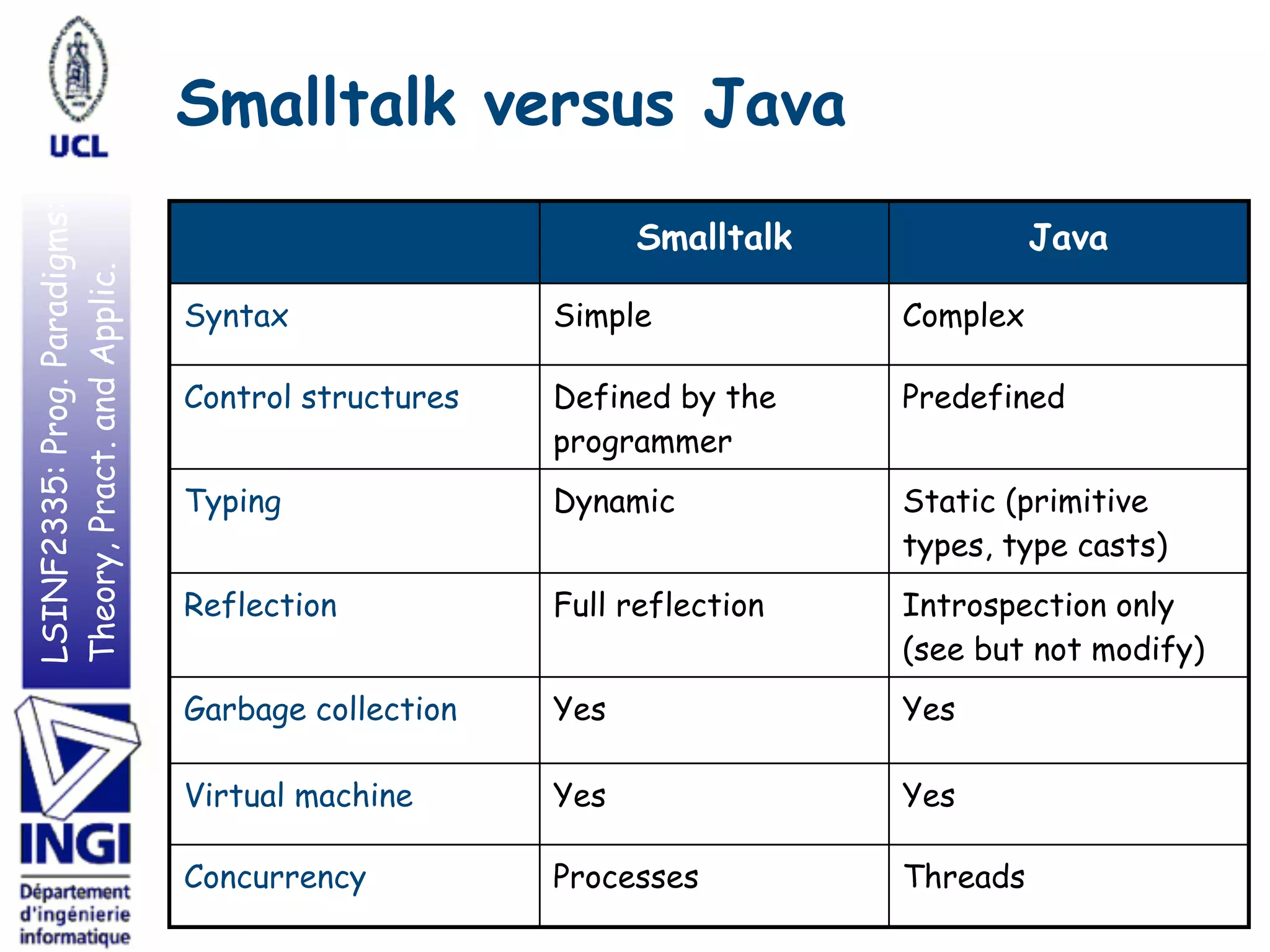
Theory,Pract.andApplic. Smalltalk versus Java
Smalltalk Java
Syntax Simple Complex
Control structures Defined by the
programmer
Predefined
Typing Dynamic Static (primitive
types, type casts)
Reflection Full reflection Introspection only
(see but not modify)
Garbage collection Yes Yes
Virtual machine Yes Yes
Concurrency Processes Threads
LSINF2335:Prog.Paradigms:
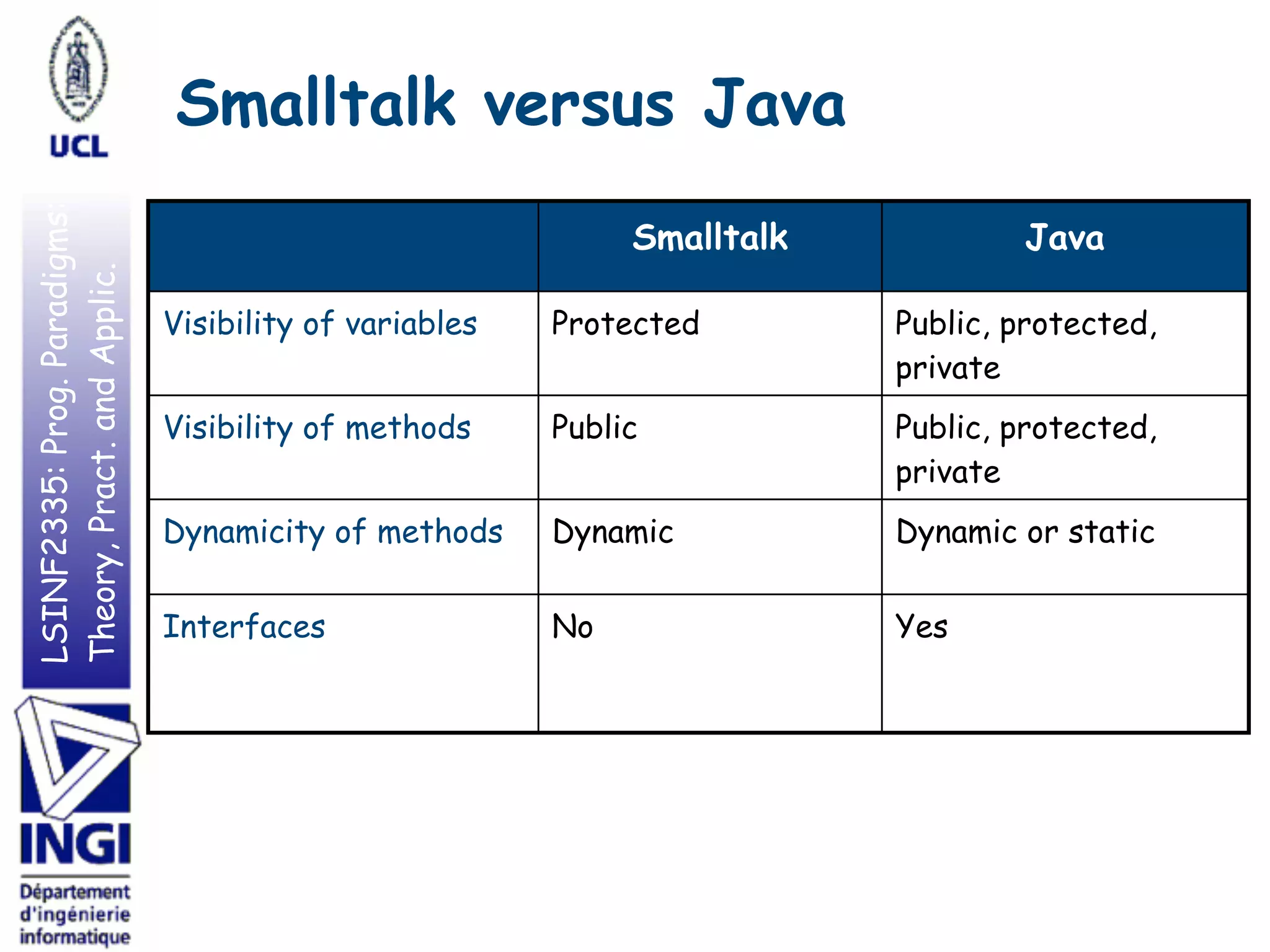
Theory,Pract.andApplic. Smalltalk versus Java
Smalltalk Java
Visibility of variables Protected Public, protected,
private
Visibility of methods Public Public, protected,
private
Dynamicity of methods Dynamic Dynamic or static
Interfaces No Yes
LSINF2335:Prog.Paradigms:
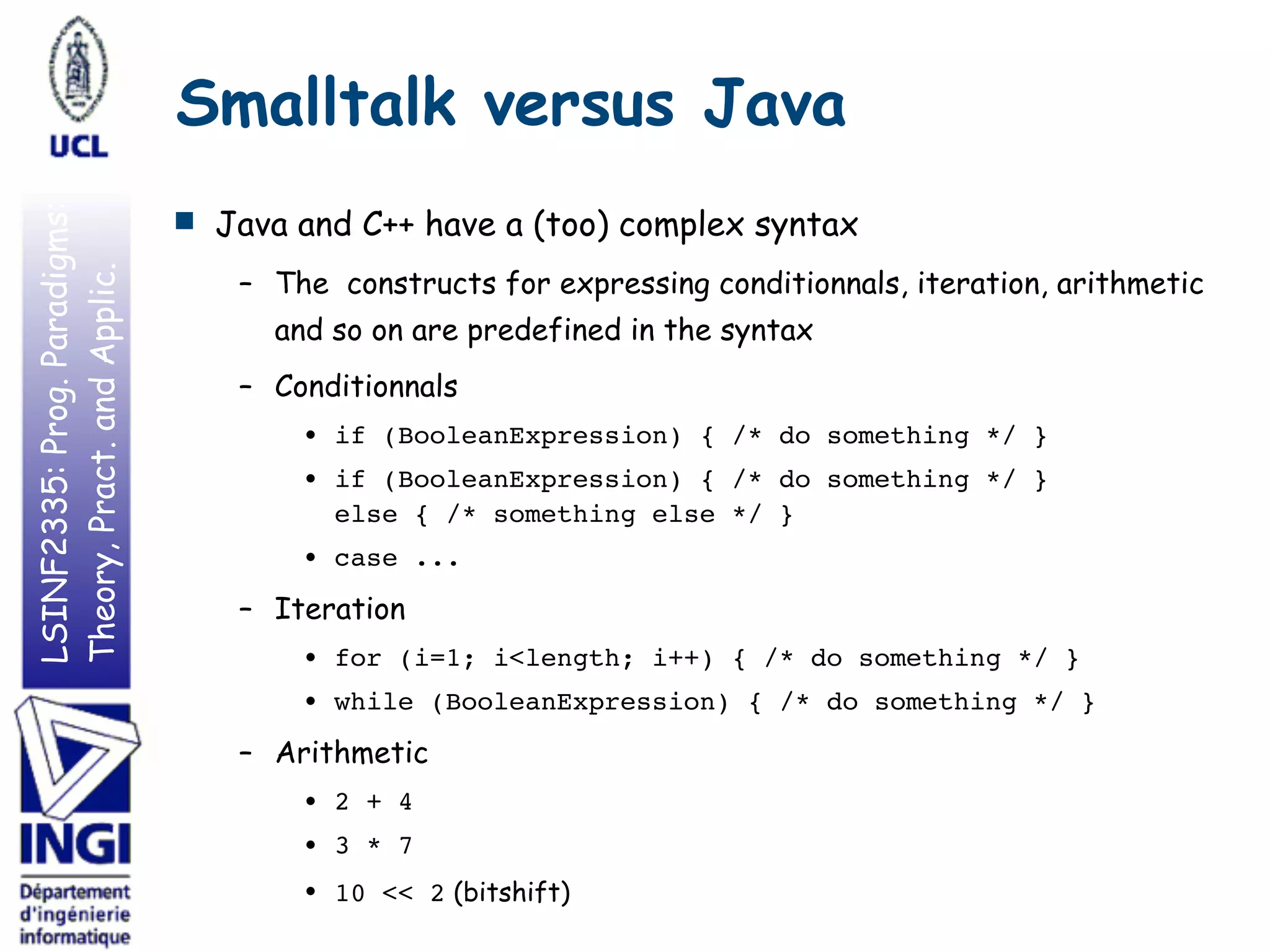
Theory,Pract.andApplic. Smalltalk versus Java
■ Java and C++ have a (too) complex syntax
– The constructs for expressing conditionnals, iteration, arithmetic
and so on are predefined in the syntax
– Conditionnals
• if (BooleanExpression) { /* do something */ }

else { /* something else */ }
• case ...
– Iteration
• for (i=1; i<length; i++) { /* do something */ }
• while (BooleanExpression) { /* do something */ }
– Arithmetic
• 2 + 4
• 3 * 7
• 10 << 2 (bitshift)
LSINF2335:Prog.Paradigms:
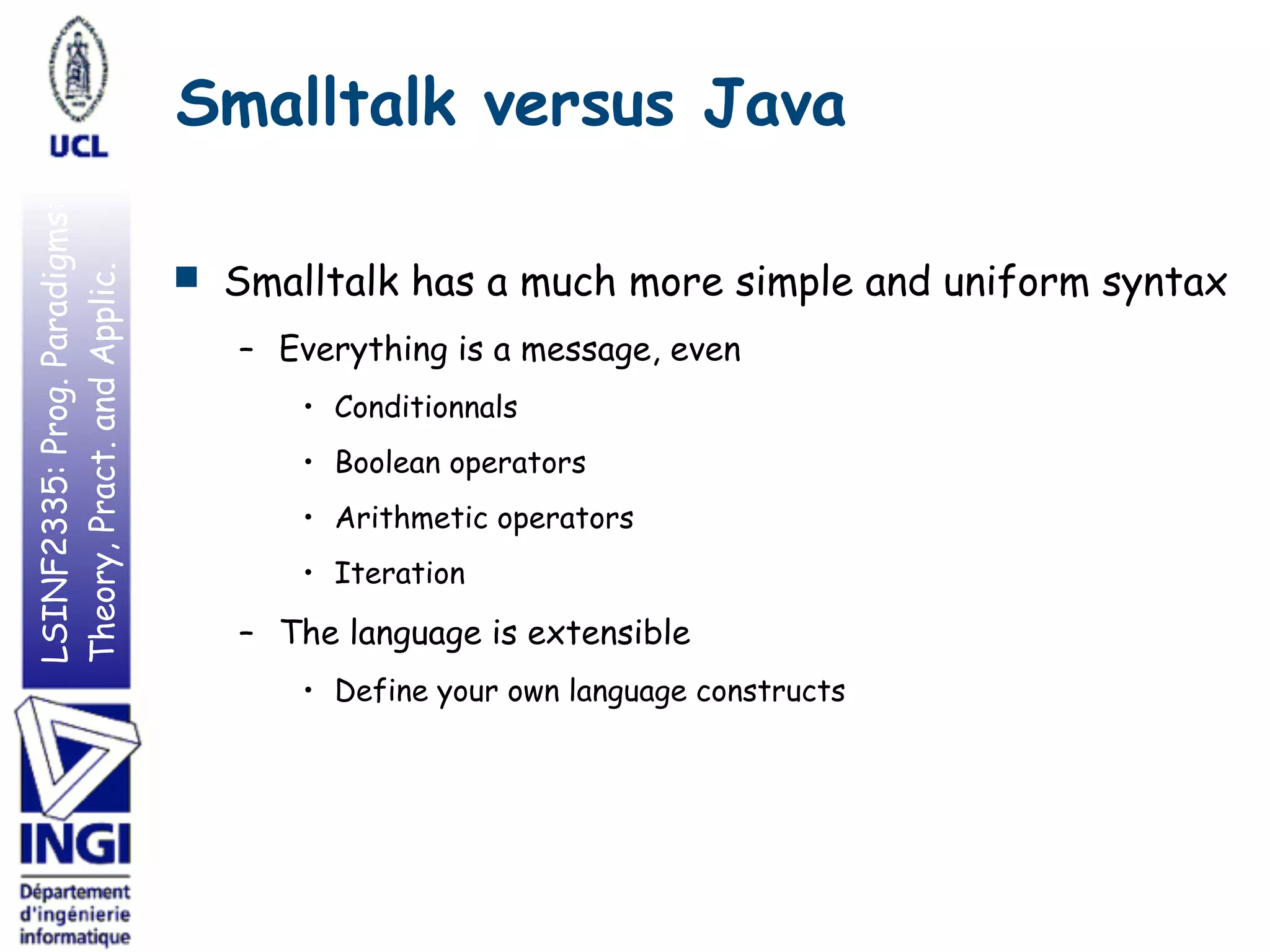
Theory,Pract.andApplic. Smalltalk versus Java
■ Smalltalk has a much more simple and uniform syntax
– Everything is a message, even
• Conditionnals
• Boolean operators
• Arithmetic operators
• Iteration
– The language is extensible
• Define your own language constructs
LSINF2335:Prog.Paradigms:
Theory,Pract.andApplic.
LSINF2335:Prog.Paradigms:
Theory,Pract.andApplic.
Homework and exercises
36
■ Download and install Pharo on your computer
– Pharo can be downloaded on http://pharo-project.org
– Download the latest stable version
■ Download and read the free online book on Pharo
– “Pharo by Example” can be downloaded on

http://pharobyexample.org
– Read and try chapters 1 to 6 of the book
– (attention: the book may not have been updated yet to the most
recent version of Pharo)
■ Also try out the examples from this theory session.

Introduction to Smalltalk

  • 1.
    LSINF2335:Prog.Paradigms: Theory,Pract.andApplic. Lecture 3 :
 Introductionto Smalltalk LSINF 2335 Programming Paradigms Prof. Kim Mens UCL / EPL / INGI (Slides revised with the help of
 Dr. Johan Brichau and partially based
 on slides by Kris Gybels and others) Disclaimer: any pictures used in this presentation remain with the copyright of their original owner and were included here for didactical purposes only. In case of any suspected violation of copyright please contact me so that I can remove or replace those pictures.
  • 2.
    LSINF2335:Prog.Paradigms: Theory,Pract.andApplic. Smalltalk ina nutshell (1) ■ Pure object-oriented language : – Everything is an object – Objects communicate only by message passing ■ Class-based language : – Every object is an instance of a class – All classes have a (single) parent class – Object is the root class ■ Uniform & simple syntax – Forces one to think object-oriented – Syntax fits on a single sheet of paper – Statements read almost like English phrases – Originally designed as a learning environment for children ■ Dynamically typed ■ Fully reflective language – IDE entirely written (and modifiable) in Smalltalk itself 2
  • 3.
    LSINF2335:Prog.Paradigms: Theory,Pract.andApplic. Smalltalk ina nutshell (2) ■ Platform independent – A runtime environment based on VM technology ■ Encourages exploratory programming ■ Memory management (garbage collection) ■ A large set of reusable classes – basic data structures, GUI classes, DB access, internet, graphics, … ■ Powerful development tools – browsers, GUI builders, inspectors, change management tools, crash recovery tools, project management tools, unit testing, refactoring, … ■ Team working environment – releasing, versioning, deploying ■ Source of inspiration to many other languages and environments – environment, collections, debugger, reflective features
 and many development tools 3
  • 4.
    LSINF2335:Prog.Paradigms: Theory,Pract.andApplic. A byte-code interpreter: thevirtual machine interpretes the image IMAGE2.IM IMAGE2.CHA Standard SOURCES Shared by everybody IMAGE1.IM IMAGE1.CHA All the objects of the system at a moment in time One per user + Smalltalk run-time architecture ■ Virtual Machine + Image + Changes and Sources ■ Image = bytecode ■ Sources and changes = code (text) 4
  • 5.
    LSINF2335:Prog.Paradigms: Theory,Pract.andApplic. Point x, y Classes Concepts ofSmalltalk: `pure’ OO 5 a Point x y a SmallInteger 5 a SmallInteger 10 Objects add: a SmallInteger 15Messages add: extra x := x + extra. y := y + extra. Methods
  • 6.
    LSINF2335:Prog.Paradigms: Theory,Pract.andApplic. Everything isan object 6 a Person name address a ByteString ‘Kim Mens’ an Address street nr a ByteString ‘Pl. Sainte Barbe’ a SmallInteger 2 Objects have state
  • 7.
    LSINF2335:Prog.Paradigms: Theory,Pract.andApplic. Everything isan object ■ Workspaces, windows, text editors, scrollbars, ... are all objects. ■ ‘hello word’ is an object: it is an instance of String. ■ #show: is a Symbol that is also an object. ■ Numbers are instances of classes: 1 is instance of Integer ■ Booleans are instances of their class: true is instance of class True ■ The parser, compiler and garbage collector are objects. ■ Even classes are objects themselves ■ Smalltalk is a consistent, uniform world written in itself. You can learn how it is implemented, you can extend it or even modify it. All the code is available and readable. – Smalltalk is a fully reflective language
  • 8.
    LSINF2335:Prog.Paradigms: Theory,Pract.andApplic. Objects communicateusing messages 8 a SmallInteger 15 add: Objects can be sent messages ... add: extra x := x + extra. y := y + extra. ... and reply by executing a method ↺ a SmallInteger 20 + a SmallInteger 5 a SmallInteger 10 a Point x y a SmallInteger 25 +
  • 9.
    LSINF2335:Prog.Paradigms: Theory,Pract.andApplic. Objects communicateusing messages ■ A message is a request to an object to do something ■ A method is piece of source code belonging to a class ■ Transcript show: ‘hello world’ ■ The above expression is a message – Transcript is a global variable containing a Stream object that represents a “console” window. – show: ‘hello world’ is a message sent to a Stream object • The stream object (value of Transcript) is the receiver of the message • #show: is the selector of the message • the string ‘hello world’ is the (actual) argument of the message
  • 10.
    LSINF2335:Prog.Paradigms: Theory,Pract.andApplic. Objects communicate usingmessages ■ An object executes a method when it receives a message. ■ ‘hello world’ reverse – Object ‘hello world’ receives a request to reverse itself – Method reverse is defined on the class String – Executing this method returns a new string ‘dlrow olleh’ ■ Transcript show: ‘hello world’ – Object Transcript receives a request to show a string and results in the string being printed on the transcript window. ■ Message passing or sending a message is similar to – invoking a method in Java or C++ – calling a procedure in procedural languages – applying a function in functional languages
  • 11.
  • 12.
    LSINF2335:Prog.Paradigms: Theory,Pract.andApplic. Smalltalk basicexpressions 12 Literals Variable Reference Message Expressions Return Expressions Block Expressions 1234 someObject someObject doSomethingWith: 1234 ^ someObject print: ‘Johan’ $a #Johan ‘Kim’ #(#a #b) a GlobalVariable [ :x :y | x + y ] 1 + 2 ‘Kim’ , ‘Mens’ #(#a #b) first
  • 13.
    LSINF2335:Prog.Paradigms: Theory,Pract.andApplic. Literal Expressions 13 aByteString ‘Pleinlaan’ a 42 a ByteSymbol #Brussels a Character $a ‘Pleinlaan’↺ = = = = 42 ↺ #Brussels ↺ $a ↺ #(1 #a $c) ↺ an Array 1 2 3 = a SmallInteger 1 a Character $c a ByteSymbol #a
  • 14.
    LSINF2335:Prog.Paradigms: Theory,Pract.andApplic. Three kindsof messages 14 a SomeObjectsomeVar + add: with: a Number 42 a Number 100 printYourself
  • 15.
    LSINF2335:Prog.Paradigms: Theory,Pract.andApplic. Unary message 15 printString anAssistant name a ByteString ‘Johan Brichau’ = a ByteString ‘Brichau J.’ selector is alphabetic name no arguments selector is printString
  • 16.
    LSINF2335:Prog.Paradigms: Theory,Pract.andApplic. Unary messageexpressions 16 42 cos 42 cos sin ↺ = cos a SmallInteger 42 = a Float -0.399985 cos a SmallInteger 42 a Float -0.399985 ↺ sin = a Float -0.389405 =
  • 17.
    LSINF2335:Prog.Paradigms: Theory,Pract.andApplic. Binary messages 17 aSmallInteger 10 + a SmallInteger 42 selector is one or two special characters exactly one argument (and one receiver)
  • 18.
    LSINF2335:Prog.Paradigms: Theory,Pract.andApplic. Binary messageexpressions 18 1 + 2 cos 1 + (2 cos)= 1 + 2 cos - 3 (1 + (2 cos)) - 3= 1 + 2 cos + 3 (1 + (2 cos)) +3= 1 + 2 * 3 + 4 ((1 + 2) * 3) + 4= 1 + 2 * 3 + 4 1 + (2 * 3) + 4=!
  • 19.
    LSINF2335:Prog.Paradigms: Theory,Pract.andApplic. a ByteString Boo’ Keyword messages 19 a SomeObjectsomeVar add:with: andPrint: a SmallInteger42 a SmallInteger100 Selector is sequence of names ending in colon (a keyword) One argument for each keyword selector is add:with:andPrint:
  • 20.
    LSINF2335:Prog.Paradigms: Theory,Pract.andApplic. Keyword messageexpressions 20 Time readFrom: (ReadStream on: ‘1:30:00 pm’) Time readFrom: ReadStream on: ‘1:30:00 pm’ =
  • 21.
    LSINF2335:Prog.Paradigms: Theory,Pract.andApplic. ■Unary message 
 >>binary message 
 >> keyword message ■ Evaluation from left to right ■ There are no specific precedence rules for the arithmetic or logic operators 2 negated raisedTo: 3 + 2 * 5 is equivalent with (2 negated) raisedTo: ((3 + 2) * 5) Precedence rules
  • 22.
    LSINF2335:Prog.Paradigms: Theory,Pract.andApplic. ■ In Javadifferent predefined syntactic constructs like >>, if, for, while, … are hard-coded into the language grammar ■ In Smalltalk, they are just defined on objects, e.g. : (>>) bitShift: is just a message sent to numbers 10 bitShift: 2 (if) ifTrue: is just messages sent to a boolean (1> x) ifTrue: [ … ] (for) do:, to:do: are just messages to collections or numbers #(a b c d) do: [:each | Transcript show: each ; cr] 1 to: 10 do: [:each | Transcript show: each printString ] ■ Advantages : – Language is extensible (very easy to add “new syntax”) – Simplicity & orthogonality (uniform language design) Control structures
  • 23.
    LSINF2335:Prog.Paradigms: Theory,Pract.andApplic. Blocks 23 [ :foo:bar |foo + bar ] ↺ a BlockClosure = value: value: Blocks are “delayed” expressions Blocks can be sent messages to evaluate the body of the block [ :foo :bar |foo + bar ] value: 4 value: 2 ↺ = a SmallInteger 6 a BlockClosure
  • 24.
    LSINF2335:Prog.Paradigms: Theory,Pract.andApplic. Block expressions 24 [Transcript show: 'Boo!'] value ablock := [ :someName | someName asUppercase ]. ablock value: 'Kim' [ :a :b| a + b ] valueWithArguments: (Array with: 1 with: 2)
  • 25.
    LSINF2335:Prog.Paradigms: Theory,Pract.andApplic. Blocks example:if then else 25 a TrueifTrue: ifFalse: a BlockClosure a BlockClosure value
  • 26.
    LSINF2335:Prog.Paradigms: Theory,Pract.andApplic. Blocks example:if then else 26 a FalseifTrue: ifFalse: a BlockClosure a BlockClosure value
  • 27.
    LSINF2335:Prog.Paradigms: Theory,Pract.andApplic. Blocks 27 true ifTrue:[ Transcript show: ‘yes’ ] ifFalse: [ Transcript show: ‘no’ ] (a < b ) ifTrue: [ Transcript show: ‘a smaller’ ] ifFalse: [ Transcript show: ‘a not smaller’ ] Transcript show: ((a < b) ifTrue: [ ‘a’ ] ifFalse: [‘a not’ ]) , ‘ smaller’
  • 28.
    LSINF2335:Prog.Paradigms: Theory,Pract.andApplic. ■ A methodthat illustrates every part of Smalltalk method syntax except primitives. uselessMethod: x |y| true & false not & (nil isNil) ifFalse: [self halt]. y := self size + super size. #($a #a ’a’ 1 1.0) do: [:each | Transcript show: (each class name); show: (each printString); show: ’ ’]. ^ x < y Power & Simplicity: Syntax on a PostCard
  • 29.
    LSINF2335:Prog.Paradigms: Theory,Pract.andApplic. Power &Simplicity: Syntax on a PostCard ■ This (useless) method illustrates the entire Smalltalk syntax – messages • unary, binary, and key word messages • cascaded messages – variables • arguments and temporaries (local variables) ; no block temporaries • global variables • accessing and assigning a variable • pseudo variables (true, false, nil, self, super) – instructions • sequence of instructions (.) • return statement (^) – blocks (both zero argument and one argument block) – literals (array, character, symbol, string, integer, float)
  • 30.
    LSINF2335:Prog.Paradigms: Theory,Pract.andApplic. “a comment” $c $t$e $r $# $@ ‘a string’ ‘lulu’ ‘l’’idiot’ #mac #+ #(1 2 3 (1 3) $a 4) 1, 2r101 1.5, 6.03e-34,4, 2.4e7 1/33 true, false 10@120 <primitive: …> ( … ) Smalltalk Syntax (1) ■ comment ■ character ■ string ■ symbol ■ array ■ integer (r = radix) ■ real (e = exponent) ■ fraction ■ boolean ■ point ■ VM primitive call ■ parenthesis (precedence)
  • 31.
    LSINF2335:Prog.Paradigms: Theory,Pract.andApplic. var := aValue [:var| |tmp| expr...] |tmp| :var receiver selector receiver selector arg receiver kw1: arg1 kw2: arg2 message ; selector; … message . message ^ message Smalltalk Syntax (2) ■ assignment ■ a block ■ local variable (method / block) ■ block variable ■ unary message ■ binary message ■ keyword message ■ cascading of messages = sending several messages to the same instance ■ sequence of instructions ■ return statement
  • 32.
    LSINF2335:Prog.Paradigms: Theory,Pract.andApplic. Smalltalk versusJava Smalltalk Java Syntax Simple Complex Control structures Defined by the programmer Predefined Typing Dynamic Static (primitive types, type casts) Reflection Full reflection Introspection only (see but not modify) Garbage collection Yes Yes Virtual machine Yes Yes Concurrency Processes Threads
  • 33.
    LSINF2335:Prog.Paradigms: Theory,Pract.andApplic. Smalltalk versusJava Smalltalk Java Visibility of variables Protected Public, protected, private Visibility of methods Public Public, protected, private Dynamicity of methods Dynamic Dynamic or static Interfaces No Yes
  • 34.
    LSINF2335:Prog.Paradigms: Theory,Pract.andApplic. Smalltalk versusJava ■ Java and C++ have a (too) complex syntax – The constructs for expressing conditionnals, iteration, arithmetic and so on are predefined in the syntax – Conditionnals • if (BooleanExpression) { /* do something */ } • if (BooleanExpression) { /* do something */ }
 else { /* something else */ } • case ... – Iteration • for (i=1; i<length; i++) { /* do something */ } • while (BooleanExpression) { /* do something */ } – Arithmetic • 2 + 4 • 3 * 7 • 10 << 2 (bitshift)
  • 35.
    LSINF2335:Prog.Paradigms: Theory,Pract.andApplic. Smalltalk versusJava ■ Smalltalk has a much more simple and uniform syntax – Everything is a message, even • Conditionnals • Boolean operators • Arithmetic operators • Iteration – The language is extensible • Define your own language constructs
  • 36.
    LSINF2335:Prog.Paradigms: Theory,Pract.andApplic. LSINF2335:Prog.Paradigms: Theory,Pract.andApplic. Homework and exercises 36 ■Download and install Pharo on your computer – Pharo can be downloaded on http://pharo-project.org – Download the latest stable version ■ Download and read the free online book on Pharo – “Pharo by Example” can be downloaded on
 http://pharobyexample.org – Read and try chapters 1 to 6 of the book – (attention: the book may not have been updated yet to the most recent version of Pharo) ■ Also try out the examples from this theory session.