USAGE CONTRACTS* 
KIM MENS 
UNIVERSITÉ CATHOLIQUE DE LOUVAIN (UCL) 
JOINT WORK WITH 
ANGELA LOZANO 
ANDY KELLENS 
SATTOSE 2014 – L’AQUILA – 9-11.07.2014 
* SLIDES LARGELY BASED ON AN EARLIER PRESENTATION MADE BY ANGELA LOZANO
SOME OF MY 
RESEARCH INTERESTS 
Programming languages 
Context-Oriented Programming 
Language interoperability between logic and OO 
(Aspect-oriented programming ✞) 
Tool support for software development, maintenance and evolution 
source code mining 
source-code based recommendation tools 
structural source-code regularities (e.g. usage contracts)
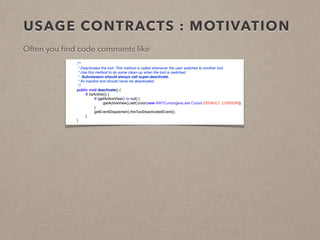
USAGE CONTRACTS : MOTIVATION 
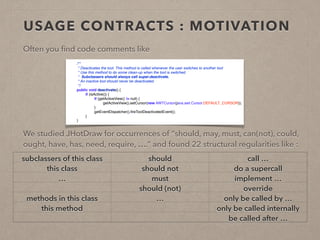
Often you find code comments like 
! 
! 
! 
! 
! 
! 
! 
! 
! 
! 
/** 
* Deactivates the tool. This method is called whenever the user switches to another tool 
* Use this method to do some clean-up when the tool is switched. 
* Subclassers should always call super.deactivate. 
* An inactive tool should never be deactivated. 
*/ 
public void deactivate() { 
if (isActive()) { 
if (getActiveView() != null) { 
getActiveView().setCursor(new AWTCursor(java.awt.Cursor.DEFAULT_CURSOR)); 
} 
getEventDispatcher().fireToolDeactivatedEvent(); 
} 
}
USAGE CONTRACTS : MOTIVATION 
Often you find code comments like 
! 
! 
! 
! 
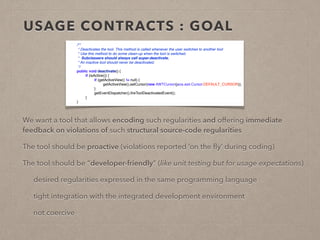
We studied JHotDraw for occurrences of “should, may, must, can(not), could, 
ought, have, has, need, require, ….” and found 22 structural regularities like : 
! 
! 
! 
! 
! 
/** 
* Deactivates the tool. This method is called whenever the user switches to another tool 
* Use this method to do some clean-up when the tool is switched. 
* Subclassers should always call super.deactivate. 
* An inactive tool should never be deactivated. 
*/ 
public void deactivate() { 
if (isActive()) { 
if (getActiveView() != null) { 
getActiveView().setCursor(new AWTCursor(java.awt.Cursor.DEFAULT_CURSOR)); 
} 
getEventDispatcher().fireToolDeactivatedEvent(); 
} 
} 
subclassers of this class should call … 
this class should not do a supercall 
… must implement … 
should (not) override 
methods in this class … only be called by … 
this method only be called internally 
be called after …
USAGE CONTRACTS : GOAL 
/** 
* Deactivates the tool. This method is called whenever the user switches to another tool 
* Use this method to do some clean-up when the tool is switched. 
* Subclassers should always call super.deactivate. 
* An inactive tool should never be deactivated. 
*/ 
public void deactivate() { 
if (isActive()) { 
if (getActiveView() != null) { 
getActiveView().setCursor(new AWTCursor(java.awt.Cursor.DEFAULT_CURSOR)); 
} 
getEventDispatcher().fireToolDeactivatedEvent(); 
} 
} 
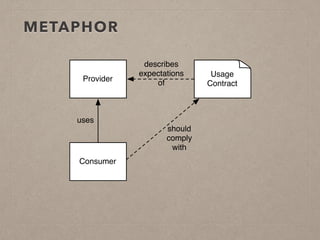
We want a tool that allows encoding such regularities and offering immediate 
feedback on violations of such structural source-code regularities 
The tool should be proactive (violations reported ‘on the fly’ during coding) 
The tool should be “developer-friendly” (like unit testing but for usage expectations) 
desired regularities expressed in the same programming language 
tight integration with the integrated development environment 
not coercive
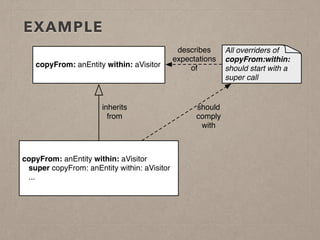
METAPHOR 
Provider 
uses 
Consumer 
Usage 
Contract 
describes 
expectations 
of 
should 
comply 
with
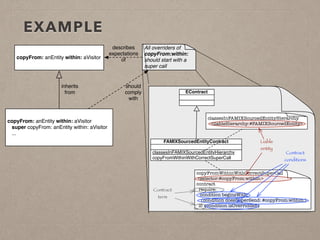
EXAMPLE 
copyFrom: anEntity within: aVisitor 
inherits 
from 
copyFrom: anEntity within: aVisitor 
super copyFrom: anEntity within: aVisitor 
... 
All overriders of 
copyFrom:within: 
should start with a 
super call 
describes 
expectations 
of 
should 
comply 
with
EXAMPLE 
copyFrom: anEntity within: aVisitor 
inherits 
from 
copyFrom: anEntity within: aVisitor 
super copyFrom: anEntity within: aVisitor 
... 
All overriders of 
copyFrom:within: 
should start with a 
super call 
describes 
expectations 
of 
should 
comply 
with 
EContract 
classesInFAMIXSourcedEntityHierarchy 
<liableHierarchy:#FAMIXSourcedEntity> 
FAMIXSourcedEntityContract 
classesInFAMIXSourcedEntityHierarchy 
copyFromWithinWithCorrectSuperCall 
Liable 
entity 
copyFromWithinWithCorrectSuperCall 
<selector:#copyFrom:within:> 
contract 
require: 
condition beginsWith: 
(condition doesSuperSend: #copyFrom:within:) 
if: (condition isOverridden) 
Contract 
term 
Contract 
conditions
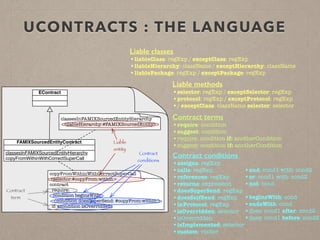
UCONTRACTS : THE LANGUAGE 
EContract 
Liable classes 
•liableClass: regExp / exceptClass: regExp 
•liableHierarchy: className / exceptHierarchy: className 
•liablePackage: regExp / exceptPackage: regExp 
classesInFAMIXSourcedEntityHierarchy 
<liableHierarchy:#FAMIXSourcedEntity> 
FAMIXSourcedEntityContract 
classesInFAMIXSourcedEntityHierarchy 
copyFromWithinWithCorrectSuperCall 
Liable 
entity 
copyFromWithinWithCorrectSuperCall 
<selector:#copyFrom:within:> 
contract 
require: 
condition beginsWith: 
(condition doesSuperSend: #copyFrom:within:) 
if: (condition isOverridden) 
Contract 
term 
Contract 
conditions 
Liable methods 
•selector: regExp / exceptSelector: regExp 
•protocol: regExp / exceptProtocol: regExp 
•/ exceptClass: className selector: selector 
Contract terms 
•require: condition 
•suggest: condition 
•require: condition if: anotherCondition 
•suggest: condition if: anotherCondition 
Contract conditions 
•assigns: regExp 
•calls: regExp 
•references: regExp 
•returns: expression 
•doesSuperSend: regExp 
•doesSelfSend: regExp 
•inProtocol: regExp 
•isOverridden: selector 
•isOverridden 
•isImplemented: selector 
•custom: visitor 
! 
•and: cond1 with: cond2 
•or: cond1 with: cond2 
•not: cond 
! 
•beginsWith: cond 
•endsWith: cond 
•does: cond1 after: cond2 
•does: cond1 before: cond2
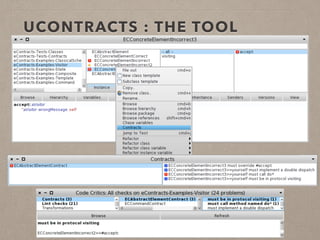
UCONTRACTS : THE TOOL
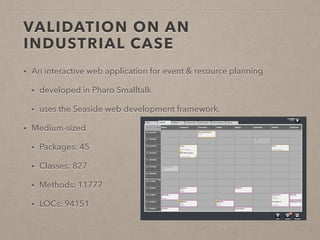
VALIDATION ON AN 
INDUSTRIAL CASE 
• An interactive web application for event & resource planning 
• developed in Pharo Smalltalk 
• uses the Seaside web development framework. 
• Medium-sized 
• Packages: 45 
• Classes: 827 
• Methods: 11777 
• LOCs: 94151
INDUSTRIAL VALIDATION : 
SET-UP OF THE EXPERIMENT 
• Qualitative assessment 
• Ideally we would have liked the tool to be used directly by the 
developers, but instead we had to perform an offline experiment. 
• Together with the developers, during 2 days we defined 13 
contracts documenting important regularities in their framework 
• We checked all contracts in December and reported all contract 
breaches to the developers 
• 3 months later, we reverified compliance of the code against the 
same contracts
INDUSTRIAL VALIDATION : 
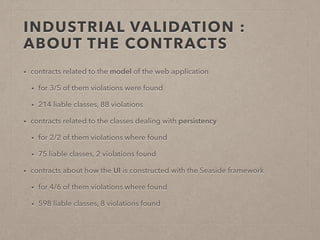
ABOUT THE CONTRACTS 
• contracts related to the model of the web application 
• for 3/5 of them violations were found 
• 214 liable classes, 88 violations 
• contracts related to the classes dealing with persistency 
• for 2/2 of them violations where found 
• 75 liable classes, 2 violations found 
• contracts about how the UI is constructed with the Seaside framework 
• for 4/6 of them violations where found 
• 598 liable classes, 8 violations found
INDUSTRIAL VALIDATION : 
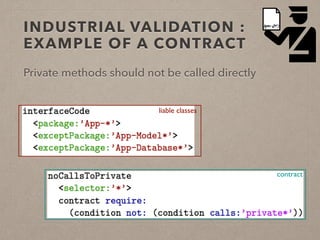
EXAMPLE OF A CONTRACT 
Private methods should not be called directly 
liable classes 
contract
INDUSTRIAL VALIDATION : 
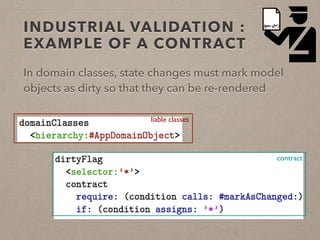
EXAMPLE OF A CONTRACT 
In domain classes, state changes must mark model 
objects as dirty so that they can be re-rendered 
liable classes 
contract
INDUSTRIAL VALIDATION : 
EXAMPLE OF A CONTRACT 
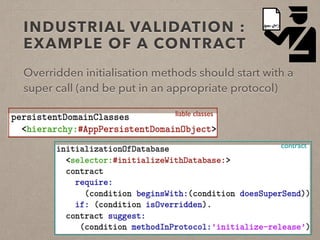
Overridden initialisation methods should start with a 
super call (and be put in an appropriate protocol) 
liable classes 
contract
INDUSTRIAL VALIDATION : 
EXAMPLE OF A CONTRACT 
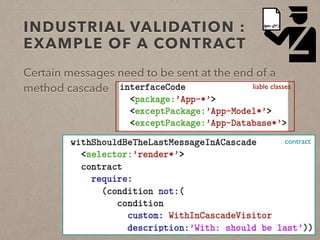
Certain messages need to be sent at the end of a 
method cascade liable classes 
contract
INDUSTRIAL VALIDATION : 
EXAMPLE OF A CONTRACT 
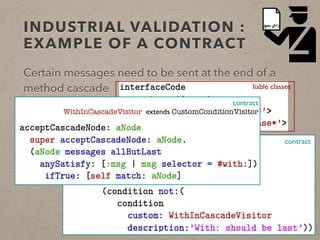
Certain messages need to be sent at the end of a 
method cascade liable classes 
contract 
contract 
WithInCascadeVisitor extends CustomConditionVisitor
INDUSTRIAL VALIDATION : 
RESULTS 
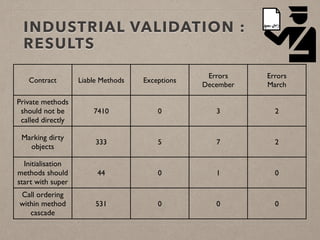
Contract Liable Methods Exceptions 
Errors 
December 
Errors 
March 
Private methods 
should not be 
called directly 
7410 0 3 2 
Marking dirty 
objects 333 5 7 2 
Initialisation 
methods should 
44 0 1 0 
start with super 
Call ordering 
within method 
cascade 
531 0 0 0
UCONTRACTS : CONCLUSION 
• uContracts offer a simple unit-testing like way for letting programmers 
document and check conformance to structural source-code regularities 
• using a “contract” metaphor 
• focus on immediate feedback during development 
• embedded DSL close to the programming language 
• tight integration with the IDE 
• Publication pending: A. Lozano, K. Mens, and A. Kellens, “Usage 
contracts: offering immediate feed- back on violations of structural 
source-code regularities”. (submitted to SciCo)
FUTURE WORK 
• More validation 
• Improve / extend the DSL 
• Port to most recent version of Pharo 
• uContracts for other languages (e.g., Ruby)

Usage contracts (presented at SATToSE 2014 in L'Aquila, Italy)

  • 1.
    USAGE CONTRACTS* KIMMENS UNIVERSITÉ CATHOLIQUE DE LOUVAIN (UCL) JOINT WORK WITH ANGELA LOZANO ANDY KELLENS SATTOSE 2014 – L’AQUILA – 9-11.07.2014 * SLIDES LARGELY BASED ON AN EARLIER PRESENTATION MADE BY ANGELA LOZANO
  • 2.
    SOME OF MY RESEARCH INTERESTS Programming languages Context-Oriented Programming Language interoperability between logic and OO (Aspect-oriented programming ✞) Tool support for software development, maintenance and evolution source code mining source-code based recommendation tools structural source-code regularities (e.g. usage contracts)
  • 3.
    USAGE CONTRACTS :MOTIVATION Often you find code comments like ! ! ! ! ! ! ! ! ! ! /** * Deactivates the tool. This method is called whenever the user switches to another tool * Use this method to do some clean-up when the tool is switched. * Subclassers should always call super.deactivate. * An inactive tool should never be deactivated. */ public void deactivate() { if (isActive()) { if (getActiveView() != null) { getActiveView().setCursor(new AWTCursor(java.awt.Cursor.DEFAULT_CURSOR)); } getEventDispatcher().fireToolDeactivatedEvent(); } }
  • 4.
    USAGE CONTRACTS :MOTIVATION Often you find code comments like ! ! ! ! We studied JHotDraw for occurrences of “should, may, must, can(not), could, ought, have, has, need, require, ….” and found 22 structural regularities like : ! ! ! ! ! /** * Deactivates the tool. This method is called whenever the user switches to another tool * Use this method to do some clean-up when the tool is switched. * Subclassers should always call super.deactivate. * An inactive tool should never be deactivated. */ public void deactivate() { if (isActive()) { if (getActiveView() != null) { getActiveView().setCursor(new AWTCursor(java.awt.Cursor.DEFAULT_CURSOR)); } getEventDispatcher().fireToolDeactivatedEvent(); } } subclassers of this class should call … this class should not do a supercall … must implement … should (not) override methods in this class … only be called by … this method only be called internally be called after …
  • 5.
    USAGE CONTRACTS :GOAL /** * Deactivates the tool. This method is called whenever the user switches to another tool * Use this method to do some clean-up when the tool is switched. * Subclassers should always call super.deactivate. * An inactive tool should never be deactivated. */ public void deactivate() { if (isActive()) { if (getActiveView() != null) { getActiveView().setCursor(new AWTCursor(java.awt.Cursor.DEFAULT_CURSOR)); } getEventDispatcher().fireToolDeactivatedEvent(); } } We want a tool that allows encoding such regularities and offering immediate feedback on violations of such structural source-code regularities The tool should be proactive (violations reported ‘on the fly’ during coding) The tool should be “developer-friendly” (like unit testing but for usage expectations) desired regularities expressed in the same programming language tight integration with the integrated development environment not coercive
  • 6.
    METAPHOR Provider uses Consumer Usage Contract describes expectations of should comply with
  • 7.
    EXAMPLE copyFrom: anEntitywithin: aVisitor inherits from copyFrom: anEntity within: aVisitor super copyFrom: anEntity within: aVisitor ... All overriders of copyFrom:within: should start with a super call describes expectations of should comply with
  • 8.
    EXAMPLE copyFrom: anEntitywithin: aVisitor inherits from copyFrom: anEntity within: aVisitor super copyFrom: anEntity within: aVisitor ... All overriders of copyFrom:within: should start with a super call describes expectations of should comply with EContract classesInFAMIXSourcedEntityHierarchy <liableHierarchy:#FAMIXSourcedEntity> FAMIXSourcedEntityContract classesInFAMIXSourcedEntityHierarchy copyFromWithinWithCorrectSuperCall Liable entity copyFromWithinWithCorrectSuperCall <selector:#copyFrom:within:> contract require: condition beginsWith: (condition doesSuperSend: #copyFrom:within:) if: (condition isOverridden) Contract term Contract conditions
  • 9.
    UCONTRACTS : THELANGUAGE EContract Liable classes •liableClass: regExp / exceptClass: regExp •liableHierarchy: className / exceptHierarchy: className •liablePackage: regExp / exceptPackage: regExp classesInFAMIXSourcedEntityHierarchy <liableHierarchy:#FAMIXSourcedEntity> FAMIXSourcedEntityContract classesInFAMIXSourcedEntityHierarchy copyFromWithinWithCorrectSuperCall Liable entity copyFromWithinWithCorrectSuperCall <selector:#copyFrom:within:> contract require: condition beginsWith: (condition doesSuperSend: #copyFrom:within:) if: (condition isOverridden) Contract term Contract conditions Liable methods •selector: regExp / exceptSelector: regExp •protocol: regExp / exceptProtocol: regExp •/ exceptClass: className selector: selector Contract terms •require: condition •suggest: condition •require: condition if: anotherCondition •suggest: condition if: anotherCondition Contract conditions •assigns: regExp •calls: regExp •references: regExp •returns: expression •doesSuperSend: regExp •doesSelfSend: regExp •inProtocol: regExp •isOverridden: selector •isOverridden •isImplemented: selector •custom: visitor ! •and: cond1 with: cond2 •or: cond1 with: cond2 •not: cond ! •beginsWith: cond •endsWith: cond •does: cond1 after: cond2 •does: cond1 before: cond2
  • 10.
  • 11.
    VALIDATION ON AN INDUSTRIAL CASE • An interactive web application for event & resource planning • developed in Pharo Smalltalk • uses the Seaside web development framework. • Medium-sized • Packages: 45 • Classes: 827 • Methods: 11777 • LOCs: 94151
  • 12.
    INDUSTRIAL VALIDATION : SET-UP OF THE EXPERIMENT • Qualitative assessment • Ideally we would have liked the tool to be used directly by the developers, but instead we had to perform an offline experiment. • Together with the developers, during 2 days we defined 13 contracts documenting important regularities in their framework • We checked all contracts in December and reported all contract breaches to the developers • 3 months later, we reverified compliance of the code against the same contracts
  • 13.
    INDUSTRIAL VALIDATION : ABOUT THE CONTRACTS • contracts related to the model of the web application • for 3/5 of them violations were found • 214 liable classes, 88 violations • contracts related to the classes dealing with persistency • for 2/2 of them violations where found • 75 liable classes, 2 violations found • contracts about how the UI is constructed with the Seaside framework • for 4/6 of them violations where found • 598 liable classes, 8 violations found
  • 14.
    INDUSTRIAL VALIDATION : EXAMPLE OF A CONTRACT Private methods should not be called directly liable classes contract
  • 15.
    INDUSTRIAL VALIDATION : EXAMPLE OF A CONTRACT In domain classes, state changes must mark model objects as dirty so that they can be re-rendered liable classes contract
  • 16.
    INDUSTRIAL VALIDATION : EXAMPLE OF A CONTRACT Overridden initialisation methods should start with a super call (and be put in an appropriate protocol) liable classes contract
  • 17.
    INDUSTRIAL VALIDATION : EXAMPLE OF A CONTRACT Certain messages need to be sent at the end of a method cascade liable classes contract
  • 18.
    INDUSTRIAL VALIDATION : EXAMPLE OF A CONTRACT Certain messages need to be sent at the end of a method cascade liable classes contract contract WithInCascadeVisitor extends CustomConditionVisitor
  • 19.
    INDUSTRIAL VALIDATION : RESULTS Contract Liable Methods Exceptions Errors December Errors March Private methods should not be called directly 7410 0 3 2 Marking dirty objects 333 5 7 2 Initialisation methods should 44 0 1 0 start with super Call ordering within method cascade 531 0 0 0
  • 20.
    UCONTRACTS : CONCLUSION • uContracts offer a simple unit-testing like way for letting programmers document and check conformance to structural source-code regularities • using a “contract” metaphor • focus on immediate feedback during development • embedded DSL close to the programming language • tight integration with the IDE • Publication pending: A. Lozano, K. Mens, and A. Kellens, “Usage contracts: offering immediate feed- back on violations of structural source-code regularities”. (submitted to SciCo)
  • 21.
    FUTURE WORK •More validation • Improve / extend the DSL • Port to most recent version of Pharo • uContracts for other languages (e.g., Ruby)