K to 12 BASIC EDUCATION CURRICULUM
TECHNOLOGY AND LIVELIHOOD EDUCATION
K to 12 TLE-Home Economics – Handicraft Curriculum Guide December 2013 * LO – Learning Outcome Page 1 of 13
HOME ECONOMICS – HANDICRAFT
Grade 7/8 (Exploratory)
Course Description:
This curriculum guide is a specialization course which leads to Handicraft Making. It covers core competencies that a grade 7/8 Technology and Livelihood Education
(TLE) student ought to possess, namely; produce crochet, quilt, knitted and embroidery projects. The preliminaries of this specialization course include the following: 1)
discussion on the relevance of the course; 2) explanation of key concepts relative to the course and; 3) exploration on career opportunities.
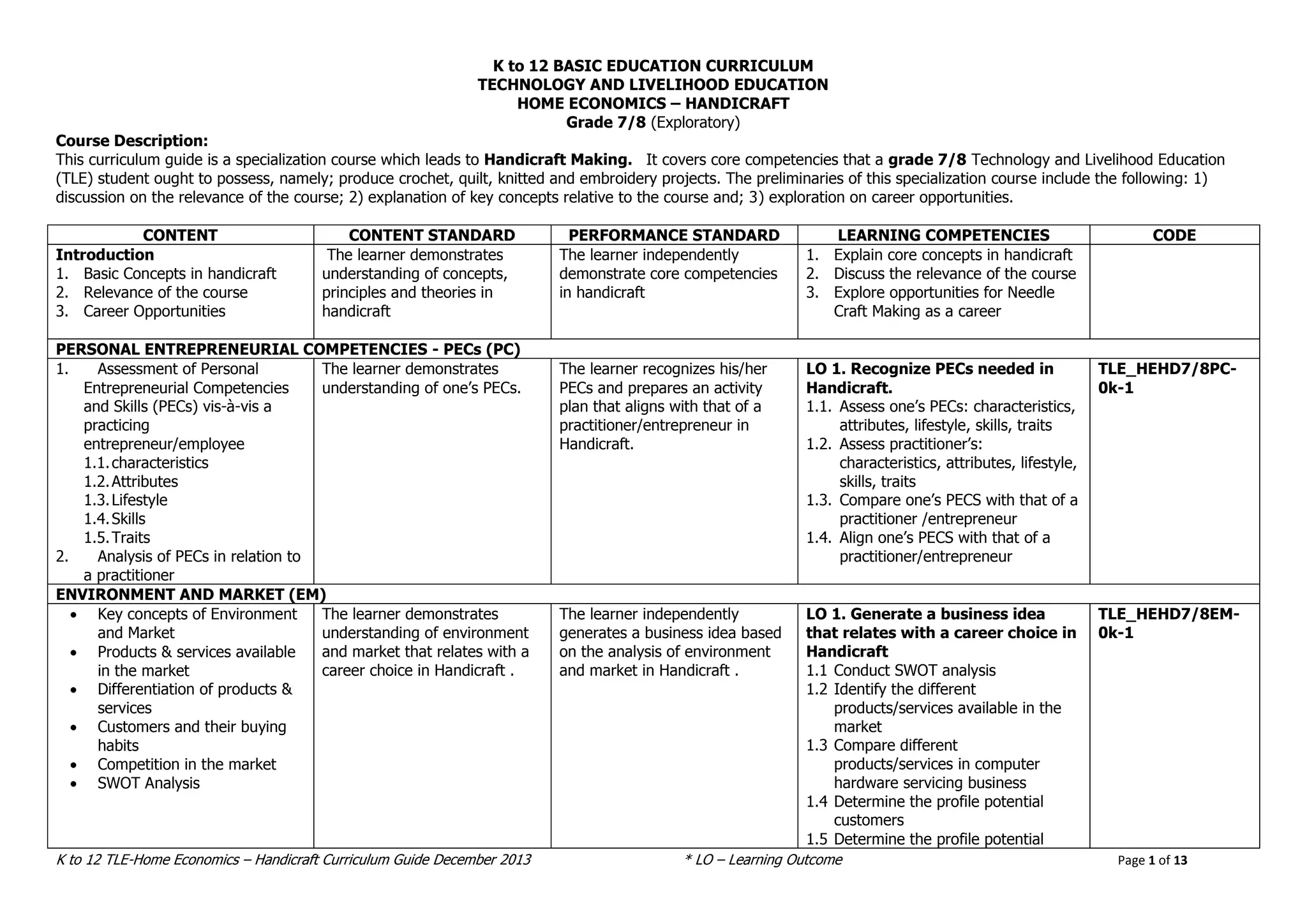
CONTENT CONTENT STANDARD PERFORMANCE STANDARD LEARNING COMPETENCIES CODE
Introduction
1. Basic Concepts in handicraft
2. Relevance of the course
3. Career Opportunities
The learner demonstrates
understanding of concepts,
principles and theories in
handicraft
The learner independently
demonstrate core competencies
in handicraft
1. Explain core concepts in handicraft
2. Discuss the relevance of the course
3. Explore opportunities for Needle
Craft Making as a career
PERSONAL ENTREPRENEURIAL COMPETENCIES - PECs (PC)
1. Assessment of Personal
Entrepreneurial Competencies
and Skills (PECs) vis-à-vis a
practicing
entrepreneur/employee
1.1.characteristics
1.2.Attributes
1.3.Lifestyle
1.4.Skills
1.5.Traits
2. Analysis of PECs in relation to
a practitioner
The learner demonstrates
understanding of one’s PECs.
The learner recognizes his/her
PECs and prepares an activity
plan that aligns with that of a
practitioner/entrepreneur in
Handicraft.
LO 1. Recognize PECs needed in
Handicraft.
1.1. Assess one’s PECs: characteristics,
attributes, lifestyle, skills, traits
1.2. Assess practitioner’s:
characteristics, attributes, lifestyle,
skills, traits
1.3. Compare one’s PECS with that of a
practitioner /entrepreneur
1.4. Align one’s PECS with that of a
practitioner/entrepreneur
TLE_HEHD7/8PC-
0k-1
ENVIRONMENT AND MARKET (EM)
 Key concepts of Environment
and Market
 Products & services available
in the market
 Differentiation of products &
services
 Customers and their buying
habits
 Competition in the market
 SWOT Analysis
The learner demonstrates
understanding of environment
and market that relates with a
career choice in Handicraft .
The learner independently
generates a business idea based
on the analysis of environment
and market in Handicraft .
LO 1. Generate a business idea
that relates with a career choice in
Handicraft
1.1 Conduct SWOT analysis
1.2 Identify the different
products/services available in the
market
1.3 Compare different
products/services in computer
hardware servicing business
1.4 Determine the profile potential
customers
1.5 Determine the profile potential
TLE_HEHD7/8EM-
0k-1
K to 12 BASIC EDUCATION CURRICULUM
TECHNOLOGY AND LIVELIHOOD EDUCATION
K to 12 TLE-Home Economics – Handicraft Curriculum Guide December 2013 * LO – Learning Outcome Page 2 of 13
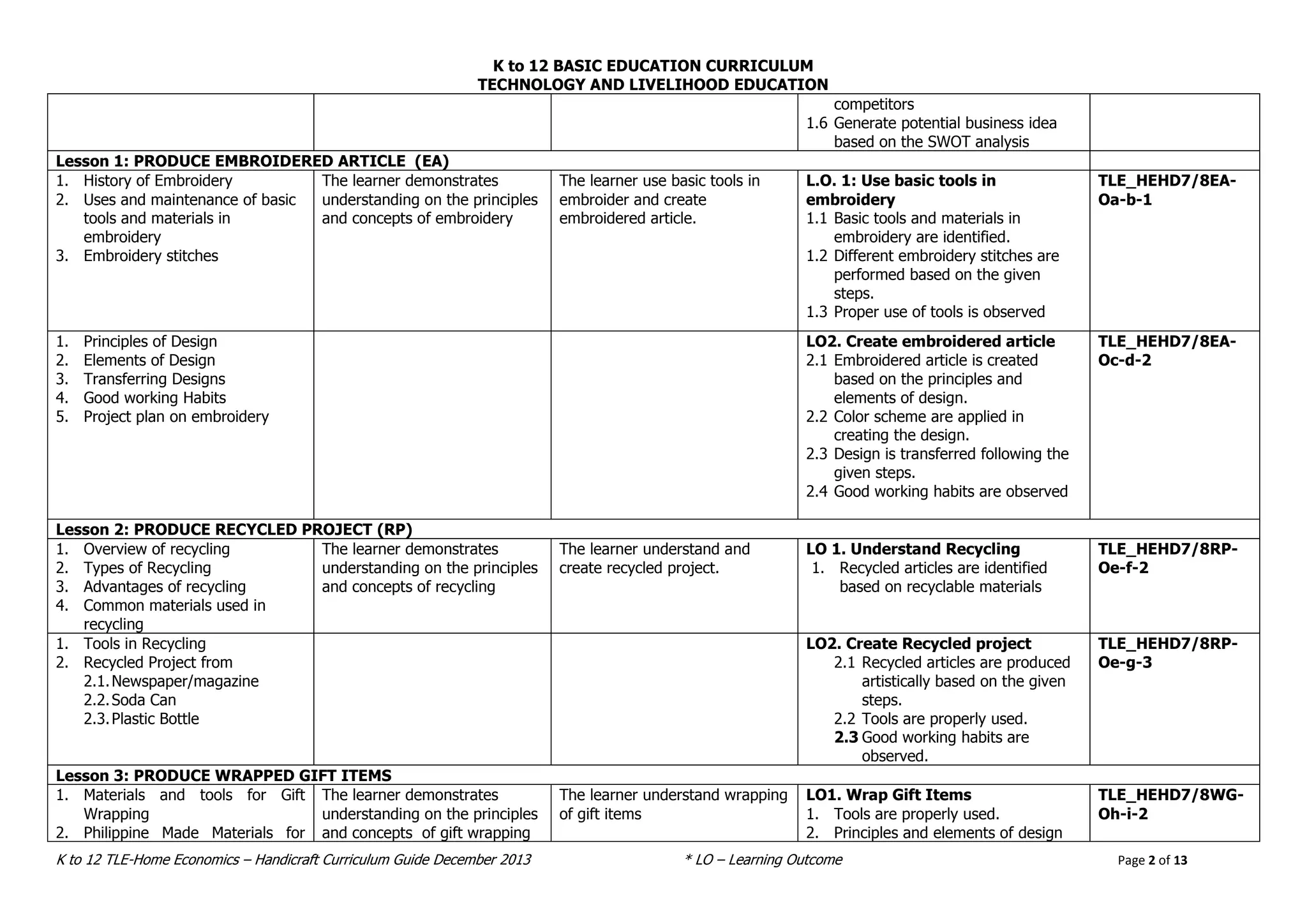
competitors
1.6 Generate potential business idea
based on the SWOT analysis
Lesson 1: PRODUCE EMBROIDERED ARTICLE (EA)
1. History of Embroidery
2. Uses and maintenance of basic
tools and materials in
embroidery
3. Embroidery stitches
The learner demonstrates
understanding on the principles
and concepts of embroidery
The learner use basic tools in
embroider and create
embroidered article.
L.O. 1: Use basic tools in
embroidery
1.1 Basic tools and materials in
embroidery are identified.
1.2 Different embroidery stitches are
performed based on the given
steps.
1.3 Proper use of tools is observed
TLE_HEHD7/8EA-
Oa-b-1
1. Principles of Design
2. Elements of Design
3. Transferring Designs
4. Good working Habits
5. Project plan on embroidery
LO2. Create embroidered article
2.1 Embroidered article is created
based on the principles and
elements of design.
2.2 Color scheme are applied in
creating the design.
2.3 Design is transferred following the
given steps.
2.4 Good working habits are observed
TLE_HEHD7/8EA-
Oc-d-2
Lesson 2: PRODUCE RECYCLED PROJECT (RP)
1. Overview of recycling
2. Types of Recycling
3. Advantages of recycling
4. Common materials used in
recycling
The learner demonstrates
understanding on the principles
and concepts of recycling
The learner understand and
create recycled project.
LO 1. Understand Recycling
1. Recycled articles are identified
based on recyclable materials
TLE_HEHD7/8RP-
Oe-f-2
1. Tools in Recycling
2. Recycled Project from
2.1.Newspaper/magazine
2.2.Soda Can
2.3.Plastic Bottle
LO2. Create Recycled project
2.1 Recycled articles are produced
artistically based on the given
steps.
2.2 Tools are properly used.
2.3 Good working habits are
observed.
TLE_HEHD7/8RP-
Oe-g-3
Lesson 3: PRODUCE WRAPPED GIFT ITEMS
1. Materials and tools for Gift
Wrapping
2. Philippine Made Materials for
The learner demonstrates
understanding on the principles
and concepts of gift wrapping
The learner understand wrapping
of gift items
LO1. Wrap Gift Items
1. Tools are properly used.
2. Principles and elements of design
TLE_HEHD7/8WG-
Oh-i-2
K to 12 BASIC EDUCATION CURRICULUM
TECHNOLOGY AND LIVELIHOOD EDUCATION
K to 12 TLE-Home Economics – Handicraft Curriculum Guide December 2013 * LO – Learning Outcome Page 3 of 13
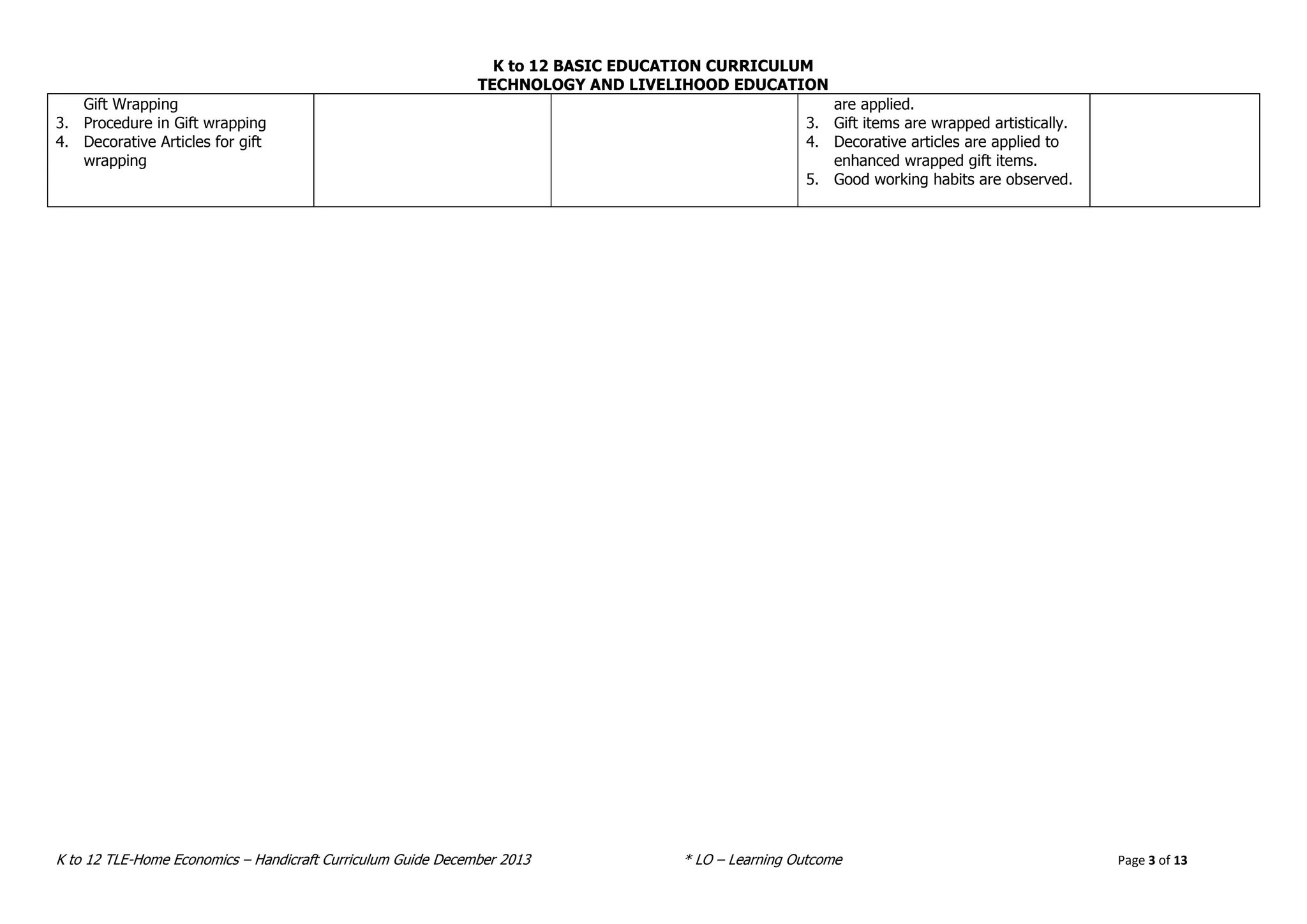
Gift Wrapping
3. Procedure in Gift wrapping
4. Decorative Articles for gift
wrapping
are applied.
3. Gift items are wrapped artistically.
4. Decorative articles are applied to
enhanced wrapped gift items.
5. Good working habits are observed.
K to 12 BASIC EDUCATION CURRICULUM
TECHNOLOGY AND LIVELIHOOD EDUCATION
K to 12 TLE-Home Economics – Handicraft Curriculum Guide December 2013 * LO – Learning Outcome Page 4 of 13
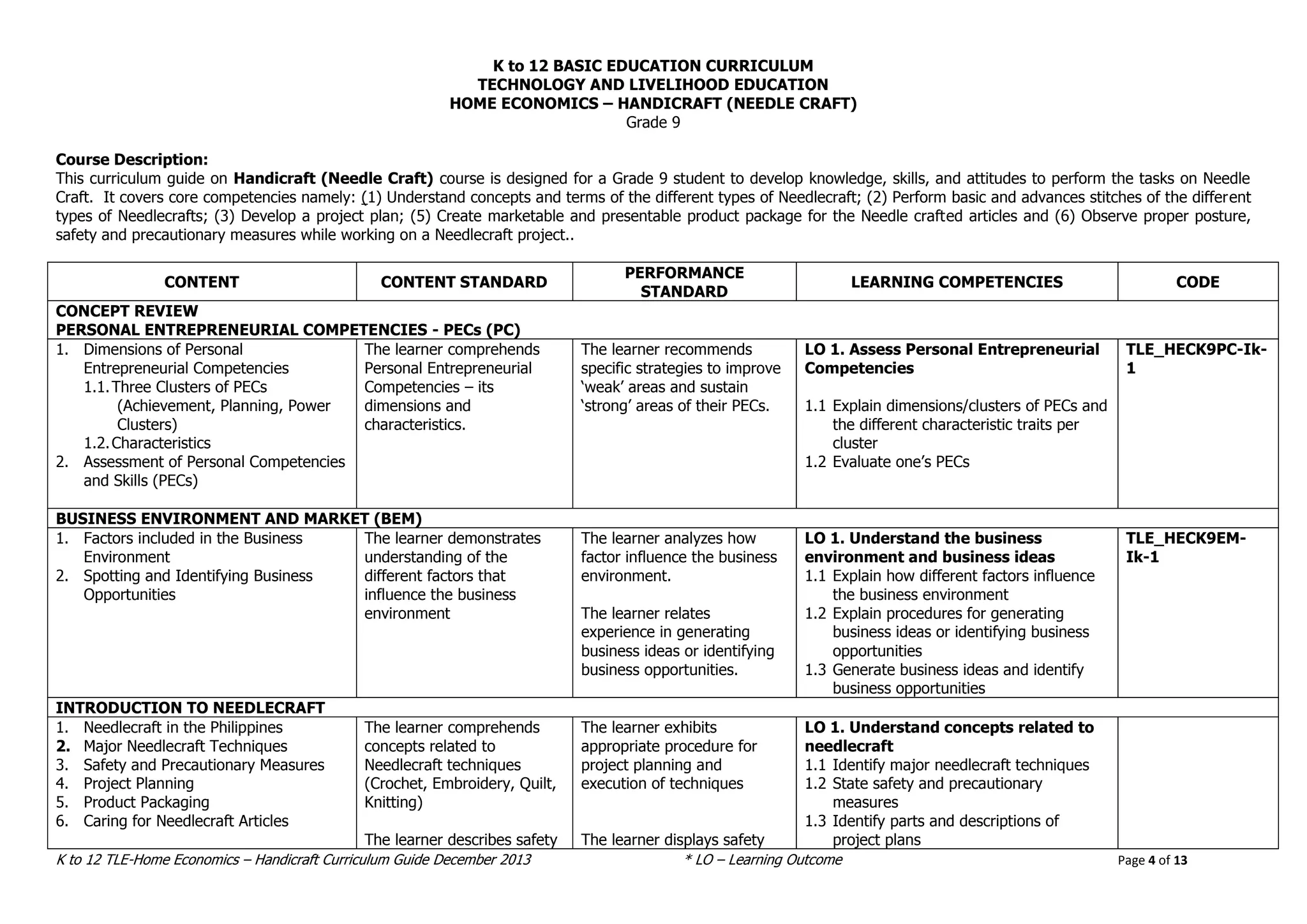
HOME ECONOMICS – HANDICRAFT (NEEDLE CRAFT)
Grade 9
Course Description:
This curriculum guide on Handicraft (Needle Craft) course is designed for a Grade 9 student to develop knowledge, skills, and attitudes to perform the tasks on Needle
Craft. It covers core competencies namely: (1) Understand concepts and terms of the different types of Needlecraft; (2) Perform basic and advances stitches of the different
types of Needlecrafts; (3) Develop a project plan; (5) Create marketable and presentable product package for the Needle crafted articles and (6) Observe proper posture,
safety and precautionary measures while working on a Needlecraft project..
CONTENT CONTENT STANDARD
PERFORMANCE
STANDARD
LEARNING COMPETENCIES CODE
CONCEPT REVIEW
PERSONAL ENTREPRENEURIAL COMPETENCIES - PECs (PC)
1. Dimensions of Personal
Entrepreneurial Competencies
1.1.Three Clusters of PECs
(Achievement, Planning, Power
Clusters)
1.2.Characteristics
2. Assessment of Personal Competencies
and Skills (PECs)
The learner comprehends
Personal Entrepreneurial
Competencies – its
dimensions and
characteristics.
The learner recommends
specific strategies to improve
‘weak’ areas and sustain
‘strong’ areas of their PECs.
LO 1. Assess Personal Entrepreneurial
Competencies
1.1 Explain dimensions/clusters of PECs and
the different characteristic traits per
cluster
1.2 Evaluate one’s PECs
TLE_HECK9PC-Ik-
1
BUSINESS ENVIRONMENT AND MARKET (BEM)
1. Factors included in the Business
Environment
2. Spotting and Identifying Business
Opportunities
The learner demonstrates
understanding of the
different factors that
influence the business
environment
The learner analyzes how
factor influence the business
environment.
The learner relates
experience in generating
business ideas or identifying
business opportunities.
LO 1. Understand the business
environment and business ideas
1.1 Explain how different factors influence
the business environment
1.2 Explain procedures for generating
business ideas or identifying business
opportunities
1.3 Generate business ideas and identify
business opportunities
TLE_HECK9EM-
Ik-1
INTRODUCTION TO NEEDLECRAFT
1. Needlecraft in the Philippines
2. Major Needlecraft Techniques
3. Safety and Precautionary Measures
4. Project Planning
5. Product Packaging
6. Caring for Needlecraft Articles
The learner comprehends
concepts related to
Needlecraft techniques
(Crochet, Embroidery, Quilt,
Knitting)
The learner describes safety
The learner exhibits
appropriate procedure for
project planning and
execution of techniques
The learner displays safety
LO 1. Understand concepts related to
needlecraft
1.1 Identify major needlecraft techniques
1.2 State safety and precautionary
measures
1.3 Identify parts and descriptions of
project plans
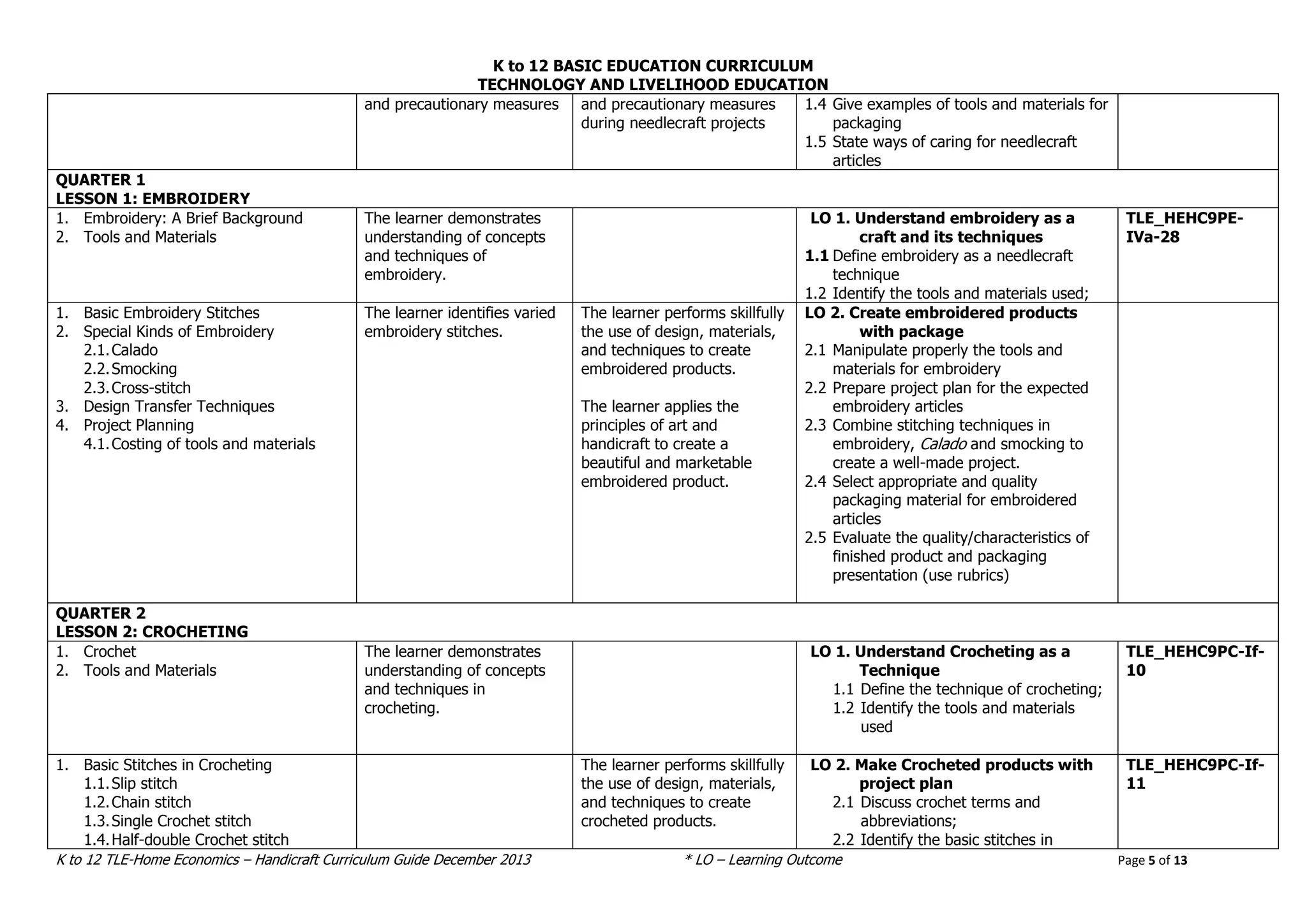
K to 12 BASIC EDUCATION CURRICULUM
TECHNOLOGY AND LIVELIHOOD EDUCATION
K to 12 TLE-Home Economics – Handicraft Curriculum Guide December 2013 * LO – Learning Outcome Page 5 of 13
and precautionary measures and precautionary measures
during needlecraft projects
1.4 Give examples of tools and materials for
packaging
1.5 State ways of caring for needlecraft
articles
QUARTER 1
LESSON 1: EMBROIDERY
1. Embroidery: A Brief Background
2. Tools and Materials
The learner demonstrates
understanding of concepts
and techniques of
embroidery.
LO 1. Understand embroidery as a
craft and its techniques
1.1 Define embroidery as a needlecraft
technique
1.2 Identify the tools and materials used;
TLE_HEHC9PE-
IVa-28
1. Basic Embroidery Stitches
2. Special Kinds of Embroidery
2.1.Calado
2.2.Smocking
2.3.Cross-stitch
3. Design Transfer Techniques
4. Project Planning
4.1.Costing of tools and materials
The learner identifies varied
embroidery stitches.
The learner performs skillfully
the use of design, materials,
and techniques to create
embroidered products.
The learner applies the
principles of art and
handicraft to create a
beautiful and marketable
embroidered product.
LO 2. Create embroidered products
with package
2.1 Manipulate properly the tools and
materials for embroidery
2.2 Prepare project plan for the expected
embroidery articles
2.3 Combine stitching techniques in
embroidery, Calado and smocking to
create a well-made project.
2.4 Select appropriate and quality
packaging material for embroidered
articles
2.5 Evaluate the quality/characteristics of
finished product and packaging
presentation (use rubrics)
QUARTER 2
LESSON 2: CROCHETING
1. Crochet
2. Tools and Materials
The learner demonstrates
understanding of concepts
and techniques in
crocheting.
LO 1. Understand Crocheting as a
Technique
1.1 Define the technique of crocheting;
1.2 Identify the tools and materials
used
TLE_HEHC9PC-If-
10
1. Basic Stitches in Crocheting
1.1.Slip stitch
1.2.Chain stitch
1.3.Single Crochet stitch
1.4.Half-double Crochet stitch
The learner performs skillfully
the use of design, materials,
and techniques to create
crocheted products.
LO 2. Make Crocheted products with
project plan
2.1 Discuss crochet terms and
abbreviations;
2.2 Identify the basic stitches in
TLE_HEHC9PC-If-
11
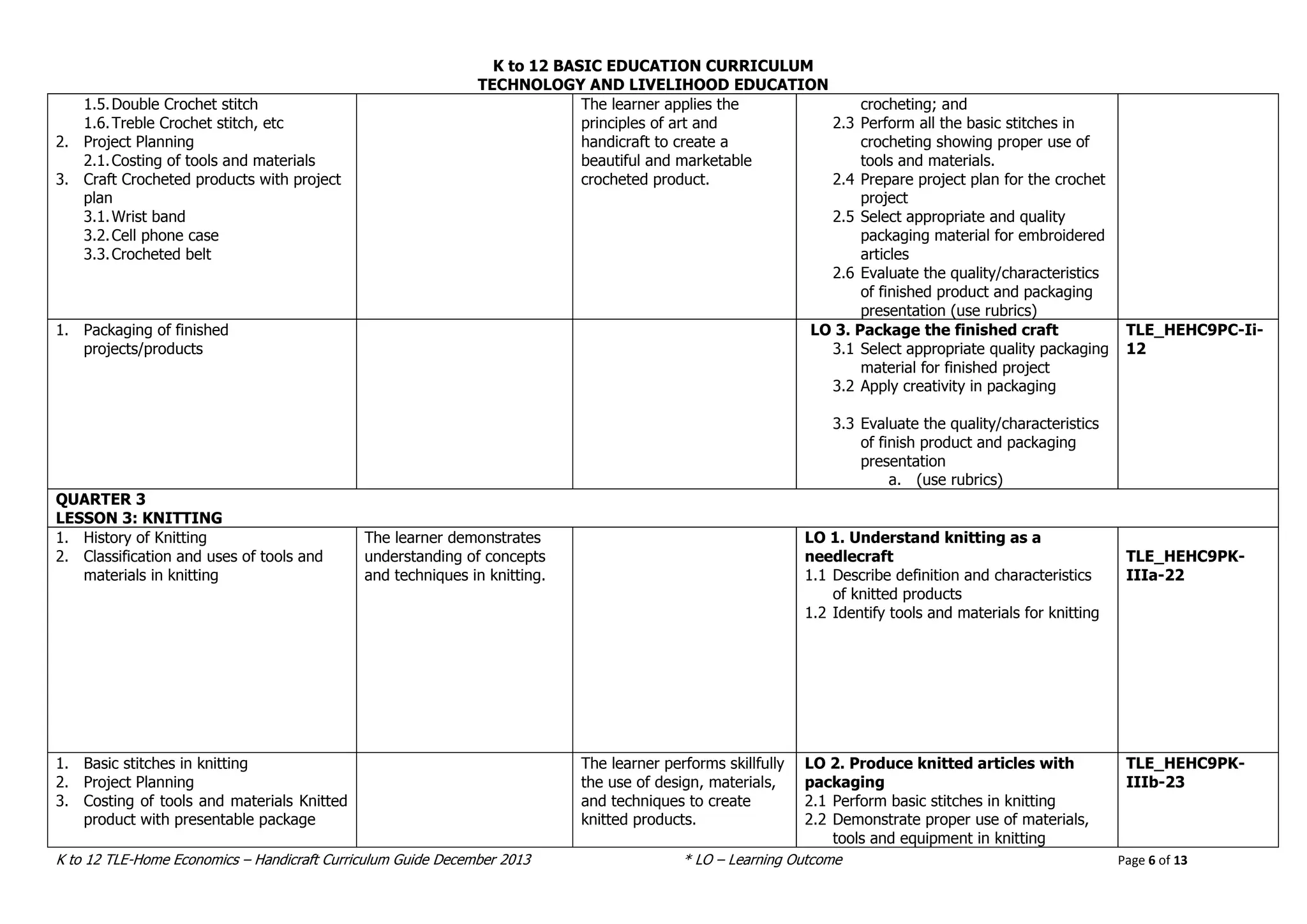
K to 12 BASIC EDUCATION CURRICULUM
TECHNOLOGY AND LIVELIHOOD EDUCATION
K to 12 TLE-Home Economics – Handicraft Curriculum Guide December 2013 * LO – Learning Outcome Page 6 of 13
1.5.Double Crochet stitch
1.6.Treble Crochet stitch, etc
2. Project Planning
2.1.Costing of tools and materials
3. Craft Crocheted products with project
plan
3.1.Wrist band
3.2.Cell phone case
3.3.Crocheted belt
The learner applies the
principles of art and
handicraft to create a
beautiful and marketable
crocheted product.
crocheting; and
2.3 Perform all the basic stitches in
crocheting showing proper use of
tools and materials.
2.4 Prepare project plan for the crochet
project
2.5 Select appropriate and quality
packaging material for embroidered
articles
2.6 Evaluate the quality/characteristics
of finished product and packaging
presentation (use rubrics)
1. Packaging of finished
projects/products
LO 3. Package the finished craft
3.1 Select appropriate quality packaging
material for finished project
3.2 Apply creativity in packaging
3.3 Evaluate the quality/characteristics
of finish product and packaging
presentation
a. (use rubrics)
TLE_HEHC9PC-Ii-
12
QUARTER 3
LESSON 3: KNITTING
1. History of Knitting
2. Classification and uses of tools and
materials in knitting
The learner demonstrates
understanding of concepts
and techniques in knitting.
LO 1. Understand knitting as a
needlecraft
1.1 Describe definition and characteristics
of knitted products
1.2 Identify tools and materials for knitting
TLE_HEHC9PK-
IIIa-22
1. Basic stitches in knitting
2. Project Planning
3. Costing of tools and materials Knitted
product with presentable package
The learner performs skillfully
the use of design, materials,
and techniques to create
knitted products.
LO 2. Produce knitted articles with
packaging
2.1 Perform basic stitches in knitting
2.2 Demonstrate proper use of materials,
tools and equipment in knitting
TLE_HEHC9PK-
IIIb-23
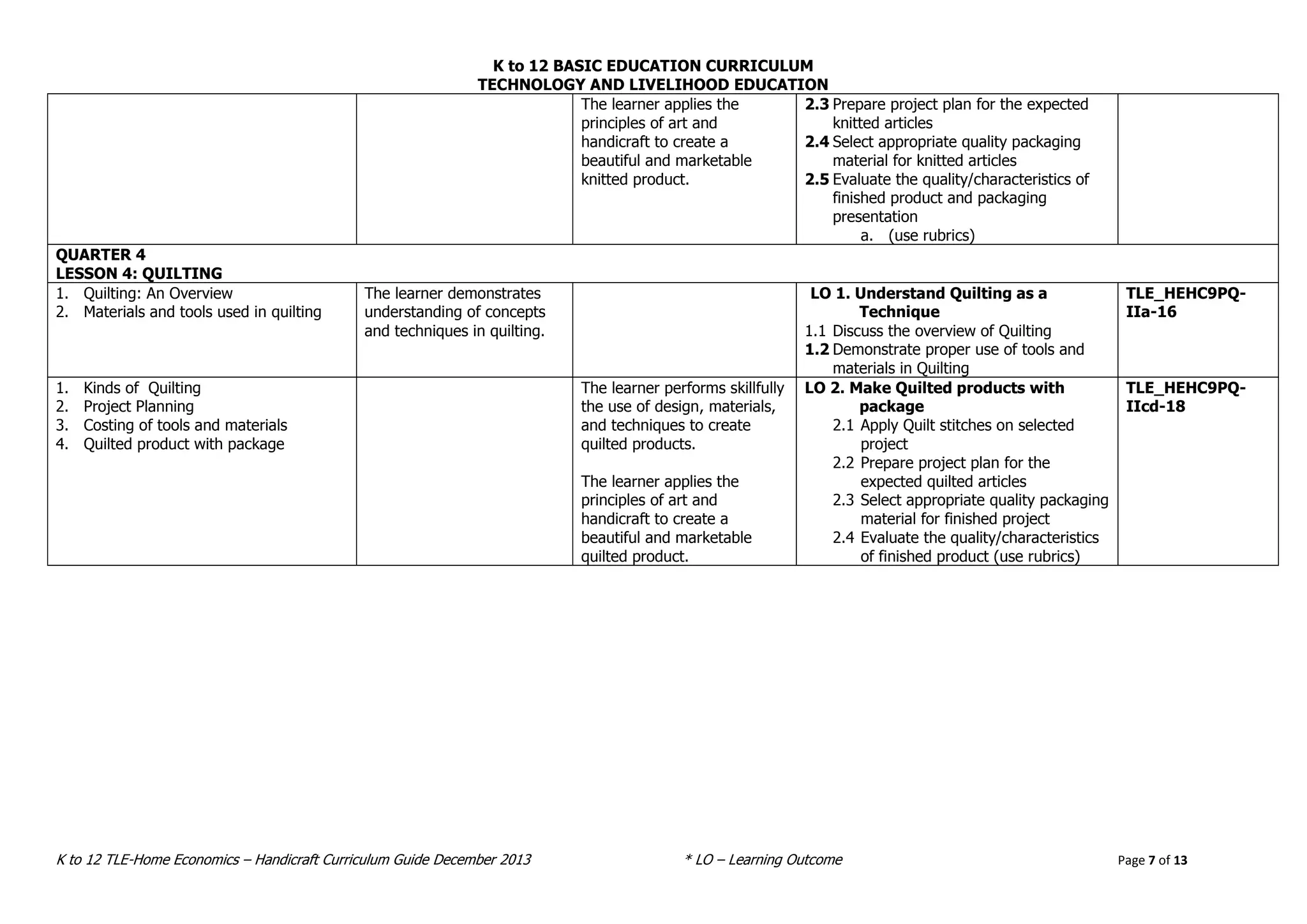
K to 12 BASIC EDUCATION CURRICULUM
TECHNOLOGY AND LIVELIHOOD EDUCATION
K to 12 TLE-Home Economics – Handicraft Curriculum Guide December 2013 * LO – Learning Outcome Page 7 of 13
The learner applies the
principles of art and
handicraft to create a
beautiful and marketable
knitted product.
2.3 Prepare project plan for the expected
knitted articles
2.4 Select appropriate quality packaging
material for knitted articles
2.5 Evaluate the quality/characteristics of
finished product and packaging
presentation
a. (use rubrics)
QUARTER 4
LESSON 4: QUILTING
1. Quilting: An Overview
2. Materials and tools used in quilting
The learner demonstrates
understanding of concepts
and techniques in quilting.
LO 1. Understand Quilting as a
Technique
1.1 Discuss the overview of Quilting
1.2 Demonstrate proper use of tools and
materials in Quilting
TLE_HEHC9PQ-
IIa-16
1. Kinds of Quilting
2. Project Planning
3. Costing of tools and materials
4. Quilted product with package
The learner performs skillfully
the use of design, materials,
and techniques to create
quilted products.
The learner applies the
principles of art and
handicraft to create a
beautiful and marketable
quilted product.
LO 2. Make Quilted products with
package
2.1 Apply Quilt stitches on selected
project
2.2 Prepare project plan for the
expected quilted articles
2.3 Select appropriate quality packaging
material for finished project
2.4 Evaluate the quality/characteristics
of finished product (use rubrics)
TLE_HEHC9PQ-
IIcd-18
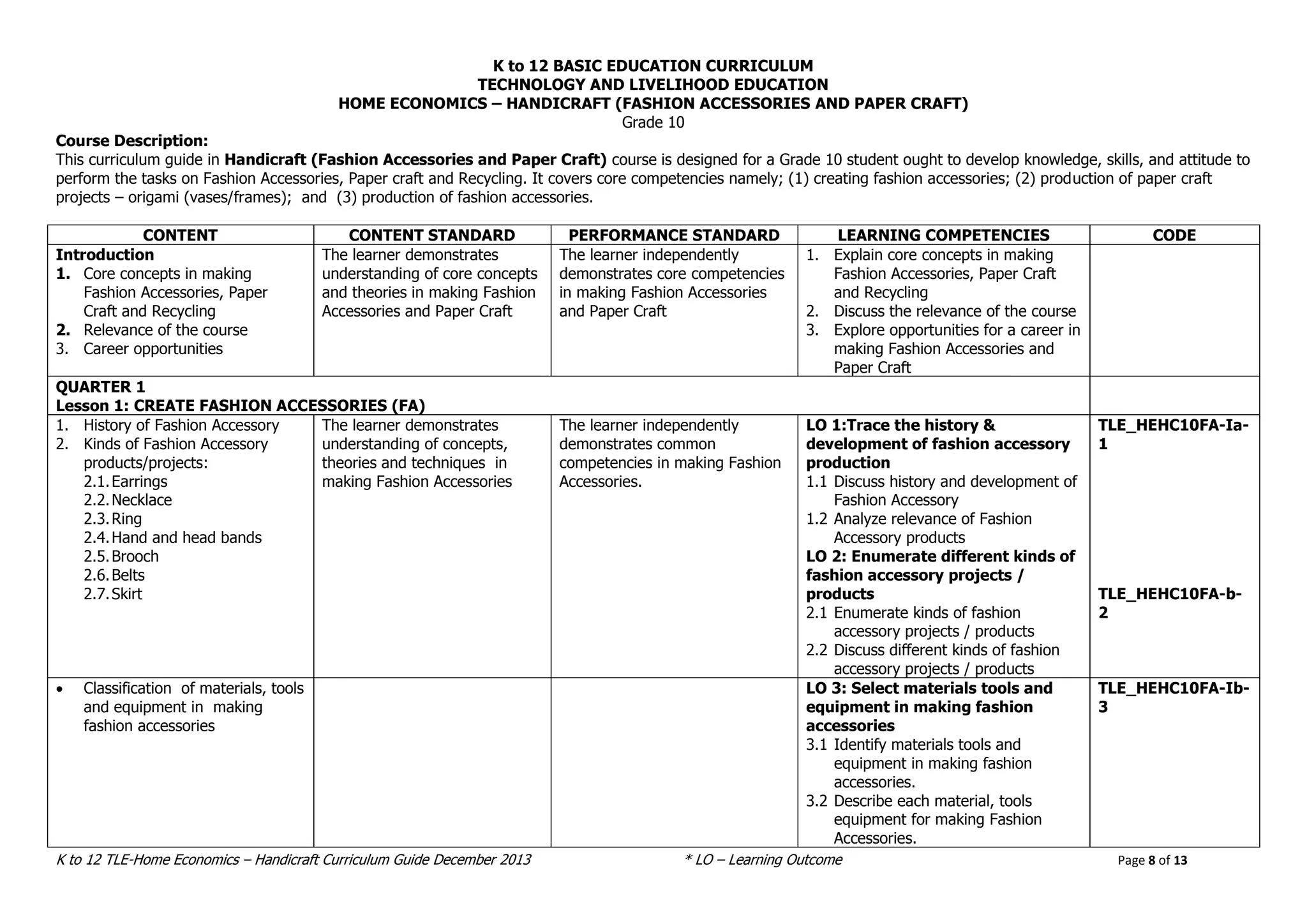
K to 12 BASIC EDUCATION CURRICULUM
TECHNOLOGY AND LIVELIHOOD EDUCATION
K to 12 TLE-Home Economics – Handicraft Curriculum Guide December 2013 * LO – Learning Outcome Page 8 of 13
HOME ECONOMICS – HANDICRAFT (FASHION ACCESSORIES AND PAPER CRAFT)
Grade 10
Course Description:
This curriculum guide in Handicraft (Fashion Accessories and Paper Craft) course is designed for a Grade 10 student ought to develop knowledge, skills, and attitude to
perform the tasks on Fashion Accessories, Paper craft and Recycling. It covers core competencies namely; (1) creating fashion accessories; (2) production of paper craft
projects – origami (vases/frames); and (3) production of fashion accessories.
CONTENT CONTENT STANDARD PERFORMANCE STANDARD LEARNING COMPETENCIES CODE
Introduction
1. Core concepts in making
Fashion Accessories, Paper
Craft and Recycling
2. Relevance of the course
3. Career opportunities
The learner demonstrates
understanding of core concepts
and theories in making Fashion
Accessories and Paper Craft
The learner independently
demonstrates core competencies
in making Fashion Accessories
and Paper Craft
1. Explain core concepts in making
Fashion Accessories, Paper Craft
and Recycling
2. Discuss the relevance of the course
3. Explore opportunities for a career in
making Fashion Accessories and
Paper Craft
QUARTER 1
Lesson 1: CREATE FASHION ACCESSORIES (FA)
1. History of Fashion Accessory
2. Kinds of Fashion Accessory
products/projects:
2.1.Earrings
2.2.Necklace
2.3.Ring
2.4.Hand and head bands
2.5.Brooch
2.6.Belts
2.7.Skirt
The learner demonstrates
understanding of concepts,
theories and techniques in
making Fashion Accessories
The learner independently
demonstrates common
competencies in making Fashion
Accessories.
LO 1:Trace the history &
development of fashion accessory
production
1.1 Discuss history and development of
Fashion Accessory
1.2 Analyze relevance of Fashion
Accessory products
LO 2: Enumerate different kinds of
fashion accessory projects /
products
2.1 Enumerate kinds of fashion
accessory projects / products
2.2 Discuss different kinds of fashion
accessory projects / products
TLE_HEHC10FA-Ia-
1
TLE_HEHC10FA-b-
2
 Classification of materials, tools
and equipment in making
fashion accessories
LO 3: Select materials tools and
equipment in making fashion
accessories
3.1 Identify materials tools and
equipment in making fashion
accessories.
3.2 Describe each material, tools
equipment for making Fashion
Accessories.
TLE_HEHC10FA-Ib-
3
K to 12 BASIC EDUCATION CURRICULUM
TECHNOLOGY AND LIVELIHOOD EDUCATION
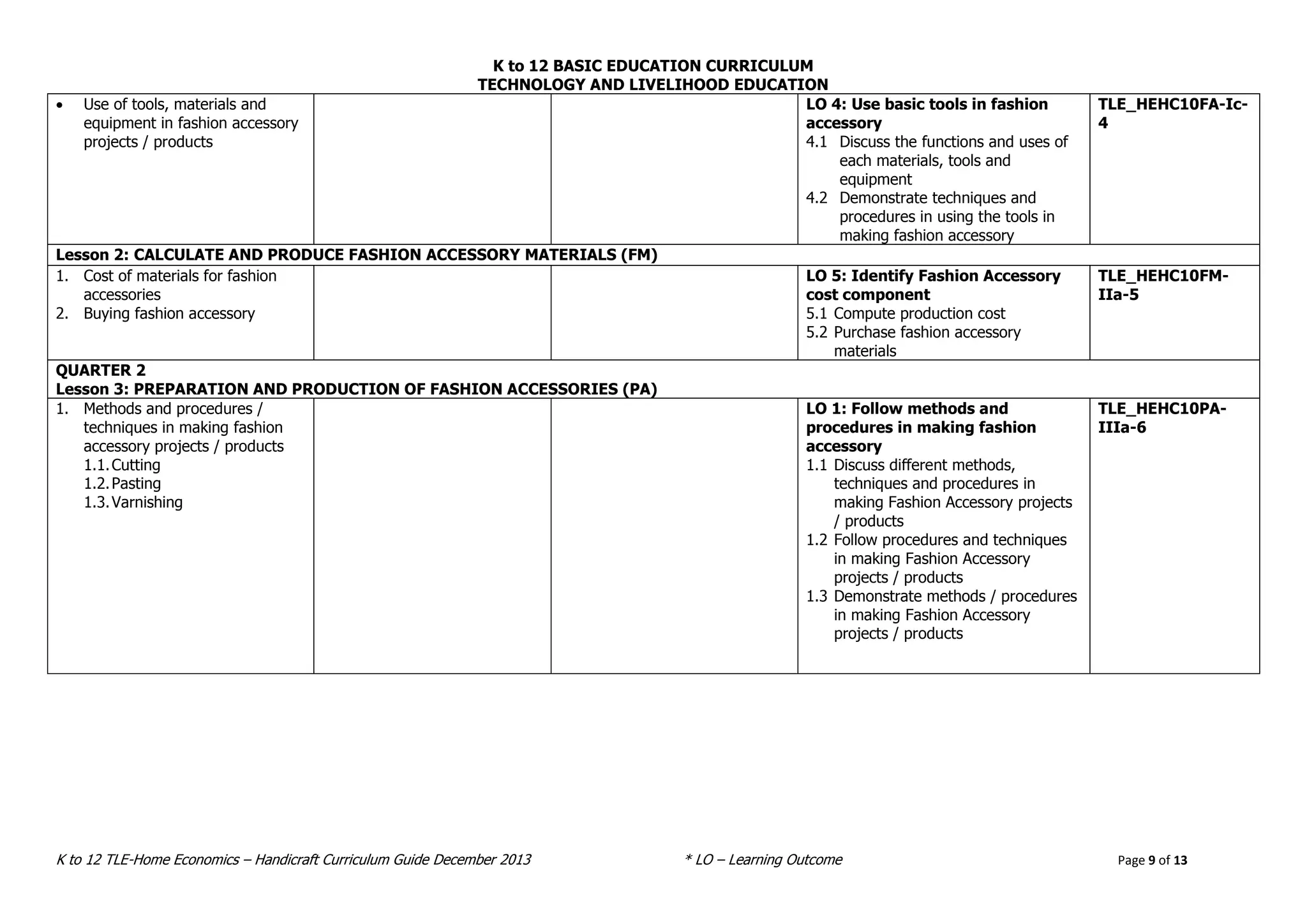
K to 12 TLE-Home Economics – Handicraft Curriculum Guide December 2013 * LO – Learning Outcome Page 9 of 13
 Use of tools, materials and
equipment in fashion accessory
projects / products
LO 4: Use basic tools in fashion
accessory
4.1 Discuss the functions and uses of
each materials, tools and
equipment
4.2 Demonstrate techniques and
procedures in using the tools in
making fashion accessory
TLE_HEHC10FA-Ic-
4
Lesson 2: CALCULATE AND PRODUCE FASHION ACCESSORY MATERIALS (FM)
1. Cost of materials for fashion
accessories
2. Buying fashion accessory
LO 5: Identify Fashion Accessory
cost component
5.1 Compute production cost
5.2 Purchase fashion accessory
materials
TLE_HEHC10FM-
IIa-5
QUARTER 2
Lesson 3: PREPARATION AND PRODUCTION OF FASHION ACCESSORIES (PA)
1. Methods and procedures /
techniques in making fashion
accessory projects / products
1.1.Cutting
1.2.Pasting
1.3.Varnishing
LO 1: Follow methods and
procedures in making fashion
accessory
1.1 Discuss different methods,
techniques and procedures in
making Fashion Accessory projects
/ products
1.2 Follow procedures and techniques
in making Fashion Accessory
projects / products
1.3 Demonstrate methods / procedures
in making Fashion Accessory
projects / products
TLE_HEHC10PA-
IIIa-6
K to 12 BASIC EDUCATION CURRICULUM
TECHNOLOGY AND LIVELIHOOD EDUCATION
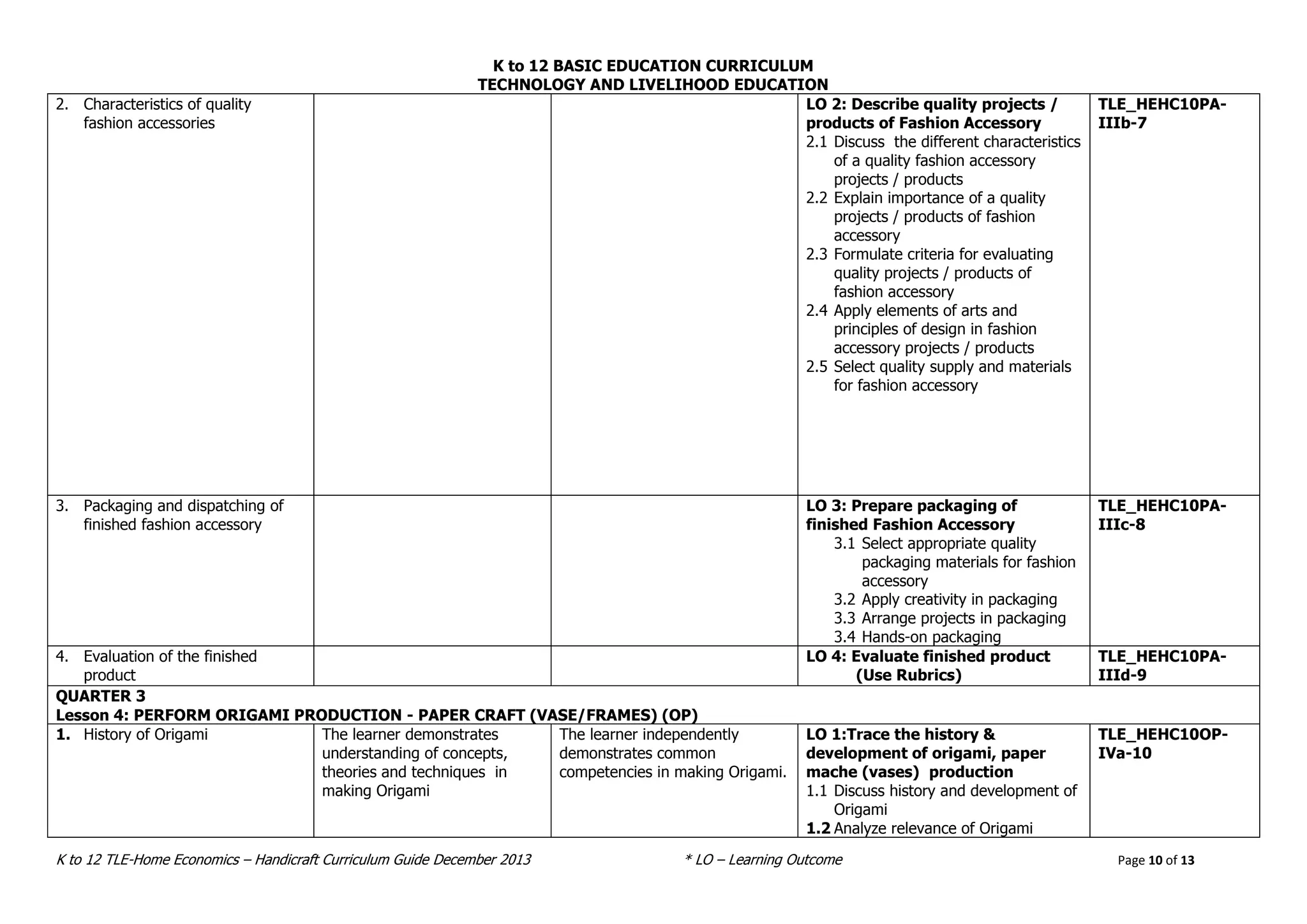
K to 12 TLE-Home Economics – Handicraft Curriculum Guide December 2013 * LO – Learning Outcome Page 10 of 13
2. Characteristics of quality
fashion accessories
LO 2: Describe quality projects /
products of Fashion Accessory
2.1 Discuss the different characteristics
of a quality fashion accessory
projects / products
2.2 Explain importance of a quality
projects / products of fashion
accessory
2.3 Formulate criteria for evaluating
quality projects / products of
fashion accessory
2.4 Apply elements of arts and
principles of design in fashion
accessory projects / products
2.5 Select quality supply and materials
for fashion accessory
TLE_HEHC10PA-
IIIb-7
3. Packaging and dispatching of
finished fashion accessory
LO 3: Prepare packaging of
finished Fashion Accessory
3.1 Select appropriate quality
packaging materials for fashion
accessory
3.2 Apply creativity in packaging
3.3 Arrange projects in packaging
3.4 Hands-on packaging
TLE_HEHC10PA-
IIIc-8
4. Evaluation of the finished
product
LO 4: Evaluate finished product
(Use Rubrics)
TLE_HEHC10PA-
IIId-9
QUARTER 3
Lesson 4: PERFORM ORIGAMI PRODUCTION - PAPER CRAFT (VASE/FRAMES) (OP)
1. History of Origami The learner demonstrates
understanding of concepts,
theories and techniques in
making Origami
The learner independently
demonstrates common
competencies in making Origami.
LO 1:Trace the history &
development of origami, paper
mache (vases) production
1.1 Discuss history and development of
Origami
1.2 Analyze relevance of Origami
TLE_HEHC10OP-
IVa-10
K to 12 BASIC EDUCATION CURRICULUM
TECHNOLOGY AND LIVELIHOOD EDUCATION
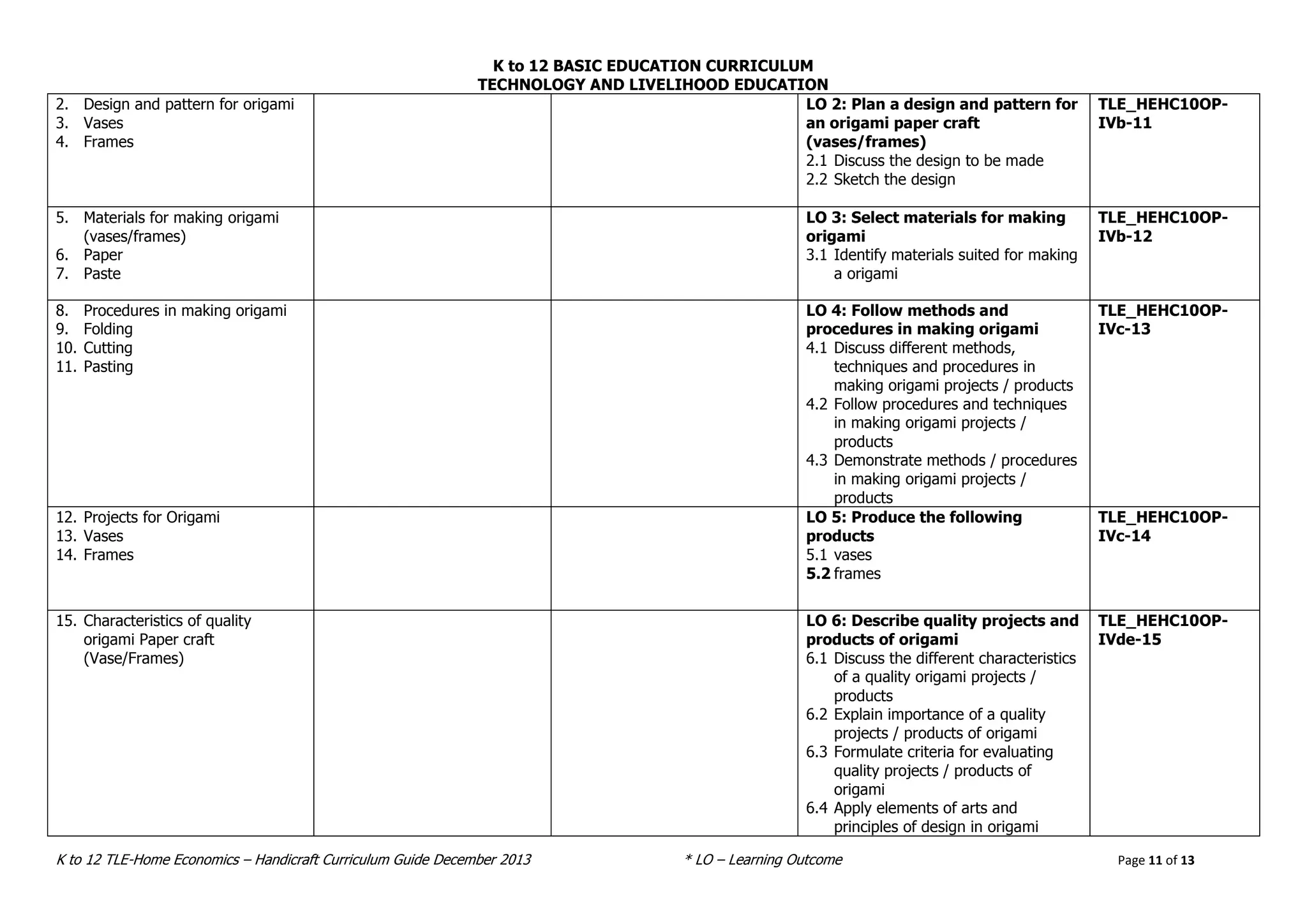
K to 12 TLE-Home Economics – Handicraft Curriculum Guide December 2013 * LO – Learning Outcome Page 11 of 13
2. Design and pattern for origami
3. Vases
4. Frames
LO 2: Plan a design and pattern for
an origami paper craft
(vases/frames)
2.1 Discuss the design to be made
2.2 Sketch the design
TLE_HEHC10OP-
IVb-11
5. Materials for making origami
(vases/frames)
6. Paper
7. Paste
LO 3: Select materials for making
origami
3.1 Identify materials suited for making
a origami
TLE_HEHC10OP-
IVb-12
8. Procedures in making origami
9. Folding
10. Cutting
11. Pasting
LO 4: Follow methods and
procedures in making origami
4.1 Discuss different methods,
techniques and procedures in
making origami projects / products
4.2 Follow procedures and techniques
in making origami projects /
products
4.3 Demonstrate methods / procedures
in making origami projects /
products
TLE_HEHC10OP-
IVc-13
12. Projects for Origami
13. Vases
14. Frames
LO 5: Produce the following
products
5.1 vases
5.2 frames
TLE_HEHC10OP-
IVc-14
15. Characteristics of quality
origami Paper craft
(Vase/Frames)
LO 6: Describe quality projects and
products of origami
6.1 Discuss the different characteristics
of a quality origami projects /
products
6.2 Explain importance of a quality
projects / products of origami
6.3 Formulate criteria for evaluating
quality projects / products of
origami
6.4 Apply elements of arts and
principles of design in origami
TLE_HEHC10OP-
IVde-15
K to 12 BASIC EDUCATION CURRICULUM
TECHNOLOGY AND LIVELIHOOD EDUCATION
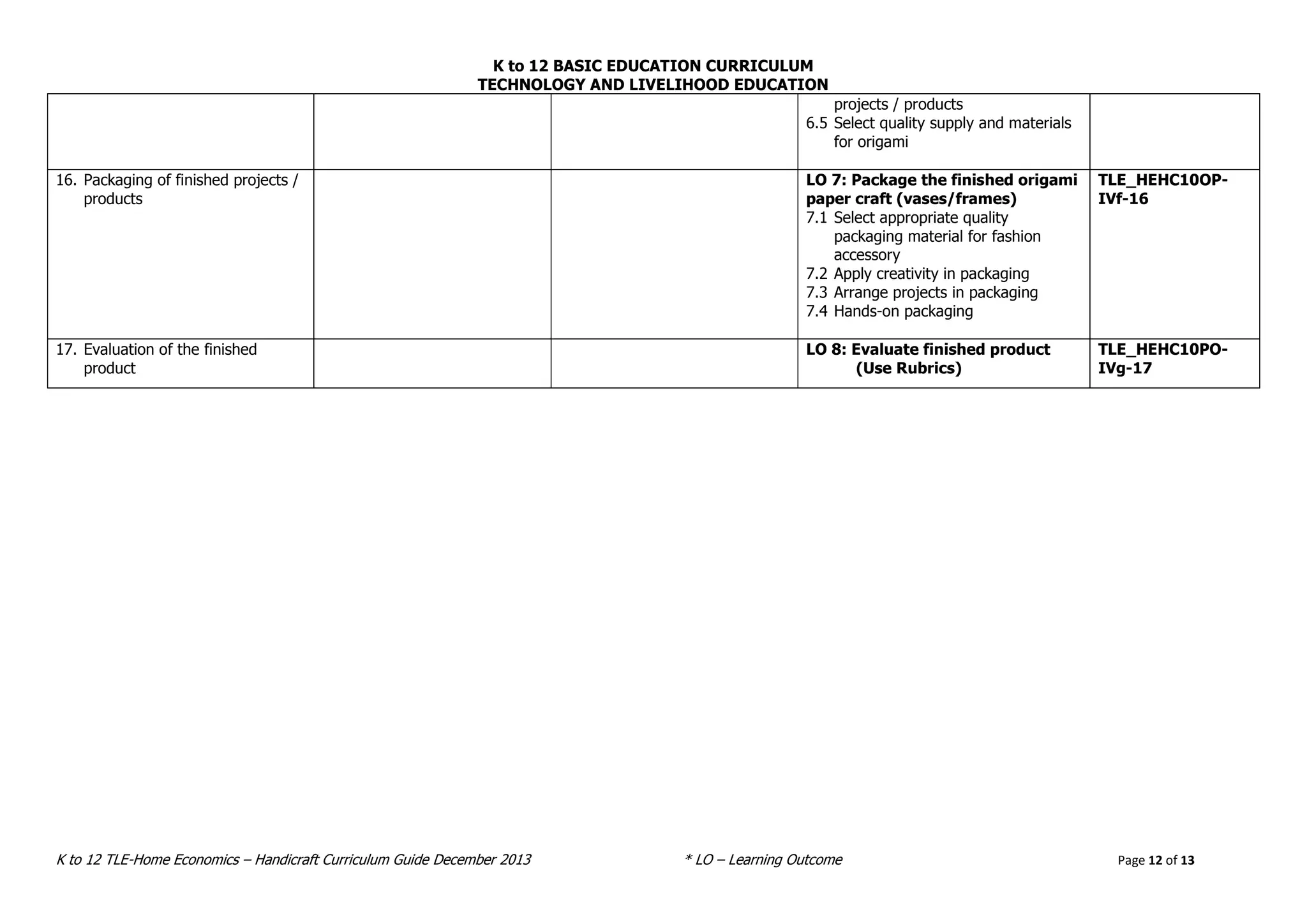
K to 12 TLE-Home Economics – Handicraft Curriculum Guide December 2013 * LO – Learning Outcome Page 12 of 13
projects / products
6.5 Select quality supply and materials
for origami
16. Packaging of finished projects /
products
LO 7: Package the finished origami
paper craft (vases/frames)
7.1 Select appropriate quality
packaging material for fashion
accessory
7.2 Apply creativity in packaging
7.3 Arrange projects in packaging
7.4 Hands-on packaging
TLE_HEHC10OP-
IVf-16
17. Evaluation of the finished
product
LO 8: Evaluate finished product
(Use Rubrics)
TLE_HEHC10PO-
IVg-17
K to 12 BASIC EDUCATION CURRICULUM
TECHNOLOGY AND LIVELIHOOD EDUCATION
K to 12 TLE-Home Economics – Handicraft Curriculum Guide December 2013 * LO – Learning Outcome Page 13 of 13
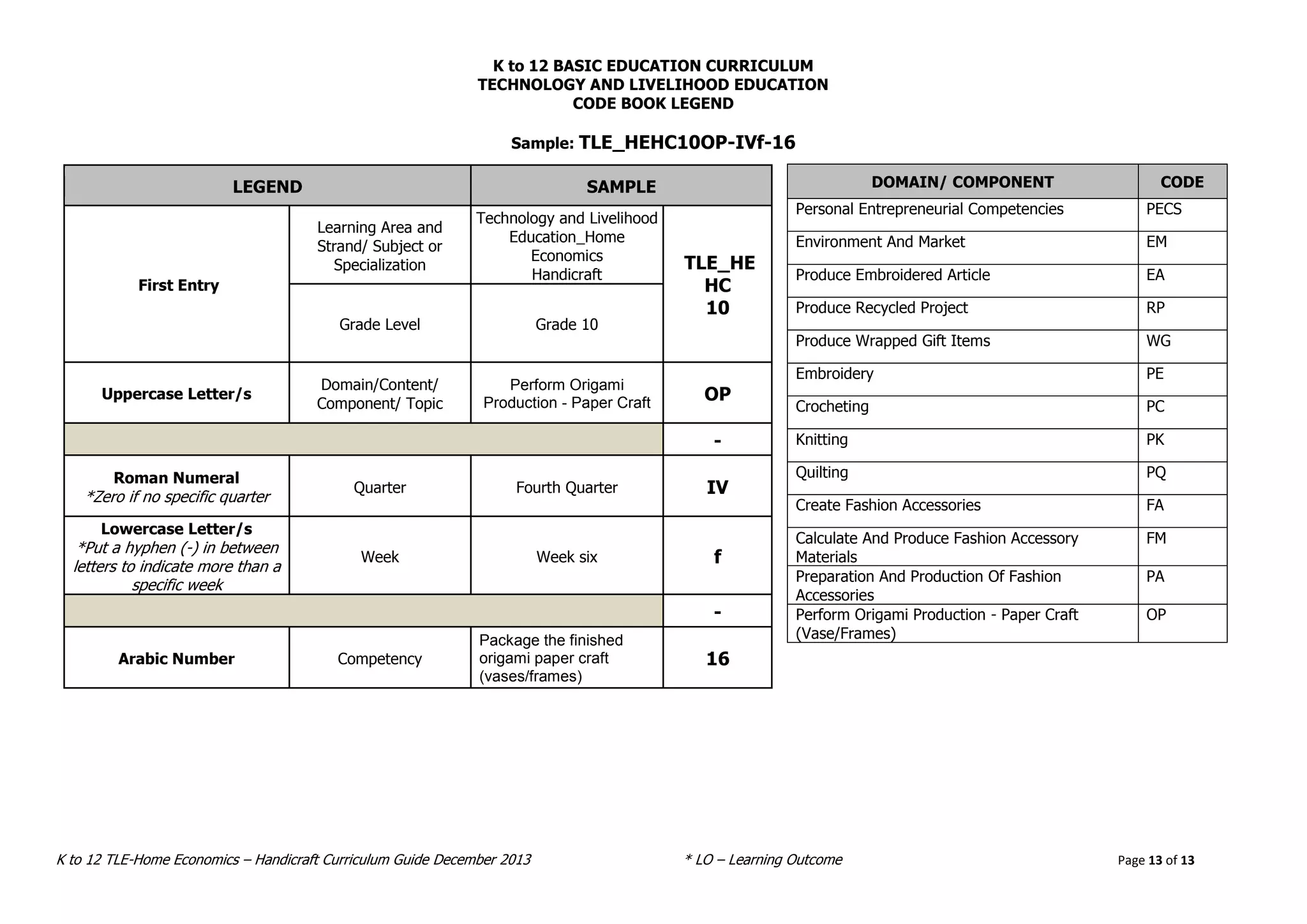
CODE BOOK LEGEND
Sample: TLE_HEHC10OP-IVf-16
LEGEND SAMPLE
First Entry
Learning Area and
Strand/ Subject or
Specialization
Technology and Livelihood
Education_Home
Economics
Handicraft
TLE_HE
HC
10
Grade Level Grade 10
Uppercase Letter/s
Domain/Content/
Component/ Topic
Perform Origami
Production - Paper Craft OP
-
Roman Numeral
*Zero if no specific quarter
Quarter Fourth Quarter IV
Lowercase Letter/s
*Put a hyphen (-) in between
letters to indicate more than a
specific week
Week Week six f
-
Arabic Number Competency
Package the finished
origami paper craft
(vases/frames)
16
DOMAIN/ COMPONENT CODE
Personal Entrepreneurial Competencies PECS
Environment And Market EM
Produce Embroidered Article EA
Produce Recycled Project RP
Produce Wrapped Gift Items WG
Embroidery PE
Crocheting PC
Knitting PK
Quilting PQ
Create Fashion Accessories FA
Calculate And Produce Fashion Accessory
Materials
FM
Preparation And Production Of Fashion
Accessories
PA
Perform Origami Production - Paper Craft
(Vase/Frames)
OP

TLE/HE Handicraft Curriculum Guide

  • 1.
    K to 12BASIC EDUCATION CURRICULUM TECHNOLOGY AND LIVELIHOOD EDUCATION K to 12 TLE-Home Economics – Handicraft Curriculum Guide December 2013 * LO – Learning Outcome Page 1 of 13 HOME ECONOMICS – HANDICRAFT Grade 7/8 (Exploratory) Course Description: This curriculum guide is a specialization course which leads to Handicraft Making. It covers core competencies that a grade 7/8 Technology and Livelihood Education (TLE) student ought to possess, namely; produce crochet, quilt, knitted and embroidery projects. The preliminaries of this specialization course include the following: 1) discussion on the relevance of the course; 2) explanation of key concepts relative to the course and; 3) exploration on career opportunities. CONTENT CONTENT STANDARD PERFORMANCE STANDARD LEARNING COMPETENCIES CODE Introduction 1. Basic Concepts in handicraft 2. Relevance of the course 3. Career Opportunities The learner demonstrates understanding of concepts, principles and theories in handicraft The learner independently demonstrate core competencies in handicraft 1. Explain core concepts in handicraft 2. Discuss the relevance of the course 3. Explore opportunities for Needle Craft Making as a career PERSONAL ENTREPRENEURIAL COMPETENCIES - PECs (PC) 1. Assessment of Personal Entrepreneurial Competencies and Skills (PECs) vis-à-vis a practicing entrepreneur/employee 1.1.characteristics 1.2.Attributes 1.3.Lifestyle 1.4.Skills 1.5.Traits 2. Analysis of PECs in relation to a practitioner The learner demonstrates understanding of one’s PECs. The learner recognizes his/her PECs and prepares an activity plan that aligns with that of a practitioner/entrepreneur in Handicraft. LO 1. Recognize PECs needed in Handicraft. 1.1. Assess one’s PECs: characteristics, attributes, lifestyle, skills, traits 1.2. Assess practitioner’s: characteristics, attributes, lifestyle, skills, traits 1.3. Compare one’s PECS with that of a practitioner /entrepreneur 1.4. Align one’s PECS with that of a practitioner/entrepreneur TLE_HEHD7/8PC- 0k-1 ENVIRONMENT AND MARKET (EM)  Key concepts of Environment and Market  Products & services available in the market  Differentiation of products & services  Customers and their buying habits  Competition in the market  SWOT Analysis The learner demonstrates understanding of environment and market that relates with a career choice in Handicraft . The learner independently generates a business idea based on the analysis of environment and market in Handicraft . LO 1. Generate a business idea that relates with a career choice in Handicraft 1.1 Conduct SWOT analysis 1.2 Identify the different products/services available in the market 1.3 Compare different products/services in computer hardware servicing business 1.4 Determine the profile potential customers 1.5 Determine the profile potential TLE_HEHD7/8EM- 0k-1
  • 2.
    K to 12BASIC EDUCATION CURRICULUM TECHNOLOGY AND LIVELIHOOD EDUCATION K to 12 TLE-Home Economics – Handicraft Curriculum Guide December 2013 * LO – Learning Outcome Page 2 of 13 competitors 1.6 Generate potential business idea based on the SWOT analysis Lesson 1: PRODUCE EMBROIDERED ARTICLE (EA) 1. History of Embroidery 2. Uses and maintenance of basic tools and materials in embroidery 3. Embroidery stitches The learner demonstrates understanding on the principles and concepts of embroidery The learner use basic tools in embroider and create embroidered article. L.O. 1: Use basic tools in embroidery 1.1 Basic tools and materials in embroidery are identified. 1.2 Different embroidery stitches are performed based on the given steps. 1.3 Proper use of tools is observed TLE_HEHD7/8EA- Oa-b-1 1. Principles of Design 2. Elements of Design 3. Transferring Designs 4. Good working Habits 5. Project plan on embroidery LO2. Create embroidered article 2.1 Embroidered article is created based on the principles and elements of design. 2.2 Color scheme are applied in creating the design. 2.3 Design is transferred following the given steps. 2.4 Good working habits are observed TLE_HEHD7/8EA- Oc-d-2 Lesson 2: PRODUCE RECYCLED PROJECT (RP) 1. Overview of recycling 2. Types of Recycling 3. Advantages of recycling 4. Common materials used in recycling The learner demonstrates understanding on the principles and concepts of recycling The learner understand and create recycled project. LO 1. Understand Recycling 1. Recycled articles are identified based on recyclable materials TLE_HEHD7/8RP- Oe-f-2 1. Tools in Recycling 2. Recycled Project from 2.1.Newspaper/magazine 2.2.Soda Can 2.3.Plastic Bottle LO2. Create Recycled project 2.1 Recycled articles are produced artistically based on the given steps. 2.2 Tools are properly used. 2.3 Good working habits are observed. TLE_HEHD7/8RP- Oe-g-3 Lesson 3: PRODUCE WRAPPED GIFT ITEMS 1. Materials and tools for Gift Wrapping 2. Philippine Made Materials for The learner demonstrates understanding on the principles and concepts of gift wrapping The learner understand wrapping of gift items LO1. Wrap Gift Items 1. Tools are properly used. 2. Principles and elements of design TLE_HEHD7/8WG- Oh-i-2
  • 3.
    K to 12BASIC EDUCATION CURRICULUM TECHNOLOGY AND LIVELIHOOD EDUCATION K to 12 TLE-Home Economics – Handicraft Curriculum Guide December 2013 * LO – Learning Outcome Page 3 of 13 Gift Wrapping 3. Procedure in Gift wrapping 4. Decorative Articles for gift wrapping are applied. 3. Gift items are wrapped artistically. 4. Decorative articles are applied to enhanced wrapped gift items. 5. Good working habits are observed.
  • 4.
    K to 12BASIC EDUCATION CURRICULUM TECHNOLOGY AND LIVELIHOOD EDUCATION K to 12 TLE-Home Economics – Handicraft Curriculum Guide December 2013 * LO – Learning Outcome Page 4 of 13 HOME ECONOMICS – HANDICRAFT (NEEDLE CRAFT) Grade 9 Course Description: This curriculum guide on Handicraft (Needle Craft) course is designed for a Grade 9 student to develop knowledge, skills, and attitudes to perform the tasks on Needle Craft. It covers core competencies namely: (1) Understand concepts and terms of the different types of Needlecraft; (2) Perform basic and advances stitches of the different types of Needlecrafts; (3) Develop a project plan; (5) Create marketable and presentable product package for the Needle crafted articles and (6) Observe proper posture, safety and precautionary measures while working on a Needlecraft project.. CONTENT CONTENT STANDARD PERFORMANCE STANDARD LEARNING COMPETENCIES CODE CONCEPT REVIEW PERSONAL ENTREPRENEURIAL COMPETENCIES - PECs (PC) 1. Dimensions of Personal Entrepreneurial Competencies 1.1.Three Clusters of PECs (Achievement, Planning, Power Clusters) 1.2.Characteristics 2. Assessment of Personal Competencies and Skills (PECs) The learner comprehends Personal Entrepreneurial Competencies – its dimensions and characteristics. The learner recommends specific strategies to improve ‘weak’ areas and sustain ‘strong’ areas of their PECs. LO 1. Assess Personal Entrepreneurial Competencies 1.1 Explain dimensions/clusters of PECs and the different characteristic traits per cluster 1.2 Evaluate one’s PECs TLE_HECK9PC-Ik- 1 BUSINESS ENVIRONMENT AND MARKET (BEM) 1. Factors included in the Business Environment 2. Spotting and Identifying Business Opportunities The learner demonstrates understanding of the different factors that influence the business environment The learner analyzes how factor influence the business environment. The learner relates experience in generating business ideas or identifying business opportunities. LO 1. Understand the business environment and business ideas 1.1 Explain how different factors influence the business environment 1.2 Explain procedures for generating business ideas or identifying business opportunities 1.3 Generate business ideas and identify business opportunities TLE_HECK9EM- Ik-1 INTRODUCTION TO NEEDLECRAFT 1. Needlecraft in the Philippines 2. Major Needlecraft Techniques 3. Safety and Precautionary Measures 4. Project Planning 5. Product Packaging 6. Caring for Needlecraft Articles The learner comprehends concepts related to Needlecraft techniques (Crochet, Embroidery, Quilt, Knitting) The learner describes safety The learner exhibits appropriate procedure for project planning and execution of techniques The learner displays safety LO 1. Understand concepts related to needlecraft 1.1 Identify major needlecraft techniques 1.2 State safety and precautionary measures 1.3 Identify parts and descriptions of project plans
  • 5.
    K to 12BASIC EDUCATION CURRICULUM TECHNOLOGY AND LIVELIHOOD EDUCATION K to 12 TLE-Home Economics – Handicraft Curriculum Guide December 2013 * LO – Learning Outcome Page 5 of 13 and precautionary measures and precautionary measures during needlecraft projects 1.4 Give examples of tools and materials for packaging 1.5 State ways of caring for needlecraft articles QUARTER 1 LESSON 1: EMBROIDERY 1. Embroidery: A Brief Background 2. Tools and Materials The learner demonstrates understanding of concepts and techniques of embroidery. LO 1. Understand embroidery as a craft and its techniques 1.1 Define embroidery as a needlecraft technique 1.2 Identify the tools and materials used; TLE_HEHC9PE- IVa-28 1. Basic Embroidery Stitches 2. Special Kinds of Embroidery 2.1.Calado 2.2.Smocking 2.3.Cross-stitch 3. Design Transfer Techniques 4. Project Planning 4.1.Costing of tools and materials The learner identifies varied embroidery stitches. The learner performs skillfully the use of design, materials, and techniques to create embroidered products. The learner applies the principles of art and handicraft to create a beautiful and marketable embroidered product. LO 2. Create embroidered products with package 2.1 Manipulate properly the tools and materials for embroidery 2.2 Prepare project plan for the expected embroidery articles 2.3 Combine stitching techniques in embroidery, Calado and smocking to create a well-made project. 2.4 Select appropriate and quality packaging material for embroidered articles 2.5 Evaluate the quality/characteristics of finished product and packaging presentation (use rubrics) QUARTER 2 LESSON 2: CROCHETING 1. Crochet 2. Tools and Materials The learner demonstrates understanding of concepts and techniques in crocheting. LO 1. Understand Crocheting as a Technique 1.1 Define the technique of crocheting; 1.2 Identify the tools and materials used TLE_HEHC9PC-If- 10 1. Basic Stitches in Crocheting 1.1.Slip stitch 1.2.Chain stitch 1.3.Single Crochet stitch 1.4.Half-double Crochet stitch The learner performs skillfully the use of design, materials, and techniques to create crocheted products. LO 2. Make Crocheted products with project plan 2.1 Discuss crochet terms and abbreviations; 2.2 Identify the basic stitches in TLE_HEHC9PC-If- 11
  • 6.
    K to 12BASIC EDUCATION CURRICULUM TECHNOLOGY AND LIVELIHOOD EDUCATION K to 12 TLE-Home Economics – Handicraft Curriculum Guide December 2013 * LO – Learning Outcome Page 6 of 13 1.5.Double Crochet stitch 1.6.Treble Crochet stitch, etc 2. Project Planning 2.1.Costing of tools and materials 3. Craft Crocheted products with project plan 3.1.Wrist band 3.2.Cell phone case 3.3.Crocheted belt The learner applies the principles of art and handicraft to create a beautiful and marketable crocheted product. crocheting; and 2.3 Perform all the basic stitches in crocheting showing proper use of tools and materials. 2.4 Prepare project plan for the crochet project 2.5 Select appropriate and quality packaging material for embroidered articles 2.6 Evaluate the quality/characteristics of finished product and packaging presentation (use rubrics) 1. Packaging of finished projects/products LO 3. Package the finished craft 3.1 Select appropriate quality packaging material for finished project 3.2 Apply creativity in packaging 3.3 Evaluate the quality/characteristics of finish product and packaging presentation a. (use rubrics) TLE_HEHC9PC-Ii- 12 QUARTER 3 LESSON 3: KNITTING 1. History of Knitting 2. Classification and uses of tools and materials in knitting The learner demonstrates understanding of concepts and techniques in knitting. LO 1. Understand knitting as a needlecraft 1.1 Describe definition and characteristics of knitted products 1.2 Identify tools and materials for knitting TLE_HEHC9PK- IIIa-22 1. Basic stitches in knitting 2. Project Planning 3. Costing of tools and materials Knitted product with presentable package The learner performs skillfully the use of design, materials, and techniques to create knitted products. LO 2. Produce knitted articles with packaging 2.1 Perform basic stitches in knitting 2.2 Demonstrate proper use of materials, tools and equipment in knitting TLE_HEHC9PK- IIIb-23
  • 7.
    K to 12BASIC EDUCATION CURRICULUM TECHNOLOGY AND LIVELIHOOD EDUCATION K to 12 TLE-Home Economics – Handicraft Curriculum Guide December 2013 * LO – Learning Outcome Page 7 of 13 The learner applies the principles of art and handicraft to create a beautiful and marketable knitted product. 2.3 Prepare project plan for the expected knitted articles 2.4 Select appropriate quality packaging material for knitted articles 2.5 Evaluate the quality/characteristics of finished product and packaging presentation a. (use rubrics) QUARTER 4 LESSON 4: QUILTING 1. Quilting: An Overview 2. Materials and tools used in quilting The learner demonstrates understanding of concepts and techniques in quilting. LO 1. Understand Quilting as a Technique 1.1 Discuss the overview of Quilting 1.2 Demonstrate proper use of tools and materials in Quilting TLE_HEHC9PQ- IIa-16 1. Kinds of Quilting 2. Project Planning 3. Costing of tools and materials 4. Quilted product with package The learner performs skillfully the use of design, materials, and techniques to create quilted products. The learner applies the principles of art and handicraft to create a beautiful and marketable quilted product. LO 2. Make Quilted products with package 2.1 Apply Quilt stitches on selected project 2.2 Prepare project plan for the expected quilted articles 2.3 Select appropriate quality packaging material for finished project 2.4 Evaluate the quality/characteristics of finished product (use rubrics) TLE_HEHC9PQ- IIcd-18
  • 8.
    K to 12BASIC EDUCATION CURRICULUM TECHNOLOGY AND LIVELIHOOD EDUCATION K to 12 TLE-Home Economics – Handicraft Curriculum Guide December 2013 * LO – Learning Outcome Page 8 of 13 HOME ECONOMICS – HANDICRAFT (FASHION ACCESSORIES AND PAPER CRAFT) Grade 10 Course Description: This curriculum guide in Handicraft (Fashion Accessories and Paper Craft) course is designed for a Grade 10 student ought to develop knowledge, skills, and attitude to perform the tasks on Fashion Accessories, Paper craft and Recycling. It covers core competencies namely; (1) creating fashion accessories; (2) production of paper craft projects – origami (vases/frames); and (3) production of fashion accessories. CONTENT CONTENT STANDARD PERFORMANCE STANDARD LEARNING COMPETENCIES CODE Introduction 1. Core concepts in making Fashion Accessories, Paper Craft and Recycling 2. Relevance of the course 3. Career opportunities The learner demonstrates understanding of core concepts and theories in making Fashion Accessories and Paper Craft The learner independently demonstrates core competencies in making Fashion Accessories and Paper Craft 1. Explain core concepts in making Fashion Accessories, Paper Craft and Recycling 2. Discuss the relevance of the course 3. Explore opportunities for a career in making Fashion Accessories and Paper Craft QUARTER 1 Lesson 1: CREATE FASHION ACCESSORIES (FA) 1. History of Fashion Accessory 2. Kinds of Fashion Accessory products/projects: 2.1.Earrings 2.2.Necklace 2.3.Ring 2.4.Hand and head bands 2.5.Brooch 2.6.Belts 2.7.Skirt The learner demonstrates understanding of concepts, theories and techniques in making Fashion Accessories The learner independently demonstrates common competencies in making Fashion Accessories. LO 1:Trace the history & development of fashion accessory production 1.1 Discuss history and development of Fashion Accessory 1.2 Analyze relevance of Fashion Accessory products LO 2: Enumerate different kinds of fashion accessory projects / products 2.1 Enumerate kinds of fashion accessory projects / products 2.2 Discuss different kinds of fashion accessory projects / products TLE_HEHC10FA-Ia- 1 TLE_HEHC10FA-b- 2  Classification of materials, tools and equipment in making fashion accessories LO 3: Select materials tools and equipment in making fashion accessories 3.1 Identify materials tools and equipment in making fashion accessories. 3.2 Describe each material, tools equipment for making Fashion Accessories. TLE_HEHC10FA-Ib- 3
  • 9.
    K to 12BASIC EDUCATION CURRICULUM TECHNOLOGY AND LIVELIHOOD EDUCATION K to 12 TLE-Home Economics – Handicraft Curriculum Guide December 2013 * LO – Learning Outcome Page 9 of 13  Use of tools, materials and equipment in fashion accessory projects / products LO 4: Use basic tools in fashion accessory 4.1 Discuss the functions and uses of each materials, tools and equipment 4.2 Demonstrate techniques and procedures in using the tools in making fashion accessory TLE_HEHC10FA-Ic- 4 Lesson 2: CALCULATE AND PRODUCE FASHION ACCESSORY MATERIALS (FM) 1. Cost of materials for fashion accessories 2. Buying fashion accessory LO 5: Identify Fashion Accessory cost component 5.1 Compute production cost 5.2 Purchase fashion accessory materials TLE_HEHC10FM- IIa-5 QUARTER 2 Lesson 3: PREPARATION AND PRODUCTION OF FASHION ACCESSORIES (PA) 1. Methods and procedures / techniques in making fashion accessory projects / products 1.1.Cutting 1.2.Pasting 1.3.Varnishing LO 1: Follow methods and procedures in making fashion accessory 1.1 Discuss different methods, techniques and procedures in making Fashion Accessory projects / products 1.2 Follow procedures and techniques in making Fashion Accessory projects / products 1.3 Demonstrate methods / procedures in making Fashion Accessory projects / products TLE_HEHC10PA- IIIa-6
  • 10.
    K to 12BASIC EDUCATION CURRICULUM TECHNOLOGY AND LIVELIHOOD EDUCATION K to 12 TLE-Home Economics – Handicraft Curriculum Guide December 2013 * LO – Learning Outcome Page 10 of 13 2. Characteristics of quality fashion accessories LO 2: Describe quality projects / products of Fashion Accessory 2.1 Discuss the different characteristics of a quality fashion accessory projects / products 2.2 Explain importance of a quality projects / products of fashion accessory 2.3 Formulate criteria for evaluating quality projects / products of fashion accessory 2.4 Apply elements of arts and principles of design in fashion accessory projects / products 2.5 Select quality supply and materials for fashion accessory TLE_HEHC10PA- IIIb-7 3. Packaging and dispatching of finished fashion accessory LO 3: Prepare packaging of finished Fashion Accessory 3.1 Select appropriate quality packaging materials for fashion accessory 3.2 Apply creativity in packaging 3.3 Arrange projects in packaging 3.4 Hands-on packaging TLE_HEHC10PA- IIIc-8 4. Evaluation of the finished product LO 4: Evaluate finished product (Use Rubrics) TLE_HEHC10PA- IIId-9 QUARTER 3 Lesson 4: PERFORM ORIGAMI PRODUCTION - PAPER CRAFT (VASE/FRAMES) (OP) 1. History of Origami The learner demonstrates understanding of concepts, theories and techniques in making Origami The learner independently demonstrates common competencies in making Origami. LO 1:Trace the history & development of origami, paper mache (vases) production 1.1 Discuss history and development of Origami 1.2 Analyze relevance of Origami TLE_HEHC10OP- IVa-10
  • 11.
    K to 12BASIC EDUCATION CURRICULUM TECHNOLOGY AND LIVELIHOOD EDUCATION K to 12 TLE-Home Economics – Handicraft Curriculum Guide December 2013 * LO – Learning Outcome Page 11 of 13 2. Design and pattern for origami 3. Vases 4. Frames LO 2: Plan a design and pattern for an origami paper craft (vases/frames) 2.1 Discuss the design to be made 2.2 Sketch the design TLE_HEHC10OP- IVb-11 5. Materials for making origami (vases/frames) 6. Paper 7. Paste LO 3: Select materials for making origami 3.1 Identify materials suited for making a origami TLE_HEHC10OP- IVb-12 8. Procedures in making origami 9. Folding 10. Cutting 11. Pasting LO 4: Follow methods and procedures in making origami 4.1 Discuss different methods, techniques and procedures in making origami projects / products 4.2 Follow procedures and techniques in making origami projects / products 4.3 Demonstrate methods / procedures in making origami projects / products TLE_HEHC10OP- IVc-13 12. Projects for Origami 13. Vases 14. Frames LO 5: Produce the following products 5.1 vases 5.2 frames TLE_HEHC10OP- IVc-14 15. Characteristics of quality origami Paper craft (Vase/Frames) LO 6: Describe quality projects and products of origami 6.1 Discuss the different characteristics of a quality origami projects / products 6.2 Explain importance of a quality projects / products of origami 6.3 Formulate criteria for evaluating quality projects / products of origami 6.4 Apply elements of arts and principles of design in origami TLE_HEHC10OP- IVde-15
  • 12.
    K to 12BASIC EDUCATION CURRICULUM TECHNOLOGY AND LIVELIHOOD EDUCATION K to 12 TLE-Home Economics – Handicraft Curriculum Guide December 2013 * LO – Learning Outcome Page 12 of 13 projects / products 6.5 Select quality supply and materials for origami 16. Packaging of finished projects / products LO 7: Package the finished origami paper craft (vases/frames) 7.1 Select appropriate quality packaging material for fashion accessory 7.2 Apply creativity in packaging 7.3 Arrange projects in packaging 7.4 Hands-on packaging TLE_HEHC10OP- IVf-16 17. Evaluation of the finished product LO 8: Evaluate finished product (Use Rubrics) TLE_HEHC10PO- IVg-17
  • 13.
    K to 12BASIC EDUCATION CURRICULUM TECHNOLOGY AND LIVELIHOOD EDUCATION K to 12 TLE-Home Economics – Handicraft Curriculum Guide December 2013 * LO – Learning Outcome Page 13 of 13 CODE BOOK LEGEND Sample: TLE_HEHC10OP-IVf-16 LEGEND SAMPLE First Entry Learning Area and Strand/ Subject or Specialization Technology and Livelihood Education_Home Economics Handicraft TLE_HE HC 10 Grade Level Grade 10 Uppercase Letter/s Domain/Content/ Component/ Topic Perform Origami Production - Paper Craft OP - Roman Numeral *Zero if no specific quarter Quarter Fourth Quarter IV Lowercase Letter/s *Put a hyphen (-) in between letters to indicate more than a specific week Week Week six f - Arabic Number Competency Package the finished origami paper craft (vases/frames) 16 DOMAIN/ COMPONENT CODE Personal Entrepreneurial Competencies PECS Environment And Market EM Produce Embroidered Article EA Produce Recycled Project RP Produce Wrapped Gift Items WG Embroidery PE Crocheting PC Knitting PK Quilting PQ Create Fashion Accessories FA Calculate And Produce Fashion Accessory Materials FM Preparation And Production Of Fashion Accessories PA Perform Origami Production - Paper Craft (Vase/Frames) OP