Microsatellite

 Dr Karan Veer Singh
       NBFGR
What is a microsatellite?
Tandemly repeated DNA (may see in the
literature as STRs - Short tandem repeats)
–   Poly A/T most common
–   1-10 bp tandemly repeated = ‘micro’ satellite
–   >10 = ‘mini’ satellite
Types of microsats
–   Di, tetra and tri nucleotide (used in that order)
–   Perfect
–   Imperfect/interrupted
–   Compound
       Varying levels of variation associated with each type
       Difficulty in scoring
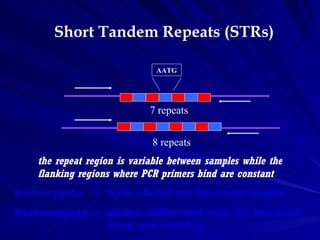
Short Tandem Repeats (STRs)

                              AATG


                             7 repeats


                             8 repeats
    the repeat region is variable between samples while the
    flanking regions where PCR primers bind are constant
Homozygote      = both alleles are the same length
Heterozygote = alleles differ and can be resolved
               from one another
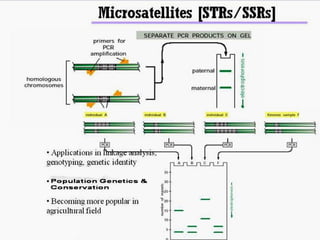
 Also called as STR, SSR, VNTR
 Tandemly repeated DNA sequences with the
  repeat/size of 1 – 6 bases repeated several
  times
 Highly polymorphic; can be analysed with the
  help of PCR
 Individual alleles at a locus differ in number
  of tandem repeats of unit sequence owing to
  gain of loss of one or more repeats and they
  can be differentiated by electrophoresis
  according to their size
 Powerful DNA markers for quantifying genetic
  variations within & between populations of a
  species
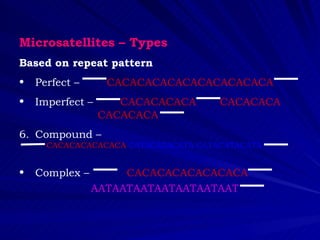
Microsatellites – Types
Based on repeat pattern
•   Perfect –      CACACACACACACACACACACA
•   Imperfect –      CACACACACA       CACACACA
                  CACACACA
6. Compound –
      CACACACACACACA CATACATACATA CATACATACATA


•   Complex –        CACACACACACACACA
                AATAATAATAATAATAATAAT
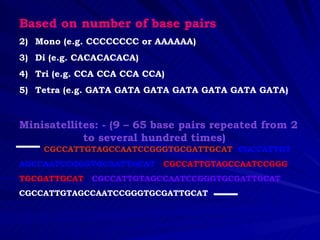
Based on number of base pairs
2) Mono (e.g. CCCCCCCC or AAAAAA)
3) Di (e.g. CACACACACA)
4) Tri (e.g. CCA CCA CCA CCA)
5) Tetra (e.g. GATA GATA GATA GATA GATA GATA GATA)


Minisatellites: - (9 – 65 base pairs repeated from 2
            to several hundred times)
    CGCCATTGTAGCCAATCCGGGTGCGATTGCAT CGCCATTGT
AGCCAATCCGGGTGCGATTGCAT     CGCCATTGTAGCCAATCCGGG
TGCGATTGCAT   CGCCATTGTAGCCAATCCGGGTGCGATTGCAT
CGCCATTGTAGCCAATCCGGGTGCGATTGCAT
Microsatellites – Properties
 Co-dominant
 Inherit in Mendelian Fashion
 Polymorphic loci with allele number as high as 14 – 15
  per locus
 Mostly reported from non-coding region, hence can be
  independent of selection
 Flanking region is highly conserved in related species
 Can be obtained from small amounts of tissues [STR
  analysis can be done on less than one billionth of a
  gram (a nanogram) of DNA (as in a single flake of
  dandruff)]
 PAGE separation; silver staining/automated genotyping
 Abundant in the eukaryote genome (~103 to 105 loci
  dispersed at 7 to 10100 kilobase pair (kb) intervals)
Microsatellites and Human Diseases
Allele size variations in microsatellite loci in close
proximity (showing linkage disequilibrium) to the following
genes within the Human Major Histocompatibility Complex
(MHC) region

   •   IDDM (Insulin Dependent Diabetes Mellitus)
   •   Multiple Sclerosis (MS)
   •   Narcolepsy
   •   Uveitis


have been reported to cause genetic disorders; hence these
genetic disorders can be detected by screening the allele
sizes of the microsatellite loci (Type I markers) that are in
close proximity to these genes (Goldstein & Schlotterer,
2001)
The microsatellite, or short sequence repeat (SSR), is a
powerful genetic marker, useful in many areas of fish
genetics and breeding.
Polymorphic microsatellite loci have been frequently applied
to the analysis of genetic diversity,
       population genetic structure, and
       genomic mapping.

These co-dominant markers have also been applied to the
classification and systematics,
        parentage identification,
        germplasm conservation, and
        breeding programme of food fish.
The zebrafish        is the first vertebrate organism used for large-
scale genetic screens seeking genes critical to development.

1800 recessive mutations discovered to morphogenesis of the
vertebrate embryo. The cloning of the mutant genes depends on a
dense genetic map.

The 2000 markers, using microsatellite       (CA) repeats,
provides 1.2-cM average resolution.

One centimorgan in zebrafish is about 0.74 megabase, so, for many
mutations, these markers are close enough to begin positional cloning
by YAC walks.
A Microsatellite Genetic Map of the Turbot (Scophthalmus maximus)

                Genetics. 2007 December; 177(4): 2457–2467.


A consensus microsatellite-based linkage map was constructed from two
unrelated families. The mapping panel was derived from a gynogenetic family
of 96 haploid embryos and a biparental diploid family of 85 full-sib progeny
with known linkage phase.
A total of 242 microsatellites were mapped in 26 linkage groups.
The consensus map length was 1343.2 cM, with an average distance between
markers of 6.5 ± 0.5 cM.

The comparison of turbot microsatellite flanking sequences against
the Tetraodon nigroviridis genome revealed 55 significant matches, with a
mean length of 102 bp and high sequence similarity (81–100%).

This map will be suitable for QTL identification of productive traits in this
species and for further evolutionary studies in fish and vertebrate species.
Cloning and isolating genes:

   Locating a gene is easy if the gene product (protein) is identified.

    •    Create a cDNA library using an expression vector.

    •    Probe with antibodies that bind the gene product.

    •    Isolate and sequence positive clones.


   If the gene product is unknown, locating a gene is more difficult.

    •    Identify a marker (microsatellite, RFLP, SNPs) that is physically linked to
         the gene on the same chromosome, and segregates in test crosses with the
         disease phenotype (i.e., shows a strong statistical association).

    •    Use a technique called positional cloning to home in on gene.

         e.g., cloning and discovery of the cystic fibrosis (CF) gene.
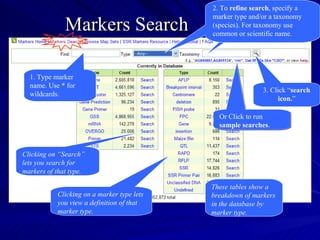
2. To refine search, specify a
                                            marker type and/or a taxonomy
              Markers Search                (species). For taxonomy use
                                            common or scientific name.


  1. Type marker
  name. Use * for
                                                            3. Click “search
  wildcards.
                                                                 icon.”

                                              Or Click to run
                                              sample searches.


Clicking on “Search”
lets you search for
markers of that type.

                                            These tables show a
           Clicking on a marker type lets   breakdown of markers
           you view a definition of that    in the database by
           marker type.                     marker type.
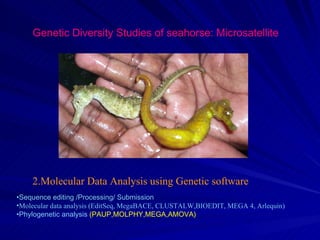
Genetic Diversity Studies of seahorse: Microsatellite


    2.Molecular Data Analysis using Genetic software
•Sequence editing /Processing/ Submission
•Molecular data analysis (EditSeq, MegaBACE, CLUSTALW,BIOEDIT, MEGA 4, Arlequin)
•Phylogenetic analysis (PAUP,MOLPHY,MEGA,AMOVA)
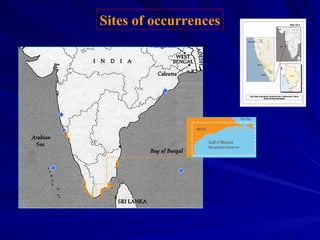
Sites of occurrences
Total 23 alleles

                    No Gene Flow


                       Genetic Tags


Stock specific Markers
Partitioning of Breeding Population
Limitation in Migration
Total 11 Private Alleles


                          No Mixing of Gene Pool


* Stock- Specific markers
* Genetic TAGs for selection programs
Microsatellites PCR reaction Mixture &               Volume per
Concentration                                         reaction
Double distilled water                                 18.0µL
Assay buffer (10X; Genei, Bangalore, India)            2.5µL
(100mM Tris, 500mM KCl, 0.1% gelatin, pH9) (final
conc. 1X)

dNTPs (Genei, Bangalore, India) (200 mM)               2.0µL
Primer (forward & reverse working solution) (total     0.5µL
conc. ~ 10.0 pmoles in 25µl of master mix)
MgCl2    (1.5mM )                                      0.5 µl
Taq polymerase (Genei, Bangalore, India) (3Units/      0.5µL
µl)
Template DNA (25ng)                                    1.0µL

Total volume                                          25.0µL
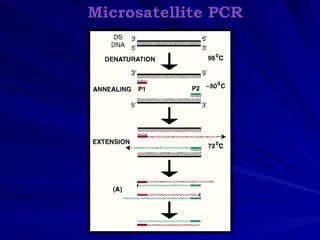
Microsatellite PCR
10% non- denaturing Polyacrylamide gel
electrophoresis (PAGE) to separate the PCR
products

Acrylamide (19:1 acrylamide   :   5mL
and bisacrylamide)
Double distilled water        :   2mL
5 x TBE                       :   2mL
10% Ammonium persulphate      :   70µL
TEMED                         :   3.5µL
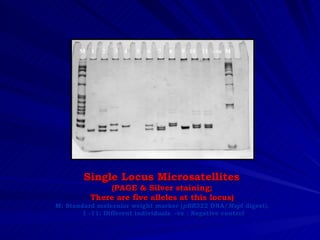
M 1    2   3   4   5   6   7   8   9 10   11 –ve M


        Single Locus Microsatellites
             (PAGE & Silver staining;
         There are five alleles at this locus)
M: Standard molecular weight marker (pBR322 DNA/MspI digest).
       1 -11: Different individuals -ve : Negative control
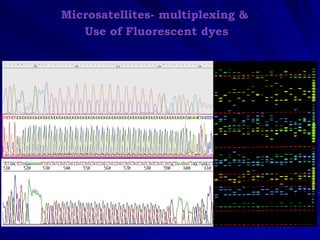
Microsatellites- multiplexing &
   Use of Fluorescent dyes
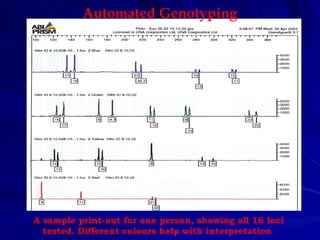
Automated Genotyping


A sample print-out for one person, showing all 16 loci
  tested. Different colours help with interpretation
Thanks

The Improbable seahorses,National Geography 1994

Microsatellite

  • 1.
    Microsatellite Dr KaranVeer Singh NBFGR
  • 2.
    What is amicrosatellite? Tandemly repeated DNA (may see in the literature as STRs - Short tandem repeats) – Poly A/T most common – 1-10 bp tandemly repeated = ‘micro’ satellite – >10 = ‘mini’ satellite Types of microsats – Di, tetra and tri nucleotide (used in that order) – Perfect – Imperfect/interrupted – Compound Varying levels of variation associated with each type Difficulty in scoring
  • 3.
    Short Tandem Repeats(STRs) AATG 7 repeats 8 repeats the repeat region is variable between samples while the flanking regions where PCR primers bind are constant Homozygote = both alleles are the same length Heterozygote = alleles differ and can be resolved from one another
  • 4.
     Also calledas STR, SSR, VNTR  Tandemly repeated DNA sequences with the repeat/size of 1 – 6 bases repeated several times  Highly polymorphic; can be analysed with the help of PCR  Individual alleles at a locus differ in number of tandem repeats of unit sequence owing to gain of loss of one or more repeats and they can be differentiated by electrophoresis according to their size  Powerful DNA markers for quantifying genetic variations within & between populations of a species
  • 5.
    Microsatellites – Types Basedon repeat pattern • Perfect – CACACACACACACACACACACA • Imperfect – CACACACACA CACACACA CACACACA 6. Compound – CACACACACACACA CATACATACATA CATACATACATA • Complex – CACACACACACACACA AATAATAATAATAATAATAAT
  • 6.
    Based on numberof base pairs 2) Mono (e.g. CCCCCCCC or AAAAAA) 3) Di (e.g. CACACACACA) 4) Tri (e.g. CCA CCA CCA CCA) 5) Tetra (e.g. GATA GATA GATA GATA GATA GATA GATA) Minisatellites: - (9 – 65 base pairs repeated from 2 to several hundred times) CGCCATTGTAGCCAATCCGGGTGCGATTGCAT CGCCATTGT AGCCAATCCGGGTGCGATTGCAT CGCCATTGTAGCCAATCCGGG TGCGATTGCAT CGCCATTGTAGCCAATCCGGGTGCGATTGCAT CGCCATTGTAGCCAATCCGGGTGCGATTGCAT
  • 7.
    Microsatellites – Properties Co-dominant  Inherit in Mendelian Fashion  Polymorphic loci with allele number as high as 14 – 15 per locus  Mostly reported from non-coding region, hence can be independent of selection  Flanking region is highly conserved in related species  Can be obtained from small amounts of tissues [STR analysis can be done on less than one billionth of a gram (a nanogram) of DNA (as in a single flake of dandruff)]  PAGE separation; silver staining/automated genotyping  Abundant in the eukaryote genome (~103 to 105 loci dispersed at 7 to 10100 kilobase pair (kb) intervals)
  • 10.
    Microsatellites and HumanDiseases Allele size variations in microsatellite loci in close proximity (showing linkage disequilibrium) to the following genes within the Human Major Histocompatibility Complex (MHC) region • IDDM (Insulin Dependent Diabetes Mellitus) • Multiple Sclerosis (MS) • Narcolepsy • Uveitis have been reported to cause genetic disorders; hence these genetic disorders can be detected by screening the allele sizes of the microsatellite loci (Type I markers) that are in close proximity to these genes (Goldstein & Schlotterer, 2001)
  • 11.
    The microsatellite, orshort sequence repeat (SSR), is a powerful genetic marker, useful in many areas of fish genetics and breeding. Polymorphic microsatellite loci have been frequently applied to the analysis of genetic diversity, population genetic structure, and genomic mapping. These co-dominant markers have also been applied to the classification and systematics, parentage identification, germplasm conservation, and breeding programme of food fish.
  • 12.
    The zebrafish is the first vertebrate organism used for large- scale genetic screens seeking genes critical to development. 1800 recessive mutations discovered to morphogenesis of the vertebrate embryo. The cloning of the mutant genes depends on a dense genetic map. The 2000 markers, using microsatellite (CA) repeats, provides 1.2-cM average resolution. One centimorgan in zebrafish is about 0.74 megabase, so, for many mutations, these markers are close enough to begin positional cloning by YAC walks.
  • 13.
    A Microsatellite GeneticMap of the Turbot (Scophthalmus maximus) Genetics. 2007 December; 177(4): 2457–2467. A consensus microsatellite-based linkage map was constructed from two unrelated families. The mapping panel was derived from a gynogenetic family of 96 haploid embryos and a biparental diploid family of 85 full-sib progeny with known linkage phase. A total of 242 microsatellites were mapped in 26 linkage groups. The consensus map length was 1343.2 cM, with an average distance between markers of 6.5 ± 0.5 cM. The comparison of turbot microsatellite flanking sequences against the Tetraodon nigroviridis genome revealed 55 significant matches, with a mean length of 102 bp and high sequence similarity (81–100%). This map will be suitable for QTL identification of productive traits in this species and for further evolutionary studies in fish and vertebrate species.
  • 14.
    Cloning and isolatinggenes:  Locating a gene is easy if the gene product (protein) is identified. • Create a cDNA library using an expression vector. • Probe with antibodies that bind the gene product. • Isolate and sequence positive clones.  If the gene product is unknown, locating a gene is more difficult. • Identify a marker (microsatellite, RFLP, SNPs) that is physically linked to the gene on the same chromosome, and segregates in test crosses with the disease phenotype (i.e., shows a strong statistical association). • Use a technique called positional cloning to home in on gene. e.g., cloning and discovery of the cystic fibrosis (CF) gene.
  • 19.
    2. To refinesearch, specify a marker type and/or a taxonomy Markers Search (species). For taxonomy use common or scientific name. 1. Type marker name. Use * for 3. Click “search wildcards. icon.” Or Click to run sample searches. Clicking on “Search” lets you search for markers of that type. These tables show a Clicking on a marker type lets breakdown of markers you view a definition of that in the database by marker type. marker type.
  • 20.
    Genetic Diversity Studiesof seahorse: Microsatellite 2.Molecular Data Analysis using Genetic software •Sequence editing /Processing/ Submission •Molecular data analysis (EditSeq, MegaBACE, CLUSTALW,BIOEDIT, MEGA 4, Arlequin) •Phylogenetic analysis (PAUP,MOLPHY,MEGA,AMOVA)
  • 21.
  • 22.
    Total 23 alleles No Gene Flow Genetic Tags Stock specific Markers Partitioning of Breeding Population Limitation in Migration
  • 23.
    Total 11 PrivateAlleles No Mixing of Gene Pool * Stock- Specific markers * Genetic TAGs for selection programs
  • 24.
    Microsatellites PCR reactionMixture & Volume per Concentration reaction Double distilled water 18.0µL Assay buffer (10X; Genei, Bangalore, India) 2.5µL (100mM Tris, 500mM KCl, 0.1% gelatin, pH9) (final conc. 1X) dNTPs (Genei, Bangalore, India) (200 mM) 2.0µL Primer (forward & reverse working solution) (total 0.5µL conc. ~ 10.0 pmoles in 25µl of master mix) MgCl2 (1.5mM ) 0.5 µl Taq polymerase (Genei, Bangalore, India) (3Units/ 0.5µL µl) Template DNA (25ng) 1.0µL Total volume 25.0µL
  • 26.
  • 27.
    10% non- denaturingPolyacrylamide gel electrophoresis (PAGE) to separate the PCR products Acrylamide (19:1 acrylamide : 5mL and bisacrylamide) Double distilled water : 2mL 5 x TBE : 2mL 10% Ammonium persulphate : 70µL TEMED : 3.5µL
  • 28.
    M 1 2 3 4 5 6 7 8 9 10 11 –ve M Single Locus Microsatellites (PAGE & Silver staining; There are five alleles at this locus) M: Standard molecular weight marker (pBR322 DNA/MspI digest). 1 -11: Different individuals -ve : Negative control
  • 29.
    Microsatellites- multiplexing & Use of Fluorescent dyes
  • 30.
    Automated Genotyping A sampleprint-out for one person, showing all 16 loci tested. Different colours help with interpretation
  • 31.

Editor's Notes

  • #20 To further refine your search query, you may specify a marker type (e.g., "RFLP") and/or a species (e.g., "rice"). Each search parameter can be used alone or in conjunction with any other parameter. For instance, you may wish to search for all markers with a name starting with "RM," all rice markers , all SSR markers , or all of these conditions. Immediately below this form are some examples of what you could search for. Clicking on any of these search examples will initiate a search for that example and return the results. Below the search examples is a summary of the number of markers by each type with a link to "Search" for those markers.