BY
Complementary
feeding
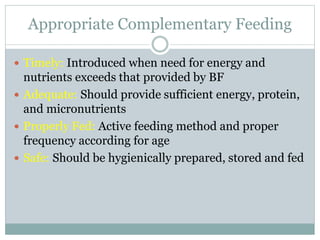
Definition of Complementary feeding
 The process of giving an
infant other foods and
liquids along with breast
milk or non-human milk
as breast milk alone is no
longer sufficient to meet
the nutritional
requirements.
 These foods should
complement rather than
replace breastmilk.
Appropriate Complementary Feeding
 Timely: Introduced when need for energy and
nutrients exceeds that provided by BF
 Adequate: Should provide sufficient energy, protein,
and micronutrients
 Properly Fed: Active feeding method and proper
frequency according for age
 Safe: Should be hygienically prepared, stored and fed
Timing of Complementary Feeding
Soon after completing 6 months of age
 Breast milk sufficient to promote growth and
development till 6 months
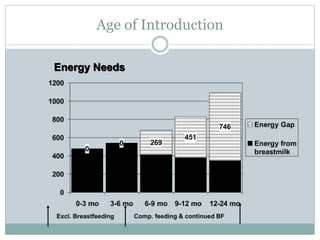
 Energy and nutrient gap appears after 6 months
and widens thereafter
 Infant’s development and behavior makes him
ready for other foods
 Holds objects (e.g. biscuit) and takes everything to mouth
 Chewing movements start
 Tendency to push solids out decreases
 Eruption of teeth and beginning of biting movements
Age of Introduction
0
0 269
451
746
0
200
400
600
800
1000
1200
0-3 mo 3-6 mo 6-9 mo 9-12 mo 12-24 mo
Energy Gap
Energy from
breastmilk
Energy Needs
Excl. Breastfeeding Comp. feeding & continued BF
Timing of Complementary Feeding
Disadvantages of adding foods too soon
 Decrease the intake of breast milk resulting in a
low nutrient diet
 Increase risk of illness esp. diarrhea
Disadvantages of adding foods too late
 Growth and development slows down or stops
 Risk of deficiencies and malnutrition
Importance of continued breastfeeding for 2
years and beyond
37
55
76
98
5
63
45
24
2
95
0
20
40
60
80
100
120
Energy Protein Vit. A Vit. C Iron
% daily needs
provided by
500ml breast
milk
Gaps to be filled by complementary foods
Energy and Nutrients from breastmilk
Why Continue Breastfeeding?
 Vital source of energy (30-40%) and nutrients into
2nd yr of life
 Key source of
 Good quality proteins & essential fatty acids
 Micronutrients:
 45% of Vitamin A
 40% of calcium & riboflavin
 95% of Vitamin C
 Fluids and nutrients during infection
 Associated with greater linear growth
 Linked to lower risk of chronic diseases & obesity
Adequacy (Quality)
 Staples: Cereals (Rice, wheat, maize, millets) and
Legumes
 Fats (Vegetable oils/butter/ghee; 1g ~ 9 Kcal) and
sugars to improve energy density and taste
 Foods of animal origin (Milk, curd, eggs, meat,
fish) to provide good quality proteins, vitamin A
and calcium.
 Vegetables and Fruits to provide micronutrents
e.g. iron and vitamins. Supplements e.g. iron might
be required.
Other Attributes of
Complementary Foods
 Right consistency
 Soft
 Easy to digest
 Inexpensive
 Locally available
 Culturally acceptable
 Easily prepared at
home
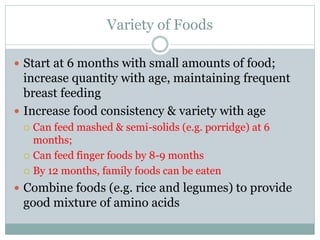
Variety of Foods
 Start at 6 months with small amounts of food;
increase quantity with age, maintaining frequent
breast feeding
 Increase food consistency & variety with age
 Can feed mashed & semi-solids (e.g. porridge) at 6
months;
 Can feed finger foods by 8-9 months
 By 12 months, family foods can be eaten
 Combine foods (e.g. rice and legumes) to provide
good mixture of amino acids
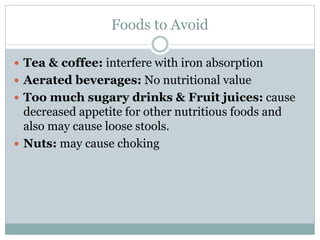
Foods to Avoid
 Tea & coffee: interfere with iron absorption
 Aerated beverages: No nutritional value
 Too much sugary drinks & Fruit juices: cause
decreased appetite for other nutritious foods and
also may cause loose stools.
 Nuts: may cause choking
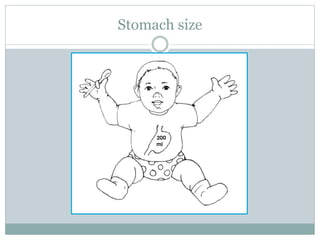
Stomach size
How to initiate weaning and progress
 Consistency:Introduction of right consistency of food at
the right age is important to develop good food behaviors.
Essentially follow the sequence :
 Breast feeds (0-6 months)
 Semi-liquid (after 5-6 months) Easy to digest,
smooth and gentle on baby’s stomach.
 Semi-solid (after 8-9 months) Baby now needs food
with taste and texture.
 Semi solid (after 10 months) Baby now needs food
that satisfy his urge to chew-complex taste and
texture
 Solid diet including variety of food items (1-1.2 yrs).
How to initiate weaning and progress
Frequency:
 Energy requirement on a per kg basis, is 3 times more than the
adults in infants and 2 times more than the adults in case of
children till 2 years of age.
 Children have to be fed frequently since they can eat small amount
at a time due to their little capacity.
Till 5-6 months - child is given breast feeds on demand i.e. 9-10 times over 24
hours.
From 6- 8 months - As the child grows, his requirements increase and he starts to
accept larger volume and thicker consistency at a time - feed
him 7-8 times/d
From 9- 12 months - child normally eats 6-7 times per day and each time.
By 12 - 15 months - child eats at least 6 times per day.
By 18 months - child’s eating schedule of 5-6 times /day gets fixed
3 regular meals – Breakfast, Lunch and dinner and
3 in-between healthy snacks – midmorning (recess time),
evening at 4:30 – 5 PM
bedtime.
How to initiate weaning and progress
Volume:
Children have little capacity due to their smaller surface
area. Initially accepts small amount but as he increases in
size, accepts larger volume.
Till 5-6 months - Few spoons to 30ml at a time
From 6- 7 months - 50-75 ml/g at a time
From 7-8 months - 75 - 100 ml/g at a time
From 9- 12 months - 100 - 150 ml/g at a time
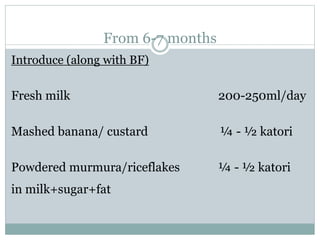
From 6-7 months
Introduce (along with BF)
Fresh milk 200-250ml/day
Mashed banana/ custard ¼ - ½ katori
Powdered murmura/riceflakes ¼ - ½ katori
in milk+sugar+fat
Cont.
Khichri (Liquid consistency) ¼ - ½ katori
Washed moong dal + rice + fat
Biscuit/ bread/Suji in milk ¼ - ½ katori
+sugar+fat
Boiled mashed potato/ halwa ¼ - ½ katori
From 8-9 months
Continue breast feeds
Fresh milk (includes curd) 250-400 ml/day
Banana OR any other ¾ - 1
seasonal fruit
Suji/sago/Dalia in milk ½ - 1 katori
+sugar+fat
Cont.
khichri (semisolid consistency) ½ - 1 katori
(dal + rice + fat) OR rice-dal
Biscuit/ bread in milk ½ – 1 katori
+sugar+fat
Potato+ vegetable ½ - 1 katori
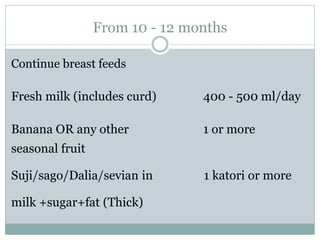
From 10 - 12 months
Continue breast feeds
Fresh milk (includes curd) 400 - 500 ml/day
Banana OR any other 1 or more
seasonal fruit
Suji/sago/Dalia/sevian in 1 katori or more
milk +sugar+fat (Thick)
Cont.
Khichri (semisolid consistency) 1katori or more
(dal + rice + fat) OR rice-dal
Biscuit/ bread/chapati/ paratha 1katori or more
(by 1 year)
Potato + any other vegetable as desired
Curd/ paneer/ groundnut/Egg
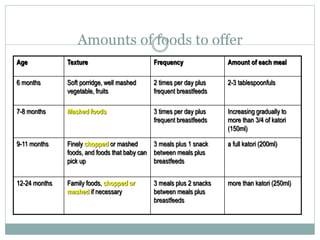
Amounts of foods to offer
Age Texture Frequency Amount of each meal
6 months Soft porridge, well mashed
vegetable, fruits
2 times per day plus
frequent breastfeeds
2-3 tablespoonfuls
7-8 months Mashed foods 3 times per day plus
frequent breastfeeds
Increasing gradually to
more than 3/4 of katori
(150ml)
9-11 months Finely chopped or mashed
foods, and foods that baby can
pick up
3 meals plus 1 snack
between meals plus
breastfeeds
a full katori (200ml)
12-24 months Family foods, chopped or
mashed if necessary
3 meals plus 2 snacks
between meals plus
breastfeeds
more than katori (250ml)
Ensure Adequacy
 Growth Monitoring:
Measure weight and
length periodically and
interpret by plotting in
growth curves.
 Investigate causes of poor
growth: Dietary history;
evaluate for any illness.
 Counsel
mother/caregivers on
growth, feeding and
caring practices
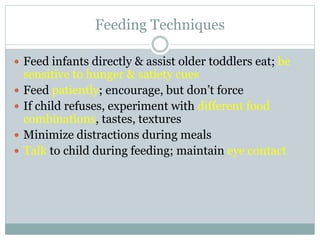
Feeding Techniques
 Feed infants directly & assist older toddlers eat; be
sensitive to hunger & satiety cues
 Feed patiently; encourage, but don’t force
 If child refuses, experiment with different food
combinations, tastes, textures
 Minimize distractions during meals
 Talk to child during feeding; maintain eye contact
Responsive feeding
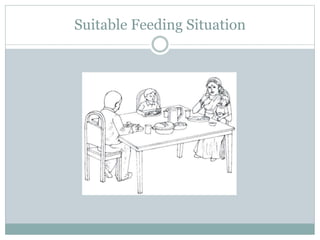
Suitable Feeding Situation
Safe
Unhygienic feeding
 the risk of infectious illness (esp. diarrhea)
compromising nutritional status
 Undermines the parents’ confidence leading to delay
in CF
Ensuring Food Hygiene
 Washing caregiver’s and child’s hands before
preparing, handling and eating food
 Clean water and raw materials to cook food
 Storing foods safely: Keeping food covered and
serving shortly after preparation
 Use clean utensils to prepare & serve food
 Use clean bowls & cups when feeding child
 No feeding bottles
Feeding the child who is ill
 Encourage the child to drink and to eat - with lots of
patience
 Feed small amounts frequently
 Give foods that the child likes
 Give a variety of nutrient-rich foods
 Continue to breastfeed
Feeding during Recovery
 Feed an extra meal
 Give an extra amount
 Use extra rich foods
 Feed with extra patience
 Give extra breastfeeds as often as child wants
Key Messages
 Complementary feeding should begin soon after
completing 6 months of age along with continued
breastfeeding
 Complementary foods should be of right consistency,
energy dense and the variety to provide all nutrient
demands of a growing child.
 Child should be fed patiently giving adequate attention
and time
 Foods should be prepared, stored and fed hygienically to
the children.
 Continue feeding during illness and increase during
convalescence.
Important Precautions:
 Use only clean utensils
 Use prepared feed within half an hour
 Discard unused feed
After the initial phase of hard work by the mother, there
will be no need of forcing, coaxing, fussing or running
after the child to eat food. It will be very natural for him
to eat at all meal times and adequately.
Thank You

4 complementary-feeding

  • 1.
  • 2.
    Definition of Complementaryfeeding  The process of giving an infant other foods and liquids along with breast milk or non-human milk as breast milk alone is no longer sufficient to meet the nutritional requirements.  These foods should complement rather than replace breastmilk.
  • 3.
    Appropriate Complementary Feeding Timely: Introduced when need for energy and nutrients exceeds that provided by BF  Adequate: Should provide sufficient energy, protein, and micronutrients  Properly Fed: Active feeding method and proper frequency according for age  Safe: Should be hygienically prepared, stored and fed
  • 4.
    Timing of ComplementaryFeeding Soon after completing 6 months of age  Breast milk sufficient to promote growth and development till 6 months  Energy and nutrient gap appears after 6 months and widens thereafter  Infant’s development and behavior makes him ready for other foods  Holds objects (e.g. biscuit) and takes everything to mouth  Chewing movements start  Tendency to push solids out decreases  Eruption of teeth and beginning of biting movements
  • 5.
    Age of Introduction 0 0269 451 746 0 200 400 600 800 1000 1200 0-3 mo 3-6 mo 6-9 mo 9-12 mo 12-24 mo Energy Gap Energy from breastmilk Energy Needs Excl. Breastfeeding Comp. feeding & continued BF
  • 6.
    Timing of ComplementaryFeeding Disadvantages of adding foods too soon  Decrease the intake of breast milk resulting in a low nutrient diet  Increase risk of illness esp. diarrhea Disadvantages of adding foods too late  Growth and development slows down or stops  Risk of deficiencies and malnutrition
  • 7.
    Importance of continuedbreastfeeding for 2 years and beyond 37 55 76 98 5 63 45 24 2 95 0 20 40 60 80 100 120 Energy Protein Vit. A Vit. C Iron % daily needs provided by 500ml breast milk Gaps to be filled by complementary foods Energy and Nutrients from breastmilk
  • 8.
    Why Continue Breastfeeding? Vital source of energy (30-40%) and nutrients into 2nd yr of life  Key source of  Good quality proteins & essential fatty acids  Micronutrients:  45% of Vitamin A  40% of calcium & riboflavin  95% of Vitamin C  Fluids and nutrients during infection  Associated with greater linear growth  Linked to lower risk of chronic diseases & obesity
  • 9.
    Adequacy (Quality)  Staples:Cereals (Rice, wheat, maize, millets) and Legumes  Fats (Vegetable oils/butter/ghee; 1g ~ 9 Kcal) and sugars to improve energy density and taste  Foods of animal origin (Milk, curd, eggs, meat, fish) to provide good quality proteins, vitamin A and calcium.  Vegetables and Fruits to provide micronutrents e.g. iron and vitamins. Supplements e.g. iron might be required.
  • 10.
    Other Attributes of ComplementaryFoods  Right consistency  Soft  Easy to digest  Inexpensive  Locally available  Culturally acceptable  Easily prepared at home
  • 11.
    Variety of Foods Start at 6 months with small amounts of food; increase quantity with age, maintaining frequent breast feeding  Increase food consistency & variety with age  Can feed mashed & semi-solids (e.g. porridge) at 6 months;  Can feed finger foods by 8-9 months  By 12 months, family foods can be eaten  Combine foods (e.g. rice and legumes) to provide good mixture of amino acids
  • 12.
    Foods to Avoid Tea & coffee: interfere with iron absorption  Aerated beverages: No nutritional value  Too much sugary drinks & Fruit juices: cause decreased appetite for other nutritious foods and also may cause loose stools.  Nuts: may cause choking
  • 13.
  • 14.
    How to initiateweaning and progress  Consistency:Introduction of right consistency of food at the right age is important to develop good food behaviors. Essentially follow the sequence :  Breast feeds (0-6 months)  Semi-liquid (after 5-6 months) Easy to digest, smooth and gentle on baby’s stomach.  Semi-solid (after 8-9 months) Baby now needs food with taste and texture.  Semi solid (after 10 months) Baby now needs food that satisfy his urge to chew-complex taste and texture  Solid diet including variety of food items (1-1.2 yrs).
  • 15.
    How to initiateweaning and progress Frequency:  Energy requirement on a per kg basis, is 3 times more than the adults in infants and 2 times more than the adults in case of children till 2 years of age.  Children have to be fed frequently since they can eat small amount at a time due to their little capacity. Till 5-6 months - child is given breast feeds on demand i.e. 9-10 times over 24 hours. From 6- 8 months - As the child grows, his requirements increase and he starts to accept larger volume and thicker consistency at a time - feed him 7-8 times/d From 9- 12 months - child normally eats 6-7 times per day and each time. By 12 - 15 months - child eats at least 6 times per day. By 18 months - child’s eating schedule of 5-6 times /day gets fixed 3 regular meals – Breakfast, Lunch and dinner and 3 in-between healthy snacks – midmorning (recess time), evening at 4:30 – 5 PM bedtime.
  • 16.
    How to initiateweaning and progress Volume: Children have little capacity due to their smaller surface area. Initially accepts small amount but as he increases in size, accepts larger volume. Till 5-6 months - Few spoons to 30ml at a time From 6- 7 months - 50-75 ml/g at a time From 7-8 months - 75 - 100 ml/g at a time From 9- 12 months - 100 - 150 ml/g at a time
  • 17.
    From 6-7 months Introduce(along with BF) Fresh milk 200-250ml/day Mashed banana/ custard ¼ - ½ katori Powdered murmura/riceflakes ¼ - ½ katori in milk+sugar+fat
  • 18.
    Cont. Khichri (Liquid consistency)¼ - ½ katori Washed moong dal + rice + fat Biscuit/ bread/Suji in milk ¼ - ½ katori +sugar+fat Boiled mashed potato/ halwa ¼ - ½ katori
  • 19.
    From 8-9 months Continuebreast feeds Fresh milk (includes curd) 250-400 ml/day Banana OR any other ¾ - 1 seasonal fruit Suji/sago/Dalia in milk ½ - 1 katori +sugar+fat
  • 20.
    Cont. khichri (semisolid consistency)½ - 1 katori (dal + rice + fat) OR rice-dal Biscuit/ bread in milk ½ – 1 katori +sugar+fat Potato+ vegetable ½ - 1 katori
  • 21.
    From 10 -12 months Continue breast feeds Fresh milk (includes curd) 400 - 500 ml/day Banana OR any other 1 or more seasonal fruit Suji/sago/Dalia/sevian in 1 katori or more milk +sugar+fat (Thick)
  • 22.
    Cont. Khichri (semisolid consistency)1katori or more (dal + rice + fat) OR rice-dal Biscuit/ bread/chapati/ paratha 1katori or more (by 1 year) Potato + any other vegetable as desired Curd/ paneer/ groundnut/Egg
  • 23.
    Amounts of foodsto offer Age Texture Frequency Amount of each meal 6 months Soft porridge, well mashed vegetable, fruits 2 times per day plus frequent breastfeeds 2-3 tablespoonfuls 7-8 months Mashed foods 3 times per day plus frequent breastfeeds Increasing gradually to more than 3/4 of katori (150ml) 9-11 months Finely chopped or mashed foods, and foods that baby can pick up 3 meals plus 1 snack between meals plus breastfeeds a full katori (200ml) 12-24 months Family foods, chopped or mashed if necessary 3 meals plus 2 snacks between meals plus breastfeeds more than katori (250ml)
  • 24.
    Ensure Adequacy  GrowthMonitoring: Measure weight and length periodically and interpret by plotting in growth curves.  Investigate causes of poor growth: Dietary history; evaluate for any illness.  Counsel mother/caregivers on growth, feeding and caring practices
  • 25.
    Feeding Techniques  Feedinfants directly & assist older toddlers eat; be sensitive to hunger & satiety cues  Feed patiently; encourage, but don’t force  If child refuses, experiment with different food combinations, tastes, textures  Minimize distractions during meals  Talk to child during feeding; maintain eye contact
  • 26.
  • 27.
  • 28.
    Safe Unhygienic feeding  therisk of infectious illness (esp. diarrhea) compromising nutritional status  Undermines the parents’ confidence leading to delay in CF
  • 29.
    Ensuring Food Hygiene Washing caregiver’s and child’s hands before preparing, handling and eating food  Clean water and raw materials to cook food  Storing foods safely: Keeping food covered and serving shortly after preparation  Use clean utensils to prepare & serve food  Use clean bowls & cups when feeding child  No feeding bottles
  • 30.
    Feeding the childwho is ill  Encourage the child to drink and to eat - with lots of patience  Feed small amounts frequently  Give foods that the child likes  Give a variety of nutrient-rich foods  Continue to breastfeed
  • 31.
    Feeding during Recovery Feed an extra meal  Give an extra amount  Use extra rich foods  Feed with extra patience  Give extra breastfeeds as often as child wants
  • 32.
    Key Messages  Complementaryfeeding should begin soon after completing 6 months of age along with continued breastfeeding  Complementary foods should be of right consistency, energy dense and the variety to provide all nutrient demands of a growing child.  Child should be fed patiently giving adequate attention and time  Foods should be prepared, stored and fed hygienically to the children.  Continue feeding during illness and increase during convalescence.
  • 33.
    Important Precautions:  Useonly clean utensils  Use prepared feed within half an hour  Discard unused feed After the initial phase of hard work by the mother, there will be no need of forcing, coaxing, fussing or running after the child to eat food. It will be very natural for him to eat at all meal times and adequately.
  • 34.