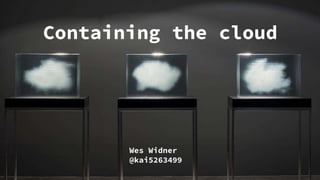
Containing the cloud
Wes Widner
@kai5263499
Containers
represent
complexity
● Every piece is
important
● Notes help us
manage complexity
● Expect every
component involved
to show their work
Docker
Registry
K8S
Master
etcd
K8S Worker
K8S Worker
K8S Worker
Pod
Container
Pod
Container
Data plane
Designed for
developers
Everyone loves having
the playground to
themselves
● Dockerfiles help
eliminate
snowflakes
● “Containers don’t
contain” - Daniel
Walsh RedHat
My friend said “Suggest to President
Obama that the team should deploy to
production every day.”
-Bill Higgins
healthcare.gov tech surge
Developers and
ops need
different images
● Templated Dockerfiles to
share structure
● Multi-stage builds to share
data
● Debug images for developers
● Separate repos for everyone
Where do images
come from?
● Production images should
come from CI/CD pipelines
● Repos in registries
should be segregated
● Everything should be
logged
What’s in your
prod layers?
● Layer construction is open
for inspection
● Add forensics information to
LABELs
● Seperate services by
function
● Understand that the kernel
is your attack surface
● Lint like crazy
Continuous image
scanning
● It’s easy to bake unwanted
things into images
● What’s clean today may not be
clean tomorrow
● We need a way to
retroactively scan images
● It’s also useful to just know
what an image contains at
build time
What happens
when the cloud
breaks?
● Let forensics be your
guide to a secure cloud
● Pretend the cloud has
melted down and put
everything in place
that you would want to
have
Misconfiguration
is the root of
all evil
● By definition, you
don’t mean to do it
● This is an even bigger
problem with
declarative systems
● How long does it take
for you to detect a
misconfiguration?
Configuration as
code
● Even without formal code
reviews, version
controlled configurations
are useful
● One-off configuration
updates are not only bad
form, they’re an incident
waiting to happen
Try not to let
people break
assumptions
● Allowing containers to
change means they will
● Mutable containers make
forensics needlessly hard
Least privileged
workers
● Privilege separation is hard
● There is not an official standard
for container security policies
● Workers can be tainted to run
sensitive pods
● Another option is multiple clusters
● Workers don’t need operational
secrets
Monitoring your
orchestrator
● Kubernetes security
solutions fall into three
broad categories
● Admin API control
● eBPF for tagging packets
and syscalls
● Hypervisor shims
● Runner-up category for
auditd
A little chaos
is good for you
● Chaos engines are not only
good for development.
They’re also good for
security
● They help smoke out false
assumptions
● Cloud fuzzing is a thing
How mature is your cloud?
❏ Properly configured access
controls to registries and
API servers
❏ Tagged packets from pods,
continuous image scanning
❏ Execution logs
❏ Images developed and pushed
from a build system
❏ Version controlled
Dockerfiles, configs, and
config values
What’s your Okta?
https://github.com/kai5263499/
container-security-awesome
More resources
● Write everything down
● Trust but verify
● Kick the tires
● Pyramid of truth
Roadmap

Containing the cloud

  • 1.
    Containing the cloud WesWidner @kai5263499
  • 3.
    Containers represent complexity ● Every pieceis important ● Notes help us manage complexity ● Expect every component involved to show their work Docker Registry K8S Master etcd K8S Worker K8S Worker K8S Worker Pod Container Pod Container Data plane
  • 4.
    Designed for developers Everyone loveshaving the playground to themselves ● Dockerfiles help eliminate snowflakes ● “Containers don’t contain” - Daniel Walsh RedHat
  • 5.
    My friend said“Suggest to President Obama that the team should deploy to production every day.” -Bill Higgins healthcare.gov tech surge
  • 6.
    Developers and ops need differentimages ● Templated Dockerfiles to share structure ● Multi-stage builds to share data ● Debug images for developers ● Separate repos for everyone
  • 7.
    Where do images comefrom? ● Production images should come from CI/CD pipelines ● Repos in registries should be segregated ● Everything should be logged
  • 8.
    What’s in your prodlayers? ● Layer construction is open for inspection ● Add forensics information to LABELs ● Seperate services by function ● Understand that the kernel is your attack surface ● Lint like crazy
  • 9.
    Continuous image scanning ● It’seasy to bake unwanted things into images ● What’s clean today may not be clean tomorrow ● We need a way to retroactively scan images ● It’s also useful to just know what an image contains at build time
  • 10.
    What happens when thecloud breaks? ● Let forensics be your guide to a secure cloud ● Pretend the cloud has melted down and put everything in place that you would want to have
  • 12.
    Misconfiguration is the rootof all evil ● By definition, you don’t mean to do it ● This is an even bigger problem with declarative systems ● How long does it take for you to detect a misconfiguration?
  • 13.
    Configuration as code ● Evenwithout formal code reviews, version controlled configurations are useful ● One-off configuration updates are not only bad form, they’re an incident waiting to happen
  • 14.
    Try not tolet people break assumptions ● Allowing containers to change means they will ● Mutable containers make forensics needlessly hard
  • 15.
    Least privileged workers ● Privilegeseparation is hard ● There is not an official standard for container security policies ● Workers can be tainted to run sensitive pods ● Another option is multiple clusters ● Workers don’t need operational secrets
  • 16.
    Monitoring your orchestrator ● Kubernetessecurity solutions fall into three broad categories ● Admin API control ● eBPF for tagging packets and syscalls ● Hypervisor shims ● Runner-up category for auditd
  • 17.
    A little chaos isgood for you ● Chaos engines are not only good for development. They’re also good for security ● They help smoke out false assumptions ● Cloud fuzzing is a thing
  • 18.
    How mature isyour cloud? ❏ Properly configured access controls to registries and API servers ❏ Tagged packets from pods, continuous image scanning ❏ Execution logs ❏ Images developed and pushed from a build system ❏ Version controlled Dockerfiles, configs, and config values What’s your Okta?
  • 19.
  • 20.
    ● Write everythingdown ● Trust but verify ● Kick the tires ● Pyramid of truth Roadmap

Editor's Notes

  • #11 Picture is Cloud Burst by David Taylor
  • #13 Picture is Misplaced by Joanne Duffy
  • #20 The small text at the bottom is from my daughter who helped put together these slides