By: Kelsey
Attention deficit hyperactivity disorder or
  ADHD is a disorder characterized by a
  persistent pattern of inattention and/or
  hyperactivity.
 Heredity:  from parent to child
 Exposure to toxic chemicals: such as lead
 Injury to the brain; brain tumors, trauma,
  stroke, or disease that effected the brain
 Smoking, drinking, and doing drugs while
  pregnant
 Pesticides
When children and adults have ADHD they have
 different symptoms. Children’s are the more
 common symptoms.

Symptoms in children:
 Hyperactivity
 Impulsivity
 Inattentiveness
Adults symptoms are more advanced when
 they have ADHD.

Symptoms in adults:
 Restlessness
 Problems with interpersonal relationships
 Problems with employment


ADHD can also be accompanied with obsessive-
 compulsive disorder or OCD.
1.   Combined ADHD: you have all of the
     symptoms; hyperactivity, impulsivity, and
     inattentiveness

2.   Hyperactive-impulsive ADHD: hyperactivity
     without inattentiveness

3.   Inattentive ADHD (now known as ADD):
     attention and concentration
There is no real treatment that can completely
  treat ADHD but there are some that can help
  decrease the amount of symptoms someone
  has. Such as:
 Behavior modification
 Medication
 Or both together
 Psychotherapy
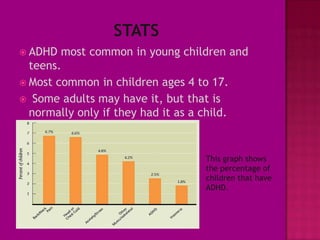
 ADHD  most common in young children and
  teens.
 Most common in children ages 4 to 17.
 Some adults may have it, but that is
  normally only if they had it as a child.


                                  This graph shows
                                  the percentage of
                                  children that have
                                  ADHD.
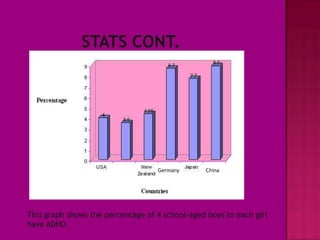
Germany       China


This graph shows the percentage of 4 school-aged boys to each girl
have ADHD.
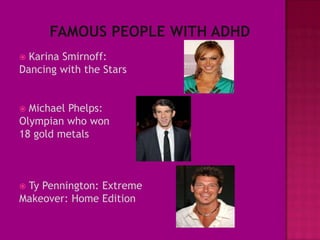
 Karina Smirnoff:
Dancing with the Stars


 Michael Phelps:
Olympian who won
18 gold metals


Ty Pennington: Extreme
Makeover: Home Edition
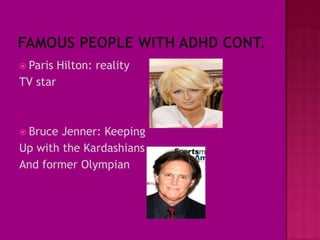
 Paris   Hilton: reality
TV star


 Bruce Jenner: Keeping
Up with the Kardashians
And former Olympian
Attention deficit disorder or ADD is a disorder
  that is characterized by excessive activity
  and the inability to concentrate on one task
  for any length of time.
The causes of ADD is the same as ADHD. The
  cause are:
 Heredity
 Exposure to toxic chemicals: such as lead
 Injury to the brain: such as brain trauma,
  tumors, stroke, or any disease
 Smoking, drinking, and doing drugs while
  pregnant
 Pesticides
There is many symptoms that you can see
  when someone has ADD. They are:
 Failure to attend to details, written or
  spoken
 Forgetfulness, absentmindness
 Difficulty listening to, and carrying out,
  instructions
 Appear to not be listening when spoken to
 Can only focus on something for a short
  period of time
Treatment for ADD is the same as ADHD. There
  is no real treatment to get rid of it, but
  there is some ways that can reduce it. They
  are:
 Behavior modification
 Medication
 Or both
 Psychotherapy
There is some medications that can help with
  ADD. They are:
 Ritalin
 Adderall
 Dexedrine
 ADD  is really common in school-aged children
  which is from around the age 4-18.
 More than 2 million school-aged children
  have been diagnosed with ADD
 It affects 3 to 5 percent of all the
  population in the United States mostly
  children.

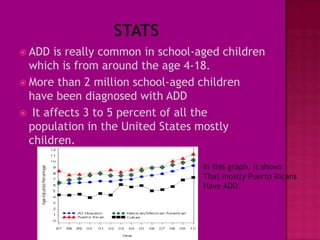
                                   In this graph, it shows
                                   That mostly Puerto Ricans
                                   Have ADD.
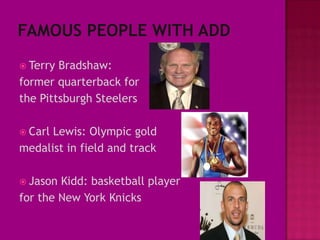
 Terry Bradshaw:
former quarterback for
the Pittsburgh Steelers

 CarlLewis: Olympic gold
medalist in field and track

 Jason Kidd: basketball player
for the New York Knicks
The main difference between ADHD and ADD is
 that ADHD is when someone is hyperactive
 and ADD does not have that as one of the
 main symptoms.
 Sir George Frederick Still discovered ADHD in
  1902
 Sir Alexander Crichton discovered ADD in
  1798
  - These were also the first times someone
  was diagnosed with the disorders.
ANY
QUESTIONS?

Add and adhd presentation

  • 1.
  • 2.
    Attention deficit hyperactivitydisorder or ADHD is a disorder characterized by a persistent pattern of inattention and/or hyperactivity.
  • 3.
     Heredity: from parent to child  Exposure to toxic chemicals: such as lead  Injury to the brain; brain tumors, trauma, stroke, or disease that effected the brain  Smoking, drinking, and doing drugs while pregnant  Pesticides
  • 4.
    When children andadults have ADHD they have different symptoms. Children’s are the more common symptoms. Symptoms in children:  Hyperactivity  Impulsivity  Inattentiveness
  • 5.
    Adults symptoms aremore advanced when they have ADHD. Symptoms in adults:  Restlessness  Problems with interpersonal relationships  Problems with employment ADHD can also be accompanied with obsessive- compulsive disorder or OCD.
  • 6.
    1. Combined ADHD: you have all of the symptoms; hyperactivity, impulsivity, and inattentiveness 2. Hyperactive-impulsive ADHD: hyperactivity without inattentiveness 3. Inattentive ADHD (now known as ADD): attention and concentration
  • 7.
    There is noreal treatment that can completely treat ADHD but there are some that can help decrease the amount of symptoms someone has. Such as:  Behavior modification  Medication  Or both together  Psychotherapy
  • 8.
     ADHD most common in young children and teens.  Most common in children ages 4 to 17.  Some adults may have it, but that is normally only if they had it as a child. This graph shows the percentage of children that have ADHD.
  • 9.
    Germany China This graph shows the percentage of 4 school-aged boys to each girl have ADHD.
  • 10.
     Karina Smirnoff: Dancingwith the Stars  Michael Phelps: Olympian who won 18 gold metals Ty Pennington: Extreme Makeover: Home Edition
  • 11.
     Paris Hilton: reality TV star  Bruce Jenner: Keeping Up with the Kardashians And former Olympian
  • 12.
    Attention deficit disorderor ADD is a disorder that is characterized by excessive activity and the inability to concentrate on one task for any length of time.
  • 13.
    The causes ofADD is the same as ADHD. The cause are:  Heredity  Exposure to toxic chemicals: such as lead  Injury to the brain: such as brain trauma, tumors, stroke, or any disease  Smoking, drinking, and doing drugs while pregnant  Pesticides
  • 14.
    There is manysymptoms that you can see when someone has ADD. They are:  Failure to attend to details, written or spoken  Forgetfulness, absentmindness  Difficulty listening to, and carrying out, instructions  Appear to not be listening when spoken to  Can only focus on something for a short period of time
  • 15.
    Treatment for ADDis the same as ADHD. There is no real treatment to get rid of it, but there is some ways that can reduce it. They are:  Behavior modification  Medication  Or both  Psychotherapy
  • 16.
    There is somemedications that can help with ADD. They are:  Ritalin  Adderall  Dexedrine
  • 17.
     ADD is really common in school-aged children which is from around the age 4-18.  More than 2 million school-aged children have been diagnosed with ADD  It affects 3 to 5 percent of all the population in the United States mostly children. In this graph, it shows That mostly Puerto Ricans Have ADD.
  • 18.
     Terry Bradshaw: formerquarterback for the Pittsburgh Steelers  CarlLewis: Olympic gold medalist in field and track  Jason Kidd: basketball player for the New York Knicks
  • 19.
    The main differencebetween ADHD and ADD is that ADHD is when someone is hyperactive and ADD does not have that as one of the main symptoms.
  • 20.
     Sir GeorgeFrederick Still discovered ADHD in 1902  Sir Alexander Crichton discovered ADD in 1798 - These were also the first times someone was diagnosed with the disorders.
  • 21.