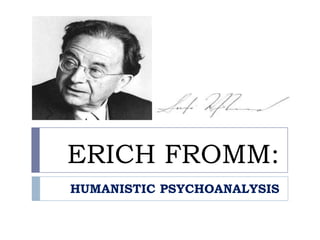
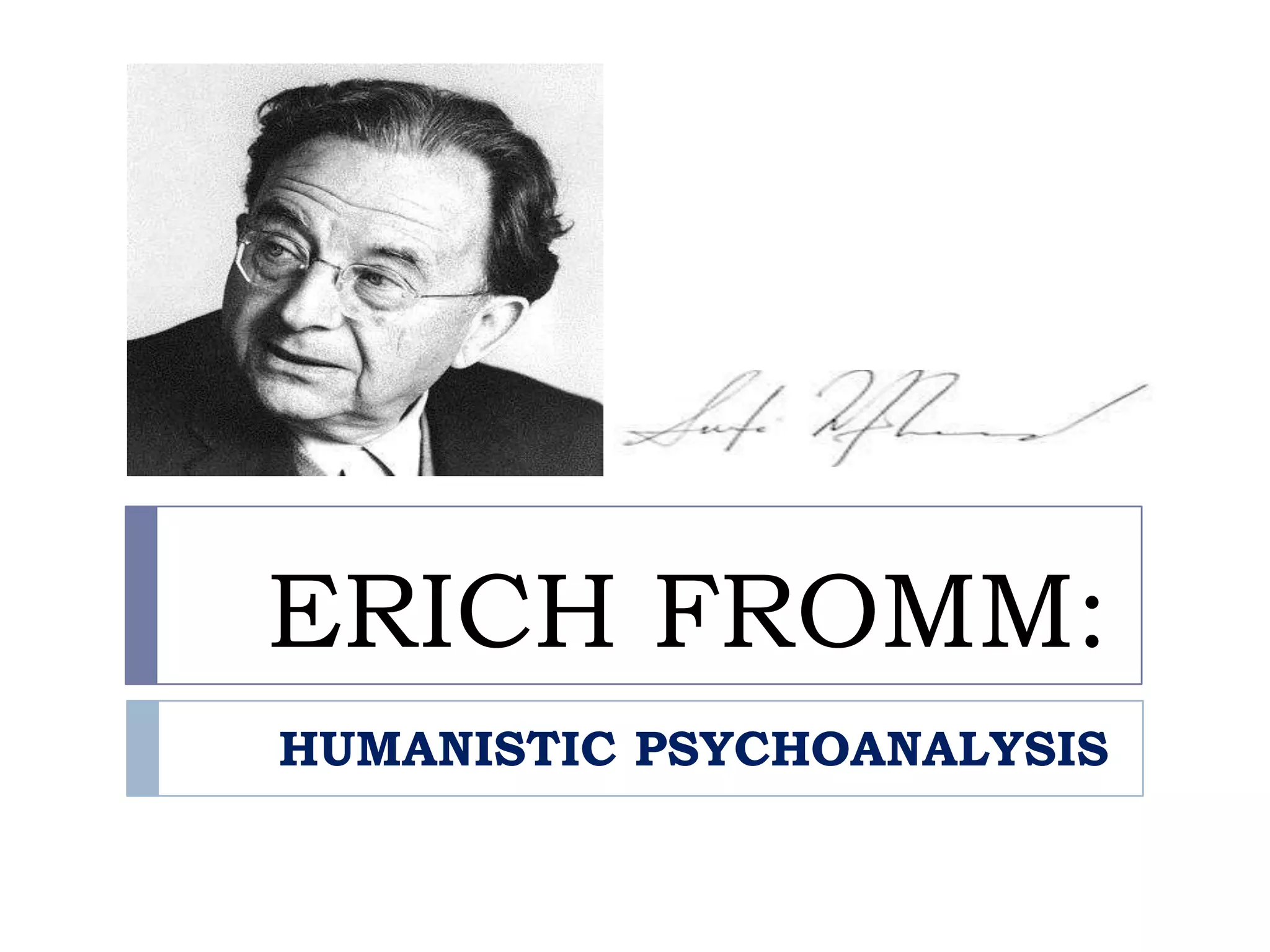
ERICH FROMM:
HUMANISTIC PSYCHOANALYSIS
INTRODUCTION/OVERVIEW:
   Erich Fromm’s basic thesis is that modern-day
    people have been torn away from their prehistoric
    union with nature and also with one another, yet they
    have the power of reasoning, foresight, and
    imagination.
   Trained in Freudian psychoanalysis and influenced
    by Karl Marx, Karen Horney, and other socially
    oriented theorists, Fromm developed a theory of
    personality that emphasizes the influence of socio-
    biological factors, history, economics, and class
    structure.      His humanistic psychoanalysis
    assumes that humanity’s separation from the natural
    world has produced feelings of loneliness and
    isolation, a condition called basic anxiety.
   His humanistic psychoanalysis looks at people from
    a historical and cultural perspective rather than a
    strictly psychological one. It is more concerned with
    those characteristics common to a culture.

   Fromm’s theory is a rather unique blend of Freud
    and Marx. Freud emphasized the unconscious,
    biological drives, repression, and so on. Marx, on the
    other hand, saw people as determined by their
    society, and most especially by their economic
    systems.
Fromm’s Basic Assumptions
   Fromm believed that humans have been torn away
    from their prehistoric union with nature and left with
    no powerful instincts to adapt to a changing world.
    But because humans have acquired the ability to
    reason, they can think about their isolated condition
    – a situation Fromm called the human dilemma.

   People experience this basic dilemma because they
    have become separate form nature and yet have the
    capacity to be aware of themselves as isolated
    beings.
HUMAN NEEDS
 These existential needs have emerged during the
 evolution of human culture, growing out of their
 attempts to find answer to their existence.

 It can only be addressed by fulfilling our uniquely
 human needs. Fromm identified five of these
 distinctively human or existential needs.
I. RELATEDNESS
 Drives people to unite with another person through
 submission, power and love.
 SUBMISSION
   A person can submit to another, to a group, or to an
    institution in order to become one with the world
 POWER
   A person seeks additional power, and as a result, they
   become more and more dependent on their partners
   and less of an individual.
 LOVE
   Fromm defined love as a “union with somebody, or
   something outside oneself under the condition of
   retaining the separateness and integrity of one’s own
   self.”
II. TRANSCENDENCE
 Is the need for people to rise above their passive
 existence and create or destroy life.

 Humans can be creative in other ways. They can
 create art, religion,       ideas,   laws,      material
 production and love.

 But we can also transcend life by destroying it and
 thus rising above our slain victims.
   Malignant Aggression (to kill for reasons)
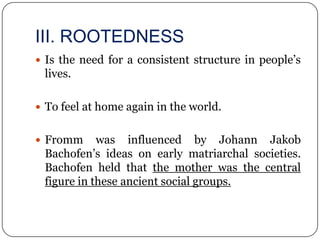
III. ROOTEDNESS
 Is the need for a consistent structure in people’s
 lives.

 To feel at home again in the world.


 Fromm     was influenced by Johann Jakob
 Bachofen’s ideas on early matriarchal societies.
 Bachofen held that the mother was the central
 figure in these ancient social groups.
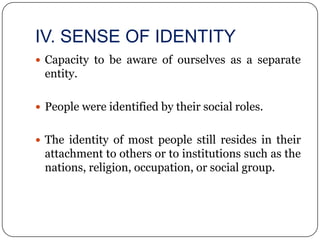
IV. SENSE OF IDENTITY
 Capacity to be aware of ourselves as a separate
 entity.

 People were identified by their social roles.


 The identity of most people still resides in their
 attachment to others or to institutions such as the
 nations, religion, occupation, or social group.
V. FRAME OF ORIENTATION

 Consistent way of looking at the world.
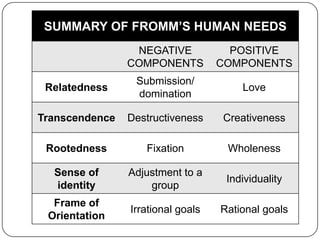
SUMMARY OF FROMM’S HUMAN NEEDS
                 NEGATIVE            POSITIVE
                COMPONENTS         COMPONENTS
                 Submission/
 Relatedness                           Love
                 domination

Transcendence   Destructiveness    Creativeness

 Rootedness        Fixation         Wholeness

  Sense of      Adjustment to a
                                    Individuality
  identity          group
  Frame of
                Irrational goals   Rational goals
 Orientation
I. AUTHORITARIANISM
        Tendency to give up the independence of one’s
         own individual self and to fuse one’s self with
         somebody or something outside oneself.
       Masochism
    •    Results from basic feelings of powerlessness,
         weakness, and inferiority, and is aimed at joining the
         self to a more powerful person or institution.
       Sadism
    •    more neurotic and more socially harmful.
II. DESTRUCTIVENESS
  is rooted in the feelings of aloneness, isolation
  and powerlessness.

III. CONFORMITY
  people who conform try to escape from a sense
  of aloneness and isolation by giving up their
  individuality and becoming whatever other people
  desire them to be.
1.   RECEPTIVE ORIENTATIONS
     feel that the source of all good lies outside
     themselves and that the only way they can
     relate to the world is to receive things.
     Negative qualities:
    Passitivity
    Submissiveness
    lack of self-confidence
     Positive traits:
    Loyalty
    Acceptance
    trust
2. EXPLOITATIVE ORIENTATIONS
 They aggressively take what they desire
  rather than passively receive it.
  Negative side:
 Egocentric
 Conceited
 Arrogant
 Seducing
  Positive side:
 Impulsive
 Proud
 Charming
 Self-confident
3. HOARDING ORIENTATIONS
 Seek to save that which they have already
  obtained.
  Negative traits:
 Rigidity
 Obstinacy
 Lack of creativity
  Positive characteristics:
 Orderliness
 Cleanliness
 Punctuality
4. MARKETING ORIENTATIONS
 Marketing     characters see themselves as
  commodities, with their personal value
  dependent on their exchange value, that is,
  their ability to sell themselves.
  Negative traits:
 Aimless
 Opportunistic
 Inconsistent
 Wasteful
  Positive Qualities:
 Open-mindedness
 generosity
5. PRODUCTIVE ORIENTATIONS
 Three Dimensions:
a. Working
    -as a means of creative self-expression
b. Loving
    -concerned     with    the    growth     and
    development of themselves as well as
    others.
c. Reasoning / thinking
    -which    cannot    be     separated    from
    productive work and love.
PERSONALITY DISORDERS
   NECROPHILIA
    ◦ Means love of death and usually refers to
      a sexual perversion in which a person
      desire sexual contact with a corpse.
   MALIGNANT NARCISSISM
    ◦ Infatuation with self
   INCESTUOUS SYMBIOSIS
    ◦ Extreme dependence on the mother or
      mother surrogate.
Erich fromm humanistic psychoanalysis

Erich fromm humanistic psychoanalysis

  • 1.
  • 2.
    INTRODUCTION/OVERVIEW:  Erich Fromm’s basic thesis is that modern-day people have been torn away from their prehistoric union with nature and also with one another, yet they have the power of reasoning, foresight, and imagination.  Trained in Freudian psychoanalysis and influenced by Karl Marx, Karen Horney, and other socially oriented theorists, Fromm developed a theory of personality that emphasizes the influence of socio- biological factors, history, economics, and class structure. His humanistic psychoanalysis assumes that humanity’s separation from the natural world has produced feelings of loneliness and isolation, a condition called basic anxiety.
  • 3.
    His humanistic psychoanalysis looks at people from a historical and cultural perspective rather than a strictly psychological one. It is more concerned with those characteristics common to a culture.  Fromm’s theory is a rather unique blend of Freud and Marx. Freud emphasized the unconscious, biological drives, repression, and so on. Marx, on the other hand, saw people as determined by their society, and most especially by their economic systems.
  • 4.
    Fromm’s Basic Assumptions  Fromm believed that humans have been torn away from their prehistoric union with nature and left with no powerful instincts to adapt to a changing world. But because humans have acquired the ability to reason, they can think about their isolated condition – a situation Fromm called the human dilemma.  People experience this basic dilemma because they have become separate form nature and yet have the capacity to be aware of themselves as isolated beings.
  • 5.
    HUMAN NEEDS  Theseexistential needs have emerged during the evolution of human culture, growing out of their attempts to find answer to their existence.  It can only be addressed by fulfilling our uniquely human needs. Fromm identified five of these distinctively human or existential needs.
  • 6.
    I. RELATEDNESS  Drivespeople to unite with another person through submission, power and love.  SUBMISSION  A person can submit to another, to a group, or to an institution in order to become one with the world  POWER  A person seeks additional power, and as a result, they become more and more dependent on their partners and less of an individual.  LOVE  Fromm defined love as a “union with somebody, or something outside oneself under the condition of retaining the separateness and integrity of one’s own self.”
  • 7.
    II. TRANSCENDENCE  Isthe need for people to rise above their passive existence and create or destroy life.  Humans can be creative in other ways. They can create art, religion, ideas, laws, material production and love.  But we can also transcend life by destroying it and thus rising above our slain victims.  Malignant Aggression (to kill for reasons)
  • 8.
    III. ROOTEDNESS  Isthe need for a consistent structure in people’s lives.  To feel at home again in the world.  Fromm was influenced by Johann Jakob Bachofen’s ideas on early matriarchal societies. Bachofen held that the mother was the central figure in these ancient social groups.
  • 9.
    IV. SENSE OFIDENTITY  Capacity to be aware of ourselves as a separate entity.  People were identified by their social roles.  The identity of most people still resides in their attachment to others or to institutions such as the nations, religion, occupation, or social group.
  • 10.
    V. FRAME OFORIENTATION  Consistent way of looking at the world.
  • 11.
    SUMMARY OF FROMM’SHUMAN NEEDS NEGATIVE POSITIVE COMPONENTS COMPONENTS Submission/ Relatedness Love domination Transcendence Destructiveness Creativeness Rootedness Fixation Wholeness Sense of Adjustment to a Individuality identity group Frame of Irrational goals Rational goals Orientation
  • 12.
    I. AUTHORITARIANISM  Tendency to give up the independence of one’s own individual self and to fuse one’s self with somebody or something outside oneself.  Masochism • Results from basic feelings of powerlessness, weakness, and inferiority, and is aimed at joining the self to a more powerful person or institution.  Sadism • more neurotic and more socially harmful.
  • 13.
    II. DESTRUCTIVENESS is rooted in the feelings of aloneness, isolation and powerlessness. III. CONFORMITY  people who conform try to escape from a sense of aloneness and isolation by giving up their individuality and becoming whatever other people desire them to be.
  • 14.
    1. RECEPTIVE ORIENTATIONS  feel that the source of all good lies outside themselves and that the only way they can relate to the world is to receive things. Negative qualities:  Passitivity  Submissiveness  lack of self-confidence Positive traits:  Loyalty  Acceptance  trust
  • 15.
    2. EXPLOITATIVE ORIENTATIONS They aggressively take what they desire rather than passively receive it. Negative side:  Egocentric  Conceited  Arrogant  Seducing Positive side:  Impulsive  Proud  Charming  Self-confident
  • 16.
    3. HOARDING ORIENTATIONS Seek to save that which they have already obtained. Negative traits:  Rigidity  Obstinacy  Lack of creativity Positive characteristics:  Orderliness  Cleanliness  Punctuality
  • 17.
    4. MARKETING ORIENTATIONS Marketing characters see themselves as commodities, with their personal value dependent on their exchange value, that is, their ability to sell themselves. Negative traits:  Aimless  Opportunistic  Inconsistent  Wasteful Positive Qualities:  Open-mindedness  generosity
  • 18.
    5. PRODUCTIVE ORIENTATIONS Three Dimensions: a. Working -as a means of creative self-expression b. Loving -concerned with the growth and development of themselves as well as others. c. Reasoning / thinking -which cannot be separated from productive work and love.
  • 19.
    PERSONALITY DISORDERS  NECROPHILIA ◦ Means love of death and usually refers to a sexual perversion in which a person desire sexual contact with a corpse.  MALIGNANT NARCISSISM ◦ Infatuation with self  INCESTUOUS SYMBIOSIS ◦ Extreme dependence on the mother or mother surrogate.