Red Bull

 “Red Bull isn’t a drink,
it’s a way of life”-Kumar


                                      Section 1: Group 9 – Team Awesome
  David Stempler, Peter Darrow, Alvaro Montemayor, Camilo Velasquez, Zhida Guo, Jon Morgan
Red Bull Company Profile
-Created and are market leaders in the
Energy Drink market.
-Control 70% of the Worldwide market.
-Sell a lifestyle not a drink
                          “We don't bring the product to the
                        people, we bring people to the product.”
                                 -Dietrich Mateschitz
The Business of Energy


               • High growth market
               • 4.1 Billion In sales
               • Around 25% of revenues targeted at
                 advertisement
               • 46% Market Share in the United States
• Gives you a needed boost
• Allows you to do
  extraordinary things
  (remove limitations)
• Live a fast-paced lifestyle
• Allows you to concentrate
• Go clubbing all night
• Lets you live your dreams


• Very high brand awareness
• Sniper advertisement
• Pull customers come to us!
Customers
Primary segment: Males aged 18-35 engaged in…
Perceived Value


Adapted from:   http://www.docstoc.com/docs/65155374/Red-Bull-and-the-Energy-drink-market
5-hour
                        Perceptual Map
        energy                                effective
        13.1%
                                                       Rock
                          AMP           Monster
                                                       star
                          4.2%           24.5%
                                                      10.7%
                                                                   Red Bull
                                                                    37.3%
Total Market Share of Top 5 Firms = 89.8%                                  coolness


              Source: Mintel Energy Drinks and Energy Shots-US-June 2012
Industry Analysis
Customer Segment                               Climate/Context
•   Active people                              •   Social Media
•   18 – 34 (67%, 24.4m - US)                  •   Use of new technology
•   Growing CS: Hispanics, professionals       •   Health social perception
                                               •   Regional cultures & rules


Company                                        Collaborators
•   Selling the dream                          •   Channels: Retail & Big box
•   Few products                               •   Ad Companies
•   Revolutionary                              •   Extreme sport events/team


               Competitors
           •    Direct: Energy drink variants (Organic & Energy-shots)
           •    Indirect: Soft drinks
Threat of Entry (Medium)
                                  - Difficult industry to
                                  penetrate.
                                  - Cheap to enter
                                  - Crowded


                                     Rivalry (Medium)           Buyers Power (Low)
 Supplier Power (Low)             - Growing Market            - Distribution Channels/ Retail
- Simple ingredients (caffeine,   - Red Bull +70% MS          : Pull
taurine, vitamin-B, sucrose,      - Competitors               - Consumer don’t influence
and glucose)                        Coca Cola / Pepsi         Selling Price (Pay Premium)


                                   Substitute Threat (High)
                                  - Non-Caffeinated energy
                                  drinks
                                  - Organic energy drinks
                                  - Soft drinks
SWOT Analysis

Strengths                          Weaknesses
•Category leadership               •Controversial taste
•Financial status quo              •Narrow products line
•Disruptive marketing strategies   •Marketing (expenses, over-
•Brand identity = Premiums         segmented, & blinders)


Opportunities
                                   Threats
•Product line extension
                                   •Intellectual property protection
•Diversify PoS (new trends)
                                   •Health concerns
•Growing market segment
                                   •Shot energy drinks
(Hispanics & working
                                   •Shrinking industry (Soft Drink)
professionals)
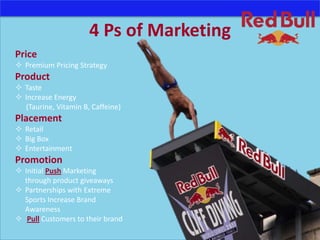
4 Ps of Marketing
Price
 Premium Pricing Strategy
Product
 Taste
 Increase Energy
  (Taurine, Vitamin B, Caffeine)
Placement
 Retail
 Big Box
 Entertainment
Promotion
 Initial Push Marketing
  through product giveaways
 Partnerships with Extreme
  Sports Increase Brand
  Awareness
 Pull Customers to their brand
Largest Live Stream of All Time!!!

Webs MOST Powerful
Branded Video Content!
4th Most Liked Company
On Facebook!

Over 30 % of Worldwide
Market Share!
4.6 Billion Cans
Sold in 2011!
Revenue
Net Income
Consolidated Income Statement Redbull
GmbH (USD)                            2012 (Est.)                             2011                              2010
Revenues                              $6,449,040,000.00                       5,512,000,000                     5,197,122,000
Net Income                            $425,636,640.00                         363,900,000                       343,100,000

Estimated Marketing Expenses*                      $1,100,000,000.00                 $964,060,000.00                $908,600,000.00

Incremental Change in Revenue                  $937,040,000.00                $314,878,000.00                   $687,122,000.00
Incremental Change in Net Income               $61,736,640.00                 $20,800,000.00                    $45,400,000.00
Incremental Change in Marketing
Expenses                                              $135,940,000.00                 $55,460,000.00                $119,770,000.00

ROMI (Revenues)                                85.19%                         32.66%                            75.62%
ROMI (Net Income)                              5.61%                          2.16%                             5.00%

                    * Source: Calculations from PrivCo Private Financial, IBIS World and Market Research.com.


 In 2012 and 2010 the ROMI as a function of revenue stream was near
 80%, covering almost all the marketing investment. In 2011 the situation
 was different with a slight increase on revenues that only covered 33%
 of the marketing expenses incurred in 2011.

 Evaluating the ROMI as a function of the net income (profits) stream,
 Redbull’s incremental change in profits covered almost 5% of the total
 marketing expenses incurred in 2012 and 2010, but only get to cover
 approximately 2% of 2011 marketing efforts.
Conclusions

      What we have done
                                       VS.   What we need to do


   Things we did right                         New Markets
       -Capitalized on first mover                     -Females
         -High brand awareness
                                                     -People 35+
             -Created market
-Created marketable markets by creating/          -Health conscious
    promoting smaller extreme sports           -Growing Latin American
           -Platforms "events"                   and African American
             -Media Creation                            segments
                 -Goodwill
Recommendations
        1. Maintain extreme advertising
             sponsorship of new sports, etc.
        2. Continue staying on top of new
            technology (social media)
        3. Promote health benefits
        4. Expand specialized channels (vending
            machines in high traffic buildings)
        5. Product extension
           (new flavors/ health)
        6. Advertise into emerging markets to
        maintain first-mover mentality

Red bull final_2

  • 1.
    Red Bull “RedBull isn’t a drink, it’s a way of life”-Kumar Section 1: Group 9 – Team Awesome David Stempler, Peter Darrow, Alvaro Montemayor, Camilo Velasquez, Zhida Guo, Jon Morgan
  • 2.
    Red Bull CompanyProfile -Created and are market leaders in the Energy Drink market. -Control 70% of the Worldwide market. -Sell a lifestyle not a drink “We don't bring the product to the people, we bring people to the product.” -Dietrich Mateschitz
  • 3.
    The Business ofEnergy • High growth market • 4.1 Billion In sales • Around 25% of revenues targeted at advertisement • 46% Market Share in the United States
  • 4.
    • Gives youa needed boost • Allows you to do extraordinary things (remove limitations) • Live a fast-paced lifestyle • Allows you to concentrate • Go clubbing all night • Lets you live your dreams • Very high brand awareness • Sniper advertisement • Pull customers come to us!
  • 5.
    Customers Primary segment: Malesaged 18-35 engaged in…
  • 6.
    Perceived Value Adapted from: http://www.docstoc.com/docs/65155374/Red-Bull-and-the-Energy-drink-market
  • 7.
    5-hour Perceptual Map energy effective 13.1% Rock AMP Monster star 4.2% 24.5% 10.7% Red Bull 37.3% Total Market Share of Top 5 Firms = 89.8% coolness Source: Mintel Energy Drinks and Energy Shots-US-June 2012
  • 8.
    Industry Analysis Customer Segment Climate/Context • Active people • Social Media • 18 – 34 (67%, 24.4m - US) • Use of new technology • Growing CS: Hispanics, professionals • Health social perception • Regional cultures & rules Company Collaborators • Selling the dream • Channels: Retail & Big box • Few products • Ad Companies • Revolutionary • Extreme sport events/team Competitors • Direct: Energy drink variants (Organic & Energy-shots) • Indirect: Soft drinks
  • 9.
    Threat of Entry(Medium) - Difficult industry to penetrate. - Cheap to enter - Crowded Rivalry (Medium) Buyers Power (Low) Supplier Power (Low) - Growing Market - Distribution Channels/ Retail - Simple ingredients (caffeine, - Red Bull +70% MS : Pull taurine, vitamin-B, sucrose, - Competitors - Consumer don’t influence and glucose) Coca Cola / Pepsi Selling Price (Pay Premium) Substitute Threat (High) - Non-Caffeinated energy drinks - Organic energy drinks - Soft drinks
  • 10.
    SWOT Analysis Strengths Weaknesses •Category leadership •Controversial taste •Financial status quo •Narrow products line •Disruptive marketing strategies •Marketing (expenses, over- •Brand identity = Premiums segmented, & blinders) Opportunities Threats •Product line extension •Intellectual property protection •Diversify PoS (new trends) •Health concerns •Growing market segment •Shot energy drinks (Hispanics & working •Shrinking industry (Soft Drink) professionals)
  • 11.
    4 Ps ofMarketing Price  Premium Pricing Strategy Product  Taste  Increase Energy (Taurine, Vitamin B, Caffeine) Placement  Retail  Big Box  Entertainment Promotion  Initial Push Marketing through product giveaways  Partnerships with Extreme Sports Increase Brand Awareness  Pull Customers to their brand
  • 12.
    Largest Live Streamof All Time!!! Webs MOST Powerful Branded Video Content! 4th Most Liked Company On Facebook! Over 30 % of Worldwide Market Share! 4.6 Billion Cans Sold in 2011!
  • 13.
  • 14.
  • 15.
    Consolidated Income StatementRedbull GmbH (USD) 2012 (Est.) 2011 2010 Revenues $6,449,040,000.00 5,512,000,000 5,197,122,000 Net Income $425,636,640.00 363,900,000 343,100,000 Estimated Marketing Expenses* $1,100,000,000.00 $964,060,000.00 $908,600,000.00 Incremental Change in Revenue $937,040,000.00 $314,878,000.00 $687,122,000.00 Incremental Change in Net Income $61,736,640.00 $20,800,000.00 $45,400,000.00 Incremental Change in Marketing Expenses $135,940,000.00 $55,460,000.00 $119,770,000.00 ROMI (Revenues) 85.19% 32.66% 75.62% ROMI (Net Income) 5.61% 2.16% 5.00% * Source: Calculations from PrivCo Private Financial, IBIS World and Market Research.com. In 2012 and 2010 the ROMI as a function of revenue stream was near 80%, covering almost all the marketing investment. In 2011 the situation was different with a slight increase on revenues that only covered 33% of the marketing expenses incurred in 2011. Evaluating the ROMI as a function of the net income (profits) stream, Redbull’s incremental change in profits covered almost 5% of the total marketing expenses incurred in 2012 and 2010, but only get to cover approximately 2% of 2011 marketing efforts.
  • 16.
    Conclusions What we have done VS. What we need to do Things we did right New Markets -Capitalized on first mover -Females -High brand awareness -People 35+ -Created market -Created marketable markets by creating/ -Health conscious promoting smaller extreme sports -Growing Latin American -Platforms "events" and African American -Media Creation segments -Goodwill
  • 17.
    Recommendations 1. Maintain extreme advertising sponsorship of new sports, etc. 2. Continue staying on top of new technology (social media) 3. Promote health benefits 4. Expand specialized channels (vending machines in high traffic buildings) 5. Product extension (new flavors/ health) 6. Advertise into emerging markets to maintain first-mover mentality

Editor's Notes

  • #3 Quote from the Economisthttp://www.economist.com/node/1120373 “Selling energyHow Dietrich Mateschitz turned Red Bull into a cult tipple”Picture from http://en.wikipedia.org/wiki/File:Red_bull_1.jpg
  • #6 http://www.sub5zero.com/sites/default/files/uploads/2012/07/2012-X-Games-RallyCross-3.jpgOur Customers are segmented by Age and gender, but our primary market is Males Aged 18-35
  • #9 http://fc08.deviantart.net/fs70/f/2010/196/f/9/Red_Bull_Tornado_Sailing_by_HellDard.jpg----------------------------------------------------------------------------------------------------------------------------------------------------------------------------------------Red Bull is a company that is targeting people who want to be mentally and physically active. It’s customer segment are outgoing people who are living an active live style, mainly in the age group of 18 to 34 years which represents 67% (24.4m/36.4m) of the energy drink market. Research has shows a growing trends in the size of the targeted customer segment, more specifically Hispanics, seniors with age group (XX to YY), and professionals such as businessmen. ***CLICK*** <anyone knows customer acquisition cost vs. expected returns of customer lifecycle?><social media><new tech><health perception><regional cultures and rules> ***CLICK***<sell the dream><few products><revolutionary> ***CLICK***<channels><ad companies><events/teams> ***CLICK***<direct><indirect> ***CLICK***----------------------------------------------------------------------------------------------------------------------------------------------------------------------------------------References:MarketResearch.com<source for 18-34 age group><source for growing customer segment trends: Hispanics, seniors, & professionals>----------------------------------------------------------------------------------------------------------------------------------------------------------------------------------------
  • #10 Maturing Market: High number of competitors (100+/200+). However, the energy drink market is dominated by Red Bull (70‐90% market share in 100+ countries)Real competitors are Coca Cola & Pepsi in the Beverage IndustryDifficult industry to penetrate.Cheap to enterCrowded (100+ competitor)Distribution channels & Retail: PushConsumers: do not influence selling price, they pay premium (XX%).http://fc08.deviantart.net/fs70/f/2010/196/f/9/Red_Bull_Tornado_Sailing_by_HellDard.jpg----------------------------------------------------------------------------------------------------------------------------------------------------------------------------------------Now let’s have a look at the competition space: ***CLICK***We have determined that the Buyer Bargaining Power is low.<Distribution => Push> and our consumers do not influence on pricing, they are currently paying a premium of XX% profit margin. ***CLICK***TheSupplier Bargaining Power is also low since non of the main ingredients for Red Bull drinks are proprietary. ***CLICK***The Rivalry among the industry competitors depends on scope. If we are just considering the energy drink space, then it’s low. Because even though there are 100+ direct competitor in this space, the vast majority are not a real threat. Our market share is 70-90%. On the other hand, the competition rivalry is high when considering the soft drinks industry where Red Bull competes with 200+ firms, including Pepsi & Coca Cola, who are believed to be the competitors of the firm. Therefore, we have determined that the overall risk of competition is medium. ***CLICK***The Threat of New Entry is medium because while it is very difficult to penetrate the energy drink market that is dominated by Red Bull, it is relatively cheep to start your own product ($XX,XXX) and therefore there’s a 100+ competitors as mentioned earlier. ***CLICK***Threat of Substitutes is a concern because of the emerging trends that are directly catered to our targeted customers. Organic and non-caffeinated energy drinks are examples of such trends and its believed that additional trends will emerge. ***CLICK***----------------------------------------------------------------------------------------------------------------------------------------------------------------------------------------References:<financial sheets & profit margin><100+ direct competitors – energy drinks space><200+ indirect competitors – soft drinks space><avg price of starting a PL energy drink><organic & non-caffeinated>----------------------------------------------------------------------------------------------------------------------------------------------------------------------------------------
  • #11 http://liveuploads.s3.amazonaws.com/wp-content/uploads/2012/09/ws_Red_Bull_F1_side_1920x1440-754467.jpg----------------------------------------------------------------------------------------------------------------------------------------------------------------------------------------We have conducted a SWOT analysis of the firm and found the following:Strengths: ***FEEL FREE TO REDUCE… SIGNIFICANTLY***Category Leadership –Within the energy drinks market, Red Bull has been the category creator (in most markets) and is well recognized as being its global leader.Financial Status Quo –more that XXBn @ it’s disposal.Disruptive Marketing Strategies – Red Bull’s mostly uses unconventional marketing tactics that allowed it to penetrate the soft drink industry unseen by its competitors. For example, it priced itself high and picked bars as its initial PoS which made it unattractive for its main competitors, Pepsi & Coca Cola. In addition, its also the executed highly praised promotions, marketing campaigns, and sponsorships (e.g. F1, Felix, …etc.) all with laser focus on their targeted CS. As a result ***CLICK*** they entered an industry where top firms were seeking revenue maximization ***CLICK*** and prospered by charging premium markups and demanding profit maximization.Weaknesses:Taste – controversial taste, but this is said to be part of their (deterring) strategyNarrow Products Line– relying on a single product with variants in size and ingredients, yet competing among the soft drink industry. Marketing Expenses – are high ($XXm).<consider comparing metrics with competitors> <over-segmented> <blinders???>Opportunities:Production Line Extension – Red Bull has the opportunity to expand the length & breath of its line to include new products that speak to its positioning (e.g. smaller can similar to 5-Hour Energy & energy bars, respectively)Diversify PoS– As Red Bull has acknowledged, they can expand its Points of Sale (PoS) to include vending machine.Growth – as mentioned earlier.Threats:IPP - Lack of Intellectual Property protection on Red Bull’s recopies means that they could eventually be copied by competitors (ingredients are clearly labeled on can). Health Concerns – Public criticized for health concerns. Experts fear that the drink could be potentially deadly when combined with alcohol or when drunk after strenuous exercise. Some countries/jurisdictions have banned it due to concern with high caffeine concentrations (e.g. France & Denmark).Shot Energy Drinks– are a direct threat as they are competing directly <why did it not work for Red Bull’s attempt?>Soft Drink Industry Trend – is decreeing a X%----------------------------------------------------------------------------------------------------------------------------------------------------------------------------------------References:<category creator><excess cash><RB marketing review/analysis><shot energy drinks><decreasing soft drink industry><health concerns>----------------------------------------------------------------------------------------------------------------------------------------------------------------------------------------
  • #12 Price: Premium pricing strategy. $1.99 per 8 ounce bottle, compared to same price for Monster 16 ounce. Redbull have successfully avoid a Price War and continues to owns for approximately 40% of the energy drink market.Product: Different taste, with functional qualities. Increases metabolism, provides taurine and other “brain-enhancing” ingredients, provides Vitamin B, provides caffeine. Redbull in its roll of Energy Drinks Market Pioneer capitalized on developing this attributes valuation.Placement: Bars, convenience stores, supermarkets. Redbull approach have been to make their cans available in as many points of sales as possible and capitalized the brand awareness they have develop.Promotion: Targeted push-marketing and giveaway products at Redbull sponsored events, but clearly concentrated into getting the Brand in the mind of all their potential customers and Pull them to look for and try the product.In line with current strategy, but opportunity to grow into new/different segments.
  • #13 http://www.attackmarketing.net/guerrilla-projections.phphttp://www.personal.psu.edu/mjr5528/blogs/la101h/2012/02/the-extreme-world-of-red-bull.htmlhttp://www.businessinsider.com/the-20-most-liked-companies-on-facebook-2012-8?op=1http://chadkobzey.wordpress.com/2012/12/02/red-bulls-digital-presence/http://goviral.com/sve1008 Million Viewers for Stratos, Compared to second largest of 500,000 at londonolympicsMust touch on how the buzz is created