Joe Wilson, Chief Executive
Open, Collaborative, Sharing
Practice in the FE Sector
About me
• Qualifications
• Arrive in FE in 1986 as Communications
Lecturer
• SFEU 1999-2003
• SQA 2003-2014
• January 2015 Chief Executive, College
Development Network (CDN)
How I use digital space
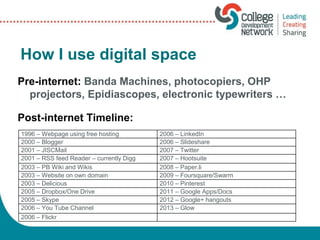
Pre-internet: Banda Machines, photocopiers, OHP
projectors, Epidiascopes, electronic typewriters …
Post-internet Timeline:
1996 – Webpage using free hosting 2006 – LinkedIn
2000 – Blogger 2006 – Slideshare
2001 – JISCMail 2007 – Twitter
2001 – RSS feed Reader – currently Digg 2007 – Hootsuite
2003 – PB Wiki and Wikis 2008 – Paper.li
2003 – Website on own domain 2009 – Foursquare/Swarm
2003 – Delicious 2010 – Pinterest
2005 – Dropbox/One Drive 2011 – Google Apps/Docs
2005 – Skype 2012 – Google+ hangouts
2006 – You Tube Channel 2013 – Glow
2006 – Flickr
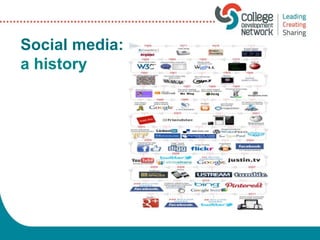
Social media:
a history
Three year vision
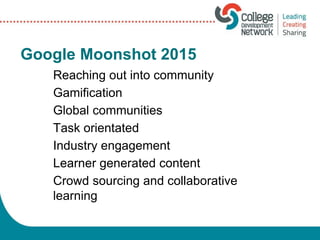
Google Moonshot 2015
Reaching out into community
Gamification
Global communities
Task orientated
Industry engagement
Learner generated content
Crowd sourcing and collaborative
learning
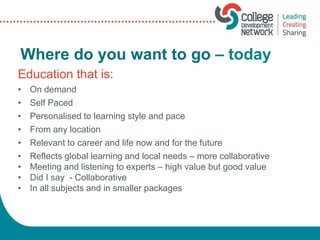
Where do you want to go – today
Education that is:
• On demand
• Self Paced
• Personalised to learning style and pace
• From any location
• Relevant to career and life now and for the future
• Reflects global learning and local needs – more collaborative
• Meeting and listening to experts – high value but good value
• Did I say - Collaborative
• In all subjects and in smaller packages
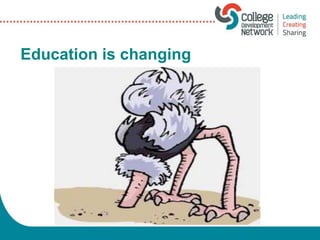
Education is changing
13 Further Education Regions in
Scotland.
Are we ready to do things
differently?
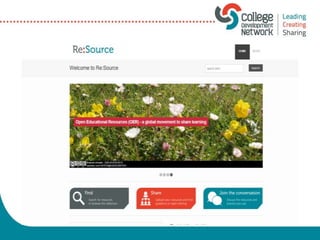
OER & ukoer Vision
“...digitised materials offered freely and openly for
educators, students and self-learners to use and
reuse for teaching, learning and research.”
Giving Knowledge for Free: The Emergence of Open Educational Resources.
Organisation for Economic Co-operation and Development (OECD, 2007)
“The UK must have a core of open access learning
resources organised in a coherent way to
support on-line and blended learning by all
higher education institutions and to make it more
widely available in non-HE environments.”
Sir Ron Cooke (as Chairman of Jisc, 2008)
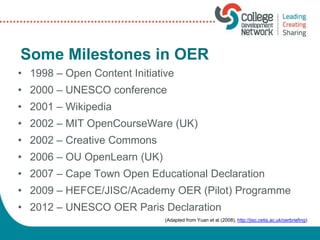
Some Milestones in OER
• 1998 – Open Content Initiative
• 2000 – UNESCO conference
• 2001 – Wikipedia
• 2002 – MIT OpenCourseWare (UK)
• 2002 – Creative Commons
• 2006 – OU OpenLearn (UK)
• 2007 – Cape Town Open Educational Declaration
• 2009 – HEFCE/JISC/Academy OER (Pilot) Programme
• 2012 – UNESCO OER Paris Declaration
(Adapted from Yuan et al (2008), http://jisc.cetis.ac.uk/oerbriefing)
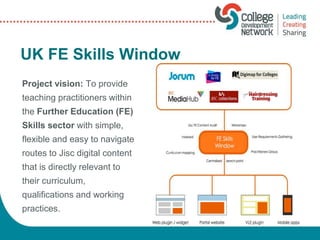
UK FE Skills Window
Project vision: To provide
teaching practitioners within
the Further Education (FE)
Skills sector with simple,
flexible and easy to navigate
routes to Jisc digital content
that is directly relevant to
their curriculum,
qualifications and working
practices.
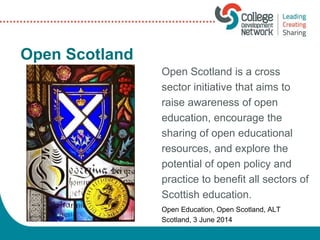
Open Scotland
Open Scotland is a cross
sector initiative that aims to
raise awareness of open
education, encourage the
sharing of open educational
resources, and explore the
potential of open policy and
practice to benefit all sectors of
Scottish education.
Open Education, Open Scotland, ALT
Scotland, 3 June 2014
Open Scotland
Open Education, Open Scotland, ALT Scotland SIG, 3 June 2014
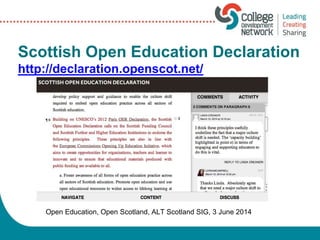
Scottish Open Education Declaration
http://declaration.openscot.net/
Open Education, Open Scotland, ALT Scotland SIG, 3 June 2014
Bits Beyond
• What can you do this year to provide additional support to
your learners ?
• Regionalisation of Colleges – shared services – gaps in
provision – how can you help University of West of Scotland
and others ?
• What can you do for schools or community based learning ?
• What course would you open to the world ?
• How do you promote open practice across institution and
figure out business model ?
• As an individual practitioner – how do you start the learning
journey and building your personal learning network ?
Are you ready?
• WiFi ?
• Social Software policy ?
• BYOD ?
• Open Moodle ?
• Digital literacy and Digital participation for all
• Who are your digital leaders – in the staff room and in the
classroom?
• Do you have any open practitioners ?
• Where can I start ?
• Which apps do you use ?
• What collections ?
• Where , how do you share, reuse , remix ?
So where do we want to be …?
Sharing, confident and
supporting learners , open
practitioners
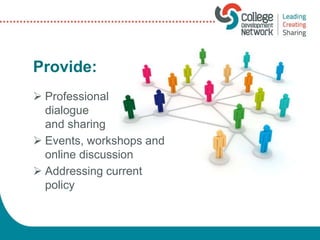
Provide:
 Professional
dialogue
and sharing
 Events, workshops and
online discussion
 Addressing current
policy
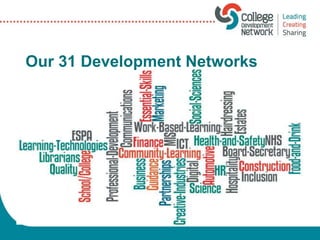
Our 31 Development Networks
Contact
joe.wilson@cdn.ac.uk
@joecar

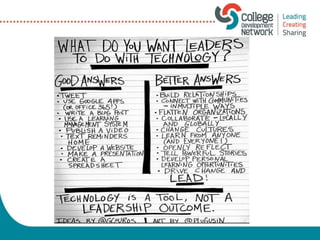
How to use technology with learners

  • 1.
    Joe Wilson, ChiefExecutive Open, Collaborative, Sharing Practice in the FE Sector
  • 2.
    About me • Qualifications •Arrive in FE in 1986 as Communications Lecturer • SFEU 1999-2003 • SQA 2003-2014 • January 2015 Chief Executive, College Development Network (CDN)
  • 3.
    How I usedigital space Pre-internet: Banda Machines, photocopiers, OHP projectors, Epidiascopes, electronic typewriters … Post-internet Timeline: 1996 – Webpage using free hosting 2006 – LinkedIn 2000 – Blogger 2006 – Slideshare 2001 – JISCMail 2007 – Twitter 2001 – RSS feed Reader – currently Digg 2007 – Hootsuite 2003 – PB Wiki and Wikis 2008 – Paper.li 2003 – Website on own domain 2009 – Foursquare/Swarm 2003 – Delicious 2010 – Pinterest 2005 – Dropbox/One Drive 2011 – Google Apps/Docs 2005 – Skype 2012 – Google+ hangouts 2006 – You Tube Channel 2013 – Glow 2006 – Flickr
  • 4.
  • 7.
  • 8.
    Google Moonshot 2015 Reachingout into community Gamification Global communities Task orientated Industry engagement Learner generated content Crowd sourcing and collaborative learning
  • 9.
    Where do youwant to go – today Education that is: • On demand • Self Paced • Personalised to learning style and pace • From any location • Relevant to career and life now and for the future • Reflects global learning and local needs – more collaborative • Meeting and listening to experts – high value but good value • Did I say - Collaborative • In all subjects and in smaller packages
  • 10.
  • 14.
    13 Further EducationRegions in Scotland. Are we ready to do things differently?
  • 15.
    OER & ukoerVision “...digitised materials offered freely and openly for educators, students and self-learners to use and reuse for teaching, learning and research.” Giving Knowledge for Free: The Emergence of Open Educational Resources. Organisation for Economic Co-operation and Development (OECD, 2007) “The UK must have a core of open access learning resources organised in a coherent way to support on-line and blended learning by all higher education institutions and to make it more widely available in non-HE environments.” Sir Ron Cooke (as Chairman of Jisc, 2008)
  • 16.
    Some Milestones inOER • 1998 – Open Content Initiative • 2000 – UNESCO conference • 2001 – Wikipedia • 2002 – MIT OpenCourseWare (UK) • 2002 – Creative Commons • 2006 – OU OpenLearn (UK) • 2007 – Cape Town Open Educational Declaration • 2009 – HEFCE/JISC/Academy OER (Pilot) Programme • 2012 – UNESCO OER Paris Declaration (Adapted from Yuan et al (2008), http://jisc.cetis.ac.uk/oerbriefing)
  • 17.
    UK FE SkillsWindow Project vision: To provide teaching practitioners within the Further Education (FE) Skills sector with simple, flexible and easy to navigate routes to Jisc digital content that is directly relevant to their curriculum, qualifications and working practices.
  • 19.
    Open Scotland Open Scotlandis a cross sector initiative that aims to raise awareness of open education, encourage the sharing of open educational resources, and explore the potential of open policy and practice to benefit all sectors of Scottish education. Open Education, Open Scotland, ALT Scotland, 3 June 2014
  • 20.
    Open Scotland Open Education,Open Scotland, ALT Scotland SIG, 3 June 2014
  • 21.
    Scottish Open EducationDeclaration http://declaration.openscot.net/ Open Education, Open Scotland, ALT Scotland SIG, 3 June 2014
  • 24.
    Bits Beyond • Whatcan you do this year to provide additional support to your learners ? • Regionalisation of Colleges – shared services – gaps in provision – how can you help University of West of Scotland and others ? • What can you do for schools or community based learning ? • What course would you open to the world ? • How do you promote open practice across institution and figure out business model ? • As an individual practitioner – how do you start the learning journey and building your personal learning network ?
  • 25.
    Are you ready? •WiFi ? • Social Software policy ? • BYOD ? • Open Moodle ? • Digital literacy and Digital participation for all • Who are your digital leaders – in the staff room and in the classroom? • Do you have any open practitioners ? • Where can I start ? • Which apps do you use ? • What collections ? • Where , how do you share, reuse , remix ?
  • 26.
    So where dowe want to be …? Sharing, confident and supporting learners , open practitioners
  • 27.
    Provide:  Professional dialogue and sharing Events, workshops and online discussion  Addressing current policy
  • 28.
  • 30.

Editor's Notes

  • #3 Qualifications - Professional MA(hons), PGCE , DipEd, MBA, and a few units SCQF 5-9 English and History Background/Arrive in FE - With view to journalism but – scouts – secondary school teacher – arrives in FE Cardonald 1986 – Communications lecturer - adult literacy and community worker too –SCOTVEC unit writer – examiner - assessor – first HNC/D developments – Senior lecturer - Section leader – Higher Still - SQA Coordinator – General Education SFEU - SFEU 1999-2003 – Project manager – College Quality Systems – Restructuring – on-line and blended learning – JISC – FERL – NILTA – Anniesland Board and Chair of Learning and teaching committee and Clyde College .. SQA 2003 – 2014 - SQA 2003-2014 Head of 0.5 of all vocational qualifications in Scotland , Head of New Ventures .. ALT Ambassador .. JORUM Advisor … Non Executive - Youth Link Scotland , Scotland’s Adult Learning Partnership – SCQF Partnership CDN - From January 2015 CEO CDN